utilization and storage through hydrothermal
alteration of peridotite
著者
Wang Jiajie
学位授与機関
Tohoku University
学位授与番号
11301甲第19378号
URL
http://hdl.handle.net/10097/00129331
Doctoral Dissertation
Enhanced hydrogen production with CO
2utilization and storage
through hydrothermal alteration of peridotite
(カンラン岩の熱水変質を用いた二酸化炭素利用・固定型水素製造)
Jiajie Wang
B7GD1004
Graduate School of Environmental Studies
Tohoku University
Abstract
Replacement of fossil fuel by clean hydrogen (H2) energy and carbon dioxide (CO2) storage
have been regarded as the most promising methods to develop a low-carbon sustainable society. However, H2 production processes usually have high energy costs and emit CO2, and CO2 storage
processes are unprofitable and CO2 cannot be efficiently utilized. In recent decades, dissolved H2
was discovered in some natural geothermal vents, which was related to the oxidation of ferrous iron [Fe(II)] contained in ultramafic rocks during their hydrothermal hydration. It suggests us a new promising way for H2 production, through Fe(II)-bearing rock hydration. For another,
carbonation of magnesium/calcium (Mg/Ca)-rich rocks has attracted increasing attention in these years for permanent CO2 storage. Of the ultramafic rocks in the crust, peridotite was considered to
be the most favorable raw material for both H2 production and CO2 storage, since 1) it is abundant
on the Earth's surface; 2) it is rich in Mg and has appreciable Fe(II). Moreover, creating CO2-rich
environments, particularly by adding high concentration HCO3- solutions was found to be an
efficient way to accelerate the sluggish peridotite dissolution. Therefore, in this study, a new system combining the strategies of H2 production and CO2 storage through peridotite hydration and
carbonation, respectively, in CO2-rich hydrothermal environment was proposed.
The primary objective of this study is to explore a novel CO2 emission-free H2 production
approach with the utilization and storage of CO2 by enhanced peridotite hydrothermal alteration.
Three secondary objectives are then identified: 1) to explore efficient ways to enhance H2
production based on lab-scale experimental investigations; 2) to illustrate the mechanisms that control the H2O-peridotie-CO2 reaction processes; 3) to verify the feasibility of large-scale
applications based on lab-scale investigations.
Olivine [(Mg,Fe)2SiO4], the dominant mineral in peridotite, was first used to study the
behaviours of H2 generation and CO2 storage during olivine alteration were successfully controlled
by varying reaction conditions, such as bicarbonate (HCO3-) concentration, temperature, pH,
water/rock ratio and olivine grain size. H2 generation from olivine alteration was drastically
enhanced to 3.13 mmol/(kginitial olivine·h) (15 times higher than previously reported) by adding 1
mol/L HCO3- at 300 °C. The HCO3- after being utilized to promote olivine dissolution and
potentially control the behaviour of Fe(II) was stored in magnesite [(Mg,Fe)CO3] or converted to
formic acid (HCOOH). The promoted H2 production was attributed to the acceleration on olivine
alteration with inhibited brucite [Mg,Fe(OH)2] formation and lower Fe(II) contents in serpentine
[(Mg,Fe)3Si2O5(OH)4] and magnesite. The chemical equation for H2O-olivine-CO2 reaction in
environments with 0.5-1.0 mol/L HCO3- was also approximately expressed.
(Mg0.90Fe0.10)2SiO4 + m H2O + (b+f) HCO3- + n H+ → a (Mg,Fe2+)3-0.5βFe3+βSi2-0.5βO5(OH)4
olivine serpentine + b (Mg,Fe)CO3 + d Fe3O4 + (1-2a) SiO2 + e H2 + f HCOOH + p Mg2+
magnesite magnetite Natural peridotites that contain pyroxenes and spinel with olivine are also promising raw materials for H2 production. Especially, peridotite contains ≤ 20 wt% of orthopyroxene or ≥ 10 wt%
of Mg-Al spinel is more suitable for H2 production than monomineralic olivine. H2 production rate
and pathways, and CO2 storage rates were greatly controlled by SiO2(aq) released from
orthopyroxene and Al released from Mg-Al spinel. A two-stage Fe(II) oxidation process was revealed for H2 production in the presence of orthopyroxene and Mg-Al spinel. At the beginning,
olivine alteration was enhanced to form more Fe(II)-bearing serpentine with high Fe(II) content. With the reaction proceeded, Fe(II)-bearing serpentine was breakdown to form magnetite and H2.
In this way, H2 production rate was accelerated due to the enhancement on the typically sluggish
olivine alteration with the release of Fe(II). But the total yield of H2 will not be significantly
Two large-scale H2 production with CO2 storage systems based on peridotite alteration were
then proposed using geothermal or industrial wasted heat as the heating sources. Abandoned mines were suggested to be utilized as the huge reactors in the system using moderate temperature (≤ 573K) heating source. The other system aims at using higher temperature (> 573K) heating source in a replaceable tank. The possible reaction processes were simulated using a 1-dimensional energy balance model and experimentally revealed thermodynamic properties of olivine serpentinization and carbonation. The evaluations for environmental and social impacts indicated that both H2
production systems proposed in this thesis can realize negative CO2 emission, and have advantages
of moderate cost, high energy efficiency and high stability. However, due to relatively low H2
production rate compares to the conventional technologies, the systems are suggested to be included in the promising H2 production toolbox with the conventional and other low CO2-emission
H2 production methods to create a green and efficient H2 production network with a high resilience.
This thesis firstly developed the H2 production by rock hydrothermal alteration from natural
phenomena to practical technology. It has potential contributions to the low-carbon society development by proposing a negative CO2-emission H2 production method. In addition, the CO2
can be efficiently used before being mineralized , which potentially improves the conventional CO2
Outline
Chapter 1 Introduction ... 1
1.1 Hydrogen production and CCUS ... 1
1.1.1 Energy crisis and CO2 problem ... 1
1.1.2 Hydrogen energy and production techniques ... 3
1.1.3 CO2 mineralization ... 5
1.2 Peridotite and its contributions to H2 production and CO2 storage ... 6
1.2.1 Introduction of Peridotite ... 6
1.2.2 H2 production during peridotite hydration ... 8
1.2.3 CO2 storage by peridotite carbonation ... 10
1.3 A novel system for simultaneous H2 production and CO2 utilization/storage ... 12
1.4 Objectives of this thesis and Technical route ... 14
1.4.1 Research objectives ... 14
1.4.2 Thesis structure... 15
Chapter 2 Feasibility study on H2 production with CO2 utilization/storage during olivine hydrothermal alteration ... 17
2.1 Introduction ... 17
2.2 Materials and Methods ... 18
2.2.1 Materials ... 18
2.2.2 Olivine alteration experiments ... 19
2.2.3 Measurement and characterization ... 22
2.3.1 Effect of NaHCO3 concentration on H2 and HCOOH generations ... 23
2.3.2 Effect of NaHCO3 concentration on mineral formations ... 24
2.3.3 Effect of NaHCO3 concentration on olivine alteration pathways ... 27
2.3.4 Implications and significance ... 30
2. 4 The role of initial pH in olivine alteration ... 32
2.4.1 Effect of initial pH on H2 and HCOOH generations ... 32
2.4.2 Effect of initial pH on mineral formations ... 33
2.4.3 Effect of initial pH on olivine alteration pathways ... 37
2.4.4 Implications and significance ... 38
2.5 The role of temperature in olivine alteration ... 39
2.5.1 Effect of temperature on H2 and HCOOH generations ... 39
2.5.2 Effect of temperature on mineral formations ... 40
2.5.3 Effect of temperature on olivine alteration pathways... 43
2.5.4 Implications and significance ... 45
2.6 The role of water/rock ratio in olivine alteration ... 48
2.6.1 Effect of water/rock ratio on H2 and HCOOH generations ... 48
2.6.2 Effect of water/rock ratio on mineral alteration ... 49
2.6.3 Implications and significance ... 50
2.7 The role of olivine grain size in olivine alteration ... 51
2.7.1 Effect of olivine grain size on H2 and HCOOH generations ... 51
2.7.2 Effect of olivine grain size on mineral formations ... 52
2.8 The role of reaction time in olivine alteration ... 56
2.8.1 Effect of reaction time on H2 and HCOOH generations ... 56
2.8.2 Effect of reaction time on mineral formations ... 57
2.9 Summary ... 60
Chapter 3 Coexisting minerals control of pathways and rates of H2O-olivine-CO2 reactions ... 61
3.1 Introduction of pyroxene and spinel ... 61
3.2 Materials and methods ... 63
3.2.1 Materials ... 63
3.2.2 Hydrothermal experiments and measurements ... 64
3.3 Orthopyroxene effects on water-olivine-CO2 reactions ... 65
3.3.1 Effects of orthopyroxene on H2 and HCOOH generations ... 65
3.3.2 Effects of orthopyroxene on mineral formations... 66
3.3.3 Effect of orthopyroxene as a function of time ... 72
3.3.5 Implications and significance ... 77
3.4 Mg-Al spinel effects on water-olivine-CO2 reactions ... 78
3.4.1 Effects of Mg-Al spinel on H2 and HCOOH generations ... 78
3.4.2 Effects of Mg-Al spinel on mineral formations ... 80
3.5 Summary ... 81
Chapter 4 Economically and technically feasible field-scale systems modelling and assessments ... 82
4.2 Abandoned mine-based Multi-step hydrothermal H2 production with CO2 storage system
... 85
4.2.1 System establishment and operations ... 85
4.2.2 Modelling example ... 87
4.2.3 Environmental and economic impacts assessment ... 93
4.3 Replaceable Single-step hydrothermal H2 production with CO2 storage system ... 96
4.3.1 System establishment and operations ... 96
4.3.2 Modelling example ... 98
4.3.3 Environmental and economic impacts assessment ... 100
4.4 Contributions to the H2 production toolbox ... 104
4.4 Summary ... 109
Chapter 5 Conclusions ... 110
5.1 Conclusions ... 110
5.2 Implications to other related systems and Future plans ... 112
References ... 116
Publications and Conferences ... 125
1
Chapter 1 Introduction
1.1 Hydrogen production and CCUS
1.1.1 Energy crisis and CO2 problem
Energy is the basic need of modern life, all our activities, economic, social and physical welfare depend on energy. In these decades, the expansion in global production drives the continuous and significant growth in energy demand. In 2018, energy demand worldwide grew by 2.3%, which was its fastest pace in this decade, with the value reached 13978 Mtoe. The exceptional high energy demand was mainly spurred by the sustained economic growth in developing Asian countries [1]. Increasing consumption and demand for energy shows that sustainable energy production will be one of the major problems in the world. At present, more than 80% of the world energy consumption comes from oil, coal and natural gas, all fossil fuels which are non-renewable [2]. The non-renewable energy, once consumed, cannot be reused or recycled and therefore accelerated extraction will hasten their depletion, leading to scarcity. The energy resource scarcity may ultimately disrupt product manufacturing and cause a range of undesirable environmental, economic and social impacts.
Driven by higher energy demand, global energy-related carbon dioxide (CO2) emissions rose
1.7% to a historic high value of 33.1 Gt CO2 in 2018, 85% was from China, India, and the United
States (US). Coal use in power generation alone surpassed 10 Gt, accounting for a third of total emissions. The atmospheric CO2 concentrations have thus increased from 280 ppm in pre-industrial
times to the current concentrations of 411.85 ppm (December, 2019) [3]. The extensive fossil fuel consumption is associated to some undesirable phenomena such as global warming, climate change, ozone layer depletion and acid rain. Since 1970, it has been understood scientifically that global warming is closely related to fossil fuel usages because they emit greenhouse gases such as CO2
2
troposphere becomes warmer [4]. The rise in CO2 and other greenhouse gas concentrations has
already led to an increase in global mean temperature of 0.7 °C since 1900, and will likely rise 1.5-4.0 °C by the end of this century relative to the level in 1900 [5,6].
The Paris Agreement, which focuses on climate mitigation actions after 2020, represents a clear and indisputable commitment from the world’s political leaders to transition to a low-carbon economy. The CO2 emissions must be reduced by 50-60% by 2050 to maintain the CO2 level in
the atmosphere below 550 ppm [7]. This means that technologies which can rapidly remove vast amounts of CO2 from the atmosphere may therefore need to be deployed. International Energy
Agency (IEA) has thus suggested a portfolio of technological options such as renewable energy, Carbon Capture, Utilization and Storage (CCUS), end-use fuel and electricity efficiency, end-use fuel switching [6].
Among these options, renewable energy may offer the best prospects for their long-term replacing fossil fuel and also mitigating global warming. Renewable energy includes electricity and heat generated from solar, wind, ocean, hydropower, biomass, geothermal resources, biofuels and hydrogen (H2) derived from renewable resources [8]. It should be noted that the renewable
energy sources, such as wind and solar energy, are usually intermittent, which will necessitate the development of energy storage if these sources are used to dominate total energy supply in future [9]. H2 has been recognized globally as an energy carrier that complies with all the environmental
quality, energy security and economic competitiveness demands.
On the other hand, CCUS technology is a promising technological solution to meet both energy demand and CO2 emissions reduction that can be applied in the industrial sector and in
power generation. According to IEA, CCUS technology accounts for 14% of the total GHG mitigation potential to achieve the 2-degree target by 2050 [10].
3 1.1.2 Hydrogen energy and production techniques
H2 is regarded as having great potential for use as a versatile and major energy carrier, being
complementary to electricity, and with the potential to replace fossil fuels in the near future. H2 has
the capability to produce electricity up to 33.5 kWh/kg during its combustion, which is 3 times larger than that by other fuels. H2 also has the great advantage of releasing only water, rather than
CO2 in the combustion process [11]. Additionally, H2 can also be used as a raw material in various
industrial applications such as ammonia production, petroleum refining and soil enrichment, production of methanol, metal refining. For example, US annual H2 production is approximately
10 million metric tons, 68% of which is used in petroleum processing [12]. For this reasons, international attention towards the development of “hydrogen economy” has emerged especially in US, Japan, United Kingdom (UK) and many European counties.
H2 can be produced from many energy sources through various methods, typically be derived
from fossil fuel, biomass, and water by chemical, physico-chemical, photolytic, electrolytic or biological transformation means [13]. Fossil fuels is the most important source of H2 production,
which contributes to approximately 96% of global H2 production. H2 can be generated from a lot
of fossil fuels, mainly natural gas and coal, by steam reforming, auto-thermal reforming and partial oxidation. Steam methane reforming is the preferred current technology for H2 and syngas
production [14]. In the method, methane and water vapor are converted to H2 and CO by
endothermic conversion as in Eq. 1-1. CO is then oxidized to CO2 through the water-gas shift
reaction in a separate reactor with simultaneous generation of molecular H2, shown in Eq. 1-2.
CH4 + H2O → CO + 3H2 (1-1)
CO + H2O → CO2 + H2 (1-2)
The steam reforming of methane is energy intensive due to its high endothermicity, which needs as high as 1100 °C [14]. This energy is presently generated by the combustion of fossil fuels which also produces CO2. According to IEA report, H2 demand in the year of 2018 is approximately 74
4
million tons, most of which was produced through fossil fuel reforming, which emitted nearly 830 million tons of CO2, equivalent to the CO2 emissions of the UK and Indonesia combined.
Biomass can also be directly converted to H2 through liquefaction, pyrolysis, and gasification.
This conversion process results in a mixture of H2, CO2, CH4 and other gas-phase, liquid or solid
carbon-containing by-products. Promising ways to reduce the CO2 emission from biomass-based
H2 production technologies are still under development.
Water is considered to be the most suitable source of H2 production due to the fact that H2 and
O2 are the only reaction products. Splitting water with electricity, called electrolysis, has been
industrially applied for H2 production. However, the electricity is usually produced from fossil fuel
combustion, which has high cost, and also contributes to air pollution due to the formation of CO2.
If using a CO2-free energy source, CO2 emissions can be totally avoided during H2 production from
water. Thus, developments on H2 production from water on an industrial level via stable CO2
emission-free (neutral or negative CO2 emission) ways are highly encouraged [13].
The process of H2 production from water using renewable energy is actually occurring in
natural systems. In recent years, extraordinary high dissolved H2 (up to 16 mmol/kg) was
discovered in a variety of hydrothermal vents such as in Rainbow (located at 36°14’N on the Mid-Atlantic Ridge) and Logatchev (14°45’N on the Mid-Mid-Atlantic Ridge) [15,16]. The H2 is commonly
produced during the high-temperature hydration of Fe(II)-bearing mafic and ultramafic rocks [17]. During the reaction, water is reduced by Fe(II) to produce H2, and Fe(III) is precipitated as
Fe(III)-bearing minerals. The process can be represented by the general reaction [18]:
2(FeO)rock + H2O → (Fe2O3)rock + H2 (1-3)
The H2-producing step proceeds most effectively in ultramafic rocks, such as peridotite, because
the minerals that form in these relatively silica-poor rocks during hydrothermal alteration tend to exclude Fe(II) from their metal sites, forcing the Fe(II) to oxidize.
5
1.1.3 CO2 mineralization
CCUS technologies involve the capture of CO2 from fuel combustion or industrial processes,
the transport of CO2, followed by recycling the CO2 for utilization and determining safe and
permanent storage options. In the last decade, research in CO2 storage has increased substantially
due to its relatively low cost [19]. Analysts and governments have also recognized that some of the world’s most carbon-intensive industries (e.g., cement, iron and steel) may have no alternatives to CO2 storage for a fast and drastic emission reduction. So far, the major CO2 storage methods being
considered by the industrialized countries are deep-ocean and geological sequestrations. Since the former has potential contributions to ocean acidification [20], geological sequestration was the better option at this time.
Geological sites that can be used for CO2 sequestration mainly include depleted oil and gas
reservoirs, deep saline aquifers, deep coal seams and salt caverns. The mechanisms are conveniently divided into four classes: structural and stratigraphic trapping, residual trapping, dissolution trapping, and mineral trapping (or CO2 mineralization). Structural and stratigraphic
trapping refers to a physical trap of CO2 in reservoir, where its further migration is ceased due to
the presence of impermeable barriers. Residual trapping refers to the CO2 that remains trapped in
the pore space between the rock grains as the CO2 plume migrates through the rock. These two
trapping classes describe relatively less stable trapping forms than solubility trapping and mineral trapping; the latter two refer dissolving CO2 in water and including it as a constituent of newly
formed minerals, respectively. Based on the high availability of sites and long storage lifetime, mineral trapping is the safest and economical mechanism in the long term [21,22].
CO2 mineral trapping has been employed in large-scale to permanently and safely decrease
concentrations of CO2 in the atmosphere. It was achieved by accelerating a natural weathering
process in which CO2 dissolves in water and reacts with magnesium/calcium (Mg/Ca) silicates to
6
the fastest known carbonation rates and also has the highest molar proportion of divalent cations needed to form natural carbonate minerals [23,24].
1.2 Peridotite and its contributions to H2 production and CO2 storage 1.2.1 Introduction of Peridotite
Rocks are associated with H2 generations in natural systems and can be used for CO2
mineralization. Among the various rocks on Earth, peridotites are the most promising raw materials for both H2 production and CO2 storage.
Peridotite is the dominant rock of the upper part of Earth’s mantle, it contains less than 45 wt% silica, high Mg and appreciable Fe(II). Peridotite consists mostly of olivine [(Mg,Fe)2SiO4],
pyroxenes [(Na,Ca)(Mg,Fe,Al)(Al,Si)2O6] and fewer content of spinel [(Mg,Fe)(Al,Cr)2O4].
Pyroxenes that form in the monoclinic crystal system are known as clinopyroxenes and those form in the orthorhombic crystal system are known as orthopyroxenes. Peridotite can be classified into four types based on proportions of olivine, orthopyroxene and clinopyroxene: dunite, wehrlite, harzburgite and lherzolite (upper part in Fig. 1-1). Lherzolite is most common form of peridotite, composed of olivine, orthopyroxene and clinopyroxene. The grey area in the figure encompasses the most common compositions of peridotite in the upper part of the Earth’s mantle.
Olivine is the dominant mineral (> 40 wt%) in peridotite, which commonly has the chemical composition between forsterite (Mg2SiO4) and fayalite (Fe2SiO4). The atomic scale structure of
olivine is shown in Fig. 1-2, it has an independent SiO4 tetrahedra linked by divalent ions [e.g., Mg,
Fe(II)] in octahedral coordination. Olivine is generally Mg-rich (forsterite-rich), with Mg# [Mg/(Mg+Fe) mole ratio] of 0.85-0.93 [26]. SiO4 tetrahedra is hard to be broken, so olivine
7 or near the surface, liberating adjoining SiO44− tetrahedra to form H4SiO4 (also be expressed as
SiO2(aq)), shown in Eq. 1-4 [27].
(Mg,Fe)2SiO4 + 4H+ → 2(Mg,Fe)2+ + H4SiO4 (1-4)
olivine
Fig. 1-1. Triangular classification diagram of ultramafic rocks based on the mineral modes expressed in terms of Olivine-Orthopyroxene-Clinopyroxene [25].
8
Peridotites (include monomineralic olivine) are easy to be obtained from Earth’s surface. During orogenesis, mantle peridotites can be emplaced into the continental crust (even upper continental crust) by tectonic processes. For instance, the Samail ophiolite in Oman, a thrust-bounded slice of oceanic crust and upper mantle, is the largest surface exposures of peridotite in the world. It contains approximately 5×10¹⁶ kg of peridotite with a depth of 3 km. Peridotites also
occur as xenoliths carried up by magma from the mantle. Total global continental mass of peridotite is assumed to be between 1017 and 1018 kg [23]. For olivine, the world largest supplier is Messrs Olivin, Norway, with a production of 3.3 million tons per annum [28]. Other olivine supplying countries are Spain (supplier Pasek Espana SA), Italy (supplier Nuova Cives SrL), Austria (supplier Magnolithe GmbH), Sweden, Japan (supplier Toho Olivine Industrial Co Ltd) etc [28]. Olivine beaches with fine olivine grains were also found in Hawaii and Guam in US, Ecuador and Norway.
1.2.2 H2 production during peridotite hydration
Field evidence suggests that peridotite (includes olivine) hydrothermal hydration can produce H2 due to the oxidation of Fe(II) in it, which can support microbial communities in both seafloor
and continental setting [29-31]. Although H2 production during alteration of peridotite has been
confirmed, the reaction pathways that control the processes, amounts and rates of H2 production
remain poorly understood.
Based on petrographic, experimental, and theoretical investigations, two possible H2
production pathways during olivine hydration have been proposed in previous studies [32]. The first model is a multi-stage process, involving early formations of brucite and serpentine (Eq. 1-4, 1-5 and 1-6), followed by magnetite formation from the breakdown of primary Fe(II)-brucite (Eq. 1-7) and Fe(II)-serpentine (Eq. 1-8) accompanied by H2 generations.
3(Mg,Fe)2+ + 2SiO2 + 5H2O → (Mg,Fe)3Si2O5(OH)4 + 6H+ (1-5)
9 (Mg,Fe)2+ + 2H
2O → (Mg,Fe)(OH)2 + 2H+ (1-6)
brucite
9Fe(OH)2 + 4SiO2 → 2Fe3Si2O5(OH)4 + 4H2O + Fe3O4 + H2 (1-7)
Fe(II)-brucite Fe(II)-serpentine magnetite
Fe3Si2O5(OH)4 → 2SiO2 + Fe3O4 + H2O + H2 (1-8)
Fe(II)-serpentine magnetite
The second pathway for H2 production during olivine hydration on the other hand, involves a single
step formation of serpentine, brucite and magnetite, as shown in Eq. 1-9. The overall pathway of the multi-stage model can also be expressed using the same equation. Since serpentine is the main hydrous mineral produced during olivine hydrothermal hydration, this process is also called serpentinization.
8(Mg,Fe)2SiO4 + 10H2O → 4(Mg,Fe)3Si2O5(OH)4 + (Mg,Fe)(OH)2 + Fe3O4 + H2 (1-9)
olivine serpentine brucite magnetite
Both reaction pathways indicate that the H2 is produced with the formation of magnetite. However,
Seyfried et al. [33] and Klein et al. [34] also recently revealed that H2 can be generated through
Fe(III) hosted only in serpentine, rather than magnetite.
Factors such as the Fe content of raw minerals, pH, activity of silica and thermodynamic equilibrium among mineral phases may exert strong influences on the kinetic of each step of serpentinization, the fate of Fe(II) during peridotite alteration and consequently the amount of H2
generated. The thermodynamic models applied in Klein et al. suggest that the Mg# of olivine and the relative proportions of olivine to pyroxenes are first order variables in controlling the amount of H2 generated during peridotite hydration [35]. The sluggish peridotite dissolution can be
accelerated under acid conditions (low pH) since it consumes H+. Silica activity is one of the key factors in controlling olivine hydration pathways. Ogasawara et al. suggested that serpentinization precipitation (Eq. 1-5 and 1-7) proceeded fast with high silica activity [36]. In contrast, with low silica activity, brucite and magnetite formations were facilitated. In this way, H2 production is
10
McCollom et al. found the rates of H2 generation from olivine serpentinization increased steeply
from 200 to 300 °C but dropped off at higher temperatures. This trend in H2 generation rates was
associated with the rate of olivine serpentinization and the behaviour of Fe(II) during reactions [37]. Over the last several decades, only a handful of studies have monitored the production of H2
during peridotite hydration, and most of which were performed with olivine as the raw material, as summarized in Table 1-1. The optimal condition for H2 production from olivine serpentinization
may at around 300 °C with weak acid solution. It should be noted that all these studies were performed in the (simulated) natural systems with specified reaction conditions, which were generally CO2-poor, high pressure and without gas phase. Due to the constrained H2 generation by
peridotite hydration in such environments, the elevating on H2 production through artificial control
is highly expected.
Table 1-1. Summary of experimental studies on H2 production by olivine/peridotite serpentinization.
Material Temperature (°C) Pressure (MPa) pH Time (h) H2 (mmol/L) Reference
Olivine (0.88a) 300 50 7.69b 1678 158 Berndt et al. [38]
Olivine (0.90) 300 35 - 651 74 McCollom and Seewald [39]
Olivine (0.90) 335 35 - 424 119 McCollom and Seewald [40]
Olivine (0.89) 400 50 4.90b 1536 1.2 Allen and Seyfried [41]
Peridotite (62 wt% olivine) 200 50 6.2c 7875 76.7 Seyfried et al. [33]
Harzburgite (70 wt% olivine) 300 35 6.3b 13441 7.7 Klein et al. [42]
Olivine (0.90) 300 50 6.8c 2688 61.8 Shibuya et al. [43]
Olivine (0.90) 300 50 5.9c 2736 38.85 Ueda et al. [44]
a The value in bracket infers the Mg# of olivine.
b The in site starting pH calculated based on chemistry compositions. c Starting pH measured at 25 °C.
1.2.3 CO2 storage by peridotite carbonation
Among several rocks that have been studied for CO2 mineralization, peridotite exhibits the
fastest known carbonation rates and also has the highest molar proportion of divalent cations needed to for carbonate formations [23,24]. The carbonation of peridotite may have a significant impact on atmospheric CO2 reductions. For instance, Kelemen and Matter have suggested that
11 adding 1 wt% CO2 to the peridotite in Oman would consume 25% of current atmospheric CO2, an
amount approximately equivalent to the increase since the industrial revolution [24].
When using olivine for CO2 mineralization, the reaction contains several steps, which involves
CO2 hydration (Eq. 1-10, 1-11 and 1-12) and mineral dissolution (Eq. 1-4), followed by carbonate
formation (Eq. 1-13). The overall reaction in which olivine directly reacts with CO2 in the aqueous
phase to form magnesite (MgCO3) and dissolved or solid SiO2 phases is shown as Eq. 1-14.
CO2 hydration: 2CO2(g) → 2CO2(aq) (1-10)
2CO2(aq) + 2H2O ↔ 2H2CO3(aq) ↔ 2H(aq)+ + 2HCO3(aq)- (1-11)
2HCO3(aq)- ↔ 2CO3(aq)2- + 2H(aq)+ (1-12)
2Mg(aq)2+ + 2CO3(aq)2- → 2MgCO3(s) (1-13)
(Mg,Fe)2SiO4 + 2CO2 → 2(Mg,Fe)CO3 + SiO2 (1-14)
Each reaction step can be influenced by various reaction conditions, such as temperature, CO2
partial pressure, reaction pH and the presence of catalysts.
The dissolution of peridotite and the CO2 hydration are usually sluggish, which are considered
to be the rate-control processes during peridotite carbonation. The dissolution of peridotite can be enhanced by increasing reaction temperatures [24]. Gerdemann et al. [45] pointed out that at higher temperatures, the carbonation reaction is kinetically favorable due to quicker mineral dissolution. However, if the temperature is too high, the carbonation rate decreases due to the enhanced competing serpentinization reaction, both processes need Mg as the main reactant.
At a low pH, the solubility of the peridotite can be increases with the release of more cations (Eq. 1-4). However, under acid condition, CO2 hydration process is inhibited (Eq. 1-11 and 1-12).
pH of 7-11 was reported to be the optimal condition for olivine carbonation if using CO2 gas for
reaction [46]. The presence of bicarbonate compounds reagent, typically 0.64 mol/L NaHCO3
water solution, has been proposed to led to a substantial enhancement (up to 1000 times) in the olivine carbonation rate at 185 °C [47,48]. HCO3- not only serves as a pH buffer to provide H+ for
12
olivine dissolution, but also provides carbonate ions (CO32-) for solid carbonate (e.g., magnesite)
formation [49]. In this way, the sluggish CO2 hydration can be skipped. Due to the quick
consumption of Mg in the fluid, olivine dissolution can be further drove. However, the effects of HCO3- have not been fully evaluated, and some studies also implied a catalysis role of it.
Peridotites have been deeply investigated for CO2 storage in these two decades in lab-scale,
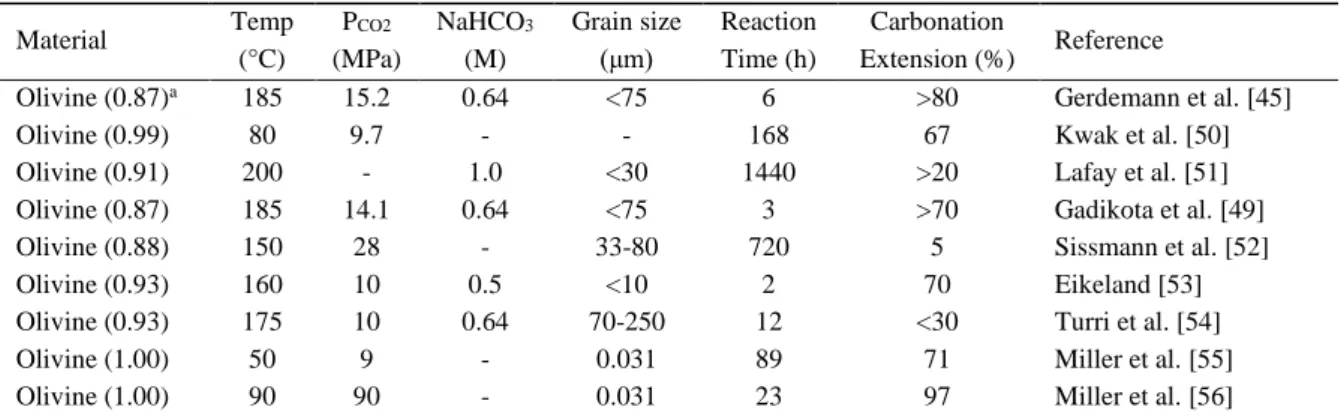
although the majority of publications are dominated by olivine (Table 1-2). High mineral carbonation rates have been reported, typically at reaction temperature of 185 °C with 0.64 mol/L NaHCO3 solution. For instance, Gadikota et al. reported that > 70 wt% of olivine was carbonated
in 3 hours in the presence of 0.64 mol/L NaHCO3 at a temperature of 185 °C [49].
Although carbonation of massive peridotite provides an opportunity for long-term, safe and large CO2 storage, it has yet to be implemented on an industrial scale, since researchers still arguing
the non-profitable and high energy input of the CO2 mineralization techniques [57]. Thus, an
effective CO2 utilization or additional energy output during CO2 mineralization may be promising
ways to further develop the CO2 mineralization techniques for practical application.
Table 1-2. Summary of experimental studies on CO2 storage by olivine carbonation.
Material Temp (°C) PCO2 (MPa) NaHCO3 (M) Grain size (μm) Reaction Time (h) Carbonation Extension (%) Reference
Olivine (0.87)a 185 15.2 0.64 <75 6 >80 Gerdemann et al. [45]
Olivine (0.99) 80 9.7 - - 168 67 Kwak et al. [50]
Olivine (0.91) 200 - 1.0 <30 1440 >20 Lafay et al. [51]
Olivine (0.87) 185 14.1 0.64 <75 3 >70 Gadikota et al. [49]
Olivine (0.88) 150 28 - 33-80 720 5 Sissmann et al. [52]
Olivine (0.93) 160 10 0.5 <10 2 70 Eikeland [53]
Olivine (0.93) 175 10 0.64 70-250 12 <30 Turri et al. [54]
Olivine (1.00) 50 9 - 0.031 89 71 Miller et al. [55]
Olivine (1.00) 90 90 - 0.031 23 97 Miller et al. [56]
a The value in bracket infers the Mg# of olivine.
1.3 A novel system for simultaneous H2 production and CO2 utilization/storage
Peridotite contains both Mg and Fe(II), which can be used for both CO2 storage and H2
13 mechanism of H2 generation in (simulated) natural system or CO2 storage by reacting with both
Mg and Fe(II) released from peridotite. The main barriers of these processes are low H2 production
rate and non-profitable of CO2 mineralization. Therefore, in this thesis, a novel system aiming at
artificially elevating H2 generation from peridotite hydrothermal hydration, and combining it with
CO2 mineralization was proposed, which has potential contributions to overcome these barriers.
Peridotite dissolution is the rate-control process for both serpentinization and carbonation with H2 production. By efficient peridotite dissolution, more Mg and Fe(II) can be released for CO2
storage and H2 production. One of the efficient and engineering feasible ways to accelerate
peridotite dissolution is using high concentration HCO3-/CO32- solutions, which can be obtained
from the conventional CO2 capture technologies. Thus, CO2 utilization can also be included in the
new system. An ideal system for H2 production and CO2 utilization/storage using peridotite as the
feedstock is thus illustrated in Fig. 1-3. The ideal reaction pathway would be, first, with the using of HCO3-/CO32- solution obtained from CO2 capture technologies, peridotite packed in the system
is quickly dissolved to release Mg and Fe(II). Fe(II) oxidation is thus accelerated with a maximum production of H2 under specific hydrothermal conditions. HCO3-/CO32- after being utilized will be
stored in carbonates by reacting with Mg; while the left Mg and Fe(III) are converted to secondary minerals (e.g., serpentine). Second, these secondary minerals together with the residual peridotite will be carbonated with the storage of CO2 in the system. In the present study, the first stage was
focused. During the reaction, geothermal or industrial waste heat are suggested to support the high reaction temperature (e.g. 200-300 °C) [58,59]. H2 can be directly output or further converted to
hydrocarbons in the presence of catalyst (e.g., mineral catalyst) for various industrial purposes. In this system, the H2 production process is CO2 emission-free with low energy cost; moreover, CO2
can be efficiently utilized before being stored, and it makes CO2 mineralization profitable due to
14
Fig. 1-3. The ideal system for H2 production with CO2 utilization/storage based on peridotite alteration.
The possibility of simultaneous H2 production and CO2 mineralization by rock alteration has
been confirmed by Kularatne et al. in 2017. They successfully used olivine-bearing mine tailings for H2 production and CO2 storage at 200-300 °C [60], even though the H2 yield in their study was
still low. On the other hand, the inclusion of CO2 in the system influences the reaction processes.
Especially, the formation of magnesite may incorporate Fe(II) and inhibit its oxidation under specific conditions. Neubeck et al. revealed the incorporation of Fe(II) into carbonates occurred faster than Fe(II) oxidation in experiments carried out at 30-50 °C; thus, H2 production was not
increased even with the enhanced olivine dissolution [61]. As discussed in Section 1.2, during peridotite alteration, both the secondary minerals formations and the fate of Fe(II) may be changed under different reaction conditions. Thus, in this thesis, prior Fe(II) oxidation for H2 production
will be aimed through controlling various reaction conditions, such as carbon concertation, temperature and pH, and the optimal condition for H2 production will be suggested for application.
1.4 Objectives of this thesis and Technical route
1.4.1 Research objectives
Replacement of fossil fuel by H2 energy and CO2 mineralization have been regarded as
15 usually have high energy costs and emit CO2, and CO2 mineralization processes are unprofitable
whereby CO2 cannot be well utilized. Peridotite is a promising raw material for both H2 production
and CO2 mineralization, although the H2 generation rates in natural systems are still very low.
While previous studies mainly focused on either the mechanism of H2 generation in natural systems
or CO2 mineralization separately, this thesis first tried to elevate the H2 production and combine it
with CO2 mineralization by using CO2-beaing hydrothermal conditions.
The primary objective of this thesis is thus to explore a new CO2 emission-free H2 production
approach with the utilization and storage of CO2 by enhanced peridotite hydrothermal alteration.
Three secondary objectives are identified: (1) to explore effective ways to elevate H2 production
based on experimental investigations conducted in this study; (2) to clarify the behaviours of H2
production and CO2 storage, and to illustrate the mechanisms that control the H2O-peridotie-CO2
reaction processes; (3) to evaluate the feasibility of large-scale application of the new system based on lab-scale experimental results. This study will have potential significant contributions to the developments of both H2 production and CO2 mineralization technologies.
1.4.2 Thesis structure
To establish the new H2 production system, three parts of investigations were conducted in
this thesis: reaction conditions studies, mechanism studies, environmental and social implications assessments. The structure of this thesis is briefly shown in Fig. 1-4. First stage conducted in Chapter 2 is the feasibility study using olivine as the raw material, rather than peridotite. The effects of the reaction conditions, such as HCO3- concentration, pH, temperature, particle size, water/rock
ratio and reaction time on H2 generation, CO2 mineralization, olivine alteration pathways and rates
were experimentally investigated. Especially, simultaneous enhanced H2 and CO2 storage were
realized by using high concentration (≥ 0.5 mol/L) HCO3- solution. The fate of Fe(II) during H2
16
At the second stage conducted in Chapter 3, the feasibility of using peridotite for H2
production was investigated. The influences of the most common coexisting minerals with olivine in peridotite, pyroxenes and spinel, were clarified by performing the H2
O-olivine+orthopyroxene/Mg-Al spinel-CO2 reactions in hydrothermal environments. The presence
of orthopyroxene and Mg-Al spinel in peridotite with olivine may have positive effect on H2
production rate, but have negative influence on CO2 storage.
Based on the experimental results, possible large-scale applications with the utilization of natural and waste resources were proposed in Chapter 4. The economical and engineering feasibilities, and environmental impacts were also evaluated.
17
Chapter 2 Feasibility study on H
2production with CO
2utilization/storage during olivine hydrothermal alteration
2.1 Introduction
H2 production and CO2 storage by peridotite alteration under hydrothermal conditions has
been confirmed in these decades. But in natural geological environments, the rates of H2 production
from peridotite serpentinization are still poorly constrained, due probably to the low peridotite dissolution rate with the release of Fe(II) [62,63] and the incorporation of dissolved Fe(II) into secondary minerals, such as Fe-bearing brucite [34,37,64] before being oxidized. It should be noted that previous investigations on H2 production from olivine alteration were still limited in natural
science, and little efforts has been paid to artificially elevate the constrained H2 production rate. In
this chapter, the feasibility of enhancing H2 production and combining it with CO2 storage during
peridotite alteration were investigation by using the dominant mineral in peridotite, olivine [(Mg,Fe)2SiO4] as the feedstock to simply the reaction system.
Olivine dissolution has been reported to be drastically promoted with the addition of CO2-
containing fluid, particularly 0.64 mol/L HCO3- at around 185 °C [65,66], even though the role of
HCO3- during olivine alteration has not been clearly clarified. Moreover, Fe(II)-bearing brucite
precipitation process can be suppressed in a CO2-containing system [67], which potentially increase
the chance of Fe(II) being oxidized, thus contributes to H2 production. However, HCO3- can be
mineralized to solid carbonates, such as magnesite, by olivine carbonation (Eq. 1-14); in this way, Fe(II) is incorporated into carbonates rather than be oxidized, and H2 production is diminished.
All the above pathways are favoured at different reaction conditions. Particularly, the HCO3
-concentration is directly related with the amount of H+ in the system, which may play important role on olivine alteration pathways and rates. For another, elevating the reaction temperature from
18
185 °C to higher potentially inhibit magnesite precipitation but promote serpentine precipitation [60]. The optimum temperature for H2 production during olivine serpentinization under CO2-free
condition is around 300-400 °C [38,39,68]. The influence of temperature on H2O-olivine-CO2
reactions has not be revealed. Other factors, such as water/rock (w/r) ratio and rock grain size are also important and usually primarily considered during field-scale application. Thus, varying the above reaction conditions is a possible way to control the H2 generation and CO2 storage behaviours
during H2O-olivine-CO2 hydrothermal reaction.
The present chapter experimentally investigated the effects of HCO3- concentration, initial pH,
temperature, water/rock ratio, olivine grain size on products generation during olivine alteration on the lab-scale. The concentration of HCO3- was controlled at 0.1-1.0 mol/L, much higher than of
that in natural marine system (~0.002 mol/L); thus, system with 0.1-1.0 mol/L HCO3- was
expressed as “CO2-rich” in this thesis. The purpose of this chapter is to explore the possibility of
accelerating H2 production with CO2 utilization/storage during H2O-olivine-CO2 reaction; and to
address the outstanding questions concerning the chemical reactions that control the pathways and rates of H2 production during olivine alteration under CO2-rich hydrothermal conditions.
2.2 Materials and Methods
2.2.1 Materials
Millimetric grains of olivine from Damaping (China) were chosen for experimental investigation (Fig. 2-1). Based on the elemental compositions determined using electron probe microanalysis (EPMA), the olivine was defined as (Mg0.90Fe0.10)2SiO4 with Mg# [Mg/(Mg+Fe)
mole ratio] of 0.90, see in Table 2-1. The olivine grains were ball-milled for 120 min at 500 r/min (Pulverisette 6, Fritsch) and particles with diameters < 62 μm were sieved for experiments. The particles were determined to have a high specific surface area of 3.57 m2/g by N2 adsorption
19 isotherms using the Brunauer-Emmett-Teller (BET) method. The high surface area was attributed to the presence of a high ratio of superfine particles (e.g., < 1 μm), as observed using scanning electron microscopy (SEM; SU-8000, Hitachi, Japan). Initial olivine was unaltered, as evidenced by a very small weight loss (< 0.2 wt%) during heating from room temperature to 1000 °C in a thermodilatometer (TG, Thermo plus EVO TG 8120, Rigaku, Japan). Solid sodium bicarbonate (NaHCO3) purchased from Kanto Chemical (Japan) was used for preparing CO2-rich water
solutions for experiments.
Fig. 2-1. (a) Photos of olivine particles before grinding and (b) SEM image of olivine powder after grinding.
Table 2-1. Composition of olivine determined by EPMA analysis (wt%).
Na2O Al2O3 Cr2O3 MnO CaO MgO SiO2 NiO FeO TiO2 Total
0.01 0.07 0.01 0.10 0.08 49.46 40.90 0.33 8.92 0.00 99.88
2.2.2 Olivine alteration experiments
Olivine alteration experiments were performed in a high-temperature and high-pressure closed-batch reactor (the vessel shown in Fig. 2-2) made of Hastelloy-C with a volume of 170 mL. The maximum tolerable values for temperature and pressure are 300 °C and 20 MPa, respectively. In this thesis, the highest reaction temperature was 300 °C and pressure was approximately 10 MPa, both in the tolerate range of the reactor.
(a) (b)
20
Fig. 2-2. Schematic diagram of the experimental set-up.
In a typical run, a 100 mL suspension containing 5±0.01 g of olivine powder and NaHCO3
solution prepared using solid NaHCO3 and Milli-Q water was charged into the vessel, which was
then subjected to continuous stirring. The initial pH of the suspension was measured at the ambient temperature. The reactor was then sealed and purged with N2 gas to facilitate O2 removal from the
solution and the upper headspace. After 10 min, the air outlet was closed and N2 gas continued to
flow through the inlet to reach a certain pressure, such as 2.8 MPa. The total volume of N2 gas in
the reactor before reaction was thus calculated to be approximately 2.0 L. Once the reactor temperature set-point was specified at 300 °C, it took approximately 15 min for the reactor temperature to be stabilized (at 300 °C). At this point, the reaction pressure was also increased to the desired value, 10 MPa, slightly higher than the saturated vapor pressure of water. During each experiment, gas samples (10 mL per extraction) and liquid samples (2 mL per extraction) were withdrawn at several reaction times (e.g., 0, 2, 6, 24, 48 and 72 h) through gas and liquid sampling valves. Reactions were stopped at 72 h by decreasing the reactor temperature with cooling water; it generally took 10 min to cool the reactor to below 50 °C. The pH of the reacted suspension was
21 measured again at the ambient temperature. The mineral powder was then filtered and dried at 50 °C for 24 h in an oven before further analysis.
The effect of the NaHCO3 concentration, initial pH of the suspensions, reaction temperature,
water/rock (w/r) ratio and olivine particle size on the reaction pathways and rates were experimentally investigated. The studied ranges of the parameters are listed in Table 2-2. The impact of HCO3- on the olivine alteration process was investigated by varying initial NaHCO3
concentration from 0 to 1.0 mol/L at 300 °C without pH adjustment. However, the addition of NaHCO3 also causes pH variation from alkaline to neutral, thus the separate pH effects were also
investigated in both Milli-Q (CO2-free) and 0.5 mol/L NaHCO3 (CO2-rich) by varying the initial
pH in the range of 8-11 at 300 °C. The initial pH of each suspensions was adjusted using HCl and NaOH solutions with concentration of 0.1 mol/L. The reaction temperature was controlled at 225-300 °C, aiming to obtain a high H2 production rate based on literature investigation [38,43].
Table 2-2. Values of the parameters used in the experiments.
Parameters Values Unit
NaHCO3 concentration 0, 0.1, 0.5, 1.0 mol/L
Initial pH 8.3, 9.3, 10.1, 10.9 -
Temperature 225, 250, 275, 300 °C
Particle size 28-53, 53-90, 90-160 µm
Water/rock ratio 5, 10, 20 -
Reaction time 2, 6, 24, 72, 120 hours
Two blank experiments in Milli-Q water and NaHCO3 (0.5 mol/L) solution without olivine
addition were also conducted at 300 °C. No H2 or HCOOH were detected in the Milli-Q water
experiment; however, in the experiment with the 0.5 mol/L NaHCO3 solution, the H2 and HCOOH
yields reached 0.18 and 0.05 mmol, respectively, over 72 h. The lesser yields of H2 and HCOOH
were regarded as being generated by reaction between NaHCO3 and elements (e.g., Fe) released
from the stainless steel reactor [69]. During the investigations on the effects of pH, w/r and olivine grain size, the reaction conditions were consistent (300 °C, 10MPa and 0.5 mol/L), thus, the background H2 and HCOOH were assumed to be same. Olivine alteration experiments in 0.5 mol/L
22
NaHCO3 at 300 °C without pH adjustment was conducted 3 times to test the reproducibility of the
experiments. The products analysis results showed good reproducibility with the margin of error within 3.8%. Thus, all the other experiments were conducted only once to reduce the experiment time while the accuracy will not be significantly influenced. Each gas and liquid sample were measured 3 times to quantify the product concentration, and the average result was summarized.
2.2.3 Measurement and characterization
Liquid samples were analyzed using ion chromatography (IC; 761 Compact IC, Metrohm, Switzerland) coupled with a Metrosep Organic Acids column (235532, Metrohm, Switzerland). Gas species were analyzed using gas chromatography (GC), one chromatograph (GC-3200, GL Science, Japan) was equipped with a thermal conductivity detector (TCD) and another (GC-7890A, Agilent Technologies) was equipped with a flame ionization detector (FID). Fluid samples at 72 h were analyzed for dissolved components [e.g., Mg, Fe(II) and Si] by inductively-coupled plasma atomic emission spectroscopy (ICP-AES). The mineral composition and crystalline structures of the minerals were measured using X-ray diffraction (XRD; Multiflex, Rigaku, Japan) with Cu K radiation (λ= 1.54 Å) operated at 40 kV and 20 mA, and with a 2θ step size of 0.02° from 10° to 45°. The surface morphologies of the minerals were observed using SEM equipped with energy dispersive spectroscopy (EDS). TG analyses of all the reacted minerals were performed by increasing the temperature from ambient one to 1000 °C at a rate of 10 °C/min. The H2O contents
of brucite and serpentine, and the CO2 content of magnesite could be determined separately from
the weight loss observed in different temperature ranges [63]. The mass losses due to different minerals could then be identified and the final mineral composition was estimated.
23
2.3 The role of NaHCO3 concentration in olivine alteration
2.3.1 Effect of NaHCO3 concentration on H2 and HCOOH generations
The effect of NaHCO3 concentration on H2 production and CO2 storage processes during H2
O-olivine-CO2 reaction were investigated by varying the NaHCO3 concentration from 0 to 1.0 mol/L.
The reaction condition was controlled at 300 °C, 10 MPa with olivine particle size < 62 µm, and the w/r ratio was 20. In 72 h reaction, the main products were detected to be gaseous H2 and liquid
formate ion (HCOO-), the later was regarded as HCOOH to simplify the calculation; this assumption will not influence the calculation on Fe(II) oxidation amount. Few gaseous CH4 was
also detected after 72 h reaction; however, the concentration (i.e., 1 µmol/L) could not be quantified with enough accuracy. Higher cumulative H2 and HCOOH yields were detected in CO2-rich
experiments, especially with higher NaHCO3 concentration (Fig. 2-3). For instance, when the initial
NaHCO3 concentration was increased from 0 to 1.0 mol/L, cumulative H2 yield after 72 h reaction
increased from 0.23 mmol to 1.13 mmol; at the same time, 0.65 mmol HCOOH was formed. The quick formation of HCOOH at the beginning 2 h was the background value, since H2 yield was still
very low at the beginning.
Fig. 2-3. Cumulative H2 and HCOOH yields during olivine alteration in NaHCO3 solution with
concentrations of 0-1.0 mol/L at 300 °C, without pH adjustment.
Reaction time (h) 0 24 48 72 Cu m u la tive H 2 and HCO O H y ie ld ( m m o l) 0.0 .5 1.0 1.5 0 0.1 mol/L 0.5 mol/L 1.0 mol/L H2 HCOOH
24
The initial pH of the H2O-olivine suspension without NaHCO3 addition measured at room
temperature was 10.9. When NaHCO3 was added in the suspension, the pH was decreased (Table
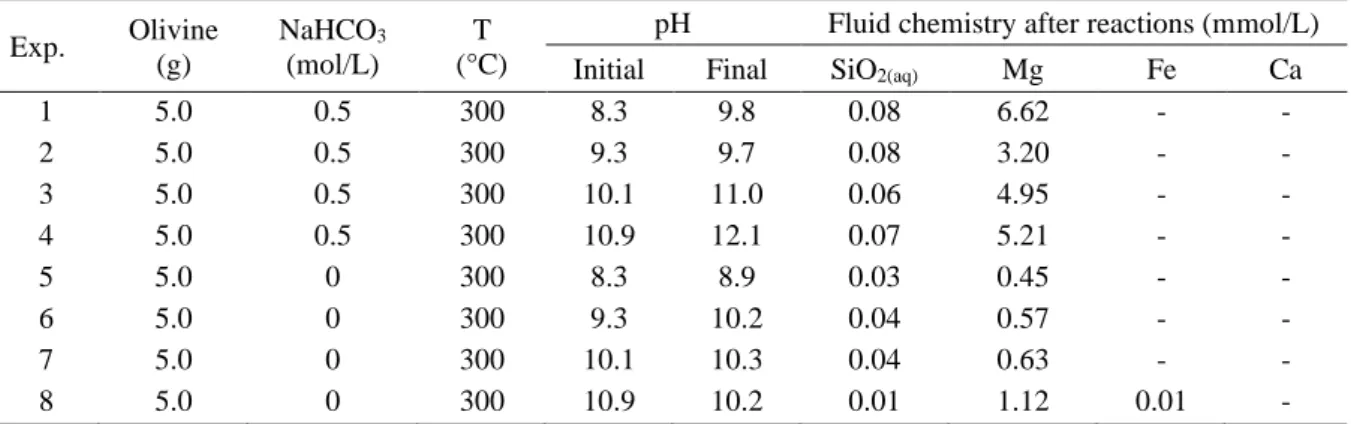
2-3) due to the pH buffer effect of HCO3-. After 72 h reaction, pHs in experiments with NaHCO3
were elevated, mainly attributed to the promoted olivine dissolution process (consumed H+) [70].
Table 2-3. Summary of experimental conditions and reacted fluid chemistry of experiments with different NaHCO3 concentrations.
Exp. Olivine (g) NaHCO3 (mol/L) T (°C)
pH Fluid chemistry after reactions (mmol/L)
Initial Final SiO2(aq) Mg Fe Ca
1 5.0 0 300 10.9 10.2 0.01 1.12 0.01 -a
2 5.0 0.1 300 8.8 9.8 0.02 6.66 - -
3 5.0 0.5 300 8.3 9.5 0.08 6.62 - -
4 5.0 1.0 300 8.1 9.2 0.12 7.65 - -
a“-” refers the concentration low the detection limit.
2.3.2 Effect of NaHCO3 concentration on mineral formations
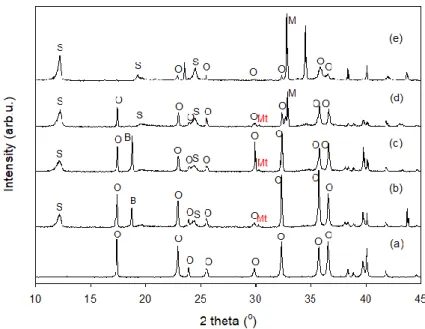
Secondary minerals after 72 h reaction were identified to be serpentine, brucite, magnesite and magnetite, according to XRD results (Fig. 2-4). Over the entire NaHCO3 concentration range
(0-1.0 mol/L), serpentine characteristic peaks were clearly observed (e.g., 12.2° and 24.5°) [51], indicating olivine serpentinization process proceeded in both CO2-free and CO2-rich environments.
With the increase of NaHCO3 concentration, both serpentine and magnesite (32.8°) peaks [51] were
stronger, infers the accelerated precipitations of serpentine and magnesite. However, brucite characteristic peak (18.8°) [71] was observed only in experiments with ≤ 0.1 mol/L NaHCO3.
Magnetite was also formed, as evidenced by very weak peaks at 30.2° [72]; however, these peaks were too small to be used for quantification. The XRD results also indicate that Na ions did not join the olivine alteration reactions.
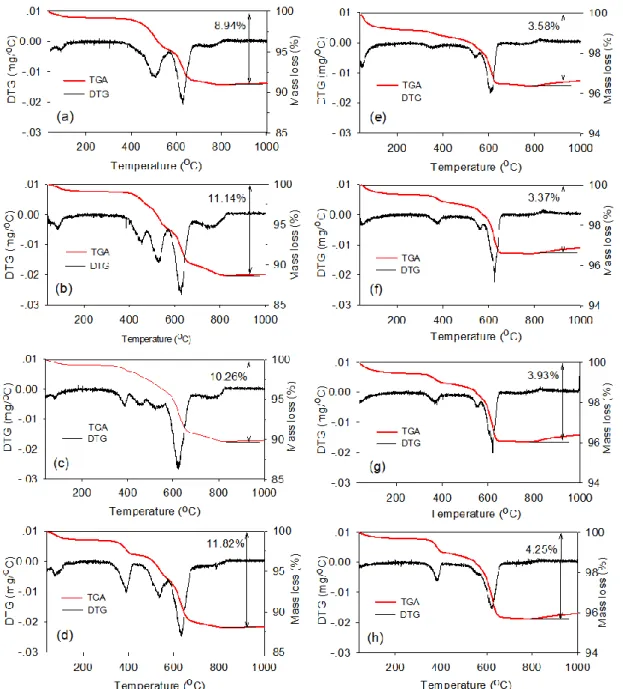
TG analysis results and the first derivative curves (DTG) (Fig. 2-5) were used to calculate the weight ratios of secondary minerals and residual olivine after 72 h reactions. Brucite, magnesite and serpentine lost weights at different temperatures. For instance, one molecule of brucite lost one
25 molecule of H2O and formed a DTG peak at around 390 °C; while DTG peaks observed at around
500 °C and 620-700 °C are assigned to the decompositions of magnesite and serpentine, respectively.
Fig. 2-4. XRD patterns of (a) unreacted olivine and olivine after reacting in (b) 0, (c) 0.1, (d) 0.5, € 1.0 mol/L NaHCO3 solution at 300 °C and 10 MPa for 72 h.
O: olivine, S: serpentine, M: magnesite, B: brucite, Mt: magnetite.
Fig. 2-5. TG analysis of olivine after 72 h alteration under hydrothermal condition with NaHCO3
26
During olivine hydrothermal alteration, Mg, Fe(II) and SiO2(aq) were released; part of them
were converted into secondary minerals whereas the rest remained in the solution. Thus, the exact weights of olivine and secondary minerals can be quantified according to Mg mass balance calculation. According to the XRD results, the magnetite generation was very low; thus, magnetite formation was ignored during calculation, which should not affect estimates of the mole fraction significantly. The mineral quantification results were summarized in Fig. 2-6. With the adding of 1.0 mol/L NaHCO3, the olivine alteration amount in 72 h reached 2.93 g (58.6 wt%), 2.5 times
higher than that without NaHCO3 addition [i.e., 1.16 g (23.2 wt%)]. At the same time, serpentine
and magnesite generations also reached maximum the values of 2.36 g and 1.06 g (42.5 wt% and 19.2 wt% of the reacted solid sample), respectively. Brucite was only generated in experiments with ≤ 0.1 mol/L NaHCO3.
Fig. 2-6. Residual olivine and secondary minerals generations after reactions in 0-1.0 mol/L NaHCO3
solution at 300 °C, 10 MPa for 72 h.
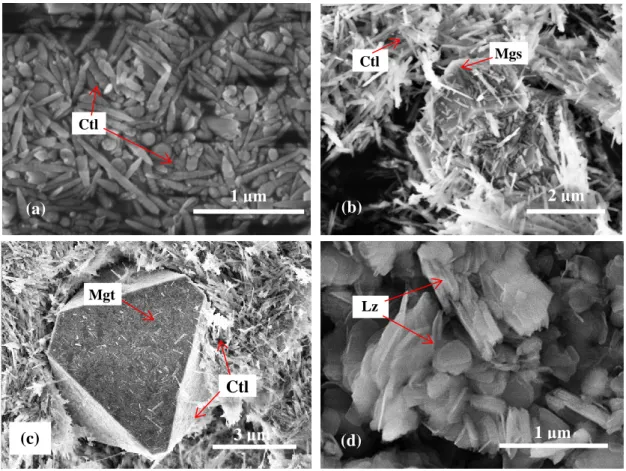
The concentrations of NaHCO3 also influenced the generated serpentine polymorphs. In the
experiments with NaHCO3 concentrations ≤ 0.5 mol/L, chrysotile was the dominant serpentine
species (Figs. 2-7a, b and c). However, flat lizardite was observed as the main serpentine species
M in e ra l we ig h t (g ) 0 1 2 3 4 5 6
NaHCO3 concentration (mol/L)
0.1 0.5 1.0 Unreacted Olivine 0 H2O Brucite Magnesite Serpentine Olivine
27 in experiment with 1.0 mol/L NaHCO3 (Fig. 2-7d). For another, magnetite with octahedral shapes
was observed (Fig. 2-7c), which has close relationship with H2 generation [18].
Fig. 2-7. SEM images of olivine after 72 h reaction in NaHCO3 solution with concentrations of (a) 0, (b, c)
0.5 and (d) 1.0 mol/L at 300 °C, 10 MPa.
Ctl: chrysotile, Lz: lizardite, Mgs: magnesite, Mgt: magnetite
2.3.3 Effect of NaHCO3 concentration on olivine alteration pathways
Reaction pathway for each environment was calculated based on the measurements on gas, liquid and solid samples taken after 72 h reaction. The general reaction pathway for olivine alteration in experiments with HCO3- concentration ≤ 0.1 mol/L is expressed in Eq. 2-1. When the
initial HCO3- concertation ≥ 0.5 mol/L, brucite could not be formed in 72 h during olivine
hydrothermal alteration. Thus, H2O-olivine-CO2 reaction equation was expressed in Eq. 2-2. It
should be noted that these equations are approximate estimates, trace ions in fluid (e.g., Fe) and
(b) (d) Ctl Mgs Mgt Lz 1 μm (c) (a) 2 μm 1 μm Ctl 3 μm Ctl
28
hydrocarbon (e.g., CH4) formations were ignored, and all formate were regarded as HCOOH.
Moreover, Na ions were not shown in the equation since they did not join the chemical reaction. During the calculations, Fe(II) was assumed to replace Mg, while Fe(III) was assumed to replace both Mg and Si in serpentine [37,73].
(Mg0.90Fe0.10)2SiO4 + m H2O + (b+f) HCO3- + n H+ → a (Mg,Fe2+)3-0.5βFe3+βSi2-0.5βO5(OH)4
olivine serpentine + b (Mg,Fe)CO3 +c Mg,Fe(OH)2 + d Fe3O4 + (1-2a) SiO2 + e H2 + f HCOOH + p Mg2+
magnesite brucite magnetite (2-1) (Mg0.90Fe0.10)2SiO4 + m H2O + (b+f) HCO3- + n H+ → a (Mg,Fe2+)3-0.5βFe3+βSi2-0.5βO5(OH)4
olivine serpentine + b (Mg,Fe)CO3 + d Fe3O4 + (1-2a) SiO2 + e H2 + f HCOOH + p Mg2+
magnesite magnetite (2-2) The coefficients of serpentine, magnesite, brucite, H2 and HCOOH were calculated according
to experimental measurements, whereas others were calculated based on elements conservation, all the results are summarized in Table 2-4. For example, in experiment with 0.5 mol/L NaHCO3, the
0.360 mol magnesite and 0.495 mol serpentine were generated from 1 mol olivine alteration. According to EDS measurement, the atomic fraction XFe [Fe/(Mg+Fe)×100, %] of magnesite and serpentine were 3.4 and 7.0, respectively. The Fe concentration in fluid was low enough to be ignored according to ICP-OES measurement. Thus, the amount of Fe3O4 that generated during the
reaction was quantified to be 0.028 mol based on Fe conservation. Moreover, the total Fe(III) content in secondary minerals (mainly serpentine and magnetite) was quantified according to H2
and HCOOH yields, by deducting the Fe(III) in magnetite, the Fe(III) content in serpentine can be calculated. Finally, the approximate chemical reaction for olivine alteration in 0.5 mol/L NaHCO3
can be exactly expressed as Eq. 2-3. Under this condition, 0.376 mol of HCO3- is mineralized or
reduced to HCOOH during the alteration of 1 mol olivine in 0.5 mol/L HCO3- solution. It should
be noted that charge conservation could not always be achieved for the equations due to the assumptions made during calculations.
29 (Mg0.90Fe0.10)2SiO4 + 0.667 H2O + 0.376 HCO3- + 0.42 H+ →
0.495 (Mg0.991Fe2+0.009)2.904Fe3+0.192Si1.904O5(OH)4+ 0.36 (Mg0.966Fe0.034)CO3+ 0.028 Fe3O4
+ 0.058 SiO2 + 0.060 H2 + 0.016 HCOOH + 0.027Mg2+ (2-3)
Table 2-4. The values of main coefficients for olivine alteration equations of experiments with different NaHCO3 concentrations.
Exp.a
Products Reactants
Srp Mgs Brc Mgt H2 HCOOH SiO2 H2O HCO3- H+
a β b c d e f (1-2a) m (b+f) n 1 0.496 0.036 - 0.243 0.026 0.029 - 0.017 1.088 - 0.352 2 0.495 0.034 0.070 0.210 0.029 0.032 0.005 0.018 0.016 0.075 0.355 3 0.495 0.192 0.360 - 0.028 0.060 0.016 0.058 0.667 0.376 0.420 4 0.450 0.192 0.650 - 0.033 0.052 0.027 0.143 0.441 0.677 0.505 a
In experimental description, the numbers are the same as in Table 2-3.
The calculation results also show that serpentine incorporated both Fe(II) and Fe(III). The values of Fe(II)/[Fe(II)+Fe(III)] of serpentines formed in experiments with ≤ 0.1 mol/L NaHCO3
concentration (Fig. 2-8) were consistent with that modelled by Klein et al. [74]. But when NaHCO3
concentration was further elevated to ≥ 0.5 mol/L, more Fe(III) but less Fe(II) was stored in serpentine in 72 h reaction, which contributed to H2 production. Unfortunately, the mechanism of
this variation has not been experimental revealed in this thesis. H2 and HCOOH yields from per
mol olivine alteration was much higher in environments with ≥ 0.5 mol/L HCO3-, which may relate
to the absence of Fe(II)-bearing brucite. The average value of XFe of brucite generated in experiments with ≤ 0.1 mol/L NaHCO3 was 6.0, nearly two times of that of magnesite (with highest XFe value of 3.4).
When the NaHCO3 concentration was increased to 1.0 mol/L, serpentine precipitation from 1
mole olivine was slightly decreased to 0.450 mol, whereas magnesite precipitation kept increase. It indicated the serpentinization process starts to be suppressed only when HCO3- concentration ≥
1.0 mol/L due to the competing effect from magnesite precipitation.
The linear correlation between H2+HCOOH yields (y, mmol) and magnetite formation (x,
mmol) in different experiments over 72 h were summarized in Fig. 2-9 with R2=0.9253. The dash
30
contains 2 mol Fe(III)]. This figure demonstrated that a larger part of Fe(III) was incorporated into serpentine, rather than magnetite in experiment with higher NaHCO3 concentration.
Fig. 2-8. The values of XFe and Fe(II)/[Fe(II)+ Fe(III)] in serpentine generated in experiments with 0-1.0 mol/L NaHCO3 concentration at 300 °C in 72 h.
Fig. 2-9. Relationship between H2+HCOOH yields and magnetite formations in experiments with 0-1.0
mol/L NaHCO3 at 300 °C, 10 MPa in 72 h.
2.3.4 Implications and significance
It has been previously proposed that the presence of CO2 species severely suppresses H2
generation from olivine hydration, because Fe(II) is prone to be incorporated into magnesite rather
NaHCO3 concentration (mol/L)
0.0 .5 1.0 XFe o f s er pent ine, b ruc ite o r m agne s ite ( % ) 0 2 4 6 8 10 F e( II )/[ F e( II )+Fe (II I) ] in s er pent ine (% ) 0 20 40 60 80 100 serpentine serpentine brucite magnesite
Magnetite formation (mmol)
0.0 .5 1.0 1.5 2.0 H2 +H C OOH yi el d (m m ol ) 0.0 .5 1.0 1.5 2.0 y=3.5039x-0.4043 R2=0.9253
31 than be oxidized [69,75]. However, in this section, high NaHCO3 concentration (0.1-1.0 mol/L)
solutions had significant positive effects on H2 generation from olivine alteration, and CO2 storage
was also realized. The experimental results suggested that artificially accelerating H2 production
with the utilization and storage of CO2 during rock alteration is possible.
A comparison of the H2 generation rates in this section and the previous studies was made in
Fig. 2-10. Under CO2-free condition (300 °C), the H2 generation rate in this thesis was 0.47
mmol/(kginitial olivine·h), higher than previous studies even using same reaction conditions. This
elevation may relate to the inclusion of gas phase during reaction in this thesis, by which the low H2 solubility will not be an inhibition factor anymore. Moreover, the higher specific surface area
of olivine particles (3.57 m2/g) in this thesis than previous ones (e.g., 0.59-0.929 m2/g) may also contributed to the quick H2 production [75,76]. With the addition of NaHCO3, the H2 production
rates were higher. The highest H2 production rate reached 3.13 mmol/(kginitial olivine·h) in the
experiment with 1.0 mol/L NaHCO3, more than 15 times higher than previous researches. Although
Jones et al. also tried CO2-rich conditions (up to 106.6 mmol/L) [75], the rate of H2 production
from olivine was not elevated, which may be attributed to the low temperature (200 °C) they used.
Fig. 2-10. H2 yield as a function of initial NaHCO3 concentration in this thesis and in previous research
[37-39,43,44,75-77].
Initial NaHCO3 concentration (mmol/L)
0 200 400 600 800 1000 H2 y ield pe r ho ur ( m m ol/ k gol iv ine .h) 0 1 2 3 0 20 40 60 80 100 0.0 .1 .2 .3 .4 .5 .6 Berndt et al., 1996 (300 o C, 8.9 mmol/L) Shibuya et al., 2015 (300 o C, 0 mmol/L) Jones et al., 2010 (200 o C, 0-106.6 mmol/L) Klein and McCollom, 2013 (300 o
C, 0 mmol/L) McCollom et al., 2001 (300 o C, 10.7 mmol/L) Oze et al., 2012 (200 o C, 13.2 mmol/L) McCollom et al., 2016 (200-320 o C, 20.4 mmol/L) Ueda et al., 2017 (300 o C, 65 mmol/L) This thesis (300 o C, 0-1000 mmol/L) 100 mmol/L 500 mmol/L 1000 mmol/L 0
![Fig. 1-1. Triangular classification diagram of ultramafic rocks based on the mineral modes expressed in terms of Olivine-Orthopyroxene-Clinopyroxene [25]](https://thumb-ap.123doks.com/thumbv2/123deta/5914194.1050568/18.892.228.665.284.661/triangular-classification-diagram-ultramafic-expressed-olivine-orthopyroxene-clinopyroxene.webp)


![Fig. 2-8. The values of X Fe and Fe(II)/[Fe(II)+ Fe(III)] in serpentine generated in experiments with 0-1.0 mol/L NaHCO 3 concentration at 300 °C in 72 h](https://thumb-ap.123doks.com/thumbv2/123deta/5914194.1050568/41.892.229.675.208.513/fig-values-iii-serpentine-generated-experiments-nahco-concentration.webp)