鴬野定値計画問題に現れる密行列のための
一般化共役残差法
面面面 中田和秀
新田義寛
東京大学大学院工学系研究科物理工学専攻
Shao-Liang
Zhang
Kazuhide Nakata
Yoshihiro Nitta
Department
of
Applied Physics, The Universityof
TokyoAbstract
It isagreatconcern in the field of Semidefinite Programmingto solve the large and
dense linear systems which arise from the interior-point method. Often direct
meth-ods are too expensive in terms ofcomputer memory and CPU-time requirements,
then the only alternative is to use iterativemethods. Here,weapply the generalized
conjugate residual method to this type of SDP’s linear systems. The theoretical
properties and practicalperformance of the method will be discussed.
1 Introduction
Recently Semidefinite Programming (SDP hereafter) has been considered
as
an
extension of Linear Programming. It has a number of interestingappli-cations to physical problems, control problems and other mathematical
pro-gramming [16]. It is well-known that the interior-pointmethods
are
well suited for solving SDP with the primal problem and its dual problem (primal-dualSDP hereafter), and theoretical results and computational experiments have
shown this fact $[1,5]$.
As
an
iterative approach, it is necessaryto determinea
searchdirection forthe next approximate solution in the interior-point methods. There is an elegant and powerful class of ways for determining the search direction. Throughoutthepresentpaper,
we
onlyfocusour
attentionon
theso-called$\mathrm{H}\mathrm{R}\mathrm{V}\mathrm{W}/\mathrm{K}\mathrm{S}\mathrm{H}/\mathrm{M}$search direction [6,9,11,12]. When
one uses
theinterior-point methods for solv-ing primal-dual SDP,one
usually has to efficiently solvea
large and dense linear system (SDP’s linear system hereafter)as an
immediate problem atdefinite and dense matrix in general. If the size of the matrix is not large, di-rect methods such
as
Cholesky factorizationare
often used and its attractiveefficiency has been confirmed by many numerical experiments using
some
suc-cessful libraries [4,15,2,14]. However, if the size of the matrix is getting larger, alldirect approachesare
prohibitive in termsofexpensive computational costsof$O(m^{3})$ and much storage requirements to keep all elements of$m^{2}$
.
The only alternative is to
use
iterative methods for which it is not necessaryto keep simultaneously all elements of the matrix [18,10,13]. The purpose of thepresentpaper is to apply the generalized conjugate residual method (GCR hereafter) for solving SDP’s linear systems.
The plan of the present paper is
as
follows. First,we
will introducea
simple description of SDP and the interior-point methods for solving primal-dual SDP, and consider SDP’s linear systems in section 2. After makinga
clear understanding of the structure of the matrices of SDP’s linear systems by using rewriting the matrices,we
will consider to applyGCR
for solving SDP’slinear systems, and $\mathrm{d}\mathrm{i}\mathrm{s}\mathrm{C}\mathrm{u}\mathrm{S}\mathrm{s}$ the theoretical properties of GCR in
section 3.
Finally,
we
will give several numerical experiments to confirm the practical performance ofGCR in section 4.2 $\mathrm{S}\dot{\mathrm{D}}\mathrm{P}$
and Primal-Dual Interior-Point method
Let $R^{n\cross n}$ denote the set ofall $n\cross n$ real matrices, $S^{n\cross n}$ denote the set of all
$n\cross n$ symmetric real matrices. We define an inner product of $X$ and $\mathrm{Y}$ in
$R^{n\cross n}$ by
$X$ $\bullet$$Y\equiv Tr(x^{T}\mathrm{Y})$
where $Tr(A)$ denotes the trace of $A$, the
sum
of its diagonal elements. For$X\in S^{n\cross n}$, we write $X\succ O$ to denote positive definiteness of $X$ and $X\succeq O$
to denote positive semidefiniteness of$X$.
Let $A_{i}\in S^{n\cross n}(0\leq i\leq m),$ $b_{i}\in R(1\leq i\leq m)$. Here
we assume
that$A_{i}(1\leq i\leq m)$
are
linearly independent which implies that $m\leq n(n+1)/2$.Using above notation, let
us
recall thestandardform ofprimal-dualSDP
oftenPrimal problem: minimize $A_{0}$$\bullet$ $X$
subject to $A_{i}$ $\bullet$ $X=b_{i}$ $(1 \leq i\leq m)$, $X\succeq O$.
Dual problem: maximize $i=1 \sum_{m}^{m}b_{i}yi$
(1) subject to $\sum_{i=1}A_{iyi}+Z=A_{0}$, $Z\succeq O$.
(X,$y,$$Z$) is called
an
optimal solution of (1) if $X$ isan
optimal solution of Primal problem and $(y, Z)$ isan
optimal solution ofDual problem.Interior-point approaches
are
well suited for solving primal-dual SDP $[1,16]$,and produce iterative solutions along the so-called central path which is pa-rameterized by parameter $\mu>0$
as
follows.$A_{i}$$\bullet$$X=b_{i}(1 \leq i\leq m),\sum_{=}^{m}\backslash i1Aiy_{i}+\dot{Z}=A_{0},\acute{X}Z=\mu I,$ $X\succ O,$ $Z\succ O$.
Notethat Newton’s method
can
not be directly appliedto the above nonlinear equations, because of the different dimensions.To solve numerically the above nonlinear equations,
a
common
technique is to choosea
search direction $(dX, dy, dZ)$, then iterate the next approximate solutionas
follows.(X,$y,$$Z$) $=(X, y, Z)+\alpha(dX, dy, dz)$.
$r_{4}$
Several successful approaches for search directions have already been
pro-posed. Here
we
only discuss the $\mathrm{H}\mathrm{R}\mathrm{V}\mathrm{W}/\mathrm{K}\mathrm{S}\mathrm{H}/\mathrm{M}$ search direction whichcan
be reduced
as
follows [6,9,11,12].$Bdy=f$ , (2)
$B_{ij}=A_{i}\bullet$$XA_{j}Z^{-1}(1\leq i\leq m, 1\leq j\leq m)$, (3)
$f_{i}=p_{i}-A_{i}$ $\bullet$$X(X^{-1}K-D)Z-1(1\leq i\leq m)$,
$dZ=D- \sum_{i=1}^{m}Aidy_{i},$ $d\hat{\lambda}’=x(X^{-}1K-dz)z-1,$ $dX=(d_{d}^{\wedge}\mathrm{X}^{\mathit{7}}+d\hat{X}^{T})/2$,
where $K=X$$\bullet$$Z\beta/nI-xZ$for
a
parameter$\beta\in(0,1)$. In general, the $m\cross m$3 CG and GCR for the SDP’s linear system
In this section, we first discuss the property of $B$. Note that for the
sym-metric positive definite $X$ and $Z$ in (3),
we
have $X=X^{1//2}2X^{1}$ and $Z^{-1}=$$Z^{-1/2}Z^{-1/2}$ where $X^{1/2}$ and $Z^{-1/2}$
are
the square roots of$X$ and $Z^{-1}$respec-tively.
Using $Tr(A)=Tr(A^{T})$ and $T?\cdot(AB)=Tr(BA)$, then
we
have$B_{ij}=A_{i}$$\bullet$ $XA_{j}Z^{-1}=Tr(A^{\tau}iXA_{j}Z-1)$
$=Tr((X1/2Aiz^{-1}/2)^{\tau}X1/2A_{j}Z-1/2)$
$=(X^{1/2}A_{i}Z-1/2)$ $\bullet$ $(X^{1/2}A_{j}Z-1/2)$
$=(X^{1/2}A_{j}Z-1/2)$ $\bullet$ $(X^{1/2}A_{i}Z-1/2)=B_{ji}$
which
means
that $B$ is symlnetric.Inaddition, let$a_{i1},$ $\cdots$ ,$a_{in}\in R^{n}$denote the columnsofthematrix$x^{1/2}A_{i}z^{-}1/2$, and $c_{i}\in R^{n^{2}}$ denote the vector $(a_{i}^{\tau_{1’ i\eta}}\cdots, a^{\tau})T$, then
we can
rewrite $B_{ij}$as
fol-lows.$B_{ij}=Tr((ai1, \cdots , a_{in})^{T}(a_{j1}, \cdots , a_{jn}))=(\mathrm{C}_{i}, c_{j})$. Let $C$ be the $n^{2}\cross m$matrix with columns
$c_{1},$$\cdots,$ $c_{m}$, then $B$
can
be expressedas
$B=c^{\tau}C$ $\in S^{m\cross m}$
which implies that $B$ is positive definite.
Since $B$ is symmetric and positive definite, it is natural to apply the conjugate
gradient method (CG hereafter) to SDP’s linear system (2) [18,10,13]. The
algorithm of CG
can
be describedas
follows [7]. ALGORITHM 1 $CG$$x_{0}$ is
an
initial guess, $r_{0}=f-BX_{0}$, set $p_{0}=r_{0}$, For $i=0,1,$$\cdots$ until $||r_{i}||/||r_{0}||\leq\epsilon$ Do:$\alpha_{i}=\frac{(r_{i},r_{i})}{(p_{i},Bp_{i})}$,
$x_{i+1}=X_{i}+\alpha ip_{i}$, $r_{i+1}=r_{i}-\alpha_{i}Bpi$
’
$p_{i+1}=r_{i+1}+\beta_{ip_{i}}$,
$\mathrm{E}\mathrm{n}\mathrm{d}\mathrm{D}\mathrm{o}$
However, when the approximate solution (X,$y,$$Z$) is close to the optimal
solution of (1), one has to encounter an ill-posed matrix $B$ because $X$ and
$Z$ become nearly singular. In general, CG for solving singular linear systems
usually shows a bad performance of convergence, $\mathrm{f}_{\mathrm{U}\Gamma \mathrm{t}}\}_{1}\mathrm{e}\mathrm{r}\mathrm{n}\mathrm{l}\mathrm{o}\mathrm{r}\mathrm{e}$ diverges [8].
Note that the residual $r_{i}$ in CG satisfies
$||r_{i}||_{B^{-1}}= \min_{rX\in X_{0}+\mathrm{A}_{i}^{r}(B,0)}||f-BX||B^{-1}$
where $K_{i}(B, r_{0})=Span\{r0, Br_{0}, \cdots , B^{i-1}r_{0}\}$.
In the presentpaper,
we
prefer to applyGCR
to SDP’slinear systems whether$B$ become nearly singular. The algorithm of
GCR
can
be describedas
follows[3].
ALGORITHM
2 $GCR$$x_{0}$ is an initial guess, $r_{0}=f-BX_{0}$, set $p_{0}=r_{0}$,
.F
or $i=0,1,$$\cdots$ until $||r_{i}||/||r_{0}||\leq \mathit{6}$ Do:$\alpha_{i}=\frac{(r_{i},Bp_{i})}{(Bp_{i},Bp_{i})}$,
$x_{i+1}=x_{i}+\alpha ip_{i}$, $r_{i+1}=r_{i}-\alpha_{i}Bp_{i}$,
$\beta_{i,j}=-\frac{(Br_{i+1p_{j}}B)}{(Bp_{j’ j}Bp)},$, $j=0,1,$ $\cdots,$$i$ (4)
$p_{i+1}=r_{i+1}+j=0 \sum\beta_{i}i,jpj$
’ (5)
$Bp_{i+1}=Br_{i+1}+ \sum_{=j0}\beta \mathfrak{i}i,jBp_{j}$, (6)
$\mathrm{E}\mathrm{n}\mathrm{d}\mathrm{D}\mathrm{o}$
There
are
threedefinitereasons
whywe
choseGCR
for solving theSDP’s linear systems. The firstreason
is that GCR alwaysconverges
when the coefficientmatrix is symmetric and positive definite
even
if singular [17]. The secondreason
is due to the following property ofGCR
$||r_{i}||2=X \in X\min_{0+Ki(B,r\mathrm{o})}||f-Bx||_{2}$.
It implies that
GCR
will givea
better performance ofconvergence
than $\mathrm{C}\mathrm{G}$.is symmetric and positive definite. Therefore, (4), (5) and (6) in
ALGORITHM
2can
be reducedas
the follows.$\beta_{i}=-\frac{(Br_{i+1p_{i}}B)}{(Bp_{i},Bp_{i})},,$ $p_{i+1}=r_{i+1}+\beta ip_{i},$ $Bp_{i+1}=Br_{i+1}+\beta_{ip_{i}}B$.
It implies $\mathrm{t}_{}\mathrm{h}\mathrm{a}\mathrm{t}$ GCR.
can
be reduced
as
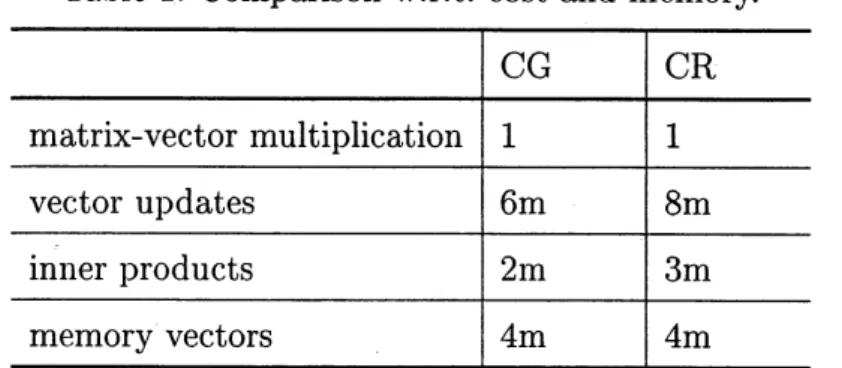
the conjugate residual method (CR hereafter).Table 1 shows
a
comparison between CG and CR with respect to computa-tional costs at each iteration and memory.Table 1. Comparison w.r.t. cost and memory.
Although CR is expensive than CG with respect to vector updates and inner products at each iteration, the total computat,ionalcosts during each iteration
in CG and CR
are
almost equalbecause the dense matrix-vectormultiplication is the major part. Fewer iterations to achieve the stopping criterionmeans
better performance ofconvergence.4 Numerical experiments
In this section,
we
report several numerical experiments to compare the com-putational performance between CG and $\mathrm{C}\mathrm{R}$. All experiments have beencar-ried out with double precision floating point arithmetic
on an
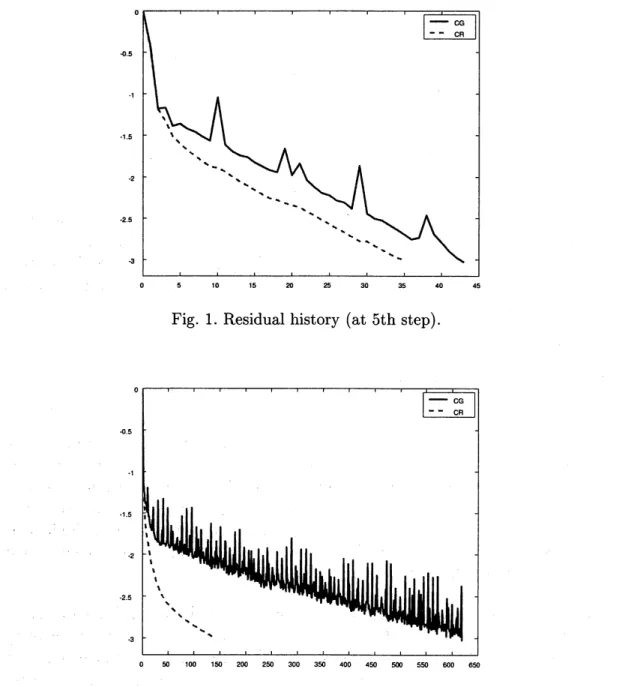
Alpha computer ($750\mathrm{M}\mathrm{H}_{\mathrm{Z})}$. We always $\mathrm{c}\mathrm{h}_{\mathrm{o}\mathrm{O}\mathrm{S}}\mathrm{e}$ the initial guess$x_{0}=0$ in ALGORITHM 1 and ALGORITHM 2. Allfigures throughout this section display the logarithmic rela-tive residual 2-norm $\log_{10}||r_{i}||/||r_{0}||$ (on the vertical axis)
versus
the iterationnumber $i$ (on the horizontal axis).
Here
we
consider a Maximum Clique problem. Here all data in (1)are
givenas
follows: $A_{0}$ is the matrix whose all elementsare
equal to 1, $A_{1}$ is the identitymatrix, $A_{l}$ $(l=2, \cdots , m)$ is
a
matrix in which the ij-th andji-th elementsare
equal to $-1$ for
a
given integer pair $(i,j)(1\leq i<j\leq n)$ and else elementsWe applied the interior-point method to
a
Maximum Clique problem and its dual problem simultaneously with $m=9957$ and $n=200$. The following twofigures show the numerical results of CG
versus
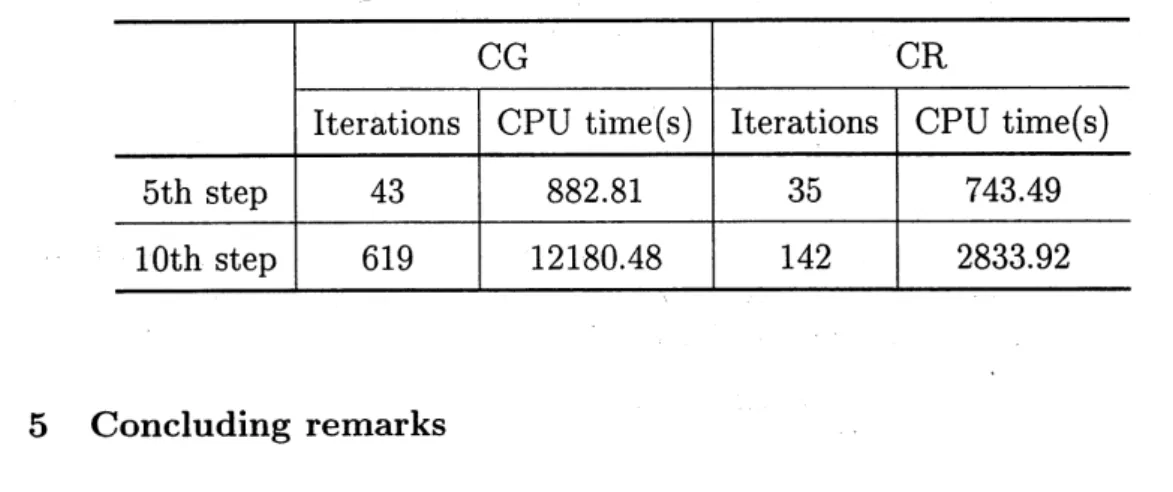
CR for solving SDP’s linearsystems at 5th step and 10th step in the interior-point method respectively. The stopping criterion is set
as
$10^{-3}$. Table 2 $\mathrm{s}h$ows
the performance for CGand
CR
in terms of the total numbers of iterations and CPU times to achievethe stopping criterion. Throughout the Maximum Cliqueproblem,
we
supposedeliberately that the all elements ofthe matrix$B$ in (2)
can
be not keptsimul-taneously in the memory of the computer. To compute $Bp_{i}$ in ALGORITHM 1
and
ALGORITHM
2, the element $B_{ij}$ is computed extemporaneously via (3) ateach iterative step. Note that the computation of $Bp_{i}$ costs very much, then
takes most ofCPU time.
Fig. 1. Residualhistory (at 5th step).
We observe that
CR
began toconverge
faster thanCG
at 5th step from Fig. 1 and Table 2. At 10th step where the approximate solution (X,$y,$ $Z$) in the interior-point methodwas
very close to the optimal solution,we
had to solvean
ill-posed matrix $B$ because $X$ and $Z$ became numerically nearly singular.From Fig. 2 and Table 2,
we
observe that CR becamemore
efficient andmore
useful for this difficult one. Therefore, itcan
be said that CR is suitable for the Maximum Clique problem.Table 2. $\mathrm{T}11\mathrm{e}$ performance for the Maximum Clique problem.
5 Concluding remarks
In the present paper,
we
considered the application of GCR to the large and dense line$a\mathrm{r}$ systems which arise from Semidefinite Programming. Comparingthe theoretic$a1$ aspect of CG and GCR, we emphasize that GCR has
some
$at$tractive and competitive features for solving SDP’s linear systems. The
nu-merical experiments showed that GCR is suitable and powerful for solving
SDP’s linear systems.
References
[1] F. Alizadeh, J.-P. A. Haeberly and M. L. Overton, Primal-dual
interior-point methods
for
semidefinite
programming: convergence rates, stability andnumerical results, SIAM J. Optim., 8 (1998) 746-768.
[2] B. Borchers, CSDP 2.3 user’s guide, Optimization Methods and Software,
11-12 (1999) 597-611.
[3] S. C. Eisenstat, H. C. Elman and and M. H.Schultz, Variational Iterative
Methods
for
Nonsymmetric Systemsof
Linear Equations, SIAM J. Numer.Anal., 20 (1983) 345-357.
[4] K. Fujisawa, M. Kojima and K. Nakata, SDPA (Semidefinite Programming
Algorithm) - user’s manual -, (Technical Report B-308, Department of
[5] K. Fujisawa, M. Fukuda, M. Kojima and K. Nakata, Numerical evaluation
of
SDPA (SemiDefinite Programming Algorithm), in: H. Frenk el at.,eds, High
Performance Optimization, (Kluwer Academic Publishers, 1999) 267-301.
[6] C. Helmberg, F. Rendl, R. J. Vanderbei and H. Wolkowicz, An interior-point
method
for
semidefinite
programming, SIAM J. Optim., 6 (1996) 342-361.[7] M. R. Hestenes and E. Stiefel, Methods
of
conjugate gradientsfor
solving linearsystems, J. Res. Nat. Bur. Standards, 49 (1952) 409-435.
[8] E. F. Kaasschieter, Preconditioned conjugate gradients
for
solving singularsystems, J. Comput. Appl. Math., 24 (1988) 265-275.
[9] M. Kojima, S. Shindoh and S. Hara, Interior-point methods
for
the monotonesemidefinite
linear complementarity problems, SIAM J. Optim., 7 (1997)86-125.
[10] C. Lin and R. Saigal, Onsolving large-scale
semidefinite
programmingproblems-a cproblems-ase study
of
quadratic assignment problem, (Technical report, Departmentof Industrial and Operations Engineering, University of Michigan, 1998).
[11] R. D. C. Monteiro, Primal-dual path-following algorithms
for
semidefinite
programming, SIAM J. Optim., 7 (1997) 663-678.
[12] R. D. C. Monteiro and Y. Zhang, A
unified
analysisfor
a classof
path-following primal-dual interior-point algorithms
for
semidefinite
programming,Math. Programming, 81 (1998) 281-299.
[13] K. Nakata, K. Fujisawa and M. Kojima, Using the conjugate gradient method
in interior-point methods
for
semidefinite
programs (in Japanese), Proceedingsof the Institute of Statistical Mathematics, 46 (1998) 297-316.
[14] F. A. Potra, R. Sheng and N. Brixius, SDPHA -a MATLAB implementation
of
homogeneous interior-point algorithmsfor semidefinite
programming,(Department ofMathematics, University of Iowa, 1997).
[15] K. C. Toh, M. J. Todd and R. H. T\"ut\"unc\"u, SDPT3 -a MATLAB
software
package
for
semidefinite
programming, (Dept. of Mathematics, NationalUniversity ofSingapore, 1996).
[16] L. Vandenberghe and S. Boyd,
Semidefinite
programming, SIAM Rev., 38(1996) 49-95.
[17] S.-L. Zhang, Y. Oyanagi and M. Sugihara, Necessary and
Sufficient
Conditionsfor
Convergenceof
$\mathrm{O}rth_{\mathit{0}}\min(k)$ on Singular and Inconsistent Linear Systems,Numer. Math., 87-2 (2000) 391-405.
[18] Q. Zhao, S. E. Karisch, F. Rendl and H. Wolkowicz,
Semidefinite
programmingrelaxation