Japan Advanced Institute of Science and Technology Title Interphase transfer of plasticizer between
immiscible rubbers
Author(s) Kuhakongkiat, Nawaphorn; Wachteng, Viyada; Nobukawa, Shogo; Yamaguchi, Masayuki Citation Polymer, 78: 208-211
Issue Date 2015-10-09
Type Journal Article
Text version author
URL http://hdl.handle.net/10119/14818
Rights
Copyright (C)2015, Elsevier. Licensed under the Creative Commons Attribution-NonCommercial-NoDerivatives 4.0 International license (CC BY-NC-ND 4.0).
[http://creativecommons.org/licenses/by-nc-nd/4.0/] NOTICE: This is the author's version of a work accepted for publication by Elsevier. Nawaphorn Kuhakongkiat, Viyada Wachteng, Shogo Nobukawa, Masayuki Yamaguchi, Polymer, 78, 2015, 208-211,
http://dx.doi.org/10.1016/j.polymer.2015.09.079 Description
Interphase Transfer of Plasticizer between Immiscible Rubbers
Nawaphorn Kuhakongkiat,
1)Viyada Wachteng,
2)Shogo Nobukawa,
1)and Masayuki Yamaguchi
1)*1) School of Materials Science, Japan Advanced Institute of Science and Technology 1-1 Asahidai, Nomi, Ishikawa 923-1292 JAPAN
2) Department of Chemistry, Faculty of Science, Mahidol University Rama VI Road, Ratchthewee, Bangkok 10400 THAILAND
*Corresponding author: M. Yamaguchi Phone: +81-761-51-1621
Fax: +81-761-51-1149
ABSTRACT
Interphase transfer of di-2-ethylhexyl adipate (DOA) between ethylene-propylene copolymer (EPR) and polyisobutylene (PIB) in the laminated sheets was studied. It was found that the amount of DOA in each phase is determined by the ambient temperature. DOA moved to EPR from PIB at -20 oC and vice versa at 40 oC, when the DOA content before lamination was 10 phr. This is attributed to the change of interaction parameters between DOA and each rubber as a function of temperature. Because of the DOA transfer, the glass transition temperature of each rubber phase changes with the ambient temperature. The phenomenon can be applicable to an all-season tire, when a matrix polymer contains more plasticizer at low temperature and vice versa in a blend with sea-island structure.
1. Introduction
The addition of a third component in an immiscible polymer blend is often carried out in polymer industries to obtain a high-performance polymeric material. When a low molecular weight compound is used as a third component, it is usually dissolved into polymers due to the contribution of mixing entropy, in which the content of a third component in each phase is not the same in general. In fact, uneven distribution occurs owing to the difference in the miscibility of a third component with each polymer.1-5 The miscibility of polymer blends is expressed by the Flory-Huggins equation, in which the Flory-Huggins interaction parameter represents the contribution of the mixing enthalpy and other factors except for the combinatorial entropy.6,7 Furthermore, the interaction parameter is known to be a function of temperature, which affects the phase diagram.8-10 As similar to a polymer blend, the interaction parameter between a low molecular weight compound and a polymer is also dependent upon the temperature. Since a low molecular weight compound tends to be dissolved more in a polymer due to the large contribution of mixing entropy, the distribution state of a third component in an immiscible polymer blend could be controlled by the ambient temperature. This phenomenon occurs with the migration of a third component from one phase to another through the boundary of phases, which has been confirmed by several researchers using laminated sheets and/or blends composed of immiscible polymer pairs containing a third component, such as nanofiller, tackifier, and curative for rubbers.11-16 Here, we propose a novel material design using the plasticizer transfer in an immiscible rubber blend, in which a matrix shows low glass transition temperature Tg in winter and high Tg in
summer season. In this study, amorphous polyolefins, such as polyisobutylene (PIB) and ethylene-propylene copolymer (EPR), were employed. As a third component, di-2-ethylhexyl adipate (DOA), known as a plasticizer, was employed because it can decrease Tg greatly. The
found to decrease with increasing the temperature,17,18 indicating that the difference in the interaction parameter between each rubber and DOA also changes with the ambient temperature. This will lead to the interphase transfer of DOA in the blend and change the distribution state in each rubber phase. Since the amount of a plasticizer greatly affects Tg, it
can be used for a material design of an all-season tire.
2. Experimental 2.1 Materials
Ethylene-propylene rubber (EPR) (JSR EP11, ethylene content 52 wt.%, JSR, Japan), polyisobutylene (PIB) (Sigma-Aldrich, USA), and di-2-ethylhexyl adipate (DOA) (New Japan Chemical, Japan) were used in this study. The molecular weights of the rubbers were evaluated using a gel permeation chromatography (HLC 8020, Tosoh, Japan) with polystyrene standard and found to be Mn = 3.4 x 10⁶ and Mw = 4.7 x 10⁶ for EPR and Mn =
5.6 x 10⁶ and Mw = 7.5 x 10⁶ for PIB, respectively.
2.2 Sample Preparation
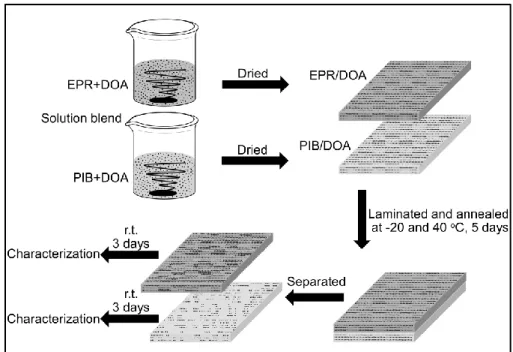
A rubber and 10 phr of DOA were blended in a mixed solvent of dichloromethane and toluene (8:2). After slowly evaporating the solvent, the obtained mixture, i.e., a rubber with DOA, was compressed into a flat sheet with 1 mm thickness using a compression-molding machine at 100 oC under 20 MPa. The EPR and PIB sheets containing 10 phr of DOA were laminated together under an applied slight pressure by manual operation. Then the samples were annealed without pressure at -20 and 40 oC for 5 days. Fig. 1 shows the experimental procedure for the interphase transfer experiment. In order to confirm the reversibility of the DOA transfer phenomenon, one set of the laminated sheets annealed at 40 oC (or -20 oC) was
further annealed at -20 oC (or 40 oC). The separated sheets were kept at room temperature for 3 days to homogenize the DOA distribution in a sheet prior to the characterization.
Fig. 1 Schematic illustration of experimental procedure.
Moreover, crosslinked rubbers were also prepared to predict the difference in the interaction parameter between EPR-DOA and PIB-DOA. As a curing agent, 2 phr of sulfur (Kanto Chemical, Japan) was added with 2 phr of N-tert-butyl-2-benzothiazole sulfonamide (Alfa Aesar, UK) as an accelerator for each rubber. Furthermore, 3 phr of zinc oxide (Kanto Chemical, Japan) and 1.5 phr of stearic acid (Sigma Aldrich, USA) were also added as activators. They were mixed together at 60 oC in an internal batch mixer (Labo-Plastomill, Toyoseiki, Japan) with a blade rotation speed of 40 rpm. The curing was performed using a compression-molding machine at 170 oC under 20 MPa for 15 min and subsequently cooled at 15 oC for 10 min. The thickness of the film was 1 mm.
2.3 Measurements
Temperature dependence of the dynamic tensile modulus was measured by a dynamic mechanical analyzer (DVE3, UBM, Japan). The specimen with 5 mm in width and 20 mm in ength was employed. The measurements were performed from -100 to 100 oC at a heating rate of 2 oC/min. The frequency was 10 Hz. The peak temperature in the tensile loss modulus was taken to define Tg.
Thermal properties were evaluated by a differential scanning calorimeter (DSC) (DSC 8500, Perkin Elmer, USA). Measurements were carried out from -100 to 25 oC at a heating rate of 10 oC/min.
The attenuated total reflection (ATR) spectra were measured by a Fourier–transform infrared spectroscopy (FT-IR) analyzer (Spectrum 100, Perkin Elmer, USA) using diamond as an ATR plate. The DOA content is evaluated by the absorption peak at 1740 cm-1 ascribed to the C=O=C stretching vibration mode.
The swell ratio of crosslinked rubbers in DOA was measured. The crosslinked rubber films were immersed in toluene at 25 oC to evaluate the crosslink density. Moreover, they were immersed in DOA at -20 or 40 oC for 5 days to measure the weight of the swollen gel
Ws. They were then immersed in ethanol several times to remove DOA perfectly. The
samples were dried in a vacuum oven to measure the weight of the dry gel Wd. The swell
ratio 𝑞 was defined as follows;
d s
W W
q (1)
3. Results and discussion
Prior to the evaluation of the transfer phenomenon, the effect of the DOA addition on the dynamic tensile modulus is examined. Fig. 2 shows the temperature dependence of tensile
storage modulus E' and loss modulus E'' for pure polymers and the polymers with 10 phr of DOA. It is found that the peak temperatures of E'', defined as Tg, shift to lower temperature
by the addition of DOA. The Tg shift for EPR is more pronounced than that for PIB,
presumably owing to higher Tg for EPR. The peak width is not so affected by the DOA
addition, suggesting the narrow distribution of relaxation time, i.e., good miscibility. The rubbery plateau modulus decreases slightly by the DOA addition. This is reasonable because the entanglement density decreases.
Fig. 2 Temperature dependence of (circles) storage modulus E' and (diamonds) loss modulus E'' for (open symbols) pure rubber and (closed symbols) rubber containing 10 phr of DOA;
(a) EPR and (b) PIB.
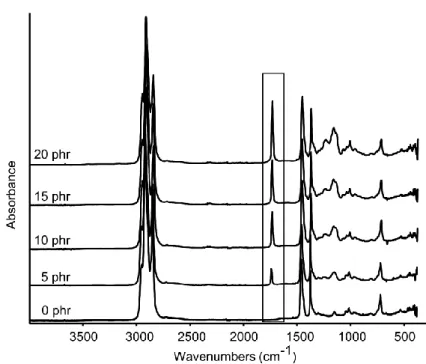
The amounts of DOA can be characterized by FT-IR spectra using the peak intensity at 1740 cm-1, ascribed to the stretching vibration mode of the carbonyl group in DOA. At first, the peak intensities are evaluated using the EPR sheets containing various amounts of DOA, as shown in Fig. 3. This peak is appropriate to estimate the DOA amount, because (1) pure EPR does not show any absorbance; and (2) good reproducibility with almost no experimental error.
Fig. 3 ATR-FT-IR spectra of the EPR sheets with various amounts of DOA.
The laminated samples composed of the EPR and PIB sheets, in which 10 phr of DOA was added into each sheet, were annealed at -20 or 40 °C for 5 days. Assuming that the diffusion constant of a low molecular weight compound in a rubber is 10-11 m2/s,19 it takes 1 day for the diffusion distance of 1 mm, i.e., the thickness of the sheet. Therefore, the annealing time is long enough to be in the equilibrium state from the viewpoint of the DOA distribution. In this experiment, the laminated sheets were separated without any difficulty, suggesting that the interfacial thickness λ, provided by equation (2),20,21 is too thin to show strong adhesion because of a small number of entanglement couplings at boundary;
1/26 2
b (2)
where χ is the polymer-polymer interaction parameter and b is the statistical segment step length.
The weak interface is attributed to the immiscible nature between PIB and EPR. Although Krishnamoorti and Graessley reported that the lower critical solution temperature (LCST) for PIB and EPR system is approximately 25 °C,22 the high molecular weight of the rubbers used in this study is responsible for the immiscibility. The interphase transfer of DOA between two rubbers is examined by the characterization of the separated sheets after exposure to the annealing operation of the laminated sheets. Both sheets contain 10 phr of DOA prior to the lamination. Fig. 4 shows the ATR spectra for the EPR/DOA sheets separated from PIB/DOA after annealing at different temperatures. Since the separated sheets were kept at room temperature for 3 days as the same with the sample sheets prepared to produce a calibration curve, the DOA distribution in the sheet must be homogeneous. As shown in the figure, the peak intensity at 1740 cm-1 is greatly affected by the annealing temperature; strong peak after annealing at -20 oC and weak one at 40 oC.
Fig. 4 ATR-FT-IR spectra of the EPR sheets separated from PIB sheets after annealing
For the quantitative evaluation of the amount of DOA transfer between rubbers during annealing, the calibration curve is produced using the EPR sheets with DOA. The absorbance is proportional to the weight percentage of DOA. The two dotted lines in Fig. 5 represent the absorbances of the EPR sheets after separation. From the results, 5.4 phr (5.2 wt.%) of DOA transfers from PIB to EPR by the annealing procedure at -20 oC. In the case of 40 oC annealing, 3.6 phr (3.5 wt.%) of DOA moves from EPR to PIB, i.e., the opposite direction. The measurements are also carried out using samples after multiple annealing treatments, e.g., -20 oC annealing after 40 oC annealing. It is found that the DOA amount is determined by the temperature at the final annealing procedure.
Fig. 5 Absorbances at 1740 cm-1 for the EPR/DOA sheets containing various amounts of DOA. The absorbances after annealing are also indicated by the dotted lines.
The DOA amount in each sheet is affected by the ambient temperature, i.e., annealing temperature. Therefore, Tg of each sheet after separation changes with the annealing
temperature. Fig. 6 shows the temperature dependence of tensile loss modulus E'' of the separated sheets after annealing at -20 and 40 oC. After annealing at -20 oC, Tg’s of EPR and
PIB shift to low and high temperatures, respectively, as compared with those of the virgin samples, i.e., the rubber containing 10 phr of DOA. It is reasonable because the DOA transfer occurs from PIB to EPR. At the high annealing temperature, in contrast, the transfer direction is opposite, in which Tg of EPR shifts to higher temperature and vice versa. The results
correspond with the FT-IR spectra.
Fig. 6 Temperature dependence of tensile loss modulus E'' for the sample sheets separated
after annealing for 5 days at (closed symbols) -20 oC and (opened symbols) 40 oC ; (top) EPR, α=1 and (bottom) PIB, α=0.
Since the initial concentration of DOA, i.e., 10 phr, is the same for both rubbers, the transfer occurs by the difference in the Flory-Huggins interaction parameter between EPR-DOA and PIB-EPR-DOA. Furthermore, the interaction parameter must depend on the ambient temperature.
The difference in the interaction parameter and its temperature dependence were estimated by the immersion experiments using crosslinked rubbers. According to the theory
proposed by Flory and Rehner,23 the swell ratio is determined by the network chain density in a crosslinked rubber and the interaction parameter as shown in equation (3).
1/3 1
1 1 1 5 . 0 1 ln * q q V q q q v (3)where 𝑣∗ is the network chain density, 𝑞 is the swell ratio, and 𝑉 is the partial molar volume
of the solvent.
At first, the crosslinked rubbers were immersed into toluene to evaluate the crosslink density of both rubbers. Because the interaction parameter between each rubber and toluene at room temperature was already reported, i.e, 0.49 for EPR-toluene and 0.557 for PIB-toluene,23,24 the crosslink densities can be calculated as follows; 6.3 x 10⁻¹¹ [mol/m3] for EPR and 2.0 x 10⁻¹¹ [mol/m3] for PIB. Then, the crosslinked rubbers were immersed into DOA at specific temperatures, i.e., -20 and 40 oC, to measure the swell ratio. It was found that the equilibrium swell ratio of EPR (1.32) is larger than that of PIB (1.18) at -20 oC. In contrast, PIB shows a larger swell ratio than EPR at 40 oC (EPR 1.82 and PIB 2.21). Since the network chain density in each rubber is revealed, the interaction parameter with DOA can be quantitatively calculated as follows; 0.59 for EPR-DOA and 2.15 for PIB-DOA at -20 oC; and 0.41 for EPR-DOA and 0.27 for PIB-DOA at 40 oC. As demonstrated, the interaction parameter of EPR-DOA is lower than that of PIB-DOA at -20 oC, and vice versa at 40 oC. This result corresponds with the DOA transfer phenomenon.
4. Conclusions
Two rubber sheets with DOA were laminated and annealed at -20 and 40 oC. After separation, FT-IR measurements and dynamic mechanical properties were carried out using each rubber sheet to estimate the DOA transfer through one rubber to another. It was found that DOA transfers from PIB to EPR at -20 oC and vice versa at 40 oC. Correspondingly, the
EPR sheet shows low Tg after annealing at -20 oC and high Tg at 40 oC. Although the
laminated sheets were employed in this study, the temperature-dependent-transfer of DOA is expected even in the EPR/PIB blend with sea-island structure. In the case of the blend with EPR as a matrix phase, Tg of the matrix is low in winter and high in summer season, which
provides the possibility to develop an all-season tire.
References
[1] M. Sumita, K. Sakata, Y. Hayakawa, S. Asai, K. Miyasaka, M. Tanemura, Colloid Polym. Sci. 270 (2) (1992) 134-139.
[2] N. Moussaif, R. JérÔme, Polymer 40 (14) (1999) 3919-3932.
[3] T.S. Jose, A. Anand, R. Joseph, Int. J. Polym. Mater. 59 (7) (2010) 488-497.
[4] A. Das, R.N. Mahaling, K.W. Stöckelhuber, G. Heinrich, Compos. Sci. Technol. 71 (3) (2011) 276-281.
[5] A. Gӧldel, A. Marmur, G.R. Kasaliwal, P. Pӧtschke, G. Heinrich, Macromolecules 44 (15) (2011) 6094-6102.
[6] P.J. Flory, J. Chem. Phys. 10 (51) (1942) 51-61.
[7] M.L. Huggins, J. Phys. Chem. A 46 (1) (1942) 151-158.
[8] W.W. Graessley, R. Krishnamoorti, G.C. Reichart, N.P. Balsara, L.J. Fetters, D.J. Lohse, Macromolecules 28 (4) (1995) 1260-1270.
[9] A.J. Nedoma, M.L. Robertson, N.S. Wanakule, N.P. Balsara, Ind. Eng. Chem. Res. 47 (10) (2008) 3551-3553.
[10] M. Tambasco, J.E.G. Lipson, J.S. Higgins, Macromolecules 39 (14) (2006) 4860-4868.
[12] A.E. Zaikin, E.A. Zharinova, R.S. Bikmullin, Polym. Sci. Ser. A Chem. Phys. 49 (3) (2007) 328-336.
[13] H. Yoon, K. Okamoto, M. Yamaguchi, Carbon 47 (12) (2009) 2840-2846. [14] S.H. Im, S.S. Choi, Elastomers Compos. 44 (4) (2009) 397-400.
[15] H.H. Le, S. Ilisch, D. Heidenreich, A. Wutzler, H.J. Radusch, Polym. Compos. 31 (10) (2010) 1701-1711.
[16] V.A. Doan, S. Nobukawa, S. Ohtsubo, T. Tada, M. Yamaguchi, J. Mater. Sci. 48 (5) (2013) 2046-2052.
[17] K. Freed, J. Dudowicz, Macromolecules 29 (2) (1996) 625-636. [18] P. White, J.E.G. Lipson, Macromolecules 45 (21) (2012) 8861-8871.
[19] Z. Tadmor, C.G. Gogos, Principles of Polymer Processing, Wiley-Interscience Press, New York, 1979.
[20] E. Helfand, Y. Tagami, J. Polym. Sci., Part B: Polym. Phys. 9 (10) (1971) 741-746. [21] E. Helfand, Y. Tagami, J. Chem. Phys. 56 (7) (1972) 3592-3601.
[22] R. Krishnamoorti, W.W. Graessley, L.J. Fetters, R.T. Garner, D.J. Lohse, Macromolecules 28 (4) (1995) 1252-1259.
[23] L.R.G. Treloar, The Physics of Rubber Elasticity, Oxford University Press, New York, 1975.