The Establishment of
in vitro Culture and Genetic Transformation of
the Wheat
Glu-1Dx5 Gene to Rice Plants by Gene Gun Bombardment
2007. 9
Science of Plant and Animal Production
United Graduate School of Agricultural Science
Tokyo University of Agriculture and Technology
This research was conducted from October 2004 to May 2007 at Utsunomiya University, Japan. The work carried out during the course of this research has resulted in the following publications:
1) Nono Carsono and Tomohiko Yoshida (2006)
Identification of Callus Induction Potential of 15 Indonesian Rice Genotypes Plant Production Science 9 (1) : 65-70.
2) Nono Carsono and Tomohiko Yoshida (2006)
Plant Regeneration Capacity of Calluses Derived from Mature Seed of Five Indonesian Rice Genotypes
Plant Production Science 9 (1) : 71-77.
3) Nono Carsono and Tomohiko Yoshida (2007)
Variation in Spikelet-Related Traits of Rice Plants Regenerated from Mature Seed-derived Callus Culture
Plant Production Science 10 (1) : 86-90. 4) Nono Carsono and Tomohiko Yoshida
Transient Expression of Green Fluorescent Protein Gene in Rice Calluses: Optimization of Parameters for Helios Gene Gun Bombardment
Reviewed in Plant Production Science 5) Nono Carsono and Tomohiko Yoshida
Genetic Transformation of the Wheat Glu-1Dx5 Gene into Rice cv. Fatmawati In preparation
Contents
General Summary 1
Summary 2
I Introduction 5
II Establishment of in vitro Culture for the Success of Genetic Transformation
2.1 Callus Induction Potential of 15 Indonesian Rice Genotypes
2.2 Plant Regeneration Capacity of Calluses Derived from Mature Seeds of Five Indonesian Rice Genotypes
13 26
III Assessment of Somaclonal Variants from Primary Callus-derived Plants Variation in the Spikelet-related Traits of Rice Plants Regenerated from Mature
Seed-derived Callus Culture 42
IV Genetic Transformation of Rice Plants Using Helios Gene Gun for Developing Transgenic Rice Lines
4.1 Transient Expression of Green Fluorescent Protein in Rice Calluses: Optimization of Parameters for Helios Gene Gun Bombardment
4.2 Genetic Transformation of the Wheat Glu-1Dx5 Gene to Rice cv. Fatmawati
53 70 V Gene Transfer to Rice Mediated by Agrobacterium tumefaciens
Transient Expression of Green Fluorescent Protein in Rice Calluses of cvs.
Fatmawati and Nipponbare 81
VI General Discussion 91 References Acknowledgment 96 106
General Summary
The work carried out and presented in this thesis was mainly aimed to establish a suitable in vitro culture system as well as to introduce the wheat Glu-1Dx5 gene encoding a high molecular weight glutenin subunit 1Dx5 into rice genome using HeliosTM gene gun bombardment.
Reliable phenotypic assessment on callus performance was able to identify promising genotypes with high quality callus production. Genotype, medium and explant are considered to be essential factors for inducing high quality calluses. Five selected Indonesian rice genotypes were capable in regenerating whole green plants. Genotypes Fatmawati and BP-140 consistently performed best in callus subculture as well as in plant regeneration. Culture media D1 and NB5 were the most suitable media for callus subculture
and plant regeneration, respectively. Phenotypic evaluation in the spikelet-related traits of primary callus-regenerated plants (T0) showed that the occurrence of somaclonal variants varied with the genotype. The
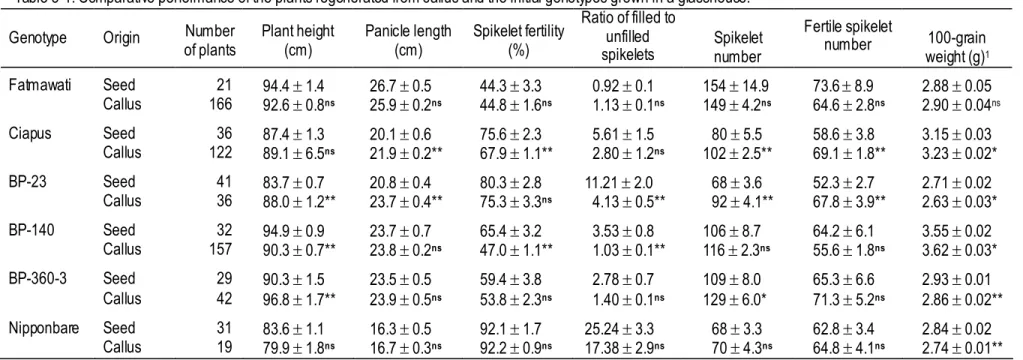
spikelet fertility of the regenerated rice plants was not significantly lower than that of the initial plants except in Ciapus and BP-140.
Optimization of parameters of HeliosTM gene gun for rice callus bombardment based on synthetic
green fluorescent protein (sgfp) expression has been successfully conducted. Parameters found to be the most favorable conditions were as follows: 250 psi helium pressure, 0.6 m gold particle size, 0.25 mg gold particles per shot, and 1.5 g plasmid-DNA per shot.
The introduction of the wheat Glu-1Dx5 gene in combination with either selectable marker bar or hpt gene into rice cv. Fatmawati has been performed well. PCR analysis confirmed the presence of transgene in the genome of some transgenic plants. These plants will be incorporated into breeding program for further assessment of their benefits.
The significant differences in transient expression of sgfp of two genotypes mediated by Agrobacterium were found with regard to the osmotic treatment (0.4 M mannitol), solid-subcultured callus, and 10 min. air drying. The highest sgfp expression was achieved in Nipponbare callus treated with 10 min air drying. The level of green fluorescent spots was higher in Nipponbare than that in Fatmawati.
Summary
Rice is one of the important food crops that serves energy for human life, thus attempts on genetic improvement of rice crop would have a significant contribution to the benefits of humankind. This thesis was mainly devoted to introduce the wheat Glu-1Dx5 gene encoding a high molecular weight glutenin subunit 1Dx5 which is one of the major determinants of bread-making quality in bread wheat (Triticum aesticum L.) into rice genome. Steps in establishing callus induction, proliferation and in vitro plant regeneration, assessing somaclonal variants of primary callus-regenerated plants, optimizing the parameters of HeliosTM gene gun device and transforming the rice plants with this valuable gene accompanied with selectable marker bar gene conferring resistance to herbicide bialaphos or hpt gene harboring resistance to hygromycin B using Helios gene gun were also presented. Finally, transient expression of synthetic green fluorescent protein (sgfp) mediated by Agrobacterium in two cvs. Fatmawati and Nipponbare was described. This present study has highlighted some interesting findings as described bellow: 1. Callus induction is one of the substantial steps for selecting the suitability of genotypes for
tissue culture-based research and for plant improvement program, particularly for genetic transformation. Genotype x medium x explant interaction effect was found for inducing high quality callus in terms of white/cream/yellow callus with an organized structure (callus type I and II) and for callus browning, but not for callus induction ability and diameter of callus. Genotypes significantly differed in inducing high quality of calluses depending on medium and explant used. Four indica types, Fatmawati, Ciapus, BP-23 and BP-360-3, had callus quality-related traits similar to those of Nipponbare. Culturing seed explant on MS was more suitable for callus induction than either root explant on MS or both explants on CI medium.
2. Establishment of a suitable system for multiplication and plant regeneration of rice calluses is a prerequisite for the success of genetic transformation using callus as the target tissue. The experiment with five Indonesian rice genotypes showed that callus-growth capacity was significantly affected by genotype and callus-proliferation capacity by medium. The interaction effect between genotype and medium was found on both shoot-regeneration and plantlet-regeneration capacities. However for green plant-plantlet-regeneration capacity, it was affected independently by genotype and medium. Culture media D1 and NB5 were the most suitable media for callus subculture and plant regeneration, respectively. Genotypes Fatmawati and BP-140 consistently performed best in the callus subculture and plant regeneration.
3. Callus is an excellent source for in vitro plant regeneration, but plants regenerated from callus sometimes show phenotypic and genotypic variation from the initial plants. Phenotypic variation in the spikelet-related traits of the callus-regenerated plants was not always in a reduction in their mean value. For instance, panicle length, spikelet number and fertile spikelet number of Indonesian rice genotypes Ciapus and BP-23 in the regenerated plants were significantly greater than those of the seed-grown plants. The spikelet fertility of the regenerated rice plants was not significantly lower than that of the initial plants, except in Ciapus and BP-140. The occurrence of somaclonal variants varied with the genotype. Ciapus, BP-23 and BP-140, which induce many somaclonal variants, are suggested to be valuable for genetic, breeding or functional genomic studies, while the opposite, Fatmawati could be used for genetic transformation study.
4. An optimized condition for particle bombardment is necessary for efficient genetic transformation. The parameters for HeliosTM gene gun, another device for cell transformation, were optimized based on transient expression of synthetic green fluorescent protein (sgfp) in rice calluses of indica cv. Fatmawati and japonica cv. Nipponbare. Parameters found to be the most favorable conditions for transient expression of sgfp in rice callus cells were as follows: 250 psi helium pressure, 0.6 m gold particle size, 0.25 mg gold particles per shot, and 1.5 g plasmid-DNA per shot. Desiccation of callus cells for eight min. was found also appropriate. The level of transient sgfp expression was not significantly influenced by the pre-culture for 4 to 12 days before bombardment or by callus age between 10 and 33-weeks old in Fatmawati. Optimized parameters for this particular device should improve the transient expression, thus enabling stable expression of introduced genes via HeliosTM gene gun using callus as a target tissue.
5. The wheat Glu-1Dx5 gene encoding a high molecular weight (HMW) glutenin subunit 1Dx5 from bread wheat, Triticum aesticum L. and either bar gene conferring resistance to herbicide bialaphos or hpt gene conferring resistance to hygromycin B was co-transformed to rice callus cells of cv. Fatmawati using Helios gene gun device. Nine plants regenerated from bialaphos-containing medium and ten plants from hygromycin-bialaphos-containing medium were molecularly characterized. By means of PCR analysis, the Glu-1Dx5 gene had been integrated into some transgenic rice plants. These plants will be incorporated into breeding program for further assessment of their benefits.
6. Transient expression of synthetic green fluorescent protein (sgfp) gene mediated by
Agrobacterium is rapid and useful approach for visual monitoring the genetic transformation
event in transformed cells/tissues of examined genotype. The significant differences in transient expression of two genotypes were found with regard to the osmotic treatment (0.4 M mannitol), solid-subcultured callus, and 10 min. air drying. While, no significant differences in
sgfp expression were observed in two genotypes on without air-drying and 5 min. air-drying of
calluses prior immersed in Agrobacterium suspension. Surprisingly, the sgfp expression could not be detected in suspension-subcultured callus of both cultivars. The highest sgfp expression was achieved in Nipponbare callus treated with 10 min. air drying. The level of green fluorescent spots was higher in Nipponbare than that in Fatmawati, however, plants regenerated from Fatmawati were considerably comparable with those of Nipponbare. Seventeen and 16 transgenic rice plants expressing sgfp transgene were obtained from Nipponbare and Fatmawati, respectively.
Chapter 1
Introduction
Rice (Oryza sativa L.) is a major staple food and one of the most important crops worldwide. More than half of the world’s population depends on rice for its major daily source of energy and protein. Twenty three percent of the total calories consumed globally are supplied by rice (Khus, 2001). There are two cultivated and twenty–one wild species of genus Oryza. O. sativa, the Asian cultivated rice is grown all over the world. The African cultivated rice, O. glaberrima is planted in small scale of West Africa (Khush, 1997). The majority of Asian rice cultivars can be classified as either japonica or indica, based on agro morphological traits (Oka and Morishima, 1997) and supported by a number of studies based on the use of molecular marker, such as isozymes (Glaszmann, 1987), restriction fragment length polymorphisms (RFLP; Wang and Tanksley, 1989), amplicon length polymorphisms (ALP; Xu et al., 1998), inter-simple sequence repeat (ISSR; Blair et al., 1999) and short interspersed elements (SINE; Cheng et al., 2003). These studies show a clear genetic differentiation between two subspecies groups, indica and japonica, arose from two independent domestication events in Asia.
Currently, rice is recognized as a model plant for the study of cereals genomes (Shimamoto and Kyozuka, 2002), due to its small genome size (~430 Mb), the availability of complete genome sequence (Sasaki et al., 2002), the largeness of public germplasm collection and the development of several key genomic mapping resources (McCouch et al., 2002) and synteny with other cereals crops (Sasaki et al., 2002).
At present, with the advent of recombinant DNA and genetic transformation techniques, it is now possible to transfer genes from other organisms into the plant genome. The genetic transformation has offered many advantages for basic research and plant improvement program. Those advantages are to find unknown function of the genes/cDNA sequence (Pereira, 2000), to introduce new gene pool (Gepts, 2002) and many desirable genes in a single event, to improve the crop with more precisely and in a relatively short time. This approach has been applied to complement traditional plant breeding methods in rice genetic improvement. Recently, it has
become a valuable approach for introduction of useful genes for rice quality improvement (Anai et al., 2003; Datta et al., 2003), molecular farming (Takagi et al., 2005; Yang et al., 2007), transposon tagging (Greco et al., 2001), developing rice plant resistant to biotic stress: insect pests (Tu et al. 1998; Shu et al., 2000), fungi (Patkar and Chattoo, 2006), bacteria (Patkar and Chattoo, 2006), virus (Sivamani et al., 1999) and rice plant tolerant to abiotic stress: drought (Sawahel, 2003), salinity (Oh et al., 2005), cold (Takesawa et al., 2002; Ozawa et al.,2006), and among others. It is clear that for many desirable traits from unrelated plants or other organisms, genetic transformation is the only source of variation for breeding programs. However, the application of genetic transformation to rice breeding requires efficient and reproducible in vitro culture systems that allow production of high number of regenerative tissues and recovery of fertile transgenic rice plants.
Callus, comprising mainly masses of undifferentiated cells, is a good starting material for in
vitro manipulation. Moreover, calluses, induced from scutellar tissue of mature seeds, are the
excellent source of cells for in vitro regeneration as stated in this thesis, and even for the production of transgenic rice (Hiei et al., 1994; Rashid et al., 1996). Genotypes, medium composition and explant sources are often considered to be essential factors in callus induction as well as in plant regeneration. Therefore, identification of high quality callus with regard to its appearance, such as good-looking, healthy/no browning and actively growing, which is supposed to be embryogenic calluses induced by some rice genotypes, is one of the most essential factors for efficient plant regeneration.
Plant regeneration has been known as a major bottleneck on the successful application of genetic transformation of valuable genes into rice genome. Rice genotypes display a wide range in regeneration capacity depending on their genetic background and their interaction with the culture media (Khanna and Raina, 1998; Lee et al., 2002; Lin and Zhang, 2005). Many leading varieties, such as Koshihikari in Japan and IR-64 in tropical country, show low regeneration capacities
(Nishimura et al., 2005), resulting in serious obstacle to efficient production of transgenic plants. In order to obtain high totipotency (i.e. capable of giving rise of a whole plant) and to facilitate recovery of stable and fertile transformants, appropriate genotype and medium culture should therefore be examined for the establishment of regeneration system.
Based on many earlier experiments, tissue culture may possibly induce variations (Larkin and Scowcroft, 1981; Karp, 1995), known as somaclonal variations which could be very valuable for rice breeding. However, the occurrence of somaclonal variants hampers the use of in vitro culture for the development of transgenic rice plants since somaclonal variants will complicate the evaluation of the effects of inserted genes. In addition, they have potential to alter agronomic characteristics of rice, such as, reducing the spikelet fertility, thus constitute a major problem especially for rice that generatively propagated by seeds. A preliminary assessment on the possibility of somaclonal variants from primary callus-regenerated plants is therefore considered necessary for evaluating the occurrence of tissue culture-derived variations in order to develop transgenic rice plants expressing the genes of particular interest without altering their phenotypes.
The introduction of genes into plant genome by means of genetic engineering is becoming an accepted technique in plant breeding. Genes derived from unrelated plant species and even other kingdoms (bacteria, fungi, animals), which would otherwise be inaccessible for plant breeder, can be introduced into plant breeding programs by this technology (De Block, 1993). The first transgenic rice plants were obtained by direct DNA uptake from protoplast (Toriyama et al., 1988). Shortly thereafter, transformation of several indica and japonica either by particle bombardment (Christou et al., 1991) or by Agrobacterium-mediated transformation (Hiei et al., 1994; Rashid et al., 1996; Kumria et al., 2001) was reported. Currently, production of transgenic rice plants become routine experiment in many laboratories in the world with various purposes. Even more, transgenic crops are grown at present on more than 40 million hectares in 13 countries around the world. Transgenic technology promises the great improvement for food and non food with regard to
quantity, quality, diversity, nutrient and environmental friendly products (Dunwell, 2002).
Genetic transformation mediated by particle bombardment-based technology offers the means of selective introducing of valuable genes to our source of energy, rice. Particle bombardment (bombarding nucleic acids-coated particles into the target cells) is now emerging as a new tool for delivering nucleic acids into target organisms. This innovative technique proved to work quite efficiently regardless of the genotype used, and is of particular utility for the transformation of recalcitrant species.
Genetic transformation of rice using particle bombardment has offered some attractive objectives. Those are as following: to obtain a large number of transformed plants (Dai et al., 2001), to get high transgene copy number (Dai et al., 2001; Shou et al., 2004), to introduce simultaneous multiple genes which are valuable for designing the metabolic pathway (Maqbool and Christou, 1999; Agrawal et al., 2005), plastid or chloroplast transformation (Daniell et al., 2001; Kanamoto et al., 2006), and to introduce the gene cassettes (promoter-coding sequence-terminator) without the sequence of vector (Breitler et al., 2002; Agrawal et al., 2005). Moreover, no biological constraints or host limitations, diverse cell types can be targeted efficiently and capable for delivery of high molecular weight DNA are other advantages of using particle bombardment (Alpeter et al., 2005). However, particle bombardment is still not devoid of all the disadvantages connected to direct DNA transfer, like multiple DNA integrations promoting rearrangements and transgene silencing (Dai et al., 2001; Taylor and Fauquet, 2002).
Particle bombardment has been fruitfully applied for genetic enhancement of rice crop. However, to date, most bombardment experiments for rice transformation utilize the PDS-1000/He Biolistic Particle Delivery System (for example, Bec et al., 1998; Ghosh-Biswas et al., 1998; Jiang et al., 2000; Martinez-Trujillo et al., 2003) and currently there is no protocol for rice callus cells bombarded using the HeliosTM gene gun device (Bio-Rad Laboratories, USA) and furthermore, transgenic plants obtained using this particular tool have not been reported yet. Moreover, some
physical and biological parameters of HeliosTM gene gun would affect the efficiency of transformation. Therefore, optimization of parameters for HeliosTM gene gun based on transient expression of green fluorescent protein (gfp) is considered necessary for efficient genetic transformation.
The use of gfp as a reporter gene is much valuable for confirming the expression of the inserted gene or transformation event in transformed cells or tissues. In plant science, gfp has been extensively applied for testing the efficacy of the promoter (Newell et al. 2003), detection of virus activity (Oparka et al. 1997), protein localization (Hibberd et al. 1998; Jang et al. 1999) and optimization of transformation methods (Tee and Maziah, 2005).
Other essential requirement for genetic transformation technology is the utilization of selectable marker genes, such as hpt (hygromycin phosphotransfrease gene) conferring resistance to Hygromycin B and bar (phosphinothricin N-acetyl transferase gene) harboring resistance to herbicide bialaphos. They could facilitate the selection and the recovery of transformed tissues. This is because the chances of recovering transgenic lines without selection are extremely low due to only a very small proportion of cells are transformed in most experiments. The selectable marker gene is usually co-transformed with a gene of interest. Once the transgenic plant has been generated, characterized and bred through classical genetic crosses, the selectable marker gene generally no longer serves an essential purpose (Miki and McHugh, 2004). Genetic transformation of rice has been successfully employed for quality improvement program. Such successful examples are rice with high iron content (Goto et al., 1999), human-lactoferrin (Nandi et al., 2002), low amylose content (Liu et al., 2005), and ß-carotene (Golden Rice, Datta et al., 2003). Other improvement on the rice grain quality, especially on rice flour quality, is of great relevance since Japan and Indonesia are rice producer countries in which rice is abundant available and rice flour has been used for many food products. However, dough from rice flour lacks extensibility and elasticity. A probable cause for this is that rice endosperm lacks the
proteins responsible for this trait. In contrast, dough made from wheat flour is elastic and extensible making it suitable for many food products particularly for bread (Sangtong et al., 2002).
Wheat flour is different from other cereal flours, including rice, because it contains gluten that gives it elasticity and extensity required for breadmaking quality in bread wheat (Triticum
aesticum L.; Payne et al., 1987; Barro et al. 1997). Gluten mainly consists of two types of seed storage proteins, the glutenins and the gliadins. Glutenins are classified into high-molecular-weight (HMW) subunits and low-molecular-weight (LMW) subunits. They are encoded by A1 loci,
Glu-B1 loci, Glu-D1 loci, located in the long arms of the chromosome of homoeologous group 1 (Payne
et al., 1987).
Genes encoding six HMW glutenins have been cloned (Anderson et al., 2002). The availability of cloned HMW glutenin genes allows plant transformation approaches to altering HMW glutenin content. Cloned HMW glutenin genes have been shown to be functional when introduced into tobacco (Roberts et al., 1989), wheat (Alvarez et al., 2000), tritordeum (Rooke et al., 1999), maize (Sangtong et al., 2002) and more recently into rye (Altpeter et al., 2004).
Although the HMW glutenins contribute only about 5% of the total protein in mature wheat kernels (Shewry et al., 1989), the elasticity of wheat dough depends mainly on the HMW glutenins, thus they are important determinants of bread-making quality (Payne et al., 1987). Moreover, Payne et al. (1987) reported that most good bread-wheat cultivars contain the 1Dx5-1Dy10 HMW glutenin combination. This suggests that bread-making quality is associated with the presence of this combination of HMW glutenins. It would be useful to set out the experiment to determine whether a wheat HMW glutenin gene could be used to develop rice with novel dough characteristics which could possibly substitute the wheat flour.
The scope of the thesis
The scope of the research work described in this thesis was to establish a suitable in vitro culture protocol and to develop transgenic rice lines with the wheat Glu-1Dx5 gene. This thesis
describes five major activities and one additional activity. Those are as following: 1. Study on callus induction potential of 15 Indonesian rice genotypes,
2. Establishment on plant regeneration system of mature seed-derived callus culture of five Indonesian rice genotypes,
3. Preliminary assessment on the spikelet fertility of primary callus-regenerated rice plants, 4. Optimization of parameters for HeliosTM gene gun bombardment for rice calluses based on
transient expression of green fluorescent protein,
5. Genetic transformation of the wheat Glu-1Dx5 gene into rice cv. Fatmawati using HeliosTM gene gun bombardment,
6. Transient expression of synthetic green fluorescent protein in calluses of cvs. Fatmawati and Nipponbare mediated by Agrobacterium tumefaciens
Chapter 2
Establishment of
in vitro Culture for the Success of Genetic
Transformation
2.1. Callus Induction Potential of 15 Indonesian Rice Genotypes
Abstract
Callus induction potential of 15 indica rice genotypes from Indonesia was examined in comparison with that of the japonica rice Nipponbare. Callus was induced from embryos of mature seeds and root segments on MS and CI media. There was genotype x medium x explant interaction effect for inducing white/cream/yellow callus with an organized structure (callus type I and II) and for callus browning, but not for callus induction ability and diameter of callus. Genotypes significantly differed in inducing high quality of calluses depending on medium and explant used. Four indica types, Fatmawati, Ciapus, BP-23 and BP-360-3, had callus induction-related traits similar to those of Nipponbare. These genotypes would be useful for tissue-culture based research and for crop improvement program, particularly for genetic transformation. Culturing seed explant on MS was more suitable for callus induction than either root explant on MS or both explants on CI medium.
Introduction
Callus induction is one of the substantial steps for selecting the suitability of genotype for tissue-culture-based research and for plant improvement program, particularly for genetic transformation. In rice, different callus types, i.e., type I, II, III and IV, can be induced (Visarada et al., 2002). Type I callus is white and cream colored compact organized callus, type II is yellow organized callus, type III is yellow or brown unorganized callus, and the type IV is highly unorganized white, yellow or brown callus. Type-I and-II calluses are embryogenic and can be induced from tissues of various organs such as immature seeds (Masuda et al., 1989), immature embryos (Koetje et al., 1989), and roots (Abe and Futsuhara, 1985; Hoque and Mansfield, 2004). The type-III callus is dark and necrotic. In general, immature embryos and meristematic tissues, having undifferentiated cells, are suitable for callus induction and plant regeneration than mature tissues (Morrish et al., 1987). However, such explants are available only in a restricted period of the growth cycle in the rice plant (Hoque and Mansfield, 2004), and to obtain such explants all year round, we have to grow the plants in a greenhouse. However, embryos of mature seeds are available throughout the year, and are more suitable for rice callus culture. The embryogenic calluses induced by culture of mature seeds are effectively used for genetic transformation by particle bombardment (Jiang et al., 2000) or Agrobacterium-mediated transformation (Kumria et al., 2001). The aseptic culture of root explants is also useful since it is relatively easy to provide in any season.
In the in vitro culture of rice, a significant difference in callus induction has been found among the different genotypes of indica rice (Abe and Futsuhara, 1986; Peng and Hodges, 1989; Seraj et al., 1997) and japonica rice (Yoshida and Oosato, 1998; Ogawa et al., 1999). Indica rice cultivars generally show less induction of callus formation than japonica (Abe and Futsuhara, 1986). Not only callus production, but also somatic embryogenesis and subsequent plant regeneration (Chu and Croughan, 1990) are also inferior in indica rice, which may limit the success in the transformation for indica rice.
Callus induction as well as regeneration potential is affected not only by genotype and the type of explant but also by the composition of the culture medium including plant growth regulators, and by the culture conditions. However, in particular, genotype and type of explant are important factors for the successful embryogenic callus induction and regeneration of rice plants (Rueb et al., 1994). In this study, genotypic differences among 15 Indonesian rice genotypes in callus induction potential was examined, combined with two types of explants (embryos of mature seed and root segment) and two culture media: MS (Murashige and Skoog, 1962) and CI (Potrykus et al., 1979).
The success using MS medium (Seraj et al., 1997; Khanna and Raina, 1998; Lee et al., 2002), as well as CI medium (Jiang et al., 2000) for callus induction has already been reported.
The objective of the present study was to identify callus induction potential of 15 Indonesian rice genotypes. The genotypes identified to have a good induction potential could then be utilized in tissue culture-based studies directed for the coming genetic transformation studies with the valuable genes of agricultural interest.
Materials and Methods
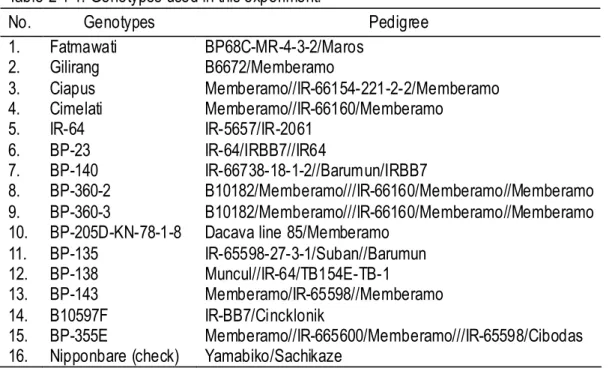
Fifteen indica rice genotypes from Indonesia (Table 2-1-1) and one japonica rice cv. Nipponbare as a check were used in the experiment since this genotype has been widely used as model plant in tissue culture and plant improvement studies (Ogawa et al., 1999; Sasaki and Burr, 2000; Kawahigashi et al., 2003). The first five genotypes listed in the table are broadly cultivated in Indonesia and the following ten genotypes are promising ones bred by Indonesia Institute for Rice Research (Sukamandi, Subang, West Java).
Mature healthy seeds were dehusked manually and soaked in 70% ethanol for 3 min. with gentle agitation followed by rinsing with sterile distilled water. The seeds were then surface sterilized in 50% commercial bleach (5% sodium hypochlorite) for 30 min. with agitation and rinsed with sterile distilled water three times. The root explants were obtained from the seedlings grown on MS-basal medium. The embryos of mature seeds (seed explants) and root segment (root explants, from 5- to 7-day-old seedling) were aseptically cultured on callus induction medium; eight explants were placed on a Petri dish (9 cm in diameter) containing 20 mL MS or CI medium supplemented with 2 mg L-1 2,4 dichlorophenoxyacetic acid (2,4-D) (Table 2-1-2). To anticipate the contamination that would arise, culturing additional explants of each genotype on both media was supplied. The pH of medium was adjusted to 5.8 before autoclaving, and the cultures were kept at 25±10C under dark condition.
Table 2-1-1. Genotypes used in this experiment.
No. Genotypes Pedigree
1. Fatmawati BP68C-MR-4-3-2/Maros 2. Gilirang B6672/Memberamo 3. Ciapus Memberamo//IR-66154-221-2-2/Memberamo 4. Cimelati Memberamo//IR-66160/Memberamo 5. IR-64 IR-5657/IR-2061 6. BP-23 IR-64/IRBB7//IR64 7. BP-140 IR-66738-18-1-2//Barumun/IRBB7 8. BP-360-2 B10182/Memberamo///IR-66160/Memberamo//Memberamo 9. BP-360-3 B10182/Memberamo///IR-66160/Memberamo//Memberamo 10. BP-205D-KN-78-1-8 Dacava line 85/Memberamo
11. BP-135 IR-65598-27-3-1/Suban//Barumun 12. BP-138 Muncul//IR-64/TB154E-TB-1
13. BP-143 Memberamo/IR-65598//Memberamo 14. B10597F IR-BB7/Cincklonik
15. BP-355E Memberamo//IR-665600/Memberamo///IR-65598/Cibodas 16. Nipponbare (check) Yamabiko/Sachikaze
After a 30-day culture, explants were examined for callus induction ability (CIA : total number of explants with calluses per total number of explants cultured x 100%), average diameter of callus (ADC in cm), % of white or cream or yellow calluses that belong to callus type I or II (WYC : number of white or cream or yellow calluses with compact or friable structure per number of explants cultured x 100%), and % of callus browning (CBW : number of callus browning per number of explants cultured x 100%).
A completely randomized factorial design with three replications was employed in this study. Analysis of variance (ANOVA) and Dunnett’s pairwise multiple comparison t-test for genotypes were performed by using SPSS 10 software (SPSS for Windows, 1999; SPSS Inc., USA).
Table 2-1-2. Composition of media used in this study.
Components Medium MS* Medium CI*
Inorganic salts Macro elements NH4NO3 1650 640 KNO3 1900 1212 CaCl2.2H2O 440 588 MgSO4.7H2O 370 247 KH2PO4 170 136 Micro elements KI 0.83 0.83 H3BO3 6.2 3.1 MnSO4.4H2O 22.3 11.15 ZnSO4.7H2O 8.6 5.76 Na2MoO4. 2H2O 0.25 0.24 CuSO4. 5H2O 0.025 0.025 CoCl2. 6H2O 0.025 - CoSO4. 7H2O - 0.028 FeSO4. 7H2O 27.85 27.8 Na2EDTA. 2H2O 37.25 37.3 Organic supplement Nicotinic acid 0.5 6.0 Pyridoxine-HCl 0.5 1.0 Thiamine-HCl 0.5 8.5 Coconut water - 100 mLL-1 Glycine 2.0 2.0 Carbon source Sucrose 30000 20000 Mannitol - 36430 Phytohormone (2,4-D) 2.0 2.0
Results
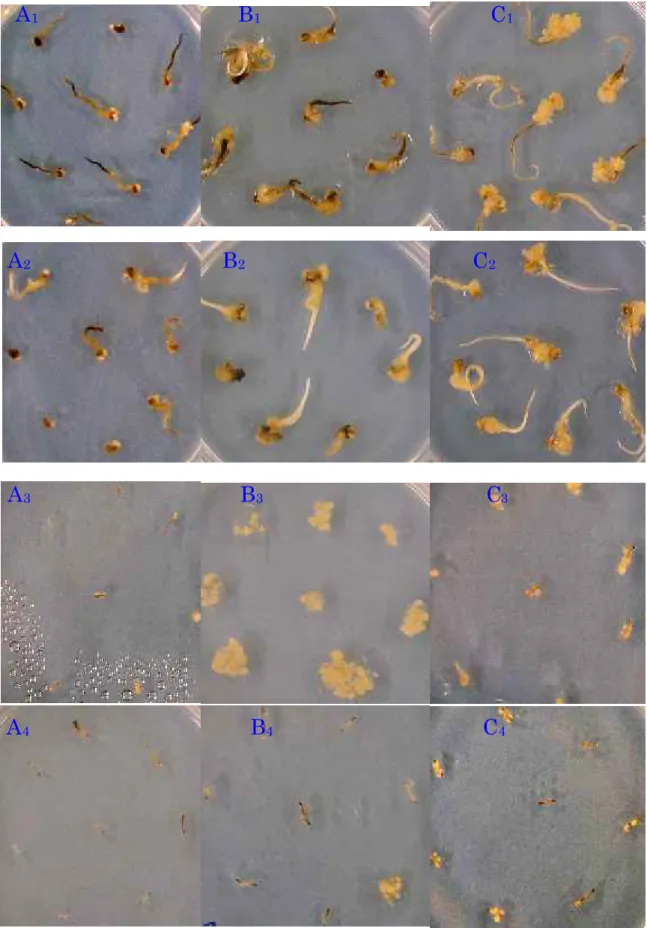
All genotypes induced calluses, but callus induction ability (CIA) varied with the genotypes. Total number of explants with calluses was 76 for Nipponbare; on the average per dish were 6.3 (79.17%). Fig. 2-1-1. shows the induced callus of some genotypes. B10597F had poor callus induction ability.
Phenotypically, calluses derived from mature seed were relatively hard, and sometimes dry, but those derived from root segment were highly mucilaginous, soft and covered with a translucent sticky substance. In some roots, calluses were produced on a few sites of the segment. Most of the root segments with hairs had a high ability to induce callus.
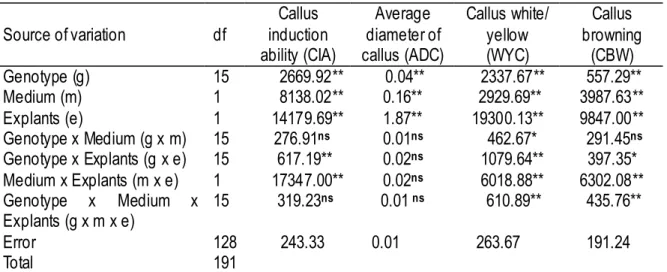
A significant interaction was detected for genotype x medium x explant (p<0.01 for WYC and CBW), medium x explant (p<0.01 for CIA, WYC and CBW), genotype x explant (p<0.01 for CIA, WYC and p<0.05 for CBW), and genotype x medium (p<0.05 for WYC) (Table 2-1-3). For WYC and similarly for CBW, except for the genotype x medium interaction, main- and interaction effects were significant. For CIA, the medium x explant interaction accounted for the greatest variation. In general, explant accounted for the greatest variation in ADC, WYC, and CBW, but not in CIA. The author found no significant interaction among the genotype x medium x explant for CIA and ADC. Medium x explant and genotype x explant interaction for ADC, genotype x medium interaction for both CIA and ADC were also not significant. The main effect of each factor for these traits was significant (p<0.01, Table 2-1-3).
A
1B
1C
1 A2B
2C
2 A3 B3 C3A
4B
4C
4Fig. 2-1-1. Calluses of the genotypes B10597F (A), BP-360-3 (B) and Nipponbare (C), derived from seed explant (A, B, C followed by subscript number 1 and 2) and root explant (with subscript number 3 and 4), cultured on MS (with subscript number 1 and 3) and CI (with subscript number 2 and 4) media.
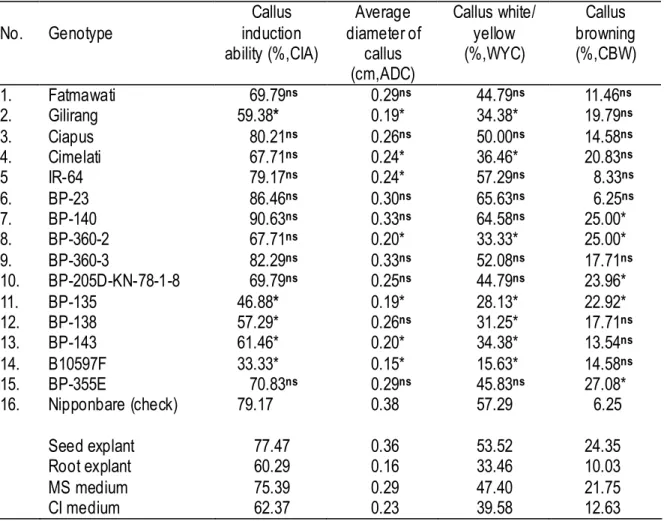
Although a significant genotype x medium x explant interaction was obtained for WYC and CBW as previously mentioned, the author mainly analyzed the genotypic difference among the traits observed. In comparison with Nipponbare, Fatmawati, Ciapus, BP-23, and BP-360-3 had similarly superior callus induction-related traits irrespective of the medium and explants used according to Dunnett’s pairwise multiple comparison t-test at 0.05 probability level (Table 2-1-4). On the other hand, BP-135 was the only genotype showing significantly inferior performance in all traits as compared with Nipponbare.
In the overall analysis, MS medium and seed explant were superior for CIA, ADC, and WYC, whereas CI medium and root explant were superior for CBW.
Table 2-1-3. Analysis of variance for callus induction performances.
Source of variation df Callus induction ability (CIA) Average diameter of callus (ADC) Callus white/ yellow (WYC) Callus browning (CBW) Genotype (g) 15 2669.92** 0.04** 2337.67** 557.29** Medium (m) 1 8138.02** 0.16** 2929.69** 3987.63** Explants (e) 1 14179.69** 1.87** 19300.13** 9847.00** Genotype x Medium (g x m) 15 276.91ns 0.01ns 462.67* 291.45ns Genotype x Explants (g x e) 15 617.19** 0.02ns 1079.64** 397.35* Medium x Explants (m x e) 1 17347.00** 0.02ns 6018.88** 6302.08** Genotype x Medium x Explants (g x m x e) 15 319.23 ns 0.01 ns 610.89** 435.76** Error 128 243.33 0.01 263.67 191.24 Total 191
Table 2-1-4. Comparison for callus induction-related traits of 15 genotypes with those of Nipponbare and overall means for media and explants.
No. Genotype Callus induction ability (%,CIA) Average diameter of callus (cm,ADC) Callus white/ yellow (%,WYC) Callus browning (%,CBW) 1. Fatmawati 69.79ns 0.29ns 44.79ns 11.46ns 2. Gilirang 59.38* 0.19* 34.38* 19.79ns 3. Ciapus 80.21ns 0.26ns 50.00ns 14.58ns 4. Cimelati 67.71ns 0.24* 36.46* 20.83ns 5 IR-64 79.17ns 0.24* 57.29ns 8.33ns 6. BP-23 86.46ns 0.30ns 65.63ns 6.25ns 7. BP-140 90.63ns 0.33ns 64.58ns 25.00* 8. BP-360-2 67.71ns 0.20* 33.33* 25.00* 9. BP-360-3 82.29ns 0.33ns 52.08ns 17.71ns 10. BP-205D-KN-78-1-8 69.79ns 0.25ns 44.79ns 23.96* 11. BP-135 46.88* 0.19* 28.13* 22.92* 12. BP-138 57.29* 0.26ns 31.25* 17.71ns 13. BP-143 61.46* 0.20* 34.38* 13.54ns 14. B10597F 33.33* 0.15* 15.63* 14.58ns 15. BP-355E 70.83ns 0.29ns 45.83ns 27.08* 16. Nipponbare (check) 79.17 0.38 57.29 6.25 Seed explant 77.47 0.36 53.52 24.35 Root explant 60.29 0.16 33.46 10.03 MS medium 75.39 0.29 47.40 21.75 CI medium 62.37 0.23 39.58 12.63
ns : nonsignificant, * : significant compared to Nipponbare’s per for mance using Dunnett’s pairwise multiple comparison t-test at 0.05 probability level with right- sided (>check) for CIA, ADC and WYC, and left-sided (<check) for CBW. Values are means of combination of 2 media and 2 explants with 3 replicates. The difference between seed explant and root explant or between MS medium and CI medium are significant (Table 2-1-3).
Discussion
It is well known that the genotype (Abe and Futsuhara, 1986), the interaction between genotype and medium (Khanna and Rainna, 1998) and also the interaction between genotype and explant (Hoque and Mansfield, 2004) have significant effects on callus induction. In this study, the effect of genotype x medium x explant interaction on WYC and CBW was significant, but that on CIA and ADC was not (Table 2-1-3). The WYC and CBW are believed to be related to the quality of callus. White/cream/yellow calluses as reported by Visarada et al. (2002) are embryogenic calluses and also associated with at least two other types of calluses, i.e. 1) a soft, transparent, unorganized callus, which is nonmorphogenic or may form only roots, and 2) soft mucilaginous callus, which often form roots. Maeda (2000) and Maeda et al. (2002) reported that white and green patches are often seen on the surface stratum of callus with high regeneration ability. Moreover, in sorghum, Kaeppler and Pedersen (1997) reported that the production of a high quality callus depends mainly on the genotype. Lee et al. (2002) found that the number, color, size, shape and appearance of the embryogenic calluses varied among the rice genotypes depending on the type of basal medium, indicating that induction of high-quality rice callus is influenced by genotype, medium, and the kind of explant as well as by their interactions.
Callus browning is one of the major problems in an in vitro culture. Abe and Futsuhara (1991) and Ogawa et al. (1999) argued that callus browning is genetically controlled, which correspond to the present study. A decrease in the rate of callus growth is occasionally related to the appearance of a brown colored area (Maeda et al., 2002). A low 2,4-D concentration (Mitsuoka et al., 1994) and high temperature (Hoque and Mansfield, 2004) seem to cause callus browning or regeneration of albino plants. However, in the present study, 2 mg L-1 2,4-D and 25oC were used for callus induction, which are supposed to be an optimum for callus induction. However, the result of callus browning in this study should be considered carefully, since explants of the genotype that could not produce the calluses were not examined. If the browning of the culture including the browning of explants was examined, the result would be slightly different, particularly in the genotypes that had low ability in callus induction ability, i.e., Gilirang, BP-135, BP-138, BP-143, and B10597F (Table 2-1-4).
In the present study, the author provided root explants from 5- to 7-day-old seedlings; although Hoque and Mansfield (2004) found that the younger explants (3- to 5-day-old seedlings) of indica rice were most efficient in both callus induction and plant regeneration. This is because a large variation was found in root length in the 3-to 5-day-old seedlings, but in some genotypes root
length was only a few centimeters.
Medium composition plays an important role in callus induction (Khanna and Raina, 1998; Ogawa et al., 1999). The nutrient, particularly the nitrogen source, affects the callus induction of somatic embryos, particularly in monocots (Leifert et al., 1995). MS medium was suitable for obtaining high CIA, ADC and WYC, while CI medium was suitable for obtaining low CBW, although the difference was slight (Table 2-14). MS medium, compared with CI medium, has a higher concentration of macro and micro elements, but lower content of organic supplement, only one carbon source (i.e. sucrose) and no coconut water (Table 2-1-2). Such differences might cause the differences in tissue culture response.
Although genotype significantly contributed to the variation of traits observed, the contribution was not as large as expected (Table 2-1-3). This may be due to the similar genetic background of the materials used. Eight of them are derived from the same parent, i.e., cv. Memberamo (from crossing between B6555 and IR-19661), and twelve of them are also derived from the IR-series (breeding lines) developed by IRRI (Table 2-1-1), thus all genotypes carry a genetic composition (female/male parent) from IR-series.
In Table 2-1-3, the author found a high contribution of the explant to the variation of traits observed. The seed explant was suitable for obtaining high CIA, ADC, and WYC, and root explant for low CBW (Table 2-1-4). In addition, four genotypes i.e., Fatmawati, Ciapus, 23, and BP-360-3 have been identified as excellent genotypes for high CAI, ADC, WYC and low CBW compared with Nipponbare (Table 2-1-4). This shows that the seed explants of these superior genotypes have a high callus induction potential which depends on the activity of genes that determine and maintain the meristematic activity of the cells, level of hormones, and sensitivity to hormones, as well as on the activity of other genes that control different stages of plant morphogenesis (Ezhova, 2003). Fatmawati, released as a new cultivar in Indonesia in 2003, and BP-360-3 are new plant type (NPT) with low tilleringcapacity and large panicles. Ciapus is also a new cultivar released in 2003 and BP-23 is a promising line, though not released yet. These genotypes should be further examined for their plant regeneration ability or may be used as genetic transformation materials. The author believed that these genotypes with good callus induction-related traits would be useful for plant regeneration, though Visarada et al. (2002) found that genotypes showing moderate callus induction showed high regeneration ability. Since these genotypes are similar to Nipponbare in callus induction ability, further works especially on plant regeneration and genetic transformation experiments may be promising.
Concluding remarks
It has been shown that reliable assessment on callus performance i.e., good-looking callus with white/cream/yellow appearance, no browning spot/healthy, actively growing that supposed to be embryogenic induced by some rice genotypes may lead to identify genotypes with high quality callus production. These selected genotypes were further examined for in vitro plant regeneration since regeneration capacity is thus far a bottle neck in the success of genetic transformation experiments.
Chapter 2
Establishment of
in vitro Culture for the Success of Genetic
Transformation
2.2. Plant Regeneration Capacity of Calluses Derived from Mature
Seeds of Five Indonesian Rice Genotypes
Abstract
Establishment of a suitable system for plant regeneration of rice calluses derived from mature seed is a prerequisite for the success of genetic transformation using callus as the target tissue. Selecting the most suitable medium and assessing the genotype performance for in vitro response are essential requirement for this purpose. The experiment with five Indonesian rice genotypes showed that callus-proliferation capacity (CPC) was affected only by medium and callus-growth capacity were significantly affected by genotype and by medium. The shoot-regeneration capacity and plantlet-regeneration capacity were affected by the interaction effect between genotype and medium. However for green plant-regeneration capacity, it was affected independently by genotype and medium. Culture media D1 and NB5 were the most suitable media for callus subculture and plant regeneration, respectively. Genotypes Fatmawati and BP-140 consistently performed best in the callus subculture and plant regeneration.
Introduction
Plant regeneration capacity is one of the primary properties of totipotency of plant cells, which has been widely used for application of plant biotechnology including genetic transformation. For efficient genetic transformation, a highly efficient and robust tissue culture system is a prerequisite since the efficiency of transformation mainly depends on regeneration capacity of genotypes, among others (Alfonso-Rubi et al., 1999). To date, efficient plant regeneration for rice has been reported by some authors (Abe and Futsuhara, 1986; Higuchi and Maeda, 1990; Lee et al., 2002), but despite the availability of protocols for rice regeneration, no procedure appears to be universally adaptable when a new genotype is to be considered for in vitro manipulation (Visarada et al., 2002).
In rice, plant regeneration capacity is affected by genotype (Abe and Futsuhara, 1986; Seraj et al., 1997), age and type of explant (Hoque and Mansfield, 2004), nutrient media such as, basal media (Khanna and Raina, 1998; Lee et al., 2002; Lin and Zhang, 2005), plant growth regulators (Pons et al., 2000; Lee et al., 2002), passage in subculture (Lin and Zhang, 2005) and culture conditions. Numerous efforts have been undertaken to improve plant regeneration capacity of rice callus with varying degrees of success. Amino acids such as proline (Yang et al., 1999; Chowdhry et al., 2000) and glutamine (Pons et al., 2000), a specific growth regulator, such as, abscisic acid (ABA) (Higuchi and Maeda, 1990; Kobayashi et al., 1992; Yang et al., 1999) and high concentration of gelling agent (Lai and Liu, 1988; Lee et al., 2002) have been used for improving the regenerability of rice callus culture. Furthermore, genetic transformation with a ferredoxin- nitrite reductase gene isolated from indica Kasalath (Nishimura et al., 2005) and cDNA Os22A isolated from indica Konansou (Ozawa, et al., 2003) have been applied for improving regeneration capacity of rice plants.
For in vitro regeneration, the use of mature embryos rather than immature tissues as initial explants has distinctive advantages since embryogenic calluses induced from mature seeds are suitable for gene delivery and genetic transformation, actively dividing and capable of regenerating into fertile plants (Jiang et al., 2000). Thus, proliferation of the embryogenic calluses with high regeneration capacity through subculture is prerequisite for the successful development of transgenic rice plants via callus culture. In addition, establishing an efficient plant regeneration system will therefore facilitate the development of transgenic and other biotechnological aims. In this study, the author employed five culture media in combination with five Indonesian rice genotypes for examining callus proliferation (subculture) and plant regeneration capacities. The
objective of this study was to establish a suitable plant regeneration system for five selected Indonesian rice genotypes using a mature seed as the initial explant.
Materials and Methods 1. Plant materials
Mature healthy dehusked seeds of Fatmawati, Ciapus, BP-23, BP-140 and BP-360-3 (all
indica subspecies) were soaked with 70% ethanol for 3 min. and surface sterilized in 50%
commercial bleach (4.5% sodium hypochlorite) supplemented with 2-3 drops of Tween20 for 45 min. with gently shaking, and then rinsed thoroughly with sterile distilled water three times. The seeds were cultured in Petri dishes (9 cm in diameter) containing 20 mL of callus-induction medium and incubated at 270C in the dark for 30 days.
2. Callus induction, subculture and regeneration
MS (Murashige and Skoog, 1962) medium, gelled with 0.8% agar, supplemented with 3 mgL-1 of 2,4-D and 3% sucrose was used for callus induction. Five basal media, MS, CI (Potrykus et al., 1979), D1 and L3 (Lin and Zhang, 2005), and NB5 (micronutrient and organic components of Gamborg et al., 1968; macronutrient of Chu et al., 1975) (Table 2-2-1), were used for both subculture of calluses (simply called subculture hereafter) and plant regeneration. All media for subculture were supplemented with 3 mgL-1 2,4-D, 500 mgL-1 l-proline, 500 mgL-1 l-glutamine, 3% maltose and semi solidified with 0.25% Phytagel (Gellan gum, Kanto Chemical Co., Inc.).
Table 2-2-1. Composition of media for callus induction, subculture and plant regeneration*.
Components Medium D1a Medium L3b Medium NB5c
Macro elements NH4NO3 1,700 (NH4)2SO4 450 463 KNO3 2,900 1,900 2,830 CaCl2.2H2O 170 400 166 MgSO4.7H2O 185 370 185 KH2PO4 400 170 400 Micro elements KI 7.5 7.5 0.75 H3BO3 30 30 3 MnSO4.4H2O 100 100 10 ZnSO4.7H2O 20 20 2 Na2MoO4. 2H2O 2.5 2.5 0.25 CuSO4. 5H2O 0.25 0.25 0.025 CoCl2. 6H2O 0.25 0.25 0.025 CoSO4. 7H2O FeSO4. 7H2O 55.9 41.8 27.8 Na2EDTA. 2H2O 74.5 55.9 37.3 Organic supplement Nicotinic acid 1.0 1.0 1.0 Pyridoxine-HCl 1.0 1.0 1.0 Thiamine-HCl 1.0 1.0 10 Glycine 2.0 2.0 Coconut water Myo-inositol 100 100 100
* : Concentration in mgL-1 and for MS (Murashige and Skoog, 1962) and CI (Potrykus et al., 1979) presented
in page 18; a Lin and Zhang (2005); b Lin and Zhang 2005; c Chu et al. (1975) for macronutr ient and
Gamborg et al. (1968) for micronutrient and organic components.
Callus induction medium: MS + 3 mgL-1 2,4-D + 3% sucrose + 0.8% agar, pH 5.8.
Callus proliferation/subculture medium: all five media + 3 mgL-1 2,4-D, 500 mgL-1 l-proline, 500 mgL-1
l-glutamine, maltose 3% + Phytagel 0.25% , pH 5.8.
Regeneration medium: All five media + 3 mgL-1 Kinetin + 3 mgL-1 BA + 0.5 mgL-1 IAA + 0.5 mgL-1 NAA +
500 mgL-1 l-proline, 500 mgL-1 l-glutamine, 800 mgL-1 casein hydrolysate + maltose 3% + Phytagel 0.3% , pH
5.8.
Fine, friable, white/cream/yellow pale globular embryogenic calluses, 2-3 mm in diameter, were selected, and 20 calluses were transferred into each Petri dish containing 20 mL subculture medium (Fig. 2-2-1a, 1b) with three replications. They were subcultured at 270C in the dark for 3 weeks.
For plant regeneration, the above-mentioned media supplemented with 3 mgL-1 Kinetin, 3 mgL-1 BA, 0.5 mgL-1 IAA, 0.5 mgL-1 NAA, 500 mgL-1 l-proline, 500 mgL-1 l-glutamine, 800 mgL-1 casein hydrolysate, 3% maltose and 0.3% Phytagel was used. The pH of all media was adjusted to 5.8 before autoclaving. Calluses grown and proliferated from the same medium were transferred to the corresponding regeneration medium. Subcultured clusters of calluses ca. 10-13 mm in diameter were transferred into Petri dish containing 20 mL regeneration medium, 10 clusters in each dish (Fig. 2-2-1c) with five replications, and incubated under a 16-h photoperiod of fluorescent light, with 8-h darkness, at 270C, for 3-5 weeks.
Regenerated shoots, when their height reached over 2 cm, were transferred to a plant growth regulator-free MS medium for root development (Fig. 2-2-1d). When leaf height reached 10 cm, the green plants were transferred onto the soil and grown in a greenhouse for further growth. 3. Evaluation and experimental design
For the callus subculture, two variables: a) callus-proliferation capacity (CPC in %): (number of callus clusters proliferated)(number of callus clusters on the subculture medium)-1 x 100); and b) callus-growth capacity (CGC in mm2) shown by the size of callus clusters after a 21-day culture, were examined. The size of callus clusters is the average of multiplication of the longest and the shortest diameter of the cluster of callus.
For plant regeneration, three variables were examined: a) shoot-regeneration capacity (SRC in %): (number of callus clusters developing green shoot buds)(number of callus clusters on the regeneration medium)-1 x 100; examined after a 3-week culture; b) plant-regeneration capacity (PRC in %): (number of callus clusters developing green plantlets)(number of callus clusters on the regeneration medium)-1 x 100; examined after 4-5-week culture; and c) green plant-regeneration capacity (GRC) shown by the number of green plantlets per replication; examined when plantlets were transferred to soil.
A completely randomized factorial design was used in this study. Data were then analyzed statistically by the analysis of variance (ANOVA) and differences among means were evaluated by Duncan’s multiple range test (DMRT).
a b a
c
d
e f
Fig. 2-2-1. Plant regeneration from mature seed-derived calluses. a) an embryogenic calluses of genotype Fatmawati on the D1 subculture medium; b) 20 clusters of calluses of Fatmawati on the NB5 subculture medium after a
21-day culture; c) 10 clusters of calluses of Fatmawati on the NB5 subculture medium showing shoot
regeneration after a 14-day culture; d) plantlets of BP-140 growing on D1 regeneration medium; e) and f) plantlets of Fatmawati regenerated on medium NB5 and D1, respectively. Scale bars in a) to d) correspond to
Results
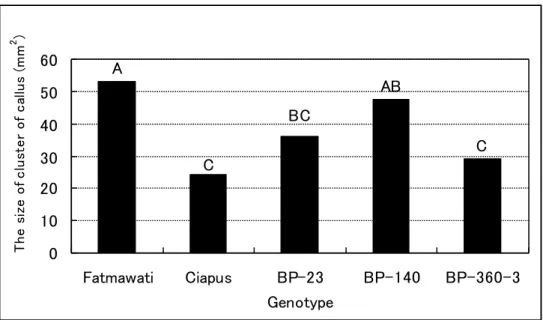
In the subculture, callus-growth capacity (CGC) was affected independently by medium (p<0.01) and genotype (p<0.01), but callus-proliferation capacity (CPC) was affected independently by genotype (p<0.01) (Table 2-2-2). The interaction effect between genotype and medium was not significantly detected for these traits (CGC and CPC). In the five genotypes, CGC varied with the genotype but CPC did not. In addition, medium accounted for the greatest variation in the proliferation and growth of calluses (Table 2-2-2). Since the interaction effect is not significant for both traits, the effect of genotype on CGC and that of medium on CPC and CGC are presented in Fig. 2-2-2 and 2-2-3, separately. Among five genotypes, Fatmawati and BP-140 had the highest CGC (Fig. 2-2-2). All media except for L3 had high CPC (Fig. 2-2-3i). Medium D1 had the highest CGC among the five media and L3 had the lowest CGC (Fig. 2-2-3ii).
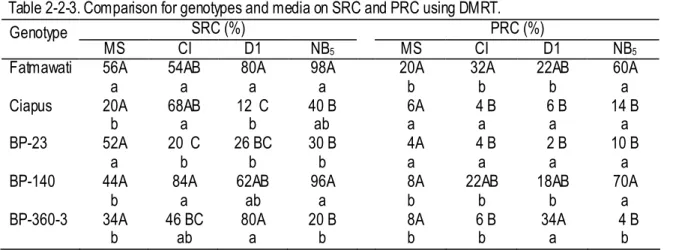
In the plant regeneration experiment, all five genotypes tested were capable of generating shoot bud and subsequently regenerating plantlets. However, the regeneration capacity significantly varied with the genotype (Table 2-2-2). Irrespective of medium used, plantlet regeneration was early in Fatmawati. In general, shoot regeneration was poorly synchronized; it took 15- to 20 days for rice calluses to regenerate shoots on regeneration medium. SRC and PRC were significantly affected by the interaction effect between genotype and medium (p<0.01) but GRC was not (Table 2-2-2). Genotype accounted for the greatest variation in SRC and PRC. Conversely, medium contributed to give the highest variation in GRC (Table 2-2-2). Fatmawati showed no difference in SRC on different media and had a high PRC on NB5 (Table 2-2-3). Fatmawati and BP-140 showed the highest PRC on NB5 (Table 2-2-3) and the highest GRC on the average (Fig. 2-2-4i). Ciapus cultured on CI and NB5; BP-23 on MS; BP-140 on NB5, CI, and DI; BP-360-3 on DI and CI, had high SRC (Table 2-2-3). However, Fatmawati and BP-140 cultured on NB5, and BP-360-3 cultured on DI had high PRC. Ciapus, BP-23 and BP-360-3 produced relatively low PRC (Table 2-2-3) and low GRC (Fig. 2-2-4i). Medium NB5 gave the highest GRC for all five genotypes and MS, CI and D1 gave similarly low GRC (Fig. 2-2-4ii).
The appearance of plantlets greatly varied with the medium culture. For instance, on medium NB5, Fatmawati produced numerous green healthy plantlets with many tillers (Fig. 2-2-1e), while, on D1, it produced light yellow/brownish plantlets with few tillers (Fig. 2-2-1f).
A AB BC C C 0 10 20 30 40 50 60 Fatmawati Ciapus BP-23 BP-140 BP-360-3 Genotype T he s iz e o f c lu st e r o f c all u s ( m m 2 )
Fig. 2-2-2. Comparison for genotype on CGC in the subculture after 21-day culture. Values with the same alphabet show no difference by DMRT at the 0.05 probability level. Each value is the average of genotype perfor mance across five media with three replicates and each consists of 20 clusters of seed-derived callus. CGC ( callus-growth capacity) is shown by the size of callus clusters in mm2. The size of callus cluster is the average of the
Table 2-2-2. Analysis of variance for callus proliferation (CPC, CGC) and plant regeneration variables (SRC, PRC, GRC). Source of variation dfa dfb CPC CGC SRC PRC GRC Genotype (g) 4 4 259.50 ns 2202.08 ** 7893.50 ** 3381.50 ** 2383.82 * Medium (m) 4 3 5786.17 ** 4855.48 ** 1260.00 ns 2366.33 ** 4964.35 ** Genotype x Medium (g x m) 16 12 39.92 ns 267.25 ns 2667.50 ** 1075.50 ** 1142.02 ns Error 50 80 191.33 298.77 715.50 215.50 762.67 Total 75 100
Data show mean square value. ns: non-significant, *: significant at p = 0.05, **: significant at p = 0.01, respectively.
a: for callus subculture, calculated on the basis of combination of 5 genotypes and 5 media with 3 replications.
b: for regeneration, calculated on the basis of combination of 5 genotypes and 4 media with 5 replications ( medium L3 was excluded from the analysis because of no variation over
replications).
CPC (callus-proliferation capacity in % ): number of callus clusters proliferated)(number of callus clusters on the subculture medium)-1 x 100.
CGC (callus-growth capacity in mm2) is the average of the multiplication of the longest and the shor test diameter of the cluster of callus after a 21-day culture.
SRC (shoot-regeneration capacity in % ): (number of callus clusters developing green shoot buds)(number of callus clusters on the regeneration medium)-1 x 100.
PRC (plant-regeneration capacity in % ): (number of calluses clusters producing green plantlet)(number of callus clusters on the regeneration medium)-1 x 100.
A A A B A 0 20 40 60 80 100 120 MS CI D1 L3 NB5 Medium C all u s-pr o lif e ra ti n g c ap ac it y ( % ) i B C A B B 0 10 20 30 40 50 60 70 MS CI D1 L3 NB5 Medium T he s iz e o f c lu st e r o f c all u s ( m m 2 ) ii
Fig. 2-2-3. Comparison for medium on (i) CPC, (ii) CGC in the subculture after 21-day culture. Values with the same alphabet show no difference by DMRT at the 0.05 probability level. Each value is the average of the value from five genotypes with three replicates and each consists of 20 clusters of seed-derived calluses. CPC (callus-proliferation capacity in % ): number of callus clusters proliferated) (number of callus clusters on the subculture medium)-1 x 100. CGC (callus-growth capacity in mm2) is the average of the multiplication of the longest and
Table 2-2-3. Comparison for genotypes and media on SRC and PRC using DMRT. SRC (%) PRC (%) Genotype MS CI D1 NB5 MS CI D1 NB5 Fatmawati 56A a 54AB a 80A a 98A a 20A b 32A b 22AB b 60A a Ciapus 20A b 68AB a 12 C b 40 B ab 6A a 4 B a 6 B a 14 B a BP-23 52A a 20 C b 26 BC b 30 B b 4A a 4 B a 2 B a 10 B a BP-140 44A
b 84A a 62AB ab 96A a 8A b 22AB b 18AB b 70A a BP-360-3 34A
b 46 BC ab 80A a 20 B b 8A b 6 B b 34A a 4 B b Data are the means of five replicates, each with 10 clusters of callus.
The same capital alphabet (between genotypes within a medium) and small alphabet (between media within a genotype) in column and row, respectively, show no difference by DMRT at the 0.05 probability level.
SRC (shoot-regeneration capacity in % ): (number of callus clusters developing green shoot buds)(number of callus clusters on the regeneration medium)-1 x 100.
PRC (plant-regeneration capacity in % ): (number of calluses cluster s producing green plantlet)(number of callus clusters on the regeneration medium)-1 x 100.
A AB B A B 0 5 10 15 20 25 30 35 Fatmawati Ciapus BP-23 BP-140 BP-360-3 Genotype N u m be r o f pl an tl e ts p e r re pli c at io n i A B B B 0 5 10 15 20 25 30 35 40 MS CI D1 NB5 Medium N u m be r o f pl an tl e ts p e r re pli c at io n ii
Fig. 2-2-4. Comparison for genotype (i) and medium (ii) on GRC in the regeneration. Values with the same alphabet show no difference by DMRT at the 0.05 probability level. Values in (i) show the mean for four media, and the values in (ii) show the means for five genotypes with five replicates and each consists of 10 clusters of seed-derived calluses. GRC (green plant-regeneration capacity in % ): number of green plantlets per replication. Medium L3 was excluded from the analysis because of no variation over replication.
Discussion
Plant regeneration is indispensable for plant transformation technology and other biotechnology aims. In this study, a suitable regeneration system for mature seed derived calluses of five indica subspecies has been established. Stages from callus proliferation till regeneration have been investigated. After the step of callus induction, in my view, selecting the most suitable medium and assessing the genotype’s capacity for callus proliferation and regeneration in order to improve its regenerability are essential for the success of genetic transformation using callus as target material. The result of the present experiment indicated that the callus-proliferation capacity (CPC) was affected only by medium, while the callus-growth capacity (CGC) was independently influenced by genotype and by medium (Table 2-2-2). The significant effect of genotype on CPC was not detected (Table 2-2-2) due to the fact that the genotypes used excluding BP-140 had been selected as the most responsive ones in callus induction and quality-related callus traits as stated in the previous section. However, the genotypes and media tested significantly differed in CGC, with Fatmawati and BP-140 were the most responsive genotypes (Fig. 2-2-2) and D1 was the most suitable medium for callus subculture (Fig. 2-2-3ii). The genotypic differences in CGC may have resulted from the difference of the activity of the genes that control the callus proliferation process, such as those involved in plant hormone metabolism (Henry et al., 1994; Ezhova, 2003). Some differences in composition existed among five media seem to cause the difference in promoting proliferation and growth of callus (Table 2-2-1).
For callus proliferation, 2,4-D is an essential element as reported by Inoue and Maeda (1980) and Mitsuoka et al. (1994). In the present study, however, 3 mg L-1 of 2,4-D was supplied equal to all media tested. Suggesting the differences in genotype’s response may not be associated with 2,4-D. This also suggests that the genetic and non–genetic factors (medium, growth regulator, and culture condition) clearly influence both CPC and CGC. However, author could not determine exactly what nutrient is a critical factor for callus proliferation/propagation, since the nutrients are too numerous and demands as well as uptake by the rice cell are diverse. It is likely that the basal composition of medium influenced embryogenic callus proliferation, as has been previously reported by some researchers (Rueb et al., 1994; Lin and Zhang, 2005). The result of present experiment, however, is not in accordance with the result of Lin and Zhang (2005), who reported that L3 was the best medium for subculture of three indica genotypes.
For plant regeneration, the author identified a significant interaction between genotype and medium in SRC and PRC, but not in GRC that was affected independently by genotype and by medium (Table 2-2-2). This indicates that, for SRC and PRC of each genotype shows a different