Generalized
volume and geometric
structure of
3-manif0lds
早稲田大学・理工学部・数理科学科 村上 順 (Jun Murakami)
Department of Mathematical Sciences,
School of Science and Engineering, Waseda University
INTRODUCTION
For several hyperbolic knots, arelationbetween certain quantum invariants
and the volume of their complements are discovered by R. Kashaev in [2].
In [6], it is shown that Kashaev’s invariants are specializations of the colored
Jones polynomials. Kashaev used the saddle point method to obtain certain
limit ofinvariants, and Y. Yokota proved that the equations to determine the
saddle points correspond to the equations defining the hyperbolic structure of
the knot complement. He introduce asimplicial decomposition of the
com-plement associated to aknot diagram, and show that the equations to give
the hyperbolic structure of each simplexcoincide with theequations for saddle
points. For 3-manifolds obtainedby surgeries alongafigure-eight knot, H.
Mu-rakami [5] follows Kashaev’s computation for the
Witten-Reshetikhin-Turaev
invariants and found that avalue at certain saddle point relatesto the volume.
Trying toextend theseworks to the Turaev-Viro invariant [9], aformula for
the volume of ahyperbolic tetrahedron is obtained in [7]. The Turaev-Viro
invariant is defined from asimplicial decomposition of a3-manifold, and
use
astate sum associating the quantum $6\mathrm{j}$-symbol to each tetrahedron, and the
formula for the volume of ahyperbolic tetrahedron
comes
from the quantum$6\mathrm{j}$-symbols. Moreover, extendingYokota’stheorytothis case, wemayget
some
relation between thevolume and the geometric structure of themanifold, which
is the main subject ofthis note
数理解析研究所講究録 1272 巻 2002 年 91-113
1. FLUCTUATING STRUCTURE
In thisreport, Iwould like to speculateamethod to
determine
thegeometricstructure of a3-manifold ffom its simplicial decomposition by using
agener-alized volume function, which is called apotential
function
in [12]. To definethe generalized volume, we introduce afluctuating structure of asimplicial decomposition.
1.1. Fluctuating simplicial decomposition. Let $\mathcal{T}$ be asimplicial
decom-positionofa3-manifold $M$
.
Assume that$\mathcal{T}$consists of$k3$-simplices$T_{1}$, $T_{2}$, $\cdots$ ,
$T_{k}$. Each 3-simplex has 6corners corresponding to its two faces
(2-simplices),
and we associate real numbers to each corners, say $\theta \mathrm{i}$,
$\theta_{2}$, $\cdots$, $\theta_{6}^{i}$ for the
3-simplex $T_{i}$. These numbers are called the dihedral
angles of the
corners.
Let$\Theta$ be the
correction of the dihedral angles
$\Theta=\{\theta_{j}^{i}|i=1,2, \cdots, k,j=1,2, \cdots, 6\}$.
Let $E$beanedge (1-simplex)of$\mathcal{T}$,
$T_{\dot{\iota}_{1}}$,$T_{i_{2}}$, $\cdots$, $T_{i_{p}}$ be the tetrahedra containing
the edge $E$, and $\theta_{j_{1}}^{i_{1}}$, $\theta_{j_{2}}^{i_{2}}$, $\cdots$ , $\theta_{j_{\ell}}^{i_{\ell}}$ be the dihedral angles of the
corners
of$T_{\dot{1}_{1}}$,
$T_{i_{2}}$, $\cdots$, $T_{i_{\ell}}$ corresponding to $E$. Then the following relationis called the angle
relation corresponding to $E$.
angle relation: $\sum_{p=1}^{\ell}\theta_{j_{\mathrm{p}}}^{i_{p}}=2\pi$
.
(1)The correction of the dihedral angles $\ominus \mathrm{i}\mathrm{s}$ called afluctuating
structure of$\mathcal{T}$
if the angles of$\ominus$ satisfy the edgerelations for
all the edges of$\mathcal{T}$
.
Asimplicialdecomposition with afluctuatingstructure $\ominus \mathrm{i}\mathrm{s}$ denoted
by $\mathcal{T}_{\Theta}$ and is called a
fluctuating simplicial decomposition.
1.2. Generalized volume. Thegeneralizedvolumeis introducedto
afluctu-ating simplicial decomposition $\mathcal{T}_{\Theta}$. This is denoted by
$\mathcal{V}(\mathcal{T}_{\Theta})$ and it is define
as
asum
of generalized volumes of each fluctuating 3-simplex, i.e.$\mathcal{V}(\mathcal{T}_{\ominus})=\sum_{T\in \mathcal{T}^{3}}\mathcal{V}(T_{\ominus})$,
(2)
where $\mathcal{T}^{3}$
bethe set of3-simplices of$\mathcal{T}$ and$T_{\Theta}$ meansthefluctuating 3-simplex
$T$ with the fluctuating structure given by the restriction of $$ to $T$, in other
words, the six
corners
of$T$ are assigned dihedral angles given by0.
The generalized volume $\mathcal{V}$ for afluctuating 3-simplex $T_{\Theta}$ is defined by the
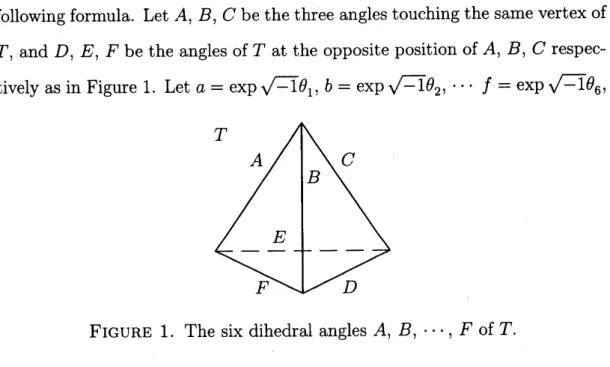
followingformula. Let $A$, $B$, $C$ bethe three angles touching the samevertex of
$T$, and $D$, $E$, $F$ be the angles of$T$ at the opposite position of$A$, $B$, $C$
respec-tively
as
in Figure 1. Let $a=\exp\sqrt{-1}\theta_{1}$, $b=\exp\sqrt{-1}\theta_{2}$, $\cdots$ $f=\exp\sqrt{-1}\theta_{6}$,FIGURE 1. The six dihedral angles $A$, $B$, $\cdots$ , $F$ of $T$.
and $\mathrm{L}\mathrm{i}_{2}(z)$ be the dilogarithm function defined as an analytic continuation of
the following function.
$\mathrm{L}\mathrm{i}_{2}(x)=-\int_{0}^{x}\frac{\log(1-x)}{x}dx=\sum_{k=1}^{\infty}\frac{x^{k}}{k^{2}}$. (3)
For the detail of$\mathrm{L}\mathrm{i}_{2}$, see, for example, [4]. Note that the dilogarithm $\mathrm{L}\mathrm{i}_{2}(z)$ is
amulti-valued function as the logarithm function $\log(z)$. We put
$U(z, T)= \frac{1}{2}(\mathrm{L}\mathrm{i}_{2}(z)+\mathrm{L}\mathrm{i}_{2}$($z$a$b$$de$) $+\mathrm{L}\mathrm{i}_{2}$(zacd$f$) $+\mathrm{L}\mathrm{i}_{2}(zbcef)$
$-\mathrm{L}\mathrm{i}_{2}$($-z$a$bc$) $-\mathrm{L}\mathrm{i}_{2}(-zaef)$ -Li2(z)$bdf)-\mathrm{L}\mathrm{i}_{2}$(-zcde)$)$ .
(4) Let $z_{1}$, $z_{2}$ be the two non-trivial solutions of the equation
$\frac{d}{dz}U(z, T)=\frac{2\pi k}{z}$, $(k\in \mathrm{Z})$ (5)
which is equivalent to
$(1-z)$ (1 -abde$z$)
$(1-acdfz)(1-bcefz)$
(6)
$-(1+abcz)(1+aefz)(1+bdfz)(1+cdez)=0$
.
Note that asolution of (6) may be asolution of (5) in
some
branch becausethe function $\log$ is amulti-valued function. In the following formulas, we take
an adequate branch of logarithm and dilogaxithm functions corresponding to
the solutions $z_{1}$ and $z_{2}$. Let $k_{1}$ and $k_{2}$ be the integers satisfying the following.
$\frac{d}{dz}U(z_{1}, T)=\frac{2\pi k_{1}}{z_{1}}$, $\frac{\sim d}{dz}U(z_{2}, T)=\frac{2\pi k_{2}}{z_{2}}$.
By using $z_{1}$ and $z_{2}$, let
$\mathcal{V}(T_{\Theta})=\frac{1}{2}(U(z_{1}, T_{\Theta})-U(z_{2}, T_{\Theta})-k_{1}\log z_{1}+k_{2}\log z_{2})$. (7)
It is known in [7] that $|\sqrt{-1}\mathcal{V}(T_{\Theta})|$ is equal to the actual volume of$T_{\Theta}$ if $T_{\Theta}$
is realized as ahyperbolic tetrahedron,
Volume(T\Theta ), $=|\sqrt{-1}\mathcal{V}(T_{\Theta})|$ (8)
and $|\mathcal{V}(T_{\Theta})|$ is equal tothe actual volume of$T_{\Theta}$ if$T_{\Theta}$ is realized
as
atetrahedronin $S^{3}$,
Volume(T\Theta ). $=|\mathcal{V}(T_{\Theta})|$ (9)
This formula is proved by comparing with the formula given in [1]. Let $z_{1}$
be asolution of (6) such that $z_{1}$ goes to 1ifwe deform $T_{\Theta}$ continuously to a
tetrahedron with aidealvertex. For this case, $-\sqrt{-1}\mathcal{V}(T_{\Theta})$ is positive and we
have
Volume(T\Theta ). $=-\sqrt{-1}\mathcal{V}(T_{\Theta})$ (10)
for ahyperbolic tetrahedron $T_{\Theta}$.
1.3. Some special
cases.
First consider thecase
that the angles $A$, $B$, $C$satisfy
$A+B+C=\pi$.
Hence $a$$bc=-1$ and so the equation (6) is the following.
(1-z)(l-abdez)(l-acdfz)(l-bcefz)
$-(1-z)(1+aefz)(1+bdfz)(1+cdez)=0$
. (11)Therefore $z=1$ is
one
of the solution of (6). This implies that, ifone of thevertex of the tetrahedron is an idal vertex, then $z=1$ is one of the non-trivial
solutions of (6).
Next, consider the
case
that$A=0$, $B+C=\pi$, $E+F=\pi$.
This tetrahedronis degenerated to aface since $A=0$. The parameters $a$, $\cdots$ ,
$f$ satisfy $a=1$, $bc=-1$, $ef=-1$ and the equation (6) is the following.
$(1-z)(1-bdez)(1-acdfz)(1-z)$
(12)
$-(1-z)(1-z)(1+bdfz)(1+cdez)=0$
.Hence the non-trivial solutions of (6) are $z_{1}=z_{2}=1$, which is amultiple root.
1.4. Gram matrix. For afluctuating 3-simplex$T_{\Theta}$, let Gram(T) be the Gram
matrixof $T_{\Theta}$ defined by
$\mathrm{G}\mathrm{r}\mathrm{a}\mathrm{m}(T_{\Theta})=(_{-}^{-}-1\cos\theta_{1}\cos\theta_{2}\cos\theta_{6}$ $—1\cos\theta_{1}\cos\theta_{5}\cos\theta_{3}$ $- \mathrm{s}\theta_{2}-\mathrm{s}\theta_{3}-\mathrm{s}\theta_{4}\frac{\mathrm{c}\mathrm{o}\mathrm{c}\mathrm{o}}{\mathrm{c}\mathrm{o}}1$ $—1\cos\theta_{6}\cos\theta_{5})\cos\theta_{4}$ .
The condition of realization of$T_{\Theta}$ as atetrahedron in ahyperbolic space or a
spherical space is known and is given in terms of the elements of Gram(T).
1.5. Stationary decomposition and geometric decomposition. Let $M$
be a3-manifold and let $\mathcal{T}_{\Theta}$ asimplicial decomposition of$M$ with afluctuating
structure
0.
Afluctuating decomposition $\mathcal{T}_{\Theta_{0}}$ is called astationarydecomposi-tionif $_{0}$ is astationary point of $\mathcal{V}(\mathcal{T}_{\theta})$. In other words, thepartial
derivative
of$\mathcal{V}(\mathcal{T}_{\theta})$ with respect to any independent
parameters of$\ominus$ vanishes.
Afluctuatingdecomposition $\mathcal{T}_{\Theta}$ is called ageometric
decomposition if all the
faces of$\mathcal{T}$
are
partsofplanesand the dihedral angles givenby $\ominus \mathrm{c}\mathrm{o}\mathrm{i}\mathrm{n}\mathrm{c}\mathrm{i}\mathrm{d}\mathrm{e}$with
the angle of faces with respect to the hyperbolic structure of$M$.
1.6. Schl\"afli’s formula and stationary point of volume. Each
tetrahe-dron$T$ofageometricdecompositionsatisfiesSch\"anfli’s
formula, whichis stated
as
follows. Let $\theta_{1}$, $\theta_{2}$, $\cdots$ , $\theta_{6}$ be the dihedralangles of $T$ and let Ei, $E_{2}$, $\cdots$ ,
$E_{6}$ be the corresponding edges. Then,
for hyperbolic case,
$d$ Volume(T) $=- \frac{1}{2}\sum_{i=1}^{6}\mathrm{L}\mathrm{e}\mathrm{n}\mathrm{g}\mathrm{t}\mathrm{h}(E_{i})d\theta:$
.
(13)
Hence, by using (7), we have
$d \mathcal{V}(T)=-\frac{\sqrt{-1}}{2}\sum_{i=1}^{6}\mathrm{L}\mathrm{e}\mathrm{n}\mathrm{g}\mathrm{t}\mathrm{h}(E_{i})d\theta_{i}$. (14)
Now,
we
vary the fluctuating structure0.
Then Sch\"affii’sformula
impliesthe following theorem, which is equivalent to the argument to determine the
hyperbolic structure given by Casson.
Theorem 1. If$\mathcal{T}_{\theta_{0}}$ is ageometric decomposition of ahyperbolic
3manifold
$M$, then $_{0}$ is astationarypoint of$\mathcal{V}(\mathcal{T}_{\Theta})$, i.e. $\mathcal{V}(\mathcal{T}_{\Theta})$ is stable at 00.
Proof.
We use Lagrange’s multiplier method. The stationary point of $\mathrm{V}(7\mathrm{e})$for the parameterset $\ominus$ satisfying theanglerelation
(1) is givenby the solution
of the following set of equations. Let $E_{1}$, E2, $\cdots$ , $E_{k}$ be the edges of $\mathcal{T}$,
and let $\theta_{1}^{i}$, $\theta_{2}^{i}$, $\cdots$,
$\theta_{j}^{i}.\cdot$ be the dihedral angles given by $\ominus \mathrm{a}\mathrm{r}\mathrm{o}\mathrm{u}\mathrm{n}\mathrm{d}$
$E_{i}$. Then the
equations for astationary point of $\mathcal{V}(T_{\Theta})$ under the edge relations
are
givenby
$\frac{\partial \mathcal{V}(\mathcal{T})}{\partial\theta_{1}^{i}}=\frac{\partial \mathcal{V}(\mathcal{T})}{\partial\theta_{2}^{l}}=\cdots=\frac{\partial \mathcal{V}(\mathcal{T})}{\partial\theta_{j}^{i}}.=\lambda_{i}$ $(i=1,2, \cdots, k)$ (15)
Here $\lambda_{i}(i=1,2, \cdots, k)$
are some
numbers called Lagrange’s multipliers. Inthis equation,
$\frac{\partial \mathcal{V}(\mathcal{T})}{\partial\theta_{p}^{i}}=\frac{\partial \mathcal{V}(T_{p}^{i})}{\partial\theta_{p}^{i}}$,
where $T_{p}^{i}$ is the tetrahedron containing the dihedral angle $\theta_{p}^{i}$, and so the above
equations are equivalent to the following system ofequations.
$\frac{\partial \mathcal{V}(T_{p}^{i})}{\partial\theta_{p}^{i}}=\lambda_{i}$ $(i=1,2, \cdots, k, p=1,2, \cdots, j_{i})$ (16)
If $\theta_{p}^{i}$’s are dihedral angles given by $_{0}$ corresponding to ageometric
decomp0-sition, (16) is satisfied by putting
$\lambda_{i}=-\frac{\sqrt{-1}}{2}\mathrm{L}\mathrm{e}\mathrm{n}\mathrm{g}\mathrm{t}\mathrm{h}(E_{i})$.
from (13). Hence $_{0}$ correspond to astationary point of $\mathcal{V}(\mathcal{T}_{\Theta})$. $\square$
Theorem 2. If$\mathcal{T}_{\theta_{0}}$ is ageometric decomposition ofaelliptic 3-manifold $M$,
$i.e$. the universal cover of$M$ is isomorphic to$S^{3}$, then $_{0}$ is astationary point
of$\mathcal{V}(\mathcal{T}_{\Theta})$, i.e. $\mathcal{V}(\mathcal{T}_{\Theta})$ is stable at $_{0}$
.
Proof.
Theorem 2is proved similarly as for Theorem 1. In this case, theconstant $\lambda=i$ satisfy
$\lambda_{i}=\frac{1}{2}\mathrm{L}\mathrm{e}\mathrm{n}\mathrm{g}\mathrm{t}\mathrm{h}(E_{i})$. $\square$
Remark. The relation (15) meansthat the lengthof theedge $E_{i}$ is equalwith
respect to all the tetrahedra with the edge $E_{i}$
.
By this reason, we call (15) thelength relation.
Definition (generalized length). We call $\frac{\partial \mathcal{V}(T_{p}^{i})}{\partial\theta_{p}^{i}}$ the generalized length of
the edge $E_{i}$ with respect to the terahedron $T_{p}^{i}$. It is areal number if $T_{p}^{i}$ is a
elliptic tetrahedron, apureimaginary number if$T_{p}^{i}$ is ahyperbolictetrahedron,
and 0if $T_{p}^{i}$ is aEuclidean tetrahedron. If the fractuating structure $$ satisfies
the length relation, then the generalized length does not depend
on
the choiceof the tetrahedron containing $E_{i}$
.
1.7. Geometric structure of general
case.
Generalizing Theorem 1, itmay be not so bad to expect the following.
In otherwords, areal soltion of the anglerelation (1) and the length relation
(15) may give the geometric structure.
2. EXAMPLES
In this section,
we
apply the formula and the working hypothesis to severalexamples.
2.1. Regular tetrahedron. The first example is the volume and edge length
ofaregular tetrahedron $T$. Let $x$ be the dihedralangle of$T$. Then thevolume
function behaves as in Figure 2. The value explains the absolute value of the real part of the volume function if $x\geq\arccos 1/3=0.391827$$\pi$ and the
absolute value of the imaginary part if$x<\arccos 1/3$
.
If$x=\arccos 1/3$, then$T$ is the Euclidean regular tetrahedron, and if $x=\pi/3$ then
$T$ is the ideal
regulartetrahedron. If$x<\pi/3$, then the absolute value of the imaginarypart
of the volume function explains the volume of the $t$ uncated tetrahedron as
shown in [3]. Expecially, if $x=0$, then the truncated tetrahedron is equal to
the ideal octahedron, which is aunion of eight tetrahedra with dihedralangles
$\pi/2$, $\pi/2$, $\pi/2$, $\pi/4$, $\pi/4$ and $\pi/4$, whose volume is
0.457983
FIGURE 2. Volume of aregular polyhedron.
$\cross\pi$
truncated hyperbolic hyperbolic ellipctic
FIGURE 3. Edge length of aregular polyhedron.
2. Lens spaces. The lens space $L_{p,q}$ is known to have aspherical structure,
$\mathrm{r}1\mathrm{d}$ so there is ageometric decomposition. Such fluctuating structure is given
$\gamma$ one of the stationary decompositions. Asimple geometric decompositio $\mathrm{n}$
is given by$p$ tetrahedra of the
same
shape as in Figure 4with dihedral angles$A$, $B$, $C$, $D$, $E$, $F$. Then
$A= \frac{2\pi}{p}$, $B= \frac{\pi}{2}$, $C= \frac{\pi}{2}$, $D= \frac{2\pi}{p}$, $E= \frac{\pi}{2}$, $F= \frac{\pi}{2}$
satisfy the equation (15).
FIGURE 4. Thetrahedral decomposition ofaLens space.
The volume of the tetrahedron with the above dihedral angles
are
$\overline{p^{2}}$ and2$\pi^{2}$
the volume of $L_{p,q}$ is $\frac{2\pi^{2}}{p}$
.
The length of the edges corresponding to$A$ and $D$
is equal to $\frac{2\pi}{p}$ and that corresponding to $B$, $C$,
$E$ and $F$ is equal to $\frac{\pi}{2}$
.
Theabove volume and lengths can be obtained by using the formula $\mathcal{V}(T)$.
2.3. Poincare homology sphere. In the book ofThurston [8], examples of
two 3-manif0lds obtained by glueing the faces of
adodecahedron are
given.One has aspherical structure and the another
one
has ahyperbolic structure,and the first one is known to be the Poincare homology sphere.
For this case, the dihedral angle of the
dodecahedron
is equal to $\frac{2pi}{3}$.
Let$T$ be atetrahedron obtained by subdividing the
dodecahedron by using the
center of the dodecahedron$p_{0}$ and thecenter of the pentagon
$p_{1}$ as in Figure 5.
Then the dihedral angles of $T$ assigned as in Figure 10 axe given
as
follows.
$A= \frac{2\pi}{5}$, $B= \frac{\pi}{3}$,
$C= \frac{\pi}{3}$, $D= \frac{\pi}{3}$, $E= \frac{\pi}{2}$, $F= \frac{\pi}{2}$.
Thevolumeof$T$isequalto $\frac{\pi^{2}}{3600}$
.
Recall that the volume of$S^{3}$is equalto2$\pi^{2}$,
the Poincare homology sphere is the quotient of$S^{3}$ by afinite group
of order
120 (the binary icosahedral group), and the volume of the
dodecahedron
is 60FIGURE 5. The tetrahedron $T$ in the dodecahedron.
$\mathrm{E}$
$\mathfrak{o}_{1}$
FIGURE 6. The angles of $T$.
times the volume of $T$. The lengths of the edges corresponding to $A$, $\cdots$ , $F$
are 0.086236$\pi$, 0.123549$\pi$, 0.123549$\pi$, $\frac{\pi}{10}$, 0.123549$\pi$, 0.123549$\pi$respectively.
These results suggest that the distances of the vertex $v$ of the dodecahedron
from$p_{0}$ and $p_{1}$ are equal.
2.4. Seifert-Weber dodecahedral space. Ahyperbolic 3-manifold is
ob-tained by glueing thefaces of adodecahedron andit iscalled the Seifert-Weber
dodecahedral space. Let $T$be atetrahedron as in Figure 5. Thenthe dihedral
angles of$T$ corresponding to the Seifert-Weber space are given as follows
$A= \frac{2\pi}{5}$, $B= \frac{\pi}{3}$, $C= \frac{\pi}{3}$, $D= \frac{\pi}{5}$, $E= \frac{\pi}{2}$, $F= \frac{\pi}{2}$
.
Then the volume of $T$ is equal to 0.186651, and so the volume of the
Seifert-Weber space is 11.1991. The lengths of the edges corresponding to $A$, $\cdots$, $F$
are 1.99277, 1.43911,1.43911, 0.996384, 1.90285, 1.90285 respectively. These
results suggest that the length of an edge of the dodecahedron is twice the
length of$p_{0}p_{1}$.
2.5. 3-dimensional torus. A3-dimensional torus has asimplicial
decomp0-sition with six tetrahedra as in Figure 7. Assume that the dihedral angles at
the edges of the cube are all equal to $\pi/2$, the right angle, and the length of
the edges
are
all equal.FIGURE 7. Decomposition of acube by six tetrahedra.
Now consider about the three tetrahedra in the triangle cilynderABC-EFG.
Let $T_{1}$ be the tetrahedron AEFG, $T_{2}$ be the tetrahedron ABFG and $T_{3}$ be the
tetrahedron ABCG. Then the dihedral anglesof$T_{1}$ at the edges $\mathrm{A}\mathrm{E}$, $\mathrm{A}\mathrm{F}$, $\mathrm{A}\mathrm{G}$,
$\mathrm{E}\mathrm{F}$, $\mathrm{E}\mathrm{G}$, $\mathrm{F}\mathrm{G}$ are $\pi/4$, $\pi/2$, $\pi/3$, $\pi/2$,
$\pi/2$, $\pi/4$ respectively, the dihedral angles
of $T_{2}$ at the edges AB, $\mathrm{A}\mathrm{F}$, $\mathrm{A}\mathrm{G}$,
$\mathrm{B}\mathrm{F},\mathrm{B}\mathrm{G}$, FG are $\mathrm{t}\mathrm{t}/4$, $\pi/2$, $\pi/3$, $\pi/2$, $\pi/2$,
$\pi/4$ respectively, and the dihedral angles of $T_{3}$ at the edges AB, $\mathrm{A}\mathrm{C}$, $\mathrm{A}\mathrm{G}$, $\mathrm{B}\mathrm{C}$, $\mathrm{B}\mathrm{G}$, CG
are
$\pi/4$, $\pi/2$, $\pi/3$, $\pi/2$, $\pi/2$, $\pi/4$ respectively. Such angles
are
obtained by solving the equation that the determinant of the Gram matrix of
each tetrahedron is equal to 0.
Remark. Let $T_{1}$ and $T_{2}$ be two adjacent Equclidean tetrahedra at an edge $E$.
Then the generalized length of $E$ with respect to $T_{1}$ and $T_{2}$ are both 0and so
the length relation is always satisfied.
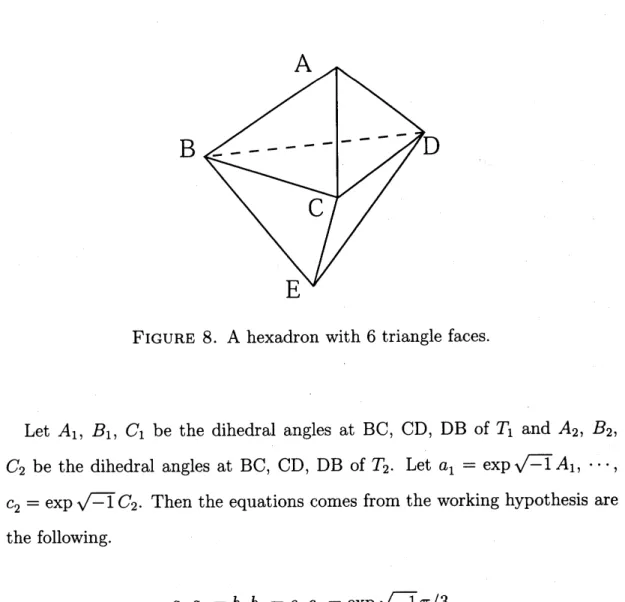
2.6. Subdivision of ahyperbolic hexadron. Let A-BCD-E be the
hex-adron $H_{1}$ given in Figure 8, whose dihedral angles at the edges AB,
$\mathrm{A}\mathrm{C}$, $\mathrm{A}\mathrm{D}$,
BE, CE, DE
are
all $\pi/2$, and those at the edges $\mathrm{B}\mathrm{C}$, $\mathrm{B}\mathrm{D}$, CDare
all 3$\pi/5$.
Then $H_{1}$ is realized in the hyperbolic space. Let $T_{1}$, $T_{2}$ be the tetrahedra
ABCD and BCDE. Now obtain the dihedral angles of $T_{1}$ and $T_{2}$ at the edges
$\mathrm{B}\mathrm{C}$, $\mathrm{C}\mathrm{D}$, and BD from the working hypothesis.
$\mathrm{B}$
FIGURE 8. Ahexadron with 6triangle faces.
Let $A_{1}$, $B_{1}$, $C_{1}$ be the dihedral angles at $\mathrm{B}\mathrm{C}$, $\mathrm{C}\mathrm{D}$, DB of $T_{1}$ and A2, $B_{2}$, $C_{2}$ be the dihedral angles at $\mathrm{B}\mathrm{C}$, $\mathrm{C}\mathrm{D}$, DB of $T_{2}$. Let $a_{1}=\exp\sqrt{-1}A_{1}$, $\cdots$ ,
$c_{2}=\exp\sqrt{-1}C_{2}$. Then the equations comes from the working hypothesis are
the following.
$a_{1}a_{2}=b_{1}b_{2}=c_{1}c_{2}=\exp\sqrt{-1}\pi/3$,
$(1+\sqrt{-1}za_{1}b_{1})(1+\sqrt{-1}za_{1}c_{1})(1+z’a_{1}b_{1})(1+z’a_{1}c_{1})\cross$ $(1+\sqrt{-1}u’a_{2}b_{2})(1+\sqrt{-1}u’a_{2}c_{2})(1+ua_{2}b_{2})(1+ua_{2}c_{2})=$ $(1+\sqrt{-1}z’a_{1}b_{1})(1+\sqrt{-1}z’a_{1}c_{1})(1+za_{1}b_{1})(1+za_{1}c_{1})\cross$ $(1+\sqrt{-1}ua_{2}b_{2})(1+\sqrt{-1}ua_{2}c_{2})(1+u’a_{2}b_{2})(1+u’a_{2}c_{2})$, $(1+\sqrt{-1}za_{1}b_{1})(1+\sqrt{-1}zb_{1}c_{1})(1+z’a_{1}b_{1})(1+z’b_{1}c_{1})\cross$ $(1+\sqrt{-1}u’a_{2}b_{2})(1+\sqrt{-1}u’b_{2}c_{2})(1+ua_{2}b_{2})(1+ub_{2}c_{2})=$ $(1+\sqrt{-1}z’a_{1}b_{1})(1+\sqrt{-1}z’b_{1}c_{1})(1+za_{1}b_{1})(1+zb_{1}c_{1})\cross$ $(1+\sqrt{-1}ua_{2}b_{2})(1+\sqrt{-1}ub_{2}c_{2})(1+u’a_{2}b_{2})(1+u’b_{2}c_{2})$, $(1+\sqrt{-1}za_{1}c_{1})(1+\sqrt{-1}zb_{1}c_{1})(1+z’a_{1}c_{1})(1+z’b_{1}c_{1})\cross$ $(1+\sqrt{-1}u’a_{2}c_{2})(1+\sqrt{-1}u’b_{2}c_{2})(1+ua_{2}c_{2})(1+ub_{2}c_{2})=$ $(1+\sqrt{-1}z’a_{1}c_{1})(1+\sqrt{-1}z’b_{1}c_{1})(1+za_{1}c_{1})(1+zb_{1}c_{1})\cross$ $(1+\sqrt{-1}ua_{2}c_{2})(1+\sqrt{-1}ub_{2}c_{2})(1+u’a_{2}c_{2})(1+u’b_{2}c_{2})$, (17)
where $z$, $z’$ be the non-trivial solutions of
$(1-z)(1+za_{1}b_{1})(1+za_{1}c_{1})(1+zb_{1}c_{1})=$
$(1+\sqrt{-1}za_{1}b_{1})(1+\sqrt{-1}za_{1}c_{1})(1+\sqrt{-1}zb_{1}c_{1})(1-\sqrt{-1}z)$, (18)
and $u$, $u’$ be the non-trivial solutions of
$(1-u)(1+ua_{2}b_{2})(1+ua_{2}c_{2})(1+ub_{2}c_{2})=$
$(1+\sqrt{-1}ua_{2}b_{2})(1+\sqrt{-1}ua_{2}c_{2})(1+\sqrt{-1}ub_{2}c_{2})(1-\sqrt{-1}u)$. (19)
Then
$a_{1}=b_{1}=c_{1}=a_{2}=b_{2}=c_{2}=\pi/6$
satisfies (17). Then the volumes of$T_{1}$ and $T_{2}$ are equal to 0.00610257 and the
length of the edges of the hexadron are computed numerically as follows
AB $=\mathrm{A}\mathrm{C}=\mathrm{A}\mathrm{D}=\mathrm{B}\mathrm{E}$ $=\mathrm{C}\mathrm{E}$ $=\mathrm{D}\mathrm{E}$ $=0.481212$,
$\mathrm{B}\mathrm{C}=\mathrm{B}\mathrm{D}=\mathrm{C}\mathrm{D}=0.337138$.
2.7. Subdivision ofan elliptic hexadron. Let A-BCD-E be the hexadron
$H_{1}$ given in Figure 8, whose dihedral angles at the edges AB,
$\mathrm{A}\mathrm{C}$, $\mathrm{A}\mathrm{D}$, BE,
CE, DE are all $\pi/2$, and those at the edges $\mathrm{B}\mathrm{C}$, $\mathrm{B}\mathrm{D}$, CD
are
all 2$\pi/3$. Then$H_{1}$ is realized in $S^{3}$. Let $T_{1}$, $T_{2}$ be the tetrahedra ABCD and BCDE. Then
the dihedral angles corresponding to the edges of $\mathrm{B}\mathrm{C}$, $\mathrm{B}\mathrm{D}$, $\mathrm{C}\mathrm{D}$ of $T_{1}$ and $T_{2}$
are all equal to $\pi/3$. Hence the volumes of $T_{1}$ and $T_{2}$ are equal to 0.102808
and the lengths of edges are computed numerically as follows.
AB $=\mathrm{A}\mathrm{C}=\mathrm{A}\mathrm{D}=\mathrm{B}\mathrm{E}=\mathrm{C}\mathrm{E}=\mathrm{D}\mathrm{E}=1.0472$,
$\mathrm{B}\mathrm{C}=\mathrm{B}\mathrm{D}=\mathrm{C}\mathrm{D}=0.785398$.
2.8. Subdivision of aEuclidean hexadron. LetA-BCD-Ebe the hexadron
$H_{1}$ given in Figure 8, whose dihedral angles at the edges AB,
$\mathrm{A}\mathrm{C}$, $\mathrm{A}\mathrm{D}$, BE,
CE, DE are all$\pi/2$, and those at the edges $\mathrm{B}\mathrm{C}$, $\mathrm{B}\mathrm{D}$, CD
are
all 2 $\arccos 1/\sqrt{3}$.Then $H_{1}$ isrealized inthe Euclidean space. Let$T_{1}$, $T_{2}$ be the tetrahedraABCD
and BCDE. Nowobtain the dihedral angles of$T_{1}$ and $T_{2}$ at the edges $\mathrm{B}\mathrm{C}$, $\mathrm{C}\mathrm{D}$,
and BD from the working hypothesis.
Let $A_{1}$, $B_{1}$, $C_{1}$ be the dihedral angles at $\mathrm{B}\mathrm{C}$, $\mathrm{C}\mathrm{D}$, $\mathrm{D}\mathrm{B}$ of$T_{1}$ and $A_{2}$, $B_{2}$, $C_{2}$
be the dihedral angles at $\mathrm{B}\mathrm{C}$, $\mathrm{C}\mathrm{D}$, DB of $T_{2}$
.
Let$g_{1}=92$(A2,$B_{1},$ $C_{1}$) $=\det \mathrm{G}\mathrm{r}\mathrm{a}\mathrm{m}(T_{1})$,
$g_{2}=92$(A2, $B_{2},$$C_{2}$) $=\det$Gram$(T_{2})$
.
Since $T_{1}$ and $T_{2}$ should be tetrahedra in the Euclidean space, we should have
$g_{1}(A_{1}, B_{1}, C_{1})=g_{2}(A_{2}, B_{2}, C_{2})=0$.
The equations corresponding to the edges are all satisfied for such Euclidean
case because the length of the ‘edges’ are all equal to 0. Actual computaio
show that
$g_{1}(A_{1}, B_{1}, C_{1})=1-\cos^{2}A_{1}-\cos^{2}B_{1}-\cos^{2}C_{1}$,
$g_{2}(A_{2}, B_{2}, C_{2})=1-\cos^{2}A_{2}-\cos^{2}B_{2}-\cos^{2}C_{2}$
.
Since $A_{1}+A_{2}=B_{1}+B_{2}=C_{1}+C_{2}=2\arccos 1/\sqrt{3}$,
$\cos^{2}A_{1}+\cos^{2}A_{2}\geq\frac{2}{3}$, $\cos^{2}B_{1}+\cos^{2}B_{2}\geq\frac{2}{3}$, $\cos^{2}C_{1}+\cos^{2}C_{2}\geq\frac{2}{3}$.
The equalities hold for $A_{1}=A_{2}=B_{1}=B_{2}=C_{1}=C_{2}=\arccos 1/\sqrt{3}$.
Therefore,
$g_{1}(A_{1}, B_{1}, C_{1})+g_{2}(A_{2}, B_{2}, C_{2})\leq 0$,
and $g_{1}(A_{1}, B_{1}, C_{1})+g_{2}(A_{2}, B_{2}, C_{2})=0$ if $A_{1}=A_{2}=B_{1}=B_{2}=C_{1}=C_{2}=$
$\arccos 1/\sqrt{3}$.
Note that the six unknowns are determined ffom the five relations.
We explainanother example ofaEuclidean hexadron. Let A-BCD-Ebe the
hexadron $H_{2}$ given in Figure 8, whose dihedral angles at the edges AB, $\mathrm{A}\mathrm{C}$,
$\mathrm{A}\mathrm{D}$, BE, CE, DE are
all $\arccos 1/3$, and those at the edges $\mathrm{B}\mathrm{C}$, $\mathrm{B}\mathrm{D}$, CD are
all 2 $\arccos 1/3$. Then $H_{2}$ is realized in the Euclidean space. Let $T_{1}$, $T_{2}$ be the
tetrahedra ABCD and BCDE.
Let $A_{1}$, $B_{1}$, $C_{1}$ be the dihedral angles at $\mathrm{B}\mathrm{C}$, $\mathrm{C}\mathrm{D}$, DB of
$T_{1}$ and $A_{2}$, $B_{2}$, $C_{2}$
be the dihedral angles at BC CD, DB of$T_{2}$. Let
$g_{1}=g_{1}(A_{1}, B_{1}, C_{1})=\det$Gram(T2). $g_{2}=g_{2}(A_{2}, B_{2}, C_{2})=\det$ Gram(T2).
Since $T_{1}$ and $T_{2}$ should be tetrahedra in the Euclidean space, we should have
$g_{1}(A_{1}, B_{1}, C_{1})=g_{2}(A_{2}, B_{2}, C_{2})=0$
.
(20)The equations corresponding to the edges are all satisfied for such Euclidean
case because the length of the ‘edges’
are
all equal to 0. Actual computaio$\mathrm{n}$show that
$g_{1}(A_{1}, B_{1}, C_{1})= \frac{8}{9}(\frac{2}{3}-\mathrm{c}\mathrm{o}\mathrm{s}^{2}A_{1}-\mathrm{c}\mathrm{o}\mathrm{s}^{2}B_{1}-\mathrm{c}\mathrm{o}\mathrm{s}^{2}C_{1}$
$-\cos A_{1}\cos B_{1}-\cos A_{1}\cos C_{1}-\cos B_{1}\cos C_{1})$, (21)
$g_{2}(A_{2}, B_{2}, C_{2})= \frac{8}{9}(\frac{2}{3}-\mathrm{c}\mathrm{o}\mathrm{s}^{2}A_{2}-\mathrm{c}\mathrm{o}\mathrm{s}^{2}B_{2}-\mathrm{c}\mathrm{o}\mathrm{s}^{2}C_{2}$
$-\cos A_{2}\cos B_{2}-\cos A_{2}\cos C_{2}-\cos B_{2}\cos C_{2})$ . (22)
Now let $\cos A_{1}=1/3+x$, $\cos B_{1}=1/3+y$, $\cos C_{1}=1/3+z$, then $\cos A_{2}=$
$1/3-x$ , $\cos B_{2}=1/3-y$, $\cos C_{2}=1/3-z$, since $A_{1}+A_{2}=B_{1}+B_{2}=$ $C_{1}+C_{2}=2\arccos 1/3$, and so
$g_{1}(A_{1}, B_{1}, C_{1})+g_{2}(A_{2}, B_{2}, C_{2})=- \frac{16}{9}(x^{2}+y^{2}+z^{2}+xy+xz+yz)$
$=- \frac{8}{9}((x+y)^{2}+(z+z)^{2}+(y+z)^{2})\leq 0$
.
(23)The equalities hold for $A_{1}=A_{2}=B_{1}=B_{2}=C_{1}=C_{2}=\arccos 1/3$. There
fore,
$g_{1}(A_{1}, B_{1}, C_{1})+g_{2}(A_{2}, B_{2}, C_{2})\leq 0$,
and $g_{1}(A_{1}, B_{1}, C_{1})+g_{2}(A_{2}, B_{2}, C_{2})=0$ if$x=y=z=0$, i.e. $A_{1}=A_{2}=B_{1}=$
$B_{2}=C_{1}=C_{2}=\arccos 1/3$.
2.9. Tetrahedron with ahole. Herewe consider atetrahedron with asmall
hole, whichis homeomorphic toatetrahedron witharemovedball. Thisobject
is useful for donsidering about the connected sum. For simplisity, we consider
the symmetric case. Let $T$ be aregular tegrahedron whose dihedral angles ar
allequal to0, let $T’$ be asmall tetrahedron at thecenter of$T$, andwesubdivide
$T\backslash T’$ into 14 tetrahedra of three kinds of shapes as in Figure 9. Let Type I
be tetrahedra corresponding to the faces, Type II be those corresponding to
the edges and Tye III be those corresonding to vertices. There are four Type
Itetrahedra, six Type II tetahedra and four Type III tetrahedra
Atetrahedron with ahole.
A tetrahedron with a hole. A subdivion ofthe tetrahedron.
FIGURE 9. Subdivision of atetrahedron with ahole.
We
assume
that the subdivision is symmetric and the angles of eachtetra-hedron is assigned as in Figure 10. Then
Type ITyp e $\mathrm{I}\mathrm{I}$
Type III
FIGURE 10. Angles of tetrahedra in the subdivision.
$A= \frac{\theta}{2}$, $B= \frac{2\pi}{3}$, $C=0$, $D= \frac{\pi}{4}$, $E= \mathrm{a}\mathrm{x}\mathrm{b}\mathrm{i}\mathrm{t}\mathrm{u}\mathrm{r}\mathrm{a}\mathrm{l}\mathrm{y}F=\frac{\pi}{3}$, $G= \frac{\pi}{2}$
are
asolution of the length relation (15), andso
if we put $E=0$, then thesum of length around an edge of$T’$ is equal to $E+2G=\pi$. Therefore, we can
glue two tetrahedra with ahole with such geometricstructure at the boundary
spheres of the holes
Remark 1. It may be natural to suppose that $E=\arccos-1/3$. However,
to satisfy the angle relation for the connect sum, the solution $E=0$ is much
better than $E=\arccos-1/3$.
Remark 2. The signature ofthe determinant ofthe Gram matrices ofType I
tetrahera are equal to that of the original tetrahedron$T$. The determinant of
the GrammatricesofType IIandTypeIII tetrahedraareequalto 0, and sothe
generalized lengthofthe edges ofthese tetrahedra are equal to 0. However, by
reformulating the length relation to an algebraic relation, then such algebraic
version of the length relation is satisfied for the edge corresponding to $\mathrm{B}$, $\mathrm{D}$
and $\mathrm{F}$, and the edge corresponding to $\mathrm{E}$ and G.
3. SpECULATIONS
3.1. The geometric structure of afluctuating tetrahedron. The
ge0-metric structure of afluctuating tetrahedron $T_{\Theta}$ can be determined by the
determinant of the Gram matrix $\det$Gram(T\ominus ). Assume that $T_{\Theta}$ can be
real-ized in hyperbolic, Euclidean or spherical spaces. If$\det$Gram(T\ominus ) is negative,
$T_{\Theta}$ can be realized as ahyperbolic tetrahedron. If $\det$Gram(T\ominus ) is positive,
$T_{\Theta}$ can be realized as aspherical tetrahedron. If $\det$Gram(T\Theta ) $=0$, $T_{\Theta}$ can
be realized as aEuclidean tetrahedron. For the actual realization ofTe, there
are some conditions concerning to the minor determinants ofGram(T\Theta ) (see,
e.g. [10]$)$.
3.2. Generalized tetrahedron. Here, we consider the case that the
condi-tions for dihedral angles to realize atetrahedron arenot satisfied. In this note,
we would like to generalize the notion of tetrahedron so that it admits any
dihedral angles.
One extension is to truncated tetrahedron in ahyperbolic space. If the
solid angle at avertex is less than $\pi$, this vertex can be realized in none
of hyperbolic, Euclidean and spherical spaces. But it can be realized as a
truncated tetrahedron in ahyperbolic space as in [3]. By this reason, we
extend the notion of atetrahedron to atruncated tetrahedron. Let $T_{\Theta}$
mean
the corresponding truncated tetrahedron if$T_{\mathrm{e}}$ can be realized as atruncated
tetrahedronin the hyperbolicspace. In this case, [3] shows that the volume of
the truncated tetrahedron is also given by
Volume(T\Theta ) $=|{\rm Im} \mathcal{V}(T_{\Theta})|$.
By
this reason, we extend the notion of tetrahedron to such truncatedtetra-hedron.
Other extensions are tetrahedrons with negative volumes and edges with
negative lengths. For
some
fluctuating structure, it may happen that thevolume or the length of aedge is negative and so we would like to admit such
tetrahedron by giving asuitable rule for cancellation of overlapped tetrahedra
with positive and negative volumes.
With these generalizations of the notion of geometric tetrahedron, we can
give ageometric structure to any fluctuating tetrahedron from its fluctuating
structure.
3.3. Geometric structure of afluctuating simplicial decomposition.
For afluctuating simplicial decomposition $\mathcal{T}_{\Theta}$,
we can
give ageometricstruc-ture to each tetrahedron of$\mathcal{T}$.
But these structures of two tetrahedra sharing
aface may not be compatible at this face. The lengths ofan edge of this face
given by the sharing tetrahedra may not be equal in general.
3.4. Geometric structure of astationary decomposition.
3.4.1. Homogeneous structure
case.
Let $\mathcal{T}_{\Theta_{0}}$ be astationarydecomposi-tion of a3-manifold $M$. If the structures of all the tetrahedra of$\mathcal{T}$ given by
$\Theta_{0}$ are hyperbolic (resp. spherical), then
these structures are all compatible
at all the faces of $\mathcal{T}$. Hence these structures determine ahyperbolic (resp.
spherical) structure of $M$.
3.4.2. Non-homogenous structure
case.
Let $\mathcal{T}_{\ominus_{0}}$ be astationarydecom-positive ofa3-manifold $M$. Consider the
case
that the geometric structure ofsome two tetrahedron is different. Let $T_{1}$ and$T_{2}$ be adjacent tetrahedrawith a
commonedge $E$. Let $\theta_{1}$ and$\theta_{2}$ be the dihedralangles of$T_{1}$ and $T_{2}$ respectively
corresponding to the edge $E$. For astationary decomposition, we have
$\frac{\partial \mathcal{V}(T_{\Theta_{0}})}{\partial\theta_{1}}=\frac{\partial \mathcal{V}(T_{\Theta_{0}})}{\partial\theta_{2}}$ (24)
If the determinant of the Gram matrix of $T_{1}$ is positive and that of $T_{2}$ is
negative, then $\frac{\partial \mathcal{V}(T_{\Theta_{0}})}{\partial\theta_{1}}.\mathrm{s}$ non-negative real number and $\frac{\partial \mathcal{V}(T_{\Theta_{0}})}{\partial\theta_{2}}$ is $\sqrt{-1}$
times areal number, and the both are non-zero. This is acontradiction to
(24) and so we have the following.
Observation. The product ofthe determinants ofthe Gram matrices oftwo
adjacent tetrahedra is non-negative.
This observation is true if the two adjacent tetrahedra is actually realizable
in hyperbolic, Euclidean, or spherical spaces. However, it is not provedyet for
other generalized cases.
3.5. Existence of astationary point. The volume formula (7) is given in
terms of dilogarithm functions and so its partial derivatives with respect to
the dihedral angles are given in terms of logarithm functions. Hence, the set
of equations to get astationary point is deformed to asystem of algebraic
equations by taking exponential of the original equations of indeterminates
$x_{j}^{i}=\exp\sqrt{-1}\theta_{i}^{j}$
.
Since the number of equations and the numbers of theinde-pendent parameters are equal, this system should have at least one solution.
However, the above solution may not be acomplex number of unit length. If
they are all ofunit length, it is still not clear that their arguments satisfy the
edgerelation, if we take the appropriate choices ofbranches. The sumof dihe-dral angles around an edge may be an integral multiple of 2$\pi$ instead of 2$\pi$.
Therefore, it is not
so
clear that there always exist astationary decomposition.On the other hand, ageometric decomposition is astationary
decomposi-tion. Hence asimplicial decomposition $\tau_{\mathrm{e}}$ is realizable by ageometric
de-composition, such geometric decomposition
can
be obtained as astationarydecomposition.
In this note, we generalized the notion of tetrahedron to admit negative
volume and negative lengths of edges. If any simplicial decomposition of a
3-manif0ld $M$ is realizable as ageometric decomposition with such
general-ized tetrahedron, the geometric structure of $M$ should be given by
one
of thestationary decomposition.
4. Conclusion
Amethodto get ageometricstructure of3-manifoldsfrom
Schanfli’s
formulais already considered by Casson. His method
uses
the lengths of edges asparameters, while our method
uses
the dihedral angles as parameters. Romthe view point of the generalized volume function, dihedral angles
seems
to bevery natural parameters. For degenerate case, the length may vary from
0to
infinity, while anydihedral angleis bounded. Bythis reason, Iexpect that the
working hypothesis proposed in this note works not only for the hyperbolic
case but also for generalized case.
The obstruction forourworking hypothesis is thatwe don’t knowthat there
is asolution of thealgebraic version of theequations for stationarypoints such
that each parameters of the solution
are
ofunit lengthREFERENCES
[1] Y. Cho and H. Kim, On the volume formula for hyperbolic tetrahedra,
Discrete Comput. Geom. 22 (1999), 347-366.
[2] R. M. Kashaev, The hyperbolic volume ofknots from quantum
diloga-rithm, Moren Phys. Lett. A10 (1995), 1409-1418.
[3] R. Kellerhals, On volumes of hyperbolic polyhedra, Math. Ann. 285
(1989), 541-569.
[4] A. N. Kirillov, Dilogarithm Identities, Lectures in Mathemical Sciences,
The University of Tokyo (1995).
[5] H. Murakami, Optimistic calculations about the Witten-Reshetikhin-Turaev
invariants
of
closedthree-manifolds
obtainedfrom
the figure-eight knot byintegral Dehn surgeries, Recent progress towards the volume conjecture
(Kyoto, 2000). S\={u}rikaisekikenky\={u}sho K\={o}ky\={u}roku No. 1172, (2000), 70-79.
[6] H. Murakami and J. Murakami, The colored Jones polynomials and the
simplicial volume ofaknot, Acta Math. 186 (2001), 85-104.
[7] J. Murakami and M. Yano, On the volume of ahyperbolic
tetrahe-dra, preprint,
http://faculty.web.waseda.ac.jp/murakami/papers/tetra-hedron.pdf.
[8] W. Thurston, Three-Dimensional Geometry and Topology, Princeton
Uni-versity Press (1997).
[9] V. G. Turaev and O. Ya. Viro, State
sum
invariants of 3-manifolds andquantum $6j$-symbols, Topology 31 (1992), 865-902.
[10] E. B. Vinberg, Tie volume ofpolyhedra on asphere and in Lobachevski
space, Amer. Math. Soc. Tans. (2), 148 (1991), 15-27.
[11] Y. Yokota, On the volume conjecture of hyperbolic knots, preprint,
$\mathrm{m}\mathrm{a}\mathrm{t}\mathrm{h}.\mathrm{Q}\mathrm{A}/0009165$.
[12] Y. Yokota, On the potential functions for the hyperbolic structures ofa
knot complement, preprint.
Department of Mathematical Science,
School of Science and Engineering, Waseda University,
3-4-1 Okubo Shinjuku-ku Tokyo,
169-8555JAPAN
$E$-mail address: [email protected]
$URL$:http://faculty.web.waseda.ac.jp/murakami