The Early Modern English Formation of the Term
“Society”:
A Text-Mining Analysis
Teruhito SAKO
*1. Subject and Method
This article aims to elucidate the Early Modern English semantic history of the word “society” through the process of text-mining of a vast corpus (125 e-texts of over 260,000 sentences from political literature of the sixteenth and seventeenth centuries).
Today not a small number of eminent social theorists –including Anthony Giddens (1987:31-34),Immanuel Wallerstein (1987:315),Ulrich Beck (1997=
2000:25),John Urry (2000:5-12)-- deny the academic value of the term “society”.
They say “society” is virtually an equivalent term of “nation-state”, and today “nation- state” is on the wane. Yes, “nation-state” as a twentieth century’s dominant political- economic-cultural institution has been losing its power in considerable degree today.
And of course I agree that we social theorists should pay attention to the myriad of human relations that do not fit into the “nation-state” concept.
But even so, I feel that rejecting the term “society” altogether would be like throwing the baby out with the bathwater. Indeed, my general claim is that when one considers the semantic history of the word “society”, one finds that there is no other word that was so well-suited to describing communal life during periods of structural transformation.
First of all, the abolitionists neglect a very basic fact: “society” first surfaced as
* SAKO, Teruhito 首都大学東京人文科学研究科 教授 [email protected]
a key term in public discourse long before the rise of the “nation-state”. In the case of England, for example, the word first entered the vernacular in the 16th and 17th century. In other words, it surfaced during the long and unsteady process of development beginning with the rise of Protestantism and underwent various fits and starts before finally locking onto its course towards bourgeois revolution. As I explain in more detail later, “society” was first imported from the opposite bank of the Dover Channel in the early 16th century as a synonym of “fellowship” and “company”. By the late 16th century and early 17th century, it had come to mean an official or unofficial civil organization. Then, in the late 17th century, it was being used to describe either an entire system of political rule that protects (or that ought to protect) private property, or the aggregate of human relations within the sphere of influence of such rule.
The primary reason for I conduct a text-mining analysis exclusively on the meanings and usages of the word is that the two prerequisites for doing so are now met. First, it is now possible to access the necessary material electronically (in ASCII or HTML format). In my case, I could access the material from Proquest’s Early English Books Online (EEBO).
1)Second, there is an impressive body of research on the same subject that has used different approaches. In my view, this should now be considered a prerequisite, too. When using a new research technique like text-mining, for which a standard procedure has not yet been established, unless researchers follow certain guiding principles, their research might end up a passing fad with hardly any useful outcomes.
To avoid this risk, researchers may as well start on a secure footing by referring to the findings of existing research, and then they may as well build on these findings by using the new technique to verify them. For the purpose of this paper, the existing study that fulfills this condition is that by Phil Withington’s Society in Early Modern England (2010).
In his work, Withington traced the changes in the meanings and usages of the
word “society” in political discourse in 16th and 17th century England. He used the
traditional way of reading texts in the literal sense (using the hands and eyes), and
added to this technique by heuristically and argumentatively quantifying the appearance frequencies of certain words in the English Short Title Catalogue (ESTC).
2)Withington’s objective was different from mine; he sought to identify the important role that associational human relations played in political communication in Early Modern England, whereas mine is to elucidate the changes in the meanings and usages of the word itself. Withington’s work is, nevertheless, exceedingly valuable as existing literature, in that it shares many of the same issues that concern my research.
The methodology of using text-mining to verify the findings of existing research does indeed provide a secure footing. The downside, however, is that the study may end up becoming nothing more than a verbose approval of the existing research. This eventuality must be avoided, as in any other methodology. Thus, deploying the text-mining technique in this way can only have value if, as an extension to verifying the existing research, the technique can add fresh findings and insights.
Furthermore, if text-mining does yield findings that differ from the existing research, this will also offer immense academic value. The process of text-mining is clear-cut:
obtain findings from the actual text in the material. As such, it is easy to conduct follow-up studies, and if text-mining yields fresh findings, the significance of these findings can be accurately evaluated by comparing the different sets of findings and double-checking them against the textual materials.
There is one more point I would like to add as a provisional guiding principle
for using the text-mining technique. Text-mining should be used to accumulate
findings through a commonsensical (and thus secure-footed) analysis, that is, one that
does not rely on any arithmetical techniques beyond the level equivalent to high school
graduates. Findings that can only be obtained when using highly specialized
arithmetical techniques will be problematic; on the one hand, their reliability will be
doubted, and on the other, it will encourage the misconception that text-mining is
inaccessible to those who are not experts in advanced arithmetic. Accordingly,
throughout my analysis, I make a point of using only the four rules of arithmetic
(addition, subtraction, multiplication, and division) and percentages.
2. Creating a Data Set and Preparing for the Analysis
Using the ESTC as his source material, Withington (2010) employed the traditional technique of literal reading, while also employing the new method of heuristically and argumentatively quantifying the usages of words or phrases. As for my study, I created a data set containing copies of 16th and 17th century texts that Withington cited in his research, and I then text-mined the data set. With the above- mentioned prerequisites for text-mining being fulfilled, text-mining is an option that allows me to adjust the arguments surrounding this topic on the same wavelength.
After extensively surveying materials like the EEBO, I was able to access digital copies of 125 of the 171 texts that Withington cited. Of these, 111 are in EEBO and 14 are in other sources. Regarding the latter 14 sources, much of the text was garbled, probably because of the low resolution of the Optical Character Recognition, and there was a serious limit to what extent the characters could be cleaned. I used the copies anyway, following the same precedent of Erez Aiden & Jean-Baptiste Michel (2013).
3)The main text of [Barston 1576], which Withington considered very important, was not available in any existing public digital resources, so I created the ASCII text of it by myself.
4)I created my data set according to the following process: 1) I obtained digital copies of the 125 texts and cleaned them as much as possible. 2) I consolidated the texts into a single ASCII file. 3) I removed all line segment breaks within the file. 4) I inserted line segment breaks after every period and question mark.
5)5) At the end of each text, I added a brief citation mark (e.g., [Mayer 1621]). This process yielded a corpus consisting of 266,176 line segments. I refer to this data set hereinafter as the Withington-Sako Corpus (WSC).
The analytical software I used was Advanced Analytics’ Text Analytics for
Surveys 4.1.0 and Microsoft Excel 2007. I chosen the former program for the way it
handles the text-mining process as a single operation; in other words, it processes
natural language and measures the number of appearances and displays the results of
analysis in one go. As for Excel 2007, I used it to examine in detail each of the word-
use groups extracted using Text Analytics. I also used it to collate and pair multiple sets of results in Text Analytics.
3. Overview of Withington (2010)’s Findings, and the Analytical Strategy of this Study
Before going any further, let me outline the four key theses of Withington that align with the purposes of my study, and then I will clarify the specific strategy I used when text-mining the WSC as means of verifying Withington’s work.
Thesis (1): In 16th Century England, society was a new term absorbed from continental Renaissance concepts. As evidenced by lexicographer Thomas Elyot’s reference to “society” in his 1538 dictionary, when society first entered the lexicon, it was primarily associated with, or defined as a synonym of, well-established terms like
“company” and “fellowship”. As far as can be seen from lexicographical references, the trend to regard “society”, “company”, and “fellowship” as synonymous continued up to and included the time of Edward Phillips’ dictionary in 1696. (Withington 2010:
106-109)
Thesis (2): Aside from lexicographical references, when one looks at the actual usages of “society” in thematically linked texts, one finds that the underlying concept of “society” remained stable throughout the 16th and 17th century; that is, throughout this period, it continued to mean a voluntary, purposeful and deliberate association.
(Withington 2010: 105, 109, 112)
Thesis (3): When one traces the changes in the referents of “society” and
“company”, one finds that in the early 16th century, “society” denoted transient and convivial social encounters. However, from the late 16th century onward, one finds an increasing number of examples where “society” describes more organizationally complex and durable associations, and by the 17th century, it was predominantly being used to refer to an officially sanctioned civil association. (Withington, 2010: 110-122)
6)Thesis (4): There were also cases where “society” was deployed in a way that
“company” was not. Whereas “company” was either used to describe a transient and
informal group or used as the proper noun for such a group, “society” was often used in philosophical discussions with modifiers to indicate abstract entities like ‘humane society,’ ‘civil society,’ and ‘Christian society’. (Withington 2010: 120, 123)
Hereunder, I describe the optimum strategies to employ when text-mining the WSC in order to verify the above claims.
Regarding Thesis (1), this consists of two parts. The first (1a) is that “society”
was introduced into the English lexicon in the 16th century as a term peculiar to continental Renaissance concepts. To verify this, it is necessary to find corresponding groups of words in the WSC with such usage and check them against the actual usages thereof. The second part of the thesis (1b) is that “society” was synonymous with
“company” or “fellowship”. This can be verified by finding examples in the WSC where the word is literally qualified as such. We already know that it is qualified as such in the lexicographical references, so it would be best to find non-lexicographical examples.
Regarding Thesis (2), the conceptual continuity of “society”, we can assume that this claim will be difficult to verify by text-mining the WSC. This is because Withington’s conception of a voluntary, purposeful and deliberate association is a highly refined abstraction, one which is only possible to derive by glancing back from the present-day vantage point upon the whole body of discourse at the time and thus grasping an overall synopsis of the semantic territory. Though difficult to verify, one could, on an experimental basis, extract the words from the WSC that most closely resemble the composite words in Withington’s summation and then check the relevant texts to determine the usages of these words. To do so, we would use the following procedure:
Regarding “purposeful”-related words, there are 21 segment lines containing the word “purpose,” 53 containing the word “end,” and 2 containing the word “aim.”
Regarding “voluntary”-related words, there are 14 segment lines containing the word
“voluntary.” Regarding “deliberate”-related words, there are 71 containing the word
“reason,” five containing the word “deliberate,” and 15 containing the word “intend.”
As for “association”-related words, there are five appearances of “associate,” 40 appearances of “corporate,” and 15 appearances of “communicate.”
There is only one example in the WSC where “society” collocates with all four composite word categories (“voluntary”, “purposeful” and “deliberate”, “association”).
Therefore, this Arithmetical equality is required in contracts, as well voluntary as constrained: To the end that the communicating of things may last forever in the societies of men.
[Aristotle 1598] (underlining not in original; same applies hereinafter)
7)The text mentions an association of sorts (contract) that is voluntary and has a specific purpose (economic benefit). However, this association does not indicate “society”
itself, but rather the activity of exchanging commodities. I am not sufficiently confident in this example to posit it as a representative example of how the term
“society” was deployed in the political discourse of 16th and 17th century England.
8)An alternative tactics is required.
Regarding Thesis (3), which concerns change in the referents of “society”, Withington searched for appearances of both “society” and “company” in the ESTC and found that: (3a) in the early 16th century, the terms described informal convivial gatherings, whereas (3b) by the late 16th century, they were increasingly describing more durable organizations. Withington searched for both terms together as a means of compensating for the bias stemming from a particular feature of the corpus. Namely, in the ESTC, references to “society” from before the mid-17th century are far fewer than those in the late 17th century (as of May 2017, there are 213 references from 1400- 1650, while there are as many as 3,753 from 1651-1700). Because the WSC lacks this feature, I wanted to test whether I could obtain the same results by searching only for
“society”.
As for Thesis (4), that “society” was used in a different way from “company”,
Withington observed in a trend in the ESTC whereby (4a) “company” described a
particular organization and whereas (4b) “society” was used in abstract and
philosophical inquiry. The way to test this claim is to see whether the same trend can be found in the WSC.
4. Text-mining the Withington-Sako Corpus
Of the 266,176 line segments in the WSC, there are 1,054 (0.39%) segments containing the word “society” or variants like “socyetie(s)”, “societie(s)”, “social”,
“sociale”, “associate(s)”, “association(s)”, “conscociate”, “consociation”, and
“sociable”.
【Table 1】 Frequently Collocated Words with “Society”
1500-1699 Total Number of AppearanceCollocation
Rare 1500-1549 Number of AppearanceCollocation
Rare 1550-1599 Number of AppearanceCollocation
common 212 20.1 fellow 7 20.0 common 101 33.6 Rare
law 208 19.7 associate 5 14.3 civil 82 27.2
civil 165 15.7 fellowship 5 14.3 city 76 25.2
nature 159 15.1 iustice 5 14.3 law 74 24.6
government 109 10.3 knowlege 5 14.3 commonweal 61 20.3
state 107 10.2 reason 5 14.3 nature 58 19.3
power 100 9.5 company 4 11.4 life 48 15.9
god 97 9.2 law 4 11.4 government 37 12.3
city 95 9.0 authority 3 8.6 manner 35 11.6
life 83 7.9 confederate 3 8.6 end 34 11.3
people 82 7.8 counsel 3 8.6 god 30 10.0
person 78 7.4 love 3 8.6 virtue 30 10.0
commonweal 72 6.8 virtue 3 8.6 people 29 9.6
end 71 6.7 advantage 2 5.7 reason 29 9.6
reason 71 6.7 benevolence 2 5.7 greece 28 9.3
fellow 69 6.5 citizen 2 5.7 house 28 9.3
politic 69 6.5 companion 2 5.7 state 27 9.0
manner 63 6.0 contract 2 5.7 associate 26 8.6
public 60 5.7 country 2 5.7 beginning 24 8.0
associate 57 5.4 god 2 5.7 iustice 24 8.0
trueth 57 5.4 happiness 2 5.7 obey 22 7.3
preservation 56 5.3 injury 2 5.7 person 21 7.0
commonwealth 54 5.1 life 2 5.7 politic 21 7.0
king 54 5.1 manner 2 5.7 company 20 6.6
desire 53 5.0 nation 2 5.7 rule 20 6.6
rule 53 5.0 nature 2 5.7 public 19 6.3
body 51 4.8 office 2 5.7 trueth 19 6.3
company 49 4.6 pleasure 2 5.7 govern 18 6.0
house 49 4.6 rule 2 5.7 king 18 6.0
love 49 4.6 sentence 2 5.7 preservation 18 6.0
obey 49 4.6 sociale 2 5.7 private 18 6.0
beginning 48 4.6 speech 2 5.7 rome 18 6.0
friend 48 4.6 woman 2 5.7 speech 18 6.0
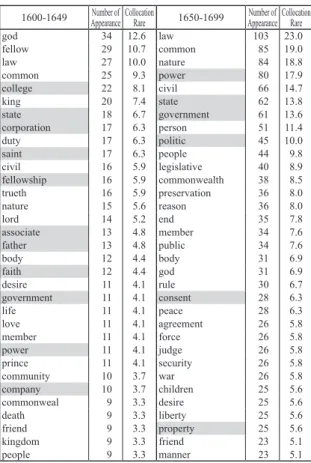
Table 1 shows for each of the four 50-year periods, the appearance frequency of “society” and the collocation frequency, and collocation rate, of key words that frequently collocate with “society”. Key words that frequently collocate with “society”
exclude grammatical articles, pronouns, and other words that regularly feature in all kinds of text (same hereinafter). The collocation rate is calculated as the number of line segments in which the word collocates with “society” within the 50-year period divided by the number of line segments in which “society” appears (same hereinafter) within that period. For example, in the early 16th century texts, there are 35 line segments in which “society” appears. “Fellowship” appears in five of these. Therefore,
1600-1649 Number of AppearanceCollocation
Rare 1650-1699 Number of AppearanceCollocation
god 34 12.6 law 103 23.0 Rare
fellow 29 10.7 common 85 19.0
law 27 10.0 nature 84 18.8
common 25 9.3 power 80 17.9
college 22 8.1 civil 66 14.7
king 20 7.4 state 62 13.8
state 18 6.7 government 61 13.6
corporation 17 6.3 person 51 11.4
duty 17 6.3 politic 45 10.0
saint 17 6.3 people 44 9.8
civil 16 5.9 legislative 40 8.9
fellowship 16 5.9 commonwealth 38 8.5
trueth 16 5.9 preservation 36 8.0
nature 15 5.6 reason 36 8.0
lord 14 5.2 end 35 7.8
associate 13 4.8 member 34 7.6
father 13 4.8 public 34 7.6
body 12 4.4 body 31 6.9
faith 12 4.4 god 31 6.9
desire 11 4.1 rule 30 6.7
government 11 4.1 consent 28 6.3
life 11 4.1 peace 28 6.3
love 11 4.1 agreement 26 5.8
member 11 4.1 force 26 5.8
power 11 4.1 judge 26 5.8
prince 11 4.1 security 26 5.8
community 10 3.7 war 26 5.8
company 10 3.7 children 25 5.6
commonweal 9 3.3 desire 25 5.6
death 9 3.3 liberty 25 5.6
friend 9 3.3 property 25 5.6
kingdom 9 3.3 friend 23 5.1
people 9 3.3 manner 23 5.1
the collocation rate of “fellowship” in this period is 14.3%.
9)The results reveal a number of terms, such as “common,” “civil,” “good,” and
“law,” that collocate frequently with “society” in most of the periods. They also reveal that certain terms collocate frequently in particular periods. In the table, the terms that are shaded are the key terms that I will discuss later on.
4.1. Thesis (1): “Society” and its Relationship with “Company” and
“Fellowship”
In this section, I will test Thesis (1a), that “society” was related to the Renaissance and was a new coinage in the English lexicon. In the WSC, there are 65 line segments in which “society” collocates with words directly linked with the Renaissance such as “Cicero,” “Aristotle,” “Latin,” “Greece,” and “Rome.” Looking at the text data itself, in 43 of these 65 instances, “society” is clearly used in relation to ancient Greece or Rome (31 are from the 16th century, 12 are from the 17th century).
This finding confirms that the “society” in Early Modern England was associated with the continental Renaissance. Without a basis for comparison, the exact strength of this linkage is unclear, but it is sufficient to know that the linkage does exist.
Regarding the finding that “society” was a newly coined term in England at the time, circumstantial evidence for this is found in the fact that of 43 instances mentioned above, 29 appear in translated texts—18 in [Aristotle 1598], six in [Bavande 1559], and five in [Bodin 1606]. In the late 16th century, there were growing numbers of readers who could not understand Latin well, and as part of the expansion of market in printed texts for such readers, many English translations were published.
(Withington 2010:117). In this period, translated texts served as a tool for introducing new concepts—concepts that were not yet present in the indigenous culture—to the large mass of people who could only access the knowledge through the vernacular, as opposed to the minority of intellectuals who were well-versed in Latin. Therefore, it is reasonable to assume that the concepts in these translated texts would have been novel to the readers at the time.
Regarding Thesis (1b), that “society” was defined as “company”, WSC has 50
line segments in which “society” collocates with “company”. After reviewing the texts concerned, I found that in 22 of these instances, the author of the text appears to treat
“society” as synonymous with “company” (1 from the early 16th century, 10 from the late 16th century, 1 from the early 17th century, and 10 from the late 17th century).
Here are some examples:
A Undoubtedly reason, society called company, and knowledge remaining…
[Elyot 1531]
B [A]mongst all other companies, and societies, there is not any more firmly and nearly linked together, then this of the learned… [Guazzo 1581]
C [W]eep for your selves who … want their sweet society, counsel, and company ... [Mayer 1621]
D [B]ut if you and your lines are such dangerous company, pray let me have no more of their society... [Woolley 1670]
That said, in most of the 22 instances (including the Sample Line B, C, and D),
“society” and “company” could also be construed as describing different things.
Indeed, there are only six line segments (including the Sample Line A) in the WSC for which I can confidently assert that “company” is clearly treated as synonymous as
“society”—one in [Elyot 1531], two in [Aristotle 1598], and three in [Phillips 1696].
The weightiness of this fact is made clearer when one compares with a third term, “fellowship”. The instances in the WSC where “society” is clearly treated as synonymous with “company” are outnumbered by the instances where it is clearly treated as synonymous with “fellowship.” “Society” and “fellowship” collocate in 42 line segments, and in eight of these, they are presented as completely synonymous with statements such as ‘society or fellowship’ or similar statements (3 from the 16th century, 5 from the 17th century). There are seven further instances in which the statement can at the very least be construed as treating “society” as a synonym of
“fellowship” (to the same extent as “society” was treated as a synonym of “company”
in the Sample Line B, C, and D above). Examples of these seven instances include the
phrases ‘society and fellowship’ and ‘society, fellowship.’
Thus, a fresh finding is that, when first introduced into the English vernacular,
“society” was associated with “fellowship” to a greater extent than it was with
“company.” This finding is not something that Withington could have discovered in his research. In the ESTC, “society” collocates with “fellowship” in a total of 19 instances in texts from between 1500 and 1700, and the terms are not presented as synonymous in a single one of these instances (as of May 2017). Thus, the above finding only came to light because I compiled a corpus based on Withington’s work and text-mined it. I discuss this point further in 4.4.
4.2. Claim (2): The Semantic Continuity of Society
I could not directly verify Withington’s formula of voluntary, purposeful and deliberate association, so as an alternative, I extract and analyze instances in the WSC where “society” is by a copular verb (e.g., “be”, “is”, “are”, etc.) or by “or” or “of.”
Such line segments would, presumably, contain a clear statement about “society”.
There were 202 such instances. In Table 2, I have arranged these instances into seven categories based on the key concepts linked to collocating word, and I have shown their appearance frequencies.
10)These categories are as follows: <Men> shows the numbers of phrases like ‘society of men,’ <Civil> shows the numbers of phrases like ‘civil society,’ <Men and Women, Family> shows the numbers of phrases like
‘society of man and woman’ and ‘society of man and his family,’ <Religious Groups>
shows the numbers of phrases like ‘society of Jesus,’ ‘society of Saints,’ and ‘Christian
【Table 2】The Words & Word Groupes directly Preceded or Proceeded to “Society”
<Men> <Civil> <Men &
Women, Family>
<Religious Groups>
<Commonwealth
&
Commonweale>
1500-1699 51 22 19 17 11
1500-1549 1 1 0 0 1
1550-1599 25 8 9 3 4
1600-1649 8 2 3 12 0
1650-1699 17 11 7 2 6
society,’ and <Commonwealth and Commonweal> shows the numbers of phrases like
‘commonwealth is society’ and ‘commonweal is society.’
From this table, I could derive the following formula: throughout the 16th and 17th centuries, “society” meant ‘(i) human relations such as relations between men and romantic or conjugal relations between men and women, particularly civil men and women (those living in towns/cities), or (ii) an organization such as a religious or sectarian society or commonwealth’. This is only one possible formula derivable from the 202 relevant line segments in the WSC and the assorted data in Table 2, so other possibilities should not be ruled out. However, suffice it to say that this formula properly mediates between the abstractedness of Withington’s formula (voluntary, purposeful and deliberate association) and rich diversity of textual materials.
In this chapter, I have shown how text-mining serves as an effective tool for mediating and linking an abstract notion intuited by an expert with the specific evidences in the primary textual material, the latter of which is supposed to inform the former. This is not to say that I completely reject an expert’s intuitions. Indeed, in my own research life, there have often been cases where I could not show how I derived a finding. Many other researchers might have the same experience. However, it is not healthy for academia if such intuited findings are allowed to become authoritative.
When the process by which a finding was derived is opaque, the finding should at least be corroborated by a more transparent process. This is where text-mining has an important role to play.
4.3. Thesis (3): Changes in the Objects that “Society” Indicated
Withington claimed that from (3a), in the early 16th century, ”society”
described informal convivial gatherings with little organizational complexity or durability (this finding was derived by searching for examples of “society” together with “company” in ESTC), and that from (3b), by the late 16th century, “society” was increasingly describing more complex and durable organizations. WSC lacks the bias of the ESTC, and so there is no need to search for examples of “society” together with
“company” as a compensatory measure. Therefore, the sensible approach here is to
verify whether Withington’s finding can be replicated when searching only for examples of “society” in the WSC.
We can get some idea as to the veracity of (3a) by referring to the primary fact in Table 1 concerning appearance of “society”-related words in the WSC. Among the early 16th century texts, there are 34 line segments where “society” appears. Five of these (a very large proportion—14.3%) are the appearances of the word “associate.” If we check the text data to articulate the character of these five instances, we find that two of the texts mention “associate” in the sense of men and women dancing, which is consistent with the notion of “society” referring to informal and convivial encounters.
In the remaining three cases, the word is used in reference to a person being accompanied by someone at court. In such cases, “society” may have meant an informal or convivial mingling among courtiers, but it could also be construed as referring to the title of official court attendants.
For the 17th century (3b) too, there is clear albeit partial evidence in Table 1’s data. While the data pertains only to the early 17th century, there is a very high collocation frequency of “society” with “college” (22 line segments, 8.1%) and
“corporation” (17 line segments, 6.3%).
“Colleges” and “corporations” were organizations that were allowed some degree of self-government. Therefore, when referring to them collectively, I use the term self-governing bodies. In Table 3, I have shown the words (or word categories)
【Table 3】 The Words Frequently Collocated with "College" and
"Corporation"
College Number of
Collocations Collocation
Rare Corporation Number of
Collocations Collocation Rare
religion 102 22.4 town 120 28.0
corporate 87 19.1 city 109 25.5
learn 37 8.1 college 87 20.3
company 35 7.7 body 61 14.3
commonweal 33 7.3 religion 50 11.7
fellow 27 5.9 priviledge 32 7.5
magistrate 23 5.1 politic 32 7.5
body 23 5.1 commonweal 27 6.3
city 23 5.1 company 23 5.4
oxford 22 4.8 borough 23 5.4
that frequently collocate with “college” (appears 455 times in the WSC) and those that frequently collocate with “corporation” (appears 428 times in the WSC). These collocations clearly reveal the nature of self-governing bodies. “Colleges” were by and large religious societies, churches, monasteries, and institutes for training clergy, as is evidenced by the prevalence of words that I have assigned to the category <religion>
(words like “god,” “Christ,” “church,” and “priest”). Looking at the text data itself, of the 105 instances where “college” collocates with <religion>, there are 25 cases where
“college” describes an institute for training clergy (‘college of Cardinals, archbishops, monks, priests,’ etc.), 10 cases where the term appears in a phrase like ‘Cathedral and collegiate churches,’ and 3 cases where it appears in a phrase like ‘monastery or college.’ The majority of the remaining cases obviously allude to a religious organization, even if they do not explicitly mention one.
As for “corporation”, according to Table 3, it frequently collocates with
“town,” “city,” and “borough,” suggesting that the term generally referred to a municipality or municipal organization. Looking at the text data itself, of the 190 instances where “corporation” collocates with “town,” “city,” and “borough,” there are 103 cases where the term appears in a phrase like ‘city, town, borough incorporate,’
and of these 103 cases, 94 are 16th century references. Most of the remainder pertains to the 17th century, and many of them refer to a town/city-based “corporation” like a guild or school.
I extracted 30 line segments in the WSC where “society” collocates with self- governing bodies (“college” or “corporation”) and checked the relevant texts to determine the context. In as many as 22 of the cases, two or more of the words
“society”, “college”, and “corporation” are listed and partitioned with “and,” “or,” or a comma; for example, ‘corporation or college,’ ‘college or society,’ and ‘corporation and college, or society.’ This data indicates that, in the 17th century, “society” meant a religious organization or a municipal or town/city-based self-governing body.
As far as can be seen from the data in Table 1, “society” was only collocated with self-governing body (“corporation” or “college”) in the early 17th century texts.
However, looking at the collocation frequency for each period, one can see that there
were no collocations in the early 16th century, eight collocations in the late 16th century, 30 in the early 17th century, and 20 in the late 17th century. Thus, just as Withington claimed, it was in the late 16th century that “society” underwent a shift from small and simple groups to more complex and durable organizations.
According to Withington, the trend of using “society” to describe a self- governing body continued in the late 17th century and became more prominent.
Unfortunately, the results of my text-mining of the WSC only back up this claim half way; they suggest that the trend continued, but that it decreased in scale (there are 30 collocations in the early 17th century and 20 in the late 17th century). This discrepancy probably stems not from the WSC but from the ESTC. The ESTC was designed so that every individual record includes a note stating the names of the author and publisher, and Withington would have counted the names of self-governing bodies that appeared in these notes. Insofar as Withington was interested in discussing the knowledge- dissemination role that these self-governing bodies played in 17th century England, the bias stemming from this design feature of the ESTC has, conversely, a positive meaning for him. As for my study, however, insofar as my interest is in the change in meanings and usages, I am content simply to affirm that in the WSC, the trend for
“society” to mean a self-governing body is abundantly present among the 17th century texts as it is with the texts of the 16th century, when the trend first surfaced.
11)4.4. Thesis (4): The Difference between “Society” and “Company”
Withington was not unaware of how “society” was used in ways that
“company” was not. He identified a tendency whereby “company” is used to denote a specific organization while “society” is used as a term in an abstract and philosophical inquiry.
In this chapter, I explore the similarities and differences in usages between
“society” and “company”. I also extend this comparative analysis to a third term,
“fellowship”, for this term was strongly linked with “society” as I mentioned in 4.1.
In Table 4, I summarized the similarities and differences between “society”,
“company”, and “fellowship” based on the collocation frequency of key terms. For
Difference Rate (D-Rate), I scaled a complete congruence at 1. The higher or lower the rate is from 1, the greater the difference is. Here, I only discuss positive differences (where the degree is higher than 1).
12)The difference rate for “company” describes the difference between the frequency of collocation with “company” and that with “society”, and the D-Rate for
“fellowship” likewise describes the difference between the frequency of collocation with “fellowship” and that with “society”.
13)According to Withington, in contrast to “society”, “company” denoted a type of association partway between an informal or convivial association and a self- governing body. In other words, it denoted an association with a degree of organizational complexity and durability, but one which was not necessarily official.
Examples of such associations include noble families and their vassals, households or their members, religious or sectarian organizations, bands of mercenaries, theater troupes, and clubs.
The notion that “company” is closely related with armed organization is supported by the data in Table 4, which shows that “soldier,” and “captain,” have high difference degrees. In the WSC, there are 80 line segments where “company”
collocates with “soldier,” and “captain.” Of these, 55 are in 16th century texts, suggesting that the linkage between “company” and armed organization was particularly prevalent in the 16th century.
In Table 4, “conversation” has a high D-Rate in the “company” category.
Checking the text data reveals that 48 of the 49 instances of “conversation” are from the 16th century. Reading these texts reveals that 13 of the instances are in phrases like
‘company and conversation’ or variants thereof, and that among the remaining 36 instances, “company” and “conversation” are inseparably linked. Assuming that
“conversation” denoted an informal exchange as with its present-day usage, this finding supports Withington’s claim that “company” denoted a type of association with a degree of organizational complexity and durability but one which was not necessarily officially recognized.
14)According to Withington, in contrast to “company”, “society” was often used
in abstract and philosophical discourse accompanied by modifiers like ‘humane society’ and ‘civil society.’ In the WSC, there are no line segments containing the terms
‘humane company’ or ‘civil company.’ Therefore, we can assume that such modifiers as “humane” and “civil” were particular to “society” and not to “company”. The results in Table 4 also indicate that these modifiers have relatively high D-Rates in the
【Table 4】 Similarities and Differences between “Society”, “Company” &
“Fellowship”
Society Company Fellowship
D-Rate Total 110.0 D-Rate Total 43.8
D-Rate D-Rate D-Rate
covenant ∞ sociable ∞ sociable ∞
executive ∞ astate ∞ astate ∞
legislate 31.3 commonweal ∞ commonweal ∞
confederate 9.4 governance ∞ governance ∞
property 6.8 souldier 42.7 greek 5.2
compact 5.5 captain 12.4 communion 3.4
associate 4.0 conversation 10.6 saint 2.9
humane 3.4 woman 2.7 faith 2.1
benevolence 2.4 gentleman 2.3 mean 2.0
sociale 2.4 occasion 2.3 company 1.9
creature 2.0 mean 2.0 friendship 1.9
freedom 2.0 speech 1.9 father 1.8
communely 1.6 enemy 1.8 god 1.7
preservation 1.5 time 1.6 noble 1.6
power 1.5 office 1.6 lord 1.6
security 1.5 counsel 1.5 friend 1.6
state 1.5 noble 1.4 religion 1.4
reformation 1.5 sociable 1.4 good 1.4
civil 1.4 mind 1.4 speech 1.4
commonwealth 1.3 country 1.4 fellowship 1.3
contract 1.3 great 1.4 conversation 1.3
political 1.3 evil 1.3 desire 1.3
consociate 1.2 place 1.3 church 1.3
government 1.2 citizen 1.3 glory 1.3
dominion 1.1 sentence 1.3 woman 1.2
wealth 1.1 pleasure 1.2 trueth 1.1
corporation 1.1 honor 1.2 liberty 1.0
member 1.0 lord 1.2 citizen 1.0
king 1.2 pleasure 1.0
religion 1.1
companion 1.1
prince 1.1
multitude 1.1
custom 1.1
greek 1.0
judge 1.0
purpose 1.0
good 1.0
“society” category.
Table 4 also reveals an interesting feature of “society” that is not seen in either
“company” or “fellowship”. Namely, there are very high D-Rates for terms closely linked with political rule like “legislate” and “executive.” There was also a very high D-Rate for “property,” which readers will surely recognize as the most important key concept in justifying political rule in the modern world. When I extracted the line segments in the WSC where these words collocate with “society”, the result was astonishing. I found that the overwhelming majority of the terms were from a single author: John Locke. [Locke 1690] is in 37 of the 40 instances of “legislate,” 24 of the 26 instances of “property,” and all nine of the instances of “executive.” [Locke 1690]
famously argued that official rule is (or should be) synonymous with a “society”
founded for the purpose of protecting the “property” of its members, each of whom have entered into the agreement voluntarily and deliberately. Thus, the data in Table 4 underscores the sheer magnitude of [Locke 1690]’s impact on the transition in meaning and usage of “society” in the political discourse of the Early Modern England.
[Locke 1690]’s impressive contribution in this respect deserves recognition in and of itself. However, the prime concern of my study should be to identify, in the WSC, the process leading up to such change.
Looking into Table 1 once more, among the late 17th century words that frequently collocate with “society”, there are some other terms, besides “property”, that apparently have a close linkage with political rule. These are “power,” “state,”
“government,” and “politic.” Checking each of these instances reveals that not all are
from [Locke 1690]. Furthermore, Table 4 shows that “society” has a very particular
relationship with words like “covenant,” “compact,” and “contract,” all of which
denote agreements between multiple people, but when I checked the sources, I found
that not all of them were attributable to [Locke 1690]. Taking hints from these
findings, I will, in the next chapter, uncover the process that eventually gave rise to a
key notion at the end of the 17th century: that political rule is (or should be)
synonymous with a “society” founded for the purpose of protecting the “property” of
its members, each having entered into the agreement voluntarily and deliberately.
In this chapter, I analyzed the differences between “society”, “company”, and
“fellowship”. In closing this chapter, I will issue my judgment on which of the two words—“company” or “fellowship”—was closer to “society”. The D-Rates Totals in Table 4 indicate the totals for the D-Rates for the 143 words that frequently collocate with “society”, “company”, or “fellowship”. A lower D-Rates Total indicates a closer relationship with “society” while a high D-Rates Total indicates a greater difference from “society”. The D-Rates Total for “fellowship” is 43.8, which is markedly lower than the total for “company” (110.0). Thus, of the two, “fellowship” is closer to
“society”.
There is also some data that corroborates the reliability of this estimation.
According to Table 4, in the “fellowship” category, religious terms like “communion”
and “saint” exhibit high D-Rates from those in “society”. When I checked the instances of these terms in the text data, I found that 25 of the 26 instances were from the 17th century. Thus, with respect to the 16th century texts, which lack these terms,
“fellowship” was closer to “society” than suggested by the above D-Rates Total.
Moreover, as I mentioned already in 4.1, the cases where “society” is explicitly equated with “fellowship” outnumber the cases where it is explicitly equated with
“company”. And as this section showed “company” was strongly characterized as an armed organization in the 16th century. When these facts together with the above facts are taken into consideration, it becomes apparent that Withington’s view on the word
“society” in Early Modern England—that it was initially defined as synonymous with
“company” and “fellowship” and that it continued to be defined as such thereafter—
requires a little modification. In light of the results of text-mining the WSC, I argue that a more appropriate understanding on the word “society” in Early Modern England is that it was initially defined as synonymous with “fellowship” and “company” and that it continued to be defined as such thereafter.
15)5. What Happened on the Way to Locke (1690)?
I completed the critical verification of Withington’s four theses above. Now, I
go to the last question about the rising process of the late 17th century particular notion of political rule as it is legitimatized as “society” that is voluntary, purposeful and deliberate association to protect the “property” of its members.
Withington too, referred to the meanings and usages of the term “society”
significant in the late 17th century. But His attention was paid mostly on the growth of
“society” (precisely speaking, “society” and “company” in ESTC) as a self-governing body especially kingly sanctioned association --such as Royal Society, Jesuit Society and Inns of Court (Withington 2010: 120-122, 127-130)--.
16)It strengthened his own claim on the importance of associational culture in the urban space at the time. But it contains very little suggestions to dig into my question. Accordingly, from now on, I have to leave Withington’s guidance.
For convenience sake, I make three categories; <rule>, <agreement>, and
<property>. <Rule> category is made up of “executive”, “legislative” –both has strong connection with Locke (1690) as I uncovered in 4.4--, and “power”, “state”, “politic”,
“government” –all collocated very frequently in the late 17th century as Table 1 shows.
<Agreement> category is made up of “covenant”,”compact”,”contract” –all three from the Table 4—, and synonyms “consent”, “agreement”. <Property> category is made up of a word “property” that has exclusive connection with [Locke 1690] as I clarified in 4.4.
I extract all 358 line segments that contain <rule> or <agreement> or
<property> from the WSC and create a corpus. Needless to say this new data set has very strong bias to pick up the lines of the late 17th century. I mean, I will impose very disadvantageous –almost merciless— conditions to my own analysis below. It makes the analysis difficult, but in doing so I may increase the accuracy to detect significant vestiges left on the way to [Locke 1690].
My question consists of two parts. (q1) Does the lines exist in the 16th century and early 17th century that collocate both <rule> and <agreement>? (q2) If the answer to the (q1) be positive, what was the aim of the <rule> as a “society” established by
<agreement>?
5.1. Rule and Agreement
In the new data set, there exists 42 lines that collocate all three of “society”,
<rule> and <agreement>. Among those 0 lines found in the early 16th century, 5 lines in the late 16th, 4 in the early 17th, 33 in the late 17th century.
Among 5 lines in the late 16th century, one is in [Bavande 1559] and four is in [Aristotle 1598]. Reading these five lines, it is clear that all those lines contain the notion of political rule as it is (or, it should be) legitimatized as a “society” that is voluntary, purposeful and deliberate association, as follows.
E [B]ut it shall be no commonweal truly institute, as in which those precepts of living be chiefly lacking which the society of our life chiefly requires, For so must we entre with a mutual consent into this politic order of life, and keep us in the same…【Bavande 1559】
F Even so falls it out with the … bodies of the society of mankind, which being joined by a civil and politic union, do begin to decay by the diversity of wills disagreeing, and at last come to nothing. 【Aristotle 1598】
So my answer to the (q1) is positive. Then, in the late 16th century, what was understood as the aim of the political rule legitimatized as a “society”?
5.2. Virtue; the Aim of Political Rule Table 5 classifies and enumerates the appearances of the aim of <rule> in the 358 lines.
17)This data set has the merciless bias as I already explained, so it is a matter of fact that most of the items –for instances, “property”,
“peace”, “happiness”, “quietness”-- increase according to chronology. The existence of decreasing item is very unlikely. However, there does exist one item decreasing steadily. It
【Table 5】 The Aim of the Political Rule as Society
1550-1599 1600-1649 1650-1699
peace 2 2 19
property 1 0 26
order 14 6 15
safety 13 2 12
virtue 11 3 1
happiness 3 4 6
justice 12 0 7
defence 5 3 4
quietness 1 0 3
is “virtue”.
The decrease of “virtue” in Table 5 does not proceed from the accidental error caused by the smallness of the data set. We can get some idea as to the veracity of this finding by referring to the primary fact in Table 1 concerning appearance of “virtue” in the WSC. In the WSC, “virtue” had collocated with “society” significantly often in the 16th century. But in the 17th century, such association between “society” and “virtue”
was overwhelmed by other strong emergent ideas.
There are 14 lines that understand “virtue” an aim of “society” as <rule>.
Followings two lines are the examples of those from the 16th century.
G I gathered … many common places of the grounds of government that policies had put in practice to begin societies for commencement of a commonweal:
how also policies began to safe keep societies, which through the spreading maims of virtue…【Barston 1576】
H Neither Hesperus nor Lucifer is more beautiful than Justice, for she governs all other virtues, and she is the chief bond of Civil society…【Melanchthon 1550】
Then, what does “virtue” mean here? In Table 6, I compare “virtue” and
“moral” in the WSC from the point of view of the collocated words. There are 164 lines that contain “moral”, and there are 3,196 lines that contain “virtue (or “vertue” or
“virtuous”)”.
【Table 6】 The Comparison of Virtue and Moral
virtue number of
lines collocation
rate moral number of
lines collocation rate
goodness 733 23.9 philosophy 32 22.2
honor 419 13.7 goodness 31 21.5
richness 413 13.5 law 19 13.2
noblenesse 366 11.9 common 19 13.2
excellence 270 8.8 richness 19 13.2
love 227 7.4 nature 17 11.8
people 218 7.1 people 17 11.8
common 213 7.0 civil 16 11.1
wisdom 213 7.0 reason 15 10.4
justice 213 7.0 wisdom 15 10.4
The comparison shows that “virtue” collocates with the words denotes distinguished personal quality – i.e., “honor”,”nobleness”,”excellence”--. Among the 3,196 lines, there are 291 lines obviously identify “virtue” with “honor”,or
”nobleness”,or ”excellence.” So it is quite certain that “virtue” meant distinguished personal excellence in the Early Modern English.
If this is the case, then the ‘maims of virtue’ seen in Sample Line G cannot simply mean adhering to norms and rules. Rather, it must surely connote deeds that are so valiant and distinguished that they garner tremendous praise from others even if they do breach laws; it must also mean the glorification of such deeds. From this perspective, we can decipher the phrase ‘policies began to safe keep societies, which through the spreading maims of virtue…’ as meaning that a voluntary, purposeful and deliberate association’ which inherently includes a tendency toward excellence and glorification, is (or should be) safeguarded and promoted by political rulers. Also, as we read in Sample Line H, the natural prerogative of <rule>, justice, is itself (or should itself be) particularly outstanding among the ‘maims of virtue’—valor, distinction, and the glorification thereof.
It is thus apparent that renaissance-inspired visionaries of 16th century England believed that “society,” as <rule>, places importance (or should place importance) on a form of “virtue” that stands out among the human qualities in communication.
However, this schema gradually changed over time. By the late 17th century, the purpose of “society,” as <rule>, ceases to be “virtue.” In its place, the purpose becomes the protection of “property.”
The nature of “virtue” itself also changed over time. Table 7 shows, for each of the four 50-year periods, the collocation rate of key words that frequently collocate with “virtue.” With each successive period, “virtue” becomes less frequently collocated with what were its key attributes i.e., distinguished personal excellence (“honor,”
“nobleness,” and “excellence”). On the other hand, it becomes increasingly collocated with “moral.”
One could construe this trend as follows: ‘Society, as rule, became less
interested in glorifying the rare, brave persons who gallantly venture into the unknown,
and much more interested in protecting, and distributing to the many, the more banal vested values.’ That said, given that my purpose in text-mining the WSC is to advance the research in a sure-footed manner, the above inference might be an overly sudden leap.
Conclusion: No Grounds to Discard “Society”
I do not know how much we have come to know for certain about the world as a result of the last 200 years of social inquiry. What I can say with confidence is the following: no matter how objective the existence of an institution may appear, it can still be construed as a voluntary, purposeful and deliberate association arising from its daily relationship with individuals. However, tension can sometimes arise between a rarified institution and people’s everyday lives, and unless these discrepancies are appropriately ironed out, much suffering and bloodshed is liable to ensue. As part of the ironing-out process that takes place when the strife between the two has grown serious, it is essential to experiment with new forms of a ‘voluntary, purposeful and deliberate association.’
The modern-day “nation state” is typical of institutions that have seen much tension and suffering in this way. Under the circumstances, if we continue to
【Table 7】 Frequently-Collocated Words with “Virtue”
1500-1549 1550-1599 1600-1649 1650-1699
Number of
CollocationCollocation
Rate Number of
CollocationCollocation
Rate Number of
CollocationCollocation
Rate Number of
CollocationCollocation Rate
goodness 55 27.9 489 27.5 108 21.1 81 14.1
honor 9 4.6 242 13.6 96 18.7 57 9.9
richness 29 14.7 277 15.6 58 11.3 49 8.5
noblenesse 40 20.3 202 11.3 80 15.6 44 7.7
excellence 24 12.2 164 9.2 37 7.2 45 7.8
god 22 11.2 129 7.2 38 7.4 44 7.7
common 1 0.5 145 8.1 28 5.5 39 6.8
justice 13 6.6 157 8.8 14 2.7 29 5.1
wisdom 23 11.7 152 8.5 22 4.3 16 2.8
nature 18 9.1 101 5.7 31 6.0 46 8.0
peace 0 0.0 43 2.4 16 3.1 20 3.5
moral 3 1.5 24 1.3 17 3.3 31 5.4
beauty 5 2.5 37 2.1 8 1.6 18 3.1
complacently equate this “nation state” with a voluntary, purposeful and deliberate association, then what message does this send to all those who are suffering because of the strife? Ultimately, it is no better than glibly exhorting someone to bear up under their misfortunate circumstances. Those who advocate discarding “society” have a valid reason for disliking the equation of the “nation state” with “society.”
In reality, however, when this conflict between the “nation state” and the people is ironed-out, it is ultimately ironed-out ceaselessly and actively through a voluntary, purposeful, and deliberate association under the name “society.” Moreover, this ironing-out process continues to be explained in this way. In conclusion, during the long and drawn-out period of structural transformation that characterized 16th and 17th century England, the word “society” surfaced as a critically important concept in that it provided a framework for understanding this very ironing-out process and because it also served as a tool for facilitating this process. Since it underwent this refining process, the word “society” survived throughout successive centuries and maintains its usefulness to this day. Indeed, there is no reason whatsoever to discard it.
Notes
1) The EEBO is an online database consisting of main texts in printed copies of primarily English- language works from 1473 to 1700, which are successively added to the database. As of May 2017, the EEBO contains approximately 130 thousand titles and over 17 million pages of content.
2) The ESTC is an online database consisting of the opening pages of primarily English-language works from 1473 to 1801, which are successively added to the database. Among the material published in the 16th and 17th centuries, the opening pages display, in addition to the author(s) and publisher, a 20 to 40-line summary of the content. The opening pages in the ESTC can be searched using Boolean logic. As of May 2017, the ESTC contains approximately 113,605 titles published between 1500 and 1700.
3) The ability to derive meaningful findings from such noisy and incomplete texts is one of the advantages of text-mining. See Aiden & Michel (2016).
4) Of the 46 texts that I was not able to access, none were among the early 16th century texts, 10 were among the 60 late 16th century texts, 15 were among the 44 early 17th century texts, and 21 were among the 51 late 17th century texts.
5) In other words, in principle, each unit of analysis is a sentence. Where the sentence was too long, I inserted the line break at around 400 words into the sentence, taking care to leave a semantically
coherent unit. This measure aligned with the specifications of the software I used (Text Analytics 4.1., and Excel 2007).
6) Withington arranged the referents of “society” and “company” into five categories: Abstract, Institution, Corporate, Interaction, and Network. He then argued that “society” and “company”
generally referred to Network in the early 16th century, that they increasingly denoted Institution and Corporate in the late 16th century, and that by the 17th century, Corporate had become the dominant referent (Withington 2010: 106-122).
7) When quoting from the WSC, I use abbreviated citations because it is unfeasible to use the customary citation style (same applies hereinafter).
8) Another reason this line segment might be inadvisable to use as an example is that it is from a translation of a translation; John Dee translated it from Loys Le Roy (Louis Le Roy)’s French translation of the original Greek (the extract is from Aristotle’s Nicomachean Ethics, Book V, Chapters 4 and 5).
9) It should be noted that I have included [Cicero 1481] in the early 16th century.
10) In Table 2, <Men & Women, Family> shows the total appearances of ‘society of man and wife’ and similar phrases, and <Religious Groups> shows the total appearances of ‘society of Jesus,’ ‘society of the Saints,’ and similar phrases. The reason why the overall total for the seven categories does not amount to 202 is that there are some cases that do not correspond to any of the seven categories.
There were 14 appearances of ‘society of life’, and 12 of these were in [Bavande 1559]. I omitted these latter instances from the Table on the basis that Bavande used these in a very particular way.
11) In the ESTC, the Royal Society, Society of Jesus, and Inns of Court are particularly high contributors to the rise in the collocation of “society” (or “company”) and self-governing body in the late 17th century. The appearance frequencies of each of these bodies and the number of cases where the appearance was in the note (name of author(s) or publisher) are as follows (as of April 2017). Royal Society: 583 appearances, 182 of which were in the note; Society of Jesus: 425 appearances, 38 of which were in the note; Inns of Court: 39 appearances, 2 of which were in the note. The most frequently appearing of these bodies, the Royal Society, was founded in 1660, so there would obviously have been no appearances before then.
12) A Negative D-Rate indicates a <lack of usage>, and words that appear infrequently will naturally have a large D-Rate. Therefore, I have analyzed only the Positive D-Rates.
13) I will use “humane” as an example to illustrate how I calculated the D-Rate for each of the words under “society.” Of the 1,054 line segments featuring “society,” “humane” appears in 45, giving it a collocation rate of 4.26…%. Likewise, “humane” appears in 0.24…% of all line segments featuring
“company,” and in 0.38…% of all line segments featuring “fellowship.” Thus, the D-Rate of
“humane” in “society” is 4.26/ (0.24+0.38) /2 = 3.4…
14) In the WSC, there is only a single instance where “conversation” (in 204 line segments) collocates with self-governing body (“college” or “corporation”). This fact demonstrates at the very least that
“conversation” was seldom used in relation to an officially incorporated body.
15) I have argued that “society” and “fellowship” –rather than “society” and “company”-- were used interchangeably in political discourse in Early Modern England, but for reference purposes, it is worth noting how “society” is defined today in the leading dictionaries. The Oxford English Dictionary (1989: 913) treats “society” as analogous to “fellowship,” stating the following at the top of its definition: ‘Association with one’s fellowman, esp. in a friendly or intimate manner;
companionship or fellowship.’ By contrast, Webster’s Dictionary (1986: 2162) opens with
‘companionship or association with one’s fellows: friendly or intimate intercourse: COMPANY.’
Though this definition is largely the same as that of the OED, it places more emphasis on the word’s similarity to “company.”
16) In view of Theses 1 through 4, Withington did briefly discuss the significance of [Hobbes 1651] and [Locke 1690]. With regards to [Hobbes 1651] in particular, Withington undertook a most interest analysis on the significance of the fact that [Hobbes 1651] explicitly avoided the word “society.”
17) I have counted not only the purpose of <rule> but also the effects of <rule>. In many cases, the text in essence discusses the purpose of the rule with wording such as ‘through <rule> … is obtained / safeguarded’. These cases are omitted from Table 5 since none of them were from the early 16th century. The reason why the total does not amount to 250 is because there are some cases where neither the purpose nor effects are discussed.
References
Aiden, Erez & Jean-Baptiste Michel, 2013, Uncharted: Big Data as a Lens on Human Culture, New York: Riverhead Books.
Aristotle, 1598, Aristotles Politiques, Translated out of Greeke into French by Loys Le Roy, translated from French to English by John Dee, London: Adam Islip.
Gove, Phillip Babcock (et.al.), 1986, Webster’s Third New International Dictionary of the English Language, Springfield, Mass: Merriam-Webster.
Barston, John., 1576, Safegarde of Societie, London: Henry Bynneman.
Bavande, William, 1559, A Woorke of Ioannes Ferrarius Montanus, Touchynge the Good Orderynge of a Common Weale, London: John Wight.
Beck, Ulrich, 1997, Was ist Globalisierung? Frankfurt am Main: Suhrkamp. (=2000, Patrick Camiller, trans., What is Globalization? Cambridge: Polity.)
Bodin, Jean, 1604, The Six Bookes of a Common-weale, Out of the French and Latine copies done into English by Richard Knolles, London: Adam Islip.
Cicero, Marcus Tullius, 1481: Here begynneth the prohemye vpon the reducynge, both out of latyn as of frensshe in to our englyssh tongue of the polytyque book named Tullius de senectute, Westminster : William Caxton.
Elyot, Thomas, 1531, The Boke Named the Gouernour, London: Thomas Berthelet.
Elyot, 1538, The Dictionary of Syr Thomas Eliot Knyght, London: Thomas Berthelet.
Giddens, Anthony, 1987, Social Theory and Modern Sociology, Stanford: Stanford University Press.
Guazzo, Stefano, 1581, The Ciuile Conuersation of M. Steeuen Guazzo, written first in Italian, and nowe translated out of French by George Pettie, London: Richard Watkins.
Hobbes, Thomas, 1651, Philosophicall Rudiments Concerning Government and Society, London: J.G.
for R. Royston.
Locke, John, 1690=1993, Two Treatises of Government, Peter Laslett (ed.) , Cambridge: Cambridge University Press.
Mayer, John, 1621, The English Catechisme, London: Augustine Mathewes.
Melanchthon, Phillipe, 1550, A ciuile nosgay wherin is contayned not onelye the offyce and dewty of all magestrates and iudges but also of of all subiectes with a preface concernynge the lyberty of iustice in this our tyme newly collected and gethered out of latyn and so translated in to the Inglyshe tonge by I.G., London: John Goodale.
Simpson, J.A., & E. S. C. Weiner (eds.), 1989, Oxford English Dictionary XV, 2nd edition, Oxford:
Oxford University Clarendon Press.
Phillips, Edward, 1696, The New World of Words: or, A Universal English Dictionary, London: E. Tyler.
Urry, John, 2000, Sociology beyond Societies: Mobilities for the Twenty-First Century, London & New York: Routledge.
Wallerstein, Immanuel, 1987, “World System Analysis,” Anthony Giddens & Jonathan H. Turner eds., Social Theory Today, Stanford: Stanford University Press, 309-24.
Withington, Phil, 2010, Society in Early Modern England: The Vernacular Origins of Some Powerful Ideas, Cambridge: Polity Press.
Woolley, Hannah, 1673, The Gentlewomans Companion, London: A. Maxwell.