I. Introduction
The East Asia and the Pacific, which is composed mostly of developing countries, is the most exposed region to natural disasters in the world, according to the World Risk Report
1. Its proximity to the Pacific Ocean and the Pacific Ring of Fire makes the region prone to climate-related disasters such as typhoon and flooding, and geophysical disasters such as earthquake and volcanic eruption. Out of the top ten countries at risk, seven of them are in the East Asia and the Pacific region
2.
Agriculture in the East Asia and the Pacific region is highly exposed to the key climatic risks of typhoon, flood, and drought. For many of the Pacific islands, there are also major exposures to tsunamis
3. In the most northerly territories such as China, Japan, Mongolia, and Nepal, agriculture is also exposed to hail, frost, and snow damage. Hail and frost are also major exposures in parts of Australia and in New Zealand
4.Climate change is a major hindrance to increasing agricultural productivity through the more frequent occurrence of extreme events resulting to more disasters, such as floods and droughts. With this amplified frequency of extreme events, there is growing concern over its impact on future global food production and food security
5. The hardest-hit of this phenomenon would be the developing countries, which still rely on agriculture as the backbone of their economies
6.
The most vulnerable to these events are the farmers located in isolated rural
A Comparison of Socioeconomic
Characteristics, Disaster Experiences, and Coping Strategies for Food Security:
The Case of Farmers in Laguna
Province, Republic of the Philippines, and Gifu Prefecture, Japan
Armand Christopher Casiple Rola
areas in developing countries. To illustrate, in December 2010, overwhelming flooding in Colombia resulted to over 200 fatalities and 1.7 million displaced residents. The catastrophe saw 628 cities and towns hit by floodwaters and over 1,800 homes devastated
7. Most of the affected who lost their relatives, homes and belongings will have no compensation for their losses and would need to restore their lives from scratch. Many of them were poor farmers living in isolated rural areas which are similar for all victims of most natural disasters all over the world
8.
T he s e r is k a nd v u l nerabi l it y t o r is k a re f u nd a ment a l re a s on s of underdevelopment
9. Sudden misfortunes induce loss of income and production―
which usually force the exposed poor to dispose of productive assets. These result to lower productivity, lower income, and higher vulnerability in the future:
a process known as the poverty-vulnerability vicious circle
10. Moreover, the expectation of such shocks stimulates the vulnerable to invest their resources in low-yield activities such as production of drought-resistant subsistence crops, to protect themselves against the shocks, and thus dampens the potential income of the poor below what it would be if they were not exposed to shocks. For both reasons, the costs of risk to the livelihoods of poor people are severe
11.
The fourth assessment report of the Intergovernmental Panel on Climate Change has recognized the intensification in frequency and intensity of extreme weather events as one of the most confrontational impacts of climate change that the world’s population has to deal with at the moment and in the prompt future
12. In disaster vulnerable countries, this is even of greater concern. The increasing frequency and intensity of typhoons in these countries, paired with other climate change-induced extreme weather such as extreme heat, heavy rains, and the surge in the intensity of floods and droughts, have been posing grave threats to the food security of the citizens, especially of the poor and the farming households, due to the large-scale damages to food production, food distribution channels, assets and livelihood, and human life
13.
Depending on the extent of vulnerability and coping capacity of the people to
the shocks brought about by extreme weather events, their state of food
insecurity may worsen into a chronic condition
14. Chronic food insecurity is a
long-term or the persistent inability to acquire enough food for a healthy and
active life due to inadequate access to productive or financial resources or due
to extended periods of poverty
15. Given the chronic and transitory distinctions of
household food insecurity, the interaction between food security and extreme weather events cannot be understated
16. Exposure to risks and shocks and the ability to cope with them are important factors that can affect food security.
Maharjan and Khatri-Chhetri (2006) argued that a high level of exposure to risks of natural disasters and an incapacity to cope with it has a substantial impact on the status of food security of households. People who are already vulnerable and suffering from food insecurity are possibly the first ones to be affected by the impacts of climate change
17. Poor people with limited risk absorption capacity are unlikely to cope with the variability and uncertainties in food system performance. In many developing countries, rural households who mostly depend on agriculture for their livelihoods tend to be more exposed and vulnerable to risks and shocks that disrupt their food access and are thereby prone to food insecurity
18.
Coping strategies are defined as the “practices that households employ in order to minimize the risks threatening their survival”
19. The World Food Program (2009) added that it is in the nature of people to use coping strategies when they feel that they do not have enough food to eat.
Agricultural production has been and will always be disturbed by the natural disasters, causing vast global damages
20. The losses in agriculture create a huge threat to global food security, especially for those who are in disaster vulnerable developing countries such as the Philippines
21. To lessen the impacts of these rising global natural disasters and to achieve food security, these countries can adopt new ways to improve their coping strategies.
II. Rationale of the Study
Yearly, substantial crop damages have been attributed to natural calamities.
The Philippines and Japan are two of the countries in the East Asia and the Pacific Region that are very much vulnerable to these events.
In a span of ten years from 2006 to 2015, the total cost of damage caused by
major natural extreme events and disasters in the Philippines was estimated to
be at 374.199 billion Philippine Pesos (7.2 billion U.S. Dollars)
22.The country’s
agricultural sector is very much reliant on the weather and climate variability
and any bad harvest from extreme events such as typhoons, flood, drought and
infestations from rats and diseases will pose a big threat in farming activities
23(Magno and Bautista, 1989).
In Japan, the “Great East Japan Earthquake” (GEJE) was one of the major natural disasters that caused significant amount of damages to the country. The physical damage was estimated to be around 195 billion U.S. Dollars to as much as 305 billion U.S. Dollars which is comparable to Greece’s Gross Domestic Product (GDP) of 330 billion U.S. Dollars at that time
24. In excess of 27,000 persons in Japan were killed or missing, and more than 202,000 homes and other buildings have been totally or partially damaged. The negative effects of the earthquake and tsunami are being compounded by the continuing crisis at the Fukushima nuclear reactors and the resulting evacuations, radioactive contamination, and shortages of electricity; continuing aftershocks; and the extensive damage to infrastructure, homes, manufacturing plants, and other buildings
25.
According to the World Risk Index report, out of 172 countries, the Philippines’ risk to natural disasters ranked 3rd while Japan ranked 29th.
Among the countries in the region, Japan has been the leader in terms of adapting and coping to natural disasters. The country has a similar score in terms of exposure to disasters such as earthquake, cyclones, floods, droughts and sea-level rise with most countries in the region, but is ranked lower in terms of risk. The exposure scores are not far apart, with Japan tallying a score of 46.55 and the Philippines with 49.94, according to UNUEHS (2018).
This is because Japan has strong scores in adapting capacities (depending on indicators such as governance, health care, and social and material security) and coping capacities (related to coming natural events, climate change and other challenges). This implies that even though Japan experiences the same amount of natural disasters every year, the country can adapt and cope better than most of their neighbors.
By looking at the comparisons of the cases of Japan, which has strong coping
and adaptive capacities, and the Philippines, which is a representative of the
countries with weak coping and adaptive capacities in the region, this research
seeks to answer the question of how disaster developing countries, such as the
Philippines, can employ better coping strategies to achieve food security amidst
the rising global natural disasters.
III. Objectives of the Paper
Given that both Japan as a representation of a developed nation, and the Philippines as developing country, experience numerous natural disasters annually and each of the country’s agriculture sector are very much vulnerable to risks, the objective of this paper is to look at the comparisons between the socio-economic profile and the agricultural practices; disaster impacts, and the types and number of coping strategies employed by the farmers from both countries.
IV. Methodology
1. Fieldwork and Description of the Location of the Study
The specific study areas were the agricultural communities in Gifu prefecture in Japan and the province of Laguna, in the Philippines. The study sites specific study sites were selected given that both agricultural areas have similar farm characteristics and similar disaster experiences. The field work was done during the months of July, August, and September of 2018 in Laguna Province in the Philippines; February, March, June, and July of 2019, in Gifu Prefecture in Japan; and again in the months of August
a n d S e p t e m b e r o f 2 0 1 9 i n L a g u n a Province in the Philippines.
1.1. Laguna Province, Philippines26
The information about the Laguna Province can be found at the Provincial Government of Laguna website. The field work in the Philippines was conducted in the agricultural municipalities of Santa Cruz, Liliw, and Nagcarlan in the province of Laguna due to the vulnerability of these areas. The municipalities of Santa Cruz and Liliw are vulnerable to climatic hazards like typhoons and flood while the
municipality of Nagcarlan is vulnerable to
Figure 1. Map of the Province of Laguna Source: Wikipedia (www.en.wikipedia.org)typhoons
27.
The province has a total land area of 175, 973 hectares (1, 759.73 square kilometers) and is situated in the southeast of Metro Manila, south of the province of Rizal, west of the province of Quezon, north of the province of Batangas and east of Cavite province. The province of Laguna is the 63rd largest in the entire country and has 60, 624 hectares of alienable and disposable agricultural land.
1.2. Gifu Prefecture, Japan28
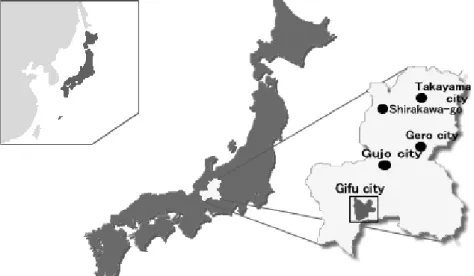
The information about Gifu Prefecture can be found at the Gifu Prefectural website. The Japan part of the field work was done in Gifu Prefecture in the Chubu Region, specifically in Gifu City and Takayama City (Figure 2). The prefecture’s population was 1,991,390, as of June 2019 with approximately 1.7 million people in the cities and the rest in towns and villages.
2. Data Collection
The research activities of this study included collection of secondary data;
courtesy calls to local government officials; and face-to-face interviews and focus group discussion to farmer respondents.
Interviews were done with a total of 70 farmer respondents in the Philippines and 7 family run farms and farm business corporations in Japan (88 in total)
Figure 2. Map of Gifu Prefecture
Source: Gifu Convention and Visitors Bureau (www.gifucvb.or.jp)
with a grand total of 158 respondents
All interviews in the Philippines were conducted in Tagalog language, which is the author’s mother language. On the other hand, all the data collection in Japan were conducted in Japanese. The author was accommodated by a Japanese doctoral student in his fieldwork in Gifu prefecture, in which the doctoral student acted as a translator. Moreover, the Japanese documents were translated by a professional Japanese-English translator.
3. Data Analysis
Descriptive statistics such as means, frequencies, and percentages were computed and used to describe the socio-economic and farming system characteristics, occurrence of natural disasters during the past ten years, the mean score rating of the perceived impact of extreme events on agricultural production and number and types of coping strategies employed.
VI. Results and Discussions
1. Comparison of the Socio-Economic and Agricultural Practices of the Respondents
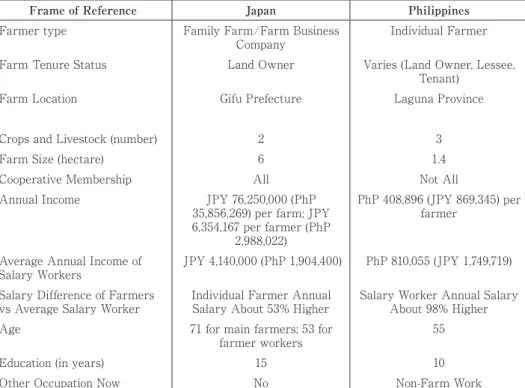
Table 1 compares farming profile and the farming systems set-up of the respondents in selected municipalities of Laguna Province in the Philippines, and Gifu Prefecture in Japan. The key differences between the Japanese and Filipino farmers are the farm set-up, size and ownership. The Filipino farmers operate singularly and can either own, lease, or rent the land they farm, whereas Japanese farmers own the land and operate either as a family-run farm, farm business, or a farm corporation or company.
Aside from engaging in farming activities, Filipino farmers take part in off- farm work while awaiting for their crops to be ready for harvesting or while waiting for a certain amount of days (depending on the crops they grow) until the agricultural land is ready for planting again. Female farmers usually own a
“sari-sari store” which is a small informal grocery store common all over the Philippines. Female farmers also usually work as “labanderas” or someone who is doing laundry for more well-off families. On the other hand, male farmers usually work as on-call drivers or engage in construction work or carpentry.
Most of the Japanese farmer respondents do not have off-farm work at present
but had full time jobs as a “salaryman” and engaged full time in farming after they retired from their corporate jobs. Before they engaged in full time farm work, their wives were the ones who managed their farms full time. This is the case for the family-ran farms, while the farmer leaders of the farm corporations engaged full time in farming at the beginning of their careers.
Unlike Japanese farmers, Filipino farmers operate singularly and most do not own their farm lands ever since the Spanish colonial era. During these times, as illustrated by Sen Nag (2017), the Spanish, mixed Spanish and native, and other elite families in the region enjoyed exclusive rights over vast tracts of fertile lands, and exploited the native Filipino workers to toil on their lands for their benefit at the locals’ expense. This was called the “Hacienda System”
29.
The average number of crops grown in Japan is two on an average six hectares of farm land, while three is the average in the Philippines on a 1.4 hectares of farm land. All Japanese farmers are members of the Japan
Source: Author’s Fieldwork in Laguna Province, Philippines, and Gifu Prefecture, Japan 2018- 2019; Kawano, 2019; and Average Salary Survey, 2019
Table 1. Comparison of Farmer Profile and Farming Systems Set-up of the Respondents in the Philippines and Japan
Frame of Reference Japan Philippines
Farmer type Family Farm/Farm Business
Company Individual Farmer
Farm Tenure Status Land Owner Varies (Land Owner, Lessee,
Tenant)
Farm Location Gifu Prefecture Laguna Province
Crops and Livestock (number) 2 3
Farm Size (hectare) 6 1.4
Cooperative Membership All Not All
Annual Income JPY 76,250,000 (PhP
35,856,269) per farm; JPY 6,354,167 per farmer (PhP
2,988,022)
PhP 408,896 (JPY 869,345) per farmer
Average Annual Income of
Salary Workers JPY 4,140,000 (PhP 1,904,400) PhP 810,055 (JPY 1,749,719) Salary Difference of Farmers
vs Average Salary Worker Individual Farmer Annual
Salary About 53% Higher Salary Worker Annual Salary About 98% Higher
Age 71 for main farmers; 53 for
farmer workers 55
Education (in years) 15 10
Other Occupation Now No Non-Farm Work
Agriculture group and other various cooperatives, while not all Filipino farmers belong to a cooperative.
Both countries’ farmers are aging as the Japanese population are generally aging and the Filipino youth are discouraged from venturing into agriculture because they see as a kind of “dirty work”. The average age of Japanese farmer- respondents is 71, while the average age of Japanese farm workers is 53. The average age of Filipino farmer-respondents is 55, which is considered old age in the Philippines. The average years spent in school of the Filipino farmers is ten years (finished high school) whereas Japanese farmers spent 15 years in school and were bachelor degree holders in various fields such as Business Economics, Mechanics, Commerce, and Agriculture. Most of the female Japanese farmers were into farming activities while their husbands work in the corporate world before retiring in the farm. On the other hand, Filipino farmers do farming as a main occupation and get involved in non-farm work as another source of income.
There is a huge difference between the average income of the Japanese and Filipino farmer respondents. The average annual income of a Japanese farm respondent is 76,250,000 Japanese Yen (JPY) or 35,856,269 Philippine Pesos (PhP) whereas the average annual income of a Filipino farmer respondent is PhP 408,896 (JPY 869,345). The average annual income of a Japanese farm respondent is the income generated for the whole farm and given these figures, the average annual income of Japanese individual farmer respondents would amount to JPY 6,354,167 (PhP 2,988,022) which is about 630% higher than the average annual income of the Filipino farmer respondents.
The Filipino farmer respondents’ annual incomes are above average compared to the annual incomes of the farmers in the Philippines. The average gross profit per hectare of farmers amounts to PhP 89,070 as of 2019
30. This is lower than the per hectare annual income of the farmer respondents in Laguna province whose average annual income per hectare valued at PhP 138,052. On the other hand, farmer-respondents from Gifu prefecture are in the lowest income group of farmers in Japan
31.Chiba prefecture has the highest income per hectare while Hokkaido has the highest average annual income per farm
32. Although Hokkaido’s income per hectare is low, its income per farm is five times greater than the national average because its agricultural land area per farm is 14.6 times larger than the rest of Japan
33.
The average annual income of a salary worker in Japan is about JPY
4,140,000 (PhP 1,904,400)
34which means that the annual income of an individual farmer in the study areas in Gifu prefecture is about 53% higher. On the other hand, the average annual income of a salary worker in the Philippines
35is PhP 810,055 (JPY 1,749,719) which is almost double the annual income of the average annual salary of the farmers in the study areas in Laguna province.
2. Natural Disaster Experience
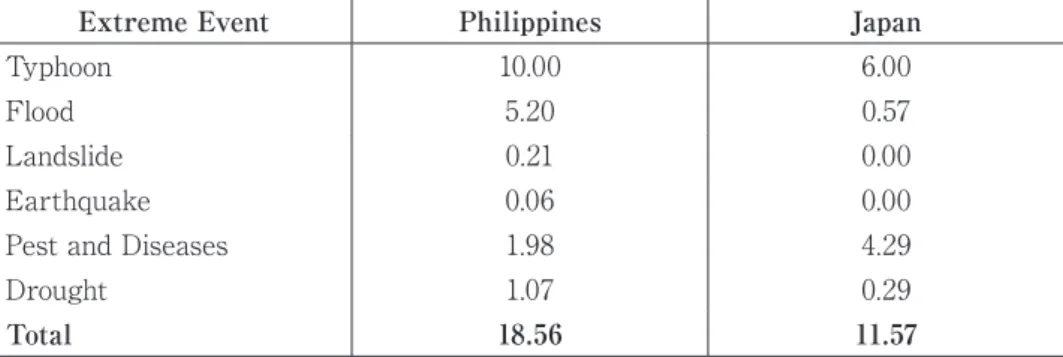
Generally, the Filipino farmers were affected more by destructive natural disasters from 2009 to 2019 as they were affected around seven more than their Japanese counterparts (Table 2). Farmer respondents in both countries experienced typhoon the most, while flooding brought about by typhoons and heavy rains are prevalent in the Philippines. There were more pest and diseases problems for the Japanese farmers than the Filipino farmers.
Even though both countries experienced earthquakes, these geographical disasters were not strong enough to inflict damages and disruption to the farming activities of the farmer respondents. Drought is present in both areas, but the Filipino farmers are more susceptible to them. A reason for this is the lack of agricultural technology in the Philippines. Shallow tube wells are a common site in Japanese farms that use heavy irrigation, which can be useful in times of drought. Lowland rice farming systems are present in both countries, and that particular farming system heavily relies on irrigation. The lowland rice farming systems in the Philippines generally have less use of
Source: Author’s Fieldwork in Laguna Province, Philippines, and Gifu Prefecture, Japan 2018- 2019
*Flood is most dominant extreme event in Philippine lowland; Typhoon in Upland
**Typhoon is most dominant extreme event in both elevations in Japan
Table 2. Comparison of the Average Number of Extreme Events That Affected the Respondents’ Farms from 2009 to 2019 in the Philippines and Japan
Extreme Event Philippines Japan
Typhoon 10.00 6.00
Flood 5.20 0.57
Landslide 0.21 0.00
Earthquake 0.06 0.00
Pest and Diseases 1.98 4.29
Drought 1.07 0.29
Total 18.56 11.57
technology and not all farms have shallow tube wells and pumps which provide additional irrigation. This makes Philippine farms more susceptible to drought.
Yearly, almost the same number of natural disasters hit both the Philippines and Japan. Yet, the results revealed that Filipino farmers were more affected by these disasters. This is because the Philippines lacks the agricultural technologies and infrastructure that can help its farmers combat the effects of natural disasters. Japanese farmers have agricultural technologies to combat disasters such as drought, while infrastructure such as flood control gates and boulder walls protect Japanese farmers from flooding and landslides, respectively. Therefore, the Japanese farmers are generally less affected by natural disasters compared to their Filipino counterparts. These case study results justify the World Risk Report by the United Nations University Institute for Environment and Human Security (2018) which indicated that Japan ranked lower (29
thout of 172 countries) than the Philippines (3rd) in terms of risk yet both countries have similar exposure scores. The report mentioned that Japan has stronger scores in adaptive and coping capacities which is why the country was ranked lower overall.
According to the report by the United Nations International Strategy for Disaster Reduction (2018), climate-linked calamities dominated all disasters over the past 20 years. It added the most frequent disaster was floods followed by typhoons, earthquakes, and extreme temperature. The results found this to be correct, with the occurrence of floods and typhoons identified as the most common disasters in both countries.
3. Comparison of Coping Strategies
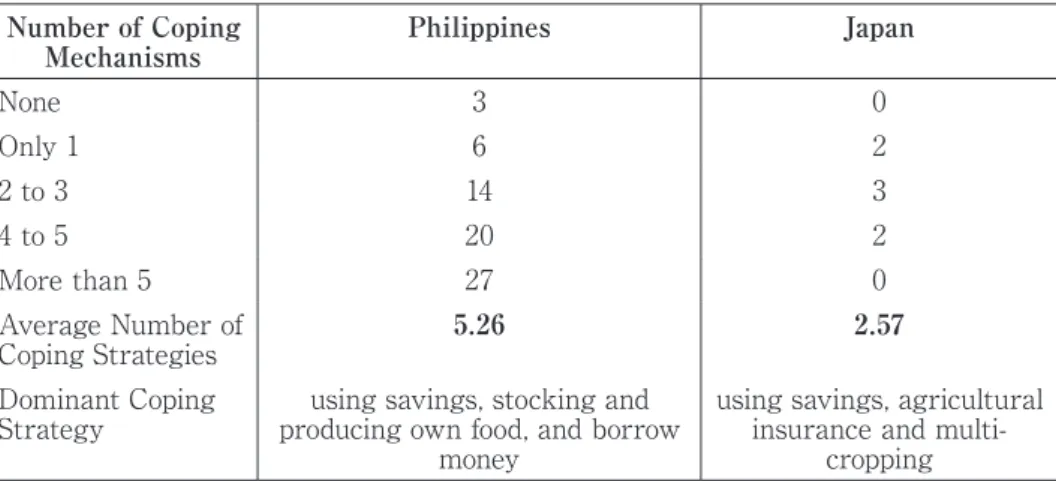
The Filipino farmers employed more coping strategies than their Japanese counterparts to minimize the effects of destructive disasters (Table 3). The average coping mechanism employed by the Filipino farmers is around five, while Japanese farmers employ two to three types of coping mechanisms.
Farmer respondents in both countries use savings as a coping strategy. In Japan, aside from savings, they use agricultural insurance and multi-cropping (a method of cropping where the farmer interchanges the crops).
In the Philippines, aside from using their savings, the farmers resort to
stocking and producing their own food and borrowing money from formal and
informal sources. Similar results were found by Quilloy et al. (2016, pp. 185-210),
as they discovered that the most common coping strategies of Filipinos were related to income flows such as use savings, borrowing money or purchasing food on credit, delaying payment of their utility bills, reducing health and education expenses to prioritize food spending, and selling assets to generate income for purchasing food.
For the case of Filipino farmers, borrowing money is a common coping mechanism but should not be practiced (Figure 4). Continuous borrowing may lead the farmers further down to poverty. According to a farmer leader respondent, most of the Filipino farmers resort to borrowing from informal sources because those who continued to borrow from formal sources such as banks and other financial institutions were not allowed to borrow anymore for the reason that they were not able to settle their previous debts. The Filipino farmers have no other choice but to borrow from informal sources which normally have high interest rates. The farm leader mentioned that these informal sources, termed “5-6”, have an interest rate of twenty percent.
The “5-6” scheme is a practice where someone, usually a neighbor or an official from the barangay (village) will lend you 5 Philippine Pesos (PhP) and you have to pay PhP 6 in return in within a week. For instance, if a person borrows PhP 10, that person should pay back PhP 12. Although most of the time, the borrower is not able to pay the lender thus creating tensions between them. This is why the borrower usually borrows money from their friends and
Source: Author’s Fieldwork in Laguna Province, Philippines, and Gifu Prefecture, Japan 2018- 2019Table 3. Comparison of Number of Coping Strategies Employed by the Respondents for Extreme Events in the Philippines and Japan
Number of Coping
Mechanisms Philippines Japan
None 3 0
Only 1 6 2
2 to 3 14 3
4 to 5 20 2
More than 5 27 0
Average Number of
Coping Strategies 5.26 2.57
Dominant Coping
Strategy using savings, stocking and producing own food, and borrow
money
using savings, agricultural insurance and multi-
cropping
315 Figure 4. Types of Coping Strategies Employed by the Respondents for Extreme
Events, by Elevation, Laguna Province, Philippines
Source: Author’s Fieldwork in Laguna Province, Philippines, 2018-2019
Figure 5. Types of Coping Strategies Employed by the Farm Groups for Extreme Events, by Elevation, Gifu Prefecture, Japan
Source: Author’s Fieldwork in Gifu Prefecture, Japan, 2018-2019
0 10 20 30 40 50 60
Type of Coping Strategies
All Farmers (n=70)
0 1 2 3 4 5 6 7
Use Savings Borrow
Money Eat Less Food Agricultural Insurance Other
Insurance Multi‐
Cropping
Type of Coping Strategies
All Farmers
15_研究_ローラ・アーマンド.indd 315 21/03/09 11:11
relatives. Generally, their more well-off friends and relatives lend them a certain amount of money that they know will never be paid. This practice of borrowing as a coping strategy should therefore be terminated as much as possible.
Because of constant borrowing and failing coping strategies, the Filipino farmers rely on relief goods and aid provided by the Philippine government, and other foreign sources such as foreign governments and international organizations to save them in times of natural disasters.
The Japanese farmers, on the other hand, have more effective individual coping mechanisms as compared to the Filipino farmers. The types of coping strategies they employed is summarized in figure 5.
The Japanese farmers normally have larger income savings from their income per hectare compared to Filipino farmers. Moreover, the Japanese farmers use multi-cropping as a coping mechanism, so they can still harvest other crops in the event that their main crops fail. In addition to these coping mechanisms, Japanese farmers have agricultural insurance, which give them the assurance that they will only lose about 20% of their income if they will be affected by
Figure 6. Flood Control Gates in Gifu City, Gifu Prefecture Author’s Fieldwork in Gifu Prefecture, Japan, 2019
natural disasters. The Japanese government also provides subsidies to the farmers as the government view that agriculture is very important to Japanese society. Moreover, the government installed strong infrastructure to lessen the impacts of destructive disasters, such as flood control gates to constrain flooding, as well as boulder walls to prevent landslides (figure 6).
VII. Conclusion
The Japanese government provides infrastructure to minimize the effects of natural disasters as well as establish responsive agricultural insurance in addition to subsidies given to farmers during times of disasters. Moreover, Japanese farmers have effective individual coping mechanisms compared to the Filipino farmers, partly because they have higher income, which gives them the ability to rebuild their capital even after the occurrence of a natural disaster.
The Japanese farmers’ savings as well as government subsidies are enough to cushion them from the effects of natural disasters.
The Filipino farmers on the individual level resort to multiple yet ineffective and unsustainable coping strategies. Unlike the Japanese farmers, Filipinos do not use insurance as a coping strategy. Similar to other developing country cultures such as in Africa, (Ajayi, no date), insurance is alien to the Filipino culture. It is not a popular practice especially in most poor households, who may need this more in order to mitigate losses due to human and non- human uncertain events.
Filipino Farmers lack “insurance culture” because the Filipino culture have strong familial and community ties that bind them in cases of uncertainties.
This explains why some answers on coping mechanisms were “borrowing from friends and family” or “eating at other people’s house”. Filipinos have a strong social capital, which they can rely on even in times of uncertainties. In contrast, the Japanese do not have this kind of “strong social capital”, thus, when it comes to uncertainties, they turn to insurance and use their own savings. Kobayashi’s (1997) book about insurance philosophy mentioned that insurance is a
“philosophy of helping somebody who is in trouble and is defined in an
extremely wide sense as a philosophy that points out measures to be taken
regarding a guaranteed order in human life or death”. In addition, in Japanese
culture, people do not want to cause trouble to others as much as possible. That
is why they view insurance as a “total approach” or have created an “insurance culture” in which they have all kinds of. Whenever any kind of uncertainty occurs, Japanese people can always turn to insurance to lessen their anticipated financial burden.
Although at present time the Filipino culture have strong social capital, this
might not be the trend in the future. Thus, the coping mechanisms employed by
the Filipino farmers can be deemed unsustainable compared to the Japanese
mainly using insurance. Thus, establishing “insurance culture” and insurance
utilization can be a more sustainable and effective coping strategy which
disaster vulnerable developing countries can adopt to cope better to the rising
natural disasters.
Endnotes
1 UNUEHS, World Risk Report (2018) 2 Ibid.
3 FAO, Agricultural insurance in Asia and the Pacific region, (2011) 4 Ibid.
5 Kurukulasuriya, P., and Rosenthal, S. Climate Change and Agriculture: A Review of the Impacts and Adaptations (2003), pp. 7-23
6 Ibid.
7 The Guardian, Can Micro-insurance Protect the Poor?, (2011) 8 Ibid.
9 World Bank, World Development Report , (2000); Dercon, S., Vulnerability: a micro perspective, (2006); and Islam, N., Can Microfinance Reduce Economic Insecurity and Poverty? By How Much and How?, (2007)
10 Mosley, P., Assessing the success of microinsurance programmes in meeting the insurance needs of the poor, (2001), p. 1
11 Ibid.
12 Pachauri, Rajendra K., Andy Reisinger, and the Core Writing Team, Climate Change 2007: Synthesis Report. Geneva: Intergovernmental Panel on Climate Change, (2007) 13 Quilloy, K.P., Z.M. Sumalde and Rola,A.C.C., 2016. Food Vulnerability of Households and
Their Coping Strategies During Extreme Weather Events, (2016), p. 186 14 Ibid.
15 Kennes, W., The European Community and Food Security, (1990) and FAO, Climate Change and Food Security: A Framework Document, (2008)
16 Quilloy, K.P., Z.M. Sumalde and Rola,A.C.C., 2016. Food Vulnerability of Households and Their Coping Strategies During Extreme Weather Events, (2016), p. 186
17 FAO, Climate Change and Food Security: A Framework Document, (2008)
18 Quilloy, K.P., Z.M. Sumalde and Rola,A.C.C., 2016. Food Vulnerability of Households and Their Coping Strategies During Extreme Weather Events, (2016), p. 186
19 Maxwell, D. and Caldwell. R., The Coping Strategies Index: Field Methods Manual, (2008), p. 2
20 Marza, B., Angelescu, C., and Tindeche, C., Agricultural Insurances and Food Security, (2015), pp. 594-599
21 Ibid.
22 Businessworld, Natural disaster damage at P374B in 2006-2015, (2018)
23 Magno, M.T. and Bautista, E.D., Is there a role for crop insurance in Philippine agricultural development?, (1989)
24 Nanto, D.K., Cooper, W.H., Donnelly, J.M., Johnson, R., Japan’s 2011 Earthquake and Tsunami: Economic Effects and Implications for the United States, (2011), pp. 2-6 25 Ibid.
26 The Provincial Government of Laguna (https://laguna.gov.ph/) (Accessed April 5, 2020) 27 Rola, A.C., Z.M. Sumalde, Garcia, J.N.M., Environment and Food Security Interaction
Amid Climate Change: A Multi-scale Analysis in a Philippine Watershed, (2016)
28 Gifu Prefectural Government (https://www.pref.gifu.lg.jp/foreign-languages/English/
info/gifu/1.html) (Accessed April 5, 2020)
29 Sen Nag, O., What Is The Hacienda System?, (2017)
30 The Philippine Statistical Office. 2019 Selected Statistics on Agriculture, (2019)
31 Hori, C., Regional Characteristics of Japanese Agriculture as Revealed by the Data, (2017),
pp. 2-3 32 Ibid.
33 Ibid.
34 Kawano, K., What is the Average Salary in Japan in 2019?, (2019) 35 Average Salary Survey, Annual Average Survey in the Philippines, (2019)
References
Ajayi, E.F.G., N.D. The Need to Further Imbibe the Culture of Insurance in Africa. Retrieved from: http://ssrn.com/abstract=2608527 (Accessed November 25, 2020)
Average Salary Survey. 2019. Annual Average Survey in the Philippines. Accessed from:
https://www.averagesalarysurvey.com/philippines (Accessed November 24, 2020) Businessworld. 2018. Natural disaster damage at P374B in 2006-2015. Retrieved from: http://
www.bworldonline.com/natural-disaster-damage-p374b-2006-2015/(Accessed April 5, 2020)
Dercon, S. 2006. Vulnerability: a micro perspective. Paper for Annual World Bank Conference on Development Economics (ABCDE), Amsterdam, May. Published as chapter 6 in F. Bourguignon, B. Pleskovic, J. van der Gaag (eds.) Securing development in an unstable world, Washington DC: World Bank.
FAO. 2008. Climate Change and Food Security: A Framework Document. Rome: Food and Agriculture Organization of the United Nations.
FAO. 2011. Agricultural insurance in Asia and the Pacific region. Food and Agriculture Organization of the United Nations, Bangkok, Thailand. Retrieved from: www.fao.org/
docrep/015/i2051e/i2051e00.pdf (Accessed April 29, 2019)
Gifu Convention and Visitors Bureau, 2020. Map of Gifu Prefecture. Retrieved from: https://
www.gifucvb.or.jp/en/00_aboutgifu/ (Accessed April 5, 2020)
Gifu Prefectural Government. 2019. Facts About Gifu Prefecture. Retrieved from: https://
www.pref.gifu.lg.jp/foreign-languages/English/info/gifu/1.html (Accessed April 5, 2020)
Hori, C. 2017. Regional Characteristics of Japanese Agriculture as Revealed by the Data.
Mizuho Economic Outlook and Analysis. Retrieved from: https://www.mizuho-ri.
co.jp/publication/research/pdf/eo/MEA171016.pdf (Accessed May 16, 2020)
Islam, N. 2007. “Can Microfinance Reduce Economic Insecurity and Poverty? By How Much and How?” Development Policy Analysis Division, Department of Economic and Social Affairs, United Nations, New York.
Kobayashi, T. 1997. Hoken Shiso no Genryu. “The Origins of the Philosophy of Insurance”.
Chikura Shobo.
Kawano, K. 2019. What is the Average Salary in Japan in 2019? Retrieved from: https://blog.
gaijinpot.com/what-is-the-average-salary-in-japan-in-2019/(Accessed April 9, 2020) Kennes, W. 1990. The European Community and Food Security. Institute of Development
Studies Bulletin, Issue number 21(3), pp. 67-71.
Kurukulasuriya, Pradeep and Shane Rosenthal. 2003. “Climate Change and Agriculture: A Review of the Impacts and Adaptations.” Paper prepared and published for the Rural Development Group and Environment Department of the World Bank. Retrieved from:
https://openknowledge.worldbank.org/bitstream/handle/10986/16616/787390WP0Cli ma0ure0377348B00PUBLIC0.pdf?sequence=1 (Accessed November 18, 2019)
Magno, M.T. and E.D. Bautista. 1989. Is there a role for crop insurance in Philippine agricultural development? ACPC Staff Paper 89-06. Quezon City: Agricultural Credit Policy Council, Department of Agriculture.
Marza, B., Angelescu, C., and Tindeche, C. 2015. Agricultural Insurances and Food Security.
The New Climate Change Challenges. Procedia Economics and Finance issue number 27. pp. 594 – 599.
Maxwell, D. and Caldwell. R. 2008. The Coping Strategies Index: Field Methods Manual.
Second edition, Atlanta: Cooperative for Assistance and Relief Everywhere, Inc.
(CARE).
Mosley, P. 2009. Assessing the success of microinsurance programmes in meeting the insurance needs of the poor. DESA Working Paper No. 84.
Nanto, D.K., Cooper, W.H., Donnelly, J.M., Johnson, R. 2011. Japan’s 2011 Earthquake and Tsunami: Economic Effects and Implications for the United States. Congressional Research Service. Retrieved from: https://fas.org/sgp/crs/row/R41702.pdf (Accessed March 8, 2020)
Pachauri, Rajendra K., Andy Reisinger, and the Core Writing Team, eds. 2007. Climate Change 2007: Synthesis Report. Geneva: Intergovernmental Panel on Climate Change.
Retrieved from: https://www.ipcc.ch/pdf/assessment-report/ar4/syr/ar4_syr.pdf (Accessed November 24, 2020)
Provincial Government of Laguna, 2019. The Website of the Provincial Government of Laguna. Retrieved from: https://laguna.gov.ph/ (Accessed April 5, 2020)
PSA, 2019. The Philippine Statistical Office. 2019 Selected Statistics on Agriculture.
Accessed Retrieved from: https://psa.gov.ph/sites/default/files/Selected%20 Statistics%20on%20Agriculture%202019.pdf (Accessed April 11, 2020)
Quilloy, K.P., Z.M. Sumalde and A.C.C. Rola. 2016. Food Vulnerability of Households and Their Coping Strategies During Extreme Weather Events. Chapter 9. Environment and Food Security Interaction Amid Climate Change: A Multi-scale Analysis in a Philippine Watershed. 2016. Quezon City: University of the Philippines Center for Integrative and Development Studies.
Rola, A.C., Z.M. Sumalde, Garcia, J.N.M. 2016. Environment and Food Security Interaction Amid Climate Change: A Multi-scale Analysis in a Philippine Watershed. Quezon City: University of the Philippines Center for Integrative and Development Studies Sen Nag, O. 2017. What Is The Hacienda System? WorldAtlas. Retrieved from: https://www.
worldatlas.com/articles/what-is-the-hacienda-system.html (Accessed November 22, 2020)
The Guardian. 2011. Can Micro-insurance Protect the Poor? Retrieved from: https://www.
theguardian.com/global-development/poverty-matters/2011/feb/21/micro-insurance- protect-poor (Accessed November 23, 2020)
UNUEHS. 2018. World Risk Report. United Nations University Institute for Environment and Human Security. Retrieved from: https://reliefweb.int/sites/reliefweb.int/files/
resources/WorldRiskReport-2018.pdf (Accessed January 19, 2020)
Wikipedia, 2020. Map of Laguna Province. Retrieved from: www.en.wikipedia.com (Accessed April 5, 2020)
World Bank. 2000. World Development Report 2000/01: Attacking Poverty. The World Bank.
1818 H Street, N.W. Washington, D.C., USA.