Incorporating Domain Knowledge into Stance Classification
スタンス分類における領域知識の活用に関する研究
Akira Sasaki
Graduate School of Information Sciences Tohoku University
A thesis submitted for the degree of Doctor of Information Science
January 2018
Acknowledgements
本研究を進めるにあたり,研究室のみなさまをはじめとして非常に多 くの方にご助言,ご協力いただきました.ここに感謝の意を表します.
指導教官の乾健太郎教授には,学部
4
年次から約6
年間という期間,非常に多くのご指導をいただきました.私はやや特殊な経緯で乾研究 室に配属されることとなりましたが,その際に快く受け入れていただ いたことが今の成果に繋がっています.また,研究室外での私の活動 に関しても常に後押ししてくださり,大変励みになりました.心より 感謝申し上げます.ご多忙の中,審査委員を引き受けてくださった篠 原歩教授,大町真一郎教授に深く感謝申し上げます.東京工業大学の 岡崎直観教授には,ほぼ毎週というペースで親身にご指導いただきま した.研究の初期段階でのアイデアや,手法の詳細に至るまで相談さ せていただき,日々成長することができました.研究の最中は多くの 壁にぶつかりましたが,その度に私を導いていただきました.深く感 謝申し上げます.情報通信研究機構の水野淳太さんには,研究に関す るご指導のほか,サーバ管理に関しても初歩から丁寧に教えていただ きました.そのおかげで,特に大きなサーバ障害に悩まされることも なく,無事にサーバ管理を全うできました.深く感謝申し上げます.
PKSHA Technology
の渡邉陽太郎さんには,学部,博士前期課程の未熟な時期にご指導をいただきました.深く感謝申し上げます.松田耕 史さんには,主に博士前期課程で多くの共同研究をさせていただきま した.深く感謝申し上げます.塙一晃君には,直近の多くの研究で共 同で行わせていただきました.深く感謝申し上げます.
最後に,常に私の選ぶ道を応援し,支えていただいた家族に深く感謝 します.今後とも宜しくお願いします.
Abstract
Social networking services (SNS) such as Twitter and Facebook have rapidly sunk into our lives in recent years. SNS is used not only as a kind of com- munication tools but also as a place to be used for advertisement, express- ing individual opinions, and so on. In particular, there are various kinds regarding opinion. For example, there are many opinions about a spe- cific product. These opinions are also abundant in electronic commerce services like Amazon. As these opinions play an important role in improv- ing products, many researchers and companies analyze them. Unlike the review of the above-mentioned products, there are relatively few sites in which opinion on political topics and events is compiled. There are de- bate sites such as debate.org and idebate.org in English, and zzhh.jp in Japanese, but it is overwhelmingly small compared to product reviews.
Because of such a background, analysis of opinions in SNS has been ac- tively performed.
In this thesis, we especially addressed the task called stance classification.
In this task, the goal is to identify whether a given text agrees or disagrees
a certain topic. However, it cannot be said that the performance of the
current state-of-the-art of this task is satisfactory. Various causes can be
considered for this, but the main reason for this is thought to be lack of
knowledge about topics. Under such a background, in this thesis, we aim
at acquiring and applying knowledge that contributes to the performance
improvement of stance classification.
Contents
Contents iii
List of Figures vi
Nomenclature vii
1 Introduction 1
1.1 Background . . . . 1
1.2 Contribution . . . . 3
1.3 Thesis Overview . . . . 4
2 Annotating Related Events about Targets to Improve Stance Classification 5 2.1 Introduction . . . . 5
2.2 Related Work . . . . 8
2.3 Stance Classification Task . . . . 9
2.3.1 Data Preparation . . . . 9
2.3.2 Annotating PRIOR-SITUATION and EFFECT . . . . 10
2.3.2.1 PRIOR-SITUATION . . . . 10
2.3.2.2 EFFECT . . . . 11
2.3.3 FAVOR/AGAINST classification task . . . . 13
2.4 Method . . . . 13
2.4.1 Baseline Method . . . . 13
2.4.1.1 n-gram baseline . . . . 14
2.4.1.2 Neural network based models . . . . 14
2.4.1.3 Sentiment lexicon baseline . . . . 15
CONTENTS
2.4.1.4 Nakagawa’s model . . . . 15
2.4.2 Proposed Method . . . . 16
2.4.2.1 PRIOR-SITUATION/EFFECT replaced n-gram . . 16
2.4.2.2 Patterns around PRIOR-SITUATION/EFFECT feature 18 2.4.2.3 Sentiment polarity in PRIOR-SITUATION/EFFECT feature . . . . 21
2.5 Evaluation . . . . 21
2.5.1 Error Analysis . . . . 23
2.6 Conclusion . . . . 24
3 Annotating Causal Relation Instances in Wikipedia to Automatically Rec- ognize Causal Relation 27 3.1 Introduction . . . . 27
3.2 Related work . . . . 29
3.3 Annotating promotion/suppression relations in Wikipedia articles . . . . 31
3.3.1 Labels of causal relations . . . . 31
3.3.2 Annotation policy . . . . 31
3.3.3 Using brat in crowdsourcing . . . . 32
3.4 Annotation results . . . . 33
3.4.1 Inter-annotator agreement . . . . 34
3.5 Conclusion . . . . 34
4 Modeling Inter-Topic Preference using Tweets and Matrix Factorization 35 4.1 Introduction . . . . 35
4.2 Mining Topic Preferences of Users . . . . 38
4.2.1 Mining Linguistic Patterns of Agreement and Disagreement . 38 4.2.2 Extracting Instances of Topic Preferences . . . . 40
4.3 Matrix Factorization . . . . 40
4.4 Evaluation . . . . 42
4.4.1 Determining the Dimension Parameter k . . . . 42
4.4.2 Predicting Missing Topic Preferences . . . . 43
4.4.3 Inter-topic Preferences . . . . 45
CONTENTS
4.5 Related Work . . . . 47
4.6 Conclusion . . . . 49
5 Stance Classification with Consideration of the Silent Majority by Factor- ization Machines 51 5.1 Introduction . . . . 51
5.2 Related Work . . . . 52
5.2.1 Social Science & Political Science . . . . 52
5.3 Preparation of the Matrix . . . . 53
5.3.1 Data . . . . 54
5.3.2 Retrieve Stances of Users Other Than the Silent Majority . . . 55
5.3.3 Matrix from Words . . . . 55
5.4 Method for Prediction . . . . 56
5.4.1 Matrix Factorization . . . . 56
5.4.2 Factorization Machines . . . . 56
5.5 Evaluation . . . . 57
5.5.1 Predicting Missing Topic Preferences . . . . 57
5.5.2 Evaluation for the pseudo silent majority . . . . 59
5.6 Conclusion . . . . 60
6 Conclusion 61
References 62
List of Publications 74
List of Figures
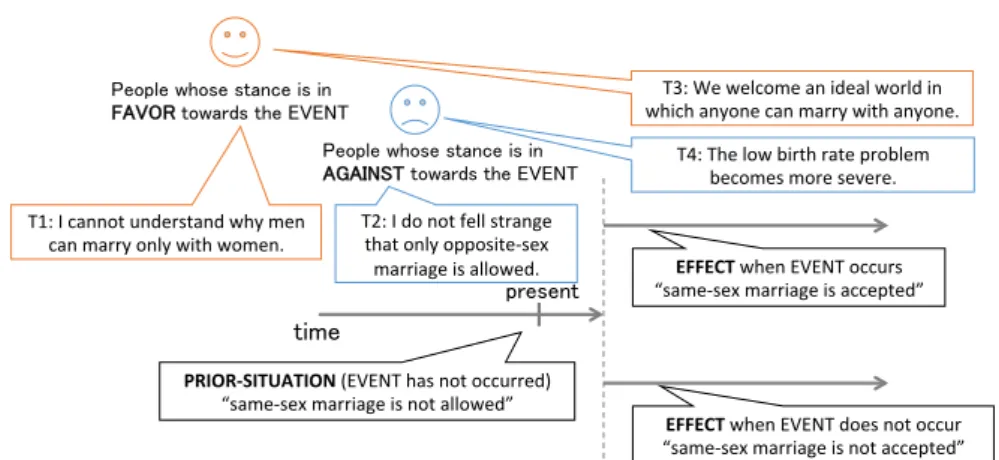
2.1 Overview of PRIOR-SITUATION and EFFECT of the event “Allow- ing same-sex marriage.” . . . . 6 2.2 Screen shot of Zeze-hihi. For each question, users respond with a vote
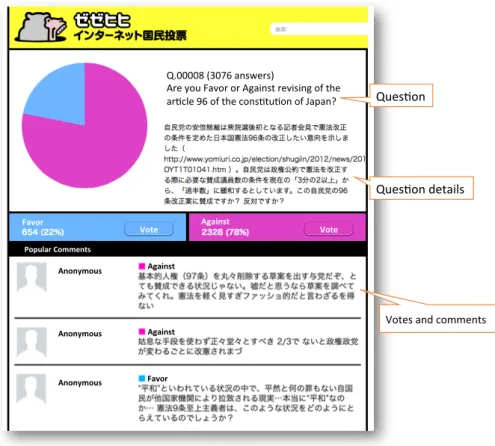
(e.g. FAVOR/AGAINST) and a comment (up to 100 characters). Note that, we provide an English translation for readability. In addition, we anonymized information of users. . . . . 10 3.1 Named entity annotation by the multiple-choice method [Finin et al.,
2010]. . . . 29 3.2 A custom interface for annotating named entities via crowdsourcing [Law-
son et al., 2010]. . . . 30 3.3 Overview of the annotation system integrating Yahoo! crowdsourcing
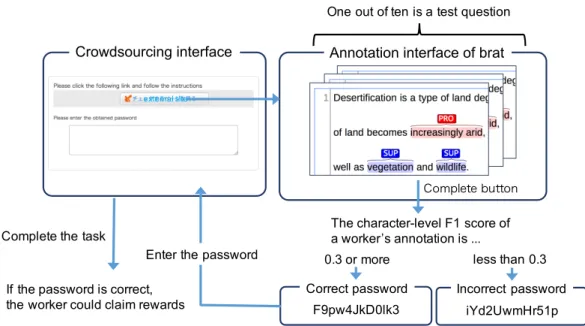
and brat . . . . 32 3.4 An example of annotation results for “Leukemia” on Wikipedia. The
color at the bottom of the text shows the relations, and the color inten- sity shows the number of workers who annotated. . . . 33 4.1 An overview of this study. . . . . 37 4.2 Reconstruction error (RMSE) of matrix factorization with different k. 42 4.3 Prediction accuracy when changing the threshold for the number of
known topic preferences of each user. . . . 43 4.4 Mean variance of preference values of self-declared topics when chang-
ing the threshold for the number of self-declared topics. . . . 45
5.1 An example of an input of factorization machines. . . . 53
LIST OF FIGURES
5.2 The overview of the proposed method . . . . 54 5.3 Accuracy of prediction. Each row shows results of different threshold.
Each column shows a result when the number of known stances is
under t, is above t, and equals to t. We show the overall accuracy of
methods in parentheses on the legend. . . . 59
5.4 Evaluation result of the pseudo silent majority. . . . 60
Chapter 1 Introduction
1.1 Background
Social networking services (SNS) such as Twitter and Facebook have rapidly sunk into our lives in recent years. SNS is used not only as a kind of communication tools but also as a place to be used for advertisement, expressing individual opinions, and so on.
In particular, there are various kinds regarding opinion. Examples are as follows:
(1) Galaxy note8 is the best smartphone ever.
(2) TPP ruins the future of our country.
(3) I can’t wait for Tokyo Olympics!
Here, (1) is a user’s opinion on a specific product. As these opinions play an impor- tant role in improving products, many researchers and companies analyze them. Such reviews are also abundant on electronic commerce services like Amazon. On the other hand, (2) and (3) are opinions on political topics and events, respectively. Unlike the review on the above-mentioned products, there are relatively few sites in which opinion on political topics and events is compiled. There are debate sites such as debate.org and idebate.org in English, and zzhh.jp in Japanese, but it is overwhelmingly small compared to product reviews. Because of such a background, analysis of opinions in SNS has been actively performed.
In this thesis, we especially addressed the task called stance classification. In this
task, the goal is to identify whether a given text agrees or disagrees a certain topic.
Recently, Task 6 of SemEval-2016
1is held to solve this task, and many researchers participated. Task 6 of SemEval-2016 is divided into two subtasks A and B, each having the following features.
Task 6 A
In this task, the training data for six topics (Atheism, Climate Change a Real Concern, Feminist Movement, Hillary Clinton, and Legalization of Abortion) are given. The goal is to predict stances of the test data.
Task 6 B
In this task, the goal is to predict stances of the test data regarding Donald Trump.
Here, it differs from task 6 A in that training data on Donald Trump is not given, and only unlabeled data concerning Donald Trump is given. However, labeled data related to other topics used in task 6 A is freely available.
For both tasks, the input is a pair of a topic (e.g. Atheism) and a text. The goal is to predict the stance (agree/disagree) of the text in regard to the topic. A noteworthy characteristic of this task is that each text does not necessarily include the topic. The text quoted from [Mohammad et al., 2016a] is shown below:
Text Jeb Bush is the only sane candidate in this republican lineup.
Target Donald Trump
In this example, although the text does not include Donald Trump, we can guess that this text disagrees with Donald Trump. This is because this text is very favorable to Jef Bush, who is other candidates in the United States presidential election. In this way, texts may indicate stances toward a specific topic without explicitly mentioning it. Therefore, the method used in targeted sentiment analysis is partially useful, but by itself, it cannot be solved completely.
Regarding the evaluation, the average of F1-score in regard to agreement/disagree- ment is used in this task. In SemEval-2016, 19 teams participated in task 6 A and 9 teams participated in task 6 B. Surprisingly, in task 6 A, even a Support Vector Ma- chines (SVM) with simple word n-gram (1, 2, 3-gram) and character n-gram (2, 3, 4,
1
http://alt.qcri.org/semeval2016/task6/
5-gram) defeated all the participants. From this result, it is said that this task is still immature and there is much room for improvement in performance.
Among them, we explain the method which was the highest score in each task.
Zarrella and Marsh [2016] propose a prediction method by Recurrent Neural Network (RNN). They collected tweets including hashtags related to topics (#climatechange,
#climatescam, etc) in advance, then they pre-trained the RNN by predicting which hashtags are included in the tweets. As a result, their model achieved 67.82 in F1- score. In task 6 B, Wei et al. [2016] propose a prediction method by Convolutional Neural Network (CNN). Among them, in order to overcome the lack of training data on Donald Trump, they focused on phrases and hashtags that agree with Donald Trump (e.g. go trump, #MakeAmericaGreatAgain) and phrases and hashtags that disagree with Donald Trump (e.g. idiot, fired). They collected tweets containing these phrases and hashtags, then they treat these tweets as pseudo labeled tweets to bring it into the framework of supervised learning.
However, it cannot be said that the performance of the current state-of-the-art of this task is satisfactory. Various causes can be considered for this, but the main reason for this is thought to be lack of knowledge about topics. As an example, consider the following texts:
(4) It is better to promote domestic consumption.
(5) It is better to promote monetary easing.
Although both of these texts express opinions on TPP, they have different stance:
(4) disagrees TPP, (5) agrees TPP. This is caused by the difference in the part of “do- mestic consumption” and “monetary easing”. The reason why a person can accurately identify these texts is considered to be because people have knowledge such as “TPP promotes monetary easing” and “TPP suppresses domestic consumption”.
Under such a background, in this thesis, we aim at acquiring and applying knowl- edge that contributes to the performance improvement of stance classification.
1.2 Contribution
The contribution of this thesis is roughly divided into the following three points.
1. Propose an idea of introducing PRIOR-SITUATION/EFFECT relations to stance classification and manually annotating them. Then, we improve the accuracy of stance classification by utilizing these annotations. In addition, we annotated Wikipedia to automatically acquire knowledge such as PROMOTE/SUPPRESS.
The annotated dataset is publicly available.
2. In addition to the relationship PROMOTE/SUPPRESS, knowledge such as “A person who agrees with A also agrees with B” or “A person who disagrees with A also disagrees B” is also important in overlooking the opinions of people, and considered to contribute to improve the accuracy of stance classification.
Therefore, we modeled such knowledge by matrix factorization, which is widely used in the field of item recommendation. In addition, for users who have not expressed any stances of themselves, we proposed the method to predict their stance from their entire posts.
3. By applying the method proposed in above, we confirmed that it contributes to the improvement of the accuracy of stance classification.
1.3 Thesis Overview
In this section, we explain the structure of this thesis. In Chapter 2, we will explain the
method aimed at improving the accuracy of stance classification by manually giving
relationships such as PRIOR-SITUATION/EFFECT. In Chapter 3, we describe data
annotated causal relations (PROMOTE/SUPPRESS) on Wikipedia. The annotated
corpus is expected to be training data for automatic recognition of causal relation-
ships. In Chapter 4, we focus on people’s trends of stances as knowledge other than
PROMOTE/SUPPRESS and perform modeling by matrix factorization. In addition, in
Chapter 5, we will also describe research that extends the method of Chapter 4 so that
it can also consider the silent majority. Finally, in Chapter 6, we review the summary
of the above research and its contribution.
Chapter 2
Annotating Related Events about Targets to Improve Stance
Classification
In this chapter, as a part of introducing knowledge into stance classification, we an- notated related events (PRIOR-SITUATION/EFFECT) about topics manually
1[Sasaki et al., 2016].
2.1 Introduction
One recent trial of stance classification is Task 6 of SemEval-2016
2. This is a task to detect a stance (favor or against) in relation towards a topic of a tweet. Consider the following example
3. The task is to detect a stance for a topic in the text. In this example, the underlined part suggests that a stance of the text towards the topic is FAVOR.
1
©2016 IEEE. Personal use of this material is permitted. Permission from IEEE must be obtained for all other uses, in any current or future media, including reprinting/republishing this material for advertising or promotional purposes, creating new collective works, for resale or redistribution to servers or lists, or reuse of any copyrighted component of this work in other works.
2
http://alt.qcri.org/semeval2016/task6/
3
This example is quoted from trial data of Task 6
time
EFFECT when EVENT occurs
“same-‐sex marriage is accepted”
EFFECT when EVENT does not occur
“same-‐sex marriage is not accepted”
present
T4: The low birth rate problem becomes more severe.
T2: I do not fell strange that only opposite-‐sex
marriage is allowed.
T1: I cannot understand why men can marry only with women.
T3: We welcome an ideal world in which anyone can marry with anyone.
PRIOR-‐SITUATION (EVENT has not occurred)
“same-‐sex marriage is not allowed”
People whose stance is in FAVOR towards the EVENT
People whose stance is in AGAINST towards the EVENT
Figure 2.1: Overview of PRIOR-SITUATION and EFFECT of the event “Allowing same-sex marriage.”
Text Hillary is our best choice if we truly want to continue being a pro- gressive nation.
Target Hillary Clinton Stance F AVOR
A popular approach for stance classification uses sentiment polarity towards a topic in a text. The underlined part of the example expresses positive sentiment polarity to
“Hillary” corresponding to the topic. This approach is known as targeted sentiment analysis [Mitchell et al., 2013; Zhang et al., 2015].
However, we suffer from a variety of examples for which stance classification is ex- tremely difficult. Figure 2.1 shows four examples for the proposition “allowing same- sex marriage
1.” Note that although our texts are written in Japanese, we provide ex- amples in English for readability. T1 expresses a negative attitude towards the current situation, i.e., “same-sex marriage is not allowed” and T4 expresses negative attitude towards the future situation when “same-sex marriage is accepted.” Both texts express negative attitudes, but the stance of T1 is in favor of the proposition and the stance of T4 is against it. To make matters worse, T4 does not even contain keywords representing the topic (e.g., marriage nor marry) but only a related situation low birth rate. Since targeted sentiment analysis methods require that a topic is explicitly mentioned in a
1
Since same-sex marriage is not allowed under Japanese law, people debate whether it should be
permitted or not
Table 2.1: Attitude towards PRIOR-SITUATION/EFFECT and corresponding stance related to the topic.
PRIOR-SITUATION EFFECT positive attitude against favorable negative attitude favorable against
text, we cannot directly apply such methods. People often implicitly express their atti- tudes towards a topic in this way, therefore, it is not a trivial problem. To detect these stances, it is necessary to recognize the situations when the event occurs or does not occur. We designate the topic as an EVENT (e.g., allowing same-sex marriage) and call the future situation an EFFECT (e.g., same-sex marriage became allowed) here- after. Note that, the future situation in which the event does not occur can be regarded as the current situation. We designate the current situation as the PRIOR-SITUATION (e.g., same-sex marriage is not allowed).
In this chapter, we focus on situations where the EVENT either occurs or does not occur, and we introduce the first method for annotating such instances. To the best of our knowledge, there is no research focused on such phenomena in either stance classification or sentiment analysis tasks. To predict stances considering these phenomena, we propose a classification method based on machine learning with the PRIOR-SITUATION and EFFECT of EVENT. We first annotate the labels PRIOR- SITUATION and EFFECT to our dataset. Then T1 can be generalized to “I cannot understand why PRIOR-SITUATION” and T4 can be generalized to “The problem of EFFECT becomes more severe.” After the generalization, the stance of the text can be detected as favorable when it has a negative attitude to PRIOR-SITUATION (before EVENT occurs) or a positive attitude to EFFECT (after EVENT occurs), or against when the text expresses a positive attitude to PRIOR-SITUATION or a negative atti- tude to EFFECT (Table 2.1).
Our contributions are two-fold:
1. We propose the concepts of the time variation (i.e., PRIOR-SITUATION and EFFECT) for the first time in the stance classification task and annotated these labels to roughly 3,000 texts.
2. We confirm that the accuracy of stance classification can be improved using these
labels.
2.2 Related Work
Most of the sentiment analysis tasks aim at detecting sentiment polarity (i.e., posi- tive/negative/neutral) of a text or a document without focusing on a specific topic.
Kiritchenko et al. [2014] expanded the sentiment lexicon for micro-blogs, and attained better results than the previous sentiment analysis works in the micro-blog domain.
Using Long Short-Term Memory (LSTM), Wang et al. [2015] achieved comparable results with data-driven techniques [Hochreiter and Schmidhuber, 1997]. They also showed that tuned word embeddings improve the performance of sentiment analysis.
Apart from that, targeted sentiment analysis task set the goal to predict sentiment to- wards a specific target [Mitchell et al., 2013; Zhang et al., 2015].
As to stance classification task, Murakami and Raymond [2010] and Sridhar et al.
[2014] use link-based methods to identify the general positions of users in online de- bates. Thomas et al. [2006b] classify the speeches of U.S. Congressional floor debates into support of or opposition to proposed legislation. Somasundaran and Wiebe [2009]
focus on posts related to debatable topics such as “iPhone vs BlackBerry”, and identify which stance the author of a post is taking. In addition, many works have been under- taken to predict political position (i.e., conservative or liberal) of the text, or of the author of the text [Akoglu, 2014; Bamman and Smith, 2015b; Iyyer et al., 2014; Wong et al., 2013; Zhou et al., 2011]. Chambers et al. [2015] predicted sentiment polarity between each country, which is one kind of targeted sentiment analysis. Furthermore, Tumasjan et al. [2010] conducted analysis of a micro-blog as political sentiment, and predicted the results of the German federal election.
These studies do not consider temporal changes which are caused by an event. This
point is a major difference between previous work and ours.
2.3 Stance Classification Task
2.3.1 Data Preparation
Since no dataset for stance classification is available for the Japanese language, we create a dataset from the Japanese debate forum Zeze-hihi
1. Although an existing English dataset is available [Mohammad et al., 2016b], we decided to use Japanese data, because annotating PRIOR-SITUATION and EFFECT requires prior knowledge of each topic
2. There are widely diverse questions in Zeze-hihi, such as politics (Are you FAVOR or AGAINST accepting same-sex marriage?), sports (Which team do you think will win this match, SPAIN or NEDERLAND?), game (Do you like watching a gameplay?), etc. Each question has two choices for voting (e.g. FAVOR/AGAINST, SPAIN/NEDERLAND, LIKE/DON’T LIKE). Zeze-hihi users choose questions freely, and answer them. Users can vote and give comment.
We collected questions along with answers from Zeze-hihi. The data consists of the following (see also Figure 2.2)
• Questions about debatable topics (e.g. Are you FAVOR or AGAINST revising article 96 of the Japanese constitution?
3).
• Two choices for voting on the question (e.g. FAVOR/AGAINST).
• Votes of users with their comments. (e.g. [FAVOR] Because article 96 of the Japanese constitution is important, I hope not to revise the article.) Comments are up to 100 characters.
In this chapter, we set the topic to politics. Therefore, we only address questions that have FAVOR / AGAINST choices. Additionally, we filtered out questions which have less than 150 FAVOR or less than 150 AGAINST. We selected the top 10 most voted questions from them (Table 2.2). Votes with no comment are omitted. To balance them, we randomly select 300 votes (150 FAVOR votes, 150 AGAINST votes) for each questions.
1
http://zzhh.jp
2
In this work, an annotator (not the authors) is Japanese
3
http://zzhh.jp/questions/0008
Favor Against
Vote Vote
Popular Comments
Against
Against
Favor Anonymous
Q.00008 (3076 answers)
Are you Favor or Against revising of the ar<cle 96 of the cons<tu<on of Japan?
Ques<on details
Anonymous
Anonymous
Votes and comments
Ques<on
Figure 2.2: Screen shot of Zeze-hihi. For each question, users respond with a vote (e.g.
FAVOR/AGAINST) and a comment (up to 100 characters). Note that, we provide an English translation for readability. In addition, we anonymized information of users.
2.3.2 Annotating PRIOR-SITUATION and EFFECT
As described in section 2.1, we adopt concepts of PRIOR-SITUATION and EFFECT to improve the performance of FAVOR/AGAINST classification. In this section, we describe how to annotate PRIOR-SITUATION and EFFECT to comments posted to Zeze-hihi.
2.3.2.1 PRIOR-SITUATION
We define the situation before the target event occurs as a PRIOR-SITUATION (i.e.,
current status). One example is the following.
Table 2.2: Top 10 most voted questions.
Question
Are you FAVOR or AGAINST revising article 9 of the Japanese constitution?
Are you FAVOR or AGAINST revising article 96 of the Japanese constitution?
Are you FAVOR or AGAINST changing constitutional interpretation of the right to collective defense?
Are you FAVOR or AGAINST reducing daily life security expenditures?
Are you FAVOR or AGAINST establishing the system of a husband and wife retaining separate family names?
Are you FAVOR or AGAINST establishing the regulation forbidding gambling using daily life security expenditures?
Are you FAVOR or AGAINST inviting the Olympics to be held in Tokyo?
Are you FAVOR or AGAINST introducing the regional system of division?
Are you FAVOR or AGAINST accepting same-sex marriage?
Are you FAVOR or AGAINST establishing the state secrecy laws?
Question Are you FAVOR or AGAINST revising article 96 of the Japanese constitu- tion?
Event Revising of the article 96 of the Japanese constitution Vote FAVOR
Comment The situation in which revising the constitution requires two-thirds agreement of both houses
PRIOR−SITUATIONis too difficult.
The underlined part is associated with the current situation related to article 96 of the Japanese constitution.
2.3.2.2 EFFECT
We define the effect of realization of the target event and the effect of NOT realization of the target event as EFFECT. Note that, although EFFECT (Event does not occur) exists in theory, only a few instance correspond to it. Therefore, we do not use this concept in our classification.
The example of EFFECT is the following.
Question Are you FAVOR or AGAINST revising article 96 of the Japanese constitu-
tion?
Event Revising of the article 96 of the Japanese constitution Vote AGAINST
Comment If the Japanese constitution can be changed easily
EFFECT, it is useless.
Although it depends on author’s subjectivity, considering the fact that revising ar- ticle 96 of the Japanese constitution alleviate the condition of revision of the constitu- tion, this substring seems to refer to EFFECT.
Question Are you FAVOR or AGAINST inviting the Olympics to be held in Tokyo?
Event Tokyo’s campaign to host the Olympics Vote AGAINST
Comment Rather than preparing amusement facilities
EFFECT, I want the government to restore aging road networks.
If Tokyo conducts a campaign to host the Olympics, then the Olympics might be held in Tokyo. Then, the government of Japan must prepare amusement facilities for it. In this way, a target event sometime leads to some new events in succession. We also regard an effect of realization of these events as EFFECT.
Using these concepts, we perform annotation of data described in section 2.3.1.
This annotation was conducted by one annotator (not the authors). As a result of the annotation, 1,585 answers (52.83%) out of 3,000 answers have at least one of PRIOR-SITUATION/EFFECT. In addition, by defining keywords representing each of the 10 questions
1, we confirmed that 2,108 answers (70.27%) out of 3,000 an- swers do not have any keywords specific to the question. Among them, 1,090 an- swers (51.70% of them, namely 36.33% of the whole) have at least one of PRIOR- SITUATION/EFFECT. In other words, compared to the case of only focusing on key- words specific to the question, we can treat 36.33% more answers (66.06% in total) by considering the concepts of PRIOR-SITUATION and EFFECT.
1
For example, we defined revise and article 96 as keywords for the question Are you FAVOR or
AGAINST revising article 96 of the Japanese constitution?
2.3.3 FAVOR/AGAINST classification task
We perform the FAVOR/AGAINST classification task using zeze-hihi answers that are annotated in section 2.3.2. In this classification task, the input is a comment of an an- swer with annotated PRIOR-SITUATION/EFFECT labels (e.g. The situation in which revising constitution requires two-thirds agreement of both houses
PRIOR−SITUATIONis too difficult.). The goal of this task is to predict the answer’s vote (FAVOR or AGAINST).
2.4 Method
We introduce baseline methods and our proposed method in this section. Because zeze- hihi answers are written in Japanese, we tokenize them in advance. We employ MeCab (0.996) [Kudo et al., 2004] as a tokenizer, and mecab-ipadic-neologd [Sato, 2015] as a dictionary. For example, “kenpou kaishaku henkou wa muda.” (Changing constitutional interpretation is useless.)
1is tokenized as Listing 2.1:
Listing 2.1: Example of tokenization.
kenpou/kaishaku/henkou/wa/muda/.
(constitutional/interpretation/changing/is/useless/.)
FAVOR/AGAINST classification is a binary classification task. In this chapter, we employ logistic regression to perform a supervised learning, and classify the input text as FAVOR or AGAINST. Note that, although we use the event as a standard for the annotation in section 2.3, we do not use the event as the input. As an implementa- tion of logistic regression, we use Classias
2. When using Classias, we set all parameters as default.
2.4.1 Baseline Method
In this section, we explain baseline methods (n-gram baseline, neural network based models, Sentiment lexicon baseline, Nakagawa’s model [Nakagawa et al., 2010]) of
1
In all examples, English follows romanized Japanese
2
http://www.chokkan.org/software/classias/index.html.en
FAVOR/AGAINST classification. In these baseline methods, we do not use PRIOR- SITUATION/EFFECT labels. We merely use a tokenized answer.
Since our purpose is to investigate the effect of the proposed labels (i.e. PRIOR- SITUATION and EFFECT), we use relatively simple model such as n-gram as baseline methods here.
2.4.1.1 n-gram baseline
We extract n-gram (uni- and bi-grams) from a tokenized answer, and use them as fea- tures to perform a supervised learning. For example, Listing 2.2 are extracted from Listing 2.1:
Listing 2.2: Example of n-gram feature.
kenpou/kaishaku/henkou/wa/muda/./
kenpou kaishaku/kaishaku henkou/
henkou wa/wa muda/muda .
(constitutional/interpretation/changing/is/useless/./
constitutional_interpretation/interpretation_changing/changing_is/is_useless/useless_
.)
Each feature is separated by slash (/), and bi-gram feature is combined by an under score ( ).
2.4.1.2 Neural network based models
We employ a variant of neural network models that have been commonly used in senti- ment analysis tasks. The implemented models are Long Short-Term Memory [Hochre- iter and Schmidhuber, 1997] (LSTM), Bidirectional LSTM (BLSTM), Convolutional Neural Network (CNN) [Kim, 2014], and Neural Attention Model. In all experiments, we set the number of epochs as 20, and the dimension of word embeddings as 128
1. We set the dimension of hidden layers as 128 (for LSTM, BLSTM, and Neural Atten- tion Model), the number of filters as 64, the width of filter window as 3 (for CNN). All models recieve uni-grams as input. We use Keras
2for implementing these models.
1
These word embeddings are initialized randomly, and fine-tuned in training.
2
https://github.com/fchollet/keras
2.4.1.3 Sentiment lexicon baseline
In this baseline, we employ sentiment polarities of words in a tokenized answer, and classify the input text into FAVOR or AGAINST based on these sentiment polarities.
The motivation behind the usage of sentiment polarities of words is that sentiment polarities are widely used in sentiment analysis tasks and stance classification tasks [Chambers et al., 2015; Mohammad et al., 2013; Somasundaran and Wiebe, 2009].
We use Japanese Sentiment Polarity Dictionary [Higashiyama et al., 2008; Kobayashi et al., 2007]
1as a sentiment lexicon. In this lexicon, terms are assigned as positive, negative, or neutral. For example, “ii” (good) is assigned positive, “muda” (useless) is assigned negative, and “aisatsu” (greeting) is assigned neutral. Here, we only use positive terms and negative terms. By counting positive terms and negative terms in the input text, we can define the polarity score as follows:
polarity score = p
+− p
−(2.1)
Here, p
+represents the number of positive terms; p
−represents the number of nega- tive terms in the input text. We regard the input text as FAVOR if polarity score is greater than zero, otherwise AGAINST. For instance, Listing 2.1 contains the nega- tive term “muda”. Other terms are not included in the sentiment lexicon. Therefore polarity score = − 1. Then, we classify an answer as FAVOR if its polarity score is greater than 0, or classify an answer as AGAINST if its polarity score is lower than 0. In terms of answers for which the polarity score is 0, we perform classification of two kinds. S EN -P treat these answers as FAVOR, and S EN -N treat these answers as AGAINST.
2.4.1.4 Nakagawa’s model
We employ Nakagawa’s model [Nakagawa et al., 2010] which is the state-of-the-art method of a Japanese sentiment analysis task. This method is a dependency tree-based.
It uses conditional random fields [Lafferty et al., 2001] with hidden variables. As an
1
http://www.cl.ecei.tohoku.ac.jp/index.php?Open%20Resources%2F
Japanese%20Sentiment%20Polarity%20Dictionary
implementation of it, we use extractopinion
1. This implementation expects a text as input. The output is a sentiment polarity (positive/negative/neutral). Then, we classify an answer as FAVOR if its sentiment polarity is positive, or classify an answer as AGAINST if its sentiment polarity is negative. Note that, in terms of an answer for which the sentiment polarity is neutral, we perform classification of two kinds. N AK -P treat these answers as FAVOR. N AK -N treat these answers as AGAINST.
2.4.2 Proposed Method
In section 2.4.1, we introduced baseline methods based on previous studies. In this section, we introduce our proposed methods, which use PRIOR-SITUATION/EFFECT labels. Using these labels, we aim to examine whether these labels are effective for FAVOR/AGAINST classification or not.
At first, we replace input texts with PRIOR-SITUATION/EFFECT. We then addi- tionally use a feature of patterns around PRIOR-SITUATION/EFFECT and a feature of sentiment polarities in PRIOR-SITUATION/EFFECT. We introduce them in detail in section 2.4.2.1 to section 2.4.2.3.
2.4.2.1 PRIOR-SITUATION/EFFECT replaced n-gram
For a tokenized text, we replace words labeled PRIOR-SITUATION/EFFECT in sec- tion 2.3 with special tokens %PRIOR-SITUATION% and %EFFECT%. Texts will be simplified by doing this replacement. It is expected that more robust features can be extracted. Consider the following example:
(1) watashi wa kenpou kaishaku henkou shi te
EFFECThoshii. (I prefer changing constitutional interpretation
EFFECT.)
This text is an answer to the question “Are you FAVOR or AGAINST changing con- stitutional interpretation of the right to collective defense?”. The event of this question is “changing constitutional interpretation of the right to collective defense”. Then the underlined part of “kenpou kaishaku henkou shi te” (changing constitutional interpre- tation) is annotated EFFECT in section 2.3, because it means the event itself. Next, we tokenize (1) and get Listing 2.3. Then we replace tokens that are in the above underline
1
https://alaginrc.nict.go.jp/opinion/
with special tokens %EFFECT% (Listing 2.4).
Listing 2.3: Tokenization result of “watashi wa kenpou kaishaku henkou shi te hoshii.”
(I prefer changing constitutional interpretation.) Note that “watashi wa” means “I”.
watashi/wa/kenpou/kaishaku/henkou/shi/te/hoshii/.
(I/constitutional/interpretation/changing/prefer/.)
Listing 2.4: Replaced tokenization result. Note that, we merged a succession of iden- tical special tokens.
watashi/wa/%EFFECT%/hoshii/.
(I/%EFFECT%/prefer/.)
When doing this replacement, we merged a succession of identical special tokens (e.g. “%EFFECT%,%EFFECT%,%EFFECT%” becomes “%EFFECT%”). Then we ex- tract n-gram (uni- and bi-grams) from this tokenized text (Listing 2.5).
Listing 2.5: n-gram (uni- and bi-grams) extracted from Listing 2.4
watashi/wa/%EFFECT%/hoshii/./
watashi wa/wa %EFFECT%/
%EFFECT% hoshii/hoshii . (I/%EFFECT%/prefer/./
I_%EFFECT%/%EFFECT%_prefer/prefer_.)
The aim of this replacement is to learn domain-independent features. Consider the following example of the other domain:
(2) watashi tachi mina koyou zouka shi te
EFFECThoshii. (We all prefer increasing employment
EFFECT.)
This text is an answer to the question “Are you FAVOR or AGAINST inviting the
Olympics to be held in Tokyo?”. The event of this question is “inviting the Olympics
to be held in Tokyo”, then the underlined part “koyou zouka shi te” (increasing em-
ployment) is annotated EFFECT in section 2.3, because it is assumed that employment
in Tokyo will increase if the Olympics is held in Tokyo. By doing the same procedure
as that explained above, we can obtain the following n-gram (Listing 2.6).
Listing 2.6: n-gram extracted from (2) by doing the same procedure as the above. Note that “watashi tachi mina” means “We all”.
watashi/tachi/mina/%EFFECT%/hoshii/./
watashi tachi/tachi mina/mina %EFFECT%/
%EFFECT% hoshii/hoshii . (We/all/%EFFECT%/prefer/
We_all/all_%EFFECT%/%EFFECT%_prefer/prefer_.)
Because of the replacement, the feature “%EFFECT% hoshii” (%EFFECT% prefer) appears in both n-gram of (1) and (2). If the classifier learned (1) is FAVOR, then it can classify (2) as FAVOR using “%EFFECT% hoshii” as a clue. In this manner, it is expected to train the robust classifier by this replacement. Note that, we use only uni-grams for neural network based models.
2.4.2.2 Patterns around PRIOR-SITUATION/EFFECT feature
Because there are various representations among questions, we are concerned about coverage of our training data. Although PRIOR-SITUATION/EFFECT replaced n- gram is aimed at simplifying texts, its classification performance depends heavily on the training data. In contrast, in this method, we semi-automatically gather patterns which tend to indicate FAVOR/AGAINST from the other data. In doing so, it is ex- pected that we can classify texts more correct, even though there are no clues in the training data. Consider the following example:
(3) san bun no ni
PRIOR−SITUATIONwa muimi. watashi wa sou giin no kahansuu ga hitsuyou de atte
EFFECThoshii. (Two-thirds agreements
PRIOR−SITUATIONis meaningless. I prefer that revising the constitution requires agreements of the greater part of both houses
EFFECT.)
In this example, the author express a negative attitude about PRIOR-SITUATION
and positive attitude about EFFECT. However, if we just use sentiment lexicon, then
the polarity score of this text will be calculated as zero because “muimi” (meaning-
less) is a negative term and “hoshii” (prefer) is a positive term. The other terms are neu-
tral. However, because the author’s negative attitude related to PRIOR-SITUATION
means that he is complaining about the current situation when EVENT is not happen- ing already, this text is apparently FAVOR. Similarly, the author’s positive attitudes in relation to EFFECT might indicate that the whole text is FAVOR.
Using this method, we semi-automatically gather patterns which are effective for the classification. When gathering patterns, we use Zeze-hihi’s questions except for Table 2.2. Which consists of 93 questions (10,490 answers). These answers also have labels of FAVOR/AGAINST, but PRIOR-SITUATION/EFFECT are not annotated. To gather patterns from these data, we perform the following procedures:
1. Tokenize all 10,490 answers. (The setting is the same as Listing 2.1)
2. Gather sequences of tokens from any noun to the next noun/verb/adjective as pat- tern, and replace the noun with a special token %X%.
3. Sort these patterns by frequency.
4. Select patterns by hand that seem to indicate a positive attitude or negative atti- tude related to %X%. For example, patterns such as “%X% wa muimi” (%X% is meaningless) and “%X% hoshii” (prefer %X%) are selected.
5. Classify these patterns whether indicating a positive attitude or negative attitude related to %X%. For example, when “%X% wa muimi” (%X% is meaningless) matches the input text, the text seems to indicate a negative attitude related to
%X%.
By performing the above procedures, we finally gathered 32 patterns. However, because they are not abstracted, some concern arises that few patterns match. For that reason, we perform the following procedures to gather abstracted patterns.
1. Tokenize all 10,490 answers. (same as above)
2. Gather sequences of tokens from any noun to the next positive/negative term as pattern, replace the noun with a special token %X%, and replace the positive/neg- ative term with a special token %PN%. The definition of positive/negative terms is the same as the sentiment lexicon baseline.
3. Sort these patterns by frequency.
4. Select patterns by hand that seem to indicate a positive attitude or negative attitude related to %X%. For example, patterns such as “%X% wa %PN%” (%X% is %PN%) are collected. Note that these patterns indicate a positive attitude about %X% if
%PN% is positive term, and indicate a negative attitude with respect to %X% if
%PN% is a negative term.
By performing the above procedures, we finally gathered 23 patterns. When ap- plying these patterns to the input text, %X% is assumed to be PRIOR-SITUATION or EFFECT. Then, we activate %PositiveToX% when a pattern indicating a positive attitude in relation to %X% matches the input text, or we activate %NegativeToX%
when a pattern indicating a negative attitude about %X% matches the input text. Con- sequently, there are four possible features conditional on %X% (%PositiveToPRIOR -SITUATION%, %PositiveToEFFECT%, %NegativeToPRIOR-SITUATION%, and %NegativeToEFFECT%). In neural network based models, we concatenated these four binary features and hidden vectors just before the output layer.
Although we extracted patterns semi-automatically here, it is possible to do auto- matically if a Japanese dataset for targeted sentiment analysis exists. Targeted senti- ment analysis is the task that aims at determining the sentiment polarity of a specific topic in text. In this task, the topic is explicitly mentioned in the text. For example, the text “iPhone is awesome.” has a positive polarity towards “iPhone”, and the text
“Don’t buy Samsung Galaxy.” has a negative polarity towards “Samsung Galaxy”. If we had a plenty of training data for this task, we could extract patterns such as “A is awesome” automatically. Although an English dataset exists [Mitchell et al., 2013]
1, there is no existing Japanese dataset. For this reason, it is difficult for us to perform pattern extraction automatically. Since these patterns are independent of the concept of PRIOR-SITUATION/EFFECT, we can improve the method for pattern extraction independently.
Patterns such as these are also used for target sentiment analysis [Chambers et al., 2015].
1
http://www.m-mitchell.com/code/index.html
2.4.2.3 Sentiment polarity in PRIOR-SITUATION/EFFECT feature
Apart from patterns around the PRIOR-SITUATION/EFFECT, expressions in PRIOR- SITUATION/EFFECT sometimes become an important factor for classifying FAVOR/
AGAINST. Consider the following example:
(4) kokumin touhyou ga naigashiro ni sare sugi
PRIOR−SITUATION.(Referendum is too much neglected
PRIOR−SITUATION.)
In this example, although no clue phrases exist for FAVOR/AGAINST classification around the PRIOR-SITUATION/EFFECT, PRIOR-SITUATION itself includes nega- tive term “naigashiro” (neglected). Similar to patterns around PRIOR-SITUATION/
EFFECT, there is apparently correspondence such that if PRIOR-SITUATION in- cludes a negative attitude, then the whole text is apparently FAVOR, or if EFFECT is containing negative attitude then the whole text is apparently AGAINST. To specify whether PRIOR-SITUATION/EFFECT contains positive or negative attitudes, we do the same way as sentiment lexicon baseline. The only difference between this fea- ture and sentiment lexicon baseline is that this feature takes account of only PRIOR- SITUATION/EFFECT, rather the than whole text. For example, if we calculate
polarity score of PRIOR-SITUATION as greater than zero (i.e., positive), then we set this feature as %PositiveInPRIOR-SITUATION%. Consequently, there are four possible features conditional on polarity score (%PositiveInPRIOR
-SITUATION%, %PositiveInEFFECT%, %NegativeInPRIOR-SITUATION%, and %NegativeInEFFECT%). Note that, if polarity score of PRIOR-SITUATION /EFFECT is calculated as zero, then this feature will be not activated. In neural net- work based models, we concatenated these four binary features and features just before the output layer.
2.5 Evaluation
To evaluate our methods, we measure the accuracy of the FAVOR/AGAINST classifi-
cation through ten-fold cross validation. For example, we use votes of nine questions
except for question “Are you FAVOR or AGAINST accepting same-sex marriage?” as
training data. Then we evaluate the classification accuracy on votes of that question.
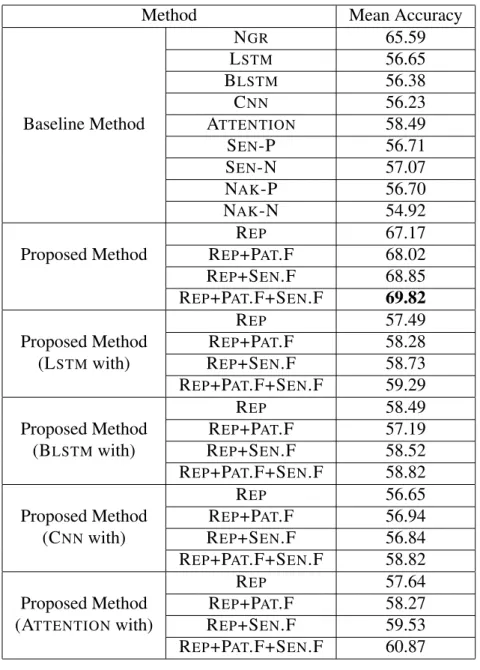
Then, we calculate the mean of these ten accuracies. Results are presented in Table 2.3.
Because of limitations of space, the names of methods are abbreviated as shown be- low: N GR (n-gram baseline), L STM (Long Short-Term Memory), B LSTM (Bidirec- tional LSTM), C NN (Convolutional Neural Network), A TTENTION (Neural Attention Model), S EN -P, S EN -N (Sentiment lexicon baseline, treat neutral as FAVOR, and treat neutral as AGAINST), N AK -P, N AK -N (Nakagawa’s model, treat neutral as FA- VOR, and treat neutral as AGAINST), R EP (PRIOR-SITUATION/EFFECT replaced n-gram), P AT .F (Patterns around PRIOR-SITUATION/EFFECT), S EN .F (Sentiment polarity in PRIOR-SITUATION/EFFECT). Note that, although our proposed methods use PRIOR-SITUATION/EFFECT labels, we can improve the classification accuracy when we use answers that have no PRIOR-SITUATION/EFFECT label in training.
Therefore, we use 300 answers of each question in training, and use answers that have at least one PRIOR-SITUATION/EFFECT label in evaluation.
From these results, it can be said that the PRIOR-SITUATION/EFFECT label is effective for FAVOR/AGAINST classification. Specially, R EP +P AT .F+S EN .F shows significant improvement over N GR (4.23 point improvement in the classification ac- curacy). For example, though N GR misclassified following texts, R EP +P AT .F+S EN .F correctly classified them.
(1) [gold: FAVOR, system output: FAVOR] Why women have to leave the house
PRIOR−SITUATION?
(2) [gold: FAVOR, system output: FAVOR] Because a world-famous event enlivens Japan, and it may also make a special demand
EFFECT.
In (1), PRIOR-SITUATION/EFFECT replaced n-gram “Why %PRIOR-
SITUATION%” makes it possible to correctly classify. In (2), since there are positive terms “enlivens” and “demand” in EFFECT, our proposed method used it as a clue for classifying.
Note that, though Nakagawa’s model is the state-of-the-art method of a Japanese sentiment analysis task, its accuracies were lower than baseline methods and proposed methods. This is likely because Nakagawa’s model was already trained by corpus of Web data, which is not restricted to the debate domain.
One of the reasons why the classification accuracy remains at about 70% is that
the stance classification task is generally very difficult. In Task6 of SemEval-2016, all
models were inferior to a baseline method using support vector machine (SVM) with word n-gram and character n-gram [Mohammad et al., 2016b]. Although we tried neural network based models, the accuracies of these models were lower than N GR
(logistic regression). This indicates that the text including the concepts of the time variation (i.e., PRIOR-SITUATION and EFFECT) is not easy to solve even for neural network models. On the other hand, neural network models with proposed features show a consistent increase in terms of accuracy, compared to other models without proposed features. Therefore, our proposed features seem to be effective not only for simple models (i.e. n-grams) but also for other sophisticated models (i.e. neural network).
2.5.1 Error Analysis
In this subsection, we investigated texts that were misclassified using the proposed method (R EP +P AT .F+S EN .F).
Most errors are caused by not activated P AT .F or S EN .F. The example is the fol- lowing:
(3) [gold: AGAINST, system output: FAVOR] Because it seems to cause indulge in the Diet
EFFECT.
(4) [gold: AGAINST, system output: FAVOR] To avoid changing for the worse, we have to defense that revising the article requires two-thirds of
the Diet
PRIOR−SITUATION.
In (3), “indulge” indicates a negative attitude, but this term was not in sentiment lexicon. In (4), we would be able to activate %PositiveToPRIOR-SITUATION%
if “have to defense %X%” were in our patterns. These errors seem to decrease if we enrich sentiment lexicon and patterns. This enrichment is left as a subject for our future work.
Next, some errors exists because of multiple opinions included in the text. An example is the following:
(5) [gold: FAVOR, system output: AGAINST] Although changing law easily
EFFECTis bad, simplification of the procedure
EFFECTis needed. Otherwise, old laws will
remain.
In (5), the author of the text indicates both a positive attitude and a negative attitude related to %EFFECT%. To tackle this problem, one possible solution is to change feature weights according to activated position in the text. For instance, if the author presents a negative attitude in relation to %EFFECT% in the first half of the text and presents a positive attitude about %EFFECT% in the latter half of the text, then the author is assumed to be in FAVOR of EFFECT all.
Furthermore, some errors are more complicated. One example is the following:
(6) [gold: AGAINST, system output: FAVOR] Because it is important decisions, we must be careful. I wish everyone to consider why people involved in framing article-96 decided that revising the article should require two-thirds of
the Diet
PRIOR−SITUATION.
2.6 Conclusion
As described herein, we proposed the concepts of the time variation for the first time in the stance classification task and labeled texts collected from different domains. Then, we demonstrated that many texts cannot be classified into FAVOR/AGAINST without PRIOR-SITUATION/EFFECT. Additionally, we performed FAVOR/AGAINST clas- sification with PRIOR-SITUATION/EFFECT, and showed improved classification ac- curacy. In future work, we plan to gather knowledge related to PRIOR-SITUATION/
EFFECT from Wikipedia, Twitter, and so on, and to use this knowledge to label PRIOR-SITUATION/EFFECT automatically. Consider the following examples:
(8) Same-sex marriage causes the low birth rate problem.
(9) Same-sex marriage changes the situation that man can marry only with a woman.
If we have the prior knowledge that a pattern “A causes B” indicates that B is an EF-
FECT of A and that a pattern “A changes the situation that B” indicates that B is a
PRIOR-SITUATION of A, we can retrieve PRIOR-SITUATION/EFFECT of “same-
sex marriage” from (8) and (9). These knowledge are similar to that of Hashimoto
et al. [2012b]. They performs acquisition of excitatory templates (e.g. “cause X,
increase X”) and inhibitory templates (e.g. “prevent X, discard X”) by bootstrap-
ping. Their method will be an immediate next step for automatic labeling of PRIOR-
SITUATION/EFFECT.
Table 2.3: Classification Results of FAVOR/AGAINST Classification (Bold Shows the Best Performance)
Method Mean Accuracy
N GR 65.59
L STM 56.65
B LSTM 56.38
C NN 56.23
Baseline Method A TTENTION 58.49
S EN -P 56.71
S EN -N 57.07
N AK -P 56.70
N AK -N 54.92
R EP 67.17
Proposed Method R EP +P AT .F 68.02
R EP +S EN .F 68.85 R EP +P AT .F+S EN .F 69.82
R EP 57.49
Proposed Method R EP +P AT .F 58.28
(L STM with) R EP +S EN .F 58.73
R EP +P AT .F+S EN .F 59.29
R EP 58.49
Proposed Method R EP +P AT .F 57.19
(B LSTM with) R EP +S EN .F 58.52
R EP +P AT .F+S EN .F 58.82
R EP 56.65
Proposed Method R EP +P AT .F 56.94
(C NN with) R EP +S EN .F 56.84
R EP +P AT .F+S EN .F 58.82
R EP 57.64
Proposed Method R EP +P AT .F 58.27
(A TTENTION with) R EP +S EN .F 59.53
R EP +P AT .F+S EN .F 60.87
Chapter 3
Annotating Causal Relation Instances in Wikipedia to Automatically
Recognize Causal Relation
In Chapter 2, we focused on the knowledge of PRIOR-SITUATION/EFFECT and showed that the accuracy of stance classification improves by annotating that knowl- edge manually. However, there is a limit to manually assigning this knowledge to large scale texts, so it is necessary to give them automatically. In this chapter, in or- der to solve the problem, annotate knowledge of causal relation to the Wikipedia cor- pus. Hereafter, we treat PROMOTE/SUPPRESS as almost same as EFFECT/PRIOR- SITUATION.
3.1 Introduction
Commonsense knowledge on entity, event and causal relationships plays an important role in recent NLP tasks, such as question answering [Oh et al., 2013, 2016; Sharp et al., 2016], hypothesis generation [Hashimoto et al., 2015a; Radinsky et al., 2012a], and stance classification [Sasaki et al., 2016].
In many previous researches, corpora for acquiring causal relations were built by
annotating two text spans (e.g., entities) and their relations in the text [Doddington
et al., 2004; Dunietz et al., 2017; Hendrickx et al., 2010; Pyysalo et al., 2015; Rehbein
and Ruppenhofer, 2017; Rinaldi et al., 2016]. However, these methods are costly. It involves many tasks, such as choosing a target domain, designing an ontology (seman- tic classes) of entities, designing an annotation guideline for relations, and annotating the relations between entities. Building such a corpus also requires the annotation ef- forts of experts. For these reasons, an approach which is scalable to various domains or genres is desired. This chapter presents an approach for annotating causal relation instances to Wikipedia articles via crowdsourcing.
In recent years, crowdsourcing services are used by many researchers in natural language processing [Brew et al., 2010; Finin et al., 2010; Fort et al., 2011; Gormley et al., 2010; Hovy et al., 2014; Jha et al., 2010; Kawahara et al., 2014; Lawson et al., 2010; Takase et al., 2016]. However, it is impossible to make complicated annotations like causal relationships with the existing crowdsourcing frameworks. This is because existing crowdsourcing frameworks were limited to relatively simple input such as multiple choice questions and free descriptions.
In this research, we examine the feasibility of annotating causal relation instances by crowdsourcing. For this reason, we implement a simple micro-task to annotate the parts corresponding to the causal relation in the article on Wikipedia. In addition, we propose a method to link such an annotation system with existing crowdsourcing service. Since we use brat
1[Stenetorp et al., 2012] widely used in existing research in NLP, our method is applicable to general purpose not limited to causal relation.
We acquired annotations on 95,008 causal relation instances from 8,745 summary
sentences
2contained in 1,494 Wikipedia articles. We publish the annotation system
and corpus proposed in this research on the website
3. Although this corpus was given
to a Japanese Wikipedia article, we here use English translations for illustrative pur-
poses.
Figure 3.1: Named entity annotation by the multiple-choice method [Finin et al., 2010].
3.2 Related work
NLP researchers have created corpora in crowdsourcing on a number of tasks. These tasks include part-of-speech tagging [Hovy et al., 2014], PP attachment [Jha et al., 2010], named entity recognition [Finin et al., 2010; Lawson et al., 2010], sentiment classification [Brew et al., 2010], relation extraction [Gormley et al., 2010], semantic modeling of relation patterns [Takase et al., 2016], and discourse parsing [Kawahara et al., 2014]. In most of these tasks, the micro-tasks are designed as multiple-choice problems. For example, Brew et al. [2010] has let the workers annotate positive, nega- tive, or irrelevant on the article. If the target task cannot be shaped like multiple-choice problems, a special approach is required. In particular, labeling text spans cannot be done in multiple-choice problems.
Nevertheless, in some studies, spans have been annotated by crowdsourcing. Finin et al. [2010] annotated the boundary and semantic class of the named entity by trans- forming the annotation task into the micro-task of multiple-choice problems. They applied the standard interface of Amazon Mechanical Turk (see Figure 3.1). This in-
1
http://brat.nlplab.org/
2
The lead paragraph of a Wikipedia article containing a quick summary of the most important points of the article.
3
http://www.cl.ecei.tohoku.ac.jp/wikipedia_pro_sup/
Figure 3.2: A custom interface for annotating named entities via crowdsourcing [Law- son et al., 2010].
terface is less readable, and the worker needs to press the radio button for each word.
The most relevant to our research is [Lawson et al., 2010] They provided the interface that allows workers to select arbitrary sections in the text and give labels (see Fig- ure 3.2). However, their research focuses on named entity recognition and cannot be generalized to other annotation tasks. In addition, their tools are not published.
In contrast, we propose a framework to facilitate complicated annotation for work- ers by combining crowdsourcing with brat, an open-source software commonly used in natural language processing. Our proposed method is not limited to causal relations, but corresponds to various annotation tasks that can be performed by brat.
Regarding the causal relations, Dunietz et al. [2017] present the version 2.0 of Bank of Effects and Causes Stated Explicitly (BECauSE). Rehbein and Ruppenhofer [2017]
built a German corpus with a similar annotation scheme. Unlike previous research, our
research aims to acquire real-world causal knowledge by using Wikipedia.
3.3 Annotating promotion/suppression relations in Wikipedia articles
3.3.1 Labels of causal relations
In this work, we annotate promotion/suppression relations [Fluck et al., 2015; Hashimoto et al., 2012a] in Wikipedia articles. Here, “X promotes Y” means that Y is activated when X is activated. Analogously, “X suppresses Y” means that Y is inactivated when X is activated.
Here, we focus on the fact that each article in Wikipedia contains knowledge about the article title (T, hereafter). Therefore, we consider promotion/suppression relations with T as an argument. The annotation task is performed by labeling P RO (“T promotes Y”), S UP (“T suppresses Y”), P RO BY (“X promotes T”), or S UP BY (“X suppresses T”) for text spans (denoted by Y for P RO and S UP , and denoted by X for P RO BY and S UP BY ) in the article.
We randomly selected 1,494 articles belonging to nine categories and to the subcategories/sub-subcategories: “Social issues”, “Disasters”, “Diseases and disor- ders”, “Innovation”, “Policy”, “Finance”, “Energy technology”, “Biomolecules” and
“Nutrients”.
3.3.2 Annotation policy
In this chapter, we examined two kinds of units to be annotated: noun phrases and verb phrases. However, none of these units is inadequate to annotate promotion/suppression relations.
In order to explain this, we quote a Wikipedia article about “Nyctalopia”
1. Nyctalopia, also called night-blindness, is a condition making it difficult to see in relatively low light. Nyctalopia may exist from birth, or be caused by injury or severe malnutrition.
Here, if we limit the annotation unit to noun phrases, we cannot annotate ⟨ S UP , nyc- talopia, see in relatively low light ⟩ . Similarly, if we limit the annotation unit to verb phrases, we cannot annotate ⟨ P RO BY , nyctalopia, injury ⟩ .
1
https://en.wikipedia.org/wiki/Nyctalopia
Annotation interface of brat Crowdsourcing interface
Enter the password
Complete button
F9pw4JkD0lk3 Correct password
iYd2UwmHr51p Incorrect password Complete the task
If the password is correct, the worker could claim rewards
One out of ten is a test question
The character-level F1 score of a worker’s annotation is ...
0.3 or more less than 0.3
external site
Figure 3.3: Overview of the annotation system integrating Yahoo! crowdsourcing and brat
In addition, there is a problem that segmentation of the annotation cannot be de- termined uniquely. For example, “severe malnutrition” and “malnutrition” can be re- garded as caused by nyctalopia as well. Here, it is difficult to define that one of them is the correct answer. Therefore, we collected annotations by multiple crowd workers without creating detailed instructions of the annotation. As a side effect of this, the more workers annotated the segment, it can be regarded as having high confidence.
Thus, this corpus will be useful for improving the annotation scheme for causal rela- tions.
3.3.3 Using brat in crowdsourcing
In crowdsourcing, since annotations are performed by many and unspecified users, quality control is indispensable. In many existing crowdsourcing tasks, quality of a worker was measured by test questions with the correct answers prepared by the task designer.
However, we cannot perform quality control by exact match, because the answer
cannot be uniquely determined in our settings. Therefore, we perform quality control
… and result in high numbers of abnormal white blood cells.
Symptoms may include bleeding and bruising problems, feeling tired, fever, … Treatment may involve some combination of chemotherapy, radiation therapy, …
PROSUP PRO_BY SUP_BY
the degree of coincidence (the number of annotator)
0 10
Figure 3.4: An example of annotation results for “Leukemia” on Wikipedia. The color at the bottom of the text shows the relations, and the color intensity shows the number of workers who annotated.
on brat by measuring character-level F1 score between worker’s annotation and correct annotation and feeding it back to crowdsourcing service.
Figure 3.3 is an overview of the proposed system. The detailed procedure of anno- tation is as follows:
1. Workers are led from the crowdsourcing screen to the annotation screen in brat.
2. Workers perform annotations on brat.
3. We measure character-level F1 score between worker’s annotation and correct annotation. When F1 score exceeds the threshold (0.3), the correct password is presented, otherwise the incorrect password is presented to the worker.
4. Workers return to the crowdsourcing screen and input the password. At that time, reward is given only when it is correct.
3.4 Annotation results
Using the above system and Yahoo! crowdsourcing service
1, we collected ten an- notations for each article. Here, we prepared separate tasks for each promotion/sup- pression relation P RO , S UP , P RO BY and S UP BY . This allows workers to annotate without annoying other relations. Figure 3.4 shows an example of annotation results for “Leukemia” on Wikipedia. Here, for example, it can be seen that many work- ers judged that leukemia causes “abnormal white blood cells” and “high numbers of abnormal white blood cells”.
1
![Figure 3.1: Named entity annotation by the multiple-choice method [Finin et al., 2010].](https://thumb-ap.123doks.com/thumbv2/123deta/5996778.2069229/37.892.252.596.259.509/figure-named-entity-annotation-multiple-choice-method-finin.webp)
![Figure 3.2: A custom interface for annotating named entities via crowdsourcing [Law- [Law-son et al., 2010].](https://thumb-ap.123doks.com/thumbv2/123deta/5996778.2069229/38.892.174.735.199.502/figure-custom-interface-annotating-named-entities-crowdsourcing-law.webp)