Fukushima Medical University
福島県立医科大学 学術機関リポジトリ
This document is downloaded at: 2021-11-07T23:08:08Z
Title A case of steroid-refractory ulcerative colitis complicated with cytomegalovirus pneumonia
Author(s) Sato, Shuzo; Kobayashi, Hiroko; Saito, Rie; Sasajima, Tomomi; Orikasa, Hiroshi; Watanabe, Hiroshi; Ohira, Hiromasa; Tasaki, Kazuhiro; Abe, Masafumi
Citation Fukushima Journal of Medical Science. 53(1): 27-32
Issue Date 2007-06
URL http://ir.fmu.ac.jp/dspace/handle/123456789/205
Rights © 2007 The Fukushima Society of Medical Science
DOI
Text Version publisher
Fukushima J. Med. Sci., Vol. 53, No.1, 2007
[Case Report]
A CASE OF STEROID-REFRACTORY ULCERATIVE COLITIS COMPLICATED WITH CYTOMEGALOVIRUS PNEUMONIA
SHUZO SATOl), HIROKO KOBA YASHP), RIE SAITO!),
TOM OM I SASA]IMN), HIROSHI ORIKASNl, HIROSHI WATANABE!), HIROMASA OHIRN), KAZUHIRO T ASAKF) and MASAFUMI ABP)
1) Department of Internal Medicine II, Fukushima Medical University School of Medicine, Fukushima, 960-1295, Japan
2)Department of Pathology I, Fukushima Medical University School of Medicine, Fukushima, 960-1295, Japan
(Received September 5, 2006, accepted January 26, 2007)
Abstract: We present a case of late-onset ulcerative colitis (UC) complicated with cytomegalovirus (CMV) pneumonia revealed by autopsy. A 77-year-old woman had a diagnosis of UC, and received high-dose steroids and leukocytapheresis.
Then she received ganciclovir because CMV -pp65 antigenemia test revealed positive which suggested systemic or colonic CMV infection. But ganciclovir was dis- continued because of thrombocytopenia and liver dysfunction. After that she had interstitial pneumonia and died of a respiratory failure. Autopsy revealed CMV colitis based on UC, and CMV pneumonia with diffuse alveolar damage. Evaluation of CMV infection in patients with steroid-refractory UC should be considered before proceeding with immunosuppressive therapy or surgery, especially in elderly patients.
Key words: ulcerative colitis, cytomegalovirus pneumonia, CMV infection
INTRODUCTION
Cytomegalovirus (CMV) is a species-specific p-herpesvirus that is present in the majority of the population (60%-90%)'). Active CMV infection often develops in immunocompromised hosts, such as human immunodeficiency virus infection, receiving chemotherapy for malignant tumors, and immunosuppressive agents for organ transplantation or autoimmune diseases.
{2I:jjjlH~=-, IN,*~-T, *ilil!l!~, 1fi'S'I~~, {2I:k §ijM~, iIi:i2l~;E;, ::k3!l5kIE, 83i1ffiJffi#, Jlii]$IE Y:.
Correspondence to: Shuzo Sato, Department of Internal Medicine II, Fukushima Medical University School of Medicine, Fukushima City 960-1295, Japan.
E-mail: [email protected]
27
28 S. SATO el al.
Recently, several reports suggest that steroid-refractory ulcerative colitis (UC) correlates with CMV infection2-4). CMV infection can aggravate UC on a basis of immunosuppressive state, and cause fatal organ damage. However, there has been no previous report describing a case with CMV pneumonia developed in a patient with Uc. In this report, we present a case of late-onset UC complicated with CMV pneumonia, revealed by autopsy.
CASE REPORT
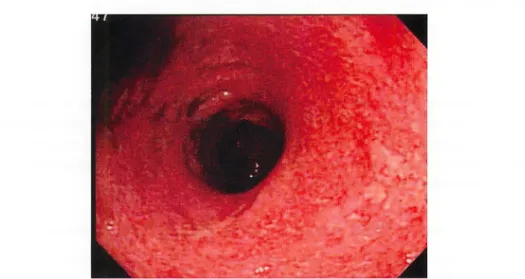
A 77-year-old woman had experienced lower abdominal pain and diarrhea since January, 2003. In February, she had a diagnosis of UC and received prednisolone for three months, but the colitis was refractory to the therapy. She was referred to our hospital in May. On admission, she suffered from lower abdominal pain. She had bloody stool or diarrhea 5 times a day. On physical examination, her body temperature was 37.0°C, her heart beat was 80/min, and blood pressure was 110/80 mmHg. Her bowel sounds were weak. She had tenderness in the left lower quadrant of abdomen. Hematological examination showed anemia, red blood cell count of 311 X 104/ J..lI and hemoglobin of 9.0 g/dl, and normal white blood cell count of 5,100/J..l1. The level of C-reactive protein was 1.3 mg/dl, and erythrocyte sedi- mentation rate was 52 mm in 1 hour. The levels of total protein and serum albumin were 5.6 g/dl, 2.4 g/dl, respectively. Disease activity of UC was moderate according to the Truelove and Witt's criteria, which classified by the extent of bloody stool, fever, pulsation, anemia, repeat of defecation, and a high erythrocyte sedimentation rate5) Sigmoidscopy showed abrupt mucosa, pseudopolyposis, and consecutive multiple deep ulcers from the rectum to sigmoid colon (Fig. 1). Biopsied specimen
Fig. 1. Sigmoidscopy showed consecutive abrupt mucosa, spontaneous bleeding and multiple deep ulcers.
UC COMPLICATED WITH CMV PNEUMONIA 29 GCV 400mg
161.23 3/4 15/21
CRP
(mg/dl) LeAP • • • • • • • • •
15 10 5 0
Feb Apr Jun Aug 2003
GCV: ganciclovir, PSL: prednisolone,
mPSL: methylprednisolone, LCAP: leukocytapheresis.
Fig. 2. Clinical course of the patient.
showed typical histological findings of DC. She received methylprednisolone in a dose of 500 mg for 3 days, followed by high doses of prednisolone (60 mg/day) (Fig.
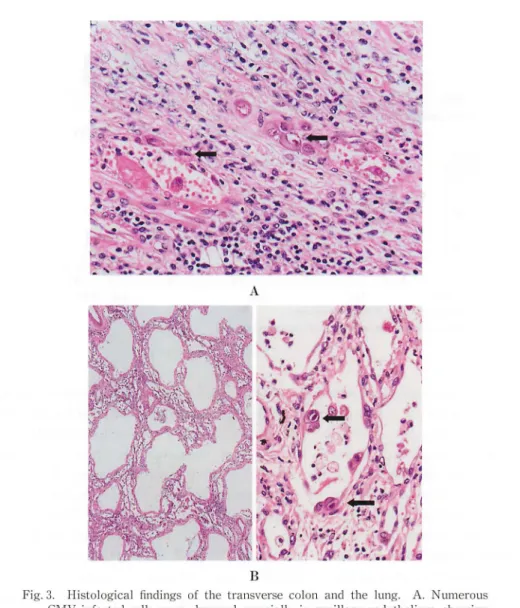
2). Also, she was treated with leukocytapheresis once a week for 10 times. Her symptoms improved slightly, but did not disappear. In June, CMV -pp65 antigenemia test revealed positive, which suggested systemic or colonic CMV infec- tion. She received ganciclovir (GCV) in a dose of 5 mg/kg for 11 days, but GCV was discontinued because of thrombocytopenia and liver dysfunction. Then, she was referred to surgery because the colitis was refractory to the therapy. In July, she suddenly experienced high fever and dyspnea. Chest X -ray and CT showed ground- glass appearance of both lungs. In spite of intensive care, she suffered from acute respiratory distress syndrome and bilateral pneumothorax. She died of a respira- tory failure and severe anemia. Autopsy findings showed consecutive deep ulcers from rectum to transverse colon compatible with DC, and severe CMV infection in capillary endothelium of proper muscle layer (Fig. 3A). Both lungs showed diffuse alveolar damage (DAD) with organized hyaline membrane in alveolar walls, includ- ing numerous CMV -infected cells (Fig. 3B). Cause of death was respiratory failure due to organized DAD. Massive bleeding from colon ulcers might also contribute to the deterioration of general condition.
DISCUSSION
CMV is a common infection, and it appears to be an important contributing factor to steroid-refractory disease in patients with DC2-4). As in this case, CMV infection may be systemic, and it is a potentially fatal complication in patients with
30 S. SATO el al.
A
B
Fig. 3. Histological findings of the transverse colon and the lung. A. Numerous CMV infected cells were observed especially in capillary endothelium, showing CMV colitis based on ulcerative colitis. Arrows indicate the inclusion bodies (x400). B. Diffuse alveolar damage was shown with organized hyaline mem- brane in alveolar walls (left, x150). Numerous CMV-infected cells on the alveolar walls are indicated by arrows (right, X 400).
inflammatory bowel disease, especially in those treated with multiple im- munomodulators. Outcome of CMV infections in patients with inflammatory bowel disease (IBD) has been reported mortality rate of 30%4). Prompt diagnosis of CMV colitis by CMV pp65 test, anti-CMV IgM, PCR, and histological analysis allows prompt treatment with GCV, which provides clinical response in steroid-refractory UO·"·6) However, establishing a diagnosis of active CMV infection is challenging in those patients because CMV colitis is often clinically indistinguishable from an episode of acute colitis. In fact, GCV was administered in this patient before
UC COMPLICATED WITH CMV PNEUMONIA 31 establishing a diagnosis of CMV colitis or pneumonia because positive CMV pp65 antigenemia test suggested a systemic CMV infection. However, the antiviral therapy was insufficient because of the GCV· side effects. To the best of our knowledge, there has been no previous report describing a case with CMV pneumo- nia developed in a patient with Uc. Two cases with CMV pneumonia developed in patients with Crohn's disease have been reported3•7). Their ages were 19 and 51- years old. They were treated with steroid, 6-mercaptopurine, ciclosporin, or 5- aminosalicylic acid before the onset of CMV pneumonia. Both patients received GCV for the treatment of CMV pneumonia; one of them was discharged and the other died.
Although risk factors of CMV infection have not fully been investigated in UC patients, Kishore et at. suggested female gender, pancolitis, or histological activity were the independent risk factors4 ). CMV colitis is well described in acquired immunodeficiency syndrome patients, in organ transplant patients, in patients receiv- ing immunosuppressants or steroids, in patients with cancer or receiving chemother- apy, and in the elderly, particularly those who suffer from chronic illness8). Onset of UC after the age of 65 is not common, for example, the number of the patients who had a diagnosis of UC at the age of over 60 were 12 of 168 (7.14%) in Japan9 ).
Late-onset UC was shown to be more aggressive, resistant to the conventional therapy, and associated with high rate of complications. Almogy et at. proposed that urgent surgery and hypoalbuminemia were predictors of adverse outcome in the elderly population suffering from late-onset UC and requiring an operation10). It is difficult to manage elderly patients with severe colitis unresponsive to conventional therapy. Absolute indications for surgery are exsanguinating hemorrhage, perfora- tion, and documented or strongly suspected carcinomal l ). In this case, surgical treatment was planned without absolute indications for surgery, because her colitis was unresponsive to the conventional therapy. But it was unable because of the onset of CMV pneumonia. Majority of patients with UC does not require surgery, however, this case may propose that elderly patients should be referred to surgery earlier than young patients if the colitis was refractory to the conventional therapy, and that we should be aware of the risks and benefits of operations within different clinical settings.
In conclusion, we described a rare case of UC complicated with CMV pneumonia revealed by autopsy. Further studies are needed in elderly patients with steroid- refractory UC to establish new tools for diagnosing CMV colitis at early stage, to evaluate high risk group for CMV infection, and to assess an indication of prophylac- tic therapy with GCV in such group.
REFERENCES
1. Sugisaki K, Maekawa S, Mori K, Ichii 0, Kanda K, Tai M, Suzuki T, Ochiai H, Ejiri Y.
Takahashi M, Hakozaki H. Self-limited Colitis during the Course of Rubella and
32 S. SA TO et at.
Cytomegalovirus Infection in an Immunocompetent Adult. Intern med, 43: 404-409, 2004.
2. Kambham N, Vij R, Cartwright CA, Longacre T. Cytomegalovirus Infection in Steroid- refractory Ulcerative Colitis. Am J Surg Pathol, 28: 365-373, 2004.
3. Papadakis KA, Tung JK, Binder SW, Kam LY, Abreu MT, Targan SR, Vasiliauskas EA.
Outcome of Cytomegalovirus Infections in Patients With Inflammatory Bowel Disease.
Am J Gastroenterol, 96: 2137-2142, 200l.
4. Kishore J, Ghoshal U, Ghoshal UC, Krishnani N, Kumar S, Singh M, Ayyagari A.
Infection with cytomegalovirus in patients with inflammatory bowel disease: preva- lence, clinical significance and outcome. J Med Microbiol, 53: 1155-1160, 2004.
5. Truelove SC, Witts LJ. Cortisone in ulcerative colitis: Final report on a therapeutical trial. Br Med J, 2: 1041-1048, 1955.
6. Hamlin PJ, Shah MN, Scott N, Wyatt ]I, Howdle PD. Systemic cytomegalovirus infection complicating ulcerative colitis: a case report and review of the literature.
Postgrad Med J, 80: 233-235, 2004.
7. Hookey LC, Depew W, Boag A, Vanner S. 6-Mercaptopurine and inflammatory bowel disease: Hidden ground for the cytomegalovirus. Can J Gastroenterol, 17: 319-322, 2003.
8. Goodname RW. Gastrointestinal Cytomegalovirus Disease. Ann Intern Med, 119:
924-935, 1993.
9. Ishibashi N, Hirota N, Ikeda M, Hirohata T. Ulcerative colitis and colorectal cancer:
a follow-up study in Fukuoka, Japan. Int J Epidemiol, 28: 609-613, 1999.
10. Almogy G, Bordian CA, Greenstein AJ. Surgery for late-Onset ulcerative colitis:
predictors of short-term outcome. Scand J Gastroenterol, 9: 1025-1028, 2002.
11. Kornbluth A, Sachar DB. Ulcerative colitis practice guidelines in adults (update):
American College of Gastroenterology, Practice Parameters Committee. Am J Gas- troenterol, 99: 1371-1385, 2004.