Fukushima Medical University
福島県立医科大学 学術機関リポジトリ
This document is downloaded at: 2021-11-07T23:06:02Z
Title
[Chapter 1] Development of screening method using
HPLC/UV for the determination of nicotine and cotinine in hair samples [Chapter 2] Determination of a hair nicotine cut-off value to distinguish smokers from non-smokers in general male adults( 本文 )
Author(s) 辻, 雅善
Citation
Issue Date 2013-09-25
URL http://ir.fmu.ac.jp/dspace/handle/123456789/586
Rights
[Chapter 1]: © The Author(s). This is the peer reviewed version of "Health. 2013 Apr;5(4). doi: 10.4236/health.2013.54091", used under CC BY. [Chapter 2]: This is the pre-peer reviewed version of "Cancer Biomark. 2017 Jul 19;20(1):41-48". The final publication is available at IOS Press through
https://doi.org/10.3233/cbm-170004.
DOI
Text Version ETD
平成25年度 博士課程学位論文
[Chapter 1]
Development of screening method using HPLC/UV for the determination of nicotine and cotinine in hair samples
(HPLC/UVを用いた簡便な毛髪中ニコチンおよびコチニン測定法の確立)
[Chapter 2]
Determination of a hair nicotine cut-off value to distinguish smokers from non-smokers in general male adults
(一般成人男性における喫煙状況を区分する毛髪中ニコチンカットオフ値)
Masayoshi Tsuji
Division of Hygiene and Preventive Medicine, Corse for Researchers,
Graduate School of Medicine, Fukushima Medical University
Title:
[Chapter 1] Development of screening method using HPLC/UV for the determination of nicotine and cotinine in hair samples
(HPLC/UVを用いた簡便な毛髪中ニコチンおよびコチニン測定法の確立)
[Chapter 2] Determination of a hair nicotine cut-off value to distinguish smokers from non-smokers in general male adults
(一般成人男性における喫煙状況を区分する毛髪中ニコチンカットオフ値)
Name: Masayoshi Tsuji
Affiliation: Division of Hygiene and Preventive Medicine, Corse for Researchers, Graduate School of Medicine, Fukushima Medical University
1
Content:
Content ……....……… 1
[Chapter 1] Abstract ...……… 4
Introduction ……… 5
Materials and methods ……… 6
Usefulness of HPLC/UV with column-switching method ……… 6
Sensitivity of HPLC/UV with column-switching method ……… 6
Intra- and inter-assay reproducibility of HPLC/UV with column-switching method ………7
Screening of nicotine and cotinine in hair ……….……… 8
Subjects and time period ………..……… 8
Hair sample collection, preservation and measurement method ……… 8
Screening survey ………..……… 8
Comparison of apparatus costs ……….………. 9
Results ………. 9
Usefulness and accuracy of HPLC/UV with column-switching method ...……… 9
Screening nicotine and cotinine in hair by HPLC/UV with column-switching method ….….. 10
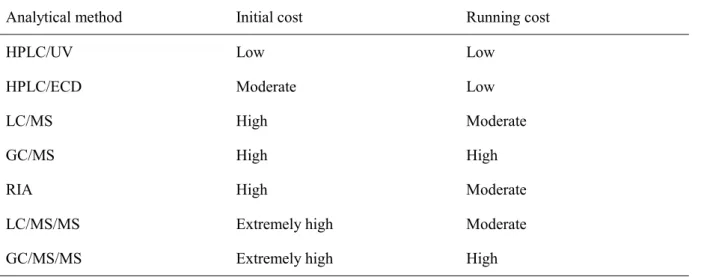
Cost comparison by analytical method ……...………... 10
Discussion …...……….. 11
References …..………... 14
Figure legends ………... 18
Figures and tables ...……….. 19
2
[Chapter 2]
Abstract ...……….. 26
Introduction ………... 27
Materials and methods ……….. 28
Subjects ………..………... 28
Questionnaire items ……….………. 28
Hair sampling ……….……… 29
Preparation of nicotine and cotinine in hair ………. 29
HPLC/UV with column-switching system ……….………. 30
Statistical analysis ……….……….. 30
Results ………... 31
Characteristics of smokers and non-smokers among the general Japanese population ... 31
Analytical results of nicotine and nicotine plus cotinine in hair ….………. 31
ROC curves of nicotine and nicotine plus cotinine in hair as predictors of smoking ……...… 31
Discussion …...……….. 32
References …..………... 36
Figure legends ………... 41
Tables and figures ...……….. 42
Acknowledgment ....……….. 45
Abbreviation ...……….. 46
Abstract for Japanese [概要] ...…………...……….. 47
3
[Chapter 1]
Development of screening method using HPLC/UV for the determination of nicotine and cotinine in hair samples
4
Abstract:
Nicotine and cotinine in hair are good biomarkers for assessing long-term exposure to smoking. However, analytical devices such as GC/MS are associated with high cost and are not widely used. HPLC/UV is used widely in laboratories, but is unsuitable for measurement of minor constituents, except when using the column-switching method. Thus, I aimed to establish a simple, inexpensive and sensitive method based on HPLC/UV with column switching for measuring nicotine and cotinine in hair. First, I compared the presence and absence of a column selection unit. I then measured amounts of nicotine and cotinine in hair samples collected from the general population, and compared both the correspondence levels and the detection limits with those in previous studies. Finally, initial and running costs of HPLC/UV were compared with other analytical methods. As one of results, the areas of nicotine and cotinine measured by HPLC/UV with column-switching method were 12.9 and 16.9 times greater, respectively, than those without the column-switching method. The amount of nicotine and cotinine in hair was significantly correlated to number of cigarettes smoked per day (r= 0.228, p=
0.040). In addition, the HPLC/UV method showed similar sensitivity and detection limit (nicotine, 0.10 ng/mg; cotinine, 0.08 ng/mg) as reported in previous studies. The cost of the HPLC/UV method is lower than that of other analytical methods. I was able to establish a low-cost method with good sensitivity for measuring nicotine and cotinine in hair. The HPLC/UV with column-switching method will be useful as a first step in screening surveys in order to better understand the effects of smoking exposure.
Keywords: HPLC/UV; Column-switching method; Nicotine; Hair; Cotinine
5
Introduction:
The risks of smoking are widely recognized and taking action against smoking continues to be a priority issue for public health. Death by cancer or ischemic heart disease is reported to be a major risk of smoking [1,2]. Thus, environmental countermeasures need to be taken for both smokers and non-smokers.
Biological monitoring is important as a means to evaluate exposure to smoking. In previous studies, levels nicotine and its metabolite, cotinine, were measured in the urine or saliva of smokers [3-5]. However, the levels of nicotine or cotinine in these samples may reflect acute exposure to smoking, but not the amount of habitual smoking. Because human hair grows about 1 cm/month, it is useful in biological monitoring in the medium or long term [6,7]. In addition, the amount of nicotine and its metabolites in the hair reportedly decreases slowly; a decrease of less than 10% was observed after being left to stand for one week at room temperature [6].
In previous studies, measurement of nicotine or cotinine in hair has been performed by gas chromatography with mass spectrophotometry (GC/MS) [8,9], but this method has high initial and running costs. More recently, high-performance liquid chromatography with electrochemical detection (HPLC/ECD) has been used for the determination of nicotine and cotinine because of its high sensitivity. The initial and running costs of HPLC are lower than those of GC. However, ECD detectors are not commonly present in laboratories, while UV detectors are much more common. Unfortunately, UV detectors are unsuitable for measurement of small amounts of compounds in hair due to poor sensitivity. It has been reported that UV detectors can be installed on column-selection units [10,11], but there have been no reports on the measurement of nicotine in hair using this approach. The column-switching method is able to concentrate samples for analyses; thus, the column-switching method may be used as a method for increasing the sensitivity of HPLC/UV.
6
This study aims to establish a simple, cheap and sensitive method based on HPLC/UV with column-switching in order to measuring nicotine and cotinine in hair. First, I compared the presence and absence of a column selection unit, and I examined the intra- and inter-assay reproducibility of HPLC/UV with column-switching. I then measured the amounts of nicotine and cotinine in hair samples collected from the general population, and compared the quality controls with previous studies. Finally, the initial and running costs of HPLC/UV were compared with other analytical methods.
Materials and methods:
Usefulness of HPLC/UV with column-switching method Sensitivity of HPLC/UV with column-switching method
This study examined the sensitivity of the column-switching method in a preliminary experiment using nicotine and cotinine standard solutions (both 1000 ng/ml; Sigma-Aldrich, Tokyo, Japan). Chromatograms of nicotine and cotinine were compared by area. An internal standard of 100 ng/ml N-ethyl norcotinine (NENC) in methanol was used. Some differences between the preliminary experiment and the present study were found with respect to analytical column, flow rate, injection volume, and introduction of column-switching. Inertsil ODS-3V (GL Sciences, Tokyo, Japan) was used as an analytical column, with a 1.0 ml/min flow rate and a 50-μl injection volume in the preliminary experiment. The present study also introduced a column selection unit HV-2080-01 (JASCO, Tokyo, Japan), as a column-switching method, for greater sensitivity than in the preliminary experiment. The analytical column used was the Ascentis Express C18 Column (100 mm × 3.0 mm × 2.7 μm; Sigma-Aldrich) with the PU-2089 pump (JASCO). The mobile phase in the analytical column consisted of ammonium formate (50 mM, pH 4.3):acetonitrile = 96:4 at a flow rate of 0.4 ml/min. The concentrating column used the Develosil ODS-UG-5 Column (10 mm × 4.0 mm i.d.; Nomura Chemical, Aichi, Japan) and the DP-model 203 pump
7
(Eicom, Kyoto, Japan). The mobile phase of the concentrated column consisted of ammonium formate (50 mM, pH9.0) with a flow rate of 0.5 ml/min. The injection volume was 200 μl. Other conditions were the same for both the preliminary experiment and the present study. I used the HPLC LC-2000 Plus Series, the AS-2055 auto sampler, the UV-2075 detector set at 260 nm, the ChromNAV data disposal device (all from JASCO), and the Waters-CHM column oven (Nihon Waters, Tokyo, Japan) with a column oven temperature at 40°C.
Intra- and inter-assay reproducibility of HPLC/UV with column-switching method
The HPLC/UV with column-switching method was examined for intra-assay and inter-assay reproducibility. With regard to pre-treatment for hair, similarly to previous studies on hair analysis [12,13], hair samples were placed in test tubes and washed three times using 3 ml of dichloromethane. After the hair sample was dried, it was weighed, and the following treatment for about 40 mg of hair was used. Samples were mixed with 1.6 ml of NaOH (2.5 M) and 60 μl of NENC (1000 ng/ml; Cosmo Bio, Tokyo, Japan) as an internal standard, followed by incubation at 40°C until the hair was completely dissolved. Next, 4 ml of solvent mixture (chloroform: isopropyl alcohol = 95:5 (v/v)) was added and the mixture was vortexed for 2 min. The mixture was then centrifuged for 5 min at 2000 rpm, and the supernatant was aspirated under a fume hood. Next, 2 ml of HCl (0.5 M) was added, followed by vortexing for 2 minutes. The mixture was centrifuged for 5 min at 2000 rpm, and the supernatant was transferred to another test tube. NaOH (0.4 ml; 2.5 M) was then added to the test tube. In addition, 1.6 ml of ammonium chloride (pH 9.5) and 4 ml of solvent mixture (chloroform: isopropyl alcohol = 95: 5 (v/v)) also was added to the test tube, followed by vortexing for 2 minutes. The mixture was centrifuged for 5 min at 2000 rpm, and the supernatant was discarded and dried under a nitrogen stream. The extract was dissolved with 600 μl of ammonium formate (0.5 M), centrifuged for 1 min at 2000 rpm, and filtered with a 0.45-μm filter. Solvent (200 μl) was then injected into the HPLC system and analyzed. This study was performed under the HPLC/UV conditions described previously. For intra-assay assessment,
8
measurements were performed every hour for 5 hours, and for inter-assay assessment, measurement was performed once daily for 5 days.
Screening of nicotine and cotinine in hair Subjects and time period
Two thousand subjects were selected in a two-stage stratified random sampling chosen from the “Basic Resident Registries” of municipalities all over Japan. I performed both a questionnaire survey and hair-cutting by home visits. Questionnaires remained anonymous in order to protect private information, and informed consent was obtained from each subject.
Questionnaires about smoking behavior were completed during home visit interviews.
Hair sample collection, preservation and measurement method
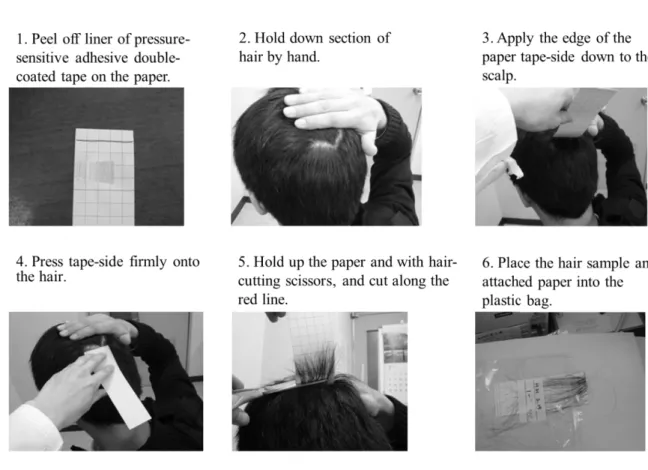
Nicotine and cotinine were measured in hair samples collected from 294 people in 2009 and 2010. Subjects were 294 people assessed for smoking status by questionnaire. Two hundred and eighty-seven samples were used for analysis due to a lack of complete data in 7 samples. I developed a hair-cutting kit and explanatory leaflet for the hair extraction method, with the aim of safely colleting hair samples with affecting subject esthetics (Figure 1). The kit included a plastic bag and a rectangular sheet of construction paper (15 cm × 5 cm), with a red line at the 1 cm from the bottom and pressure-sensitive adhesive double-coated tape above the red line. To obtain a hair sample, the top edge of the paper was first applied to the skin of the head, tape-side down. Hair was then affixed to the tape, and then, with hair-cutting scissors, the hair sample was cut at the red line on the paper. Hair used for measurement was that from the cut point to a length of 5 cm. Each hair sample and attached paper was then placed in a plastic bag and stored at -80°C in a freezer. This study was performed under the pre-treatment and HPLC/UV method conditions described previously.
Screening survey
Smoking information was assessed from questionnaires associated with 287 samples.
9
Participants were categorized into 2 groups; non-smokers and smokers. The mean values of nicotine and cotinine in the hair in each group was calculated. To examine the usefulness of the HPLC/UV method, present methods and results were compared with major studies. In addition, the correlation of sum total nicotine and cotinine in hair and number of cigarettes smoked per day were checked for the smoker group. This statistical analysis was conducted using SPSS statistics 17.0 (Nihon IBM, Tokyo, Japan). All probability values were two-tailed and all confidence intervals were estimated at the 95% levels.
Comparison of apparatus costs
Initial and running costs were compared for each analytical apparatus and I evaluated the usefulness of HPLC/UV. For market rate costs, I referred to a report by Benowitz [14] and analytical apparatus catalogs. I categorized initial costs under US$50,000 as “Low”, US$50,000 ~
$100,000 as “Moderate”, US$100,000 ~ $200,000 as “High”, and over US$200,000 as
“Extremely high”, with US$1 = 100 yen. Meanwhile, running costs were divided into 3 categories; “Low” (under US$3,000/year), “Moderate” (US$3,000 ~ $5,000/year), and “High”
(over US$5,000/year), with US$1 = 100 yen.
Results:
Usefulness and accuracy of HPLC/UV with column-switching method
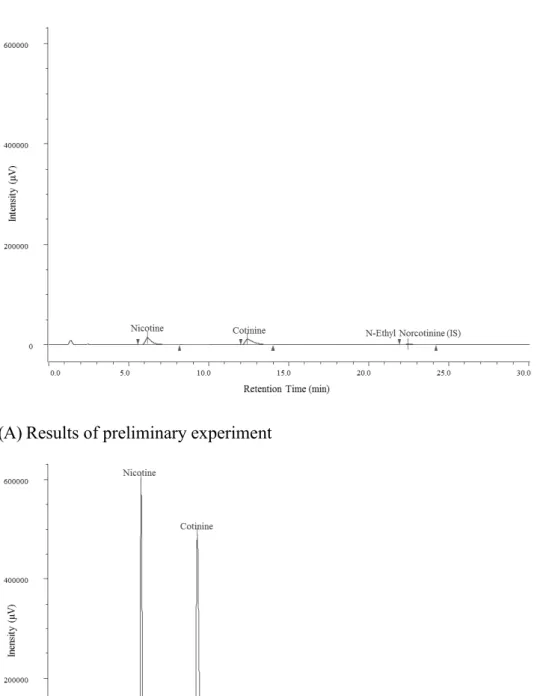
For measurement of nicotine and cotinine in hair samples, I used the HPLC/UV with column-switching method. The HPLC/UV with column-switching method was shown have better sensitivity when compared with preliminary experiments (Figure 2). Nicotine and cotinine levels measured by the column-switching method were 12.9 times and 16.9 times greater, respectively, then that of the preliminary experiment. The area of the NENC peak measured by the column-switching method was shown to be 12.2 times that of the preliminary experiment. In addition, measurement time was shortened to around 8 min by the HPLC/UV
10
without column-switching method.
Intra- and inter-assay reproducibility was stable (Table 1). Results for intra-assay assessment were 92.2±2.7 ng/mg for nicotine and 10.3±0.2 ng/mg for cotinine (Table 1 (A)).
Results for inter-assay assessment were 87.0±2.8 ng/mg for nicotine and 10.4±0.3 ng/mg for cotinine (Table 1 (B)).
Screening nicotine and cotinine in hair by HPLC/UV with column-switching method
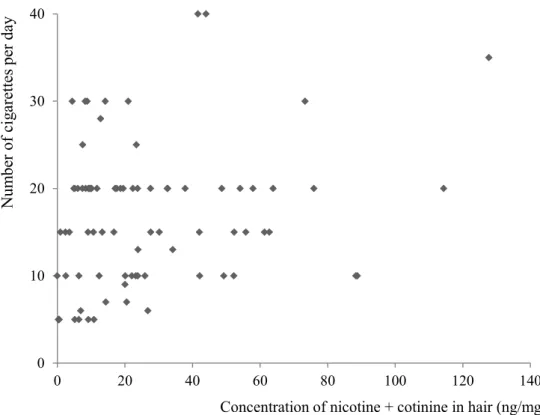
Among 287 hair sample providers, 205 were non-smokers and 82 were smokers. The sum total nicotine and cotinine in hair and the number of cigarettes smoked per day were significantly correlated in smokers (Figure 3; r= 0.228, p= 0.040).
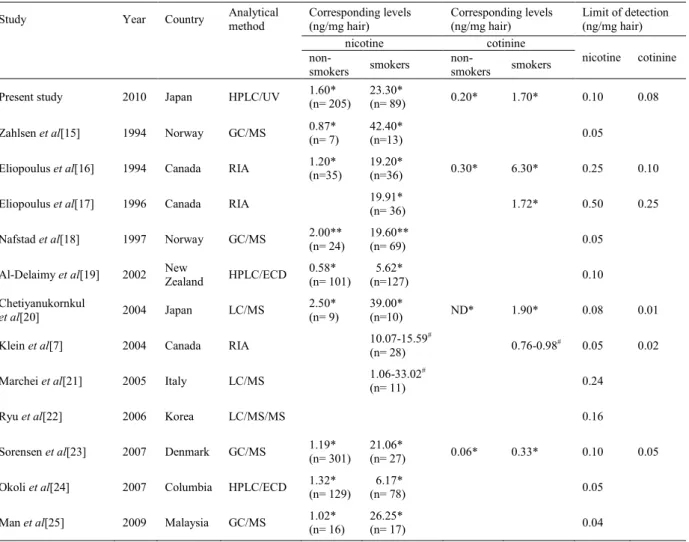
The HPLC/UV method used in my study showed a similar sensitivity and detection limit as previous studies for both nicotine and cotinine (Table 2). In my 2 groups, the mean level of nicotine and cotinine in hair samples was 1.60 ng/mg and 0.20 ng/mg among non-smokers, 23.30 ng/mg and 1.70 ng/mg among smokers, respectively. Non-smokers in previous studies showed a range of 0.58-2.50 ng/mg nicotine and ND-0.30 ng/mg cotinine in hair samples.
Meanwhile, smokers in previous studies showed a range of 6.17-42.40 ng/mg nicotine and 0.33-6.30 ng/mg cotinine in hair samples.
Using an S (signal)/N (noise) ratio of 3:1, the detection limit for nicotine was about 0.10 ng/mg and that for cotinine was about 0.08 ng/mg in hair samples using my method. The ranges for nicotine data obtained by other analytical methods were 0.05-0.50 ng/mg. My results were within these ranges.
Cost comparison by analytical method
The HPLC/UV method has a relatively low cost when compared to other analytical methods (Table 3). The HPLC/UV method was categorized as “Low” for both initial and running costs. The initial and running costs for HPLC/UV used in the present study were about US$25,000 and about US$2,500/year, respectively. The GC/MS method, used as a major
11
analytical method, has both “High” initial and running costs.
Discussion:
In the present study, I established a new method using HPLC/UV with column-switching method that has lower costs with similar sensitivity as other analytical methods in order to determine nicotine and cotinine levels in hair samples. My results suggest that my method allows high sensitivity with good reproducibility to study the effects of long-term exposure to smoking.
This study examined HPLC/UV with column-switching method for higher sensitivity measurement of nicotine and cotinine in hair. In the column-switching method, a large amount of sample solution is added to the concentration column, and trace components are first trapped. The flow path is then reversed, followed by processing with an appropriate amount of liquid solvent and measurement using an analytical column.
Therefore, I was able to concentrate the samples and reduce analysis time. Using the column-switching method, it was possible to measure larger amounts and to increase nicotine and cotinine sensitivity detection by 10 fold vs. that in the preliminary experiment. In addition, I investigated the utility of the column-switching method based on intra- and inter-assay reproducibility. It was not difficult to obtain 200 μl of extraction liquid from samples, and I confirmed effective extraction with high sensitivity. This study showed higher sensitivity than previous reports measuring nicotine and cotinine in hair samples, where HPLC/UV was used and showed a detection sensitivity of 0.20 ng/mg hair for nicotine and about 0.10 ng/mg hair for cotinine [26]. Thus, the results demonstrate the utility of the column-switching method.
There was a significant correlation between the number of cigarettes smoked per day and the total amount of nicotine and cotinine in hair samples. In order to avoid metabolic differences from nicotine to cotinine among individuals, I analyzed the total amounts of
12
nicotine and cotinine. The total of nicotine and cotinine in hair may use as a predictive bio-marker of the number of cigarettes smoked per day.
In this study, mean concentrations of nicotine in hair samples were 1.60 ng/mg for non-smokers and 23.30 ng/mg for smokers. Concentrations of cotinine in hair samples were 0.20 ng/mg for non-smokers and 1.70 ng/mg for smokers. The detection limit was 0.10 ng/mg nicotine and 0.08 ng/mg cotinine in hair samples. When compared with previous studies, my method was within the same range of accuracy as other measurement methods for nicotine and cotinine in hair. Therefore, the HPLC/UV with column-switching method appears to have similar sensitivity as the GC/MS and HPLC/ECD methods. The MS method is known to be highly sensitive in identifying materials by mass, but the HPLC/UV method has been shown to be just as sensitive. I believe that the columns and detection devices in the HPLC/UV method have been thoroughly tested [26-28], and by introducing the simple improvement of the column-switching method to the HPLC/UV method, it is possible to markedly increase sensitivity.
This study found that both the initial and running costs of the present method are
“Low,” suggesting that experiments can be performed with this method for less than US$53,000 per year. The GC/MS method, a major analytical method used for nicotine and cotinine measurement, was shown to cost over US$105,000 per year. Measurement with HPLC/UV method is therefore able to reduce cost by half when compared with the GC/MS method. In addition, because HPLC and UV detectors are already used widely [10,11], it is possible to reduce the initial costs. It is also possible to introduce a column-selection unit at the low cost of about US$3,000, reducing the total cost of this study to around US$27,500. The present HPLC/UV with column-switching method had a sensitivity similar to that of the GC/MS method, as well as a low cost. Based on its accuracy and cost, I believe that measurement of nicotine and cotinine in hair samples using this HPLC/UV method would be
13
useful in initial screening, such as in health check-ups. The HPLC/UV with column-switching method is able to perform such screening at low cost and with the same accuracy as other analytical methods, thereby facilitating the study of the effects of smoking exposure.
This study had several limitations. Because smokers of self-reported their cigarette intake, results may have been underestimated. However, because the questionnaire used in this study was answered during home visiting interviews, I assume the subjects answered honestly. In the future, a comparison between the HPLC/UV with column-switching method and other analytical methods will be necessary using the same samples.
In this study, I established a simple HPLC/UV with column-switching method for the determination of nicotine and cotinine in hair samples. Using this method, the nicotine and cotinine in hair were found to accurately reflect exposure to smoking. The HPLC/UV with column-switching method is able to detect nicotine and cotinine in hair with an equivalent sensitivity as GC/MS or HPLC/ECD, but at about the half cost of the GC/MS method.
Therefore, the HPLC/UV with column-switching method could be more widely applied, particularly for use in screening surveys, in order to better understand the effects of smoking exposure.
14
References:
[1] The examination organization about smoking and health problems. (2002) Smoking and health.
Hokendohjinsha Inc., Tokyo.
[2] Whincup PH, Gilg JA, Emberson JR, Jarvis MJ, Feyerabend C, Bryant A, Walker M, Cook DG. (2004) Passive smoking and risk of coronary heart disease and stroke: prospective study with cotinine measurement. British Medical Journal, 329, 200-205.
doi:10.1136/bmj.38146.427188.55
[3] Higashi E, Sashikuma F, Itani S, Muranaka H. (1986) Simultaneous determination of nicotine and cotinine in urine by gas liquid chromatography. Eisei Kagaku, 32, 276-280.
doi:10.1248/jhs1956.32.276
[4] Yamamoto M, Shibata Y, Mugikura M, Igarashi T, Satoh K. (2000) Usefulness of urinary cotinine measurement in determining individual smoking status. Journal of Transportation Medicine, 54, 142-146.
[5] Heinrich J, Holscher B, Seiwert M, Carty CL, Merkel G, Schulz C. (2005) Nicotine and cotinine in adults' urine: The German Environmental Survey 1998. Journal of Exposure Analysis and Environmental Epidemiology, 15, 74-80. doi:10.1038/sj.jea.7500373
[6] Al-Delaimy WK. (2002) Hair as a biomarker for exposure to tobacco smoke. Tobacco Control, 11, 176-182. doi:10.1136/tc.11.3.176
[7] Klein J, Blanchette P, Koren G. (2004) Assessing nicotine metabolism in pregnancy: a novel approach using hair analysis. Forensic Science International, 145, 191-194.
doi:10.1016/j.forsciint.2004.04.035
[8] Sporkert F, Pragst F. (2000) Use of headspace solid-phase microextraction (HP-SPME) in hair analysis for organic compounds. Forensic Science International, 107, 129-148.
doi:10.1016/S0379-0738(99)00158-9
[9] Kim SR, Wipfil H, Avila-Tang E, Samet JM, Breysse PN. (2009) Method validation for
15
measurement of hair nicotine level in nonsmokers. Biomedical Chromatography, 23, 273-279.
doi:10.1002/bmc.1110
[10] Ono T, Tanida K, Shibata H, Konishi H, Shimakawa H. (1986) High-performance liquid chromatographic determination of 6β-hydroxycortisol in urine. Chemical and pharmaceutical bulletin, 34, 2522-2527. doi:10.1248/cpb.34.2522
[11] Zdarova KJ, Novotny L, Antos K, Zivna H, Kuca K. (2010) Time-dependent changes in concentration of two clinically used acetylcholinesterase reactivators (HI-6 and obidoxime) in rat plasma determined by HPLC techniques after in vivo administration.
Analytical Sciences, 26, 63-67. doi:10.2116/analsci.26.63
[12] Nakamura H. (2003) The handbook to preprocess an analysis samples. Maruzen, Tokyo.
[13] Mizuno A, Uematsu T, Oshima A, Nakamura M, Nakashima M. (1993) Analysis of nicotine content of hair for assessing individual cigarette-smoking behavior. Therapeutic Drug Monitoring, 15, 99-104. doi:10.1097/00007691-199304000-00005
[14] Benowitz NL. (1996) Cotinine as a biomarker of environmental tobacco smoke exposure.
Epidemiologic Reviews, 18, 188-204. doi:10.1093/oxfordjournals.epirev.a017925
[15] Zahlsen K, Nilsen OG. (1994) Nicotine in hair of smokers and non-smokers: sampling procedure and gas chromatographic/mass spectrometric analysis. Pharmacology and Toxicology, 75, 143-149.
doi:10.1111/j.1600-0773.1994.tb00337.x
[16] Eliopoulos C, Klein J, Phan MK, Knie B, Greenwald M, Chitayat D, Koren G. (1994) Hair concentrations of nicotine and cotinine in woman and their newborn infants. Journal of the American Medical Association, 271, 621-623. doi:10.1001/jama.1994.03510320061031 [17] Eliopoulos C, Klein J, Koren G. (1996) Validation of self-reported smoking by analysis of hair
for nicotine and cotinine. Therapeutic Drug Monitoring, 18, 532-536.
doi:10.1097/00007691-199610000-00002
16
[18] Nafstad P, Jaakkola JJK, Hagen JA, Zahlsen K, Magnus P. (1997) Hair nicotine concentrations in mothers and children in relation to parental smoking. Journal of Exposure Analysis and Environmental Epidemiology, 7, 235-239.
[19] Al-Delaimy WK, Crane J, Woodward A. (2002) Is the hair nicotine level a more accurate biomarker of environmental tobacco smoke exposure than urine cotinine? Journal of Epidemiology and Community Health, 56, 66-71. doi:10.1136/jech.56.1.66
[20] Chetiyanukornkul T, Toriba A, Kizu R, Kimura K, Hayakawa K. (1996) Hair analysis of nicotine and cotinine for evaluating tobacco smoke exposure by liquid chromatography-mass spectrometry. Biomedical Chromatography, 18, 655-661. doi:10.1002/bmc.369
[21] Marchei E, Durgbanshi A, Rossi S, Garcia-Algar O, Zuccaro P., Pichini S. (2005) Determination of arecoline (areca nut alkaloid) and nicotine in hair by high-performance liquid chromatography/electrospray quadrupole mass spectrometry. Rapid Communications in Mass Spectrometry, 19, 3416-3418. doi:10.1002/rcm.2183
[22] Ryu HJ, Seong MW, Nam MH, Kong SY, Lee DH. (2006) Simultaneous and sensitive measurement of nicotine and cotinine in small amounts of human hair using liquid chromatography/tandem mass spectrometry. Rapid Communications in Mass Spectrometry, 20, 2781-2782. doi:10.1002/rcm.2659
[23] Sorensen M, Bisgaard H, Stage M, Loft S. (2007) Biomarkers of exposure to environmental tobacco smoke in infants. Biomarkers, 12, 38-46. doi:10.1080/13547500600943148
[24] Okoli CT, Hall LA, Rayens MK, Hahn EJ. (2007) Measuring tobacco smoke exposure among smoking and nonsmoking bar and restaurant workers. Biological Research for Nursing, 9, 81-89. doi:10.1177/1099800407300852
[25] Man CN, Ismail S, Harn GL, Lajis R, Awang R. (2009) Determination of hair nicotine by gas chromatography-mass spectrometry. Journal of Chromatography B, 877, 339-342.
doi:10.1016/j.jchromb.2008.12.014
17
[26] Pichini S, Altieri I, Pellegrini M, Pacifici R, Zuccaro P. (1997) Hair analysis for nicotine and cotinine: evaluation of extraction procedures, hair treatments, and development of reference material. Forensic Science International, 84, 243-252. doi:10.1016/S0379-0738(96)02068-3 [27] Pacifici R, Pichini S, Altieri I, Rosa M, Bacosi A, Caronna A, Zuccaro P. (1993) Determination of nicotine and two major metabolites in serum by solid-phase extraction and high-performance liquid chromatography, and high-performance liquid chromatography-particle beam mass spectrometry. Journal of Chromatography B, 612, 209-213. doi:10.1016/0378-4347(93)80165-Z
[28] Pichini S, Altieri I, Pellegrini M, Pacifici R, Zuccaro P. (1997) The analysis of nicotine in infants' hair for measuring exposure to environmental tobacco smoke. Forensic Science International, 84, 253-258. doi:10.1016/S0379-0738(96)02069-5
18
Figure legends:
Figure 1. Hair sampling method
1. Peel off the liner of the pressure-sensitive adhesive double-coated tape on the paper.
2. Hold down section of hair by hand.
3. Apply the edge of the paper tape-side down to the scalp.
4. Press tape-side firmly onto the hair.
5. Hold up the paper and with hair-cutting scissors, and cut along the red line.
6. Place the hair sample and attached paper into the plastic bag.
Note: Repeat procedure a second time
Figure 2. Chromatograms of standard nicotine and cotinine solutions (A) Results of preliminary experiment
(B) Results using column-switching method
Notes: (B) shows results from the measurement method in the preliminary experiment added to those from the column-switching method; IS: internal standard
Figure 3. Correlation between concentration of nicotine + cotinine in hair and number of cigarettes smoked per day; r= 0.228, p= 0.040
19
Figures and tables:
Figure 1. Hair sampling method
20
(A) Results of preliminary experiment
(B) Results using column-switching method
Figure 2. Chromatograms of Standard Nicotine and Cotinine Solutions
Notes: (B) shows results from the measurement method in the preliminary experiment added to those from the column-switching method; IS: internal standard
21
Figure 3. Correlation between concentration of nicotine + cotinine in hair and number of cigarettes smoked per day; r= 0.228, p= 0.040
0 10 20 30 40
0 20 40 60 80 100 120 140
Concentration of nicotine + cotinine in hair (ng/mg)
Number of cigarettes per day
22
Table 1. Intra- and inter-assay reproducibility of HPLC/UV with column-switching method (A) Intra-assay
1 hour 2 hours 3 hours 4 hours 5 hours Mean±SD
Nicotine (ng/mg) 92.0 92.9 96.5 97.6 92.0 92.2±2.7
Cotinine (ng/mg) 10.0 10.4 10.4 10.5 10.1 10.3±0.2
(B) Inter-assay
1 day 2 days 3 days 4 days 5 days Mean±SD
Nicotine (ng/mg) 90.6 89.1 85.7 85.9 83.6 87.0±2.8
Cotinine (ng/mg) 10.5 10.8 10.5 10.2 9.9 10.4±0.3
Note: SD, standard deviation
23
Table 2. Summary of present study and previous studies
Study Year Country Analytical
method Corresponding levels
(ng/mg hair) Corresponding levels
(ng/mg hair) Limit of detection (ng/mg hair)
nicotine cotinine
nicotine cotinine non-
smokers smokers non-
smokers smokers Present study 2010 Japan HPLC/UV 1.60*
(n= 205) 23.30*
(n= 89) 0.20* 1.70* 0.10 0.08 Zahlsen et al[15] 1994 Norway GC/MS 0.87*
(n= 7) 42.40*
(n=13) 0.05
Eliopoulus et al[16] 1994 Canada RIA 1.20*
(n=35) 19.20*
(n=36) 0.30* 6.30* 0.25 0.10
Eliopoulus et al[17] 1996 Canada RIA 19.91*
(n= 36) 1.72* 0.50 0.25
Nafstad et al[18] 1997 Norway GC/MS 2.00**
(n= 24) 19.60**
(n= 69) 0.05
Al-Delaimy et al[19] 2002 New Zealand HPLC/ECD 0.58*
(n= 101) 5.62*
(n=127) 0.10
Chetiyanukornkul
et al[20] 2004 Japan LC/MS 2.50*
(n= 9) 39.00*
(n=10) ND* 1.90* 0.08 0.01
Klein et al[7] 2004 Canada RIA 10.07-15.59#
(n= 28) 0.76-0.98# 0.05 0.02
Marchei et al[21] 2005 Italy LC/MS 1.06-33.02#
(n= 11) 0.24
Ryu et al[22] 2006 Korea LC/MS/MS 0.16
Sorensen et al[23] 2007 Denmark GC/MS 1.19*
(n= 301) 21.06*
(n= 27) 0.06* 0.33* 0.10 0.05 Okoli et al[24] 2007 Columbia HPLC/ECD 1.32*
(n= 129) 6.17*
(n= 78) 0.05
Man et al[25] 2009 Malaysia GC/MS 1.02*
(n= 16) 26.25*
(n= 17) 0.04
Notes: ND, no detection; HPLC/UV, high performance liquid chromatography with ultra violet; GC/MS, gas chromatography with mass spectrophotometry; RIA, radioimmunoassay;
HPLC/ECD, high performance liquid chromatography with electro chemical detection; LC/MS, high performance liquid chromatography with mass spectrophotometry; LC/MS/MS, high performance liquid chromatography with tandem mass spectrophotometry.
*: Mean, **: Median; #: Range
24
Table 3. Cost comparison by analytical method
Analytical method Initial cost Running cost
HPLC/UV Low Low
HPLC/ECD Moderate Low
LC/MS High Moderate
GC/MS High High
RIA High Moderate
LC/MS/MS Extremely high Moderate
GC/MS/MS Extremely high High
Notes: HPLC/UV, high-performance liquid chromatography with ultraviolet; HPLC/ECD, high performance liquid chromatography with electrochemical detection; LC/MS, high performance liquid chromatography with mass spectrophotometry; GC/MS, gas chromatography with mass spectrophotometry; RIA, radioimmunoassay; LC/MS/MS, high performance liquid chromatography with tandem mass spectrophotometry; GC/MS/MS, gas chromatography with tandem mass spectrophotometry.
Cost categories: US$1= 100 yen; Initial costs: Low= under US$50,000, Moderate= US$50,000
~ US$100,000, High= US$100,000 ~ US$200,000, Extremely high= over US$200,000;
Running costs: Low= under US$3,000/year, Moderate= US$3,000 ~ US$5,000/year, High=
over US$5,000/year.
25
[Chapter 2]
Determination of a hair nicotine cut-off value
to distinguish smokers from non-smokers in general male adults
26
Abstract:
Biological monitoring of exposure to tobacco smoke is an important method for helping to reduce smoking. In this study, nicotine and cotinine in hair collected from a sample of the general population were measured by HPLC/UV with the column-switching method. This study aimed to assess smoking status in hair samples using this method and to examine the usefulness of it as a screening test for smoking using receiver operating characteristic (ROC) analysis. Subjects were 192 men, who were chosen in 2009 and 2010 by 1-cluster random sampling from the population of Japan and agreed to have hair samples taken. Nicotine and cotinine levels in hair were measured by HPLC/UV with the column-switching method. I performed statistical analyses (t tests, chi-square tests and logistic regression analysis) for each questionnaire item among smokers and non-smokers. Additionally, the usefulness of the tests was calculated based on the area under the ROC curves. Among 192 subjects, 69 were smokers and 123 were non-smokers. The concentrations of nicotine and cotinine in hair were significantly higher in smokers than in non-smokers (p < 0.01). Results of ROC analysis showed that the area under the curve (AUC) for nicotine was 0.92 (95% Confidence Interval, 0.88-0.96). A hair nicotine cut-off value of 5.68 ng/mg, corresponding to a sensitivity of 94.2% and specificity of 87.0%, was found to be the optimal cut-off value separating smokers from non-smokers. I found that nicotine and cotinine levels in hair clearly distinguished smokers from non-smokers, measured by HPLC/UV with the column-switching method. Also, the optimal cut-off value for adult Japanese men (5.68 ng/mg) separated smokers from non-smokers. It is suggested that this simple analytical method of measuring nicotine in hair can be used to screen for smoking.
Keywords: HPLC/UV; Column-switching method; Nicotine; Cut-off value; ROC; Screening test
27
Introduction:
Smoking is a high priority issue for public health, and is recognized widely as a preventable risk factor for death [1,2], cancer and cardiovascular disease [3,4]. By distinguishing smoking from non-smoking in a general population, I can support smoking cessation for smokers at an early stage. In addition, it is possible to prevent exposure to passive smoking for non-smokers by early screening. In order to distinguish smokers from non-smokers in the general population, the biological monitoring of smoking exposure is important.
Previous studies have reported that nicotine and/or cotinine in hair can be measured in the blood, urine and saliva of smokers [5-7]. However, the amounts of nicotine and cotinine in these samples may reflect acute exposure to smoking, not habitual smoking. Because hair in humans is stable for a long time, it has been suggested that it may be useful for biological monitoring in the medium or long term [8,9]. The measurement of nicotine and cotinine in hair is usually done using gas chromatography with mass spectrophotometry (GC/MS) or high-performance liquid chromatography with mass spectrophotometry (HPLC/MS). However, these methods are performed only in special laboratories because of their expense [10-12]. I established a method of high-performance liquid chromatography with ultra violet (HPLC/UV) with the column-switching method to measure nicotine and cotinine in hair [13]. Its advantages are its simplicity and low cost, and its similar sensitivity to GC/MS and HPLC/MS.
This study aimed to assess the smoking status by measuring nicotine and cotinine in hair of a sample of the general population in Japan by HPLC/UV with the column-switching method.
In addition, this study examined the usefulness of this method as a screening test for smokers using Receiver Operating Characteristics (ROC) analysis.
28
Materials and methods:
Subjects
The subjects were 2000 adult men who were chosen in 2009 and 2010 based on government Basic Resident Registries using 1-cluster random sampling from all over Japan. A questionnaire about smoking status was administered and hair samples were taken from subjects during home visits. Questionnaires were anonymous to protect private information, and informed consent was obtained from each subject. Completed questionnaires were collected from 1355 people in 2009 and 2010. Hair samples were collected from 210 people (collection rate, 15.5%).
One hundred and ninety two samples were used for analysis due to missing data in 18 samples because of gray hair, dyed hair and insufficient amount. Smokers were identified as subjects who answered “Yes” or “Sometimes” to the question, “Do you smoke tobacco presently?” whereas non-smokers were identified as subjects who answered “No” to the above question or “No” to the question, "Have you ever smoked tobacco?" Among 192 subjects, 69 were smokers and 123 were non-smokers.
Questionnaire items
The questionnaire included items about age, height, weight, education, occupation and annual income. Questionnaire items related to health were about past history of cardiovascular disease, knowledge of smoking-related risks and drinking history. Body mass index (BMI) was calculated from height and weight (kg/m2). Education was determined by total education since elementary school. Occupation was categorized into five groups: office work, specialist work (e.g., doctor, teacher, hairdresser), technical work (e.g., construction, agriculture), unemployed (including student) and other. Annual income was categorized into five groups: under 3 million yen, 3-6 million yen, over 6 million yen, no income and unknown. Past history of cardiovascular disease included subjects who had been diagnosed with hypertension, angina or other heart disease in the past year. Knowledge of smoking-related risks were categorized as responses of “Yes,” “No” or
29
“Unknown” to the question, “Do you think that smoking causes serious disease?” Drinking history was categorized into six groups: everyday, several times a week, several times a month, several times a year, have not had a drink in over a year and never drink. Question items for smokers were about duration of smoking, number of cigarettes per day and abuse of nicotine. The Brinkman Index was calculated from duration of smoking and number of cigarettes per day. Tobacco dependence screener (TDS) score was calculated from abuse of nicotine.
Hair sampling
I developed a hair-cutting kit that collected hair samples by applying tape (15cm × 5 cm) to the scalp [13]. Hair was affixed to the tape and cut at 1 cm from the end of the hair with scissors.
Hair was used from the cut point to a length of 5 cm. Each hair sample taken by the hair-cutting kit was placed in a plastic bag and stored at -80°C in a freezer. Hair samples were collected in 2009 and 2010.
Preparation of nicotine and cotinine in hair
Hair samples were placed in test tubes and washed three times using 3 ml of dichloromethane. After the hair sample was dried, it weighed 25-50 mg. Samples were mixed with 1.6 ml of NaOH (2.5 M) and 60 μl of N-ethyl norcotinine (1000 ng/ml; Cosmo Bio, Tokyo, Japan) as an internal standard, followed by incubation at 40°C until the hair was completely dissolved.
Next, 4 ml of solvent mixture (chloroform:isopropyl alcohol = 95:5 (v/v)) was added and the mixture was vortexed for 2 min. The mixture was then centrifuged for 5 min at 2000 rpm, and the supernatant was aspirated under a fume hood. Next, 2 ml of HCl (0.5 M) was added, followed by vortexing for 2 minutes. The mixture was centrifuged for 5 min at 2000 rpm, and the supernatant was transferred to another test tube. Next, 0.4 ml of NaOH (2.5 M) was then added to the test tube.
In addition, 1.6 ml of ammonium chloride (pH 9.5) and 4 ml of solvent mixture (chloroform:isopropyl alcohol = 95:5 (v/v)) also was added to the test tube, followed by vortexing for 2 minutes. The mixture was centrifuged for 5 min at 2000 rpm, and the supernatant was
30
discarded and dried under a nitrogen stream. The extract was dissolved with 600 μl of ammonium formate (0.5 M), centrifuged for 1 min at 2000 rpm and filtered with a 0.45-μm filter. Solvent (200 μl) was then injected into the HPLC system and analyzed.
HPLC/UV with column-switching system
This measurement was performed by HPLC/UV with the column-switching method [13].
I used the HPLC LC-2000 Plus Series, the UV-2075 detector set at 260 nm, the column selection unit HV-2080-01 (all from JASCO, Tokyo, Japan). The concentrating column was introduced the Develosil ODS-UG-5 Column (1 cm × 4.0 mm I.D, 5.0 μm particles; Nomura Chemical, Aichi, Japan) and the DP-model 203 pump (Eicom, Kyoto, Japan). The mobile phase of the concentrated column consisted of ammonium formate (50 mM, pH 9.0) with a flow rate of 0.5 ml/min. The analytical column was introduced the Ascentis Express C18 Column (10 cm × 3.0 mm I.D, 2.7 μm particles; Sigma-Aldrich, Tokyo, Japan) with the PU-2089 pump (JASCO). The mobile phase in the analytical column consisted of ammonium formate (50 mM, pH 4.3):acetonitrile = 96:4 at a flow rate of 0.4 ml/min.
Statistical analysis
Mean concentration of nicotine, cotinine and nicotine plus cotinine; age; BMI and education among smokers and non-smokers were assessed using t tests. Occupation, annual income, past history of cardiovascular disease, knowledge of smoking-related risks and drinking history among groups were assessed using chi-square tests. Additionally, logistic regression analysis was performed to examine smoking status on concentration of nicotine and the sum of nicotine plus cotinine; age; past history of cardiovascular disease and knowledge of smoking-related risks. Past history of cardiovascular disease and knowledge of smoking-related risks were calculated by taking the lowest category as the referent. In addition, the areas under ROC curves (AUC) were calculated based on sensitivities and specificities for distinguishing smokers from non-smokers. These statistical analyses were conducted using SPSS statistics
31
17.0 (Nihon IBM, Tokyo, Japan). All probability values were 2-tailed and all confidence intervals (CI) were estimated at 95% levels.
Results:
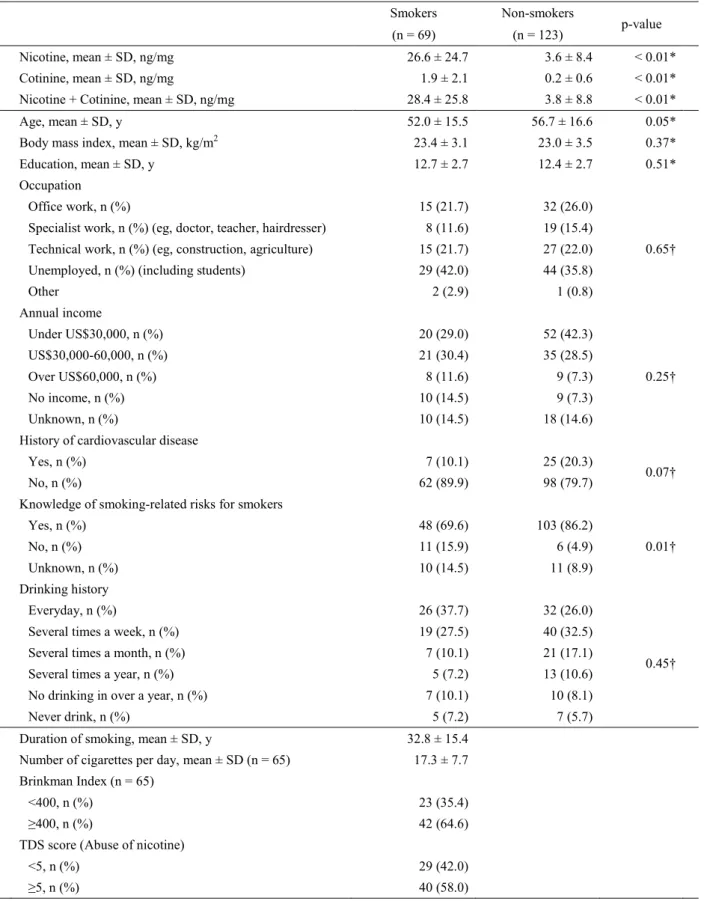
Characteristics of smokers and non-smokers among the general Japanese population The concentrations of nicotine, cotinine and sum of nicotine plus cotinine were significantly higher in smokers compared with non-smokers (Table 1; p < 0.01). The means standard deviation (SD) of nicotine, cotinine and sum of nicotine plus cotinine in hair were 26.6 ± 24.7 ng/mg, 1.9 ± 2.1 ng/mg and 28.4 ± 25.8 ng/mg, respectively, among smokers, and 3.6 ± 8.4 ng/mg, 0.2 ± 0.6 ng/mg and 3.8 ± 8.8 ng/mg, respectively, among non-smokers. There was also a significant difference in knowledge of smoking-related risks (p = 0.01). There was no significant difference for the other items. Among smokers, 42 subjects had a score of 400 on the Brinkman Index (64.6%), and 40 subjects had a TDS score of more than 5 (58.0%). In addition, there was no difference in the distribution of characteristics between the 1355 people who answered the questionnaires and 192 people whose hair was collected.
Analytical results of nicotine and nicotine plus cotinine in hair
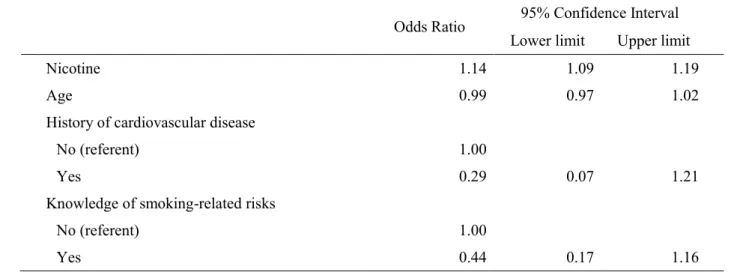
There was a significant difference in the concentration of nicotine and sum of nicotine plus cotinine in hair for smokers by logistic regression analysis (Table 2). Smokers were more likely than non-smokers to accumulate nicotine in hair (Odds Ratio [OR], 1.14; 95% CI, 1.09-1.19), and sum of nicotine plus cotinine in hair (OR, 1.13; 95% CI, 1.09-1.18). There was no significant difference in other variables.
ROC curves of nicotine and nicotine plus cotinine in hair as predictors of smoking
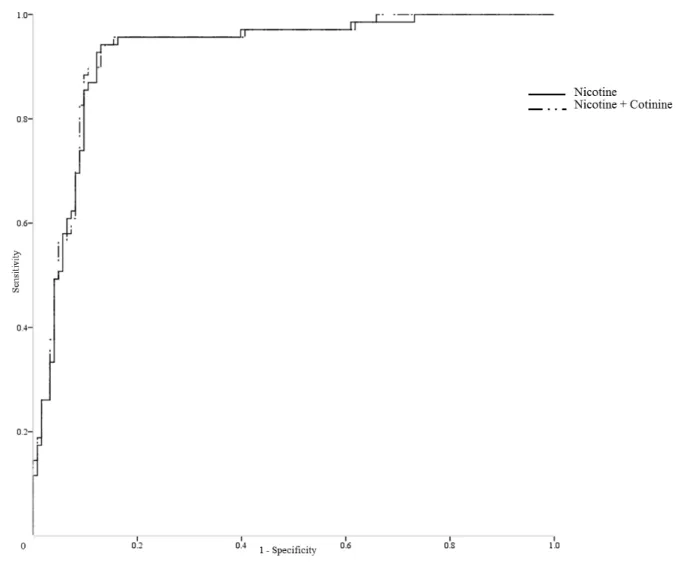
As a result of ROC analysis, the AUC of nicotine and sum of nicotine plus cotinine were 0.92 (95% CI, 0.88-0.96) and 0.93 (95% CI, 0.89-0.97), respectively (Fig. 1). The cut-off level of nicotine and sum of nicotine plus cotinine in hair were 5.68 ng/mg (sensitivity, 94.2%; specificity,
32
87.0%) and 6.39 ng/mg (sensitivity, 92.8%; specificity, 87.0%), respectively. These were found to be the optimal cut-off values to distinguish smokers from non-smokers.
Discussion:
I found that the concentrations of nicotine and/or cotinine in hair measured by HPLC/UV with the column-switching method clearly distinguished smokers from non-smokers.
Additionally, I demonstrated the cut-off value separating smokers from non-smokers in adult men.
My results may contribute to early interventions for quitting smoking and the prevention of passive smoking for non-smokers because it allows differentiation of smokers from non-smokers in the general population. This study supports the notion that nicotine in hair can be used as a screen for long-term exposure for smokers, especially since it is a simple and inexpensive test.
In a previous study, cotinine in blood was used to distinguish smokers from non-smokers [14-16], with a cotinine cut-off value of 13.7 ng/ml [16]. However, the optimal cut-off value for serum cotinine in American smokers has been reported to be 3.08 ng/ml [15], whereas in plasma it is 10.0 ng/m [14]. The cut-off value for cotinine in urine has been reported as 1.22 ng/ml (6.9 μM) among Japanese workers [17], whereas in Polish subjects who were non-smokers it was 50.0 ng/ml [18]. For saliva, the optimal cut-off value for cotinine was shown to be 14.2 ng/ml [16] for men and non-pregnant women and 13.0 ng/ml [19] for pregnant women. The optimal salivary cotinine cut-off value has also been reported to be 7.0 ng/ml among Swiss smokers [20].
Moreover, measurement of exhaled carbon monoxide is also used as a method of separating smokers from non-smokers. This tool is inexpensive and non-invasive, and it is useful for assistance with smoking cessation because it is able to distinguish recent smokers and smokers who have refrained from smoking during the previous 8 hours (cut-off value, 12 ppm) [21,22].
However, it is not suitable as a tool for long-term smoking evaluation because this method
33
cannot evaluate smokers who quit smoking > 8 hours before hair sampling. These subjects belong to the same group as smokers. Therefore, above-referenced cut-off values were greatly different according to the kind of biological sample. In addition, their samples may reflect acute exposure to smoking. I believe that hair is a better biological sample to measure for long-term exposure to smoking.
The liver metabolizes around 80 to 90% of nicotine to cotinine [23]. However, there is a great deal of individual variation. The measurement of nicotine is inaccurate in blood, urine and saliva because the half-life of cotinine is long [24,25], and the percentage of nicotine excreted in urine is about 10% [23]. However, I determined that nicotine was stable in hair because nicotine in hair has a high affinity for melanin and nicotine in hair equals the nicotine absorbed from the lungs [26]. The total concentration of nicotine and cotinine in hair should be checked to assess the amount of smoking. However, it seems that it is possible to use only nicotine as an index for smokers because cotinine loses affinity for melanin and seldom accumulates in hair. In my ROC analysis, I suggest that nicotine in hair is a variable index because the sensitivity and specificity for nicotine plus cotinine for distinguishing smokers from non-smokers was similar to nicotine alone. There are some reports that nicotine concentration in hair stabilizes over the long term and reflects smoking exposure concentration [9,27-30]. Thus, it is found that nicotine in hair has higher detectable concentrations and is more useful than only cotinine or the sum of cotinine and nicotine.
In this study, the concentration of nicotine and/or cotinine in hair clearly distinguished smoking status using the HPLC/UV with column-switching method. The results of logistic regression analysis also demonstrated this. In a previous study, where the concentration of nicotine in hair was measured by HPLC/MS, the mean level of nicotine was 39.0 ng/mg among smokers and 2.5 ng/mg among non-smokers [31] and the corresponding values for cotinine were 1.9 ng/mg among smokers and undetectable among non-smokers [31]. In my results, the mean level of
34
nicotine in hair was 26.6 ng/mg among smokers and 3.6 ng/mg among non-smokers and for cotinine the values were 1.9 ng/mg among smokers and 0.2 ng/mg among non-smokers. When these results were compared, nicotine and/or cotinine in hair had similar levels. The method using mass spectrophotometry is known to have high sensitivity because it identifies a compound by mass. If the mean level of nicotine in hair does not change much from smoking exposure, HPLC/UV with column-switching method has a high detection accuracy compared to HPLC/MS.
Thus, my results indicate that HPLC/UV with column-switching method is a good tool to distinguish smokers from non-smokers. Additionally, HPLC/UV with column-switching method is also convenient because both initial and running cost (US1$ = 100 yen; under US$3,000/year) are cheaper than HPLC/MS [13]. Additionally, if this method is used, an analysis of time-related exposure is also possible.
I could not find any articles that examined the cut-off value of nicotine and/or cotinine in hair by ROC analysis. Thus, the cut-off value in my study may distinguish smoking status using hair in the general adult male Japanese population. The AUC and the cut-off value of nicotine in hair were shown to be 0.92 and 5.68 ng/mg, respectively. The ROC curve of nicotine in hair was convex at the upper left corresponding to a sensitivity of 94.2% and specificity of 87.0%. Thus, it was suggested that nicotine in hair is more suitable for distinguishing smokers from non-smokers compared with total nicotine plus cotinine in hair.
Since my subjects were community-dwelling residents, my study showed that nicotine levels in hair may be a practical way to determine smoking status in the general population.
Research on patients who visit medical offices may have a selection bias [32]. Previous study results indicate that taking action against smoking at the local level is important [33]. Thus, this type of analysis may have significance in clearly distinguishing smoking status in the general population. My methods and cut-off value may be used to screen for long-term exposure among smokers. My results show that it is possible to have early intervention to encourage smoking