Tamami WADA
Abstract
This paper presents a case study that examined some of the differences between teacher-formed and student-selected study/working groups in English classes using cooperative learning at a Japanese university over two semesters from 2014–2015, including heterogeneous groups the teacher formed and homogeneous ones the students self-organized. Using both “The Belief in Cooperation Scale” (Nagahama, Yasunaga, Sekita, & Kouhara, 2009) and free writing comments from a questionnaire given at the end of the second semester, this study compares these two methods of group formation. The aforementioned scale measured three factors:
usefulness of cooperation, individual orientation, and inequity, showing some varying results between the first and second semesters. Some people argue that in using cooperative learning, the formation of groups should not be based on student selection. However, the students in this study showed effective co-working results in both the heterogeneous teacher-formed and homogeneous student-selected groups in each semester.
Introduction
Issues of group formation in cooperative learning demand continuous attention and concern. McCafferty, Jacobs, and DaSilva (2006) point out that the four main criteria for forming groups include (1) student preference, (2) commonality of views or interests such as music or academic discipline, (3) random selection and (4) teacher grouping. Another classification suggested by Kagan (2009) introduces four major types of groups: (1) heterogeneous, (2) random, (3) student-selected and
(4) homogeneous teams. According to Johnson, Johnson, and Holubec (2009), the least desirable way to form groups is to have students select their own groups.
However, students often prefer to select groups in order to have friends as group members. Johnson et al. (2009) as well as Jacobs, Power, and Loh (2002) noted that heterogeneous groups are advantageous due to increased depth of understanding, greater production, and more elaborative thinking. However, Barkley, Cross, and Major (2005) claimed that heterogeneous group members might resist tense of unfamiliar learning environments which might prove detrimental to their study.
On the other hand, homogeneous group members have more in common, which enables them to work together effectively and feel satisfied with cooperative learning, especially when the objective is skill development or when beginning to learn something new (Brookfield and Preskill, 1999). Cooper, Prescott, Cook, Smith, Mueck, and Cuseo, (1990) also noted that similar knowledge and skill levels can enhance the benefits to group members, consequently proving appropriate for language learning. Erikawa (2012) also claimed that how groups are formed affects the success of cooperative learning in English classrooms.
In this study, over a one-year period, students experienced two types of group formation (heterogeneous and homogenous), allowing for the examination of the differences in their respective experiences and success in the classroom. By analyzing the outcomes resulting from this difference in the formation of groups, the present study addressed the following research questions:
1. How will student beliefs concerning cooperation vary in regard to how groups are formed?
2. How will the different group formations affect learner success in the English classroom?
Method
In this study, during compulsory English classes at a Japanese university, the native Japanese teacher introduced students to several principles of cooperative
learning over the course of two semesters. The class in question was a reading class with a set textbook; however, the class was not part of a coordinated program. The aim of the class was to enable students to read English passages and build their vocabulary. Students met once a week for 90 minutes for a total of 15 weeks each semester. Most of the students were part of the college of bioscience and biotechnology, although their majors within the college varied, with three different majors in total. 35 students were enrolled in the class, with all students in their second year; thus, they knew each other from having taken other classes together within their major departments. These conditions were the same in both semesters.
Since the class was not compulsory in the second semester, the number of the students decreased from the first to the second semester, dropping from an enrollment of 35 to 28.
During the first semester, the teacher formed groups heterogeneously based on factors such as academic major, gender, academic ability, cooperative group experience, previous experience in the teacher’s English classes during the past academic year, and friendship. Since there are approximately only 80 students in each department, those 80 students have many opportunities to take the same classes together. Therefore, mixing academic majors was an important factor in forming heterogeneous groups. The gender mix was also highly taken into consideration to improve communication and interaction across genders, as well as to enhance group dynamic (Kagan & Kagan, 2009). The factors of academic ability were considered in order to increase opportunities for peer tutoring and for support within groups. Since a quarter of the students in the first semester had the same teacher the previous year, thus equipping them with knowledge of cooperative learning groups, the level of cooperative group experience was also regarded as an important factor for forming heterogeneous groups. The reason for taking friendships into consideration was to attempt to ensure that group members were unfamiliar with one another.
In the second semester, students were allowed to make their own decisions
about groupings. The purpose of this was not only to examine the effects that the two types of group formation have on individual English learning, but also to have students experience a diversity of relationships via working with peers both well known and unfamiliar, helping to discover which formations prove more effective and which demand more interpersonal effort. Another factor regarding the implementation of the student-selected groups was that 11 out of the 28 students in the second semester were students from classes the previous year, which meant they had experienced working in cooperative learning groups. As Johnson, Johnson, &
Holubec (2009) state, “Long-term friends can motivate students to work hard and do their best while holding them accountable for doing so” (p. 67). Each semester, the groups stayed together for 15 weeks. In both the first and second semester, most of the lessons were conducted in the same way. Most of the groups were composed of four members each, with each member assigned a role: facilitator, recorder, manager and cheerleader. The same textbooks were used in both semesters, and most of the structures as well as the flow of each lesson was the same. Each reading chapter progressed similarly, with students completing pre-reading activities together in a group, studying vocabulary individually and with the group, reading aloud and repeating after reading (i.e. shadowing individually and as a group), working on reading comprehension individually and with the group, summarizing in pairs, and taking a chapter test individually with some group help (see Appendix A for the chapter test procedure).
This study takes a quantitative case study approach to investigate the variance in effectiveness between both types of group formation. At the end of the second semester, after the final exam was taken, students were asked to complete a two- page anonymous questionnaire (see Appendix B). The questionnaire was in Japanese so that students could express their feelings more accurately. The questionnaire began with “The Belief in Cooperation Scale” (Nagahama et al.
2009), with questions answered on a five-point Likert Scale, and concluded with a free writing section allowing students to offer comments and opinions. The
questionnaire has 18 questions, which measured the three factors of usefulness of cooperation, individual orientation, and inequity within the groups.
The data collected was analyzed using Excel so that all the items could be compared between teacher-formed groups and student-selected groups. The total of 27 students submitted the questionnaire, with one student not completing the questionnaire. This student only answered about the second semester.
Results
Research Question 1: How will student beliefs concerning cooperation vary in regards to how groups are formed?
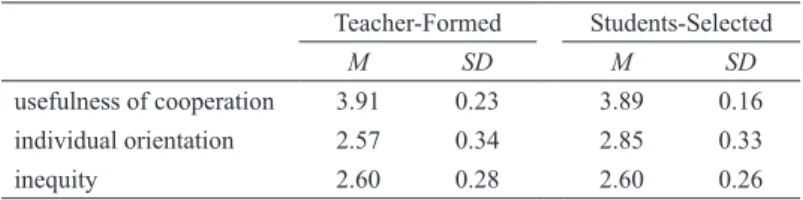
As indicated in Table 1, students tended to score the usefulness of cooperation a little higher in teacher-formed groups as compared to student-selected groups, but for individual orientation student-selected groups showed slightly higher results than teacher-formed groups. There was no difference for inequity scores between the two group formations, nor were there any significant differences in factor scores overall.
Table 1. Mean Values for Three Factors Comparing Teacher- and Student-Formed Groups
Teacher-Formed Students-Selected
M SD M SD
usefulness of cooperation 3.91 0.23 3.89 0.16
individual orientation 2.57 0.34 2.85 0.33
inequity 2.60 0.28 2.60 0.26
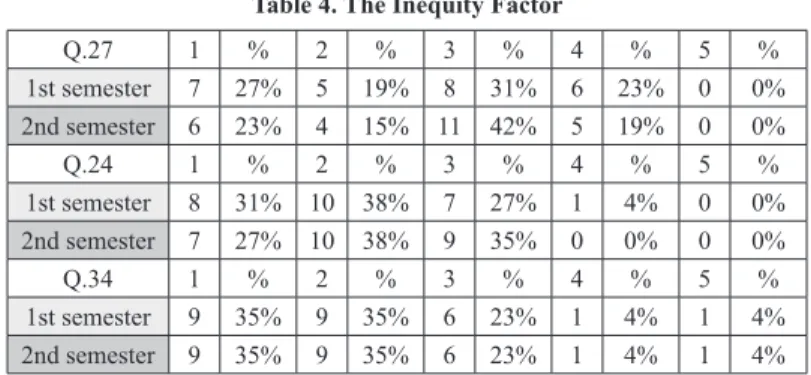
Comparing these results with a previous study (Nagahama et al. 2009), the factors of usefulness of cooperation and individual orientation were precisely similar. However, while the inequity results in Nagahama’s study were less than 2.0, this study showed inequity at more than 2.20. The reason for this will be discussed when looking at question 34 from the questionnaire (see Table 4).
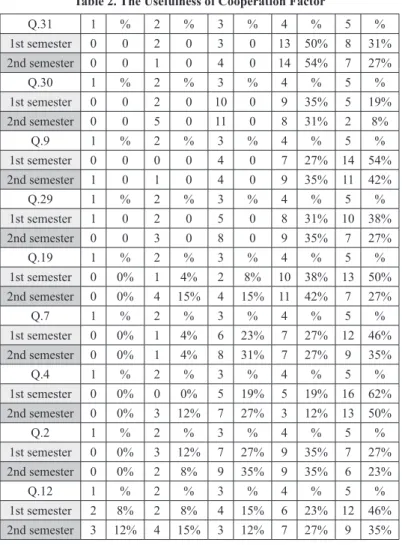
In relation to usefulness of cooperation, questions 31, 4, and 12 (see Table 2) received positive responses in both semesters. These questions were concerned with their grades and in class results (see Table 2).
Table 2. The Usefulness of Cooperation Factor
Q.31 1 % 2 % 3 % 4 % 5 %
1st semester 0 0 2 0 3 0 13 50% 8 31%
2nd semester 0 0 1 0 4 0 14 54% 7 27%
Q.30 1 % 2 % 3 % 4 % 5 %
1st semester 0 0 2 0 10 0 9 35% 5 19%
2nd semester 0 0 5 0 11 0 8 31% 2 8%
Q.9 1 % 2 % 3 % 4 % 5 %
1st semester 0 0 0 0 4 0 7 27% 14 54%
2nd semester 1 0 1 0 4 0 9 35% 11 42%
Q.29 1 % 2 % 3 % 4 % 5 %
1st semester 1 0 2 0 5 0 8 31% 10 38%
2nd semester 0 0 3 0 8 0 9 35% 7 27%
Q.19 1 % 2 % 3 % 4 % 5 %
1st semester 0 0% 1 4% 2 8% 10 38% 13 50%
2nd semester 0 0% 4 15% 4 15% 11 42% 7 27%
Q.7 1 % 2 % 3 % 4 % 5 %
1st semester 0 0% 1 4% 6 23% 7 27% 12 46%
2nd semester 0 0% 1 4% 8 31% 7 27% 9 35%
Q.4 1 % 2 % 3 % 4 % 5 %
1st semester 0 0% 0 0% 5 19% 5 19% 16 62%
2nd semester 0 0% 3 12% 7 27% 3 12% 13 50%
Q.2 1 % 2 % 3 % 4 % 5 %
1st semester 0 0% 3 12% 7 27% 9 35% 7 27%
2nd semester 0 0% 2 8% 9 35% 9 35% 6 23%
Q.12 1 % 2 % 3 % 4 % 5 %
1st semester 2 8% 2 8% 4 15% 6 23% 12 46%
2nd semester 3 12% 4 15% 3 12% 7 27% 9 35%
Question 9 proved another question regarding usefulness of cooperation that did not receive many negative responses: “It is productive to share opinions with
others.” Conversely, question 30 (“High achievers can get even better grades by cooperating with others”), which was another question related to grades, did not appeal to these students. This could be due to the positive relationship among classmates, where students may not have seemed to sense a hierarchy of values. As for class grading, group grades were not directly counted as part of individual grades. Grades relating to quizzes and pre-reading/post-reading activities were shared within the group and, often, students liked to compare their results with other groups in a competitive yet supportive way.
According to McCafferty et al. (2006), the importance of mutual recognition, understanding, and valuing individuals exists among students, and question 29 demonstrated students’ unprejudiced feelings toward different identities, which is essential to live in a diverse society (see Table 2).
Table 3. The Individual Orientation Factor
Q.6 1 % 2 % 3 % 4 % 5 %
1st semester 9 35% 5 19% 6 23% 3 12% 3 12%
2nd semester 9 35% 7 27% 7 27% 2 8% 1 4%
Q. 1 1 % 2 % 3 % 4 % 5 %
1st semester 5 19% 6 23% 4 15% 8 31% 3 12%
2nd semester 4 15% 6 23% 7 27% 7 27% 2 8%
Q.25 1 % 2 % 3 % 4 % 5 %
1st semester 9 35% 5 19% 6 23% 4 15% 2 8%
2nd semester 8 31% 7 27% 5 19% 5 19% 1 4%
Q.21 1 % 2 % 3 % 4 % 5 %
1st semester 12 46% 4 15% 5 19% 5 19% 0 0%
2nd semester 12 46% 1 4% 8 31% 4 15% 0 0%
Q.18 1 % 2 % 3 % 4 % 5 %
1st semester 4 15% 7 27% 5 19% 7 27% 3 12%
2nd semester 3 12% 6 23% 5 19% 10 38% 2 8%
Q.5 1 % 2 % 3 % 4 % 5 %
1st semester 4 15% 4 15% 7 27% 11 42% 0 0%
2nd semester 1 4% 2 8% 12 46% 7 27% 4 15%
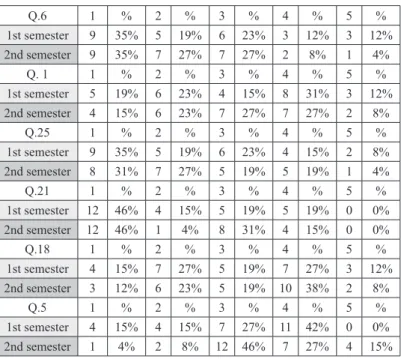
Question 21, asking whether or not students like being told what to do, had an exceptional result (see Table 3). Almost half of the students were not fond of being told what to do in both semesters. This could indicate they felt comfortable participating in lessons structured by the teacher. This could also be because the lessons were based on theories of cooperative learning.
Table 4. The Inequity Factor
Q.27 1 % 2 % 3 % 4 % 5 %
1st semester 7 27% 5 19% 8 31% 6 23% 0 0%
2nd semester 6 23% 4 15% 11 42% 5 19% 0 0%
Q.24 1 % 2 % 3 % 4 % 5 %
1st semester 8 31% 10 38% 7 27% 1 4% 0 0%
2nd semester 7 27% 10 38% 9 35% 0 0% 0 0%
Q.34 1 % 2 % 3 % 4 % 5 %
1st semester 9 35% 9 35% 6 23% 1 4% 1 4%
2nd semester 9 35% 9 35% 6 23% 1 4% 1 4%
All questions concerning the inequity factor showed the advantages of cooperation for both high achievers and those who struggle working by themselves.
For question 34, all responses were the same for both the first and second semester.
This could indicate that students seemed to have enjoyed the learning environment and rapport between co-learners and the teacher in the classroom.
Research Question 2: How will the different group formations affect learner success in the English classroom?
Judging from the student comments, one could say that students work more responsibly among unknown group members with some positive pressure or tense feelings within teacher-formed groups. In contrast, students can benefit from the more friendly and safer atmosphere within student-selected groups to discuss matters freely without much anxiety. Such a comfortable interpersonal atmosphere should be considered in the language classroom where a primary goal is creating a
productive learning environment for students.
The following are representative of student comments.
Teacher-Formed Groups
– I felt that I had to meet my obligation more in the first semester.
– We cooperated much more in the first semester.
– I studied more seriously in the first semester. It’s inspiring to make friends or talk with those who I didn’t know before.
– In the first semester, I made an effort to talk to group members, which brought excitement.
– In the first semester, a sort of pressure enabled me to concentrate on the lesson.
– I felt more responsible in the first semester. I had anxiety that I might ruin our members’ work unless I worked very hard. That’s why I studied autonomously.
– I felt more anxiety in the first semester.
– In the first semester, I tended to rely on other members.
– In the first semester, I didn’t want to be humiliated by my group members, so I tried to work hard. However, it was difficult to communicate with them and our group work didn’t go very well.
– In the first semester, I was concerned about other members and tried to study on my own. The good point in the first semester was that I got to make new friends.
– I was glad to make new friends with unknown students in the first semester.
– When I didn’t know any group members in the first semester, I was concerned about that so I tried hard to an active role in talking with them.
– The study environment was better in the first semester, so we were able to communicate better.
– In the first semester I felt uncomfortable because I had to be concerned about the other members. However, each member did his homework in the first
semester and studied harder.
– I tried not to cause trouble to others and tried to cooperate in the first semester.
– In the first semester I didn’t enjoy the lessons with students I didn’t know, but the good thing was that I didn’t cut corners because I felt more responsible.
Student-Selected Groups
– My friends relied on me in the second semester, so I tried to help them but I didn’t think it was good for them.
– We talked more in the second semester since we all knew each other.
– Through these two semesters, I now definitely believe group activities work well with unknown members.
– There was no big difference. I think it all depends on each individual’s motivation.
– In the second semester, I relied on group members and felt free from anxiety, but I didn’t feel much responsibility.
– I felt much more comfortable in the second semester.
– In the second semester, it was easy to talk to others and ask each other questions, and our group work went well. However, I felt unmotivated because I was able to rely on other members’ work.
– In the second semester, I was able to say whatever I wanted to say, but I spent some time just talking.
– I felt relaxed among friends in the second semester. It was easy to ask them about things and to cooperate.
– I felt relaxed in the second semester because I knew all the members and I didn’t have to be concerned about them. (two students)
– I cut corners in the second semester because we knew each other well, which means my group members knew my English ability was lower than theirs, and that I am not studious.
– In the second semester I caused more trouble, but I could give my opinion
more often.
– I felt relaxed in the second semester because I knew all my group members.
– I felt more relaxed not being forced to study in the second semester.
The following keywords were collected from all of the student comments and classified as either positive or negative.
Teacher-Formed Groups
Positive: Cooperate, autonomously, spontaneously, willingly, pressure or tense feeling, responsibility, concerned about, getting to know new people or friends
Negative: Anxiety, unknown people, barrier, worrying about others, having trouble communicating
Student-Selected Groups
Positive: Cooperate, relaxed, sense of security, comfortable, easy, good atmosphere, fun
Negative: Digressing, doing careless work, relying on
Discussion
There were unquestionably both positive and negative aspects of heterogeneous teacher-formed and homogeneous student-selected groups, with each group formation proving effective in its own way. In working in a heterogeneous group, each student can develop and improve their self-efficacy, which could inform their life-long learning. The independent variables were that students had to concern themselves with others and felt some pressure or tense feelings, which all turned out to be quite productive and helped establish a positive learning environment. This learning environment was one of dependent variables, which included cooperation, autonomy, spontaneity, and establishing new friendships. Consequently, concern for others and oneself was more developed while working among unknown group members during the first semester.
On the other hand, student-selected groups created a naturally friendly environment that helped students relax. However, this relaxed feeling came with both positive and negative aspects. Even though students were able to organize their groups on their own, several groups formed simply because students from the same department knew one another. As this class was split into levels via a university in- house proficiency test, good friends were occasionally placed in separate levels. As a result, some students proved most concerned about their relationships with other students they were most familiar with, knowing the importance of maintaining said relationships through to graduation, and thus they seemed to be quite careful not to hurt the feelings of such classmates.
Conclusion
On the whole, both group formations showed some degree of cooperation. For better cooperation in the classroom among students, it seems important to be aware of the benefits of forming different types of groups. Furthermore, a sense of security and feeling of comfort are crucial for developing an effective learning environment, which was achieved in these classes. In this study, the importance of team building is evident. Kagan (1995) strongly suggests team-building activities be done at a regular intervals. However, in this study, the straightforward team-building activities were only done when groups were first formed. In order to better qualify student study, more team-building activities should be carried out. Approximately one third of the students in this study had taken the teacher’s class the previous year, so there was already good rapport. Some of these students always help with setting up and cleaning the classroom after lessons during this second year. Therefore, though the free writing questionnaire comments were honestly written, the validity of this study needs to be discussed and researched further. Also, another problem with this study stands the small number of students. Moreover, the questionnaire should have been given at the end of both semesters, rather than only in the second semester, which could have led to more useful and authentic comments and
responses for comparison.
For future studies, it is essential to continue studying and looking into varied group learning contexts, where safe and effective classroom learning environments are provided to heterogeneous groups, as well as teacher-formed groups comprised of students sharing a greater commonality of views, and classes where more positive pressure is applied to language learning scenarios. Furthermore, there remains the need to examine the similarity of student traits across groups, as there were some groups, although selected by the students, where the group members did not know one another.
The results of this small piece of research undertaken whilst teaching English in a Japanese University confirmed the value and significance of good group selection; be it by the teacher or by the students. Hence, both teachers and groups can enhance students’ learning interest and improve their English ability. It has been shown that efficient grouping and the classroom environment are quite important in helping students learn English effectively in the classroom.
Acknowledgements
This paper is a revised version of a presentation made at the 11th annual convention of JASCE in Kurume in 2015. The study reported in this paper was supported by JSPS KAKENHI Grant Number 15K02685.
References
Barkley, E. F., Cross, K. P., & Major, C. H. (2005). Collaborative Learning Techniques: A handbook for college faculty. San Francisco, CA: Jossey-Bass.
Brookfield, S. D., & Preskill, S. (1999). Discussion as a way of teaching: Tools and techniques for democratic collaborative learning classrooms. San Francisco: Jossey- Bass.
Cooper, J., Prescott, S., Cook, L., Smith, L., Mueck, R., & Cuseo, J. (1990). Cooperative learning and college instruction: Effective use of student learning teams. Long Beach, CA: California State University Foundation.
Erikawa, H. (2012). Kyoudougakusyu wo toriireta eigojyugyou no susume [Encouraging
cooperative learning to the English classroom]. Tokyo: Taishukan Shoten.
Jacobs, G. M., Power, M. A., & Loh, W. I. (2002). The teacher’s sourcebook for cooperative learning: Practical techniques, basic principles, and frequently asked questions.
Thousand Oaks, CA: Corwin Press.
Johnson, D. W., Johnson, R. T., & Holubec, E. J. (2009). Circles of learning: Cooperation in the classroom (6th ed.). Edina, MN: Interaction Book Company.
Kagan, S. (1995). Group grades miss the mark. Educational Leadership, 52(8), 68–71.
Kagan, S., & Kagan, M. (2009). Kagan cooperative learning. San Clemente, CA: Kagan Publishing.
McCafferty, G. S., Jacobs, G. M., & DaSilva Iddings, A. C. (2006). Cooperative Learning and Second Language Teaching. New York, NY: Cambridge University Press.
Nagahama, F., Yasunaga, S., Sekita, K., & Kouhara, S. (2009). Kyodousagyou Ninshiki Shakudo no Kaihatsu [Development of a Scale to Measure Belief in Cooperation].
Kyouiku Shinrigaku Kenkyuu [Japanese Journal of Educational Psychology], 57(1), 24–
37.
Appendix A
The Steps in the Chapter Test 1. The teacher gives one A4 sized paper test to students.
The test is from one chapter of the reading material the students studied over the previous two or three weeks. It consists of mistakes involving vocabulary, idioms, grammar, and context. Students are to find the mistakes and correct them.
2. Each student works alone to find the mistakes and correct them for about 10 minutes.
3. The teacher asks the students if they would like to have time to discuss their findings.
4. In groups, students take turns sharing their findings one by one while hiding their papers.
Showing their papers will be counted as cheating. Students must explain their findings verbally, and also when they listen to others’ findings, they have to express their agreement or disagreement without giving away the right answers.
Appendix B
Questionnaire
Fall, 2014 Directions: Please respond to the questions below as clearly as possible. All information will be used for research purposes only and kept strictly confidential. Thank you.
1: Strongly Disagree 2: Disagree 3: Neither agree nor disagree 4: Agree 5: Strongly agree 31. I feel I can complete even large tasks successfully if I do
them with others.
1st 1 – 2 – 3 – 4 – 5 2nd 1 – 2 – 3 – 4 – 5 30. High achievers can get even better grades by cooperating
with others.
1st 1 – 2 – 3 – 4 – 5 2nd 1 – 2 – 3 – 4 – 5 9. It is productive to share opinions with others. 1st 1 – 2 – 3 – 4 – 5 2nd 1 – 2 – 3 – 4 – 5 29. Character is developed through a variety of human
relationships.
1st 1 – 2 – 3 – 4 – 5 2nd 1 – 2 – 3 – 4 – 5 19. My knowledge increases in group activities because I can
hear the opinions of other people.
1st 1 – 2 – 3 – 4 – 5 2nd 1 – 2 – 3 – 4 – 5 7. Trusting teammates is the foundation of cooperation. 1st 1 – 2 – 3 – 4 – 5 2nd 1 – 2 – 3 – 4 – 5 4. I would achieve a better result by cooperating than by
working alone.
1st 1 – 2 – 3 – 4 – 5 2nd 1 – 2 – 3 – 4 – 5 2. It is enjoyable to use my abilities (talents and skills) for the
benefit of a group.
1st 1 – 2 – 3 – 4 – 5 2nd 1 – 2 – 3 – 4 – 5 12. Even those with lower levels of ability can achieve good
results if they are part of a group.
1st 1 – 2 – 3 – 4 – 5 2nd 1 – 2 – 3 – 4 – 5 6. I feel more of a sense of accomplishment doing something
alone than working in a group.
1st 1 – 2 – 3 – 4 – 5 2nd 1 – 2 – 3 – 4 – 5 1. When I work with other people, I cannot work the way I
want.
1st 1 – 2 – 3 – 4 – 5 2nd 1 – 2 – 3 – 4 – 5 25. I would prefer to work alone if my group has to take
responsibility for an individual member’s failure.
1st 1 – 2 – 3 – 4 – 5 2nd 1 – 2 – 3 – 4 – 5 21. I do not like being told what to do. 1st 1 – 2 – 3 – 4 – 5 2nd 1 – 2 – 3 – 4 – 5 18. It takes a long time to do things if we have to talk about
them first.
1st 1 – 2 – 3 – 4 – 5 2nd 1 – 2 – 3 – 4 – 5
5. There is always someone who wants to cut corners in a group.
1st 1 – 2 – 3 – 4 – 5 2nd 1 – 2 – 3 – 4 – 5 27. Cooperation is for those people who cannot work by
themselves.
1st 1 – 2 – 3 – 4 – 5 2nd 1 – 2 – 3 – 4 – 5 24. High Achievers do not need to cooperate in order to
achieve good results.
1st 1 – 2 – 3 – 4 – 5 2nd 1 – 2 – 3 – 4 – 5 34. Weak people can help each other when they work
together, but the strong do not need to do so.
1st 1 – 2 – 3 – 4 – 5 2nd 1 – 2 – 3 – 4 – 5 Comments
Please tell me about any differences you noticed between group activities in the first semester and group activities in the second semester.
There is more space here.
(Translation into English by the author)
グループ編成が学習者に及ぼす影響
──教員編成と学生編成による違い──
和 田 珠 実
協同学習のグループ編成時に考慮することは、形態、大きさ、特性、メンバー決 定方法である。グループ編成で一般的に言われていることは、グループメンバーの 多様性を最大化にすることが勧められ、学生自身にグループを選ばせるとあまり成 功しないことがある。そのため、教員主導でグループ編成をすることが一般的であ る。しかし、習熟度別クラスの語学授業では、同じレベルの知識やスキルを互いに 強め合うことが重要であるため、同質のメンバーで編成されるグループでの学習活 動の利点もある。そこで、本研究では、同質性が高くなる傾向の学生が選んだグ ループと異質なグループの編成になるように教員が選んだグループの違いが、英語 学習にどのような影響を及ぼすかを検討するため、協同学習の基本的構成要素を用 いた英語リーディングの授業をそれぞれのグループ編成で15週間ずつ行い、両グ ループ編成で授業を受講した学生に質問紙調査を実施した。その結果、二者のグ ループ編成の違いには、学習者の協同作業認識に顕著な差は見られなかった。しか し、学習者の自由記述からそれのグループ編成の肯定的、否定的側面が示された。
その結果からグループ編成の違いが英語学習にどのような影響を及ぼすかを検討す る。さらに、協同的な学習環境と協同作業場面の確保にはどのようなグループ編成 が効果的であるかを考察する。