岩手医科大学 審 査 学 位 論 文
(博 士)
O R I G I N A L A R T I C L E
A phase I study for adjuvant chemotherapy of gemcitabine plus S-1 in curatively resected patients with biliary tract cancer:
adjusting the dose of adjuvant chemotherapy according to the surgical procedures
Takeshi Takahara• Hiroyuki Nitta• Yasushi Hasegawa•Naoko Itou• Masahiro Takahashi• Satoshi Nishizuka•Go Wakabayashi
Received: 4 August 2011 / Accepted: 13 December 2011 / Published online: 30 December 2011 ÓSpringer-Verlag 2011
Abstract
Purpose
We conducted a phase I study for adjuvant chemotherapy of gemcitabine (GEM) plus S-1 in order to determine the maximum tolerated dose and the recom- mended dose (RD) and to evaluate the efficacy and toxicity of the regimen in curatively resected patients with biliary cancer.
Methods
The study included 34 patients with adequate organ functions, Eastern Cooperative Oncology Group PS 0-1, under 80 years of age, who had curative resection after August, 2007. Patients received GEM on day 1 and day 15, and S-1 from day 1 to day 14. Dose-limiting toxicities were determined during first two treatment cycles. After deter- mining RD, a feasibility study was continued in the fol- lowing four treatment cycles.
Results
Hematological toxicity, particularly neutropenia and thrombocytopenia, was the most pronounced toxic effect of gemcitabine and S-1 adjuvant combination che- motherapy. The RD after pancreatoduodenectomy is GEM 1,000 mg/m
2?S-1 80 mg/m
2, and RD after hemihepa- tectomy is GEM 800 mg/m
2?S-1 60 mg/m
2.
Conclusions
The pharmacokinetics of GEM and S-1 indicate that changing the dose of adjuvant chemotherapy based on the operation method for biliary cancers is rea- sonable. We believe that this regimen will be established as an effective adjuvant chemotherapy for biliary cancer in the future.
Keywords
Biliary tract cancer Adjuvant
chemotherapy Gemcitabine and S-1 Phase I study
Introduction
Biliary tract cancer (BTC) is an invasive carcinoma that derives from the epithelial lining of the biliary tree and the gallbladder. The term BTC includes both cholangiocarci- noma, which refers to carcinoma arising in the intrahepatic, perihilar, distal biliary tract, or the ampulla of Vater, and carcinoma arising from the epithelial lining of the gall- bladder [1,
2]. In Japan, the estimated annual BTC mor-tality is 16,000, and BTC incidence is increasing. It is the sixth leading cause of cancer death in Japan, whereas it is relatively rare in the United States (annual mortality 3,340) and Western Europe. Worldwide, the incidence and mortality rates of intrahepatic cholangiocarcinoma are increasing, while incidence rates of extrahepatic cholan- giocarcinoma and gallbladder cancer are slightly decreas- ing [3–7].
The only treatment that offers a chance for a cure in patients with BTC is complete surgical resection. Many case reports from high volume centers have demonstrated that extensive and aggressive surgical resection, a techni- cally demanding procedure, is required to obtain a patho- logical cure with acceptable morbidity and mortality [8,
9].However, recurrence rates are high following curative resection. Therefore, surgical resection alone is not suffi- cient for improving BTC prognosis, and the use of effective adjuvant or neoadjuvant treatment, including chemother- apy and chemoradiotherapy, is also vital. However, at present, no established adjuvant therapy regimens yet exist for BTC, despite several attempts to identify effective agents [10–13].
T. Takahara (&)H. NittaY. HasegawaN. Itou M. TakahashiS. NishizukaG. Wakabayashi
Department of Surgery, Iwate Medical University School of Medicine, 19-1 Uchimaru, Morioka, Iwate 020-8505, Japan e-mail: [email protected]
DOI 10.1007/s00280-011-1805-7
Among 156 patients with advanced BTC who under- went curative resection in our institute from 2,000 to 2,008, the presence or absence of lymph node metastasis was significantly associated with their prognosis. Because those patients with metastasis-positive lymph nodes have a higher recurrence rate, postoperative adjuvant chemother- apy should be considered. Over the past decade, gemcit- abine (Eli Lilly Japan K.K., Kobe, Japan) has been widely used to treat advanced or recurrent BTC [14,
15].A favorable tumor response has been observed for gem- citabine-combination chemotherapy in several recent phase II studies [16,
17]. An oral fluoropyrimidine prodrug, S-1(Taiho Pharmaceutical Co., Ltd., Tokyo, Japan), which combines tegafur with two modulators of 5-FU metabo- lism (5-Chloro-2,4-dihydroxyprimidine and potassium oxonate), has confirmed efficacy against various solid tumors, both alone and in combination with other cytotoxic drugs [18–20]. In cases of advanced BTC, S-1 mono- therapy has shown favorable outcomes with mild toxicity [21,
22].The ABC-02 study concluded that a gemcitabine and cisplatin combination chemotherapy would be a standard regimen for the treatment for advanced BTC [23]. The superiority of this combination chemotherapy was also demonstrated in a randomized phase II study conducted in Japan (the BT-22 study) [24]. However, in Japan, gemcit- abine and S-1 are also showing promise as combined treatment agents for advanced BTC. Recently, gemcitabine and S-1 combination chemotherapy has shown good anti- tumor effect and tolerability in patients with advanced pancreatic cancer and also with advanced BTC [25–29]. In Japan, this combination therapy is expected to be as effective a regimen as the gemcitabine and cisplatin com- bination therapy reported by ABC-02 for advanced BTC.
The gemcitabine and S-1 regimen still requires investi- gation in an adjuvant setting. The purpose of the present study was to conduct a phase I study to determine the maximum tolerated dose (MTD) and the recommended dose (RD) and to evaluate the efficacy and toxicity of a gemcitabine (GEM) and S-1 regimen as adjuvant therapy for curatively resected patients with BTC.
Methods
Patient selection
Thirty-four patients admitted for curative surgery for BTC were enrolled into the study. All patients had a confirmed pathologic diagnosis of BTC. Postoperative adjuvant che- motherapy using gemcitabine and S-1 was conducted for patients beginning in 2007. Other eligibility criteria included the following factors: under 80 years of age; Eastern
Cooperative Oncology Group (ECOG) performance status of 0–1; adequate bone marrow reserve (white blood cell count
[4,000/mm
3, platelet count
[100,000/mm
3, and hemoglobin level
[9 g/dl); adequate renal function (serum creatinine concentration
\1.2 mg/dl); and adequate liver function (total serum bilirubin
\2.0 mg/dl and aspartate aminotransferase and alanine aminotransferase levels
\5 times the upper limit of normal). Those who satisfied these criteria started the regimen within 10 weeks after surgical resection without severe postoperative complications.
The exclusion criteria were as follows: the presence of either interstitial pneumonia or pulmonary fibrosis, active infection, active gastrointestinal ulcers, severe heart dis- ease, marked pleural or pericardial effusion, difficulty to control diabetes mellitus, pregnant or lactating females, women of childbearing age unless using effective contra- ception, metastases to the central nervous system, severe neurological impairment or mental disorder, active con- comitant malignancy, severe drug hypersensitivity, and other serious medical conditions. Distant metastases, even if they were resected, and peritoneal dissemination were also criteria for exclusion from this study.
All patients signed informed consent forms approved by local institute’s review boards and in accordance with the Declaration of Helsinki.
Study design
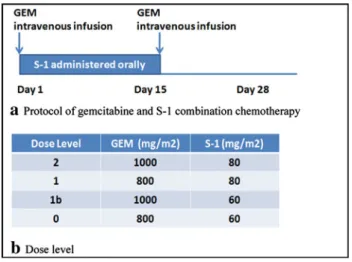
The aim of this study was to determine the maximal tol- erated dose and the recommended dose of this combination regimen for first two cycles, as well as to evaluate the feasibility of this regimen for six cycles in patients with curatively resected BTC. This was an open-label, single- institute, single-arm phase I study. Gemcitabine was administered as 30-min intravenous infusions, on day 1 and day 15. S-1 was administered orally twice daily from day 1 to day 14, followed by 2 weeks’ rest. Patients were scheduled to receive gemcitabine and S-1 at four dose levels, and at least three patients were enrolled at each dose level (Fig.
1). A cycle was defined as 4 weeks with thetotal length of 6 cycles.
Dose-limiting toxicities (DLTs), graded according to the National Cancer Institute (NCI) Common Toxicity Criteria (CTC) scale (version 3.0), were defined as follows: grade 4 leucopenia or neutropenia lasting longer than 4 days, grade 3 or 4 neutropenia complicated by fever, grade 4 throm- bocytopenia, grade 3 thrombocytopenia requiring transfu- sion, grade 3 non-hematological toxicity excluding nausea, vomiting, anorexia and fatigue, and any toxicity that necessitated second-cycle treatment delay of more than 3 weeks. If DLT was observed in the initial 3 patients, a maximum of 3 additional patients was enrolled to the same dose level. The MTD was defined as the highest dose level
1128 Cancer Chemother Pharmacol (2012) 69:1127–1133
that did not cause DLT in 3 of the 3 or 3 of the 6 patients treated at that level during the first two cycles of treatment.
The RD was defined as the dose level that is one level under MTD, considering the toxicity and tolerability. At least 3 patients were enrolled at each dose level, and for the first two cycles, the RD and MTD were determined for that combination regimen. A residual four-cycle feasibility study was also planned by evaluating the validity of the RD.
The eligibility criteria for starting the next cycle of this combination regimen were as follows: white blood cell count
[3,000/mm
3, platelet count
[70,000/mm
3, serum creatinine concentration
\1.2 mg/dl, total serum bilirubin concentration
\2.0 mg/dl, aspartate aminotransferase and alanine aminotransferase levels\ 5 times the upper limit of normal, and grade 2 non-hematological toxicity. The eli- gibility criteria for administering gemcitabine on day 15 were as follows: white blood cell count
[2,000/mm
3, neutrophils[ 1,000/mm
3, platelet count
[70,000/mm
3, and grade 2 non-hematological toxicity. The next cycle was started down by one dose level if any of the following toxicities occurred in any cycle during the residual 4 cycles: grade 4 leucopenia or neutropenia, grade 3 or 4 neutropenia complicated by fever, grade 4 thrombocyto- penia, grade 3 thrombocytopenia requiring transfusion, grade 3 non-hematological toxicity, and a serum creatinine concentration of 1.5 mg/dl.
Surgical procedure
The surgical procedures of BTC vary according to the location of the carcinoma. Patients with distal cholangio- carcinoma and ampullary carcinoma typically underwent pancreatoduodenectomy, while patients with intrahepatic
and perihilar cholangiocarcinoma typically underwent major hepatectomy including bile duct resection. Patients with gallbladder carcinoma underwent various procedures such as major hepatectomy, S4a
?S5 hepatectomy, gall- bladder bed resection, and only bile duct resection. Thirteen patients underwent pancreatoduodenectomy, 14 patients had major hepatectomy for curative resection, and 7 patients had limited operations such as only bile duct resection.
Statistical analysis
Survival curves were constructed using the Kaplan–Meier method, and differences in survival curves were compared by log-rank (Mantel-Cox) test.
P\0.05 was considered statistically significant. Statistical analysis was performed with Stat-View 5.0 (SAS Institute, Cary, NC).
Results
Patient characteristics
Between July 2007 and May 2009, 34 patients were enrolled in this study (Table
1). All patients underwent surgicalresection with the aim of achieving a cure, and all had a confirmed pathologic diagnosis of BTC. All patients had good performance status (0 or 1). The breakdown of enrolled patients was as follows: 23 bile duct cancer patients (intrahepatic, hilar, distal), 7 gallbladder carcinoma patients, and 4 patients with carcinoma of the ampulla of Vater. In total, 19 patients had lymph node metastasis and
Fig. 1 a Gemcitabine was administered as 30-min intravenousinfusions, on day 1 and day 15. S-1 was administered orally twice daily from day 1 to day 14, followed by two weeks’ rest.bPatients were scheduled to receive gemcitabine and S-1 at four dose levels, and at least three patients were enrolled at each dose level
Table 1 Characteristics of the enrolled patients
Characteristics Patients
Patients enrolled 34
Gender
Male 23
Female 11
Age (Median 71; Range 55–79) ECOG performance status
0 32
1 2
Location of the tumor
Bile duct 23
Gallbladder 7
Ampulla of vater 4
Lymph node metastasis 19
Surgical procedure
Major hepatectomy 16
Pancreatoduodenectomy 18
ECOGEastern Cooperative Oncology Group
4 patients underwent non-curative resections only, resulting from the involvement of ductal margins (proximal or/and distal) with carcinoma in situ. The enrolled patients received their adjuvant chemotherapy as outpatients within a median of 8 weeks after curative operation.
DLT and RD
DLT was mainly observed in the patients who underwent major hepatectomy, and so, RD and MTD were varied according to the surgical procedure (type A, major hepa- tectomy or type B, pancreatoduodenectomy, bile duct resection, etc.)
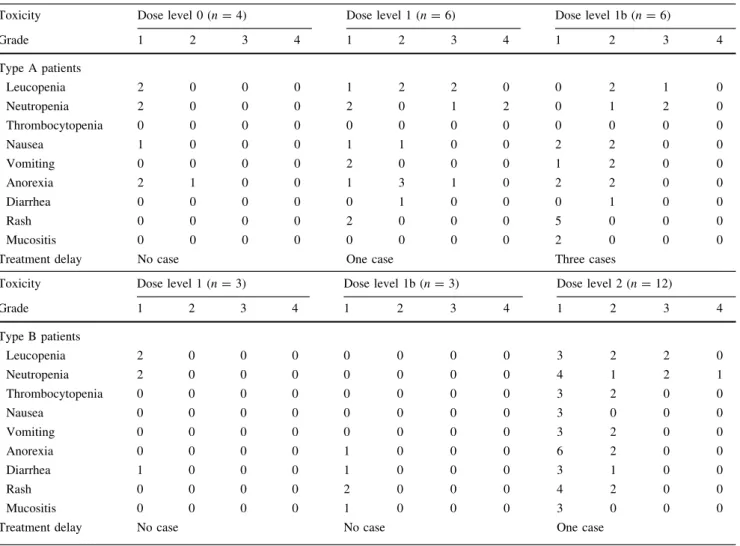
No DLT was observed at dose level 1 in 3 patients of type B or at dose level 1b in 3 type B patients. DLT was observed in 2 of 12 type B patients at dose level 2. On the other hand, 3 DLTs were observed at dose level 1 in 6 patients of type A, 3 DLTs were observed at dose level 1b in 6 type A patients, and no DLT was observed at dose level 0 in 3 type A patients. In 4 of 6 DLTs in type A patients, hematological and non-hematological toxicities
necessitated delay of the second-cycle treatment by more than 3 weeks, and residual 2 DLTs in type A patients were grade 4 neutropenia during first two cycles of treatment, but all patients recovered quickly without any severe complications. On the other hand, 2 DLTs in type B patients were grade 3 or 4 neutropenia complicated with fever (Table
2). Hematological toxicity, particularly neu-tropenia and thrombocytopenia, was the most pronounced toxicity of gemcitabine and S-1 adjuvant combination chemotherapy. While the RD in type B patients was GEM 1,000 mg/m
2?S-1 80 mg/m
2, the RD in type A patients was GEM 800 mg/m
2?S-1 60 mg/m
2and MTD is GEM 1,000 mg/m
2?S-1 60 mg/m
2.
Feasibility
Overall, 11 (68.8%) of 16 type A patients completed the last four cycles of this regimen at type A RD and 15 (83.3%) of 18 type B patients completed it at type B RD. Three type A patients had one dose reduction due to grade 4 neutropenia and serum creatinine elevation, and 2 patients dropped out
Table 2 Toxicities between first two cycles by each dose level
Toxicity Dose level 0 (n=4) Dose level 1 (n=6) Dose level 1b (n=6)
Grade 1 2 3 4 1 2 3 4 1 2 3 4
Type A patients
Leucopenia 2 0 0 0 1 2 2 0 0 2 1 0
Neutropenia 2 0 0 0 2 0 1 2 0 1 2 0
Thrombocytopenia 0 0 0 0 0 0 0 0 0 0 0 0
Nausea 1 0 0 0 1 1 0 0 2 2 0 0
Vomiting 0 0 0 0 2 0 0 0 1 2 0 0
Anorexia 2 1 0 0 1 3 1 0 2 2 0 0
Diarrhea 0 0 0 0 0 1 0 0 0 1 0 0
Rash 0 0 0 0 2 0 0 0 5 0 0 0
Mucositis 0 0 0 0 0 0 0 0 2 0 0 0
Treatment delay No case One case Three cases
Toxicity Dose level 1 (n=3) Dose level 1b (n=3) Dose level 2 (n=12)
Grade 1 2 3 4 1 2 3 4 1 2 3 4
Type B patients
Leucopenia 2 0 0 0 0 0 0 0 3 2 2 0
Neutropenia 2 0 0 0 0 0 0 0 4 1 2 1
Thrombocytopenia 0 0 0 0 0 0 0 0 3 2 0 0
Nausea 0 0 0 0 0 0 0 0 3 0 0 0
Vomiting 0 0 0 0 0 0 0 0 3 2 0 0
Anorexia 0 0 0 0 1 0 0 0 6 2 0 0
Diarrhea 1 0 0 0 1 0 0 0 3 1 0 0
Rash 0 0 0 0 2 0 0 0 4 2 0 0
Mucositis 0 0 0 0 1 0 0 0 3 0 0 0
Treatment delay No case No case One case
1130 Cancer Chemother Pharmacol (2012) 69:1127–1133
because of tumor recurrence and severe fungal infection.
One type B patient had one dose reduction related to grade 3 febrile neutropenia, and 2 patients dropped out because of tumor recurrence and severe non-hematological toxicities.
After the type A surgical procedure, the actuarial dose of gemcitabine was a median of 9,600 (range 4,000–10,400) mg/m
2with an average of 8,925 mg/m
2and that of S-1 was a median of 5,040 (range 3,080–5,600) mg/m
2with an average of 4,935 mg/m
2; in the residual four courses, the average relative dose intensity of gemcitabine was 83.9%
and that of S-1 was 90.6%. After the type B surgical pro- cedure, the actuarial dose of gemcitabine was a median of 11,200 (range 5,000–12,000) mg/m
2, with an average of 10,778 mg/m
2, and that of S-1 was a median of 6,720 (range 3,360–6,720) mg/m
2, with an average of 6,253 mg/m
2; in the residual four courses, the average relative dose intensity of gemcitabine was 86.9% and that of S-1 was 91.7%
(Table
3).Efficacy
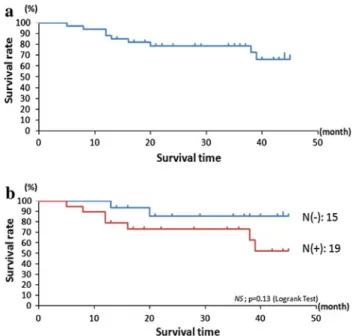
In 34 enrolled patients, 1-year survival rate and 2-year survival rate were 94.1 and 78.6%, respectively. This study was started in July 2007 and closed in April 2011; the average follow-up time for overall survival was 28.6 months (median, 31.5 months; range, 5–5 months);
and the average follow-up disease-free survival was 26.6 months (median, 28 months; range, 3–45 months).
Two patients with recurrence are alive, and 9 patients died of recurrent disease at the time of this printing. The com- pletion rate of this adjuvant protocol without dose reduction was 90.9% in disease-free survival patients, but was only 33.3% in patients of recurrent disease and cancer death. In 19 metastasis-positive lymph node patients, the 1-year and 2-year survival rates were 73.3 and 89.5%, respectively, and the average follow-up for overall survival was 26.7 months (median, 28 months; range, 5–45 months; Fig.
2).Discussion
Results of a large-scale phase III study have identified cis- platin plus gemcitabine as an appropriate option for the treatment of patients with advanced BTC [23]. Several phase II studies in Japan now also indicate gemcitabine plus S-1 to be a promising treatment for advanced BTC [27–29].
Although phase III studies are still needed to compare the efficacy of gemcitabine plus cisplatin versus gemcitabine plus S-1 in BTC, use of the latter agents as adjuvant therapy is realistic as these drugs are allowable in national medical insurance system in Japan. Excellent results have recently been reported for gemcitabine and S-1 combination adju- vant therapy after surgery for BTC [13,
30]. The surgicalprocedures used for curative resection are more varied in patients with BTC than in patients with gastric or colorectal cancer, and the surgical stress on curatively resected patients with BTC is more severe. Therefore, present phase I study for adjuvant chemotherapy of gemcitabine and S-1 combination therapy provided useful information specific to the treatment of BTC patients.
Gemcitabine combined with infusional 5-FU has shown synergetic effects in in vitro cytotoxicity in a variety of cancer cell lines [31]. Clinical studies have reported activity of gemcitabine in pancreatic cancer patients with refracto- riness to 5-FU [32]. These results suggest the lack of cross- resistance between these two agents. The synergy could be explained for two possible reasons: First, gemcitabine enhances the effect of the 5-FU metabolite 5-FdUMP by reducing the concentration of its physiological competitor
Table 3 Feasibility results
Type A patients Type B patients Actuarial cumulative dose of GEM (mg/m2)
Median 9,600 (4,000–10,400) 11,200 (5,000–12,000)
Average 8,925 10,788
Actuarial cumulative dose of S-1 (mg/m2)
Median 5,040 (3,080–5,600) 6,720 (3,360–6,720)
Average 4,935 6,253
Relative dose intensity at the RD (%)
GEM 83.9 86.9
S-1 90.6 91.7
11 (68.8%) of 16 type A patients completed the last four cycles of this regimen at type A RD and 15 (83.3%) of 18 type B patients com- pleted it at type B RD
Fig. 2 a34 enrolled patients, the average follow-up time for overall survival was 28.6 months (median, 31.5 months; range, 5–45 months). b Comparison of postoperative survival in patients with lymph node metastasis, positive or negative
via inhibition of ribonucleotide reductase [33,
34]. Second,hENT1, which carries out the most active gemcitabine uptake, increases in expression in response to 5-FU and may augment gemcitabine cytotoxicity by increasing gemcita- bine concentrations within tumor cells [35,
36]. The noveloral anticancer agent S-1 has been developed to improve the tumor-selective toxicity of 5-FU and shown efficacy in a variety of solid tumors, including biliary cancer. Therefore, we expected additive and synergistic efficacy by combining gemcitabine with S-1 and hoped that the combination would mimic the continuous infusion of 5-FU. It results in DPD inhibition, leading to the enhancement of antitumor activity.
To prove the hypothesis, the current phase I trial has been designed to use this combination regimen in an adjuvant setting.
Myelosuppression, especially neutropenia, is frequently seen in treatment with the combination of continuous infusion 5-FU and gemcitabine. We predicted that this would also be the main toxicity of the gemcitabine and S-1 combination. In the present study, the incidence of grade 3 or 4 neutropenia during the first two cycles was higher than other toxicities, with 3 of 6 type A patients at dose level 1 and 3 of 6 type A patients at dose level 1b, whereas 2 of 12 type B patients at dose level 2 showing grade 3 or 4 neu- tropenia. However, after changing the dose of this regimen according to the operation method, only 12.5% type A patients and 5.6% type B patients needed any RD reduction due to grade 3 or 4 neutropenia. This fact suggests that the myelosuppression caused by this combination regimen is manageable on an outpatient basis. On the other hand, gastrointestinal toxicities such as grade 1 or 2 anorexia and nausea were observed especially in type A patients as non- hematological toxicities. Although one type B patient at dose level 1 experienced grade 3 anorexia, DLTs associ- ated with gastrointestinal toxicities were not observed.
Diarrhea was also mild, similar to previous reports from Japanese studies of single-agent S-1. In any case, it should be cautious when applying the results of our study directly to the treatment of Western patients, particularly in terms of gastrointestinal toxicities.
The key point of this study was the identification of the importance of changing the dose of gemcitabine and S-1 combination adjuvant chemotherapy according to the surgical procedures. Patients who underwent major hepa- tectomy, in particular, showed hematological and non- hematological toxicities. We thus expected that the reason why the RD differed according to the surgical procedure was due to differences in the metabolic pathway of the two agents. It was reported that the total body clearance of 5-FU in patients with hepatic metastases was approximately half of the patients without hepatic involvement [37]. The MTDs of S-1 were also lower in patients with severe hepatic dys- function than in patients with mild hepatic dysfunction,
because a decrease in 5-FU metabolism might increase the frequency or severity of toxicity [38]. We expected that the RD of type A patients would be lower than for type B patients, because DPD activity, which produces tegafur, a cytotoxic component of S-1, occurs predominantly in the liver. This activity would be expected to be lower in patients who had undergone major hepatectomy. The decrease in 5-FU metabolism might result in more additive and syner- gistic efficacy when combining gemcitabine with S-1, so that the doses of both gemcitabine and S-1 required in type A patients might be lower of those required by type B patients.
Conclusion
The pharmacokinetics of GEM and S-1 suggest that adjusting the dose of adjuvant chemotherapy according to the surgical procedures for BTC is reasonable. Establish- ment of dose determination algorithm will warrant the adjuvant chemotherapy regimen for BTC in the future.
References
1. Sobin LH, Wittekind CH (eds) (2002) UICC TNM Classification of malignant tumors. Liver. 6th edn. Wiley-Liss, New York, pp 81–92
2. De Groen PC, Gores GJ, LaRusso NF, Gunderson LL, Nagorney DM (1999) Biliary tract cancers. New Engl J Med 341:
1368–1378
3. Jemal A, Siegel R, Ward E, Hao Y, Xu J, Murray T, Thun MJ (2008) Cancer statistics, 2008. CA Cancer J Clin 58:71–96 4. Okusaka T (2002) Chemotherapy for biliary tract cancer in Japan.
Semin Oncol 29:51–53
5. Patel T (2002) Worldwide trends in mortality from biliary tract malignancies. BMC Cancer 2:10
6. Shaib Y, El-Serag HB (2004) The epidemiology of chol- angiocrcinoma. Semin Liver Dis 24:115–125
7. National Cancer Center (2007) Cancer statistics in Japan.
http://www.fpcr.or.jp/publivation/statistics.html
8. Jarnagin WR, Fong Y, De Matteo RP, Gonen M, Burke EC, Bodniewicz BSJ, Youssef BAM, Klimstra D, Blumgart LH (2001) Staging, resectability, and outcome in 225 patients with hilar cholangiocarcinoma. Ann Surg 234:507–517
9. Nimura Y, Kamiya J, Kondo S, Nagino M, Uesaka K, Oda K, Sano T, Yamamoto H, Hayakawa N (2000) Aggressive preop- erative management and extended surgery for hilar cholangio- carcinoma: Nagoya experience. J Hepatobiliary Pancreat Surg 7:155–162
10. Takada T, Amano H, Yasuda H, Nimura Y, Matsushiro T, Kato H, Nagakawa T, Nakayama T; Study Group of Surgical Adjuvant Therapy for Carcinomas of the Pancreas and Biliary Tract (2002) Is postoperative adjuvant chemotherapy useful for gallbladder carcinoma? A phase III multicenter prospective randomized controlled trial in patients with resected pancreaticobiliary car- cinoma. Cancer 95:1685–1695
11. Nakeeb A, Tran KQ, Black MJ, Erickson BA, Ritch PS, Quebbeman EJ, Wilson SD, Demeure MJ, Rilling WS, Dua KS, Pitt HA (2002) Improved survival in resected biliary malignan- cies. Surgery 132:555–564
1132 Cancer Chemother Pharmacol (2012) 69:1127–1133
12. Nelson JW, Ghofoori AP, Willett CG, Tyler DS, Pappas TN, Clary BM, Hurwitz HI, Bendell JC, Morse MA, Clough RW, Czito BG (2009) Concurrent chemoradiotherapy in resected extrahepatic cholangiocarcinoma. Int J Radiat Oncol Biol Phys 73:148–153
13. Murakami Y, Uemura K, Sudo T, Hayashidani Y, Hashimoto Y, Nakamura H, Nakashima A, Sueda T (2009) Adjuvant gemcita- bine plus S-1 chemotherapy improves survival after aggressive surgical resection for advanced biliary carcinoma. Ann Surg 250(6):950–956
14. Eng C, Ramanathan RK, Wong MK, Remick SC, Dai L, Wade- Oliver KT, Mani S, Kindler HL (2004) A phase II trial of fixed dose rate gemcitabine in patients with advanced biliary tree carcinoma. Am J Clin Oncol 27:565–569
15. Eckel F, Schmid RM (2007) Chemotherapy in advanced biliary tract carcinoma: a pooled analysis of clinical traials. Br J Cancer 96:896–902
16. Andre T, Tournigand C, Rosmorduc O, Provent S, Maindrault- Goebel F, Avenin D, Selle F, Paye F, Hannoun L, Houry S, Gayet B, Lotz JP, de Gramont A, Louvet C, GERCOR Group (2004) Gemcitabine combined with oxaliplatin (GEMOX) in advanced biliary tract adenocarcinoma: a GERCOR study. Ann Oncol 15:
1339–1343
17. Knox JJ, Hedley D, Oza A, Feld R, Siu LL, Chen E, Nematollahi M, Pond GR, Zhang J, Moore MJ (2005) Combining gemcitabine and capecitabine in patients with advanced biliary cancer: a phase II trial. J Clin Oncol 23:2332–2338
18. Sakuramoto S, Sasako M, Yamaguchi T, Kinoshita T, Fujii M, Nashimoto A, Furukawa H, Nakajima T, Ohashi Y, Imamura H, Higashino M, Yamamura Y, Kurita A, Arai K, ACTS-GC Group (2007) Adjuvant chemotherapy for gastric cancer with S-1, an oral fluoropyrimidine. N Engl J Med 357:1810–1820
19. Boku N, Yamamoto S, Fukuda H, Shirao K, Doi T, Sawaki A, Koizumi W, Saito H, Yamaguchi K, Takiuchi H, Nasu J, Ohtsu Ohtsu, Gastrointestinal Oncology Study Group of the Japan Clinical Oncology Group (2009) Fluorouracil versus combination of irinotecan plus cisplatin versus S-1 in metastatic gastric can- cer: a randomized phase 3 study. Lancet Oncol 10:1063–1069 20. Morizane C, Okusaka T, Furuse J, Ishii H, Ueno H, Ikeda M,
Nakachi K, Najima M, Ogura T, Suzuki E (2009) A phase II study of S-1 in gemcitabine-refractory metastatic pancreatic cancer. Cancer Chemother Pharmacol 63:313–319
21. Furuse J, Okusaka T, Boku N, Ohkawa S, Sawaki A, Masumoto T, Funakoshi A (2008) S-1 monotherapy as first-line treatment in patients with advanced biliary tract cancer: a multicenter phase II study. Cancer Chemother Pharmacol 62:849–855
22. Ueno H, Okusaka T, Ikeda M, Takezako Y, Morizane C (2004) Phase II study of S-1 in patients with advanced biliary tract cancer. Br J Cancer 91:1769–1774
23. Valle JW, Wasan H, Palmer DH, Cunningham D, Anthoney A, Maraveyas A, Madhusudan S, Iveson T, Hughes S, Pereira SP, Roughton M, Bridgewater J, ABC-02 Trial Investigators (2010) Cisplatin plus gemcitabine versus gemcitabine for biliary tract cancer. N Engl J Med 362:1273–1281
24. Okusaka T, Nakachi K, Fukutomi A, Mizuno N, Ohkawa S, Funakoshi A, Nagino M, Kondo S, Nagaoka S, Funai J, Koshiji M, Nambu Y, Furuse J, Miyazaki M, Nimura Y (2010) Gem- citabine alone or in combination with cisplatin in patients with biliary tract cancer: a comparative multicentre study in Japan. Br J Cancer 103:469–474
25. Nakamura K, Yamaguchi T, Ishihara T, Sudo K, Kato H, Saisho H (2006) Phase II trial of oral S-1 combined with gemcitabine in metastatic pancreatic cancer. Br J Cancer 94:1575–1579 26. Nakai Y, Isayama H, Sasaki T, Sasahira N, Ito Y, Kogure H,
Togawa O, Matsubara S, Arizumi T, Yagioka H, Yashima Y,
Kawakubo K, Mizuno S, Yamamoto K, Hirano K, Tsujino T, Ijichi H, Toda N, Tada M, Kawabe T, Omata M (2009) A pilot study for combination chemotherapy using gemcitabine and S-1 for advanced pancreatic cancer. Oncology 77(5):300–303 27. Sasaki T, Isayama H, Nakai Y, Ito Y, Kogure H, Togawa O, Toda
N, Yasuda I, Hasebe O, Maetani I, Sasahira N, Hirano K, Tsujino T, Tada M, Omata M (2010) Multicenter, phase II study of gemcitabine and S-1 combination chemotherapy in patients with advanced biliary tract cancer. Cancer Chemother Pharmarcol 65:1101–1107
28. Kanai M, Yoshimura K, Tsumura T, Asada M, Suzuki C, Niimi M, Matsumoto S, Nishimura T, Nitta T, Yasuchika K, Taura K, Mori Y, Hamada A, Inoue N, Tada S, Yanagihara K, Yazumi S, Osaki Y, Chiba T, Ikai I, Fukushima M, Uemoto S, Hatano E (2011) A multi-institution phase II study of gemcitabine/S-1 combination chemotherapy for patients with advanced biliary tract cancer. Cancer Chemother Pharmarcol 67:1429–1434 29. Takashima A, Morizane C, Ishii H, Nakamura K, Fukuda H,
Okusaka T, Furuse J (2010) Randomized phase II study of gemcitabine plus S-1 combination therapy versus S-1 in advanced biliary tract cancer: Japan Clinical Oncology Group Study (JCOG0805). Jpn J Clin Oncol 40:1189–1191
30. Murakami Y, Uemura K, Sudo T, Hayashidani Y, Hashimoto Y, Nakamura H, Nakashima A, Sueda T (2009) Gemcitabine-based adjuvant chemotherapy improved survival after aggressive sur- gery for hilar cholangiocarcinoma. J Gastrointest Surg 13:
1470–1479
31. Ren Q, Kao V, Grem JL (1998) Cytotoxicity and DNA frag- mentation associated with sequential gemcitabine and 5-fluoro- 20-deoxyuridine in HT-29 colon cancer cells. Clin Cancer Res 4:2811–2818
32. Rothenberg ML, Moore MJ, Cripps MC, Andersen JS, Portenoy RK, Burris HA III, Green MR, Tarassoff PG, Brown TD, Casper ES, Storniolo AM, Von Hoff DD (1996) A phase II trial of gemcitabine in patients with 5-FU-refractory pancreas cancer.
Ann Oncol 7:347–353
33. Heinemann V, Xu YZ, Chubb S, Sen A, Hertel LW, Grindey GB, Plunkett W (1990) Inhibition of ribonucleotide reduction in CCRF-CEM cells by 20,20-difluorodeoxycytidine. Mol Pharmocol 38:567–572
34. Madajewicz S, Hentschel P, Burns P, Caruso R, Fiore J, Fried M, Malhotra H, Ostrow S, Sugarman S, Viola M (2000) Phase I chemotherapy study of biochemical modulation of folinic acid and fluorouracil by gemcitabine in patients with solid tumor malignancies. J Clin Oncol 18:3553–3557
35. Pressacco J, Mirovski B, Erlichman C, Hedley DW (1995) Effects of thymidylate synthase inhibition on thymidine kinase activity and nucleoside transporter expression. Cancer Res 55:
1505–1508
36. Nakahira S, Nakamori S, Tsujie M, Takeda S, Sugimoto K, Ta- kahashi Y, Okami J, Marubashi S, Miyamoto A, Takeda Y, Nagano H, Dono K, Umeshita K, Sakon M, Monden M (2008) Pretreatment with S-1, an oral derivative of 5-fluorouracil, enhances gemcitabine effects in pancreatic cancer xenografts.
Anticancer Res 28:179–186
37. Floyd FJ, Hornbeck CL, Byfield JE, Griffiths JC, Frankel SS (1982) Clearance of continuously infused 5-fluoraouracil in adults having lung or gastrointestinal carcinoma with or without hepatic metastases. Drug Intell Clin Pharm 16:665–667 38. Yoon DH, Lee HJ, Hong YS, Kim K, Lee SS, Lee JL, Chang HM,
Ryu MH, Kang YK, Lee JS, Kim TW (2011) A phase I study of S-1 treatment with a 3 week schedule in advanced biliary cancer with or without hepatic dysfunction. Invest New Drugs 29:
332–339