出生時体格に影響を及ぼす妊婦の受動喫煙曝露
(Prenatal secondhand smoke exposure is associated with infant birth size) 研究代表者 岸 玲子 北海道大学環境健康科学研究教育センター センター長・特任教授 研究分担者佐々木成子 北海道大学大学院医学研究科予防医学講座公衆衛生学分野助教 研究分担者吉岡英治 旭川医科大学医学部健康科学講座地域保健疫学分野准教授
研究要旨
The hazardous effect of tobacco smoke exposure during pregnancy is a major public health concern. Maternal smoking has been associated with adverse birth outcomes. We investigated the association between secondhand smoke (SHS) exposure and infant birth size. A prospective cohort of 2,792 non-smoking Japanese pregnant women who delivered singleton babies at hospitals within Hokkaido Prefecture from 2003 to 2007 was conducted. Information on maternal and infants’ characteristics, and lifestyle behaviors were gathered through self- administered questionnaires as well as hospital and birth records. Biochemical analysis of plasma cotinine was carried out using the enzyme-linked immunosorbent assay (ELISA) technique. Overall, an average increase in prenatal SHS exposure by about 0.66ng/mL, i.e. from 25th percentile (0.15ng/mL) to 75th percentile (0.81ng/mL) resulted in a mean reduction in birth weight of 61.4g (95% CI:-100.5, -22.3; p=0.002), birth length of 0.6cm (95%CI:-0.9, -0.2;
p=0.002) and birth head circumference of 0.6cm (95%CI:-1.0,
-0.1; p=0.007). The corresponding exposure brought about a mean birth weight deficit of 70g (95%CI:-124.9, -15.2; p=0.012) and head circumference deficit of 0.5cm (95%CI: -1.0, -0.03; p=0.037) in male infants and a birth length decrease of 0.8cm (95%CI:-1.3, -0.2; p=0.011) in female infants. This study concluded that maternal tobacco smoke exposure during pregnancy through passive route has negative effects on infant birth size especially the males.
研究協力者
Braimoh Titilola
,宮下 ちひろ 馬場 俊明,樫野 いく子
岡田 恵美子,小林 澄貴 伊藤 久美子
(
北海道大学大学院医学研究科 予防医学講座公衆衛生学分野
) Yila Thamar(
北海道大学環境健康科学研究教育セ ンター)
A.研究目的
Maternal active smoking is associated with adverse pregnancy and birth outcomes such as placenta previa, abruptio placentae, ectopic pregnancy, spontaneous abortion, preterm delivery, low birth weight and perinatal mortality. Results of few studies on the negative effects of secondhand smoke (SHS) exposure on
birth outcomes are not clearly defined.
Lack of clarity is probably due to the evaluation of SHS exposure using only self-administered questionnaires, measurement of cotinine levels in body fluids during the early gestation or failure to control for gestational age, a major determinant of birth weight.
In order to improve the reliability and validity of assessments by self- reported questionnaires, the use of biomarkers have been recently introduced. Cotinine, a widely studied biomarker, is a main metabolite of nicotine which can be found in blood, saliva, hair or urine analysis of SHS- exposed nonsmoker. Given the high prevalence of smoking among the Japanese men and the reluctance of most husbands to quit smoking during their wives’ pregnancy, nonsmoking pregnant women in Japan are at a risk of exposure to SHS especially at home. The impact of SHS exposure on the unborn fetus remains a significant public health concern as birth size of a newborn greatly determines its survival, perinatal morbidity and adulthood health conditions.
Gender-specific difference in the effect of environmental pollutants on birth outcomes has been recently reported but with inconsistent results.
Birth weight of male infants was more negatively affected by prenatal toxic exposure such as smoking, lead and airborne fine particles than the females. Contrariwise, maternal smoking during pregnancy has higher
significantly negative influence on the mean birth weight and risk of small for gestational age (SGA) in newborn girls than in boys. In this study, we investigated the effects of maternal exposure to SHS during pregnancy on birth size using plasma cotinine concentrations as a biomarker for nicotine exposure. Gender-specific difference in fetal growth reduction was also assessed.
B.研究方法
A total of 2972 Japanese pregnant women were recruited from 2003 to 2007 from the ongoing “Hokkaido study on Environment and Children’s Health”. Vital information were gathered from baseline self- administered questionnaires, infants’
hospital birth records and post–
partum self-administered questionnaires. Biochemical analysis of maternal blood specimens collected during the third trimester was carried out through enzyme-linked immunosorbent assay (ELISA) technique (Cosmic Corporation, Japan) with a limit of detection of 0.12ng/mL.
Briefly, the ELISA 96-well plates coated with a rabbit anti-cotinine-4- bovine-ɣ-globulin polyclonal antibody were first incubated with 1% bovine serum albumin (BSA) after which 25μl of blood plasma samples and 100μl horseradish peroxidase-labeled (HRP) cotinine were added. The mixture was left to incubate at 20- 250C for 1 hour. Subsequent to three
washes with 1% BSA, peroxidase substrate, tetramethylbenzidine, and H2O2 were added (Kirkegaad & Perry Laboratories, Gaithersburg, MD).
The mixture was re-incubated for 30 minutes in the dark at the same temperature and 100μl phosphoric acid was added to the wells to stop enzyme activity. The absorbance was read at a wavelength of 450nm using an ELISA reader (Emax; Molecular Devices, Sunnyvale, CA)
The main birth outcomes were birth weight, length and head circumference and their relationship with maternal and infants’
characteristics were examined with the student’s t-test, Spearman’s correlation test and analysis of variance (ANOVA). Next, their associations with exposure were examined using univariate and multivariate regression models. The main exposure variable (plasma cotinine concentration) was categorized by quartiles (<0.16, 0.16 - 0.33, 0.34 - 0.80 and >0.80ng/mL).
First, their crude effects were examined and later adjusted for confounding variables such as maternal age, pre-pregnancy maternal weight, height, educational level, annual household income, parity, infant gender and gestational age at delivery. The subjects with undetectable cotinine levels were assigned a value half the detection limit (0.06ng/mL). Another multiple linear regression model was used to elucidate the gender-specific
difference in the effect of SHS exposure on infant birth size by stratifying with infant gender. All statistical analyses were performed using the Statistical Packages for Social Sciences (SPSS, Inc., Chicago, USA) software for Windows version 16.0.
(倫理面への配慮)
This study was conducted with the informed consent of all subjects and approved by the institutional ethical board for human gene and genome studies of the Hokkaido University Center for Environmental and Health Sciences and the Hokkaido University Graduate School of Medicine.
C.研究結果
In our earlier study, cut-off points for distinguishing the smoking statuses were established. Thus, those women whose plasma cotinine levels suggested active smoking (>11.48ng/mL ) were excluded.
In the current study, 80.7% of the overall study population has detectable plasma cotinine levels (≥0.12ng/mL). Table 1 summarizes the maternal and infants’
characteristics in relation to birth size. Maternal age ranged from 17 to 44 years, with a mean (±SD) of 30.2 ± 4.4 years. Mean (±SD) pre-pregnancy weight and mean (±SD) maternal body mass index (BMI) were 52.8
±8.6 kg and 21.1 ± 3.2 kg/m2 respectively. More mothers were
multi-parous (50.5%), less educated (83.3%), low-income earners (54.3%) and drank alcohol during pregnancy (61.3%). Mean (±SD) gestational age was 39.1 ± 1.1 weeks. The associations of birth size with maternal and infants’ characteristics are also shown in Table 1. Maternal height, pre-pregnancy weight, BMI and gestational age positively correlated with birth weight, birth length and head circumference (p<0.001). Maternal age positively correlated with birth head circumference but negatively with birth length (p<0.001). First infants were smaller than subsequent babies (p<0.001). Male infants were bigger, taller and had bigger head circumference than the females at birth (p<0.001).
Table 2 shows the maternal and infants’ characteristics in relation to plasma cotinine levels. Mothers with the highest cotinine levels are more likely to be significantly younger, nulliparous (51.5%), less educated (56.0%), earn less than 5 million yen per annum (70.4%), have husbands who smoke more than 20 cigarettes per day (5.8%) in comparison to those in the lower cotinine quartile groups.
Figure 1 shows the mean birth weight, birth length and head circumference in relation to cotinine quartile levels respectively. The mean (±SD) birth weight, birth length and head circumference of infants in the highest cotinine quartile (Q4) were 3058.8 ± 362.6g, 48.9 ± 4.1cm, and
32.9 ± 3.8cm respectively; and lower in comparison to those of lower quartile groups.
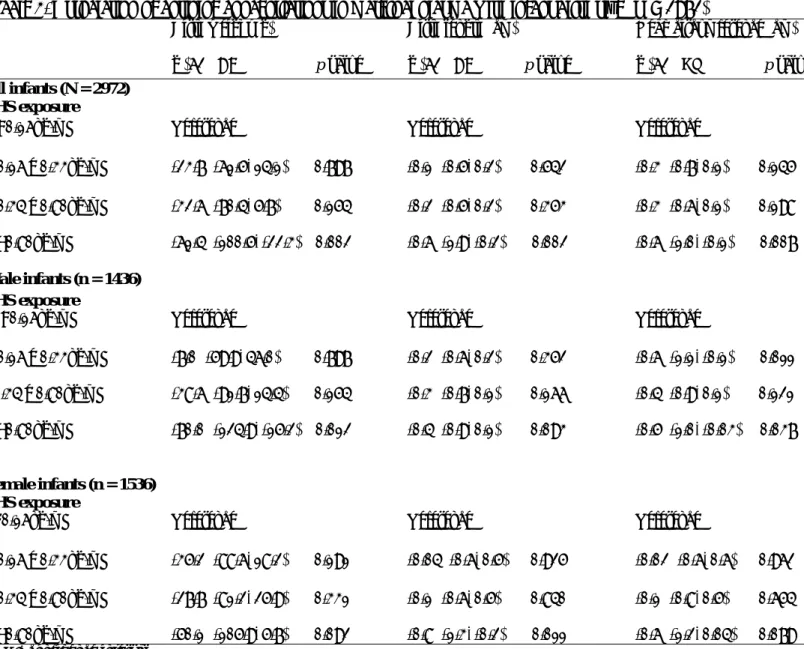
Table 3 shows the multivariate regression analysis of birth size and plasma cotinine concentrations. In the adjusted model, the known risk factors of birth size from previous literature (maternal age, maternal height, maternal pre-pregnancy weight, educational level, annual household income, number of cigarettes smoked by partner per day, parity, infant gender, gestational age and delivery mode (included for head circumference)) were included. When all infants were considered, an inverse relationship of cotinine levels with infant birth weight, length and head circumference in the adjusted model was observed. Mothers in the highest quartile (>0.80ng/mL) group gave birth to babies with significantly lower birth weight (61.4g; 95%CI:- 100.5, -22.3; p=0.002), birth length (0.6cm; 95%CI:-0.9, -0.2; p=0.002) and head circumference (0.6cm;
95%CI:-1.0, -0.1; p=0.007) than those in the lowest quartile group (<0.16ng/mL). Significant deficits in the mean birth weight (-70g; 95%CI:- 124.9, -15.2; p=0.012) at the highest cotinine level and in the birth head circumference both at the 2nd (-0.6cm, 95%CI:-1.1, -0.1, p=0.011) and 4th quartiles (-0.5cm, 95%CI:-1.0, -0.003, p=0.037) of male infants were observed. On the other hand, reduction in the birth length of female infants was associated with
highest SHS exposure (-0.8cm, 95%CI:-1.3, -0.2, p =0.011).
D.考察
The major strength of this study is the use of plasma cotinine measurements for assessing SHS exposure which reduces the possibility of misclassification bias.
The current study found an association of high SHS exposure during pregnancy with reduced mean birth weight, birth length and birth head circumference, before and after adjusting for potential confounding factors. Our finding of an inverse relationship of plasma cotinine concentrations with birth outcomes confirms the results of two studies which observed the greatest effect of prenatal SHS exposure on birth weight at the highest cotinine levels.
A decrease of 108g in the mean birth weight of infants with mothers in the upper tertile cotinine levels (>1ng/mL) in comparison with those of lower tertile (<0.5ng/mL) mothers (Haddow et al. 1988). Also, neonates of women with cotinine levels
>1.7ng/mL were 85g smaller than those of lowest quintile range (Rebagliato et al. 1995).
In a study of 263 nonsmoking African-Americans and Dominican women, high prenatal exposure to PAHs was associated with lower birth weight and smaller head circumference (Perera et al. 2003).
Nicotine exposure on pregnancy causes a transient reduction in
uterine blood flow due to early morphological changes of the placenta, while carbon monoxide in tobacco smoke can result in hypoxemia. Consequently, the birth weight, birth length and head circumference of the fetus may be reduced. The fundamental mechanisms of tobacco smoke effects on fetal growth need more clarifications and may possibly be multi-factorial.
Reduction in head circumference at birth has been correlated with a lower intelligence quotient (IQ), cognitive impairment, school performance in childhood and schizophrenia.
Our study provided an evidence of a gender difference in the effect of SHS exposure during pregnancy, with the male fetuses appearing to be more vulnerable to the exposure than the female ones. Overall average increase in exposure to SHS by about 0.66ng/mL gave rise to birth weight reduction of 70g (95% CI:-124.9, -15.2) in male infants compared to 50g (95%CI:-105.9, 5.7) in female infants.
There are conflicting findings in previous studies regarding the effect of gender-specific differences. While a greater negative effect of heavy smoking in girls than in boys has been reported in a study, male fetuses have been observed to be more susceptible to the negative effect of active tobacco smoke than the females in other studies (Zaren et al. 2000, Varvarigou et al. 2009). Prenatal
exposure to fine particulate matters affected the birth size of male infants more than females (Jedrychowski et al. 2009). The gender-specific effect can be explained by the fact that the growth rate of male fetuses is normally higher than the females, hence, the effect of the factors restraining fetal development could be greater in fetuses with faster intrauterine growth. Demands on blood circulation, oxygen or fuels related to faster growth rate are also greater by the male gender.
Differences exist in hormonal conditions based on gender. During the second half of the second trimester of pregnancy, the vulnerability to toxic effects of tobacco smoke chemicals increases as the brain begins its growth spurt (for example, glial cells and axon growth, dendrites’ branching and synapses’
formation) at this period.
The design of this study as a prospective cohort reduces recall bias.
Second, exclusion of preterm births eliminates confounding from pregnancy complications and concentrates on fetal development.
Third, the selection of study participants from 37 hospitals within Hokkaido eradicates the possibility of selection bias.
E.結論
SHS exposure obviously has adverse effects on fetal growth especially among the male fetuses.
The greater vulnerability of the male
fetuses may be due to their faster intrauterine growth and different hormonal conditions. It remains unclear why the birth length of the female fetuses suffers more negative effect than that of the males. There is the need to further investigate into this in future studies.
F.研究発表 1.
論文発表
1. Seiko Sasaki, Titilola S. Braimoh, Thamar A. Yila, Eiji Yoshioka, Reiko Kishi. Self-reported tobacco smoke exposure and plasma cotinine levels during pregnancy – A validation study in Northern Japan. Science of the Total Environment 2011; 412-413: 114- 118.
2.
学会発表
1. Titilola S. Braimoh, Seiko Sasaki, Thamar A. Yila, Toshiaki Baba, Chihiro Miyashita, Emiko Okada, Ikuko Kashino, Kumiko Ito, Sumitaka Kobayashi, Eiji Yoshioka, Reiko Kishi. Effects of prenatal environmental tobacco smoke exposure on infant birth size. The American Public Health Association (APHA) 139th Annual Meeting and Exposition. Oct 29 – Nov. 2, 2011. Washington DC, USA.
2. Titilola S. Braimoh, Seiko Sasaki, Thamar A. Yila, Toshiaki Baba, Chihiro Miyashita, Emiko Okada, Ikuko Kashino, Sumitaka Kobayashi, Eiji Yoshioka, and Reiko Kishi. Effects of exposure to
second-hand smoke during pregnancy on birth size. Women’s Health Conference. April 2, 2011.
New York, USA.
3. Titilola S. Braimoh, Seiko Sasaki, Thamar A. Yila, Toshiaki Baba, Chihiro Miyashita, Emiko Okada, Ikuko Kashino, Sumitaka Kobayashi, Eiji Yoshioka, and Reiko Kishi. Self-reported exposure to tobacco smoke and plasma cotinine during pregnancy - The Hokkaido Study on Environment and Children’s Health. The 80th Annual Meeting of the Japanese Society for Hygiene. May 9 -11, 2010. Sendai, Japan.
G.知的財産権の出願・登録状況 該当なし
参考文献
1. Benowitz NL. Biomarkers of environmental tobacco smoke exposure. Environmental Health perspectives 1999; 107 (Suppl. 2):
349-55.
2. Haddow JE, Knight GJ, Palomaki GE, McCarthy JE. Second trimester serum cotinine levels in nonsmokers in relation to birth weight. Am J Obstet Gynecol 1988; 159(2): 481-4.
3. Hegaard HK, Kjærgaard H, Møller LF, Wachmann H, Ottesen B. The effect of environmental tobacco smoke during pregnancy on birth weight. Acta Obstet Gynecol Scand 2006; 85: 675-81.
4. Ivanovic DM, Leiva BP, Pérez HT, Olivares MG, Díaz NS, Urrutia MSC, et al. Head size and intelligence, learning, nutritional status and brain development:
Head, IQ, learning, nutrition and brain. Neuropsychologia 2004; 42:
1118–31.
5. Jedrychowski W, Perera F, Mrozek- Budzyn D, Mroz E, Flak E, Spengler JD, et al. Gender differences in fetal growth of newborns exposed prenatally to air borne fine particulate matter.
Environmental Research 2009;
109: 447–456.
6. Perera FP, Rauh V, Tsai WY, Kinney P, Camann D, Barr D, Bernert T, Garfinkel R, Tu YH, Diaz D, Dietrich J and Whyatt RM.
Effects of transplacental exposure to environmental pollutants on birth outcomes in a multiethnic population. Environmental Health Perspectives 2003; 111 (2): 201-5.
7. Rebagliato M, Florey CDV, Bolumar F. Exposure to environmental tobacco smoke in nonsmoking pregnant women in relation to birth-weight. Am J Epidemiol. 1995; 142(5):531-7.
8. Robinson JS, Moore VM, Owens JA, McMillen IC. Origins of fetal growth restriction. Eur J Obstet Gynecol Reprod Biol 2000; 92:13–9.
9. Saito R. The smoking habits of pregnant women and their husbands, and the effect on their infants. Jpn J Public Health 1991;
38(2): 124-31.
10. Schwarzler P, Bland JM, Holden D, Campbell S, and Ville Y. Sex- specific antenatal reference growth charts for uncomplicated singleton pregnancies at 15–40 weeks of gestation. Ultrasound Obstet Gynecol 2004; 23: 23–29.
11. Varvarigou AA, Asimakopoulou A, Beratis NG. Impact of maternal smoking on birth size: effect of parity and sex dimorphism.
Neonatology 2009; 95: 61–7.
12. Zaren B, Lindmark G, Bakketeig L. Maternal smoking affects fetal growth more in the male fetus.
Paediatr Perinat Epidemiol. 2000;
14: 118-26.
Table 1. Maternal and infants’ characteristics in relation to birth outcomes (N= 2972)
Variables No.
Birth weight
(g) p value
Birth length
(cm) p value
Birth head circumference (cm)
p valuea
Maternal age (years) r = -0.025 0.178 r = -0.042 0.023 r = 0.058 0.002
Maternal height (cm) r = 0.173 <0.001 r = 0.188 <0.001 r = 0.154 <0.001 Pre-pregnancy
maternal weight (kg)
r = 0.219 <0.001 r = 0.183 <0.001 r = 0.177 <0.001 Maternal BMI (kg/m2) r = 0.153 <0.001 r = 0.105 <0.001 r = 0.114 <0.001 Parity
Nulliparous 1361 3078.0 ± 354.3 0.001 49.2 (2.3) 0.046 33.0 (3.1) 0.314
Multiparous 1501 3124.8 ± 365.5 49.0 (3.6) 33.1 (3.7)
Alcohol intake during pregnancy
No 1126 3102.5 ± 359.8 0.725 49.0 (3.7) 0.080 33.0 (3.9) 0.345
Yes 1823 3097.7 ± 361.1 49.2 (2.8) 33.1 (3.2)
Educational level (years)
≤12 2477 3100.0 ± 359.1 0.809 49.2 (2.3) 0.031* 33.1 (3.1) 0.261
>12 492 3096.1 ± 366.9 48.1 (3.7) 33.0 (3.8)
Annual household income (millions of Yen)
<5 1615 3102.0 ± 362.3 0.736 49.1 (3.1) 0.246 33.0 (3.3) 0.780
≥5 888 3096.1 ± 366.9 49.0 (3.4) 33.1 (3.9)
Number of cigarettes smoked by partner per day
0 1457 3101.0 ± 373.9 0.998 49.1 (3.2) 0.500 33.0 (3.3) 0.834
1 – 9 427 3104.6 ± 368.0 49.1 (3.0) 33.0 (4.0)
10 – 19 526 3103.4 ± 333.8 48.9 (4.1) 33.1 (3.3)
≥20 539 3102.8 ± 380.0 49.2 (1.9) 33.2 (3.3)
Gestational age
(weeks) r = 0.303 <0.001 r = 0.316 <0.001 r = 0.112 <0.001
Infant gender
Male 1436 3146.9 ± 354.9 <0.001 49.5 (2.9) <0.001 33.3 (3.2) <0.001
Female 1536 3056.2 ± 360.1 48.8 (3.4) 32.8 (3.7)
a Spearman’s correlation test, Student’s t test, ANOVA
b Mean (SD)
BMI, body mass index SD, standard deviation
Table 2. Maternal characteristics in relation to plasma cotinine levels during pregnancy (N= 2972)
Variable
<0.16ng/mL (n = 784)
0.16 - 0.33ng/mL (n = 714)
0.34 - 0.80ng/mL (n = 743)
>0.80ng/mL
(n = 731) p valuea
Maternal age (years)b 31.1 (4.2) 30.6 (4.1) 29.8 (4.2) 29.1 (4.5) <0.001∯
Nulliparous 336 (43.6) 339 (48.8) 339 (46.9) 347 (51.5) 0.024
Multiparous 434 (56.4) 356 (51.2) 384 (53.1) 327 (48.5)
Alcohol intake during pregnancy
No 292 (37.5) 269 (38.0) 287 (39.0) 278 (38.2) 0.939
Yes 487 (62.5) 439 (62.0) 448 (61.0) 449 (61.8)
Educational level (years)
≤12 277 (35.7) 294 (41.4) 326 (44.2) 405 (56.0) <0.001
>12 498 (64.3) 416 (58.6) 412 (55.8) 318 (44.0)
Annual household income (millions of Yen)
<5 390 (59.4) 378 (61.2) 427 (67.7) 420 (70.4) <0.001
≥5 267 (40.6) 240 (38.8) 204 (32.3) 177 (29.6)
Number of cigarettes smoked by partner per day
0 565 (72.5) 385 (54.1) 308 (41.6) 203 (27.8) <0.001
1 – 9 119 (15.3) 188 (26.4) 216 (29.2) 257 (35.3)
10 –19 90 (11.6) 122 (17.1) 179 (24.2) 227 (31.1)
≥20 5 (0.6) 17 (2.4) 37 (5.0) 42 (5.8)
Q1 aChi square test, ANOVA ∯Kruskal Wallis test bMean (SD)
Table 3. Association of cotinine concentrations in maternal plasma with infant birth size (N = 2972)
Birth weight (g)
β (95%CI p value
Birth length (cm)
β (95%CI p value
Head circumference (cm) β (95%CI p value All infants (N = 2972)
SHS exposure
<0.16ng/mL Reference Reference Reference
0.16 – 0.33ng/mL -23.7 (-61.5, 14.1) 0.797 -0.1 (-0.5, 0.2) 0.542 -0.3 (-0.7, 0.1) 0.145 0.34 – 0.80ng/mL
>0.80ng/mL
-32.6 (-70.4, 5.7) 0.154 -61.4 (-100.5, -22.3) 0.002
-0.2 (-0.5, 0.2) 0.353 -0.6 (-1.9, -0.2) 0.002
-0.3 (-0.6, 0.1) 0.198 -0.6 (-1.0, -0.1) 0.007 Male infants (n = 1436)
SHS exposure
<0.16ng/mL Reference Reference Reference
0.16 – 0.33ng/mL -7.0 (-59.9, 46.0) 0.797 -0.2 (-0.6, 0.2) 0.352 -0.6 (-1.1, -0.1) 0.011 0.34 – 0.80ng/mL
>0.80ng/mL
-38.6 (-91.7, 14.4) 0.154 -70.0 (-124.9, -15.2) 0.012
-0.3 (-0.7, 0.1) 0.166 -0.4 (-0.9, 0.1) 0.093
-0.4 (-0.9, 0.1) 0.121 -0.5 (-1.0, -0.03) 0.037
Female infants (n = 1536) SHS exposure
<0.16ng/mL Reference Reference Reference
0.16 – 0.33ng/mL -35.2 (-88.6, 18.2) 0.191 -0.04 (-0.6, 0.5) 0.925 -0.02 (-0.6, 0.6) 0.962 0.34 – 0.80ng/mL
>0.80ng/mL
-27.7 (-81.2, 25.9) 0.331 -50.1 (-105.9, 5.7) 0.092
-0.1 (-0.6, 0.5) 0.840 -0.8 (-1.3, -0.2) 0.011
-0.1 (-0.8, 0.5) 0.654 -0.6 (-1.2, 0.04) 0.079 CI, confidence interval
β: Change in birth weight after adjusting for maternal age, height, pre-pregnancy maternal weight, educational level, annual household income, parity, infant gender and gestational age.
3120
3105
3098
3086
3060 3080 3100 3120 3140
Q1 Q2 Q3 Q4
Cotinine quartile levels (ng/mL)
Mean birth weight (g)
49.2
49.1 49.1
48.9
48.6 48.8 49 49.2 49.4
Q1 Q2 Q3 Q4
Cotinine quartile levels (ng/mL)
Mean birth length (cm)
33.2
33
33.1
32.9
32.6 32.8 33 33.2 33.4
Q1 Q2 Q3 Q4
Cotinine quartile levels (ng/mL)
Mean birth head circumference (cm)
Figure 1: Fetal growth parameters and SHS exposure levels
<0.16ng/mL 0.16 – 0.33ng/mL 0.34 – 0.80ng/mL
>0.80ng/mL