薬剤師主導の抗菌薬適正使用支援活動を通じた Staphylococcus aureus 菌血症に対する
診療支援の有用性に関する検討
佐村 優1)・廣瀬 直樹1)・倉田 武徳1)・石井 淳一1)・南雲 史雄1)
高田 啓介1)・腰岡 桜1)・内田 仁樹1)・山本 隼也1)・井上 純樹1)
関根 寿一1)・石田 明2)・國香 則文2)・國島 広之3)
1)医療法人社団緑成会横浜総合病院薬剤科*
2)同 内科
3)聖マリアンナ医科大学感染症学講座
受付日:2017 年 9 月 25 日 受理日:2018 年 5 月 2 日
Staphylococcus aureus による菌血症(SAB)は死亡率の高い感染症であり,感染性心内膜炎,膿瘍,
骨髄炎などの合併症を呈することもあるため,早期の適正な治療薬の選択と適正な治療期間を遵守する ことが重要である。横浜総合病院(以下,当院)は,300 床の中規模病院であり,常勤の感染症専門医 は不在であるが,抗菌化学療法認定薬剤師主導で,血液培養の中間報告,最終報告を収集し,主治医,
病棟薬剤師とともに適正な感染症治療を支援する Antimicrobial stewardship program(ASP)活動を 行っている。今回,当院で発症した SAB を対象として,支援前(2008〜2011 年度),支援後(2012〜
2015 年度)に分類し,30 日生存率などをアウトカム指標,適正抗菌薬の累積使用率,14 日以上の抗 菌薬使用率,血液培養の陰性化確認率,経胸壁心エコー実施率などをプロセス指標として検証した。そ の結果,両群における 30 日生存率は,支援前:80.0%(20/25),支援後:81.3%(39/48)(p=0.80)で あった。また,両群における適正抗菌薬の累積使用率は,SAB 全体,MSSA では有意な差を認めなかっ たが(p=0.07,0.44),MRSA では有意な差を認めた(p=0.02)。両群における 14 日以上の適正抗菌薬 使用率は,48.0%(12/25),79.2%(38/48)(p<0.01),血液培養再検査率は,36.0%(9/25),56.3%
(27/48)(p=0.13),経胸壁心エコー実施率は 36.0%(9/25),47.9%(23/48)(p=0.46)であった。多 変量解析の結果,本研究における死亡率を増加させる因子は,MRSA 菌血症がオッズ比 4.34(95% 信 頼区間:1.10〜22.90),感染巣不明がオッズ比 5.87(95% 信頼区間:1.43〜29.98),感染性心内膜炎が オッズ比 4.00(95% 信頼区間:1.06〜244.47)であった。本研究では,生存率の改善にはいたらなかっ たが,薬剤師主導の ASP 活動を通じた SAB の感染症診療の支援は,適正抗菌薬の早期使用率,SAB に おける適切な治療期間の達成と必要な検査の施行率などのプロセス指標の向上に繋がる可能性が示唆さ れた。
Key words:antimicrobial stewardship,Staphylococcus aureus bacteremia,pharmacists
● ● ● ● ● ● ● ● ● ● ● ● ● ● ● ● ● ● ● ● ● ● ● ● ● ● ● ● ● ● ● ● ● ● ● ● ●
はじめに
Staphylococcus aureus はヒトの皮膚,消化管な どに常在し,菌血症,皮膚軟部組織感染症などの代
表的な起炎菌となるグラム陽性球菌であり,Me- thicillin感性(Methicillin-susceptibleStaphylococcus aureus:MSSA)とMethicillin耐性 (Methicillin- resistant Staphylococcus aureus:MRSA)に大別
*神奈川県横浜市青葉区鉄町 2201―5
される。S. aureusによる 菌 血 症(Staphylococcus aureus bacteremia:SAB)の死亡率は報告によっ て異なるが,MSSAでは20%程度,MRSAでは30〜
50%程度と高率であり,MRSAでは約2倍上昇す ると報告されている1)。また,年齢10歳の上昇で死 亡のリスクは1.3倍上昇するといわれている2)。し たがって,SABでは,初期に適正な抗菌薬を使用 することが重要となる。また,SABは感染性心内 膜炎,膿瘍,骨髄炎などの合併症を呈することもあ り,14日未満の治療期間では再燃する危険性が指 摘されているため,非複雑性SABでは14日以上 の治療期間,複雑性SABでは28日以上の治療期 間が推奨されている3)。さらに,近年ではさまざま なMRSA感染症の第一選択薬であるvancomycin
(VCM)において,MSSAに対してはβ―ラクタム 系薬よりも治療成績が劣ることが報告されており4), 感染性心内膜炎,人工物留置例などの初期治療とし て,β―ラクタム系薬との併用療法についても言及 されている4,5)。
近年,抗菌薬の適正使用を推進する方法として,
2007年に米国感染症学会と米国医療疫学学会から Antimicrobial stewardship program(ASP)のガ イドラインが公表された6)。本ガイドラインは「抗 菌薬の使用制限」と「前向きな介入とフィードバッ ク」を主要な戦略としており,後者では,感染症専 門医または感染症のトレーニングを受けた薬剤師に よる抗菌薬の適正使用支援を推奨している6)。本邦 においても,2017年8月に8学会合同抗微生物薬 適正使用推進検討委員会より「抗菌薬適正使用支援 プログラム実践のためのガイダンス」が発表され,
米国と同様に薬剤師を主要構成メンバーに加えた Antimicrobial stewardship team(AST)の発足を 推奨している。
横浜総合病院(以下,当院)は常勤の感染症専門 医が不在の300床の中規模病院である。また,細菌 検査は外部業者に委託しているため,菌血症などの 重症感染症では,対応の遅れによって患者の生命予 後に影響を与える可能性がある。したがって,結果 判明後の迅速な対応が求められる。そのため,当院 では,2012年度から主治医と病棟薬剤師,感染症 担当薬剤師が協働し,血液培養陽性例を対象に薬剤 師の早期支援によるAntimicrobial stewardship活 動を行っている7)。
これまでに,本邦におけるAntimicrobial stew- ardship活動を通じた菌血症に対するASTや薬剤 師の支援活動に関する報告はあるが8,9),常勤の感染 症専門医不在の中規模病院において,薬剤師主導の Antimicrobial stewardship活動によるSABへの診 療支援に関する報告は限られている。今回,当院に おける支援内容を後方視的に検証した。
I.対象と方法
1.薬剤師主導の ASP 活動における感染症診療の支 援内容
当院では,全7病棟に薬剤師が1名ずつ常駐して いる。また,2012年度から病院長の指示のもとで,
抗菌化学療法認定薬剤師1名を感染症担当薬剤師と して専任で薬剤科内に配置し,主治医および病棟薬 剤師と連携して,薬剤師主導のASP活動を開始し た7)。その主な活動内容を1)〜3),SABに対する 具体的な支援内容を4),Fig. 1に示す。
1)初期治療に対する薬剤師の支援内容
ASP活動の前は主治医または一部の病棟薬剤師 の裁量で初期治療を開始していたが,ASP活動後 は抗菌薬の開始時に病棟薬剤師と主治医で協議して 非感染性疾患を除外したうえで,抗菌薬投与前の血 液培養2セット採取を含む各種培養採取,患者背景,
感染臓器,推定起炎菌に応じた初期の抗菌薬選択に 関する支援を開始した。休日や時間外,他の業務な どで初期の抗菌薬選択に関与できていない場合は,
その翌日または休日明けの朝に病棟薬剤師が担当病 棟の使用抗菌薬を確認してその妥当性を検証するこ とで支援を行っている。また,病棟薬剤師がこれら の活動を通じて重症例と判断した場合や全身性炎症 反応症候群の基準を満たす場合には,感染症担当薬 剤師も含めた感染症診療の支援を実施している。さ らに,病院長の指示のもとで必要に応じて主治医か ら感染症担当薬剤師に相談する体制も設けるととも に,感染症担当薬剤師が専用のPHSを携帯し,不 在時でも必要に応じて血液培養陽性例や重症例の相 談を受けることで感染症診療を支援している。当院 では,これらの活動を通じて薬剤師による感染症の 初期治療に関する支援を行っている。
2)血液培養の中間報告時における薬剤師の支援内 容
当院では検体検査が外部委託ということもあり,
ASP活動前は血液培養の中間報告が該当病棟に運
Fig. 1. Outline of pharmacist-driven support through an ASP for Staphylococcus aureus bacteremia Pharmacists for infectious diseases and ward pharmacists support the doctors from initial therapy to definitive therapy for Staphylococcus aureus bacteremia.
Examination of blood cultures and selection of the initial therapy
Report on interim results of blood culture to pharmacists and doctors
Report on final results of blood culture to pharmacists and doctors
ASP by pharmacists
• Confirmation of collecting 2 sets of blood cultures
• Support of the initial therapy by ward pharmacists or pharmacists for infectious diseases
• Evaluation of the initial therapy and recommendation for the appropriate antimicrobial therapy by ward pharmacists or pharmacists for infectious diseases
ASP by pharmacists
• Evaluation of the initial therapy and recommendation for the appropriate antimicrobial therapy by pharmacists for infectious diseases and ward pharmacists if the initial therapy has failed, for instance the patient's clinical symptoms do not improve.
• Recommendation for re-examination of blood cultures and implementation of TTE if the initial therapy has failed.
ASP by pharmacists
• Evaluation of the current therapy and recommendation for a definitive therapy by ward pharmacists and pharmacists for infectious diseases
• Recommendation for re-examination of blood cultures and implementation of TTE if these Inspections have not been done yet, the patient’s clinical symptoms do not improve and bacteremia persists
• Recommendation for the appropriate duration of treatment
• Recommendation for another therapy if the current therapy has failed, for instance the patient’s clinical symptoms do not improve and bacteremia persists
搬されるのみで,主治医への連絡が遅れて治療に影 響することがあった。そのため,2012年度からの 薬剤師主導のASP活動開始後は,感染症担当薬剤 師が検査科からの血液培養陽性の中間報告を受け,
必要に応じて菌種にかかわる情報を外部委託先の検 査室に直接確認したうえで,ただちに主治医と病棟 薬剤師とともにその結果および対象患者の臨床所見,
検査所見から,現行の抗菌薬の選択と用法用量の妥 当性を評価する支援を開始した。その際,抗菌薬選 択や用法用量の適正化に加え,必要に応じて血液培 養の再検査や陰性化確認を含む各種培養検査および 治療上必要となる検査項目なども提案することで,
適正な感染症診療に繋がる支援を実施している7)。 3)最終報告後における薬剤師の支援内容
ASP活動前は主治医の裁量または一部の病棟薬 剤師の支援によって最終報告に基づくEscalation,
De-escalation,経口薬へのスイッチ,適切な治療期 間の設定,各種必要な検査を実施していた。そのた め,薬剤師主導のASP活動後は,主治医に加えて 感染症担当薬剤師と病棟薬剤師も細菌検査の最終報 告を確認し,起炎菌,感受性結果,臨床経過ととも
に現行の抗菌薬治療を評価する体制とした。また,
感染症担当薬剤師は評価した情報をもとに,Escala- tion,De-escalation,経口薬へのスイッチ,適切な 治療期間の設定,各種必要な検査の実施を主治医に 提案することで,適正な感染症診療に繋がる支援を 試みた。
4)SAB に対する薬剤師主導の具体的な支援内容 病棟におけるSABの初期治療支援および中間報 告でブドウ球菌と連絡があった場合の対応として,
市中発症例はMSSAのカバーとMRSA感染に関す るリスク因子の有無を確認し10),その危険性がある 場合や重症例の場合には原則的に抗MRSA薬の使 用を推奨している。また,院内発症例では原則的に 抗MRSA薬の使用を推奨している。その際,初期 からVCMを使用する場合は初期投与設計,Thera- peutic drug monitoring(TDM)に関する支援に加 え,VCMがMSSAに効果不十分であることも考慮 して4),原則的にはβ―ラクタム系薬などのMSSA に有効な抗菌薬の併用を提案している。さらに,抗 MRSA薬の選択時はVCMの投与可否についても 検討している。具体的には,重症例や治療が遅れて
いる症例,血中濃度コントロールの難しい高齢者お よび腎機能障害例は,不適切なVCMの血中濃度が 生命予後や腎毒性に影響する可能性があるため,肺 炎を除外したうえでdaptomycin(DAP)を使用す ることも推奨している。
最終報告後にSABと確定した場合の対応として,
単 純 性SABで は14日 以 上,複 雑 性SABで は28 日以上の治療期間10)の提案を行っている。また,単 純性および複雑性の治療期間を判断する際は先行研 究に基づいて11),中間報告後または最終報告後の血 液培養再検査による持続的菌血症の除外および経胸 壁 心 エ コ ー(Transthoracic echocardiography:
TTE)の実施による感染性心内膜炎の除外を原則 的に全例で主治医に提案し,持続的菌血症を認める 場合は骨髄炎および化膿性血栓性静脈炎,膿瘍の精 査についても主治医に提案している。
De-escalationについては,主治医と協議したう えで可能な範囲で狭域となるように提案し,原則的 には,他の感染が疑われずにMRSAが起炎菌と診 断された場合は抗MRSA薬の単剤使用とし,MSSA が起炎菌と診断された場合には,可能な限り狭域な 抗菌薬へのDe-escalationを推奨している。また,中 間報告以降で,血液培養再陽性の例や臨床所見の改 善が乏しい患者では,その感染巣について主治医と 検討するとともに,現行治療を再評価し,必要に応 じて他の抗菌薬の選択を提案することで,適切な感 染症診療の支援を試みている。
2.対象患者
2008年4月〜2016年3月 にSABを 発 症 し た 当 院の入院患者を対象とし,薬剤師主導のASP活動 前である2008年4月〜2012年3月の4年間(以下,
支 援 前)とASP活 動 後 で あ る2012年4月〜2016 年3月の4年間(以下,支援後)の2群に割り付け,
比較検討した。なお,コンタミネーションと判断さ れた患者,終末期などを理由に主治医の判断で無治 療となった患者,転院で追跡困難であった患者は除 外した。
3.SAB のアウトカム指標に関する検討
SABのアウトカム指標として,30日生存率,抗 菌薬治療終了後の再燃率,治療中の副作用発現率を 設定し,支援前後で比較した。なお,副作用につい ては,抗菌薬による副作用と確定診断された症例を 抽出した。
4.SAB のプロセス指標に関する検討
SABのプロセス指標として,適正抗菌薬の累積 使用率,初期治療薬の内訳,初期治療開始後からDe- finitive therapy前までの抗菌薬の内訳,最終報告 後のDefinitive therapyの内訳,VCMを4日以上 使用した患者における初回トラフ値の分布,De- escalation実施率,SABのCare bundleとして推奨 されている14日以上の抗菌薬使用率,抗菌薬投与 終了前までの血液培養の陰性化確認率,TTE実施 率3,11,12)を設定し,支援前後で比較した。
なお,適正抗菌薬は感受性を有する抗菌薬と定義 し,適正抗菌薬の累積使用率はMSSA,MRSAの 起炎菌別でも比較した。また,初期治療は血液培養 施行から2日以内と定義した。VCMの初回トラフ 値は10 μg/mL未満を低値,10〜20 μg/mLを治 療域,トラフ値>20 μg/mLを高値と定義した10)。 SABのCare bundle項目は先行研究3,11,12)から引用 し,血液培養陰性化の確認期間については薬剤師主 導のASP活動という点を加味して抗菌薬投与終了 前までと定義した。De-escalationは先行研究13)と細 菌検査の外部委託によるタイムラグを考慮して,感 受性結果報告から2日以内の実施率で評価し,併用 療法から単剤療法への変更も含む感受性結果に基づ いた狭域抗菌薬への変更と定義した。
5.SAB による死亡のリスク因子に関する検討 対象患者を生存群,死亡群に分類し,調査項目か ら30日以内の死亡に影響するリスク因子について 検討した。なお,リスク因子は先行研究を参考に2,11), 年齢,透析,悪性腫瘍などの患者背景,MRSA,ASP 活動,感染源を組み込み検討した。
6.統計解析
量的データは正規性および分散性を考慮してStu- dentʼs t-test,Welchʼs test,Mann-Whitneyʼs U-test の い ず れ か を 選 択 し,名 義 尺 度 に つ い て はChi- square testまたはFisherʼs exact testを用いて比較 した。また,適正抗菌薬使用の割合は血液培養施行 日をDay1としてKaplan-Meier法にて累積率を算 出し,Log-rank検定を用いて比較した。さらに,SAB によるリスク因子の検討は生存と死亡を目的変数,
その他の調査項目のうちp<0.10の項目を説明変数 とし,ロジスティック回帰分析にてオッズ比を算出 した。なお,統計学的有意性はp<0.05で判断した。
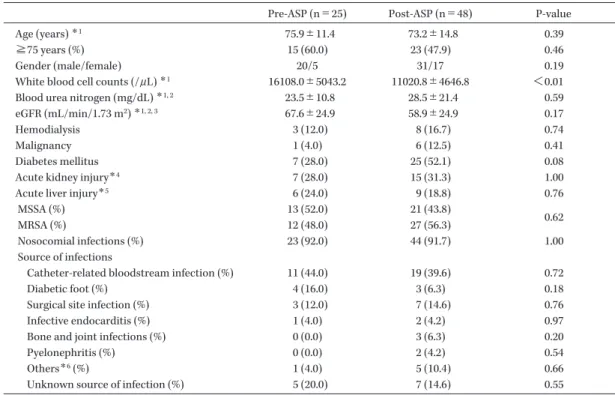
Table 1. Patient characteristics
Pre-ASP (n=25) Post-ASP (n=48) P-value
Age (years) *1 75.9±11.4 73.2±14.8 0.39
≧75 years (%) 15 (60.0) 23 (47.9) 0.46
Gender (male/female) 20/5 31/17 0.19
White blood cell counts (/μL) *1 16108.0±5043.2 11020.8±4646.8 <0.01
Blood urea nitrogen (mg/dL) *1, 2 23.5±10.8 28.5±21.4 0.59
eGFR (mL/min/1.73 m2) *1, 2, 3 67.6±24.9 58.9±24.9 0.17
Hemodialysis 3 (12.0) 8 (16.7) 0.74
Malignancy 1 (4.0) 6 (12.5) 0.41
Diabetes mellitus 7 (28.0) 25 (52.1) 0.08
Acute kidney injury*4 7 (28.0) 15 (31.3) 1.00
Acute liver injury*5 6 (24.0) 9 (18.8) 0.76
MSSA (%) 13 (52.0) 21 (43.8)
MRSA (%) 12 (48.0) 27 (56.3) 0.62
Nosocomial infections (%) 23 (92.0) 44 (91.7) 1.00
Source of infections
Catheter-related bloodstream infection (%) 11 (44.0) 19 (39.6) 0.72 Diabetic foot (%) 4 (16.0) 3 (6.3) 0.18 Surgical site infection (%) 3 (12.0) 7 (14.6) 0.76 Infective endocarditis (%) 1 (4.0) 2 (4.2) 0.97 Bone and joint infections (%) 0 (0.0) 3 (6.3) 0.20 Pyelonephritis (%) 0 (0.0) 2 (4.2) 0.54 Others*6 (%) 1 (4.0) 5 (10.4) 0.66 Unknown source of infection (%) 5 (20.0) 7 (14.6) 0.55
*1 a±b: Means±SD
*2 Excluding patients with hemodialysis.
*3 eGFR was the estimated glomerular filtration rate.
*4 We evaluated acute kidney injury based on the KDIGO criteria.
*5 We defined acute liver injury that as levels of aspartate aminotransferase and alanine aminotransferase more than twice the normal ranges or abnormal total bilirubin.
*6 Others were liver abscess in pre-ASP, febrile neutropenia, bacterial aneurysm, infectious aortic dissection, subcutaneous abscess, and graft infection of dialysis patient in post-ASP.
7.倫理的配慮
本研究は当院の倫理委員会の承認を得て行った
(承認番号:29-009)。
II.結果 1.患者背景
2008年4月〜2016年3月 に 血 液 培 養 か ら,S.
aureus が検出された患者98例のうち,コンタミ
ネーションと判断された16例,主治医の判断で無 治療となった7例,転院で追跡困難であった2例を 除外した結果,SABは支援前で25例,支援後で48 例であった。両群の患者背景をTable 1に示す。
MRSA菌血症は支援前で48.0%,支援後で56.3%,
両群とも院内発症例が92%程度であり,感染巣と し て は,カ テ ー テ ル 関 連 血 流 感 染 症(Catheter- related bloodstream infection:CRBSI)が最も多 かった。白血球数以外の項目では,両群とも有意な 差を認めなかった。
2.SAB のアウトカム指標に関する検討
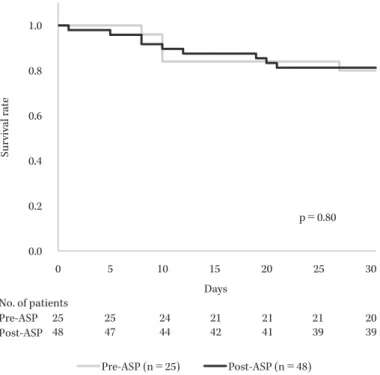
支援前後における30日生存率,抗菌薬治療終了 後のSABの再燃率,治療中の副作用発現率をFig.
2,Table 2に示す。SABのアウトカム指標とした 30日生存率,SAB再燃率,副作用発現率は有意な 差を認めなかった。
両群における死亡例は支援前:5例,支援後:9 例であり,その内訳は支援前で感染巣不明:2例,
感染性心内膜炎:1例,CRBSI:1例,糖尿病性足 病変:1例であり,4例がMRSA菌血症であった。
一方,支援後はCRBSI:4例,感染巣不明:3例,
感染性心内膜炎:1例,手術部位感染:1例であり,
7例がMRSA菌血症であった。
副作用の内訳は,支援前で,急性腎障害:3例,
血小板減少症:1例,支援後では,Clostridium diffi- cile感染症:1例,血小板減少症:1例,QT延長:
1例,間質性腎炎:1例であった。
Table 2. Rate of recurrence of SAB and adverse drug reactions in pre-and post-ASP Number of patients (%)
P-value Pre-ASP (n=25) Post-ASP (n=48)
Recurrence of SAB after the treatment 4 (16.0) 5 (10.4) 0.48
Adverse drug reactions 4 (16.0) 4 (8.3) 0.43
Fig. 2. Cumulative 30-day survival rate in patients pre-ASP and post-ASP for SAB Data of the pre-ASP group were collected between April 1, 2008 and March 31, 2012, and data of the post ASP group were collected between April 1, 2012 and March 31, 2016. Data were compared using the Kaplan-Meier method and log-rank test.
0.0 0.2 0.4 0.6 0.8 1.0
0 5 10 15 20 25 30
Days
Pre-ASP (n=25) Post-ASP (n=48) p=0.80
Survival rate
No. of patients
Pre-ASP 25 25 24 21 21 21 20
48 47 44 42 41 39 39 Post-ASP
3.SAB のプロセス指標に関する検討
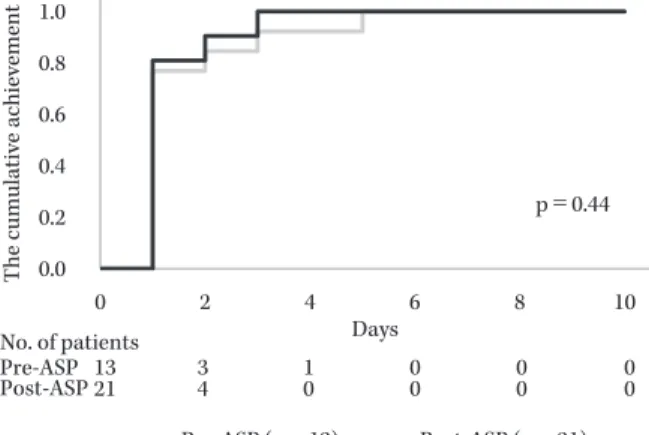
適正抗菌薬の累積使用率をFig. 3に示す。全体 における適正抗菌薬の累積使用率,MSSAにおけ る適正抗菌薬の累積使用率では有意な差を認めな かったが,MRSAにおける適正抗菌薬の累積使用 率では,支援後で有意に上昇していた(p=0.02)。
次に,支援前後における初期治療薬,初期治療開 始後からDefinitive therapy前までの使用抗菌薬,
最終報告後のDefinitive therapyをTables 3〜5に 示す。初期治療薬では,抗MRSA薬と他剤の併用 率が支援前:16.0%,支援後:41.7%であり,支援 後で有意に上昇していた(p=0.04)。また,未治療 率は支援前:20.0%,支援後:4.2%であり,支援後 で有意に低下していた(p=0.04)。抗MRSA薬の使 用率は支援前:24.0%,支援後:47.9%であった(p
=0.08)。初期治療開始後からDefinitive therapy前 までの使用抗菌薬では,抗MRSA薬と他剤の併用 率が支援前:32.0%,支援後:72.3%であり,支援 後で有意に上昇していた(p<0.01)。抗MRSA薬 の使用率は,支援前:60.0%,支援後:83.0%であ り,有意に上昇していた(p=0.046)。最終報告後の Definitive therapyでは,抗MRSA薬と他剤の併用 率は,支援前:16.7%,支援後:19.6%であり(p=
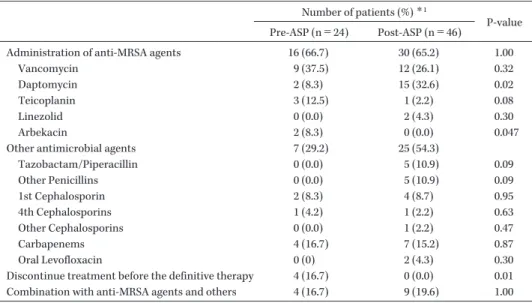
1.00),抗MRSA薬の使用率は,支援前:66.7%,支 援後:65.2%(p=1.00)と両群に大きな差は認めな かった。一方,最終報告後にDefinitive therapyに 移行せず,治療中止となった割合は支援前:16.7%,
支援後:0%であり,支援後で有意に低下していた
(p=0.01)。4日 以 上VCMを 使 用 し た25例(支 援 前:10例,支援後:15例)における血中濃度の初
Fig. 3. Cumulative use adherence to appropriate antimicrobial therapy in patients pre-ASP and post-ASP for SAB, MSSA and MRSA
(A) Cumulative use adherence to appropriate antimicrobial therapy in patients pre-ASP and post-ASP for SAB. (B) Cumula- tive use adherence to appropriate antimicrobial therapy in patients pre-ASP and post-ASP for MSSA. (C) Cumulative use adherence to appropriate antimicrobial therapy in patients pre-ASP and post-ASP for MRSA. Data of the pre-ASP group were collected between April 1, 2008 and March 31, 2012 and data of the post-ASP group were collected between April 1, 2012 and March 31, 2016. Data were compared using the Kaplan-Meier method and log-rank test.
0.0 0.2 0.4 0.6 0.8 1.0
0 2 4 6 8 10
Days
Pre-ASP (n=13) Post-ASP (n=21)
0.0 0.2 0.4 0.6 0.8 1.0
0 2 4 6 8 10
Days
Pre-ASP (n=12) Post-ASP (n=27)
p=0.44
The cumulative achievement
The cumulative achievement
B. Cumulative use with adherence to appropriate antimicrobial therapy in patients pre-ASP and post-ASP for MSSA
C. Cumulative use with adherence to appropriate antimicrobial therapy in patients pre-ASP and post-ASP for MRSA A.
The cumulative achievement 0.0 0.2 0.4 0.6 0.8 1.0
0 2 4 6 8 10
Days
Pre-ASP (n=25) Post-ASP (n=48) No. of patients
Pre-ASP 25 13 8 6 4 1
48 22 10 3 2 0
Post-ASP
No. of patients
Pre-ASP 13 3 1 0 0 0
21 4 0 0 0 0
Post-ASP
No. of patients
Pre-ASP 12 10 7 6 4 1
27 18 10 3 2 0 Post-ASP
Cumulative use with adherence to appropriate antimicrobial therapy in patients pre-ASP and post-ASP for SAB
p=0.07
p=0.02
回トラフ値分布をTable 6に示す。支援前後の比較 では,治療域である10〜20μg/mLの割合が支援後 で有意に上昇し(p=0.03),高値であるトラフ値>20 μg/mLの割合は支援後で有意に低下していた(p=
0.046)。
De-escalation実施率は支援前:14.3%,支援後:
47.7%であり,支援後で有意に上昇していた(p=0.01,
Table 7)。
支援前後における14日以上の適正抗菌薬使用率,
抗菌薬投与終了前までの血液培養の陰性化確認率,
TTE実施率をTable 8に示す。14日以上の適正抗 菌薬使用率は,支援前:48.0%,支援後:79.2%で
あり,支援後で有意な上昇を認めた(p<0.01)。
血液培養の陰性化確認率,TTE実施率では,支 援前後で有意な差は認めなかった。
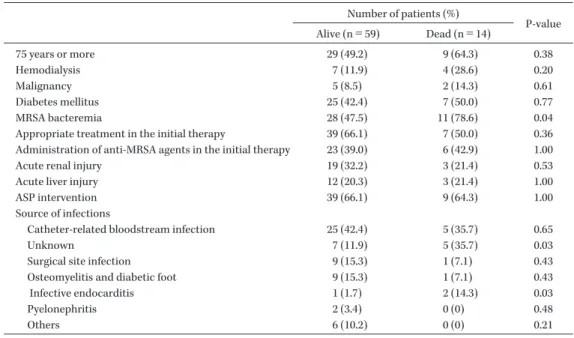
4.SAB による死亡のリスク因子に関する検討 対象患者を生存群:59例,死亡群:14例に分類 し,調査項目から死亡に影響するリスク因子につい て検討した結果,MRSA菌血症(p=0.04),感染巣 不明(p=0.03),感染性心内膜炎(p=0.03)を説明 変数とした(Table 9)。多変量解析では,MRSA 菌血症がオッズ比4.34(95%信頼区間1.10〜22.90,
p=0.04),感染巣不明がオッズ比5.87(95%信頼区 間1.43〜29.98,p=0.02),感染性心内膜炎がオッズ
Table 3. Antimicrobial agents for the initial therapy in pre-and post-ASP Number of patients (%)
P-value Pre-ASP (n=25) Post-ASP (n=48)
Administration of anti-MRSA agents 6 (24.0) 23 (47.9) 0.08
Vancomycin 3 (12.0) 10 (20.8) 0.59
Daptomycin 1 (4.0) 12 (25.0) 0.01
Teicoplanin 1 (4.0) 0 (0) 0.16
Linezolid 1 (4.0) 1 (2.1) 0.63
Other antimicrobial agents 18 (72.0) 43 (89.6)
Tazobactam/Piperacillin 3 (12.0) 17 (35.4) 0.03
Other Penicillins 1 (4.0) 3 (6.3) 0.69
1st Cephalosporin 0 (0) 4 (8.3) 0.14
4th Cephalosporins 3 (12.0) 1 (2.1) 0.08
Other Cephalosporins 1 (4.0) 3 (6.3) 0.68
Carbapenems 10 (40.0) 13 (27.1) 0.26
Fluoroquinolones 0 (0) 1 (2.1) 0.47
Others 0 (0) 1 (2.1) 0.47
No therapy 5 (20.0) 2 (4.2) 0.04
Combination with anti-MRSA agents and others 4 (16.0) 20 (41.7) 0.04
Table 4. Antimicrobial agents from starting the initial therapy to before the definitive therapy in pre- and post-ASP
Number of patients (%)*1
P-value Pre-ASP (n=25) Post-ASP (n=47)
Administration of anti-MRSA agents 15 (60.0) 39 (83.0) 0.046
Vancomycin 9 (36.0) 11 (23.4) 0.26 Daptomycin 2 (8.0) 24 (51.1) <0.01 Teicoplanin 4 (16.0) 0 (0) <0.01 Linezolid 0 (0) 4 (8.5) 0.13
Other antimicrobial agents 18 (72.0) 42 (89.4)
Tazobactam/Piperacillin 3 (12.0) 17 (36.2) 0.03 Other Penicillins 0 (0) 2 (4.3) 0.30 1st Cephalosporin 0 (0) 3 (6.4) 0.20 4th Cephalosporins 2 (8.0) 1 (2.1) 0.24 Other Cephalosporins 2 (8.0) 2 (4.3) 0.51 Carbapenems 11 (44.0) 16 (34.0) 0.41 Fluoroquinolones 0 (0) 1 (2.1) 0.46 Combination with anti-MRSA agents and others 8 (32.0) 34 (72.3) <0.01
*1 We evaluated the use of antimicrobial agents for surviving cases.
比4.00(95%信 頼 区 間1.06〜244.47,p=0.046)で あり,これら3項目が有意なリスク因子であった
(Table 10)。
III.考察
感染症専門医によるASP活動を通じたSABに 対する適正な治療管理,Care bundleの遵守率,生 存率などを検討した報告は複数あり11,12,14,15),これら の先行研究では,生存率の向上,14日以上の適正 抗菌薬使用率,血液培養再検率,TTE実施率の改 善を認めている。また,Wenzlerらは薬剤師主導の 取り組みにおいても同様の効果を報告している16)。
今回のわれわれの研究では,プロセス指標とした MRSA菌血症に対する適正抗菌薬の累積使用率,14 日以上の適正抗菌薬使用率,VCMの初回トラフ値 における治療域の割合で有意な改善を認めたが,ア ウトカム指標とした30日生存率は支援前後で有意 な差を認めなかった。
本研究はSABによる死亡のリスク因子にMRSA 菌血症,感染巣不明,感染性心内膜炎を特定してお り,支援前後の死亡例の内訳からもこれらの因子が 生存率に影響していると考えた。MRSA菌血症と 死亡のリスクについてだが,CosgroveらはMRSA
Table 5. Antimicrobial agents for the definitive therapy in pre-and post-ASP Number of patients (%) *1
P-value Pre-ASP (n=24) Post-ASP (n=46)
Administration of anti-MRSA agents 16 (66.7) 30 (65.2) 1.00
Vancomycin 9 (37.5) 12 (26.1) 0.32 Daptomycin 2 (8.3) 15 (32.6) 0.02 Teicoplanin 3 (12.5) 1 (2.2) 0.08 Linezolid 0 (0.0) 2 (4.3) 0.30 Arbekacin 2 (8.3) 0 (0.0) 0.047
Other antimicrobial agents 7 (29.2) 25 (54.3)
Tazobactam/Piperacillin 0 (0.0) 5 (10.9) 0.09 Other Penicillins 0 (0.0) 5 (10.9) 0.09 1st Cephalosporin 2 (8.3) 4 (8.7) 0.95 4th Cephalosporins 1 (4.2) 1 (2.2) 0.63 Other Cephalosporins 0 (0.0) 1 (2.2) 0.47 Carbapenems 4 (16.7) 7 (15.2) 0.87 Oral Levofloxacin 0 (0) 2 (4.3) 0.30 Discontinue treatment before the definitive therapy 4 (16.7) 0 (0.0) 0.01 Combination with anti-MRSA agents and others 4 (16.7) 9 (19.6) 1.00
*1 We evaluated the use of antimicrobial agents for surviving cases.
Table 6. Rate of serum trough concentrations of vancomycin in pre-and post-ASP Trough concentrations
of vancomycin
Number of patients*1 (%)
P-value Pre-ASP (n=10) Post-ASP (n=15)
Too low: <10 μg/mL 2 (20.0) 2 (13.3) 0.66
Target: 10-20 μg/mL 3 (30.0) 11 (73.3) 0.03
Too high: >20 μg/mL 5 (50.0) 2 (13.3) 0.046
*1We evaluated the rate of serum trough concentrations of vancomycin for pa- tients who used it for more than 4 days in pre-and post-ASP.
Table 7. Rate of de-escalation in pre-and post-ASP
Number of patients*1 (%)
P-value Pre-ASP (n=21) Post-ASP (n=44)
De-escalation within 2 days after antimicrobial susceptibility testing reports 3 (14.3) 21 (47.7) 0.01
*1We evaluated the rate of de-escalation for possible modifiable patients and excluded untreated case and definitive therapy from the initial therapy in pre-and post-ASP.
Table 8. Rate of adherence with care bundle on SAB in pre-and post-ASP Number of patients (%)
P-value Pre-ASP (n=25) Post-ASP (n=48)
Administration for 14 days or more 12 (48.0) 38 (79.2) <0.01 Re-examination of blood culture*1 9 (36.0) 27 (56.3) 0.13
Implementation of TTE*1 9 (36.0) 23 (47.9) 0.46
*1We evaluated these events with or without implementation before treatment completion.
ではMSSAよりも1.93倍上 昇 す る と 報 告 し て お り1),van Halら のReviewに お い て もMRSAは SABのリスク因子として報告されている2)。本研究
では,MRSA菌血症に対して適正抗菌薬使用率は 支援後で有意に上昇していたが,2日目までの使用 率は50%程度であり,この結果も生存率に影響し
Table 9. Univariate and multivariate analysis of mortality by risk factor in patients with SAB Number of patients (%)
P-value Alive (n=59) Dead (n=14)
75 years or more 29 (49.2) 9 (64.3) 0.38
Hemodialysis 7 (11.9) 4 (28.6) 0.20
Malignancy 5 (8.5) 2 (14.3) 0.61
Diabetes mellitus 25 (42.4) 7 (50.0) 0.77
MRSA bacteremia 28 (47.5) 11 (78.6) 0.04
Appropriate treatment in the initial therapy 39 (66.1) 7 (50.0) 0.36
Administration of anti-MRSA agents in the initial therapy 23 (39.0) 6 (42.9) 1.00
Acute renal injury 19 (32.2) 3 (21.4) 0.53
Acute liver injury 12 (20.3) 3 (21.4) 1.00
ASP intervention 39 (66.1) 9 (64.3) 1.00
Source of infections
Catheter-related bloodstream infection 25 (42.4) 5 (35.7) 0.65 Unknown 7 (11.9) 5 (35.7) 0.03 Surgical site infection 9 (15.3) 1 (7.1) 0.43 Osteomyelitis and diabetic foot 9 (15.3) 1 (7.1) 0.43
Infective endocarditis 1 (1.7) 2 (14.3) 0.03
Pyelonephritis 2 (3.4) 0 (0) 0.48 Others 6 (10.2) 0 (0) 0.21
Table 10. Multivariate analysis of mortality by risk fac- tor in patients with SAB
Odds rate (95% CI) P-value MRSA bacteremia 4.34 (1.10-22.90) 0.04
Unknown 5.87 (1.43-29.98) 0.02
Infective endocarditis 4.00 (1.06-244.47) 0.046
ている可能性が考えられた。感染巣不明と死亡のリ スクについてだが,López-Cortésらが行ったSAB の感染症診療におけるBundleの検証では,早期の 感染巣コントロールも治療を成功させるための項目 の一つとしており,死亡のリスク因子として感染巣 不明は1.5〜2倍上昇すると報告している14)。本研究 においても支援後で3例が感染巣不明のまま死亡し ていることから,これらの症例では早期の感染巣の 特定とコントロールが重要であり,抗菌薬の適正使 用支援を主とする薬剤師主導のASP活動は生存率 の向上に寄与できない可能性が考えられた。感染性 心内膜炎と死亡のリスクについてだが,支援後の2 例とも左心系感染性心内膜炎であった。このうち1 例は高齢のため薬物治療のみを実施したが永眠され た。van HalらのSABにおける死亡予測因子に関 する検証では,左心系感染性心内膜炎は死亡率の高 い疾患の一つとして報告されている2)。また,一般 的に左心系心内膜炎は薬物治療に加えて手術も必要 となるため,これらのことが本研究の生存率に影響
していると考えた。
本研究のプロセス指標としたSABに対する適正 抗菌薬の累積使用率はMRSA菌血症において支援 後で有意に上昇していた。また,初期治療,初期治 療 後 か らDefinitive therapy前 ま で に お け る 抗 MRSA薬の使用率は有意に上昇し,Definitive ther- apy移行前の治療中止率が有意に減少していた。こ れらのことから,SABの感染症診療に対する薬剤 師主導のASP活動は有用であることが示唆された。
初期治療の支援および初期治療開始後からDe- finitive therapy前までの支援内容における検討で は,支援後で抗MRSA薬とβ―ラクタム系薬などの 併用療法が有意に増加していた。両群で多く使用さ れていたVCMはMSSAに対する治療成績が低く なると報告されていること4),当院では細菌検査を 外部委託しており細菌検査に関する報告の遅れが直 接予後に影響する可能性もあることから,薬剤師主 導のASP活動の結果として初期に抗MRSA薬と β―ラクタム系薬などの併用療法が増加したと考え る。本研究は支援前後で抗MRSA薬の使用状況に 違いを認めたが,2011年10月から当院でDAPを 採用したことがこの結果に影響したと考えられた。
VCMのAUC/MICは菌血症で400以上が望まし いと考えられており,その代替指標であるトラフ値 は15〜20 μg/mLが求められているが,腎機能障 害のリスクも上昇する10)。そのため,ASP活動とし
てVCMの初期投与設計やTDMを支援することは 重要である。一方で,近年,敗血症時に抗菌薬の腎 クリアランスや分布容積が亢進するという概念が提 唱されており,通常量投与しても低濃度となる危険 性が示唆されている17)。また,本研究の支援前後で 30%程度認めた急性腎障害例でVCMを使用する場 合は,初期用量は変更せずに状態に応じて維持用量 を調整するという推奨もあるため18),血中濃度のコ ントロールが不良となる可能性のある症例では他剤 を考慮する必要がある。当院では血中濃度測定も外 部に委託しているが,重症例では測定結果が判明す るまでのタイムラグが予後に影響する可能性もある ため,高齢者,腎障害例,重症例などでは,DAP の使用を推奨している。両群におけるVCMの使用 率の差はこれらの背景も影響していると考えられた。
本研究における4日以上のVCM使用例での初回ト ラフ値分布の検証では,支援後で治療域の割合が有 意に上昇して高値の割合が有意に減少したことから,
支援後のVCMの推奨と投与設計は有用であったと 考える。
プロセス指標としたDe-escalation実施率は支援 後においても有意に上昇していた。一方で,本研究 では支援後においても狭域抗菌薬の使用率が低い傾 向にあった。その背景には以前より広域抗菌薬の使 用率が高いこと7),両群とも院内感染症が90%以上 を占めており,SABだけを対象としたDefinitive therapyに移行しづらかったことが考えられた。
プロセス指標としたSABのCare bundle項目は,
14日以上の適正抗菌薬使用率で有意な上昇を認め たが,血液培養の陰性化確認率およびTTE実施率 では統計学的に有意な変化を認めなかった。これら のSABのCare bundle項目について,本研究結果 と感染症医および感染症コンサルトの支援である先 行研究を比較検証したところ,先行研究における14 日以上の適正抗菌薬使用率は,介入前の遵守率15〜
86%から介入後は55〜95%と上昇しており11,12,14,15), 本研究の支援後遵守率である79.2%は先行研究と同 程度であった。次に,先行研究における血液培養の 陰性化確認率は,介入前の遵守率32〜85%から介 入後は65〜96%と上昇しており11,12,14,15),本研究に
おける56.3%は先行研究よりもやや低値であった。
なお,本研究は薬剤師主導のASP活動のため,血 液培養の陰性化確認までの期間を治療終了前の実施
と定義したが,先行研究はSAB同定後3〜5日以 内に実施しているため,参考値として評価する必要 がある。また,本研究では支援前後で統計学的に有 意な改善を認めていないが,近年は血液培養の陰性 化日を基準とした治療期間の推奨もあることから19), 薬剤師主導のASP活動においても早期の血液培養 の陰性化確認に基づく抗菌薬の治療期間の設定と推 奨は重要と考える。先行研究におけるTTE実施率 は,介入前の遵守率13〜85%から介入後は55〜93%
と上昇しているが11,12,14,15),本研究における47.9%は 先行研究よりもやや低値であった。本研究は薬剤師 主導のASP活動であるが,感染症非専門医である 主治医を支援することで,SABのCare bundleで ある14日以上の適正抗菌薬使用率が有意に上昇し,
その成績は感染症医主導の先行研究に近づくことが 示唆された。
● ● ● ● ● ● ● ● ● ● ● ● ● ● ● ● ● ● ● ● ● ● ● ● ● ● ● ● ● ● ● ● ● ● ● ● ●
おわりに
本研究は単施設での検証で症例数が少なく検出力 が不十分であったこともあり,アウトカム指標とし た生存率,SABの再燃率,副作用発現率の改善に はいたらなかったという限界点はあるが,薬剤師主 導のASP活動を通じてSABの感染症診療を支援 することは,適正抗菌薬の早期使用率およびSAB における適正な治療期間の達成率とVCMの初回ト ラフ値における治療域の割合というプロセス指標の 向上に繋がる可能性が示唆された。
利益相反自己申告:著者 國島広之はMSD株式 会社,富山化学工業株式会社,大正富山医薬品株式 会社から講演料を受けている。
文献
1) Cosgrove S E, Sakoulas G, Perencevich E N, Schwaber M J, Karchmer A W, Carmeli Y:
Comparison of Mortality Associated with Methicillin-Resistant and Methicillin-Susceptible Staphylococcus aureus Bacteremia: A Meta- analysis. Clin Infect Dis 2003; 36: 53-9
2) van Hal S J, Jensen S O, Vaska V L, Espedido B A, Paterson D L, Gosbell I B: Predictors of Mortality in Staphylococcus aureus Bactere- mia. Clin Microbiol Rev 2012; 25: 362-86 3) Thwaites G E, Edgeworth J D, Gkrania-Klotsas
E, Kirby A, Tilley R, Török M E, et al: Clinical management of Staphylococcus aureus bacte-
raemia. Lancet Infect Dis 2011; 11: 208-22 4) McConeghy K W, Bleasdale S C, Rodvold K A:
The Empirical Combination of Vancomycin and a β-Lactam for Staphylococcal Bacteremia.
Clin Infect Dis 2013; 57: 1760-5
5) Baddour L M, Wilson W R, Bayer A S, Fowler V G Jr, Tleyjeh I M, Rybak M J, et al: Infective Endocarditis in Adults: Diagnosis, Antimicro- bial Therapy, and Management of Complica- tions: A Scientific Statement for Healthcare Professionals From the American Heart Asso- ciation. Circulation 2015; 132: 1435-86
6) Dellit T H, Owens R C, McGowan J E Jr, Gerd- ing D N, Weinstein R A, Burke J P, et al: Infec- tious Diseases Society of America and the Soci- ety for Healthcare Epidemiology of America guidelines for developing an institutional pro- gram to enhance antimicrobial stewardship.
Clin Infect Dis 2007; 44: 159-77
7) 佐村 優,國島広之,倉田武徳,廣瀬直樹,石 井淳一,腰岡 桜,他:血液培養陽性例に対す る薬剤師の早期介入体制の構築とその効果。日 化療会誌 2015; 63: 544-52
8) Niwa T, Watanabe T, Goto T, Ohta H, Nakayama A, Suzuki K, et al: Daily Review of Antimicrobial Use Facilitates the Early Optimi- zation of Antimicrobial Therapy and Improves Clinical Outcomes of Patients with Bloodstream Infections. Biol Pharm Bull 2016; 39: 721-7 9) 前田真之,詫間隆博,内藤結花,宇賀神和久,
寺田真悠子,小司久志,他:血液培養陽性患者 に対する抗菌薬適正使用支援プログラムに基づ く早期介入のアウトカム評価―後ろ向き準実験 的研究―。日化療会誌 2017; 65: 751-7
10) MRSA感染症の治療ガイドライン作成委員会:
MRSA感染症の治療ガイドライン改訂版2017,
日本化学療法学会/日本感染症学会,東京,2017 11) Nagao M, Iinuma Y, Saito T, Matsumura Y, Shirano M, Matsushima A, et al: Close coopera- tion between infectious disease physicians and attending physicians can result in better man- agement and outcome for patients withStaphy- lococcus aureus bacteraemia. Clin Microbiol In-
fect 2010; 16: 1783-8
12) Pragman A A, Kuskowski M A, Abraham J M, Filice G A: Infectious Disease Consultation for Staphylococcus aureus Bacteremia Improves Patient Management and Outcomes. Infect Dis Clin Pract (Baltim Md) 2012; 20: 261-7
13) Paul M, Dickstein Y, Raz-Pasteur A: Antibiotic de-escalation for bloodstream infections and pneumonia: systematic review and meta- analysis. Clin Microbiol Infect 2016; 22: 960-7 14) López-Cortés L E, Del Toro M D, Gálvez-
Acebal J, Bereciartua-Bastarrica E, Fariñas M C, Sanz-Franco M, et al: Impact of an evidence- based bundle intervention in the quality-of-care management and outcome of Staphylococcus aureus bacteremia. Clin Infect Dis 2013; 57:
1225-33
15) Nguyen C T, Gandhi T, Chenoweth C, Lassiter J, Dela Pena J, Eschenauer G, et al: Impact of an antimicrobial stewardship-led intervention for Staphylococcus aureus bacteraemia: a quasi-experimental study. J Antimicrob Che- mother 2015; 70: 3390-6
16) Wenzler E, Wang F, Goff D A, Prier B, Mellett J, Mangino J E, et al: An Automated, Pharmacist-Driven Initiative Improves Quality of Care forStaphylococcus aureus Bacteremia.
Clin Infect Dis 2017; 65: 194-200
17) Shimamoto Y, Fukuda T, Tanaka K, Komori K, Sadamitsu D: Systemic inflammatory response syndrome criteria and vancomycin dose re- quirement in patients with sepsis. Intensive Care Med 2013; 39: 1247-52
18) Matzke G R, Aronoff G R, Atkinson A J Jr, Bennett W M, Decker B S, Eckardt K U, et al:
Drug dosing consideration in patients with acute and chronic kidney disease-a clinical up- date from Kidney Disease: Improving Global Outcomes (KDIGO). Kidney Int 2011; 80: 1122- 37
19) Holland T L, Arnold C, Fowler V G Jr: Clinical management of Staphylococcus aureus bac- teremia: a review. JAMA 2014; 312: 1330-41
Evaluation of the efficacy of pharmacist-driven support for infectious diseases through an antimicrobial stewardship program for
Staphylococcus aureus bacteremia
Masaru Samura
1), Naoki Hirose
1), Takenori Kurata
1), Junichi Ishii
1), Fumio Nagumo
1), Keisuke Takada
1), Sakura Koshioka
1), Masaki Uchida
1),
Syunya Yamamoto
1), Junki Inoue
1), Hisakazu Sekine
1), Akira Ishida
2), Norifumi Kunika
2)and Hiroyuki Kunishima
3)1)Department of Pharmacy, Yokohama General Hospital, 2201―5 Kurogane Aoba-ku, Yokohama, Kanagawa, Japan
2)Internal Medicine, Yokohama General Hospital
3)Department of Infectious Disease, St. Marianna University School of Medicine
Staphylococcus aureus bacteremia (SAB) is a high-mortality infectious disease and may cause complica- tions such as infective endocarditis, abscess formation, or osteomyelitis. Therefore, it is very important to select appropriate antimicrobial agents at an early stage and to adhere to treatment for more than 14 days.
Although the Yokohama General Hospital is a medium-sized hospital with 300 beds, full-time infectious disease specialists are lacking. Therefore, pharmacists of the Certified Infectious Disease Chemotherapy Pharmacists (CIDCPs) group have implemented an antimicrobial stewardship program in which CIDCPs assist physicians and ward-pharmacists to evaluate interim and final reports of blood culture, and provide support for appropriate infectious disease treatment.
In this study, we evaluated the 30-day survival rate and adherence to cumulative use of appropriate an- timicrobial agents, treatment with antimicrobial agents for more than 14 days, re-examination of blood cul- ture, and implementation of transthoracic echocardiography in the pre-ASP (2008-2011) and post-ASP (2012-2015) periods. Results showed that the 30-day survival rate as one of the outcome indicators was 80.0% (20/25) in the pre-ASP period, and 81.3% (39/48) in the post-ASP period, which was not a significant difference. Although adherence to the cumulative use of appropriate antimicrobial agents for SAB and MSSA bacteremia as process indicators was not significantly different between the pre-ASP and post-ASP groups, that for MRSA was significantly different (p=0.02). Treatment adherence for more than 14 days in the pre-ASP and post-ASP groups as one of the process indicators was 48.0% (12/25) and 79.2% (38/48) (p
<0.01), respectively; adherence to re-examination of blood culture as one of the process indicators was 36.0% (9/25) and 56.3% (27/48) (p=0.13), respectively; and adherence to implementation of transthoracic echocardiography as one of the process indicators was 36.0% (9/25) and 47.9% (23/48) (p=0.46), respec- tively. In a multivariate analysis, factors which increased mortality were MRSA bacteremia (odds rate 4.34, 95% confidence interval 1.10-22.90), unknown infection sites (odds rate 5.87, 95% confidence interval 1.43-29.98), and infective endocarditis (odds rate 4.00, 95% confidence interval 1.06-244.47). In conclusion, al- though this study found that pharmacist-driven ASP did not improve 30-day survival as one of the out- come indicators, it improved adherence to appropriate antimicrobial therapy for MRSA, the appropriate treatment duration for SAB, and the rate of the target trough concentration of vancomycin as process in- dicators.