Oceanography
Vol. 19, No. 2, June 2006 52T H E O C E A N S A N D H U M A N H E A LT H
CLIMATE
CHANGE, OCEANS, AND
HUMAN HEALTH
B Y J O N AT H A N A . P AT Z ,
S A R A H H . O L S O N , A N D A M B E R L . G R AY
Current climate changes are largely associated with the accumulation of anthropo- genic CO2 in the atmosphere. Fossil-fuel burning, which currently releases about 7 billion tonnes of carbon to the atmosphere each year, contributes roughly 70 per- cent of the anthropogenic CO2 emissions, while much of the rest is attributed to de- forestation (Raven and Falkowski, 1999). Only about half of the anthropogenic CO2 released to the atmosphere is absorbed by the oceans and continental vegetation.
As a result, atmospheric CO2 concentrations have increased by roughly 100 ppmv (parts per million by volume) during the last two centuries.
Due to this rapid and signifi cant rise in atmospheric CO2 concentrations, the Intergovernmental Panel on Climate Change (IPCC) predicts that average global temperatures will increase between 1.8°C and 5.8°C over the next century, and sea level will rise between 9 and 88 centimeters (IPCC, 2001), with midrange estimates of 3°C global mean warming and 45 cm sea-level rise, respectively. Increased vari- ability in the hydrologic cycle (i.e., more fl oods and droughts) is expected to accom- pany these global-warming trends. The rate of change in climate is faster now than in any period in the last thousand years. And while industrialized countries are most responsible for causing global warming, it is the low-income countries with little capacity to adapt that are the most vulnerable (Patz et al., 2005).
This article has been published in Oceanography, Volume 19, Number 2, a quarterly journal of The Oceanography Society. Copyright 2006 by The Oceanography Society. All rights reserved. Permission is granted to copy this article for use in teaching and research. Republication, systemmatic reproduction, or collective redistirbution of any portion of this article by photocopy machine, reposting, or other means is permitted only with the approval of The Oceanography Society. Send all correspondence to: info@tos.org or Th e Oceanography Society, PO Box 1931, Rockville, MD 20849-1931, USA.
Low-lying coastal areas and small island nations are especially at risk from sea-level rise, storms, and microbiological threats in the ocean. In general, vulnerability to climate impacts is a function of societal characteristics in combination with climate, geographic, and other phenomena . The extensive Ganges River Delta is an example of such an at-risk area .
Image acquired by Landsat 7’s Enhanced Thematic Mapper plus (ETM+) on Februar y 28, 2000. Image provided by the USGS EROS Data Center Satellite Systems Branch.
Oceanography
Vol. 19, No. 2, June 2006 54Evidence is accumulating that such changes in the broad-scale climate sys- tem may already be affecting human health outcomes sensitive to climate. For example, the World Health Organization (WHO) estimates that the warming that has already occurred in the past 30 years is responsible for over 150,000 deaths annually due to increasing rates of mor- tality and morbidity from extreme heat, cold, drought or storms; signifi cant changes in air and water quality; and changes in the ecology of a wide range of microbial diseases (Campbell-Lendrum et al., 2004). Many of these deaths are occurring in low-lying coastal areas and small island nations, which are especially
at risk from sea-level rise, storms, and microbiological threats in the ocean. In general, vulnerability to climate impacts is a function of societal characteristics in combination with climate, geographic, and other phenomena.
SE A LEVEL RISE
As noted above, the IPCC projections indicate that the sea level will rise by an additional 11 to 88 cm by the year 2100 (Houghton et al., 1996). Thermal expan- sion of the ocean is expected to account for roughly half of this increase; most of the remainder will result from the melt- ing of glaciers and ice caps, both second- ary to global warming. This sea-level
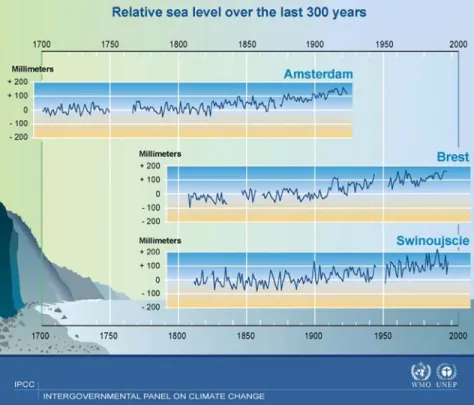
rise could affect human health through coastal fl ooding and erosion, saltwater intrusion into coastal freshwater aquifers, damage to coral reefs and coastal fi sher- ies, and forced human population dis- placement. Low-lying coastal and delta regions (such as coastal China, Bangla- desh, and Egypt), especially those that are densely populated, and low-lying small island states (such as coral-reef atolls throughout Polynesia) are at elevated risk (Figure 1) (McCarthy et al., 2001).
A large proportion of the world’s hu- man population lives close to coastlines where increasing trends in coastal settle- ment continue (see Bowen et al., this issue). The number of people who live more-or-less in harm’s way as a result of such events is projected to increase from 75 million to roughly 200 million if sea level rises by 40 cm during the 21st centu- ry (McCarthy et al., 2001). For example, according to one study, a one-meter sea- level rise would inundate low-lying areas, affecting 18.6 million people in China, 13.0 million in Bangladesh, 3.5 million in Egypt, and 3.3 million in Indonesia (Nicholls and Leatherman, 1995). The
Jonathan A. Patz ([email protected]) is Associate Professor of Environmental and Population Health Studies, Center for Sustainability and the Global Environment (SAGE), Nelson Institute for Environmental Studies and Department of Population Health Sciences, University of Wisconsin, Madison, WI, USA. Sarah H. Olson is Ph.D.
Candidate, Center for Sustainability and the Global Environment (SAGE), Nelson Insti- tute for Environmental Studies, University of Wisconsin, Madison, WI, USA. Amber L.
Gray is an undergraduate at the University of Wisconsin, Madison, WI, USA.
Figure 1. Relative sea-level rise over the last 300 years. Rates vary depending on local land subsid- ence or uplift. Global average sea-level rise has been approximately 1–2 cm per decade. Source:
IPCC (2001).
number of people at risk from fl ood- ing by coastal storm surges is projected to increase from the current 75 million to 200 million in a modeled scenario of midrange climate changes, in which a rise in sea level of 40 cm is envisaged by the 2080s (McCarthy et al., 2001).
Salination of coastal freshwater aqui- fers and disruption of storm-water drainage and sewage disposal, with or without fl ooding, could force coastal communities to migrate (Myers and Kent, 1995). Refugees suffer substantial health burdens, overcrowding, lack of shelter, and competition for resources. In fact, increased global confl ict may be one of the worst results emerging from such forced population migration (Patz and Kovats, 2002).
STORMS
Floods, droughts, and extreme storms have claimed millions of lives during the past 20 years, have adversely affected the lives of many more, and have caused billions of dollars in property damage (Noji, 1997). On average, disasters killed 123,000 people worldwide each year be- tween 1972 and 1996. Africa suffers the highest rate of disaster-related deaths (Loretti and Tegegn, 1996), although 80 percent of people affected by disasters are in Asia.
For every one person killed in a di- saster, an estimated 1,000 people are af- fected (International Federation of Red Cross and Red Crescent Societies [IFRC], 1998), either physically or through loss of property or livelihood. Furthermore, mental disorders (such as posttraumatic stress disorder) may substantially affect overall population wellbeing, depending upon the unexpectedness of the impact,
the intensity of the experience, the de- gree of personal and community disrup- tion, and long-term exposure to the vi- sual signs of the disaster (Green, 1982).
Population concentration in high-risk areas (such as fl oodplains and coastal zones) increases vulnerability. Also, deg- radation of the local environment can contribute signifi cantly to vulnerability (Diaz and Pulwarty, 1997). For example, worsening drought conditions in arid re- gions can have ramifi cations in the wide- spread (even trans-oceanic) transport of airborne dust (see case study by Prospe- ro, this issue). As another example, Hur- ricane Mitch, the most deadly hurricane to strike the Western Hemisphere in the last two centuries, caused 11,000 deaths in 1998 with thousands of others still missing in Central America. Many fatali- ties associated with Hurricane Mitch oc- curred far inland as a result of mudslides in deforested areas (National Climatic Data Center, 1999).
Hurricane formation requires sea surface temperatures (SST) above 26°C (Gray, 1979; Trenberth, 2005; Webster et al., 2005; also see Keim, this issue; case study by Miller et al., this issue). This condition exists during the summer months in the Atlantic Ocean between 5°N and 25°N, and in the North Pacifi c, Indian, and Southwest Pacifi c Oceans between latitudes 5° and 20° (Webster et al., 2005). Knutson et al. (1998) found that a sea surface warming of slightly over 2°C would intensify hurricane wind speeds by 3 to 7 meters per second (or 5 to 12 percent), although predicting the number of hurricanes that will make landfall is currently not possible.
Records indicate SSTs have steadily increased over the last 100 years, and
more sharply over the last 35 years. The highest average SST on record is between 1995–2004 (Trenberth, 2005). During the fi rst half of this period, the overall hurricane activity in the North Atlantic Ocean doubled and the Caribbean Sea experienced a fi ve-fold increase (Gold- enberg et al., 2001). SST is strongly cor- related with hurricane intensity and de- structiveness (Figure 2) (Emanuel, 2005).
Simulation models indicate future trends towards intensifi ed hurricane seasons (Knutson and Tuleya, 2004).
Much of the variability in SST is driven by the magnitude of local vertical wind shear and the effects of the El Niño Southern Oscillation (ENSO) (Golden- berg et al., 2001). ENSO refers to natural year-to-year variations in sea-surface temperatures, surface air pressure, rain- fall, and atmospheric circulation across the equatorial Pacifi c Ocean and beyond.
This cycle provides a model for observ- ing climate-related changes in many eco- systems. The El Niño phase of the ENSO cycle corresponds to a slackening of the Trade Wind system and a reduction in atmospheric pressure differentials across the equatorial Pacifi c. In recent years, the only normal regional storm activity (as measured by the Accumulated Cyclone Energy index) occurred during El Niño events, which suppress activity in the North Atlantic Ocean (Trenberth, 2005).
O CE ANS , ENS O, AND INFECTIOUS DISE A SE EPIDE MICS
Ocean temperatures associated with ENSO can strongly infl uence the resur- gence of major infectious diseases on land. For example, ENSO-driven climate variability has been linked to large epi-
Oceanography
Vol. 19, No. 2, June 2006 56demics of malaria on the Indian sub- continent and South America (Bouma and van der Kaay, 1996; Bouma and Dye, 1997). In East Africa, Rift Valley Fever epidemics (a mosquito-borne viral dis- ease) have coincided with unusually high rainfall associated with ENSO-related Pacifi c and Indian Ocean SST anoma- lies (Linthicum et al., 1999). Following the strong ENSO of 1997–1998, rainfall in the Rift Valley increased more than 50-fold and a major Rift Valley Fever epidemic ensued. These heavy rains resulted from the convergence of the strong ENSO with an unusually warm phase of the Indian Ocean, illustrating an important health-related link to sea- surface conditions. In fact, further analy-
sis showed that over three quarters of the Rift Valley Fever outbreaks between 1950 and 1988 occurred during warm ENSO event periods (Anyamba et al., 2001).
TE MPER ATURE AND DISS OLVED CO2 THRE ATS TO FISHERIE S AND PROTEIN M ALNUTRITION
Malnutrition remains one of the largest health crises worldwide; according to the WHO, approximately 800 million peo- ple are undernourished (WHO, 2002).
Droughts and other climate extremes have direct impacts on food crops and can indirectly infl uence land-based food supply by altering the ecology of plant pathogens. Also, climate effects on fi sh-
eries threaten coastal and island popula- tions that rely on fi sh as the main source of protein.
Worldwide, fi sh provides 16 percent of the animal protein consumed by people (see Dewailly and Knap, this is- sue). However, fi sh represent a higher proportion of protein in some regions (e.g., 26 percent in Asia). Global extinc- tions of fi sh are not likely to occur from climate change alone. However, worri- some evidence is emerging on the ad- verse effect of warmer temperatures on the world’s fi sheries. The recent slowing of the North Atlantic Gulf Stream may affect the abundance and seasonality of plankton that are a major source of food for many fi sh larvae (Pauly and Alder, 2005). Declining larval fi sh populations will affect the capacity of overexploited fi sh stocks to recover.
Climate change may also disrupt fi sheries as a result of both warming and changes in ocean current patterns, including freshwater input (Pauly and Alder, 2005). The capacity of fi sh to adapt to such changes is unknown, but the oceanic alterations projected from most global climate scenarios fall beyond most parameter ranges observed under natural marine regimes.
Finally, concern has arisen regard- ing the lowering of the pH of oceans (i.e., increasing acidity) from the CO2 sequestration. From a human health perspective, however, the impact of ris- ing ocean acidity on marine life is largely unknown. Legitimate concern exists over further stress on fi sheries from anticipated accelerated damage to cor- als and hard-shelled organisms because acidifi cation decreases the availability of calcium carbonate from the water.
Figure 2. Annually accumulated power dissipation index (PDI) for the western North Pacifi c and North Atlantic, compared to annually averaged sea surface temperature (Hadley Centre SST or HadlSST). Both time series have been transformed to facilitate comparison. Source: Emanuel (2005).
Coupled with coral-reef bleaching from warmer temperatures, fi sheries will likely be stressed further. Some models predict that a mean sea surface warming of only 1°C could cause the global collapse of coral-reef ecosystems (Pew Oceans Com- mission, 2003).
M ARINE MICROBIOLO GICAL EFFECTS
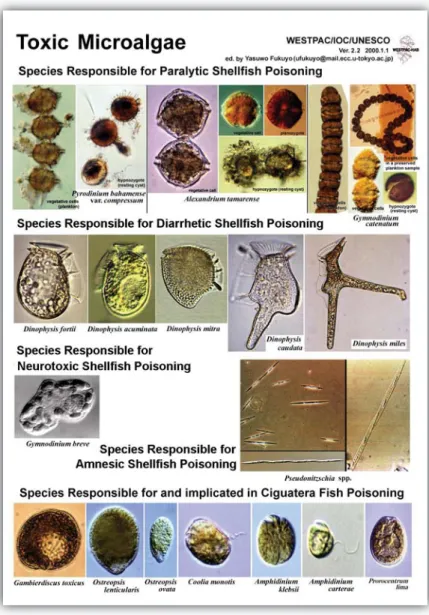
Warm water and increased nitrogen lev- els can favor blooms of certain marine algae, particularly cyanobacteria (blue green algae), dinofl agellates, and dia- toms, which can release toxins into the marine environment. These blooms—
also known as “red tides” or “harmful algal blooms (HABs)”—can cause acute and possibly chronic paralytic, diarrheic, neurologic, and amnesiac poisoning in humans through consumption of con- taminated seafood and aerosol expo- sures, as well as extensive die-offs of fi sh and of marine mammals and birds that depend on the marine food web (Fig- ure 3) (Tester, 1994; Glibert et al., 2005;
Backer and McGillicuddy, this issue; case study by Abraham and Baden, this issue).
Over the past three decades, the fre- quency and global distribution of toxic algal incidents appear to have increased, and more human intoxication from algal sources has occurred (Van Dolah, 2000).
The present variability and occurrence of harmful algal blooms (HABS) (within the last 60-year record) is unrivaled in the past (Mudie et al., 2002).
Recent studies have linked SST, up- welling events, and certain HABs (Sacau- Cuadrado et al., 2003). Wind force has also been a related variable in HABs (Sierra-Beltran et al., 2004). During the 1987 El Niño, a bloom of the dinofl agel-
late Gymnodinium breve (now known as Karenia brevis), previously confi ned to the Gulf of Mexico, extended northward after warm Gulf Stream water reached far up the east coast, resulting in human neurological shellfi sh poisoning (NSP) and substantial fi sh kills in North Caro- lina (Tester et al., 1991). Similarly that year, an outbreak of amnesic shellfi sh poisoning (ASP) occurred on Prince
Edward Island when warm eddies of the Gulf Stream neared the shore, and heavy rains increased nutrient-rich runoff, re- sulting in a bloom of the causative dia- tom, Pseudonitzchia (Hallegraeff, 1993).
Modeling in the Netherlands shows that by 2100, a 4°C increase in summer temperatures in combination with wa- ter-column stratifi cation would double growth rates of several species of HABs
Figure 3. Toxin-producing microalgae. Source: http://dinos.anesc.u-tokyo.ac.jp/Jpeg/
index.htm.
Oceanography
Vol. 19, No. 2, June 2006 58in the North Sea (Peperzak, 2005). Bio- toxin-associated human diseases seen with warmer waters also include cigua- tera fi sh poisoning, which could extend its range to higher latitudes. An associa- tion has been found between ciguatera (fi sh poisoning) and SST in some Pacifi c Islands (Hales et al., 1999).
Vibrio species of bacteria also pro- liferate in warm marine waters (see Dufour and Wymer, this issue). Other marine bacteria are capable of inhibit- ing the growth of V. cholerae, but warm temperatures reduce this process, allow- ing V. cholerae proliferation (Long et al., 2005). Also, copepods (or zooplankton), which feed on algae, can serve as reser- voirs for V. cholerae and other enteric pathogens. Therefore, in Bangladesh, cholera follows seasonal warming of SST that can enhance plankton blooms, which in turn lead to blooms of cope- pods and V. cholerae (Colwell, 1996;
also see case study by Laws, this issue).
Similarly, during the 1997–1998 El Niño event, winter temperatures in Lima, Peru increased more than 5°C above normal and the number of daily admissions for diarrhea increased by more than twofold compared to expected levels based on the prior fi ve years (Checkley et al., 2000).
Long-term studies of the ENSO have confi rmed this pattern. ENSO has had an increasing role in explaining cholera out- breaks in recent years, perhaps because of concurrent global warming (Rodo et al., 2002).
Understanding inter-annual cycles of cholera and other infectious diseases, however, requires the combined analyses of both environmental exposures and intrinsic host immunity to a disease.
When these factors are considered to-
gether, inter-annual variability of chol- era is strongly correlated to SSTs in the Bay of Bengal, to ENSO, to the extent of fl ooding in Bangladesh across short time periods (< 7 years), and to mon- soon rains and Brahmaputra River dis- charge for longer-period climate patterns (> 7 years) (Koelle et al., 2005).
CONCLUSIONS
There are several reasons to be con- cerned about the recent rise in atmo- spheric CO2 and the resulting global warming. First, the change has been more abrupt than any we have seen in the geological record. Second, current practices and policies combined with the anticipated growth of the human population during the 21st century gives us little reason to believe that anthropo- genic CO2 emissions will decline. The IPCC (more information available at http://www.ipcc.ch) “business as usual”
scenario indicates that by the year 2100 annual global CO2 emissions will have increased to roughly 20 billion tonnes and the CO2 concentration in the atmo- sphere to 700 ppmv (Houghton et al., 1996). Biological communities and hu- man societies can presumably evolve and adapt in response to gradual change. It is unclear that they can adapt in a satisfac- tory manner to the impacts associated with a doubling or greater of the current atmospheric CO2 concentrations during the 21st century.
As discussed above, this rapid and signifi cant increase in atmospheric CO2 concentrations and resulting climate change will lead to a number of ad- verse public-health outcomes through the interplay of societal and environ- mental factors. Increasing sea level and
temperature can especially threaten the increasingly large populations that live in proximity to the oceans and/or de- rive their livelihoods from the sea. It is also important to recognize how parallel processes of environmental degradation can exacerbate these risks. For example, the destruction of coastal wetlands or mangrove swamps will lessen the protec- tive capacity of these ecosystems against typhoons and storm surges. Excessive freshwater extraction, development, and building of levees that reduce sediment loading of deltas are leading to land subsidence. All three of these factors augmented the impact of the Hurricane Katrina disaster that struck the city of New Orleans in August 2005. This clear example demonstrates the close rela- tionship among climate change, social factors, and ecological degradation. It is time to pursue a highly integrated and rapid global approach to reducing the health risks from climate change.
REFERENCE S
Anyamba, A., K.J. Linthicum, and C.J. Tucker. 2001.
Climate-disease connections: Rift Valley Fever in Kenya. Cadernos de Saúde Pública 17(Sup- pl.):133–140.
Bouma, M.J. and H.J. van der Kaay. 1996. The El Niño Southern Oscillation and the historic ma- laria epidemics on the Indian subcontinent and Sri Lanka: An early warning system for future epidemics? Tropical Medicine and International Health 1:86–96.
Bouma, M.J., and C. Dye. 1997. Cycles of malaria associated with El Niño in Venezuela. Journal of the American Medical Association 278:1,772–
1,774.
Campbell-Lendrum, D., R.S. Kovats, A.J. McMi- chael, C. Corvalan, B. Menne, and A. Pruss- Ustan. 2004. The Global Burden of Disease Due to Climate Change: Quantifying the Benefi ts of Stabilization for Human Health. World Health Organization, Geneva, Switzerland. [Online]
Available at: http://www.stabilisation2005.
com/39_Sari_Kovats.pdf [last accessed May 9,
2006].
Checkley, W., L.D. Epstein, R.H. Gilman, D.
Figueroa, R.I. Cama, J.A, Patz, and R.E. Black.
2000. Effects of the El Niño and ambient temperature on hospital admissions for diar- rhoeal diseases in Peruvian children. Lancet 355:442–450.
Colwell, R.R. 1996. Global climate and infec- tious disease: The cholera paradigm. Science 274:2,025–2,031.
Diaz, H.F., and R. S. Pulwarty, eds. 1997. Hur- ricanes: Climate and Socioeconomic Impacts.
Springer-Verlag, Berlin, Germany.
Emanuel, K. 2005. Increasing destructiveness of tropical cyclones over the past 30 years. Nature 436:686–688.
Glibert, P.M., D.M. Anderson, P. Gentien, E. Grané- li, and K.G. Sellner. 2005. The global, complex phenomena of harmful algal blooms. Oceanog- raphy 18(2):136–147.
Goldenberg, S.B., C.W. Landsea, C.W., A.M. Mes- tas-Nuñez, and W.M. Gray. 2001. The recent increase in Atlantic hurricane activity: Causes and implications. Science 293:474–479.
Gray, W. 1979. Hurricanes: Their formation, struc- ture and likely role in the tropical circulation.
Pp. 155–218 in Meteorology Over the Tropical Oceans, D.B. Shaw, ed. Royal Meteorology Soci- ety, London, United Kingdom.
Green, B.L. 1982. Assessing levels of psychological impairment following disaster: Consideration of actual and methodological dimensions. Jour- nal of Nervous Disease 170:544–548.
Hales, S., P. Weinstein, and A. Woodward. 1999.
Ciguatera fi sh poisoning, El Niño and Pacifi c sea surface temperatures. Ecosystem Health 5:20–25.
Hallegraeff, G.M. 1993. PA review of harmful al- gal blooms and their apparent global increase.
Phycologia 32(2):79–99.
Houghton, J.T., L.G.M. Filho, B.A. Callander , N.
Harris, A. Kattenberg, and K. Maskell. 1996.
Intergovernmental Panel on Climate Change.
Climate Change 1995—The Science of Climate Change. Cambridge University Press, Cam- bridge, United Kingdom.
International Federation of Red Cross and Red Crescent Societies (IFRC). 1998. World Disas- ter Report 1997. Oxford University Press, New York, NY.
Intergovernmental Panel on Climate Change (IPCC). 2001. Contribution of Working Group I to the Third Assessment Report of the In- tergovernmental Panel on Climate Change.
In: Climate Change 2001: The Scientifi c Basis, J. Houghton et al., eds. Cambridge University Press, Cambridge, United Kingdom. 881 pp.
Knutson, T.R., and R.E. Tuleya. 2004. Impact of
CO2-Induced warming on simulated hurricane intensity and precipitation: Sensitivity to the choice of climate model and convective param- eterization. Journal of Climate 17:3,477–3,495.
Knutson, T.R., R.E. Tuleya, and Y. Kurihara. 1998.
Simulated increase of hurricane intensities in a CO2-warmed climate. Science 279(5353):1,018–
1,020.
Koelle, K., X. Rodo, M. Pascual, M. Yunus, and G. Mostafa. 2005. Refractory periods and cli- mate forcing in cholera dynamics. Nature 436(7051):696–700.
Linthicum, K.J., A. Anyamba, C.J. Tucker, P.W. Kel- ley, M.F. Myers, and C.J. Peters. 1999. Climate and satellite indicators to forecast Rift Valley Fe- ver epidemics in Kenya. Science 285(5426):397–
400.
Long, R.A., D.C. Rowley, E.. Zamora, J.Y. Liu, D.H.
Bartlett, and F. Azam. 2005. Antagonistic inter- actions among marine bacteria impede the pro- liferation of Vibrio cholerae. Applied and Envi- ronmental Microbiology 71(12):8,531–8,536.
Loretti, A., and Y. Tegegn. 1996. Disasters in Africa:
Old and new hazards and growing vulnerability.
World Health Statistics Quarterly 49:179–184.
McCarthy, J., O. Canziani, N. Leary, D. Kokken, and K. White. 2001. Climate Change 2001: Impacts, Adaptation, and Vulnerability. Cambridge Uni- versity Press, Cambridge, United Kingdom.
Mudie, P.J., A. Rochon, and E. Levac. 2002. Paly- nological records of red tide-producing species in Canada: Past trends and implications for the future. Palaeogeography Palaeoclimatology Pal- aeoecology 180(1–3):159–186.
Myers, N., and J. Kent. 1995. Environmental Exo- dus: An Emergent Crisis in the Global Arena. The Climate Institute, Washington, D.C.
National Climatic Data Center. 1999. Mitch: The Deadliest Atlantic Hurricane Since 1780. Nation- al Oceanic and Atmospheric Administration, Asheville, NC . [Online] Available at: http://
www.ncdc.noaa.gov/ol/reports/mitch/mitch.
html [last accessed May 9, 2006].
Nicholls, N., and S. Leatherman. 1995. Global sea- level rise. Pp. 92–124 in As Climate Changes;
International Impacts and Implications, K.M.
Strzepek and J.B. Smith, eds. Cambridge Uni- versity Press, Cambridge, United Kingdom.
Noji, E.K. 1997. The nature of disaster: General characteristics and public health effects. Pp.
3–20 in The Public Health Consequences of Di- sasters, E.K. Noji, ed. Oxford University Press, New York, NY.
Patz, J.A., D. Campbell-Lendrum, T. Holloway, and J.A. Foley. 2005. Impact of regional climate change on human health. Nature 438:310–317.
Patz, J.A., and R.S. Kovats. 2002. Hotspots in cli- mate change and human health. British Medical
Journal 325(7372):1,094–1,098.
Pauly, D., and J. Alder. 2005. Marine Fisheries Sys- tems. In: Ecosystems and Human Well-being:
Current State and Trends, Volume 1, R, Hassan, R. Scholes, and N. Ash, eds. Island Press, Wash- ington, D.C.
Peperzak, L. 2005. Future increase in harmful algal blooms in the North Sea due to climate change.
Water Science and Technology 51(5):31–36.
Pew Oceans Commission. 2003. America’s Living Oceans: Charting a Course for Sea Change. Pew Oceans Commission, Washington, D.C.
Raven, J.A. and P.G. Falkowski. 1999. Oceanic sinks for atmospheric CO2. Plant, Cell and Environ- ment 6:741–755.
Rodo, X., M. Pascual, G. Fuchs, and A.S. Faruque.
2002. ENSO and cholera: A nonstationary link related to climate change? Proceedings of the National Academy of Sciences [USA]
99(20):12,901–12,906.
Sacau-Cuadrado, M., P. Conde-Pardo, and P.
Otero-Tranchero. 2003. Forecast of red tides off the Galician coast. ACTA Astronautica 53(4–
10):439–443.
Sierra-Beltran, A.P., D.B. Lluch-Cota, S.E. Lluch- Cota, R. Cortes-Altamirano, M.C. Cortes-Lara, A. Castillo-Chavez, L. Carrillo, L. Pacas, R.
Viquez, and I. Garcia-Hansen. 2004. Spatial- temporal dynamics of red tide precursor organ- isms at the Pacifi c Coast of North and Central America. Revista de Biologia Tropical 52:99–107.
Tester, P.A., 1994. Harmful marine phytoplankton and shellfi sh toxicity: Potential consequences of climate change. Annals of New York Academy of Sciences 740:69–76.
Tester, P.A., R.P. Stumpf, F.M. Vukovich, P.K. Fowl- er, and J.T. Turner. 1991. An expatriate red tide bloom, transport, distribution, and persistence.
Limnology and Oceanography 36:1,053–1,061.
Trenberth, K. 2005. Uncertainty in hurricanes and global warming. Science 308:1,753–1,754.
Van Dolah, F.M. 2000. Marine algal toxins: Origins, health effects, and their increased occurrence.
Environmental Health Perspectives 108(S1):133–
141.
Webster P.J., G.J. Holland, J.A. Curry, and H,-R.
Chang. 2005. Changes in tropical cyclone num- ber, duration, and intensity in a warming envi- ronment. Science 309:1,844–1,846.
World Health Organization (WHO). 2002. The World Health Report 2002: Reducing Risks, Pro- moting Healthy Life. World Health Organiza- tion, Geneva, Switzerland, 248 pp. [Online]
Available at: http://www.who.int/whr/2002/en/
index.html [last accessed May 9, 2006].