174
■
Research Note ■Children
going
to Schools:
School
Choice
in
a Bangladeshi
Village
●
Kazuyo Minamide
Introduction
School education has been expanding across the world in recent years. In Bangladesh, too, primary education has been advocated in the whole country includ-ing rural areas especially since the 1980s. For the local people, the expansion of edu-cation could be realized by the appearance of many schools , even many different types of schools, and schools have become a part of community life . This transition has brought about a difference in childhood experience between contemporary school-going children and their parents who had no opportunity to go to school dur-ing their childhood. It can be said that schools have emerged as original places for today's children. This paper will try to analyze the changes in social perception re-garding children's role and behaviour, paying special attention to the effects of re-cently introduced schools on the people's traditional concepts of childhood .
I have focused on these concerns in my research carried out in a Bangladeshi vil-lage intermittently since 2000 in order to understand the transformation of childhood in its social context. In this research, I observed schools as places where children spend a part of their daily lives. In the area I studied, there are several types of schools: government schools, "non-formal schools" run by NGOs, Madrassa, and pri-vate schools. Not only the parents but the children also choose which kind of school to attend. During my research in the village, it was notable that some children moved
南 出 和 余 Kazuyo Minamide, School of Cultural and Social Studies, The Graduate
Univer-sity for Advanced Studies Subject: Cultural Anthropology
Articles: 2003 "Perception of Education in Development Process: A Case Study in a Bangladeshi rural society (in Japanese)", The Journal of Child Study 9, pp. 73-88.
from one school to another for their own reasons. Although transferring schools with-out undergoing the required procedure is against the school admission rule, the par-ents, and even teachers, seem to accept it. On the other hand, there are some cases in the same village where parents have clear expectations about school education and choose a particular type of school regardless of proximity. Children from these fami-lies do not have a choice in the kind of schools they would like to attend. These above-mentioned factors lead to a wide range of preferences in choosing schools within a given community/village/area. This study will concentrate on the emerging diversified trend in school-choice from both parents' and children's viewpoints.
The topic this paper will try to address, in one sense, relates to the nature and role of school education in a society where school education is just recently introduced. Needless to say, much has been discussed on this topic. Discourses of education as an agent of modernization in society still have strong influence in developing coun-tries, including Bangladesh, as we will see in the next section. On the other hand, many scholars have presented critical viewpoints toward school or formal education, including Illich's almost total rejection of modern education. He has criticized that educational certification, which can only be gained by following the public education system in a single track°, brings about social differentiations and permeates societies as an ideology [Illich 1970]. Bourdieu also presents a critical analysis of how educa-tion becomes a cultural arbitrator in society and works as symbolic violence backed by hierarchical social structure [Bourdieu 1970]. As I discuss in the following sec-tions, my fieldwork also shows that school education is closely related to the existing social order from the beginning. I also point out that the local people have increas-ingly come to presume that the hierarchy of their society is both a result and cause of school education.
The main concern of this paper is, however, the process of transition and not the consequence of education. I will discuss what kinds of transformation the newly in-troduced school education can bring to children's lives and their socialization. In ru-ral society in Bangladesh where school education has just been introduced, we can imagine that negotiations are taking place between the traditional perception of child-hood and the idea of "children going to schools". We can see these negotiations at work in the process of school-choice. Since most of the parents and elders think of themselves as not having a clear idea about schools without their own experience, they permit children to change schools freely and say that children do this because they do not understand (bujhi-nai) the "proper" way to behave. The concept of children's bujhi-nai (lack of understanding) is a popular traditional way to explain their behaviour. However, children who choose their own schools in fact have a clear understanding about the differences between various schools and precise reasons for choosing the particular schools they wish to attend. In this sense, children's school-choice can be considered as part of their space, permitted by parents and elders.
176 Journal of the Japanese Association for South Asian Studies, 17, 2005
Choosing their own school is also a part of their socialization within the school-based community. However, with the rapid spread of school education, which is increas-ingly regulating time and space of children's lives, clear divisions in children's space with bujhi-nai tolerance have been appearing according to the educational aspirations of the parents and their socio-economic conditions.
This paper is based on my fieldwork in Jamalpur, a rural district of Bangladesh, mainly from July to September 2004. Narratives about schools were collected from children going to various schools as well as from their parents. Interviews were also conducted with school teachers and management staff. Among the schools I focused on for my research, I have paid most attention to the NGO school, which I have ob-served for more than one and half years and collected information about the students in more detail.
A brief sketch of the development of the school system in Bangladesh is given as background information in Section 1. Section 2 analyzes the actual conditions of schools in the area studied. In Section 3, children's school-choice will be examined on the basis of their family background and their narratives about the schools.
1. Education in Present Day Bangladesh
Before going into the details of the issue of school-choice, I would like to briefly discuss the overall situation of education in Bangladesh today. We can point out two major trends: one is the coexistence of various types of schools at the primary level, and the other is the disconnection between the primary and the secondary level. Both phenomena are related to each other.
Soon after independence, the government of Bangladesh stated that achieving uni-versal primary education of high quality and with an effective system was one of the most urgent issues in the nation building process. The plan for universal education was declared in 1980, and this goal has been repeatedly stressed since then. For ex-ample, the editors of Getting Started: Universalizing Quality Primary Education in Bangladesh, a report of the conference on "Universal Primary Education" held in Dhaka in 1996,2) emphasized that "the vision for education" should be derived from the vision and enduring values of society. In order to realize this vision, they also noted the necessity "to establish a common system of universal and people oriented, free and compulsory education to all boys and girls up to a stage prescribed by law" and "to eliminate illiteracy within a time-table determined by law" [Jalaluddin 1997: xxi—xxiil.
However, establishing a common system of universal and people oriented educa-tion and eliminating illiteracy within a short period of time were not easy tasks for the newly born Bangladeshi government. Most of the population was left untouched by any kind of school system, especially in rural areas where substantial measures to
spread primary education were taken neither during the colonial times nor in the pe-riod under Pakistani rule. The government also had to face financial and administra-tive difficulties, or rather crises. Although the government was ultimately responsible for universal primary education, it could not be the sole promoter of education.
Under these circumstances, the government adopted "flexible strategies", namely, introducing a "partnership of non-governmental organizations, religious bodies, other institutions and private sector" [Jalaluddin 1997: xxiii]. They approved school man-agement by NGOs, religious bodies and private organizations at the primary. level. Departments to manage the NGO schools and Madrassa were set up under the Min-istry of Education. This flexible approach had a tremendous impact on the expansion of primary schools. Statistics show that enrolment in primary education, which was only 22.5% in 1981 and 41.0% in 1991, reached 79.8% in 2000 [BBS 2002; Chowdhury 2002].
One of the most obvious consequences of this flexible approach is coexistence of various types of schools, especially those at the primary level. Table 1 shows the per-centage of enrolment in each type of school throughout Bangladesh.
Government schools are under the administration of zila (district) governments, and can be divided into three categories according to the pattern of establishment and registration. While "full government" schools are established and run by the district government, "registered and un-registered government schools" have originally been set up by the local people, and then registered with the district government (regis-tered schools), or are in the process of registration (un-regis(regis-tered). Within the area of my fieldwork, most of the "full-government" schools were also established on land offered by local inhabitants and in buildings constructed by the government. In this sense, these three categories should be understood not as independent categories, but as different stages of school establishment. For these three categories of government schools, the district government provides teachers' salary') and students' textbooks.
Private schools are called "KG school" by the local people: an abbreviation of kin-dergarten. Many KG schools have an infant class below the primary school level. Naturally, students need to pay school fees.
NGO schools have been established since several NGOs, including BRAC, the largest NGO working in Bangladesh, introduced a "basic education" programme into
Table 1: Percentage of primary school enrolment by type of school (%)
178 Journal of the Japanese Association for South Asian Studies, 17, 2005
their social development project in the late 1980s.4) Each NGO has its own curricu-lum. Some NGO schools have four-year courses, while government schools have five-year courses. Some NGOs have published their own textbooks.
Lastly, Madrassa provides mainly Islamic and Arabic education. There are two kinds of Madrassa at the primary level, Ebtedayee and Kharezee. Ebtedayee has classes for both Bengali and Arabic, while only Arabic is taught at Kharezee. There-fore, although it is possible to shift halfway from Ebtedayee to general education, the switchover from Kharezee is not permitted.
Having such different systems brings about differentiation in the contents of edu-cation, as the textbooks clearly show. KG schools usually use multiple sets of En-glish textbooks. At Madrassa, there are Arabic classes from the first grade, and their Bengali and English textbooks are far less in content than the government ones. NGO schools usually emphasize literacy education of the people's mother tongue, Bengali. They also stress practical knowledge for daily life, such as sanitation, in their teach-ing.
While expansion of primary education is visible, that of secondary level and be-yond is still unimpressive.5) Comparing the fact that the net enrolment ratio at pri-mary level reached 80% for boys and 83% for girls, that of secondary level still remains relatively low, at 25% for boys and 13% for girls [UNICEF 2003]. Higher education remains at only 8% and 5%. In other words, for most of the population in Bangladesh, school education ends when they graduate from the primary level.
One of the reasons behind this situation can be understood if we consider the struc-ture of the labour market. The fact that 52% of the total population (and 65% of the rural population) still work in the primary sector (agriculture, forestry, and fishery), and unskilled wage labour or informal self-employment are dominant in the other sec-tors, suggests that school education, or educational qualifications of any kind, has not yet become a decisive precondition for employment [Toyota 2003]. In addition, while primary education is emphasized as "basic education", secondary education is not easily accepted as a basis for productive skills and knowledge. Although, as Takada [1991] has shown, "peasant society" in Bangladesh can no longer be constituted only by agriculture, the connection between school education and gainful employment is still weak, at least among the poor. This does not mean that there is no expectation that education provides a step toward better living, but this expectation is rather vague and not specific.
Thus, children have started to go to school without practical expectations for the future. This condition explains their particular understanding of school education in its social context. In a situation where there is a variety of schools, children have their own reasons for choosing certain schools. School-choice may indicate key factors re-garding acceptance of schools in their community.
2. Coexistence of Schools in a Rural Village
The condition of education in contemporary Bangladesh mentioned in Section 1 applies even to the small village that I studied.
The village I studied is in Jamalpur District. Jamalpur city, the district capital, is located 200km north of Dhaka and can be reached in four hours by direct bus ser-vice. 96.9% of district population is Muslim, who are largely dependent on agricul-ture, mainly rice cultivation [BBS 2002]. Literacy rate is 21.48%6) which is 11% lower than the national average 32.4% and the lowest level in the country. Some NGOs including BRAC has named Jamalpur as a "special disadvantaged area", based on the educational and income estimates, and have carried out special projects there. My research field, village N, is located 30km west of Jamalpur city. Frequent public bus services connect village N to Jamalpur city taking less than an hour, but local people seldom go.
Figure 1: Location of schools around village N
Source: Author's arrangement of Thana Jamalpur Sadar map published by the local gov-ernment.
180 Journal of the Japanese Association for South Asian Studies, 17, 2005
Figure 1 shows the location of schools around village N. Table 2 indicates the year of establishment of each school.
Table 2 shows that a considerable number of different types of primary school ex-ist in this small area. It also shows that many of the schools of village N and the surrounding area, especially those of NGO and KG type, have been established since national independence of 1971.
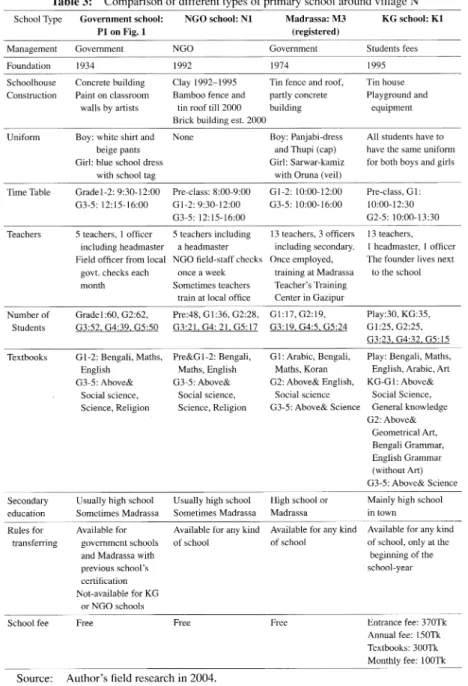
As Table 3 shows, the schools differ from each other according to their type. KG school is distinguished by many points, such as school fee and textbooks which indi-cate differences in the curriculum.
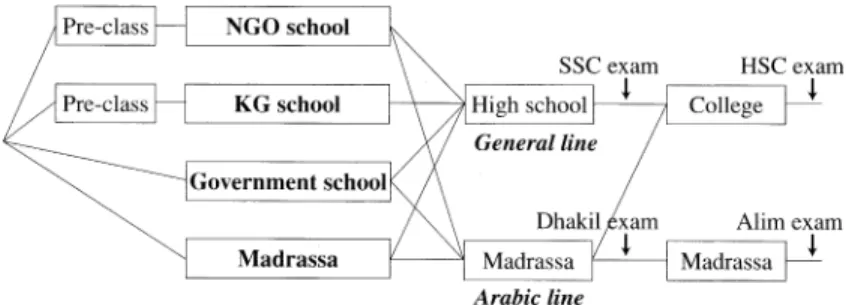
Children who graduate from each primary school in this area tend to proceed to secondary education, as Figure 2 shows. It can be seen that there are two points at which children choose to register at particular schools: one is at the entrance at pri-mary level and the other is that at secondary level. Most children in village N go to N1, an NGO school, which is located inside their village. But some children go to a KG school K 1, which is outside the village, and some go to a registered-school in a neighbouring village, R3.7) The NGO school also has quite a few students from out-side the village. Although there are four types of school at primary level, they are reduced to two at the entrance of secondary level. In this transition, Madrassa of sec-ondary level recruits its students from various primary schools, except KG schools.
Table 2: Year of establishment of each school
Table 3: Comparison of different types of primary school around village N
Source: Author's field research in 2004.
Note: Underlined student numbers indicate those for whom I collected data on family background.
182 Journal of the Japanese Association for South Asian Studies, 17, 2005
This suggests that the decisive choice of "Arabic takes place at the entrance of secondary level. The reasons behind such choice will be analyzed in Section 3.
It is noticeable that school-choice at the primary level not only means choice made at initial registration but also at the time of transfer from one school to another, with or without formal procedure. What I observed in village N is the frequent change of schools at the primary level by children, often without their parents' knowing. If schools were managed with strict rules of registration and own curriculum , transfers between schools, especially without formal procedure, would cause problems for both schools and children. In the village I studied, each school has its own rules about transferring (as mentioned in Table 3). Government schools are permitted to receive students only from other government-managed schools, not from KG or NGO schools, in the middle of a five-year course. Despite such rules, the number of stu-dents on the register often differs from actual attendance: there are children in the classroom whose names are not found on the roll, and the roll still includes the names
of children who have dropped out or are studying elsewhere. It is quite interesting that teachers seem to accept this fact. In reply to my question about the students whose names were not on the roll, the teachers clearly answered who they were and which school they came from. But they did not expel such students from their school, or count them on their register. Children did not care very much either, even if they were not called on the roll.
Thus, there are complex options for school-choice: choice of primary school among various types of schools, choice between the "Arabic line" and the "general line" at the secondary level, and choice to transfer between schools. It is not only the parents who make the choices. Children themselves frequently choose which schools to attend. Among these complex options, how do people envisage schools and carry out school-choice? In the next section, I will discuss the backgrounds and intentions of their school-choice.
Figure 2: Steps in the educational system Source: Author's field research in 2002.
3. School-Choice in a Village Society 3.1 Family Factors Behind School-Choice
As I mentioned in Section 2, there are different types of schools to which the vil-lage people can send their children. In order to understand the factors behind their school-choice, Tables 4 to 6 show the parents' occupation type-wise, literacy, the number of siblings of the students, and children's attitude about going to the morn-ing Koran school. The number of the families for each school is based on actual at-tendance, not on register rolls.
As Table 4 shows, more than 70% of students of the NGO school and the Madrassa
4-1: Primary schools
4-2: Secondary schools
Table 4: Parents' occupation in each school (according to actual attendance)
Source: Author's research in 2004.
184 Journal of the Japanese Association for South Asian Studies , 17, 2005
5-1: Primary schools
5-2: Secondary schools
6-1: Primary schools
6-2: Secondary schools
are from families that depend on agriculture , including agricultural labour, while busi-ness families tend to send their children either to the government school or the KG school. Although detailed data on agricultural income and land ownership was not collected, most of the families who live on agriculture are considered "poor" accord-ing to the villagers' perception at least in comparison with business and chakkri , ex-cept in a few cases. It is also noticeable that overseas work supports more than 10% of families among the KG school children. Over the past five or more years , the popu-lation working in foreign countries (mainly in the Middle East) has increased rapidly in this area. Their families have experienced a sudden rise in cash income . Thus, Table 4 indicates that the families of the KG schools are non-agricultural and rela-tively rich while the NGO schools and the Madrassa are predominantly agricultural , and the government school is positioned in between.
As for the number of siblings, I did not find a significant difference for each schoo1.9)
Table 5: Comparison of parents' literacy for each school (according to actual attendance)
Source: Author's research in 2004.
Table 6: Comparison of morning Koran school experience for students of each school
Parents' literacy obviously differs for each school, as shown in Table 5.
In order to see the relationship between school education and traditional learning, Table 6 shows the children's experience of the morning Koran school.
It is not difficult to understand that the Madrassa students go frequently to the morning Koran school to participate in Islamic learning. It is notable, however, that we can find significant differences among other schools, too. Most of the NGO school students go to the Koran school, but less than half of the KG school students go. This difference may indicate the different ideas about the religious aspects of education held by children and their parents in each school.
3.2 Perceptions of Schools Behind the School-Choice
As I mentioned in Section 2, school-choice is not a one-time decision made by the parents or elders in the village I studied. Process of school-choice includes school registration at the entrance of primary as well as secondary schools, and transfers be-tween schools in the middle of the five-year course period. Moreover, it involves not only parents' choice but also children's preference.
Needless to say, crucial factors in school-choice explain the perceptions of each school held by parents/elders as well as children. These do not necessarily indicate the "objective" merits and demerits of each school. In order to understand the pro-cess of school-choice, interviews" were conducted with four types of informants: 1) fifth-grade students in the NGO school and their parents (15 interviews); 2) the KG school students and their parents who live in village N (3 interviews); 3) students who have transferred from the NGO school and their parents (8 interviews); 4) the Madrassa students at the secondary level who have graduated from the NGO school in the past, and their parents (9 interviews); and 5) third-, fourth-, and fifth-grade stu-dent groups separated by gender for each grade in the NGO school.
Merits and Demerits: The Parents' Perception toward the Schools (1) NGO school vs KG school
Many children of the NGO school, and many of the parents/elders who send them there, seem to choose this school because of the quality of education: teachers at the NGO school come regularly, give classes everyday and teach well. A feeling of prox-imity, which may be due to the location of the NGO school or a personal connection (for instance, one of the relatives is working as a teacher), is also frequently men-tioned as a merit of the NGO school.
On the other hand, the parents of the KG school perceive NGO schools in a totally different way. They tend to see NGO schools as those of "poor" and "illiterate" people who are not keen on education. The following are typical remarks from the mothers in village N who send their children to a KG school. They show that the
186 Journal of the Japanese Association for South Asian Studies, 17, 2005
mothers' perceptions about NGO schools are not directly based on the quality of edu-cation, but rather on the class of people who send their children there. They tend to
see themselves apart from their "illiterate" or "poor" co-villagers.
Shubo's mother: NGO schools are for children of "gorib (poor)" families. It is worth spending money for my son's education. (Shubo is in the third-grade of the KG school, K 1. He used to go to the NGO school, Ni, when he was in sec-ond-grade and shifted to K1 at the beginning of third-grade. His father is work-ing in Saudi Arabia. His father passed ninth-grade and his mother studied up to eighth-grade. Now he lives in his father's parental home inside village N.) Paisal's mother: My son can get along with friends in town by going to the KG school. Parents of the KG school are all shikkito (literate person) and most of them are doing chakkri. Almost all of them live in the town except for us. Many children of the "village school (NGO school)" and their parents are not keen on education. (Paisal is in the first-grade of K 1. He used to go to Ni for his pre-class and shifted to K1 due to his father's decision. His father is working for the National Army in Chittagon camp. His mother got married after she finished eighth-grade. Now Paisal, his mother and younger brother live in his mother's parental home inside village N.)
Shakil's mother: KG school has many subjects. NGO school has only six sub-jects, but KG school has more, including "general knowledge".11) And the par-ents have khel (concern) for education. They always pay attention whether their children are studying or not because they spend money on their education. Par-ents of NGO school vary in their degree of concern, but many of them are o-shikkito (illiterate person) without interest in education. They do not make their children study properly at home. Every student of KG school has a private tutor to study at home. Thus, KG school has merits on three accounts: content of edu-cation, private tutor, and parents' concern. It takes about a thousand taka12) every month for school fees and transportation, snacks for break-time at school and for private tutor. That's why I scold my son if he does not study well! (Shakil is in pre-class at K 1. He used to go to pre-class of Ni before but shifted at the beginning of the year. His father has education up to third-grade and now he is working in Saudi Arabia for five years. His mother has studied up to eighth-grade. His father is an elder brother of Shubo's father, and Shakil and his mother live in the same home as Shubo's family.)
As these examples show, parents who send their children to the KG school have comparative perspectives regarding NGO and other schools, and tend to speak freely
about them, while the parents/elders of the NGO school seldom mention KG schools. For most of the NGO school parents, especially mothers, KG schools are outside their everyday knowledge. It should be noted that the information collected about schools is highly asymmetrical.
Moreover, as shown in the narratives mentioned above, the parents who send their children to the KG school tend to think that "schools that cost money" is one of the symbols of their status and value communication with urban and educated people.
(2) Choice of Government Schools
The direct "benefits" that schools provide can also be the reason for school-choice. Food supply programme called "Food For Education (FFE)" has been in operation in government schools since 1995 in order to encourage children to come to school. FFE was recently changed to "Cash For Education": to provide cash for some students of poor families who regularly attend the classes. At NGO schools, the children get sta-tionery such as notebooks and pens. The narrative of the parent whose child has trans-ferred from the NGO school to a government school mentioned below shows that these programmes are counted as a factor in school-choice.
Shobuja's aunt: We need money to go to any school. We have to pay examina-tion fees. Each school takes fees. Even if a school does not have this rule, teach-ers will never teach without getting their own "labh (profit)". If all schools need money to attend, we need not choose a distant and inconvenient school. We can get money at the government school while the NGO school gives us only note-books and pens. (Shobuja is studying at fifth-grade of P5 school. She shifted
from Ni when she was in fourth-grade. Her father has passed away and she lives with her mother in a village just north of village N. She is the youngest of seven sisters. Five of them had no experience of going to school and the sixth one went to Ni up to third-grade. Four of them got married near the village and two of them are working in Dhaka as house keepers.)
(3) Choice of Madrassa
Children who go to Madrassa from the primary level are quite limited in the vil-lage I studied, because it takes about thirty minutes to reach on foot. However, some students and their parents choose the "Arabic line" to go to Madrassa at the second-ary level. The main reason mentioned by those who choose the "Arabic line" was the value of religious knowledge for their community lives.
Shopon's mother: I want to make one of my five sons a Munsi (Imam). When we die, he can bury and pray for us. If he studies at Madrassa, he will be able to do everything. (Shopon has studied at sventh-grade of Madrassa, M3, after
188 Journal of the Japanese Association for South Asian Studies, 17, 2005
graduating from N1 . He lives in village N with his parents and brothers' fami-lies. He has four brothers: the eldest studied for the HSC examination but failed. The other two had no education. His parents had no experience of going to school either.)
Masud's father: I do not have enough money to send two sons to the "high school" (government secondary school). Fees are required to send boys to high school. School fees and textbook costs are much lower at Madrassa. There is a big "dam (advantage)" in going to a Madrassa even though it does not cost much money. The boy will get any kind of work because he is learning both Arabic and Bengali there. He will be able to become either an Imam at a Mosjid or a school teacher. He will also learn the burial rites to perform other people's fu-nerals. Madrassa is quite valuable. (Masud is in sixth-grade of M3. He lives in village N with his parents, an elder brother and two sisters. His brother and sis-ters have studied at Ni. His eldest sister left education after finishing grade five, his brother is studying at high school, H, and his younger sister is now in fifth-grade in Ni. His father is the Imam of the Mosjid in village N.)
The next example is the story of a girl student who has been going to a Madrassa from the secondary level. Her younger brother was in the fifth-grade of the NGO school Ni, at the time of this interview and will be going to the government high school in a few months time.
Rasheda: Just before I proceeded to the secondary school, I decided to go to the Madrassa. I had intended to go to the government high school but I suddenly chose to go to the Madrassa. I do not know exactly why, but one of the reasons was because a daughter of the Madrassa teacher lives near my house and she invited me to go together. I have been accustomed to studying Arabic and I like it because I have been studying at the morning Koran school since I was a little girl. Maybe my younger brother will not go to the Madrassa because he has not studied Arabic when he was small. Although the meaning of Arabic words was not taught at the morning Koran school, I have learned it at the Madrassa. Now I understand the meaning of the Koran a little. (Rasheda is a student of M3 at eighth-grade. She lives in a village just north of village N with her parents and younger brother and sister. Her parents are illiterate and live on small scale agri-culture. She has moved between three schools at primary level.)
The above mentioned narrative shows that familiarity with Arabic due to attending the daily Koran school from an early stage of childhood could be one of the reasons for choosing Madrassa at the secondary level. As far as the narratives I collected in
the village show, the reasons for choosing Madrassa are not strictly "religious" or directly related to the recent Islamization trends in Bangladesh. The fact that more students of NGO school than KG school go to Koran schools, and more children from agricultural families tend to choose Madrassa than other occupational categories (Table 4), indicate that Madrassa preference at the secondary level is mostly based on the everyday experiences of Muslim peasants in which "religious" norms provide the basis of community life.
It is also interesting that usually only one child in a family chooses the "Arabic line". I met some families in which only one son (of a family of brothers) goes to Madrassa. Moreover, among the previous generation (the one before the young chil-dren at the time of my fieldwork), for instance, two brothers out of four had received education and the rest of them had engaged in agriculture with the family. School-choice also showed the division of roles within families.
From the interviews with the parents, we can see that their school-choice is corre-lated with their occupational backgrounds and experience of /familiarity with school education. If we regard parents' occupations as an indication of their economic con-dition, we can understand why KG school parents give importance to "spending money" on their children's education and, on the other hand, government and NGO school parents pay attention to "receiving benefits" from schools. If parents' literacy can be an indicator of their familiarity with school education, KG school parents who show a higher literacy rate may be said to choose schools with more precise under-standings of the role of schools for the children's future. On the other hand, the fami-lies who think the teachings of morning Koran school are useful for the children's future in the community naturally send them to Madrassa, at least if they wish to go.
3.3 Children's Space in Their School-Choice
Although school-choice partly depends on the occupational and educational back-ground of the family, it should not be ignored that children also have some say on which school to attend.
Many parents of children who go to the NGO school prove this in their expres-sions like, "Children know about school better than we do. We had no experience of going to school (Selim's mother)." To cite another example, the parent whose child transferred from the NGO school to another school mentioned as follows:
Shahin's mother: Children decide which school to go by themselves. My daugh-ter chose the NGO school. She had many friends who went together including her brother. But my son lost friends to go with when his sister graduated. J, who goes to the NGO school, lives nearby, but my son and he dislike each other and do not to go together. So my son moved to a government school inside our vil-lage. (Shahin is at fifth-grade of government school, P5. He lives in a village
190 Journal of the Japanese Association for South Asian Studies, 17, 2005
just north of village N and his family live on agricultural labour around their village. His mother has no educational experience and his father has passed grade five. He transferred from Ni when he was in fourth-grade. He has an el-der sister and a younger sister. His elel-der sister has graduated from Ni and goes to the high school in the same place as P5.)
The narratives of the parents, especially those of the mothers, show that children have freedom regarding their school-choice because their parents do not have clear ideas or images about schools. As the parents of KG school students have more ex-perience in school education, this tendency is more visible among parents of children going to NGO and government schools.
Let me give a typical example of how children have the freedom to choose their own school. In the area I studied, a temporary programme to supply milk and bis-cuits had been carried out from the middle of 2002 to the end of 2003.'3) During this period, all students of government schools and Madrassa got milk and biscuits every-day while those of NGO schools, where the programme started later, benefited only from March 2003 to the end of that year. Thus, for more than half a year, some schools supplied milk and biscuits while others did not. This unequal situation led to the problem of many students at NGO schools moving to another school without
per-Table 7: Children who have transferred from Ni school
mission from teachers or parents to get milk and biscuits. Most of the parents, how-ever, accepted these children changing school by saying "the child cannot help doing it", "the child did this because of bujhi-nai (lack of understanding)" or "children may naturally want milk and biscuits". They overlook and tolerate their children's rule-breaking behaviour because "children do not understand".
The remark bujhi-nai for children is often heard in daily life. It is used synony-mously with "prapan (immature)". "Forgive him because he is prapan" and "forgive him for bujhi-nai" are used in the same way. In other words, the concept of bujhi-nai makes allowances for children not to follow the rules of adult society, and children gain a free space which is not controlled by social norms. School education has also been accepted as a part of and not beyond, such space of childhood.
On the other hand, however, when we focus on children's viewpoint on school-choice, we see that they have clear ideas about their options. Their understanding was clearly displayed when they compared different schools in my group-interviews with them.
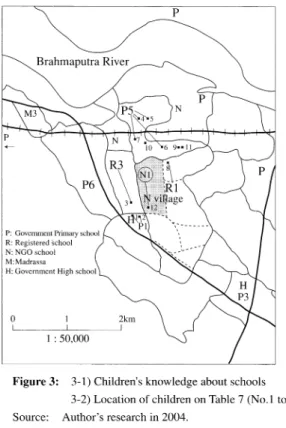
Figure 3: 3-1) Children's knowledge about schools 3-2) Location of children on Table 7 (No.1 to 12) Source: Author's research in 2004.
192 Journal of the Japanese Association for South Asian Studies, 17, 2005
Figure 3-1 indicates schools which appeared in the discussion about "other schools" by Ni students from grade three to five divided by gender.
We see that the children are conscious of other schools around their village while their parents are not. They have a broad knowledge about schools and can take the initiative in choosing their own school.
They have comparative foresight about their school-choice as shown in their com-ments on other schools below.
1) Group-interviews of fifth-grade boys at Ni school
Q: Do you know anything about schools other than your school? All: (The schools which they mentioned are indicated in Figure 3-1). Q: How did you get to know about those schools?
Samsher: Children talk about them. We can see children who go to other schools at the Bazaar. Sometimes they visit our school to see us.
Zafurul: We also visit their schools occasionally. Q: How different are their schools from your school?
Samsher: We get notebooks and pens at our school, but they don't.
Zafurul: We can study well at this school because our teachers give classes regu-larly, but they do not get good classes at other schools.
Q: Don't teachers at other schools teach well?
Nazrul: Teachers fall asleep once they start the class! This happens for example at P5 school.
Selim: They give too much time for playing. Teachers just come to feel the wind from the fans.
Q: So you think your school is better, do you? Selim and other: Yes! Our school is the best! Q: What do you like about your school?
Samsher: You come to our school and talk with us! You don't go to other schools regularly, do you?
Selim: We have a toilet at school though it is broken right now. We also have a pond, playing field and so on.
Zafurul: We don't have a tube-well now because it was stolen. Bidthut: We have a soccer ball....no, it's punctured!
Q: Have you ever wanted to go to other schools?
Zafurul: Never. Once we pass grade five here, we will go to another school.
2) Fourth-grade girls
Q: Do you know anything about schools other than your school? All: (The schools which they mentioned are indicated in Figure 3-1).
Q: Have you been to those schools?
Shapla: Yes, I have. I had been to R1 school before. Q: Shapla, which did you like, R1 school or this school? Shapla: I like this school better.
Q: Why do you like this school better?
Shapla: We can study better at this school than at that school.
Prarthona: Our teachers give good classes. They start classes on time and stu-dents also come to school regularly.
Beauty: Our teachers take care (ador) of us.
Shapla: This school gives us notebooks and pens. That's why I like this school. Q: Can't children study well at other schools?
Most of the girls: No, they cannot.
Shapla: Teachers don't give classes on time. They give too many breaks. They finish school much earlier than their schedule. They do not give classes but often chat in their office!
… …
The children mention the quality of education with teachers giving regular classes and taking care of students as advantages of their school. This is similar to their par-ents' opinions. Some of them even criticize other schools on those points. School fa-cilities, such as toilets or playing field, and the benefit of receiving notebooks and pens are also given as reasons. These make sense as reasons for their choice.
Children who changed schools also gave reasons from the viewpoint of quality of education.
Alim: At my previous school, R1, although teachers come to school everyday, they do not give us classes. They just sit in their office. They teach very little and tell us to study at home. On the other hand, at this school we have classes everyday and the teachers also teach well. So I like it here. (Alim has just trans-ferred to third-grade of N1 in July 2004. Before that he had been to R1.) Josim: Some children moved to other schools because of "milk and biscuits", but I did not. This school is good for studying though there was no milk and biscuits then. (Josim is in third-grade of N1. He lives in a village just north of village N. He has a cousin in fifth-grade and comes to school with him every-day.)
The next example shows a unique aspect of the child's school-choice. This child comes to Ni from outside village N in spite of there being another school near his house. He consciously keeps his school away from his parents' attention.
194 Journal of the Japanese Association for South Asian Studies, 17, 2005
Q: From your house, PS school is nearer than this school. But you don't go there and come to this school. Is there any reason for your choice?
Samsher: I like this school better than that school. If I go to the school near my home, my parents would come to know my quarrels with other students. The moderate distance between school and home can keep the negative matters from my parents. They will not know even if I quarrel with elder children.
Children's own school-choice appears more prominently when they transfer schools. Table 7 shows that it is not infrequent that students change schools. The stu-dents listed on Table 7 have left from one of the classrooms at Ni school between January 2003 and July 2004.14) The total number of the students was 22 in January 2003 but in August 2004, 14 students were in the class. During that period, eleven students, half of the initial total, had left the school. One student had come from an-other school, and two students had come down to the class having failed to pass in the upper class. Regarding children's reasons for transferring schools, their relation-ships with friends or siblings can strongly influence their school-choice: quarrels with friends, a close friend or siblings moving school, and so on. Some children just re-plied "moner iccha (I just wanted to do so)" without giving any specific reason for transferring schools. It can be said that their school-choice depends on personal rea-sons as well as their comparative evaluations of different schools.
Children also have their visions about their prospects in secondary schools after graduating from Ni.
(Continuation of group-interview of fifth-grade boys)
Q: Which school will you go to after graduating from this school? Selim and others: H high school.
Q. Will everyone go to H high school? Everyone: Yes!
Q: I heard that some students who graduate from this school go to Madrassa, M3. What do you think of that school? Do you know about it?
Zafurul: Yes, it is good. But I will not go.
Selim: It's too far, though it is good that they teach both Arabic and Bengali there.
Shabuj: They don't teach Bengali there! Selim: Yes they do!
Q: Which do you like better, H (high school) or M3 (Madrassa)? Nurul: I don't think M3 is better than H.
Q: Do the teachers at Madrassa teach well? Zafurul: Yes, they give good classes.
Selim: They teach Arabic and how to pray. Q: Who tells you about that school? Zafurul: My sister told me. She goes there.
Selim: Children around my house who go there tell me, too. Q: Do you want to go?
Samsher: Yes, but it's too far. It will be difficult to go regularly. It will be very hot on the road under the sun, and we will need umbrellas when it rains. Q: Have you ever visited H high school?
Samsher and others: Yes, we have. Q: How do you like it there? Everyone: It's quite good. Q: What is good about it?
Nazrul: They have fans for each classroom.
Q: What difference is there between primar schools and high schools? Selim: We have grade five as the highest at primary school but we can study
until SSC (Secondary School Certification) at high school. Q: Does everyone want to study up to SSC?
Selim: Yes!
Zafurul, Bidthut and other: We hope so. Q: Up to what level do you want to study? Most of the boys: Up to SSC.
Samsher: I want to study for SSC, but maybe it will be impossible because we don't have money at home.
・・・・・・
(Continuation of group-interview of fourth-grade girls) Q: Do you want to go to another school?
Most of the girls: Yes.
Q: Which school do you want to go to?
Happy: When we pass grade five, we want to go to high school.
Q: Does everyone want to go to high school? Which high school do you want to go to?
Most of the girls: H high school.
Q: Up to what level do you want to study? Most of the girls: Up to SSC.
Q: Does everyone want to study up to SSC? Prarthona: I want to study up to BA. Beauty: I want to study up to grade ten. Happy: I want to study up to BA. Shapla: SSC.
196 Journal of the Japanese Association for South Asian Studies, 17, 2005 Shima: BA.
Q: Where can you study for BA?
Prarthona: We can do it at Gopalpur college (next to P3).
Beauty: I will not do BA. Because my father is gorib (poor), I cannot study so much.
・・・・・・・
The children who study at fourth or fifth grade have knowledge about secondary schools and desires about which school they want to go to. At the same time, as Samsher in fifth-grade or Beauty in fourth-grade said, some of them recognize that their family's economic condition determines whether they will be able to continue their education or not.
Due to the non-intervention of parents who perceive children as bujhi-nai, chil-dren can have visions about different types of schools not only at primary level but also at secondary level. They choose schools by their comparative judgments, col-lecting information about schools from other children. This process can be regarded as a form of socialization in which children come to understand the conditions of their schools and identify their positions with a certain school.
However, as the parents' concerns and expectations regarding education grow, as we can already see among the parents of KG schools, children may lose this freedom and "space" to choose their own schools. KG schools hardly featured in the students' conversations about other schools at the NGO school. KG schools are out of their reach; they are places that cannot be approached without parental support. Besides, KG students do not transfer between schools. Even if they want to do so by any chance, their parents are unlikely to permit it.
Loss of this bujhi-nai space is more obvious in urban areas, especially in some parts of Dhaka where a growing middle class resides. Private schools which
empha-size "high standards", such as English-medium schools or "international schools" set up by foreign capital, are expanding rapidly. Although these schools demand high school fees, parents are desperate to send their children there. Employing private tu-tors at home is quite common in these families [Takada 2000]. It is said that a well known private school in Dhaka receives 100 times as many applicants as they ac-cept.15) Under such competitive circumstances, children can never have an autono-mous space free from their parents' concerns.
The current situation of children's own school-choice in rural Bangladesh should be seen as a transitional phenomenon, where schools have not yet been established in the people's consciousness. That is to say, they accept schools in terms of their exist-ing perception toward children, regardexist-ing children as bujhi-nai, and allow some space for non-intervention and tolerance. In that space, children can develop some foresight in choosing their own schools. But the future holds possibility of denying children
this space and opportunity for socialization through school-choice as parents become more concerned about schools. This is already happening in some parts of Dhaka and
among some of the cases of children going to KG schools in my study.
4. Conclusion
In this paper, I have examined school-choice at primary schools in a village of ru-ral Bangladesh, in order to understand the meaning of going to schools for children and parents.
Under the flexible approach toward universalization of school education, there is a coexistence of various types of schools in an accessible area. Children and their par-ents have options to choose schools. My research data shows that school-choice is largely correlated with the occupational as well as educational background of the par-ents.
At the same time, the interviews with parents and children also show that there is a noticeable diversity in perception and understandings toward each type of school, and schools as a whole. Briefly speaking, some of the rural people who have salaried jobs, including overseas employment and business, tend to relate schools to status, better networking and better living. They also see the various types of schools from a comparative perspective. On the other hand, majority of village people still have a rather vague idea about schools. As choice for Madrassa shows, the expectation for school-choice is not directly job-oriented, but based on their daily community living. Needless to say, a consequence of this asymmetrical situation is that schools are be-coming a system of reproducing social and economic stratification in the society. The parents and children also take part in this process when they choose schools, identi-fying themselves as members of a particular "school".
However, we cannot explain school-choice entirely by analysis of social back-ground. Regarding the process of choosing schools, I have illustrated how children have "space" for their own choice. Since the expansion of school education has
oc-curred recently in the last few decades, most parents, who have no experiences with schools, do not have clear ideas about school education. They tend to accept schools within their category of children's space. As I mentioned in Section 3, the concept of bujhi-nai, along with parents' ignorance of schools, give children space to transfer freely between schools.16) This space allows children to have clear views about schools, even more so than their parents. They compare different schools and choose which school to attend for their own reasons.
In one sense, "choosing schools" by children, or "children going to schools", can be regarded as their "participation" in the hierarchical school system. Although Jean Lave and Etienne Wenger have set aside issues of schooling in their work, they have mentioned the possibilities for rethinking schooling from the perspective afforded by
198 Journal of the Japanese Association for South Asian Studies, 17, 2005
their concept of "participation". They suggest examining "the social organization of schools themselves" as "communities of practice" with "varied forms of member-ship" [Lave and Wenger 1991: 41]. The way in which children locate themselves in the social structure through school-choice, as shown in my study in Bangladesh , may indicate possibilities for this type of analysis.
This paper discussed how children socialize themselves in certain societies through school-choice. The concept of childhood and children's "space" was shown to play a significant role in their socialization process. How this concept of childhood will be affected by the proliferation of schools is a topic for future research .
Acknowledgements
This research could never have been completed without the cooperation of all my friends in Bangladesh, especially the children who kindly received me in their com-munity. In the process of writing this paper, so many people helped me with mean-ingful comments and suggestions, and I have too few words to appreciate them all . Notes
1) The system is such that we have to follow a single course: from primary education, to secondary and to higher corresponding to students' ability.
2) This conference was organized by a committee consisting of concerned individuals mainly from the government and NGOs. It was attended by government officials, NGO workers, teachers, educationists, development assistance agencies, social scientists, social workers, and many eminent persons interested in education. The main objective of the conference was to review past performance, identify successes and shortcomings , and examine all the relevant issues and constraints in the attainment of universalization of quality primary edu-cation [Jalaluddin 1997: xiii—xiv].
3) In the case of registered/un-registered government schools, teachers' salaries are half of those paid at full-government schools.
4) BRAC has been a pioneer in initiating models of Non Formal Primary Education (NFPE) in 1985 (http://www.brac.net/). Unterhalter has pointed out that the challenge by NGOs to provide basic education is one of the characteristics of educational policy in Bangladesh
[Unterhalter 2003].
5) Under the national education system in Bangladesh, primary education generally com-prises five years, the secondary level comcom-prises three plus two years, the higher secondary lasts for two years, and higher education is different for each course.
6) The data is from "literacy rate for persons aged7 years and above in 1991 (census in 2000)" in 2000 Statistical Yearbook Bangladesh [BBS 2002].
7) The number of children who go to Ni school from village N is 56 including pre-class students, while six children go to the KG school, K 1, from there and two go to the regis-tered-school, R3. It means all children of primary school age in this village have been reg-istered at some school.
8) "Arabic line" means studying at Madrassa in their local term being symmetrical with "gen-eral line" studying at High school. This Madrassa does not necessarily mean Arabic
me-dium school but studying Arabic as one of the subjects.
9) In the village I studied, most of the families of school-going children have two or three children. Bangladesh has experienced an excessive population explosion after indepen-dence. However, provision of "family planning" hasbeen successful compared with other developing countries. While six or seven siblings are not rare for those born in the 1970s and 1980s, two or three siblings are the most common for children of school-going age born in the latter half of the 1990s.
10) The interviews were conducted with 35 informants mainly from July to September 2004. 11) What subjects are taught at each school has been explained in Table 3.
12) 1taka=,2yen (1000taka 2000 yen) according to the exchange rate of 2004.
13) This programme has been executed only in Jamalpur by Land&Laks, an NGO under BRAC.
14) I had stayed in my research field from November 2002 to March 2003, from January to March 2004, and from July to September 2004. Thus I compared the students' registration at the moments between January 2003 and August 2004.
15) Such growing competitiveness of education in relation to the emergence of a new middle class has already been noticed in India [Usuda 1993; Oshikawa 2000]. Usuda has termed this phenomenon "compartmentalization" of education, namely, a small compartment for the middle class and a bigger compartment for the rest of the people, with a growing gap between these two compartments.
16) Regarding this concept of childhood, I have examined the process and condition of children's socialization focusing on children's group-play (presentation at 2005 annual conference of Japanese Society of Cultural Anthropology) and on the building of relation-ships between adults and children (presentation at 2005 annual conference of Studies of Child's Society). I have found that the children's "space" provided by the concept of bujhi-nai is one of the key factors in their socialization in Bangladeshi rural society.
REFERENCES
Bangladesh Bureau of Statistics (BBS), 2002,2000 Statistical Yearbook of Bangladesh. Dhaka: Government of the People's Republic of Bangladesh.
Bourdieu, Pierre, and Passeron, Jean-Claude, 1970, La Reproduction. Miyajima, Takashi (trans.), 1991(1994), Sai-Seisan: Kyouiku, Shakai, Bunka (in Japanese). Tokyo: Fujiwara-shoten. Chowdhury, A., Mushtaque R., et al., 2002, Renewed Hope Daunting Challenges: State of
Pri-mary Education in Bangladesh. Dhaka: The University Press Limited.
Illich, Ivan, 1970, Deschooling Society. Azuma, Hiroshi, and Ozawa, Shuzo (trans.), 1977(1997), Datsu-Gakko no Shakai (in Japanese). Tokyo: Tokyo-Sogensha.
Jalaluddin, A. K., Chowdhury, A., and Mushtaque R. (eds.), 1997, Getting Started: Universaliz-ing Quality Primary Education in Bangladesh. Dhaka: The University Press Limited. Lave, Jean, and Wenger, Etienne, 1991, Situated Learning: Legitimate Peripheral Participation.
Cambridge: Cambridge University Press.
Oshikawa, Fumiko, 2000, ""Gakko" to Kaiso-Keisei: Delhi wo Jirei-ni (in Japanese) ("School" and Social Stratification: The Case of Delhi)", in Masanori Koga et al. (eds.) Gendai Indo no Tenbou (Perspectives on Contemporary India). Tokyo: Iwanami-shoten, pp. 125-148. Takada, Mineo, 1991, "`Noumin-Shakai,'Noumin,"Nougyogai-Roudou': Bangladesh-no
Shokugyo-200 Journal of the Japanese Association for South Asian Studies, 17,2005
Kouzou no Jirei-kara (in Japanese) (Teasant Society,' `Peasants,' Non-Farm Work: A Case Study of a Village in Bangladesh)", Minzokugaku-Kenkyu 56(1), pp. 20-43.•\
, 2000, "Bangladesh no Kyoiku Jijou: Kodomo-tachi wo meguru Hikari to Kage (in Japanese) (Educational Condition in Bangladesh: Positive and Negative Aspects for Chil-dren)", Soka 11, pp. 8-16.
UNICEF, 2003, The State of the World's Children. Oxford: Oxford University Press.
Unterhalter, Elaine, et al., 2003, "A Fragle Dialogue?: Research and Primary Education Policy Formation in Bangladesh, 1971-2001", Compare 33(1), pp. 85-99.
Usuda, Masayuki, et al. (eds.), 1993, Motto Shiritai Indo II (in Japanese) (Let's Understand In-dia II). Tokyo: Koubundo.