NOTES AND CORRESPONDENCE
Comparison of Size Changes of Asian Dust Particles Caused by Sea Salt and Sulfate
Daizhou ZHANG
Faculty of Environmental and Symbiotic Sciences, Prefectural University of Kumamoto, Kumamoto, Japan and
Yasunobu IWASAKA
Institute of Natural and Environmental Technology, Kanazawa University, Kanazawa, Japan (Manuscript received 8 March 2006, in final form 22 May 2006)
Abstract
Atmospheric particles were collected in southwestern Japan during dust storm events in spring 2000, and the samples were treated with water-dialysis. In this study, size change of dust particles be- fore and after dialysis is discussed with respect to their sea salt and sulfur contents. It is confirmed that size increase of dust particles has a strong correlation with their sea salt content but is independent from their non-sea-salt sulfur content. This suggests that the growth of dust particles in size during their dis- persion in the marine atmosphere is dominated by the combination with sea salt rather than by other processes such as surface uptake of sulfate.
1. Introduction
Asian dust has been attracting more atten- tion in recent years because of its influence on the environment. During its wide range disper- sion in the atmosphere, dust takes part in mass transformation and transportation (Duce et al.
1991; Gao et al. 1992), disturbs solar radiation (Tegen et al. 1996; Sokolik and Toon 1996), and also provides nutrients to the biological cycles in the ocean (Fung et al. 2000; Bishop et al. 2002). The physical and chemical properties of the particles are important data in under- standing the roles of mineral dust in these pro-
cesses. Dust particles, after leaving the conti- nent and entering the marine atmosphere, usually experience significant modification by surface uptake of gaseous species and combi- nation with other particulate matters in spite of their dry and wet removal (e.g., Okada et al.
1990). It has been proved that dust particles observed in Japan frequently show significant differences from their primary shape and com- position at source areas. In particular, a large number of the particles may rapidly become a mixture of mineral, sea salt, sulfate and/or nitrate in the marine atmosphere (Fan et al.
1996; Zhang et al. 2003).
Okada (1983) established a water-dialysis method coupled with electron microscope anal- ysis to detect the hygroscopic nature of individ- ual atmospheric particles. This method was applied to identify sea salt in mineral dust par- ticles collected in Japan (Niimura et al. 1994).
Corresponding author: Daizhou Zhang, Faculty of Environmental and Symbiotic Sciences, Prefec- tural University of Kumamoto, Kumamoto 862- 8502, Japan.
E-mail: [email protected]
(2006, Meteorological Society of Japan
Andreae et al. (1986) suggested that the in- ternal mixing of sea salt and silicate aerosols could be responsible for the similarity in size distribution of silicate and sea-salt aerosols and the lack of decrease in silicate particle size with distance from land. Recently, Zhang and Iwasaka (2004) developed an efficient method of water dialysis dealing with particles on electron microscope grids, and applied it to Asian dust particles collected in southwestern Japan. Quantitative data on the size change of particles during their travel from China to Ja- pan indicate that Asian dust particles grew significantly in size. It was suggested that com- bination with sea salt was responsible for the growth. As is well known, the presence of dust plumes in the downwind marine atmosphere of the Asian continent is frequently accompanied by sulfate and nitrate with their concentra- tions noticeably higher than usual. The produc- tion of sulfate and nitrate on individual dust particles has been confirmed in Asian dust ob- servations around Japan (Yamato and Tanaka 1994; Zhang et al. 2003). However, compared to that of sea salt, surface uptake of species such as sulfate is reportedly not an important factor in the size change of the particles, but no data are yet available to address this issue.
In this study, the growth of dust particles col- lected in southwestern Japan are described and discussed with respect to their composition.
Size change of the particles due to combination with sea salt is compared with that caused by surface uptake of sulfur compounds. The influ- ence of nitrate is also discussed referring to the uptake of sulfate. The purposes of this study are to show evidence that size increase of Asian dust particles in the marine atmo- sphere is dominated by combination with sea salt rather than surface uptake of sulfate and nitrate, and to provide further information to substantiate the hypothesis in Zhang et al.
(2005), which was proposed to explain the simi- larity of mode diameters of Asian dust particles at different surface sites from Asia to North America.
2. Particle collection and analysis
Particle collection was conducted at Kuma- moto (32480N, 130450E) in southwestern Ja- pan during the passage of three dust storm events in spring 2000. Details of site infor-
mation, particle collection and conservation, weather conditions and the analysis of individ- ual particles by a SEM-EDX system can be found in Zhang et al. (2003). As in Zhang et al.
(2003), dust particles are defined as those con- taining silicon (Si) together with/without other mineral elements, such as aluminum (Al) and iron (Fe). Sea-salt particles are those abundant in sodium (Na) and chlorine (Cl) with no Al. If a sea-salt like particle contained Si with the weight ratio less than 0.2%, the particle was categorized as a sea-salt particle. In addition, the ratio of Na was somewhat overestimated systematically.
In order to extract the water-insoluble parts in particles, the samples were treated with water dialysis. Details of the water-dialysis are described in Zhang and Iwasaka (2004). After the dialysis, the samples were analyzed again using the same SEM-EDX system. The mor- phology and elemental composition of residue particles were obtained, and they were com- pared with those before the dialysis.
In this study, the diameter of a particle is de- fined in terms of the mean of its longest dimen- sion and the orthogonal width. Although the samples were dehydrated in preservation and analyzed under vacuum, it is unlikely that the preservation and analysis could cause dust and sea-salt particles to change considerably in size because their major components are non- volatile. According to McInnes et al. (1997), di- ameters of solid particles, such as dust and sea- salt particles, on electron microphotographs are approximately the same as their aerodynamic diameters.
3. Results
The relative weight ratios of Na and Cl in a dust particle are used to show the content of sea salt in the particle, under the assumption that Na and Cl are derived entirely from sea salt. The relative weight ratios of Al, Si, and Fe in a dust particle are used to show its con- tent of minerals. Sulfur (S) detected in a parti- cle is presumably from sea salt and/or surface uptake of sulfur compounds. In the detected range, dust particles (including those internally mixed with sea salt) and sea-salt particles occupy more than 95% of the total detected par- ticles, in which approximately 60@90% are dust particles and 10@40% are sea-salt particles
(Zhang et al. 2003). Thus, size distributions of coarse mode particles in the range of diameter larger than 1mm are dominated by dust par- ticles together with a small fraction of sea-salt particles, and size changes of dust particles can shift the distributions significantly.
3.1 Size change of dust particles due to sea salt
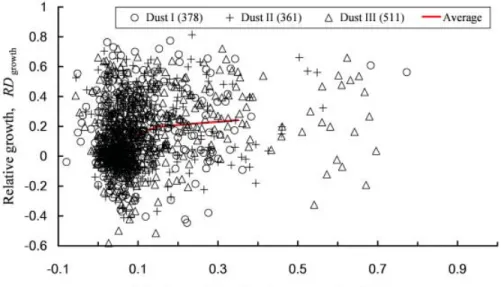
Figure 1 illustrates the changes of dust par- ticles before and after water dialysis with re- spect to their relative sea-salt content, rseasalt, which is defined as ([Na]þ[Cl])/([Na]þ[Cl]þ [Al]þ[Si]þ[Fe]). Here and also in the follow- ing descriptions, elements enclosed in brackets refer to their relative weight ratios in a parti- cle. The relative growth of a particle in size, RDgrowth, is defined as the ratio of the difference of its diameters before and after dialysis to the diameter before dialysis. At any rseasalt, most particles have their RDgrowth in a small range close to the average of growth with a minor number in a sporadic range. It is clear that the growth of dust particles is approximately proportional to their content of sea salt. That means, on average, the more sea salt a particle contains, the larger its size growth.
A few particles of rseasalt<0:3 show large growth. They should not influence significantly the number-size distributions because of their small number. Several reasons are probably responsible for their large growth. If a parti- cle contains substantially non-sea-salt water- soluble compounds and the compounds have made the particle significantly larger than its primary size, the particle should have large size change although its content of sea salt is small. That means particles showing large growth in thisrseasalt range must contain other substantial water-soluble components other than sea salt. Investigation of calcium (Ca) content by the index of [Ca]/([Ca]þ[Al]þ [Si]þ[Fe]) in particles of rseasalt<0:1 and RDgrowth>0:4 shows that Ca frequently con- stitutes large relative weight ratios, suggest- ing that the water-soluble components in those particles may be related to calcium. However, the conclusion needs to be supported with more data because the particles are too few to reach a statistically meaningful conclusion.
On the other hand, a few particles show very small or even negative growth although their
rseasalt is large. Investigation of particles in the range rseasalt>0:7 and RDgrowth<0:1, which occupy less than 5% in total Na-containing dust particles, revealed that their small growth was due to the method of diameter calculation.
From their electron micrographs before and after dialysis (figure is omitted), it has been confirmed that a large part of each particle dis- appeared after water dialysis and their mor- phologies have changed noticeably. But their maximum length and width on the sampling grids are not greatly different from before dial- ysis. Consequently, their relative growth esti- mated here is small or even negative. In future studies about the size change, it is better to ap- ply the equivalent sizes of particles which are estimated from their volume on sampling grids to give more accurate growth of particles.
3.2 Size change of dust particles with respect to sulfur content
In order to evaluate the influence of surface uptake of sulfate on the size change of dust par- ticles, particle growth is investigated with re- spect to their non-sea-salt sulfur (nssS) content.
Here, nssS content in a particle is calculated by extracting sea-salt sulfur from its sulfur con- tent. The sea-salt sulfur content is calculated from the content of sodium in the particles and the ratio of sulfur to sodium in fresh sea salt. The ratio of sulfur to sodium applied here is 0.04, which was estimated from measure- ments of fresh sea-salt particles by the same SEM-EDX system under the same operating conditions (Zhang et al. 2003). This ratio is dif- ferent from the virtual ratio in fresh sea salt because sodium content in individual particles was somewhat overestimated by the SEM-EDX system in this study as mentioned previously.
The non-sea-salt sulfur content here is used to describe and discuss the tendency of particle growth with respect to their relative sulfur content rather than to pursue or investigate the absolute sulfur content in the particles.
Thus, probable systematic biases caused by the extraction should not degrade the quality of the result and discussion. Because some dust particles contain primarily mineral so- dium, the extraction causes nssS content in such particles to be underestimated, such that the nssS content in some particles is probably less than 0. Figure 2 illustrates the relative
Fig. 1. Relative growth of dust particles RDgrowth, which is defined by ðDbeforeDafterÞ/Dbefore, via their relative content of sea saltrseasalt.DbeforeandDafterare the diameters of a particle before and after the water-dialysis. The curve shows the average ofRDgrowthwhich is calculated fromRDgrowth
of all particles of the three events in eachrseasalt range from 0.1 to 1.0 with the increment of 0.1.
Only Na-containing mineral particles are included. Numbers of particles in each case are listed in the parentheses.
Fig. 2. Relative growth of dust particles RDgrowth via their relative content of non-sea-salt sulfur, rnssS, whereRDgrowth is the same as in Fig. 1. The curve shows the average ofRDgrowth which is calculated fromRDgrowthof all particles of the three events in eachrnssS range from 0.0 to 0.4 with the increment of 0.1. Only sulfur-containing mineral particles are included. Numbers of particles in each case are listed in the parentheses.
growth RDgrowth of S-containing dust particles corresponding to their relative nssS content, rnssS, which is defined as [nssS]/([nssS]þ[Al]þ [Si]þ[Fe]). The particles can be separated roughly into three groups with their rnssS in the ranges of <0.15, [email protected], and >0.4, re- spectively.
Particles in the range rnssS<0:15 are the majority and constitute more than 80% of total particles. Number size distributions of dust particles should be dominated by particles in this range. Although the relative content of nssS in the particles is in a very small range, their RDgrowth shows a wide range with most of the particles close to the average and a number of the particles distant from the aver- age, suggesting that the growth of the particles does not depend on their nssS content, and that a correlation betweenRDgrowthandrnssS similar to the proportional correlation betweenRDgrowth andrseasaltcannot be anticipated.
Particles in the range of 0:15<rnssS <0:4 constitute about 17% of total particles, and par- ticles in the range ofrnssS>0:4 constitute less than 3%. Although these particles are not im- portant in the distributions of total particles because of their small numbers, it can be seen from the comparison of the average RDgrowth in the ranges of 0:15<rnssS<0:4 and rnssS<
0:15 that RDgrowth gradually increases more or
less with the increase of nssS content of the particles in the range of rnssS<0:4. It is not certain whether the minor increase tendency of RDgrowth is caused by sea salt or nssS because most of the particles also contain Na and Cl.
To make this clear, RDgrowth of sea-salt-free dust particles are investigated with respect to their nssS content and the results are shown in Fig. 3. The growth of sea-salt-free dust par- ticles is not correlated with the nssS content and is more likely independent from the con- tent. These results further indicate that sur- face uptake of sulfur compounds cannot lead to growth of the particles as with the combination with sea salt.
In the range of rnssS>0:4, it is found that none of the particles (33 in total) contains iron, less than 15% of the particles contain alumi- num with Si content much less than S content, and the particles are mainly composed of Na, Mg, S, Cl, and Ca. It is not sure if these par- ticles are the mixture of mineral dust and other particles. Even though the mineral components in the particles are presumably from mineral dust, it is unlikely that sulfur in them is from the surface uptake of sulfur-containing species.
Instead the sulfur is probably a primary com- ponent of the particles. Mineral components appearing in them are due to their collision with or trapping small mineral particles. That Fig. 3. Similar to Fig. 2 but for Na-free S-containing mineral particles.
means the growth of these mineral particles was not caused by surface uptake of sulfur compounds.
The above results indicate that surface up- take of nssS compounds cannot lead to a con- siderable growth of mineral dust particles.
Given that all nssS is virtually in the state of non-sea-salt sulfate, it is then able to conclude that uptake of non-sea-salt sulfate on the sur- face of dust particles cannot result in system- atic growth of the particles in size.
4. Discussion
Dust particles, besides interacting with sea salt, take up gaseous acidic species such as sul- fur dioxide and nitrogen oxide in the marine boundary layer. It has been observed that par- ticulate sulfate and nitrate in the marine atmo- sphere always show much higher levels in the presence of dust than during non-dust periods, and the increase of sulfate concentration is sometimes comparable to that of sea salt (e.g., Nishikawa et al. 1991). This means that the enhancement of sulfate production is compara- ble to that of the increase of sea salt in some dust plumes in the marine boundary layer.
However, the growth of dust particles has very good correlation with their sea-salt content but not with their sulfate content. Why has sea salt caused apparent growth of dust particles while sulfate could not?
One major reason could be that part of the sulfate in dust plumes was not produced on dust particles. Instead, it was produced through homogeneous conversions or on other particles.
Homogeneous and heterogeneous conversions are the two pathways for SO2 to convert into sulfate and result in sulfate partitioning into fine and coarse mode size ranges, respectively (Seinfeld and Pandis 1998). In the marine at- mosphere, the transformation of SO2 to sulfate is generally dominated by homogeneous conver- sion and sulfate is primarily in fine mode with a small fraction in coarse mode which is pro- duced through the heterogeneous conversion on sea-salt particles (e.g., Quinn et al. 1996).
In the presence of mineral dust, however, the surface areas provided by dust particles can en- hance heterogeneous conversion significantly and increase sulfate production in coarse mode, resulting in coarse mode sulfate being compa- rable to or even exceeding fine mode sulfate.
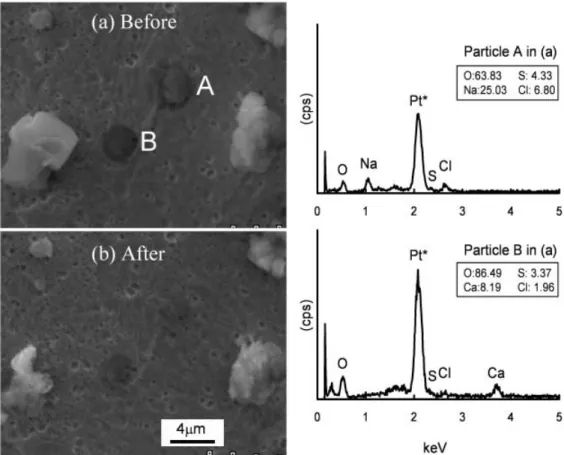
In this study, it was found that coarse mode sulfate was not only produced on dust particles but also produced frequently on other par- ticles. There are a number of distinctive par- ticles which cannot be categorized as dust particles in the samples. They are abundant in Na, S, Cl, and/or Ca, and do not have the elemental nature of natural mineral dust particles. Figure 4 shows examples of such par- ticles. They are usually smaller than dust par- ticles although in coarse mode. In the detected particles of the three dust events, such par- ticles occupy 15@40% with an average of 30%.
Water-dialysis shows that more than 60% of them are completely water-soluble as shown in the figure. So it is expected that such par- ticles should have contributed a substantial fraction of sulfate in coarse mode. Among the particles, those with an abundance of Na and S with/without Cl can be interpreted with the modification of sea-salt particles by taking up SO2. Unfortunately, it has not been recognized how particles abundant in Ca originated al- though similar particles have also been found in elevated layers in China and Japan (Matsuki et al. 2005; Trochkine et al. 2003). These re- sults suggest that sulfate in the coarse mode of dust plumes is not solely associated with dust particles and a considerable fraction of sulfate in this mode is independent of dust particles.
Another speculative reason, which may be partly responsible for the difference of dust par- ticles in size change caused by sea salt and sul- fur compounds, is that uptake processes of sea salt and acidic species should be different. Sea salt is a neutralized salt of pre-existing par- ticles predominantly in coarse mode, and the salt tends to retain much of its original status as it adheres to the surface of mineral dust par- ticles. In contrast, acidic species, such as SO2
and sulfate, are primarily in gas phase (sulfuric acid gas) or exist as fine mode particles in liquid phase (sulfuric acid particles). They are very prone to combine with alkaline materials.
Mineral dust particles take up such species as that the species are blotting into the particle surface layer and tend to produce a much more uniform coating layer by combining with the surface minerals. The result is probably a mi- nor expansion of the particles in size, which should be insignificant compared to the en- largement by sea salt.
In addition to sulfate, mineral dust particles also take up a substantial amount of nitrate in the marine atmosphere. Owing to its higher volatility compared to sulfate, nitrate rarely ap- pears in fine mode either in dust periods or in non-dust periods. However, in the presence of mineral dust, significant increase of nitrate in the coarse mode is always found in dust sam- ples around the Japanese islands, and it has been observed that the nitrate is closely asso- ciated with dust particles (Nishikawa 1991;
Wu and Okada 1994). But its increase is fre- quently much less than that of sulfate in the coarse mode (Kanamori et al. 1991; Jordan et al. 2003) although nitrate production is compa- rable to or slightly exceeds that of sulfate in the coarse mode in some cases (Ooki and Ue- matsu 2005). Further, the uptake process of
SO2 to produce sulfate on dust particle sur- faces discussed above also pertains to the up- take of nitrogen oxides to produce nitrate on the surface. Therefore, the influence of nitrate production on particle size should not exceed or is much less than that of sulfate. Conse- quently, similar to the case with sulfate, the production of nitrate on dust particles is not expected to significantly enlarge the particles either.
In summary, the comparison of size changes of Asian dust particles caused by sea salt and sulfate in this study indicates that the growth of the particles in size during their dispersion in the marine atmosphere is dominated by their combination with sea salt rather than by other processes such as surface uptake of sul- fate.
Fig. 4. Electron micrographs of particles before (a) and after (b) the water dialysis and X-ray spectra of particles marked in (a). The particles were collected during 15:30–16:30 JST on April 12, 2000.
Figures in frames are the raw data of relative weight percentages of detected elements in the par- ticles. Notice that O in each particle is largely overestimated and Na is somewhat overestimated.
Pt in the spectra is caused by the electron microscope grids.
Acknowledgment
This study was funded by the Japan Society for the Promotion of Science (JSPS) and by the Japan Ministry of Education, Science and Tech- nology.
References
Andreae, M.O., R.J. Charlson, R. Bruynseels, H.
Storms, R.V. Grieken, and W. Maenhaut, 1986: Internal mixture of sea salt, silicates, and excess sulfate in marine aerosols.Science, 232, 1620–1623.
Bishop, J.K.B., R.E. Davis, and J.T. Sherman, 2002:
Robotic observations of dust storm enhance- ment of carbon biomass in the North Pacific.
Science,298, 817–821.
Duce, R.A., O.S. Liss, J.T. Merrill, E.L. Atlas, P.
Buat-Menard, B.B. Hicks, J.M. Miller, J.M.
Prospero, R. Arimoto, T.M. Church, W. Ellis, J.N. Galloway, L. Hansen, T.D. Jickells, A.H.
Knap, K.H. Reinhardt, B. Schneider, A. Sou- dine, J.J. Tokos, S. Tsunogai, R. Wollast, and M. Zhou, 1991: The atmospheric input of trace species to the world ocean.Global Biogeochem.
Cycles,5, 193–259.
Fan, X., K. Okada, N. Niimura, K. Kai, K. Arao, G.
Shi, Y. Qin, and Y. Mitsuta, 1996: Mineral par- ticles collected in China and Japan during the same Asian dust-storm event.Atmos. Environ., 30, 347–351.
Fung, Y.Y., S.K. Meyn, I. Tegen, S.C. Doney, J. John, and J.K.B. Bishop, 2000: Iron supply and de- mand in the upper ocean. Global Biogeochem.
Cycles,14, 281–295.
Gao, Y., R. Arimoto, M.Y. Zhou, J.T. Merrill, and R.A. Duce, 1992: Relationships between the dust concentrations over Eastern Asia and the remote North Pacific. J. Geophys. Res., 97, 9867–9872.
Jordan, C.E., J.E. Dibb, B.E. Anderson, and H.E.
Fuelberg, 2003: Uptake of nitrate and sulfate on dust aerosols during TRACE-P. J. Geo- phys. Res., 108(D21), 8817, doi:10.1029/
2002JD003101.
Kanamori, S., N. Kanamori, M. Nishikawa, and T.
Higuchi, 1991: The chemistry of KOSA. In KOSA, WRI of Nagoya Univ. (eds.), Kokon Shoin Press, Nagoya, Japan, 124–156.
Matsuki, A., Y. Iwasaka, G. Shi, D. Zhang, D. Troch- kine, M. Yamada, Y.-S. Kim, B. Chen, T.
Nagatani, T. Miyazawa, M. Nagatani, and H.
Nakata, 2005: Morphological and chemical modification of mineral dust: Observational insight into the heterogeneous uptake of acidic gases. Geophys. Res. Lett., 32, L22806, doi:10.1029/2005GL024176.
McInnes, L., D. Covert, and B. Baker, 1997: The number of sea-salt, sulfate, and carbonaceous particles in the marine atmosphere: EM measurements consistent with the ambient size distribution.Tellus,49B, 300–313.
Niimura, N., K. Okada, X. Fan, K. Kai, K. Arao, and G.Y. Shi, 1994: A method for identification of Asian dust-storm particles mixed internally with sea salt.J. Meteor. Soc. Japan,72, 777–
784.
Nishikawa, M., S. Kanamori, N. Kanamori, and T.
Mizoguchi, 1991: KOSA aerosols as eolian car- rier of anthropogenic material.Sci. Total Envi- ron.,107, 13–27.
Okada, K., 1983: Nature of individual hydroscopic particles in the urban atmosphere.J. Meteor.
Soc. Japan,61, 727–736.
———, H. Naruse, T. Tanaka, O. Nemoto, Y. Iwa- saka, P. Wu, A. Ono, R. Duce, M. Uematsu, and J. Merrill, 1990: X-ray spectrometry of in- dividual Asian dust-storm particles over the Japanese Islands and the North Pacific Ocean.
Atmos. Environ.,24A, 1369–1378.
Ooki, A. and M. Uematsu, 2005: Chemical interac- tions between mineral dust particles and acid gases during Asian dust events. J. Geophy.
Res.,110, D03201, doi:10.1029/2004JD004737.
Quinn, P.K., V.N. Kapustin, T.S. Bates, and D.S. Co- vert, 1996: Chemical and optical properties of marine boundary layer aerosol particles of the mid-Pacific in relation to sources and meteoro- logical transport. J. Geophys. Res., 101(D3), 6931–6951.
Seinfeld, J.H. and S.N. Pandis, 1998: Atmospheric Chemistry and Physics: From Air Pollution to Climate Change. John Wiley, Hoboken, N. J., 1326 pp.
Sokolik, I.N. and O.B. Toon, 1996: Direct radiative forcing by anthropogenic airborne mineral aerosols.Nature,381, 681–683.
Tegen, I., A.A. Lacis, and I. Fung, 1996: The influ- ence on climate forcing of mineral aerosols from distributed soils.Nature,380, 419–422.
Trochkine, D., Y. Iwasaka, A. Matsuki, M. Yamada, Y.-S. Kim, D. Zhang, G.-Y. Shi, Z. Shen, and G. Li, 2003: Comparison of the chemical com- position of mineral particles collected in Dun- huang, China and those collected in the free troposphere over Japan: possible chemical modification during long-range transport.
Water, Air, and Soil Pollution, Focus 3, 161–
172.
Wu, P. and K. Okada, 1994: Nature of coarse nitrate particles in the atmosphere—A single particle approach.Atmos. Eviron.,28, 2053–2060.
Yamato, Y. and H. Tanaka, 1994: Aircraft observa- tions of aerosols in the free marine troposphere
over the North Pacific Ocean: Particle chemis- try in relation to air mass origin. J. Geophys.
Res.,99, 5353–5377.
Zhang, D. and Y. Iwasaka, 2004: Size change of Asian dust particles caused by sea salt interac- tion: Measurements in southwestern Japan.
Geophys. Res. Lett., 31, L15102, doi:10.1029/
2004GL020087.
———,———, and G. Shi, 2005: Sea salt shifts the range sizes of Asian dust. Feature article in EOS Trans. AGU,86(50), 523.
———,———,———, J. Zang, A. Matsuki, and D.
Trochkine, 2003: Mixture state and size of Asian dust particles collected at southwestern Japan in spring 2000. J. Geophys. Res., 108(D24), 4760, doi:10.1029/2003JD003869.