CASE STUDY
ENHANCEMENT OF WARFARIN ANTICOAGULANT ACTIVITY BY S-1
Kazufumi Terui1),Takenori Takahata2),Junya Sato1),Atsushi Ishiguro2), Jugoh Itoh2),Makoto Hayakari1) and Yasuo Saijo2)
Abstract S-1, an oral prodrug of 5-fluorouracil, has been employed in treatment of solid tumors in Japan. We report two patient cases whose international normalized ratio (INR) increased due to concomitant treatment with warfarin and S-1. In case 1, a 63-year-old man, who had taken 3.5 mg/day warfarin for dilated cardiomyopathy, had a subcutaneous hematoma in a left lower eyelid on the ninth course of combination chemotherapy with S-1 and docetaxel for metastatic gastric cancer. His INR increased to 3.68 despite careful monitoring of coagulation parameters. In case 2, a 68-year-old man, who received combination chemotherapy with S-1 and irinotecan for metastatic colorectal cancer, had to reduce the dose of warfarin twice during the same chemotherapy courses because of repeated prolongation of INR. We speculate that multiple mechanisms of unstable INR are involved in strengthening the anticoagulant eff ect of warfarin. Frequent monitoring of INR is required to prevent unexpected adverse events of coagulation abnormality induced by the interaction between S-1 and warfarin.
Hirosaki Med.J. 62:80―85,2011
Key words: coagulation; S-1; warfarin.
症例研究
S-1によるワーファリン抗凝固作用の増強
照 井 一 史1) 高 畑 武 功2) 佐 藤 淳 也1) 石 黒 敦2)
伊 東 重 豪2) 早 狩 誠1) 西 條 康 夫2)
抄録 5-FU の Prodrug である S-1 は,日本において,固形腫瘍に広く使われている.著者らは,S-1 とワーファリンを 同時に使用することにより, international normalized ratio (INR) の延長を来たした 2 例を報告する.第 1 例は,63歳 男性.拡張型心筋症でワーファリン3.5 mg 内服しており,進行期胃癌のためドセタキセル+S-1 併用化学療法施行 9 コー ス後に左眼の下に血腫が出現した.慎重な INR モニターにも関わらず INR は3.68と延長していた.第 2 例は68歳の女 性.進行期大腸癌で,S-1+塩酸イリノテカン併用化学療法を受けていたが,治療中 INR の延長を来たし, 2 回ワーファ リンの減量が必要であった.S-1 投与中の INR の不安定さは,ワーファリンの効果増強には複数の機序が関わっている ことを示唆する.S-1 とワーファリンの同時使用時には,予期しない抗凝固能の異常を予防するため,頻回の INR の測 定が重要であると考えられる.
international normalized ratio (INR)
弘前医学 62:80―85,2011
キーワード:相互作用;S-1;ワーファリン.
1)Division of Pharmacy,Hirosaki University Hospital, 53 Hon-cho, Hirosaki, Aomori, 036-8563, Japan.
2)Department of Medical Oncology,Hirosaki University Graduate School of Medicine, 5 Zaifu- cho Hirosaki, Aomori, 036-8562, Japan.
Correspondence: Y. Saijo
Received for publication, January 18, 2010 Accepted for publication, January 5, 2011
1)弘前大学大学院医学研究科薬剤学講座
2)弘前大学大学院医学研究科腫瘍内科学講座
別刷請求先:西條康夫 平成22年 1 月18日受付 平成23年 1 月 5 日受理
Introduction
S-1 is an oral anticancer drug that combines tegafur, a prodrug of 5-fl uorouracil (5-FU), with gimeracil, an inhibitor of dihydropyrimidine dehydrogenase, and oteracil, an inhibitor of fl uorouracil phosphorylation, in a molar ratio of 1:0.4:1. S-1 is used widely in digestive tract, lung, head and neck, and breast cancer in Japan1-3)
and is one of the key drugs in chemotherapy of digestive tract cancer in particular.
Warfarin is used frequently for ischemic heart diseases or thrombogenic disorders because of its strong anticoagulant activity. The international normalized ratio (INR) is one of the parameters calculated from prothrombin time, and it is aff ected by drug interaction and absorption of vitamin K. Enhancement of activity is known to occur as a result of interaction between warfarin and several anticancer drugs including 5-fluorouracil prodrug4). In addition, vitamin K1 taken from food and vitamin K2 produced by enteric bacteria are absorbed in the alimentary canal. Decreased oral intake of vitamin K and episodes of diarrhea cause INR elevation in patients receiving warfarin5). Gastrointestinal toxicity of S-1 is often observed, and the occurrence of grade >1 nausea, vomiting, and diarrhea is 22.3%, 7.8%, and 18.7%, respectively6). These gastrointestinal toxicities of S-1 could aff ect absorption of vitamin K.
We report two cases of elevated INR in patients treated with warfarin and S-1 and discuss possible drug interactions.
Cases Reports
Case 1
A 63-year-old man complained of left upper abdominal discomfort and endoscopic examination revealed advanced gastric cancer at the greater curvature of the stomach. He underwent pylorectomy, D2 nodal dissection,
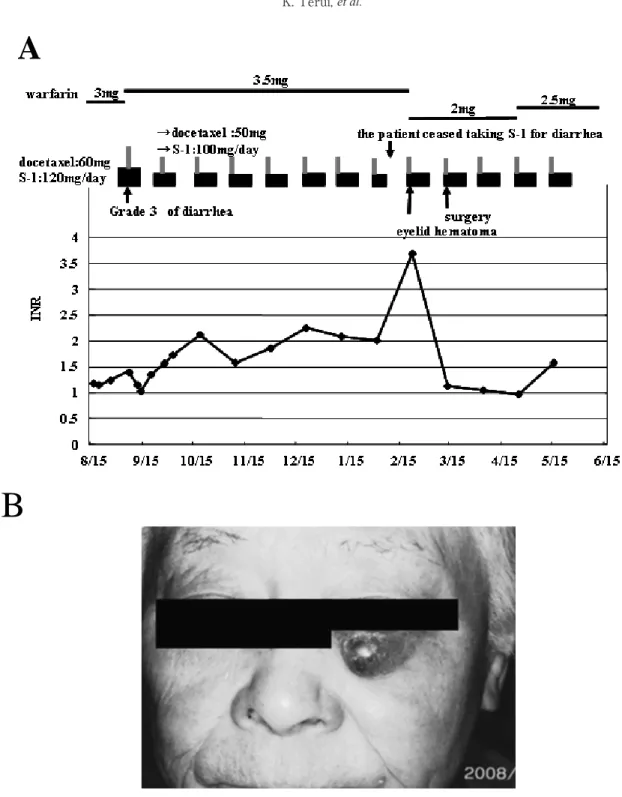
and cholecystectomy. The pathological stage was revealed to be pT3N2M0 (Stage III B). Two months later, he was initiated with combination chemotherapy with S-1 and docetaxel. He continued to receive 3 mg warfarin for dilated cardiomyopathy. Sixty mg of docetaxel was administered intravenously on day 1, and 120 mg/day S-1 was administered orally twice daily for 14 days; this treatment was repeated every 3 weeks. The patient exhibited grade 3 diarrhea, and therefore, the doses of docetaxel and S-1 were reduced to 50 mg and 100 mg/
day in the second and following courses. The daily dose of warfarin was increased from 3 to 3.5 mg because of low INR (<1.5) (Figure 1A).
INR was maintained in the range of 1.5‒2.5 until the eighth course of treatment. Although the patient ceased taking S-1 for diarrhea on day 8 during the eighth course, INR increased to 3.68 on day 1 of the ninth course (Figure 1A). He was found to have a subcutaneous hematoma on the left lower eyelid (Figure 1B). The dose of warfarin was reduced to 2 mg and then INR decreased to 1.13 after 3 weeks. The hematoma was excised by a plastic surgery. The daily dose of warfarin was raised by 2.5 mg during courses 12‒14, with 1‒1.5 INR. Genotype of the cytochrome P450 (CYP) 2C9, which metabolizes S-warfarin and vitamin K epoxide reductase complex subunit 1 (VKORC1), was analyzed after informed consent was obtained. He was homozygous for CYP2C9*1/*1 and for G/A of VKORC1 (‒1639G>A).
Case 2
A 68-year-old man complained of edema of both lower extremities and anorexia, and he was diagnosed with sigmoid colon cancer by colonoscopy. The clinical stage was T3N0M1
(Stage IV) with malignant pleural effusion and liver metastasis. He received one course o f c h e m o t h e r a p y o f m o d i f i e d F O L F O X 6
(125 mg L-OHP, 300 mg l-LV, 600 mg 5-FU
bolus injection, 3000 mg 5-FU continuous venous infusion for 46 h), and subsequent sigmoidectomy and D2-nodal dissection. During fi rst- and second-line chemotherapy, he suff ered cerebral infarction twice. Anticoagulant therapy by warfarin (2 mg/day) was started
and continued with an INR range of 1.24‒
1.48 during second-line chemotherapy with FOLFILI regimen (160 mg irinotecan, 300 mg l-LV, 600 mg 5-FU bolus injection, 3000 mg 5-FU continuous venous infusion for 46 h).
After the tumor showed progressive disease,
Figure 1 (A) Changes in INR during concomitant therapy with warfarin and S-1 in case 1. (B) Subcutaneous hematoma on the left lower eyelid in case 1.
A
B
chemotherapy regimen was changed from FOLFILI to combination chemotherapy with S-1 and irinotecan (irinotecan: 100 mg on day 1 and 15, S-1: 100 mg/day from day 1 to 14 every 4 weeks) with warfarin (Figure 2).
Because INR rose from 1.96 to 3.45 on day 29 in the first course of irinotecan plus S-1, the dose of warfarin was reduced from 2 to 1.5 mg/
day. After 2 weeks, the daily dose of warfarin was further reduced to 1 mg/day because INR remained high (3.15). INR was controlled to 1.68‒2.49 during courses 3‒11 with 1 mg/day warfarin. However, INR rose again from 1.9 to 3.49 on day 15 of the 12th course, and warfarin administration was discontinued for 2 weeks. To keep INR within the therapeutic dose, warfarin was reduced to 0.5 mg/day during courses 13‒
22 of combination chemotherapy, and thereafter, no signifi cant change in INR was observed.
Discussion
We report two cases of prolonged INR during concomitant treatment with S-1 and warfarin. Although anticoagulant activity was monitored carefully by INR, case 1 experienced subcutaneous hematoma by overdose of warfarin. The dose of warfarin had to be changed several times because of unstable INR.
In case 2, the dose reduction was necessary again 9 months later.
Several publications have reported an interaction between warfarin and anticancer drugs including fluoropyrimidines (5-FU, capecitabine) and gemcitabine7, 8). However, the exact mechanisms of increasing activity of warfarin by anticancer drugs are not well understood. CYP2C9 is the principal human liver
Figure 2 Changes in INR during concomitant therapy with warfarin and S-1 in case 2.
enzyme that modulates the in vivo anticoagulant activity of warfarin because S-warfarin, which has three times stronger anticoagulation activity than R-warfarin, is metabolized mainly by this enzyme, although the CYP isoenzymes involved in the metabolism of warfarin are 2C9, 2C19, 1A2 and 3A49). S-1 and capecitabine are both prodrugs of 5-FU. Arzu et al. reported significant inhibition of CYP2C9 activity at the end of the third course of 5-FU, whereas no inhibitory effect was observed in the first course in patients with colorectal cancer10). The area under the plasma concentration time curve from 0 to infi nity (AUC0-∞) of S-warfarin increased by 57% (90% CI, 32‒88%) with a 51%
prolongation of the elimination half-life (t1/2; 90%
CI, 32‒74%), which increased INR by 2.8 times during capecitabine treatment. Exposure to R-warfarin was not affected significantly. The capecitabine‒warfarin interaction was signifi cant clinically. The mechanism of action for the interaction might be related to downregulation of CYP2C9 by capecitabine or its metabolites or to a pharmacodynamic interaction with warfarin11). In the present two cases, INR elevation was observed again at several months after S-1 initiation. Therefore, mechanisms other than direct pharmacological interaction may be involved. Gene polymorphisms of CYP2C9 and VKORC1 greatly aff ect the response to warfarin.
When the CYP2C9 genotype is CYP2C9*3, metabolism of S-warfarin is low12). When polymorphism of VKORC1(–1639G>A) is located within the promoter region and the G allele substitutes for the A allele, its transcriptional activity decreases13). In a similar case, a bleeding tendency appeared in a patient who was homozygous for CYP2C9*1/*1(wild type)
and for A/A of VKORC1(–1639G>A) after 19 days in the second course of combination treatment with warfarin, S-1, and gemcitabine14). Gene polymorphisms in case 1 were CYP2C9*1/*1(wild type) and G/A of VKORC1(–1639G>A).
As another factor, grade 3 diarrhea appeared before INR elevation in case 1 after 6 months chemotherapy with S-1 with warfarin. Vitamin K is an essential dietary element for the normal biosynthesis of coagulation factors. INR elevation is associated with diarrhea in patients receiving warfarin because diarrhea decreases vitamin K absorption15). The frequencies of nausea, vomiting, and diarrhea, which are the major gastrointestinal toxicities of S-1, are 22.3%, 7.8%, and 18.7%, respectively6). Patient 1 suff ered from grade 3 diarrhea during the fi rst course and ceased taking S-1 for 6 days because of diarrhea on day 8 of the eighth course. INR elevation appeared after diarrhea. Therefore, S-1 might inhibit absorption of vitamin K through gastrointestinal toxicity. Management of gastrointestinal toxicity could enable us to prevent an unexpected increase in INR.
In conclusion, metabolism of warfarin could be affected by many factors. The mechanisms of the interaction between S-1 and warfarin are still unclear. However, INR may become unstable after concomitant therapy with S-1 and warfarin, and an increase in INR may appear after more than 6 months. Thus, we need to monitor patients carefully for possible INR elevation.
References
1)Sakata Y, Ohtsu A, Horikoshi N, et al. Late phase II study of novel oral fl uoropyrimidine anticancer drug S-1 (1M tegafur-0.4M gimestat-1M otastat potassium) in advanced gastric cancer patients.
Eur J Cancer, 1998;34:1715-1720.
2)Shirao K, Ohtsu A, Takada H, et al. Phase II study of oral S-1 for treatment of metastatic colorectal carcinoma. Cancer, 2004;100:2355-2361.
3)Okusaka T, Funakoshi A, Furuse J, et al. A late phase II study of S-1 for metastatic pancreatic cancer. Cancer Chemother Pharmacol, 2008;61:
615-621.
4)Janney LM, Waterbury NV. Capecitabine-warfarin interaction. Ann Pharmacother, 2005;39:1546-1551.
5)Hylek EM, Heiman H, Skates SJ, et al. Acetamino- phen and other risk factors for excessive warfarin anticoagulation. JAMA 1998;279:657-662.
6)Taiho Pharmaceutical Co., Ltd. “Drug information of TS-1, vol. 15,”ed. by The Chemical Society of Japan, P118.
7)Brown MC. Multisite mucous membrane bleeding due to a possible interaction between warfarin and 5-fl uorouracil. Pharmacotherapy. 1997;17:631- 633.
8)Kinikar SA, Kolesar JM. Identification of a gemcitabine‒warfarin interaction. Pharmacothera- py. 1999;19:1331-1333.
9)Aithal GP, Day CP, Kesteven PJ, et al. Association of polymorphisms in the cytochrome P450 CYP2C9 with warfarin dose requirement and risk of bleeding complications. Lancet 1999;353(9154):
717-719.
10)Arzu G, Ugur C, Cem B, et al. Inhibitory eff ect of 5-fl uorouracil on cytochrome P450 2C9 activity in
cancer patient. Basic Clin Pharmacol Toxicol 2006;
98:197-200.
11)Camidge R, Reigner B, Cassidy J, et al. Signifi cant effect of capecitabine on the pharmacokinetics and pharmacodynamics of warfarin in patients with cancer. J Clin Oncol. 2005;20:4719-4725.
12)Takahashi H, Kashima T, Nomizo Y, et al.
Metabolism of warfarin enantiomers in Japanese patients with heart disease having different CYP2C9 and CYP2C19 genotypes. Clin Pharmacol Ther. 1998;63:519-528.
13)Yoshizawa M, Hayashi H, Tashiro Y, et al. Eff ect of VKORC1–1639G>A polymorphism, body weight, age, and serum albumin alterations on warfarin response in Japanese patients. Thromb Res 2009;
124:161-166.
14)Yasuko Y, Tomoko N, Akinori Y, et al. A case of bleeding tendency due to warfarin in a patient treated with chemotherapy by S-1. Gan To Kagaku Ryoho 2008;35:1367-1370.
15)Prandoni P. How I treat venous thromboembolism in patients with cancer. Blood 2005;106:4027-4033.