その他のタイトル The Effect of Eye Closure on Empathic Accuracy and Motor Mimicry
著者 串崎 真志
雑誌名 関西大学心理学研究
巻 9
ページ 35‑46
発行年 2018‑03
URL http://hdl.handle.net/10112/13213
閉眼が共感の正確性と動作の模倣に及ぼす効果
串 崎 真 志
関西大学文学部The Effect of Eye Closure on Empathic Accuracy and Motor Mimicry Masashi KUSHIZAKI (Faculty of Letters, Kansai University)
Two experiments were conducted to test the hypothesis if eye closure facilitates bottom-up processing, then empathic accuracy in emotional contagion and the frequency of draws in paper- rock-scissors would increase. Participants (study 1: N = 94, study 2: N = 84) were asked to pair with partners and report how much they (themselves and partners) currently felt lonely, hungry, and tired on a 7-point scale with eyes-closed or eyes-open conditions. After that, they played rock-paper-scissors twelve times. Results showed that the frequency of draws and the score of empathic accuracy did not increased in eyes-closed condition, however, some of the results suggested a possibility of eye closure effect. The relevance of eye closure, empathic accu- racy, and motor mimicry were discussed.
Keywords: empathic accuracy, motor mimicry, empathy, eye closure.
問 題 閉眼効果
私たちは目を閉じて,心の声に耳をすます。実際,
閉眼すると,さまざまな心理的変化が生じる。目撃 証言の研究では,閉眼によって記憶の再生が向上し
(Vredeveldt, Tredoux, Kempen, & Nortje, 2015;
Vredeveldt, & Penrod, 2013),確信度(confidence)
もあがることが知られている(Vredeveldt, & Sauer, 2015)。このような閉眼効果(eye closure effect / eyes-closed effect )は 子 ど も に も 生 じ る と い う
(Mastroberardino & Vredeveldt, 2014)。それゆえ,
現場では目撃証言の聴取を閉眼で行う手続きもとられ ている(Vredeveldt et al., 2015; Vredeveldt, Baddeley,
& Hitch, 2014; Wagstaff, Wheatcroft, Caddick, Kirby, & Lamont, 2011)。
また閉眼すると,体性感覚知覚(somatosensory perception)が向上することもわかってきた(Brodoehl, Klingner, & Witte, 2016)。それは高齢者にも生じると
いう(Brodoehl, Klingner, Stieglitz, & Witte, 2015)。
完全な暗闇で目を開けても,体性感覚知覚は向上し ないことから(Brodoehl, Klingner, & Witte, 2015),
また,暗闇においても閉眼と開眼で脳活動に違いが あ る こ と か ら( Ben-Simon et al., 2013; Jao et al., 2013),閉眼そのものによる効果と考えられる。この 他,閉眼は嗅覚の脳を活性化するという報告や
(Weismann et al., 2006),統合失調症患者は,閉眼 で聴覚脳が活性化するという研究もある(Griskova- Bulanova, Dapsys, Maciulis, & Arnfred, 2013;
Griskova-Bulanova, Hubl, van Swam, Dierks, &
Koenig, 2016)。
また,目を閉じて考えると(開眼するより),非道 徳的なシナリオ(“賃金を多く得るために勤務時間を 水増し報告する”)を非倫理的だと判断し(Caruso, &
Gino, 2011, experiment 1),10 ドルのうち相手に分配 する金額が増える(Caruso, & Gino, 2011, experiment 2)。著者らは,その理由として,目を閉じることで 場面を想像しやすくなった(mental simulation)と
考察している。実際,閉眼時は凝視時(fixation)に比 べて,視覚野(primary visual cortex, medial temporal cortex)の活動が時間とともに増すという(McAvoy et al., 2014)。
閉眼効果のもうひとつの説明として,目を閉じる ことで,ふだん環境に向けている注意のリソースを 使えるようになる,という認知負荷仮説(cognitive load hypothesis)が有力である(Perfect, Andrade,
& Eagan, 2011; Vredeveldt, Hitch, & Baddeley, 2011; Vredeveldt, & Perfect, 2014)。実際,閉眼・
開眼によって,脳活動が異なることが知られている
(Brodoehl, Witte, & Klingner, 2016; Geller et al., 2014; Marx et al., 2004; Song et al., 2015 )。閉 眼 時 は開眼時に比べて,運動感覚領域(sensorimotor regions: Liang et al., 2014),運動感覚ネットワーク と聴覚ネットワーク(sensory-motor network and auditory network: Wang, Li, Xu, & Ding, 2015)が 活性化し,一次感覚運動ネットワークと顕著性ネット ワーク(primary sensory-motor network and salience network)の結合が強くなり(Zhang et al., 2015),
内受容ネットワーク(interoceptive network)と呼 ばれる視覚系,聴覚系,体性感覚系(Marx et al., 2003 )そ し て デ フォ ル ト モー ド・ネッ ト ワー ク
(default mode network)の一部(angular gyrus and anterior cingulate gyrus)の活動が上昇する(Xu et al., 2014)。脳活動の変化は,先天盲の人の閉眼時に おいても生じる(Hüfner et al., 2009)。
おそらく閉眼すると内受容感覚が高くなり,開眼 時は注意が環境に向くのだろう。見知らぬ名前に対 する聴覚野の活動は,開眼時のほうが(閉眼時より も)高いことがわかっている(Qin et al., 2013)。ま た,閉眼してネガティブな音楽を聴くと,(開眼する より)扁桃体が活性化し(Lerner, Papo, Zhdanov, Belozersky, & Hendler, 2009),Theta 波が増加する
(Chang et al., 2015)。閉眼はボトムアップ処理を活 性化するのかもしれない。
共感の正確性
ところで,私たちは日常生活のなかで,お互いに 心を読み合っている。このとき,相手の思考や感情 を正確に推測する能力を,共感の正確性(empathic accuracy)と呼ぶ(Ickes, 2009)。共感の正確性に は,情動の直感的な把握も含まれ(串崎,2017),自 己-他者共鳴(self-other resonance: Christov-Moore
& Iacoboni, 2016)や,生 理 的 共 鳴( physiological resonance: Buchanan et al., 2012; White & Buchanan, 2016)といったメカニズムを背景にもつ。相手の気 持ちを瞬時に正確に感じる能力は心理臨床場面でも 重要であり,人間性心理学や精神分析では,共鳴
(resonance)や調律(attunement)と呼ばれてきた
(Dekeyser, Elliott, & Leijssen, 2009)。「身体-感情モ ードの共感的理解」(bodily-affective mode of empathic understanding: Nakata, 2014)や,「自律神経のシン クロナイズド・ダンス」(synchronized autonomic dance: Coutinho, Silva, & Decety, 2014)ということ もある。
筆者(串崎,2013, 2014, 2015, 2016)はじゃんけ ん の 引 き 分 け を 動 作 模 倣 と と ら え,情 動 伝 染
(emotional contagion)などとの関連を検討してき た。本研究では,閉眼が共感の正確性と動作の模倣 に与える影響を取り上げる。仮説としては,もし閉 眼がボトムアップ処理を活性化するなら,閉眼する と共感の正確さが上がり,その結果,相手に対する 動作模倣が増え,じゃんけんで引き分けが出やすく なると考えられる。
研究 1 目的
研究 1 では,目を閉じると,相手の気分を直感的 に感じやすくなり,じゃんけんで引き分けやすいか どうかを検討する。
方法
参加者 教養科目の心理学を受講する学部生 94 名
(男性 58 名女性 36 名)が参加した(実施時期 2016 年 12 月)。
質問紙 最初に現在の気分として,孤独(孤独で さびしい),空腹(お腹がすいている),疲労(疲れ ている)の程度を「全くあてはまらない」を 1,「と てもあてはまる」7 とする 7 段階で評定した。次に 基 本 共 感 尺 度 ( basic empathy scale: Carré, Stefaniak, D’Ambrosio, Bensalah, & Besche- Richard, 2013)から情動伝染の 5 項目について「全 くあてはまらない」を 1,「とてもあてはまる」を 7 とする 7 件法で評定した。
手続き 続いて,近くに座っている二人組または 三人組を作り(三人組の場合は一人を観察・記録者 とした),座席位置によって,閉眼群(21 組)と開
眼群(26 組)に分けた。そして相手の気分 3 項目に ついて,閉眼または開眼で,「会話せずに直感的に想 像して」7 段階で評定した。次に実験者の合図に従 って,閉眼または開眼で,じゃんけんを(1 分間に 四分音符=70 の速さで)12 回行なった。じゃんけん は「最初はグー」の方法で,毎回の出し手を頭の中 で決めず,手のおもむくままにじゃんけんすること を注意事項とした。1 回ごとに勝ち負けを各自で記 録した。
結果
先行研究(Erbas, Sels, Ceulemans, & Kuppens, 2016; Gadassi, Mor, & Rafaeli, 2011; Howland &
Rafaeli, 2010; Kraus, Côté, & Keltner, 2010)になら って,相手の気分評定と,自分が相手の気分を評定 した差の絶対値を共感の不正確さとした。例えば,
相手の孤独感を 2 と評定し,相手の実際の孤独感が 6 だった場合,共感の不正確さを 4 とした。
まず,閉眼群(M=1.67, SD=1.37)と開眼群(M
=1.75, SD=1.45)で,孤独に関する共感の不正確 さに差があるかどうかを分散分析したところ,有意 な差はみられなかった(F[1,92]=0.080, p=.777, ηG2=.001)。そこで,共感の不正確さを目的変数,
性別(0=男性,1=女性),開閉眼条件(0=閉眼,1
=開眼),情動伝染,自分の孤独感及びそれらの交互 作用項を説明変数として重回帰分析(ステップワイ ズ法)を行った。その結果,自分の孤独(β=0.322, p=.002, 95% CI[0.126, 0.518]),情動伝染(β=
0.200, p=.055, 95% CI[-0.004, 0.404]),情動伝染
×開閉眼条件(β=-0.171, p=.098, 95% CI[-0.375, 0.032])を含む回帰式が有意になった(adj R2=.118, p=.009)。すなわち目を閉じると,情動伝染が低い ほど相手の孤独を正確に推測できていた(Figure 1)。
開眼群では,このような関連はみられなかった。
疲労に関する共感の不正確さについて,閉眼群(M
=1.38, SD=1.17)と開眼群(M=1.62, SD=1.32)
で有意な差はみられなかった(F[1,92]=0.815, p
=.369, ηG2=.009)。そこで,共感の不正確さを目 的変数,性別,開閉眼条件,情動伝染,自分の疲労 感及びそれらの交互作用項を説明変数として重回帰 分析(ステップワイズ法)を行った。その結果,性 別×情動伝染(β=-0.254, p=.029, 95% CI[-0.482,
-0.026]),性別×開閉眼条件(β=-0.209, p=.059, 95% CI[-0.425, 0.008]),疲労×情動伝染×開閉眼
条件(β=-0.347, p=.002, 95% CI[-0.562, -0.132])
を 含 む 回 帰 式 が 有 意 に な っ た( adj R2=.106, p
=.033)。すなわち,男性は目を閉じると(M=1.83, SD=1.29 ),目 を 開 け る よ り も( M=1.32, SD=
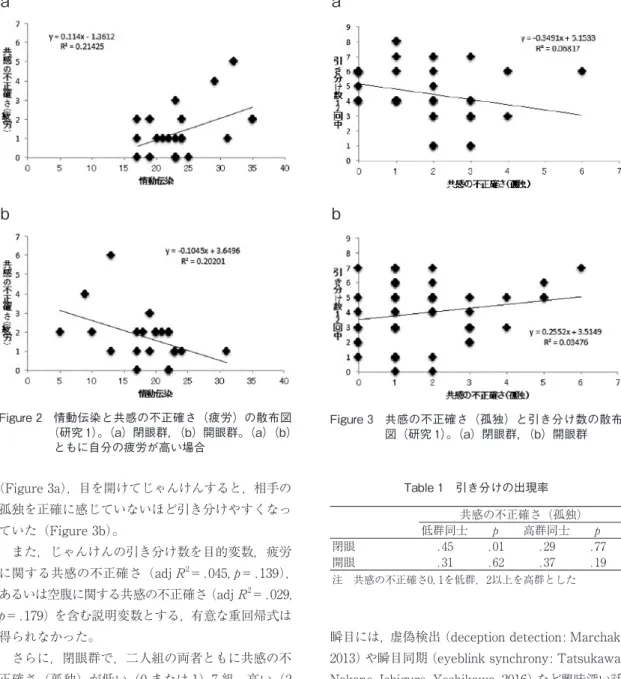
1.22),相手の疲労を正確に推測できていた。女性で はそのような傾向はみられなかった(閉眼 M=1.50, SD=1.09, 開眼 M=1.32, SD=1.32)。また,自分の 疲労が高いときは(7 件法で 6 以上:n=45),目を 閉じると,情動伝染が低いほど正確に推測できてい たのに対して(Figure 2a),目を開けると,情動伝 染が高いほど正確に推測できていた(Figure 2b)。
このような傾向は,疲労が低い群(7 件法で 1 から 5:n=49)ではみられなかった。
空腹に関する共感の不正確さについては,閉眼群
( M=2.19, SD=1.42 )と 開 眼 群( M=2.19, SD=
1.55 )で 有 意 な 差 は な く( F[ 1,92 ]=0.000, p
=.995, ηG2=.000),有意な重回帰式も得られなか った(adj R2=.011, p=.262)。
次に,閉眼群(M=4.57, SD=1.86)と開眼群(M
=3.96, SD=2.01)で,じゃんけんの引き分け数に 差があるかどうかを分散分析したところ,有意な差 はみられなかった(F[1,45]=1.143, p=.291, ηG2
=.025)。そこで,引き分け数を目的変数,開閉眼条 件,情動伝染,孤独に関する共感の不正確さ,自分 の疲労感及びそれらの交互作用項を説明変数として 重回帰分析(ステップワイズ法)を行った。その結 果,情動伝染×疲労(β=-0.206, p=.044, 95% CI
[-0.406, -0.005]),共感の不正確さ×開閉眼条件
(β=0.211, p=.047, 95% CI[0.003, 0.420])を含 む回帰式が有意な傾向になった(adj R2=.058, p
=.081)。すなわち目を閉じてじゃんけんすると,相 手の孤独を正確に感じているほど引き分けやすく Figure 1 情動伝染と共感の不正確さ(孤独)の散布図
(研究 1)。閉眼群
(Figure 3a),目を開けてじゃんけんすると,相手の 孤独を正確に感じていないほど引き分けやすくなっ ていた(Figure 3b)。
また,じゃんけんの引き分け数を目的変数,疲労 に関する共感の不正確さ(adj R2=.045, p=.139),
あるいは空腹に関する共感の不正確さ(adj R2=.029, p=.179)を含む説明変数とする,有意な重回帰式は 得られなかった。
さらに,閉眼群で,二人組の両者ともに共感の不 正確さ(孤独)が低い(0 または 1)7 組,高い(2 以上)8 組,開眼群で共感の不正確さが低い 8 組,高 い 10 組を選び,それぞれじゃんけんの総試行数と引 き分け数を数え,p=1/3,試行数 n の二項分布で,
その引き分け数以上(または以下)になる確率を求 めた。その結果,閉眼で共感の不正確さが低い群に おいて,引き分けの出現率が有意に高くなっていた
(Table 1)。
研究 2 問題
閉眼・開眼に関連して,まばたきの研究もある。
瞬目には,虚偽検出(deception detection: Marchak, 2013)や瞬目同期(eyeblink synchrony: Tatsukawa, Nakano, Ishiguro, Yoshikawa, 2016)など興味深い話 題がある。安静時で自然に生じる瞬きの回数(1 分 間あたり)を自発性瞬目率(spontaneous eye blink rate)という。そして,中枢性ドーパミンの活動性
(central dopaminergic activity)が高いほど,瞬目 が多いことがわかっている(Jongkees, & Colzato, 2016; McIntire, McKinley, Goodyear, & McIntire, 2014)。
例 え ば,ニ コ チ ン 性 受 容 体 遺 伝 子( nicotinic receptor gene)が CT/TT 型の人は,映画 Mr. Bean を観ているときの瞬目が多く(Nakano, Kuriyama, Himichi, & Nomura, 2015),レボドパ(Levodopa)
Figure 2 情動伝染と共感の不正確さ(疲労)の散布図
(研究 1)。(a)閉眼群,(b)開眼群。(a)(b)
ともに自分の疲労が高い場合
a
b
Figure 3 共感の不正確さ(孤独)と引き分け数の散布 図(研究 1)。(a)閉眼群,(b)開眼群
a
b
共感の不正確さ(孤独)
低群同士 p 高群同士 p
閉眼 .45 .01 .29 .77
開眼 .31 .62 .37 .19
注 共感の不正確さ0, 1を低群,2以上を高群とした Table 1 引き分けの出現率
を服用すると,魔術的観念の高い人ほど(magical ideation scores:“私はときどき,人から見られたり 触れられたりすると,エネルギーを得たり失うと感 じる”)瞬目が多い(Mohr, Sándor, Landis, Fathi, &
Brugger, 2005)。
ま た,神 経 症 傾 向( neuroticism )が 高 い ほ ど
(Barbato, della Monica, Costanzo, & De Padova, 2011),内的統制(internal locus of control)が高い ほど(Declerck, De Brabander, & Boone, 2006),報 酬反応質問紙の得点が高いほど(reward responses inventory:“私は人生がエキサイティングになった あとに躁状態を体験した”)瞬目が多くなる(Peckham,
& Johnson, 2016)。
そして,軽度認知症(mild cognitive impairment)
者は健康群に比べて瞬目が多い(Ladas, Frantzidis, Bamidis, & Vivas, 2014)。ADHD児は(定型児より)
瞬目が多いという研究もあるが(Baijot et al., 2016),
関連しなかったという報告もある(Groen, Börger, Koerts, Thome, & Tucha, 2017)。また,自発性瞬目 は 日 内 変 動 す る。眠 気 が 増 す と( Barbato et al., 2007),夜 20:30 ごろに瞬目が増える(Barbato et al., 2000)。ただしこの傾向は,70 歳ではみられなくなる という(De Padova, Barbato, Conte, & Ficca, 2009)。
いっぽう,精神遅滞(mental retardation)の施設 入 所 者( 平 均 55.1 歳 )で ス テ レ オ タ イ プ 行 動
(stereotyped behavior: 反復的でリズミックな常同 行動)が多いほど(Roebel, & MacLean, 2007),ま た,大麻使用年数(years of cannabis exposure)が 長いほど(Kowal, Colzato, & Hommel, 2011),コカ インのレクリエーション使用(recreational cocaine use)が多いほど(Colzato, van den Wildenberg, &
Hommel, 2008),そして瞑想期間が長い(毎日 30 分 の瞑想を 3 年以上)人は,瞬目が少ない(Kruis, Slagter, Bachhuber, Davidson, & Lutz, 2016)。この 他,鉄分が不足している乳幼児は瞬目が少ないとい う報告もある(Lozoff, 2011; Lozoff et al., 2010)。
瞬目が多いほど,指タップ課題(finger-tapping task)でボタンを押す時間が長く(Pas, Custers, Bijleveld, & Vink, 2014 ),ス トッ プ シ グ ナ ル 課 題
(stop-signal task)で反応時間が遅れ(Colzato, van den Wildenberg, van Wouwe, Pannebakker, &
Hommel, 2009),ルーレットゲームで最大利得(gain- maximizing decision)を選択し(Barkley-Levenson, &
Galván, 2017),空間注意バイアス(spatial attentional
bias)が右方向に偏る(Slagter, Davidson, & Tomer, 2010)。また,瞬目が多くて抑うつ(CES-D)が高い ほど,アイオワギャンブル課題(Iowa ganbling task)
で,有 利 な 札( advantageous deck )を 選 択 す る
(Byrne, Norris, & Worthy, 2016)。実行機能(Go/
No Go 課題など)との関連も検討されている(Zhang et al., 2015; Zhang et al., 2016)。ただし,創造性(代 替使用課題 alternate uses task)は,瞬目が中程度 に多い人が最も優れているという(逆 U 字相関 : Akbari Chermahini, & Hommel, 2010; Akbari Chermahini, & Hommel, 2012; Ueda, Tominaga, Kajimura, & Nomura, 2016)。これらの課題は,ドー パミンと関連すると考えられる。
人は瞬目するたびに,脳はデフォルトモード・ネ ットワークと注意の神経ネットワークを切り替えて い る と い う( Nakano, 2015; Nakano, Kato, Morito, Itoi, & Kitazawa, 2013)。このように考えると,瞬目 の多い人の脳は,閉眼状態を多く経験しているのか もしれない。そこで研究 2 では,ドーパミンと関連が 高い刺激追求(sensation seeking)の概念を加えて
(Campbell et al, 2010; Gjedde, Kumakura, Cumming, Linnet, & Møller, 2010),閉眼効果に対する影響を検 討する。刺激追求は閾下知覚を促すことから(Bustin, Jones, Hansenne, & Quoidbach, 2015),環境からの 刺激を積極的に取り入れる特性といえるだろう。仮 説としては,刺激追求が高いほど共感の正確性が上 がり,その結果,相手に対する動作模倣が増え,じ ゃんけんで引き分けが出やすくなると考えられる。
目的
対象者を変えて,研究 1 の再現性を検証する。ま た,刺激追求の閉眼効果に対する影響も検討する。
方法
参加者 心理学の専門科目を受講する学部生 84 名
(男性 24 名女性 60 名)が参加した(実施時期 2017 年 5 月)。
質問紙・手続き 質問紙として新たに刺激追求尺 度(brief sensation-seeking scale: Hoyle, Stephenson, Palmgreen, Lorch, & Donohew, 2002; 柴 田・古 澤,
2013)を加え,“風変わりな場所を探索してみたい”
“経路や時間は前もって計画せずに旅行に出発したい ものだ”など 8 項目について「全くあてはまらない」
を 1,「よくあてはまる」を 5 とする 5 件法で評定し
た。その他は研究 1 と同様であった。なお,研究 2 はすべて二人組で行った。
結果
研究 1 と同様,相手の気分評定と,自分が相手の 気分を評定した差の絶対値を共感の不正確さとした。
まず,閉眼群(M=1.79, SD=1.35)と開眼群(M
=1.83, SD=1.32)で,孤独に関する共感の不正確 さに差があるかどうかを分散分析したところ,有意 な差はみられなかった(F[1,82]=0.027, p=.871, ηG2=.000)。そこで,共感の不正確さを目的変数,
性別(0=男性,1=女性),開閉眼条件(0=閉眼,1
=開眼),情動伝染,刺激追求,自分の孤独感及びそ れらの交互作用項を説明変数として重回帰分析(ス テップワイズ法)を行ったが,有意な重回帰式は得 られなかった(adj R2=.111, p=.139)。
同様に,空腹に関する共感の不正確さについて,
閉眼群(M=1.79, SD=1.44)と開眼群(M=1.79, SD=1.26)で有意な差はなく(F[1,82]=0.000, p=1.000, ηG2=.000),有意な重回帰式も得られな かった(adj R2=.017, p=.312)。さらに,疲労に関 する共感の不正確さについて,閉眼群(M=1.52, SD
=1.13)と開眼群(M=1.38, SD=0.99)で有意な 差はなく(F[1,82]=0.380, p=.539, ηG2=.005),
有意な重回帰式も得られなかった(adj R2=.069, p
=.278)。
次に,閉眼群(M=3.67, SD=1.88)と開眼群(M
=4.81, SD=1.40)で,じゃんけんの引き分け数に 差があるかどうかを分散分析したところ,有意な差 がみられた(F[1,40]=4.991, p=.031, ηG2=.111)。
そこで,引き分け数を目的変数,開閉眼条件,情 動伝染,刺激追求,孤独に関する共感の不正確さ及 びそれらの交互作用項を説明変数として重回帰分析
(ステップワイズ法)を行った。その結果,情動伝染
(β=-0.215, p=.048, 95% CI[-0.428, -0.002]),開閉 眼条件(β=0.324, p=.002, 95% CI[0.123, 0.525]),
共感の不正確さ×情動伝染(β=0.335, p=.008, 95
% CI[0.088, 0.582]),刺激追求×開閉眼条件(β
=-0.297, p=.010, 95% CI[-0.520, -0.073]),共感 の不正確さ×刺激追求×開閉眼条件(β=0.278, p
=.028, 95% CI[0.031, 0.526])を含む回帰式が有 意になった(adj R2=.226, p=.002)。すなわち目を 閉じてじゃんけんすると,刺激追求が高いほど引き 分けやすく(Figure 4a),目を開けてじゃんけんす
ると,刺激追求が高いほど引き分けにくくなってい た(Figure 4b)。また,そのような閉眼効果は,相 手の孤独を正確に感じている場合(共感の不正確さ
=0 または 1)に顕著であった(Figure 5a, 5b)。
同様に,じゃんけんの引き分け数を目的変数,空 腹に関する共感の不正確さ等を説明変数とする重回 帰分析(ステップワイズ法)では,開閉眼条件(β
=0.313, p =.003, 95% CI[0.109, 0.516])を含む回 帰式が有意になった(adj R2=.176, p=.007)。また,
空腹に関する共感の不正確さ等を説明変数とする重 回帰分析では,有意な回帰式が得られなかった(adj R2=.102, p=.088)。
さらに,閉眼群で,二人組の両者ともに刺激追求 が低い(19 点以下)5 組,高い(20 点以上)8 組,
開眼群で刺激追求が低い 7 組,高い 5 組を選び,そ れぞれじゃんけんの総試行数と引き分け数を数え,p
=1/3,試行数 n の二項分布で,その引き分け数以 上(または以下)になる確率を求めた。その結果,
開眼で刺激追求が高い群において,引き分けの出現 率が高い傾向になった(Table 2)。
また,共感の不正確さ(孤独)が低い(0 または 1)場合について,閉眼群かつ二人組の両者ともに刺
Figure 4 刺激追求と引き分け数の散布図(研究 2)。(a)
閉眼群,(b)開眼群
a
b
激追求が低い(19 点以下)4 組,高い(20 点以上)
6 組,開眼群で刺激追求が低い 6 組,高い 6 組を選 び,それぞれじゃんけんの総試行数と引き分け数を 数え,p=1/3,試行数 n の二項分布で,その引き分 け数以上(または以下)になる確率を求めた。その 結果,開眼で刺激追求が低い群において,引き分け の出現率が有意に高かった(Table 3)。
考 察
まず,閉眼が共感の正確性を促進したかどうかに ついては,研究 1・研究 2 ともに,有意な結果は得 られなかった。ただし研究 1 では,目を閉じたとき,
情動伝染が低いほど相手の孤独や疲労を正確に感じ ていた(Figure 1, Figure 2a)。情動伝染は共感の中 核メカニズムなので(de Waal, 2008),それが共感
を抑制していることの解釈は難しいが,個人的苦痛
(personal distress),つまり他者の情動状態を把握 することで,こちら嫌悪的・自己指向的な情動にな ることが関連するかもしれない(Decety, & Lamm, 2009)。そもそも情動伝染尺度と共感正確性は相関せ ず(Table 4),串崎(2017)でも同様の結果であっ た。自己記入式の尺度が実際の共感力を表すかどう か,慎重にみておく必要があるだろう。
次に,閉眼が動作模倣を増やすかどうかについて,
研究 1 では有意な結果が得られず,研究 2 では閉眼 条件で引き分け数が少なかった。Cook, Bird, Lünser, Huck, & Heyes(2012)の報告では,一人が目隠し してじゃんけんすると(blind-sighted 条件),両者が 目隠しして(blind-blind 条件)じゃんけんするより,
引き分けが有意に多い。動作模倣は視覚に基づく処 理と考えられるので,閉眼すると模倣が減るのは理 にかなっている。
ただし研究 1 では,目を閉じたとき,相手の孤独 を正確に感じているほど,引き分けが出やすくなっ ていた(Figure 3a)。また研究 2 では,閉眼条件で,
刺激追求が高いほど引き分けやすく(Figure 4a),
その傾向は相手の孤独を正確に感じている場合に顕 著であった(Figure 5a)。共感の正確性が引き分け を生じやすくするという結果は,串崎(2017)の一 部でも確認されており,伝染 - 模倣説を支持するも のと考えられる。ただし,冒頭で述べたように,閉 眼がボトムアップ処理を促すとしても,目を閉じて
(視覚情報なしで),動作の模倣がどのように生じう るかについては,さらに検討が必要だろう。
刺激追求も引き分けを出やすくしたが,引き分け 数との直接の相関はなく(r=.026),刺激追求尺度 Figure 5 刺激追求と引き分け数の散布図(研究 2)。(a)
閉眼群,(b)開眼群。(a)(b)ともに共感(孤 独)の不正確さが低い場合
a
b
刺激追求
低群同士 p 高群同士 p
閉眼 .27 .83 .33 .45
開眼 .39 .10 .42 .07
注 刺激追求19点以下を低群,20点以上を高群とした Table 2 引き分けの出現率
研究1 研究2
不正確さ(孤独) .129 -.146
不正確さ(空腹) -.54 .107
不正確さ(疲労) .008 -.058
Table 4 情動伝染尺度と共感の不正確さの相関 刺激追求
低群同士 p 高群同士 p
閉眼 .31 .55 .36 .26
開眼 .44 .02 .39 .13
注 刺激追求19点以下を低群,20点以上を高群とした 共感の不正確さ(孤独)低群(0, 1)のみ
Table 3 引き分けの出現率
と共感の不正確さ(孤独,空腹,疲労)も無相関で あった(それぞれ r=.128, -.013, .057)。上述した ように,刺激追求は,環境からの刺激を積極的に取 り入れる特性と考えられるが,閉眼・開眼条件で効 果の方向が逆になった(Figure 5a, 5b)理由は明確 でない。刺激追求と動作模倣を検討した論文はまだ ないようなので,今後の研究に期待したい。
以上のことから,本研究では,閉眼するだけで共 感の正確性が促進されるわけではないが,相手の感 情を正確に感じることができる人が,目を閉じてじ ゃんけんすれば,引き分けが出やすくなる可能性を 示唆した。ただし,情動伝染は共感の正確性と無相 関あるいは抑制し,刺激追求も共感の正確性と無相 関であった。何が共感の正確性を向上させるのかに ついては,さらに検討が必要であろう。
引用文献
Akbari Chermahini, S., & Hommel, B. (2010). The (b)
link between creativity and dopamine. Cognition, 115, 458-465.
Akbari Chermahini, S., & Hommel, B. (2012). More creative through positive mood? Not everyone!
Frontiers in Human Neuroscience, 6, 319. doi:
10.3389/fnhum.2012.00319
Baijot, S., Slama, H., Söderlund, G., Dan, B., Deltenre, P., Colin, C., & Deconinck, N. (2016). Neuropsychological and neurophysiological benefits from white noise in children with and without ADHD. Behavioral and Brain Functions, 12, 11. doi: 10.1186/s12993-016- 0095-y
Barbato, G., Ficca, G., Muscettola, G., Fichele, M., Beatrice, M., & Rinaldi, F. (2000). Diurnal variation in spontaneous eye-blink rate. Psychiatry Research, 93, 145-151.
Barbato, G., De Padova, V., Paolillo, A. R., Arpaia, L., Russo, E., & Ficca, G. (2007). Increased spontaneous eye blink rate following prolonged wakefulness.
Physiology and Behavior, 90, 151-154.
Barbato, G., della Monica, C., Costanzo, A., & De Padova, V. (2011). Dopamine activation in Neuroticism as measured by spontaneous eye blink rate. Physiology and Behavior, 105, 332-336.
Barkley-Levenson, E., & Galván, A. (2017). Eye blink rate predicts reward decisi ons in adolescents.
Developmental Science, 20, e12412. doi: 10.1111/
desc.12412
Ben-Simon, E., Podlipsky, I., Okon-Singer, H., Gruberger,
M., Cvetkovic, D., Intrator, N., & Hendler, T. (2013).
The dark side of the alpha rhythm: fMRI evidence for induced alpha modulation during complete darkness. European Journal of Neuroscience, 37, 795-
803.
Brodoehl, S., Klingner, C., Stieglitz, K., & Witte, O. W.
(2015). The impact of eye closure on somatosensory perception in the elderly. Behavioural Brain Research, 293, 89-95.
Brodoehl, S., Klingner, C., & Witte, O. W. (2016).
Age-dependent modulation of the somatosensory network upon eye closure. Behavioural Brain Research, 298, Part B, 52-56.
Brodoehl, S., Klingner, C. M., & Witte, O. W. (2015).
Eye closure enhances dark night perceptions.
Scientific Reports, 5, 10515, doi: 10.1038/srep10515.
Brodoehl, S., Witte, O. W., & Klingner, C. M. (2016).
Measuring eye states in functional MRI. BMC Neuroscience, 17, 48. doi: 10.1186/s12868-016-0282-7 Buchanan, T. W., Bagley, S. L., Stansfield, R. B., &
Preston, S. D. (2012). The empathic, physiological resonance of stress. Social Neuroscience, 7, 191-201.
Bustin, G. M., Jones, D. N., Hansenne, M., & Quoidbach, J. (2015). Who does Red Bull give wings to?
Sensation seeking moderates sensitivity to subliminal advertisement. Frontiers in Psychology, 6, 825. doi:
10.3389/fpsyg.2015.00825
Byrne, K. A., Norris, D. D., & Worthy, D. A. (2016).
Dopamine, depressive symptoms and decision- making: The relationship between spontaneous eyeblink rate and depressive symptoms predicts Iowa gambling task performance. Cognitive, Affective and Behavioral Neuroscience, 16, 23-36.
Campbell, B. C., Dreber, A., Apicella, C. L., Eisenberg, D.
A., Gray, P. B., Little, A. C., ... Lum, J. K. (2010).
Testosterone exposure, dopaminergic reward, and sensation-seeking in young men. Physiology and Behavior, 99, 451-456.
Carré, A., Stefaniak, N., D'Ambrosio, F., Bensalah, L., &
Besche-Richard, C. (2013). The basic empathy scale in adults (BES-A): Factor structure of a revised form. Psychological Assessment, 25, 679-691.
Caruso, E. M., & Gino, F. (2011). Blind ethics: Closing one’s eyes polarizes moral judgments and discourages dishonest behavior. Cognition, 118, 280-
285.
Chang, Y.-H., Lee. Y.-Y., Liang. K.-C., Chen, I.-P., Tsai, C.-G., & Hsieh, S. (2015). Experiencing affective music in eyes-closed and eyes-open states: An
electroencephalography study. Frontiers in Psychology, 6, 1160. doi: 10.3389/fpsyg.2015.01160 Christov-Moore, L., & Iacoboni, M. (2016). Self-other
resonance, its control and prosocial inclinations:
Brain-behavior relationships. Human Brain Mapping, 37, 1544-1548.
Colzato, L. S., van den Wildenberg, W. P. M., & Hommel, B. (2008). Reduced spontaneous eye blink rates in recreational cocaine users : Evidence for dopaminergic hypoactivity. PLOS ONE, 3, e3461. doi:
10.1371/journal.pone.0003461
Colzato, L. S., van den Wildenberg, W. P. M., van Wouwe, N. C., Pannebakker, M. M., & Hommel, B.
(2009). Dopamine and inhibitory action control:
evidence from spontaneous eye blink rates.
Experimental Brain Research, 196, 467-474.
Cook, R., Bird, G., Lünser, G., Huck, S., & Heyes, C.
(2012). Automatic imitation in a strategic context:
Players of rock-paper-scissors imitate opponents’
gestures. Proceedings of the Royal Society B:
Biological Sciences, 279, 780-786. doi.org/10.1098/
rspb.2011.1024
Coutinho, J. F., Silva, P. O., & Decety, J. (2014).
Neurosciences, empathy, and healthy interpersonal relationships: Recent findings and implications for counseling psychology. Journal of Counseling Psychology, 61, 541-548.
Decety, J., & Lamm, C. (2009). Empathy versus personal distress: Recent evidence from social neuroscience. In J. Decety & W. Ickes (Eds.), The social neuroscience of empathy (pp. 199-213).
Cambridge, MA: MIT Press. (デセティ,J. アイクス,
W. 岡田顕宏(訳)(2016).共感の社会神経科学 勁 草書房)
Declerck, C. H., De Brabander, B., & Boone, C. (2006).
Spontaneous Eye Blink Rates vary according to individual differences in generalized control perception. Perceptual and Motor Skills, 102, 721-
735.
Dekeyser, M., Elliott, R., & Leijssen, M. (2009).
Empathy in psychotherapy: Dialogue and embodied understanding. In J. Decety & W. Ickes (Eds.), The social neuroscience of empathy (pp. 113-124).
Cambridge, MA: MIT Press. (デセティ,J. アイクス,
W. 岡田顕宏(訳)(2016).共感の社会神経科学 勁 草書房)
De Padova, V., Barbato, G., Conte, F., & Ficca, G.
(2009). Diurnal variation of spontaneous eye blink rate in the elderly and its relationships with
sleepiness and arousal. Neuroscience Letters, 463, 40-
43.
de Waal, F. B. M. (2008). Putting the altruism back into altruism: The evolution of empathy. Annual Review of Psychology, 59, 279-300
Erbas, Y., Sels, L., Ceulemans, E., & Kuppens, P. (2016).
Feeling me, feeling you: The relation between emotion differentiation and empathic accuracy. Social Psychological and Personality Science, 7, 240-247.
Gadassi, R., Mor, N., & Rafaeli, E. (2011). Depression and empathic accuracy in couples: An interpersonal model of gender differences in depression.
Psychological Science, 22, 1033-1041.
Geller, A. S., Burke, J. F., Sperling, M. R., Sharan, A. D., Litt, B., Baltuch, G. H., … Kahana, M. J. (2014). Eye closure causes widespread low-frequency power increase and focal gamma attenuation in the human electrocorticogram. Clinical Neurophysiology, 125, 1764-1773.
Gjedde, A., Kumakura, Y., Cumming, P., Linnet, J., &
Møller, A. (2010). Inverted-U-shaped correlation between dopamine receptor availability in striatum and sensation seeking. Proceedings of the National Academy of Sciences of the United States of America, 107, 3870-3875.
Griskova-Bulanova, I., Dapsys, K., Maciulis, V., &
Arnfred, S. M. (2013). Closed eyes condition increases auditory brain responses in schizophrenia.
Psychiatry Research: Neuroimaging, 211, 183-185.
Griskova-Bulanova, I., Hubl, D., van Swam, C., Dierks, T.,
& Koenig, T. (2016). Early- and late-latency gamma auditory steady-state response in schizophrenia during closed eyes: Does hallucination status matter?
Clinical Neurophysiology, 127, 2214-2221.
Groen, Y., Börger, N. A., Koerts, J., Thome, J., & Tucha, O. (2017). Blink rate and blink timing in children with ADHD and the influence of stimulant medication. Journal of Neural Transmission, 127, 27-
38.
Howland, M., & Rafaeli, E. (2010). Bringing everyday mind reading into everyday life: assessing empathic accuracy with daily diary data. Journal of Personality, 78, 1437-1468.
Hoyle, R. H., Stephenson, M. T., Palmgreen, P., Lorch, E.
P., & Donohew, R. L. (2002). Reliability and validity of a brief measure of sensation seeking. Personality and Individual Differences, 32, 401-414.
Hüfner, K., Stephan, T., Flanagin, V. L., Deutschländer, A., Stein, A., Kalla, R., ...Brandt, T. (2009). Differential
effects of eyes open or closed in darkness on brain activation patterns in blind subjects. Neuroscience Letters, 466, 30-34.
Ickes, W. (2009). Empathic accuracy: Its links to clinical, cognitive, developmental, social, and physiological psychology. In J. Decety & E. Ickes
(Eds.), The social neuroscience of empathy (pp. 57-
70).Cambridge, MA: MIT Press. (デセティ,J. アイ クス,W. 岡田顕宏(訳)(2016).共感の社会神経科 学 勁草書房)
Jao, T., Vértes, P. E., Alexander-Bloch, A. F., Tang, I-N., Yu, Y.-C., Chen, J.-H., & Bullmore, E. T. (2013).
Volitional eyes opening perturbs brain dynamics and functional connectivity regardless of light input.
NeuroImage, 69, 21-34.
Jongkees, B. J., & Colzato, L. S. (2016). Spontaneous eye blink rate as predictor of dopamine-related cognitive function. Neurosciene and Biobehavioral Reviews, 71, 58-82.
Kowal, M. A., Colzato, L. S., & Hommel, B. (2011).
Decreased spontaneous eye blink rates in chronic cannabis users: Evidence for striatal cannabinoid- dopamine interactions. PLOS ONE, 6, e26662. doi:
10.1371/journal.pone.0026662
Kraus, M. W., Côté, S., & Keltner, D. (2010). Social class, contextualism, and empathic accuracy.
Psychological Science, 21, 1716-1723.
Kruis, A., Slagter, H. A., Bachhuber, D. R., Davidson, R.
J., & Lutz, A. (2016). Effects of meditation practice on spontaneous eyeblink rate. Psychophysiology, 53, 749-758.
串崎真志(2013).共感的な人はじゃんけんで引き分けが 出やすいか? 関西大学文学部心理学論集,7, 13-19.
串崎真志(2014).情動共感及び感情調節が動作の模倣に 及ぼす効果 関西大学文学部心理学論集,8, 1-6.
串崎真志(2015).タッチすること及びタッチ場面を見る ことが動作の模倣に及ぼす効果 関西大学文学部心理 学論集,9, 1-10.
串崎真志(2016).相手の匂いをかぐことが動作の模倣に 及ぼす効果.関西大学心理学研究,7, 1-7.
串崎真志(2017).共感の正確性が動作の模倣に及ぼす効 果.関西大学心理学研究,8, 1-12.
Ladas, A., Frantzidis, C., Bamidis, P., & Vivas, A. B.
(2014). Eye blink rate as a biological marker of mild cognitive impairment. International Journal of Psychophysiology, 93, 12-16.
Lerner, Y., Papo, D., Zhdanov, A., Belozersky, L., &
Hendler, T. (2009). Eyes wide shut: Amygdala mediates eyes-closed effect on emotional experience
with music. PLOS ONE, 4, e6230. doi: 10.1371/
journal.pone.0006230.
Liang, B., Zhang, D., Wen, X., Xu, P., Peng, X., Huang, X.,
… Huang, R. (2014). Brain spontaneous fluctuations in sensorimotor regions were directly related to eyes open and eyes closed: Evidences from a machine learning approach. Frontiers in Human Neuroscience, 8, 645. doi: 10.3389/fnhum.2014.00645
Lozoff, B. (2011). Early iron deficiency has brain and behavior effects consistent with dopaminergic dysfunction. Journal of Nutrition, 141, 740S-746S.
Lozoff, B., Armony-Sivan, R., Kaciroti, N., Jing, Y., Golub, M., & Jacobson, S. W. (2010). Eye-blinking rates are slower in infants with iron-deficiency anemia than in nonanemic iron-deficient or iron-sufficient infants.
Journal of Nutrition, 140, 1057-1061.
Marchak, F. M. (2013). Detecting false intent using eye blink measures. Frontiers in Psychology, 4, 736. doi:
10.3389/fpsyg.2013.00736
Marx, E., Deutschländer, A., Stephan, T., Dieterich, M., Wiesmann, M., & Brandt, T. (2004). Eyes open and eyes closed as rest conditions: Impact on brain activation patterns. NeuroImage, 21, 1818-1824.
Marx, E., Stephan, T., Nolte, A., Deutschländer, A., Seelos, K. C., Dieterich, M., & Brandt, T. (2003). Eye closure in darkness animates sensory systems.
NeuroImage, 19, 924-934.
Mastroberardino, S., & Vredeveldt, A. (2014).
Eye-closure increases children’s memory accuracy for visual material. Frontiers in Psychology, 5, 241.
doi: 10.3389/fpsyg.2014.00241
McAvoy, M., Larson-Prior, L., Ludwikow, M., Zhang, D., Snyder, A. Z., Gusnard, D. L., … d’ Avossa, G. (2012).
Dissociated mean and functional connectivity BOLD signals in visual cortex during eyes closed and fixation. Journal of Neurophysiology, 108, 2363-2372.
doi.org/10.1152/jn.00900.2011
McIntire, L. K., McKinley, R. A., Goodyear, C., &
McIntire, J. P. (2014). Detection of vigilance performance using eye blinks. Applied Ergonomics, 45, 354-362.
Mohr, C., Sándor, P. S., Landis, T., Fathi, M., & Brugger, P. (2005). Blinking and schizotypal thinking. Journal of Psychopharmacology, 19, 513-520.
Nakano, T. (2015). Blink-related dynamic switching between internal and external orienting networks while viewing videos. Neuroscience Research, 96, 54-
58.
Nakano, T., Kato, M., Morito, Y., Itoi, S., & Kitazawa, S.
(2013). Blink-related momentary activation of the default mode network while viewing videos.
Proceedings of the National Academy of Sciences of the USA, 110, 702-706.
Nakano, T., Kuriyama, C., Himichi, R., & Nomura, M.
(2015). Association of a nicotinic receptor gene polymorphism with spontaneous eyeblink rates.
Scientific Reports, 5, 8658. doi: 10.1038/srep08658 Nakata, Y. (2014). Internal actions for empathic
understanding through a bodily-affective mode of sensing. Person-Centered and Experiential Psychotherapies, 13, 60-70.
Pas, P., Custers, R., Bijleveld, E., & Vink, M. (2014).
Effort responses to suboptimal reward cues are related to striatal dopaminergic functioning.
Motivation and Emotion, 38, 759-770.
Peckham, A. D., & Johnson, S. L. (2016). Spontaneous eye-blink rate as an index of reward responsivity:
Validation and links to bipolar disorder. Clinical Psychological Science, 4, 451-463.
Perfect, T. J., Andrade, J., & Eagan, I. (2011). Eye closure reduces the cross-modal memory impairment caused by auditory distraction. Journal of Experimental Psychology: Learning, Memory and Cognition, 37, 1008-1013.
Qin, P., Grimm, S., Duncan, N. W., Holland, G., Guo, J., Fan, Y., … Northoff, G. (2013). Self-specific stimuli interact differently than non-self-specific stimuli with eyes-open versus eyes-closed spontaneous activity in auditory cortex. Frontiers in Human Neuroscience, 7, 437. doi: 10.3389/fnhum.2013.00437
Roebel, A. M., & MacLean, W. E. Jr. (2007).
Spontaneous eye-blinking and stereotyped behavior in older persons with mental retardation. Research in Developmental Disabilities, 28, 37-42.
柴田由己・古澤照幸(2013).日本語版 Brief Sensation Seeking Scale の作成(2) 日本心理学会第 77 回大会 発表論文集,13.
Slagter, H. A., Davidson, R. J., & Tomer, R. (2010). Eye blink rate predicts individual differences in pseudoneglect. Neuropsychologia, 48, 1265-1268.
Song, X., Zhou, S., Zhang, Y., Liu, Y., Zhu, H., & Gao, J.-H. (2015). Frequency-dependent modulation of regional synchrony in the human brain by eyes open and eyes closed resting-states. PLOS ONE, 10, e0141507. doi: 10.1371/journal.pone.0141507
Tatsukawa, K., Nakano, T., Ishiguro, H., & Yoshikawa, Y. (2016). Eyeblink Synchrony in Multimodal Human-Android Interaction. Scientific Reports, 6,
39718, doi: 10.1038/srep39718
Ueda, Y., Tominaga, A., Kajimura, S., & Nomura, M.
(2016). Spontaneous eye blinks during creative task correlate with divergent processing. Psychological Research, 80, 652-659.
Vredeveldt, A., Baddeley, A. D., & Hitch, G. J. (2014).
The effectiveness of eye-closure in repeated interviews. Legal and Criminological Psychology, 19, 282-295.
Vredeveldt, A., Hitch, G. J., & Baddeley, A. D. (2011).
Eye-closure helps memory by reducing cognitive load and enhancing visualisation. Memory and Cognition, 39, 1253-1263.
Vredeveldt, A., & Penrod, S. D. (2013). Eye-closure improves memory for a witnessed event under naturalistic conditions. Psychology, Crime, and Law, 19, 893-905.
Vredeveldt, A., & Perfect, T. J. (2014). Reduction of environmental distraction to facilitate cognitive performance. Frontiers in Psychology, 5, 860. doi:
10.3389/fpsyg.2014.00860
Vredeveldt, A., & Sauer, J. D. (2015). Effects of eye-closure on confidence-accuracy relations in eyewitness testimony. Journal of Applied Research in Memory and Cognition, 4, 51-58.
Vredeveldt, A., Tredoux, C. G., Kempen, K., & Nortje, A. (2015). Eye remember what happened : Eye-closure improves recall of events but not face recognition. Applied Cognitive Psychology, 29, 169-
180.
Vredeveldt, A., Tredoux, C. G., Nortje, A., Kempen, K., Puljević, C., & Labuschagne, G. N. (2015). A field evaluation of the eye-closure interview with witnesses of serious crimes. Law and Human Behavior, 39, 189-197.
Wagstaff, G. F., Wheatcroft, J. M., Caddick, A. M., Kirby, L. J., & Lamont, E. (2011). Enhancing witness memory with techniques derived from hypnotic investigative interviewing : Focused meditation, eye-closure, and context reinstatement. International Journal of Clinical and Experimental Hypnosis, 59, 146-164.
Wang, X.-H., Li, L., Xu, T., & Ding, Z. (2015).
Investigating the temporal patterns within and between intrinsic connectivity networks under eyes- open and eyes-closed resting states: A dynamical functional connectivity study based on phase synchronization. PLOS ONE, 10, e0140300. doi:
10.1371/journal.pone.0140300
White, C. N., & Buchanan, T. W. (2016). Empathy for the stressed. Adaptive Human Behavior and Physiology, 2, 311. doi: 10.1007/s40750-016-0049-5 Wiesmann, M., Kopietz, R., Albrecht, J., Linn, J., Reime,
U., Kara, E., ...Stephan T. (2006). Eye closure in darkness animates olfactory and gustatory cortical areas. NeuroImage, 32, 293-300.
Xu, P., Huang, R., Wang, J., Van Dam, N. T., Xie, T., Dong, Z., ...Luo, Y. (2014). Different topological organization of human brain functional networks with eyes open versus eyes closed. NeuroImage, 90, 246-255.
Zhang, D., Liang, B., Wu, X., Wang, Z., Xu, P., Chang, S.,
… Huang, R. (2015). Directionality of large-scale resting-state brain networks during eyes open and eyes closed conditions. Frontiers in Human Neuroscience, 9, 81. doi: 10.3389/fnhum.2015.00081 Zhang, T., Mou, D., Wang, C., Tan, F., Jiang, Y., Lijun, Z.,
& Li, H. (2015). Dopamine and executive function:
Increased spontaneous eye blink rates correlate with better set-shifting and inhibition, but poorer updating.
International Journal of Psychophysiology, 96, 155-
161.
Zhang, T., Wang, C., Tan, F., Mou, D., Zheng, L., &
Chen, A. (2016). Different relationships between central dopamine system and sub-processes of inhibition: Spontaneous eye blink rate relates with N2 but not P3 in a Go/Nogo task. Brain and Cognition, 105, 95-103.
付記
本論文は,以下の抄録原稿に,同一著者が大幅な加筆・
修正を加えて再構成したものである。串崎真志(2017, 9 月)目を閉じてじゃんけんすると引き分けがでやすいか?
日本心理学会第 81 回大会発表論文集,20.本研究は研 究・投稿に関する協力者の同意を得て実施した。
利益相反
著者はいかなる利益相反もないことを表明する。
著者紹介
串崎真志 1970年生まれ。1999年大阪大学大学院人間 科学研究科修了,博士(人間科学)。2004 年から関西大 学文学部に勤務。2011 年,教授。心理療法の促進要因と しての共感に関心がある。著書に「共感する心の科学」
(風間書房)。Correspondence concerning to this article should be addressed to Prof. Masashi Kushizaki at [email protected].
要旨
もし閉眼がボトムアップ処理を促進するなら,目を閉 じることで,共感の正確性が上がり,じゃんけんで引き 分けやすくなるだろう,という仮説を検証するため,2 つの実験を実施した。大学生の参加者(研究 1: N=94, 研 究 2: N=84)が二人組を作り,閉眼または開眼で,現在 の孤独・空腹・疲労の程度を,お互いに 7 段階で評定し た。その後,じゃんけんを 12 回行った。閉眼は共感の正 確性や動作の模倣を直接促さなかったが,一部の結果は その可能性を示唆した。閉眼・共感の正確性・動作模倣 のモデルについて考察した。
キーワード:共感の正確性,動作の模倣,共感,閉眼