• 検索結果がありません。

福島県立医科大学 学術機関リポジトリ

N/A
N/A
Protected

Academic year: 2021

シェア "福島県立医科大学 学術機関リポジトリ"

Copied!
37
0
0

読み込み中.... (全文を見る)

全文

(1)

福島県立医科大学 学術機関リポジトリ

This document is downloaded at: 2021-11-08T00:13:18Z

Title Pentraxin 3, a new marker for vascular inflammation, predicts adverse clinical outcomes in patients with heart failure

Author(s) Suzuki, Satoshi; Takeishi, Yasuchika; Niizeki, Takeshi;

Koyama, Yo; Kitahara, Tatsuro; Sasaki, Toshiki; Sagara, Mina;

Kubota, Isao

Citation American Heart Journal. 155(1): 75-81

Issue Date 2008-01

URL http://ir.fmu.ac.jp/dspace/handle/123456789/121

Rights Copyright © 2008 Mosby, Inc. All rights reserved.

DOI 10.1016/j.ahj.2007.08.013

Text Version author

(2)

Pentraxin 3, a new marker for vascular inflammation, predicts adverse clinical outcomes in patients with heart failure.

Satoshi Suzuki, MD, Yasuchika Takeishi, MD, Takeshi Niizeki, MD, Yo Koyama, MD, Tatsuro Kitahara, MD, Toshiki Sasaki, MD, Mina Sagara,* and Isao Kubota, MD.

Department of Cardiology, Pulmonology, and Nephrology, Yamagata University School of Medicine, Yamagata, and * Perseus Proteomics Inc., Tokyo, Japan

Short title: Plasma pentraxin 3 in heart failure

This study was supported in part by a grant-in-aid for Scientific Research (No. 19590804) from the Ministry of Education, Science, Sports and Culture, Tokyo, Japan, a grant-in-aid from the 21

st

Century Center of Excellence (COE) program of the Japan Society for the Promotion of Science, Tokyo, Japan and grants from Takeda Science Foundation, Osaka, Japan and Fukuda Foundation for Medical Technology, Tokyo, Japan. There was no conflict of interest in this study.

Address for correspondence: Yasuchika Takeishi, MD

Department of Cardiology, Pulmonology, and Nephrology Yamagata University School of Medicine

2-2-2 Iida-Nishi, Yamagata, Japan 990-9585 E-mail: [email protected]

Phone: +81-23-628-5302 Fax: +81-23-628-5305

(3)

ABSTRACT

Background: Pentraxin 3 (PTX3) is a novel inflammatory marker produced by endothelial

cells, smooth muscle cells and macrophages. The purpose of the present study was to examine the clinical significance of plasma PTX3 levels in patients with heart failure.

Methods: We measured plasma PTX3 levels in 196 patients with heart failure and 60 control

subjects without heart failure by sandwich ELISA. Patients were prospectively followed during a median follow-up period of 655 days with the end points of cardiac death or progressive heart failure requiring re-hospitalization. Results: Plasma PTX3 concentrations were higher in patients with heart failure than in control subjects (P < 0.0001) and increased as the severity of NYHA functional class advanced (P < 0.0001). A total of 63 cardiac events occurred during a follow-up period, and cardiac event free rate was markedly lower in patients with high PTX3 levels than in those with normal PTX3 levels (44.7% vs. 89.2%, P <

0.0001). The multivariate Cox proportional hazard analysis demonstrated that plasma PTX3

level, but not high sensitive C-reactive protein, was the independent predictor of cardiac

events (hazard ratio 1.20, 95% confidence interval 1.03-1.40, P = 0.0162). Patients were

divided into 4 groups based on plasma PTX3 values from 1

st

to 4

th

quartile. The highest 4

th

quartile of plasma PTX3 levels was associated with the highest risk of cardiac events

(4)

(9.23-fold compared to the 1

st

quartile).

Conclusions: Plasma PTX3 level provides important prognostic information for the risk

stratification of patients with heart failure.

Key Words: Pentraxin 3, heart failure, inflammation, prognosis

(5)

INTRODUCTION

Activation of the inflammatory system plays a role in the pathogenesis of heart failure and causes increases in plasma levels of inflammatory cytokines such as tumor necrosis factor (TNF)-α and interleukin (IL)-6.

1-3

Increased plasma levels of TNF-α and IL-6 in patients with heart failure are related to decreasing functional status and provide important prognostic information for morbidity and mortality.

4,5

One of the inflammatory markers, C-reactive protein (CRP), is produced in the liver in response to stimulation of various cytokines, mostly IL-6.

6,7

It has been reported that elevated high sensitive CRP (hs-CRP) has an independent prognostic value in heart failure patients.

8,9

The classical short pentraxin, CRP and serum amyloid P, are the members of

pentraxin superfamily. Pentraxin 3 (PTX3), which is one of the long pentraxin, conserves

C-terminal pentraxin domain with the classical short pentraxins but differs for the presence of

an unrelated long N-terminal domain. A variety of cell types can produce PTX3 upon

exposure to primary inflammatory signals, such as IL-1, TNF-α, oxidized low density

lipoprotein, and microbial moieties (e.g. lipopolysaccharide, lipoarabinomannans).

10,11

These cells include dendritic cells, mononuclear phagocytes, macrophages, smooth muscle

cells, fibroblasts, and endothelial cells. Specifically, agonists for different members of the

Toll-like receptor family can produce PTX3. Interestingly, IL-6 is a potent inducer of the

(6)

classic short pentraxin CRP in the liver,

12,13

but is generally a weak inducer of the long pentraxin PTX3.

14

Vascular endothelial cells produce PTX3 in human atherosclerotic lesions.

15

Plasma PTX3 levels are very low in normal conditions, but increase rapidly to 200-800 ng/ml 6-8 hrs after treatment with proinflammatory mediators and return to basal levels in 16-24 hrs.

10,16

Recently, it has been reported that PTX3 is an early indicator of acute myocardial infarction.

17,18

However, relationship between plasma PTX3 levels and heart failure has not been previously examined.

The purpose of the present study was to examine clinical significance of plasma

PTX3 levels in patients with heart failure. We hypothesized that plasma PTX3 levels

increase with advancing the severity of heart failure, and PTX3 provides important prognostic

information. We also compared plasma PTX3 levels with hs-CRP levels and examined

which inflammatory marker was a better predictor in patients with heart failure.

(7)

METHODS

Study subjects

We measured plasma PTX3 levels in 223 patients who admitted to the Yamagata University Hospital for the treatment of worsening heart failure or for diagnosis and pathophysiological investigations of heart failure or for therapeutic evaluation of heart failure from August 2002 to March 2005. The diagnosis of heart failure was based on the Framingham criteria for heart failure. We excluded 27 patients who had renal insufficiency characterized by a serum creatinine concentration > 2.0 mg/dl, or active systemic inflammatory diseases or collagen diseases, and who had experienced clinical or electrocardiographic evidence suggestive of acute coronary syndrome, or positive troponin T within 3 months preceding admission.

17-19

The remaining 196 patients (112 men and 84 women, mean age of 68.3 ± 13.3 years old) were characterized in the subsequent analysis.

Sixty subjects matched for age without heart failure were served as control (34 men and 26 women, aged 66.1 ± 9.5 years old). Those subjects were diagnosed as normal by physical examinations, ECG, chest X-ray, and echocardiography. The study protocol was approved by the institutional review board of the Yamagata University, and the written informed consent was obtained from all participating patients.

The functional severity of heart failure was New York Heart Association (NYHA)

(8)

class I in 43, class II in 79, class III in 55, and class IV in 19 patients (Table 1).

Hypertension, diabetes mellitus, and hyperlipidemia were identified in 104 (53%), 52 (27%), and 43 (22%) of patients, respectively. Hypertension was defined as elevated systolic pressure of > 140 mmHg, diastolic blood pressure > 90 mmHg, or when patients had taken antihypertensive drugs. Diabetes mellitus was defined as an increased fasting plasma glucose concentration of > 126 mg/dl, glycosylated hemoglobin of > 6.4%, or when patients undergo treatment with insulin or hypoglycemic agents. Hyperlipidemia was defined as augmented total cholesterol level of > 220 mg/dl, triglyceride > 150 mg/dl, decreased high-density lipoprotein level of < 40 mg/dl, or when patients had taken drugs of antihyperlipidemia. The etiologies of heart failure were identified as dilated cardiomyopathy in 55 (28%), ischemic heart disease in 50 (26%), valvular heart disease in 43 (22%), hypertensive heart disease in 26 (13%), and others in the remaining 22 (11%) patients.

Blood samples were obtained on admission to measure levels of serum hs-CRP, plasma PTX3, B-type natriuretic peptide (BNP), TNF- α , and other biochemical markers.

Glomerular filtration rate (GFR) was estimated from the Modification of Diet in Renal

Disease (MDRD) formula.

20

Two-dimensional echocardiography was performed by an

experienced cardiologist within 1 week after admission. Physicians were kept blind to the

results of the biochemical markers, and optimal medical therapy was performed

(9)

independently based on improvement in symptoms, physical examination findings, and pulmonary congestion on chest X-ray.

Endpoints and follow-up

All patients were followed up (mean 655 days, range 5-1600 days) after discharge.

Events were centrally adjudicated using medical records, autopsy reports, death certificates, and witness statements. The endpoints were (1) cardiac death, defined as death from worsening heart failure or sudden cardiac death, and (2) re-hospitalization with worsening heart failure. Sudden cardiac death was defined as death without definite premonitory symptoms or signs and was established by the attending physician. Patients were contacted after the initial presentation by telephone interview performed by trained researchers.

Human PTX3 ELISA

Human PTX3 ELISA system is obtained from Perseus Proteomics Inc. (Tokyo,

Japan). This kit can be measured plasma PTX3 concentration linearly between 0.1 and 20

ng/ml. Plasma PTX3 levels were measured as previously reported.

19

The ELISA assay did

not cross-react with the short pentraxins CRP and serum amyloid P.

(10)

Assay of BNP and TNF-α levels

Same plasma samples were used for measurements of plasma BNP concentrations (n

= 196). BNP concentrations were measured using a commercially available specific radioimmunoassay for human BNP (Shiono RIA BNP assay kit, Shionogi Co. Ltd, Tokyo, Japan). TNF- α levels were also measured using commercially available high sensitive ELISA kit (Human TNF- α /TNFSF1A Immunoassay, R&D Systems, Minneapolis, MN, USA).

Statistical analysis

Results are expressed as mean ± standard deviation (SD), and skewed variables are presented as median and inter-quartile range. A P value of 0.05 was considered as statistically significant. Significance between 2 groups was determined by unpaired Student’s t test for continuous variables and by chi-square test for discrete variables. If data were not distributed normally, the Mann-Whitney’s U test was used. Comparisons of the levels of PTX3 among NYHA functional classes were performed by the Kruskal-Wallis test.

The Cox proportional hazard regression analysis and multiple logistic regression analysis

were used to determine which variables were related significantly to cardiac events. Only

(11)

variables with P value less than 0.05 in the univariate Cox regression analysis were entered

into the multivariate Cox regression analysis. Kaplan-Meier survival curves determined the

time-dependent cumulative cardiac event free rates in patients stratified into 2 groups on the

basis of the plasma PTX3 levels, and were analyzed by a log rank test. Statistical analysis

was performed with a standard statistical program package (Stat View, version 5.0, SAS

Institute Inc, Cary, NC, USA).

(12)

RESULTS

Clinical characteristics of study subjects and plasma PTX3 levels

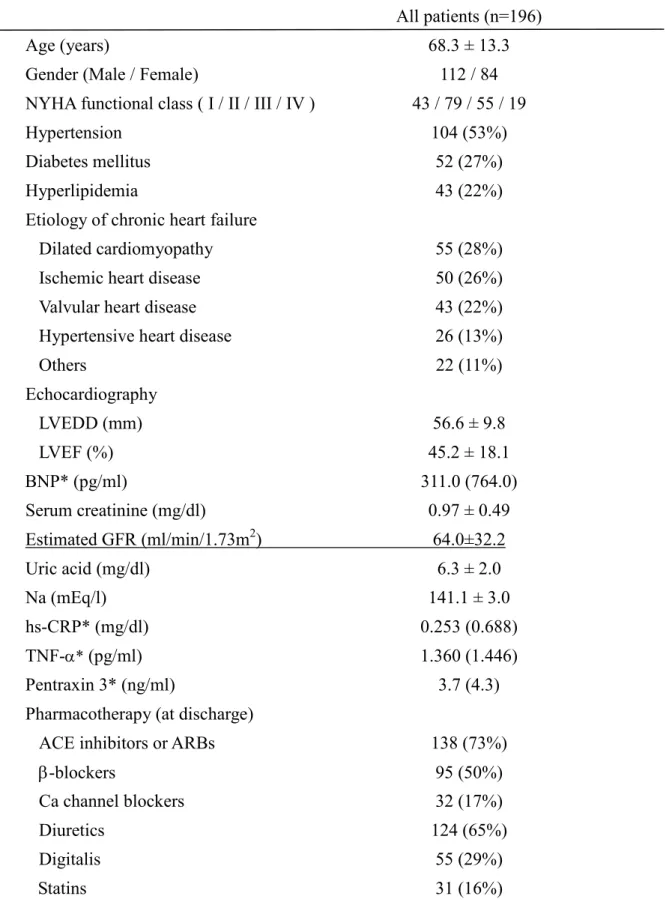
The clinical characteristics, laboratory data, and medications of all study subjects are listed in Table 1. The mean left ventricular end diastolic diameter (LVEDD) and left ventricular ejection fraction (LVEF) were 56.6 mm and 45.2%, respectively. The median values of plasma BNP, serum hs-CRP, TNF- α and plasma PTX3 were 311.0 pg/ml, 0.253 mg/dl, 1.360 pg/ml and 3.7 ng/ml, respectively.

As shown in Figure 1, the concentration of plasma PTX3 levels was significantly higher in patients with heart failure than in control subjects, and increased with advancing NYHA functional class (P < 0.0001), especially in severe heart failure patients with NYHA class III and IV.

From the mean + 2SD value of 60 normal control subjects, the normal upper limit of plasma PTX3 level was determined as 4.0 ng/ml. Heart failure patients were divided into two groups: normal plasma PTX3 levels (< 4.0 ng/ml, n = 102) and high plasma PTX3 levels (> 4.0 ng/ml, n = 94). High plasma PTX3 levels were present in 10 of 43 patients (23.3%) with NYHA class I, 28 of 79 patients (35.4%) with NYHA II, 39 of 55 patients (70.9%) with NYHA III, and 17 of 19 patients (89.5%) with NYHA IV (P < 0.0001).

Clinical characteristics were compared between patients with normal and high plasma

(13)

PTX3 groups (Table 2). NYHA functional class was more severe, and LVEF and estimated GFR were lower in high plasma PTX3 group than in normal PTX3 group. We found that plasma BNP (P < 0.0001) and serum hs-CRP (P < 0.0001) levels were higher in high plasma PTX3 group than in normal PTX3 group. Levels of plasma PTX3 and serum hs-CRP were weakly correlated by a simple linear regression analysis (R = 0.300, P < 0.0001).

Prognosis of subjects and plasma PTX3 levels

There were 63 cardiac events (24 cardiac deaths and 39 re-hospitalization) during a follow-up period in all heart failure patients. Clinical characteristics were compared between patients with and without cardiac events (Table 3). We found that plasma BNP (P <

0.0001), serum creatinine (P = 0.0328), uric acid (P = 0.0039), hs-CRP (P = 0.0025), TNF- α (P = 0.0006) and plasma PTX3 levels (P < 0.0001) were higher in the cardiac event group than in the event free group. Estimated GFR was lower in the cardiac event group than in the event free group (P < 0.0001). Echocardiography showed that LVEDD was larger and LVEF was lower in the cardiac event group than in the event free group (P = 0.0010 and P = 0.0057, respectively).

Cumulative event free survival curves were illustrated by the Kaplan-Meier method

and compared by a log rank test (Figure 2). Cardiac event free rate was significantly lower

(14)

in the high PTX3 group than in the normal PTX3 group (44.7% vs. 89.2%, P<0.0001, Figure 2A). Rates of cardiac death (P < 0.0001) and re-hospitalization due to worsening heart failure (P < 0.0001) were significantly higher in patients with high PTX3 than in those with normal PTX3 levels (Figures 2B and 2C).

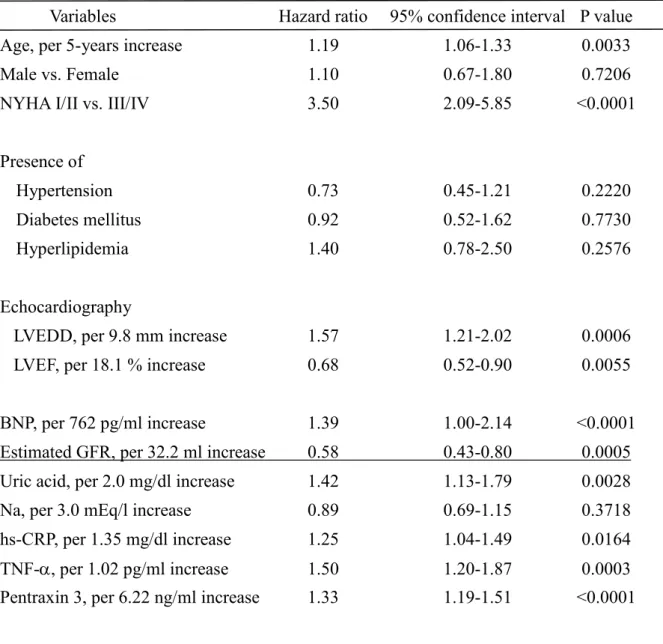
The univariate Cox proportional hazards analysis to predict cardiac events for PTX3 and other variables are shown in Table 4. An increase of one SD (6.22 ng/ml) in plasma PTX3 levels was a significant variable (hazard ratio 1.33, 95% confidence interval, 1.19-1.51, P < 0.0001). Furthermore, age, NYHA class, an increase of one SD in the LVEDD, LVEF, BNP, estimated GFR, uric acid, hs-CRP, and TNF- α were related significantly to cardiac events (Table 4).

Those variables with P values of less than 0.05 were entered into the multivariate Cox proportional hazard regression analysis (Table 5). With the multivariate Cox proportional hazard regression analysis, plasma PTX3 level, LVEDD, hs-CRP and BNP were the independent predictors of cardiac events among those variables as reported in Table 5.

We classified all heart failure patients into 4 groups according to plasma PTX3 levels:

1

st

quartile (< 2.2 ng/ml, n = 49), 2

nd

quartile (2.2-3.7 ng/ml, n = 49), 3

rd

quartile (3.7-6.5

ng/ml, n = 49) and 4

th

quartile (> 6.5 ng/ml, n = 49). As shown in Figure 3, the relative risk

of all cardiac events was the highest in 4

th

quartile (9.23-fold compared to the 1

st

quartile).

(15)

Comparison of PTX3 with BNP

Plasma PTX3 levels were weakly correlated with BNP by a simple linear regression analysis (R = 0.241, P = 0.0007). Receiver operated characteristic (ROC) curves for PTX3 and BNP are shown in Figure 4. The area under the ROC of PTX3 was larger than that of BNP (0.8047 vs. 0.7107), suggesting that PTX3 was superior to BNP to predict adverse outcomes. The sensitivity and specificity to detect future cardiac events were 71.4% and 64.7% by BNP alone, 82.5% and 69.2% by PTX3 alone, and 93.7% and 52.6% by PTX3 + BNP.

Subset analysis in patients with NYHA class III/IV

There were 74 patients with NYHA class III and IV in the present study. Those patients were divided into high PTX3 group (n = 55) and normal PTX3 group (n = 19).

Event free rates were compared between high and normal PTX3 groups (Figure 5).

Kaplan-Meier curves demonstrated that high PTX3 group had significantly lower cardiac

event free rate than normal PTX3 group (P = 0.0193) in patients with NYHA class III and IV

as shown in Figure 5.

(16)

Discussion

We reported the new important findings in this study; (1) PTX3, which is one of the pentraxin superfamily and a new vascular inflammatory marker, was increased in patients with heart failure, and plasma PTX3 levels increased with advancing NYHA functional class (Figures 1), (2) patients with abnormally high plasma PTX3 levels more frequently had cardiac events than patients with normal PTX3 levels (Figure 2), and (3) PTX3 remained an independent predictor of cardiac events by the multivariate Cox proportional hazard analysis (Table 5) and the multiple logistic regression analysis (Table 6) when compared with other well-known predictors of clinical outcomes in heart failure.

Heart failure is systemic disorder which affects not only cardiovascular and

musculoskeletal systems but also inflammation and immune systems.

4,5,21,22

There is now

substantial evidence to suggest that activation of the inflammatory and immune systems may

play an important role in the heart failure process.

21-24

Recently, several numbers of

biochemical novel factors, inflammatory markers and cytokines (e.g. hs-CRP, TNF- α , IL-6,

tissue factor) have been identified that are related to prognosis and risk in patients with heart

failure.

8,9,25

CRP, which is one of the short pentraxin, is synthesized in the liver in response

to various inflammatory signals and cytokines, mostly IL-6. In contrast to short pentraxin

CRP, the long pentraxin including PTX3 is produced only in small amounts in the liver, but

(17)

much more in dendritic cells, endothelial cells, smooth muscle cells, macrophages, and fibroblasts in response to primary inflammatory signals. PTX3 binds the complement component C1q and activates the classical pathway of complement activation.

26

In addition, PTX3 binds fibroblast growth factor 2 and inhibits activation of smooth muscle cells, neointima formation, and angiogenesis after arterial injury.

27

PTX3 is also expressed in human advanced atherosclerotic plaques.

15

There was not a close correlation between PTX3 and CRP in the present study as reported in other studies.

17

Therefore, PTX3 provides important diagnostic and prognostic information independently from CRP, and is more sensitive and immediate inflammatory marker than CRP in heart failure patients.

There were some limitations in the present study. The use of

angiotensin-converting enzyme inhibitors/angiotensin II receptor blockers and β -blockers was

relatively low in this study (Table 1). There are some reasons for these low rates; (1) many

of study subjects had preserved left ventricular systolic function (LVEF > 40%) in the present

study, and (2) numbers of patients with ischemic heart failure were relatively low (26%) in

this study population compared to Western countries. The prevalence of ischemic heart

disease was lower than in comparable European or North American cohorts. To generalize

our findings with PTX3 in heart failure, assessment of a new biomarker should be performed

in a larger population. Ideally, findings in this study would be independently and

(18)

prospectively confirmed in another cohort. Multi-center trial with a large scale study population is necessary to validate the clinical importance of PTX3 in the future.

Conclusion

Plasma PTX3 level was increased in patients with heart failure and independently

associated with an increased risk for cardiac events. These data indicate that plasma PTX3

level is a novel promising marker to provide useful prognostic information for clinical

outcomes in patients with heart failure.

(19)

References

1. Raymond RJ, Dehmer GJ, Theoharides TC

in patients with asymptomatic left ventricular systolic dysfunction. Am Heart J. 2001;

141:435-438.

2. Torre-Amione G, Kapadia S, Benedict C, Oral H, Young JB, Mann DL. Proinflammatory cytokine levels in patients with depressed left ventricular ejection fraction: A report from the studies of left ventricular dysfunction (SOLVED). J Am Coll Cardiol. 1996;

27:1201-1206.

3. Wallert KC, Drexler H. The role of interleukin-6 in the failing heart. Heart failure reviews.

2001; 6:95-103. Review.

4. Rauchhaus M, Doehner W, Francis DP, Davos C, Kemp M, Liebenthal C, Niebauer J, Hooper J, Volk HD, Coats AJ, Anker SD. Plasma cytokine parameters and mortality in patients with chronic heart failure. Circulation. 2000; 102:3060-3067.

5. Pan JP, Liu TY, Chiang SC, Lin YK, Chou CY, Chan WL, Lai ST. The value of plasma levels of tumor necrosis factor-alpha and interleukin-6 in predicting the severity and prognosis in patients with congestive heart failure. J Chin Med Assoc. 2004; 67:222-228.

6. Ganapathi MK, May LT, Schultz D, Brabenec A, Weinstein J, Sehgal PB, Kushner I. Role

of interleukin-6 in regulating synthesis of C-reactive protein and serum amyloid A in

(20)

human hepatoma cell lines. Biochem Biophys Res Commun. 1988; 157:271-277.

7. Ganter U, Arcone R, Toniatti C, Morrone G, Ciliberto G. Dual control of C-reactive protein gene expression by interleukin-1 and interleukin-6. EMBO J. 1989; 8:3773-3779.

8. Yin WH, Chen JW, Jen HL, Chiang MC, Huang WP, Feng AN, Young MS, Lin SJ.

Independent prognostic value of elevated high-sensitive C-reactive protein in chronic heart failure. Am Heart J. 2004; 147:931-938.

9. Mueller C, Laule-Killian K, Christ A, Brunner-La Rocca HP, Perruchoud AP.

Inflammation and long-term mortality in acute congestive heart failure. Am Heart J. 2006;

151:845-850.

10. Garlanda C, Bottazzi B, Bastone A, Mantovani A. Pentraxins at the crossroads between innate immunity, inflammation, matrix deposition, and female fertility. Annu Rev Immunol. 2005; 23:337-366.

11. Basile A, Sica A, d’Aniello E, Breviario F, Garrido G, Castellano M, Mantovani A, Introna M. Characterization of the promoter for the human long pentraxin PTX3. Role of NF- κ B in tumor necrosis factor- α and interleukin-1 β regulation. J Biol Chem. 1997;

272:8172-8178.

12. Baumann H, Gauldie J. The acute phase response. Immunol Today. 1994; 15:74-80.

13. Steel DM, Whitehead AS. The major acute phase reactants: C-reactive protein, serum

(21)

amyloid P component and serum amyloid A protein. Immunol Today. 1994; 15:81-88.

14. Alles VV, Bottazzi B, Peri G, Golay J, Introna M, Mantovani A. Inducible expression of PTX3, a new member of the pentraxin family, in human mononuclear phagocytes. Blood.

1994; 84:3483-3493.

15. Rolph MS, Zimmer S, Bottazzi B, Garlanda C, Mantovani A, Hansson GK. Production of the long pentraxin PTX3 in advanced atherosclerotic plaques. Arterioscler Thromb Vasc Biol. 2002; 22:10-14.

16. Mantovani A, Garlanda C, Bottazzi B. Pentraxin 3, a non-redundant soluble pattern recognition receptor involved in innate immunity. Vaccine. 2003; 21 Suppl 2: S43-47.

Review.

17. Peri G, Introna M, Corradi D, Iacuitti G, Signorini S, Avanzini F, Pizzetti F, Maggioni AP, Moccetti T, Metra M, Cas LD, Ghezzi P, Sipe JD, Re G, Olivetti G, Mantovani A, Latini R.

PTX3, a prototypic long pentraxin, is an early indicator of acute myocardial infarction in humans. Circulation. 2000; 102:636-641.

18. Latini R, Maggioni AP, Peri G, Mantovani A. Prognostic significance of the long pentraxin PTX3 in acute myocardial infarction. Circulation. 2004; 110:2349-2354.

19. Inoue K, Sugiyama A, Reid PC, Ito Y, Miyauchi K, Mukai S, Sagara M, Miyamoto K,

Satoh H, Kohno I, Kurata T, Ota H, Mantovani A, Hamakubo T, Daida H, Kodama T.

(22)

Establishment of a high sensitivity plasma assay for human pentraxin3 as a marker for unstable angina pectoris. Arterioscler Thromb Vasc Biol. 2007; 27: 161-167.

20. Levy AS, Bosch JP, Lewis JB, Greene T, Rogers N, Roth D. A more accurate method to estimate glomerular filtration rate from serum creatinine: A new prediction equation.

Ann Intern Med 1999; 130: 461-469.

21. Torre-Amione G.. Immune activation in chronic heart failure. Am J Cardiol. 2005;

95(11A):3C-8C; discussion 38C-40C. Review.

22.

Serum complement activation in congestive

heart failure. Am Heart J. 2001; 141:684-690.

23. Shan K, Kurrelmeyer K, Seta Y, Wang F, Mann DL. The role of cytokines in disease progression in heart failure. Curr Opin in Cardiol. 1997; 12:218-223.

24. Sharma R, Anker SD. The role of inflammatory mediators in chronic heart failure:

cytokines, nitric oxide, and endothelin-1. Int J Cardiol. 2000; 72:175-186.

25. Vasan RS, Sullivan LM, Roubenoff R, Dinarello CA, Harris T, Benjamin EJ, Sawyer DB, Levy D, Wilson PW, D’Agostino RB. Inflammatory markers and risk of heart failure in elderly subjects without prior myocardial infarction: the Framingham Heart Study.

Circulation. 2003; 107:1486-1491.

(23)

26. Nauta AJ, Bottazzi B, Mantovani A, Salvatori G, Kishore U, Schwaeble WJ, Gingras AR, Tzima S, Vivanco F, Egido J, Tijsma O, Hack EC, Daha MR, Roos A. Biochemical and functional characterization of the interaction between pentraxin 3 and C1q. Eur J Immunol.

2003; 33:465-473.

27. Camozzi M, Zacchigna S, Rusnati M, Coltrini D, Ramirez-Correa G, Bottazzi B, Mantovani A, Giacca M, Presta M. Pentraxin 3 inhibits fibroblast growth factor 2-dependent activation of smooth muscle cells in vitro and neointima formation in vivo.

Arterioscler Thromb Vasc Biol. 2005; 25:1837-1842.

(24)

Figure legends

Figure 1. Plasma levels of PTX3 in study population. We determined the normal upper

limit of plasma PTX3 levels from mean + 2SD value of 60 control subjects (4.0 ng/ml, dash line). *P < 0.01 vs. control, #P < 0.05 vs. NYHA I, ##P < 0.01 vs. NYHA I, $P < 0.01 vs.

NYHA II

Figure 2. Kaplan-Meier analysis for all cardiac events (A), cardiac deaths (B), and

re-hospitalization (C) between patients with high and normal plasma PTX3 levels.

Figure 3. Quartile analysis of plasma PTX3 levels and relative risk for all cardiac events in

heart failure patients. *P < 0.05, **P < 0.01 vs. 1

st

Quartile, #P < 0.05 vs. 2

nd

Quartile.

Figure 4. Receiver operated characteristic (ROC) curves for PTX3 and BNP. The area

under the ROC (AUC) of PTX3 was larger than that of BNP (0.8047 vs. 0.7107).

Figure 5. Kaplan-Meier analysis for all cardiac events between patients with high and normal

plasma PTX3 levels in NYHA class III/IV.

(25)

Table 1. Clinical Characteristics of 196 Patients With Chronic Heart Failure

All patients (n=196)

Age (years) 68.3 ± 13.3

Gender (Male / Female) 112 / 84

NYHA functional class ( I / II / III / IV ) 43 / 79 / 55 / 19

Hypertension 104 (53%)

Diabetes mellitus 52 (27%)

Hyperlipidemia 43 (22%)

Etiology of chronic heart failure

Dilated cardiomyopathy 55 (28%)

Ischemic heart disease 50 (26%)

Valvular heart disease 43 (22%)

Hypertensive heart disease 26 (13%)

Others 22 (11%)

Echocardiography

LVEDD (mm) 56.6 ± 9.8

LVEF (%) 45.2 ± 18.1

BNP* (pg/ml) 311.0 (764.0)

Serum creatinine (mg/dl) 0.97 ± 0.49

Estimated GFR (ml/min/1.73m

2

) 64.0±32.2

Uric acid (mg/dl) 6.3 ± 2.0

Na (mEq/l) 141.1 ± 3.0

hs-CRP* (mg/dl) 0.253 (0.688)

TNF-

α

* (pg/ml) 1.360 (1.446)

Pentraxin 3* (ng/ml) 3.7 (4.3)

Pharmacotherapy (at discharge)

ACE inhibitors or ARBs 138 (73%)

β -blockers 95 (50%)

Ca channel blockers 32 (17%)

Diuretics 124 (65%)

Digitalis 55 (29%)

Statins 31 (16%)

NYHA, New York Heart Association; LVEDD, left ventricular end-diastolic diameter; LVEF,

(26)

rate; hs-CRP, high sensitive C-reactive protein; TNF, tumor necrosis factor; ACE,

angiotensin converting enzyme; ARB, angiotensin II receptor blocker. *Skewed data are

reported as median (inter-quartile range).

(27)

Table 2. Comparisons of Clinical Characteristics between Patients with Normal and High Plasma Pentraxin 3 Levels

Normal PTX3 levels High PTX3 levels

(<4.0 ng/ml) (n=102) (>4.0 ng/ml) (n=94) P value

Age (years) 67.7 ± 11.6 69.1 ± 15.0 0.4489

Gender (Male / Female) 59 / 43 53 / 41 0.8365

NYHA functional class (I / II / III / IV) 33 / 51 / 16 / 2 10 / 28 / 39 / 17 <0.0001

Hypertension 61 (61%) 43 (46%) 0.0488

Diabetes mellitus 32 (32%) 20 (21%) 0.1097

Hyperlipidemia 25 (25%) 18 (19%) 0.3649

Etiology oh chronic heart failure 0.7575

Dilated cardiomyopathy 25 (25%) 30 (32%)

Ischemic heart disease 25 (25%) 25 (26%)

Valvular heart disease 25 (25%) 18 (19%)

Hypertensive heart disease 15 (15%) 11 (12%)

Others 12 (11%) 10 (11%)

Echocardiography

LVEDD (mm) 54.8 ± 9.1 57.7 ± 10.3 0.0817

LVEF (%) 50.9 ± 17.9 42.3 ± 16.9 0.0002

BNP* (pg/ml) 147.0 (356.2) 722.0 (1087.0) <0.0001 Serum creatinine (mg/dl) 0.96 ± 0.56 0.97 ± 0.40 0.8634 Estimated GFR (ml/min/1.73m

2

) 68.7 ± 31.5 54.2 ± 31.6 0.0034

Uric acid (mg/dl) 6.0 ± 1.9 6.5 ± 2.1 0.1010

Na (mEq/l) 141.3 ± 2.5 140.0 ± 3.4 0.5491

hs-CRP* (mg/dl) 0.063 (0.241) 0.516 (2.011) <0.0001

TNF-

α

* (pg/ml) 1.143 (1.064) 1.296 (1.005) 0.0527

Abbreviations as in Table 1

(28)

Table 3. Comparisons of Clinical Characteristics between Patients With and Without Cardiac Events

Event-free Cardiac event

(n=133) (n=63) P value

Age (years) 66.6 ± 13.7 71.9 ± 11.6 0.0082

Gender (Male / Female) 77 / 56 35 / 28 0.7573

NYHA functional class (I / II / III / IV) 40 / 59 / 26 / 8 3 / 20 / 29 / 11 <0.0001

Hypertension 76 (57%) 28 (44%) 0.0962

Diabetes mellitus 36 (27%) 16 (25%) 0.8046

Hyperlipidemia 28 (21%) 15 (24%) 0.6631

Etiology oh chronic heart failure 0.3497

Dilated cardiomyopathy 34 (26%) 21 (33%)

Ischemic heart disease 32 (24%) 18 (29%)

Valvular heart disease 32 (24%) 11 (17%)

Hypertensive heart disease 18 (13%) 8 (13%)

Others 17 (13%) 5 (8%)

Echocardiography

LVEDD (mm) 54.4 ± 8.5 59.5 ± 11.5 0.0010

LVEF (%) 49.8 ± 17.5 42.0 ± 18.2 0.0057

BNP* (pg/ml) 198.3 (449.2) 809.0 (981.3) <0.0001 Serum creatinine (mg/dl) 0.92 ± 0.48 1.08 ± 0.50 0.0328 Estimated GFR (ml/min/1.73m

2

) 72.2 ± 32.7 50.3 ± 26.2 <0.0001

Uric acid (mg/dl) 6.0 ± 2.0 6.9 ± 1.9 0.0039

Na (mEq/l) 141.3 ± 2.5 140.8 ± 3.8 0.2561

hs-CRP* (mg/dl) 0.078 (0.483) 0.411 (0.970) 0.0025

TNF- α * (pg/ml) 1.150 (1.064) 1.562 (1.828) 0.0006

Pentraxin 3* (ng/ml) 2.99 (2.95) 6.22 (5.59) <0.0001

Abbreviations as in Table 1

(29)

Table 4. Results of the Univariate Cox Proportional Hazard Analysis

Variables Hazard ratio 95% confidence interval P value

Age, per 5-years increase 1.19 1.06-1.33 0.0033

Male vs. Female 1.10 0.67-1.80 0.7206

NYHA I/II vs. III/IV 3.50 2.09-5.85 <0.0001

Presence of

Hypertension 0.73 0.45-1.21 0.2220

Diabetes mellitus 0.92 0.52-1.62 0.7730

Hyperlipidemia 1.40 0.78-2.50 0.2576

Echocardiography

LVEDD, per 9.8 mm increase 1.57 1.21-2.02 0.0006

LVEF, per 18.1 % increase 0.68 0.52-0.90 0.0055

BNP, per 762 pg/ml increase 1.39 1.00-2.14 <0.0001 Estimated GFR, per 32.2 ml increase 0.58 0.43-0.80 0.0005 Uric acid, per 2.0 mg/dl increase 1.42 1.13-1.79 0.0028

Na, per 3.0 mEq/l increase 0.89 0.69-1.15 0.3718

hs-CRP, per 1.35 mg/dl increase 1.25 1.04-1.49 0.0164 TNF- α , per 1.02 pg/ml increase 1.50 1.20-1.87 0.0003 Pentraxin 3, per 6.22 ng/ml increase 1.33 1.19-1.51 <0.0001

Abbreviations as in Table 1

(30)

Table 5. Results of the Multivariate Cox Proportional Hazard Analysis

Variables Hazard ratio 95% confidence interval P value

Age, per 5-years increase 1.16 0.98-1.38 0.0904

LVEDD, per 9.8mm increase 1.47 1.06-2.05 0.0207

LVEF, per 18.1% increase 0.99 0.69-1.40 0.9467

BNP, per 762 pg/ml increase 1.25 1.00-2.14 0.0493

Estimated GFR, per 32.2 ml increase 1.12 0.70-1.83 0.6424 Uric acid, per 2.0 mg/dl increase 1.20 0.90-1.59 0.1989

hs-CRP, per 1.35 mg/dl increase 1.24 1.01-1.53 0.0418

TNF-

α

, per 1.02 pg/ml increase 1.16 0.88-1.53 0.2971

Pentraxin 3, per 6.22 ng/ml increase 1.20 1.03-1.40 0.0162

Abbreviations as in Table 1

(31)

0 10 20 30 40

Plasma PTX3 level

(ng/ml)

Control NYHA I NYHA II NYHA III NYHA IV

## $ *

# $ *

(32)

Event free (%)

Time (days)

Log rank test, P < 0.0001 High PTX3 levels (n=94)

> 4.0 ng/ml

Normal PTX3 levels (n=102)

< 4.0 ng/ml

0 20 40 60 80 100

0 200 400 600 800 1000 1200 1400 1600 1800

All cardiac events

(33)

Cardiac deaths

Event free (%)

0 200 400 600 800 1000 1200 1400 1600 1800 0

20 40 60 80 100

Time (days)

High PTX3 levels (n=94)

> 4.0 ng/ml

Normal PTX3 levels (n=102)

< 4.0 ng/ml

Log rank test, P < 0.0001

(34)

Re-hospitalization

0 200 400 600 800 1000 1200 1400 1600 1800

Event free (%)

0 20 40 60 80 100

Time (days)

High PTX3 levels (n=94)

> 4.0 ng/ml

Normal PTX3 levels (n=102)

< 4.0 ng/ml

Log rank test, P < 0.0001

(35)

Relative risk

Range of PTX3 (ng/ml) (< 2.2) (2.2-3.7) (3.7-6.5) (> 6.5)

All cardiac events 4/49 7/49 21/49 31/49

0 5 10

1st Quartile 2nd Quartile 3rd Quartile 4th Quartile

* #

* #

1.00 1.54

5.80

9.23

(36)

0 0.2 0.4 0.6 0.8 1

0 0.2 0.4 0.6 0.8 1

Sensitivity

1 - specificity PTX3

BNP

AUC: PTX3 = 0.8047

AUC: BNP = 0.7107

(37)

0 200 400 600 800 1000 1200 1400 1600

Event free (%)

Time (days)

0 20 40 60 80 100

Log rank test, P = 0.0193 Normal PTX3 levels (n=19)

< 4.0 ng/ml

High PTX3 levels (n=55)

> 4.0 ng/ml

All cardiac events

Table 1. Clinical Characteristics of 196 Patients With Chronic Heart Failure
Table 2. Comparisons of Clinical Characteristics between Patients with Normal and  High Plasma Pentraxin 3 Levels
Table 3. Comparisons of Clinical Characteristics between Patients With and Without  Cardiac Events
Table 4. Results of the Univariate Cox Proportional Hazard Analysis
+2

参照

関連したドキュメント

We present sufficient conditions for the existence of solutions to Neu- mann and periodic boundary-value problems for some class of quasilinear ordinary differential equations.. We

“Breuil-M´ezard conjecture and modularity lifting for potentially semistable deformations after

Then it follows immediately from a suitable version of “Hensel’s Lemma” [cf., e.g., the argument of [4], Lemma 2.1] that S may be obtained, as the notation suggests, as the m A

Applying the representation theory of the supergroupGL(m | n) and the supergroup analogue of Schur-Weyl Duality it becomes straightforward to calculate the combinatorial effect

[9, 28, 38] established a Hodge- type decomposition of variable exponent Lebesgue spaces of Clifford-valued func- tions with applications to the Stokes equations, the

Considering this lack of invariance of existing models and to non-conformity with thermo- dynamical principles, we propose in the next section a new way of deriving models which, on

Use the minimum Moccasin II PLUS + AAtrex rate postemergence with Touchdown or Roundup in glyphosate- tolerant corn as specified in the CORN - Moccasin II PLUS Combinations –

In theory of Statistics, we do not come across very often a notion of matrix diagonalization except for that of covariance matrices, which are symmetric and diagonalizable.