Fukushima Medical University
福島県立医科大学 学術機関リポジトリ
This document is downloaded at: 2021-11-07T23:45:33Z
Title Evaluation of nail fold capillaroscopy findings in patients with primary biliary cirrhosis
Author(s) Monoe, Kyoko; Takahashi, Atsushi; Abe, Kazumichi; Kanno, Yukiko; Watanabe, Hiroshi; Ohira, Hiromasa
Citation Hepatology research. 44(10): E129-E136
Issue Date 2014-10
URL http://ir.fmu.ac.jp/dspace/handle/123456789/470
Rights
© 2013 The Japan Society of Hepatology. This is the peer reviewed version of the following article: Hepatol Res. 2014 Oct;44(10):E129-36., which has been published in final form at dx.doi.org/10.1111/hepr.12255. This article may be used for non-commercial purposes in accordance with Wiley Terms and Conditions for Self-Archiving.
DOI 10.1111/hepr.12255
Text Version author
1 Original Article
Evaluation of nailfold capillaroscopy findings in patients with primary biliary cirrhosis
Kyoko Monoe, Atsushi Takahashi, Kazumichi Abe, Yukiko Kanno, Hiroshi Watanabe and Hiromasa Ohira
Department of Gastroenterology and Rheumatology, Fukushima Medical University School of Medicine, Fukushima, Japan
Running title; Nailfold capillaroscopy in PBC patients
Correspondence: Hiromasa Ohira, Department of Gastroenterology and Rheumatology, Fukushima Medical University, 1 Hikarigaoka, Fukushima 960-1295, Japan
Tel 81-24-547-1202 Fax 81-24-547-2055 Email:[email protected]
2 ABSTRACT
Aims: Some patients with primary biliary cirrhosis (PBC) experience Raynaud's phenomenon.
The objective of this study was to clarify the relationships between nailfold capillaroscopy findings and clinical presentations of PBC.
Methods: A total of 70 patients with PBC and 57 patients with non-PBC liver diseases, including 44 patients with chronic viral hepatic disease, 8 with autoimmune hepatitis and 5 with non-alcoholic fatty liver disease, were included in this study. Nailfold capillaroscopy findings were classified as normal or abnormal and were further graded as mild, moderate or severe, and the relationships between frequency of abnormal blood vessel and their clinical presentations were examined.
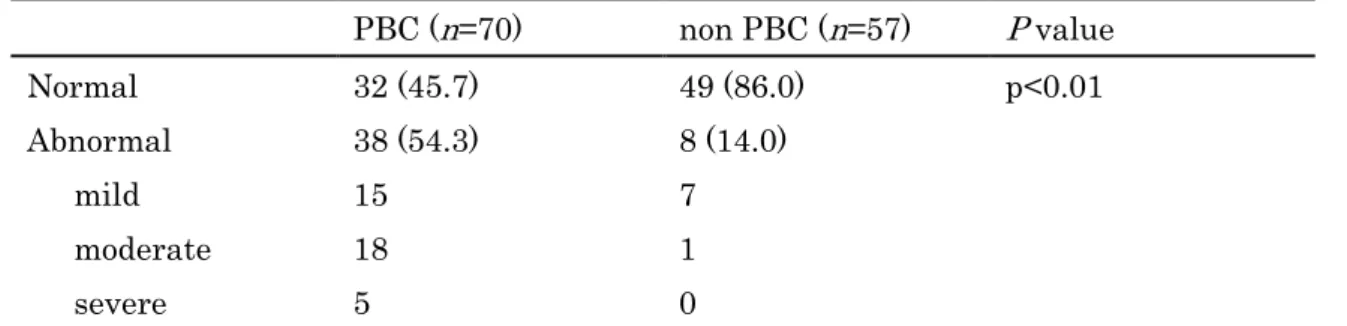
Results: The frequency of abnormal nailfold capillaroscopic findings was significantly higher in PBC patients (54.3%) than in patients with non-PBC liver disease (13.8%) (p<0.01). These abnormal findings observed in PBC patients were graded as mild in 15 patients, moderate in 18 patients and severe in 5 patients. Significantly more PBC patients with abnormal capillaroscopy findings (19/38, 50%) were positive for anticentromere antibody than were those with normal capillaroscopy findings (3/32, 9.4%) (p<0.01).
Conclusions: PBC patients had significantly higher frequency of abnormal nailfold capillaroscopy findings than did patients with non-PBC liver disease.
Keywords: nailfold capillaroscopy, primary biliary cirrhosis, Raynaud’s phenomenon, anticentromere antibody
3 INTRODUCTION
Primary biliary cirrhosis (PBC) is characterized by chronic nonsuppurative destructive cholangitis (CNSDC) and associated damage to intrahepatic bile ducts and can progress to hepatic failure in many cases.1, 2 Based on the appearance of autoantibodies and liver histology findings, the condition is believed to be caused by autoimmune disease targeting interlobular bile ducts.3 Anti-mitochondrial antibodies (AMA) are found in approximately 90% of PBC patients and thus can be used as a disease marker for diagnosis of PBC.4, 5 PBC patients also often test positive for anti-nuclear antibodies (ANA), with anti-centromere antibodies (ACA) detected in approximately 30% of patients.6-8 Many PBC patients also have Raynaud's phenomenon. The incidence of Raynaud’s phenomenon is high in PBC patients positive for ACA, and such patients are susceptible to portal hypertension.9-11
In Europe, non-invasive nailfold capillaroscopy of the fingers is widely used for assessment of microcirculatory disturbance of skin capillaries as well as for differential diagnosis and prognosis prediction in patients with rheumatic disease, particularly in those with scleroderma.12-15 Fonollosa et al. reported a high frequency of nailfold capillary abnormalities in PBC patients.16 However, there has been no other study in which nailfold capillary findings in liver disease patients were analyzed in detail.
The objective of this study was to clarify the relationships between frequency of finger nailfold capillary abnormalities in PBC patients and their clinical presentations.
MATERIALS AND METHODS Patients
A total of 70 patients with PBC (14 males and 56 females, mean observation period of 98.4 ±
4
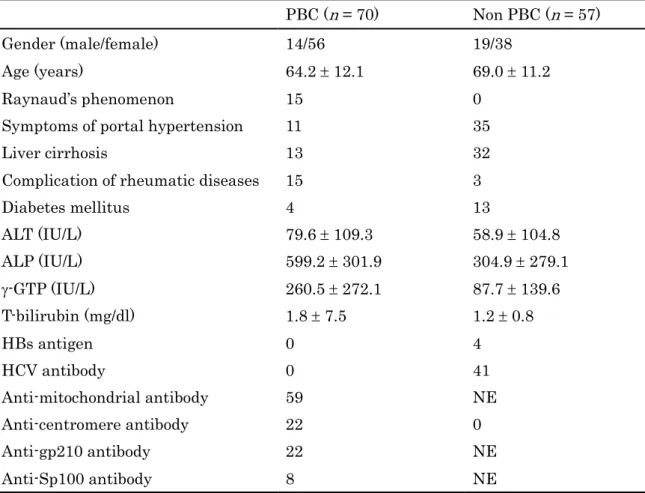
71.7 months) diagnosed in our hospital or affiliated institutions between 1987 and 2011 were included in this study. Fifty-seven patients with non-PBC liver diseases (19 males and 38 females) were also included as disease controls. Those 57 patients included 44 patients with chronic viral hepatic disease (CVH), 8 with autoimmune hepatitis (AIH) and 5 with non-alcoholic fatty liver disease (NAFLD). Patients were diagnosed as having PBC if they met at least two of three criteria: (1) chronic elevation of cholestatic liver enzymes, alkaline phosphatase (ALP) and gamma-glutamyltranspeptidase (GGT), (2) presence of serum AMA, and (3) typical histological findings of biopsied liver specimens.1 AIH was diagnosed according to the revised scoring system proposed by the International Autoimmune Hepatitis Group for diagnosis of AIH.17 CVH was diagnosed by a positive HBs antigen or positive HCV antibody test with hematological/imaging findings indicative of chronic liver disease. NAFLD was diagnosed by negative tests for HBs antigen and HCV antibody with hematological/imaging findings indicative of hepatic steatosis in patients with a daily alcohol consumption of less than 20 g. Patients who had non-PBC chronic liver disease with Raynaud's phenomenon or a positive ACA test were excluded from the study. The main clinical presentations of these patients are summarized in Table 1.
All patients gave informed consent. This study was approved by the Ethics Committee of Fukushima Medical University.
Nailfold capillaroscopy
The prototype finger nailfold capillaroscopy system consisted of a 4X or 10X objective lens (PLX4× and PLX10×, Olympus, Tokyo, Japan) and a prototype scope body and stage, which were all assembled at Olympus Medical Science. With this system and a DP71 digital camera, nailfold capillaroscopy was performed on the left fourth finger of each patient under immersion
5
oil, and captured images were saved (Figure 1). Capillaroscopy was performed at a room temperature of about 25°C with the patient in a sitting position and with the patient’s left hand lifted to the level of the heart.
Classification of finger nailfold capillaroscopy findings
In order to define abnormal finger nailfold capillaroscopy findings, capillaroscopic images were obtained from 40 healthy volunteers (14 males and 26 females, mean age of 46.9 ± 18.7 years) and the mean maximum diameter of nailfold capillaries was determined on saved images.
The mean +2SD of the maximum capillary diameter was determined to be 24 μm. Using this value as the standard and according to Cuttlo et al.18, abnormal findings of finger nailfold capillaroscopy were classified as follows (Figure 2).
Normal: Maximum capillary diameter is less than 24 µm with no abnormal capillary architecture or loss of capillaries.
Mild: Maximum capillary diameter is 24 µm or more.
Moderate: Presence of winding and tortuous capillaries in addition to "mild" abnormal findings.
Severe: Presence of ramified capillaries or loss of capillaries in addition to "moderate"
abnormal findings.
Three readers evaluated saved capillaroscopy images and classified the findings in a blinded manner.
Comparison of frequency of finger nailfold capillary abnormalities and clinical presentations
The finger nailfold capillaroscopy findings of PBC patients and patients with non-PBC liver
6
disease were classified according to the above criteria, and the frequency of each type of finding was determined. For PBC patients, the relationships of presence or absence of finger nailfold capillary abnormalities with clinical presentations (gender, age at capillaroscopy, observation period from diagnosis, presence or absence of Raynaud's phenomenon, itching, portal hypertension (splenomegaly or gastroesophageal varices), liver cirrhosis, rheumatic diseases, and diabetes) and with blood test results (ALT, ALP, γ-GTP, total bilirubin, total cholesterol, IgM, AMA, ACA, anti-gp210 antibody and anti-Sp100 antibody) were examined. Anti-gp210 and anti-Sp100 antibodies were measured using the Euroimmune Test System (EUROIMMUN Medizinishe Labordiagnostika AG, Germany).
Statistical analysis
The differences between the two groups were analyzing using Fisher’s exact test or the Mann-Whitney U test. In all tests, corrected p-values of less than 0.05 were considered statistically significant.
RESULTS
Frequency of finger nailfold capillary abnormalities in PBC patients
As shown in Table 2, finger nailfold capillaroscopy findings in PBC patients were assessed as normal in 32 patients (45.7%) and abnormal in 38 patients (54.3%). In the 38 patients with abnormal findings, findings were assessed as mild in 15 patients, moderate in 18 patients and severe in 5 patients. In patients with non-PBC liver disease, capillaroscopy findings were assessed as normal in 49 patients (86.0%) and abnormal in 8 patients (14.0%), abnormal findings being assessed as mild in 7 patients and moderate in 1 patient. The underlying diseases
7
associated with these abnormal findings were CVH in 7 patients and AIH in 1 patient, of whom 5 had liver cirrhosis. Thus, PBC patients had a significantly higher frequency of finger nailfold capillary abnormalities than did patients with non-PBC liver disease (p <0.01).
Comparison of finger nailfold capillaroscopy findings and clinical presentations in PBC patients
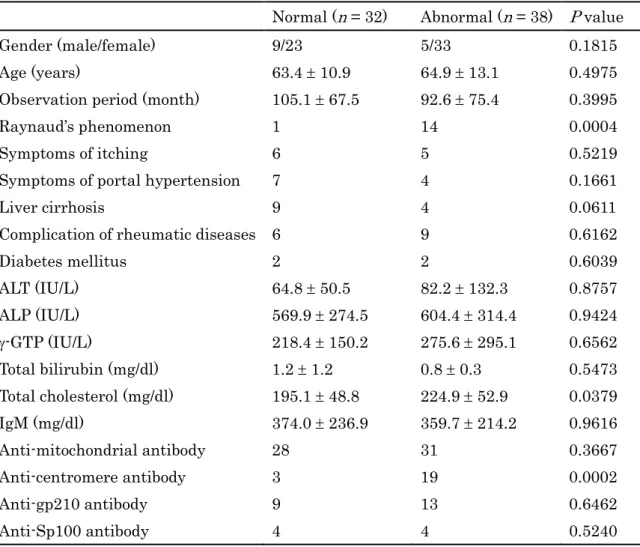
As shown in Table 3, no significant difference was found in mean age, observation period from diagnosis, presence or absence of portal hypertension (splenomegaly or gastroesophageal varices) or liver cirrhosis between PBC patients with normal (n = 32) and abnormal (n = 38) capillaroscopy findings. In contrast, the prevalence of Raynaud's phenomenon was significantly higher in PBC patients with abnormal finger nailfold capillaroscopy findings (14/38, 36.8%) than in those with normal finger nailfold capillaroscopy findings (1/32, 3.1%) (p<0.01).
Similarly, no significant difference was found in ALT, ALP, γ-GTP or total bilirubin between the two groups of patients. However, the prevalence of ACA was significantly higher in PBC patients with abnormal finger nailfold capillaroscopy findings (19/38, 50.0%) than in those with normal finger nailfold capillaroscopy findings (3/32, 9.4%) (p<0.01). Eleven patients with PBC were negative for AMA, and 7 of those patients had abnormal finger nailfold capillaroscopy findings (moderate in 5 and severe in 2). No significant correlation was found between prevalence of abnormal finger nailfold capillaroscopy findings and positivity of anti-gp210 or anti-Sp100 antibody.
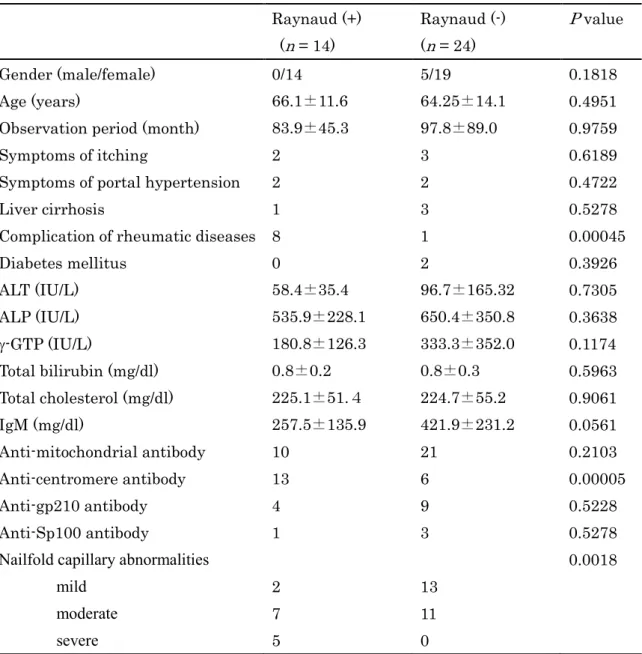
As shown in Table 4, the comparison of nailfold capillaroscopy findings with and without Raynaud's phenomenon revealed a significantly higher prevalence of concomitant rheumatic disease and ACA in those with Raynaud's phenomenon. Finger nailfold capillary abnormalities were observed in 24 of 55 (43.6%) patients with PBC without Raynaud's phenomenon (13
8
patients with mild, 11 with moderate and 0 with severe abnormalities).
DISCUSSION
Raynaud's phenomenon is a symptom in which cold stimuli or other types of stimuli induce sympathetic nerve activation and subsequent vasospasm. In secondary Raynaud's phenomenon associated with collagen disorder, it is thought that vascular endothelial damage caused by the spread of underlying inflammation and recurrent microcirculatory disturbance can lead to increased permeability, abnormal architecture/morphology and loss of capillaries in the finger nailfold.19 A high frequency of finger nailfold capillary abnormalities has been reported in patients with scleroderma, for which various analyses with nailfold capillaroscopy have been performed.15, 18, 20, 21 Some patients with PBC also experience Raynaud's phenomenon and thus are assumed to have similar nailfold capillary abnormalities.
Nailfold capillaroscopy in healthy individuals shows regularly-arranged, hairpin or U-shaped capillary loops, but in patients with rheumatic disease accompanied by Raynaud's phenomenon, enlarged capillaries or giant capillaries, architectural disarrangement of the nailfold microvascular network, angiogenesis, loss of capillaries and/or avascular areas can be observed as characteristic findings.12 Capillaroscopy findings in scleroderma patients can be classified into three patterns.15, 18, 20 Based on these reports, we evaluated capillaroscopy findings for the following abnormalities: enlarged capillary, disorganization of the capillary architecture (winding/tortuous capillaries), angiogenesis (ramified capillaries) and loss of capillaries.
Enlarged capillary was defined as a capillary diameter equal to or larger than the maximum capillary diameter for healthy volunteers plus 2SD. The degree of abnormality was graded as mild if only enlarged capillaries were observed, moderate if an abnormal capillary architecture
9
was observed in addition to "mild" abnormalities, and severe if angiogenesis or loss of capillaries were observed in addition to "moderate" abnormalities. This classification is simple and useful in practical clinic.
Fonollosa et al. reported that finger nailfold capillary abnormalities were observed in 20 (91%) of 22 patients with PBC, although about half of them also had other rheumatic diseases.16 They identified abnormalities based on the presence of tortuosities, capillary branching, capillary loop enlargement, megacapillaries or capillary loop loss. Our results showed the frequency of abnormal capillaroscopy findings in PBC patients to be 54.3%. The discrepancy between results of the two studies is likely to be due to the different criteria for evaluating capillaroscopy findings. Nagy et al. reported the frequency of abnormal capillaroscopy findings in 447 patients with collagen disorders and Raynaud’s disease to be 87.5% in those with scleroderma, 26.4% in those with dermatomyositis/polymyositis and 8.5%
in those with systemic lupus erythematosus.22 These results indicate that the frequency of finger nailfold capillary abnormalities in PBC patients is higher than that in patients with other rheumatic diseases.
One of the interesting findings in this study was that 43.6% of PBC patients without Raynaud's phenomenon had finger nailfold capillary abnormalities. A possible explanation is that vascular damage was caused by PBC itself, although it is also possible that the symptoms of Raynaud's phenomenon were too mild to be noticed by these patients. Previous studies have suggested a role of endothelin in decreased antioxidant capacity and impaired vascular endothelial cell function or microcirculation in PBC.23-26 The relationships between these factors and finger nailfold capillary abnormalities in PBC patients should be examined in future studies.
The ACA positivity rate was significantly higher in PBC patients with nailfold capillary abnormalities (50.0%) than in those without abnormalities, suggesting an association between
10
ACA and nailfold capillary abnormalities. The autoantibody ACA has been shown to be associated with Raynaud's phenomenon. In the present study, Raynaud's phenomenon was observed in 15 (21.4%) of the patients with PBC, of whom 13 were positive for ACA. CENP-B, a corresponding antigen of ACA, is detected in almost all patients seropositive for ACA and thus is considered a major antigen of ACA (27). CENP-B binds to chemokine receptor 3 (CCR3) expressed on vascular smooth muscle cells and plays a role in the healing process following vascular damage by promoting the transcriptional activity of epidermal growth factor receptors (EGFR). ACA has been shown to inhibit these activities of CENP-B.28, 29 Serum samples collected from ACA-positive scleroderma patients have been shown to induce apoptosis of vascular endothelial cells by activating caspase 3 in these cells30, suggesting the involvement of ACA in vascular endothelial cell damage and a prolonged healing process. An association between ACA and vascular damage has also been suggested from clinical cases, since some ACA-positive patients, including those with mild sclerodema, have been shown to have skin ulcers and gangrene.31 The present results suggest an association between ACA positivity and nailfold capillary abnormalities. Future studies should address whether there is any direct relationship between seropositivity of ACA and vascular endothelial cell damage in PBC patients. Nailfold capillary abnormalities were also observed at a high frequency in PBC patients negative for AMA. The fact that these patients were all positive for ACA also suggests the involvement of ACA in nailfold capillary abnormalities. However, no study has investigated endothelial damage in the liver sinusoidal wall or portal vein in patients with ACA-positive PBC. We also found no relationship between nailfold capillary abnormality and symptoms of portal hypertension. In this study, portal hypertension was evaluated based on the presence or absence of splenomegaly and varices at the time of examination. The lack of direct monitoring of portal pressure, as well as the lack of a long-term follow-up in this study might explain the
11
lack of a relationship. It will be important to determine whether there is any relationship between nailfold capillary abnormality and intrahepatic vascular abnormality. Mantaka et al.
recently investigated the relationship between polymorphism of the eNOS gene and disease susceptibility.32 The involvement of portal hypertension should also be investigated in future studies.
In the present study, nailfold capillary abnormalities were also observed in 8 (13.8%) of the patients with non-PBC liver disease. Although patients with non-PBC chronic liver disease with Raynaud's phenomenon or ACA should have been included, these cases are very rare and no patient meeting these criteria was available during the study period. The accumulation of such cases and the further improvement of evaluation criteria for abnormal capillaroscopy findings are needed for a more accurate and specific diagnosis of PBC based on nailfold capillary abnormalities.
In summary, PBC patients had a significantly higher frequency of finger nailfold capillary abnormalities than did patients with non-PBC liver disease. ACA positivity and the presence of Raynaud's phenomenon were associated with the significantly high frequency of abnormal findings, suggesting the involvement of ACA in vascular endothelial cell damage in PBC, as well as in scleroderma.
CONFLICT OF INTEREST
No potential conflict of interest relevant to this article was reported.
ACKNOWLEDGEMENT
We would like to thank Dr. Mikio Otsuka (Department of Dermatology, Fukushima Medical University) for his help with this study.
12 REFERENCES
1. Kaplan MM, Gershwin ME. Primary biliary cirrhosis. N Engl J Med 2005; 353: 1261-73.
2. Lindor KD, Gershwin ME, Poupon R, Kaplan M, Bergasa NV, Heathcote EJ; American Association for Study of Liver Diseases. Primary biliary cirrhosis. Hepatology 2009; 50:
291-308.
3. Poupon R. Primary biliary cirrhosis: a 2010 update. J Hepatol 2010; 52: 745-58.
4. Muratori L, Granito A, Muratori P, Pappas G, Bianchi FB. Antimitochondrial antibodies and other antibodies in primary biliary cirrhosis: diagnostic and prognostic value. Clin Liver Dis 2008; 12: 261-76.
5. Bogdanos DP, Komorowski L. Disease-specific autoantibodies in primary biliary cirrhosis.
Clin Chim Acta 2011; 412: 502-12.
6. Invernizzi P, Selmi C, Ranftler C, Podda M, Wesierska-Gadek J. Antinuclear antibodies in primary biliary cirrhosis. Semin Liver Dis 2005; 25: 298-310.
7. Granito A, Muratori P, Quarneti C, Pappas G, Cicola R, Muratori L. Antinuclear antibodies as ancillary markers in primary biliary cirrhosis. Expert Rev Mol Diagn 2012; 12: 65-74.
8. Saito H, Takahashi A, Abe K, et al. Autoantibodies by line immunoassay in patients with primary biliary cirrhosis. Fukushima J Med Sci 2012; 58: 107-16.
9. Nakamura M, Kondo H, Mori T, et al. Anti-gp210 and anti-centromere antibodies are different risk factors for the progression of primary biliary cirrhosis. Hepatology 2007; 45:
118-27.
10. Tojo J, Ohira H, Suzuki T, et al. Clinicolaboratory characteristics of patients with primary biliary cirrhosis associated with CREST symptoms. Hepatol Res 2002; 22: 187-95.
11. Miyawaki S, Asanuma H, Nishiyama S, Yoshinaga Y. Clinical and serological heterogeneity in patients with anticentromere antibodies. J Rheumatol 2005; 32: 1488-94.
13
12. Cutolo M, Grassi W, Matucci Cerinic M. Raynaud's phenomenon and the role of capillaroscopy. Arthritis Rheum 2003; 48: 3023-30.
13. Grassi W, De Angelis R. Capillaroscopy: questions and answers. Clin Rheumatol 2007; 26:
2009-16.
14. Kuryliszyn-Moskal A, Ciolkiewicz M, Klimiuk PA, Sierakowski S. Clinical significance of nailfold capillaroscopy in systemic lupus erythematosus: correlation with endothelial cell activation markers and disease activity. Scand J Rheumatol 2009; 38: 38-45.
15. Cutolo M, Sulli A, Smith V. Assessing microvascular changes in systemic sclerosis diagnosis and management. Nat Rev Rheumatol 2010; 6: 578-87.
16. Fonollosa V, Simeón CP, Castells L, et al. Morphologic capillary changes and manifestations of connective tissue diseases in patients with primary biliary cirrhosis.
Lupus 2001; 10: 628-31.
17. Alvarez F, Berg PA, Bianchi FB, et al. International Autoimmune Hepatitis Group Report:
review of criteria for diagnosis of autoimmune hepatitis. J Hepatol 1999; 31: 929-38.
18. Cutolo M, Sulli A, Pizzorni C, Accardo S. Nailfold videocapillaroscopy assessment of microvascular damage in systemic sclerosis. J Rheumatol 2000; 27: 155-60.
19. Herrick AL. The pathogenesis, diagnosis and treatment of Raynaud phenomenon. Nat Rev Rheumatol 2012; 8 :469-79.
20. Smith V, Pizzorni C, De Keyser F, et al. Reliability of the qualitative and semiquantitative nailfold videocapillaroscopy assessment in a systemic sclerosis cohort: a two-centre study.
Ann Rheum Dis 2010; 69: 1092-96.
21. Murray AK, Moore TL, Manning JB, Taylor C, Griffiths CE, Herrick AL. Noninvasive imaging techniques in the assessment of scleroderma spectrum disorders. Arthritis Rheum 2009; 61: 1103-11.
14
22. Nagy Z, Czirják L. Nailfold digital capillaroscopy in 447 patients with connective tissue disease and Raynaud's disease. J Eur Acad Dermatol Venereol 2004; 18: 62-8.
23. Marasini B, Pipia C, DeValle G, et al. Vascular impairment in patients with primary biliary cirrhosis. Int J Microcirc Clin Exp 1995; 15: 75-9.
24. Aboutwerat A, Pemberton PW, Smith A, et al. Oxidant stress is a significant feature of primary biliary cirrhosis. Biochim Biophys Acta 2003; 1637: 142-50.
25. Cash WJ, McCance DR, Young IS, et al. Primary biliary cirrhosis is associated with oxidative stress and endothelial dysfunction but not increased cardiovascular risk. Hepatol Res 2010; 40: 1098-106.
26. Mantaka A, Goulielmos GN, Koulentaki M, Tsagournis O, Voumvouraki A, Kouroumalis EA. Polymorphisms of genes related to endothelial cells are associated with primary biliary cirrhosis patients of Cretan origin. Hum Immunol 2012; 73: 829-35.
27. Earnshaw W, Bordwell B, Marino C, Rothfield N. Three human chromosomal autoantigens are recognized by sera from patients with anti-centromere antibodies. J Clin Invest 1986;
77: 426-30.
28. Robitaille G, Hénault J, Christin MS, Senécal JL, Raymond Y. The nuclear autoantigen CENP-B displays cytokine-like activities toward vascular smooth muscle cells. Arthritis Rheum 2007; 56: 3814-26.
29. Robitaille G, Christin MS, Clément I, Senécal JL, Raymond Y. Nuclear autoantigen CENP-B transactivation of the epidermal growth factor receptor via chemokine receptor 3 in vascular smooth muscle cells. Arthritis Rheum 2009; 60: 2805-16.
30. Ahmed SS, Tan FK, Arnett FC, Jin L, Geng YJ. Induction of apoptosis and fibrillin 1 expression in human dermal endothelial cells by scleroderma sera containing anti-endothelial cell antibodies. Arthritis Rheum 2006; 54: 2250-62.
15
31. Takahashi M, Okada J, Kondo H. Six cases positive for anti-centromere antibodies with ulcer and gangrene in the extremities. Br J Rheumatol 1997; 36: 889-93.
32. Mantaka A, Goulielmos GN, Koulentaki M, Tsagournis O, Voumvouraki A, Kouroumalis EA. Polymorphisms of genes related to endothelial cells are associated with primary biliary cirrhosis patients of Cretan origin. Hum Immunol 2012;73:829-35.
16 Figure legends
Figure 1 Prototype finger nailfold capillaroscopy system. With this system and a digital camera, nailfold capillaroscopy was performed on the left fourth finger of each patient under immersion oil and captured images were saved.
Figure 2 Representative images of classification of finger nailfold capillaroscopy findings.
a: normal, b: mildly abnormal, c: moderately abnormal, d: severely abnormal
Figure 1
a b
c d
Figure 2
Table 1 Patient characteristics
PBC (n = 70) Non PBC (n = 57)
Gender (male/female) 14/56 19/38
Age (years) 64.2 ± 12.1 69.0 ± 11.2
Raynaud’s phenomenon 15 0
Symptoms of portal hypertension 11 35
Liver cirrhosis 13 32
Complication of rheumatic diseases 15 3
Diabetes mellitus 4 13
ALT (IU/L) 79.6 ± 109.3 58.9 ± 104.8
ALP (IU/L) 599.2 ± 301.9 304.9 ± 279.1
γ-GTP (IU/L) 260.5 ± 272.1 87.7 ± 139.6
T-bilirubin (mg/dl) 1.8 ± 7.5 1.2 ± 0.8
HBs antigen 0 4
HCV antibody 0 41
Anti-mitochondrial antibody 59 NE
Anti-centromere antibody 22 0
Anti-gp210 antibody 22 NE
Anti-Sp100 antibody 8 NE
NE: not examined
Table 2 Frequency of finger nailfold capillary abnormalities in PBC and non-PBC
PBC (n=70) non PBC (n=57) P value
Normal 32 (45.7) 49 (86.0) p<0.01
Abnormal 38 (54.3) 8 (14.0)
mild 15 7
moderate 18 1
severe 5 0
Data are expressed as numbers (%) in each group
Table 3 Comparison between frequency of finger nailfold capillary abnormalities and clinical presentation in PBC
Normal (n = 32) Abnormal (n = 38) P value
Gender (male/female) 9/23 5/33 0.1815
Age (years) 63.4 ± 10.9 64.9 ± 13.1 0.4975
Observation period (month) 105.1 ± 67.5 92.6 ± 75.4 0.3995
Raynaud’s phenomenon 1 14 0.0004
Symptoms of itching 6 5 0.5219
Symptoms of portal hypertension 7 4 0.1661
Liver cirrhosis 9 4 0.0611
Complication of rheumatic diseases 6 9 0.6162
Diabetes mellitus 2 2 0.6039
ALT (IU/L) 64.8 ± 50.5 82.2 ± 132.3 0.8757
ALP (IU/L) 569.9 ± 274.5 604.4 ± 314.4 0.9424
γ-GTP (IU/L) 218.4 ± 150.2 275.6 ± 295.1 0.6562
Total bilirubin (mg/dl) 1.2 ± 1.2 0.8 ± 0.3 0.5473
Total cholesterol (mg/dl) 195.1 ± 48.8 224.9 ± 52.9 0.0379
IgM (mg/dl) 374.0 ± 236.9 359.7 ± 214.2 0.9616
Anti-mitochondrial antibody 28 31 0.3667
Anti-centromere antibody 3 19 0.0002
Anti-gp210 antibody 9 13 0.6462
Anti-Sp100 antibody 4 4 0.5240
Table 4 Clinical profile between the patients with finger nailfold capillary abnormalities with Raynaud's phenomenon and without Raynaud's phenomenon in PBC
Raynaud (+) (n = 14)
Raynaud (-) (n = 24)
P value
Gender (male/female) 0/14 5/19 0.1818
Age (years) 66.1±11.6 64.25±14.1 0.4951
Observation period (month) 83.9±45.3 97.8±89.0 0.9759
Symptoms of itching 2 3 0.6189
Symptoms of portal hypertension 2 2 0.4722
Liver cirrhosis 1 3 0.5278
Complication of rheumatic diseases 8 1 0.00045
Diabetes mellitus 0 2 0.3926
ALT (IU/L) 58.4±35.4 96.7±165.32 0.7305
ALP (IU/L) 535.9±228.1 650.4±350.8 0.3638
γ-GTP (IU/L) 180.8±126.3 333.3±352.0 0.1174
Total bilirubin (mg/dl) 0.8±0.2 0.8±0.3 0.5963
Total cholesterol (mg/dl) 225.1±51.4 224.7±55.2 0.9061
IgM (mg/dl) 257.5±135.9 421.9±231.2 0.0561
Anti-mitochondrial antibody 10 21 0.2103
Anti-centromere antibody 13 6 0.00005
Anti-gp210 antibody 4 9 0.5228
Anti-Sp100 antibody 1 3 0.5278
Nailfold capillary abnormalities mild
moderate severe
2 7 5
13 11 0
0.0018