
テキスト圧縮と圧縮文字列マイニング
後藤, 啓介
https://doi.org/10.15017/1441265
出版情報:Kyushu University, 2013, 博士(理学), 課程博士 バージョン:
権利関係:Fulltext available.
Keisuke Goto
January, 2014
can utilize a large amount of machine-readable data today. Most of such data can be seen as sequences of characters, or strings, and the demand for mining valuable information from them is increasing. To mine valuable information from them, efficient string mining algorithms ap- plicable to large-scale string data are needed. In this thesis, we develop fast and space efficient string mining algorithms for enormous string data, using text compression as a core technol- ogy. We focus on compressed string processing, which is an approach that directly processes compressed data without explicit decompression.
We present simple and efficient algorithms for calculating all frequencies of q-grams that occur in a stringT represented in compressed form, namely, as a straight line program (SLP).
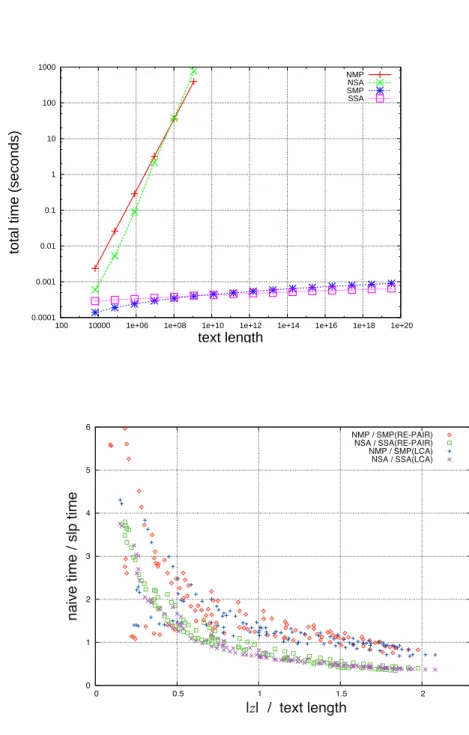
Our algorithm runs in O(qn) time and space, where n is the size of the SLP. Computational experiments show that our algorithm and its variation are practical for smallq, actually running faster on various real string data, compared to algorithms that work on the uncompressed text.
We also discuss applications in data mining and classification of string data, for which our algorithms can be useful.
We then improve the algorithm so that it can handle largerq. We propose anO(min{qn, N− dup(q,T)})algorithm improving on our previous O(qn)algorithm whenq = Ω(N/n), where N is the length ofT anddup(q,T)is a quantity that represents the amount of redundancy that the SLP captures with respect toq-grams inT. The algorithm is asymptotically always at least as fast and better in many cases compared to working on the uncompressed strings.
We further consider the extended problem which computes non-overlapping occurrence fre- quency of allq-grams. The non-overlapping occurrence frequency of a stringP in a stringT is defined as the maximum number of non-overlapping occurrences ofP inT. We present the first algorithm for calculating the non-overlapping occurrence frequency of allq-grams, that works for anyq≥2, and runs inO(q2n)time andO(qn)space.
Since the runtime of compressed string processing algorithms depends on the size of an input SLP, it is important to develop algorithms to compute, from a given text, an SLP of small size that derives it. It is known that the computation of the smallest sized grammar of a string is NP-hard, and therefore several approximation algorithms have been proposed. Rytter pro-
bottleneck here is the computation of the LZ77 factorization fromT.
To eliminate the above bottleneck, we propose linear time LZ77 factorization algorithms that are fast in practice. Computational experiments on various data sets show that our algo- rithms constantly outperform LZ OG (Ohlenbusch and Gog 2011) which is one of the fastest existing linear time algorithms, and can be up to 2 to 3 times faster in the processing after obtaining the suffix array.
We also propose space efficient linear time LZ77 factorization algorithms. Our new algo- rithms use NlogN +O(σlogN)bits of working space, where σ is the alphabet size. Com- putational experiments show that our algorithms are only about 2-3 times as slow as KKP2 (K¨arkk¨ainen et al. 2013), which is the fastest algorithm among linear time algorithms using 2NlogN bits of working space, despite the intricacies introduced in order to use less space.
First, I would express my appreciation to my supervisor, Professor Masayuki Takeda. He kindly directed me and taught many things to me, how to research, how to think, and so on. I will never forget anything that I learned from him. I would also express my appreciation to Professor Hideo Bannai and Professor Shunsuke Inenaga. They always supported and encouraged me in various situations. Without their support, most of my research would not have gone well. I would like to thank Professor Eiji Takimoto and Professor Masafumi Yamashita, who are the members of the committee of my thesis.
I would like to express my appreciation to all students in the laboratory. I enjoyed very much the discussion with them, and their comments were very helpful for my research. Thanks to them, I was able to live a satisfying research life.
This research was partly supported by JSPS (Japan Society for the Promotion of Science).
The results in the thesis were partially published in the Proc. of SPIRE’11, the Proc. of SOF- SEM’12, the Proc. of CPM’12, the Proc. of DCC’13, and the Proc. of DCC’14. I am thankful for all editors, committees, anonymous referees, and publishers.
Last, but not least, I really thank my parents and wife Narumi for their support.
Abstract i
Acknowledgements iii
1 Introduction 1
1.1 Background and Motivation . . . . 1
1.2 Our Contribution . . . . 2
1.3 Organization of the Thesis . . . . 5
2 Preliminaries 7 2.1 Intervals and Strings . . . . 7
2.2 Occurrences and Frequencies . . . . 8
2.3 Straight Line Programs . . . . 9
2.4 Suffix Arrays and LCP Arrays . . . . 10
2.5 LZ77 Factorization . . . . 11
3 Algorithm forq-gram Frequencies 13 3.1 O(N)time Algorithm on Uncompressed Strings . . . . 14
3.2 O(qn)time Algorithm on SLPs . . . . 15
3.3 Computational Experiments . . . . 19
3.4 Applications and Extensions . . . . 26
4 Faster Algorithm forq-gram Frequencies 29 4.1 O(N −dup(q,T))time Algorithm on SLPs . . . . 29
4.2 Computational Experiments . . . . 35
5 Algorithm for Non-Overlappingq-gram Frequencies 37 5.1 Simple Linear Time Algorithm on SLPs forq= 2 . . . . 38
5.2 O(q2n)time Algorithm on SLPs forq >2 . . . . 39
6.1 Algorithm Using Three Integer Arrays . . . . 54
6.2 Computational Experiments . . . . 57
7 Space Efficient Algorithm for LZ77 Factorization 62 7.1 Overview of the KKP Algorithms . . . . 63
7.2 Algorithm Using Two Integer Arrays . . . . 64
7.3 Algorithm Using a Single Integer Array . . . . 65
7.4 Computational Experiments . . . . 70
8 Conclusion and Future Perspectives 74 8.1 Conclusion . . . . 74
8.2 Future Perspectives . . . . 75
Introduction
1.1 Background and Motivation
Due to the progress and spread of computer and sensor technologies, we can now obtain enor- mous sized machine-readable data. Most of such data can be seen as sequences of characters, or strings, and the demand for mining valuable information from them is increasing. To this end, it is necessary to develop efficient string mining algorithms applicable to large-scale string data. In this thesis, we develop fast and space efficient string mining algorithms for enormous string data, using text compression as a core technology.
Text compression is a widely used technology that allows us to represent strings more com- pactly by detecting and removing the redundancies in them. Though text compression is useful for reducing storage and communication costs, we usually need to decompress the compressed representation of the data before utilizing and analyzing them. It takes extra time compared with processing from uncompressed strings. Compressed string processing (CSP) is an approach that directly processes compressed data without explicit decompression in order to reduce the above mentioned overhead. One goal of CSP is to develop algorithms such that[Goal 1]processing time on compressed strings<decompression time + processing time on uncompressed strings.
The algorithms in [54, 56–58] achivedGoal 1for the exact and approximate pattern matching problems. A more difficult and challenging goal is to develop algorithms such that [Goal 2]
processing time on compressed strings < processing time on uncompressed strings. The al- gorithms in [51, 64] achieved Goal 2for the exact pattern matching problem. CSP has been studied especially for pattern matching problems [9, 20, 34, 39, 49, 54–58, 68, 73]. On the other hand, other CSP algorithms, e.g. for problems of equality testing and edit distance, have also been proposed [21, 30, 30, 33, 53], but they consider only theoretical aspects.
Since there exist many different text compression schemes, it is not realistic to develop dif- ferent algorithms for respective schemes. Thus, it is common to consider algorithms on strings represented as straight line programs(SLPs) [30, 39, 48]. An SLP is a context free grammar
rithms, e.g. Sequitur [59], Re-Pair [46], and Lempel-Ziv family [66, 72, 74, 75], can be regarded as or quickly transformed to SLPs. Thus many CSP algorithms assume that the input is given as an SLP. SLPs can represent strings of length exponential in its size. Therefore in such ex- treme case, if we can develop polynomial time algorithms on SLPs, they can run exponentially faster than the algorithms on uncompressed strings, and consume exponentially less space as well. Recently, even compressed self-indices based on SLPs have appeared [13], and SLPs are a promising representation of compressed strings for conducting various operations.
Since the runtime of CSP algorithms depends on the input SLP size, it is important to de- velop algorithms to compute, from a given text, an SLP of small size that derives it. However, it is known that the computation of the smallest sized grammar of a string is NP-hard [11].
There is no polynomial time algorithm to compute the smallest sized grammar unless P=NP.
Therefore many approximation algorithms have been proposed that guarantee the output size is proportional in approximation of the smallest grammar size [42, 46, 52, 59, 75]. We only focus on linear time approximation algorithms since we want to treat enormous data.
The runtime of some CSP algorithms on SLPs depends not only on the size of a given SLP but also on other properties of the SLP. For example, the algorithm in [13] depends on the height of the derivation tree of a given SLP to locate the occurrences of a given pattern in the decompressed string, and the algorithm [21] computing edit distance depends on, for each internal node of the derivation tree, the balancedness with respect to the decompressed strings for its left and right children. Therefore, it is also important to develop compression algorithms which obtain SLPs having good properties for CSP.
1.2 Our Contribution
In this thesis, we explore more advanced fields of applications for CSP, and especially study CSP for string mining, we callcompressed string mining. There are two ways to speed up CSP.
The first is to develop fast and space efficient algorithms running on compressed strings, and the second is to develop efficient approximation algorithms which output smaller SLPs. Our main contributions are the following two.
(A) Developing efficient algorithms to computeq-gram frequencies on SLPs. We consider the problem of computing all frequencies ofq-grams that occur in a stringT when give an SLP of sizenrepresentingT of sizeN over an alphabetΣ. Frequencies ofq-grams are important features of string data, widely used in many fields such as text and natural language processing [8], machine learning [3], and bioinformatics [6].
Inenaga and Bannai proposed [33] anO(|Σ|2n2)-timeO(n2)-space algorithm for finding the most frequent2-gram from an SLP. Claude and Navarro [13] mentioned that the most
frequent2-gram can be found inO(|Σ|2nlogn)time and O(nlogN)space, if the SLP is pre-processed and a self-index is built. It is possible to extend these two algorithms to handleq-grams forq >2, but would respectively requireO(|Σ|qqn2)andO(|Σ|qqnlogn) time, since they must essentially enumerate and count the occurrences of all substrings of length q, regardless of whether the q-gram occurs in the string. Note also that any algorithm that first decompresses the SLP obtaining the entire textT, and then works on the decompressed text, requires exponential time in the worst case, since N can be as large asO(2n).
We propose anO(qn)-time and space algorithm that computes all frequencies ofq-grams that occur in a string when given an SLP of size n representing the string. We prove that the q-gram frequencies problem on SLPs can be reduced to the weighted q-gram frequencies problem on a single uncompressed string of size at most 2(q − 1)n, and the reduced problem can be solved in time proportional to the input size of 2(q −1)n.
The algorithm solves the more general problem and greatly improves the computational complexity compared to previous work, moreover the algorithm achievedGoal 2. Com- putational experiments show that our algorithm and its variation are practical for smallq, actually running faster on various real string data, compared to algorithms that work on the uncompressed text. Our algorithms have profound applications in the field of string mining and classification. We discuss several applications and extensions. For example, our algorithm leads to anO(q(n1 +n2))-time algorithm for computing theq-gram spec- trum kernel [47] between SLP compressed texts of size n1 and n2. It also leads to an O(qn)-time algorithm for finding the optimalq-gram (or emergingq-gram) that discrim- inates between two sets of SLP compressed strings, whennis the total size of the SLPs.
We then improve the algorithm to be able to handle larger q. The improved algorithm is asymptotically always at least as fast and better in many cases compared to working on the uncompressed strings. Though the O(qn) algorithm runs faster than algorithms on uncompressed strings whenq is small, it is slower when q is large. This is because the total length of the partial decompressions in the algorithm becomes longer than the uncompressed stringT. Theoretically, q can be as large asO(N), hence in such a case the algorithm requires O(N n) time, which is worse than a trivial O(N) solution that first decompresses the given SLP and runs a linear time algorithm forq-gram frequencies computation onT. We propose anO(min{qn, N −dup(q,T)})algorithm improving on our previousO(qn)algorithm whenq= Ω(N/n). The computational experiments show that our new approach achieves a practical speed up as well, for all values ofq.
We further consider the extended problem which computesnon-overlapping occurrence frequencyof all q-grams. Thenon-overlapping occurrence frequency of a stringP in a
The problem for SLP was first considered in [32], where an algorithm forq = 2running inO(n4logn)time and O(n3) space was presented. However, the algorithm cannot be readily extended to handle q > 2. Intuitively, the problem for q = 2 is much easier compared to larger values ofq, since there is only one way for a2-gram to overlap, while there can be many ways that a longerq-gram can overlap. We present the first algorithm for calculating the non-overlapping occurrence frequency of all q-grams, that works for any q ≥ 2, and runs inO(q2n) time and O(qn) space. Not only do we solve a more general problem, but the complexity is greatly improved compared to previous work.
(B) Developing efficient compression algorithms with high compression ratio. We consider the problem of computing a smaller sized SLP representing a given stringT. Rytter [63]
proposed an algorithm that, given the LZ77 factorization ofT, computes an SLP of size O(zlogN)representingT in output linear time, wherez is the size of the LZ77 factor- ization of T and N is the length of T. This is one of several algorithms which achieve the best known approximation ratio running in linear time. Moreover, the SLP by Ryt- ter’s algorithm has good feature that the height of derivation tree isO(logN) since the derivation tree of the SLP is of form AVL trees. For a stringT, we can obtain an SLP ofT by firstly computing the LZ77 factorization ofT, and then computing an SLP from the LZ77 factorization using Rytter’s algorithm. The bottleneck here is the computation of the LZ77 factorization fromT. We propose several fast and space efficient algorithms to compute the LZ77 factorization of a given stringT in linear time.
Fast linear time LZ77 factorization algorithm. Most recent efficient linear time algo- rithms are off-line, and useO(N)space for integer alphabets [12, 15–17, 36, 62]. They first construct the suffix arrays [50] of the string, and then compute an array called the Longest Previous Factor (LPF) array from which the LZ77 factorization can be easily computed [1, 12, 16, 17, 62]. Many algorithms of this family first compute the longest common prefix (LCP) array prior to the computation of the LPF array. However, the com- putation of the LCP array is also costly. The algorithm CI1 (COMPUTE LPF) of [15], and the algorithm LZ OG [62] cleverly avoids its computation and directly computes the LPF array.
An important observation here is that the LPF array is actually more information than is required for the computation of the LZ77 factorization, i.e., if our objective is the LZ77 factorization, we only use a subset of the entries in the LPF array . However, the above algorithms focus on computing the entire LPF array, perhaps since it is difficult to determine beforehand, which entries of LPF are actually required. Although some algorithms such as a variant of CPS1 or CPS2 in [12] avoid computation of LPF, they
either require the LCP array, or do not run in linear worst case time and are not as efficient.
(See [1] for a survey.)
We propose a new approach to avoid the computation of LCP and LPF arrays altogether, and our algorithms run in linear time and using three to four integer arrays of lengthN. The resulting algorithms are surprisingly both simple and efficient. Computational exper- iments on various data sets show that our algorithms constantly outperform LZ OG [62]
which is one of the fastest among existing linear time algorithms, and can be up to 2 to 3 times faster in the processing after obtaining the suffix array, while requiring the same or a little more space.
Space efficient linear time LZ77 factorization algorithm. K¨arkk¨ainen et al. [36] inde- pendently and almost simultaneously proposed 3 algorithms which avoid the computation of LPF array. Their algorithms are called KKP3, KKP2, and KKP1, which respectively store and utilize 3, 2, and 1 auxiliary integer arrays of length N kept in main memory.
KKP3 can be seen as reorganization of one of our algorithms, but is modified so that array access are more cache friendly, thus making the algorithm run faster. KKP2 is based on KKP3, but further reduces one integer array by an elegant technique that rewrites values on the integer array. KKP1 is the same as KKP2, except that it assumes that the suffix array is stored on disk, but since the values of the suffix array are only accessed sequen- tially, the suffix array is streamed from the disk. Thus, KKP1 can be regarded as requiring only a single integer array to be held in memory. In this sense, KKP1 is the most space efficient linear time algorithm, and has been shown to be faster than KKP2, if we assume that the suffix array is already computed and exists on disk [36]. However, note that the totalspace requirement of KKP1 is still two integer arrays, one existing in memory and the other existing on disk.
We propose new algorithms for computing the LZ77 factorization that uses onlyNlogN+ O(σlogN)bits of working space. We achieve this by introducing a series of techniques for rewriting the various auxiliary integer arrays from one to another, in linear time and in-place, i.e., using onlyO(σlogN)bits of working space. Computational experiments show that our algorithm is at most around twice as slow as previous algorithms, but in turn, uses only half the total space, and may be a viable alternative when the total space (including disk) is a limiting factor due to the enormous size of data.
1.3 Organization of the Thesis
The rest of the thesis is organized as follows.
In Chapter 2 we define some notations and introduce several important data structures such
In Chapter 3, we present algorithms that computes allq-gram frequencies of a string from a given SLP repreesnting the string without explicit decompression. We also explain applications ofq-gram frequencies to several data mining tasks, and describe efficient CSP solutions based on the above algorithm.
In Chapter 4, we show how to improve the algorithm in Chapter 3 in order to handle large q.
In Chapter 5, we present an algorithm that computes all non-overlappingq-gram frequencies of a string from a given SLP representing the string without explicit decompression.
In Chapter 6, we present fast linear time LZ77 factorization algorithms which avoid the computation of the whole LPF array. We show that our approach is very effective compared with the previous approach that firstly computes LPF array.
In Chapter 7, we describe new space efficient linear time LZ77 factorization algorithms, which are the most space efficient among all existing linear time algorithms when the alphabet size is small.
In Chapter 8, we present the conclusion of the thesis, and give future perspectives.
Preliminaries
2.1 Intervals and Strings
Let Σ be a finite alphabet. An element of Σ∗ is called a string. For any integer q > 0, an element ofΣqis called anq-gram. The length of a stringT is denoted by|T|. The empty string ε is a string of length 0, namely, |ε| = 0. For a stringT = XY Z, X, Y andZ are called a prefix,substring, andsuffixofT, respectively. Thei-th character of a stringT is denoted byT[i]
for1≤ i ≤ |T|, and the substring of a string T that begins at positioniand ends at positionj is denoted byT[i : j]for1 ≤ i ≤j ≤ |T|. For convenience, letT[i: j] = ε ifj < i. LetTR denote the reversal ofT, namely,TR=T[N]T[N−1]· · ·T[1], whereN =|T|. For a stringT andq ≥ 0, letpre(T, q)andsuf(T, q)represent respectively, the length-qprefix and suffix of T. That is,pre(T, q) =T[1 : min(q, N)]andsuf(T, q) =T[max(1, N −q+ 1) : N].
For integers i ≤ j, let [i : j] denote the interval of integers {i, . . . , j}. For an interval [i:j]and integerq >0, letpre([i:j], q)andsuf([i:j], q)represent respectively, the length-q prefix and suffix interval, that is,pre([i : j], q) = [i : min(i+q−1, j)]andsuf([i : j], q) = [max(i, j − q + 1) : j]. The substrings of T is also denoted by the combination of T and interval. For a stringT and interval[i : j](1 ≤ i ≤ j ≤ N), T([i : j]) denoteT[i : j], and T([i:j]) =T[i:j] =εifi < j.
For an integeriand a set of integersA, leti⊕A ={i+x| x∈ A}andi⊖A= {i−x| x ∈ A}. IfA = ∅, then let i⊕A = i⊖A = ∅. Similarly, for a pair of integers (x, y), let i⊕(x, y) = (i+x, i+y).
For the computation model, we use the word RAM model with word-length Θ(logN), where any arithmetic operation for a number represented byΘ(logN)bits, and read and write of the number to memory are achieved in constant time. For convenience, we omitO(logN) terms when describing space complexities in bits, i.e. ignore a constant number of integers.
For any stringsT andP, letOcc(T, P)be the set of occurrences ofP inT, i.e., Occ(T, P) ={k > 0|T[k :k+|P| −1] =P}.
The number of occurrences ofP in T, or the frequency of P in T is, |Occ(T, P)|. Any two occurrencesk1, k2 ∈ Occ(T, P)withk1 < k2 are said to beoverlappingifk1+|P| −1≥ k2. Otherwise, they are said to benon-overlapping. Thenon-overlapping frequencynOcc(T, P)of P inT is defined as the size of a largest subset ofOcc(T, P)where any two occurrences in the set are non-overlapping. For any stringsX, Y, we say that an occurrenceiof a stringZ inXY, with|Z| ≥2,crossesXandY, ifi∈[|X| − |Z|+ 2 :|X|]∩Occ(XY, Z).
For any stringsT andP, we define the sets ofright and left priority non-overlapping occur- rencesofP inT, respectively, as follows:
RnOcc(T, P) =
{ ∅ ifOcc(T, P) =∅,
{i} ∪RnOcc(T[1 :i−1], P) otherwise, LnOcc(T, P) =
{ ∅ ifOcc(T, P) =∅,
{j} ∪j+|P|−1⊕LnOcc(T[j+|P|:|T|], P) otherwise,
wherei = maxOcc(T, P)and j = minOcc(T, P). For allk ∈ RnOcc(T, P), it is trivially said thatRnOcc(T[k : |T|], P) ⊆ RnOcc(T, P). It can be said toLnOcc similarly. Note that RnOcc(T, P)⊆Occ(T, P),LnOcc(T, P)⊆Occ(T, P), andLnOcc(T, P) =|T| − |P|+ 2⊖ RnOcc(TR, PR).
Lemma 1. nOcc(T, P) =|RnOcc(T, P)|=|LnOcc(T, P)|
Proof. We prove nOcc(T[1 : i], P) = |LnOcc(T[1 : i], P)| by induction on i. For i ≤ 1, the statement clearly holds. Now, assume that the statement holds for i < k, where k ≥ 2.
Fori = k, notice that0 ≤ nOcc(T[1 : k], P)− |LnOcc(T[1 : k], P) ≤ 1, since there can be at most one new occurrence of P ending at positioni, which may or may not be counted for nOcc(T[1 :k], P). If we assume on the contrary that the statement does not hold fori=k, then nOcc(T[1 :k], P)−nOcc(T[1 :k−1], P) =nOcc(T[1 :k], P)− |LnOcc(T[1 :k], P)|= 1.
Since the change was caused by the new occurrence, we have nOcc(T[1 : k]) = nOcc(T[1 : k− |P|]) + 1. By the inductive hypothesis, we havenOcc(T[1 :k− |P|], P) =|LnOcc(T[1 : k − |P|], P)|. Also, |LnOcc(T[1 : k], P)| = |LnOcc(T[1 : k − |P|], P)|+ 1, since the new occurrence does not overlap with any occurrences in LnOcc(T[1 : k − |P|]). This leads to nOcc(T[1 :k]) = |LnOcc(T[1 :k], P)|, a contradiction. nOcc(T, P) = |RnOcc(T, P)|can be shown symmetrically.
X1 X2
a b
a a b a a b a b a a b
X1 X3
X1 X2 X3
X1 X2 X3 X4 X1 X5 X4
X6
X1 X2 X3
X1 X2 X3 X4 X1 X5 X7
2 3
1 4 5 6 7 8 9 10 11 12 13
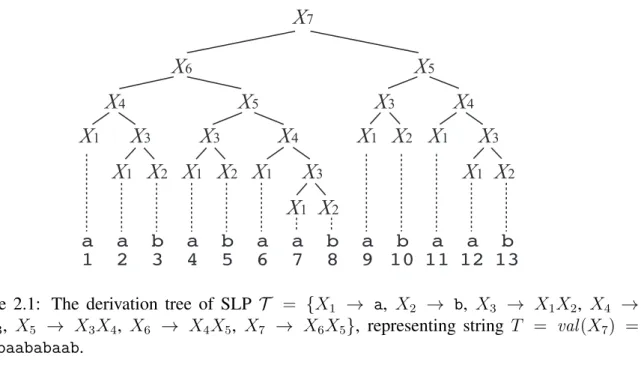
Figure 2.1: The derivation tree of SLP T = {X1 → a, X2 → b, X3 → X1X2, X4 → X1X3, X5 → X3X4, X6 → X4X5, X7 → X6X5}, representing string T = val(X7) = aababaababaab.
Lemma 2. For any stringsT andP, and any integeriwith1≤i≤ |T|, letu1 = maxLnOcc(T[1 : i − 1], P) + |P| −1 and u2 = i − 1 + minRnOcc(T[i : |T|], P). Then nOcc(T, P) =
|LnOcc(T[1 :u1], P)|+nOcc(T[u1+ 1 :u2−1], P) +|RnOcc(T[u2 :|T|], P)|.
Proof.By Lemma 1 and the definitions ofu1,u2,LnOccandRnOcc, we have nOcc(T, P)
= |LnOcc(T[1 :u1], P)|+|LnOcc(T[u1+ 1 :|T|], P)|
= |LnOcc(T[1 :u1], P)|+|RnOcc(T[u1 + 1 :|T|], P)|
= |LnOcc(T[1 :u1], P)|+|RnOcc(T[u1+1 :u2−1], P)|+|RnOcc(T[u2 :|T|], P)|
= |LnOcc(T[1 :u1], P)|+nOcc(T[u1+1 :u2 −1], P) +|RnOcc(T[u2 :|T|], P)|.
2.3 Straight Line Programs
Astraight line program(SLP) is a set of assignmentsT ={X1 →expr1, X2 →expr2, . . . , Xn→ exprn}, where eachXiis a variable and eachexpriis an expression, whereexpri =a(a∈Σ), orexpri = Xℓ(i)Xr(i) (i > ℓ(i), r(i)). It is essentially a context free grammar in the Chomsky normal form, that derives a single string. Letval(Xi)represent the string derived from variable Xi. To ease notation, we sometimes associateval(Xi)withXiand denote|val(Xi)|as|Xi|, and val(Xi)([u : v])asXi([u : v])for any interval [u : v]. pre(Xi, q)andsuf(Xi, q)respectively denotes the length-qprefix and suffix ofval(Xi). An SLPT representsthe stringT =val(Xn).
Θ(2 ). However, we assume as in various previous work on SLP, that the computer word size is at leastlogN, and hence, values representing lengths and positions ofT in our algorithms can be manipulated in constant time.
The derivation tree of SLP T is a labeled ordered binary tree where each internal node is labeled with a non-terminal variable in{X1, . . . , Xn}, and each leaf is labeled with a terminal character in Σ. The root node has label Xn. Let V denote the set of internal nodes in the derivation tree. For any internal nodev ∈ V, let⟨v⟩denote the index of its labelX⟨v⟩. Nodev has a single child which is a leaf labeled withcwhen(X⟨v⟩→c)∈ T for somec∈Σ, orvhas a left-child and right-child respectively denotedℓ(v)andr(v), when(X⟨v⟩ →X⟨ℓ(v)⟩X⟨r(v)⟩)∈ T. Each node v of the tree derives val(X⟨v⟩), a substring ofT, whose corresponding interval itv(v), withT(itv(v)) =val(X⟨v⟩), can be defined recursively as follows. Ifv is the root node, then itv(v) = [1 : N]. Otherwise, if (X⟨v⟩ → X⟨ℓ(v)⟩X⟨r(v)⟩) ∈ T, then, itv(ℓ(v)) = [bv : bv +|X⟨ℓ(v)⟩| −1]anditv(r(v)) = [bv +|X⟨ℓ(v)⟩|: ev], where[bv : ev] =itv(v). LetvOcc(Xi) denote the number of times a variableXi occurs in the derivation tree, i.e., vOcc(Xi) = |{v | X⟨v⟩ =Xi}|. We assume that any variableXi is used at least once, that isvOcc(Xi)>0.
For any interval [b : e] ofT(1 ≤ b ≤ e ≤ N), letξT(b, e) denote the deepest nodev in the derivation tree, which derives an interval containing [b : e], that is, itv(v) ⊇ [b : e], and no proper descendant of v satisfies this condition. We say that node v stabs interval [b : e], andX⟨v⟩ is called the variable that stabs the interval. If b = e, we have that(X⟨v⟩ → c) ∈ T for some c ∈ Σ, and itv(v) = b = e. Ifb < e, then we have (X⟨v⟩ → X⟨ℓ(v)⟩X⟨r(v)⟩) ∈ T, b ∈ itv(ℓ(v)), ande ∈ itv(r(v)). When it is not confusing, we will sometimes useξT(b, e)to denote the variableX⟨ξT(b,e)⟩.
SLPs can be efficiently pre-processed to hold various information. |Xi|andvOcc(Xi)can be computed for all variables Xi(1 ≤ i ≤ n) in a total of O(n) time by a simple dynamic programming algorithm. Also, the following Lemma is useful for partial decompression of a prefix of a variable.
Lemma 3([22]). Given an SLPT ={Xi →expri}ni=1, it is possible to pre-processT inO(n) time and space, so that for any variableXi and1≤ j ≤ |Xi|,Xi([1 : j])can be computed in O(j)time.
2.4 Suffix Arrays and LCP Arrays
The suffix array [50]SAof any stringT is an array of lengthN such that for any1≤ i ≤ N, SA[i] = j indicates that suf(j) is thei-th lexicographically smallest suffix of T. For conve- nience, we assume thatSA[0] = SA[N + 1] = 0. The inverse suffix array SA−1 ofSA is an array of lengthN such thatSA−1[SA[i]] = i. As in [37], let Φ be an array of lengthN such
![Table 2.1: Suffix array and LCP array for string T =abracadabra i T [i : N] SA[i] LCP [i] T [SA[i] : N ]](https://thumb-ap.123doks.com/thumbv2/123deta/9920270.1920578/18.892.255.638.209.486/table-suffix-array-lcp-array-string-abracadabra-lcp.webp)

![Table 3.2: Running times in seconds for the Pizza & Chili Corpus. Each data is compressed by LCA [52]](https://thumb-ap.123doks.com/thumbv2/123deta/9920270.1920578/30.892.171.728.303.1180/table-running-times-seconds-pizza-chili-corpus-compressed.webp)


![Figure 5.3: Illustration for Lemma 16 case 1. Rectangles show important occurrences of X i [j : j + q − 1]](https://thumb-ap.123doks.com/thumbv2/123deta/9920270.1920578/52.892.241.652.178.475/figure-illustration-lemma-case-rectangles-important-occurrences-x.webp)
![Figure 5.4: Illustration for Lemma 16 case 2. Rectangles show important occurrences of X i [j : j + q − 1]](https://thumb-ap.123doks.com/thumbv2/123deta/9920270.1920578/53.892.243.658.179.474/figure-illustration-lemma-case-rectangles-important-occurrences-x.webp)
