組合せ的文字列分解
杉本, 志穂
https://doi.org/10.15017/1928634
出版情報:Kyushu University, 2017, 博士(理学), 課程博士 バージョン:
権利関係:
Shiho Sugimoto
August, 2017
String factorization is a task of factorizing a string into a sequence of non-empty strings under given constraints. The size of factorization is defined to be the number of factors in it. For example, the Lyndon factorization has the constraints that each factor is a Lyndon word and the factors are arranged in the lexicographically non-increasing order. On the other hand, the Lempel-Ziv 77 (LZ77) factorization, the core of LZ77 compression, is a smallest-sized factor- ization such that each factor has a previous occurrence.
It is known that the sizes of the Lyndon factorization and the LZ77 factorization of a string w are lower bounds on the size of grammar that generates w in the grammar-based compression.
Moreover, these factorizations can be used as a means of accelerating several string processing algorithms. Studies on string factorization can thus contribute not only to Combinatorics on Strings but also to String Algorithms. Many kinds of string factorizations have been introduced and efficient factorization algorithms have been developed for them.
Kolpakov and Kucherov proposed a variant of the LZ77 factorization, called the reversed LZ factorization (Theoretical Computer Science, 410(51), 2009). We present an online algorithm that computes the reversed LZ factorization of a given string w of length n in O(n log
2n) time using O(n log σ) bits of space, where σ ≤ n is the alphabet size. Also, we introduce a new variant, called the reversed LZ factorization with self-references, and present two online algorithms to compute this variant, in O(n log σ) time using O(n log n) bits of space, and in O(n log
2n) time using O(n log σ) bits of space.
A palindromic factorization of a string w is a factorization of w into palindromic substrings of w. We present an online O(n log n) time O(n) space algorithm to compute a smallest- sized palindromic factorization of every prefix of w, where n is the length of a given string w.
We then show how to extend this algorithm to compute a smallest-sized maximal palindromic
factorizations of every prefix of w, where the factors are maximal palindromes (non-extensible
palindromic substring) of the prefix, in O(n log n) time and O(n) space, in an online manner.
We also define a restricted variant of palindromic factorization, called the diverse palin- dromic factorization, where the factors are distinct from each other. We prove that the existence problem of the diverse palindromic factorization is NP-complete.
A closed string is a string with a proper substring that occurs in the string as a prefix and a suffix, but not elsewhere. Closed strings were introduced by Fici (WORDS 2011) as objects of combinatorial interest in the study of Trapezoidal and Sturmian words. We consider algorithms for computing closed factors (substrings) in strings, and in particular for greedily factorizing a string into a sequence of longest closed factors. We describe an algorithm for this problem that uses linear time and space. We then consider the related problem of computing, for every position in the string, the longest closed factor starting at that position. We present a simple algorithm for the problem that runs in O(n log n/ log log n) time.
Two strings x and y are said to be Abelian equivalent if x is a permutation of y, or vice
versa. If a string z satisfies z = xy with x and y being Abelian equivalent, then z is said to
be an Abelian square. If a string w can be factorized into a sequence v
1, . . . , v
sof strings such
that v
1, . . . , v
s−1are all Abelian equivalent and v
sis a substring of a permutation of v
1, then
w is said to have a regular Abelian period (p, t) where p = |v
1| and t = |v
s|. If a substring
w
1[i..i + l − 1] of a string w
1and a substring w
2[j..j + l − 1] of another string w
2are Abelian
equivalent, then the substrings are said to be a common Abelian factor of w
1and w
2and if the
length l is the maximum of such then the substrings are said to be a longest common Abelian
factor of w
1and w
2. We propose efficient algorithms which compute these Abelian regularities
using the run length encoding (RLE) of strings. For a given string w of length n whose RLE is
of size m, we propose algorithms which compute all Abelian squares occurring in w in O(mn)
time, and all regular Abelian periods of w in O(mn) time. For two given strings w
1and w
2of
total length n and of total RLE size m, we propose an algorithm which computes all longest
common Abelian factors in O(m
2n) time.
I really appreciate all the support I received from everyone. I begin by my most grateful thanks for Professor Masayuki Takeda who is my supervisor and the committee chair of this thesis. He gave me the choice to try the PhD course. I learned what research is, what researcher is, and how to enjoy the life as a researcher from what he did. Thanks to him, my life in laboratory could not have been better. I also express my appreciation to Professor Eiji Takimoto, Professor Daisuke Ikeda and Professor Yukiko Yamauchi, who are the members of the committee of this thesis. They gave me some advice to make this thesis better.
I greatly appreciate to Professor Hideo Bannai and Professor Shunsuke Inenaga. They were always my goals far from me. It was a happiness that I always had my role models. They had many big ideas, knowledges and techniques and they had never hesitated to give it us. I am grateful to Dr. Tomohiro I in Kyushu Institute of Technology. He helped me my research when and after he was in Kyushu University. I also appreciate to Professor Eiji Takimoto and Professor Kohei Hatano for their advice in weekly seminars. The discussions with them were always productive.
This research was partly supported JSPS (Japan Society for the Promotion of Science). The results in the thesis were partially published in the Proc. of PSC2013, the Proc. of PSC2014, the Proc. of CPM2014, the Proc. of DLT2015 and the Proc. of IWOCA2017. Also, the journal version of PSC2014 paper was published in 2016 in Discrete Applied Mathematics by ELSEVIER. I am thankful for all editors, committees, anonymous referees, and publishers.
I express my gratitude to co-authors Dr. Golnaz Badkobeh, Dr. Travis Gagie, Professor
Costas S. Iliopoulos, Dr. Juha K¨arkk¨ainen, Dr. Dominik Kempa, Dr. Marcin Piatkowski and
Dr. Simon J. Puglisi. Especially, I really enjoyed discussing stringology and talking about
others with Dr. Golnaz Badkobeh and Dr. Simon J. Puglisi. Additionally, discussing with
Professor Maxime Crochemore and Dr. Tatiana Starikovskaya were great time to me. I hope I
will write a paper with them.
my paperwork . I also express thanks to all of staffs in Department of Informatics, Kyushu University.
Last, but not least, I express my lots of thanks and lots of loves to my family.
Abstract i
Acknowledgements iii
1 Introduction 1
1.1 Background . . . . 1
1.2 Previous work on string factorization . . . . 2
1.3 Our contributions . . . . 3
1.4 Organization . . . . 8
2 Preliminaries 9 2.1 Notion and notation . . . . 9
2.2 Model of computation . . . . 10
2.3 Tools . . . . 10
2.4 Two variants of LZ77 factorization . . . . 12
3 Reversed LZ Factorization Online 14 3.1 Notation . . . . 14
3.2 Reversed LZ factorization . . . . 14
3.3 Computing RLZ (w) in O(n log
2n) time and O(n log σ) bits of space . . . . . 16
3.4 Online computation of reversed LZ factorization with self-references . . . . 20
3.5 Reversed LZ factorization and smallest grammar . . . . 24
4 Palindromic Factorization 25 4.1 Palindromic factorization and palindromic cover of string . . . . 25
4.2 Combinatorial properties of palindromic suffixes . . . . 26
4.3 Computing smallest-sized palindromic factorizations online . . . . 28
4.4 Computing smallest-sized maximal palindromic factorizations online . . . . 31
4.5 Computing smallest-sized palindromic covers online . . . . 32
4.6 Related Work . . . . 34
5 Diverse Palindromic Factorization is NP Complete 36 5.1 Outline of the proof . . . . 36
5.2 Adding a wire . . . . 39
5.3 Splitting a wire . . . . 40
5.4 Adding a NAND gate . . . . 43
5.5 Summing up . . . . 54
5.6 k-Diverse factorization . . . . 54
5.7 Binary alphabet . . . . 55
6 Closed Factorization 58 6.1 Closed strings and closed factorization . . . . 58
6.2 Greedy longest closed factorization in linear time . . . . 59
6.3 Longest closed factor array . . . . 62
7 Abelian Regularities 64 7.1 Notation . . . . 64
7.2 Computing regular Abelian periods using RLEs . . . . 65
7.3 Computing Abelian squares using RLEs . . . . 67
7.4 Computing longest common Abelian factors using RLEs . . . . 75
8 Conclusion 83
Introduction
1.1 Background
Combinatorics is an area of Discrete Mathematics, which studies how to count or enumerate certain combinatorial objects. Combinatorics on Words, branching from Combinatorics, fo- cuses on words or strings, i.e., sequences of symbols. Examples of combinatorial string objects are squares, repetitions (i.e., periodic strings), palindromes, Lyndon words, closed strings, and so on.
A string factorization is a research topic in Combinatorics on Words, and has received spe- cial concerns. It is a task of factorizing a given string into combinatorial objects. An example is the Lyndon factorization introduced by Chen, Fox and Lyndon [17] in 1958. The goal of studies on string factorization in this area is mainly to discover algebraic properties on strings. Little attention has been paid to development of algorithms for factorizing strings or analysis of their complexities in this area.
On the other hand, Stringology is an area of Theoretical Computer Science, which studies algorithms and data structures for processing string data efficiently as well as algebraic prop- erties on combinatorial string objects. Algorithmic aspects of string factorization have been a subject of active research in Stringlogy. For the Lyndon factorization, Duval [27] revealed in 1983 the property that a sequence of longest Lyndon words corresponds to the Lyndon factor- ization, and presented a simple linear-time algorithm based on this property. Efficient parallel algorithms for the Lyndon factorization are also known [7, 25]. Recently, Lyndon factorization algorithms over compressed string were proposed [41, 42].
The Lyndon factorization is of a mathematical interest but it has several applications, espe-
cially related to data compression. It is used in a bijective variant of Burrows-Wheeler trans-
form [57, 37]
1. In the context of grammar-based compression, it is shown in [42] that the size of Lyndon factorization of a string gives a lower bound on the size of a smallest grammar that generates it uniquely. Examples of applications not related to data compression are a digital geometry algorithm [14] and a public key cryptosystem [69]. Very recently, it turns out that the Lyndon factorization can be used as a preprocessing step in computation of runs (maximal repetitions) within a given string [54, 36, 21].
The goal of this thesis is to develop efficient algorithms for existing or newly introduced string factorization problems, or to show their intractability.
1.2 Previous work on string factorization
First, we mention a class of string factorizations which were originally intended for data com- pression. Ziv and Lempel [78] proposed the LZ77 factorization as a tool of data compression.
It plays a central role in efficient string processing algorithms [52, 28], in compressed full text indices [56], and in an approximation algorithm to the smallest grammar problem [67].
Due to its importance, efficient algorithms for computing the LZ77 factorization have been proposed, both in offline manner and in online manner. In the offline setting where the string is static, there exist efficient algorithms to compute the LZ77 factorization of a given string w of length n, running in O(n) time and using O(n log n) bits of space, assuming an integer alphabet [19]. See [1] for a survey, and [48, 38, 47, 46] for more recent results in this line of research.
In the online setting where new characters may be appended to the end of the string, Okanohara and Sadakane [66] gave an algorithm that runs in O(n log
3n) time using n log σ + o(n log σ) + O(n) bits of space, where σ is the size of the alphabet. Later, Starikovskaya [70]
proposed an algorithm running in O(n log
2n) time using O(n log σ) bits of space, assuming
logσN
4
characters are packed in a machine word. Yamamoto et al. [76] developed an online LZ77 factorization algorithm running in O(n log n) time using O(n log σ) bits of space.
Some variants of the LZ77 factorization also exist; the LZ-End factorization [55] allows faster random access in compressed strings, and the reversed LZ factorization [53, 71] is useful for finding gapped palindromes in strings.
Ziv and Lempel [79] also proposed the LZ78 factorization, and later Welch [75] proposed its variant called the LZW factorization. These factorizations are intended for data compression.
1The Burrows-Wheeler transform is a core of the compression toolbzip2.
Also, they can be used as a means of accelerating computation of alignments of two strings [22].
The LZ78/LZW factorization of a string of length n over an alphabet of size σ can be computed in O(n log σ) time. A more efficient algorithm for computing the LZ78/LZW factorization was proposed by Jansson et al. [45].
Next, we mention several string factorizations not related to data compression. The smallest- sized maximal palindromic factorization problem introduced by Alatabbi et al. [3] is to find a factorization of a given string into factors that are maximal palindromes (non-extensible palin- dromic substrings) of smallest size. They presented in [3] an offline O(n)-time algorithm.
Dumitran et al. [26] introduced two factorization problems: the square factorization prob- lem and the repetition factorization problem, which are defined as the problems of finding any factorization of a given string into squares and finding any factorization of a given string into runs (maximal repetitions), respectively. For the square factorization problem, they presented in [26] an O(n log n) time solution. Matsuoka et al. [63] proposed an improved algorithm that runs in O(n) time. They also proposed in [63] algorithms that compute square factorizations of smallest/largest size in O(n log n) time using O(n) space, assuming an integer alphabet.
For the repetition factorization problem, Dumitran et al. [26] presented an O(n) time al- gorithm. Inoue et al. [44] proposed algorithms that compute repetition factorizations of small- est/largest size in O(n log n) time using O(n) space for a general ordered alphabet.
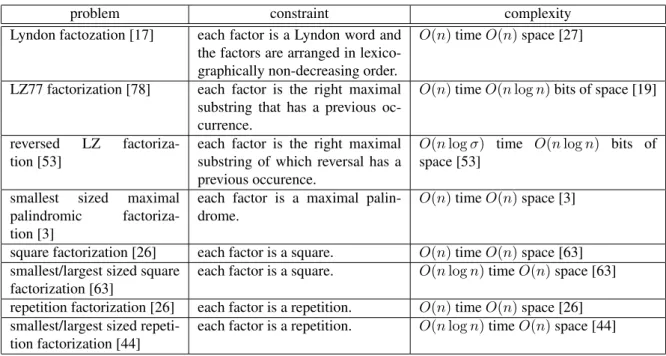
Table 1.1 summarizes known string factorizations and the complexity of existing algorithms for them.
1.3 Our contributions
In this section, we state the problems we consider in this thesis and explain related works of the problems and outline of our solution.
1.3.1 Reversed LZ factorization
One of the most well-studied factorizations is the LZ77 factorization we mentioned above.
In this thesis we consider the reversed LZ factorization problem introduced by Kolpakov and
Kucherov [53], which is used as a basis of computing gapped palindromes. In the online setting,
the reversed LZ factorization can be computed in O(n log σ) time using O(n log n) bits of space,
utilizing the algorithm by Blumer et al. [12].
Table 1.1: Several string factorization problems are listed with complexity of existing solutions, where n is the input string length and σ is the alphabet size.
problem constraint complexity
Lyndon factozation [17] each factor is a Lyndon word and the factors are arranged in lexico- graphically non-decreasing order.
O(n)timeO(n)space [27]
LZ77 factorization [78] each factor is the right maximal substring that has a previous oc- currence.
O(n)timeO(nlogn)bits of space [19]
reversed LZ factoriza- tion [53]
each factor is the right maximal substring of which reversal has a previous occurence.
O(nlogσ) time O(nlogn) bits of space [53]
smallest sized maximal palindromic factoriza- tion [3]
each factor is a maximal palin- drome.
O(n)timeO(n)space [3]
square factorization [26] each factor is a square. O(n)timeO(n)space [63]
smallest/largest sized square factorization [63]
each factor is a square. O(nlogn)timeO(n)space [63]
repetition factorization [26] each factor is a repetition. O(n)timeO(n)space [26]
smallest/largest sized repeti- tion factorization [44]
each factor is a repetition. O(nlogn)timeO(n)space [44]
We present a space-efficient solution to compute reversed LZ factorization, which requires only O(n log σ) bits of working space with slightly slower O(n log
2n) running time.
We also introduce a new, self-referencing variant of the reversed LZ factorization, and pro- pose two online algorithms; the first one runs in O(n log σ) time and O(n log n) bits of space, and the second one in O(n log
2n) time and O(n log σ) bits of space. A key to achieve such complexity is efficient online computation of the longest suffix palindrome for each prefix of the string w.
As an independent interest, we consider the relationship between the number of factors in the reversed LZ factorization of a string w, and the size of the smallest grammar that generates only w. It is known that the number of factors in the LZ77 factorization of w is a lower bound of the smallest grammar for w [67]. We show that, unfortunately, this is not the case with the reversed LZ factorization with or without self-references.
1.3.2 Palindromic factorization
In 2013, Alatabbi et al. [3] introduced a new kind of factorization problem, called the smallest-
sized maximal palindromic factorization problem. A factorization of string w is said to be a
maximal palindromic factorization of w if every factor in the factorization is a maximal palin- drome in w. They presented an offline O(n)-time algorithm to compute a smallest-sized maxi- mal palindrome factorization of a given string of length n.
In this thesis, we introduce yet another kind of factorization problem, called the smallest- sized palindromic factorization problem. A factorization of a string w is said to be a palin- dromic factorization of w if every factor is a palindrome (not necessarily maximal). We present an online O(n log n)-time O(n)-space algorithm to compute a smallest-sized palindromic fac- torization of a given string w of length n. In addition, we show how to extend this algorithm to obtain an online O(n log n)-time O(n)-space algorithm to compute a smallest-sized maximal palindromic factorization of w. We achieve the O(n log n)-time bound in our solutions using combinatorial properties of palindromic suffixes of strings. We remark that the algorithm of Alattabi et al. [3] is offline, and a na¨ıve extension of their algorithm to the online scenario leads to an O(n
2)-time bound.
Also, we consider the problem of covering a given string with fewest palindromes. We show how to compute such covers in O(n) time in an offline fashion, and later describe how to extend it to an online O(n)-time algorithm. Both of the algorithms use O(n) space. This solves an open problem of Alatabbi et al. [3].
1.3.3 Diverse palindromic factorization
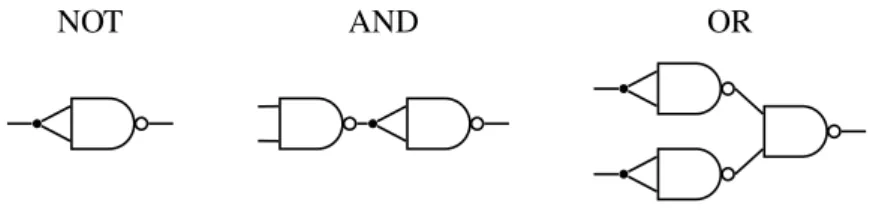
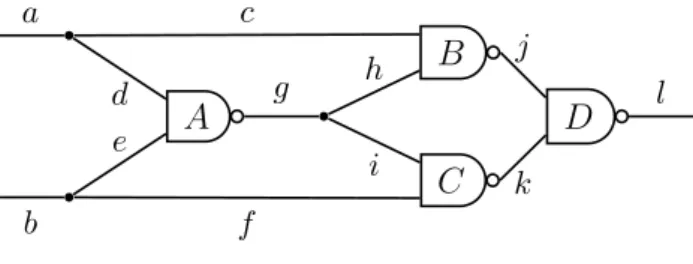
We define a restricted variant of palindromic factorization, called the diverse palindromic fac- torization. A factorization of a string w is said to be diverse if the factors are distinct from each other. Some well-known factorizations, such as the LZ78 [79] factorization are diverse (except that the last factor may have appeared before). Fernau et al. [30] recently proved that it is NP- complete to determine whether a given string has a diverse factorization of at least a given size, and Schmid [68] has investigated related questions. It seems natural to consider the problem of determining whether a given string has a diverse factorization into palindromes. For example, abcddeef and abcdefed each have exactly one such factorization — i.e., a, b, c, dd, ee, f and a, b, c, defed, respectively — but abcdefdc has none. This problem is obviously in NP and we prove that it is NP-hard and, thus, NP-complete by showing a reduction from the circuit satisfiability problem [58].
We also show that it is NP-complete for any fixed k to decide whether a given string can
be factored into palindromes that each appear at most k times in the factorization; we call such
a factorization k-diverse. Finally, since several recent papers (e.g. [15, 16, 40]) consider the effect of alphabet size on the difficulty of various string problems, we show that the problems remain NP-complete even if the string is restricted to be binary.
1.3.4 Closed factorization
A closed string is a string with a proper substring that occurs as a prefix and a suffix but does not have internal occurrences. Closed strings were introduced by Fici [31] as objects of com- binatorial interest in the study of Trapezoidal and Sturmian words. Since then, Badkobeh, Fici, and Liptak [9] have proved a tight lower bound for the number of closed substrings in strings of given length and alphabet.
In this thesis, we initiate the study of algorithms for computing closed factors. In particular we consider two algorithmic problems. The first, which we call the closed factorization prob- lem, is to greedily factorize a given string into a sequence of longest closed factors (we give a formal definition of the problem in Section 6.1). We describe an algorithm for this problem that uses O(n) time and space, where n is the length of the given string.
The second problem we consider is the closed factor array problem, which requires us to compute the length of the longest closed factor starting at each position in the input string. We show that this problem can be solved in O(n
log loglognn) time, using techniques from computational geometry.
1.3.5 Abelian regularities
Two strings s
1and s
2are said to be Abelian equivalent if s
1is a permutation of s
2, or vice versa.
For instance, strings ababaac and caaabba are Abelian equivalent. Since the seminal paper by Erd˝os [29] published in 1961, the study of Abelian equivalence on strings has attracted much attention, both in word combinatorics and string algorithmics.
We are interested in the following algorithmic problems related to Abelian regularities of strings.
1. Compute Abelian squares in a given string.
2. Compute regular Abelian periods of a given string.
3. Compute longest common Abelian factors of two given strings.
Cummings and Smyth [24] proposed an O(n
2)-time algorithm to solve Problem 1, where n is the length of the given string. Crochemore et al. [20] proposed an alternative O(n
2)-time solution to the same problem. Recently, Kociumaka et al. [51] showed how to compute all Abelian squares in O(s +
logn22n) time, where s is the number of outputs.
Related to Problem 2, various kinds of Abelian periods of strings have been considered: An integer p is said to be a full Abelian period of a string w iff there is a decomposition u
1, . . . , u
zof w such that |u
i| = p for all 1 ≤ i ≤ z and u
1, . . . , u
zare all Abelian equivalent. A pair (p, t) of integers is said to be a regular Abelian period (or simply an Abelian period) of a string w iff there is a decomposition v
1, . . . , v
sof w such that p is a full Abelian period of v
1· · · v
s−1,
|v
i| = p for all 1 ≤ i ≤ s − 1, and v
sis a permutation of a substring of v
1(and hence t ≤ p). A triple (h, p, t) of integers is said to be a weak Abelian period of a string w iff there is a decomposition y
1, . . . , y
rof w such that (p, t) is an Abelian period of y
2· · · y
r, |y
1| = h,
|y
i| = p for all 2 ≤ i ≤ r − 1, |y
r| = t, and y
1is a permutation of a substring of y
2(and hence h ≤ p).
The study on Abelian periodicity of strings was initiated by Constantinescu and Ilie [18].
Fici et al. [34] gave an O(n log log n)-time algorithm to compute all full Abelian periods. Later, Kociumaka et al. [50] showed an optimal O(n)-time algorithm to compute all full Abelian periods. Fici et al. [34] also showed an O(n
2)-time algorithm to compute all regular Abelian periods for a given string of length n. Kociumaka et al. [50] also developed an algorithm which finds all regular Abelian periods in O(n(log log n + log σ)) time, where σ is the alphabet size.
Fici et al. [33] proposed an algorithm which computes all weak Abelian periods in O(σn
2) time, and later Crochemore et al. [20] proposed an improved O(n
2)-time algorithm to compute all weak Abelian periods. Kociumaka et al. [51] showed how to compute all shortest weak Abelian periods in O(n
2/ √
log n) time.
Consider two strings w
1and w
2. A pair (s
1, s
2) of a substring s
1of w
1and a substring s
2of w
2is said to be a common Abelian factor of w
1and w
2, iff s
1and s
2are Abelian equivalent.
Alatabbi et al. [2] proposed an O(σn
2)-time and O(σn)-space algorithm to solve Problem 3 of computing all longest common Abelian factors (LCAFs) of two given strings of total length n. Later, Grabowski [39] showed an algorithm which finds all LCAFs in O(σn
2) time with O(n) space. He also presented an O((
σk+ log σ)n
2log n)-time O(kn)-space algorithm for a parameter k ≤
logσσ. Recently, Badkobeh et al. [10] proposed an O(n log
2n log
∗n)-time O(n log
2n)-space algorithm for finding all LCAFs.
In this thesis, we show that we can accelerate computation of Abelian regularities of strings
via run length encoding (RLE) of strings. Namely, if m is the size of the RLE of a given string w of length n, we show that:
1. All Abelian squares in w can be computed in O(mn) time.
2. All regular Abelian periods of w can be computed in O(mn) time.
3. All longest common Abelian factors of w
1and w
2can be computed in O(m
2n) time.
Since m ≤ n always holds, our O(mn)-time solution to Problem 1 is at least as efficient as the O(n
2)-time solutions by Cummings and Smyth [24] and by Crochemore et al. [20], and can be much faster when the input string w is highly compressible by RLE. Amir et al. [5] proposed an O(σ(m
2+ n))-time algorithm to compute all Abelian squares using RLEs. Our O(mn)-time solution is faster than theirs when
m−σσm2= ω(n).
Our O(mn)-time solution to Problem 2 is faster than the O(n(log log n + log σ))-time solu- tion by Kociumaka et al. [50] for highly RLE-compressible strings with log log n = ω(m)
2.
Our O(m
2n)-time solution to Problem 3 is faster than the O(σn
2)-time solution by Grabowski [39]
when σn = ω(m
2), and is faster than the fastest variant of the other solution by Grabowski [39]
(choosing k =
logσσ) when √
n log n log σ = ω(m). Also, our solution is faster than the O(n log
2n log
∗n)-time solution by Badkobeh et al. [10] when log n p
log
∗n = ω(m). The time bounds of our algorithms are all deterministic.
1.4 Organization
The rest of this thesis is organized as follows: In Chapter 3, we introduce the reversed LZ fac- torization without self-references, and consider computing the reversed LZ factorization with or without self-references of a given string w in a small space. In Chapter 4, we define the problems of computing a smallest-sized palindromic factorization of w and of computing a smallest-sized palindromic cover of w, and present efficient algorithms for them. In Chapter 5, we formulate the diverse palindromic factorization problem and prove that the existence prob- lem of the diverse palindromic factorization is NP-complete. In Chapter 6, we define the closed factorization problem and the longest closed factor array problem, and show algorithms for solving them. In Chapter 7, we consider accelerating computation of various Abelian regular- ities Abelian squares: Abelian periods, and longest common Abelian factors via Run Length factorization.
2Since we can w.l.o.g. assume thatσ≤m, thelogσterm is negligible here.
Preliminaries
2.1 Notion and notation
Let Σ be an alphabet. An element of Σ
∗is called a string. Strings x, y, and z are called a prefix, a substring, and a suffix of the string w = xyz, respectively. A prefix, substring, and suffix of a string w is said to be proper if it is not w. A string b is called a border of another string w if b is both a proper prefix and suffix of w. The sets of substrings and suffixes of w are denoted by Substr (w) and Suffix (w), respectively. The length of string w is denoted by |w|. The empty string ε is a string of length 0, that is, |ε| = 0. For 1 ≤ i ≤ |w|, w[i] denotes the i-th character of w. For 1 ≤ i ≤ j ≤ |w|, w[i..j] denotes the substring of w that begins at position i and ends at position j. For convenience, let w[i..j] = ε for i > j.
A period of a string x is an integer p with 0 < p ≤ |x| such that x[i] = x[i + p] for all i with 1 ≤ i ≤ |x| − p.
Proposition 1 (Periodicity Lemma [23]). Let d and d
0be two periods of a string w. If d + d
0− gcd(d, d
0) ≤ |w|, then gcd(d, d
0) is also a period of w.
Let w
revdenote the reversed string of s, that is, w
rev= w[|w|] · · · w[2]w[1]. A string x is called a palindrome if x = x
rev. The center of a palindromic substring w[i..j] of a string w is
i+j
2
. The radius of palindrome x is
|x|2. A palindromic substring w[i..j] is called the maximal palindrome at the center
i+j2if no other palindromes at the center
i+j2have a larger radius than w[i..j], i.e., if w[i − 1] 6= w[j + 1], i = 1, or j = |w|. Since a string w of length n ≥ 1 has 2n − 1 centers (1, 1.5, . . . , n − 0.5, n), w has exactly 2n − 1 maximal palindromes. Note that every palindromic suffix of w is a maximal palindrome of w.
For any string w of length n ≥ 1, let Spals(w) denote the set of the beginning positions of
the palindromic suffixes of w, i.e.,
Spals(w) = {n − |s| + 1 | s ∈ Suffix (w), s is a palindrome}.
We introduce the property of Spals.
Proposition 2 ([6, 62]). For any string w of length n, Spals(w) can be represented by O(log n) arithmetic progressions.
A factorization of a string w is a sequence f
1, . . . , f
kof non-empty strings such that w = f
1· · · f
k. Each f
iis called a factor of the factorization. The size of the factorization is the number k of factors in it.
2.2 Model of computation
In this thesis, we use the unit cost word RAM model
1, where we have access to a random access memory consisting of cells, each of which stores an `-bit word, and all the basic arithmetic and logic operations over `-bit words can be carried out in constant time. Let n be the size of data in memory. In this model it is usually assumed that ` = Ω(log n), or simply ` ≥ dlog ne, which means that with one machine word we can address any data element.
There are three types of alphabets from which symbols are drawn: (i) a constant-sized alphabet, (ii) an integer alphabet where symbols are integers in the range [1..n
c] for a constant c, and (iii) a general alphabet in which the only operations on strings are symbols comparisons.
2.3 Tools
2.3.1 Suffix array
The suffix array [61] SA
w(we drop subscripts when they are clear from the context) of a string w is an array SA[1..n] which contains a permutation of the integers [1..n] such that w[SA[1]..n] <
w[SA[2]..n] < · · · < w[SA[n]..n]. In other words, SA[j] = i iff w[i..n] is the j
thsuffix of w in ascending lexicographical order.
1RAM stands for Random Access Machine.
a! b!
c! a!
a! c!
a! b! b! b! a! c! b!
b! a! c!
b! b! b! a! c!
b! b!
b! a! c! b! a! a! a! a! b! b! b! ca!!
a!
c!
b! b! a! c! b!
a! a! a!
b!
a! c! b!a!
c!
b! b! a! c! b!
a! a! a!
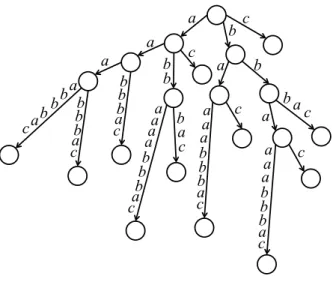
Figure 2.1: STree(w) with w = abbaaaabbbac.
2.3.2 Suffix tree
The suffix tree [74] of string s, denoted STree(s), is a rooted tree such that
1. Each edge is labeled with a non-empty substring of s, and each path from the root to a node spells out a substring of s;
2. Each internal node v has at least two children, and the labels of distinct out-going edges of v begin with distinct characters;
3. For each suffix x of w, there is a path from the root that spells out x.
The number of nodes and edges of STree(s) is O(|s|), and STree(s) can be represented using O(|s| log |s|) bits of space, by implementing each edge label y as a pair (i, j) such that y = s[i..j].
For a constant alphabet, Weiner’s algorithm [74] constructs STree(s
rev) in an online manner from left to right, i.e., constructs STree(s[1..j]
rev) in increasing order of j = 1, 2, . . . , |s|, in O(|s|) time using O(|s| log |s|) bits of space. It is known that the tree of the suffix links of the directed acyclic word graph [12] of s forms STree (s
rev). Hence, for larger alphabets, we have the following:
Proposition 3 ([12]). Given a string s, we can compute STree(s
rev) online from left to right, in
O(|s| log σ) time using O(|s| log |s|) bits of space.
2.3.3 Suffix trie
In our algorithms, we will also use the generalized suffix trie for a set W of strings, denoted STrie(W ). STrie(W ) is a rooted tree such that
1. Each edge is labeled with a character, and each path from the root to a node spells out a substring of some string w ∈ W ;
2. The labels of distinct out-going edges of each node must be different;
3. For each suffix s of each string w ∈ W , there is a path from the root that spells out s.
2.3.4 Knuth-Morris-Pratt algorithm
Let P be a non-empty string called the pattern. The Knuth-Morris-Pratt (KMP for short) al- gorithm [49] is based on the KMP automaton, which accepts the language Σ
∗P . Let Q = {0, 1, . . . , |P |} be the set of states, and let fail be a special value not in Q. The state-transition δ : Q × Σ → Q of the KMP automaton for P is represented as the two functions: the goto function g : Q × Σ → Q ∪ {fail}, and the failure function f : Q − {0} → Q satisfying
δ(j, a) =
( g(j, a), if g (j, a) 6= fail;
δ(f(j), a), otherwise.
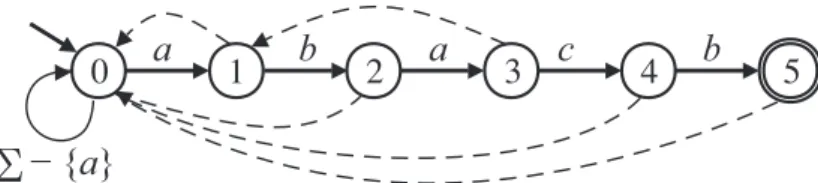
The goto function g takes j ∈ Q and a ∈ Σ as input and returns j + 1 if P [j + 1] = a, otherwise, returns fail. (The case j = 0 is an exception. Let g(0, a) = 0 for every a ∈ Σ with P [1] 6= a.) The failure function f takes j ∈ Q − {0} as input and returns the length of longest border of P [1..j]. Figure 2.2 shows the KMP automaton for P = abacb with Σ = {a, b, c}. The move of the KMP automaton of Figure 2.2 on text T = abacbbaababacbb is shown in Figure 2.3.
Proposition 4. The KMP algorithm finds all occurrences of a pattern P of length m within a text T of length n in O(m + n) time using O(m) space for a general unordered alphabet.
2.4 Two variants of LZ77 factorization
We give formal definitions of two variants of LZ77 factorization as below.
Definition 1 (LZ77 factorization without self-references). The LZ77 factorization without self-
reference of a string w is a factorization f
1, . . . , f
msuch that for any 1 ≤ i ≤ m,
0 a 1 b 2 a 3 c 4 b 5
− { a }
Figure 2.2: KMP automaton for P = abacb is displayed. The circles denote the states, and the thick circle means the final state. The solid and the broken arrows represent the goto and the failure functions, respectively.
original text:
state transition:
a b a c b b a b a a b a c b
0 1 2 3 4 5 0
0
1 2 3
1 0
1 2 3 4 5
Figure 2.3: Move of KMP automaton is demonstrated. The solid and the broken arrows repre- sent the state transitions with the goto and the failure functions, respectively. The underlined number indicates that the pattern occurs.
f
iis the longest non-empty prefix of w[j..|w|] that occurs in w[1..j − 1] if such exists, and f
i= w[j] otherwise,
where j = |f
1· · · f
i−1| + 1.
Definition 2 (LZ77 factorization with self-references). The LZ77 factorization with self-reference of a string w is a factorization f
1, . . . , f
msuch that for any 1 ≤ i ≤ m,
f
iis the longest non-empty prefix of w[j..|w|] that occurs in w[1..|f
1· · · f
i| − 1] if such exists, and f
i= w[j] otherwise,
where j = |f
1· · · f
i−1| + 1.
Reversed LZ Factorization Online
In this chapter, we address two variants of the LZ77 factorization, called the reversed LZ factor- ization with and without self-references, and present efficient online algorithms for computing them.
The results in this chapter were originally published in [71].
3.1 Notation
For an input string w of length n over an alphabet of size σ ≤ n, let r =
log4σn=
4 loglognσ. For simplicity, assume that log n is divisible by 4 log σ, and that n is divisible by r. A string of length r, called a meta-character, fits in a single machine word. Thus, a meta-character can also be transparently regarded as an element in the integer alphabet Σ
r= {1, . . . , n}. We assume that given 1 ≤ i ≤ n − r + 1, any meta-character A = w[i..i +r −1] can be retrieved in constant time.
We call a string on the alphabet Σ
rof meta-characters, a meta-string. Any string w whose length is divisible by r can be viewed as a meta-string w of length m =
nr. We write hwi when we explicitly view string w as a meta-string, where hwi[j] = w[(j − 1)r + 1..jr] for each j ∈ [1, m]. Such range [(j − 1)r + 1, jr] of positions will be called meta-blocks and the beginning positions (j − 1)r + 1 of meta-blocks will be called block borders. For clarity, the length m of a meta-string hwi will be denoted by khwik. Note that m log n = n log σ.
3.2 Reversed LZ factorization
Kolpakov and Kucherov [53] introduced the following variant of LZ77 factorization.
k! fi!
fi-1!
w !
"!firev! f1!
Figure 3.1: Let k = |f
1· · · f
i−1| + 1. f
iis the longest non-empty prefix of w[k..|w|] that is also a substring of w[1..k − 1]
revif such exists.
Definition 3 (Reversed LZ factorization without self-references). The reversed LZ factorization of a string w without self-references, denoted RLZ (w), is a factorization f
1, . . . , f
mof w such that for any 1 ≤ i ≤ m,
f
iis the longest non-empty prefix of w[k..|w|] that occurs in w[1..k − 1]
revif such exists, and f
i= w[k] otherwise,
where k = |f
1· · · f
i−1| + 1.
Figure 3.1 illustrates Definition 3.
Example 1. For string w = abbaaaabbbac, RLZ (w) consists of the following factors: f
1= a, f
2= b, f
3= ba, f
4= a, f
5= aabb, f
6= ba, and f
7= c.
We are interested in online computation of RLZ (w). Using Proposition 3, one can compute RLZ (w) online in O(n log σ) time using O(n log n) bits of space [53], where n = |w|. The idea is as follows: Assume we have already computed the first j factors f
1, f
2, . . . , f
j, and we have constructed STree(w[1..l
j]
rev), where l
j= P
jh=1
|f
h|. Now the next factor f
j+1is the longest prefix of w[l
j+ 1..n] that is represented by a path from the root of STree(w[1..l
j]
rev). After the computation of f
j+1, we update STree(w[1..l
j]
rev) to STree(w[1..l
j+1]
rev), using Propo- sition 3. In the next section, we will propose a new space-efficient online algorithm which requires O(n log
2n) time using O(n log σ) bits of space.
We introduce yet another new variant, the reversed LZ factorization with self-references.
Definition 4 (Reversed LZ factorization with self-references). The reversed LZ factorization of a string w with self-references, denoted RLZS (w), is a factorization g
1, . . . , g
pof w such that for any 1 ≤ i ≤ p,
g
iis the longest non-empty prefix of w[k..|w|] that occurs in w[1..|g
1· · · g
i| − 1]
revif such exists, and g
i= w[k] otherwise,
where k = |g
1· · · g
i−1| + 1.
Figure 3.2 illustrates Definition 4.
Example 2. For string w = abbaaaabbbac, RLZS (w) consists of the following factors: g
1= a, g
2= b, g
3= baaaabb, g
4= ba, and g
5= c.
Note that in Definition 4 the ending position of a previous occurrence of g
revidoes not have to be prior to the beginning position k of g
i, while in Definition 3 it has to. This is the difference between RLZ (w) and RLZS (w).
In this chapter we propose two online algorithms to compute RLZS (w); the first one runs in O(n log σ) time using O(n log n) bits of space, and the second one does in O(n log
2n) time using O(n log σ) bits of space.
3.3 Computing RLZ (w) in O(n log 2 n) time and O(n log σ ) bits of space
The outline of our online algorithm to compute RLZ (w) follows the algorithm of Starikovskaya [70] which computes LZ 77 factorization [78] in an online manner and in O(n log
2n) time using O(n log σ) bits of space. The Starikovskaya algorithm maintains the suffix tree of the meta-string hwi in an online manner, i.e., maintains STree(hwi[1..k]) in increasing order of k = 1, 2, . . . , n/r, and maintains a generalized suffix trie for a set of substrings of w[1..kr] of length 2r that begin at a block border. In contrast to the Starikovskaya algorithm, our algo- rithm maintains STree((hwi[1..k])
rev) in increasing order of k = 1, 2, . . . , n/r, and maintain a generalized suffix trie for a set of substrings of w[1..kr]
revof length 2r that begin at a block border.
Assume we have already computed the first i − 1 factors f
1, . . . , f
i−1of RLZ (w) and are computing the ith factor f
i. Let l
i= P
i−1j=1
|f
j|. This implies that we have processed
!!
"#!
"#$!!
% !
"!"#&'(!
"!!
Figure 3.2: Let k = |g
1· · · g
i−1| + 1. g
iis the longest non-empty prefix of w[k..|w|] that is also
a substring of w[1..|g
1· · · g
i| − 1]
revif such exists.
a
a b
a
a
a a
a
b b
b
b
b
b
b
b b
a
a a
a a a
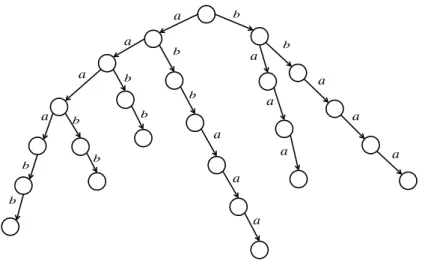
Figure 3.3: Let r = 3 and consider string w = bba|aaa|bba|bac, where | represents a block border. The figure shows STrie (W
3rev) where W
3rev= {aaaabb, abbaaa}.
(hwi[1..k])
revwhere k = dl
i/re, i.e., the kth meta block contains position l
i. As is the case with the Starikovskaya algorithm, our algorithm consists of two main phrases, depending on whether
|f
i| < r or |f
i| ≥ r.
3.3.1 Algorithm for |f
i| < r
For any k (1 ≤ k ≤ n/r), let W
krevdenote the set of substrings of w[1..kr]
revof length 2r that begin at a block border, i.e., W
krev= {w[tr + 1..(t + 2)r]
rev| 1 ≤ t ≤ (k − 2)}. We maintain STrie(W
krev) in an online manner, for k = 1, 2, . . . , n/r. Note that STrie(W
krev) represents all substrings of w[1..kr]
revof length r which do not necessarily begin at a block border. Therefore, we can use STrie (W
krev) to determine if |f
i| < r, and if so, compute f
i. An example for STrie (W
krev) is shown in Figure 3.3.
A minor issue is that STrie (W
krev) may contain “unwanted” substrings that do not corre-
spond to a previous occurrence of f
irevin w[1..l
i], since substrings w[(k − 2)r + 1..y]
revfor
any l
i< y ≤ kr are represented by STrie(W
krev). In order to avoid finding such unwanted
occurrences of f
irev, we associate to each node v representing a reversed substring x
rev, the left-
most ending position of x in w[1..kr]. Assume we have traversed the prefix of length p ≥ 0 of
w[l
i+ 1..n] in the trie, and all the nodes involved in the traversal have positions smaller than
l
i+ 1. If either the node representing w[l
i+ 1..l
i+ p + 1] stores a position larger than l
ior
there is no node representing w[l
i+ 1..l
i+ p + 1], then f
i= w[l
i+ 1..l
i+ p] if p ≥ 1, and
f
i= w[l
i+ 1] if p = 0.
As is described above, f
ican be computed in O(|f
i| log σ) time. When l
i+ p > kr, we insert the suffixes of a new substring w[(k − 1)r + 1..(k + 1)r]
revof length 2r into the trie, and obtain the updated trie STrie(W
k+1rev). Since there exist σ
2r= σ
log2n= √
n distinct strings of length 2r, the number of nodes in the trie is bounded by O( √
nr
2) = O( √
n(log
σn)
2). Hence the trie requires o(n) bits of space. Each update adds O(r
2) new nodes and edges into the trie, taking O(r
2log σ) time. Since there are n/r blocks, the total time complexity to maintain the trie is O(nr log σ) = O(n log n).
The above discussion leads to the following lemma:
Lemma 1. We can maintain in O(n log n) total time, a dynamic data structure occupying o(n) bits of space that allows whether or not |f
i| < r to be determined in O(|f
i| log σ) time, and if so, computes f
iand a previous occurrence of f
irevin O(|f
i| log σ) time.
3.3.2 Algorithm for |f
i| ≥ r
Assume we have found that the length of the longest prefix of w[l
i+ 1..n] that is represented by STrie(W
krev) is at least r, which implies that |f
i| ≥ r.
For any string f and integer 0 ≤ m ≤ min(|f |, r − 1), let strings α
m(f ), β
m(f ), γ
m(f) satisfy f = α
m(f)β
m(f)γ
m(f ), |α
m(f)| = m, and |β
m(f)| = j
0r where j
0= max{j ≥ 0 | m + jr ≤ |f |}. We say that an occurrence of f in w has offset m (0 ≤ m ≤ r − 1), if, in the occurrence, α
m(f ) corresponds to a suffix of a meta-block, β
m(f ) corresponds to a sequence of meta-blocks (i.e. β
m(f ) ∈ Substr (hwi)), and γ
m(f) corresponds to a prefix of a meta-block.
Let f
imdenote the longest prefix of w[l
i+ 1..n] which has a previous occurrence in w[1..l
i] with offset m. Thus, |f
i| = max
0≤m<r|f
im|.
Our algorithm maintains two suffix trees on meta-strings, STree((hwi[1..k − 1])
rev) and STree((hwi[1..k])
rev). Depending on the value of m, we use either STree((hwi[1..k − 1])
rev) and STree ((hwi[1..k])
rev).
If l
i− (k − 1)r ≥ m, i.e. the distance between the (k − 1)th block border and position l
iis not less than m, then we use STree((hwi[1..k])
rev) to find f
im. We associate to each internal
node v of STree((hwi[1..k])
rev) the lexicographical ranks of the leftmost and rightmost leaves
in the subtree rooted at v, denoted left(v) and right(v), respectively. Recall that the leaves
of STree((hwi[1..k])
rev) correspond to the block borders 1, r + 1, . . . , (k − 1)r + 1. Hence,
α
m(f
im)β
m(f
im) occurs in w[1..l
i]
reviff there is a node v representing β
m(f
im) and the interval
[left(v), right(v)] contains at least one block border b such that w[b − m..b − 1] = α
m(f
im). To
determine γ
m(f
im), at each node v of STree((hwi[1..k])
rev) we maintain a trie T
vthat stores the first meta-characters of the outgoing edge labels of v. Then, α
m(f
im)β
m(f
im)γ
m(f
im) occurs in w[1..l
i]
reviff there is a node u of T
vrepresenting γ
m(f
im) and the interval [left (u
1), right (u
2)]
contains at least one block border b such that w[b − m..b − 1] = α
m(f
im), where u
1and u
2are respectively the leftmost and rightmost children of u in T
v.
If l
i− (k − 1)r < m, i.e. if the the distance between the (k − 1)th block border and position l
iis less than m, then we use STree((hwi[1..k − 1])
rev) to find f
im. This allows us to find only previous occurrences of f
irevthat end before l
i+ 1. All the other procedures follow the case where l
i− (k − 1)r ≥ m, mentioned above.
Lemma 2. We can maintain in O(n log
2n) total time, a dynamic data structure occupying O(n log σ) bits of space that allows to compute f
iwith |f
i| ≥ r and a previous occurrence of f
irevin O(|f
i| log
2n) time.
Proof. Traversing the suffix tree for β
m(f
im) takes O(
|firm|log n) = O(|f
im| log σ) time since khβ
m(f
im)ik ≤ |
firm|. Also, traversing the trie for γ
m(f
im) takes O(r log σ) time, since |γ
m(f
im)|
< r. To assure β
m(f
im)γ
m(f
im) is immediately preceded by α
m(f
im), we use the dynamic data structure proposed by Starikovskaya [70] which is based on the dynamic wavelet trees [59].
At each node v, the data structure allows us to check if the interval [left (v), right(v)] contains a block border of interest in O(log
2n) time, and to insert a new element to the data struc- ture in O(log
2n) time. Thus, f
ican be computed in O( P
0≤m≤r−1
(|f
im| log σ + r log σ +
|
firm| log
2n)) = O(|f
i| log
2n). The position of a previous occurrence of f
irevcan be retrieved in constant time, since each leaf of the suffix tree corresponds to a block border. Once f
iis computed, we update STree((hwi[1..k])
rev) to STree((hwi[1..k
0])
rev), such that the k
0th block border contains position l
i+1in w. Using Proposition 3, the suffix tree can be maintained in a total of O(
nrlog σ) = O(n log n) time.
It follows from Proposition 3 that the suffix tree on meta-strings requires O(
nrlog n) = O(n log σ) bits of space. Since the dynamic data structure of Starikovskaya [70] takes O(n log σ) bits of space, the total space complexity of our algorithm is O(n log σ) bits.
The main result of this section follows from Lemma 1 and Lemma 2:
Theorem 1. Given a string w of length n, we can compute RLZ (w) in an online manner, in
O(n log
2n) time and O(n log σ) bits of space.
3.4 Online computation of reversed LZ factorization with self- references
In this section, we consider to compute RLZS (w) for a given string w in an online manner. An interesting property of the reversed LZ factorization with self-references is that, the factorization can significantly change when a new character is appended to the end of the string. A concrete example is shown in Figure 3.4, which illustrates online computation of RLZS (w) with w = abbaaaabbbac. Focus on the factorization of abbaaaab. Although there is a factor starting at position 5 in RLZS (abbaaaab), there is no factor starting at position 5 in RLZS (abbaaaabb).
Below, we will characterize this with its close relationship to palindromes.
a b b a a a a b b b a c !
a ! a b ! a b b ! a b b a ! a b b a a ! a b b a a a ! a b b a a a a ! a b b a a a a b a b b a a a a b b a b b a a a a b b b a b b a a a a b b b a a b b a a a a b b b a c !
Figure 3.4: A snapshot of online computation of RLZS (w) with w = abbaaaabbbac. For each non-empty prefix w[1..k] of w, | denotes the boundary of factors in RLZS (w[1..k]).
3.4.1 Computing RLZS (w) in O(n log σ) time and O(n log n) bits of space
Let w be any string of length n. For any 1 ≤ j ≤ n, the occurrence of substring p starting at position j is called self-referencing, if there exists j
0such that w[j
0..j
0+ |p| − 1]
rev= w[j..j +
|p| − 1] and j ≤ j
0+ |p| − 1 < j + |p| − 1.
For any 1 ≤ k ≤ n, let Lpal
w(k) = max{k − j + 1 | w[j..k] = w[j..k]
rev, 1 ≤ j ≤ k}.
That is, Lpal
w(k) is the length of the longest palindrome that ends at position k in w.
Lemma 3. For any string w of length n and 1 ≤ k ≤ n, let RLZS (w[1..k − 1]) = g
1, . . . , g
p. Let l
q= P
qh=1
![Figure 3.1: Let k = |f 1 · · · f i−1 | + 1. f i is the longest non-empty prefix of w[k..|w|] that is also a substring of w[1..k − 1] rev if such exists.](https://thumb-ap.123doks.com/thumbv2/123deta/9917482.1919190/23.892.193.701.172.237/figure-let-longest-non-prefix-substring-rev-exists.webp)
![Figure 3.5: Illustration of Lemma 4. Let w[t −1] = c, w[t +q− 1] = a, and w[k] = b. w[t −1..k]](https://thumb-ap.123doks.com/thumbv2/123deta/9917482.1919190/31.892.229.660.166.371/figure-illustration-lemma-let-w-t-c-w.webp)