Beliefs about language learning : a survey of Doshisha University students
著者(英) Casilda E. Luzares journal or
publication title
Doshisha literature
number 35
page range 137‑156
year 1992‑03‑10
権利(英) English Literary Society of Doshisha University
URL http://doi.org/10.14988/pa.2017.0000014761
BELIEFS ABOUT LANGUAGE LEARNING: A SURVEY OF DOSHISHA UNIVERSITY STUDENTS
CASILDA E. LUZARES
INTRODUCTION
Except for a few people, language learning IS an expenence that everybody shares. Thus, it is not surprising for people to have strong opinions and feelings about how to learn a language or languages.
Research in second language acquisition has shown that many factors influence the process of language acquisition. One of these constellations of factors have to do with the learners' emotions or affects and are called the affective variables or the affective domain. These variables include such phenomena as self-esteem, attitud'e, motivation, and introvertedness or extrovertedness.
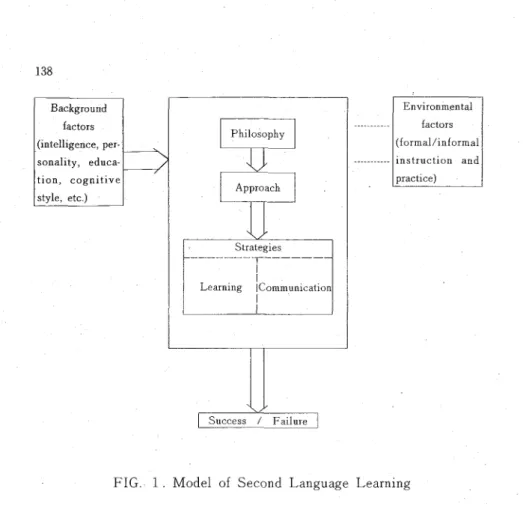
To what extent and how learner beliefs affect language learning or acquisition have not yet been adequately explored although there is general intuitional agreement that they are important in this enterprise. In the case study they did on the strategies of language learners, Abraham and Vann (1987) found out that the learners' choice of strategies were determined by their philosophy or beliefs about language and what it means to learn a language. On the basis of their observations, they posit the following model of second language learning (p. 97):
(137J
Background Environmental factors (formallinformal instruction and factors
(intelligence, per·
sonality, educa·
tion, cognitive style, etc.)
Strategies
- - - , - - - -
I I
Learning ICommunication I
Success / Failure
practice)
FIG. 1. Model of Second Language Learning Abraham and Vann explain their model as follows:
We suggest that learners have, at some level of consciousness, a philosophy of how language is learned. This philosophy guides the approach they take in language learning situations, which in turn is manifested in observable (and unobservable) strategies used in learning and communication. These factors form a hierarchy shown in the "E"
box in the model, and they directly influence the degree of success learners achieve.
However, the "E" factors should not be considered in isolation.
Combinations of variables in the learners' background (factors in the
139
"A" box in the model) are also important, because they affect each of the
"B" factors. Additionally, influences in the environment surrounding the second language learning experience ("C" factors, including formal or informal instruction and practice) may be important in modifying the
"B" factors, and, hence, have an indirect effect on degree of success. The model, therefore, permits many combinations of factors, both "winning"
and "losing".
In another study reported in W enden 1987, a group of adult learners talked about situations in which they functioned in English and about language learning activities they used both inside and outside the classroom. The transcripts produced from these interviews were content analyzed and statements of beliefs were identified.
Wenden's study indicated that learners (at least most learners) do hold beliefs and that the learning strategies that they choose seem to be consistent with these beliefs.
Both of these studies have given us important insights into what beliefs learners have and how these beliefs affect language learning but there still remain a lot of questions to be answered. We need a more systematic way of ferreting out these beliefs. We also need to know if beliefs differ from culture to culture and how these beliefs develop. We also need to test the model of Abraham and Vann-if it is true that beliefs determine the outcomes, what kind of beliefs are likely to result in failure and what kind result in success?
THE PRESENT STUDY
Methodology
The study reported in this article is an application of an instrument developed by Horwitz (see Horwitz 1985) to assess student beliefs about language and language learning. Called the Beliefs about Language
Learning Inventory (BALLI), this instrument asks students to state their degree of agreement or disagreement on 34 statements of beliefs. These statements fall into five categories: foreign language aptitude, the difficulty of language learning, the nature of language learning, learning and communication strategies, and motivations.
This study was done by the students in the Master's degree program of Doshisha University as part of their requirement in the course Second Language Acquisition (see Note). To save time in the administration of the BALLI and to make sure that the subjects understood the statements, it was decided to translate the instrument into Japanese. It was also decided to change certain expressions in the original BALLI to make the instrument more specific to the Japanese context. Thus 'people from my country' became 'the Japanese people', 'my native language' became 'Japanese', and 'Americans' became 'the English-speaking people'. The Japanese version was then pretested in one high school to identify problems in the translation and to determine the approximate amount of time needed to administer the instrument.
The BALLI was administered to 193 first year students of Doshisha University's Department of English in June 1990. This group made up 54%
of the total population of first year students in the department. At the time of administration, the students were into their third month of university studies and they were all taking an English class once a week for 90 minutes with a foreign professor. This means that the students had already been exposed to communicative teaching methods, and, since the medium in this class is English, to real situations where they were forced to use English actively (although one can argue that 90 minutes a week for three months isn't sufficient exposure).
Findings
Foreign Language Aptitude
The students believed that everyone can learn to speak a foreign language (69.8% agreed) although they indicated that learning a foreign language is easier for children than for adults (91.7% agreed), and that previous experience in learning a foreign language helps in learning another one (55%
agreed). A smaller number of students believed that some people have special abilities for learning foreign languages (40.9% agreed) and that people who speak more than one language are very intelligent (33.5%
agreed). They did not believe that women are better than men in learning foreign languages (52% did not agree), or that there is an inverse relationship between being good at science and mathematics and being good at foreign languages. They disagreed with the statement that the Japanese people are good at learning foreign languages (61.4% did not agree). As for themselves, only 4.7% believed they had a special ability for learning foreign languages while 56% believed they did not. A sizeable group, 39.3%, chose the neutral
"response.
The Difficulty of Language Learning
The students believed that some languages are easier to learn than others (83.5% agreed). Practically nobody considered English as a very easy language and only 2.1 % considered it a very difficult language. Most of the students considered English as difficult (29.7%) or of medium difficulty (48.4%) As for the four language skills, the students considered the skills that allowed them time (i. e. reading and writing) and the receptive skills (i. e.
reading and listening) easier.
When asked how long it would take one to learn· to speak English very well if she/he spent one hour a' day learning it, 6.3% answered one year, 27.7% answered one to 2 years, 36.2% answered 3 to 5 years, 14.7% answered 5 to 10 years, and 15.1 % answered never. To the statement 'I believe that I will learn to speak English very well', 26.6% agreed, 30.7% disagreed while the majority, 42.7% neither agreed nor disagreed.
The Nature of Language Learning
The students believed that knowledge of the English-speaking cultures facilitates the learning of English (77.7%) and that it is best to learn English in an English-speaking country (87.4%). Most of the students did not equate learning English with the ability to translate from Japanese (65.3%) or with learning the grammar of English (50.3%). Most of them, however, believed that learning vocabulary words is important (54.2%). The students also believed that learning a foreign language is different from learning other academic subjects (64.2%).
Learning and Communication Strategies
Most of the students believed in the value of language practice (83%) and endorsed the use of cassettes or tapes (77.5%). No one agreed with the statement 'You shouldn't say anything in English unless you can say it correctly (96.8% disagreed) although they also agreed that if beginning students were allowed to make errors in English, it would be difficult for them to speak correctly later on (62.7%). The majority of the students said they enjoyed speaking English with the Englishcspeaking people they meet (57.8%) although they felt timid doing it (48.5%). They also believed that guessing the meaning of a word is an acceptable learning strategy (77%).
The majority of the students believed that excellent pronunciation is most desirable (81.8%).
Motivations
The majority of the students believed that English is important to the Japanese (82.2%). Their reasons for learning English were: to have English-speaking friends (89.1 %), to have a better opportunity for a good job (75.5%), and to get to know English-speaking people better (67.3%).
Practically all of the students indicated a desire to learn to speak English well (99%).
Discussion
The students' responses to the BALLI yielded some interesting results.
Some of the findings confirm what many people already know. The most interesting results, however, are those that indicate changes in attitudes or beliefs and those that seem to point to solutions to language learning problems.
I t is a common belief among Japanese that, because they are basically a monolingual people, they do not have a special ability to learn foreign languages. From their responses it is obvious that the students have bought this idea. This belief seems to be responsible for their low expectations of themselves in relation to learning English: only 26.6% predicted success while 42.7% did not know if they would succeed, and 30.7% did not think they would succeed. However, almost all the students (99%) indicated a strong desire to learn English well. There is obviously a conflict between desire and goal or expectations for most of the students.
From their responses to the BALLI statements on foreign language
aptitude, the students seem to be communicating this message: "Everyone can learn a foreign language but the Japanese are different and since I am Japanese I do not expect to succeed in my efforts to learn English."
Op. the basis of their study to find out the relationshhp between personality and success in an English language program, Brodkey and Shore (1976) conclude that self-confidence is predictive of success while pessimism is predictive of failure in language learning. It would seem, therefore, that an important component of teaching foreign languages in Japan is building self-esteem.
The responses to the BALLI statements on the nature of language learning and on learning and communication strategies seem to indicate a negative reaction to the prevailing grammar-translation method of teaching in the junior high school and the high school. Because of this, it is possible to think that the high percentage given to the statement "It is best to learn English in an English-speaking country" is not an expression of belief in immersion programs but an expression of their frustration with the English teaching practice in Japan. This negative reaction notwithstanding, there is still an ambivalent attitude towards correctness/perfection and use of language that focuses on communication. This is shown in the inconsistency in the responses to Item 22 (If beginning students are permitted to make errors "in English, it will be difficult for them to speak correctly later on---- high degree of agreement) and Item 9 (You shouldn't say anything in English unless you can say it correctly-high degree of disagreement).
Since the subjects are enrolled in the Department of English, it is to be expected that their motivations are high and this fact is supported by the findings. (However, it is also a fact that English is not necessarity the first choice of all the students who end up in the department. Some of them settle for English because they can not get into the department of their choice. It is therefore possible that surveys on other groups of students would not yield
different results-but this conjecture needs to be verified).
The students believe that English is an important language to the Japanese. Their reasons for learning English are both integrative and instrumental (Gardner and Lambert 1972). Most students want to get to know English-speaking people better, to have English-speaking friends, and to have a better opportunity to get a good job. These responses are quite different from the responses of the Japanese adults studying English at the Osaka YMCA, surveyed by Chihara and Oller 15 years ago (Chihara and Oller 1978). Among the reasons for studying English, "to get a better paying job" and "to have English speaking friends" were the two responses chosen the least by the subjects of the Chihara and Oller study.
Summary and Conclusions
The important findings of this study may be summarized as follows:
l. Most students have low self-esteem and do not expect to succeed in learning English.
2. Most students do not equate learning a language with learning grammar or with having the ability to translate from one language to the other.
3. Most students consider learning vocabulary important.
4. Most students believe that knowledge of culture facilitates language learning.
5. Most students believe that learning a language is most effective in a target-language setting.
6. The students are both integratively and instrumentally motivated to learn English.
From the findings, it seems that there are two important things that can be done to improve the rate of success in language learning of
students and of other similar groups. Both would involve changing what Abraham and Vann call the "losing factors", specifically, (a) raising self-esteem or selfconfidence, and (b) de-emphasizing grammar and transla- tion, on the one hand, and increasing the opportunities for students to be exposed to and use English' both inside and outside the classroom on the other hand.
Despite the research findings that show that selfesteem and language learning are positively correlated, it is not clear whether self-esteem causes success or whether success causes self-esteem. Brown (1981) called this the classic chicken-or-egg question (p. 115). However, he cited Heyde 1979, which reported the results of a study on the performance in an oral production task of American college students studying French. Heyde (1979) found out that after only eight weeks of instruction, certain sections of French 101 had higher scores in oral production and in self-esteem than other sections (students were randomly assigned to the sections), suggesting that teachers really can have a positive and influential effect on both the linguistic performance and the well-being of the student. Perhaps those 'good' teachers succeeded because they gave optimal attention to linguistic goals and to the personhood of their students (Brown 1981:
116).
Entering university students in Japan have had six years of instruction in English behind them. However, their school-leaving proficiency is hilfdly functional-it is true they pass the English section of the univers,ity examination but most of them are not able to comprehend simple spoken English or give a simple answer to a simple question. Outside the formal education sector the English teaching industry is a very vigorous industry but teachers (both Japanese and foreign) lament that the Japanese are not learning English as well as they ought to considering the time and effort that
they spend trying to learn the language. Might low self-esteem be the cause?
It is obvious that we need to know more about self-esteem--what is responsible for it and how it is developed. In conjunction with research on self esteem, we need more classroom research to find out what the actual teaching/learning conditions are (teacher-student interactions, student- student interactions, teaching techniques, learning activities, syllabus, etc.), especially in the junior high school and the high school. Since practically all the learning of the language that the students do happen in the classroom, it is important that classroom data be made available for examination.
NOTE
The data for this study were gathered by the following graduate students:
Masanobu Horiguchi, Hideki Oiwa, Seichi Sugawa, Kazumi Suzuki, Tomoe Tamamura and Mutsumi Yamamoto. My thanks to them. They also translated the BALL I into Japanese and Horiguchi pre-tested the Japanese version in the high school where he is a teacher. A draft of a report (not this report) was prepared by these students but since it was not revised for re-submission, I decided to write this report myself so as not to let the data go to waste.
REFERENCES
Abraham, Roberta G. and Roberta
J
Vann. 1987. Strategies of two language learners:a case study. In Wenden and Rubin (eds.), 1987.
Brodkey, Dean and Howard Shore. 1976. Student personality and success III an English language program. In Language Learning, 26/1:153-162.
Brown, H. D. 1981. Affective factors in second language learning. In Alatis, J, H.
Altman and P. Alatis (eds.). 1981. The Second Language Classroom: Directionsfor the 1980s. New York: Oxford University Press.
Chihara, Tetsuro and John W. Oiler. 1978. Attitudes and attained proficiency in EFL:
a sociolinguistic study of adult Japanese speakers. In Language Learning, 2811:
55-68.
Gardner, R. and W. Lambert. 1972. Attitudes and Motivation in Second-Language
. Learning. Rowley, Mass.: Newbury House.
Heyde, A. 1979. The relationship between self-esteem and the oral production of a second language. Unpublished Ph. D. dissertation, University of Michigan, Ann Arbor.
Horwitz, Elaine K. 1985. Using student beliefs about language learning and teaching in the foreign language methods course. In Foreign Language Annals, 18/4:
333-340.
~~~~ _ _ ~_.1987. Surveying student beliefs about language learning. In Wenden and Rubin (eds.), 1987.
Wenden, Anita L. 1987. How to be a successful language learner: insights and prescriptions from L2 learners. In Wenden and Rubin (eds.), 1987.
Wenden, Anita and Joan Rubin (eds.). 1987. Strategies in Language Learning.
Englewood Cliffs, New Jersey: Prentice-Hall International.
APPENDIX A
BALL!: ORIGINAL VERSION
Beliefs About Language Learning Inventory. ESL Student Version
Below are beliefs that some people have about learning foreign languages.
Read each statement and then decide if you:
(1) strongly agree, (2) agree, (3) neither agree nor disagree, (4) disagree, (5) strongly disagree.
There are no right or wrong answers. We are simply interested in your opinions. Mark each answer on the special answer sheet. Questions 4 & 15 are slightly different and you should mark them as indicated.
REMEMBER:
(1) strongly agree, (2) agree, (3) neither agree nor disagree, (4) disagree, (5) strongly disagree.
1. It is easier for children than adults to learn a foreign language.
2. Some people have a special ability for learning foreign languages.
3. Some languages are easier to learn than others.
4. English is:(a) a very difficult language (b) a difficult language
(c) a language of medium difficulty (d) an easy language
(e) a very easy language.
5. I believe that I will learn to speak English very well.
6. People from my country are good at learning foreign languages.
7. It is important to speak English with an excellent pronunciation.
S. It is neccessary to know about English -speaking cultures in order to
speak English.
[149J
9. You shouldn't say anything in English until you can say it correctly.
10. It is easier for someone who already speaks a foreign language to learn another one.
11. People who are good at mathematics or SCIence are not good at learning foreign languages.
12. It is best to learn English in an English-speaking country.
13. I enjoy practicing English with the Americans I meet.
14. It's o.k. to guess if you don't know a word in English.
15. If someone spent one hour a day learning a language, how long would it take them to speak the language very well:
(a) less than a year (b) 1-2 years (c) 3-5 years (d) 5-10 years
(e) You can't learn a language in 1 hour a day.
16. I have a special ability for learning foreign languages.
17 _ The most important part of learning a foreign language is learning vocabulary words.
18. It is important to repeat and practice a lot.
19. Women are better than men at learning foreign languages.
20. People in my country feel that it is important to speak English.
21. I feel timid speaking English with other people.
22. If beginning students are permitted to make errors in English, it will be difficult for them to speak correctly later on.
23. The most important part of learning a foreign language is learning the grammar.
24. I would like to learn English so that I can get to know Americans better.
25. It is easier to speak than understand a foreign language.
151
26. It is important to practice with cassettes or tapes.
27. Learning a foreign is different than learning other academic subjects.
28. The most important part of learning English is learning how to translate from my native language.
29. If I learn English very well, I will have better opportunities for a good
job.
30. People who speak more than one language are very intelligent.
31. want to learn to speak English well.
32. I would like to have American friends.
33. Everyone can learn to speak a foreign language.
34. It is easier to read and write English than to speak and understand it.
Foreig_~l:~~!;lge
Aptitude~-1-1-2- -~-4-l-~ 1
It is easier for children than adults to learn a foreign61.1 30.6 4.7 2.6 1.0
language.2
Some people have a special ability for learning1 6.3134.6120.4127.7111. 0
foreign languages. .6
The Japanese people are good at learning foreign 1.0 7.8 29.2 51. 6 10.4
languages.10
It is easier for someone who already speaks a foreign6.8 48.2 25.1 17.3 2.6
language to learn another. ?:J>-
11 People who are good at mathematics or science are0.0 3.6 13.5 53.1 29.8
M >-cl not good at learning foreign languages. C/l >-cl C M16
I have a special ability for learning foreign languages.0.5 4.2 39.3 34.5 21.5
l'z 19
Women are better than men at learning foreign >-l t::J1.6 8.3 38.0 33.3 18.8
C/l..., languages. ~.>< 30
People who speak more than one language are very8.9 24.6 38.7 18.9 8.9
?f? tcJ intelligent.33
Everyone can learn to speak a foreign language.24.5 45.3 20.3 8.9 1.0
The N ature ~an~ge Learning
1 2 I '
4 5 8
It is necessary to know about English-speaking cultures30.6 47.1 13.5 7.8 1.0
in order to speak English.12
It is best. to learn English in an English-speaking46.0 41.4 7.9 3.7 1.0
country.17
The most important part of learning a foreign language is I11.5 42.7 22.5 18.2 3.1
learning vacabulary words.23
The most important part of learning a foreign language is I1.5 10.9 37.3 40.0 10.3
learning the grammar.27
Learning a foreign language is different from learning I12.9 51.3
other academIc subjects.22.8 10.9 2.1 28
The most important part of learning English is learmng I1.0 7.8 25.9 45.6 19.7
how to translate from Japanese. The Difficulty of Language Le~rning1 2 3 4 5 3
Some languages are easier to learn than others.21.8 61.7 6.4 8.5 1.6 4
English is(1)
very difficult(2)
difficult(3)
of medium2.1 29.7 48.4 19.3 0.5
difficulty(4)
easy(5)
very easy5
I believe that I will learn to speak English very well.7.3 19.3 42.7 27.1 3.6 15
If someone spent one hour.a day learning a language, how long would it take them to speak the language very well:(1)
less than a year(2) 1-2
years(3) 3-5
years(4) 5-10
years(5)
You can't learn a language in one hour a day.6.3 27.7 36.2 14.7 15.1 25
It is easier to speak than understand a foreign language..5.2 16.1 34.4 33.9 10.4 34
It is easier to read and write English than to speak and8.8 33.8 31.1 21. 7 4.6
understand it..- <J1
.,.
Learning and Communication Strategies 2t
3 4 5 7 It is important to speak English with an excellent 43.0 9.8 8.8 1.6 pronunciation. 9 You shouldn't say anything in English unless you can I "say it correctly. 0.0 0.0 3.2 45.5 51.3 13 I enjoy speaking English with the English-speaking 27.1 30.7 35.4 6.3 0.5 people I meet. 14 It's ok to guess if you don't know a word in English. 19.3 57.7 15.0 7.0 1.0 18 It is important to repeat and practice a lot. 32.2 50.8 8.3 4.7 1.0 21 I feel timid speaking English with other people. 11.5 37.0 20.3 22.9 8.3 22 If beginning students are permitted to make errors in English, it will be difficult for them to speak correctly later on. 111 .9 50.8 19.2 15.0 3.1 22 It is important to practice with cassettes or tapes. 25.1 52.4 16.7 5.8 0.0Motintion~ ~!!:~I
2 3;':t::
20 The Japanese feel that it is important to speak English. 33.0 49.2 8.9 7.9 1.0 24 I would like to learn English so that I can get to know 22 8 44 5 23.3 7.8 1.6 English-speaking people better. ." 29 If I learn English very well I will have better opportum- 21.4 54.1 16.7 5.7 2.1 ties for a good job. 31 I want to learn to speak English well. 87.5 11.5 1.0 0.0 0.0 32 I would like to have English-speaking friends. 61.1 28.0 9.3 1.6 0.0
155
APPENDIX C
BALL!: JAPANESE VERSION
j}.OOE!'lIf1~~::1'kl ~
-C A4
iJ'~ t-Cv'.6 2: c iJ'T
~::~~G h -Cv, i To 4'f.)(
~~JCA.,"Z", 5J1l*~0)
1 iJ'G 5
O)r:p-C'Ef{~T.6 'bO)~:::tL~-:::;ft-CT'2v'o4 c15 li
(a)7PG
(e) O)r:p--C-Ef{~T.6'bO)~:::tL~-:::;lt-CT'2v>o c'hiJ'lEIW--C-,c'*1..iJ'~~
Cv' -) 2: c lie!)
I) i-1t
A.o e!) ij,
t:.El
~O)ltJil. ~~~-CT'2
1,'01. AAO)a~.J:: I) r1:lt0)~0) ~l-) iJ':$'i-OOE!~'lIf1~T.6 O)iJ'*--C- e!).6 0
2.
:$'i-OOE!~'¥:£O)~::!f1r5JUij,::t§~~:fif--::>t:.AiJ'v,.6
o3. '¥:U'-?Tv'i3E!c'¥:[n:: < v'i3E!iJ'e!).6 o
4.
~E!li (a) A'@2~ ~v>i3~-C'e!).6o(b)
il~v'i3~-c'e!).6o(c) ~~< 'bij,v'~,
-?'2
~<'bij,v'o
(cl) fiijij!ij,i3~-C'e!).6o(e) A'@2fiijij!ij,i3~--C-e!).6o
5. fl.li c -C 'b
1.:. =F~:: ~E!iJ'Ej§--1t.6 .J:: -)
~:: ij,.6 c }~,-)
06. B
*AIHi-OOE!~,¥:£O)iJ'1~ltt-=o7.
~hv'ij,9f;.:g:--C-~E!~Ej§-T2:c lije-Wt-=o 8.
~~! ~Ej§-T~:: li~~!~0))(1t
~*D.6 £'~iJ'e!).6 09. lE
~< i3;{..6.J:: -)
~::ij,.6 i --C-li~~!H~-) ~~--C-liij,v'o
10.
T--C-~::,e!).6
j}.OO~! ~Ej§--1t.6A li,
*O)j}.OO~! ~ ,¥:£O)iJ'~)1--C-e!).6
011. ~'¥:-?f4,¥:iJ'1~ltij,
A
IHi-OO~!~'¥:£
0)iJ''5=F -C' e!).6
012.
~E!~-c'~~!~,¥:£O)iJ'-il'&'v'o13.
fJ,.li~~!~O)92DAc
~~!~*~'lIfT.6 O)iJ'* ~ V>o14.
~~!-C'*DG
ij, v'ij!~!iJ'e!)--::> -C 'b ltP;f:
~ ~lt{~Thli'.&. 1,'015. 7l-00~fr~-8-lt!frll'$~c
L-C
c·O)< GIt,"t"'7
i<
~i5-1t.oJ: '7 f.:tj
I')
iTi,po
( a ) 1:¥J:.Li*J
(b) 1-2:¥
( c ) 3-5=¥
(cl) 5-lO:¥
( e ) 1
8
1 a~rll'"t"(±~:f!!!.t!o 16.fJ,. f.:
(±7l-00~fr ~$~~7JiJtj::tllbJ'<b.o
017. 7l-00~fr~'llI1~T.o o)f':(±~fr*~±~-?T::::'
c 7J'-*O);f:lHR"t"<b.o o
18 . .
Bl1l**'llI
~{liJ@J'b T.o::::, C 7J':X1jJ]"t"<b.o o
19.
R'tio) (1'7 7J'!'iHi J:
I')'b
7l-00~fr ~$~O) (.: [Q]1t' '"(It'.o
020.
8
~A(±~~fr~~i5T::::'C
O)£~tt ~~ t.'"(It'.oo
2l. ~~fr"t"1lP.0)
A C
~i5TO)f.:
(±~;J3< n T.o
022. 11lt:f)]O).§(:~~"t"~~frO) ~ A ~fJ<Jjff7J't~:J1l;j
Ltjlt' C T.o C, :f&"t"IE L <
~i5TO)7J'ft L <
tj.o 023. 7l-00~fr~,&,/1~T.o 0) (.:
(±)(rt
~'&'/'7
O)7J'-*O);f±5~-c'<b.o 0 24. fJ,.(±~~frI!lO)A4 ~J:
I')J: <
9:0.ot.:06(':~~fr~$U't.:v'0 25. jj.OO~fr~/j{J ~C.o J:
I') ~i5T(1'7 7J'Ml'Iit!o
26. iJ -t '/
r
tj c""t"~~fr~**,&,/T.o::::,C
(±:;k1jJ]t!o 27. 7l-00~frO)$'&'/(±{lP.O)n El
0)$'&'/C
,±~tj.o 0~. ~m~$,&,/T.oO)~-*:;k1jJ]tj::::.c~, 8~m~G~m~.~T.o::::,
c
t!o29. ~~fr~,!1tI':--:Jltt.:
G,
Rv'~~.5i!.--:Jlt
.o1l~7J'~'z.oo 30.=
Jr OO~fr .L.J,-.L ~ ~i5TA
(HJ[7J' Rv'
031. ~~fr~
'7
i<
~i5-1t.oJ: '7
I.: tj I') t.:. 1,.'032. ~~frI!l0)1Jz:J17J'(1
Lv'o
33. .
Nl"t" 'b
~~fr ~ ~i5-1t .0J: '7 (.:
tj .0034 . ~ ~fr ~ ~i5
L
t.: I')/j{J
~C
-::> t.:. I')T
.0J:
I')'b
~JC A.,!! I') • v ,t.:. I')T
.0t 1 '7 7J{
Ml'Iit!o