九州大学学術情報リポジトリ
Kyushu University Institutional Repository
テキスト分類の実践:実問題の構造の定式化
石田, 栄美
http://hdl.handle.net/2324/2236253
出版情報:Kyushu University, 2018, 博士(情報科学), 課程博士 バージョン:
権利関係:
Text Classification in Practice:
Formalizing the structure of real problems
January 2019
Emi Ishita
Contents
1 Introduction 1
1.1 Contributions of the Dissertation 3
1.2 Structure of the Dissertation 4
References 5
2 Automatic Detection of Academic Papers based on Their Structure and Elements 6 2.1 Elements and Structure of Academic Papers 7
2.1.1 Establishment of Academic Papers 7
2.1.2 Diffusion of the IMRAD Format 8
2.2 Survey on Structure and Elements of Academic Papers 10 2.2.1 Related Work on the Structure and Elements of Papers 11 2.2.2 Survey of the Structure and Elements of the Papers 11
2.2.3 Results 13
2.2.4 Structure and Elements of Academic Papers 15
2.3 Detecting Academic Papers 16
2.3.1 Related Work on Text Genre Classification 16
2.3.2 Feature Selection 17
2.3.3 Building PDF Files Test Collection 20 2.3.4 Classifiers and Evaluation Measures 23
2.3.5 Results 25
2.3.6 Discussion 26
2.4 Summary 26
References 27
3 The Applicability of Classifiers to Content Analysis and Quantity of Training Data 30 3.1 Related Work 31 3.2 Applicability of Classifiers to Content Analysis 31
3.2.1 Test Collection 31
3.2.2 Multi-Label Classification 33
3.2.3 Comparison of Human and System Coding 35
3.2.4 Discussion 36
3.3 Quantity of Training Data vs. Human Effort 36
3.3.1 Test Collection 37
3.3.2 Experimental Design 38
3.3.3 Evaluation Measure 39
3.4 Results 40
3.5 Summary 43
References 44
4 The Quality-Quantity Trade-off for Training Data in Automation of Content Analysis 47 4.1 Test Collection of Nuclear Power Debate Editorials 48
4.2 On/Off Topic Identification 50
4.2.1 Coding Guidelines 50
4.2.2 Experimental Design 51
4.2.3 Results 53
4.3 Identifying Value Sentences 56
4.4 Summary 57
References 57
5 Conclusion 59
References 62
Acknowledgments 63
1
Chapter 1 Introduction
Various machine learning classifiers such as Naïve Bayes, Decision Trees and Support Vector Machines have been developed. In addition, classifiers using Deep Learning methods have also recently been proposed. As the amount of digitized and born-digital data continues to increase, attention to the design and application of classifiers has continued to increase as well.
In text classification research, with the test collection for automated text classification (e.g., Reuters-21578 [1]) provided, theoretical research and the development and improvement of classifiers have been actively conducted. Classification using a support vector machine (SVM) classifier with use of WordNet information, for example, has achieved high classification performance by obtaining an F value of 0.94 or higher for the classification of topic categories such as earn and grain in Reuters-21578 [2]. The relationship between a document topic and words or phrases is clear because the classification of a document topic is conducted based on the content of the document.
Therefore, a classifier such as the SVM can classify documents into related topic categories, using words and phrases characterized as the document topic. However, for classifying documents into non-topical categories, such as the detection of academic papers, the types of information that are effective for characterizing documents are unclear.
For a machine-learning classifier, training data are required. Training data are a set of documents with assigned categories. In general, assigning categories to documents is conducted manually by human coders. When newspaper articles are assigned into topic categories such as corporate/industrial, economics, government/social, and market [3], it is relatively easy to determine the articles that should be assigned to a particular category by reading the contents of the articles. However, to assess whether, for example, a given set of articles primarily discuss the survival of nuclear power plants after the Great East Japan Earthquake, or to infer human values reflected in opinion sentences, the construction of training data is time consuming and expensive. Therefore, in research focusing on the classification tasks to categories where it is difficult to determine whether the documents should be assigned to a given category, the following problems should be considered: How much training data should be prepared for the classifiers? Which should be prioritized when the budget to construct training data is limited: quantity or quality of the training data?
2 In this dissertation, three real problems in text classification that arise when introducing the classifiers in practice are explored.
The first part of this dissertation discusses the detection of academic papers. In web search, search engines respond to queries by providing documents that satisfy specific information needs. Search engines that focus only on topical matching, however, cannot perform distinctions based on the source credibility or information quality. Hence, it can be useful to augment a search engine with the results of a classifier for a document genre, so that academic papers, press releases, white papers, etc. might be recognized. In the current study, the task is to detect academic papers. Recently, open access journals and self-archiving of academic papers have become more common. Thus, it is now easy to obtain full-text papers, often in the PDF form, from the web. However, words that are used in other less reputable genres (e.g., blogs, personal web pages, or conspiracy sites) are often used in academic papers. Therefore, it is necessary to detect academic papers from documents of various genres (document types). In this study, information characterizing academic papers are identified and included into the feature set;
subsequently, academic papers are detected using the trained classifiers. For the information, the section types, other elements of academic papers, and descriptive attributes of files such as file size, page number, and length were considered, in addition to words occurring in academic papers.
The second task is coding content in computational social science. Classifiers have been applied for quantitative analysis in social science research in recent years, notably (but not exclusively) for large-scale sentiment analysis. For example, sentiment classification has provided an effective and efficient method to measure positive or negative attitudes toward policies, politicians, brands, products, and services at the web scale [4]. However, a much deeper and more interesting question is why people hold certain sentiments. Human values, which can be defined as what people consider important in life [5], can be used to predict individuals’ attitudes [6] and behaviors [7]. A method in which social scientists study human values is by using content analysis. Hence, social science researchers determine the scope of a set of documents to be analyzed (target documents), develop a set of categories (a "coding frame") for analyzing target documents, and manually assign categories to them (a "coding" process). Finally, they analyze statistically based on the number of categories given and then draw conclusions according to their research questions. Although a set of target documents is finite, the number of target documents becomes large when social scientists focus on socially significant topics for contents analysis. Social scientists typically conduct coding by hand for all target documents; however, this is difficult when coding at a large scale. Therefore, the method to code the entire set of target documents is challenging. A solution is by using classifiers, in which a human coder codes part of a document set (training set), a classifier is learned by the training set, and subsequently the trained classifier assigns categories to the remaining target documents. In this research, classifiers that estimate human values reflected in opinion sentences are explored first. Next, the rates of training data for classifiers are studied. The trained classifiers are trained by part of the human-coded documents (training data). Subsequently, the performances of the trained classifiers with
3 different numbers of training data are examined. The results of this experiment indicate the possibility of reducing a human coder's effort in the task of coding human values.
In content analysis for human values, the selection of documents to be analyzed is important as well as the coding of human values to sentences. The third task in this dissertation is to identify whether documents collected by the keyword search are target documents to be analyzed. The set of target documents consists of documents that primarily describe or discuss a topic of primary focus for content analysis. Even words related to a topic are included in documents; documents that do not involve the topic of content analysis are out of scope of the target documents. For instance, in the content analysis of newspaper articles on the discussion of nuclear power plants, an article that primarily describes a political situation such as a governor's election in Tokyo is out of target (off topic) even when the words "nuclear power plant" are included in that article.
The topic identification task that assesses whether a document is to be analyzed (on- topic/off-topic) is a qualitative task of determining the primary topic of the document. The construction of training data is time consuming and expensive, as it involves the coding of human values. When constructing training data for classifiers, it is best to obtain a large amount of high-quality training data. However, the budgets for research projects are often limited. Within a certain budget, training data are to be constructed with the most suitable balance of quality and quantity that yield the best performance of the classifiers. In this study, the quality and number of documents required for achieving the best performance by classifiers under a certain cost are examined. In other words, the tradeoff between the quality and quantity of training data is explored.
1.1 Contributions of the Dissertation
In this section, the principal contributions of the dissertation are summarized.
First, the experiment results regarding the detection of academic papers indicate that features collected based on the characteristics of academic paper suffice for this task.
These features include structural information such as section headings and component elements (such as the presence of references) and the descriptive attributes of a file of a particular genre such as file size, page number, and length, in addition to a tailored set of expressions as word-level content features. The benefits of this approach are demonstrated in two languages (Japanese and English) for an important genre (academic papers).
Next, the experiments indicate that machine-learning techniques for text classification can be used to infer human values in written text, and can yield results similar to that which human coders would produce. These were the first experiments to demonstrate that text classification could be used in such a manner. Moreover, these experiments demonstrate that strong results can be obtained using only word-level content features, and that relatively modest quantities of training data may suffice. These results have important practical implications for the scalability of this type of content analysis in social science research. In other words, in this study, classifiers are trained using training data consisting of sentences assigned to categories by a human coder;
4 subsequently, the trained classifiers that code the remaining sentences were employed.
These experimental results indicate that the approach can be used to conduct content analysis for a large number of document sets.
Finally, experiments focusing on the quality–quantity tradeoff for the training data indicate that an adaptive approach to managing data quality can facilitate in optimizing the cost–benefit ratio. In particular, the experiment results indicate that early in the training process, the diversity of the content being coded trumps the quality of those coding, suggesting that when multiple coders are available, the traditional practice of adjudicating conflicting coding of the same documents may not be as cost effective as an alternative in which each coder labels different documents. More generally, the results indicate that larger quantities of lower quality training data are useful early in the training process.
1.2 Structure of the Dissertation
This section describes the structure of the remainder of this dissertation.
Chapter 2, which is based on a journal article published by the Japanese Society of Library and Information Science, presents the design, results, analysis, and experiments for academic paper genre classification [8]. This article received the best paper award for FY 2014 in that journal.
Chapter 3 presents the design, results, and analysis of two sets of experiments for using text classification to infer the direct or indirect expression of human values in text.
This chapter draws together two related publications, the first at the Annual Conference of the American Society for Information Science and Technology (ASIST) [9] and the second at International Conference on E-Service and Knowledge Management (ESKM) [10]. The ASIST paper was the first to apply text classification to human values, and the ESKM paper built on those early results to explore learning rates and to characterize classifier performance with limited quantities of training data.
Chapter 4 introduces a more nuanced three-stage coding process that combines topical and non-topical classification for inferring the expression of human values with respect to a specific topic. The topical classification experiments shed light on the quality-quantity trade-off by explicitly modeling the cost of achieving higher coding quality. This chapter is based on a paper that has been accepted for publication at the Fourteenth Annual Conference of the iSchools in April, 2019 [11].
Finally, Chapter 5 concludes the dissertation with some remarks on several directions for future research.
5
References
[1] Lewis, D. D. Reuters-21578 Text Categorization Collection Data Set.
http://www.daviddlewis.com/resources/testcollections/reuters21578/ (accessed 2019- 01-26)
[2] 福本文代, 鈴木良弥. (2002). 「WordNetの同義語クラストその上位関係を利用した文書 の自動分類」『情報処理学会論文誌』, 43(6), 1852-1865.
[3] Lewis, D. D., Yang, Y., Rose, T. G., & Li, F. (2004). RCV1: A New Benchmark Collection for Text Categorization Research. Journal of Machine Learning Research, 5, 361-397.
[4] Pang, B. & Lee, L. (2008). Opinion mining and sentiment analysis. Journal of foundations and trends in information retrieval, 2(1-2), 1-135.
DOI:10.1561/1500000011
[5] Friedman, B., Kahn, P. H. Jr., & Borning, A. (2006). Value sensitive design and information systems. Human-computer interaction and management information systems: Foundations, 348-372. DOI: 10.1002/9780470281819.ch4
[6] Templeton, T. C., & Fleischmann, K.R., (2011). The relationship between human values and attitudes toward the Park51 and nuclear power controversies. Proceedings of the 74th Annual Meeting of the American Society for Information Science and Technology (ASIST2011), 10p. DOI: 10.1002/ meet.2011.14504801172
[7] Schwartz, S. H. (2007). Value orientations: Measurement, antecedents and consequences across nations. Measuring Attitudes Cross-nationally: Lessons from the European Social Survey, 169-203. DOI: 10.4135/9781849209458. n9.
[8] 石田栄美, 安形輝, 宮田洋輔, 池内淳, 上田修一 (2014). 「構造と構成要素に基づく学術 論文の自動判定」『日本図書館情報学会誌.』, 60(1), 18-34.
[9] Ishita, E., Oard, D. W., Fleischmann, K. R., Cheng, A.-S., & Templeton, T. C. (2010).
Investigating multi-label classification for human values. Proceedings of the 73rd Annual Meeting of the American Society for Information Science and Technology(ASIST2010), 47(1), 1-4.
[10] Ishita, E., Oard, D. W., Fleischmann, K. R., Tomiura, Y., Takayama, Y., & Cheng, A.- S. (2015). Learning curves for automating content analysis: How much human annotation is needed? Proceedings - 2015 IIAI 4th International Conference on Advanced Applied Informatics (IIAI-AAI 2015), 171-176. DOI:10.1109/IIAI- AAI.2015.295, © [2015] IEEE. Reprinted, with permission, from [Ishita, E., Oard, D. W., Fleischmann, K. R., Tomiura, Y., Takayama, Y., & Cheng, A.-S, Learning curves for automating content analysis: How much human annotation is needed?, Proceedings - 2015 IIAI 4th International Conference on Advanced Applied Informatics, July/2015]
[11] Ishita, E., Fukuda, S., Oga, T., Oard, D. W., Fleischmann, K. R., Tomiura, Y., & Cheng, A.-S. (2019). Toward three-stage automation of annotation for human values.
Proceedings of the iConference 2019 (to appear).
6
Chapter 2
Automatic Detection of Academic Papers based on Their Structure and Elements
In this chapter, we attempted to select features for detecting whether or not texts are academic papers. Generally, when features are selected for classifiers, the methods of selection use linguistic features such as the parts of speech of words occurring in the texts.
By contrast, the approach in this research is that the structures and elements of academic papers, and the specific words and phrases occurring in academic papers, were used as features.
In general, a document has a specific form and structure depending on its purpose and role. Its elements and order of description are prescribed by social customs and laws and regulations. For example, legal documents, the text of judicial judgments, office documents or business documents each have a specific format. In many cases, a form of document is established by certain agreements among people who create and use those documents, then the format is discussed, and this becomes the standard among those people. Finally, the form of the document becomes established over time. Conversely, if a document has certain elements and a specific form, it is becoming accepted that it is a particular type of document. Currently, many documents are digitized. Therefore, the analysis of the format and structures of documents and the detection of specific types of document from a high volume of digitized document files have been addressed as a research topic [1].
In this chapter, the focus is on the academic paper as a type of document form.
Academic research outcomes in any field are made public through certain procedures. It is thought that academic papers have come to have a specific form with the specialization of academic fields and the dissemination of academic journals. In recent years, open access journals and the self-archiving of academic papers have become more common and widespread, and there are many academic papers openly accessible on the web. Academic papers on the web are written in multiple languages and across various academic fields.
However, English is still a common international language in the academic world.
Therefore, the purpose of this research is to detect academic papers written in English. In
7 addition, there is a focus on Japanese academic papers, because building the method needs to be independent of language.
The structure of this chapter is as follows. In Section 2.1, the format and elements of academic papers were extracted from guidelines and textbooks concerning the writing of academic papers. In Section 2.2, the format and elements of papers on the web were inspected and the specific structure and elements of papers actually used were confirmed.
In Section 2.3, we selected features based on the structure and elements of academic papers confirmed in Section 2.2, and then we conducted an experiment using selected features to detect academic papers from the English and Japanese portable document format (PDF) collections collected by web crawling.
2.1 Elements and Structure of Academic Papers
The format and elements of academic papers are defined in the submission rules (author or submission guidelines) of each academic journal, and authors submit papers according to these rules. The rules differ depending on the academic journal, but there are common rules among them. For example, individual journals determine whether the title of a figure is "FIG. 1" or "Figure 1,” but it is common rules that put the title of a figure below the figure and the title of the table above the table.
2.1.1 Establishment of Academic Papers
John Ziman pronounced that the most important medium of scientific communication was the "primary paper" in academic journals. This was a completely new concept in the late 17th century [2]. Prior to this, the means of communicating scientific information was through a "letter" and/or books. Scientific (academic) papers were extremely short having a few pages and did not assemble new principles, but they had taken a more drastic step from the scaffolds established in previous studies by cited other papers [2]. They were also published within a short period and worked for promotion of debates and at the same time achieving priority for the findings. Moreover, scientific papers became public documents and were organized for retrieval and quotation [2].
With the launch of academic journals such as Philosophical Transactions in 1665, the
"letter" format had been mainly used for quite some time, and the present "paper" format was not used. The proportion of "letters" in articles published in Philosophical Transactions from 1740 to 1859 was examined [3]. The author reported that the proportion of "letters" was around 50% in the 1760s, and then the proportion of “letters”
gradually decreased over the following century, until "letters" had almost disappeared by the 1850s [3].
In the latter half of the 19th century, the number of academic journals and academic papers increased, and two million scientific papers were published during the 19th century [4]. Joseph Harmon declared that the 19th century brought about significant advances in experimental design, innovative statistical methods for analyzing experimental results, and new theories explaining experimental results and observations
8
[5]. These were expected to be exhibited in articles. The new form of technical paper was required by professional scientists when editing journals [5].
As a result, the paper form changed in the 20th century to the form consisting of topic, abstract, introduction, method or experimentation details, result, discussion, conclusion, acknowledgment, and reference, which combined was called the "topical structure.”
According to Harmon, this was an efficient way to organize the necessary information logically and efficiently when reporting on experiments [5]. Sam F. Trelease encouraged scientists employing this structure in the book "Preparation of Scientific and Technical Papers" (1927), the first book written in English on the subject of academic paper writing [6].
In Japan, three books about how to write academic papers were published from 1929 to 1934. In the oldest book "How to write medical papers second part No.1 (『医学論文の 書き方 後篇 第1』)" (1929) written by Inokichi Kubo [7], he established the following as structures of academic papers: "1. Title and table of contents(表 題 及 目 次), 2.
Introduction (緒言), 3. History(歴史), 4. Materials and Methods (材料及方法), 5. Result and Scores (結果成績), 6. Summary and Conclusion (統括結論), 7. Acknowledgments (謝辞), 8.
Reference(文 献), and 9. Abstract (抄 録).” Structure “3. History" is "the historical description about the same problem as conducted by analyzing”. It is about the description of related and prior research. We could see that those elements of the paper were similar to the modern style of academic paper. The elements of the paper given by Kubo were very similar to the "topical structure" defined by Harmon. However, the influence relationship between them is unclear.
2.1.2 Diffusion of the IMRAD Format
Conversely, there was another explanation concerning the structure of academic papers that was developed based on the IMRAD format consisting of introduction, method, result, and discussion. In 1989, Robert A. Day revealed that a paper written by Louis Pasteur was in the IMRAD format [8]. Day and Barbara Gastel described the history of scientific papers in the guide detailing how to write a paper, and it differed from Harmon’s explanation [9]. Papers of academic journals originating in the middle of the 17th century were "descriptive" [9]. Typically, a scientist would report that “First, I saw this, and then I saw that” or “First, I did this, and then I did that.” The observations were displayed in a simple chronological sequence. In the 19th century, science had developed and the method became more important in papers [9]. For example, Louis Pasteur, who developed pure-culture methods of studying microorganisms, described his experimental method in exquisite detail. After that, “the reproducibility of experiments became a fundamental tenet of the philosophy sciences, and a segregated methods section led the way toward the highly structured IMRAD format” [9].
Day also indicated that the logic of IMRAD could be defined in question form [9]:
9
What question (problem) was studied? The answer is the Introduction.
How was the problem studied? The answer is the Methods. What were the findings? The answer is the Results. What do these findings mean? The answer is the Discussion.
Furthermore, the IMRAD format helped authors to organize and write the manuscript and it provided common background for editors, referees, and readers [9].
Sollaci et al. examined the IMRAD format of papers published in the British Medical Journal, JAMA, Lancet, and the New England Journal of Medicine, which were core journals in the medical field from 1935 to 1985 [10]. In 1935, there were no papers with the IMRAD format in any journals, but their presence increased rapidly from the 1960s onwards. All papers in The New England Journal of Medicine in 1975 had the IMRAD format, and all papers in the other three journals also had the format in 1985. In further detail, only 20% of papers in the British Medical Journal had the IMRAD format in 1935, even including those partially in that format. The proportion increased up to the 1960s.
The transition to the IMRAD format in the medical field was a gradual process, which took a long time.
Currently, the term "topical structure" is not used, and the term IMRAD had been commonly used. "Topical structure" included not only the body of the paper but also elements such as the title, corresponding text, authors, and references, whereas the IMRAD format included only the structure of the body in the paper.
The IMRAD format developed mainly in the medical and biological fields but then it became commonly used in broader fields from the natural sciences to the social sciences.
The book "How to write academic papers" was published in 1977 by Umeberto Eco, and it provides guidelines for writing academic papers in the humanities. The Japanese translation of the book was published in 1991 and was then repeatedly published thereafter. However, there was no description of the structure and elements of the papers [11]. In the humanities, awareness of the structure of papers was limited.
In 1977, Akio Sawada understood the structure of papers in the natural sciences field and stated the following [12] while not emphasizing the differences by field.
“The process, which consists of looking at various data and facts, thinking about questions of inexplicable phenomena, making a hypothesis to answer that question, verifying whether the hypothesis to explain the reality comparing with facts, was common to all academic fields.
Academic papers in natural science mostly consisted of "Introduction showing questions", "Method of experiment", "Experimental results, Evaluation, Discussion, and Conclusion.” In the humanities and social sciences, researchers could not conduct experiments that reproduce the
10
results, but the procedure to verify the hypothesis by fact was equivalent to the process of verification by natural science experiments. The whole procedure was fundamentally no differences between both fields”.
In addition, Sawada stated that there was a "temporal approach" to explaining the occurrence and formation of phenomena systematically, and a "logical approach" to explaining it in a logical and analytical manner, and that 5W of 5W1H was helpful as a clue in discussions within the social science and human science fields [13]. This was similar to the description of the IMRAD format referenced by Day. Consequently, awareness of the structure of the paper rose in the human sciences as well, and proposals for structures were made.
In the natural science field, the structure of academic papers, consisting of introduction, method, result, and conclusion had been established for decades. However, it was only recently named as the IMRAD. The consensus that papers in natural science fields should have the IMRAD format, has become gradually recognized by most researchers in the social sciences and humanities in Japan, although they had no knowledge of the acronym "IMRAD.”
In addition, it had been repeatedly referenced in the guidelines and books about writing academic papers, that title, author name, affiliation, abstract, keywords, acknowledgments, and references to papers require inclusion as elements of papers. For example, in "Presentation of Scientific Papers (SIST08)" ("Preparation and Components of Scholarly Papers" in 2010 edition [14]) of Standard for Information of Science and Technology established in 1986, the elements of academic papers are shown.
The development of electronic journals has caused potential changes that need to be identified. For example, a DOI (Digital Object Identifier System), the identifier of each paper, has been frequently shown on papers. It could be used for automatically detecting academic papers. The specific expression and words used in papers could be important identifiers, although language may affect their usefulness.
As described above, academic papers had specific structures and elements. Many guidelines and textbooks recommended using the format. In practice, if academic papers use common structure and elements, these could be important identifiers for automatically detecting academic papers.
2.2 Survey on Structure and Elements of Academic Papers
We investigated the proportion of academic papers with the IMRAD format and the elements constituting them. The intent of this chapter is to delineate the automatic
11
detection of academic papers from PDFs on the web, and therefore in this section we inspected the structure and elements of academic papers on the web.
2.2.1 Related Work on the Structure and Elements of Papers
There are several studies on the subject of trying to determine the structure and elements of academic papers. In the field of medicine, Sollaci et al. examined 1,297 original papers published in the British Medical Journal, JAMA, Lancet, and the New England Journal of Medicine from 1935 to 1985 [10]. They found that all papers have the IMRAD format in 1985 and the IMRAD format had become widelyspread within this field. The number of papers in the IMRAD format grew by a factor of 4 in the 20 years from 1955 to 1975. In the field of physics, Charles Bazerman investigated various characteristics of academic papers published in the Physical Review from 1893 to 1980 [15]. In the papers in Physical Review, he pointed out that the papers had been structured using post-1950 headings and then more abstract headings, such as "Experiment," had been used, not using a proper noun as in past years. In the field of experimental psychology, Keiko Kurata and Takayuki Sakagami examined all papers concerning certain experiments published in 1975 and 1998 in the Journal of Experimental Analysis of Behavior, the Journal of Experimental Psychology: Animal Behavior Processes, the Journal of Experimental Psychology: Human Learning and Memory, and Memory and Cognition [16]. They showed that the proportion of both introduction and discussion increased, and discussion and interpretation sections were considered as important as just showing results. Ling Lin et al. surveyed 433 papers in 39 fields of engineering, applied chemistry, social science, and humanities, published in 2007 [17]. Many of the empirical papers had the IMRAD format, but the structure
"introduction - literature review - method - results and discussion - conclusion (ILM [RD])"
was the most frequent pattern among those papers.
As shown above, there were several research papers examined in specific fields. In this research, we conducted the survey for academic papers from a broad range of fields.
2.2.2 Survey of the Structure and Elements of the Papers
(1) Collection of Journals for the Survey
To obtain academic papers from widely distributed and different fields and independent of the academic journal's rating, academic journals published in Japan were randomly selected from the "CiNii Journal Directory including full-text versions (CiNii本文収録刊 行物ディレクトリ)". The directory included English journals, but those were excluded from the selected journals. It was referred to as the Japanese journal set. Foreign journals were randomly selected from the journal list of Web of Science,Journal Citation Reports, and the Arts & Humanities Citation Index. The selected foreign journals included journals in which the body of the articles was written in a non-English language, while title and abstract were expressed in English. However, as all the papers selected from these
12
journals by the following method were written in English, this was referred to as the English journal set.
We checked manually whether papers with electronic files (full-text version) of each journal in both the journal sets were provided using database and search engines. When PDF formats were available, for the survey we downloaded the second article shown in the table of contents in the first issue of 2010, because they were relatively new publications and had similar publication dates. The reason for the selection of the second article was that first articles were often the preface or the outline. In this survey, we focused only on papers (academic articles) that existed on the web and were available in PDF format, but we also included papers for which a charge made to gather as many academic papers as possible. When papers not taking the form of academic papers such as bibliographies and poetry were found, these journals were excluded from the targeted items. As a result, a total 1,172 files were obtained including 490 files for the Japanese set and 682 files for the English set.
(2) Survey Items
Based on the elements of academic papers described in Section 2.2, presence of these elements "title of papers," "author name," "affiliation," "abstract," "keywords," "reference,"
"ISSN," and "DOI" were checked in each paper, as well as checking "headings" as a structure. The writing direction, vertical or horizontal, was also checked.
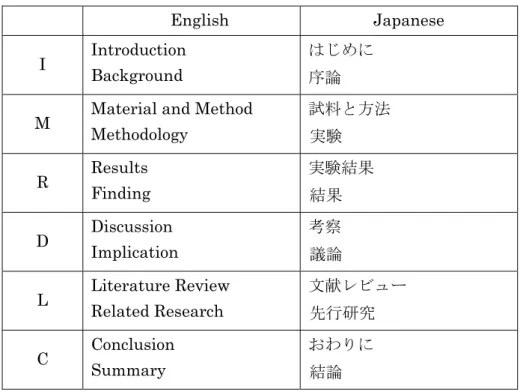
If a paper had "headings,” we recorded the characters of those headings. We labeled the structure only when the recorded heading was explicitly represented by the words shown in Table 2-1. For example, if the heading was "discussion,” it was considered as the structure "discussion (D)". If the heading was "Effectiveness of the proposed method,” it was not considered as "discussion (D)" because it was not explicitly expressed. For this survey, six labels were used "Introduction (I)," "Method (M)," "Result (R)," and "Discussion (D)" comprising the IMRAD format, in addition to the structures "Literature Review (L)"
and "Conclusion (C)". If the same labels were assigned sequentially in a paper, they were combined into one. For example, if a paper consisting of five headings of "Introduction,"
"Materials," "Experimental Method," "Result," and "Discussion" was provided, it was labeled as “IMMRD,” but it was modified to the “IMRD” after removing the duplicate
“M”.
13
Table 2-1. Examples of words representing academic paper’s structure English Japanese I Introduction
Background
はじめに 序論 M Material and Method
Methodology
試料と方法 実験 R Results
Finding
実験結果 結果 D Discussion
Implication
考察 議論 L Literature Review
Related Research
文献レビュー 先行研究 C Conclusion
Summary
おわりに 結論
2.2.3 Results
(1) Elements
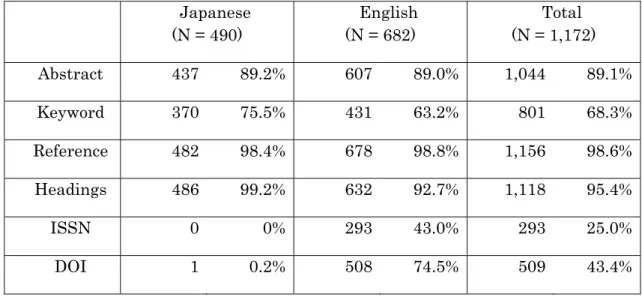
The elements for detecting academic papers such as titles (English: 100%, Japanese:
100%), author name(s) (English: 99.9%, Japanese: 100%), affiliation (English: 97.2%, Japanese: 100%), journal title (English: 98.5%, Japanese: 97.8%) were shown explicitly in almost all academic papers. There was no major difference between the Japanese set and the English set. Other elements are shown in Table 2-2. Regarding abstracts (English:
89.0%, Japanese: 89.2%) and references (English: 98.4% and Japanese: 98.8%), their ratios of presence were lower than titles and author names, but both elements still occurred in papers with relatively high ratios. There was no major difference between the English and Japanese sets. Although the ratio of keyword was lower than that of abstracts and reference, 75.5% of papers in the Japanese set included them, and 63.2% in the English set also did. The writing direction of all papers was horizontal.
Regarding the presence or absence of headings as the index of the structure of academic papers, 0.8% of papers in the Japanese set and 7.3% of the English set had no headings. The ratio of papers without headings in the English set was higher than in the Japanese set. In 50 papers without headings, 44 papers (88.0%) were from the Arts &
Humanities Citation Index. The English set included many articles from the humanities such as literature and religious studies. This may have had an effect on the result.
For the ratios of ISSN and DOI, there was a big difference between both sets. ISSN was not included in any of papers in the Japanese set, whereas 40% of papers in the
14
English set included it. As for the DOI, it was rarely included in papers in the Japanese set. In Japan, it was difficult to assign DOI because the registration agency of DOI in Japan did not exist until the "Japan Link Center" was approved on March 15, 2012.
Table 2-2. Ratio of elements of academic papers.
Japanese (N = 490)
English (N = 682)
Total (N = 1,172)
Abstract 437 89.2% 607 89.0% 1,044 89.1%
Keyword 370 75.5% 431 63.2% 801 68.3%
Reference 482 98.4% 678 98.8% 1,156 98.6%
Headings 486 99.2% 632 92.7% 1,118 95.4%
ISSN 0 0% 293 43.0% 293 25.0%
DOI 1 0.2% 508 74.5% 509 43.4%
(2) Structure
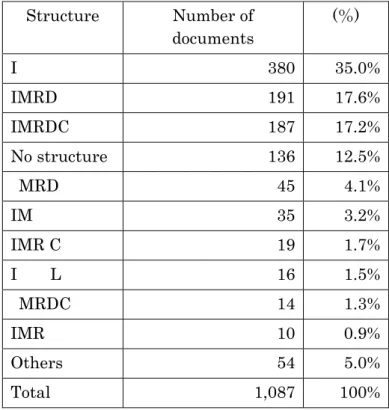
In this survey, review articles were excluded. We examined 1,087 papers with headings from 1,118 articles. After the survey, 35 structure patterns were discovered. Table 2-3 shows the top ten patterns. “L” stands for literature review or related research. Three hundred and eighty of all of them (35%) had no explicit structure except for
“Introduction.” The patterns “IMRD” and “IMRDC” were second and third place respectively. In the IMRAD format, 181 papers (17%) had “Conclusion” at the end of paper. Moreover, the pattern “MRD” also was found, which follows the IMRAD format, but these papers had no “Introduction.” Although not the complete IMRAD format, 40%
of papers in PDF format on the web had the IMRAD format including the structure
"Conclusion" or without "Introduction.”
15
Table 2-3. Top ten structures patterns of academic papers.
Structure Number of documents
(%)
I 380 35.0%
IMRD 191 17.6%
IMRDC 187 17.2%
No structure 136 12.5%
MRD 45 4.1%
IM 35 3.2%
IMR C 19 1.7%
I L 16 1.5%
MRDC 14 1.3%
IMR 10 0.9%
Others 54 5.0%
Total 1,087 100%
2.2.4 Structure and Elements of Academic Papers
We investigated how extensively the elements and structure identified in Section 2.1 were included in academic papers on the web. The results concluded that titles, author name, affiliation, journal title, abstract, reference, and keywords were found and that they were considered as common elements of academic papers. Regarding the structure, about 40%
of papers explicitly had the IMRAD format or a similar format. In Table 2-3, ratio of the IMRAD format and similar ones was 87.5%, excluding the ratio of papers without structures. The results showed that papers published in most English and Japanese journals used common elements and structures. They were also independent of languages.
When detecting academic papers from within a group of documents mixed together with other types of documents, these common elements and structures were considered useful. Even if a paper did not have all elements and structures, it could be considered as an academic paper if it contained part or parts of them. In addition, this survey covered only academic papers published in academic journals, but it could also be applied to papers of bulletins by universities and conference proceedings, as they also used a similar format. In the next section, we selected features to detect academic papers automatically based on common elements and structures of academic papers obtained from this survey.
16
2.3 Detecting Academic Papers
For automatically detecting academic papers, features were selected based on specific structure and elements of academic papers. Furthermore, to verify the effectiveness of selected features, a large PDF sets were created. We conducted experiments to detect academic papers using the selected features. In addition, the "academic paper" in this section included the following articles; papers published in academic journals, papers in bulletins published by universities, and papers in conference proceedings.
2.3.1 Related Work on Text Genre Classification
For the method of detecting academic papers, the approach was similar to that of identifying the genre and type of texts.
Shlomo Argamon et al. conducted research to identify 12 separate journals in six fields of experimental and historical sciences. They used frequency information of function words such as "the" and "as" and features such as "and," "moreover," and "in general" to express an expansion, a comment, and modality by analyzing academic journal papers as feature, for machine learning methods [18]. Efstathios Stamatatos et al. conducted experiments to classify texts into genres such as Review & outlook (Editorial) and Letters to the editor, based on the frequency information of words appearing in the texts, using a corpus of The Wall Street Journal newspaper [19]. They selected frequently used words, but pointed out that the positioning of punctuation marks was also important information.
Pranitha K. Kumari et al. classified web pages (the 7genre corpus) into seven genres such as a blog, an online shop, and a list, using a Random Forest classifier [20]. They selected features to classify genre based on stems obtained from several stemming methods.
Ioannis Kanaris et al. conducted the classification experiments using two test collections:
7genre corpus and KI-04 consisting of eight genres such as arts, links, help, and online shops [21]. In this research, the features used were the character n-gram and HTML tags included in the web page, using the support vector machine (SVM) classifier. Chul Su Lim et al. attempted to classify web pages into eleven categories, such as personal/public/commercial homepages, link collections, research reports, and FAQs [22].
They used the following items as features: (1) information on URL such as URL depth, file name, domain name, and words included in the URL such as FAQ, paper, research, (2) HTML tag, (3) number of characters, number of words, average number of words per sentence, number of POS (part-of-speech) tags, total number of words for 9 POSs tags etc., (4) the number of content words and function words, (5) structural information such as the number of declarative sentences and the number of imperative sentences. Michael Shepherd et al. divided texts into three attributes of content, form, and functionality [23].
The content included the number of uses of meta tag and common words, and the form included number of images, definition of CSS, domain and subdomain information of the web pages, the number of words in a page. The functionality included the number of links in the web pages, the proportion of links that were links to locations within the same page,
17
and the proportion of them that were links to other pages on other sites. They classified web pages into genres such as personal/corporate/organization home pages using these features. Chaman Thapa studied the problem of classifying websites into four non-topical categories: public, private, non-profit, and commercial franchise [24]. They used two types of features; the textual features including terms, part-of-speech bigrams and named entities, and the structural features including the link structure of the site and URL patterns.
To identify genres and types of texts, test collections including texts were classified to some genres or categories. Classifiers were trained to extract features in texts or attribute information of texts from the test collection. There were many research cases to develop classifiers, but there were also many researches focusing on a feature selection to be input to classifiers. In this research, we also focus on feature selection.
For non-topical classification, hundreds to thousands of words and their frequency information in the text were used as features, and features of genres and types were also used sometimes. In this research, we used words representing the characteristics of academic papers as features. As shown in Section 2.2, academic papers had common structures and elements, regardless of field or language. These characteristics did not appear many times in texts, but if some structures and elements were identified, the text could be an academic paper. To detect an academic paper, it proved effective to use these features. Classifiers generally require a large amount of training data because they used the statistical information of words. However, there was the advantage that classifiers did not require a large volume of data to extract features based on structures and elements because classifiers use only the information of presence or absence of those features.
Furthermore, HTML tags, information of URL, link structures, and file attribute information were used as features for classifying web pages in addition to words [22, 23, 24]. In this research, because the PDF file was a target, the domain of the URL of the file, the words used in the URL, and the attribute information of the file were used as features.
2.3.2 Feature Selection
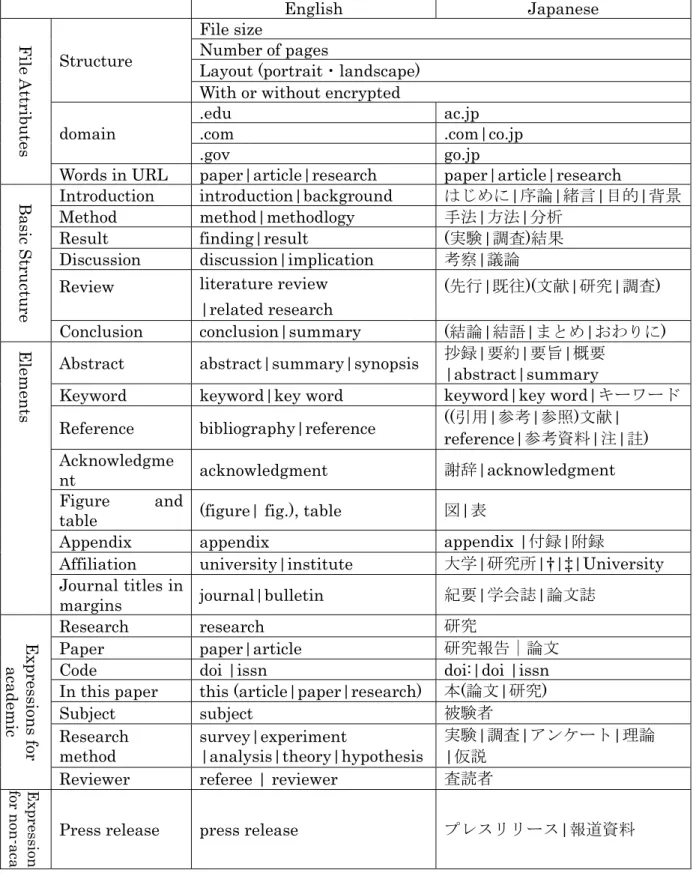
In the work of an automatic detection of Japanese academic papers [25], file size, number of pages, page orientation, URL domain, writing style, and keywords were used as features to detect Japanese academic papers. In this paper, we selected new features based on elements and structures of papers identified in Section 2.2. These features belonged to the four basic categories such as file attributes, structure of academic papers, elements of academic papers, and expressions in academic/non-academic papers. In addition, we aimed at selecting features independent of language. Table 2-4 showed the list of selected features.
In terms of file attributes, structure of files, domain of files, and words in the URL were selected as features. In the structure of file category, file size, number of pages, layout, and encrypted/unencrypted were selected because the average size or volume of
18
those differed between academic papers and non-academic papers (it will be described in a later section). The domain of files was extracted from the domain of the URL.
Conforming to the IMRAD format, introduction, method, result, discussion, and conclusion were selected as features of the basic structure of a paper. As elements, abstract, keywords, references, acknowledgments, tables, figures, and appendix were selected. When these words appeared as headings and had a single space before them, and with a new line break following the words, they were considered as headings.
Furthermore, in some cases, those elements had the same meanings, but may have used different expressions. For example, the structure "abstract" might be expressed by words such as "abstract" or "summary" in English papers, and "abstract", "summary", ”抄録",
"要約", "要旨", or "概要" in Japanese papers. Therefore, in this study, in the case of an English article, if a paper had "abstract,” "summary," or "synopsis," it was considered that it had structure "abstract."
For expressions in each of academic and non-academic papers, words likely to be used frequently in those types of texts were selected. The selection was based on the expressions used in the previous report [25] and words were suggested through the assessment procedures by five assessors. The selected expressions were shown in Table 2-4. The codes DOI and ISSN were often shown in footers and headers, not in the body of the paper. However, they were selected through the investigation in the previous section because they were unique items for academic papers. "Journal title in margins" was the journal title shown in margins.
These features were input to classifiers for training and then classifiers detected whether or not a paper was an academic paper. For the file size and the number of pages, the numerical values were used as features. For words in the URL, a Boolean variable was set to 1 if there was "paper" or "research" included in the URL. For the orientation, a Boolean variable was set to 1 if it was portrait and 0 if it was landscape. For the basic structure, elements, and expressions, Boolean variables were set to 1 if they were present and 0 if they were absent.
19
Table 2-4. Selected features.
English Japanese
File Attributes
Structure
File size
Number of pages
Layout (portrait・landscape) With or without encrypted domain
.edu ac.jp .com .com|co.jp .gov go.jp Words in URL paper|article|research paper|article|research
Basic Structure
Introduction introduction|background はじめに|序論|緒言|目的|背景
Method method|methodlogy 手法|方法|分析
Result finding|result (実験|調査)結果
Discussion discussion|implication 考察|議論 Review literature review
|related research
(先行|既往)(文献|研究|調査) Conclusion conclusion|summary (結論|結語|まとめ|おわりに)
Elements
Abstract abstract|summary|synopsis 抄録|要約|要旨|概要
|abstract|summary
Keyword keyword|key word keyword|key word|キーワード Reference bibliography|reference ((引用|参考|参照)文献|
reference|参考資料|注|註) Acknowledgme
nt acknowledgment 謝辞|acknowledgment
Figure and
table (figure| fig.), table 図|表
Appendix appendix appendix |付録|附録
Affiliation university|institute 大学|研究所|†|‡|University Journal titles in
margins journal|bulletin 紀要|学会誌|論文誌
Expressions for academic
Research research 研究
Paper paper|article 研究報告|論文
Code doi |issn doi:|doi |issn
In this paper this (article|paper|research) 本(論文|研究)
Subject subject 被験者
Research
method survey|experiment
|analysis|theory|hypothesis
実験|調査|アンケート|理論
|仮説
Reviewer referee | reviewer 査読者
Expression for non-aca Press release press release プレスリリース|報道資料
20
2.3.3 Building PDF Files Test Collection
In the experiment, each set of 20,000 PDF files sets, of English papers and of Japanese papers was constructed using the following procedure: (1) collection of the URLs of the PDFs, (2) downloading of the PDF files based on the URLs, and (3) manual identification of academic papers.
(1) Collection of URLs of PDFs
To construct the test collection with no bias toward specific fields, the search engine API was used to collect the URLs of the PDFs. As the API, Yahoo! Search BOSS 28 [26] of the search engine Yahoo! of the United States was used. The reason for choosing the Yahoo!
API was that (1) the API was publicly available, (2) it allowed searching for the file type
"PDF,” (3) there was little restriction on the number of searches, (4) there was no limitation on obtaining search results.
As search terms, general nouns were used. To collect English PDFs, 117,797 phrases registered in the noun phrase dictionary (index.noun) in WordNet 3.0 [27] were used.
Phrases consisting of multiple words were also used as search terms. URLs were collected from the top 500 rankes in the search results per search. If the number of search results was less than 500, URLs from all search results were collected. Search by API and the collection of URLs were conducted in July 2010. After the removal of duplicates of collected URLs, 22,591,139 different URLs were obtained. In the preliminary survey, the language filter was applied to a search. We mainly obtained PDF files in English, but we also collected a small number of PDF files in other languages. Thus, the language filter was not applied to collect English PDF files.
For collection of Japanese PDF files, 27,384 nouns registered in both Japanese WordNet [28] and IPAdic [29] were used as search terms. In December 2010, URLs were collected using those search terms with "PDF" file type option and the "Japanese"
language filter option. Up to 1,000 URLs were collected, ranked by search results. Finally, 6,602,504 URLs were obtained after the removal of duplicates.
Next, 30,000 URLs were selected randomly from both collected URL sets. The English PDF files were downloaded in August 2010, and the Japanese PDF files in January 2011, based on those collected URLs. For the Japanese PDF file set, PDF files with subdomains of URL ".cn" ". tw" ".hk" ".kr" ". sg" were excluded because they were written in Chinese.
Texts were extracted from the downloaded PDF files sets using Apache PDFBox 1.2.1 [30]. 27,848 files in the English PDFs and 27,158 files in the Japanese PDFs were obtained, including files which were extracted only with partial text. Then 20,000 files were randomly selected from the English files and the Japanese files. Hereinafter, they are referred to as the English PDF file set and the Japanese PDF file set.
21
(2) Manually Identifying Academic Papers
For both English and Japanese PDF sets, five assessors checked individual PDF files to determine whether they were academic papers as defined in this chapter, based on the following criteria.
(a) The file was in the form of an academic paper (b) Title, author name(s), affiliation(s) were shown (c) Citations and references were included
(d) One article comprises one file (e) The file had two pages or more.
To unify criteria among assessors, training sessions were conducted using several samples.
Even during the assessment period, they examined files with different assessments and tried to maintain the consistency of the assessments. In addition, a second assessor repeated an assessment on a file assessed as an academic paper by the first assessor. For the English PDF file set, files where abstracts and titles were written in English but the body written in another language were excluded.
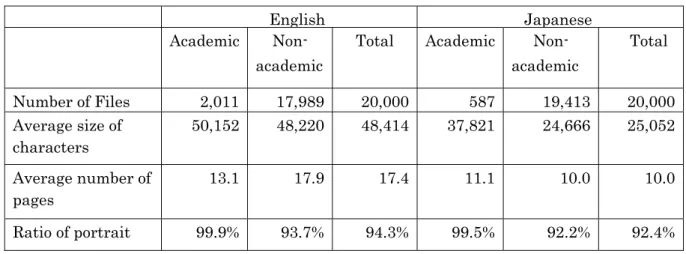
(3) Characteristics of the English and Japanese PDF File Sets
Table 2-5 shows the number of academic and non-academic papers, the file size, the average number of pages, and the ratio of portrait oriented papers in both sets. Although 2,011 (10.1%) of files were academic papers in the English PDF file set, 587 (2.9%) of the files in the Japanese PDF file set. When the Japanese PDF file set was put together, different search terms were used and files from the top 1,000 URLs ranked from search results were collected, and this was different from the method of construction of the English PDF file set. However, the results indicated that the proportion of academic papers in the Japanese PDF file set was lower than the English PDF file set.
The portrait orientation was defined as a file whose vertical length was longer when comparing the vertical length and the horizontal length of the first page of the PDF file.
The ratios of the portrait layout in academic papers in both the English and Japanese sets were 99.9%, which meant most of academic papers were portrait orientation. Furthermore, the number of characters was greater in the academic papers of both sets, but the average number of pages for was larger for non-academic papers in the English set, but larger for academic papers in the Japanese set.
22
Table 2-5. Statistics of English and Japanese PDF file sets.
English Japanese
Academic Non-
academic
Total Academic Non- academic
Total
Number of Files 2,011 17,989 20,000 587 19,413 20,000 Average size of
characters
50,152 48,220 48,414 37,821 24,666 25,052
Average number of pages
13.1 17.9 17.4 11.1 10.0 10.0 Ratio of portrait 99.9% 93.7% 94.3% 99.5% 92.2% 92.4%
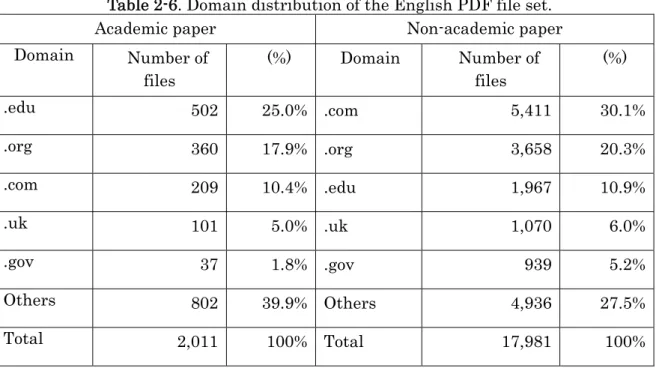
Table 2-6 shows the number of files and the ratio of the top five domains of the URL in the English PDF set. ".edu" domain in the academic papers accounts for 25% of the total. ".org" and ".com" followed in second and third places respectively, and these top three domains accounted for 53.3% of the academic papers. Conversely, ".com" was the most dominant domain for non-academic papers. ".org" and ".edu" were in second and third places respectively. Although these three domains were the dominant domains of the English PDF set, it can be seen that the “.edu” domain was the dominant domain in academic papers, and the “.com” domain was dominant in the non-academic papers.
Table 2-7 shows the number of the top five second level domains of the URLs in the Japanese PDF set (".com" was only shown as the top level domain). 54.5% of the domains of the academic papers were ".ac.jp.” For the domain of the non-academic papers, the highest percentage was ".com" at 14.3%. However, there was no significant difference with other domains.
There were differences in the attributes of files and distribution of domains among academic papers and non-academic papers. Those characteristics were used for feature selection because they were useful in identifying academic papers.
23
Table 2-6. Domain distribution of the English PDF file set.
Academic paper Non-academic paper
Domain Number of files
(%) Domain Number of files
(%)
.edu 502 25.0% .com 5,411 30.1%
.org 360 17.9% .org 3,658 20.3%
.com 209 10.4% .edu 1,967 10.9%
.uk 101 5.0% .uk 1,070 6.0%
.gov 37 1.8% .gov 939 5.2%
Others 802 39.9% Others 4,936 27.5%
Total 2,011 100% Total 17,981 100%
Table 2-7. Domain distribution of the Japanese PDF file set.
Academic paper Non-academic paper
Domain Number of files
(%) Domain Number of files
(%)
ac.jp 320 54.5% .com 2,775 14.3%
go.jp 47 8.0% co.jp 2,434 12.5%
or.jp 40 6.8% ac.jp 1,913 9.9%
co.jp 28 4.8% or.jp 1,505 7.8%
.com 12 2.0% go.jp 1,299 6.7%
Others 140 23.9% Others 9,487 48.9%
Total 587 100% Total 19,413 100%
2.3.4 Classifiers and Evaluation Measures
(1) Classifiers
In this research, we conducted the experiments using multiple classifiers and then compared their performance. As classifiers, SVM, AdaBoost, Random Forest, Naive Bayes, and Decision Tree (C 4.5) in Weka 3.5.6 [31] were used.
24
(a) Support Vector Machine (SVM)
SVM is a type of binary classifier proposed by Vladimir N. Vapnik [32]. It has high generalization capability and is able to handle high dimensional features by using kernel functions. There have been many applications in text classification research using this because they required a large number of features. It has been said that SVM achieves high performance for these cases. The polynomial kernel was used for the experiments.
(b) AdaBoost
The boosting method is a way to improve performance by learning the weighting of multiple weak classifiers whose accuracy is relatively low. AdaBoost was an improvement of the initial boosting method. Using AdaBoost, a classifier, combining weak classifiers based on the presence or absence of individual words, showed higher performance than the classifier using the nearest neighbor method (k-NN method) or the Naïve Bayes method [33]. The decision stumps were used as a weak classifier in this experiment. The number of iterations was 100.
(c) Random Forest
Random Forest is an ensemble learning method of combining multiple weak learners whose performance is not very high and improving that performance by learning weights [34]. In this experiment, the number of decision trees used as weak classifiers was 100, and the number of features selected randomly by each decision tree was five.
(d) Naïve Bayes
Naive Bayes is a classifier based on Bayes probability. In previous studies using this classifier, it showed a low precision but a high recall. This is different performance when compared with other classifiers.
(e) Decision Tree (C4.5) [35]
The decision tree is a highly readable classifier and is often used as a weak learner of group learning such as AdaBoost. We used C4.5 (module name is J48) implemented in Weka for the experiments.
(2) Evaluation Measure
As evaluation measures, precision (P), recall (R), and F measure (F) were used. Fmeasure is the harmonic measure of precision and recall. F score can change the weight of them depending on the parameter α. Here, the F1 score with the most common value of α = 0.5 was used, meaning that precision and recall were the same weight. In this experiment, the scores of each measure were computed with ten-fold cross-validation and macro- averaging.
25
2.3.5 Results
(1) Results with the English and Japanese PDF files sets
We verified selected features by experiments using the English PDF file set and the Japanese PDF file set. We conducted experiments to detect academic papers among PDF files using the five classifiers described above. Ten cross-validation sets were used for the experiments. The results in each set are shown in Table 2-8. In the English PDF file set, the highest precision was 0.79 by the Random Forest classifier and the highest recall was 0.84 by the Naive Bayes classifier. In terms of F1 scores, Random Forest achieved the best performance of 0.74. For the Japanese PDF file set, all scores were lower in each classifier than that in the English PDF file set. The highest precision was 0.72 by the SVM classifier, the best recall was 0.78 by the Naive Bayes classifier, and the best F1 score was 0.53 by Random Forest.
In similar work to detect Japanese academic papers [25], the highest performance was the voting classifier (Vote), and the F1 score was 0.49 (accuracy was 0.44 and recall was 0.54). Compared with these figures, performance was improved across all evaluation measures. With regard to the English PDF file set, it was possible to detect academic papers with a probability exceeding 70%.
Table 2-8. Precision (P), recall (R) and F1 scores (F1) with the English and Japanese PDF file sets.
English PDF file set Japanese PDF file set
Classifiers P R F1 P R F1
AdaBoost 0.72 0.53 0.61 0.67 0.35 0.46
Decision Tree 0.76 0.65 0.70 0.65 0.38 0.48
Naïve Bayes 0.41 0.84 0.55 0.30 0.78 0.43
Random Forest 0.79 0.70 0.74 0.68 0.44 0.53
SVM 0.73 0.54 0.62 0.72 0.10 0.18
(2) Results using the Corrected Japanese PDF file Set
The performance measures using the Japanese PDF file set were lower than that using the English PDF file set for all classifiers. There may have been multiple reasons for this and the causes may need to be investigated. The proportion of academic papers in the English PDF file set was 10.1% but only 2.9% in the Japanese PDF file set. In the previous experiments, we did not adjust the ratio of academic papers in each set to replicate the real situation on the web. For these experiments, however, we used the corrected Japanese PDF file set, which had same ratio of academic papers as in the English PDF
26
file set. The corrected Japanese PDF file set consisted of 10% academic papers and 90%
non-academic papers. Non-academic papers were randomly selected from the Japanese PDF file set.
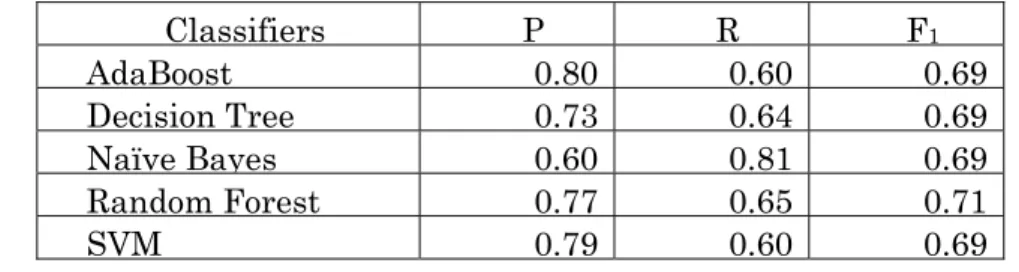
Table 2-9 shows the results using the corrected Japanese PDF file set. The F1 score by Random Forest classifier was 0.71, which was a greatly improvement over the original Japanese PDF file set. Comparing the results of Table 2-9 with those of Table 2-8, the scores of all measures improved in all classifiers. This result indicates that the ratio of academic papers in the Japanese PDF file set did affect the performance of each classifier.
In addition, because similar results were obtained in the English file set and the corrected Japanese file set, it also indicated that this feature selection was language independent.
Table 2-9. Precision (P), recall (R) and F1 scores (F1) with the Japanese corrected PDF file set.
Classifiers P R F1
AdaBoost 0.80 0.60 0.69
Decision Tree 0.73 0.64 0.69
Naïve Bayes 0.60 0.81 0.69
Random Forest 0.77 0.65 0.71
SVM 0.79 0.60 0.69
2.3.6 Discussion
We conducted experiments on detecting academic papers among the PDF file sets collected off the web, using selected features based on the structure and elements of academic papers. Using the English PDF file set, the Random Forest achieved the highest performance with over 70% of precision and recall. The experiments using the corrected Japanese PDF file set, which had similar ratio of academic papers as in the English set, showed similar performance as for the English set. This result showed that the selected features in this study were independent of language.
The purpose of the research was to select features and we focused on efficiently selecting features. However, to improve performance, it was also important to analyze failures not caused by features. For example, there were cases where text extraction from a PDF file failed. There were cases where single byte alphabetic or numeric characters were extracted, but extraction of Japanese characters failed, and if the file was written vertically, each single character was extracted as a new line. These text extraction failures were largely dependent on the nature of the PDF files and the software used to extract the text.
2.4 Summary
In this chapter, we discussed features for automatically detecting academic papers.
Firstly, we extracted the structure and elements of academic papers from literatures
27
describing the form of academic papers, and the guidelines and textbooks about writing papers. The result of our analysis showed that the IMRAD format was the most common format as the structure, and titles, author name, affiliation, abstracts, and references were identified to be elements of academic papers. Secondly, we inspected the structures and elements of academic papers present on the web and found that many papers written in English or Japanese used the structures and elements we extracted. Thirdly, we selected features based on the extracted structure and elements to automatically detect academic papers. In the selection process, we selected features independent of field and language. We conducted experiments using those selected features to detect academic papers from 20,000 PDF files collections (English and Japanese sets) collected by web crawling. The results from the Random Forest classifier showed an F1 score of 0.74 obtained from the English PDF set and 0.53 from the Japanese PDF set.
Based on the above results, we showed the potential for automatically detecting academic papers using a small number of features, provided we can find structures and elements representing the form and characteristics of academic papers. In many cases, features for machine learning classifiers are selected using linguistic or notational characteristics, or the statistical information of texts. However, our research approach is different. In other words, the approach of capturing characteristics such as the form and structures of academic papers and then selecting features based on these characteristics, is also an effective approach. These features could be applied not only to English and Japanese but also to other languages. Furthermore, the approach of this research may be applied to detect other types of texts.
References
[1] Argamon, S., Whitelaw, C., Chase, P., Hota, S. R., Garg, N., & Levi-tan, S. (2007).
Stylistic text classification using functional lexical features. Journal of the American Society of Information Science,58(6), 802-822.
[2] Ziman, J. M. (1981). 『社会における科学(上)』 松井巻之助訳, 草思社, 206p.
[3] 飯田崇文 (2000). 「「学術論文の社会学」試論--「書簡」から「論文」へ:Philosophical Transactions(1740~1859)」『早稲田大学大学院文学研究科紀要第1分冊』46, 59-65.
[4] Vickery, Brian. C. (2002). 『歴史のなかの科学コミュニケーション』村主朋英訳, 勁草 書房, 268p.
[5] Harmon, J. E. (1989). The structure of scientific and engineering papers: A historical perspective. IEEE Transactions on Professional Communication, 32(3), 132-138.
[6] Trelease, S. F. & Yule, E. S. (1927). Preparation of Scientific and Technical Papers. Williams & Wilkins, 117p.