はじめに A型ボツリヌス毒素製剤療法(ボツリヌス療法)は脳卒中 後遺症にともなう筋痙縮にも近年保険適応がみとめられ,有 効性が拡く受け入れられている1).しかし,本邦発売のボトッ クス ® 添付文書に記載された上肢推奨投与量には,橈側手根 屈筋と尺側手根屈筋,深指屈筋,浅指屈筋が各 50 単位,長母 指屈筋と母指内転筋は各 20 単位とあるが,近位筋については 記載がなく,効果も手関節のみの検討であるため,とくに初 回は投与量に迷う症例も多い1)2).米国から「標準的身長・体 重の患者」の初回投与量,英国ガイドラインにも投与量の提 案があるが,これらには効果の明示はない3)4).対象も欧米人 が念頭と考えられ,体格のことなる日本人への適用には疑問 が残る.そこで日本人の至適用量探求のため,投与量と効果 を筋別,薬液希釈濃度別に検討した. 対象と方法 2012年 8 月から 2014 年 5 月までに名古屋市総合リハビリ テーションセンター附属病院神経内科において,脳卒中後遺 症にともなう上肢筋痙縮に対するボツリヌス療法の施行後, 効果を経過観察しえた日本人患者延べ 112 例のうち,電気刺 激療法もしくは促通運動療法(いわゆる「CI 療法」)を併用 した 12 例を除く 100 例(脳出血 63 例,脳梗塞 36 例,くも膜 下出血 1 例.投与時年齢 59.1 ± 11.3 歳 /37~89 歳,罹病期間 7.3 ± 5.6 年 /0.4~29.8 年.9 例は下肢に同時投与)を対象に, 投与量と効果を検討した. 筋電図観察下で筋腹中央部に施注し,施注部位の決定に当 たっては,電気刺激をもちいた運動点療法や,神経終板標的 療法はおこなっていない.大胸筋(pectoralis major; PM),大 円筋(teres major; TM),上腕二頭筋(biceps brachii; BB),腕 橈骨筋(brachioradialis; BR),上腕筋(brachialis; B),円回内 筋(pronator teres; PT),橈側手根屈筋(flexor carpi radialis; FCR),尺側手根屈筋(flexor carpi ulnaris; FCU),深指屈筋 (flexor digitorum profundus; FDP),浅指屈筋(flexor digitorum
superficialis; FDS),長母指屈筋(flexor pollicis longus; FPL), 母指内転筋(adductor pollicis; AP)の 12 筋を検討対象とし, 上腕二頭筋では長頭に 2 ヵ所,他の 11 筋は筋腹 1 ヵ所に施注 した.投与前日または当日の施注前と 1 ヵ月後(33.6 ± 6.5 日 / 21~61 日)に,Modified Ashworth Scale(MAS)による 0:筋 緊張亢進なし,1:筋緊張軽度亢進(他動途中に断続的停止, あるいは終盤にわずかな抵抗),1+:筋緊張軽度亢進(他動途
原 著
ボツリヌス毒素療法 100 例の投与結果
―標準投与量と希釈濃度の確立を目指して―
堀本 佳彦
1)*
稲垣 亜紀
1)吉川 美佳
2)神戸 久美
2)田中 創
2)安藤 麗華
3)日比野敬明
1)田島 稔久
1)深川 和利
1)蒲澤 秀洋
1) 要旨: 脳卒中後筋痙縮のボツリヌス療法日本人至適用量を求め,延べ 100 例の 1 ヵ月後評価から,MAS 1 度改 善用量を推定した.1 度当り大胸筋 64.6 ± 31.1 単位,大円筋 51.2 ± 21.3 単位,上腕二頭筋 111.7 ± 48.0 単位, 腕橈骨筋 51.6 ± 26.8 単位,上腕筋 54.1 ± 23.2 単位,円回内筋 34.4 ± 10.7 単位,橈側手根屈筋 64.6 ± 27.9 単位,尺側手根屈筋 62.4 ± 26.8 単位,深指屈筋 58.5 ± 31.1 単位,浅指屈筋 69.7 ± 35.1 単位,長母指屈筋 24.6 ± 13.4 単位,母指内転筋 15.6 ± 11.3 単位を要した.保険上限 240 単位では全痙縮筋への有効量投与は難しく, 上限拡大が望まれる. (臨床神経 2015;55:544-549)Key words: ボツリヌス療法,上肢筋痙縮,脳卒中後遺症,Modified Ashworth Scale(MAS)
*Corresponding author: 名古屋市総合リハビリテーションセンター神経内科〔〒 467-8622 名古屋市瑞穂区弥富町密柑山 1-2〕
1)名古屋市総合リハビリテーションセンター神経内科
2)名古屋市総合リハビリテーションセンター作業療法部
3)名古屋市総合リハビリテーションセンター看護部
(Received September 16, 2014; Accepted April 6, 2015; Published online in J-STAGE on July 7, 2015) doi: 10.5692/clinicalneurol.cn-000667
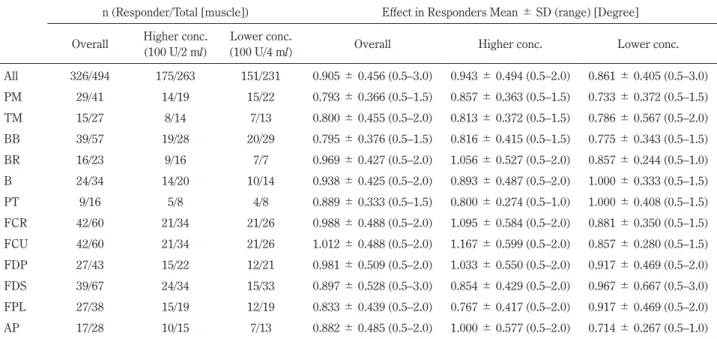
中で停止,残る半分以下にわずかな抵抗),2:筋緊張著明亢進 (容易に他動),3:筋緊張高度亢進(他動困難),4:屈曲また は伸展強直,の 6 段階で評価した5).検討に当たり,MAS 1+ は 1.5 として扱った.MAS 4 から 3,3 から 2,2 から 1,1 か ら 0 への変化を「1 度改善」,MAS 2 から 1+,1+ から 1 への 変化を「0.5 度改善」とし,0.5 度以上の改善を「有効」とした. 薬液濃度は高濃度希釈 100 単位 /2 ml での投与が 52 例 263 筋,低濃度 100 単位 /4 ml が 48 例 231 筋であった(Table 1). 述べ 494 筋の評価から,10 単位当りの効果を無効例もふくめ て算出し,また有効例のみの投与結果から MAS 1 度改善用量 を推定した.結果の比較には対応のない t 検定およびマン・ ホィットニー検定,クラスカル・ワーリス検定をもちい,有 意水準は 5%とした. 有害事象として薬疹(同一症例が 2 回)と効果過剰による Table 1 Summary of responders and effects.
n (Responder/Total [muscle]) Effect in Responders Mean ± SD (range) [Degree] Overall Higher conc.
(100 U/2 ml)
Lower conc.
(100 U/4 ml) Overall Higher conc. Lower conc.
All 326/494 175/263 151/231 0.905 ± 0.456 (0.5–3.0) 0.943 ± 0.494 (0.5–2.0) 0.861 ± 0.405 (0.5–3.0) PM 29/41 14/19 15/22 0.793 ± 0.366 (0.5–1.5) 0.857 ± 0.363 (0.5–1.5) 0.733 ± 0.372 (0.5–1.5) TM 15/27 8/14 7/13 0.800 ± 0.455 (0.5–2.0) 0.813 ± 0.372 (0.5–1.5) 0.786 ± 0.567 (0.5–2.0) BB 39/57 19/28 20/29 0.795 ± 0.376 (0.5–1.5) 0.816 ± 0.415 (0.5–1.5) 0.775 ± 0.343 (0.5–1.5) BR 16/23 9/16 7/7 0.969 ± 0.427 (0.5–2.0) 1.056 ± 0.527 (0.5–2.0) 0.857 ± 0.244 (0.5–1.0) B 24/34 14/20 10/14 0.938 ± 0.425 (0.5–2.0) 0.893 ± 0.487 (0.5–2.0) 1.000 ± 0.333 (0.5–1.5) PT 9/16 5/8 4/8 0.889 ± 0.333 (0.5–1.5) 0.800 ± 0.274 (0.5–1.0) 1.000 ± 0.408 (0.5–1.5) FCR 42/60 21/34 21/26 0.988 ± 0.488 (0.5–2.0) 1.095 ± 0.584 (0.5–2.0) 0.881 ± 0.350 (0.5–1.5) FCU 42/60 21/34 21/26 1.012 ± 0.488 (0.5–2.0) 1.167 ± 0.599 (0.5–2.0) 0.857 ± 0.280 (0.5–1.5) FDP 27/43 15/22 12/21 0.981 ± 0.509 (0.5–2.0) 1.033 ± 0.550 (0.5–2.0) 0.917 ± 0.469 (0.5–2.0) FDS 39/67 24/34 15/33 0.897 ± 0.528 (0.5–3.0) 0.854 ± 0.429 (0.5–2.0) 0.967 ± 0.667 (0.5–3.0) FPL 27/38 15/19 12/19 0.833 ± 0.439 (0.5–2.0) 0.767 ± 0.417 (0.5–2.0) 0.917 ± 0.469 (0.5–2.0) AP 17/28 10/15 7/13 0.882 ± 0.485 (0.5–2.0) 1.000 ± 0.577 (0.5–2.0) 0.714 ± 0.267 (0.5–1.0) PM: pectoralis major, TM: teres major, BB: biceps brachii, BR: brachioradialis, B: brachialis, PT: pronator teres, FCR: flexor carpi radialis, FCU: flexor carpi ulnaris, FDP: flexor digitorum profundus, FDS: flexor digitorum superficialis, FPL: flexor pollicis longus, AP: adductor pollicis. n: number.
Table 2 Mean effect with 10 units of onabotulinum toxin. Overall Mean ± SD (range)
[Degree/10 U]
Higher conc. Mean ± SD (range) [Degree/10 U]
Lower conc. Mean ± SD (range)
[Degree/10 U] P All 0.180 ± 0.346 (︲1.000–4.000) 0.207 ± 0.414 (0.000–4.000) 0.149 ± 0.244 (︲1.000–2.000) 0.187 PM 0.137 ± 0.124 (0.000–0.500) 0.154 ± 0.127 (0.000–0.375) 0.123 ± 0.122 (0.000–0.500) 0.332 TM 0.129 ± 0.201 (︲0.333–0.750) 0.173 ± 0.222 (0.000–0.750) 0.081 ± 0.171 (︲0.333–0.400) 0.519 BB 0.073 ± 0.062 (0.000–0.200) 0.066 ± 0.056 (0.000–0.150) 0.080 ± 0.067 (0.000–0.200) 0.435 BR 0.178 ± 0.175 (0.000–0.667) 0.174 ± 0.208 (0.000–0.667) 0.187 ± 0.062 (0.083–0.250) 0.376 B 0.161 ± 0.159 (︲0.125–0.667) 0.173 ± 0.170 (0.000–0.667) 0.144 ± 0.147 (︲0.125–0.375) 0.823 PT 0.177 ± 0.174 (0.000–0.400) 0.206 ± 0.186 (0.000–0.400) 0.148 ± 0.168 (0.000–0.400) 0.505 FCR 0.135 ± 0.121 (0.000–0.500) 0.125 ± 0.127 (0.000–0.500) 0.147 ± 0.114 (0.000–0.400) 0.479 FCU 0.137 ± 0.120 (0.000–0.500) 0.132 ± 0.130 (0.000–0.500) 0.143 ± 0.107 (0.000–0.400) 0.749 FDP 0.134 ± 0.165 (︲0.200–0.600) 0.175 ± 0.169 (0.000–0.600) 0.091 ± 0.152 (︲0.200–0.400) 0.142 FDS 0.102 ± 0.137 (︲0.333–0.600) 0.124 ± 0.128 (0.000–0.600) 0.079 ± 0.145 (︲0.333–0.500) 0.155 FPL 0.390 ± 0.415 (︲0.200–2.000) 0.448 ± 0.477 (0.000–2.000) 0.332 ± 0.344 (︲0.200–1.000) 0.644 AP 0.696 ± 1.123 (︲1.000–4.000) 0.933 ± 1.358 (0.000–4.000) 0.423 ± 0.732 (︲1.000–2.000) 0.525 P; P value by Mann-Whitney U test among diluted concentrations.
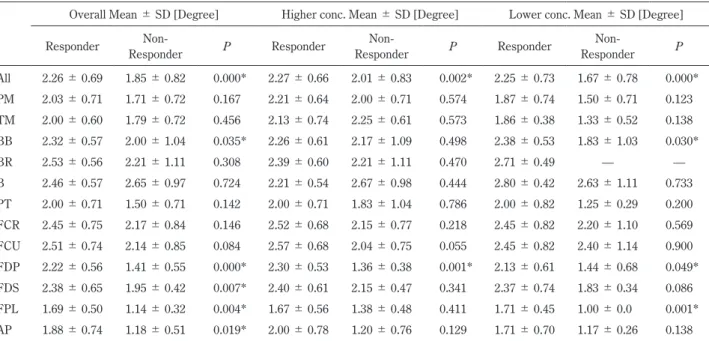
患肢実用性低下の計 2 例 3 件をみとめたがいずれも自然回 復,重篤なものはみとめなかった.本研究は,名古屋市総合 リハビリテーションセンター倫理審査委員会の承認をえた. 結 果 全 100 例 494 筋が 10 単位当り 0.180 ± 0.346 度,高濃度投 与 263 筋は 0.207 ± 0.414 度,低濃度 231 筋は 0.149 ± 0.244 度の改善で,薬液濃度による有意差はみとめなかった(Table 2,マン・ホィットニー検定,P = 0.187).また,有効例 326 筋のみから算出した MAS 1 度改善用量は 61.3 ± 38.0 単位, 高濃度 175 筋は 59.9 ± 40.7 単位,低濃度 151 筋は 63.0 ± 34.8 単位で,やはり薬液濃度による有意差はみとめなかった (Table 3,対応のない t 検定,P = 0.472).投与前 MAS 4 で あった 18 例の効果は 0.889 ± 0.900 度,MAS 3 であった 131 例 は 0.977 ± 0.581 度,MAS 2 の 199 例は 0.520 ± 0.468 度,MAS 1+の 82 例は 0.323 ± 0.440 度,MAS 1 の 62 例は 0.258 ± 0.502 度で,前評価による効果の違いが有意であり,とくに MAS 3 症例への投与で良好な効果がえられていた(クラスカル・ワー リス検定,P = 0.000). 個別の筋の検討では 12 筋いずれにおいても,10 単位当り 改善度と MAS 1 度改善用量は,ともに薬液濃度による有意差 をみとめなかった(Table 2, 3).有効例と無効例を比較する と,投与前評価が上腕二頭筋(マン・ホイットニー検定,P = 0.035),深指屈筋(P = 0.000),浅指屈筋(P = 0.007),長母 指屈筋(P = 0.004),および母指内転筋(P = 0.019)におい て,無効例で有意に軽症であったが,投与量には有意差をみ とめなかった(Table 4, 5). 考 察 米国および英国の標準投与量では,期待できる効果につ Table 3 Dosage expected to improve MAS 1 degree.
Botox® Attached document1) Brin et al. Starting dose3) National Guidelines Royal College of Physicians4)
Dosage expected to improve MAS 1 degree in the present study Overall Mean ± SD (range) [Unit] Higher conc. Mean ± SD (range) [Unit] Lower conc. Mean ± SD (range) [Unit] P All — — — 61.3 ± 38.0 (2.5–240.0) 59.9 ± 40.7 (2.5–240.0) 63.0 ± 34.8 (5.0–180.0) 0.472 PM — 100 75 64.6 ± 31.1 (20.0–160.0) (26.7–160.0)61.7 ± 36.7 (20.0–120.0)67.3 ± 25.8 0.632 TM — 50 30 51.2 ± 21.3 (13.3–80.0) 46.7 ± 24.9 (13.3–80.0) 56.4 ± 16.5 (25.0–80.0) 0.396 BB — 100 75–100 111.7 ± 48.0 (50.0–240.0) 121.9 ± 52.4 (66.7–240.0) 102.0 ± 42.4 (50.0–180.0) 0.199 BR — 50 50 51.6 ± 26.8 (15.0–120.0) 43.9 ± 23.7 (15.0–80.0) 61.4 ± 29.1 (40.0–120.0) 0.205 B — 50 50 54.1 ± 23.2 (15.0–100.0) (15.0–100.0)52.5 ± 24.6 56.3 ± 22.1 (26.7–80.0) 0.699 PT — 40 30–40 34.4 ± 10.7 (25.0–50.0) 33.0 ± 11.5 (25.0–50.0) 36.3 ± 11.1 (25.0–50.0) 0.682 FCR 50 50 30–40 64.6 ± 27.9 (20.0–100.0) 60.7 ± 27.1 (20.0–100.0) 68.6 ± 28.8 (25.0–100.0) 0.368 FCU 50 40 30–40 62.4 ± 26.8 (20.0–100.0) 56.0 ± 24.5 (20.0–100.0) 68.9 ± 27.9 (25.0–100.0) 0.118 FDP 50 15 30–40 58.5 ± 31.1 (16.7–140.0) (16.7–100.0)51.8 ± 27.6 (25.0–140.0)66.8 ± 34.5 0.219 FDS 50 50 25–30 69.7 ± 35.1 (16.7–160.0) 76.7 ± 40.0 (16.7–160.0) 58.4 ± 22.2 (20.0–100.0) 0.115 FPL 20 15 20–30 24.6 ± 13.4 (5.0–60.0) 26.7 ± 15.8 (5.0–60.0) 22.1 ± 9.9 (10.0–40.0) 0.389 AP 20 10 20–40 15.6 ± 11.3 (2.5–40.0) 17.0 ± 13.9 (2.5–40.0) 13.6 ± 6.3 (5.0–20.0) 0.554 P; P value by unpaired t test among diluted concentrations.
いては触れられていない.そこで本研究では,効果を実感で きる指標とすることを念頭に,MAS 1 度改善用量を算出した (Table 3)3)4).日本人を対象としてえられたこの用量から,全 12筋に占める各筋の比率を算出して米英と比較すると,前腕 4筋(橈側手根屈筋,尺側手根屈筋,浅指屈筋,深指屈筋)の 比率が,米国の初回標準量は 27.2%,英国ガイドラインは 25.7%であったのに対し,本研究の MAS 1 度改善用量は 38.4% と高かった(Table 6).日本人が他の上肢筋より前腕筋に高用 量を要する傾向を示している.要因としては,日本人と英米 人とでの筋容積分布や,期待する痙縮改善度,回復への欲求 などに違いがある可能性をうたがう. 本研究では,上腕二頭筋の MAS 1 度改善用量が 12 筋中で もっとも大きかった.長頭の筋腹中央付近 2 ヵ所に施注した 結果であるが,今回の対象にはおこなっていない短頭への投 Table 4 Comparison of MAS before treatment between responders and non-responders.
Overall Mean ± SD [Degree] Higher conc. Mean ± SD [Degree] Lower conc. Mean ± SD [Degree] Responder Non- Responder P Responder Non- Responder P Responder Non- Responder P All 2.26 ± 0.69 1.85 ± 0.82 0.000* 2.27 ± 0.66 2.01 ± 0.83 0.002* 2.25 ± 0.73 1.67 ± 0.78 0.000* PM 2.03 ± 0.71 1.71 ± 0.72 0.167 2.21 ± 0.64 2.00 ± 0.71 0.574 1.87 ± 0.74 1.50 ± 0.71 0.123 TM 2.00 ± 0.60 1.79 ± 0.72 0.456 2.13 ± 0.74 2.25 ± 0.61 0.573 1.86 ± 0.38 1.33 ± 0.52 0.138 BB 2.32 ± 0.57 2.00 ± 1.04 0.035* 2.26 ± 0.61 2.17 ± 1.09 0.498 2.38 ± 0.53 1.83 ± 1.03 0.030* BR 2.53 ± 0.56 2.21 ± 1.11 0.308 2.39 ± 0.60 2.21 ± 1.11 0.470 2.71 ± 0.49 — — B 2.46 ± 0.57 2.65 ± 0.97 0.724 2.21 ± 0.54 2.67 ± 0.98 0.444 2.80 ± 0.42 2.63 ± 1.11 0.733 PT 2.00 ± 0.71 1.50 ± 0.71 0.142 2.00 ± 0.71 1.83 ± 1.04 0.786 2.00 ± 0.82 1.25 ± 0.29 0.200 FCR 2.45 ± 0.75 2.17 ± 0.84 0.146 2.52 ± 0.68 2.15 ± 0.77 0.218 2.45 ± 0.82 2.20 ± 1.10 0.569 FCU 2.51 ± 0.74 2.14 ± 0.85 0.084 2.57 ± 0.68 2.04 ± 0.75 0.055 2.45 ± 0.82 2.40 ± 1.14 0.900 FDP 2.22 ± 0.56 1.41 ± 0.55 0.000* 2.30 ± 0.53 1.36 ± 0.38 0.001* 2.13 ± 0.61 1.44 ± 0.68 0.049* FDS 2.38 ± 0.65 1.95 ± 0.42 0.007* 2.40 ± 0.61 2.15 ± 0.47 0.341 2.37 ± 0.74 1.83 ± 0.34 0.086 FPL 1.69 ± 0.50 1.14 ± 0.32 0.004* 1.67 ± 0.56 1.38 ± 0.48 0.411 1.71 ± 0.45 1.00 ± 0.0 0.001* AP 1.88 ± 0.74 1.18 ± 0.51 0.019* 2.00 ± 0.78 1.20 ± 0.76 0.129 1.71 ± 0.70 1.17 ± 0.26 0.138 P; P value by Mann-Whitney U test between responders and non-responders.
*; P < 0.05.
Table 5 Comparison of injected dose between responders and non-responders.
Overall Mean ± SD [Unit] Higher conc. Mean ± SD [Unit] Lower conc. Mean ± SD [Unit] Responder Non Responder P Responder Non-Responder P Responder Non-Responder P All 46.6 ± 23.1 43.0 ± 21.6 0.089 46.1 ± 24.0 44.4 ± 22.7 0.573 47.3 ± 22.2 41.4 ± 20.3 0.053 PM 44.8 ± 19.0 40.0 ± 16.0 0.444 44.3 ± 14.5 42.0 ± 21.7 0.793 45.3 ± 22.9 38.6 ± 12.2 0.476 TM 34.0 ± 9.9 34.2 ± 9.0 0.964 31.3 ± 9.9 33.3 ± 12.1 0.729 37.1 ± 9.5 35.0 ± 5.5 0.637 BB 76.9 ± 21.4 65.6 ± 21.8 0.069 84.2 ± 20.1 70.0 ± 19.4 0.089 70.0 ± 20.8 61.1 ± 24.2 0.320 BR 41.9 ± 12.8 34.3 ± 7.9 0.163 37.8 ± 14.8 34.3 ± 7.9 0.583 47.1 ± 7.6 — — B 44.2 ± 16.9 45.0 ± 17.8 0.898 38.6 ± 12.9 40.0 ± 8.9 0.809 52.0 ± 19.3 52.5 ± 26.3 0.969 PT 28.9 ± 11.9 32.1 ± 8.1 0.547 24.0 ± 2.2 28.3 ± 2.9 0.053 35.0 ± 16.8 35.0 ± 10.0 1.000 FCR 54.5 ± 19.8 48.9 ± 18.1 0.306 55.7 ± 20.6 50.0 ± 20.8 0.439 53.3 ± 19.5 46.0 ± 8.9 0.426 FCU 54.3 ± 18.2 49.4 ± 18.3 0.349 54.8 ± 17.1 49.2 ± 21.8 0.416 53.8 ± 19.6 50.0 ± 0.0 0.672 FDP 45.0 ± 10.1 44.1 ± 12.0 0.785 41.7 ± 9.2 47.1 ± 16.0 0.318 49.2 ± 10.0 41.7 ± 7.9 0.079 FDS 50.6 ± 14.4 53.8 ± 19.8 0.459 53.5 ± 15.6 59.0 ± 21.3 0.411 46.0 ± 11.2 50.8 ± 18.8 0.389 FPL 17.2 ± 7.0 15.5 ± 5.7 0.462 16.7 ± 7.0 12.5 ± 5.0 0.283 17.9 ± 7.2 17.1 ± 5.7 0.811 AP 10.6 ± 5.8 7.7 ± 2.6 0.140 12.0 ± 7.1 8.0 ± 2.7 0.256 8.6 ± 2.4 7.5 ± 2.7 0.471 P; P value by unpaired t test between responders and non-responders.
与の併用や,運動点や神経終板を標的とした投与などにより, 減量できる期待はある.米国の治療アルゴリズムでは,運動 点療法や神経終板標的療法への言及はないが,上腕二頭筋に 対しては 4 分割を推奨している3).英国ガイドラインでは, 不快感の増大や疼痛による一時的痙縮亢進の懸念から,分割 投与は推奨せず,長短両頭への投与のみを勧めている4). 有効例と無効例を比較すると,有効例の投与前評価が有意 に重症であったが,投与量には有意差がなく,同量を投与し ても,症例の状態により効果がことなることが示された (Table 4, 5).症例による微調整は欠かせず,とくに反復投与 例では,過去の投与結果に基づく微調整も重要と考えられた. 重症度や希望する改善度合などによっては,投与量を減じて も満足できる効果をえられる症例もあると期待される. 薬液濃度については前頭筋への 5 単位投与効果の比較で, 低濃度高容量(0.25 ml = 100 単位 /5 ml)の方が高濃度低容量 (0.05 ml = 100 単位 /1 ml)より拡散が大きい,との報告があ る6).また,標準的な筋への投与では,100 単位 /1~2 ml の 濃度で 0.5 ml を超えない局所容量が適切で,高容量の施注は 標的筋を超えた拡散や免疫系への影響の懸念もあるため避け るべき,との指摘もある3).本研究にもちいたものより高濃 度の 100 単位 /1 ml を,100 単位 /2 ml と比較した報告では, 手根および手指屈筋群への 60 単位の効果に有意差はなかっ たとされる7).また,脳性麻痺患者の下肢筋への投与では, 100単位 /1 ml と 100 単位 /2 ml,100 単位 /2.5 ml の比較,あ るいは 100 単位 /1 ml と 100 単位 /4 ml の比較,100 単位 /2 ml と 100 単位 /8 ml の比較で,いずれも濃度による有意差はな かったという8)~10).本研究では,高濃度 100 単位 /2 ml と低 濃度 100 単位 /4 ml の比較で,全 12 筋いずれも有意差をみと めなかった.しかし今回の検討には加えていないが,虫様筋 のような小さい筋への投与では,低濃度高容量は手技上も施 注時の疼痛の点でも不利である3).効果に差がなければ,大 小さまざまな筋への同時投与には,高濃度低容量が有用と考 えられた. MAS 1度改善用量の全 12 筋合計は 663.0 単位,上腕 3 筋 (上腕二頭筋,腕橈骨筋,上腕筋)のみで 217.4 単位,前腕 4 筋(橈側手根屈筋,尺側手根屈筋,深指屈筋,浅指屈筋)で 255.2単位となる.保険適応の 240 単位以内で,希望されるす べての筋に効果の見込める量を投与することは,困難な症例 がほとんどであろう.米国の治療アルゴリズムでは,投与す る肢数によらず,1 回の施注での総量 400 単位以内を推奨し ている3).少量で高い効果をえるため,より有効な濃度の探 求の他,手技は煩雑になるが運動点療法や,神経終板標的療 法についての検討も報告されている.低濃度(100 単位 /4 ml) での上腕二頭筋と腕橈骨筋への計 90 単位投与では,運動点療 法と 6 等分投与に有意差はなかったという11).また,上腕二 頭筋への 160 単位投与では,高濃度低容量(100 単位 /1 ml) の 4 等分投与より,低濃度高容量(100 単位 /5 ml)の 4 等分 投与や高濃度低容量の神経終板標的療法の方が,神経筋遮断 や痙縮軽減効果にすぐれていたとされる12).しかしいずれも, 用量不足の解消をもたらす大幅な減量とはいいがたい.治療 の必要なすべての痙縮筋に有効量を投与できるよう,安全性 の確認された投与実績を踏まえて,保険上限の拡大に向けた 議論の深まることが期待される. 本報告の要旨は,第 139 回日本神経学会東海・北陸地方会で発表 し,会長推薦演題に選ばれた.また,第 55 回日本神経学会学術大会 においても発表した. ※本論文に関連し,開示すべき COI 状態にある企業,組織,団体 はいずれも有りません.
Table 6 The proportion of the dose for individual muscle. Brin et al. Starting dose3) National Guidelines Royal College
of Physicians4)
Dosage expected to improve MAS 1 degree in the present study
[Unit] [%] [Unit] [%] [Unit] [%]
PM 100 17.5 75 14.6 64.6 9.7 TM 50 8.8 30 5.8 51.2 7.7 BB 100 17.5 87.5* 17.0 111.7 16.9 BR 50 8.8 50 9.7 51.6 7.8 B 50 8.8 50 9.7 54.1 8.2 PT 40 7.0 35* 6.8 34.4 5.2 FCR 50 8.8 35* 6.8 64.6 9.7 FCU 40 7.0 35* 6.8 62.4 9.4 FDP 15 2.6 35* 6.8 58.5 8.8 FDS 50 8.8 27.5* 5.3 69.7 10.5 FPL 15 2.6 25* 4.9 24.6 3.7 AP 10 1.8 30* 5.8 15.6 2.4
文 献
1) ボトックス ® 添付文書.第 16 版.東京:グラクソ・スミス クライン株式会社;2012.
2) Kaji R, Osako Y, Suyama K, et al. GSK1358820 Spasticity Study Group. Botulinum toxin type A in post-stroke upper limb spasticity. Curr Med Res Opin 2010;26:1983-1992.
3) Brin MF. Dosing, administration, and a treatment algorithm for use of botulinum toxin A for adult-onset spasticity. Spasticity Study Group. Muscle Nerve Suppl 1997;6:S208-220.
4) Royal college of physicians. Spasticity in adults: management using botulinum toxin. National guidelines. London: Royal College of Physicians; 2009. 40-47.
5) Bohannon RW, Smith MB. Interrater reliability of a modified Ashworth scale of muscle spasticity. Phys Ther 1987;67:206-207.
6) Hsu TS, Dover JS, Arndt KA. Effect of volume and concentration on the diffusion of botulinum exotoxin A. Arch Dermatol 2004;140:1351-1354.
7) Francisco GE, Boake C, Vaughn A. Botulinum toxin in upper limb spasticity after acquired brain injury: a randomized trial
comparing dilution techniques. Am J Phys Med Rehabil 2002;81:355-363.
8) Pascual-Pascual SI, Pascual-Castroviejo I, Ruiz PJ. Treating spastic equinus foot from cerebral palsy with botulinum toxin type A: what factors influence the results?: an analysis of 189 consecutive cases. Am J Phys Med Rehabil 2011;90:554-563. 9) Lee LR, Chuang YC, Yang BJ, et al. Botulinum toxin for lower
limb spasticity in children with cerebral palsy: a single-blinded trial comparing dilution techniques. Am J Phys Med Rehabil 2004;83:766-773.
10) Lee JH, Sung IY, Yoo JY, et al. Effects of different dilutions of botulinum toxin type A treatment for children with cerebral palsy with spastic ankle plantarflexor: a randomized controlled trial. J Rehabil Med 2009;41:740-745.
11) Mayer NH, Whyte J, Wannstedt G, et al. Comparative impact of 2 botulinum toxin injection techniques for elbow flexor hypertonia. Arch Phys Med Rehabil 2008;89:982-987.
12) Gracies JM, Lugassy M, Weisz DJ, et al. Botulinum toxin dilution and endplate targeting in spasticity: a double-blind controlled study. Arch Phys Med Rehabil 2009;90:9-16.
Abstract
Therapeutic outcome of onabotulinum toxin type A in patients with upper limb spasticity
Yoshihiko Horimoto, M.D., Ph.D.
1), Aki Inagaki, M.D., Ph.D.
1), Mika Yoshikawa
2), Kumi Kanbe
2),
Hajime Tanaka, M.S.
2), Reika Ando
3), Hiroaki Hibino, M.D., Ph.D.
1), Toshihisa Tajima, M.D., Ph.D.
1),
Kazutoshi Fukagawa, M.D., Ph.D.
1)and Hidehiro Kabasawa, M.D., Ph.D.
1)1)Department of Neurology, Nagoya City Rehabilitation and Sports Centre 2)Department of Occupational Therapy, Nagoya City Rehabilitation and Sports Centre
3)Department of Nursing, Nagoya City Rehabilitation and Sports Centre