lSSN O304−2146
Japanese Joumal of Tropical Medicine and Hygiene
第16巻第1.号 昭和63年3月15日
内 容 原 著
グアテマラ共和国の6力村におけるマラリア,G6PD欠乏症,Duffy血液型の調査(英文)
・松岡裕之,長谷川恩,石井 明,林 滋生,
Hector A,Godoy B呼Francisco A.Salazar G. 1−9
糞便中からの糞線虫の新しい検出法(英文)・・新垣 民樹,長谷川英男,安里 龍二,池城 毅,
金城 福則,斉藤 厚,岩永 正明 11−17 Hepatic Hydatidosis in Man and his Livestocks in Southem Iraq
・・Nadham K.Mahdi,Abdul−Khalik Z.Benyan,A.」.A1−Nowfal19−22
ハブ毒による血圧降下と2,3の薬物の抑制効果
一峰下 哲,鎮西 弘,中西 均 23−33
会 報昭和62年度第2回幹事会記録・…………・一………・……・…………・……… 35−37
昭和62年度評議員会記録…………一・・…………一・…・…・一…………・…一……一…・37−38第29回総会記録…一…・……・………一・……一…・……・……一………・・………… 38−39
選挙選出昭和63−65年度幹事打合せ会記録一一………・…一………・一………・……・39昭和61年度会計決算書1一・…一…・………・一………・・……・…………・39−40 昭和63年度予算書・・………・……・・…………・………一…一・…一………一・…… 40 国際熱帯医学・マラリア会議関係事項(3)・…一……・・…一・…………・一…・…………・… 40−46
会則一…・…………・…………一・…・…一……・……・………・…・・………47−50投稿規定一…・…………・……一……・…・………・・…・………・………・・………51−52 会員名簿・………・・…・・…・一………・・……一……一・………一……・・………53−83
日熱医会誌
Jaりan.J.T.M.H. 日本熱帯医学会
A SURVEY OF MALARIA, GLUCOSE‑6‑
PHOSPHATE DEHYDROGENASE DEFICIENCY AND DUFFY BLOOD GROUP
IN SIX LOCALITIES IN GUATEMALA
HIROYUKI MATSUOKAl, MEGUMI HASEGAWA2, AKIRA ISHIll,
SHIGEO HAYASH13, HECTOR A. GODOY B.4 AND FRANCISCO A. SALAZAR G.4
Received November 30 1987/Accepted January 5 1988Abstract: The first survey of glucose‑6‑phosphate dehydrogenase (G6PD) deficiency and the Duffy blood group was carried out in connection with a malariometric survey in the rainy season of November 1986 in Republic of Guatemala. In 1,510 persons, 28 patients with Plasmodium vivax and three patients with P. falciparum were found. The parasite
rate was 2.1% in all age groups. The infant parasite rate was 1.2%. There was nosignificant difference in the parasite rates between the age groups whereas the parasite density was high in younger age group. The spleen rate in children under nine years old was 0.1%. In 567 males, three persons were found to be G6PD deficient (0.5%), but no person was G6PD deficient in 943 females. Six hundred persons were examined for the Duffy blood group: 85.0% were Duffy positive and 15.0% were Duffy negative. All the patients infected with P. vivax were Duffy positive, which was statistically significant (p <
0.025) ,
INTRODUCTION
In Republic of Guatemala, malaria patients are mainly monitored by passive case
detection. There are more than 6,000 collaborative volunteers to take blood and make bloodfilms from the patients who consult with them. Blood films are sent to Servisio Nacional de Erradication de la Malaria (SNEM) and are examined by experienced microscopists. The patients, in whom malaria was detected at SNEM, receive and take the drugs sent from
SNEM by collaborative volunteers. The record of medication is written on individual cards.The patients with Plasmodium falciparum are given chloroquine and primaquine for three
days and the patients with P. vivax are given chloroquine for three days and primaquine for
eight days. Four to flve hundred thousand films are collected, of which fifty to seventythousand films are parasite positive every year. The slide positivity rate is 12 to 14%. Among
1 . Department of Parasitology, Okayama University Medical School, 2‑5‑1 Shikata‑cho,Okayama, 700, Japan.
2 . 5248‑86‑1‑307, Yamaguchi, Tokorozawa 359, Japan.
3 . National Institute of Health, 2‑10‑35 Kamiosaki, Shinagawa‑ku, Tokyo 141, Japan.
4 . Servicio Nacional de Erradication de la Malaria, 5a Avenida, 11‑40, Zona ll, Guatemala, Republic of Guatemala.
This study was supported by the Ministry of Public Health, Republic of Guatemala, and by the
Japan International Cooperation Agency (JICA) .
2
the positive slides, 90 to 94% are P. vivax and the rest is P. falciparum. SNEM records the
result of the slide examination on a card for each locality every month. Therefore, we canmonitor the annual or monthly incidences of malaria in each locality. Besides those data, we
needed the prevalence of malaria in a certain locality on a certain day to compare theincidence with the prevalence because we could not detect the latent cases of malaria by the present system of passive case detection.
We intended to obtain the prevalence rate of glucose‑6‑phosphate dehydrogenase (G6PD) deficiency in Guatemala. It is a hereditary abnormality which may result in
haemolytic anemia after the administration of some kinds of drugs: e.g. 8‑aminoquinolineantimalarials (primaquine etc.) (Carson et al.. 1956). Primaquine has been used for malaria
patients in Guatemala without testing for G6PD. The information of the prevalence rate of G6PD deficiency was needed.In Guatemala, there is also no datum on the Duffy blood group. Negative phenotype of
the Duffy blood group, Fy (a‑b‑ ) , is highly present in West Africans and American blacks.
They are resistant to P. vivax but are susceptible to the other species of human malaria
(Welch et al.. 1977; Miller et al.. 1978). There are many cases of P. vivax in Guatemala. We
examined whether the Duffy positive population was dorninant or not.Study area
Based
on the dataMATERIALS
ANDof SNEM, we selected six
METHODS
localities (Figure 1, Table 1) .
o 1 OO Km
l
l
n¥
r, ‑
¥ ' ¥
¥ L1
7
/ / Cubilguitz chicanuz
Z
)
i Guat emala
¥ :) e cjty , '
b .
ACeituno
Empa[izada Jvlilagro J
5Sipacate /
PACIFIC OCEAN
'l
ji
L
r
f
/
.lFigure 1
Map of Republicwhere the survey
of Guatemala showing
was carried out.
six villages
Table I Slide positivity rate obtained by passive case detection in six localities in Guatemala (1983‑1985)
Locality
(Population)
No. of positive/slide examined (Slide positivity rate %)
1983 1984 1985
Cubilguitz
Chicanuz Aceituno Milagro EmpalizadaSi pacate
(692) (1 , 184) ( I , 139)
(2 , 295) ( I , 060)
(4 , 605)
101/258 36/219.
251/600 106/320 139/478
482/1 , 406(39 . 1)
(16.4) (41.8)
(33 . 1) (29 . 1) (34 . 3)
36/99 ( 36 . 4) 56/211 (26.5) 513/2,025 (25.3) 79/292 (27 . 1) 1301458 (28 . 4) 523/1,738 (30.1)
23/57 61/205 166/976 34/319 1051459
597/2 , 164
(40 . 4) (29 . 8)
(11.9)
( 10 . 7)
(22 . 9) (27 . 6)
Two villages of Kekchi tribe, Cubilguitz and Chicanuz were selected in Departamento Alta Verapaz in the northern part of Republi,c of Guatemala. The inhabitants produce corn,
coffee beans, cocoa beans and cardamom. The annual rainfall is 1,800‑2,500 mm. The
altitude is 300‑500 m. Many malaria patients were recorded in these two villages. Slidepositivity rates in 1985 were over 30%.
Four villages of mestizos, Aceituno, Milagro, Empalizada and Sipacate were selected in
Departamen. to Escuintla facing the Pacific Ocean. The residents grow suger cane and cotton
and rear cattle. The annual rainfall is 2,200‑2,900 mm. The altitude is 0‑300 m. The slidepositivity rates of the four villages three years ago were high; but they decreased to 11.9%
and 10.7% in Aceituno and Milagro, respectively, while in Ernpalizada and Sipacate, they remained over 20% in 1985.
Collection of blood specimens and spleen euamination
The surveys were carried out in the rainy season of November 1986 in Republic of
Guatemala. We requested the residents of all ages to assemble in each village. Three drops of blood were taken by the finger prick method. The first drop of blood was for thick fiim to examine malaria parasite. The next drop of blood was placed on cellulose paper for G6PDtest. The last drop was taken with a heparinized capillary tube and dropped in physiological saline for the determination of Duffy blood group. Spleen examination of the children under
nine years old was done on the standing position. The spleen size was classified according to WHO criteria (1963).Parasite examination
Thick films were stained with methylene blue and Giemsa solution (pH 7.4) , and in each
slide, 100 microscopic fields under oil immersion were examined. The parasite density was recorded as follows; (4+): over 201 parasites in one microscopic field, (3+): 21 to 200parasites in one microscopic field, (2+) : 2 to 20 parasites in one microscopic field, (+) : one parasite in one inicroscopic field, (+/2): 41 to 60 parasites in 100 microscopic fields and
(Number): one to 40 parasites in 100 microscopic fields.
G6PD test
G6PD test was done by the method of Fujii et al. (1984).
4
Table 2 Age group and malariometric survey in six localities in Guatemala Spleen examination
Blood examination Age groupNo, of persons Enlarged
examined case
Spleen rate
(%)No. of slides
examined
Positive case
Parasite
(%)rate
O ‑ll months
12‑23 months2 ‑ 4 years 5 ‑ 9 years 10‑14 years 15 and over
83 82 228 366
o
o
o
o
o 0.4
o
83 82 228 366 210 541
2
6 6 7 9
1.2 2.4 2.6 1.6 3.3 1.7
Total 759 1 0.1 1 , 510 31 2.1
Duffy blood group ,
The Duffy blood group was determined by the agglutination of erythrocytes by rabbitanti‑hurnan immunogloblin (MBL, Japan) after incubation ofth'e red cells at 37'C with anti‑
Fy" and anti‑Fyb sera (Biotest Diagnostics, West Germariy) . : Gene frequencies of Fy*. Fyb
and fy were estimated by a gene counting method of Yasuda ,(1968) .RESULTS
Malaria infections
Spleen examination was carried out in 759 children ungler nine ye rs old. Only one child of two years old had a large spleen (class 111 by WHO dr teria, 1963). P. falciparum gametocyte was positive in his blood with a parasite density five in 100 microscopic fields.
f
+Hr
:h
+h
+' coc+
o
' co 40'
20'
10 e e
e e
vee
o:
v:
P, vivax P= flci arum
ee
o
eeoo
v
v
eo
e e
e o
o
4#f : over 201 /field 11+ :21 ‑ 200 . fieid 4f : 2 ‑ 20/field
eee
e
e
: /
+ I field
+/2 :41 ‑eo laofieldS
number : I ‑ 40/100fieldS
e
o
10A
Figure 2
20 30 40 50
G E (yearS)
Correlation between ag'e and parasite density.
60
The spleen rate of the children under nine years old was 0.1% (Table 2) .
Thirty‑one out of 1,510 blood specimens were found as malaria positive. The parasite
rate was 2.1%. Three persons were infected with P. falciparum and 28 persons with P. vivax.
The patients with high parasite density were observed in the young generation under 20 years old (Figure 2) .
In 83 infants, one malaria patient was found. The infant parasite rate was 1.2%. There
was no significant difference in the parasite rates between the age groups (Table 2). In six
localities, the parasite rates ranged from O to 6.3%. The parasite rate was O% in two localities where the slide positivity rate was relatively low in 1985. There was a slightcorrelation between the parasite rates and the slide positivity rates in the six localities (r=
0.568) (Table 1, 3).
G6PD
In
G6PD
567 males, three persons were detected to be G6PD deficient
deficient in 943 females (Table 4).
(0.5% ) .
No person was
Table 3 Spleen rate and parasite rate obtained by malariometric survey localities in Guatemala
in six
Spleen examination
Blood examinationLocality No, of persons
examined Spleen Spleen No. of slides Positive enlarged rate (%) examined case
Parasite rate (%) Cubilguitz
Chicanuz Aceituno Milagro Empalizada
Sipacate
129 165 117 148 95 l05
O
O O
Ol
Oo
o o o1.1
o
253
2 71
241 323 221 201
10
2 OO 14
54,0
ol 7
o o‑ 6.3
2.5
Total
759 1 0.1 1,510 31 2.l
Table 4 Detection of glucose‑6‑phosphate dehydrogenase deficiency in six localities in Guatemala
Male Female
Locality No. examined No. G6PD
deficient ( % )
No. examined
No. G6PD
deficient ( % )
Cubilguitz
Chicanuz Aceituno Milagro Empalizada
Sipacate
104 82 91 138 83 69
O (O) O (O)
1 (1.1) 2 (1.4)
O (O) O (O)
149 189 150 185 138 132
o (o) o (o) o (o) o (o) o (o) o (o)
Total 567 3 (0.5) 943 o (o)
6
Table 5 Distribution of phenotypes of Duffy blood group in six localites in Guatemala Locality No, of cases Phenotype
examined Fy(a+b ) Fy(a+b+) Fy(a b+) Fy(a‑b‑)Cubi]guitz
Chicanuz Aceituno Milagro EmpalizadaSipacate
100 lOO 100 100 lOO 100
63 73 70 54 38 34
13 10 18 13 19 35
5 8 3 18 21 15
19
99 15 22 16
Total 600 332
(55 . 3% )
108 (18.0%)
70
(11 . 7%)90 (15.0%)
Table 6 Distribution of phenotypes of Duffy blood group in malaria positives
Species No. of cases Phenotype examined Fy (a+b‑) Fy (a+b+) Fy (a‑ b‑)
b+) Fy (a‑(%) (%)
P. vivax P, jalciparum
28 3
16 (57.1) 1 (33.3)
5 (17.9)
O (O)
7 (25,0) 2 (66.7)
o (o) o (o) Total 31 17 (54.9) 5 (16.1) 9 (29.0) o (o)
Duffy blood group
In each locality, 100 selected persons were examined for the Duffy blood group. In each locality, the distribution of four phenotypes of the Duffy blood group vas slightly different
(Table 5). As a whole, 85.0% of the residents were Duffy positive and 15.0% were Duffy negative. .The gene frequencies of Fy*, Fyb and fy were estimated to be 47.3%, 15.8% and36.9% , respectively.
The Duffy blood group was determined in all persons who were malaria positive (Table 6). No person belonged to the phenotype, Fy (a‑b‑) . It was statistically significant that
all 28 persons with P. vivax were Duffy positive (p< 0.025).
DlscUssroN
There was a slight correlation between the parasite rates and the slide positivity rates
in the six localities. The higher the slide positivity rate, the higher was the parasite rate. We
can estimate malaria endemicity using the slide positivity rates. In Aceituno and Milagro, no
parasite carrier was found, whereas the slide positivity rates were over 10% in 1985. It is
difficult to believe that malaria had been eradicated within one year in those villages. We
concluded that malaria endemicity differed in each village and the blood samples were collected in the area where malaria was not endemic at the period. Kanbara and Panjaitan (1983) reported in North Sumatra, Indonesia that the parasite rates were different amongsub‑villages in the same village with 6,000 population; they ranged from zero to 26% in the
same month.
The Duffy blood group system consisting of four phenotypes, Fy (a+b‑ ) , Fy (a+b+ ) ,
Fy (a‑b+) and Fy (a‑b‑) is defined by two antisera, anti‑Fy' and anti‑Fyb. Duffy
negative erythrocytes, Fy (a‑b‑), are not agglutinated by either antiserum. The Duffynegative phenotype frequently occurs in blacks. The blacks with Duffy negative erythrocytes
cannot be infected by the human malaria parasite P. vivax (Miller et al., 1976). Duffy negative human erythrocytes are resistant to invasion in vitro by monkey malaria parasites(Miller et al.. 1975). It has been postulated that the molecule serving as the antigen in the Duffy positive individuals serves the malaria parasite as a site of attachme,nt or penetration on the surface of the erythrocyte.
In the fields, the parasite rate of P. vivax was reported to be zero or lower in the Duffy
negative group than in the Duffy positive group (Welch et al.. 1977; Spencer et al.. 1978;Mathews and Armstrong, 1981). Our results suported those reports mentioned above. In 28 patients with P. vivax, all were Duffy positive. It was extremely unlikely that all the 28 patients would be Duffy positive by chance alone (p< 0.025). This fact is similar to that reported by Miller et al. (1978). They determined blood group phenotypes of 13 American blacks who were infected with P. vivax in Vietnam. A11 were Duffy blood group positive as compared to 40 to 50% Duffy positive in American blacks.
The Duffy type is different in distribution among races. Gene frequencies of Fy*, Fyb and fy are 5.3%, 12.2% and 82.5%, respectively in New York Negros (Sanger et al., 1955) ; 43.5%,
56.5% and O%, respectively in Caucasians (Chown et al., 1965). They are 89.8%, 10.3% and0.9%, respectively in Japanese (Nakajima, 1971). When we compare these data with our
result (47.3%, 15.8% and 36.9%) , Guatemalan dose not belong to any of the races mentioned above.G6PD deficiency is said to be few in Central America (WHO, 1967). We confrmed this tendency since the percentage of G6PD deficiency in male was 0.5%. The prevalence of G6PD deficiency is very low in Caucasians (WHO, 1967) and Japanese (Nakatsuji and Miwa, 1979) ,
however, it is high in Tropical Asia (Panich, 1981; Matsuoka et al.. 1986) and Africa (WHO,
1967). Guatemalan is similar to Caucasians or Japanese so far as the prevalence of G6PDdeficiency is concerned.
Primaquine, which is widely used for malaria patients in Guatemala, has a side effect of
hemolysis in some of G6PD deficiency (WHO, 1981). We have no experience of the patient with hemolytic crisis caused by primaquine in Guatemala. Probably it is due to the low prevalence of G6PD deficiency. However, we should continue to monitor the side effect ofprimaquine through collaborative volunteers of malaria teams, health centers and hospitals.
ACKNOWLEDGEMENTS
We wish to express our appreciation to Dr. Rodolfo Zeissig B., Dr. Carlos Garcia D., Br.
Cesar A. Carranza and Prof. Carlos Aguilar Murillo for their supervision of our field works
and to all who participated in the field survey. We also thank Sra. Dolores del Rio and the
microscopists in the laboratory of SNEM for helpful assistance. We are deeply indebted to Dr. Guillermo Zea Flores and Br. Pedro Antonio Molina for their encouragement throughoutthis study.
8
REFERENCES
l) Carson, P. E., Flanagan, C. L., Ickes, C. E. and Alving, A. S. (1956): Enzymatic deficiency in primaquine‑sensitive erythrocytes, Science, 124 (14 Sep.) , 484‑485
2) Chown, B., Lewis, M. and Kaita. H. (1965): The Duffy blood group system in Caucasians:
Evidence for a new allele, Am. J. Hum. Genet., 17(5) , 384‑389
3) Fujii, H., Takahashi, K. and Miwa, S. (1984): A new simple screening method for glucose 6‑
phosphate dehydrogenase deficiency, Acta Haematol. Jpn., 47(1) , 185‑188
4) Kanbara, H. and Panjaitan, W. (1983): The epidemiological survey of malaria in Asahan district, North Sumatra, Indonesia, Japan. J. Trop. Med. Hyg., 11(1), 17‑24
5) Mathews, H. M. and Armstrong, J. C. (1981) : Duffy blood types and vivax malaria in Ethiopia, Am. J. Trop. Med. Hyg., 30(2) , 299‑303
6) Matsuoka, H., Ishii, A., Panjaitan, W. and Sudiranto R. (1986): Malaria and glucose‑6‑
phosphate dehydrogenase deficiency in North Sumatra, Indonesia, Southeast Asian J. Trop.
Med. Pub. Hlth., 17(4), 530‑536
7) Miller, L. H., Mason, S. J., Dvorak, J. A., McGinniss, M. H. and Rothman, I. K. (1975):
Erythrocyte receptors for (Plasmodium knowlesi) malaria: Duffy blood group determinants, Science, 189 (15 Aug.), 561‑563
8) Miller, L. H., Mason S. J., Clyde, D. F. and McGinniss, M. H. (1976): The resistance factor to Plasmodium vivax in blacks: The Duffy‑blood‑group genotype, FyFy, N. Engl. J. Med., 295(6) , 302‑304
9) Miller, L. H., McGinniss, M. H., Holland, P. V. and Sigmon. P. (1978) : The Duffy blood group phenotype in American blacks infected with Plasmodium vivax in Vietnam, Am. J. Trop. Med.
Hyg., 27(6) , 1069‑1072 ̲
10) Nakatsuji, T. and Miwa, S. (1979): Incidence and characteristics of glucose‑6‑phosphate dehydrogenase variants in Japan, Hum. Genet., 51 (3), 297‑305
11) Nakajima, H. (1971): The Rh, MNSs, Duffy, and Xg blood group frequencies in Japanese
‑Further tests on unrelated people‑, J. Anthrop. Soc. Nippon, 79(2) , 178‑181
12) Sanger, R., Race, R. R. and Jack. J. (1955): The Duffy blood groups of New York Negros: The phenotype Fy (a‑b‑), Br. J. Haematol., 1(4), 370‑374
13) Spencer, H. C., Miller, L. H., Collins, W. E., Knud‑Hansen, C., McGinniss, M. H., Shiroishi, T., Lobos, R. A. and Feldman, R. A. (1978) : The Duffy blood group and resistance to Plasmodium vivax in Honduras, Am. J. Trop. Med. Hyg., 27(4) , 664‑670
14) Panich, V. (1981): Glucose‑6‑phosphate dehydr6genase deficiency: Part 2 Tropical Asia, Clinics Haematol., 10(3) , 800‑814
15) Welch, S. G., McGregor, I. A. and Williams, K. (1977): The Duffy blood group and malaria prevalence in Gambian West Africans, Trans. R. Soc. trop. Med. Hyg., 71(4) , 295‑296
16) WHO (1963): Terminology of malaria and of malaria eradication, 38‑42, World HealthOrganization, Geneva
17) WHO (1967): Standardization of procedures for the study of glucose‑6‑phosphate dehy‑
drogenase, WHO technical report series, No. 366, 48‑51, World Health Organization, Geneva 18) WHO (1981): Chemotherapy of malaria, 2nd ed., 61‑65, World Health Organization, Geneva 19) Yasuda, N. (1968): Gene frequency estimation by a counting method, Jpn. J. Hum. Genet., 12
(4), 226‑245 (in Japanese with English summary)
グアテマラ共和国の6力村におけるマラリア,
G6PD欠乏症,Duffy血液型の調査
松岡 裕之1・長谷川 恩2・石井 明1・林 滋生3
Hector A.Godoy B.4・Francisco A、Salazar G.4グアテマラ共和国(人口800万人)では,マラリア患者は全国6,000名余のボランティアにより passivecasedetectionで把握されている。年間40−50万件の厚層標本が中央の保健省マラリア局 に寄せられ,5.5〜7.7万人のマラリア原虫陽性者が検出されている。陽性者にはクロロキンとプ リマキンが投与されている。我々はこの記録をもとにマラリアが比較的多く検出されている村落 6カ所を選び,雨期にあたる1986年11月,全年齢層を対象に血液検査を行った。10歳未満の小児 には腹部触診も加えた。血液検査はマラリア診断のための厚層標本のほか,Duffyの血液型,glu・
cose−6−phosphate dehydrogenase(G6PD)欠乏者のスクリーニングを行った。
1,510名から採血を行い,31名に原虫陽性者を得た(2.1%)。PヵZ6ゆ4剛郷3例,P〃ね鶴28 例であった。村落別では原虫陽性率は最高6.3%であり,2力村で0%であった。新生児原虫陽性 率は1.2%であった。年齢層別では小児・成人とも原虫陽性率に差を認めなかった。血液中の原虫
濃度の高い者は若年層で多くみられた。脾腫は10歳未満の小児759名中1例のみであった
(0.1%)。G6PD欠乏者は男子567名中3名(0.5%)にみられたが,女子には認めなかった。Duffy
血液型はFy(a+b一)55.3%,Fy(a+b+)18.0%,Fy(a−b+)11.7%,Fy(a−b一)15.0%で あった。gene frequencyは,Fya47%,Fyb16%,fy37%であった。三日熱マラリア陽性者28
名は全員Duffy血液型陽性であり,これは統計的に有意であった(P〈0.025)。1.岡山大学医学部寄生虫学教室 2.所沢市山口5248−86−1−307
3.国立予防衛生研究所 4.Servicio Nacional de Erradication de la Malaria
Japan J Trop. Med. Hyg., Vol. 16, No, l, 1988, pp. 11‑17 11
A NEW METHOD TO DETECT STRONGYLOIDES STERCORALIS FROM HUMAN STOOL
TAMIKI ARAKAKI*, HIDEO HASEGAWA2
RYUJI ASAT03, TSUYOSHI IKESHIRO', FUKUNORI KINJ05,
ATSUSHI SAIT05 AND MASAAKI IWANAGA*
Received December 15 1987/Accepted January 19 1988
Abstract: A new method for the detection of Strongyloides larvae was established. A small amount of stool was placed in the center of an agar plate and was incubated at 37'C for 24 hr. Characteristically aligned bacterial colonies or furrows left by crawling Strongyloides larvae appeared on the agar surface are the positive findings. The larvae gathered in a well made on positive plate were identified. By using thismethod, Stron‑
gyloides was detected in 46 cases (4.5%) out of 1.017 healthy adults. Whereas, it was detected in O and 3 cases (O and 0.3%) by direct stool smear method and filter paper technique, respectively. Examination of 246 cases by this agar plate method and formalin‑
ether method (MGL) revealed that 14 cases (5.7%) were positive by the former and 2
cases (0.8%) by the latter. Agar plate method is not laborious nor expensive, andrecommendable for mass examination and for the detection of asymptomatic carriers.
INTRODUCTION
Strongyloides stercoralis is a well known parasitic nematode as the etiologic agent of
human strongyloidiasis. This parasite is mainly distributed in the tropical and subtropical
areas, and infection rate up to 20% or more among inhabitants has been reported (Beaver etal., 1984) . In Japan, the endemic areas are located in southern part of Kagoshima and whole
Okinawa Prefecture (Tanaka, 1966) where fatal cases are occasionally found. There hasbeen no satisfactory method for detection of Strongyloides larvae from human stool (cf. Asato
et al., 1984). For diagnosis of strongyloidiasis, the test tube culture method (Harada andMori, 1955) has been recommended (Tanaka et al., 1958). However, recent works have
claimed that this method is not so satisfactory as has been believed (Asato et al., 1984).Depertment of Bacteriology*, Department of Parasitology2 and Department of Internal Medicine*, University of the Ryukyus School of Medicine, 207 Uehara, Nishihara, Okinawa 903‑01, Japan.
Oklnawa Prefectural Institute of Public Health3, Ozato, Okinawa 901‑12; Japan. Center for Preventive Medicine", Naha. Okinawa 903, Japan.
Corresponding author: Masaaki lwanaga
Corresponding address: Department of Bacteriology, University of the Ryukyus School of Medi‑
cine, 207 Uehara, Nishihara, Okinawa 903‑01, Japan
Although some immunological techniques ha e been developed (Neva et al., 1981; Sato et al., 1984) , their value is still limited to screening test.
On bacteriological examination of the stools in Okinawa, the authors have occasionally noticed a network of furrows with bacterial colonies on the surface of agar plate media.
Subsequently it was proved that these furrows were left by the crawling Strongyloides larvae.
This phenomenon suggested a new diagnostic method for strongyloidiasis using agar plate.
This paper describes the value of the agar plate method for the detection of Strongyloides in
comparing with some traditional methods.MATERIALS AND METHODS
Stool specimens: Stools collected from 1,017 adults visited Center for Preventive Medicine, Okinawa, for medical examination were used. The donors of stool specimens were healthy at the time of sampling without any remarkable diseases. The stools were examined
within the day of sampling, but the stools for examination with MGL (formalin‑ether sedimentation technique) were stocked in a refrigerator for I to 4 weeks before examination.
Detection of larvae: All specimens were examined by the agar plate method, traditional
direct smear and test tube culture methods. Randomly selected 246 samples were also examined with MGL method.
Agar plate method: Meat extract agar plates media (E‑MCO1, Eiken Co., Tokyo) for
bacteriological examination were used. Finger head‑sized stool was placed at the center of a plate, and was incubated at 37'C for 24 hr or more. After incubation, the plates were examined. The plates with aligned bacterial colonies and/or furrows were searched forcrawling larvae under low magnification microscope (40 x ) .
Traditional methods: The examinations with direct smear, test tube culture and MGL method were carried out by routine procedures (Harada and Mori, 1955; Ritchie, 1948) .
RESULTS
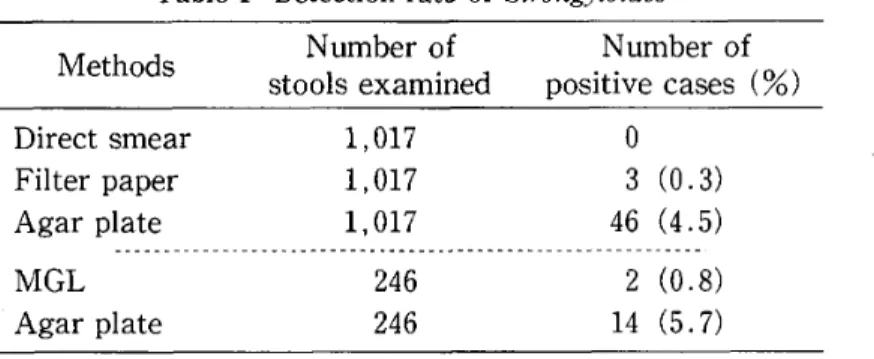
Forty‑six (4.5%) out of 1,017 stool samples were found positive for Strongyloides by the
agar plate method. Characteristic alignment of bacterial colonies and furrows left bycrawling rhabditoid and/or filariform larvae were clearly observed on agar plates (Fig. 1) . On the other hand, no larva was demonstrated by the direct smear method, and only 3 samples
(0.3%) were positive for Strongyloides by the filter paper cultures. Among 246 samplesexamined with both agar plate and MGL method, only 2 (0.8%) were positive by MGL
method, whereas Strongyloides was detected in 14 samples (5.7%) by the agar plate method (Table 1) . The agar plate method detected Strongyloides larvae from all the samples which were positive by the other methods. When a well was made on the agar plate with positivefindings (aligned bacterial colonies or furrows) and filled with water or physiological saline
solution, the larvae gathered around the well and entered the water. The larvae moving inthe water were easily collected by using a pipette to be identified. In several cases, adult
free‑living worms were observed on the agar plate. In such cases, oviposition and hatching were seen.In 2 out of positive 46 cases, aligned bacterial colonies and/or furrows were observed at
48 hr although they were not discernible at 24 hr. Incubation more than 48 hr did not result
A
Figure l, Positive findings found on agar plate cuivure oi stoois contaminated with Stron^
gyloides slercoralis larvae.
A : Aligned bacterial colonies formed around the stool.
B i Enlarged view of the aligned bacterial colonies.
C, D : Strongyioides larvae and furrows left by them on the agar plate.
13
Table I Detection rate of Strongyloides
Methods Number of Number of
stools examined positive cases (%)
Direct smearFilter paper
Agar plateMGL
Agar plate
1 017
1 , 017
1 017
246 246
o 3 46 2 14
(o . 3) (4 . 5)
(o . 8) (5 . 7)
in the increased detection rate. No parasite other than Strongyloides stercoralis was found by
any of the methods employed in the present survey.DISCUSSION
The results of the present study have clearly shown that the detection rate of Stron‑
gyloides stercoralis from human stools by the agar plate method was markedly higher than
those by traditional methods. It is apparent that the detection of Strongyloides larvae depends
on the number of worms in the stool specimens primarily. When the number of worms in thestool sample was very few (for example only one worm) , it must be so difficult to find it out
by the traditional methods (cf. Asato et al., 1984). But only one worm left a network offurrows by crawling on the agar surface and developed aligned bacterial colonies. Therefore, it is possible to find a very small number of worms by the agar plate method as long as the
worms are alive. Considering this phenomenon, most of the stools examined in the presentstudy were supposed to be only slightly contaminated with Strongyloides, because the detec‑
tion rate by the traditional methods was very poor. If the number of worms in the stool was so many as easily detectable even by direct smear method, the detection rate by any methods is supposed to be similar. Therefore, the agar plate method is especially significant in the
examination of asymptomatic carriers.It has been well known that many soil and plant parasitic nematodes are readily cultured on agar plate (Yokoo, 1959) . In this viewpoint, it is quite reasonable that Strongyloides, which is phylogenetically close to the free‑living rhabditoids, is developed on agar plate. Panosian et al. (1986) found Strongyloides stercoralis on agar plate media in the routine laboratory
work of bacteriological examination. They suspected the presence of Strongyloides because aligned bacterial colonies displaced from the streak marks were developed. However, as faras the authors are aware of, no attempt has been made to utilize agar plate for the diagnosis of strongyloidiasis.
In Okinawa Prefecture, the test tube culture method has been mainly used for Stron‑
gyloides detection, and the infection rate has been believed to be less than 2% (Center for
Preventive Medicine, Okinawa, 1983) . However, Asato et al. (1984, 1985) demonstrated, by using a combination of MGL and test tube culture methods, that the rate was much higher.Since the present results proved that the agar plate method is more efficient than MGL and
test tube culture methods, it is suggested that the exact prevalence may be surprisingly higher
than that believed so far. As agar plate method is not laborious nor expensive, its application
15
should be recommended in epidemiological survey.
Recently, strongyloidiasis has attracted special interests as opportunistic agent in im‑
munocompromised condition such as AIDS (Ndayiragije and Matheron, 1985) . Moreover, its special relationship with adult T‑cell leukemia (ATL) has been stressed (Nakada et al.,
1984, 1987) . The unstable results of fecal examination with traditional methods might have disturbed these researches. The agar plate method may also contribute to laboratory research of strongyloidiasis.
Since living larva in the stool sample is indispensable for detection by agar plate method, stool samples should be stored in an appropriate condition until examination. It has been well documented that some free‑living rhabditoid nematodes such as Rhabditis hominis are
occasionally contaminated in human feces. Asato et al. (1985) found R. hominis in 2 cases (0.09%) of 2,176 inhabitants examined in Itoman‑City, Okinawa. It is probable that suchspecies may also developed on agar plate. Therefore, species identification is necessary to certify the diagnosis. Instead of making wells in agar plate to collect the worms, we usually used small amount of agar media (lO ml or less per plate) . The Pettri‑dish was not
completely covered with this amount of agar, and some agar‑defect‑area (hollow) appearedin the plate. The water was poured into that hollow of the plate with positive findings.
On proceeding the present study, some interesting facts were noted. When fungal colonies developed on the agar plate, the larvae of Strongyloides did not come close to the
fungi. Although the fungus was not identified, there is a possibility to get some anti‑Strongyloides agent from this fungus. Some cases with numerous furrows but without any
bacterial colonies were occasionally seen. This is probably due to antibiotics taken prior to stool sampling.
REFERENCES
1) Asato, R., Hasegawa, H., Takai. A. and lkeshiro, T. (1984): Strongyloidiasis in Okinawa:
Examination and diagnosis. (1) Recent problems on the examination methods, J. Okinawa Ass.
Publ. Hlth., 15, 91‑99 (in Japanese)
2) Asato, R., Hasegawa, H., Takai, A. and lkeshiro, T. (1985): Transition of prevalence of intestinal parasites in Itoman District, Okinawa. Japan. Ann. Rep. Okinawa Prefec. Inst. Publ.
Hlth., 18, 51‑56 (in Japanese)
3) Beaver, P. C., Jung, R. C. and Cupp, E. W. (1984): Clinical Parasitology, 9th ed. p 825. Lea &
Febiger, Philadelphia
4) Harada, Y. and Mori, O. (1955) : A new method for culturing hookworm, Yonago Acta. Med., l, 177‑17'9
5) Nakada, K., Yamaguchi, K., Furugen, S., Nakasone, T., Nakasone, K., Oshiro, Y., Kohakura, M., Hinuma, Y., Seiki, M., Yoshida, M., Matutes, E., Catovsky, D.. Ishii, T. and Takatsuki, K.
(1987): Monoclonal integration of HTLV‑1 proviral DNA in patients with strongyloidiasis, Int. J. Cancer., 40, 145‑148
6) Nakada, 'K., Kohakura, M., Komoda, H. and Hinuma, Y. (1984): High incidence of HTLV
antibody in carriers of Strongyloides stercoralis. Lancet, 1, 633
7) Ndayiragije, A. and Matheron, S. (1985) : Le traitement des inf.ections opportunistes au cours de syndrome d'immunodeficience acquise (SIDA). Med. Afr. Noire., 32, 557‑573
8) Neva, F. A. Gam, A. A., and Burke, J. (1981): Comparison of larval antigens in an enzyme‑
linked immunosorbent assay, J. Infect. Dis., 144, 427‑432
9) Panosian, K. J., Marone, P. and Edberg, S. C. (1986): Elucidation of Strongyloides stercoralis by bacterial colony displacement, J. Clin. Microbiol., 24, 86‑88
10) Ritchie, L. S. (1984): An ether sedimentation technique for routine stool examination, Bull. U.
S. Army Med. Dept., 8, 326
11) Sato, Y., Maeshiro, J., Kawahira, M., Suzuki, M., Takai, A., Hasegawa, H., Asato, R. and lkeshiro, T. (1984): Application of Micro‑ELISA to a screening test of strongyloidiasis in the mass‑examination, Jpn. J. .Parasitol., 33, 501‑508 (in Japanese)
12) Tanaka, H. (1966) : Genus Strongyloides. In: Progress in Medical Parasitology in Japan 111 (K.
Morishita et al. eds.) , pp.591‑638, Meguro Parasitological Museum, Tokyo
13) Tanaka, H., Tokuriki, H., Shirasaka, K. and Hayashi, S. (1958) : On Strongyloides, with special reference to the methods of detection, Naika no Ryoiki, 6, 335‑340 (in Japanese)
14) Yokoo, T. (1959): Soil nematodes‑Their ecology and control measures. p. 553, Meibundo,
Tokyo (in Japanese)
17
糞便中からの糞線虫の新しい検出法
新垣 民樹1・長谷川英男2・安里 龍二3 池城 毅4・金城 福則5・斉藤 厚5 岩永 正明1
普通寒天平板培地を用いた糞線虫の新しい検出法を開発したので,その有用性を報告する。指 頭大の糞便を寒天平板培地の中央に置き,37。Cで24時間培養する。糞線虫陽性例では,寒天平板 上に糞線虫が這った後に残された轍や,その後に増殖した細菌コロニーの特徴的な線状配列を認
めることができる。幼虫の同定に関しては,陽性所見のある平板に穴(well)を作製し,水を満た すと幼虫は水中に集まってくるので,それを吸い上げて鏡検し確かめた。検査結果の内訳は,人 間ドック受診者1,017人中,陽性例が寒天平板法46人(4.5%),直接塗抹法0人(0%),濾紙培
養法3人(0.3%)であった。そのうち,ランダムに抽出した246人についてMGL法を用いて検査
したが,陽性率は寒天平板法14人(5.7%),MGL法2人(0.8%)であった。以上の結果から,
寒天平板法が従来の方法に比し,極めて高い検出率を示すことが知られた。本法は,手技が容易 でかつ安価であり,特に健康保虫者のスクリーニングに有用であると思われる。
1.琉球大学医学部細菌学教室 2.同寄生虫学教室
3.沖縄県公害衛生研究所 4.沖縄県予防医学協会
5.琉球大学医学部第一内科学教室
HEPATIC HYDATIDOSIS IN MAN AND HIS LIVESTOCKS IN SOUTHERN IRAQ
NADHAM K. MAHDI, ABDUL‑KHALIK Z BENYAN
AND A. J. AL‑NoWFAL
Received September 21 1987/Accepted December 22 1987
Abstract: Human hepatic hydatidosis was studied in surgically operated 61 cases at Basrah Hospitals in 1985. The age of the patients varied from 6 to 75 years. The ratio of rural to urban patients was 42 to 19. There were 31 females and 30 males.
A survey on animal hepatic hydatidosis at Basrah abattoirs during the first 6 months of 1985 was carried out. A total of 57,255 slaughtered animals was inspected and the results revealed that 8.4% of 38,398 sheep, 3.7% of 16,229 cattle and 5.6% of 2,628 buffaloes were found to be infected.
Prevalence of hydatidosis is considered to be high in Middle East countries (Mattosian et al., 1977). Many workers have proved that the disease is endemic (Al‑Jeboori, 1976;
Mahmoud, 1980; A1‑Sakkal, 1982) and enzootic (Senekjie and Beattie, 1940; Imari, 1954;
babero et al., 1963; Mubarek, 1978; Mahmoud, 1980; Al‑Abbassy et al., 1980) in nature in the central and northern parts of lraq.
Sixty one cases of human hepatic hydatidosis operated during 12 months period of 1985
were studied in Basrah Hospitals, southern lraq (Table l) . Age of patients varied from 6 to 75 years with mean of 31.2 :!: 16.9 years. Male patients were slightly younger (30.3 d: 15.7 years) than females ̲(32.0 i 18.4 years) . There were 31 females and 30 males. Examinations
and background of 61 cases are shown in Table 2.Animal hepatic hydatidosis was determined by the inspection of 57,255 Iivers belong to
38,398 sheep, 16,229 cattle and 2,628 buffaloes slaughtered at Basrah abattoirs during the first 6 months of 1985. The infection retes were 8.4%, 3.7% and 5.6% for sheep, cattle and buffaloes respectively (Table 3) .
The present study indicates that the hepatic hydatidosis is endemic and enzootic in natural environment in the southern lraq.
The maximum prevalence observed was among patients in ages 30s' and 40s'. In males,
the prevalence was highest in age 40s', while in females it was noticed in age 30s'. Almost
25% of all cases occurred in patients under the age 19. But 47.5% of cases were detectedamong patients of age class of 20 to 39. These findings are in agreement with results of other
1 . Department of Microbiology, College of Medicine, University of Basrah, Basrah, Iraq.
2 . Department of Surgery, College of Medicine, University of Basrah, Basrah, Iraq.
3 . Department of Surgery, Al‑Jamhory Hospital, Basrah, Iraq.
20
Table l Age distribution of patients which were operated on for hepatic hydatidosis and confirmed surgically in 1985
Age
(years)
No. of patients
Females Males
Total
0‑9
10‑19 20‑29 30‑39 40‑49 50‑59 60‑69 70‑79
4
2 11 5
24 l 2
3 6 4 9
3
O
7 8 15 14 6 7
22
Total 31 30 61
Table 2 Surgically confirmed 61 cases of human hepatic hydatidosis in 1985 Residency
Liver lobe
Casoni
testUltra sound test
Dog ownershipUraban Right
BothPositive
Not donePositive
Yes
19 44
23.
17 22 41
Rural
Lef t
Negative
Not done
No
42 10
21
39 20
Table 3 Prevalence of hepatic hydatidosis among slaughtered animals at Basrah abattoirs during the first 6 months of 1985
Species
No.examined
Livers
inf ected% of
total
% of cyst fertility rate
Sheep
Cattle Buff aloes
38 , 398 16 , 229 2 , 628
3 , 221
598 147
8.4 3.7 5.6
67 . 7 10 . 6 12 . 9
workers (Al‑Jeboori, 1976; Mahmoud, 1980; Al‑Sakkal, 1982). They concluded that the old aged people are more prone to this type of infection. It has also been reported that most
hydatid cysts are acquired in the childhood (Beard, 1978) . This may be due in part to greater
susceptibility of man to develop the infection as compared with animals (Schwabe et al.,1959) .
In this investigation, females and males are about equally infected. Similar sex distribu‑
tion was observed in Yougoslavia (Suice, 1957) and Lebanon (Schwabe and Abo‑Daoud,
1961). This is possibly due to the existence of some epidemiological factors such as socio‑cultural and occupational risks.
It is well known that liver is most frequently affected. In this study, about three quarters
of hepatic cysts are found in the right lobe of the liver (Table 2) .
Casoni test was positive in 52.3% of examined cases (Table 2) . However, test sensitivity
may depend on the location and condition of the cyst (Mahmoud, 1980) .Results also showed that the most frequent occurrence of animal hepatic hydatidosis was in sheep (8.4%), followed by buffaloes (5.6%) and cattle (3.7%) (Table 3). Sirnilar observa‑
tions were recorded in the central and northern parts of lraq (Imari, 1954; Babero et al., 1963;
Mahmoud, 1980; Al‑Abbassy et al., 1980). In contrast, Senekjie and Beattie (1940) and Mubarek (1978) have reported higher prevalence in cattle than in sheep. This distribution
probably correlates with the degree of keeping dogs within the herds of sheep and cattle.
The high prevalence detected arnong aged slaughtered animals (2‑7 years) can be attributed to the slow development of cysts (Schantze et al., 1977).
From the epidemiological point of view, sheep are considered to be a potential source of canine infection as they harbour mostly fertile cysts (Benyan and Mahdi, 1987) .
These results together with those observed in our previous work (Benyan and Mahdi,
1987) contributes to a better understanding of the epidemiological situation of hepatic and
pulmonary hydatidosis in southern lraq.ACKNOWLEGMENT
We are grateful to the meat inspectors of Basrah abattoirs for their interest and help.
REFERENCES
l) Al‑Abbassy, S. N., Altaif, K. I., Jawad, A. K, and Al‑Saqur, I. M. (1980): The prevalence of hydatid cysts in slaughtered animals in lraq, Ann. trop. Med. Parasitol., 74, 185‑187
2) Al‑Jeboori, T. (1976): Hydatid disease: a study of th records of the medicai city hospital, J.
Facult. Med., Baghdad, 18, 65‑75
3) Al‑Sakkal, N. (1982): Human hydatid disease in Mosul, Iraqi Med. J., 29, 80‑86
4) Babero, B. B., Al‑Dabagh, M. A., A1‑Safar, A. S. and Ali, F. M. (1963): The zoonosis of animal parasites in lraq, 111. Hydatid disease, Annal. trop. Med. Parasitol., 57, 499‑510
5) Beard T C (1978) Evidence that hydatid disease rs seldom "As old as the patrent", The Lancet, July I, 217‑219
6) Benyan, A. Z. and Mahdi, N. K. (1987): Pulmonary hydatidosis in man and his livestocks in Southern lraq, Saudi Med. J., (In press)
7) Imari, A. J. (1954): Hydatid disease in lraq, J. Med. Prof. Assoc., Baghdad, 1, I15‑138 8) Mahmoud, S. S. (1980): Studies on hydatid disease in Mosul, M. Sc. Thesis: University of
Mosul, Iraq
9) Mattosian, R. M., Rickard, M. D. and Smyth, J. D. (1977): Hydatidosis: a global problem of increasing importance, Bull. Wld Hlth Org., 55, 499‑507
lO) Mubarek, S. K. (1978): Serological and epidemiological studies on hydatid (Echinococcus granulosus) of sheep, cattle and camels, M. Sc. Thesis: University of Baghdad, Iraq
11) Schantze, P. M., Von Reyn, C. F., Welty, T., Anderson, F. L., Schultz, M. G. and Kagan, I. G.
(1977) : Epidemiology investigation of echinococcosis in American Indians living in Arizona and New Mexico, Am. J. Trop. Med. Hyg., 26, 121‑126
12) Schwabe, C. W. and Abo‑Daoud, K. (1961) : Epidemiology of echinococcosis in the Middle East, I. Human infection in Lebanon, 1949‑1959, Am. J. Trop. Med. Hyg., 10, 374
13) Schwabe, C. W., Schinazi, L. A. and Kilejian, A. (1959): Host parasite relationships in
echinococcosis, II. Age resistance to secondary echinococcosis in the white mice, Am. J. Trop.
22
14)
15)
Med. Hyg., 8, 29‑36
Senekjie, H. A. and Beattie, C. P. (1940): The incidence of hydatid disease in lraq, Trans. R.
Soc. trop. Med. Hyg., 33, 461‑462
Suice, M. (1957) : L'echinococcus humaine en Yougoslavie, Archives International Hidat, 16,
51‑57
ハブ毒による血圧降下と2,3の薬物の抑制効果
峰下 哲1,鎮西 弘2,中西 均3
1987年4月11日 受付/1988年2月19日 受理緒 口
環境衛生の発達と都市化にもかかわらず奄美大 島や沖縄県下には現在なお毎年数百名のハブ咬傷 者の発生をみ,そして抗血清の開発と普及にもか かわらず今なお約1%の犠牲者を出している(井 上ら,1982)。
その死因についてはすでに諸家によりさまざま な検討がなされているが,今なお不明な点が多い
(沢井,1960;館野ら,1960)。
ハブ咬傷による局所変化は出血,腫張,筋壊死 であり,全身性には重篤な場合には死に至る。逢 坂らは出血因子と致死因子とは別のものと考え,
2種の出血因子を分離し(逢坂ら,1968;Omori
Satoh andOhsaka,1970),腫張作用とその因子
については山川らにより報告され(山川ら,1973;Nozakiα認,1974),筋壊死については
鎮西によりハブ粗毒より筋壊死因子(myone−
croticfactor:MNF)の分離が報告された(Chin−
zei,1974;鎮西,1987)。
今回はこのMNFを用いてその生体反応に及
ぼす影響について検討した。
材料および方法
1.動物および薬物体重7−15㎏の雌雄雑種成犬,および体重400−
5009のWistar系雄性ラットを用いた。作用物質
および薬物としては奄美大島産ハブ毒と,これか
ら分離したMNF,抗ヒスタミン薬としてジフェンヒドラミンとプロメサジン,カリクレイン阻害 薬(トラジロール,三共),タマサキツヅラフジか ら抽出されたビスコクラウリン型のアルカロイド
(セファランチン,化研生薬)を用いた。
MNFの分離:奄美大島で1969年採毒の凍結 乾燥ハブ粗毒を0.15M NaClに1%溶液とし,こ れに等量の冷アセトンを加えて,一2ぴC,4時間放 置し遠心(8,000×9,一10。C,10分)し,その上 清に再び冷アセトンを最終濃度60%量に加え,一 晩一20。Cに放置後,遠心(13,700x8,一10。C,30 分)この沈殿物を0.15M NaCl価容解し,脱イオ
ン水で透析後凍結乾燥。粗毒19から,約150㎎得
られた。
2.方 法
a.麻
酔犬の血行動態に及ぽす影響
塩酸ケタミン(ケタラール,三共)12㎎/㎏を 筋肉内に注射し,更にペントバルビタール(ネ ンブタール,山之内)20㎎/㎏を静脈内に投与し て麻酔した後,気策内挿管を行い人工呼吸器に 接続した。
収縮期血圧(SBP),拡張期血圧(DBP)お よび平均血圧(MBP)は右股動脈にカテーテル
を挿入し,圧トランスデューサー(MPU−0.5,
日本光電)を介して電気血圧計(RP−5,日本 光電)を用いて測定した。また左腎動脈に電磁 流量計のプローブを装着して電磁流量計(日本
光電MF25)で腎血流量を測定した。薬物は右 股静脈に挿入したポリエチレンチューブ(PE−60)より注入した。
123 東京医科歯科大学難治疾患研究所臨床薬理学部門 ぴおシティ東洋診療所(〒231 横浜市中区桜木町1−1 帝京大学医学部薬理学教室
ぴおシティ5F)
24
b.ラットの血圧に及ぼす影響
薬物の反応を血圧の変動を指標にしてとらえ
るためにラットを用いて検討した。ペントバル ビタール(20㎎/㎏)を腹腔内に投与し麻酔した 後両側股動静脈を露出しポリエチレンチューブ (PE−160)を右側動脈および左側静脈に挿入し
動脈からはイヌの場合と同様にして血圧を測定 し,静脈側からは薬物の注入を行った。
c.セファランチンの薬物作用
撲殺したラットの回腸および子宮を用いた。
浴槽内の温度は32。C−35℃に保ち,栄養液は Tyrode液を使用し絶えず通気した。反応記録
はMagnus法に従い各収縮薬をcumulation
法で投与して薬量一反応曲線を得た。
結 果
1.イヌにおける血行動態
イヌにハブの粗毒(2㎎/㎏)を静脈内投与した
場合の血行動態を図1に,MNF100μg/㎏
(Folin法)を静脈内投与した場合の血圧および 腎血流量の変動を図2に示した。血圧の下降と共 に腎血流量はわずかに増加しているが,数分間で 血圧,腎血流とも投与前のレベルにもどった。こ の濃度での降圧効果はタキフラキシーを呈し,同 一の個体での同一条件による実験結果は再現性に 乏しいことが認められた。
2.ラットにおける生体反応
a.図3に示すようにラットにMNF100μg/㎏
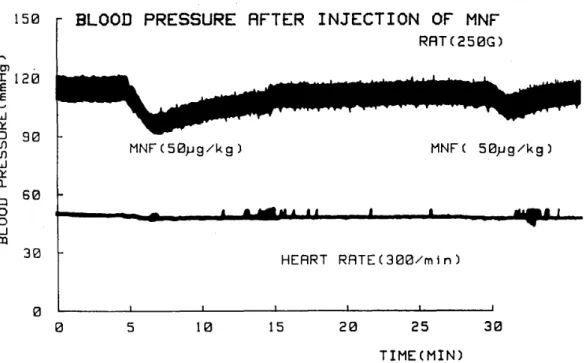
(Folin法)を二度にわけて静注するとイヌの 場合と同様に急激な血圧下降が惹起されまた脈 圧の減少が認められた。血圧がMNF投与前の レベルにもどるにはイヌの場合よりも長時間を
.要した。ラットの場合にもタキフラキシーが認 められた。この血圧降下は図4に示すようにジ フェンヒドラミンやプロメタジンのような抗ヒ スタミン薬により抑制された。
b.血圧降下時のキニン系の関与を検討する目的
で,カリクレイン阻害剤(Trasylo1)を投与後,同量のMNFを投与した。図5に示すよう に血圧降下は抑制されなかった。
c.台湾
で古くから毒蛇咬傷の治療に民問療法と
して用いられてきた防己科の1種(タマサキツ
ヅラフジ)から抽出されたアルカロイド(セファ ランチン)を5㎎/㎏静脈内投与した時の血圧変 動を図6に示す。MNF投与によって起こる血 圧降下時にセファランチンを投与すると下降し た血圧が速やかに正常レベルに回復することが 認められた。
d.セファランチンの薬理作用
ラットの子宮およびモルモットの腸管を用い て,ブラジキニン,ヒスタミン,セロトニンの
薬量反応曲線を図7−9に示した。いずれも薬 量に応じた収縮がみられた。セファランチン1μg/㎏の投与後ブラジキニン,ヒスタミン,セロ トニンを投与すると,図10−12に示すようにい
ずれも収縮が抑制されている。即ちセファラン チンには非特異性の抗ブラディキニン,抗ヒス タミン,抗セロトニン作用があることが認めら
れた。
考 察
ハブ毒による死の原因については心筋に対する 直接の抑制作用や乳酸性アシドーシスや低血流状 態などいろいろな問題が指摘され検討されている がまだ不明の点が多い(寺泉,1958)。今回の実験 は強力な筋壊死をひきおこすハブ毒中のある成分 が壊死のみでなく強力な血圧降下作用を有するこ
とを示した。ハブ毒のイヌにおける50%致死量は 筋肉内投与で8.2㎎/㎏とされているが(貫ら,
1963)本実験では極微量(100μg/㎏)の筋壊死因 子で著しい血行動態の変化が認められ,この血圧 降下は抗ヒスタミン剤の前処置で抑制されること から肥満細胞からのヒスタミンの遊離によるので はないかと思われた。
貫ら(1963)はイヌにおけるハブ毒の静脈内投 与実験の結果から投与量に応じて2つの病態のあ
ることを報告している。すなわち①2−10㎎/㎏
では一過性の血圧低下を来たすが一度回復しその 後数時間で死亡する。②15㎎/㎏では急速な血圧 低下とともに呼吸麻痺により短時問で死に至る。
図1,2に示すように今回の実験ではおそらく①