Electromotive force study of lanthanides in liquid Bi phase
Jiawei Sheng* Hajimu Yamana** Hirotake Moriyama**
The thermodynamic properties of Pr, Gd, Tb, Dy and Ho in liquid bismuth were determined by the electromotive force (EMF) measurement method using a cell consisting of molten chloride and liquid bismuth. The partial molar excess free energy changes of lanthanides dissolved in Bi solution and activity coefficients were determined at varying concentration and temperature. The partial excess entropy and corresponding enthalpy of lanthanides dissolved in Bi solution in a temperature range of 773K~1100K were evaluated. It was found that the excess free energy and entropy changes of trivalent lanthanides depend linearly on the 2/3 power of their metallic volume. The partial excess free energy changes of LnCl3 dissolved in the salt of some trivalent lanthanides were deduced.
Keywords: electromotive force, lanthanides, activity coefficient, thermodynamic properties, systematics
1 Introduction
∆E
electrometer thermocouple
Ta wire (lead) Ta wire (lead)
Al2O3 tube stainless tube
Ln electrode molten salt
liquid metal
electric furnace Al2O3crucible
Implementation of partitioning and transmutation (P&T) is intended to reduce the inventories of actinides and long-lived fission products in nuclear wastes. Aqueous separation techniques (such as PUREX process) are currently employed in the nuclear fuel reprocessing industry for effective separation of minor actinides and fission products based on the separation of element by element. The conditions of a possible grouping of certain elements would achieve a compact, economic and non-proliferative recycling process and simplify the overall management. Pyrochemical process based on the liquid-liquid extraction using molten salt and liquid metal is a possible technology for the group separation of lanthanides and actinides in the irradiated fuel reprocessing industry [1,2]. However, pyrochemical process is still in basic research phase and may need great efforts and breakthroughs before being applied. In support of the establishment of this group separation process, thermodynamic behavior of lanthanides and actinides in molten salt and liquid metal are needed to be determined. The extraction and separation performance of lanthanides and actinides by the pyrometallurgical extraction system mainly depends on the standard Gibbs free energy of formation of their chlorides, but their activity coefficients in both phases greatly influence the separation efficiency as well [3]. However, there are insufficient data related to the activity coefficients of lanthanides and actinides in the liquid bismuth systems. The purpose of this study is to determine the thermodynamic quantities associated with the formation of liquid lanthanide-bismuth alloys using the EMF measurement method.
Fig.1 Schematic diagram of the apparatus for electromotive force measurement
2 Experimental
The following galvanic cell was designed to measure the
EMF values between the metallic lanthanide (Ln) and Ln solute in Bi solution.
Ln (solid) | KCl-LiCl | Ln-Bi (solution)
The apparatus of EMF measurement is shown in Fig.1.
A pure lanthanide electrode was prepared by welding a tantalum lead to a small rod of 99.9% pure lanthanide metals.
The alloy electrode was prepared by directly dissolving a small piece of pure lanthanide metal in pure bismuth. The electrolyte was pure KCl-LiCl eutectic (mole ratio of lithium and potassium = 51/49) purchased from Anderson Physics Laboratory Engineered Materials Inc. All other reagents used were of analytical grade purchased from Wako Pure Chemicals Co. Ltd. The experiments were carried out in a glove-box filled with purified argon whose oxygen and humidity content was kept < 1ppm. In a typical experiment, 133 grams of Bi with about 1 gram of metallic Ln was loaded into a finely sintered alumina crucible, and then about 36 grams KCl-LiCl eutectic was loaded. The crucible was heated to a desired temperature in an electric furnace. After the desired temperature was achieved, then the pure lanthanide
This article was presented in Japan-China Workshop on Nuclear Waste Management and Reprocessing .
Electromotive force study of lanthanides in liquid Bi phase, by Jiawei Sheng([email protected]), Hajimu Yamana, Hirotake Moriyama
* Ecoglass Research Group Special Division for the Green Life Technology, AIST Kansai, 1-8-31 Midorigaoka, Ikeda, Osaka 563-8577, Japan
**Research Reactor Institute, Kyoto University, Kumatori, Sennan-gun, Osaka 590-0494, Japan
electron as immersed into the molten salt phase, and the EMF between the pure lanthanide electron and liquid alloy electrode as measured by an electrometer (HG-5100, Hokutodenko Co. Ltd.). After immersing the pure lanthanide electrode, the variation of EMF was monitored for longer than 10 minutes, waiting for the stabilization of EMF. In many cases, the fluctuation of EMF settled into < ± 2mV within 10 minutes after starting the measurements, and in such cases it was recognized that the electrochemical equilibrium was achieved. Measurement for Pr, Gd, Tb, Dy and Ho were performed at four different temperatures in a range of 773K~1100K. At each temperature, the concentration of lanthanide in bismuth phase was changed several times to record EMF at different concentration. For increasing the lanthanide concentration, small pieces of lanthanide metals were added. For decreasing the concentration, lanthanides were electrodeposited onto another cathode by using the liquid metal electron as an anode. After the EMF measurement, a small portion of the metal phase was sucked into a stainless steel tube as a sample. The sample was weighed and dissolved with 6N HNO3, and then the concentration of lanthanide in bismuth was analyzed by ICP-AES (ICPS-1000III, Shimadzu Co. Ltd.).
3 Thermodynamic basis
In general, the valences of the various species in the salt phase were those expected. All of the studied lanthanides in chloride melts in contact with a metal were trivalent [4]. The following equilibrium between the salt phase and Ln-Bi solution were thus attained.
Ln3+ (in salt) + 3e- = Ln ( in Bi solution ) (1) According to the Nernst’s equation, the electric potential of metallic Ln (ELn) and Ln in Bi solution (ELn (in Bi)) can be expressed as the following equations, respectively.
ELn=ELn0 + nF
RT 3 .
2 log (a /a ) (2)
3
LnCl Ln
ELn(in Bi) = ELn0 + nF
RT 3 .
2 log (aLnCl3/a ) (3)
Ln−Bi
Where is the standard potential of the couple LnCl
0
ELn
Bi
aLn−
3/Ln; Rthe gas constant;Τthe absolute temperature; nthe valence of the lanthanide ion (n=3); Fthe Faraday constant;α LnCl3 the activity of LnCl3 in molten salt; αLn and αLn-Bi the activities of metallic Ln and that of dissolved Ln in Bi solution, respectively. The EMF value between metallic Ln and Ln-Bi solution (⊿E) can obtained via the formula
=1 and =
aLn XLn
×
γLn as⊿E=ELn(in Bi) −ELn
= F RT 3
3 .
2 log (aLn/aLn−Bi)
= − F
RT 3 3 .
2 logΧLn − F RT 3
3 .
2 logγLn (4)
Where ΧLn denotes mole fraction of Ln in Bi solution, and γLn is the activity coefficient of Ln in Bi solution.
Equation (4) is the basic thermodynamic expression of this study. The Ln-Bi solution can be treated as a regular solution at lower Ln concentration, the partial molar excess Gibbs free energy changes of Ln dissolved in Bi solution ( ex
GLn
∆ ) can be deduced as following [5,6]:
ex
GLn
∆ = RTln
γLn (5) The temperature dependence of formation free energy can be expressed by
ex
GLn
∆ = ex HLn
∆ - T∆SLnex (6) Where ex
HLn
∆ is the partial excess enthalpy change of Ln dissolved in Bi solution, and ex
SLn
∆ is the corresponding excess entropy change. Combining equations (5) and (6), the following equation is yielded.
logγLn
RT S T HLnex Lnex
3 . 2
∆
−
=∆
RT H R SLnex Lnex
3 . 2 3 . 2
+∆
∆
=− (7)
In this experiment, Ln concentrations in the Bi solution were very low (mole fraction < 0.01%), thus the activity coefficient of Bi is treated as 1. The standard Gibbs free energy of formation of liquid Ln-Bi alloys (∆ , the standard state here means the pressure) can be shown that
0
Gf
0
Gf
∆ = ex GLn
∆ + ∆GLnfusion (8) Where is the fusion energy of Ln, which can obtain from literature [7].
fusion
GLn
∆
4 Results and discussion
For all the elements and temperatures tested, the observed showed a roughly linear dependence on log as shown in Fig.2. The variation of
approximately obeys equation (4). The lines drawn in Fig.2 are those of theoretical slopes (−
⊿E
XLn
⊿E
F RT 3 3 .
2 ) that were obtained by applying the least squares fitting method to the experimental data of every temperature. It could find that less Ln dissolved in Bi solution obeys Henry’s law. The term (−2.33FRT log
γLn) in equation (4) is a constant over the tested concentration and temperature ranges, suggesting that the activity coefficients of Ln in Bi solution are constant in the experimental concentration ranges at a given temperature. The activity coefficients can be calculated from equation (4), using the values of ⊿E and ΧLn obtained in this study along with temperature and other constants. The errors of logγLn
involve all the errors associated with the measurement. Major components of the errors are those accompanied by: (1) chemical analysis, from 10% forXLn=10-6 to 2% forXLn=10-2; (2) temperature measurement, constantly ±1K; and (3) EMF
26
10-6 10-5 10-4 10-3 10-2 10-1 0.6
0.7 0.8 0.9
Mole fraction of Tb in Bi
EMF, V
535C 635C 735C 835C
10-6 10-5 10-4 10-3 10-2
0.7 0.8 0.9
Mole fraction [ Dy in Bi ]
EMF, V
548C 651C 732C 828C
10-3 10-2
0.75 0.8 0.85 0.9
Mole fraction of Pr in Bi
EMF, V
540C 640C 740C 840C
10-4 10-3 10-2
0.65 0.7 0.75 0.8 0.85
Mole fraction of Gd in Bi
EMF, V
511C 608C 701C 793C
10-6 10-5 10-4 10-3 10-2
0.6 0.7 0.8 0.9
Mole fraction of Ho in Bi
EMF, V
527C 625C 725C 820C
(b) Gd (a) Pr
of Dy in Bi
(c) Tb (d) Dy
(e) Ho
Fig.2 Concentration dependence of the EMF
Table 1 Activity coefficients of Ln in liquid Bi
0.8 0.9 1 1.1 1.2 1.3
-12 -11 -10 -9 -8 -7 -6
1000/
Pr Gd Tb Dy Ho log
γ
Ln =a
+b
/T
Ln
a
-b
γ values at 873K
La (1) 0.94 11158 1.44E-12
Ce (1) 2.03 11400 9.37E-12
Pr 1.60 ± 0.376
11290 ±
378 4.61E-12
Nd (1) 1.90 11074 1.64E-11
Gd 1.58 ± 0.358
9933 ±
345 1.59E-10
Tb 1.72 ±
0.586
9870 ±
585 2.51E-10
Dy 2.03 ±
0.037
10219 ±
37 2.11E-10
Ho 1.96 ±
0.284
9686 ±
280 7.42E-10
Er 1) 1.23 8593 2.44E-09
Log rLog r
T, K-1
Fig.4 Temperature effects on the activity coefficient
(1) Reference[8]
measurement, constantly ±2mV. An example of the observed dependence of logγLnon log is given in Fig.3, where the independence of log on log is clearly seen. The same results can also be obtained for other studied lanthanides.
XLn Ln X
γ Ln
There is a considerable increase in the activity coefficient on the temperature. For determining the∆HLnexand∆SLnex
Ln
by temperature dependence of logγLn , plotting logγ on was performed according to the equation (7), as shown in Fig.4. The lines in the Fig.4 show the results of the least squares fitting treatment, which gave quite satisfactory agreement to the data. By writing the linear functions as
T / 1
logγLn = a + b /T (9) Where a and b are determined constants. Table 1 provides the values of a and b. A systematic increase of the activity
coefficient in Bi solution along with atomic number can be found at a given temperature. Combining equation (7) and (9),
ex
HLn
∆ and ∆SLnexare given by the following equations:
ex
HLn
∆ = 2.3R × b (10)
ex
SLn
∆ = -2.3R × a (11) The ∆GLnexcan be calculated at a given temperature from equation (5), using γLnvalues. Table 2 summarized the results of thermodynamic properties related to Ln dissolved in Bi solution at 873K.
The systematic variation of the major thermodynamic quantities along with the lanthanide series is an important research topic in order to understand the reductive extraction behavior of Ln [3]. In the liquid alloy, it is presumably considered that the solute metal forms a chemical complex with the solvent metals, i.e. a cluster, and this is considered to be responsible for the thermodynamic excess stabilization of the solute metals [9]. Thus, the excess partial molar quantities of the solute metals in the solvent metals should reflect the degree of chemical bondings associated with the formation of the clusters. In most case of the compounds of lanthanides, their chemical stabilities scarcely depend on the number of
‑12
‑11
‑10
‑9
‑8
‑7
10‑5 0.0001 0.001 0.01
log r
M o le fr a c tio n o f G d in B i Gd
511oC 608oC 701oC 793oC
Fig.3 Activity coefficient of Gd in Bi solution
4f-electrons, thus tend to show monotonic variations along the lanthanides series [10]. Fig.5 shows plots of∆GLnex&∆HLnexvs. ( is the atomic molar volume, cm
3 /
V2 V
3/mol) [11]. A linear dependence of ∆GLnex and ∆HLnexon
3for trivalent lanthanides at 873K was observed, which is agreed with theoretical calculation results by Miedema’s model [3,11]. Such a linear relationship can be used to predict the thermodynamic properties of other unknown lanthanides.
The developing reductive extraction process of trivalent lanthanides with the use of metallic Li as a reductant is described as the following reaction [2,3]:
/
V2
LnCl3(in salt) + 3Li (in Bi) ↔ Ln (in Bi) + 3LiCl (in salt) (12)
28
Table 2 The changes in the partial molar thermodynamic properties at 873K
∆Gf, kJ.mol-1
Ln ex
G
Ln∆
∆ G
Lnfusion(1)∆ G
0fex
H
Ln∆
kJ.mol-1
ex
S
Ln∆
J.K-1mol-1
La -197.67 2.43 -195.24 -213.37 -17.97
Ce -184.10 1.33 -182.77 -217.99 -38.82
Pr -189.26 ± 4.57 2.28 -186.98 ± 4.57 -215.89 ± 7.23 -30.51 ± 7.19
Nd -180.04 2.63 -177.41 -211.76 -36.33
Gd -163.56 ± 5.90 5.77 -157.79 ± 5.90 -189.94 ± 6.60 -30.21 ± 6.84 Tb -160.27 ± 6.86 5.75 -154.52 ± 6.86 -188.32 ± 11.19 -32.13 ± 11.21 Dy -161.52 ± 0.94 5.01 -156.51 ± 0.94 -195.41 ± 0.71 -38.82 ± 0.71 Ho -152.41 ± 4.15 7.55 -144.86 ± 4.15 -184.80 ± 5.35 -37.10 ± 5.43
Er -143.78 9.97 -133.81 -164.32 -23.52
1): Reference [7].
‑300
‑250
‑200
‑150
‑100
6.8 7 7.2 7.4 7.6 7.8 8 8.2
DGex &, kJ/mol
V2/3, cm2/m ol2/3 Fig. 5 ex
GLn
∆ & ex HLn
∆ vs. V2/3
‑100
‑90
‑80
‑70
‑60
‑50
‑40
0.95 1 1.05 1.1 1.15
Cl3, kJ/mol
1/R, A-1
∆GDGLnex -ex
Ln ex-ex DH Ln
∆HLn
LnHex Ln∆GL∆HLn-ex
The extractability of Ln can be expressed as the sum of formation free energy of products and reactants [2,3].
log(DLn/DLi3) = -2.3RT
1
ex
GLn
∆ +2.3RT
1
{∆ 0(LnCl Gf 3, liquid)
+∆Gex(LnCl3, in salt)} + ¢ (13)
Where log(DLn/DLi3
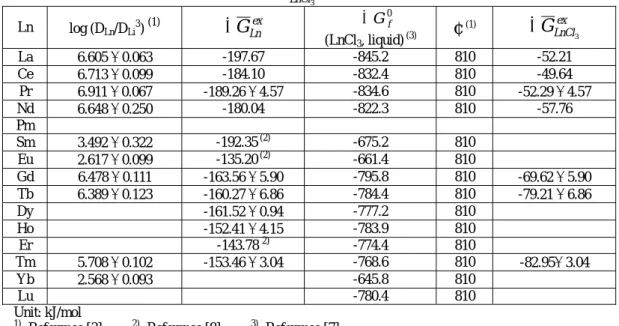
) denotes the extractability of Ln (DLn and DLi are the distribution ratio of Ln and Li in two phases, respectively); ∆G0f( LnCl3, liquid) the formation free energy of liquid LnCl3; ∆GLnClex 3the partial excess free energy change of LnCl3 dissolved in the salt; ¢ the constant related with formation free energy of LiCl and Li in molten salt and liquid Bi phases. At a given temperature, the extractability of Ln can be estimated by the thermodynamic quantities in equation (13). The ∆GLnexvalues can be directly determined by the EMF measurement as this study expressed. In contrast, the
values of GLnClex 3
∆ are difficult to be measured by EMF, especially at higher temperature than about 773K. In fact, there are few reference electrodes to be easily adapted. Thus, the theoretical study of Ln extractability is severely limited because of the insufficient data of GLnClex
∆ 3. The ∆GLnex
0
Gf
values of some lanthanides have been obtained in this study and literatures, the log(DM/DLi3) values of some lanthanides have been obtained in previous studies, and the values of ∆ (LnCl3, liquid) and ¢ are available in the published database [3,7]. Then, the values of GLnClex
∆ 3of some lanthanides can be obtained from equation (13). Table 3 presents the calculated results of GLnClex
∆ 3 at 873K. The relationship between the GLnClex
∆ 3values of some trivalent lanthanides and their ionic radius (R) is shown in Fig.6. A linear dependence of GLnClex
∆ 3on 1/R was observed. Regardless of its physical meanings, this linearity of GLnClex
∆ 3, i.e. that of∆GLnexand∆HLnexas well, is useful for the assessment of the characteristic extraction behaviors of lanthanides by liquid Bi.
Dn &-ex DG Ln∆GL3
ex ncl-ex
Fig.6 ∆GLnClex vs. 1/R
3
Table 3 Calculation values of
G
LnClex∆
3for some trivalent lanthanides at 873K Ln log (DLn/DLi3) (1)
∆ G
Lnex ∆G0f(LnCl3, liquid) (3)
¢
(1)G
LnClex∆
3La 6.605 ± 0.063 -197.67 -845.2 810 -52.21
Ce 6.713 ± 0.099 -184.10 -832.4 810 -49.64
Pr 6.911 ± 0.067 -189.26 ± 4.57 -834.6 810 -52.29 ± 4.57
Nd 6.648 ± 0.250 -180.04 -822.3 810 -57.76
Pm
Sm 3.492 ± 0.322 -192.35 (2) -675.2 810
Eu 2.617 ± 0.099 -135.20 (2) -661.4 810
Gd 6.478 ± 0.111 -163.56 ± 5.90 -795.8 810 -69.62 ± 5.90 Tb 6.389 ± 0.123 -160.27 ± 6.86 -784.4 810 -79.21 ± 6.86
Dy -161.52 ± 0.94 -777.2 810
Ho -152.41 ± 4.15 -783.9 810
Er -143.78 2) -774.4 810
Tm 5.708 ± 0.102 -153.46 ± 3.04 -768.6 810 -82.95± 3.04
Yb 2.568 ± 0.093 -645.8 810
Lu -780.4 810
Unit: kJ/mol
1): Reference [3]. 2): Reference [8]. 3): Reference [7].
5 Conclusions
The EMF measurement method was used to determine the thermodynamic quantities of Pr, Gd, Tb, Dy and Ho in Bi solution. The temperature dependence of their activity coefficients was investigated, and then ∆HLnex and ∆SLnex were obtained. There has a linear dependence of ∆GLnex and ∆HLnex
values for trivalent lanthanides on the V 3. The calculation of
/ 2 ex
GLnCl3
∆ of some trivalent lanthanides was evaluated and a systematic variation of ∆GLnClex 3 values along with their ionic radii was found.
References
[1] H.Moriyama, H.Yamana, S.Nishikawa, Y.Miyashita, K.Moritani, T.Mitsugashira, Equilibrium distributions of actinides and lanthanides in molten chloride salt and liquid zinc binary phase system, J. Nucl. Mater. 247,197-202.
(1997)
[2] H.Moriyama, H.Yamana, S.Nishikawa, S.Shibata, N.Wakayama, Y.Miyashita, K.Moritani, T.Mitsugashira, Thermodynamics of reductive extraction of actinides and lanthanides from molten chloride salt into liquid metal, J.
Alloys Comp. 271-273, 587-591. (1998)
[3] H.Yamana, N.Souda and H.Moriyama. Systematics of the thermodynamic properties of trivalent f-elements in a pyrometallurgical bi-phase extraction system, J. Nucl.
Mater. 278 (1), 37-47. (2000).
[4] L.M.Ferris, J.C.Mailen and F.J.Smith, Chemistry and thermodynamics of the distribution of lanthanide and actinide elements between molten LiF-BeF2 and liquid bismuth solutions, J. Inor. Nucl. Chem. 33 (1971)
1325-1335.
[5] W.Pan, R.Li, J.Chen, R.Sun and J.Lian, Thermodynamic properties of Ti in Ag-Ti alloys, Mater Sci Eng. A287, 72-77. (2000).
[6] X.Ding, P.Fan and W.Wang, Thermodynamic calculation for alloy systems, Metal. Mater. Trans. 30B, 271-277.
(1999).
[7] I.Barin, O.Knake, O.Kubaschewski. Thermodynamical properties of inorganic substances. Springer, Berlin, (1997).
[8] V.A.Lebedev. “Selectivity of liquid metal metal electrodes in molten halides.” 1993 (in Russian).
[9] R.N.Singh, N.H.March, Intermetallic compounds – principle and practice, John Wiley & Sons, Baffins, (1995).
[10] L.R.Morss, in K.A.Gschneidner, Jr.L.Eyring, G.R.Choppin and G.H.Lander (eds.), Handbook of the physics and chemistry of rare earths, Vol.18, Chapter, North-Holland, Amsterdam, (1994).
[11] F.R. de Boer, R.Boom, W.C.Mattens, A.R.Miedema, and A.K.Niessen, Cohesion in Metal-Transition Metal Alloys, North-Holland, Amsterdam, (1988).
30