• 検索結果がありません。

A Collection of Hepatics from the Tottori Prefecture, Japan

N/A
N/A
Protected

Academic year: 2021

シェア "A Collection of Hepatics from the Tottori Prefecture, Japan"

Copied!
8
0
0

読み込み中.... (全文を見る)

全文

(1)

A Collection of Hepatics from the Tottori Prefecture, Japan

Vadim A. Bakalin

1,

* , Tomotsugu Arikawa

2

and Masanobu Higuchi

3

1

Botanical Garden-Institute, Far Eastern Branch of the Russian Academy of Sciences, Makovskogo Street 142, Vladivostok 690024, Russia

2

Keio University, Hiyoshi 4–1–1, Kohoku-ku, Yokohama, Kanagawa 223–8521, Japan

3

Department of Botany, National Museum of Nature and Science, Amakubo 4–1–1, Tsukuba, Ibaraki 305–0005, Japan

* E-mail: [email protected]

(Received 27 August 2013; accepted 2 October 2013)

Abstract Basing on the collection of hepatics gathered in the middle of March, 2013, in Tottori Prefecture, Japan, 56 species of liverwort and one hornwort species are recorded. Compiled check- list provides the information on generative structures and vegetative propagules presence, altitudi- nal diapason of collected specimens, habitat description and accompanying taxa list for each recorded species. Nine species (Aneura maxima, Conocephalum salebrosum, Lejeunea aquatica, Megaceros flagellaris, Plectocolea horikowana, Plectocolea ovalifolia, Riccardia kodamae, Ricca- rdia latifrons and Riccardia tamariscina) are new for Tottori Prefecture.

Key words : bryophytes, hornworts, Japan, liverworts, Tottori Prefecture.

Tottori Prefecture is located in South–West part of Honshu, Japan, and covers over than 3500 km

2

. It stretches out long and thin from east to west (approximately 120 km east–west and max- imum 50 km north–south). It faces the Sea of Japan in the north, and it is bordered southward with a ridgeline of Chugoku Mountains including Mt. Daisen (1,729 m alt.), the highest peak in a Western part of Honshu. The vegetation of the lower part under 300 m alt. was originally repre- sented by warm-temperate, evergreen broad- leaved forests (e.g. laurel forest), and that of the higher part over 600 m alt. was by deciduous broad-leaved forest (e.g. beech forest). The part between 300 and 600 m alt. is an ecotone. Most of these forests, however, are now replaced by secondary forests dominated by Pinus densiflora and the plantation of Cryptomeria japonica. Tot- tori Prefecture is the least populous prefecture in Japan (ca. 590,000), because of the mountainous topography. In spite of the low latitude, heavy snowfalls are sometimes occurred in winter

owing to the Sea of Japan.

The prefecture has a long history of bryologi- cal exploration that was summarized by Arikawa et al. (2011) provided checklist of bryophytes of the prefecture. The list counts 312 species of mosses, 124 species of liverworts and 3 species of hornworts recorded in literature. Later Ari- kawa et al. (2012) published floristic results of field survey for Tottori red list species recogniz- ing. That list is based on field researches curried in 2010. Arikawa et al. (2012) provide data on distribution of 183 species of mosses and 93 spe- cies of hepatics, respectively with 30 and 14 spe- cies of bryophytes new for Tottori Prefecture.

Recently Kobayashi (2012a, 2012b) also reported 2 species of hepatics as new record for Tottori Prefecture.

Our researches were conducted in three days

at March of 2013 as the part of collaboration

project for studies of biota diversity and develop-

ment around Sea of Japan, concluded between

National Museum of Nature and Science, Tokyo,

(2)

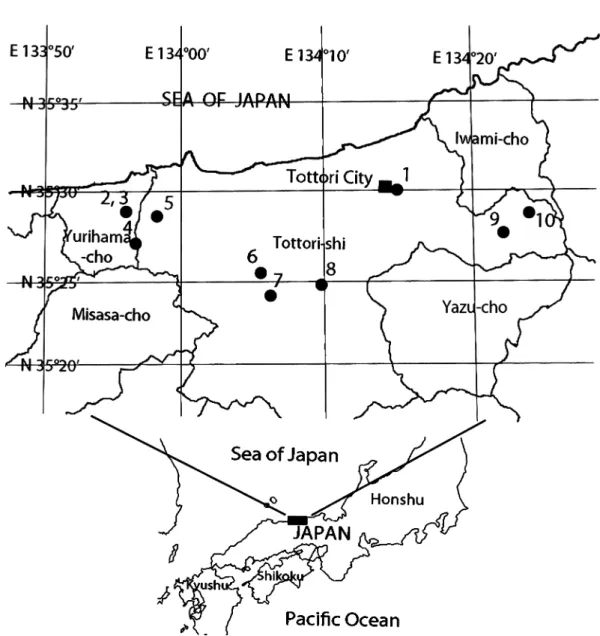
and three institutes of the Far East Division of the Russian Academy of Sciences (Botanical Garden-Institute, Institute of Biology and Soil Sciences and Institute of Geology). Due to springtime we conducted field researches in low altitudes in Tottori Prefecture (see Fig. 1 and Table 1), when over than 200 specimens of hepatics were collected. All specimens were studied for oil-bodies features within one week after the collection, when the plants were in liv- ing condition. Despite the time for collecting was

very limited we have found 57 species of hepat- ics (56 liverworts and 1 hornwort), 9 of them are new for the prefecture. Due to the latter fact, as well as we found in additional localities some rare in Tottori Prefecture taxa we provide the list of our collection below.

Enumeration of Species

The conspectus lists taxa in alphabetical order.

Taxa new for the prefecture are marked with

Fig. 1. Map of collecting localities in Tottori Prefecture.

(3)

asterisk. The nomenclature mostly followed to the accepted in the “Catalog of the hepatics of Japan” (Yamada and Iwatsuki, 2006) with the exception in recognizing of Plectocolea and Solenostoma as the genera different from, Jungermannia s. str. (cf. Bakalin and Vilnet, 2012). Each species is annotated by the follow- ings.

(1) Locality number.

(2) Presence of generative structures and vege- tative propagules (if present) in the following abbreviations: per. (perianths including fleshy calyptrae and pseudoperianths of metzgerioid hepatics), ant. (antheridia), arch. (archegonia), spor. (sporangia), gemm. (gemmae).

(3) Altitudinal diapason where the species was collected.

(4) Habitat description.

(5) Accompanying species (if present).

(6) Selected specimens examined herbarium number (one per each locality, according to the Fig. 1 and Table 1).

(7) In some cases some taxonomical or other notes are added.

The specimens cited here were mainly col- lected by Bakalin, and they are deposited in the herbarium of the Botanical Garden-Institute, Far Eastern Branch of the Russian Academy of Sci- ences (VBGI) and some duplicates in the herbar- ium of the Department of Botany, National

Museum of Nature and Science (TNS).

* Aneura maxima (Schiffn.) Steph. L10, 390 m. Wet cliff in open place in the spray zone of waterfall. Only one collection. With Conoceph- alum salebrosum, Heteroscyphus coalitus, Pal- lavicinia subciliata, Pellia neesiana and Riccar- dia chamaedryfolia. J-10-9-13.

Bazzania tridens (Reinw., Blume & Nees) Trevis. L1, 60 m. Wet clay road cuts and tree trunks in part shade in broadleaved-coniferous forest. In pure mats or with Blepharostoma minus and Kurzia makinoana. J-1-45-13.

Blepharostoma minus Horik. L1, 60 m. Wet clay road cuts and stone walls in the valley in part shade in the secondary forests. In pure mats or with Bazzania tridens, Diplophyllum taxifo- lium, Kurzia makinoana and Scapania parvi- texta. J-1-44-13.

Calypogeia japonica Steph. L1, 60 m. Wet stone walls in the valley in the seconcary forests.

In pure mats or with Conocephalum salebrosum, Pallavicinia subciliata and Riccardia tamar- iscina. J-1-15-13.

Calypogeia tosana (Steph.) Steph. L1, 2, 7, 40–240 m. Wet sandy and clayish road cuts in part shade, clay on slope to stream, moist cliffs along stream in the secondary forests. In pure mats or with Lejeunea japonica, Pallavicinia subciliata, Plagiochila ovalifolia and Plectoco- lea truncata. J-1-26-13, J-2-9-13, J-7-18-13.

Table 1. Collecting localities in Tottori Prefecture Locality

number Coordinates Geographic description Altitude,

m alt. Date

1 35°30′04.7″N 134°14′59.7″E Tottori-shi, Ue-machi, Ouchi-dani Park 60 10 March 2013 2 35°28′55.1″N 133°56′09.3″E Tohaku-gun, Yurihama-cho, Urushibara,

Fudo Waterfall 40 11 March 2013

3 35°28′54.0″N 133°56′07.3″E Tohaku-gun, Yurihama-cho, Urushibara 40 11 March 2013 4 35°27′13.8″N 133°56′50.8″E Tohaku-gun, Yurihama-cho, Kawakami,

around the summit of Mt. Hachibuse 500 11 March 2013 5 35°28′41.3″N 133°58′20.7″E Tottori-shi, Aoya-cho, Tawaradani, Fudo

Waterfall 115 11 March 2013

6 35°25′17.3″N 134°05′28.0″E Tottori-shi, Kouchi, Kouchi Shrine 170 12 March 2013 7 35°24′09.6″N 134°06′0.9.4″E Tottori-shi, Iwatsubo, Iwatsubo Shrine 240 12 March 2013 8 35°24′48.3″N 134°09′42.6″E Tottori-shi, Naka-sunami 210 12 March 2013 9 35°27′40.8″N 134°22′18.2″E Tottori-shi, Kokufu-cho, Sugano, Sugano

Marsh 400 12 March 2013

10 35°28′42.5″N 134°24′04.0″E Tottori-shi, Kokufu-cho, Amedaki, Amedaki

Waterfall 390 12 March 2013

(4)

Cavicularia densa Steph. L7, 240 m. Very wet cliff along stream in the secondary forest.

Only one collection. With Conocephalum sale- brosum and Plectocolea unispiris. J-7-13-13.

Cephalozia otaruensis Steph. L1,5, per.

60–110 m. Moist rotten log in part shade in the secondary forests. In pure mats or with Heter- oscyphus coalitus, Odontoschisma denudatum and Riccardia latifrons var. miyakeana. J-1-4-13, J-5-30-13.

Chiloscyphus polyanthos (L.) Corda L2, 5, 7, ant., per., spor. 40–240 m. Very wet cliffs in spray zone of waterfall in part shade, wet boul- ders and cliffs in the stream valley in open place or in part shade in the secondary forests. In pure mats or with Conocephalum salebrosum. J-2-15- 13, J-5-12-13, J-7-16-13.

Cololejeunea japonica (Schiffn.) S.Hatt. ex Mizut. gemm. L1, 60 m. Tree trunk in the sec- ondary forest. Only one collection. With Radula constricta. J-1-19-13.

Cololejeunea longifolia (Mitt.) Benedix in Mizut. L6, 170 m. Boulders in part shade in the secondary forests. Only one collection. In pure mats. J-6-16-13.

Conocephalum japonicum (Thunb.) Grolle L5, 110 m. Clay covering rocks in slope to stream in mesic conditions in part shade in the secondary forests. Only one collection. With Dumortiera hirsuta and Plectocolea horikawana.

J-5-2-13.

* Conocephalum salebrosum Szweyk., Bucz- kowska & Odrzykoski spor. L1, 5, 7, 10, 60–390 m. Wet clay and sandy road cuts, moist rotten log, wet cliffs along stream and in the spray zone of waterfall, clay covering rocks in slope to stream in mesic conditions, in part shade to open places mostly in the secondary forests. Very common species in pure mats or with Aneura maxima, Calypogeia japonica, Cavicularia densa, Chiloscyphus polyanthos, Dumortiera hir- suta, Heteroscyphus coalitus, H. planus, Maki- noa crispata, Pallavicinia subciliata, Pellia nee- siana, Plectocolea unispiris, Radula kojana, Riccardia chamaedryfolia, R. tamariscina, Trichocolea tomentella and Wiesnerella denu-

data. J-1-38-13, J-5-28-13, J-7-17-13, J-10-12- 13.

This species was recorded for Japan (Kyushu, Miyazaki-ken) relatively recently (Szweykovsky et al., 2005). In the same paper (l.c.) it was shown that the distribution of C. conicum (L.) Underw. mainly restricted to Europe, with the westernmost known locality in Turkey. Further researches by Borovichev et al. (2009) showed the similar tendency (the westernmost locality of C. conicum in Eurasia is in Altai Mts.). In our researches we did not recognize this species in the Russian Far East, Korean Peninsula and China (unpublished), where all population of the species previously named as C. conicum are really belonging to C. salebrosum. Akiyama (2006) suggested that Conocephalum conicum doesnʼt occur in Japan. The present research rather confirms this point of view.

Diplophyllum taxifolium (Wahlenb.) Dumort.

L1, 7, ant., per. 60–240 m. Moist to wet cliffs along streams and wet stone walls in the valley in the secondary forests. In pure mats or with Blepharostoma minus and Scapania parvitexta.

J-1-10-13, J-7-14-13.

Dumortiera hirsuta (Sw.) Nees in Reinw. L1, 2, 5, 7, 10, arch. 40–390 m. Moist to wet clayish road cuts, cliffs along stream, boulders and clay covering rocks on slopes to valleys, cliff in spray zone of waterfall, mostly in part shade in the sec- ondary forests. Very common species growing in pure mats or with Conocephalum japonicum, C. salebrosum, Heteroscyphus coalitus, Jubula hutchinsiae, Pallavicinia subciliata, Pellia neesi- ana, Plectocolea sp. and Wiesnerella denudata.

J-1-41-13, J-2-10-13, J-5-2-13, J-7-21-13, J-10- 4-13.

Frullania appendiculata Steph. L1, 60 m.

Tree trunks in the secondary forest. In pure mats.

J-1-22-13.

Frullania appendiculata Steph. was consid- ered by Hattori (1972) as one of synonyms of F. tamarisci subsp. obscura. Recent molecular researches, however, confirmed the species rank for F. appendiculata (cf. Heinrichs et al., 2010).

Frullania davurica Hampe L1, 60 m. Tree

(5)

trunks in the secondary forests. In pure mats. J-1- 20-13.

Frullania muscicola Steph. L1, 3, per., spor.

40–60 m. Tree trunk in open places near the roads or trunk in the secondary forests in part shade. In pure mats. J-1-23a-13, J-3-4-13.

Haplomitrium mnioides (Lindb.) R.M.

Schust. L1, 7, ant., per. 60–240 m. Moist to wet cliffs along streams and wet sandy to clayish road cuts in part shade in the secondary forests.

In pure mats. J-1-27-13, J-7-30-13.

Heteroscyphus coalitus (Hook.) Schiffn. L1, 2, 5, 7, 10, 40–390 m. Moist to wet clay to sandy road cuts in part shade, moist to wet cliffs along streams, near waterfalls, mostly in part to full shade in the secondary forests. Very common species. In pure mats or with Aneura maxima, Cephalozia otaruensis, Conocephalum salebro- sum, Dumortiera hirsuta, Heteroscyphus planus, Makinoa crispata, Pallavicinia subciliata, Pla- giochila ovalifolia, P. sciophila, Radula kojana, Riccardia chamaedryfolia, Pellia neesiana, Trichocolea tomentella and Wiesnerella denu- data. J-1-57-13, J-2-22-13, J-5-22-13, J-7-23-13, J-10-12-13.

Heteroscyphus planus (Mitt.) Schiffn. L1, 5, 6, 7, 60–240 m. Moist to wet clay to sandy road cuts in part shade, moist cliffs and tree trunks in part shade in stream valleys in the secondary for- ests. In pure mats or with Conocephalum sale- brosum, Heteroscyphus coalitus, Plagiochila sci- ophila and Trichocolea tomentella. J-1-39-13, J-5-19-13, J-6-4-13, J-7-25-13.

Jubula hutchinsiae (Hook.) Dumort. ssp.

javanica (Steph.) Verd. L2, 5, 6, 7, 10, ant., arch., per. 40–390 m. Moist boulders and humus on slopes to and along of the streams in part to full shade in the secondary forests. In pure mats or with Dumortiera hirsuta, Megaceros flagel- laris, Makinoa crispata, Plagiochila ovalifolia, Riccardia chamaedryfolia and Wiesnerella denu- data. J-2-5-13, J-5-33-13, J-6-13-13, J-7-1-13, J-10-5-13.

Kurzia makinoana (Steph.) Grolle L1, per.

60 m. Rotten logs and wet clay road cuts in part shade in the secondary forests. In pure mats or

with Bazzania tridens, Blepharostoma minus, Plagiochila ovalifolia and Plectocolea ovalifolia.

J-1-2-13.

* Lejeunea aquatica Horik. L2, 5, 40–110 m.

Very wet to moist cliffs in spray zone of waterfall or along steam valley, in part shade in the sec- ondary forests. In pure mats or with Riccardia chamaedryfolia. J-2-18-13, J-5-21-13.

Lejeunea japonica Mitt. L5, 7, ant., per. 110–

240 m. Wet to moist stone walls and cliffs, moist humus slope to valleys and along streams, tree trunks in part shade in the secondary forests. In pure mats or with Calypogeia tosana, Plagioch- ila ovalifolia, P. sciophila and Wiesnerella denu- data. J-5-15-13, J-7-18-13.

Lophocolea minor Nees L1, 4, 5, 6, gemm., per. 60–500 m. Tree trunks in open places and moist rotten log in part shade in the secondary forests. In pure mats or with Metzgeria lindber- gii. J-1-1-13, J-4-1-13, J-5-8-13, J-6-3-13 .

This species is listed as Chiloscyphus minor (Nees) J.J.Engel & R.M.Schuster in Katagiri and Furuki (2012).

Macvicaria ulophylla (Steph.) S.Hatt L3, 40 m. Tree trunk in open place near the road across rice fields. In pure mats or with Radula con- stricta. J-3-2-13.

Makinoa crispata (Steph.) Miyake L1, 5, 6, 60–170 m. Wet stone walls, boulders and moist cliffs in part shade along streams in the second- ary forests. In pure mats or with Conocephalum salebrosum, Heteroscyphus coalitus, Jubula hutchinsiae, Megaceros flagellaris and Riccardia chamaedryfolia. J-1-12-13, J-5-22-13, J-6-11- 13; Higuchi 51330.

* Megaceros flagellaris (Mitt.) Steph. L2, 6, 7, spor. 40–240 m. Very wet cliffs in spray zone of waterfalls, wet to moist boulders in the stream valleys in part shade in the secondary forests. In pure mats or with Jubula hutchinsiae, Makinoa crispata and Riccardia chamaedryfolia. J-2-21- 13, J-6-11-13, J-7-1-13; Higuchi 51349.

Metzgeria furcata (L.) Dumort. L6, 170 m.

Moist boulders along stream in part shade in the

secondary forests. Only one collection. In pure

mat. J-6-10-13.

(6)

Metzgeria lindbergii Schiffn. L5, ant., arch.

110 m. Tree trunk in open place in the secondary forests. Only one collection. With Lophocolea minor. J-5-7-13.

Nardia assamica (Mitt.) Amakawa L3, 6, per., spor. 40–170 m. Clayish roadside in mesic condi- tion in open to partly shaded places along road across rice fields or in the secondary forests. In pure mats or with Plectocolea infusca var. ovica- lyx. J-3-1-13, J-6-5-13.

Odontoschisma denudatum (Mart.) Dumort.

L1, gemm. 60 m. Rotten log in part shade in the secondary forests. In pure mats or with Cephalo- zia otaruensis and Riccardia latifrons var.

miyakeana. J-1-5-13.

Pallavicinia subciliata (Austin) Stephani L1, 5, 6, 7, 10, ant., arch., per., spor. 60–390 m. Wet to moist clay, humus, stones on slopes to and along streams, near waterfalls, along roads or in forest floor, mostly in part shade in the secondary forests. Very common species. In pure mats or with Aneura maxima, Calypogeia japonica, C.

tosana, Conocephalum salebrosum, Dumortiera hirsuta, Heteroscyphus coalitus, Pellia neesiana, Plectocolea truncata, Radula kojana, Riccardia chamaedryfolia and Trichocolea tomentella. J-1- 17-13, J-5-25-13, J-6-6-13, J-7-31-13, J-10-12- 13; Higuchi 51313.

Pellia neesiana (Gott.) Limpr. L1, 7, 10, arch., spor. 60–390 m. Wet clay road cuts, wet to moist cliffs along streams or in the spray zone of water- falls in part shade in the secondary forests. In pure mats or with Aneura maxima, Conoceph- alum salebrosum, Dumortiera hirsuta, Heter- oscyphus coalitus, Pallavicinia subciliata and Riccardia chamaedryfolia. J-1-37-13, J-7-31-13, J-10-9-13.

Plagiochila ovalifolia Mitt. L1, 2, 7, 10, 40–390 m. Wet to moist sandy road cuts, boul- ders along streams, cliffs in the spray zone of waterfalls, mostly in part shade in the secondary forests. In pure mats or with Heteroscyphus coalitus, Kurzia makinoana, Plagiochila scioph- ila and Wiesnerella denudata. J-1-31-13, J-2-22- 13, J-7-2-13, J-10-6-13.

Plagiochila sciophila Neew in Lindenb. L5, 7,

10, ant., arch. 110–390 m. Cliffs, tree trunks and branches mostly in mesic, but rarely in wet con- ditions, in part shade in the secondary forests. In pure mats or with Heteroscyphus coalitus, H.

planus, Lejeunea japonica, Plagiochila ovalifo- lia, Radula kojana and Wiesnerella denudata.

J-5-18-13, J-7-7-13, J-10-1-13; Higuchi 51343.

* Plectocolea horikawana Amakawa L5, ant., per., spor. 110 m. Clay covering rocks in slope to stream in mesic conditions in part shade in the secondary forests. In pure mats or with Cono- cephalum japonicum. J-5-1-13.

This species is listed as Solenostoma hori- kawanum (Amakawa) Váňa, Hentschel & J.Hein- richs in Katagiri and Furuki (2012).

Plectocolea infusca var. ovicalyx (Steph.) Bakalin L1, 40 m. Clayish road cut along road across rice fields in open place. Only one collec- tion. With Nardia assamica. J-3-1-13.

This variety is listed as Solenostoma infuscum (Mitt.) J.Hentschel var. ovicalyx (Steph.) Potem- kin & Sofronova in Katagiri and Furuki (2012).

* Plectocolea ovalifolia (Amakawa) Bakalin

& Vilnet L1, per., spor. 60 m. Wet clay road cut in part shade in the secondary forest. Only one collection. With Diplophyllum taxifolium, Kurzia makinoana. J-1-56-13.

This species is listed as Solenostoma infuscum (Mitt.) J.Hentschel var. ovalifolium (Amakawa) Potemkin & Sofronova in Katagiri and Furuki (2012).

Plectocolea truncata (Nees) Bakalin L1, 5, ant., per., spor. 60–110 m. Mesic to wet clay on slope to stream or along road cuts in part shade in the secondary forests. In pure mats or with Calypogeia tosana and Pallavicinia subciliata.

J-1-50-13, J-5-10-13.

This species is listed as Solenostoma trunca- tum (Nees) R.M.Schust. ex Váňa & D.G.Long in Katagiri and Furuki (2012).

Plectocolea unispiris Amakawa L5, 7, ant.,

per., spor. 110–240 m. Moist to wet cliffs and

boulders on slopes and along streams, in part

shade to open places in the secondary forests. In

pure mats or with Cavicularia densa and Cono-

cephalum salebrosum. J-5-23-13, J-7-11-13.

(7)

This species is listed as Solenostoma unispire (Amakawa) Váňa, Hentschel & J.Heinrichs in Katagiri and Furuki (2012).

Porella densifolia (Steph.) S.Hatt. L1, 7, 60–240 m. Tree trunks on slope to valleys, in part shade in the secondary forests. In pure mats.

J-1-21-13, J-7-8-13.

Porella japonica (Sande Lac.) Mitt. L7, per., spor. 240 m. Tree trunks on slope to valley, in part shade in the secondary forests. In pure mats.

J-7-5-13.

Porella perrottetiana (Mont.) Trevis. L7, arch. 240 m. Tree trunks on slope to valley, in part shade in the secondary forests. In pure mats.

J-7-3-13.

Porella vernicosa Lindb. L6, arch. 170 m.

Tree trunks on slope to valley, in part shade in the secondary forests. Only one collection. In pure mat. J-6-2-13.

Radula constricta Steph. L1, 3, gemm. 40–60 m. Tree trunks in open place near road across rice fields and in part shade in the secondary for- ests. In pure mats or with Cololejeunea japonica and Macvicaria ulophylla. J-1-24-13, J-3-2-13.

Radula japonica Gottsche ex Steph. L2, per.

40 m. Tree trunk in part shade in the secondary forests. In pure mat. J-2-6-13.

Radula kojana Steph. L2, 5, 7, 40–240 m.

Moist to wet cliffs in part shade along streams in the secondary forests. In pure mats or with Cono- cephalum salebrosum, Heteroscyphus coalitus, Plagiochila sciophila, Pallavicinia cf. subciliata and Wiesnerella denudata. J-2-11-13, J-5-20-13, J-7-26-13.

Reboulia hemisphaerica (L.) Raddi ssp. ori- entalis R.M.Schust. L5, 6, 7, 10, ant., arch., spor.

110–390 m. Moist to wet and mesic stones and cliffs in part shade to in open places along streams, on slopes to valleys and in the spray zone of waterfalls in the secondary forests. In pure mats or with Wiesnerella denudata. J-5-4- 13, J-6-15-13, J-7-20-13, J-10-13-13.

Riccardia chamedryfolia (With.) Grolle L2, 6, 10, gemm. 40–390 m. Moist to wet boulders and cliffs along streams, in the spray zone of waterfall, clayish road cuts in mesic conditions,

in part shade in the secondary forests. In pure mats, but mostly mixed with other hepatics, such as Aneura maxima, Conocephalum salebrosum, Heteroscyphus coalitus, Jubula hutchinsiae, Lejeunea aquatica, Makinoa crispata, Megace- ros flagellaris, Pallavicinia subciliata, Pellia neesiana and Wiesnerella denudata. J-2-7-13, J-6-14-13, J-10-11-13.

* Riccardia kodamae Mizut. & S.Hatt. L2, per. spor. 40 m. Clayish road cut in mesic condi- tions in part shade in the secondary. Only one collection. In pure mat. J-2-8-13.

* Riccardia latifrons (Lindb.) Lindb. var.

miyakeana (Schiffn.) Furuki L1, arch. 60 m.

Rotten log in part shade in the secondary forests.

Mixed with Cephalozia otaruensis and Odontos- chisma denudatum. J-1-3-13.

* Riccardia tamariscina (Steph.) Schiffn. L1, 60 m. Wet stone wall in the valley. Wet clay road cuts and stone walls along streams, in part shade in the secondary forests. In pure mats or with Calypogeia japonica and Conocephalum sale- brosum. J-1-40-13.

Scapania parvitexta Steph. L1, 2, ant., per.

40–60 m. Wet clay road cuts, boulders in the stream beds, stone walls along streams, in part shade in the secondary forests. In pure mats or with Blepharostoma minus and Diplophyllum taxifolium. J-1-48-13, J-2-1-13.

Trichocolea tomentella (Ehrh.) Dumort. L7, 240 m. Moist to wet cliffs along stream in part shade in the secondary forests. In pure mats or with Conocephalum salebrosum, Heteroscyphus coalitus, H. planus and Pallavicinia subciliata.

J-7-25-13.

Trocholejeunea sandvicensis (Gottsche) Mizutani L2, per. 40 m. Tree branch in open place in the secondary forest. Only one collec- tion. In pure mat. J-2-3-13.

Wiesnerella denudata (Mitt.) Steph. L2, 5,

10, ant., arch. 40–390 m. Moist to wet cliffs,

boulders (including clay covered) and humus

along streams, on slopes, in the spray zone of

waterfalls, mostly in part shade in the secondary

forests. In pure mats or with Conocephalum sale-

brosum, Dumortiera hirsuta, Heteroscyphus

(8)

coalitus, Jubula hutchinsiae, Lejeunea japonica, Plagiochila ovalifolia, P. sciophila, Radula kojana, Reboulia hemisphaerica ssp. orientalis and Riccardia chamaedryfolia. J-2-19-13, J-5-5- 13, J-10-7-13; Higuchi 51320.

Acknowledgments

The laboratory work of V. Bakalin was par- tially supported by the grants from Russian Foundation for Basic Researches (12-04-91150, 13-04-00775). The bryophyte collections used in this study were made under a research program,

“Research on the Earthʼs surface processes and biota in and near the Sea of Japan,” by the National Museum of Nature and Science, Tokyo.

References

Akiyama, H. 2006. Information of the Japanese Cono- cephalum conicum complex. Bryological Research 9:

88–91 (in Japanese).

Arikawa, T., Hirooka, R., Kawai, K., Tateishi, Y. and Nishimura, N. 2011. A checklist of the bryophytes in Tottori Prefecture, Japan. Bulletin of the Tottori Prefec- tural Museum 48: 103–118 (in Japanese).

Arikawa, T., Kawai, K., Tamura, E., Tateishi, Y. and Nishimura, N. 2012. A list of the bryophytes, collected in the field survey for red list species of Tottori Prefec- ture, 2010. Natural History Researches of Sanʼin 8:

17–27 (in Japanese).

Bakalin, V. A. and Vilnet, A. A. 2012. New combinations and new species of Solenostoma and Plectocolea (Sole-

nostomataceae) from the Russian Far East. Bryologist 115: 566–584.

Borovichev, E. A., Kalinauskaite, N. and Konstantinova, N. A. 2009. On the distribution of Conocephalum coni- cum and C. salebrosum (Marchantiophyta) in Russia.

Arctoa 18: 115–120.

Hattori, S. 1972. Frullania tamarisci-complex and the species concept. Journal of the Hattori Botanical Labo- ratory 35: 202–251.

Heinrichs, J., Hentschel, J., Bombosch, A., Fiebig, A., Reise, J., Edelmann, M., Kreier, H.-P., Schaefer-Ver- wimp, A., Caspari, S., Schmidt, A., Zhu, R.-L., von Konrat, M., Shaw, B. and Shaw, A. J. 2010. One spe- cies or at least eight? Delimination and distribution of Frullania tamarisci (L.) Dumort. s.l. (Jungermanniop- sida, Porellales) inferred from nuclear and chloroplast DNA markers. Molecular Phylogenetics and Evolution 56: 1105–1114.

Katagiri, T. and Furuki, T. 2012. Checklist of Japanese liverworts and hornworts, 2012. Bryological Research 10: 193–210.

Kobayashi, R. 2012a. New record of Syzygiella nipponica (S.Hatt.) K.Feldberg et al. from Tottori Prefecture, Japan. Bryological Research 10: 266–267 (in Japa- nese).

Kobayashi, R. 2012b. New record of Diplophyllum serru- latum (Müll.Frib.) Steph. from Tottori Prefecture, Japan. Bryological Research 10: 267 (in Japanese).

Szweykovski, J., Buczkovska, K. and Odrzykoski, I. J.

2005. Conocephalum salebrosum (Matchantiophyta, Conocephalaceae) a new Holarctic liverwort species.

Plant Systematics and Evolution 253: 133–158.

Yamada, K. and Iwatsuki, Z. 2006. Catalog of the hepat-

ics of Japan. Journal of the Hattori Botanical Labora-

tory 99: 1–106.

Fig.  1.  Map of collecting localities in Tottori Prefecture.
Table  1.  Collecting localities in Tottori Prefecture Locality

参照

関連したドキュメント

A NOTE ON SUMS OF POWERS WHICH HAVE A FIXED NUMBER OF PRIME FACTORS.. RAFAEL JAKIMCZUK D EPARTMENT OF

A lemma of considerable generality is proved from which one can obtain inequali- ties of Popoviciu’s type involving norms in a Banach space and Gram determinants.. Key words

– Free boundary problems in the theory of fluid flow through porous media: existence and uniqueness theorems, Ann.. – Sur une nouvelle for- mulation du probl`eme de l’´ecoulement

We present sufficient conditions for the existence of solutions to Neu- mann and periodic boundary-value problems for some class of quasilinear ordinary differential equations.. We

de la CAL, Using stochastic processes for studying Bernstein-type operators, Proceedings of the Second International Conference in Functional Analysis and Approximation The-

[3] JI-CHANG KUANG, Applied Inequalities, 2nd edition, Hunan Education Press, Changsha, China, 1993J. FINK, Classical and New Inequalities in Analysis, Kluwer Academic

Then it follows immediately from a suitable version of “Hensel’s Lemma” [cf., e.g., the argument of [4], Lemma 2.1] that S may be obtained, as the notation suggests, as the m A

Definition An embeddable tiled surface is a tiled surface which is actually achieved as the graph of singular leaves of some embedded orientable surface with closed braid