Science Monographs, No. 39, pp. 737-755, 2009
Contamination by Persistent Organohalogen Compounds in Deep-sea Fishes from off the Pacifi c Coast of Northern Japan
Shin Takahashi
1*, Tomoko Oshihoi
1, Tomohiko Isobe
1, Karri Ramu
1, Koji Ohmori
1, Tsunemi Kubodera
2and Shinsuke Tanabe
11 Center for Marine Environmental Studies, Ehime University, Bunkyo-cho 2 5, Matsuyama, Ehime, 790 8577 Japan
E-mail: [email protected]
2 Department of Zoology, National Museum of Nature and Science, 3 23 1 Hyakunin-cho, Shinjuku-ku, Tokyo, 169 0073 Japan
Abstract: Twelve species of deep-sea fi shes collected in 2005 from off the Pacifi c coast of northern Japan from depths ranging from 400 1000 m were analyzed for persistent organochlorine compounds (OCs), includ- ing PCBs and organochlorine pesticides and brominated fl ame retardants (BFRs) such as polybrominated di- phenyl ethers (PBDEs) and hexabromocyclododecane isomers (HBCDs). Among OCs, concentrations of DDTs and PCBs (up to 23000 and 12400 ng/g lipid wt, respectively) were the highest and other OCs were approximately in the order of CHLs > HCHs ≥ HCB. PBDEs and HBCDs were also detected in almost all the deep-sea fi shes. The present study is the foremost to report the occurrence of BFRs in deep-sea fi shes from the North Pacifi c region. Although magnitude of contamination by these organohalogen compounds in most of the fi sh species analyzed was comparable or lower than that reported in shallow-water and deep-sea fi shes from Japanese coastal waters, snubnosed eels accumulated some hydrophobic compounds like PCBs, DDTs and PBDEs at extremely high concentrations. Signifi cant positive correlations found between δ15N (‰) and PCBs, DDTs and PBDEs suggest the high biomagnifi cation potential of these contaminants in food web. Neverthe- less, large variation in δ13C (‰) values observed between the species indicate multiple sources of carbon in the food web and specifi c accumulation of hydrophobic organohalogen compounds in benthic dwelling species like snubnosed eel. It is noteworthy that no signifi cant declining trends of PCBs, HCB and HCHs levels were observed in fi shes collected in 1995 and 2005, suggesting continuous input of the contaminants into the envi- ronment. The results obtained in this study highlight the usefulness of deep-sea fi shes as sentinel species to monitor the deep-sea environment.
Key words: organochlorines, brominated fl ame retardants, stable isotopes, deep-sea fi shes, Tohoku region
Introduction
The long-range transport, persistence, and global dynamics of persistent organic pollutants (POPs) are issues of increasing concern in recent years. Organochlorine compounds (OCs), a rep- resentative group of classical POPs, are ubiquitous contaminants entering the marine environment in coastal areas, mainly by river infl ow and continental runoff and in the open sea by atmospheric deposition. In the global marine environment, the apparent fate of these compounds is to adsorb to the detritus and marine snow and eventually carried to the deep-sea where they biomagnify in the food web (Froescheis et al., 2000). Several models suggested that deep-sea sediments are the fi nal accumulation site for OCs (Woodwell et al., 1971; Tatsukawa and Tanabe, 1984), and fi sh living in association with sediments are exposed to and accumulate these compounds (Berg et al., 1997).
Increasing concern that the deep-sea might act as an ultimate sink for such contaminants and the growing importance of deep-sea commercial fi sheries around the world have resulted in numerous
* To whom correspondence should be addressed.
monitoring studies on the accumulation of OCs in deep-sea organisms (Berg et al., 1997, 1998;
Lee et al., 1997; Takahashi et al., 1998, 2000, 2001; Looser et al., 2000; Froescheis et al., 2000;
Sole et al., 2001; de Brito et al., 2002a; Mormede and Davies, 2003; Storelli et al., 2004). Al- though our previous study also found signifi cant levels of OC contaminants in some deep-sea or- ganisms collected from off the Pacifi c coast of northern Japan, during 1994-1995 (de Brito et al., 2002a), no recent information is available on the contamination status of OCs in the ecosystem of this region.
In addition to OC contamination, aquatic pollution resulting from widespread usage of bro- minated fl ame retardants (BFRs) such as polybrominated diphenyl ethers (PBDEs) and hexabro- mocyclododecanes (HBCDs) deserves concern because of the bioaccumulation potential, persis- tence and endocrine disrupting effects of the contaminants (Watanabe and Sakai, 2003, Tanabe et al., 2008). Therefore, these compounds have been recently reported as emerging global environ- mental contaminants. Nevertheless, compared to OCs, there is still little information on contami- nation by BFRs in the Asia-Pacifi c region, and studies addressing the contamination of deep-sea areas by BFRs are scarce (Ramu et al., 2006).
Concerned over the possible fl ux of such persistent organohalogen contaminants to the bot- tom of the oceans, the present study attempted to investigate the contamination and accumulation of OCs, such as polychlorinated biphenyls (PCBs), DDT and its metabolites (DDTs), chlordane- related compounds (CHLs), hexachlorocyclohexane isomers (HCHs) and hexachlorobenzene (HCB), and BFRs such as PBDEs and HBCDs, in deep-sea fi shes from off the Pacifi c coast of northern Japan (Tohoku region). Additionally, the data on OCs in deep-sea fi shes reported in our earlier study (de Brito et al., 2002a) were compared with that observed in this study to delineate the temporal trend of OCs contamination during the last decade from 1994/95 to 2005.
Stable isotope analysis is generally used to investigate energy fl ow through an ecosystem.
The δ
15N and δ
13C values in animals refl ect their diets. Thus, trophic relationships can successfully be derived using relative abundances of naturally occurring stable isotopes of nitrogen (
15N/
14N, expressed as δ
15N values) (Hobson and Welch, 1992). Furthermore, measurements of δ
15N as a continuous trophic-level variable enable to quantitatively estimate the magnitude of contaminant biomagnifi cation within food webs (Ruus et al., 2002). Hence, to examine the biomagnifi cation of OCs and BFRs through the deep-sea food web, δ
15N and δ
13C analyses were performed on deep- sea fi shes from off the Pacifi c coast of northern Japan.
The present study was conducted as part of a joint research project entitled “Study on Deep- Sea Fauna and Conservation of Deep-Sea Ecosystem” between the Department of Zoology, Na- tional Museum of Nature and Science and Center for Marine Environmental Studies, Ehime Uni- versity.
Materials and Methods
Samples
Twelve species of deep-sea fi shes collected from off the Pacifi c coast of northern Japan (36 38˚N, 141 142˚E) from depths ranging from 400 to 1000 m during October to November 2005 were analyzed in this study. The fi sh samples were collected by the R/V Wakataka-maru of the Fisheries Research Agency (FRA) using a research bottom trawl. Sampling location and biological information of the samples are shown in Fig. 1 and Table 1, respectively. The collected samples were placed in polyethylene bags and frozen in a deep-freezer at 25˚C until chemical analysis.
The whole body of individual specimens belonging to the same species collected from the same
sampling location were pooled and homogenized to prepare a composite sample for chemical
analysis.
Fig. 1. Map showing the sampling area (shaded portion) off the Pacifi c coast of northern Japan (Tohoku region).
Table 1. Sample details of deep-sea fi shes from off the Pacifi c coast of northern Japan. n.m: not measured.
Sample No. Common name Scientifi c name n Sampling year
Depth (m)
Mean length (cm)
Mean
weight (g) Habitat Fish-1 Flathead fl ounder Hippoglossoides dubius 1 2005 650 37 610 Demersal Fish-2 Flathead fl ounder Hippoglossoides dubius 1 2005 650 36 500 Demersal
Fish-3 Longfi n codling Laemonema longipes 1 2005 650 47 500 Bathydemersal
Fish-4 Kaup’s arrowtooth eel Synaphobranchus kaupii 1 2005 550 67 450 Bathydemersal Fish-5 Kaup’s arrowtooth eel Synaphobranchus kaupii 1 2005 550 61 290 Bathydemersal Fish-6 Kaup’s arrowtooth eel Synaphobranchus kaupii 1 2005 550 69 610 Bathydemersal
Fish-7 Spinyhead sculpin Dasycottus setiger 1 2005 450 26 290 Demersal
Fish-8 Snubnosed eel Simenchelys parasitica 1 2005 900 44 140 Bathydemersal Fish-9 Snubnosed eel Simenchelys parasitica 1 2005 900 41 100 Bathydemersal
Fish-10 Snubnosed eel Simenchelys parasitica 1 2005 900 36 65 Bathydemersal
Fish-11 Snubnosed eel Simenchelys parasitica 1 2005 900 38 100 Bathydemersal
Fish-12 Sake-bikunin Careproctus rastrinus 2 2005 425 n.m 160 Bathydemersal
Fish-13 Longarm grenadier Coelorinchus macrochir 1 2005 410 59 620 Bathydemersal Fish-14 Longarm grenadier Coelorinchus macrochir 1 2005 410 59 720 Bathydemersal Fish-15 Largenose grenadier Coryphaenoides nasutus 5 2005 900 31 71 Bathydemersal Fish-16 Blackbelly lanternshark Etmopterus lucifer 3 2005 480 50 230 Benthopelagic
Fish-17 Pacifi c cod Gadus macrocephalus 1 2005 450 39 610 Demersal
Fish-18 Pacifi c cod Gadus macrocephalus 1 2005 450 38 760 Demersal
Fish-19 Eelpout Lycodes hubbsi 2 2005 750 38 130 Bathydemersal
Fish-20 Brokenline laternfi sh Lampanyctus jordani 14 2005 480 13 17 Bathypelagic
Chemical analysis
Analysis of PBDEs and HBCDs was performed following the procedures described by Ueno et al. (2004, 2006) with slight modifi cations, while OCs such as DDTs, CHLs, HCHs, HCB, and PCBs were analyzed following the method described by Kajiwara et al. (2003).
Briefl y, 15 30 g of the homogenized tissue sample was ground with anhydrous sodium sulfate and extracted in a Soxhlet apparatus with a mixture of diethyl ether and hexane for 7 8 h. An ali- quot of the extract, after spiking 5 ng of internal standards for PBDEs (
13C
12
-labeled BDE-3, BDE- 15, BDE-28, BDE-47, BDE-99, BDE-153, BDE-154, BDE-183, BDE-197, BDE-207 and BDE- 209) and 10 ng of internal standards for HBCDs (
13C
12-labeled α-, β- and γ-HBCD), was added to a gel permeation chromatography column (GPC) for lipid removal. The GPC fraction containing organohalogens was concentrated and passed through 4 g of activated silica gel (Wakogel DX, Wako Pure Chemical Industries Ltd., Japan) column. The fi rst fraction eluted with 5% dichlo- romethane in hexane for cleanup contained PBDEs, while the second fraction eluted with 25%
dichloromethane in hexane contained HBCDs.
13C
12-labled BDE-139 was added to the fi nal fi rst fraction solution prior to GC-MS analysis for PBDEs. Quantifi cation was performed using a GC (Agilent 6890N) equipped with MS (Agilent 5973N) for mono- to hepta-BDEs, and GC coupled with MS (JEOL GCmate II) for octa- to deca-BDEs, using electron ionization with selective ion monitoring (EI-SIM) mode. GC columns used for quantifi cation were DB-1 fused silica capillary (J&W Scientifi c Inc.) having 30 m x 0.25 mm i.d. x 0.25 μm fi lm thickness for mono- to hepta- BDEs, and 15 m x 0.25 mm i.d. x 0.1 μm fi lm thickness for octa- to deca-BDEs. Fourteen major congeners of PBDEs (BDE-3, BDE-15, BDE-28, BDE-47, BDE-99, BDE-100, BDE-153, BDE- 154, BDE-183, BDE-196, BDE-197, BDE-206, BDE-207 and BDE-209) were quantifi ed in this study. All the congeners were quantifi ed using the isotope dilution method to the corresponding
13
C
12-labeled congener. Recovery of
13C
12-labeled BDE ranged between 60 and 120%.
The fraction containing HBCDs was solvent exchanged into methanol and 10 ng of d
18-la- beled α-, β- and γ-HBCD was added to the fi nal solution prior to liquid chromatography combined with tandem mass spectrometry (LC-MS-MS) analysis as a performance standard. The diastereo- meric analysis of HBCDs was performed on the basis of an analytical method reported by Tomy et al. (2004). Samples were analyzed with Quattro Micro API triple-quadrupole mass spectrometer (Waters/Micromass, Tokyo, Japan) equipped with Alliance 2795 LC separation module (Waters, Tokyo, Japan). Separation of HBCD isomers (α-, β- and γ-) was achieved with an Extend-C
18col- umn (2.1 mm i.d. x 150 mm, 5 μm particle size). The mobile phase consisted of water/acetonitrile/
methanol (20:30:50) at 200 μL/min in initial condition for 2 min and then ramped to acetonitrile/
methanol (30:70) in 5 min, and this was then maintained for 6 min. The MS-MS analysis, which was operated in negative mode of electrospray ionization (ESI), was performed in multiple reac- tion monitoring mode (MRM). Quantifi cation of native HBCDs was achieved from mean value of the response of two MRM transitions (i.e., m/z 640 > 81, m/z 642 > 81) corrected with response of
13
C
12
-HBCDs (i.e., m/z 652 > 81 MRM transition). HBCD isomers were quantifi ed by isotope dilu- tion using the corresponding
13C
12-labeled isomers. Recoveries of
13C
12-labeled HBCDs during analytical procedure were determined using d
18-labeled isomers and the values ranged between 60% and 120%.
For analysis of OCs an aliquot of the extract was subjected to GPC for lipid removal. The GPC fraction containing OCs was concentrated and passed through an activated Florisil column for clean-up and fractionation. Quantifi cation of PCBs and most of the organochlorine pesticides was performed using a GC equipped with a microelectron capture detector (micro-ECD) and an auto-injection system (Agilent 7683 Series Injector). The GC column used for OC analysis was a fused silica capillary (DB-1; 30 m x 0.25 mm i.d. x 0.25 μm fi lm thickness, J&W Scientifi c Inc.).
The concentration of individual OCs was quantifi ed from the peak area of the sample to that of the
corresponding external standard. The PCB standard used for quantifi cation was a mixture of 62 PCB isomers and congeners (BP-MS) obtained from Wellington Laboratories Inc., Ontario, Can- ada. Concentrations of individually resolved peaks of PCB isomers and congeners were summed to obtain total PCB concentrations.
Procedural blanks were analyzed simultaneously with every batch of fi ve samples to check for interferences or contamination from solvents and glassware. Lipid contents were determined by measuring the total nonvolatile solvent extractable material on subsamples taken from the orig- inal extracts. The concentrations of organohalogens are expressed on lipid weight basis unless otherwise specifi ed.
Stable isotope analysis
Sub-samples from the homogenized samples were dried for 24 hours at 60˚C and ground into powder with a mortar and pestle. The solvent-extractable lipid fraction was removed from the subsample by extraction with a mixture of chloroform: methanol (2:1), and the lipid free residues were centrifuged using micro-tubes and dried at room temperature and later at 60˚C for 24 hours.
One mg powder subsamples were packed into 4 x 6 mm tin capsules for stable isotope measure- ments. Stable isotopes were measured using ANCA-SL mass spectrometer (PDZ Europa Ltd.).
Isotope ratios of carbon (δ
13C) and nitrogen (δ
15N) are expressed as the deviation from standards in parts per thousand (‰) according to the following equation:
δ
13C, δ
15N = [(R
sample/R
standard)-1] X 1000 (‰)
where R =
13C/
12C or
15N/
14N. Pee Dee Belemnite (PDB) limestone carbonate and atmospher- ic nitrogen (N
2) were used as standards for carbon and nitrogen isotope ratios, respectively.
Results and Discussion
Contamination status of OCs
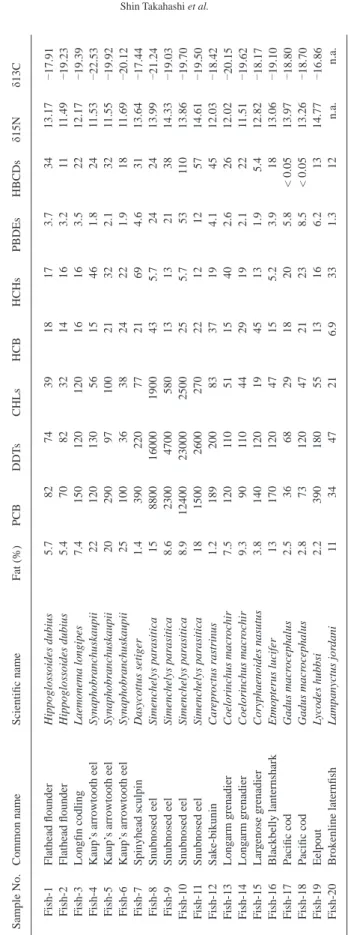
Concentrations of organohalogen compounds in deep-sea fi shes from off the Pacifi c coast of northern Japan are shown in Table 2. Although concentrations of organohalogen compounds var- ied among the species, concentrations of PCBs and DDTs were the highest among the OCs ana- lyzed, and other compounds were approximately in the order of CHLs > HCHs ≥ HCB. The pre- dominance of DDTs and PCBs in the fi shes analyzed in this study is similar to that in deep-sea organisms from Suruga Bay, Japan (Lee et al., 1997); Tosa Bay, Japan (Takahashi et al., 2001), western North Pacifi c, off-Tohoku, Japan (de Brito et al., 2002a), the East China Sea (Tanabe et al., 2005) and the Sulu Sea (Ramu et al., 2006). This may be due to the higher bioaccumulative properties and the continuous input of these compounds into the environment.
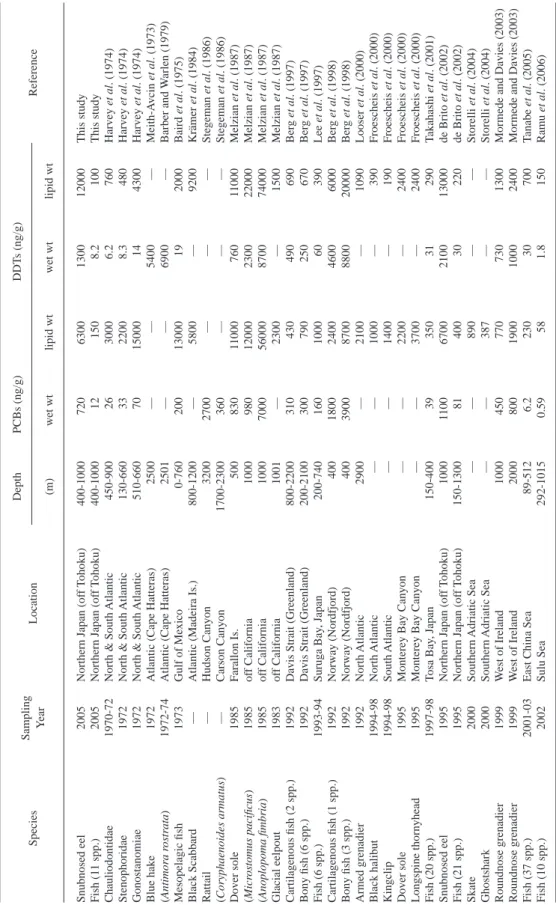
Concentrations of OCs such as PCBs and DDTs in deep-sea fi shes from off the Pacifi c coast of northern Japan were lower than those in deep-sea fi shes from the Atlantic Ocean (Meith-Avcin et al., 1973; Harvey et al., 1974; Barber and Warlen, 1979; Krämer et al., 1984; Looser et al., 2000; Froescheis et al., 2000), Gulf of Mexico (Baird et al., 1975), US coasts (Stegeman et al., 1986; Melzian et al., 1987) and the Arctic region (Hargrave et al., 1992; Berg et al., 1997, 1998;
Mormede and Davies, 2003) (Table 3). The relatively low contamination by OCs in the present
study area might be due to the less usage of these compounds in this region compared to that in the
Atlantic countries. In addition to this, decreasing trends of OCs have been noticed globally in re-
cent years in the marine environment even in the deep-sea, as evidenced in the Atlantic Ocean
between the 1970s and 1992. The samples analyzed in the present study were collected in 2005 and
factors like variations in analytical methods and fi sh species compared between the studies may
Table 2. Concentrations of organohalogen compounds (ng/g lipid wt), δ15N and δ13C in deep-sea fi shes from off the Pacifi c coast of northern Japan. n.a.: not analyzed. Sample No.Common nameScientifi c nameFat (%)PCBDDTsCHLsHCBHCHsPBDEsHBCDsδ15Nδ13C Fish-1Flathead fl ounderHippoglossoides dubius 5.7 82 74 39 18 17 3.7 34 13.17 17.91 Fish-2Flathead fl ounderHippoglossoides dubius 5.4 70 82 32 14 16 3.2 11 11.49 19.23 Fish-3Longfi n codlingLaemonema longipes7.4 150 120 120 16 16 3.5 22 12.17 19.39 Fish-4Kaup’s arrowtooth eelSynaphobranchuskaupii22 120 130 56 15 46 1.8 24 11.53 22.53 Fish-5Kaup’s arrowtooth eelSynaphobranchuskaupii20 290 97 100 21 32 2.1 32 11.55 19.92 Fish-6Kaup’s arrowtooth eelSynaphobranchuskaupii25 100 36 38 24 22 1.9 18 11.69 20.12 Fish-7Spinyhead sculpinDasycottus setiger1.4 390 220 77 21 69 4.6 31 13.64 17.44 Fish-8Snubnosed eelSimenchelys parasitica15 8800 16000190043 5.7 24 24 13.99 21.24 Fish-9Snubnosed eelSimenchelys parasitica8.6 2300 4700580 13 13 21 38 14.33 19.03 Fish-10Snubnosed eelSimenchelys parasitica8.9 12400 23000250025 5.7 53 110 13.86 19.70 Fish-11Snubnosed eelSimenchelys parasitica18 1500 260027022 12 12 57 14.61 19.50 Fish-12Sake-bikuninCareproctus rastrinus1.2 189 200 83 37 19 4.1 45 12.03 18.42 Fish-13Longarm grenadierCoelorinchus macrochir7.5 120 11051 15 40 2.6 26 12.02 20.15 Fish-14Longarm grenadierCoelorinchus macrochir9.3 90 110 44 29 19 2.1 22 11.51 19.62 Fish-15Largenose grenadierCoryphaenoides nasutus3.8 140 120 19 45 13 1.9 5.4 12.82 18.17 Fish-16Blackbelly lanternsharkEtmopterus lucifer13 170 120 47 15 5.2 3.9 18 13.06 19.10 Fish-17Pacifi c codGadus macrocephalus2.5 36 68 29 18 20 5.8 < 0.0513.97 18.80 Fish-18Pacifi c codGadus macrocephalus2.8 73 120 47 2123 8.5 < 0.0513.26 18.70 Fish-19EelpoutLycodes hubbsi 2.2 390 180 55 13 16 6.2 13 14.77 16.86 Fish-20Brokenline laternfi shLampanyctus jordani11 34 47 21 6.9 33 1.3 12 n.a.n.a.
Table 3. Comparison of mean concentrations of PCBs and DDTs in deep-sea fi shes from various parts of the world. — : not available. SpeciesSampling YearLocationDepth PCBs (ng/g) DDTs (ng/g) Reference (m)wet wt lipid wtwet wt lipid wt Snubnosed eel2005Northern Japan (off Tohoku)400-10007206300130012000This study Fish (11 spp.)2005Northern Japan (off Tohoku)400-1000121508.2100This study Chauliodontidae1970-72North & South Atlantic450-9002630006.2760Harvey et al. (1974) Stenophoridae1972North & South Atlantic130-6603322008.3480Harvey et al. (1974) Gonostanomiae1972North & South Atlantic510-6607015000144300Harvey et al. (1974) Blue hake1972Atlantic (Cape Hatteras)2500——5400—Meith-Avcin et al. (1973) (Antimora rostrata)1972-74Atlantic (Cape Hatteras)2501——6900—Barber and Warlen (1979) Mesopelagic fi sh1973Gulf of Mexico0-76020013000192000Baird et al. (1975) Black Scabbard —Atlantic (Madeira Is.)800-1200—5800—9200Krämer et al. (1984) Rattail—Hudson Canyon32002700———Stegeman et al. (1986) (Coryphaenoides armatus)—Carson Canyon1700-2300360———Stegeman et al. (1986) Dover sole1985Farallon Is.5008301100076011000Melzian et al. (1987) (Microstomus pacifi cus)1985off California100098012000230022000Melzian et al. (1987) (Anoplopoma fi mbria)1985off California1000700056000870074000Melzian et al. (1987) Glacial eelpout 1983off California1001—2300—1500Melzian et al. (1987) Cartilagenous fi sh (2 spp.)1992Davis Strait (Greenland)800-2200310430490690Berg et al. (1997) Bony fi sh (6 spp.)1992Davis Strait (Greenland)200-2100300790250670Berg et al. (1997) Fish (6 spp.)1993-94Suruga Bay, Japan200-740160100060390Lee et al. (1997) Cartilagenous fi sh (1 spp.)1992Norway (Nordfjord)4001800240046006000Berg et al. (1998) Bony fi sh (3 spp.)1992Norway (Nordfjord)40039008700880020000Berg et al. (1998) Armed grenadier 1992North Atlantic2900—2100—1090Looser et al. (2000) Black halibut 1994-98North Atlantic——1000—390Froescheis et al. (2000) Kingclip 1994-98South Atlantic——1400—190Froescheis et al. (2000) Dover sole 1995Monterey Bay Canyon——2200—2400Froescheis et al. (2000) Longspine thornyhead 1995Monterey Bay Canyon——3700—2400Froescheis et al. (2000) Fish (20 spp.)1997-98Tosa Bay, Japan150-4003935031290Takahashi et al. (2001) Snubnosed eel1995Northern Japan (off Tohoku)100011006700210013000de Brito et al. (2002) Fish (21 spp.)1995Northern Japan (off Tohoku)150-13008140030220de Brito et al. (2002) Skate 2000Southern Adriatic Sea——890——Storelli et al. (2004) Ghostshark2000Southern Adriatic Sea——387——Storelli et al. (2004) Roundnose grenadier1999West of Ireland10004507707301300Mormede and Davies (2003) Roundnose grenadier1999West of Ireland2000800190010002400Mormede and Davies (2003) Fish (37 spp.)2001-03East China Sea89-5126.223030700Tanabe et al. (2005) Fish (10 spp.)2002Sulu Sea292-10150.59581.8150Ramu et al. (2006)
also infl uence the differences in the OC levels.
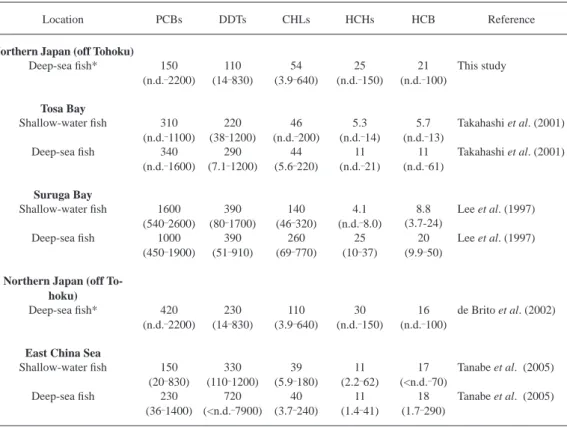
To understand the current status of OCs pollution in deep-sea fi shes from off the Pacifi c coast of northern Japan residue levels found in the present study were compared the with studies on deep-sea fi shes in adjoining areas carried out by our group (Table 4). Except for snubnosed eels (Simenchelys parasitica), which contained some OCs at extremely high concentrations, the con- centrations of PCBs, DDTs, CHLs and HCB in deep-sea fi shes collected from off the Pacifi c coast of northern Japan were comparable or lower than the data so far reported in our related studies in the western North Pacifi c region (Lee et al., 1997; Takahashi et al., 1998, 2000, 2001; de Brito et al., 2002a) and the East China Sea (Tanabe et al., 2005). It was noted that PCBs used in electrical equipment are continuously released into the environment (Hirai et al., 2003). In Japan, CHLs were used largely as a termiticide until 1986. Higher levels of PCBs and CHLs found in fi shes from other locations such as Suruga Bay were due to their proximity to urban cities with more intensive human activities. In addition, large scale use of DDT in agricultural practices and the subsequent runoff in the waterways have resulted in their accumulation in the freshwater, estuarine and marine environment of China (Yuan et al., 2001). This might explain the reason for the elevat- ed levels of DDT observed in deep-sea fi shes from the East China Sea. On the other hand, concen- trations of HCHs in deep-sea fi shes from off the Pacifi c coast of northern Japan were higher than those from other locations along the warm Kuroshio Current. Higher concentrations of HCHs in cold waters along the Oyashio Current than other offshore waters around Japan were also observed in a monitoring study using skipjack tuna (Katsuwonus pelamis) (Ueno et al., 2003). Due to high vapor pressure, HCHs are known to rapidly evaporate and be transported from their pollution
Table 4. Comparison of mean and range concentrations of organochlorines (ng/g lipid wt) between fi shes from the western North Pacifi c and East China Sea. Figures in parentheses indicate the range of concentrations. n.d.: not detected (for calculation of mean, n.d. was assumed to be 0). *Data without snubnosed eel.
Location PCBs DDTs CHLs HCHs HCB Reference
Northern Japan (off Tohoku)
Deep-sea fi sh* 150 110 54 25 21 This study
(n.d. 2200) (14 830) (3.9 640) (n.d. 150) (n.d. 100) Tosa Bay
Shallow-water fi sh 310 220 46 5.3 5.7 Takahashi et al. (2001)
(n.d. 1100) (38 1200) (n.d. 200) (n.d. 14) (n.d. 13)
Deep-sea fi sh 340 290 44 11 11 Takahashi et al. (2001)
(n.d. 1600) (7.1 1200) (5.6 220) (n.d. 21) (n.d. 61) Suruga Bay
Shallow-water fi sh 1600 390 140 4.1 8.8 Lee et al. (1997)
(540 2600) (80 1700) (46 320) (n.d. 8.0) (3.7-24)
Deep-sea fi sh 1000 390 260 25 20 Lee et al. (1997)
(450 1900) (51 910) (69 770) (10 37) (9.9 50) Northern Japan (off To-
hoku)
Deep-sea fi sh* 420 230 110 30 16 de Brito et al. (2002)
(n.d. 2200) (14 830) (3.9 640) (n.d. 150) (n.d. 100) East China Sea
Shallow-water fi sh 150 330 39 11 17 Tanabe et al. (2005)
(20 830) (110 1200) (5.9 180) (2.2 62) (<n.d. 70)
Deep-sea fi sh 230 720 40 11 18 Tanabe et al. (2005)
(36 1400) (<n.d. 7900) (3.7 240) (1.4 41) (1.7 290)
sources in the tropics and temperate regions to colder regions via the atmosphere (Iwata et al., 1993; Wania and Mackay 1996; Beyer et al., 2000). The distribution patterns of HCHs found in the biota refl ect such highly transportable nature of HCHs and its accumulation in the cold water cur- rent of the western North Pacifi c. Considering the above, the contamination status of OCs in deep- sea fi shes analyzed in this study seems to refl ect typical magnitude of OCs pollution in open water ecosystems of the western North Pacifi c.
Contamination status of BFRs
Polybrominated diphenyl ethers which are one of the most commonly used fl ame retardants were detected in all the deep-sea fi shes from off the Pacifi c coast of northern Japan (Table 2). The present study is the foremost to report the occurrence of PBDEs in deep-sea fi shes from the North Pacifi c region. The concentrations of PBDEs (ranged from 1.3 to 8.5 ng/g with mean 3.6 ng/g lipid wt) in deep-sea fi shes (except for snubnosed eels) from this region were lower than the levels reported for marine fi sh from Japanese coastal waters (Akutsu et al., 2001), various species of fi sh from the Belgian North Sea (Voorspoels et al., 2003) and coastal fi shes from Florida (Johnson- Restrepo et al., 2005), but comparable to those found in skipjack tuna from offshore waters of the North Pacifi c (Ueno et al., 2004) and higher than the levels in deep-sea fi shes from Sulu Sea (Ramu et al., 2006). Despite the low levels of PBDEs found in offshore waters, the detection of these compounds in deep-sea fi shes confi rms that PBDEs, like the classical POPs, are transport- able to the deep oceans and, thus, can cause global environmental contamination.
In addition to PBDEs, HBCDs were detected in almost all the deep-sea fi shes analyzed in this study. To our knowledge, this is the fi rst report on the detection of HBCDs in deep-sea biota. This result again indicates the widespread presence of such ‘emerging POPs’ even in deep oceans. The concentrations of HBCDs (ranged from 5.4 to 45 ng/g with mean 22 ng/g lipid wt) in deep-sea fi shes (except for snubnosed eels) from this region were lower than those in fi sh collected from the North Sea (Morris et al., 2004) and the Scheldt estuary in the Netherlands (Janak et al., 2005), but comparable to those found in skipjack tuna from offshore waters around Japan (Ueno et al., 2006).
On the other hand, concentrations of HBCDs in deep-sea fi shes were higher than those of PBDEs (Table 2). Higher concentrations of HBCDs than PBDEs were also observed in skipjack tuna col- lected from offshore waters around Japan (Ueno et al., 2004, 2006). Increasing levels of HBCDs, which appear to exceed those of PBDEs in recent years, were noted in recent studies on temporal trends of BFRs contamination in marine mammals stranded and collected around Japanese coastal waters (Tanabe et al., 2008). In Japan, consumption of HBCDs increased continuously from around 600 tons in 1986 to 2200 tons in 2001, while the use of PentaBDE and OctaBDE was withdrawn from the Japanese market in 1991 and 2000, respectively (Watanabe and Sakai, 2003). Consider- ing the remarkable increase in market demand for HBCDs in Japan, it can be anticipated that contamination by HBCDs in marine ecosystems around Japan may further increase because, un- like PBDEs, HBCDs are currently not regulated.
Species-specifi c accumulation of organohalogen compounds
It has been well demonstrated that gill-breathing organisms exchange OCs through the gills and equilibrate the levels between ambient water and body lipids (Clayton et al., 1977; Tanabe et al., 1984). In this study, concentrations of OCs and BFRs (wet wt basis) in deep-sea fi shes (except for snubnosed eels) were signifi cantly correlated with their body lipid content, but considerable variation between the species was observed even in the concentrations of OCs and BFRs on lipid weight basis. Particularly, snubnosed eel accumulated hydrophobic organohalogens (with log K
owca. 6 to 8) such as PCBs, DDTs, CHLs and PBDEs at extremely high concentrations (Table 2).
This is quite similar to the results found in our previous study on OCs in snubnosed eel (de Brito
et al., 2002a). This species can be considered as an organism at a high trophic level in the food web due to its strong carnivorous and unique feeding habit; this fi sh has been found to burrow into the body of large fi sh such as halibut and shark and feed on their intestine and blood (Caira et al., 1997). Relatively higher concentrations of the hydrophobic OCs and PBDEs were also found in large carnivore and/or bottom dwelling fi shes (e.g., blackbelly lanternshark (Etmopterus lucifer), eelpout (Lycodes hubbsi) and Kaup’s arrowtooth eel (Synaphobranchus kaupii)) (Table 2). These observations suggest that accumulation of these contaminants is infl uenced by biomagnifi cation and/or feeding habits of organisms and their long biological half-lives, i.e., higher uptake rate via food and slower equilibrium between ambient water and body lipids. In contrast, less lipophilic compounds (with log K
owless than 6), HCHs, HCB and HBCDs, showed smaller variation in con- centrations among species of different trophic levels and feeding habits, owing to their faster rates of attaining equilibrium water concentrations (Ellgehausen et al., 1980; Tanabe et al., 1984; Kelly et al., 2007). In addition to the difference in physico-chemical properties of the compounds, differ- ing rates of uptake and elimination which are dependent on biological factors, like respiration rate, lipid composition and metabolic activities of the organism, may infl uence the accumulation pattern of organic contaminants in organisms. Importance of these factors should be examined in future studies incorporating experiments and statistical models, including various biological processes for bioaccumulation/biomagnifi cation (Kelly et al., 2007) as well as further fi eld monitoring of various organohalogen compounds in marine ecosystems.
Food web structure and biomagnifi cation of organohalogen compounds
Increase in contaminant concentrations in a marine food web is diffi cult to assess because the predators diet often consists of prey organisms from different trophic levels and also depend on the availability of prey organisms. Hence, for further discussion of the biomagnifi cation of organo- halogen compounds, δ
15N and δ
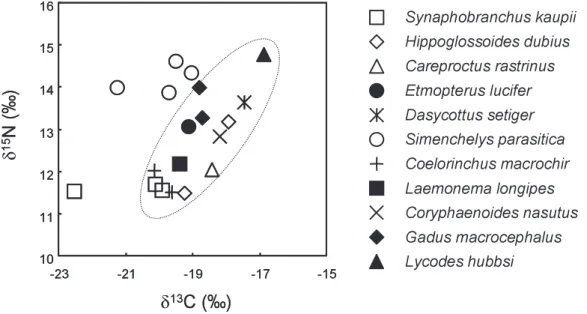
13C analyses were performed on deep-sea fi shes collected in this study to understand their general trophic level and differences in feeding habits. Fig. 2 shows the δ
13C and δ
15N map of deep-sea fi shes from off the Pacifi c coast of northern Japan. The stable iso- tope ratios of nitrogen δ
15N refl ect the trophic level of organisms in a food web (Hobson and Welch, 1992) and, thus, δ
15N analysis is often used to assess trophic transfer of contaminants (Fisk
Fig. 2. The food-web of deep-sea fi shes on the δ13C-δ15N map.
et al., 2001; Das et al., 2003; Kelly et al., 2007). It has been assumed that an increase in δ
15N value of ca. 3.8 with δ
13C value of ca. 1.0 corresponds to one trophic level (Hobson and Welch, 1992; Fisk et al., 2001). Although an eelpout and snubnosed eels showed relatively high δ
15N val- ues, the maximum difference of δ
15N values between the fi shes analyzed in this study was only 3.4.
This implies that almost all the fi shes are included within one trophic level, and snubnosed eels in this region probably do not prey upon higher trophic animals like shark and halibut.
On the other hand, large variation in δ
13C values was observed among the deep-sea fi shes (Fig. 2). The stable isotope ratios of δ
13C are varied due to different carbon sources. For example, organisms dependent on primary production from phytoplankton in offshore surface waters can be expected to have higher δ
13C values than those living in coastal regions affected by fresh water inputs (Michener and Schell, 1994). Fry and Wainright (1991) demonstrated that diatoms can be a source of
13C-rich carbon in many marine food webs. In Fig. 2, snubnosed eels and one Kaup’s arrowtooth eel appear to be outliers. A signifi cant positive correlation was found between δ
15N and δ
13C in deep-sea fi shes when the data of snubnosed eels and one Kaup’s arrowtooth eel were ex- cluded (p < 0.01, Speaman’s rank order correlation test). However, a wide range of δ
13C values (more than ca. 1.0) between fi shes was observed even after the exclusion of outliers, implying the existence of multiple carbon sources in the food web of this region. Although there are still unclear factors, lower δ
13C values observed in some fi shes, particularly snubnosed eels, may indicate that they are related to the food web which depends on carbon sources in sediments rather than fresh atmospheric carbon (enriched
13C) assimilated by phytoplankton in surface waters. To make clear such variation of carbon isotope in the food web it is necessary to collect surface sediments and particulate organic matter (POM) in the benthic and epibenthic ecosystems of deep-seas.
Signifi cant positive correlations were found between δ
15N (‰) and lipid normalized concen- trations of PCBs, DDTs and PBDEs (p < 0.05) showing their high biomagnifi cation potential in marine food webs (Fig. 3). No such relationship was found for HCB, HCHs and HBCDs (Fig. 3).
The rapid elimination of these compounds through gills to surrounding water and by excretion via other means may prevent biomagnifi cation of these compounds. Similar results on HCB and HCHs were observed in marine food webs (Ruus et al., 2002; Kelly et al., 2007). Relatively high water solubility of α-HBCD isomer (48.8 μg/l, Hunziker et al., 2004), which is a major contributor to total HBCD concentration as shown in the later section, may also result in lower biomagnifi cation of HBCDs than other hydrophobic organohalogen compounds such as PCBs, DDTs and PBDEs.
On the other hand, biomagnifi cation of α− and γ-HBCD isomers was reported in a Lake Ontario
food web (Tomy et al., 2004). Less biomagnifi cation observed for some organohalogen com-
pounds in this study may be due to smaller difference in trophic levels of fi shes as noted above. In
fact, there were no signifi cant correlations between δ
15N values and the concentrations of almost
all the compounds analyzed when the data of snubnosed eels was excluded (p > 0.05 for all OCs
and HBCDs, only a signifi cant relationship for PBDEs with p < 0.05, Spearman’s rank order cor-
relation test). In addition, such accumulation profi les of organohalogen compounds in deep-sea
fi shes may refl ect not only their trophic transfer but also different sources of the substances in the
food web and/or species-specifi c distribution of fi shes. As noted above, fi shes showing lower δ
13C
values such as snubnosed eels may be affected by substances originated from sediments. Interest-
ingly, snubnosed eels showed lower concentrations of HCHs than other fi shes with signifi cantly
higher concentrations of other hydrophobic OCs and PBDEs (Table 2 and Fig. 3). In our earlier
studies on deep-sea fi shes from the western North Pacifi c, off-Tohoku, Japan (Takahashi et al.,
2000; de Brito et al., 2002a) higher concentrations of PCBs, DDTs and CHLs were found in non-
migratory fi shes from deeper waters and, on the contrary, HCHs and HCB were accumulated at
higher concentrations in shallow/migratory fi shes. These observations may refl ect the vertical dis-
tribution of these contaminants in the water column of this region (until at least ca. 1000 m depth).
Fig. 3. Relationship between δ15N (‰) and organohalogen compounds (ng/g lipid wt) in deep-sea fi shes from off the Pacifi c coast of northern Japan.
Tanabe and Tatsukawa (1983) showed that the concentrations of HCHs signifi cantly decreased with depth in the open water column of the Pacifi c Ocean. Hargrave et al. (1992) reported that benthic amphipods from the Arctic continental shelf accumulated between ten to sixty times the concentrations of PCBs, DDTs and CHLs but only two to fi ve times those of HCHs and HCB found in pelagic plankton, and suggested that OCs with lower water solubility and higher affi nity for absorption to particles will be transported to deeper waters and incorporated into the benthic food web more readily than higher water soluble compounds. Snubnosed eel, a bathydemersal fi sh species, was collected from the deepest waters (900 m) in this study area. Therefore, results of this study are also suggestive of the distribution of OCs and BFRs in the ecosystem and the accumula- tion of hydrophobic OCs and PBDEs in the demersal fauna.
Composition of OCs
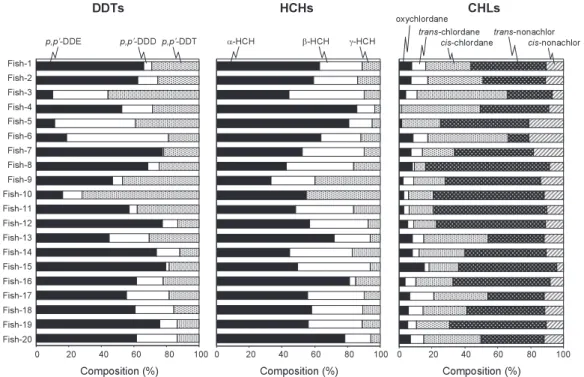
The residue patterns of OCs in organisms are infl uenced by the patterns in food, habitat and metabolism of the fi shes and refl ect environmental inputs of these compounds. Among DDT com- pounds, p, p’-DDE and p, p’-DDT were the predominant constituents in almost all the deep-sea fi shes (Fig. 4). Relatively high proportions (> 40%) of p, p’-DDT were found in some deep-sea fi shes compared to those reported in Suruga (Lee et al., 1997) and Tosa Bay, Japan (Takahashi et al., 2001). The present study area lies in the Kuroshio-Oyashio transitional zone which is a confl u- ence of various currents resulting in the formation of diverse water masses. Takahashi et al. (2000) analyzed myctophid fi shes from the western North Pacifi c, Japan and reported high proportion of p, p’-DDT (>50%) in non- or less-migratory fi shes living in mesopelagic waters. Similarly high proportions of p, p’-DDT (> 40%) were also found in Japanese common squid (Todarodes pacifi - cus) from off Sanriku, Japan even though this location seems to be far away from the sources of DDT (Ueno et al., 2003). It has been suggested that the North Pacifi c Intermediate Water (NPIW), which is found at depths of 300 800 m in the North Pacifi c subtropical gyre, originates from the
Fig. 4. Composition of DDTs, HCHs and CHLs in deep-sea fi shes from off the Pacifi c coast of northern Japan.
watermass in the Okhotsk Sea, and new NPIW is formed along the Kuroshio-Oyashio interfrontal zone (Yasuda, 1997). Elevated background levels of DDTs in the Okhotsk Sea have been reported in several studies (Iwata et al., 1995, 2000). In this context, the intermediate water in the study area can be expected to have relatively fresh input of DDTs, which originate from more contaminated Okhotsk Sea. However, information on the distribution of OCs and geophysical and geochemical studies, which can support this hypothesis, is very limited.
Among HCHs isomers, α-HCH was the predominant isomer in all the deep-sea fi shes of the present study (Fig. 4). It has been reported that the ratio of α-HCH to total HCH concentrations in seawater and fi sh has a tendency to increase with the increasing latitude (Iwata et al., 1993; Ueno et al., 2003). α-HCH is preferentially transported to northern colder regions due to higher vapor pressure among various HCH isomers. Higher proportion of α-HCH was found in fi shes from northern part of Japan, such as off-Tohoku and Japan Sea (Takahashi et al., 2000; de Brito et al., 2002). In case of CHLs, the most predominant CHL-related compound was trans-nonachlor, which is a stable form of the CHL-related compounds, followed by cis-chlordane, trans-chlordane, cis- nonachlor and oxychlordane (Fig. 4). Similar pattern was noted for walleye Pollock (Theragra chalcogramma) from the North Pacifi c and the Bering Sea (de Brito et al., 2002b).
Congener/isomer profi les of BFRs
Of the fourteen PBDE congeners analyzed, a total of nine congeners from tri- to deca-BDE were identifi ed in deep-sea fi shes of the present study (Fig. 5). The congener profi les of PBDEs varied between the species and, in most fi sh samples, the congeners from tri- to hexa-BDEs (BDE- 28, BDE-47, BDE-99, BDE-100, BDE-154) were predominant. The PBDE congener profi les var- ied between the species and the different profi les in the fi sh species could be related to specifi c uptake, metabolism, storage and excretion mechanisms. The higher contribution of BDE-47 to total BDE burdens could be attributable to a higher bioaccumulation potential of this congener and possible debromination of BDE-99 or other BDE congeners in biota tissues. In the present study, BDE-183 was not detected in any of the fi sh samples. Debromination of BDE-183 to lower conge- ners may be the reason, as experimental studies in fi sh have shown debromination of BDE-183 to BDE-154 (Stapleton et al., 2004). The higher brominated congeners from octa- to deca-BDE were detected in few samples, suggesting the relatively low bioaccumulation potential as well as the low bioavailability of these congeners. Accumulation of BDE-209 in some fi shes such as spinyhead sculpin (Dasycottus setiger) and largenose grenadier (Coryphaenoides nasutus) can be explained by their sediment dwelling habit as BDE-209 is mainly associated with sediments.
Among the HBCD isomers, α- and γ-HBCD were detected in all the samples, while β-isomer was below detection limits in most of the samples. The prevalence of α-HBCD has been observed in other aquatic biota samples like fi sh, shrimp and mussels (Morris et al., 2004; Tomy et al., 2004;
Janak et al., 2005; Ueno et al., 2006; Ramu et al., 2007). The dominance of α-HBCD over the other two isomers could be due to the isomer specifi c metabolism as well as the potential of α-HBCD for long range atmospheric transport. Zegers et al. (2005) reported that β- and γ-HBCD were signifi cantly metabolized when compared to α-HBCD, in the microsomal preparations of seal liver. Ueno et al. (2006) observed that, like that of α-HCH, the percentage contribution of α-HBCD also increased with increasing latitude and a high proportion of α-HBCD was found in skipjack tuna from the northern cold-water region of North Pacifi c, Japan. These results may indicate that α-HBCD could have the highest transportable potential among the HBCD isomers in the environ- ment.
Temporal trends of OCs
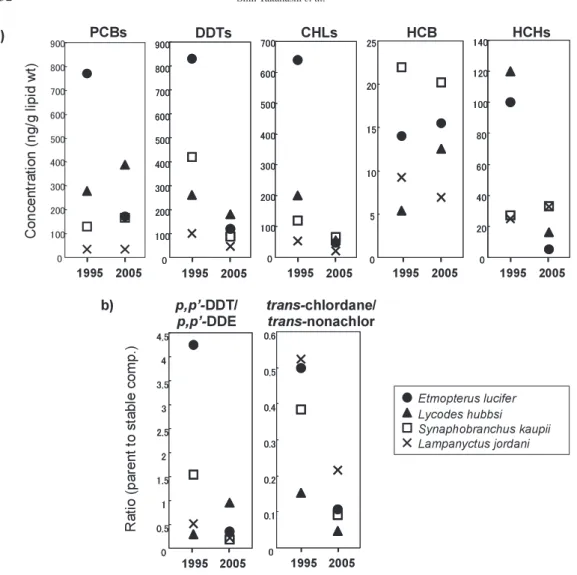
To elucidate the temporal trend of OCs contamination during the last decade, the results of the
present study were compared with the data reported for deep-sea fi shes in our earlier study (de Brito et al., 2002), in which the area of survey, off the Pacifi c coast of northern Japan, almost over- lapped the sampling locations of the present study. In Fig. 6, the concentrations of OCs (ng/g lipid wt) and ratios of parent to stable compounds of DDTs and CHLs were compared between the same species of fi shes collected in 1995 and 2005 (the data for snubnosed eels were excluded from the comparison because of the species-specifi c accumulation of OCs and large variation of data be- tween the individual specimens). Decreasing trends in the concentrations of DDTs and CHLs from 1995 to 2005 were observed in almost all the fi sh species analyzed. It is also noteworthy that ratios of parent compounds, p, p’-DDT and trans-chlordane, to stable compounds, p, p’-DDE and trans- nonachlor, respectively, which are an indication of recent input of technical DDTs and CHLs into the environment, decreased during this period. These results suggest declining environmental loads of DDTs and CHLs in this region during the last decade. On the other hand, no signifi cant trend was observed for the concentrations of PCBs, HCB and HCHs between 1995 and 2005.
Tanabe et al. (1994) reported residue levels of PCBs and DDTs in archived fat tissues of northern fur seals (Callorhinus ursinus) collected from northern North Pacifi c; 1) DDT levels declined continuously even in the 1980s and 1990s, and those levels at the end of the 1990s reached about one thirtieth of the maximum values found in the early 1970s; Nevertheless, 2) PCB levels in the 1980s and the 1990s showed a steady-state condition of about half the maximum value found in the 1970s; and 3) HCH and CHL levels were stable and no apparent decline was noticed since 1971. In addition, Kajiwara et al. (2004) confi rmed no apparent decline of HCB levels during 1971 to the 1990s by analyzing the same archived samples of northern fur seals. Except for CHLs, the results of the present study agree well with the data reported for OCs in northern fur seals.
Fig. 5. Congener/isomer profi les of BFRs (PBDEs and HBCDs) in deep-sea fi shes from off the Pacifi c coast of northern Japan.
Chlordane was used largely as a termitcide in Japan until 1986, even after the prohibition of its use as pesticide, and thus, it can be hypothesized that environmental levels of CHLs have not declined signifi cantly during the 1980s/90s. On the other hand, continuous release of PCBs and HCB from various sources (e.g., PCB containing wastes such as stored transformers and obsolete electrical and electric products, secondary formation of dioxin-like PCBs and HCB in combustion processes, generation of HCB as by-product in manufacturing processes etc.) has been suggested in Japan (Sakai et al., 2001; Hirai et al., 2003). No declining trend of HCH levels may be attributable to their long range atmospheric transport and cold condensation in the colder regions (Iwata et al., 1993; Wania and Mackay 1996; Beyer et al., 2000). In addition to the present study, further moni- toring studies are required to delineate contamination status by organohalogen compounds includ- ing emerging POPs such as PBDEs and HBCDs and their temporal trends in deep-sea fauna be- cause of their signifi cant increasing levels during the last decades in marine mammals and sediment cores from Japanese waters (Tanabe et al., 2008).
Fig. 6. Comparison of the concentrations of OCs (ng/g lipid wt) (a) and ratios of parent to stable compounds (b) in deep-sea fi shes from off the Pacifi c coast of northern Japan sampled in 1995 and 2005.
Acknowledgments
We thank the crew and staff members of the R/V Wakataka-maru and Fisheries Research Agency (FRA) for their help during the sampling. This study was supported by Global Center of Excellence (COE) Program of the Japanese Ministry of Education, Culture, Sports, Science and Technology and Grants-in-Aid for Scientifi c Research (S) (No. 20221003), (A) (No. 20241017) and (B) (18310046) from Japan Society for the Promotion of Science (JSPS). The award of JSPS Postdoctoral Fellowship to K. Ramu (No. P07153) is acknowledged.
References
Akutsu, K., H. Obana, M. Okihashi, M. Kitagawa, H. Nakazawa, Y. Matsuki, T. Makino, H. Oda and S. Hori, 2001. GC/MS analysis of polybrominated diphenyl ethers in fi sh collected from the Inland Sea of Seto, Japan. Chemosphere, 44:
1325 1333.
Baird, R. C., N. P. Thompson, T. L. Hopkins and W. R. Weiss, 1975. Chlorinated hydrocarbons in mesopelagic fi shes of the eastern Gulf of Mexico. Bulletin of Marine Science, 25: 473 481.
Barber, R. T and S. M. Warlen, 1979. Organochlorine insecticide residues in deep sea fi sh from 2500 m in the Atlantic Ocean.
Environmental Science and Technology, 13: 1146 1148.
Berg, V., K. I. Ugland, N. R. Hareide, P. E. Aspholm, A. Polder and J. U. Skaare, 1997. Organochlorine contamination in deep-sea fi sh from Davis Strait. Marine Environmental Research, 44: 135 148.
Berg, V., A. Polder and J. U. Skaare, 1998. Organochlorines in deep-sea fi sh from the Nordfjord. Chemosphere, 38:
275 282.
Beyer, A., D. Mackay, M. Matthies, F. Wania and E. Webster, 2000. Assessing long-range transport potential of persistent organic pollutants. Environmental Science and Technology, 34: 699 703.
Caira, J. N., G. W. Benz, J. Borucinska and N. E. Kohler, 1997. Pugnose eels Simenchelys parasiticus (Synaphobranchidae) from the heart of a shortfi n mako Isurus oxyrinchus (Lamnidae). Environmental Biology of Fishes, 49: 139 144.
Clayton, J. R., S. P. Pavlou and N. F. Breitner, 1977. Polychlorinated biphenyls in coastal marine zooplankton: bioaccumula- tion by equilibrium partitioning. Environmental Science and Technology, 11: 676 682.
Das, K., C. Beans, L. Holsbeek, G. Mauger, S. D. Berrow, E. Rogan and J. M. Bouquegneau, 2003. Marine mammals from Northeast Atlantic: relationship between their trophic status as determined by δ13C and δ15N measurements and their trace metal concentrations. Marine Environmental Research, 56: 349 365.
de Brito, A. P. X., S. Takahashi, D. Ueno, H. Iwata, S. Tanabe and T. Kubodera, 2002a. Organochlorine and butyltin residues in deep-sea organisms collected from the western North Pacifi c, off-Tohoku, Japan. Marine Pollution Bulletin, 45:
348 361.
de Brito, A. P. X., D. Ueno, S. Takahashi and S. Tanabe, 2002b. Organochlorine and butyltin residues in walleye pollock (Theragra chalcogramma) from Bering Sea, Gulf of Alaska and Japan Sea. Chemosphere, 46: 401 411.
Ellgehausen, H., J. A. Guth and H. O. Esser, 1980. Factors determining the bioaccumulation potential of pesticides in the individual compartments of aquatic food chains. Ecotoxicology and Environmental Safety, 4: 137 157.
Fisk, A. T., K. A. Hobson and R. J. Norstrom, 2001. Infl uence of chemical and biological factors on trophic transfer of per- sistent organic pollutants in the Northwater Polyna marine food web. Environmental Science and Technology, 35:
732 738.
Froescheis, O., R. Looser, G. M. Cailliet, W. M. Jarman and K. Ballschmiter, 2000. The deep-sea as a fi nal global sink of semivolatile persistent organic pollutants? Part 1: PCBs in surface and deep-sea dwelling fi sh of the North and South Atlantic and the Monterey Bay Canyon (California). Chemosphere, 40: 651 660.
Fry, B. and S. C. Wainright, 1991. Diatom sources of 13C-rich carbon in marine food webs. Marine Ecology Progress Series, 76: 149 1573.
Harvey, G. R., H. P. Miklas, V. T. Bowen and W. G. Steinhauer, 1974. Observations on the distribution of chlorinated hydro- carbons in Atlantic Ocean organisms. Journal of Marine Research, 32: 103 118.
Hargrave, B. T., G. C. Harding, W. P. Vass, P. E. Erickson, B. R. Fowler and V. Scott, 1992. Organochlorine pesticides and polychlorinated biphenyls in the Arctic Ocean food web. Archives of Environmental Contamination and Toxicology, 22:
41 54.
Hirai, Y., H. Takatsuki and S. Sakai, 2003. Comparative risk assessment for storage and destruction of PCB waste. Journal of Environmental Chemistry, 13: 103 115. (In Japanese)
Hobson, K. A. and H. E. Welch, 1992. Determination of trophic relationships within a high Arctic marine food web using δ13C and δ15N analysis. Marine Ecology Progress Series, 84: 9 18.
Hunziker, R. W., S. Gonisor, J. A. MacGregor, D. Desjardins, J. Ariano and U. Friederich, 2004. Fate and effect of hexabro-
mocyclododecane in the environment. Organohalogen Compounds, 66: 2300 2305.
Iwata, H., S. Tanabe, N. Sakai and R. Tatsukawa, 1993. Distribution of persistent organochlorines in the oceanic air and surface seawater and the role of ocean on their global transport and fate. Environmental Science and Technology, 27:
1080 1098.
Iwata, H., S. Tanabe, E. Ouchi and R. Tatsukawa, 1995. Persistent organochlorines in air and water from east Siberia. In:
Abstracts, Second SETAC (Society of Environmental Toxicology and Chemistry) World Congress. SETAC, Vancouver, BC, p.77.
Iwata, H., M. Watanabe, E. Y. Kim, R. Gotoh, G. Yasunaga, S. Tanabe, Y. Masuda and S. Fujita, 2000. Contamination chlo- rinated hydrocarbons and lead in Steller’s sea eagle and whited-tailed sea eagle from Hokkaido, Japan. In: M. Ueta and M. J. McGrady (eds.), First Symposium on Steller’s and whited-tailed sea eagles in East Asia, pp. 91 106. Wild Bird Society of Japan, Tokyo.
Janak, K., A. Covaci, S. Voorspoels and G. Becher, 2005. Hexabromocyclododecane in marine species from the Western Scheldt Estuary: Diastereoisomer- and Enantiomer-Specifi c accumulation. Environmental Science and Technology, 39:
1987 1994.
Johnson-Restrepo, B., K. Kannan, R. Addink and D. H. Adams, 2005. Polybrominated diphenyl ethers and polychlorinated biphenyls in a marine foodweb of coastal Florida. Environmental Science and Technology, 39: 8243 8250.
Kajiwara N., D. Ueno, I. Monirith, S. Tanabe, M. Pourkazemi and D. G. Aubrey, 2003. Contamination by organochlorine compounds in sturgeons from Caspian Sea during 2001 and 2002. Marine Pollution Bulletin, 46: 741 747.
Kajiwara, N., D. Ueno, A. Takahashi, N. Baba and S. Tanabe, 2004. Polybrominated diphenyl ethers and organochlorines in archived northern fur seal samples from the Pacifi c coast of Japan, 1972–1998. Environmental Science and Technology, 38: 3804 3809.
Kelly, B. C., M. G. Ikonomou, J. D. Blair, A. E. Morin and Frank A. P. C. Gobas, 2007. Food-web specifi c biomagnifi cation of persistent organic pollutants. Science, 317: 236 239.
Krämer, W., H. Buchert, U. Reuter, M. Biscoito, D. G. Maul, G. LeGrand and L. Ballschmiter, 1984. Global baseline pollu- tion studies IV: C6-C12 organochlorine compounds in surface-water and deepsea fi sh from the eastern North Atlantic.
Chemosphere, 13: 1255 1267.
Lee, J. S., S. Tanabe, N. Takemoto and T. Kubodera, 1997. Organochlorine residues in deep-sea organisms from Suruga Bay, Japan. Marine Pollution Bulletin, 34: 250 258.
Looser, R., O. Froescheis, G. M. Cailliet, W. M. Jarman and K. Ballschmiter, 2000. The deep-sea as a fi nal sink of semi volatile persistent organic pollutants? Part 11: organochlorine pesticides in surface and deep-sea dwelling fi sh of the North and South Atlantic and the Monterey Bay Canyon (California). Chemosphere, 40: 661 670.
Meith-Avcin, N., S. M. Warlen and R. T. Barber, 1973. Organochlorine insecticide residues in bathyl-demersal fi sh from 2500 meters. Environmental Letters, 5: 215 221.
Melzian, B., C. Zoffmann and R. B. Spies, 1987. Chlorinated hydrocarbons in lower continental slope fi sh collected near the Farallon Islands, California. Marine Pollution Bulletin, 18: 388 393.
Michener, R. H., and D. M. Schell, 1994. Stable isotope ratios as tracers in marine aquatic food webs. In: R. H. Michener and K. Lathja (eds.), Stable isotopes in ecology and environmental science, pp. 138 157. Blackwell Scientifi c Publications, Oxford.
Mormede, S. and I. M. Davies, 2003. Horizontal and vertical distribution of organic contaminants in deep-sea fi sh species.
Chemosphere, 50: 563 574.
Morris, S., C. R. Allchin, B. N. Zegers, J. J. H. Haftka, J. P. Boon, C. Belpaire, P. E. G. Leonards, S. P. J. Van Leeuwen and J. de Boer, 2004. Distribution and fate of HBCD and TBBPA brominated fl ame retardants in North Sea estuaries and aquatic food webs. Environmental Science and Technology, 38: 5497 5504.
Ramu, K., N. Kajiwara, H. Mochizuki, H. Miyasaka, K. A. Asante, S. Takahashi, S. Nishida and S. Tanabe, 2006. Occurrence of organochlorine pesticides, polychlorinated biphenyls and polybrominated diphenyl ethers in deep-sea fi shes from the Sulu Sea. Marine Pollution Bulletin, 52: 1827 1832.
Ramu, K., N. Kajiwara, T. Isobe, S. Takahashi, E. Y. Kim, B. Y. Min, S. U. We and S. Tanabe, 2007. Spatial distribution and accumulation of brominated fl ame retardants, polychlorinated biphenyls and organochlorine pesticides in blue mussels (Mytilus edulis) from coastal waters of Korea. Environmental Pollution, 148:562 569.
Ruus, A., K. I. Ugland and J. U. Skaare, 2002. Infl uence of trophic position on organochlorine concentrations and composi- tional patterns in a marine food web. Environmental Toxicology and Chemistry, 21: 2356 2364.
Sakai, S., Y. Hirai and H. Takatsuki, 2001. Stockholm convention and its future perspective: Environmental emissions and their sources of hexachlorobenzene (HCB). Waste Management Research, 12: 349 362.
Solé, M., C. Porte and J. Albaigés, 2001. Hydrocarbons, PCBs and DDT in the NW Mediterranean deep-sea fi sh Mora moro.
Deep-Sea Research, 48: 495 513.
Stapleton, H. M., M. Alaee, R. J. Letcher and J. E. Baker, 2004. Debromination of the fl ame retardant decabromodiphenyl ether by juvenile carp (Cyprinus carpio) following dietary exposure. Environmental Science and Technology, 38:
112 119.
Stegeman, J. J., P.J. Kloepper-Sams and J. W. Farrington, 1986. Monooxygenase induction and chlorobiphenyls in the deep- sea fi sh Coryphaenoides armatus. Science, 231: 1287 1289.
Storelli, M. M., A. Storelli, R. D’ Addabbo, G. Barone and G. O. Marcotrigiano, 2004. Polychlorinated biphenyl residues in deep-sea fi sh from the Mediterranean Sea. Environment International, 30: 343 349.
Tanabe, S. and R. Tatsukawa, 1983. Vertical transport and residence time of chlorinated hydrocarbons in the open ocean water column. Journal of the Oceanographical Society of Japan, 39: 53 62.
Tanabe, S., H. Tanaka and R. Tatsukawa, 1984. Polychlorobiphenyls, DDT, and hexachlorocyclohexane isomers in the west- ern North Pacifi c ecosystem. Archives of Environmental Contamination and Toxicology, 13: 731 738.
Tanabe, S., J. K. Sung, D. Y. Choi, N. Baba, M. Kiyota, K. Yoshida and R. Tatsukawa, R., 1994. Persistent organochlorine residues in northern fur seal from the Pacifi c coast of Japan since 1971. Environmental Pollution, 85: 305 314.
Tanabe, S., K. Ramu, H. Mochizuki, H. Miyasaka, N. Okuda, M. Muraoka, N. Kajiwara, S. Takahashi and T. Kubodera, 2005.
Contamination and distribution of persistent organochlorine and organotin compounds in deep-sea organisms from East China Sea. In: K. Hasegawa, G. Shinohara and M. Takeda (eds.), Deep-sea Fauna and Pollutants in Nansei Islands.
National Science Museum Monographs, (29): 453 476.
Tanabe, S., K. Ramu, T. Isobe and S. Takahashi, 2008. Brominated fl ame retardants in the environment of Asia-Pacifi c: an overview of spatial and temporal trends. Journal of Environmental Monitoring, 10: 188 197
Tatsukawa, R. and S. Tanabe, 1984. Environmental monitoring: geochemical and biochemical behavior of PCBs in the open ocean environment. In: M. C. Barros, H. Koemann and R.Visser (eds), Proceeding of PCB seminar, Ministry of Housing, Physical Planning and Environment, The Netherlands, pp. 343 372.
Takahashi, S., J. S. Lee, S. Tanabe and T. Kubodera, 1998. Contamination and specifi c accumulation of organochlorine and butyltin compounds in deep-sea organisms collected from Suruga Bay, Japan. Science of the Total. Environment, 214:
49 64.
Takahashi, S., S. Tanabe and K. Kawaguchi, 2000. Organochlorine and butyltin residues in mesopelagic myctophid fi shes from the western North Pacifi c. Environmental Science and Technology, 34: 5129 5136.
Takahashi, S., S. Hayashi, R. Kasai, S. Tanabe and T. Kubodera, 2001. Contamination of deep-sea organisms from Tosa Bay, Japan by organochlorine and butyltin compounds. In: T. Fujita, H. Saito and M. Takeda (eds.), Deep-sea Fauna and Pol- lutants in Tosa Bay. National Science Museum Monographs, (20): 363 380.
Tomy, G. T., W. Budakowski, T. Halldorson, D. M. Whittle, M. J. Keir, C. Marvin, G. Macinnis and M. Alaee, 2004. Biomag- nifi cation of α- and γ-hexabromocyclododecane isomers in a Lake Ontario food web. Environmental Science and Tech- nology, 38: 2298 2303.
Ueno, D., S. Takahashi, H. Tanaka, An. Subramanian, G. Fillman, H. Nakata, P. K. S. Lam, J. Zheng, M. Muchtar, M. Pru- dente, K. H. Chung and S. Tanabe, 2003. Global pollution monitoring of PCBs and organochlorine pesticides using skipjack tuna as a bioindicator. Archives of Environmental Contamination and Toxicology, 45: 378 389.
Ueno, D., N. Kajiwara, H. Tanaka, An. Subramanian, G. Fillmann, P. K. S. Lam, G. J. Zheng, M. Muchtar, H. Razak, M.
Prudente, K. H. Chung and S. Tanabe, 2004. Global pollution monitoring of polybrominated diphenyl ethers using skipjack tuna as a bioindicator. Environmental Science and Technology, 38: 2312 2316.
Ueno, D., M. Alaee, C. Marvin, D. C. G. Muir, G. Macinnis, E. Reiner, P. Crozier, V. I. Furdui, An. Subramanian, G. Fillmann, P. K. S. Lam, G. J. Zheng, M. Muchtar, H. Razak, M. Prudente, K. H. Chung and S. Tanabe, 2006. Distribution and transportability of hexabromocyclododecane (HBCD) in the Asia-Pacifi c region using skipjack tuna as a bioindicator.
Environmental Pollution, 144: 238 247.
Voorspoels, S., A. Covaci and P. Schepens, 2003. Polybrominated diphenyl ethers in marine species from the Belgian North Sea and the Western Scheldt Estuary: levels, profi les, and distribution. Environmental Science and Technology, 37:
4348 4357.
Wania, F. and D. Mackay, 1996. Tracking the distribution of persistent organic pollutants. Environmental Science and Tech- nology, 30: 390 396.
Watanabe, I. and S. Sakai, 2003. Environmental release and behavior of brominated fl ame retardants. Environment Interna- tional, 29: 665 682.
Woodwell, G. M., P. P. Craig and H. A. Johnson, 1971. DDT in the biosphere: where does it go? Science, 174: 1101 1107.
Yasuda, I., 1997. The origin of the North Pacifi c Intermediate Water. Journal of Geophysical Research, 102: 893 909.
Yuan, D., D. Yang, T. L. Wade and Y. Qian, 2001. Status of persistent organic pollutants in the sediment from several estuar- ies in China. Environmental Pollution, 114: 101 111.
Zegers, B. N., W. E. Lewis, K. Booji, R. H. Smittenberg, W. Boer, J. de Boer and J. P. Boon, 2003. Levels of polybrominated diphenyl ether fl ame retardants in sediment cores from Western Europe. Environmental Science and Technology, 37:
3803 3807.