Introduction
Yamanashi Prefecture, situated in the middle of Honshu, is not a large prefecture, occupying an area of 4,465.37 km2, but its natural environ- ments are diversified and fairly well preserved.
About 78% of the area, ranging from 70 to 3,776 m in altitude, is covered with various kinds of forests, which provide excellent habitats for phytophagous insects. The sawfly fauna of Ya- manashi Prefecture should be very rich, but our knowledge on this subject is rather poor and only scattered collection records published in various taxonomic works are available for the moment.
The first record of the sawfly family Pamphili- idae from Yamanashi Prefecture dates back to Yano’s (1919, 1920) reports on the infestation of larch by “Cephaleia kaebelei [sic] Rohwer”.
Since then, 28 species of the family were added to the Yamanashi fauna by Takeuchi (1938) and Shinohara (1985a, etc.; see under respective species).
The present work is an attempt to get together all the information on the family Pamphiliidae in Yamanashi Prefecture. All the published records
are summarized and new collection records are given mainly based on the study of the collection of the National Museum of Nature and Science, Tokyo (NSMT), and the private collection of H.
Suda (HSC). Other depositories of the material examined are H. Kumamoto collection (HKC), H. Nagase collection (HNC), and Kobe Universi- ty collection (KU).
We wish to thank H. Kumamoto (Hirakata), H.
Nagase (Kamakura), and T. Naito (Kobe Univer- sity, Kobe) for the loan of the material.
Results and Discussion
We have recognized 36 species of four genera of Pamphiliidae occurring in Yamanashi Prefec- ture. They are seven species of Acantholyda, three species of Cephalcia, seven species of Onycholyda, and 19 species of Pamphilius (see Table 1 and the enumeration below). Of these, 29 species are already known to occur in Yamanashi Prefecture, while six species are newly recorded in this work. One remaining species, a Cephalcia, has not been identified.
Pamphiliid Sawflies (Insecta, Hymenoptera) from Yamanashi Prefecture, Central Honshu, Japan
Akihiko Shinohara1, Hirohisa Suda2and Hideo Takahashi3
1Department of Zoology, National Museum of Nature and Science, 3–23–1 Hyakunin-cho, Shinjuku-ku, Tokyo, 169–0073 Japan
E-mail: [email protected]
22–13–8 Sennari, Sakura-shi, Chiba, 285–0034 Japan
3876–1–203 Higashiasakawa-machi, Hachioji-shi, Tokyo, 193–0834 Japan
Abstract Collection data are given for 36 species of pamphiliid sawflies of the genera Acan- tholyda, Cephalcia, Onycholydaand Pamphiliusfrom Yamanashi Prefecture, central Honshu. Of these, one species of Cephalciahas not been determined and two species of Onycholydaand four species of Pamphilius are newly recorded from Yamanashi Prefecture. Compared with the other well-investigated areas in Honshu, the pamphiliid fauna of Yamanashi Prefecture is very rich, hav- ing the largest number of species in total (the same number as that of Tochigi Prefecture) and in the “northern group” of species.
Key words : Hymenoptera, Pamphiliidae, fauna, Yamanashi Prefecture, Honshu, Japan.
Table1.Pamphiliidae recorded in six areas in Honshu (undetermined species not included). Hyogo Pref.Ishikawa Pref.Yamanashi Pref. KamiangeTochigi Pref.Aomori Pref. [0–1510m alt.][0–2702m alt.][70–3776m alt.][ca. 400m alt.][0–2578m alt.][0–1625m alt.] Subfamily CEPHALCIINAE Genus ACANTHOLYDA Subgenus AcantholydaA. nipponicaxxxx Subgenus ItycorsiaA. albomaculataxx A. alpinax A. iwatai xxx A. kojimaixx A. mizunoixx A. posticalis posticalisxx A. sasakiixxxx A. tsuyukiixx A. laricisx Genus CEPHALCIA C. lariciphila japonicaxx C. koebeleix C. variegataxx Subfamily PAMPHILIINAE Genus NEUROTOMA Subgenus NeurotomaN. iridescensxxxxx Subgenus GongylocorsiaN. atratax N. haraixx Genus CHRYSOLYDA C. leucocephalax Genus ONYCHOLYDA O. amplectagroupO. decorataxxxxx O. esakiixxxxx O. lucidaxxxxxx O. minomalisxxxxxx O. moriutiixx O. similisxxxxx O. tenuisxxxx O. viriditibialisxxxxxx O. luteicornis groupO. kumamotonisxxx
Table1.(Continued). Hyogo Pref.Ishikawa Pref.Yamanashi Pref. KamiangeTochigi Pref.Aomori Pref. [0–1510m alt.][0–2702m alt.][70–3776m alt.][ca. 400m alt.][0–2578m alt.][0–1625m alt.] Genus PAMPHILIUS P. basilaris groupP. basilarisx P. alternans groupP. komonensisxxxxxx P. takeuchiixxxxxx P. sulphureipes groupP. ishikawaixxxxxx P. zhelochovtsevi nipponicusxxxx P. histrio groupP. brevicornis ibukiixx P. tricolorx P. vafer groupP. confususxxxx P. flavipectusxxx P. nakagawaixxxx P. lobatusxxxxx P. venustusxxxx P. kamikochensisxxx P. archiducalisxx P. naokoaex P. opacusx P. hortorumx P. itoixxxxxx P. variusxxx P. togashiixxxx P. sylvaticus groupP. alnicolaxx P. benesixxxxxx P. daisenusxxx P. gracilisx P. japonicusxxxx P. volatilisxxxxxx P. inanitusgroupP. hilarisxxx Total number of species243235193526 B/T ratio (see text for explanation)0.750.590.460.840.510.62 N/B ratio (see text for explanation)0.170.53100.780.56 Naito et al.Togashi (1998) ShinoharaNakamura (2003) Shinohara and Main referencesShinohara and present workShinohara and (2004) Yamada (2005)(2002) Yamada (2005)Yamada (2005) Heavily shadowed: Species of the “basic group”Lightly shadowed: Species of the “northern group”
Noteworthy species and probable additions in the future
The occurrence of three rare species of Pam- philius in Yamanashi Prefecture is noteworthy.
Pamphilius naokoae Shinohara, 1999, which is endemic to Yamanashi Prefecture, is known only from the type series collected at Masutomi-kosen in the northern part of the prefecture (for more information, see comments under the species).
Pamphilius brevicornis ibukii Shinohara, 1995, and P. tricolor Benesˇ, 1974, are also very rare species. In Honshu, the former is known only by one specimen each from Ishikawa and Yamanashi Prefectures and the latter by one specimen each from Niigata and Yamanashi Prefectures.
On the other hand, some relatively common or widespread pamphiliid species have not been found in Yamanashi Prefecture. Among these are Cephalcia variegataTakeuchi, 1930, Neurotoma iridescens (André, 1882), Onycholyda kumamo- tonis(Matsumura, 1912), Pamphilius zhelochov- tsevi nipponicus Shinohara, 1993, P. japonicus Shinohara, 1985, P. togashiiBenesˇ, 1977, and P.
varius(Audinet-Serville, 1823). Of these, C. vari- egata will certainly be found on Pinus pumila stands in the subalpine zones of Yatsugatake or Akaishi Mountains, and P. variuson Betulatrees on the same mountain ranges. Onycholyda ku- mamotonis will be found on Filipendula in the areas where P. venustus, a species also associated with this plant, has been collected. Neurotoma iridescens is rather common and widespread in central Honshu. Other three species of Pam- philiusare not common but widely distributed in Honshu, including prefectures around Ya- manashi. Further collectings will certainly reveal the occurrence of these species in Yamanashi Prefecture. A very rare species, Chrysolyda leu- cocephala (Takeuchi, 1938), has been collected at Shiratsuka-rindo on the southwestern slope of Mt Fujisan in Shizuoka Prefecture (1/, 21. V.
1978, S. Tsuyuki, NSMT); this species is also likely to be found in Yamanashi Prefecture.
Comparison with other prefectures and nature of local pamphiliid faunae in Honshu
Table 1 shows the pamphiliid species known to occur in five prefectures and one area in Honshu.
Besides the entry of Yamanashi Prefecture, the table was already published by Shinohara and Yamada (2005). These are the best-investigated areas in Honshu in terms of pamphiliid fauna.
The pamphiliid fauna of Yamanashi Prefecture is very rich, comparable only to that of Tochigi Pre- fecture, according to the present study. In Hon- shu, a little more species of the Pamphiliidae may have been recorded or collected in Nagano Prefecture, but the collection data from the pre- fecture have not been worked out.
Shinohara and Yamada (2005), based on distri- bution patterns, roughly classified the pamphiliid species in Honshu into three categories, the
“basic group”, the “northern group”, and the
“others”, and proposed to use two different ra- tios, the B/T ratio and the N/B ratio, for compar- ing the species compositions of the local pam- philiid faunae in Honshu. The species of the
“basic group” occur widely in Honshu (ideally in all prefectures), whereas the species of the
“northern group” occur mainly on mountains of central to northern Honshu. The “others” include rare species without sufficient information on distribution; possibly, they may eventually be al- located into “basic” or “northern” groups. The B/T ratio is the ratio of the species number of the
“basic group” to the total number of species oc- curring in the area, whereas the N/B ratio is the ratio of the number of species of the “northern group” to that of the “basic group” found in the area. The use of these ratios may help to under- stand the characteristics of the pamphiliid faunae at the prefecture or lower levels (see Shinohara and Yamada, 2005, for more details).
The number of the species included in the
“basic group” is expected to increase as our knowledge on the pamphiliid fauna of Honshu grows (Shinohara and Yamada, 2005). After the data of the Yamanashi Prefecture are added, we propose to treat 20 species (heavily shadowed in Table 1) as belonging to the “basic group”. The representatives of the “basic group” in this work are widespread species recorded in four or more
areas out of the six areas treated and are expected to be found eventually in all prefectures in Hon- shu. Pamphilius confusus Shinohara, 2005, P.
nakagawai Takeuchi, 1930, and P. venustus (Smith, 1874) were recorded from four areas, but they are not likely to be found in western Honshu because their known host plants are not distrib- uted or rarely found there (Shinohara and Morita, 2003; Shinohara, 2005); therefore, these species are not included in the “basic group”. The
“northern group” (lightly shadowed in Table 1) is also redefined here to include the species of the Cephalciinae, the Pamphilius vafer group, and the Pamphilius histrio group, excluding the species included in the “basic group”, and Onycholyda kumamotonis (Matsumura, 1912), which is very similar to Pamphilius venustus, a member of the P. vafer group, in biology and distribution.
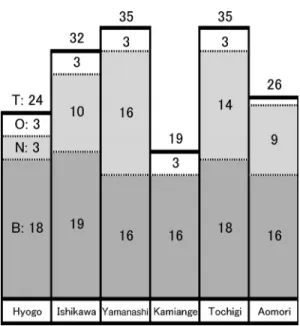
Figure 1 shows the number of species, allocat- ed into three categories, for each prefecture and area, and the B/T and N/B ratios calculated for each prefecture and area are given in Table 1.
Among the six areas, Kamiange is exceptional. It is not a prefecture but a small area about 400 m high in the west of Tokyo (Shinohara, 2002). It shows the highest B/T ratio of 0.84 and the low- est N/B ratio of 0, meaning that its pamphiliid fauna is mostly composed of the species of the
“basic group” and no species of the “northern group” have been found there (see also Fig. 1).
This is probably a typical species composition of the Pamphiliidae in the lowlands of central Hon- shu. On the other hand, Yamanashi Prefecture shows the lowest B/T ratio (0.46) and the highest N/B ratio (1) among the six areas considered.
The low value of the B/T ratio, shared by Tochigi Prefecture (0.51), simply shows the relatively small share of the “basic group” and consequent- ly high species diversity of the pamphiliid sawflies in the prefecture. The very high value of the N/B ratio, also shared by Tochigi Prefecture (0.78), indicates a very rich representation of the species of the “northern group” in Yamanashi Prefecture.
As shown in Fig. 1, the species of the “basic
group” may occur in all prefectures in Honshu (thus “basic”) and additional occurrence of the
“northern group” species in each prefecture will determine the total species diversity of the Pam- philiidae in the prefecture. Yamanashi Prefecture, having the largest number of the species of the
“northern group” (16), apparently has the most diverse pamphiliid fauna in Honshu.
List of Pamphiliidae from Yamanashi Prefecture (The numerals in brackets after the locality
names in the collection data refer to the numerals in the map, Fig. 2)
Acantholyda albomaculata Shinohara, 1985
[Japanese name: Shiromon-matsu-hiratahabachi]
Distribution. Japan (central to western Hon- shu, Shikoku).
Fig. 1. Diagram showing the number of species of pamphiliid sawflies, classified into three cat- egories, for each of Hyogo, Ishikawa, Ya- manashi, Tochigi, and Aomori Prefectures and Kamiange area. B (heavily shadowed): The
“basic group”. N (lightly shadowed): The
“northern group”. O (not shadowed): Others.
T: Total number of species known to occur in the area. See text for more explanation.
Material examined. 1? from Hatchodaira [15], Mt. Kimpu-zan, 1/ (paratype) from Aoki- gahara [48], 1/ from Fuji-rindo recorded by Shi- nohara (1985b, 2001a)
Host plant. Unknown.
Remarks. This species has been recorded from Honshu (Yamanashi, Nagano, Mie, Nara and Hyogo Prefectures) and Shikoku (Kochi Pre- fecture) (Shinohara, 2001a). In Yamanashi Pre- fecture, three collection records were published by Shinohara (1985b, 2001a).
Acantholyda iwataiTakeuchi, 1938
[Japanese name: Iwata-hiratahabachi]
Distribution. Japan (Honshu, Shikoku, Kyushu).
Material examined. 1/ and 2? from Fuji- rindo, 1? from Masutomi-kosen [13], and 1/
from Mt. Kimpu-zan [17], all recorded by Shino- hara (2001a).
Host plant. Unknown.
Remarks. This species is known to occur in Honshu (Aomori, Tochigi, Yamanashi, Nagano, Aichi Prefectures), Shikoku (Tokushima Prefec- ture), and Kyushu (Kagoshima Prefecture). It was first recorded from Yamanashi Prefecture by Shinohara (2001a).
Acantholyda laricis(Giraud, 1861)
[Japanese name: Kiberi-hiratahabachi]
Distribution. Europe to Siberia and China.
Japan (central Honshu).
Material examined. 1/ from Hoo-goya [8], Mt. Hoo-zan, recorded by Shinohara (1997).
Host plants. Larixspp. (Shinohara, 1997).
Remarks. This larch-feeding species is rare
Fig. 2. Map of Yamanashi Prefecture. Numerals refer to those given in brackets in each collection data and show approximate locations of the sites.
in Japan, known so far only from five specimens (3/, 2?) from Nagano Prefecture and one female from Yamanashi Prefecture, central Honshu.
Acantholyda mizunoiShinohara, 2001
[New Japanese name: O-tsuga-hiratahabachi]
Distribution. Japan (central Honshu).
Material examined. 1? from Masutomi- kosen [13] and 1/ from Mt. Misaka-yama [42], both paratypes.
Host plant. Tsuga diversifolia (Maxim.) Masters (see Shinohara, 2001a).
Remarks. This species was described on the basis of seven specimens from central Honshu (Tochigi, Yamanashi and Nagano Prefectures), including two paratypes from Yamanashi Prefec- ture (Shinohara, 2001a).
Acantholyda nipponicaYano and Sato, 1928
[Japanese name: Nihon-akazu-hiratahabachi]
Distribution. Japan (Hokkaido, northern to central Honshu).
Material examined. 1/ from Tokusa-toge [18] recorded by Shinohara (1997).
Host plants. Larix leptolepis(Sieb. et Zucc.) Gord., Pinus strobus L., Pinus pumila (Pallas) Regel (see Shinohara, 2001a).
Remarks. This species is known to occur in Hokkaido and Aomori, Miyagi, Tochigi, Saita- ma, Tokyo, Yamanashi, Nagano, and Ishikawa Prefectures (Shinohara, 2001a; Nakamura, 2003).
From Yamanashi Prefecture, this species was first recorded by Shinohara (1997). This is usually an uncommon species but it occurred in larch plan- tations of Hokkaido in outbreak proportions in the last decade.
Acantholyda sasakii(Yano, 1916)
[New Japanese name: Haraaka-matsu-hiratahabachi]
Distribution. Japan (Honshu).
Material examined. 1/ from Sasago-toge [29], 1/ from Saruhashi [36], and 1/ from
Aokigahara [48] recorded by Takeuchi (1938) and Shinohara (1995 b). Additional material.1/, Mt. Tenjo-yama [46], Kawaguchi-ko, 22. V.
1979, H. Suda (HSC); 1?, Koyodai [49], 3. V.
2002, H. Takahashi (NSMT).
Host plants. Pinus densiflora Sieb. et Zucc., Pinus parviflora var. pentaphylla (Mayr) Henry, Pinus koraiensis Sieb. et Zucc. (see Shinohara, 2001 a).
Remarks. This species is known from Aomori, Yamagata, Miyagi, Fukushima, Tochigi, Gunma, Ibaraki, Saitama, Tokyo, Kanagawa, Yamanashi, Nagano, Ishikawa, and Tottori Pre- fectures (Shinohara, 1995b, 2001a). Takeuchi (1938) and Shinohara (1995b) recorded this species from Yamanashi Prefecture.
Acantholyda tsuyukiiShinohara, 2001
[New Japanese name: Tsuga-hiratahabachi]
Distribution. Japan (central Honshu, Shikoku).
Material examined. 1/ and 1?from Kitaza- wa [5], Mt. Kitadake and 1/ and 1? from Mt.
Senjodake [6], South Alps, 1/from Okanbazawa [7], 1/ from Gozaishi [9]/Hoo-goya [8], 1/from Gozaishi-kosen [9], and 2/ from Hatchodaira [15], Mt. Kimpu-zan, all paratypes.
Host plant. Tsuga diversifolia (Maxim.) Masters (see Shinohara, 2001a).
Remarks. This species was described on the basis of the material from central Honshu (Tochigi, Yamanashi, Nagano and Gifu Prefec- tures) and Shikoku (Ehime Prefecture) (Shino- hara, 2001a).
Cephalcia koebelei(Rohwer, 1910)
[Japanese name: Karamatsu-hiratahabachi]
Distribution. Japan (Hokkaido, Honshu), Russia (Baikal region).
Material examined. 1/, 14?from Mt. Hoo- zan recorded by Shinohara (1997). Additional material.1?, Mitsutoge-guchi [43], Kawaguchi- ko Town, 27. VIII. 1986, Y., T. and H. Suda (HSC).
Host plant. Larix leptolepis (Sieb. et Zucc.)
Gord. (see Shinohara, 1997).
Remarks. Yano (1919, 1920) reported on the mass occurrence of “Cephaleia kaebelei [sic]
Rohwer” in larch forests in Yamanashi Prefec- ture. This old record may actually refer to the foregoing species, C. lariciphila japonica (see Shinohara, 1997). In Honshu, this species has been recorded from Niigata, Yamanashi, and Nagano Prefectures (Shinohara, 1997).
Cephalcia lariciphila japonica Shinohara, 1997
[Japanese name: Nihon-karamatsu-hiratahabachi]
Distribution. Japan (Hokkaido, Honshu).
Material examined. 2/ and 1? from Mt.
Hoo-zan [8] recorded by Shinohara (1997). Addi- tional material. 1/, Mt. Mitsutoge-yama [44], Kawaguchi-ko Town, 22. V. 1990, H. Suda (HSC); 1?, Mt. Tenjo-yama [46], Kawaguchi-ko Town, 10. VI. 1986, H. Suda (HSC); 1/2?, Shi- bokusa–Toriiji Pass [51], 31. V. 1988, H. Suda (HSC).
Host plant. Larix leptolepis(Sieb. et Zucc.) Gord. (see Shinohara, 1997).
Remarks. In Honshu, this species is known to occur in Tochigi, Yamanashi, and Nagano Pre- fectures (Shinohara, 1997). In artificial larch forests, C. lariciphila japonica and C. koebelei sometimes occur in great numbers and are re- garded as pests.
Cephalciasp.
Material examined. 1/, Kagosaka Pass [55], Yamanaka-ko Village, 25. V. 1972, T. and H.
Suda (HSC).
Remarks. Japanese species of the genus Cephalciaare badly in need of revision, and this female specimen has not been identified with certainty.
Onycholyda decorataShinohara, 1985
[Japanese name: Wamon-hiratahabachi]
Distribution. Japan (Hokkaido, Honshu).
Specimens examined. 1/, Tokusa Spa, Suta-
ma Town, 18. VII. 1968, H. Suda (HSC); 1/, Oshino [39], Saruhashi Town, Otsuki City, 10. V.
1977, H. Suda (HSC); 2/, Tateno [40], Yana- gawa Town, Otsuki City, 23. V. 1975, H. Suda (HSC); 1/, Koyodai [49], 11. VIII. 1993, H.
Takahashi (NSMT); 1/, Minobu [56], Minobu Town, 18. V. 1964, H. Suda (HSC).
Host plant. Agrimonia pilosa Ledeb. var.
japonica(Miq.) Nakai (see Shinohara, 2006).
Remarks. In Honshu, O. decorata has been recorded from Miyagi, Fukushima, Tochigi, Saitama, Chiba, Tokyo, Kanagawa, Ishikawa, Nagano, Osaka, and Hyogo Prefectures (Shino- hara, 1985c), and this is the first record from Ya- manashi Prefecture.
Onycholyda esakii(Takeuchi, 1937)
[Japanese name: Esaki-hiratahabachi]
Distribution. Japan (Honshu, Shikoku, Kyushu).
Material examined. 1/ from Yanagisawa- toge [23] and 1/ from Fuji-rindo recorded by Shinohara (1986a). Additional material. 1/, Koyodai [49]–Sankodai, 3. IX. 1992, H. Taka- hashi (NSMT).
Host plant. Unknown.
Remarks. In Honshu, this species is known to occur in Aomori, Iwate, Yamagata, Fukushi- ma, Tochigi, Tokyo, Kanagawa, Fukui, Ya- manashi, Nagano, Gifu, Aichi, Nara, Hyogo, and Hiroshima Prefectures (Shinohara, 1986a; Enoki and Nakamura, 1993; Nagase, 2004). From Ya- manashi Prefecture, it was first recorded by Shi- nohara (1986a).
Onycholyda lucida(Rohwer, 1910)
[Japanese name: Tsuya-hiratahabachi]
Distribution. Japan (Honshu, Shikoku, Kyushu).
Material examined. 1? from Masutomi- kosen [13] recorded by Shinohara (1986b). Addi- tional material. 6/4?, Utsukushinomori [1], 1500–1700 m, Yatsugatake Mts., 5–8, VI. 2000, A. Shinohara (NSMT); 1?, Kiyosato [2], Takane,
Kitakoma, 20. V. 1980, H. Suda (HSC); 1/, Ma- sutomi [13], 8. V. 1994, H. Hamaji (NSMT); 1/, Kanayama-kogen [14], Sutama Town, 28. V.
1979, H. Suda (HSC); 2/, Tokusa-toge [18], Kurohira, 19–20. V. 1987, H. Yamazaki (NSMT);
3/, Kitahara [19], Makioka Town, 24. V. 1976, H. Suda (HSC); 1/, Nishizawa-keikoku [21], Mitomi Village, 28. V. 1980, H. Suda (HSC); 1/, Sakeishi [24], Enzan, 23–24. V. 1987, H. Ya- mazaki (NSMT); 1/, Daibosatsu-toge [25], 19–
22. V. 1961, H. Takenaka (NSMT); 1/, same lo- cality, 27–28. VII. 1981, T. Niisato (NSMT); 1/, Daibosatsu road, Enzan City, 18. V. 1966, T. and H. Suda (HSC); 1/, Hikawa-rindo [26], Dai- bosatsu, 9. VI. 1986, Y. Kurosawa (NSMT); 1/, Hikawa Path [26], Daibosatsu, 14. VI. 1992, S.
Tsuyuki (NSMT); 2/, Hikage [28], Yamato Vil- lage, 16. V. 1978, H. Suda (HSC); 1/, Yoshikubo [30], Sasago Town, Otsuki City, 17. V. 1988, H.
Suda (HSC); 1/, Yunosawa-guchi [31], Otsuki City, 21. V. 1998, H. Suda (HSC); 4/, Magi [33], Otsuki Town–Okuyama [35], Nigioka Town, Ot- suki City, 11. V. 1976, H. S Suda (HSC); 2/, same locality, 2. V. 1980, H. Suda (HSC); 3/, Ogatayama [34], Tsuru City, 26. IV. 1988, H.
Suda (HSC); 3?, Ogisan [38], 9. IV. 1990, H.
Takahashi (NSMT); 3/, Torisawa [39], Otsuki City, 7. V. 1974, H. Suda (HSC); 2/1?, same lo- cality, 23. IV. 1979, H. Suda (HSC); 2/, Oshino [39], Saruhashi Town, Otsuki City, 10. V. 1977, H. Suda (HSC); 4/, Kawai [41], Uenohara, Ki- tatsuru District, 24. IV. 1990, H. Suda (HSC);
5/, same locality, 16. IV. 1991, H. Suda (HSC);
1/2?, Mt. Mitsutoge [44], Kawaguchi-ko Town, 22. V. 1990, H. Suda (HSC); 1?, Tenjo-san [46], Kawaguchi-ko, 4. V. 1993, H. Takahashi (NSMT);
1/, same locality, 28. IV. 1987, T. and H. Suda (HSC); 1/, Misaka road, Kawaguchiko Town, 22. V. 1990, H. Suda (HSC); 1/, Panoramadai [47], Kamikuishiki, 22. V. 1978, H. Suda (HSC);
1/, Koyo-dai [49], Narusawa-mura, 6. V. 1991, H. Takahashi (NSMT); 4/5?, Oshino-mura [52], 1. V. 1990, H. Nagase (HNC).
Host plants. Rubusspp. (Okutani and Fujita, 1955).
Remarks. Onycholyda lucida is widespread
in Honshu from Aomori to Hiroshima Prefec- tures (Shinohara, 1986b; Nakamura and Enoki, 1997). Shinohara (1986b) was the first to record the species from Yamanashi Prefecture.
Onycholyda minomalis(Takeuchi, 1930)
[Japanese name: Komon-hiratahabachi]
Distribution. Japan (Hokkaido, Honshu, Shi- koku, Kyushu).
Specimens examined. 1/1?from Kawaguchi- ko [45] recorded by Shinohara (1987). Additional material. 2?, Kamisasao [3], Kobuchizawa, 19.
V. 1980, H. Suda (HSC); 2?, Kitahara [19], Makioka Town, 24. V. 1976, H. Suda (HSC); 2/, Nishizawa-keikoku [21], Mitomi Village, 28. V.
1980, H. Suda (HSC); 1?, Kuwasai [32], Otsuki City, 21. V. 1998, H. Suda (HSC); 1?, Koyodai [49]–Ashiwada-yama [50], 21. V. 1978, H. Suda (HSC); 1/, Oshino-mura [52], 6. VI. 1996, H.
Nagase (HNC); 1/, Kagosaka Pass [55], Ya- manaka-ko Village, 25. V. 1972, T. and H. Suda (HSC).
Host plant. Rubus parvifolius L. (see Oku- tani, 1967).
Remarks. In Honshu, this species has been recorded from Miyagi, Saitama, Tokyo, Kana- gawa, Niigata, Fukui, Ishikawa, Yamanashi, Nagano, Gifu, Mie, Kyoto, Osaka, Hyogo, Tottori and Hiroshima Prefectures (Shinohara, 1987;
Taguchi, 1988). It was first recorded from Ya- manashi Prefecture by Shinohara (1987).
Onycholyda similisShinohara, 1987
[Japanese name: O-komon- hiratahabachi]
Distribution. Japan (Honshu, Kyushu).
Specimens examined. 1/ from Kawaguchi- ko [45] and 1/ from Yanagawa [40] (both paratypes) recorded by Shinohara (1987). Addi- tional material. 1?, Yoshikubo [30], Sasago, O- tsuki, 17. V. 1988, H. Suda (HSC); 2/, Yuno- sawa-guchi [31], Otsuki City, 21. V. 1988, H.
Suda (HSC); 1?, Kuwasai [32], Otsuki City, 21.
V. 1998, H. Suda (HSC); 1?, Tateno [40], Yana- gawa Town, Otsuki City, 23. V. 1975, H. Suda
(HSC); 2/3?, Kawai [41], Uenohara Town, 14.
V. 1991, H. Suda (HSC); 1/, Toriiji Pass [51]–Ohasumi, Fujiyoshida City, 31. V. 1988, H.
Suda (HSC); 1/, Kagosaka Pass [55], Yamana- ka-ko Village, 25. V. 1972, T. and H. Suda (HSC).
Host plant. Unknown.
Remarks. This species was described on the basis of the specimens from Akita, Gunma, Tokyo, Kanagawa, Niigata, Fukui, Ishikawa, Ya- manashi, Nagano, Gifu, Shizuoka, Shiga, Kyoto, and Hyogo Prefectures (Shinohara, 1987), and was later recorded from Tochigi Prefecture (Nakamura, 2003).
Onycholyda tenuis(Takeuchi, 1937)
[Japanese name: Hoso-haraaka-hiratahabachi]
Distribution. Japan (Honshu).
Specimens examined. 1?, Sensui-toge [4], South Alps, 9. VIII. 1985, A. Shinohara (NSMT); 1/, Masutomi-kosen [13], Sutama, 6.
VIII. 1986, A. Shinohara (NSMT); 1/, Tokusa Pass [18], Sutama Town, 18. VII. 1968, H. Suda (HSC); 1/, Marukawa Pass–Sakeishi [24], Enzan, 18. VII. 1978, H. Suda (HSC); 1/, Yuno- sawa-guchi [31], Otsuki City, 21. V. 1998, H.
Suda (HSC); 1/, Kuwasai [32], Otsuki City, 21.
V. 1998, H. Suda (HSC).
Host plant. Rubus microphyllus L. f. var.
subcrataegifolius (H. Lev. et Vaniot) Ohwi (see Shinohara, 1987).
Remarks. This species is known to occur on higher mountains in Tochigi, Gunma, Saitama, Niigata, Toyama, Ishikawa, Nagano, Gifu, and Hyogo Prefectures (Shinohara, 1985e). The spec- imens listed above represents the first distribution record from Yamanashi Prefecture. The record from Hiroshima Prefecture (Taguchi, 1988) may need confirmation.
Onycholyda viriditibialis(Takeuchi, 1930)
[Japanese name: Aosune-hiratahabachi]
Distribution. Japan (Hokkaido, Honshu, Shikoku, Kyushu), Korea, Russia (Primorskij
kraj).
Material examined. 1/ from Yashajin-toge [10] recorded by Shinohara (1986a). Additional material. 1/, Utsukushinomori [1], 1500–1700 m, Yatsugatake Mts., 5–8. VI. 2000, A. Shinohara (NSMT); 1?1/, Tokuwa-keikoku [22], Mitomi Village, 12. VIII. 1993, H. Suda (HSC);
1/, Hikawa-rindo [26], Daibosatsu, 19. VI. 1982, S. Tsuyuki (NSMT); 1/1?, Yunosawa-guchi [31], Otsuki City, 21. V. 1998, H. Suda (HSC);
1?, Saihara [37], Uenohara Town, 11. VI. 1991, H. Suda (HSC); 1/, Kawai [41], Uenohara Town, 9. V. 1979, H. Suda (HSC); 1/, Kawai [41], Uenohara Town, 14. V. 1991, H. Suda (HSC); 1?, Panoramadai [47], Kamikuishiki Village, 22. VII.
1975, Y., T. and H. Suda (HSC); 1?, Koyodai [49]–Ashiwada-yama [50], 29. VII. 1986, H.
Suda (HSC); 1?, Sankodai–Mt. Ashiwada-yama [50], 3. VIII. 1995, H. Takahashi (NSMT); 1/, Mt. Hirao-yama–Hirano [54], 12. VII. 2002, H.
Takahashi (NSMT); 1/, Kagosaka Pass [55]–
Azamidaira, 20. V. 1998, H. Takahashi (NSMT) Host plant. Rubus crataegifolius Bunge (see Okutani and Fujita, 1956).
Remarks. This species occurs widely in Hon- shu from Aomori to Hiroshima Prefectures (Shi- nohara, 1986 a; Nagase, 2004). It was first recorded from Yamanashi Prefecture by Shino- hara (1986a).
Pamphilius alnicolaErmolenko, 1973
[Japanese name: Hannoki-shima-hiratahabachi]
Distribution. Japan (Hokkaido, southern Kuriles, Honshu), Russia (Primorskij kraj).
Material examined. 1/ from Masutomi- kosen [13] and 1? from Fuji-rindo recorded by Shinohara (1985 a, 2002).
Host plant. Alnus hirsutaTurcz. (see Shino- hara and Hara, 1993).
Remarks. This is an uncommon species recorded in Honshu only from Tokyo, Nagano, and Yamanashi Prefectures (Benesˇ, 1977; Shino- hara, 1985a, 2002).
Pamphilius archiducalisKonow, 1897
[Japanese name: Yumimon-hiratahabachi]
Distribution. Japan (Hokkaido, Honshu), Shikotan Is., Sakhalin.
Material examined. 1/, Ochiai–Ichinose [11], 16. VII. 1977, H. Suzuki (NSMT); 1/, Ma- sutomi Spa [13], 22. VII. 1978, A. Shinohara (NSMT).
Host plants. Alnus hirsuta Turcz., A. ma- tsumurae Call. (see Shinohara and Hara, 1999;
Shinohara, 2005).
Remarks. This species was described on the basis of a female specimen from “Japan”
(Konow, 1897) and later recorded in Honshu from Ishikawa Prefecture only (Shinohara and Okutani, 1983). We have examined specimens of this species from Gunma Prefecture (1/, Marunuma, 1,400 m, 8–9. VI. 2001, A. Shino- hara, NSMT), Kanagawa Prefecture (1/, Miku- ni-toge, Yamakita, 1,100 m, 1. VI. 2005, H. Na- gase, HNC), Nagano Prefecture (1?, Shichimi- onsen, 3. VI. 1985, A. Shinohara, NSMT; 2/, same data except 4–5. 1988, NSMT; 2/, Yari- sawa, Kamikochi, 1,600–1,900 m, 18–22. VII.
1989, A. Shinohara, NSMT; 1/, same data ex- cept 30. VII. 1990, NSMT; 1/, Makuiwa, Shiga- kogen, 1,550 m, 7–9. VIII. 1996, A. and T. Shi- nohara, NSMT; 1/, Nakanoyu, Mt. Ontake, 1,600 m, 21. VII. 1981, H. Hara, NSMT; 2?, Shimashima-dani, 1,700–1,800 m, 28. VI. 1976, A. Shinohara, NSMT; 1?, Kamikochi, 24–25.
VII. 1957, R. Ishikawa, NSMT; 1/, Karuizawa, 12. VII. 1959, R. Ishikawa, NSMT; 1/, Akadake-kosen, Yatsugatake Mts., 2. VII. 1972, A. Shinohara, NSMT; 1/, Minoto, 1,800–
2,000 m, Yatsugatake Mts., 26. VII. 1980, A. Shi- nohara, NSMT; 1/, same data except 7. VII.
1982, NSMT; 1/, same data except 6. VIII.
1982, NSMT; 1/, same data except 3. VIII.
1984, NSMT; 7/, same data except 29. VII.–3.
VIII. 1986, NSMT; 1/1?, same data except 4–8.
VIII. 1987, NSMT; 4/, same data except 4–8.
VIII. 1988, NSMT; 6/2?, same data except 23–26. VII. 1996, NSMT; 2/, same data except 31. VII.–1. VIII. 1997, NSMT; 3/, same data ex-
cept 27–31. VII. 1999, NSMT; 1/, Niiyama- toge, 1,200 m, 35°46N 138°02E, Ina, 23–24. V.
2003, A. Shinohara, NSMT), and Gifu Prefecture (1?, Takayama, 20. V. 1979, A. Shinohara, NSMT; 1/, Oshirakawa, 6. VII. 1979, A.
Shimizu, NSMT).
Pamphilius benesi Shinohara, 1985
[Japanese name: Hashibami-hiratahabachi]
Distribution. Japan (Hokkaido, Honshu, Shikoku, Kyushu); Korea.
Material examined. 1? from Utsukushi- nomori [1] and 1/from Hikawa-rindo [26] listed by Shinohara (1988, 2001 b). Additional materi- al. 1/, Shibokusa [52]–Toriiji Pass [51], 31. V.
1988, H. Suda (HSC).
Host plant. Corylus sieboldiana Blume (see Shinohara and Hara, 1997).
Remarks. In Honshu, this species has been recorded from Aomori, Iwate, Tochigi, Tokyo, Niigata, Ishikawa, Yamanashi, Nagano, Shizu- oka, Kyoto, Hyogo, Okayama, Nara, and Tottori Prefectures (Shinohara, 2001b; Nakamura, 2003;
Shinohara and Yamada, 2005). We have exam- ined two females of this species collected in Hiroshima Prefecture (Yokogo, Togouchi Town, 14–16. VI. 2002, S. Tsuyuki, NSMT).
Pamphilius brevicornis ibukiiShinohara, 1995
[Japanese name: O-tsuyazu-hiratahabachi]
Distribution. Japan (Hokkaido, Honshu).
Material examined. 1/, a paratype, from Utsukushinomori [1] (Shinohara, 1995 a).
Host plant. Unknown.
Remarks. Only two females, the holotype from Mt. Hakusan, Ishikawa Prefecture, and a paratype from Utsukushinomori, Yamanashi Pre- fecture, are known from Honshu (Shinohara, 1995a).
Pamphilius confususShinohara, 2005
[Japanese name: Hannoki-hiratahabachi]
Distribution. Japan (Hokkaido, Honshu,
Shikoku).
Material examined. 1/ (paratype) from Hoo-goya [8] (Shinohara, 2005).
Host plant. Alnus maximowiczii Call. (see Shinohara, 2005).
Remarks. This species is usually found on higher mountains where the host plant grows. In Honshu, it has been recorded from Aomori, Miyagi, Fukushima, Tochigi, Gunma, Niigata, Tokyo, Yamanashi, Nagano, and Ishikawa Prefec- tures (Shinohara, 2005).
Pamphilius flavipectus Shinohara, 2005
[Japanese name: Kimune-hiratahabachi]
Distribution. Japan (Honshu, Shikoku, Kyushu).
Material examined. 17 paratypes listed by Shinohara (2005): 1/8? from Utsukushinomori [1], 2/ from Kiyosato [2], 1/ from Hoo-goya [8], 1/1? from Shinshu-toge [12], and 1/2?
from Masutomi-kosen [13].
Host plants Alnus hirsuta Turcz., A. ma- tsumuraeCall. (see Shinohara and Kojima, 2006).
Remarks. Shinohara (2005) described this species on the basis of the material from Aomori, Iwate, Yamagata, Fukushima, Tochigi, Gunma, Niigata, Yamanashi, Nagano, and Yamaguchi Prefectures in Honshu, besides the material from Shikoku and Kyushu. Yoshida (2006) recorded it also from Osaka Prefecture.
Pamphilius gracilisShinohara, 1985
[Japanese name: Nanakamado-hiratahabachi]
Distribution. Japan (Hokkaido, Honshu), Korea.
Material examined. 1? from Utsukushi- nomori [1] recorded by Shinohara (2001b).
Host plant. Sorbus commixtaHedl. (see Shi- nohara and Hara, 1992).
Remarks. This species is known to occur only in Nagano, Niigata, Yamanashi, and Tottori Prefectures in Honshu (Shinohara, 2001b).
Pamphilius hilaris(Eversmann, 1847)
[Japanese name: Bara-hiratahabachi]
Distribution. Russia (Urals to Kamchatka and to Primorskij kraj), Japan (Honshu), China (Shaanxi).
Material examined. 38/, 25? from Kawa- guchi-ko [45] and 1? from Aokigahara [48]
recorded by Shinohara (2002). Additional mater- ial.1/, Hirano–Mt. Hirao [54], 18. V. 2001, H.
Takahashi (NSMT).
Host plant. Rosa multifloraThunb. (see Shi- nohara and Okutani, 1983).
Remarks. This species is uncommon in Japan, recorded only from Tochigi, Gunma, Saitama, Tokyo, Yamanashi, and Nagano Prefec- tures (Shinohara, 2002; Nakamura, 2004). Be- sides Saitama and Yamanashi Prefectures, only one or a few specimens were collected in each prefecture. Close to the northeastern coast of Kawaguchi-ko Lake, there was a large open field covered with bushes of Rosa multiflora, where P.
hilaris was abundant, when Shinohara visited there during the end of the 1970s.
Pamphilius ishikawaiShinohara, 1979
[Japanese name: Tsuyakuro-hiratahabachi]
Distribution. Japan (Honshu).
Material examined. 1/1? (paratypes) from Mitsutoge [44] cited by Shinohara (1979). Addi- tional material.1?, Kanayama-kogen [14], Suta- ma Town, 28. V. 1979, H. Suda (HSC); 1/, Tateno [40], Yanagawa Town, Otsuki City, 23. V.
1975, H. Suda (HSC); 1/, Oshino-mura [52], 6.
VI. 1996, H. Nagase (HNC).
Host plant. Unknown.
Remarks. This is not a common species but is fairly wide spread in Honshu. It is known to occur in Aomori, Akita, Fukushima, Tochigi, Gunma, Saitama, Tokyo, Kanagawa, Niigata, Toyama, Ishikawa, Fukui, Yamanashi, Nagano, Aichi, Hyogo, and Tottori Prefectures (Shino- hara, 2002; Shinohara and Yamada, 2005).
Pamphilius itoiShinohara, 1985
[Japanese name: Hanno-haraaka-hiratahabachi]
Distribution. Japan (Hokkaido, southern Kuriles, Honshu).
Material examined. 1/ from Masutomi- kosen [13] and 1/ from Yanagisawa-toge [23], both paratypes, treated by Shinohara (1985 d).
Additional material. 2/2?, Utsukushinomori [1], Yatsugatake Mts., 1,500–1,700, 5–8. VI.
2000, A. Shinohara (NSMT); 1/, Masutomi- kosen [13], 6. VIII. 1986, A. Shinohara (NSMT);
2?, Kanayama-kogen [14], Sutama Town, 28. V.
1979, H. Suda (HSC); 1/, Yunosawa-guchi [31], Otsuki City, 21. V. 1998, H. Suda (HSC); 1/, Mt.
Tenjo-yama [46], Kawaguchi-ko Town, 10. VI.
1986, H. Suda (HSC).
Host plant. Alnus hirsutaTurcz. (see Shino- hara and Hara, 1995).
Remarks. This species has been recorded from Aomori, Iwate, Tochigi, Tokyo, Kanagawa, Niigata, Ishikawa, Fukui, Yamanashi, Nagano, Gifu, and Hyogo Prefectures (Shinohara, 1985d;
Naito et al., 2004; Shinohara and Yamada, 2005).
Pamphilius kamikochensis Takeuchi, 1930
[Japanese name: Ko-haraaka-hiratahabachi]
Distribution. Japan (Hokkaido, Honshu).
Material examined. 1?from Masutomi [13]
recorded by Shinohara (1998).
Host plant. Prunus ssioriFr. Schm. (see Shi- nohara and Okutani, 1983).
Remarks. In Honshu, this species has been recorded from Aomori, Tochigi, Nagano, and Ya- manashi Prefectures (Shinohara, 1998).
Pamphilius komonensisTakeuchi, 1930
[Japanese name: Kaede-hiratahabachi]
Distribution. Japan (Honshu, Shikoku, Kyushu).
Material examined. A series of specimens from Kanayama-kogen [14], Nishizawa-keikoku [21], Yoshikubo [30], Torisawa [39], Yanagawa
[40], Kawai [41], and Koyodai [49], all listed by Shinohara and Zhou (2006).
Host plant. Acer mono Maxim. (see Shino- hara and Okutani, 1983).
Remarks. Shinohara and Zhou (2006) fully discussed this and allied species. Pamphilius komonensisis rather common in lower mountains in Honshu.
Pamphilius lobatusMaa, 1950
[Japanese name: O-haraaka-hiratahabachi]
Distribution. Japan (Hokkaido, Honshu), Korea, China (Jilin), Russia (Primorskij kraj).
Material examined. 1?, Kanayama-kogen [14], Sutama Town, 28. V. 1979, H. Suda (HSC);
1/, Mt. Kimpu-zan [17], 1. VII. 1963, T. Naito (KU); 1?, Mitsutoge [44], 30. IV. 1974, K.
Kimura (NSMT); 1/, Azamidaira [55], 17. VI.
1990, H. Takahashi (NSMT).
Host plant. Unknown.
Remarks. In Honshu, this species has been recorded from Aomori, Akita, Miyagi, Tochigi, Kanagawa, and Hyogo Prefectures, besides the type locality, Kirizumi, Gunma Prefecture (Maa, 1950; Nakamura, 2003; Nagase, 2004; Naito et al., 2004; Shinohara and Yamada, 2005). This is the first distribution record from Yamanashi Pre- fecture. We have also examined a female speci- men from Fukushima Prefecture (Fudosawa- bashi–Takayu-onsen, 27. VI. 1993, H. Takahashi, NSMT).
Pamphilius nakagawaiTakeuchi, 1930
[Japanese name: Nakagawa-hiratahabachi]
Distribution. Japan (Honshu, Shikoku, Kyushu).
Material examined. Long series of speci- mens from Utsukushinomori [1], Shinshu-toge [12], Masutomi-kosen [13], Biwakubozawa [16], Otome-onsen [20], Tenmoku [27], Saruhashi [36], Tenjo-yama [46], Koyodai [49], all listed by Shinohara (2005). Additional material.2/1?, Kanayama-kogen [14], Sutama Town, 28. V.
1979, H. Suda (HSC); 1/, Yunosawa-guchi [31],
Otsuki City, 21. V. 1998, H. Suda (HSC); 1?, Mt.
Mitsutoge [44], Kawaguchi-ko Town, 22. V.
1990, H. Suda (HSC); 1/3?, Tenjo-yama [46], Kawaguchi-ko, 4. V. 1992, H. Takahashi (NSMT); 16?, Koyodai [49]–Ashiwada-yama [50], 21. V. 1978, H. Suda (HSC); 3?, same lo- cality, 7. V. 1980, H. Suda (HSC); 1?, Ode-yama [53], Yamanaka-ko Village, 23. V. 1980, H. Suda (HSC); 1/, Kagosaka Pass [55], Yamanaka-ko Village, 25. V. 1972, T. and H. Suda (HSC).
Host plant. Alnus hirsuta Turcz., A. matsu- muraeCall. (see Ishii, 1952; Shinohara, 2005).
Remarks. In Honshu, this species is known to occur in Aomori, Yamagata, Miyagi, Fukushi- ma, Tochigi, Gunma, Tokyo, Kanagawa, Ya- manashi, Nagano, Shizuoka, Gifu, Toyama, Ishikawa, and Fukui Prefectures (Shinohara, 2005). This species is sometimes found com- monly on or around the young leaves of the host plants.
Pamphilius naokoaeShinohara, 1999
[New Japanese name: Hime-kurozu-hiratahabachi]
Distribution. Japan (Honshu).
Material examined. Holotype (/) and paratypes (2/, 21?), all from the type locality, Masutomi-kosen [13].
Host plant. Unknown.
Remarks. This species was described on the basis of a series of specimens collected at Masu- tomi-kosen, Yamanashi Prefecture, in 1978–1979 (Shinohara, 1999). So far as we know, these are the only specimens ever collected. The type se- ries was swept from the foliage of Alnus hirsuta stands along the stream at the type locality. The vegetation of this site was completely destroyed by a flood caused by a typhoon a few years later.
Pamphilius takeuchiiBenesˇ, 1972
[Japanese name: Usumon-hiratahabachi]
Distribution. Japan (Hokkaido, Honshu, Shikoku, Kyushu).
Material examined. 4/1? from Yashajin
[10], Saihara [37], Narusawa, Koyodai [49], and Sankodai–Mt. Ashiwada-yama [50], listed by Shinohara and Zhou (2006).
Host plant. Acer mono Maxim. (see Shino- hara and Okutani, 1983).
Remarks. This species is widely distributed in Japan from lowlands to high mountains. See Shinohara and Zhou (2006) for more discussion.
Pamphilius tricolorBenesˇ, 1974
[Japanese name: Miiro-hiratahabachi]
Distribution. Japan (Hokkaido, Honshu), Ural to the Russian Far East, Korea.
Material examined. 1/, Kitahara [19], Makioka Town, 24. V. 1976, H. Suda (NSMT).
Host plant. Unknown.
Remarks. In Honshu, this species is very rare, so far known only from one male specimen from Niigata Prefecture (Shinohara, 1995a). The first female specimen from Honshu is not distin- guishable from the females collected in Hokkai- do, Korea and Primorskij kraj.
Pamphilius venustus(Smith, 1874)
[Japanese name: Haraaka-hiratahabachi]
Distribution. Japan (Hokkaido, Honshu, Shikoku).
Material examined. 1/, Okanbazawa [7], Mt. Kitadake, 12. VII. 1979, N. Takeuchi (NSMT); 1/, Okanbazawa [7], 15. VII. 1978, H.
Kumamoto (HKC); 1?, Shinshu-toge [12], 4. VI.
1984, A. Shinohara (NSMT).
Host plant. Filipendula camtschatica (Pall.) Maxim. (see Shinohara and Okutani, 1983)
Remarks. Shinohara and Morita (2003) al- ready recorded this species from Yamanashi Pre- fecture but did not give any collection data. In Honshu, this species is known to occur in Aomori, Iwate, Tochigi, Niigata, Yamanashi, Nagano, Gifu, Ishikawa, and Shiga Prefectures (Shinohara and Yamada, 2005).
Pamphilius volatilis(Smith, 1874)
[Japanese name: Shima-hiratahabachi]
Distribution. Japan (Hokkaido, Honshu, Kyushu), Korea, Russia (Primorskij Kraj).
Material examined. 1/, Utsukushinomori [1], Yatsugatake Mts., 1,500–1,700 m, 19. VI.
1999, A. Shinohara (NSMT); 2?, same locality, 5–8. VI. 2000, A. Shinohara (NSMT); 9?, Shin- shu-toge [12], 4. VI. 1984, A. Shinohara (NSMT); 2?, Kanayama-kogen [14], Sutama Town, 28. V. 1979, H. Suda (HSC); 2/1?, Tokusa-toge [18], Kurohira, 19–20. V. 1987, H.
Yamazaki (NSMT); 2/, Ogatayama [34], Tsuru City, 26. IV. 1988, H. Suda (HSC); 1/, Tateno [40], Yanagawa Town, Otsuki City, 23. V. 1975, H. Suda (HSC); 1/, Oshino [39], Saruhashi Town, Otsuki City, 10. V. 1977, H. Suda (HSC);
1/, Kawai [41], Uenohara Town, 9. V. 1979, H.
Suda (HSC); 1?, same locality, 16. IV. 1991, H.
Suda (HSC); 1/, Mt. Tenjo-yama [46], Kawaguchi-ko Town, 22. V. 1979 H. Suda (HSC); 1?, Koyodai [49], Narusawa-mura, 3. V.
1992, H. Takahashi (NSMT).
Host plants. Prunus spp., Crataegus chlorosarca Maxim. (see Shinohara and Hara, 1999).
Remarks. This widely distributed species is often commonly found in central Honshu but it has not been recorded from Yamanashi Prefec- ture. It has been recorded from Aomori, Miyagi, Tochigi, Gunma, Saitama, Tokyo, Kanagawa, Toyama, Nagano, Ishikawa, Fukui, Gifu, Mie, Nara, Osaka, Hyogo, Okayama, Hiroshima, Ya- maguchi Prefectures in Honshu (Tanaka, 1979;
Shinohara, 1985a, 2002; Miyoshi, 1988; Naka- mura and Enoki, 1997).
We have examined specimens of this species also from Fukushima Prefecture (1?, Tsuchiyu- onsen, Fukushima-shi, 29. V. 1993, H. Takahashi, NSMT), Chiba Prefecture (1?, Matsudo, NSMT;
2/, Mabashi, 24. IV. 1938, J. Yoshioka, NSMT;
1/, Naritasan Park, Narita City, 18. IV. 1979, H.
Suda, HSC; 1?, Shibayama, Sanbu District, 18.
IV. 1973, H. Suda, HSC; 2?, Koichibe, Kimitsu City, 24. IV. 1996, H. Suda, HSC), Niigata Pre-
fecture (1?, Mantaro-dani, Tsuchitaru, 6. VI.
1984, A. Shinohara, NSMT), Shiga Prefecture (3/7?, Azai-cho, 8. V. 1984, A. Shinohara, NSMT), Kyoto Prefecture (2?, Kyoto, 15. V.
1916, NSMT), and Tottori Prefecture (7?, Yokotemichi, W. slope of Mt. Daisen, 1,000 m, 20–25. V. 2000, A. Shinohara, NSMT).
References
Benesˇ, K., 1977. Two additional species of the genus Pamphilius from Japan (Hymenoptera, Pamphiliidae).
Acta Entomologica Bohemoslovaca, 74: 263–269.
Enoki, J. and S. Nakamura, 1993. Records of the sawflies from Hiroshima Prefecture. Hibakagaku(Journal of the Hiba Society of Natural History), 155: 11–14. (In Japanese.)
Ishii, M., 1952. [Larvae of Pamphilius pallipesvar. naka- gawai Takeuchi and the life history of the species.]
Shin-Konchu, 5(2): 19–20. (In Japanese.)
Konow, F. W., 1897. Systematische und kritische Bear- beitung der Blattwespen-Tribus Lydini. I, II. Annalen des K.K. Naturhistorischen Hofmuseums, Wien, 12:
1–32, 231–255.
Maa, T., 1950. New or little known Chinese sawflies and woodwasps (Hymenoptera). Quarterly Journal of Tai- wan Museum, 3: 1–21.
Miyoshi, K., 1988. Hymenoptera. In: The Insects of Yamaguchi Prefecture, pp. 46, 187–197. Yamaguchi Museum, Yamaguchi.
Nagase, H., 2004. Hymenoptera (excl. Formicidae). In:
Insect Fauna of Kanagawa, pp. 1241–1326. Kanagawa Konchu Danwakai, Odawara, (In Japanese.)
Naito, T., H. Yoshida, H. Nakamine, T. Morita, T. Ikeda, H. Suzuki and A. Nakanishi, 2004. Species Diversity of Sawflies in Hyogo Prefecture, central Japan. Museum of Nature and Human Activities, Hyogo, Monograph of Natural History and Environmental Science, (1): (2), (10 pls.), 1–85. (In Japanese.)
Nakamura, K., 2003. [Hymenoptera (excl. Formicidae).]
In: Tochigi-ken Shizen-kankyo Chosa Kenkyu-Kai Konchu Bukai (ed.), [Insects of Tochigi I, Basic Survey of Natural Environment in Tochigi Prefecture], pp.
249–336. Tochigi-ken, Rimmu-bu, Utsunomiya. (In Japanese.)
Nakamura, K., 2004. [Additional records of Hymenoptera to the “Insects of Tochigi” I.] Insekuto, Utsunomiya, 55: 101–102. (In Japanese.)
Nakamura, S. and J. Enoki, 1997. Hymenoptera. In: Hiba- kagaku-kyouiku-shinkou-kai (ed.), The Insects of Hi- roshima Prefecture, pp. 559–633. (In Japanese.) Okutani, T., 1967. Food plants of Japanese Symphyta (I).
Japanese Journal of Applied Entomology and Zoology, 11: 43–49. (In Japanese with English abstract.) Okutani, T. and E. Fujita, 1955. Studies on Symphyta (II).
On the life-history of a Japanese pamphilid[sic]-sawfly, Pamphilius lucidus Rohwer. Science Reports of the Hyogo University of Agriculture, 2(1): 80–88.
Okutani, T. and E. Fujita, 1956. Outline of the life-history of a sawfly Pamphilius viriditibialisTakeuchi (Studies on Symphyta V). Science Reports of the Hyogo Univer- sity of Agriculture, 2(2): 3–10.
Shinohara, A., 1979. A study on the sulphureipescom- plex of the genus Pamphilius(Hymenoptera, Pamphili- idae). Transactions of the Shikoku Entomological Soci- ety, 14: 151–161.
Shinohara, A., 1985a. Web-spinning sawflies of the syl- vaticusgroup of Pamphilius(Hymenoptera, Pamphili- idae). Systematic Entomology, London, 10: 323–351.
Shinohara, A., 1985b. Two new species of Cephalciinae from Japan (Hymenoptera, Pamphiliidae). Kontyû, Tokyo, 53: 90–96.
Shinohara, A., 1985c. The sawfly genus Onycholyda(Hy- menoptera, Pamphiliidae) of Japan I. Kontyû, Tokyo, 53: 346–359.
Shinohara, A., 1985d. Pamphilius itoin. sp. from Japan and the southern Kuriles, with notes on Pamphilius balteatus (Fallén) (Hymenoptera, Pamphiliidae).
Kontyû, Tokyo, 53: 452–460.
Shinohara, A., 1985e. The sawfly genus Onycholyda(Hy- menoptera, Pamphiliidae) of Japan II. Kontyû, Tokyo, 53: 711–720.
Shinohara, A., 1986a. The sawfly genus Onycholyda(Hy- menoptera, Pamphiliidae) of Japan III. Kontyû, Tokyo, 54: 271–281.
Shinohara, A., 1986b. The sawfly genus Onycholyda(Hy- menoptera, Pamphiliidae) of Japan IV. Kontyû, Tokyo, 54: 611–617.
Shinohara, A., 1987. The sawfly genus Onycholyda(Hy- menoptera, Pamphiliidae) of Japan V. Kontyû, Tokyo, 55: 486–501.
Shinohara, A., 1988. The group of Pamphilius sylvaticus (Hymenoptera, Pamphiliidae)—Five new species and additional records from the Far East—. Kontyû, Tokyo, 56: 307–320.
Shinohara, A., 1995a. Pamphilius histrio (Hymenoptera, Pamphiliidae) and its close relatives. Bulletin of the Na- tional Science Museum, Tokyo, Series A, 21: 37–70.
Shinohara, A., 1995b. Notes on a pine web-spinning sawfly Acantholyda sasakii (Hymenoptera, Pamphili- idae). Memoirs of the National Science Museum, Tokyo, (28): 165–167.
Shinohara, A., 1997. Web-spinning sawflies (Hy- menoptera, Pamphiliidae) feeding on larch. Bulletin of the National Science Museum, Tokyo, Series A, 23:
191–212.
Shinohara, A., 1998. Pamphilius albopictus (Hy- menoptera, Pamphiliidae) and its close relatives. Bul- letin of the National Science Museum, Tokyo, Series A, 24: 225–252.
Shinohara, A., 1999. Two new leaf-rolling sawflies of the genus Pamphilius (Hymenoptera, Pamphiliidae) from Japan. Japanese Journal of Systematic Entomology, 5:
79–86.
Shinohara, A., 2001a. Conifer-feeding webspinning sawflies of the genus Acantholyda(Hymenoptera, Pam- philiidae) of Japan. Species Diversity, 6: 23–63.
Shinohara, A., 2001b. The group of Pamphilius sylvaticus (Hymenoptera, Pamphiliidae): Two new species, new collection records, and a key to Palearctic species.
Japanese Journal of Systematic Entomology, 7: 99–
116.
Shinohara, A., 2002. Pamphiliid sawflies (Hymenoptera, Symphyta) from Kamiange at the foot of Mt. Jinbaya- ma, southwestern Tokyo. Memoirs of the National Sci- ence Museum, Tokyo, (38): 179–194.
Shinohara, A., 2005. Leaf-rolling sawflies of the Pam- philius vafer complex (Hymenoptera, Pamphiliidae).
National Science Museum Monographs, (27): 1–116.
Shinohara, A., 2006. Onycholyda decorata(Insecta, Hy- menoptera, Pamphiliidae), a leaf-rolling sawfly feeding on Agrimonia pilosa var. japonica, found in central Tokyo. Bulletin of the National Science Museum, Tokyo, Series A, 32: 137–141.
Shinohara, A. and H. Hara, 1992. A new host record for Pamphilius gracilis (Hymenoptera, Pamphiliidae).
Japanese Journal of Entomology, 60: 432.
Shinohara, A. and H. Hara, 1993. Larvae of Pamphilius alnicola(Hymenoptera, Pamphiliidae), gregarious leaf- rollers on Alnus hirsuta. Japanese Journal of Entomol- ogy, 61: 546.
Shinohara, A. and H. Hara, 1995. A new host record for Pamphilius itoi (Hymenoptera, Pamphiliidae). Japan- ese Journal of Entomology, 63: 572.
Shinohara, A. and H. Hara, 1997. Occurrence of Pam- philius benesi(Hymenoptera, Pamphiliidae) in Hokkai- do, Japan, and notes on its gregarious leaf-rolling lar- vae on Corylus sieboldiana. Japanese Journal of Ento- mology, 65: 851–852.
Shinohara, A. and H. Hara, 1999. Host-plant records for six pamphiliine sawflies (Hymenoptera, Pamphiliidae) in Hokkaido, Japan. Bulletin of the National Science Museum, Tokyo, Series A, 25: 123–128.
Shinohara, A. and H. Kojima, 2006. Some biological features of three Pamphilius species (Hymenoptera, Pamphiliidae) feeding on alders in Nagano Prefecture, Honshu, Japan: Results of rearing experiments in 2004/2005. Bulletin of the National Science Museum, Tokyo, Series A, 32: 23–28.
Shinohara, A. and T. Morita, 2003. A leaf-rolling sawfly,
Pamphilius venustus (Hymenoptera, Pamphiliidae) found in Shikoku, Japan. Japanese Journal of System- atic Entomology, 9: 29.
Shinohara, A. and T. Okutani, 1983. Host-plant of Japan- ese Pamphiliinae (Hymenoptera, Pamphiliidae).
Kontyû, Tokyo,51: 276–281.
Shinohara, A. and M. Yamada, 2005. Pamphiliid sawflies (Hymenoptera) from Aomori Prefecture, northern Hon- shu, Japan. Bulletin of the National Science Museum, Tokyo, Series A, 31: 51–64.
Shinohara, A. and H.-z. Zhou, 2006. Leaf-rolling sawflies of the Pamphilius komonensiscomplex (Hymenoptera, Pamphiliidae). Bulletin of the National Science Muse- um, Tokyo, Series A, 32: 153–189.
Taguchi, H., 1988. [Hymenoptera from Hiroshima Prefec- ture and its neiboring areas: Fifth report.] Hiroshima Mushi-no-kai Kaiho, 27: 58-62. (In Japanese.) Takeuchi, K., 1938. A systematic study on the suborder
Symphyta of the Japanese Empire (I). Tenthredo, Kyoto, 2: 173–229.
Tanaka, C., 1979. Family Pamphiliidae. In: Toyama-ken Konchu Kenkyu-kai (ed.), [Insects of Toyama Prefec- ture], p. 459. (In Japanese.)
Togashi, I., 1998. Hymenoptera. In: [Insects of Ishikawa Prefecture], pp. 252–304. Ishikawa Pref. Govt., Kanazawa.
Yano, M., 1919. [Injurious forest insects that have hitherto occurred in great abundance in Japan.] Sanrin-koho, (6): 453–470. (In Japanese; English summary pub- lished in Review of Applied Entomology, A, 7:
370–371, 1919.)
Yano, M., 1920. [On sawflies injurious to larch.] Ringyo- shiken-iho, (2): 31–38. (In Japanese.)
Yoshida, H., 2006. Symphyta (Hymenoptera) of Osaka Prefecture, Japan. (4 pp.)24 pls.127 pp. West Japan Hymenopterists’ Club, Kakogawa. (In Japanese.)