The use of electric power is essential modern life. However, the public is unaware of the generation of electricity and the power plant. We therefore developed a set of CAI teaching aids on the generation of electricity in order to promote public interest in and attention to electricity. In developing these teaching aids, we assumed that readers have sufficient basic understanding of electricity; they are exposed to this information science course's study at the junior high school level. We used a Power Macintosh 7600/200(RAM 160MB, HD 2GB)for the hardware and a Hyper Card(Version 2.3)for the software. This set of CAI teaching aids consists of six sections, one on each of the following:(1)electricity generation,
(2)hydro generation,(3)thermal generation,(4)atomic power generation,(5)natural power generation such as that of solar and geothermal power, and(6)new power generation such as that of nuclear fusion and fuel cell. The set has 226 photographs and animation to provide clear explanations, and takes up 172. 7 MB. Some discussion of various power plants in Fukui, where we live, was also included so that readers can give their attention to a particular area of study. Some effective valuations were obtained by using these CAI teaching aids for students at a junior high school.
Key words: Generation of electricity, Power plants, CAI Teaching aids, Regional study
In Japan, life without electricity is unimaginable. Electricity is as vital to life as water and natural gas. However, its importance feature does not necessarily mean that it is well understood. The waste of energy including electric energy increases the degree of
( Received 20 August 2002 )
*:Human Ecology and Technology Education Track, Faculty of Education and Regional Studies, Fukui University, Fukui, 910-8507, Japan
**:Unpin Elementary School, Obama, 917-0095, Japan
environmental disruption in the world. Thus, education on the use of energy is required in compulsory education. Various kinds of commercial power plants as well as an atomic power generator are stationed in Fukui where we live. These CAI teaching aids for understanding the generation of electricity and the power plant will be the beginning to the search of area study for those who were born or will live in Fukui.
At present, only a few teaching aids on the generation of electricity and power plants have been published. Thirty years ago, Yoshiaki Kohno first developed a teaching method for the principle of electricity.1)This method primarily offered a technical understanding of the generation of electricity. Recently, Yoshio Suzuki developed a text on the electric dynamo using hyper card text, which treated a direct current motor.2)In those reports, however, social influence such as environmental disruption and temperature increase was not addressed.
We developed a set of CAI teaching aids to promote an understanding of the generation of electricity and power plants, and to attempt to direct social influence. The curriculum suggestions for science education at the elementary and junior high levels according to a course of study at the Ministry of Education and Science were as follows: at the elementary level,
(1)teach the action of electricity by demonstrating an electric circuit consisting of a motor and an electric light bulb as the electric load and a dry cell and a light cell as the electric sources,3)and
(2)teach the action of an electric current by means of an electro-magnet;4)
and at the junior high level,
(3)teach the relationship between current and voltage, demonstrate the action of an electric current through experiments and observations of the electric circuit, and emphasize the elementary concept of electric current and electro-magnets, in connection with aspect of daily life.5)
These CAI teaching aids were developed according to such curriculum suggestions in order that the students at the junior high level gain an understanding of the generation of electricity and the power plant.
A Power Macintosh and a Hyper card for an Apple Computer were used to develop these CAI teaching aids for this CAI teaching aids.
Table 1 shows the settings used for this Hyper card. The information contained on this
Hyper card was displayed collectively on the Windows, and the user could write arbitrary information on each card. Some cards with related content were compiled in a Stack. Each card had a Button that had several functions, and the main functions of the Hyper card were carried out by means of this button. Each button, card, and stack have an area for interpolation of script by means of Hyper Talk, a program used to create and control the Hyper card, as shown in Figure 1.
Any information on the cards and the stack can be obtained by means of the ID number or the button, which shows task information, as shown in Figure 2. An operation for visual and audio displays can also be specified. Further, the Home card, on which a table of contents is displayed, can be re-displayed from any picture by using the button.6)
The set of teaching aids consists of six sections, i.e., six stacks, one on each of the
following:(1)electricity generation,(2)hydro generation,(3)thermal generation,
(4)atomic power generation,(5)natural power generation, and(6)new power generation.
All information for these six sections can be displayed by means of a button on the main picture, i.e., the Home card. Further, we can return to main picture, i.e., the Home card, by means of a button on each card. Figure 3 shows the outline of these teaching aids.
Various methods by which to generate power and practical power plants were described by these teaching aids, which have been commercially used and are now under study. Primarily, hydro generation, thermal generation, and atomic power generation were described by these teaching aids because these were the three main types of power plants in Japan. In developing these teaching aids, we designed them so that would promote the interest and attention of students, encouraging them to think about some problems in Fukui where many atomic power plants have been built. Natural power generation and new power generation are promising for use by future generations due to their low potential for environmental disruption and the fact that they do not waste natural resources. However, we present these methods of generation in these CAI teaching aids primarily because they are now under study.
The names of the Stacks and their respective contents are as follows.
◎ Electric generator Contents
① Light for a bicycle …Dynamo
② Construction and mechanism of the electric generator
③ Direct current, alternating current, … Varieties of electricity
④ Some power plants in Fukui, … Seat and condition for building power plants
⑤ Consumption rate of various type of electricity … Hydro generation, Thermal generation, Atomic power generation
◎ Hydro generation by means of water pressure Contents
① Construction and mechanism of the electric generator
② Advantages … Economical use of sources, Easy to control, High conversion rate
③ Disadvantages … Costly and time consuming for building, Environmental disruption due to building
◎ Thermal generation by means of coal oil and coal Contents
① Construction and mechanism of the electric generator
② Tsuruga thermal power plant(using coal)… Introduction to power plant
③ Fukui thermal power plant(using coal oil)… Introduction to power plant
④ Advantages … Technical safety in electric generation, Economical in construction and power transmission
⑤ Disadvantages … Dependence on imported sources, Low conversion efficiency, Production of harmful gasses
◎ Atomic power generation using steam produced in a nuclear reactor Contents
① Construction and mechanism of the electric generator … Comparison with thermal generation
② Nuclear fusion … Natural and enriched uranium, Mechanism of the nuclear fusion, Radioactivity
③ Various atomic power plants
Nuclear reactor … Mechanism of the nuclear reactor, Method for the use of fuel Various nuclear reactors … Mechanism of water-boiler type reactor, water-pressure type reactor, new type reactor, power breeder reactor
④ Advantages … High production efficiency of electric power by means of a few fuels, Low cost of fuel, Low-level exhaust of CO2gasses
⑤ Disadvantages … Technical problem of electric generation, Problem of disposal of used reactor, Exhaust of high-level radioactivity
◎ Power generation by natural forces(Natural power generation)
Contents
① Natural power for power generation… Geothermal power, Wind power, Solar heat power, Sea wave power, Moon force power in the sea, Temperature deference in the sea
② Mechanism of power generation … Geothermal power generation, Wind power generation, Solar heat power generation, Sea wave power generation, Moon force power generation in the sea, Temperature deference power generation in the sea
◎ New power generation Contents
Mechanisms and generation plants for the solar power generation, nuclear fusion generation, and fuel cell generation
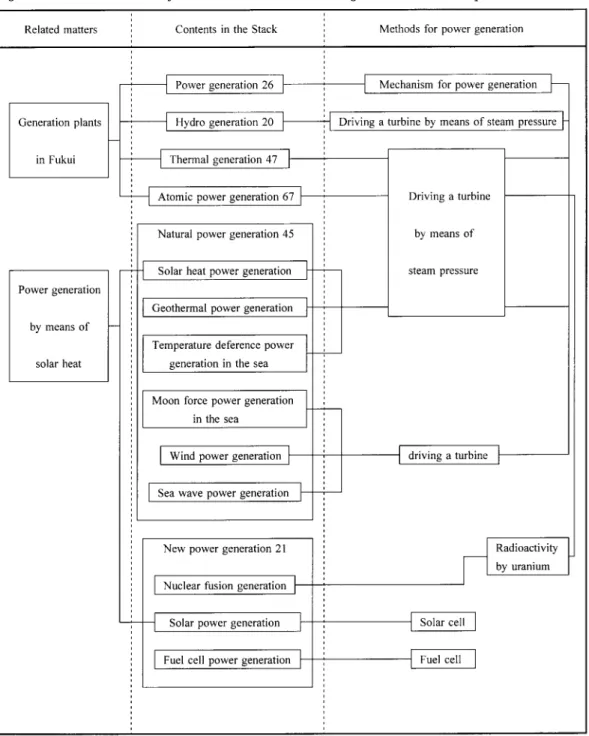
We present a main picture of the contents of each Stack as shown in 2.3 ; the reader can return to the main picture at anytime. We also present some problems and explanations to further learning and understanding. Figure 4 shows an example of Stack content on an atomic power generation plant, where a nuclear power reactor is shown. The contents in these Stacks
are inter-related so that the reader can build an understanding of the whole system. Changes of the picture between Cards and between Stacks can be carried out by clicking the Button.
Figure 5 shows the whole system for Stack cards and Figure 6 shows a sample card.
The CAI teaching aids were examined and evaluated by using a group of six junior high school students at Miyama Junior High School in Fukui on February 7, 1998.
From these examinations, it was found that:
(1)The majority of students were more interested in thermal generation, atomic power generation, and natural power generation;
(2)Given information on hydro generation, thermal generation, and atomic power generation, which are considered the usual types, almost all of the students were most interested in the mechanism for atomic power generation and nuclear fission in particular; and
(3)almost all the students undertook to learn the information contained in these CAI teaching aids earnestly.
The evaluations for these CAI teaching aids were carried out by obtaining answers to the following seven items:
(1)Did you enjoy yourself in using the Hyper cards?,
(2)Was the operation simple enough?,
(3)Did you gain sufficient understanding of the contents?
(4)Were you interested in the contents?
(5)Were the Figures understandable?
(6)Were the Photographs easy to see? and,
(7)Were the explanations sufficiently clear?
The items were responded to using a 4-point scale: 4 points was the highest grade, 3 points was a high grade, 2 points was an inferior grade, and 1 point was the worst grade. The total evaluation of each item was judged to be the mean of their values. Grades are shown in Figure 7. In conclusion, a good evaluation was obtained for both the content and operation of the CAI teaching aids.
We developed CAI teaching aids for use in explaining electricity, and power generation and power plants, in particular, to motivate an interest in these study of these by students at the Junior High level. Some teaching aids including those explaining power generation have been published. However, teaching aids including explanation and description of various power plants, such as ours, are to our knowledge, the first. These teaching aids will present advantages and disadvantages of various types of power generation to the students who will have a voice in Japan s future. It was found from the after-examination of the use of these
teaching aids by students that both the content and the operation were quite satisfactory, and we concluded that these teaching aids could be used in a synthetic study. For further improvement of these teaching aids, the number of cards will be increased, and a card with questions related to the content of another card, i.e., paired cards, will be included. Another potential improvement is the addition of an independent dictionary, access to which would enable the reader to understand the contents of the cards more easily.
1) Yoshiaki Kohno: Electric engineering for technology education(Fundamentals), Private Communication
(1979), pp. 70-75.
2) Yoshio Suzuki, Atsushi Toyama, Takashi Abe, & Takeshi Sakaguchi: Development of A Study of Motors by Hypertext, Journal of the Japanese Society of Technology Education, Vol. 38, No. 2(1996). pp. 117-124.
3) Ed. Ministry of Education and Science: Course of Study for Elementary Schools in Japan, Gyosei(1998), pp. 56.
4) ibid., pp. 64.
5) Ed. Ministry of Education and Science: Course of Study for Lower Secondary Schools in Japan, Press Department of Finance Ministry(1999), pp. 46.
6) Apple Japan,Inc.:Referring guide for Hyper Card(1998)