Study on
Rural Development Utilizing Rice Husk-Fired Power Generation with Waste Heat Recovery
Study Report
December 2004
Engineering and Consulting Firms Association, Japan
Nippon Koei Co., Ltd.
Study Area
Major investigation locations
Other field work sites
Moratuwa
Kurunegala Matale
Trincomalee
Anuradhapura
Polonnaruwa
Walappane
Existing Biomass Power Plant Visited
Saw Mill Visited
Rice Mill & Coconut Processing Plant Visited Coconut
Processing Plant Visited
Rice Mill Visited Rice Mill &
Saw Mill Visited
Waste Heat Need Survey
COLOMBO
Hambantota
Batticaloa Five rice-producing areas
1. Introduction
Background and Objectives
In Sri Lanka, the regional economy depends heavily on agriculture. Main agricultural products are coconut, gum and tea from plantation farms, and rice, which is a staple food of the people in Sri Lanka. About 90% of the rural population can be classified economically as poor. There are several reasons for this. Firstly, high production costs due to inefficient farming put pressure on agricultural profits, which results in low income. Secondly, local indus tries are at an early stage of development and job opportunities are limited. This makes it difficult for the people in rural areas to have a secure income.
In Sri Lanka, a large amount of agricultural production, fresh vegetables and fruits in particular, become s waste. According to a survey on agricultural distribution, about 30 to 40% of agricultural produce is dumped, because of damage incurred during the distribution process. A large amount of cow milk is also dumped, due to the lack of an adequate distribution system. Only a small portion of milk is processed to produce skim milk.
Meanwhile, rice husks account for about 25% or 0.7 million tons of the total domestic rice produc tion of 2.8 million tons (figures for 2000). Some rice husks are used to process rice or fire bricks. However, most is simply burned and/or dumped in a field. This has caused a problem, because ash is a serious source of air pollution.
The Ceylon Electricity Board (CEB), which exercises jurisdiction over the power sector in Sri Lanka, is preparing a Long Term Expansion Plan for 2003-2017. This plan is aimed at expanding the electricity service area to cover 65% of the nation’s land during 2002, and increasing the service area to 76% in 2006. CEB recommends the development of renewable energies such as biomass or other sources to supply electricity in the areas that were left out of the plan.
Under the circumstances, this project aims to reduce poverty in rural areas and promote regional development through reform of structures and systems of agricultural unions and improvement of distribution systems, by using biomass power generation that mainly utilizes rice husks and cogeneration to simultaneously produce heat and power.
Scope of Work
This study will collect and analyze data on the following, examine a scheme for implementation of this project, and recommend measures to realize this project.
• Present situation related to the power sector (Outlines of power genalation, power supply and demand, IPP-related systems)
• Potential of biomass energy resources
• Present situation related to biomass power generation in Sri Lanka
• Need for power generation and waste heat recovery
• Present situation related to CDM in Sri Lanka
The investigation was conducted mainly at two locations, Polonnaruwa and Anuradahpura. These locations were selected in view of their potential to supply rice husks as an energy source for power generation. There are many rice mills in these areas, thus a constant supply of rice husks is assured.
In addition, an exploratory investigation was conducted in Trincomalee, Matale, Kurunegala, Moratuwa and Walappane to identify the potential of coconut shell, sawdust and waste wood as energy sources, and the need for waste heat utilization, and also to collect information about existing biomass power generation plants.
2. Power Sector in Sri Lanka Overview of Power Generation
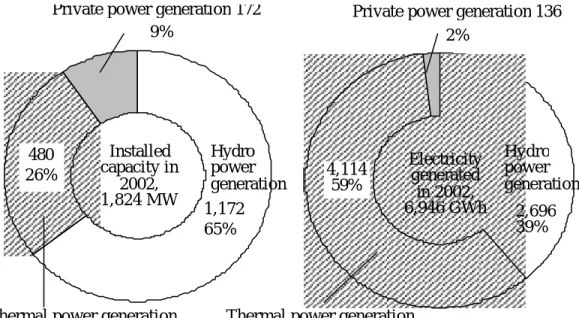
In 2002, of the total capacity of power plants (1,824 MW in total), hydropower plants accounted for 65% of the total capacity, followed by thermal power plants with 26%. The reverse applies when it comes to the amount of electricity generated (6,946 GWh in total). Hydropower plants accounted for 39%, and thermal power plants for 59%. This is not only because they have different operational methods (to meet base demand or peak demand), but also because the electricity generated by hydropower plants decreased due to drought in recent years.
Projected Demand and Power Development Plan
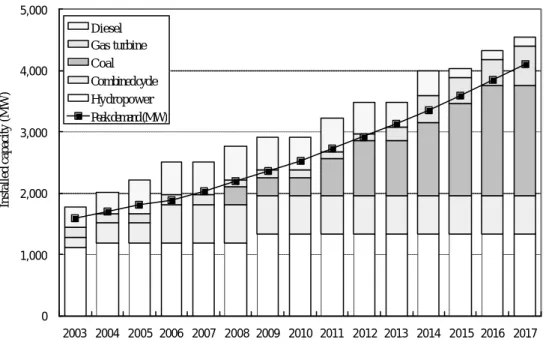
The latest edition of the Long Term Generation Expansion Plan aims to ensure that thermal power plants such as coal, gas turbine, combined cycle and diesel will account for 93.2% of total power production of 3,228 MW, which is the electricity to be generated by new power sources slated for development from 2003 to 2017 (with hydropower plants accounting for the remaining 6.8%).
Present Situation Related to IPP
In Sri Lanka, the CEB once monopolized power generation. Presently, the government encourages independent power producers (IPP) to enter the market under its new national policy.
1) IPP Project in Sri Lanka
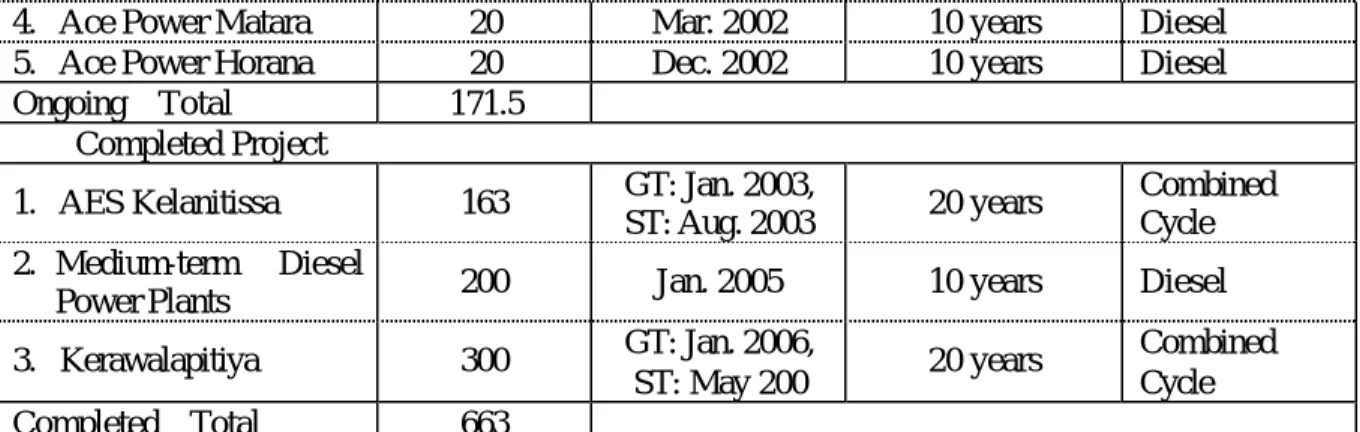
IPP hydro projects cited in the Long Term Generation Expansion Plan are concerned with the five existing plants (with a total installed capacity of 171.5 MW) and three new plants (with a total installed capacity of 663 MW), to which the government is committed.
The CEB’s IPP projects can be devided into two groups: projects that aim for an installed capacity of 10 MW and above, and projects that aim for a lower installed capacity. The former are known as IPP, and the latter as SPP (Small Power Producer).
Thus, this project will fall under the SPP category if private funds are introduced for its implementation.
At the present time, most of the SPP projects are related to hydropower generation.
2) Procedures for SPP Projects
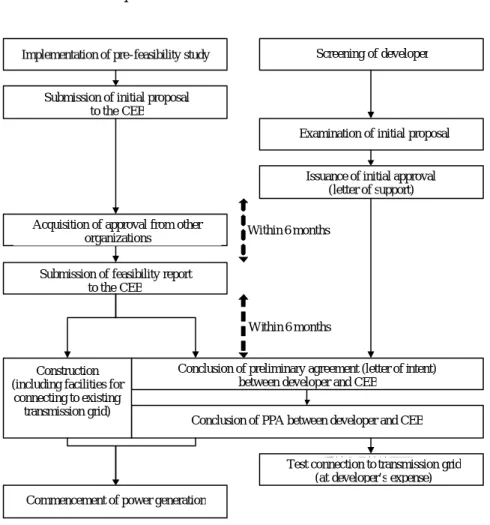
It is necessary to go through the following procedures, if the project is categorized as SPP.
Screening of developer Implementation of pre-feasibility study
Submission of initial proposal to CEB
Examination of initial proposal
Issuance of initial approval (Letter of Support)
Acquisition of approval from other organizations
Submission of feasibility report to CEB
Conclusion of preliminary agreement (Letter of Intent) between developer and CEB
Conclusion of Commencement of power generation PPA between developer and CEB
Test connection to transmission grid (at the developer ’s expense) Commencement of power generation
Within 6 months
Construction (including facilities for connecting to existing transmission grid)
Within 6 months
Procedures for SPP Project
3) Investment-related Preferential Scheme
In Sri Lanka, the Board of Investment (BoI) has jurisdiction over the investment system. Investment-related preferential schemes, to which small-scale infrastruc ture projects such as this project are entitled, are listed in the table below.
Investment-related Preferential Scheme in Sri Lanka
Qualifying Criteria Incentive Import Duty
Exemption Concessionary Tax
Minimum Investment
(US$)
Minimum Export Requirement (% of output)
Tax
Holiday 10 % 15 % 20 %
Capital Goods
Raw Materials
500,000 N/A 5 years 2 years N/A
From the third year
onward
Yes No
Source: Industry-wide Incentives at a Glance by BoI
3. Biomass as Energy Source
In Sri Lanka, biomass accounted for 53% of primary energy consumption in 2000, petroleum for 39% and hydropower for 8%. Industries accounted for 24% of biomass energy consumption and households for 76%.
The table below shows the estimated amount of biomass potentially available as an energy source in Sri Lanka (reported in 1997). It is clear that a large amount of crop residue can be utilized as an energy source.
Item Weight (tons/year) %
Rice husk from rice mill 179,149 6.2
Coconut residue (e.g. outer shell) 1,062,385 37.0
Bagasse 283,604 8.3
Kitchen garbage 286,840 27.4
Sawdust 52,298 1.8
Waste wood 47,938 1.7
Plants grown in garden and other places
(e.g. Gliricidia sepium) 505,880 17.6
Total 2,873,880 100.0
Source: Sri Lanka Energy Balance
Presently, biomass energy is mainly used for cooking in households. It is considered that a significant amount of the biomass resources in the table above remain unused.
Rice Husk
There are two rainfall seasons in Sri Lanka, the high rainfall season (Maha) and the low rainfall season (Yala). Rice is cultivated during both seasons. This means that rice husks, a potential source of biomass energy, can be obtained relatively easily throughout the year. The northeast region, Ampala, Polonnaruwa and Anuradahpura in particular, for which this project is designed, is the country’s most fertile land for rice (rough rice) growing and produces a significant amount of surplus rice.
Although it is commonly thought that this region produces a large amount of rice husks, in reality, rice husk is not produced in rice-producing districts but at rice mills.
Therefore, Ampala, Polonnaruwa and Anuradahpura, each with a cluster of rice mills, produce a large amount of rice husks. The table below shows the estimated rice husk production in these three districts (assuming that rice husk amounts to 30% of rough rice production).
Estimated Rice Husk Production in Ampala, Polonnaruwa and Anuradahpura
District Yala(tons) Maha(tons) Total(tons)
Ampala 67,223 68,567 135,790
Polonnaruwa 52,056 59,063 111,119
Anuradahpura 11,858 65,713 77,571
Total 131,136 193,344 324,480
Gliricidia sepium
Gliricidia sepium is a versatile, small to medium-sized tree and is used for various purposes such as living fences, fuel wood, fodder, green manure, shade and erosion control. This legume is easy to grow, and has been introduced in the dry and semi-dry lands of Sri Lanka for various purposes.
As firewood, it has a specific gravity of 0.5 to 0.8 and a calorific value of 20,580 kJ/kg. (It has a calorific value of 19,600 kJ/kg with 0% water content, 14,000 kJ/kg with 20% water, and 13,000 kJ/kg with 40% water.) It makes a good fuel, because it burns with little smoke and no sparks.
Reportedly, Sri Lanka produced about 700,000 m of sawdust and waste wood in 2001 (or about 35,000 tons of sawdust and waste wood, based on the assumption that the wood has a specific gravity of 0.5, which may vary depending on type of tree and the water content).
Presently, the districts with clusters of sawmills face a worsening environmental problem. This stems from the fact that a significant amount of sawdust and waste wood is believed to be dumped unlawfully in nearby rivers and lagoons in these districts.
Coconut Shell
Coconut (shell and coir) is a biomass resource that remains unused. The coconut shell provides fibers which are used for various purposes. Some coconut shells are provided to brick manufacturers and local people as fuel. Even so, it is assumed that 50 to 60% of coconut shells are dumped or left to lie unused.
Assuming that 50% of coconut shell is dumped, about 360,000 tons have been dumped in recent years alone. In Sri Lanka, 50% of coconut planting acreage is found in the “Coconut Triangle”, which covers Colombo, Chiwla and Matale. A huge amount of coconut shell is produced at coconut mills.
4. Present Situation Related to Biomass Power Generation in Sri Lanka Power Generation Technology
1) Biomass Power Generation Technology in Sri Lanka
In Sri Lanka, most biomass resources are used as a heat source for drying rough rice, parboiling rice, firing bricks, cooking and other purposes.
Meanwhile, power generation using biomass has already begun in Sri Lanka.
• National Engineering Research & Development Centre(NERD)
NERD is a subordinate body of the Ministry of Science and Technology and specializes in biogas-related R&D activities. NERD developed a unique biogas system, based on technologies developed in India and China. This biomass system has been patented in Sri Lanka. Meanwhile, NERD is conducting demonstration experiments of a gasification power generation system with an output of 100 kW that was developed in India.
• Bio Energy Association of Sri Lanka (BEASL)
BEASL was formed by private companies with the aim of promoting the effective use and the diffusion of biomass resources in Sri Lanka.
• LTL Energy (Pvt) Ltd.(Lanka Transformers Ltd.)
LTL Energy (Pvt) Ltd. is a subsidiary of Lanka Transformers Ltd., a joint-stock company formed by CEB and ABB. LTL Energy has built a gasification power generation plant with an installed capacity of 34 kW that uses harvested wood as an energy source. The company is conducting demonstration experiments for the plant. It has also built power plant with a 1 MW boiler turbine system, which is set to begin commercial operation shortly using Gliricidia sepium.
Recogen (Pvt) Limited is an activated carbon manufacturing company wholly owned by Haycarb Limited. It has been ten years since the company began its effort to collect the biogas released during activated carbon manufacturing for power generation. It has already built a boiler turbine power generation plant with an installed capacity of 580 kW, based on its proprietary biogas collection technology and biogas- fired boiler combustion technology.
Construction of a full- scale boiler turbine power generation plant with an installed capacity of 1 MW was completed this year.
2) Biomass Power Generation Technology in Japan
There are two major biomass power generation technologies in use in Japan:
thermochemical conversion technologies such as direct combustion and gasification, and biochemical conversion technologies such as ethanol fermentation and methane fermentation. The former uses dried biomass such as rice husk, wood and coconut shell, and the latter uses wet biomass such as livestock waste, kitchen garbage and sludge. Several types of power generation methods are in use, including boiler (steam) turbine, gas engine and gas turbine.
The figure below shows various patterns of biomass usage.
Biomass
Anaerobic digestion (methane fermentation): Methane and methanol synthesis
Ethanol fermentation: Ethanol
Thermal decomposition
Direct combustion, power generation plus heat supply
Gasification (ga s engine, gas turbine) Ethanol and methanol synthesis
Liquefaction (biodiesel oil) Carbonization (charcoal, activated charcoal)
←Technologies are more or less established
Source: Latest Trend and Prospects of Distributed Power System, September 2001; NTS Inc.
Pattern of Biomass Usage
As shown in the figure above, it can be said that direct combustion-based power generation is an established technology. In Japan, development efforts are centered on co-combustion of biomass resources and high efficiency technology for this type of power generation. One example is the technology to co-combust coal and woody biomass (developed by NEDO).
Northern Europe, other European countries and India are ahead of others in the field of gasification-based power generation, with some commercially successful operations. In Japan, there have been rapid advances in this field in recent years, with government institutions such as NEDO, universities and private institutions stepping up their efforts. NEDO developed a woody biomass-based small-scale, dispersed, high efficiency gasification system and a gas processing technology. Ashikaga
constructing a biomass power generation plant.
A gasification power generation plant would be ideal for this project, given fuel supply and generating power. It is strongly expected that an economically viable technology will be developed to ensure the technical and economic success of this project.
5. Potential of Waste Heat and Power Generation Cow Milk
A limited quantity of raw milk is distributed in Sri Lanka, due to a delay in the diffusion of refrigeration and cold chain systems. Presently, skim milk and condensed milk are the major dairy products readily available in Sri Lanka.
In Anuradhapura, one of the investigated locations, there are three leading processing companies that operate a dairy plant in the district. It is estimated that only 10 to 16% of raw milk production is shipped for processing. In Sri Lanka, the price of raw milk is determined by its milkfat content. However, a considerable quantity of raw milk is dumped, because raw milk production per cow is low and milking does not pay. In addition, raw milk is often spoiled because it is not processed within 3 hours after milking, due to the shortage of refrigeration facilities and the dysfunction of the collection network. In order to address the former issue, it is necessary to improve breeds of livestock and breeding technology. The latter, however, can be addressed in a short time by developing a network of waste heat recovery plants.
Electricity and waste heat can be utilized not only for cold storage facilities but also for milk boilers and separators. Waste heat recovery is expected to have a dramatic impact on the promotion of dairy products. Cold storage facilities are expected to improve the nutritional status of children and increase the utilization of milk, because milk can be distributed to schools in the neighboring area. If these facilities are utilized for vaccine refrigeration, animal health protection will also improve.
Fruits and Vegetables
According to a report on the distribution of fresh fruits and vegetables in Sri Lanka, 30 to 40% of fresh fruits and vegetables are spoiled and dumped during the course of distribution. Introduction of the cold chain system may provide a solution to this problem. However, the loss of fruits and vegetables in the course of distribution is largely due to inadequate treatment during and after harvest or inferior distribution technologies. Thus, introduction of the cold chain system alone would not solve all problems.
There is another issue concerning fresh fruits and vegetables. Tropical fruit prices tend to decline during the height of the harvest season, because their harvest period is short. The decline in tropical fruit prices directly impacts the farm economy. Fruit is often not harvested, but simply abandoned. Fruit imports continued to increase in recent years, which significantly affected the morale of farmers. As a result, fruit production in Sri Lanka is decreasing.
households. For example, pouch-packed foods such as vegetable curry may create demand in urban areas, because they can be stored at room temperature.
6. Clean Development Mechanism(CDM)
Maturity of Related Organizations and Systems
As part of its effort to combat climate change, Sri Lanka has established a system to grant state approval to CDM projects, following the ratification of the United Nations Framework Convention on Climate Change in 1994 and the Kyoto Protocol to the United Nations Framework Convention on Climate Change in 2002.
Organizations that are involved in the governmental approval of CDM projects include the DNA, which grants governmental approval, and the CDM National Expert Committee (consisting of the relevant ministry, industry, academic society and NGO) which provides support to the DNA in policy and technical matters by closely examining each CDM project.
At the present time, there are several vital issues: development of human resources that are capable of creating PDD, which is indispensable for CDM projects, improved awareness of CDM among government institutions and industries, and investigation of the baseline against which greenhouse gas reduction will be measured.
Present Situation Related to CDM Projects
At this point, there have been no successful implementations of CDM projects.
Some twenty applications have been made to DNA to obtain approval for a CDM project. The DNA has granted formal governmental approval to three projects (consisting of nine small-scale hydropower plants). These projects are set to sell about 50,000 tons of CER to American companies. There are other organizations (private companies) which have filed applications to the World Bank or the government of the Netherlands to implement CDM projects. It seems, however, that these applications have not yet led to the actual implementation of CDM projects.
Possible Application of CDM to This Project
Biomass power generation is expected to reduce greenhouse gas emissions, regardless of the type of fuel. There is a strong possibility that this project will obtain CDM status, because the government of Sri Lanka is expected to issue a letter of authorization for this project.
However, governmental approval, the issuance of a business license and the screening of environmental conditions are not closely coordinated in Sri Lanka. In addition, approval criteria are not specific enough and the screening process is not clear, because of weak coordination across governmental organizations. It is necessary to solve all of these problems before applying CDM to this project.
Project Implementation with ODA Funds 1) Scheme for Implementation
There are two approaches to project implementation with ODA funds. The first approach is a scheme that focuses on regional development through the construction of a power plant and cogeneration plant to utilize waste heat. The second approach is a scheme that aims to solve environmental problems through the construction of a power plant and cogeneration plant.
• Regional Development Approach
Under the initiative of local government and with the cooperation of local people and locally based NGOs, the project will construct a small-scale (10 to 100 kW) biomass power plant and a cogeneration plant to utilize waste heat.
The project aims to implement a “regional development” package including the establishment of a system to operate, maintain and control the plants (to assure sustainability of the project) including financial management and activation of local industries.
• Environmental Problem Resolution Approach
The project will construct a biomass power plant as a way to resolve environmental issues with a specific focus on rice husk from rice mills and sawdust and waste wood from sawmills. (Waste heat recovery facilities may also be constructed depending on demand.) Components of the project (power generation plant and cogeneration plant to utilize recovered waste heat) are the same as in the first approach. This approach, however, centers on environmental issues in selecting the location of project implementation.
There are two possibilities for ODA assistance with each of the above approaches:
grant aid and loan assistance.
Given the objectives of this project, grant aid may include JICA Grassroots Technical Cooperation and free financial aid for Japanese NGOs. Implementation of this project is expected to pave the way for it to expand into other parts of Sri Lanka, or to prime the pump for private investment. As for loan assistance, a yen loan may be provided in the form of a packaged loan, provided that this project continues to be implement ed in various parts of Sri Lanka (and extended in phases from the first phase onwards).
2) Issues for ODA-based Project Implementation
There are two issues concerning ODA-based implementation of the project to construct a biomass power plant in Sri Lanka, namely the issue of responsible organization (counterpart) and the issue of technology.
• Organization Responsible for Project Implementation
CEB, which has jurisdiction over the power sector in Sri Lanka, intends to exercise jurisdiction only over hydropower plants with an output of a few dozens of MW or more, and thermal power plants with an output of 100 MW or more. It takes the position that a small-scale power project like the one in this project should be implemented through private resources. If this project is financed with ODA funds, it is necessary to look for other organizations, such as the Ministry of Agriculture and Livestock, and local governments, in order to select an organization that will be responsible for project implementation.
responsible organization must seek partnership with private businesses, because these candidate organizations will lack technical or operational experience with power plant s. In other words, project implementation through public-private partnership (PPP) would be feasible.
Nevertheless, it is necessary to closely examine various forms of PPP to identify the most appropriate form. However, the basic idea is that the project will be implemented through local community participation. Under a public-private partnership, local organizations and NGOs will construct a power plant with the cooperation of the local community. When the plant is complete, a village organization will undertake the responsibility for sustainable operation of the plant, both operationally and financially.
• Technology for Project
There are two possible technologies for this project, namely a boiler turbine plant and a gasification plant.
From a cost standpoint, a boiler turbine plant can hold down the cost per unit of output if it is large in scale. However, the cost per unit of output rapidly increases for a small-scale boiler turbine plant. On the other hand, the cost per unit of output for a gasification plant remains relatively flat. From a technical standpoint, a boiler turbine plant is suitable for large- and medium-scale power generation, because its facilities are large. In contrast, a gasification plant is suitable for small- scale power generation, because it uses an engine generator.
Consequently, a boiler turbine plant would be appropriate for a capacity of MW class and above, and a gasification plant for a capacity of kW class.
When fuel supply, potential output and participation by Japanese companies are taken into account, a gasification plant will be most appropriate for implementation of this project at this stage.
Gasification technologies, and the small-scale gasification technology required for this project in particular, are already commercially available in India and Czechoslovakia. Japanese- made small-scale gasification equipment is yet to be commercialized. In Japan, however, there has been progress in the field of gasification technology, thanks to the efforts of government institutions (such as NEDO) and universities. With some companies already making commercialization efforts, there is no doubt that gasification technology will be commercialized in the coming years.
Project Implementation through Private Resources 1) Scheme for Implementation(Business Model)
If this project is implemented through private resources, there are two possible approaches to project implementation, as follows.
• Parallel Establishment of Large-scale Rice Mill
In this approach, a power plant is built on the premises of a rice mill so that rice chaff can be supplied directly from the mill to generate electricity.
Generated electricity will be supplied to the rice plant and sold to CEB. Waste heat will also be utilized for drying and parboiling rice.
In this approach, a power plant will be built independently on the land suitable for power generation. The plant will use rice husks from small- to medium-scale rice mills, Gliricidia sepium from plantations, sawdust and waste wood from wood processing and furniture factories, and coconut shells and other waste from coconut processing plants to generate electricity. Generated electricity will be sold to CEB. In an offgrid area, customers may be supplied through a local transmission grid network in exchange for payment of an electricity charge. If this is the case, it is necessary to carefully examine the progress of transmission grid network development. Waste heat will be used for various purposes to meet different local demands.
2) Economic Viability
In the study, a rough estimate of the economic viability of the project that is type of the parallel establishment of a large-scale rice mill, was made referring to data on large-scale rice mills.
It was found that the ROI for the base case was 11.9% for 10 years and 15.4% for 15 years. The NPV for 15 years was plus US$ 30,000. In the base case, it would take 5.5 years to recoup the investment.
The calculation revealed that the ROI for 10 years was below the WACC, but that for 15 years was slightly above the WACC. These ROI values are good, compared to interest rates on loans provided by commercial banks in Sri Lanka. NPV was positive.
Therefore, the economic viability of this project is good, provided that it is implemented under the same conditions as the base case.
The initial investment cost (CAPEX) will determine whether or not this project can be implemented through private resources.
8. Recommendations for Realization of Project Scheme for Project Implementation with ODA Funds
If this project is to be implemented with ODA funds, whether grant aid or loan assistance, it will be necessary to supplement the function of the government institution which is responsible for project implementation (counterpart), to ensure the efficient operation, maintenance and control of the project.
In the case of grant aid, NGOs and universities can supplement this function by utilizing a program called JICA Grassroots Technical Cooperation or grant aid programs for Japanese NGOs. It is important to achieve an excellent record by utilizing small- scale grant aid, given the fact that no power projects have received assistance in Sri Lanka to date, except those conducted by the CEB.
In the case of loan assistance, it is necessary to focus on regional development. For the success of the project, it is essential to create a framework for supplementing the capability of the responsible organization to operate, maintain and control the project.
Project implementation through a public-private partnership (PPP) is mentioned in the previous chapter. The figure below shows a working plan for a PPP-based project implementation from investigation to project implementation (draft).
Development of a rough supply plan (scope of project, size of investment) Survey of energy potential
Public-private partnership model (structure, system, role o f stakeholders)
Capability assistance model for stakeholders
Financial model
• Procurement of development fund
• O&M fund procurement
• aid and subsidy policy
Community empowerment model (Examination of assistance measures to reduce poverty) Collection and analysis of
PPP models in the past
plan in target areas
Working Plan for PPP-based Project Implementation Scheme for Project Implementation through Private Resources
If a Japanese private company engages in biomass power generation as a business and utilizes Japanese equipment, there are two possibilities for project implementation: (1) sale of a power plant (a cogeneration plant that utilizes waste heat will also be built depending on demand) and (2) sale of electricity (and thermal energy) generated at a power plant (a cogeneration plant that utilizes waste heat will also be built depending on demand). In other words, there are two approaches to implementing an IPP project.
In the case of (1), price competitiveness of the plant is a major issue. As the example of LTL Energy shows, products from India and China are already available in Sri Lanka. Prices of Japanese products are several fold higher for those products.
Therefore, it will be difficult to promote Japanese products among owners of these facilities and to persuade them to adopt Japanese products, even if their performance and reliability are superior to competing products from other countries.
Meanwhile, case (2) has an advantage over inexpensive products from India and China, despite the higher initial investment cost for introducing Japanese products.
This is because the Japanese products will generate more electricity during the project implementation period, thereby delivering higher investment efficiency than rival products. Although it is necessary to closely investigate and examine various factors such as stability of fuel supply, plant cost, development of legal systems and risk, the project offers attractive incentives including modest initial investment (low investment risk), the prospect of nationwide operation from the standpoint of fuel supply (the number of plants can be adjusted depending on the size of investment), and acquisition of CDM credit.
Therefore, it is realistic for a Japanese private company entering a biomass power generation related business to undertake a small- scale IPP project first, which can minimize the investment risk.
Rural Development Utilizing Rice Husk-Fired Power Generation with Waste Heat Recovery Main Report
Table of Contents Summary
1. Introduction... 1
1.1 Background and Objectives ...1
1.2 Scope of Works...2
1.3 Study Area...2
1.4 Study Schedule ...2
1.5 Study Team Member...2
2. Power Sector in Sri Lanka... 3
2.1 Overview of Power Generation ...3
2.2 Present Situation related to Power Supply and Demand ...3
2.3 Projected Demand and Power Development Plan...4
2.4 Present Situation related to IPP ...5
2.4.1 IPP Project in Sri Lanka ...5
2.4.2 Procedures for SPP Projects...7
2.4.3 Investment-related Preferential Scheme ...7
3. Biomass as Energy Source ... 9
3.1 Rice Husk ...9
3.2 Gliricidia sepium ...12
3.3 Sawdust & Waste Wood ...13
3.4 Coconut Shell ...14
3.5 Other Biomass Resources (Bagasse & Gum)...14
4. Present Situation related to Biomass Power Generation in Sri Lanka ... 15
4.1 Power Generation Technology ...15
4.1.1 Biomass Power Generation Technology in Sri Lanka...15
4.1.2 Biomass Power Generation Technology in Japan...17
4.2 Cost and Economic Viability ...18
5. Potential of Utilizing Waste Heat from Power Generation... 21
5.1 Cow Milk ...21
5.2 Fruit and Vegetables...22
5.3 Raw Milk Commercialization Plan...23
6. Clean Development Mechanism (CDM)... 25
6.1 Maturity of Related Organizations and Systems ...25
6.2 Present Situation related to CDM Projects ...26
6.3 Possible Application of CDM to This Project...27
7. Scheme for Project Implementation... 28
7.1 Project Implementation with ODA Funds ...28
7.1.1 Scheme for Implementation...28
7.1.2 Issues for ODA-based Project Implementation ...29
7.2 Project Implementation through Private Resources...31
7.2.1 Scheme for Implementation (Business Model) ...31
7.2.2 Economic Viability ...31
8. Recommendations for Realization of Project... 34
8.1 Scheme for Project Implementation with ODA Funds...34
8.2 Scheme for Project Implementation through Private Resources...35
List of Tables Table 1.1 Members of Study Team ... 2
Table 2.1 Ongoing and Completed IPP Projects... 5
Table 2.2 SPP Projects under Negotiation for PPA (as of 2000)... 6
Table 3.1 Estimated Biomass Resources in Sri Lanka(as of 1997)... 9
Table 3.2 Rice (Husk) Acreage and Production in the Northeast and in All of Sri Lanka ...10
Table 3.3 Demand and Supply of Rice (Husk) in Northeast Sri Lanka ...11
Table 3.4 Estimated Rice Husk Production in Ampala, Polonnaruwa and Anuradahpura...11
Table 3.5 Coconut Production and Parts... 14
Table 4.1 Principal Biogas Components at Recogen Plant ... 17
Table 4.2 Conditions for Calculating Economic Viability of LTL Energy Plant ... 19
Table 5.1 Trends in Demand for Dairy Products in Sri Lanka... 21
Table 5.2 Trends in Fruit Production in Sri Lanka... 22
Table 6.1 Effort to Combat Climate Change in Sri Lanka ... 25
Table 7.1 Economic Viability of the Project ... 31
Table 8.1 Options for PPP-based Electrification Work ... 35
List of Figure s Figure 2.1 Power Generation Capacity and Production in 2002 ... 3
Figure 2.2 Power Generation Capaciy and Peak Load Demand ... 4
Figure 2.3 Power Generation Expansion Plan from 2003 to 2017 ... 5
Figure 2.4 Procedures for SPP Project... 7
Figure 4.1 Fuel Collection System at LTL Energy Plant ... 16
Figure 4.2 Forms of Biomass Usage ... 18
Figure 4.3 Economic Sensitivity of LTL Energy Plant (ROI (10 years)・NPV)... 20
Figure 6.1 CDM-related Organizations in Sri Lanka ... 25
Figure 7.2 Example of a PPP Project in Pakistan... 30
Figure 7.3 Economic Sensitivity of the Project (ROI (10 Years)・NPV)... 33
Figure 8.1 Working Plan for PPP-based Project Implementation ... 34
Appendices
Appendix 1 Schedule for Field Investigation Appendix 2 Major Interviewees
Appendix 3 Photos
Abbreviations
BEASL : Bio Energy Association of Sri Lanka BoI : Board of Investment
CDM : Clean Development Mechanism CEB : Ceylon Electricity Board
DNA : Designated National Authority IPP : Independent Power Producer LoI : Letter of Intent
NERD : National Engineering Research & Development Centre NPV : Net Present Value
PPA : Power Purchase Agreement ROI : Return on Investment SPP : Small Power Producer VAT : Value Added Tax
WACC : Weighted Average Cost of Capital
1. INTRODUCTION
1.1 Background and Objectives
In Sri Lanka, the regional economy depends heavily on agriculture. Main agricultural products are coconut, gum and tea from plantation farms, and rice, which is a staple food of the people in Sri Lanka. About 90% of the rural population is classified economically as poor. There are several reasons for this. Firstly, high production costs due to inefficient farming put pressure on agricultural profits, which results in low income. Secondly, local industries are at an early stage of development and job opportunities are limited. This makes it difficult for the people in rural areas to have a secure income.
In December 2002, the government of Sri Lanka announced “Regaining Sri Lanka” (an economic recovery policy that provides a framework for development for five years to come). This specified four issues to deal with, one of which was pove rty reduction (increased income levels and higher productivity).
In Sri Lanka, a large amount of agricultural production, fresh vegetables and fruits in particular, become s waste. According to a survey on agricultural distribution, about 30 to 40% of agricultural produce is dumped, because of damage incurred during the distribution process. The Department of Agriculture recognized the importance of improving the situation and decided that it was a priority issue to improve the existing distribution facilities and systems. However, it has yet to come up with specific measures to improve the situation. A large amount of cow milk is also dumped, due to the lack of an adequate distribution system. Only a small portion of milk is processed to produce skim milk. In Sri Lanka, dairy product intake per person is less than half of that in Japan, which has caused concern in that it may lead to health problems (particularly for infants and toddlers).
Meanwhile, rice husks account for about 25% or 0.7 million tons of the total domestic rice produc tion of 2.8 million tons (figures as of 2000). Some rice husks are used to process rice or fire bricks. However, most is simply burned and/or dumped in a field. This has caused a major problem, because ash is a serious source of air pollution.
The Ceylon Electricity Board (CEB), which exercises jurisdiction over the power sector in Sri Lanka, is preparing a Long Term Generation Expansion Plan for 2003-2017. This plan is aimed at expanding the electricity service area to cover 65%
of the nation’s land during 2002, and increasing the service area to 76% in 2006.
CEB recommends the development of renewable energies such as biomass or other sources to supply electricity in the areas that were left out of the plan. In 1999, the Energy Conservation Fund conducted a nationwide energy use survey including biomass energy (Sri Lanka Energy Balance 1999). In February 2002, the Bio Energy Association of Sri Lanka was formed. Developments in recent years reflect a growing interest in biomass energy which is produced domestically.
Under the circumstances, this project is aimed at reducing poverty in rural areas and promoting regional development through the utilization of biomass in power plants that will mainly use rice husks as an energy source, the utilization of electricity generation with waste heat recovery, the reform of existing structures and systems of cooperative associations, and the improvement of the existing distribution system.
1.2 Scope of Works
This study will collect and analyze data on the following, examine a scheme for implementation of this project, and recommend measures to realize this project.
• Present situation related to the power sector (Outlines of power generation, power supply and demand, IPP-related systems)
• Potential of biomass energy resources
• Present situation related to biomass power generation in Sri Lanka
• Need for power generation with waste heat recovery
• Present situation related to CDM in Sri Lanka
1.3 Study Area
The investigation was conducted mainly at two locations, Polonnaruwa and Anuradahpura. These locations were selected in view of their potential to supply rice husks as a source of energy for power generation. There are many rice mills in these areas, thus a constant supply of rice husks is assured.
In addition, an exploratory investigation was conducted in Trincomalee, Matale, Kurunegala, Moratuwa and Walappane to identify the potential of coconut shell, sawdust and waste wood as energy sources, and the need for waste heat utilization, and also to collect information about existing biomass power generation plants.
1.4 Study Schedule
Two field investigations were conducted. The first field investigation was conducted over ten days from August 1, 2004 to August 10, 2004. The second investigation took seven days from August 29, 2004 to September 4, 2004. (Refer to Appendix 1 for the schedule of the two investigations.
1.5 Study Team Member
The table below shows members of the study team who conducted the investigations.
Table 1.1 Members of Study Team
No. Name Specialty
1 Tomoyasu FUKUCHI Regional Development Plan
2 Yoshihiko OGATA Village Society/ Organization & Distribution System
3 Yuichi UEDA Fuel Supply Plan/ Biomass Power Generation &
Co-generation Plant
4 Michinobu AOYAMA Clean Development Mechanism (CDM)
2. POWER SECTOR IN SRI LANKA
2.1 Overview of Power Generation
The figure below shows the capacity of power plants and the generated electricity in Sri Lanka in 2002, by plant type.
2,696 39%
Thermal power generation
Hydro power generation 4,114
59%
Electricity generated in 2002, 6,946 GWh
Private power generation 136 2%
Thermal power generation
Private power generation 172 9%
Installed capacity in
2002, 1,824 MW
Hydro power generation 1,172 65%
480 26%
Source: Long Term Generation Expansion Plan 2003-2017, Jun. 2003; CEB
Figure 2.1 Power Generation Capacity and Production in 2002
In terms of the capacity of power plants, hydropower plants accounted for 65% of the total capacity, followed by thermal power plants with 26%. The reverse applies when it comes to the amount of electricity generated. Hydropower plants accounted for 39%, and thermal power plants for 59%. This is not only because they have different operational methods, but also because the electricity generated by hydropower plants decreased due to drought in recent years.
2.2 Present Situation related to Power Supply and Demand
The figure below shows the capacity of power plants and the peak load demand from 1984 to 2002.
0 500 1,000 1,500 2,000
1984 1985 1986 1987 1988 1989 1990 1991 1992 1993 1994 1995 1996 1997 1998 1999 2000 2001 2002
年
MW
設備容量(MW)
ピーク負荷需要(MW)
Source: Long-Term Generation Expansion Plan 2003-2017, Jun. 2003; CEB
Figure 2.2 Power Generation Capaciy and Peak Load Demand
Peak load demand increased at an annual rate of 7 to 8% during this period, but the growth slowed in recent years. As Figure 2.1 shows, Sri Lanka depends heavily on hydropower. In addition, drought in recent years affected the capability of hydropower plants. It is believed that this has cont ributed to the slowed growth.
2.3 Projected Demand and Power Development Plan
The following figure shows the power generation expansion plan for each type (base case) and the projected demand presented in the latest version of the Long Term Generation Expansion Plan 2003 - 2017 published in June 2003.
Year Installed capacity (MW)
Peak load demand (MW)
0 1,000 2,000 3,000 4,000 5,000
2003 2004 2005 2006 2007 2008 2009 2010 2011 2012 2013 2014 2015 2016 2017 年
設備容量(MW)
ディーゼル ガスタービン 石炭
コンバインド・サイクル 水力
ピーク需要(MW)
Note: The above figure includes retired power generation (diesel and gas turb ine).
Source: Long Term Generation Expansion Plan 2003-2017, Jun. 2003; CEB
Figure 2.3 Power Generation Expansion Plan from 2003 to 2017
This plan focuses on the development of thermal power generation and aims to ensure that coal (1,800 MW), gas turbine (525 MW), combined cycle (463 MW) and diesel (220 MW) account for 93.2% of 3,228 MW, which is the electricity to be generated by new power sources slated for development from 2003 to 2017.
(Hydropower is expected to generate the remaining 6.8% or 220 MW of electricity.)
2.4 Present Situation related to IPP
In Sri Lanka, the CEB once monopolized power generation. Presently, the government encourages independent power producers (IPP) to enter the market under its new national policy (Policy Directions for Power Sector, August 1997, Ministry of Irrigation and Power).
2.4.1 IPP Project in Sri Lanka
The table below shows thermal IPP projects presented in the Long Term Expansion Plan listed in Figure 2.3.
Table 2.1 Ongoing and Completed IPP Projects Power Plant Name Capacity
(MW)
First Year of
Operation Contract Period Remarks n Ongoing Project
1. Lakdhanavi 22.5 1997 15 years Diesel
2. Asia Power 49 1998 20 years Diesel
3. Colombo Power 60 Mid 2000 15 years Diesel
Year Diesel
Gas turbine Coal Combined cycle Hydropower Peak demand (MW)
Installed capacity (MW)
4. Ace Power Matara 20 Mar. 2002 10 years Diesel
5. Ace Power Horana 20 Dec. 2002 10 years Diesel
Ongoing Total 171.5
n Completed Project
1. AES Kelanitissa 163 GT: Jan. 2003,
ST: Aug. 2003 20 years Combined
Cycle 2. Medium-term Diesel
Power Plants 200 Jan. 2005 10 years Diesel
3. Kerawalapitiya 300 GT: Jan. 2006,
ST: May 200 20 years Combined
Cycle
Completed Total 663
Source: Long Term Generation Expansion Plan 2003-2017, Jun. 2003; CEB
The plan revealed that small-scale IPP hydropower plants had been connected to the existing grid network to generate the electricity 37 MW (which is included in the installed capacity of the existing plants shown in Figure 2.2), in addition to the thermal IPP projects shown in the table above. It was also reported that small-scale IPP hydropower plants with a capacity of 37 MW were under construction and that a letter of intent (LoI) or preliminary agreement had been signed to implement small-scale IPP hydropower projects that aim to achieve a total capacity of 100 MW.
CEB’s IPP projects can be divided into two groups: projects to deliver a capacity of 10 MW and above, and projects with a capacity of less than 10 MW. The former are known as IPP, and the latter as SPP (Small Power Producer). Thus, this project will fall under the SPP category if private funds are introduced for its implementation.
For reference, the table below shows SPP projects for which PPA negotiations were under way as of 2000. As the table shows, most of the projects planned to develop a small-scale hydropower plant.
Table 2.2 SPP Projects under Negotiation for PPA (as of 2000) No. Plant Name Capability
(MW)
First Year of
Operation Type Remarks
1 Seetha Eliya 0.14 1993 Small-scale hydropower Private use
2 Dickoya 1.20 1994 Small-scale hydropower Connected to grid
3 Ritigaha Oya 0.11 1997 Small-scale hydropower Private use
4 Rakwana Ganga
0.76 1998 Small-scale hydropower Connected to grid
5 Talawakelle 0.11 1998 Small-scale hydropower Private use
6 Madampe 0.58 1998 Boiler Turbine (Waste heat
recovery at plant)
7 Kolonna 0.78 1999 Small-scale hydropower Connected to grid
8 Wedamulla 0.20 1999 Small-scale hydropower Connected to grid
9 Ellapita Ella 0.55 1999 Small-scale hydropower Connected to grid
10 Carolina 2.50 1999 Small-scale hydropower Connected to grid
11 Delgoda 2.50 1999 Small-scale hydropower Connected to grid
12 Glassaugh 3.20 2000 Small-scale hydropower Connected to grid
13 Mandagal Oya 1.28 2000 Small-scale hydropower Connected to grid Source: CEB homepage
2.4.2 Procedures for SPP Projects
In order to implement a project that falls under the SPP category, it is necessary to go through procedures stipulated in the “Guidelines for Private Sector Participation in Small Renewable Energy Power Generation Plants” published by the CEB.
Developerの審査 Pre-Feasibility Studyの実施
CEBへのInitial Proposalの提出
Initial Proposalの検討
Initial Approval (Letter of Support)を発行
CEB以外の関係機関からのApproval取得
CEBへFeasibility Reportを提出する
( )
DeveloperとCEB間で予備契約 Letter of Intent を締結
DeveloperとCEB間でPPAを締結
系統への接続テスト
( )
費用はDeveloper負担 発電開始
6ヶ月以内
建設
( )
系統接続用施設も含む
6ヶ月以内
< >
Developer < CEB >
Figure 2.4 Procedures for SPP Project
Other organizations appropriate for an SPP project include the Central Environmental Authority, the Ministry of Irrigation and Power and the Board of Investment.
2.4.3 Investment-related Preferential Scheme
In Sri Lanka, the Board of Investment (BoI) has jurisdiction over the investment system. Investment-related preferential schemes, to which small-scale infrastructure projects such as this project are entitled, are listed in the table below.
<Developer> <CEB>
Implementation of pre-feasibility study Screening of developer
Submission of initial proposal to the CEB
Examination of initial proposal Issuance of initial approval
(letter of support) Acquisition of approval from other
organizations Submission of feasibility report
to the CEB
Conclusion of preliminary agreement (letter of intent) between developer and CEB
Conclusion of PPA between developer and CEB
Test connection to transmission grid (at developer’s expense) Commencement of power generation
Construction (including facilities for
connecting to existing transmission grid)
Within 6 months
Within 6 months
Table 2.3 Investment -related Preferential Scheme in Sri Lanka
Qualifying Criteria Incentive Import Duty
Exemption Concessionary Tax
Minimum Investment
(USD)
Minimum Export Requirement (% of output)
Full Tax
Holiday 10 % 15 % 20 %
Capital Goods
Raw Materials
500,000 N/A 5 years 2 years N/A
From the third year onward
Yes No
Source: Industry-wise Incentives at a Glance by BoI
The following provides additional information from an interview with the person in charge of this matter at BoI.
‑ Only developers of Sri Lankan origin can enter a sales agreement (PPA: Power Purchase Agreement) with the CEB.
‑ It takes about two weeks to obtain an approval from BoI.
‑ The tax holiday period begins in the company’s first profitable year, provided that less than two years have passed since the commencement of commercial operation.
‑ The rate of Value Added Tax (VAT) is 15%.
3. BIOMASS AS ENERGY SOURCE
In rural areas of Sri Lanka, firewood and charcoal are widely used for domestic cooking. According to Energy Balance 2002, published by the Energy Conservation Fund, biomass accounted for 53% of primary energy consumption in Sri Lanka in 2000, petroleum for 39% and hydropower for 8%. It is also reported that 24% of biomass energy was used by industries and 76% by general households (Sri Lanka Energy Balance 2000).
There are three supply sources for primary energy in rural areas, namely tea, coconut and gum, which are the three major products of plantation farms. Coconut and gum are particularly important as energy sources. Certain data also suggest that biomass derived from coconut and gum (including their residue) account s for more than 40% of nationwide biomass use. Coconut and gum-derived biomass are used mainly as “firewood”.
The table below shows the estimated amount of biomass potentially available as an energy source in Sri Lanka (reported in 1997). It is clear that a large amount of crop residue can be utilized as an energy source.
Table 3.1 Estimated Biomass Resources in Sri Lanka(as of 1997)
Item Weight (tons/year) %
Rice husk from rice mill 179,149 6.2
Coconut residue (e.g. outer shell) 1,062,385 37.0
Bagasse 283,604 8.3
Kitchen garbage 286,840 27.4
Sawdust 52,298 1.8
Waste wood 47,938 1.7
Plants grown in garden and other
places (e.g. Gliricidia sepium) 505,880 17.6
Total 2,873,880 100.0
Source: Sri Lanka Energy Balance
Presently, biomass energy is mainly used for cooking in households. It is considered that a significant amount of the biomass resources in the table above remains unused.
3.1 Rice Husk
Table 3.2 shows rice (rough rice) production in the northeast and whole of Sri Lanka. There are two rainfall seasons in Sri Lanka, the high rainfall season (Maha) and the low rainfall season (Yala). Rice is cultivated during both seasons. This means that rice husks, a potential source of biomass energy, can be obtained relatively easily throughout the year. The northeast region, Ampara, Polonnaruwa and Anuradahpura in particular, for which this project is designed, is the country’s most fertile land for rice (rough rice) growing. As shown in Table 3.3, the area produces a significant amount of surplus rice.