PAPER
Peer-to-Peer Video Streaming of Non-Uniform Bitrate with Guaranteed Delivery Hops ∗
Satoshi FUJITA†a),Member
SUMMARY In conventional video streaming systems, various kind of video streams are delivered from a dedicated server (e.g., edge server) to the subscribers so that a video stream of higher quality level is encoded with a higher bitrate. In this paper, we consider the problem of deliver- ing those video streams with the assistance of Peer-to-Peer (P2P) technol- ogy with as small server cost as possible while keeping the performance of video streaming in terms of the throughput and the latency. The basic idea of the proposed method is to divide a given video stream into sev- eral sub-streams called stripes as evenly as possible and to deliver those stripes to the subscribers through different tree-structured overlays. Such a stripe-based approach could average the load of peers, and could effectively resolve the overloading of the overlay for high quality video streams. The performance of the proposed method is evaluated numerically. The result of evaluations indicates that the proposed method significantly reduces the server cost necessary to guarantee a designated delivery hops, compared with a naive tree-based scheme.
key words: P2P video streaming, tree-structured overlay, guaranteed de- livery hops, quality level
1. Introduction
Video streaming over the Internet has attracted considerable attention in recent years. In fact, IP video traffic occupies 73% of the worldwide consumer Internet traffic in 2016, and is expected to exceed 80% by 2021[8]. Suchvideo streams are delivered from the publisher to the subscribers in vari- ous manners. Many companies and organizations including YouTube, ESPN and BBC, adopt Content Delivery Network (CDN) such as Akamai∗∗, Azure CDN∗∗∗, and Verizon Dig- ital Media Services∗∗∗∗for broadcasting video streams, and according to the success of edge and fog computing[15], video streamingassisted bythe Peer-to-Peer (P2P) technol- ogy has also attracted considerable attention as a method to realize a scalable, stable video streaming over the Inter- net[21],[26],[29],[32],[33].
This paper considers P2P-assisted video streaming withnon-uniform quality levels, designated by the spatial resolution and the frame rate. For example, the resolution of high definition (HD) video is 1280×720 and that of 8K video is 7680×4320, whereas concerned with the frame rate, HD supports 30 fps and 8K supports up to 120 fps[23].
Manuscript received March 28, 2019.
Manuscript revised May 31, 2019.
Manuscript publicized August 8, 2019.
†The author is with the Department of Information Engi- neering, Graduate School of Engineering, Hiroshima University, Higashi-Hiroshima-shi, 739–8527 Japan.
∗This work was partially supported by KAKENHI, the Grant- in-Aid for Scientific Research (B),F Grant Number 16H02807.
a) E-mail: [email protected] DOI: 10.1587/transinf.2019EDP7088
The difference of quality levels is generally reflected to the bitrateof the resulting video streams, while it is highly de- pendent on the underlying codec.
In this paper, we assume that each video stream has its own quality level encoded with a constant bitrate∗∗∗∗∗, and consider the problem of delivering those video streams to their subscribers with as small server cost as possible while keeping the performance of video streaming in terms of the throughput and the latency. If a simple tree-structured over- lay is used for delivering each video stream, which will be referred to as anaive schemehereafter, subscribers of high quality video stream are easily overloaded, and it limits the number of participants which allows the delivery with a des- ignated latency and a server cost[1],[12],[13]. In general, to attain a low latency in P2P video streaming, we should bound the number of intermediate peers encountered dur- ing the delivery of video streams, but it is difficult for high quality video streams since it occupies a large portion of the upload capacity of the participant which severely limits the number of peers which could directly receive a stream from intermediate peers (e.g., each peer can forward a received video stream to at most one peer if the bitrate of the stream exceeds a half of the upload capacity of the peer).
We will overcome this problem by dividing a given video stream into several sub-streams called stripes and by delivering those stripes to the subscribers through different tree-structured overlays. The division of a video stream into stripes is conducted in such a way that the bitrate of each stripe is as even as possible, indicating that a high quality video stream is delivered through many contributing peers.
Such a stripe-based approach could average the load of the participants, and could effectively resolve the overloading of overlays for high quality video streams. More specifically, we could reduce the bitrate of a stream by dividing it into several stripes. The reduction of the bitrate could signifi- cantly reduce the server cost since the number of subscribers covered by a delivery tree with a fixed height increasesex- ponentially while itlinearly increases the overhead as the number of stripes increases. The performance of the pro- posed scheme is evaluated numerically. The result of evalu- ations indicates that the proposed method reduces the server
∗∗https://www.akamai.com/
∗∗∗https://azure.microsoft.com/en-us/services/cdn/
∗∗∗∗https://www.verizondigitalmedia.com/
∗∗∗∗∗Although practical codec such as MPEG-4 and H.264 encodes video with a variable bitrate, to clarify the exposition, we will as- sume that each stripe is encoded with a constant bitrate.
Copyright c⃝2019 The Institute of Electronics, Information and Communication Engineers
cost to only 3% of the naive scheme if the number of de- livery hops is bounded by four, the upload capacity of each peer is fixed to eight (i.e., if each peer can simultaneously forward eight stripes to other peers), and the video stream is divided into four stripes.
The remainder of this paper is organized as follows.
Section 2 overviews related work. Section 3 gives prelim- inaries. Section 4 describes the proposed method. Section 5 summarizes the result of evaluations. Finally, Sect. 6 con- cludes the paper with future work.
2. Related Work
Video streaming assisted by the P2P technology has been widely used in recent years[28],[30],[31]. For example, the demonstration experiments conducted by NHK science &
technology research laboratories during London Olympics in 2012 indicate that a mesh-based P2P realizes the deliv- ery of live contents to more than 1600 subscribers in 1.5 Mbps in a stable manner[22]. P2P video streaming systems can be classified into several types by the way of delivering video contents to the subscribers, including tree-type such as SCRIBE[6] and Bayeux[34], mesh-type such as Bul- let[17], PRIME[20], and CoolStreaming/DONet[29]and a hybrid of mesh and tree such as mTreebone[25].
The idea of using multiple trees for video streaming was firstly adopted in SplitStream[5]. More concretely, SplitStream divides a given video stream intob stripes so that the jth stripe, for 1≤ j ≤ b, consists of the (bi+j)th chunks in the given stream fori ≥ 0 [1]. Then it delivers those stripes through different spanning trees to have dis- joint sets of internal nodes. In other words, in SplitStream, each peer joins at most one spanning tree as an internal node and joins all of the other spanning trees as a leaf node. Such a construction of the set of spanning trees enables peers to contribute their upload capacity with low cost, and bal- ances the load of all peers participating in the streaming sys- tem[2],[9].
Theoretical aspects concerned with multiple-tree-based P2P video streaming have also been studied in recent years.
Liu[18]considered the problem of minimizing the broad- cast time of each chunk contained in a given stream un- der the constraint such that each peer can upload at most one chunk at a time†, and proposed an algorithm which broadcasts every chunk to n subscribers in ⌈log2n⌉ steps.
In this algorithm, any two consecutive chunks are delivered through different binomial trees since in order to enable the delivery of chunks in⌈log2n⌉steps, every peer receiving a chunk must continuously upload the chunk to different re- ceivers in the succeeding steps until the chunk is received by all subscribers (to complete the broadcast of a chunk to nsubscribers in⌈log2n⌉steps, the number of subscribers re- ceiving the chunk mustdoublein each step). Liu’s result was extended to the cases in which each peer has a constant
†This assumption is slightly relaxed by Bianchiet al. [3]so that each peer can upload at mostkchunks at a time.
number of neighbors in the overlay[10]and the upload ca- pacity of peers is not uniform[11], respectively.
In addition to the above results, the upper bound on the network capacity of multiple-tree-based P2P was dis- cussed in different contexts. For example,[19]discussed the network capacity of peer-assisted live streaming, and [16]
considered the problem of constructing multiple trees which maximize the network capacity by considering the topology of the underlying physical network.
3. Preliminaries
3.1 Model of P2P System
Let us consider a P2P system consisting of a media server and a set of subscribers P. Each video stream published by the media server has a fixed quality level drawn from {1,2, . . . ,k}, where kmeans the highest quality level. Let S def= {σ(u) :u ∈ P}be the set of video streams subscribed by the peers inP, whereσ(u) denotes the video stream sub- scribed by peeru.
In the proposed method, we assume that a video stream of quality level i is divided into i stripes by the media server beforehand, and those stripes are delivered to the corresponding subscribers through different delivery trees††. More concretely, the media server pushes each stripe to sev- eral subscribers each of which serves as the root of a deliv- ery tree corresponding to the stripe, and each stripe received by the root is disseminated to the remaining nodes in the delivery tree through tree edges (note that each stripe can have several roots). In other words, peer u can receive a stripe generated from streamσ(u) ∈ Sby connecting to a peer in a delivery tree corresponding to the stripe as a re- ceiver, and can restoreσ(u) from received stripes, where we assume that the overhead for the restoration is negligible.
To simplify the exposition, in the following, we assume that every stripe has the same bitrate and each peer has an ability of simultaneously forwardingany b stripes to other peers, wherebis called theupload capacityof a peer. In addition, we will bound the height of any delivery tree by h under the constraint on the upload capacity, to guarantee that ev- ery stripe is received by any subscriber with a designated latency (i.e., a deepest leaf of the delivery tree receives the stripehhops away from the media server, and a peer con- necting to the deepest leaf receives the stripe withinh+1 hops away from the media server).
3.2 Basic Observations
For eachs∈ S, letq(s) denote the quality level of streams,
††Such a division into stripes can be realized by using MDC (Multiple Description Coding)[4],[24], for example. MDC was originally proposed to improve the resiliency of video streaming, in such a way that each stripe can be decoded independently and the quality of restored video stream increases as the number of decoded stripes increases. MDC-based P2P video streaming was proposed in[7].
andn(s) denote the number of subscribers ofs. LetXbe the upload capacity of the media server consumed for delivering Sto their subscribers, which equals to the total number of roots forS. The following inequality holds regardless of the intended latency (i.e., delivery hops) of the video streaming:
b∑
s∈S
n(s)+X≥∑
s∈S
q(s)×n(s), (1)
where the left hand side is the amount of upload capaci- ties and the right hand side is the amount of required down- loads. In client/server systems,X =∑
s∈Sq(s)×n(s),since each subscriber directly receivesq(s) stripes from the media server. Ifn(s∗)=|P|andX=q(s∗) for somes∗∈ S, namely, if all peers subscribes to a single streams∗and every stripe generated froms∗is pushed to exactly one peer by the media server, then Eq. (1) is restated as
b≥q(s∗) (
1−q(s∗) n(s∗) )
,
which intuitively implies that each peer must have an up- load capacity of amountq(s∗), which could slightly reduce ifn(s∗)(=|P|)< √
q(s∗).
In the above model of P2P video streaming, the deliv- ery of a stripe is realized with the assistance of several peers.
A peeruwhich assists the delivery of stream s∗is called a helperifσ(u) , s∗. It is known that even ifb = k, the existence of helper is mandatory to enable the delivery ofk stripes to∑h
i=0bi−2 subscribers as long asX=b[14].
4. Proposed Method
Given a set of subscribers of a video stream, we can easily construct a set of spanning trees which delivers all stripes generated from the stream to the subscribers (in fact, Split- Stream uses such a set of spanning trees). However, it is not trivialhow to maintain such trees against dynamic change of the set of subscribers, while keeping the delivery of stripes to the existing peers with a designated delivery hops (i.e., latency). The main contribution of this paper is to propose a concrete procedure for such maintenance operations.
4.1 Core Tree
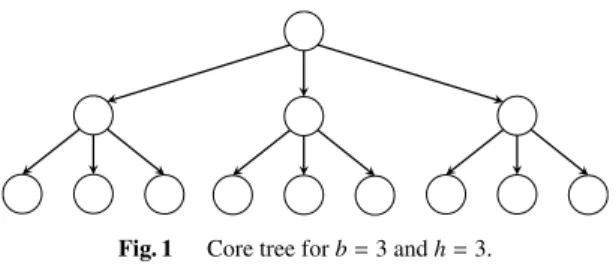
The proposed scheme is designed with the notion of core trees. Core tree is a subtree of a completeb-ary tree of heighthconsisting of 1+b+b2+· · ·+bh−1 peers (recall that in the graph theory, the height of a trivial tree consisting of a single peer is defined to be one). Figure 1 illustrates a core tree forb =3 andh = 3. Since a complete core tree hasbh−1leaves with upload capacitybeach, it has an upload capacity of amountbh. In other words, if a stripe is pushed to the root of a complete core tree, it can be delivered tobh peers through the tree in exactlyh+1 hops away from the media server excluding peers contained in the core tree.
To deliver a video stream divided into several stripes,
Fig. 1 Core tree forb=3 andh=3.
we should prepare at least one core tree for each stripe, and the number of core trees should increase as the number of subscribers increases since a single core tree can contain at most bh+1b−−11subscribers.
4.2 Growth of Core Trees
Next, we give a procedure togrowcore trees while keeping the delivery of stripes to the subscribers withinh+1 hops.
A core tree is said to beactive(or incomplete) if it contains less than ∑h−1
i=0bi peers. Consider the delivery of a video stream of quality levelb to the growing set of subscribers (the case of other quality levels will be discussed later). Let R={r1.r2, . . . ,rb}be the set ofbstripes generated from the video stream.
In the proposed procedure, the set of core trees is main- tained in such a way that it contains exactly one active core tree for each stripe to satisfy an invariant such thateach ac- tive tree has the residual capacity of amount b. The proce- dure starts with btrees, each of which consists of a single helper peer and is dedicated to the delivery of a stripe in R. Such an initial configuration certainly satisfies the above invariant, since each helper is not required to forward a re- ceived stripe to other helpers; namely each tree has a resid- ual capacity of amountb.
Thosebactive trees grow by repeatingroundsin which all of b trees increase their size by exactly one. Assume that during a round,bpeersu1,u2, . . ., andubjoin the set of subscribers in this order. LetTi denote the active tree for striperi. For each 1 ≤i ≤b,uibecomes a member of tree Ti. More concretely,
1. Letvbe a peer inTiat the smallest depth (i.e., closest to the root) among peers with less thanbchildren (i.e., with a positive residual capacity). Peer ui becomes a child ofvinTi, and ifvis forwarding striperito a peer wbelonging to other tree, thenuisubstitutes for the role of forwardingritowso thatvcan have up tobchildren inTi.
2. uiestablishes atentative connectionto a peerw′inTj
(with a residual capacity) for eachi+1≤ j≤b, to re- ceive striperjfromw′. Note that suchw′always exists since we are assuming that each active tree has a resid- ual capacity of amountb at the beginning of a round, and suchw′ can be quickly identified by keeping the indices to (at mostb) such peers on the media server.
3. uiestablishes a connection toujfor each 1≤ j≤i−1, to receive striperjfromuj, and to substitute for the role
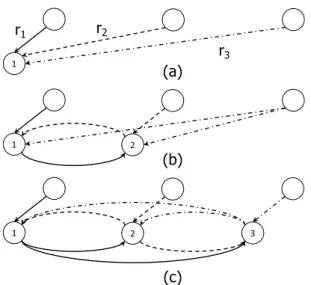
Fig. 2 Joining of the first three peers to the initial core trees. Striper1is delivered to peers 2 and 3 through peer 1; Although striper2, indicated by dashed lines, is delivered to peer 1 from the root in (a), it is substituted by peer 2 in (b) and (c).
of forwarding striperitouj.
Figure 2 illustrates the first round of the procedure for b = 3, where peers 1, 2 and 3 join the set of subscribers in this order. At any point in time, each peer receives three stripesr1, r2, andr3 indicated by solid, dashed, and dot- dashed lines, respectively. Figure 3 illustrates the first step of the fourth round. After becoming a child of peer 1, peer 10 substitutes for the role of forwarding striper1 to peer 2 (to clarify the exposition, this figure omits the second hop of the delivery of stripesr2andr3).
The reader should observe that if each active tree has a residual capacity of amountb at the beginning of a round, it still has the same capacity after the round, since although the capacity of the tree of amountbis consumed bybnew peers, a newly added peer increases the capacity of the tree byb. In addition, since each peer in a core tree can haveb children, after the (∑h
i=0bi−1)st round, we havebcomplete core trees of capacitybeach. Thus we can addbmore peers, sayu′1,u′2, . . . ,u′b, to the resulting (complete) core trees so that each peeru′i receives b stripes in exactly h+1 hops away from the media server through those core trees. Those bpeers can become roots of new active trees by requesting the media server to directly pushritou′i (in contrast to the initial core trees, the roots of next trees need not be helper since they receiveb−1 stripes from former active trees).
The overhead required for adding a new peer to the set of active trees is evaluated as follows. The new peer contacts bpeers to receive stripes through those peers, and contacts b peers to forward a received stripe to those peers, while the “substitution” of the role of forwarding needs an addi- tional contact. Peers to be connected can be quickly iden- tified by keeping the indices toblastly joined peers on the media server for each active tree (i.e., the memory size is O(b) for each stripe), although it incurs a bottleneck at the server when many peers arrive at the system in a short time
Fig. 3 Joining of the tenth peer to the initial core trees. Figure (a) shows the configuration after the joining of the ninth peer, where the second hop of stripesr2andr3is not displayed to clarify the exposition. In Fig. (b), the tenth peer 10 joinsT1as a child of peer 1, and then substitutes for the forwarding ofr1to peer 2 (when peer 1 accepts the second child, it will substitute for the forwarding ofr1to peer 3 so that peer 1 can have the third child).
period. Finally, an additional contact to the media server should occur if the joined peer becomes the root of a new active tree. In summary, the overhead for adding a new peer to the set ofbactive trees isO(b).
4.3 Leave from Core Trees
This subsection describes a procedure to remove a desig- nated peer from the set of subscribers. Recall that core trees grow by repeating round. Suppose that in the current round, peersv1,v2, . . ., andvb′join the set of subscribers in this or- der, where 1 ≤b′ ≤ b. For each subscribervcontained in a core tree, letQin(v) denote the set of peers forwarding a stripe tov(which contains the parent ofvin a core tree un- less it is the root), andQout(v) be the set of peers receiving a stripe fromv.
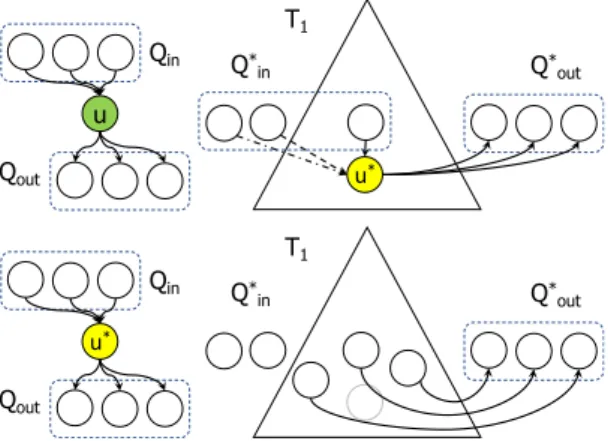
Assume that a leaving peeruis a member of a core tree concerned with striperi. Ifu = vb′, then the removal ofu proceeds as follows (see Fig. 4 for illustration).
1. It requests|Qout(u)|(≤b) peers inTiwith a residual ca- pacity to forwardrito a peer inQout(u).
2. It requests all peers inQin(u) to stop the forwarding of a stripe tou.
3. Thenvb′leaves.
On the other hand, ifu ,vb′,vb′is removed fromTb′ and then substitutes for the leaving peeru(see Fig. 5 for illustra- tion). More concretely,
1. It requests all peers inQin(u) to change the receiver of a stripe tovb′ and requests all peers inQin(vb′) to stop the forwarding of a stripe tovb′.
2. It requestsvb′to forward striperito all peers inQout(u) and requests|Qout(vb′)|(≤b) peers inTb′with a residual capacity to forward striperb′to a peer inQout(vb′).
3. Thenuleaves.
Fig. 4 When leaving peeruis the lastly joined peer. The forwarding of a stripe touis canceled, and the forwarding of striper1byuis substituted by peers inT1with residual capacity.
Fig. 5 When leaving peerujoinedTiin a former round.
If several peers leave the system, the removal of the second peer can start after completing the removal of the first peer, and such a conflict can be resolved at the media server (in other words, we are assuming that the media server plays the role of tracker).
Similar to the addition of a peer, the overhead required for removing a peer from a core tree can also be bounded by O(b) by keeping the indices tob lastly joined peers on the media server for each active tree.
4.4 Video Streaming of Lower Quality Level
The proposed scheme usesb∗ core trees for delivering a video stream of quality levelb∗. Thus ifb∗ <b, we can al- low several subscribersnot to join any core tree. More con- cretely, amongb peers newly joined the set of subscribers during a round, merelyb∗peers should become a member of a core tree and the remainingb−b∗ ≥ 1 peers are not required to forward any stripe to other peers. See Fig. 6 for illustration.
Such a modification does not violate the invariant such that the residual capacity of each active core tree is exactly
Fig. 6 Whenb=3 andi=2, peers 3, 6 and 9 are not required to forward a stripe to other peers.
b, and does not reduce the number of subscribers covered by b∗core trees from∑h
j=0bj, while it allows∑h−1
j=0bj(b−b∗) peers not to join any core tree, which could be used as a helper for other video streams; i.e., the proposed stripe- based scheme could effectively realize a load balancing among video streams of different quality levels.
4.5 Video Streaming of Higher Quality Level
With the notion of helpers, we could realize the delivery of b∗ >b stripes to the subscribers; namely we could realize the delivery of a video stream with asuper high qualityex- ceeding the upload capacityb. The idea is to useb∗−b+1 helper treesconsisting of∑h−1
j=0bjhelpers in addition tob−1 ordinary core trees. The role of ordinary core trees is to mu- tually deliverb−1 stripes to
(b−1)
h−1
∑
j=0
bj=bh−1
peers in the ordinary core trees, and the role of helper trees is to forward the remaining b∗−b+1 stripes tobh peers contained in ordinary core trees.
5. Evaluation
This section numerically evaluates the performance of the proposed method. At first, we analyze the server cost required for guaranteeing a given latency (i.e., de- livery hops). We then evaluate the residual capacity of the overall network to certify that the reduction of the server cost does not rely on the overloading of the subscribers. Since there is no previous scheme for maintaining delivery trees while keeping the delivery of stripes with a designated latency, we merely compare it with a naive tree-based scheme which does not divide a given video stream into stripes.
In the following evaluation, the upload capacity b is fixed to either 8 or 12, since those value have many divi- sors. Quality leveliof video stream is varied from 2 tob/2 so that each peer can have at least two children in the naive scheme. Finally, we fixhto three, which is the maximum number of hops away from the root peer, since the effect of peer-assistance is too restrictive for smallh’s, and a too long delivery path could cause failures and performance degrada- tion.
5.1 Server Cost
By assumption, the upload of a video stream of quality level iconsumes the upload capacity of amounti. Thus in the naive scheme, each peer can have at mostd=⌊b/i⌋children in the delivery tree, which implies that ifd ≥2, the server cost of amountican cover at most
h+1
∑
i=0
di= dh+2−1 d−1
peers provided that the latency from the media server is bounded byh+1. Hence the server cost which is neces- sary to coverNsubscribers withinh+1 hops is at least
⌈N(d−1) dh+2−1
⌉
×i.
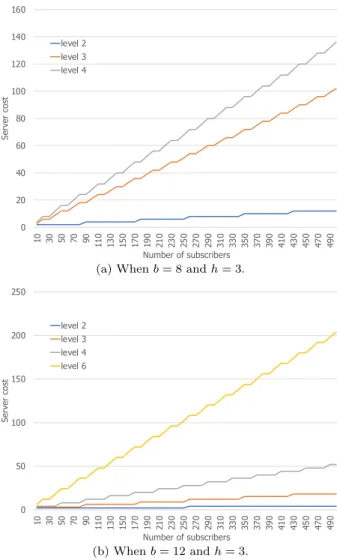
Figure 7 shows how this value increases as the number of subscribers N increases for each i. Although it could be bounded by a small value for smalli’s, it rapidly increases as the quality leveliincreases, e.g., whenb = 12,h = 3,
Fig. 7 Server cost in the naive scheme.
andN=500, the server cost is only four fori=2 (i.e., 500 peers are covered by two delivery trees), but increases to 18 fori=3, and to 52 fori=4.
On the other hand, in the proposed scheme, since a video stream of quality level iusesi core trees consisting of∑h
j=0bjpeers for the delivery ofistripes, the server cost is bounded byias long asN≤ib∑h
j=0bj. Hence the server cost to cover the delivery ofistripes toNsubscribers within h+1 hops is
⌈ N(b−1) b(bh+1−1)
⌉
×i
(note that wheni = 1, the proposed scheme covers fewer subscribers than the naive scheme). The server cost signif- icantly reduces by the proposed scheme. In particular, for anyi ≤ b, it coincides with the number of stripesi(i.e., it takes the minimum value) as long asN ≤b∑h
j=0bj; e.g., if N≤4680 forb=8 andh=3, and ifN≤22620 forb=12 andh=3.
5.2 Residual Capacity
Finally, we evaluate the residual capacity of peers in the proposed scheme, and compare it with the naive scheme to certify that the reduction of the server cost does not rely on the overloading of the subscribers. In the proposed scheme, a video stream of quality leveli<byields peers with a residual capacity. More precisely, for suffi- ciently largeN, the ratio of peers to have residual capacity of amountbis given asbb−i for each level 1≤i≤b. On the other hand, the residual capacity in the naive scheme is eval- uated as follows. Assumei ≤b/2, without loss of general- ity, since otherwise, given video stream should be delivered through a path consisting of at mosth+1 peers. The ratio of leaf peers ind-ary trees of heighth+1 is maximized when all leaves are of depthh+1; namely when it is a completed-ary tree. Since a completed-ary tree of heighth+1 hasdhleaves and∑h−1
i=0 diinternal peers, for sufficiently largeN, the ratio
Fig. 8 The ratio of peers to have residual capacity of amountbin each scheme forh=3. Dashed lines represent the proposed scheme and solid lines with marks indicate the naive scheme.
of leaf peers to have residual capacity of amountbis given as ∑hdh
i=0bi.In addition, givenN≤∑h
i=0bisubscribers, we can construct ad-ary tree of height at mosth+1 so that there is at most one peer to have a residual capacity of amountb′for some 1≤b′≤b−1 (i.e., so that the residual capacity of the other peers is either 0 orb).
Figure 8 shows how those values decrease as the qual- ity leveliincreases. We could observe from the figure that ifi ≤ b/2, the proposed scheme allow more peers to have residual capacity of amountbthan the naive scheme.
6. Concluding Remarks
This paper proposes a scheme to deliver video streams to the subscribers with a designated latency in different quality levels. The proposed scheme is designed with the notion of core trees, and could significantly reduce the server cost while guaranteeing a designated latency. A future work is to evaluate the dynamic behavior of the proposed scheme by conducting event-driven simulations.
References
[1] H. Ando and S. Fujita, “Tight Bounds for Two-Hop Delivery in Ho- mogeneous P2P Video Streaming Systems,” Proc. 4th International Symposium on Computing and Networking (CANDAR), pp.1–8, 2016.
[2] B.A. Alghazawy and S. Fujita, “A Scheme for Maximal Resource Utilization in Peer-To-Peer Live Streaming,” Int. J. Comput. Netw.
& Communications (IJCNC), vol.7, no.5, pp.13–28, Sept. 2015.
[3] G. Bianchi, N.B. Melazzi, L. Bracciale, F.L. Piccolo, and S. Salsano,
“Streamline: An Optimal Distribution Algorithm for Peer-to-Peer Real-Time Streaming,” IEEE Trans. Parallel Distrib. Syst., vol.21, no.6, pp.857–871, June 2010.
[4] M. Biswas, M.R. Frater, and J.F. Arnold, “Multiple description wavelet video coding employing a new tree structure,” IEEE Trans.
Circuits Syst. Video Technol. vol.18, no.10, pp.1361–1368,, 2008.
[5] M. Castro, P. Druschel, A.-M. Kermarrec, A. Nandi, A. Rowstron, and A. Singh, “SplitStream: High-bandwidth Multicast in Coopera- tive Environments,” Proc. the 19th ACM Symp. Operating Systems Principles (SOSP), pp.298–313, 2003.
[6] M. Castro, P. Druschel, A.-M Kermarrec, and A. Rowstron,
“SCRIBE: A Large-Scale and Decentralized Application-Level Multicast Infrastructure,” IEEE J. Sel. A. Commun., vol.20, no.8, pp.1489–1499, Oct. 2002.
[7] J. Chakareski, S. Han, and B. Girod, “Layered coding vs. multiple descriptions for video streaming over multiple paths,” Multimedia Systems, vol.10, no.4, pp.275–285, 2005.
[8] Cisco, “Visual Networking Index-Forecast and Methodology 2016- 2021,” http://www.cisco.com/en/US/solutions/collateral/ns341/ns525/ ns537/ns705/ns827/white paper c11-481360.pdf,
[9] G. Dan, V. Fodor, and I. Chatzidrossos, “On the Performance of Multiple-Tree-Based Peer-to-Peer Live Streaming,” Proc. the 26th IEEE Int’l Conf. Computer Communications (INFOCOM), pp.2556–2560, 2007.
[10] S. Fujita, “Optimal Serial Broadcast of Successive Chunks,” Theo- retical Computer Science, vol.575, pp.3–9, April 2015.
[11] S. Fujita, “Broadcasting a Stream of Chunks in Heterogeneous Net- works with a Short Maximum Broadcast Time,” J. Interconnection Networks (JOIN), vol.18, no.2n03, 2018.
[12] S. Fujita, “Cloud-Assisted Peer-to-Peer Video Streaming with Min- imum Latency,” IEICE Trans. Inf. & Syst., vol.E102-D, no.2, pp.239–246, Feb. 2019.
[13] S. Fujita, “Flash Crowd Absorber for P2P Video Streaming,” IEICE Trans. Inf. & Syst., vol.E102-D, no.2, pp.261–268, Feb. 2019.
[14] S. Fujita, “Multi-Tree-Based Peer-to-Peer Video Streaming with a Guaranteed Latency,” vol.E102-D, no.9, pp.1707–1714, Sept. 2019.
[15] H.-J. Hong, “From Cloud Computing to Fog Computing: Un- leash the Power of Edge and End Devices,” Proc. IEEE Int. Conf.
Cloud Computing Technology and Science (CloudCom), pp.331–
334, 2017.
[16] X. Jin, W.-P.K. Yiu, S.-H.G. Chan, and Y. Wang, “On Maximizing Tree capacity for Topology-Aware Peer-to-Peer Streaming,” IEEE Trans. Multimedia, vol.9, no.8, pp.1580–1592, Dec. 2007.
[17] D. Kosti´c, A. Rodriguez, J. Albrecht, and A. Vahdat, “Bullet: High bandwidth Data Dissemination using an Overlay Mesh,” Proc. the 19th ACM Symp. Operating Systems Principles (SOSP), pp.282–
297, 2003.
[18] Y. Liu, “On the Minimum Delay Peer-to-Peer Video Streaming:
How Realtime Can It Be?” Proc. 15th ACM Int’l Conf. on Mul- timedia., pp.127–136, 2007.
[19] S. Liu, Z.-S. Rui, W. Jiang, J. Rexford, and M. Chiang, “Perfor- mance Bounds for Peer-Assisted Live Streaming,” Proc. Int’l Conf.
on Measurement and Modeling of Computer Systems (SIGMET- RICS), pp.313–324, 2008.
[20] N. Magharei and R. Rejaie, “PRIME: Peer-to-Peer Receiver-Driven Mesh-Based Streaming,” IEEE/ACM Trans. Networking, vol.17, no.4, pp.1052–1065, Aug. 2009.
[21] L. Natali and M.L. Merani, “Successfully Mapping DASH Over a P2P Live Streaming Architecture,” IEEE Trans. Circuits Syst. Video Technol., vol.27, no.6, pp.1326–1339, June 2017.
[22] https://www.nhk.or.jp/strl/publica/rd/rd137/PDF/P57-62.pdf (in Japa- nese)
[23] S. Saito, T. Shitomi, S. Asakura, A. Satou, M. Okano, K. Murayama, and K. Tsuchida, “8K Terrestrial Transmission Field Tests Us- ing Dual-Polarized MIMO and Higher-Order Modulation OFDM,”
IEEE Trans. Broadcasting, vol.62, no.1, pp.306–311, March 2016.
[24] V. Stankovic, R. Hamzaoui, and Z. Xiong, “Robust layered multi- ple description coding of scalable media data for multicast,” IEEE Signal Process. Lett. vol.12, no.2, pp.154–157, Feb. 2005.
[25] F. Wang, Y. Xiong, and J. Liu, “mTreebone: A Collaborative Tree-Mesh Overlay Network for Multicast Video Streaming,” IEEE Trans. Parallel Distrib. Syst., vol.21, no.3, pp.379–392, March 2010.
[26] W. Wu, H. Mao, Y. Wang, J. Wang, W. Wang, and C. Tian, “Cool- Conferencing: Enabling Robust Peer-to-Peer Multi-Party Video Conferencing,” IEEE Access, vol.5, pp.25474–25486, 2017.
[27] X. Xiao, Q. Zhang, Y. Shi, and Y. Gao, “How Much to Share: A Re- peated Game Model for Peer-to-Peer Streaming under Service Dif- ferentiation Incentives,” IEEE Trans. Parallel Distrib. Syst., vol.23, no.2, pp.288–295, Feb. 2012.
[28] H. Yin, X. Liu, T. Zhan, V. Sekar, F. Qiu, C. Lin, H. Zhang, and B.
Li, “Livesky: Enhancing CDN with P2P,” ACM Trans. Multimedia Comput. Commun. Appl. (TOMM) vol.6, no.3, Aug. 2010.
[29] X. Zhang, J. Liu, B. Li, and Y. -S.P. Yum, “CoolStreaming/DONet:
A Data-Driven Overlay Network for Peer-to-Peer Live Media Streaming,” Proc. the 24th Annual Joint Conf. of the IEEE Com- puter and Communications Societies, vol.3, pp.2102–2111, 2005.
[30] G. Zhang, W. Liu, X. Hei, and W. Cheng, “Unreeling Xunlei kankan:
understanding hybrid CDN-P2P video-on-demand streaming,” IEEE Trans. Multimedia, vol.17, no.2, pp.229–242 Feb. 2015.
[31] M. Zhao, P. Aditya, A. Chen, Y. Lin, A. Haeberlen, P. Druschel, B. Maggs, B. Wishon, and M. Ponec, “Peer-assisted content distri- bution in Akamai NetSession,” Proc. 2013 conference on Internet measurement conference, pp.31–42, ACM, 2013.
[32] C. Zhao, J. Zhao, X. Lin, and C. Wu, “Capacity of P2P On- Demand Streaming With Simple, Robust, and Decentralized Con- trol,” IEEE/ACM Trans. Networking, vol.24, no.5, pp.2607–2620, Oct. 2016.
[33] Y. Zhou, T.Z.J. Fu, and D.M. Chiu, “A Unifying Model and Anal- ysis of P2P VoD Replication and Scheduling,” IEEE/ACM Trans.
Networking, vol.23, no.4, pp.1163–1175, Aug. 2015.
[34] S.Q. Zhuang, B.Y. Zhao, A.D. Joseph, R.H. Katz, and J.D.
Kubiatowicz, “Bayeux: An Architecture for Scalable and Fault- Tolerant Wide-Area Data Dissemination,” Proc. NOSSDAV’1, pp.11–20, 2001.
Satoshi Fujita received the B.E. degree in electrical engineering, M.E. degree in sys- tems engineering, and Dr.E. degree in informa- tion engineering from Hiroshima University in 1985, 1987, and 1990, respectively. He is a Professor at Graduate School of Engineering, Hiroshima University. His research interests in- clude communication algorithms, parallel algo- rithms, graph algorithms, and parallel computer systems. He is a member of the Information Processing Society of Japan, SIAM Japan, and IEEE Computer Society.