Doctoral Dissertation
Development of the Instrument to Measure Technological Pedagogical Content Knowledge (TPACK) of Pre-Service Science Teacher in Indonesia
ARIF HIDAYAT
Graduate School for International Development and Cooperation Hiroshima University
September 2018
Development of the Instrument to Measure Technological Pedagogical Content Knowledge (TPACK) of Pre-Service Science Teacher in Indonesia
D142936 ARIF HIDAYAT
A Dissertation Submitted to
the Graduate School for International Development and Cooperation of Hiroshima University in Partial Fulfillment
of the Requirement for the Degree of Doctor of Philosophy in Education
September 2018
i Development of The Instrument to Measure Technological Pedagogical Content
Knowledge (TPACK) of Pre-Service Science Teacher in Indonesia
Abstract
This study aims to design and examine an instrument measuring the development of preservice science teachers’ Technological, Pedagogical, and Content Knowledge (TPACK) in technology integration of teaching practice program. The study investigates domains i.e.:
Content Knowledge (CK), Pedagogy Knowledge (PK), Technology Knowledge (TK), Pedagogical Content Knowledge (PCK), Technological Pedagogical Knowledge (TPK), Technological Content Knowledge (TCK), and TPACK; where its derivation leads to define indicators and items development of the instruments.
A set of TPACK development instrument is produced, with as many as 116 items in 31 indicators of the TPACK tool with 6–point Likert type scales result initially from this research.
Validation process on the instrument applied to 1628 respondents of preservice science teachers in Indonesia. The construct validity of the tool is examined through Confirmatory Factor Analysis using Principal Axis Factor (PFA), and the researcher applying multiple PFA method after selecting items without sharing of factor loading to ensure there is no ambiguous of items respective to the formed elements. Regarding those process, the result shows after the modification and or deletion of 49 of the survey items, the 67 items-survey are considered as a reliable and valid instrument. This instrument would help educators designing studies to assess preservice science teachers’ development of TPACK. The finding shows some domain are getting less or smaller indicators and items except for the Technological Content Knowledge.
Some recommendations include in this research for the future investigation, i.e.: (1) Understanding of those preservice science teachers’ TPACK affecting their practices during student teaching actions; (2) The teacher preparation program needs to take for improving on development properties of preservice science teachers’ TPACK; and (3) identification of significant relationships between preservice teachers’ TPACK during the program and their use of technology in their future teaching career.
ii Table of Content
Cover
Abstract i
Table of Content ii
List of Figures iii
List of Tables iv
Chapter 1 INTRODUCTION
a. Technology Integration and its packed framework in education 1 b. Framework of Technological Pedagogical and Content Knowledge
(TPACK)
3
c. TPACK for Pre-service Science Teacher 5
d. TPACK Framework for Preservice Science Teacher in Indonesia 6
e. Research Questions 8
f. Statement of the Problem 9
g. Objectives 10
h. Significance of the Study 10
Chapter 2 THEORETICAL REVIEW
Indonesia Education System: A Glance 13
National Curriculum of Indonesia: School Science and Technology and Technology for Science Prospective Teacher
15 Science Teacher Competencies in Indonesia : in-service and pre-service 18 Technology in Pedagogical Content Knowledge (PCK) 23 Technological, Pedagogical, and Content Knowledge (TPACK) 24 Identifying and Measuring Technological, Pedagogical, and Content
Knowledge
28 Chapter 3 METHODOLOGY
Research Design 41
Participants and Location 41
Gaining Permission 42
Sampling and Recruiting 43
Instruments 43
Data Analysis 44
iii Chapter 4 INSTRUMENT DEVELOPMENT and DATA PROCESSING
Sub Domain Development 45
Factor Analysis 75
Chapter 5 RESULT DESCRIPTION 87
Chapter 6 IMPLICATION for PRACTICE 121
REFERENCE 126
APPENDICES 141
1 CHAPTER 1
INTRODUCTION
a. Technology Integration and its packed framework in education
Technology has been recognized by human being before 20th century and also changed significantly over the last two centuries. Initially, term of technology refers to the study of the useful arts (George:1823), to allude technical education (Mannix, et al:2005), then as industrial arts (Schatzber:2006), tool or device (Read:1937), and as applied science or practice the way we do (Franklin:1999), until to be the pursuit of life by means other than life and technology as organized inorganic matter (Stiegler:1998). Nowadays, technology is a similarly broad way as a means to fulfill a human purpose (Arthur:2009) which can be an activity that forms or changes the culture (Borgmann:2006) as the use of scientific knowledge involving a simple or complex piece of equipment (Stylairas et al : 2011).
Technology has transformed the way members of society live and conduct business, yet despite decades of national, state, and local reform initiatives to promote technology in various of aspects, including education (Donovan, Hartley, & Strudler, 2007). Regarding technology using in the educational learning, is defined as the use to achieve learning goals and to empower students learning throughout the instructional program (Cartwright &
Hammond, 2003; Koçak-Usluel, Kuúkaya-Mumcu, & Demiraslan, 2007). Even widespread innovative technology use has not evolved in education especially in the classroom (Means, 2010; Sandholtz, Ringstaff, & Dwyer, 1990) but has been proved to bring advantages while applied in learning (Arroyo, 1992; Daher, 2009; Koller, Harvey, & Magnotta, 2006),
Strudler (2010) states that field of education and technological innovations as dynamic and changing and thus contributing to new opportunities and challenges for technology integration in the reform of education. The term of technology integration itself has a broad perspective from practice and study of facilitating and enhancing the learning process (Byrnes and Etter :2008), to systemic design or deliver the instruction and curriculum and resources (Weisberg:2016), through the use of computers and related pieces of equipment in the classroom (Incikabi:2015) in educational setting for effective use in learning, both theory and practice ( Delfino & Donatella: 2009; Mulder:2016; Vasin et al:2018)
In fact, educational reformers may aim to encourage technology integration, but imposed reform does not readily transfer into meaningful or authentic practices (Rakes,
2 Fields, & Cox, 2006).Furthermore, Judson (2006) states, “technology integration is not necessarily a pillar of reformed instruction” (p. 592), suggesting that a top-down approach to integrating technology is not sufficient to meet students’ educational needs. It related with Mishra and Koehler (2007) who state that there is no ideal solution to the resulting problems associated with integrating technology into the curriculum. It seems that real educational reform efforts regarding with this technology integration focus on developing appropriate instructional strategies that merge technology use with pedagogical and curricular outcomes to prepare students for the 21st century (Ertmer & Ottenbreit-Leftwich, 2010; Onchwari, &
Wachira, 2008a).
According to Lawless and Pellegrino (2007), the rapid rate of technological innovations requires teachers to base technology integration decisions on theories and research related to learning, instruction, and assessment. The emphasis on technology integration should focus on a teachers competence to achieve technological literacy across all content areas, rather than just on technological competence (Rutherford, 2004). Planning for technology integration across the curriculum presents opportunities to examine teaching and learning models which can provide teachers with a pedagogical knowledge base to augment the impact of educational improvement and reform (Shulman, 1986, 1987).
Perspectives on efforts to implement effective changes in technology have been a recurring research topic with increased pedagogical emphasis on changing not just what is taught but also how subject matter is delivered (Ertmer & Ottenbreit-Leftwich, 2010; Lawless &
Pellegrino, 2007; Mishra & Koehler, 2006; Prensky, 2011). As curriculum designers, teachers decide which pedagogical strategies promote meaningful and strategic technology integration across the curriculum (Harris, 2005), thus contributing to students’ learning (Mundy, Kupczynski, & Kee, 2012). Similarly, Ertmer (2005) suggests, “the decision regarding whether and how to use technology for instruction rests on the shoulders of the teachers” (p. 27). Consequently, these methods and supporting research guide teachers to strategic planning for not only how to use technology, but also “when to use technology, what technology to use, and for what purposes” (Lawless & Pellegrino, 2007, p. 581). Furthermore, the classroom teacher must engage in a pedagogical shift between traditional and new instructional practices to adopt technological changes for 21st- century learners across different contexts (Donovan et al., 2007; Wiske, 2001). Tee and Lee (2011) promote teachers with training and knowledge thoughtfully discern how to choose, apply, and evaluate technological tools to enhance learners’ understanding of the content
3 Ertmer and Ottenbreit-Leftwich (2010) suggest that context, including content and the school culture, influence a teacher’s decision to integrate technology. It is found that changes in how teachers use technology for instruction occur when teachers witness firsthand how technology-supported student-centered activities influence learner outcomes. They also state that for meaningful teaching and learning to occur, teachers must be knowledgeable in how technology, pedagogy, and content can support curricular goals as a package framework.
The technological, pedagogical, and content knowledge framework as separate domains is a model which combines a teacher’s knowledge, skills, and understanding of the content to transform meaningful learning experiences through pedagogical and technological context- specific solutions (Mishra & Koehler, 2006; Mishra, Koehler, & Henriksen, 2011).
From that passage, the researcher would like to put a base introduction on how essential technology integration in education, primarily focused on instruction level. It relies on teacher’s competencies not only on how to use technology, but also when to use technology, what technology to use, and for what purposes as a package of separate knowledge domain, i.e. technology, pedagogy, and content.
b. Framework of Technological Pedagogical and Content Knowledge (TPACK) Although technology, pedagogy, and content are three different knowledge domains, the interactions of these three domains which consist of the technological, pedagogical, and content knowledge framework, thus representing the knowledge that teachers need to integrate technology effectively. Shulman proposed PCK to describe the relationship between content and pedagogy. Mishra and Koehler (2006) introduced their theory comes after five years of studying teachers at all different grade levels with design experiments to see how their classrooms operated. He argued that modern digital technologies (ICT) had changed the nature of the classroom sufficiently to justify extending Shulman’s model to incorporate the intersections of technological knowledge (TK) with both content knowledge (CK) and pedagogical knowledge (PK). It produced three more intersections (TPK, TCK, and TPCK) as represented in Figure 1. Mishra & Koehler (2006) do not argue that the concepts described by the TPACK framework are entirely new, but what distinguishes their approach is their articulation of the relationships and interplay among the three core domains.
4 Figure 1. Technological Pedagogical Content Knowledge (TPACK) Framework [Mishra and Koehler (2006)]
The TPACK framework provides teachers with an understanding of how to learn and how to think about technology to meet learner outcomes based on content or pedagogical approaches within specific contexts (Koehler & Mishra, 2005). This type of understanding about teachers’ thought processes also provides insight into teaching staff’ varying levels of technology use for specific purposes. This framework heightens the teacher’s role as a curriculum designer to integrate technology judiciously (Tee & Lee, 2011) through a dynamic relationship among technology, pedagogy, and content knowledge rather than just repurposing existing technological resources (Mishra et al., 2011).
It can be said that TPAK is the set of knowledge that teachers need to teach their students a subject (content), teach effectively(pedagogy), and use technology (Technology).
Teachers’ TPACK represents three kinds of knowledge for integrating technology across content areas (Mishra & Koehler, 2006, 2007). Flexible planning using these three knowledge components provides teachers with a framework to strategize for technology integration within specific instructional contexts, specifically one-to-one technology- enhanced environment (Koehler & Mishra, 2008). There are increased demands for teachers to integrate technology effectively; providing one-to-one technological access alone is not a practical solution to technology integration (Inan & Lowther, 2010). Mishra et al. (2011) recommend transforming learning by connecting teachers’ TPACK with the seven cognitive tools of perception, patterning, abstracting, embodied thinking, modeling, play, and synthesizing. These tools provide teachers with universal applications for repurposing
5 existing tools within different contexts and across content areas for specific pedagogical purposes (Koehler & Mishra, 2008; Mishra et al., 2011).
The teaching and learning context is an integral part of the TPACK framework.
Consequently, when teachers integrate one-to-one technology, the setting should also reflect teachers’ awareness of an individual learner’s physical, linguistic, social, psychological, and cultural aspects for acquiring knowledge as the affordances and constraints of technology in planning for efficient and equitable use (Kelly, 2008). Kelly identifies the following three types of context elements that teachers should consider when integrating technology for individual students:
1. equity issues that apply across content areas such as student preferences or learning styles;
2. equity issues unique to individual students or content areas resulting in miscommunication between the teacher and the learner, particularly in mathematics; and
3. equity issues in which some students’ technology use is limited to drill and practice while other students’ use is more productive or challenging.
Koehler and Mishra (2008) identify teaching with technology as a complex problem of how best to use technology for learning based on an understanding of flexible and integrated knowledge. Consequently, the technological, pedagogical, and content knowledge framework provides a practical solution for teachers to modify situational variances within teaching and learning contexts for students of diverse backgrounds and learning styles (Koehler & Mishra, 2008).
c. TPACK for Pre-Service Science Teacher
Polly and Brantley-Dias noted what teachers know and how teachers are using technology in the classrooms indicated by using TPACK in association with technology integration in learning environments (Polly and Brantley-Dias, 2009). These studies suggest the need for further research about the ways that pre-service teachers are being prepared to teach using technology tools that are rapidly changing. Thompson and Schmidt provide support for the utilization of the TPACK framework in the development of educational technology among pre-service teachers and others. They describe it as having entered a new phase in its
6 use in research; its focus now being used in research and development, and no longer solely on developing a theoretical definition of the framework itself (Thompson and Schmidt, 2010).
The TPACK framework also has been used by other researchers in the search for insight into technology integration practices. A study by Graham and others in 2009 examined TPACK development among in-service teachers of science. Their focus was on the measurement of the confidence that the participants had in their TPACK knowledge. The TPACK constructs that the measured are TPACK, TPK, TCK, and TK. The results of this study are used to support further development of science program coordinators in strengthening the technology content knowledge (TCK) of science teachers by exposing them to technology tools especially useful in supporting science teaching. Graham (2011) study is related to this research as it suggests the need for exposing pre-service science teachers to specific technology tools that help science teaching and learning.
Chai and others studied the perceived development of TPACK among pre-service teachers using an adapted version of the TPACK survey designed by Schmidt and others. The study’s findings and implications suggest that the pedagogical component of TPACK should be the focus first when preparing pre-service teachers for the classroom. These researchers also determined that it is important to continually provide opportunities for pre-service teachers to practice combining pedagogy with content and technology throughout their education courses to maintain strong pedagogical skills (Chai et al., 2010).
These studies provide insight into the development of the activity sequence for this study as participants needed to develop of how to best measure an understanding of pre-service science teacher on teaching science pedagogically according to the available technology tools.
d. TPACK Framework for Preservice Science Teacher in Indonesia
Science Teacher Education Programs in Indonesia have been designed by taking into account PCK (MoE:2015) which Shulman described as “the special amalgam of content and pedagogy that is uniquely the province of teachers, their special form of professional understanding” (p. 8). Shulman’s work reflected in many of the current to ‘content knowledge,’
‘pedagogical knowledge,’ and ‘pedagogical content knowledge’.
The importance of technology framework is started to emphasize as responses of the result of achievement Indonesians’ students in mathematics, reading, and science from four cycles of international assessment in TIMSS and PISA (OECD:2010) as follow:
7 Figure 2. Comparison Result of Mathematics, Reading and Science for Indonesian Student in PISA and TIMSS [OECD:2010]
Directorate of Higher Education (DGHE) of MoE of Indonesia through National Education Priorities on Human Development describe that for mathematics and science learning should be more focused on “Using understandable abstractions, and relationships between concept through mathematics, science impacts countless empiricism decisions students in daily life (MoEC:2015). Furthermore, ICT has been transforming in curriculum and praxis of science not as a specific subject but as Integration support for effective teaching and learning (MoEC:2015).
Nevertheless, the government mention using technology for teaching and learning is made concerning the Teachers Professional Standards for Teachers requiring four National Teacher Standards, i.e., Pedagogy, Personality, Social and Professional Competencies.
Regarding with these standards, utilization of technology is mandatory needed as one of the aspects of Professional Competencies only, with less mentioned in the Pedagogy, Social and Personal competencies (MoE: 2013; Pusparini et al.:2017) both in pre-service and in-service levels. According to the Guideline of Curriculum Development of Teacher Education Institute by DGHE, there are no specific references made to TPACK in national curriculum at any subjects (MoE: 2014), but all school highly demanded technology as enrichment in learning support. The government also put pedagogic activities and strategies change in response of ICT and interactive technologies to support knowledge building, consolidation, and application of concepts to new contexts as part of Science Teacher Education Standard (MoE:2013), which emphasize for science teacher to use learning technology using ICT technology functionally, mastering technology related to his/her teaching (MoEC:2013)
8 Meanwhile, especially for science teachers candidates curriculum, technology integration is emphasized concerning modifying materials including strengthening underlying concepts, interaction during the lesson, students feedback methods, until making a relationship between science concept with daily lives (MoEC:2013).
Furthermore, Indonesian National Qualification Framework Competencies for Higher Education for Pre-Service Teachers demanding for integration of technology concerning utilizing current ICT development and elaborate in the classroom situation to optimize their teaching activities” (MoEC:2015)
From the passage, technology integration is demanded widely not only for science teachers but also pre-service science teacher but less description in which extend the framework of this technology integration. The explication of the frame is an essential part since it will become fundamental for further steps of measurement and skills description.
Regarding with point c and d, the essential step to investigate TPACK development on specific area (local) to pre-service teachers is to identify its properties or characteristics through initial measurement (Koehler and Mishra: 2008), and over 500 studies have been conducted on the TPACK framework and TPACK instruments for in-service teachers but less for pre-service teachers (Hofer & Harris, 2012). Furthermore, in specific case of Indonesia, some researchers investigated TPACK instruments in particular subjects such as Social, English, and including science (Cahyono et al.:2016; Mahdum: 2015; Akmal :2007, Drajati et al.: 2018), but some TPACK instruments designed for in pre-service science teacher level arisen separately such as in chemistry and biology with lack for science as a whole (Riandi:2017, Pusparini et al:2017, Agustin et al.:2018).
So, according to these arguments in the passage, it is crucial to know the characteristic of the pre-service science teacher in Indonesia concerning on TPACK development start from the initial stage through creating and examining an instrument.
e. Research Questions
Based on the background described, the central Research Question (RQ) in this research is
"How TPACK as a framework of technology integration is adopted and adapted to be a set of an instrument of measuring technology integration development of pre-service teacher in Indonesia?”.
9 To answer this research question in this case study research for pre-service science level, the researcher needs to steps from investigating the framework of TPACK for the preservice science teacher and its necessity to measure technology integration of preservice science teacher in Indonesia. Furthermore, the stage is defining indicators and items of TPACK instrument, working with validity and findings from this instrument and finally analyzing its the strength and the weaknesses.
f. Statement of the Problem
Students and teachers live in a digital age in which innovative technologies are a part of their daily lives. Nationwide initiatives are in place to expand student access to technologies in the classroom, thus increasing opportunities for teaching and learning with technology enhancement (MoE, 2013). Essentially, technology enhancement settings provide students with access to a technological device. As student access increases, so do opportunities for teachers to integrate technology for a variety of purposes to meet the needs of 21st-century skills learners.
According to Spires, Wiebe, Young, Hollebrands, and Lee (2012), increased technology access has the potential to alter the instructional environment provided the classroom teacher possesses the pedagogical knowledge to facilitate learning in a one-to-one setting. Lawless and Pellegrino (2007) maintain that teachers must stay abreast of instructional strategies for integrating content using new technologies for teaching and learning. Koehler and Mishra (2008) suggest that specific technologies have their affordances or constraints which make them applicable to completing particular tasks. Consequently, teachers must
“reject functional fixedness” (p. 17), looking beyond the apparent features of technology to repurpose technologies to provide educational opportunities for 21st-century learners (Koehler
& Mishra, 2008).
The context of technology integration environment provides an opportunity to explore science teachers’ adaptation of TPACK to integrate technology effectively and advance teachers’ decision making processes for curricular design and implementation. Additionally, the lack of technological support and training has been identified as an extrinsic barrier to integrating technology (Ertmer, 2005). Although over 500 studies have been conducted on the TPACK framework (Hofer & Harris, 2012), research about the TPACK framework, preservice science teacher in case of Indonesia, not only in particular subjects, within the same study are
10 essential and have not been explored (Cahyono et al:2016, Mahdum:2015, Pusparini et al:
2017, Riyanti et al:2016, Chai et al:2017). Exploring these three factors may expand practitioners’ knowledge of the TPACK framework to affect an educational change for technology integration of preservice science teacher in Indonesia.
According to those brief description, the statement of the problems as followed: There is a bunch research on TPACK framework of teachers to prepare teacher dealing with increased technology which potentially altering instructional environment with affordances, but less followed for pre-service science teacher, and for case of Indonesia pre-service science teacher, it has not been explored.
g. Objectives
The purpose of this case study research is to design and examine an instrument measuring the development of science preservice teachers’ Technological, Pedagogical, and Content Knowledge (TPACK) in technology integration. The science curriculum in secondary level (both junior and high school) encompasses a range of content topics that can be taught using technology. In the future, these pre-service science teachers will serve as the curriculum director, selecting activities and resources to fulfill specific goals and objectives.
According to Mishra and Koehler (2006), the incorporation of new technology requires teachers to reconfigure their understanding of how these three elements (technology, pedagogy, and content) interact as knowing a technology does not equate to understanding how to teach using technology. Although the integration of the tools and technologies is often the result of imperatives, the technological, pedagogical, and content knowledge framework provides a language to discuss the educational connections between content and pedagogy through different technological representations and levels of access (Mishra & Koehler, 2006). Mainly for the case of Indonesian pre-service science teacher how the instrument to measure its development would be an essential tool for the understanding of those three elements.
h. Significance of the Study
As technology integration in science learning demand continues to increase, preservice science teachers will need to equip with instructional practices to support meaningful
11 technology integration for 21st-century learners. This study may describe properties for preservice science teachers to integrate technology effectively in the classroom as one of additional reference in Documents of Indonesian National Qualification Framework (MoEC:2015). This case study research might contribute to the body of literature to increase pre-service science teachers’ awareness of the TPACK framework which teacher education program directors have recognized to support technology integration endeavors across content areas in the Guideline of Curriculum Development of Teacher Education Institutes (MoEC:2014). This study may also influence the need of standards for future of teacher educator competencies to prepare prospective science teacher’ technology integration as an essential component of support for technology integration knowledge.
12 CHAPTER 2
THEORETICAL REVIEW
This literature review begins with findings the new movement of National Curriculum in Indonesia, where technology integration is one of an essential part, particularly in the science subject. Systematically, the researcher will arrange this chapter as follow:
(a) A brief of Indonesia education system which will be presented into pictures and tables; (b) Short overview about curriculum of Indonesia time to time since independence era to the recent years particularly in terms of general properties, science, technology for schools and technology in pre-service science teachers; (c) comparison of science teacher and pre- service science teacher competencies in Indonesia. For this part of a, b, c the researcher would like to present how the competencies of science-teacher and pre-service science teacher become essential in the localize TPACK Framework in the research. This part is a core to on adoption, adaptation, and creation in the designing process of the instrument describing in chapter 4.
Regarding the TPACK, the researcher then addresses insights on the concept of pedagogical content knowledge (Shulman, 1986,1987) that led to changes in how teachers use pedagogy and content knowledge to improve instructional practices. Additionally, the researcher evaluates the technological, pedagogical, and content knowledge framework (Mishra & Koehler, 2006) through related literature to delineate applications of the TPACK framework, an example of its use in science content, including identifying and measuring TPACK.
Last but not least, the researcher will provide a theoretical review for development of TPACK instruments for the pre-service science teacher, including rational from determined types of instrument obtained. Along with particular situation in Indonesia, this part also will lead to the adoption, adaptation, and creation in the designing process of the instrument in chapter 4. From a plethora of literature review, it leads for the researcher to connect, combine and extract a theoretical review to build the body of knowledge of the instrument for this study
13 a. Indonesia Education System: A Glance
The Indonesia education system is vast and diverse. With around 60 million students and more than 4 million teachers in some 340 thousand educational institutions, it is the most extensive education system in the Asia region and the in the world after China, India, and the US, where educational improvement in Indonesia will bring substantial impact to Asia as well (World Bank:2014). There are two ministries responsible for managing the education system, with 84% of schools under the Ministry of Education and Culture (MoEC) about 16% under the Ministry of Religious Affairs (MORA) (WorldBank, 2017). Besides public schools, private schools play an essential role. Even only about 7% of primary schools are private, the share increase to 56% of junior secondary schools and 67% of senior secondary schools (MOEC:2013, OECD:2015, ADB:2015). Figure 3 describes the current structure of Indonesia’s educational system as an interdependent series.
Figure 3. Indonesia education system [MoEC:2013]
Regarding with a very diverse population, geographically dispersed, and with wide variations concerning socio-economic status among the big five islands; it also brings to the
14 Table 2. Proportion of spending in education by level of government and level of education, Indonesia, 2009
(%) Source Al-Samarrai, S. (2013)
distribution of people, students, institutions and teachers at the various educational levels.
Table 2 shows the distribution of population, students, educational institutions and teachers in Indonesia.
While the share of expenditure on education by level of government is presented as follow:
As Table 2 shows, the districts carry the bulk of funding responsibility for primary education (61%) and account for just over half of spending on senior secondary education.
series of reforms in education since 2004 produced some fundamental laws and regulations which provided an overall framework for education sector development in Indonesia. It brings some cheer up progress for citizens generally. First of all is a commitment to allocate 20% of the national budget to education has seen increased almost triple in real terms since 2001, with spending of IDR 310.8 trillion (the US $35.3bn) in 2012 (Tobias et al.: 2014, MOEC: 2005, OECD/ADB: 2015). Furthermore, an upgrading of the teacher workforce where between 2006 and 2010, the percentages of teachers with a bachelor’s degree inclined from 17% to 27% at the primary level and from 62% to 76% at the junior secondary level (Tobias et al.: 2014). A NEST is a set of new professional allowances for teachers who have completed the teacher
Table 1. Distribution of population, Students, Educational Institutions, and Teachers, by age and level of education, Indonesia, 2013 [Education Statistics of MoEC 2012/2013]
15 certification process and for those who work in remote areas (MoEC: 2005). Also, a large scale of School Operations Grant program (SOG), as a way of supporting direct-funding into a sub- district level to keep children in classroom activities and provide schools some flexibility in managing their funds (MOEC:2005, OECD: 2014). Also, to support decentralization effort in general, the government has moved to anchor the principles of school-based management, where school considerable transferred decision-making authority to individual schools.
Since 2006, the enrollment for being teachers at Teacher Education Institutes are raised up almost double, school training and teacher association activities are getting bigger, and also some improvement in the quality of education occurred. Indications of Improvements in the quality of education in Indonesian showed in international tests of reading levels, with both PISA (Program of International Science Assessment) and PIRLS (Progress in International Reading Literacy Study) assessments. It reported statistically significant improvements in reading levels across 2000-2012 and 2006-2011, respectively, although there are variations in consecutive years (OECD 2013, IEA 2012). Also, OECD noted that Indonesia was one of the few countries who achieve improvements in reading performance from 2000-2009 and also narrowing gaps between the highest and lowest performance of students (OECD: 2012). This performance in mathematics, still based on PISA scores, has improved overall across 2003- 2012, but the annualized change over the period is statistically insignificant.
b. National Curriculum of Indonesia: School Science and Technology and Technology for Science Prospective Teacher
Since educational reform waved in 2004, a dramatic improvement in the education sector have been occurred and could not be better since then. A commitment to spend 20% of the national budget for education brings impact in many aspects of educational improvement, including new movement of the school science national curriculum (MoEC: 2012). This movement is part of the improvement journey from school science curriculums of Indonesia.
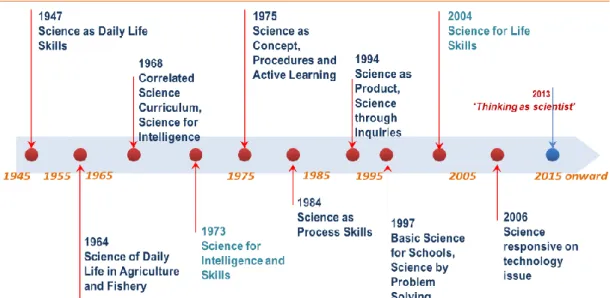
Indonesia has experienced to revise National Curriculum for 11 times since its independence in 1945. From each period of changes, science and technology also evolved in School Curriculum. In case of School Science in National Curriculum itself is evolved from the period of time as change in national curriculum since 1945 from science directly translated for daily living skills in agriculture and fisheries, increasing science to be science as content, process, and product, until becoming science as part of thinking as scientist in recent curriculum. How
16 main properties of school science curriculum changes over time briefly presented in the following figure 4, i.e.
Figure 4. Main Strike of Evolution Science in School Curriculums of Indonesia
According to the overall objectives of a new curriculum, one of science education is aimed at enabling Indonesian children to utilize technology to solve the problem within daily life (MoEC:2013). This objective is matching with demand for science teacher that “ . . . Shall able to elaborate technology updates and its application to support learning . . .” (MoEC:2013) This statement means technology integration, which unfortunately there is no precise definition of technology integration on it.
Figure 5. Main Strike of Evolution Technology in School Curriculums of Indonesia
17 At the same time, the presence of technology in national curriculum as timeframe showed that it evolved from pure handicraft in early practice (1945), translate to technology as unique skills (1968), assisting subject lesson (1984), become technology in local subjects (1995), and introducing primary technology education (2004), until technology means ICT as a particular school subject (2006), and recently ICT integrated into subjects (2015). How main properties of technology briefly changes overtime presented in figure 5.
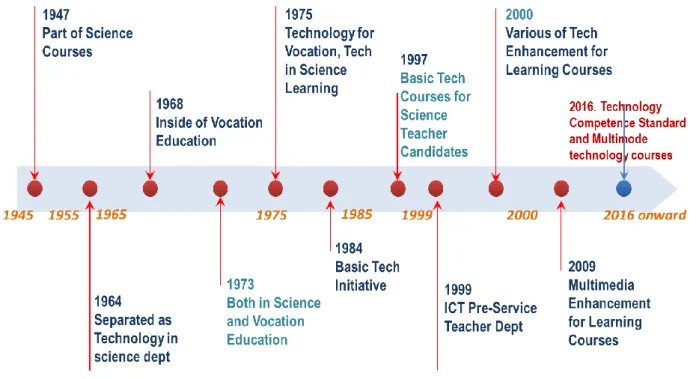
As it is mandated to fulfill the need of the science teacher at the school, there is also an evolution in pre-service science teacher educators which mostly it changes follow the curriculum changes as well. In level of teacher education institute, not like science which has started to establish since 1947, the presence of technological education in a chronicle of Indonesia curriculum development is unique for technology. It was part of science education at the early existence in the country (1945), regarded as vocational core (1964, 1968), and become two cores both in vocational and science (1975), until it becomes part of pre-service science courses since 1997 until now, and separately has become new identity of ICT (1999 until now). How main properties of technology briefly changes overtime presented in figure 6, i.e.
Figure 6. Main Strike of Evolution Technology in Science Curriculums for Pre-Service Science Teacher in Indonesia
18
c. Science Teacher Competencies in Indonesia : in-service and pre-service
Technology integration has not explicitly defined in the national curriculum of Indonesia. However, researchers believe that Indonesian teachers hold strong beliefs that teachers should be designers and students learning should be driven by creating digital artifacts in participatory culture (Chai et al.:2017), and teachers possess strong beliefs that education with technology should move towards the new culture of learning and teachers should be the designer for such learning (Chai et al.:2017).
As mentioned in chapter 1, The elaboration of Teacher Qualifications and Competencies is regulated by the Minister of National Education Regulation No.16 of 2007 on Teachers Qualification and Competency Standards. Teacher Competence according to National Education Articles No.16 of 2007 developed intact from four main competence, covering pedagogic competence, professional competence, personality competence, and social competence. The following table describing Competency Standards for science teachers in detail :
Types of Competences Competences Indicator
Pedagogy
1. Understanding learners characteristics covering the physical, moral, spiritual, social, cultural, emotional, and intellectual aspects
2. Mastering learning theories and principles of educational learning 3. Develop a curriculum related to the subject matter
4. Organizing educational learning
5. Utilizing information and communication technologies for the benefit of learning
6. Facilitate the development of the potential of learners to actualize their potentials
7. Communicate effectively, empathically, and well mannered with learners 8. Conducting assessment and evaluation of processes and outcomes of learning 9. Utilizing assessment and evaluation results for learning purposes
10. Applying reflective action to improve the quality of learning
Personality
1. The act under the norms of religion, law, social, and national culture of Indonesia
2. Presenting as an honest person, noble character, and role model for learners and society
3. Showing a steady, stable, mature, wise, and authoritative person
4. Demonstrates work ethic, high responsibility, pride in being a teacher, and self-esteem
19 5. Uphold the professional code of ethics of teachers
Social
1. Be inclusive, objective, and non-discriminatory due to gender, religion, race, physical, family background, and socioeconomic status
2. Communicate effectively, empathically, and courteously with fellow educators, education personnel, parents, and the community
3. Adopt on duty throughout the territory of the Republic of Indonesia which has socio-cultural diversity
4. Communicate with the professional community itself and other professions orally and in writing or other forms
Professional
1. Mastering the materials, structures, concepts, and scientific mindsets that support the subjects
2. Mastering the competency standards and foundation competencies of subjects or areas of development.
3. Developing creative learning materials
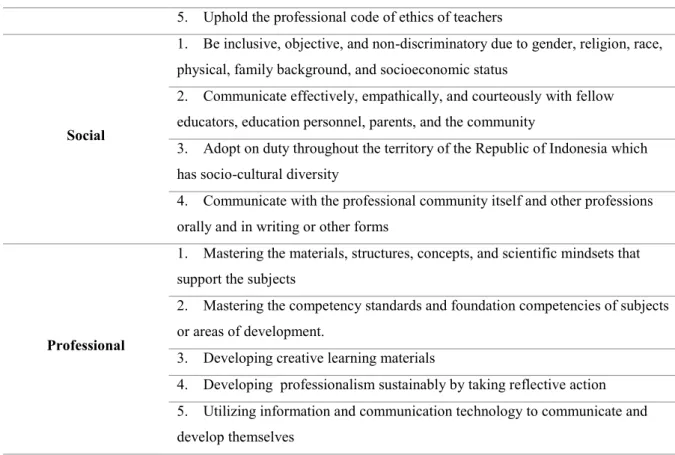
4. Developing professionalism sustainably by taking reflective action 5. Utilizing information and communication technology to communicate and develop themselves
Table 3. Standard of Competence Indicators for Indonesia Science Teachers
The competences, which explicitly said for pedagogy and professional competences, are demanding pedagogic activities and strategies change in response of ICT and interactive technologies to support knowledge building, consolidation, and application of concepts to new contexts as part of professionalism (MoEC:2007). This technology integration becomes essential for teachers as mandated in Government Regulation No. 74/2008 on Teachers; it declared that teachers should have competencies “ . . . . to use learning technology, using ICT technology functionally, mastering technology related with his/her teaching, and part of teacher achievement for being awarded in technology-related competition, and keep updating with technology issues . . .” (MoEC:2008, MoEC:2013).
The researcher critically puts attention about the frameworks adopted or adapted to gain this technology integration and how to obtain technology integration into the classroom learning through designated framework is lack discussed. In this study, the Standard of Competence Indicators for Indonesia Science Teachers would be an essential consideration to make a draft of the instrument of TPACK for pre-service science teachers. Based on the above description, professional competence that can be measured in the TPACK instrument includes the mastery of science materials, concepts and mindset science, master the competency
20 standard and basic competence of science subjects, and the development of science learning materials under the competence to be achieved.
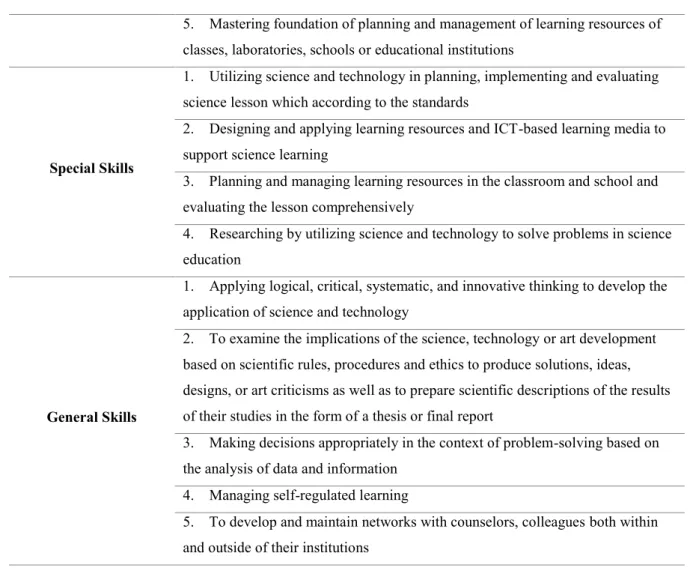
The government designed the Standard of Competence Indicators for Indonesia Science Teachers, but it is a difference in the way of formulating Standard Competence for pre-service science teachers. The competencies transforming into learning outcomes by Indonesia Science Teacher Educator Associations (ISTEA:2018) which devoted into (a) Attitude, (b) Mastery Knowledge, (c) Special Skills, and (d) General Skills as described in the following table:
Types of Competences / Learning Outcomes
Competences / Learning Outcomes Indicator
Attitude
1. Be cautious to God Almighty and able to show religious attitude 2. Uphold the value of humanity in carrying out duties based on religion, morals, and ethics
3. Internalize academic values, norms, and ethics
4. Acting as a proud citizen and love of the country, having nationalism and a sense of responsibility to the state and nation
5. Respecting cultural diversity, views, religion, and beliefs, as well as the original opinions or findings of others
6. To contribute to the improvement of the quality of life of society, nation, state, and progress of civilization based on Pancasila;
7. Cooperate and have social sensitivity and concern for society and environment
8. Law-abiding and disciplined in social life and state
9. Internalize the spirit of independence, struggle, and entrepreneurship
10. Demonstrate a responsible attitude towards the work in the field of expertise independently
11. Have sincerity, commitment, sincerity to develop an attitude, value, and the ability of learners
Mastery Knowledge
1. Mastering the facts, concepts, principles, laws, theories, and procedures of the science
2. Mastering the educational foundation, learning theory, characteristics of learners, strategies, planning, and evaluation of science learning comprehensively 3. Mastering the theoretical concepts of problem-solving in science education procedurally through a scientific approach
4. Mastering the factual knowledge about the functions and benefits of technology, especially relevant information and communication technology for the development of the quality of science education
21 5. Mastering foundation of planning and management of learning resources of classes, laboratories, schools or educational institutions
Special Skills
1. Utilizing science and technology in planning, implementing and evaluating science lesson which according to the standards
2. Designing and applying learning resources and ICT-based learning media to support science learning
3. Planning and managing learning resources in the classroom and school and evaluating the lesson comprehensively
4. Researching by utilizing science and technology to solve problems in science education
General Skills
1. Applying logical, critical, systematic, and innovative thinking to develop the application of science and technology
2. To examine the implications of the science, technology or art development based on scientific rules, procedures and ethics to produce solutions, ideas, designs, or art criticisms as well as to prepare scientific descriptions of the results of their studies in the form of a thesis or final report
3. Making decisions appropriately in the context of problem-solving based on the analysis of data and information
4. Managing self-regulated learning
5. To develop and maintain networks with counselors, colleagues both within and outside of their institutions
Table 4. Standard of Competence / Learning Outcomes for Indonesia Pre-Service Science Teachers
Regarding with pre-service teachers, technology integration is indicated in the national guidelines of teacher education institutes as “ . . . Essential enhancement for teachers candidate to incorporate their pedagogy and content knowledge to mastering concepts and its contexts in the daily situation and to support teaching to the classroom effectively” (MoEC:2013).
Furthermore, among Indonesian National Qualification Framework Competencies for Higher Education especially for pre-service teachers, technology integration is demanded regarding utilizing current ICT development and elaborate in the classroom situation to optimize their teaching activities (MoEC:2015).
TPACK as a framework of technology integration is essential to be adopted and to be adopted in the context of Indonesia since technology integration has been indicated as calls both informal national documents and previously mentioned research. Moreover, besides the TPACK frameworks has not been investigated a lot in Indonesia, as one of most significant education forces in South East Asia, bring TPACK framework to Indonesia would bring impacts in the future to a considerable population of education workforces as well. From these
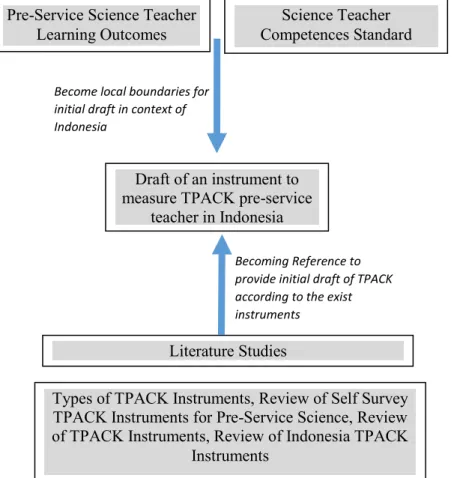
22 rational, the researcher decided to put on the table Indonesia pre-service teacher as the context to localize TPACK. Regarding with part of a, b, c the researcher would like to present how the competencies of science-teacher and pre-service science teacher become essential in the localize TPACK Framework in order to design and examine TPACK instrument for pre-service science teacher with the following figure:
Figure 7. Localize TPACK Framework in order to design and examine TPACK instrument for pre-service science teacher
Pre-Service Science Teacher
Learning Outcomes Science Teacher Competences Standard
Literature Studies
Becoming Reference to provide initial draft of TPACK according to the exist instruments
Types of TPACK Instruments, Review of Self Survey TPACK Instruments for Pre-Service Science, Review of TPACK Instruments, Review of Indonesia TPACK
Instruments Draft of an instrument to measure TPACK pre-service
teacher in Indonesia
Become local boundaries for initial draft in context of Indonesia
23 d. Technology in Pedagogical Content Knowledge (PCK)
The combination of pedagogy and content knowledge evolved into a pedagogical content knowledge framework that has influenced both the educational and research fields (Shulman, 1987). Effective teachers possess a repertoire of pedagogical knowledge skills and content knowledge skills to integrate into the curriculum to meet learners’ diverse needs.
Shulman (1986) identifies the omission of combined pedagogy and content knowledge as the missing paradigm of how teachers transform subject matter knowledge into various methods of instruction. Shulman (1987) states that the “knowledge base for teachers is not fixed and final” (p. 12), indicating a growth paradigm. He proposes three categories of knowledge which contribute to growing teachers’ knowledge base: (a) subject or content knowledge, (b) pedagogical content knowledge, and (c) curricular knowledge (Shulman, 1986).
Shulman (1986) states that teachers should be able not only to understand the content being taught but also to discern why the topic is essential to a given discipline. Shulman identifies pedagogical content knowledge as “an understanding of what makes the learning of specific topics easy or difficult; the conceptions and preconceptions that students of different ages and backgrounds bring with them to the learning of those most frequently taught topics and lesson” (p. 9). Shulman describes the curriculum as a range of materials and resources with which a teacher designs are varying pedagogical approaches to represent the content or subject matter for instruction. In addition to knowledge of content, pedagogy, and curriculum, Shulman (1987) also identifies learner knowledge, content knowledge, and knowledge of goals and beliefs as essential to developing a teacher’s knowledge base.
The use of technology as tools of teaching to meet the needs of 21st-century learners provides new perspectives for examining changes in teachers’ knowledge, specifically teachers’ pedagogical beliefs (Ertmer & Ottenbreit-Leftwich, 2010). In fact, the way teachers use technology for instruction has been the topic of interest to researchers, policymakers, and school leaders for several decades. Ertmer and Ottenbreit-Leftwich state, “teaching with technology requires teachers to expand their knowledge of pedagogical practices across multiple aspects of the planning, implementation, and evaluation processes” (p. 260).
Schuck and Kearney (2008) conducted a study to understand teachers’ pedagogical practices in two technology-using classrooms: one classroom used digital videos, and the other classroom used an interactive whiteboard. The teachers’ roles varied in each classroom depending on the instructional approach for using the technology. For the digital video project, the students experienced increased autonomy during the learning experience with the teacher providing minimal assistance with camera operations and video edits. The teacher maintained
24 primary control using the interactive whiteboard to present content information. The researchers (Schuck & Kearney, 2008) identify this approach as replicating a traditional presentation approach with the addition of using technology.
Schuck and Kearney (2008) suggest that each pedagogical approach was influenced by the technology being used to represent the content. Ertmer and Ottenbreit-Leftwich (2010) maintain that when teachers are introduced to a new pedagogical tool, the decision to use the tool is based on the teacher’s belief as to whether the tool aligns with the instructional outcome.
Schuck and Kearney note that both teachers expressed using technology to enhance student understanding, increase student motivation, and increase student ownership. The school context, including leadership support for using technology, can also impact a teacher’s pedagogical beliefs for integrating technology (Ertmer & Ottenbreit-Leftwich, 2010; Schuck
& Kearney, 2008).
It can be inferred that the presence of Technology in PCK not only expanding its domains but also gives a new perspective of teachers’ pedagogical beliefs and practices for integrating technology.
e. Technological, Pedagogical, and Content Knowledge (TPACK)
The technological, pedagogical, and content knowledge framework incorporates technology from Shulman’s (1987) constructs of pedagogical content knowledge. Koehler and Mishra (2005) developed this framework to represent a pragmatic approach to understanding the teachers’ knowledge base essential for integrating technology effectively. The technological, pedagogical, and content knowledge framework consists of a dynamic relationship between three core knowledge areas: technology, pedagogy, and content. Koehler and Mishra (2005, 2008, 2009) and Mishra and Koehler (2006, 2007) identify seven knowledge components of the technological, pedagogical, and content knowledge that comprise an essential knowledge base for teachers. A brief overview of each component of the framework is below:
1. Content knowledge (CK) is knowledge about the subject matter or specific content such as mathematics, science, or social studies. Teachers must know the concepts, theories, and procedures within a given field to teach effectively (Shulman, 1986).
2. Pedagogical knowledge (PK) is knowledge about the processes or methods of teaching and learning including planning; assessment; and cognitive, social, and developmental learning theories (Koehler & Mishra, 2008; Shulman, 1986)
25 3. Pedagogical content knowledge (PCK) is flexible knowledge about which instructional methods fit with the content and how to represent the content to promote meaningful learning (Koehler & Mishra, 2008; Shulman, 1986).
4. Technology knowledge (TK) is knowledge of both standard and new technologies as the acquisition and adaptation of skills as technological innovations develop (Koehler
& Mishra, 2008).
5. Technological content knowledge (TCK) is knowledge about the reciprocal and flexible relationship in which one can use technology to represent content. Both content and technology have affordances and constraints which may prevent possible representations for curricular planning (Koehler & Mishra, 2008).
6. Technological pedagogical knowledge (TPK) is knowledge of the flexible use of technological tools for teaching and learning as knowledge of the affordances and constraints of technologies within a particular context (Koehler & Mishra, 2008).
7. TPACK is knowledge which requires teachers to develop an understanding of the relationships between and among technology, content, and pedagogy to integrate technology productively (Harris, Mishra, & Koehler, 2009; Koehler & Mishra, 2008;
Koehler & Mishra, 2009).
Koehler and Mishra (2009) recognize, “no single technological solution applies to every teacher, every course, or every view of teaching” (p. 66). These components as illustrated in the model (Figure 1) comprise an interactive framework which emphasizes the connections among technologies, pedagogy, and content and the complexities of planning for technology integration.
Figure 8. Technological, Pedagogical, and Content Knowledge Framework. Permission to use the technological, pedagogical, and content knowledge image is granted [source: http://tpack.org.]
26 When making decisions about technology integration, teachers should take into consideration the dynamic relationships between and among these three modes of knowledge rather than simple solutions (Koehler & Mishra, 2008).
Mishra and Koehler (2006) state the following:
[Technological pedagogical content knowledge] is the basis of good teaching with technology and requires an understanding of the representation of concepts using technologies;
pedagogical techniques that use technologies in constructive ways to teach content; knowledge of what makes concepts difficult or easy to learn and how technology can help redress some of the problems that students face; knowledge of students’ prior knowledge and theories of epistemology; and knowledge of how technologies can be used to build on existing knowledge and to develop new epistemologies or strengthen old ones. (p. 1029)
By this framework, one avoids the perception that a single pedagogical approach can be used with digital technologies, instead of considering the ways technologies can support various pedagogies and content areas. Similarly, general technological approaches may not be as useful as considering flexible ways that technology can be integrated into specific content areas. Consequently, the diversity of innovative technologies increases options for teachers to cultivate technological, pedagogical, and content knowledge through thoughtful and meaningful technology integration.
Just as valuable as teacher beliefs about how to integrate technology is a teacher’s possession of multiple sources of knowledge which serve as the foundation for those beliefs.
Koehler and Mishra (2005) propose that good teaching requires not only introducing technology to teach content material but also possessing the ability to synthesize the core curricular components and make adjustments to instruction based on the different levels of technology integration. Teachers’ knowledge of the technological, pedagogical, content knowledge framework provides a range of flexible and fluid use of technologies to provide differentiated learning experiences within a content-based curriculum.
Harris and Hofer (2009, 2011) suggest that teachers’ technological, pedagogical, and content knowledge is grounded in using content-specific, technology-enhanced learning activity types for instructional planning. Harris and Hofer (2009) identify five instructional decisions which contribute to a teacher’s plan when using learning models as conceptual planning tools:
27 1. Selecting the learning goals;
2. Making pedagogical decisions based on the learning experiences to achieve the learning goals;
3. Choosing and sequencing activity types to develop the learning experiences;
4. Selecting assessment strategies to identify students’ understanding and misconceptions; and
5. Selecting tools and resources to support the learners’ acquisition of knowledge, and understanding of the learning experiences and goals.
Harris and Hofer (2009) note that the use of activity types requires teachers to focus on the learning goals and activities specific to instructional content before selecting the technology appropriate for the lesson. Rather than considering the affordances and constraints associated with technology, teachers select the technological tool which best supports students’ learning (Harris & Hofer, 2009). This practice of using activity types supports an authentic approach to developing teachers’ technological, pedagogical, and content knowledge by considering what students will learn, which activities students will do, and which technologies will support the learning goals.
In contrast, Forssell (2012a) suggests that in-service teachers’ typical application of technological, pedagogical, and content knowledge may be restricted because of limited access to technologies. Forssell explains that teachers’ technological, pedagogical, and content knowledge is evidenced when teachers employ professional judgment about a technological tool’s instructional effectiveness and decide whether or not to use a particular technological tool even within the constraints of limited access. Forssell (2012a, 2012b) contends that a teacher’s decision or reasoning not to use instructional technology reflects adaptive expertise with a deliberate focus on process rather than on product.
Harris et al. (2010) “suggest a logical approach to helping teachers to integrate technologies in their teaching is to directly link students’ content-based learning activities and related educational technologies that will best support the activities’ successful implementation” (p. 575). Educational leaders, pedagogical experts, and technology specialists designed content-based learning activity type taxonomies across six curriculum areas: K-6 literacy, mathematics, science, secondary English language arts, social studies, and world languages (Harris et al.,2010). These activity type taxonomies provide teachers with content- specific standards-based activities to expand and refine traditional instructional planning with
28 meaningful technology integration strategies. Harris et al. note that the taxonomies do not encompass the full range of pedagogical strategies for instructional planning the function of the taxonomies is to expand teachers’ range of instructional strategies for curricular planning, thus accommodating the learning styles of 21st-century learners
It can be seen from the framework describes how the framework of TPACK thoroughly presented which make it different from technology-embedded or limited to the application of technology or repurpose technology as part of instructional strategies. It also encountered previous ideas in Shulman (1987) which put technology as part of content knowledge.
f. Identifying and Measuring Technological, Pedagogical, and Content Knowledge Mishra and Koehler (2006) promoted the technological, pedagogical, and content knowledge framework by adding technology as an additional construct to Shulman’s (1987) pedagogical content knowledge framework. The dynamic interplay of the technology-added constructs identified as technological content knowledge; technological pedagogical knowledge; and technological, pedagogical, and content knowledge have gained attention among researchers seeking to clarify the constructs’ theoretical foundation or meaning (Angeli
& Valanides, 2009; Graham, 2011). Koehler and Mishra (2008) recognize the framework as complex, specifying that teachers’ technological content knowledge is “the most neglected aspect of the various intersections of the [technological, pedagogical, and content knowledge framework]” (p. 16). Accordingly, Graham (2011) examines issues surrounding theory development of the technological, pedagogical, and content knowledge framework using Whetten’s (1989) three essential elements for theory development. Whetten refers to the following elements as building blocks for theory development:
1. identifying which factors, constructs, or concepts are specific to the phenomenon being studied;
2. exploring how elements are related; and
3. explaining why the factors and relationships are relevant to the phenomenon and broader audience.
Graham (2011) notes that the precise definitions for the interactions of the constructs within the technological, pedagogical, and content knowledge framework lack clarity. In describing the second element, Graham refers to two conditions which may impede a clear understanding of the constructs. Those are (a) the relationship in which pedagogical content knowledge is perceived as either transformative or integrative, thus influencing the researchers’
29 overall synthesis of the technological, pedagogical, and content knowledge framework; and (b) the lack of clarity between individual constructs and among constructs that share boundaries, preventing researchers from distinguishing different constructs. The last element pertains to a rationale or soundness for the theory or model, specifically the constructs of the technological, pedagogical, and content knowledge framework. Graham suggests that researchers have construed the dimensions of the technological, pedagogical, and content knowledge framework to value the core components of technology, pedagogy, and content knowledge rather than the interactive relationships. Graham recommends that future researchers and teacher education programs work together to identify common understandings of the constructs to increase the framework’s viability as a theoretical framework.
Varied assessment tools used to determine teachers’ technological, pedagogical, and content knowledge have been developed amidst the growing number of researchers exploring teachers’ technological, pedagogical, and content knowledge. These tools include self-reported survey instruments, technology integration observation instruments, technology integration assessment rubrics and semi-structured interview protocols. Researchers have used the assessment tools as originally designed or adapted the tools to advance general understanding of the dynamic relationship among teachers’ technological, pedagogical, and content knowledge. Abbitt (2011) suggests, “as the methods and instruments for assessing [technological, pedagogical, and content knowledge] are further developed and refined, there is an overarching need for the establishment of meaningful norms for the various instruments to provide additional indices to which these changes can be compared” (p. 297). Hofer and Harris (2012) report a literature base of over 500 studies on the technological, pedagogical, and content knowledge framework with researcher emphasis primarily on preservice teachers rather than in-service teachers as participants. Hofer and Harris analyzed 12 studies that researchers conducted in 2011 to explore experienced teachers’ technological, pedagogical, and content knowledge before or during professional development training. A common theme reported in each of the 12 studies was that teachers’ technological content knowledge was less evident as compared to technological pedagogical knowledge. Hofer and Harris suggest five reasons for this variance:
1. teachers may attend to pedagogy more than to content;
2. teachers may not separate technological content knowledge from the content or curricular knowledge
![Figure 3. Indonesia education system [ MoEC:2013 ]](https://thumb-ap.123doks.com/thumbv2/123deta/5696717.1013554/19.892.159.755.483.1047/figure-indonesia-education-system-moec.webp)
![Table 1. Distribution of population, Students, Educational Institutions, and Teachers, by age and level of education, Indonesia, 2013 [Education Statistics of MoEC 2012/2013]](https://thumb-ap.123doks.com/thumbv2/123deta/5696717.1013554/20.892.170.774.587.714/distribution-population-students-educational-institutions-indonesia-education-statistics.webp)
![Figure 8. Technological, Pedagogical, and Content Knowledge Framework. Permission to use the technological, pedagogical, and content knowledge image is granted [source: http://tpack.org.]](https://thumb-ap.123doks.com/thumbv2/123deta/5696717.1013554/31.892.315.636.792.1091/technological-pedagogical-knowledge-framework-permission-technological-pedagogical-knowledge.webp)