The Impact of Innovations on the ICT Market
in the Twenty-first Century
Boguslawa Drelich-Skulska*
Abstract
This article explores the influence of innovations on the information and communication technologies (ICT) market. In the first part of the article, I draw on extant literature concerning the definition of innovation to describe notable types of innovation and the factors that determine their introduction in various functional areas and processes. Following this, I analyze the influence of innovation on the efficiency of virtual organizations that have been active in the ICT market (i.e., Google, Nasza-Klasa). These case studies clearly illustrate that innovation allows firms to secure competitive advantages within the dynamic segments of the ICT market, and is thus a key factor for success.
In this vein, the case studies demonstrate that for enterprises that operate in dynamic markets characterized by frequent changes in technology, innovation is the primary contributor of competitive advantage. In particular, product and service innovations are most important for providing firms with advantages over their competitors and redefining the market structure.
I. Introduction
1Innovation is often referred to as the engine of growth. Despite its importance, it is often difficult to understand how innovations occur in light of the complexity of a company’s internal environment and interconnections with external business partners. Although specific activities that can increase an enterprise’s innovative potential have been identified, there remains no universal solution for comprehensively boosting innovation. Because the identification of this universal solution remains elusive, there has been a recent increase in empirical research performed on individual companies. This research has collectively sought to provide a detailed understanding of internal factors that contribute to innovation within enterprises. In line with this recent research, this paper’s primary hypothesis is that innovation is a key factor for allowing a firm to gain a competitive advantage in dynamic segments of the ICT market.
In exploring this hypothesis, this article seeks to expand upon current knowledge concerning the role of innovation in virtual organizations that are active on the ICT
* Professor, Institute of International Economic Relations, Faculty of Economic Sciences, Wroclaw University of Economics
E-mail: [email protected]
1 This paper is based on research performed while the author was a visiting research fellow at the Center
market. In particular, the analyses performed in this paper will focus on (a) exploring the occurrence of innovations in different functional areas and processes of an organization, and (b) determining the influence of innovations on relationships between virtual organizations that are active in the ICT market.
II. The theory of innovation
1. Definition of innovation
The tendency for innovations to induce organizational growth and adaptability (Ahmed 1998) seems to be particularly pronounced in dynamic markets, where they allow companies to proactively shape the manner in which the market develops and adjust to unexpected changes in the external environment. In this way, innovation equips companies with tools needed to better respond to environmental change, remain competitive in increasingly competitive environments, and exploit new market opportunities.
Though most firms claim to support innovation, the general lack of understanding surrounding this term has generated a situation in which “innovation” is largely synonymous with R&D investment or product development. The term “innovation,” however, relates to concepts that transcend a company’s products and services. One of the earliest definitions for the term describes innovation as “…the generation, acceptance and implementation of new ideas, processes, products and services” (Thompson 1965: 2). Buckler offers a similarly high-level perspective, describing innovation as “an environment, a culture – almost spiritual force – that exists in a company” (Buckler 1997: 43). Both Thompson and Buckler indicate that rather than be restricted to a domain populated by a dedicated group of employees, innovation pervades the whole of a company’s activities and processes. This perspective has been supported by Myers and Marquis who developed one of the earliest and most comprehensive definitions for innovation. They argued that “innovation is not a single action but a total process of interrelated sub processes. It is not just the conception of a new idea, nor the invention of a new device, nor the development of a new market. The process is all these things acting in an integrated fashion” (Myers and Marquis 1969: 44). Farr and West extended classic definitions for innovation, indicating that the value it generates for the company’s stakeholders is a critical aspect of its conceptualization as well. For them, innovation relates to “…the intentional introduction and application within a role, group or organization of ideas, processes, products and procedures, new to the relevant unit of adoption, designed to significantly benefit role performance, the group, the organization or the wider society” (Farr and West 1989: 16). This perspective has been further elaborated upon by Trott, who distinguished “innovation” from “invention” by arguing that definitions for the former should incorporate the concept of commercial benefits. According to Trott, innovation is comprised of three key elements: theoretical conception, technical invention, and commercial exploitation (Trott 2005: 15). In parallel
with his development of an equation that predicts innovation, Trott developed one of the most widely recognized definitions of the term. He argued that innovation is “the management of all activities involved in the process of idea generation, manufacturing and marketing of a new (or improved) product or manufacturing process or equipment” (Trott 2005: 16).
Despite the pervasiveness with which it is applied, Trott’s definition was not the first to include newness or change as critical components. The concepts of novelty and change were also incorporated into Damanpour’s definition for innovation. According to Damanpour, “innovation is conceived as a means of changing an organization, either as a response to changes in the external environment or as a pre-emptive action to influence the environment. Hence, innovation is here broadly defined to encompass a range of types, including new products or services, new processes and technologies, new organization structures or administrative systems, or new plans or program pertaining to organizational members” (Damanpour 1996: 694). Owing to the broadness of its scope, I have adopted Damanpour’s definition for innovation for the subsequent sections of this paper.
Many researchers have argued that the innovation process can be divided into phases. Ahmed, for example, argued that the successful development and commercialization of innovations requires three critical stages. Many innovations may not proceed beyond the first stage, idea generation, because of incompatibility or inconsistency with corporate strategy. In the second stage, different types of structured methodologies are applied to verify the degree to which the new idea is useful and compliant with the organization’s objectives. In the final stage, commercialization, the extent to which the idea is operationally feasible is determined to capitalize on the results of the earlier phases (Ahmed 1998: 30). Whereas most innovative ideas are generated in the first phase, the second and the third phases feature critical measures for transforming those ideas into successful products, services, and organizational solutions.
Similar to Ahmed, Baregheh, Rowley, and Sambrook also argued that the innovation process occurs over several steps. However, Baregheh and his colleagues offer a more detailed account of how innovation occurs. Specifically, the authors indicate that five key steps are required to successfully innovate. These steps include the creation, generation, implementation, development, and adoption of the new idea (Baregheh, Rowley, and Sambrook 2009: 1333). These stages emerged from a content analysis of more than sixty definitions of innovation and a cluster analysis involving the most commonly cited themes in various theoretical papers. However, rather than extract a single notion to represent each of the stages, Baregheh et al. simply grouped the most common words. Therefore, despite the nuances offered by this approach, there exists a possibility that it identified phases of innovation that are not mutually exclusive. For example, the idea “creation” may be equivalent to “generation” and “implementation” may be equivalent to “adoption.” In spite of their attempt to develop a framework for a more differentiated innovation process, Baregheh et al.’s approach would yield only three stages.
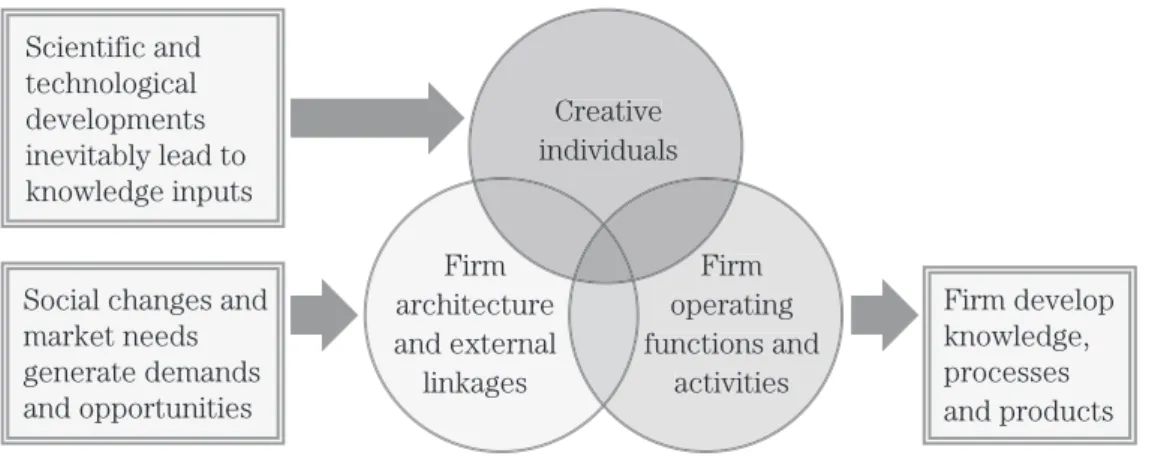
an advanced innovation model based on interactions between the company and its environment. This model delineates three sectors of a firm that should be the core of innovation generation and support: creative individuals, firm operating actions and activities, and firm architecture and external linkages. These three sectors facilitate the efficient generation of ideas, thus allowing for timely responses to external incentives to innovate, including technological progress and changes in social dynamics and market structures. As a result, the three aforementioned sectors can serve to improve a firm’s adaptations to change. Trott’s model, which incorporates these sectors, has been summarized in Figure 1 below.
Social changes and market needs generate demands and opportunities Firm develop knowledge, processes and products Scientific and technological developments inevitably lead to knowledge inputs Firm architecture and external linkages Firm operating functions and activities Creative individuals
Figure 1: Overview of the innovation process
(Source: Trott, 2005: 10)
Trott’s model provides a systemic view of a firm and allows for an understanding of its innovation process in the context of external factors. However, the model possesses one critical weakness; it exclusively conceptualizes the innovation process as a reaction to changes in the external environment. However, there have been a number of cases in which firms have used innovation as a tool to proactively shape the markets they operate in, thus increasing the degree to which they are competitive in those markets. To render Trott’s model a more accurate representation of the markets in which firms operate, it should incorporate the proactive aspects of innovation as well.
2. Innovation types
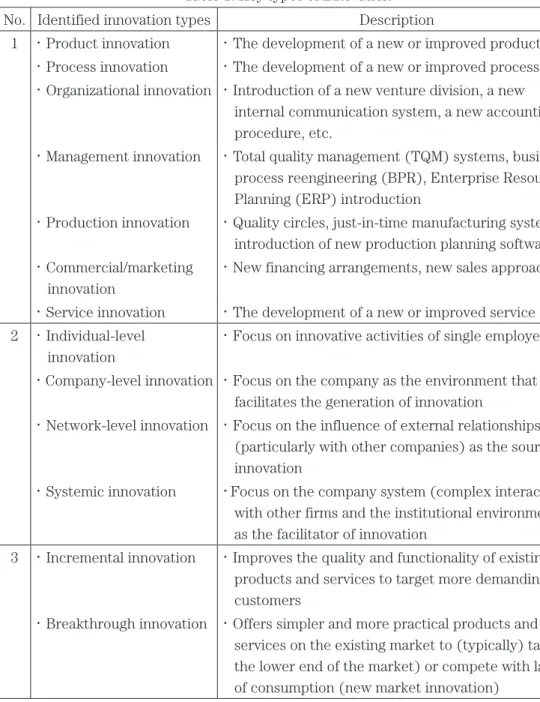
Past literature on innovation features a number of typologies of the concept. These typologies focus on different, but equally important aspects of the innovation process. These aspects include (a) the functional area of a company’s activities in which innovation occurs, (b) the parts of a company’s system that facilitate innovation generation, (c) types of change caused by innovation, and (d) approaches to intellectual property rights for innovative solutions.
provide a comprehensive overview of different types of innovation. Key categories used by each of the typologies are summarized in Table 1.
Table 1: Key types of innovation No. Identified innovation types Description
1 ・Product innovation ・The development of a new or improved product ・Process innovation ・The development of a new or improved process ・Organizational innovation ・Introduction of a new venture division, a new
internal communication system, a new accounting procedure, etc.
・Management innovation ・Total quality management (TQM) systems, business process reengineering (BPR), Enterprise Resource Planning (ERP) introduction
・Production innovation ・Quality circles, just-in-time manufacturing system, introduction of new production planning software ・Commercial/marketing
innovation
・New financing arrangements, new sales approaches ・Service innovation ・The development of a new or improved service offer 2 ・Individual-level
innovation
・Focus on innovative activities of single employee ・Company-level innovation ・Focus on the company as the environment that
facilitates the generation of innovation
・Network-level innovation ・Focus on the influence of external relationships (particularly with other companies) as the source of innovation
・Systemic innovation ・Focus on the company system (complex interactions with other firms and the institutional environment) as the facilitator of innovation
3 ・Incremental innovation ・Improves the quality and functionality of existing products and services to target more demanding customers
・Breakthrough innovation ・Offers simpler and more practical products and services on the existing market to (typically) target the lower end of the market) or compete with lack of consumption (new market innovation)
4 ・Closed innovation ・Innovation that remains internal to a company; typically new solutions are patented and intellectual property rights are strongly protected
・Open innovation ・Innovation that is either with the external
environment or is deliberately developed in an open environment to avoid the exploitation of intellectual property rights (e.g., open source programmers)
(Sources: Trott 2005: 17; Littunen and Varis 2010: 128-154; Christensen and Raynor 2010; Almirall and Casadesus-Masanell 2010: 27-47)
The list of innovation typologies outlined in Table 1 should not be considered exhaustive. Rather than serve as a list of all known categories of innovation, the categories listed in Table 1 indicate the variety of perspectives from which the topic of innovation can be analyzed. As a result of the drastic increase in studies focused on aspects of innovation in recent years, additional typologies of innovation could have been identified. However, the four typologies described in Table 1 were chosen on the basis of their diversity.
3. Innovation enablers
Just as the definition of innovation has been addressed by a large number of studies in the literature, a number of researchers have also empirically explored internal and external factors that enhance a company’s capacity to innovate. For instance, in accordance with Typology 2 (as described in Table 1), it is possible to identify innate features that make an employee more or less apt to innovate (individual-level innovation). Ahmed (1998) studied attributes of creative employees, suggesting that self-confidence, experience, energy, curiosity, interpersonal skills, intuition, self-control, and independence are key contributors to creativity on the part of employees. It can therefore be argued that enterprises can increase their potential for internal innovation through focused carefully tailored recruiting policies.
However, securing the right personnel is only part of the process through which a firm can promote innovation. Companies must also develop an organizational culture and climate that empowers its employees to utilize their creative potential to come up with new ideas and solutions, thus creating an environment that supports innovation. To successfully establish a culture and climate that supports innovation, firms must consider several key elements: the definition of work within the firm, the company’s structure, and cultural norms.
First, the importance of how work is defined within a company relates to the importance of unstructured, open-ended tasks that require complex problem-solving abilities on the part of the employees. Complex, multifaceted tasks promote creativity among employees, as solutions to the problems presented to them require unorthodox thinking.
Second, organic, open, and participative structures support the development of an innovation-enhancing culture within a company. In particular, structures that promote company-wide innovation should be participative and informal in nature, provide freedom from rules, allow for the consideration of multiple viewpoints, encourage face-to-face communication among company personnel, create interdisciplinary teams, emphasize creative interactions, adopt a willingness to take on ideas from outside the organization, remain cognizant and flexible of the changing needs of the market, possess hierarchies that are flat in shape, and facilitate open upward and downward communication within the organization (Ahmed 1998: 36).
Third, company executives must promote cultural norms that support innovation within the organization. In particular, Ahmed (1998: 35-38) argued that companies should:
• Create a strong focus on the end results of innovative thinking • Emphasize the significance of hard work as a key company value
• Allow employees to take risks and challenge existing structures and processes without fear of failure or negative repercussions
• Avoid focusing on how things have been done in the past and promote the perception of change as a positive factor that brings the company closer to achieving its goals
• Demonstrate a focus on both customers and the company’s business partners, adapting existing processes to better respond to their needs
• Facilitate open communication among company personnel through active listening and the acceptance of criticism, as well as allowing employees to share opinions without fear of negative consequences
• Create teams that are comprised of members from different departments; allow employees to gain experience in various company areas; efficiently manage interdependencies
• Provide an open declaration (vision/mission) that emphasizes the company’s goal to build or maintain an innovation-centered company culture; act as an example in implementing the innovation-enhancing managerial practices • Offer awards and rewards that intrinsically motivate employees (e.g., publicly
recognize innovators within the company, thus setting an example for others) • Ensure that employees have sufficient time and resources to develop and
implement new ideas (i.e., resource slack); provide training that teaches employees techniques for enhancing innovation
• Allow employees to certain sets of activities within the company; promote mutual respect and trust among all members of the organization; share the company’s vision with all stakeholders and allow them to participate in making relevant decisions
in creating and maintaining a culture and climate that promotes innovation. By incorporating messages expressed in the mission, vision, and other official statements with internal communications to employees (e.g., memos, presentations, and announcements), leaders spread key company values and indirectly embed them in the employees’ mindsets. Additionally, managers can utilize tangible rewards (e.g., promotion, monetary incentives) to demonstrate which types of behavior are most valued by the company. Based on their subjective interpretation of the rewards offered to certain individuals within the organization, employees identify which approaches and solutions are expected of them in their daily work and modify their behavior accordingly. In the long term, the promoted beliefs, norms, and values are expressed through behavioral patterns that are widely adopted across the company, thus establishing the company’s culture.
In contrast to the work of Ahmed, Trott’s (2005) work focused not only on identifying features of a company’s structure and norms that affect innovation, but also on those knowledge-based aspects that facilitate innovation. For example, he argued that the diversity of knowledge and skills within an organization is a key driver of innovative thinking. The combination of multiple perspectives and the exchange of practical experiences among specialists can yield the generation of new ideas, thus resulting in more innovative approaches to solving company-specific problems.
Trott (2005) also emphasized the role of IT systems in enabling innovation. In particular, he asserted that companies that seek to enhance their innovative potential should (a) commit to technology and (b) become more receptive to technological solutions that have been used outside the organization. In the long term, a commitment to technology enables firms to establish internal IT platforms that provide a mechanism for the open exchange of new ideas and solutions. Receptivity towards external IT solutions allows enterprises to constantly monitor their technological environment, which facilitates the identification of new methods for optimizing their internal processes, management systems, and organizational structure. Adopting new applications yields greater cost efficiency, shorter lead times, and improved internal communications, thus providing a significant competitive advantage within dynamic, technology-driven markets.
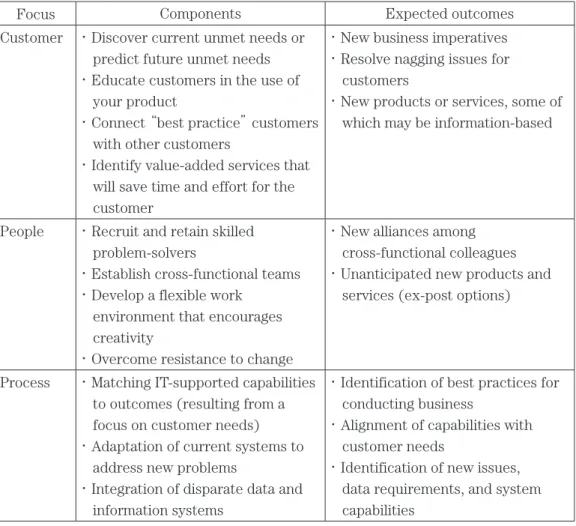
Kohli and Melville (2009) adopted an approach similar to that of Trott through their analysis of IT innovation platforms and their respective impacts on a company’s daily activities. To better understand which IT practices help a company realize its innovative potential, Kohli and Melville performed case studies on several enterprises (i.e., UPS, TAL Apparel Group, Ross School of Business) that have been recognized as having successfully exploited opportunities generated through the effective use of IT platforms. The results of this study demonstrated that there are three key areas in which a strong organizational focus on IT yields tangible results and improves a company’s ability to innovate. These macro-level areas include customers, employees, and processes. In addition, Kohli and Melville identified organizational activities that are categorized in each of the three categories and explored where the launch of dedicated IT solutions
would prove most effective for a company. Finally, Kohli and Melville sought to predict outcomes associated with the organizational activities classified into each macro-level category. The results of their analysis are summarized in Table 2.
Table 2: Components of IT Innovation Platform
Focus Components Expected outcomes Customer ・Discover current unmet needs or
predict future unmet needs ・Educate customers in the use of
your product
・Connect “best practice” customers with other customers
・Identify value-added services that will save time and effort for the customer
・New business imperatives ・Resolve nagging issues for
customers
・New products or services, some of which may be information-based
People ・Recruit and retain skilled problem-solvers
・Establish cross-functional teams ・Develop a flexible work
environment that encourages creativity
・Overcome resistance to change
・New alliances among cross-functional colleagues ・Unanticipated new products and
services (ex-post options)
Process ・Matching IT-supported capabilities to outcomes (resulting from a focus on customer needs) ・Adaptation of current systems to
address new problems
・Integration of disparate data and information systems
・Identification of best practices for conducting business
・Alignment of capabilities with customer needs
・Identification of new issues, data requirements, and system capabilities
(Source: Kohli and Melville 2009: 122-126)
Although the information listed in Table 2 facilitates the identification activities that can bring added value when supported by additional IT resources (e.g., “Educate customers in the use of your product,” “Connect ‘best practice’ customers with other customers”, “Integration of disparate data and information systems”), the list also features several points activities that can be perceived as company-wide, high-level recommendations. For example, the discovery of current unmet needs or prediction of future unmet needs is not a measurable activity, nor did the authors indicate which processes should be implemented to achieve these goals. In addition, it is difficult to determine how improving a company’s IT systems could affect its ability to identify and
satisfy unmet customer needs.
In addition to analyzing the relative impacts of IT innovation platforms for organizations, Kohli and Melville (2009) also provided an overview of what kinds of benefits can be expected from a company’s prioritization of IT (i.e., the company supplies sufficient resources to support IT infrastructure). Specifically, they showed that creativity within a firm does not result only in the development of new products and services. An increased focus on innovation (and IT-related tools to support it) yields a number of additional benefits, including the identification of associations between existing company processes and end-users, the development of best practices within the organization, and the ability to develop an organizational environment that motivates employees to search for ideas that go beyond traditional firm activities. Given this, innovation (which often requires strong IT support) enables a company to exploit opportunities that were not realized through traditional organizational thinking.
Thus far, this section has featured a summary of research related to factors internal to a company that support innovative behaviors. However, within the literature on innovation, many analyses have sought to indicate how a firm’s external environment can affect its innovative potential. For example, Littunen and Varis identified two critical external elements that facilitate innovation within a company: the availability of diverse sources of information and the establishment of collaborative relationships. Specifically, the authors provided evidence for a positive correlation between different channels of freely available market information, such as exhibitions, internet, or media, and the scale of both novel product and market innovations. In addition, they identified different financial organizations as valuable sources of information for introducing novel process (e.g., production methodology/technology) innovations. Finally, organizational innovations were linked with information flows within networks involving regional companies, and educational and R&D organizations (Littunen and Varis 2010: 146). Their analyses clearly demonstrate that a firm’s capacity to interact with other organizations that are active within the same market and the commitment to discovering solutions available beyond the company’s borders promotes product- and market-specific innovations.
Related to this, enterprises that constantly monitor their environment are more adept at learning about new technologies and scientific breakthroughs. Thus, they have greater potential for transforming turn new ideas into tangible products and services. Despite their innate connection, knowledge of new technologies and the implementation of strategic long-term goals should be treated as separate facilitators of innovation facilitators. Whereas being aware of novel technologies can positively influence a company’s capacity for innovation innovate, that company’s management must also understand which solutions best support the long-term strategic goals of the organization and provide the best chance for successfully launching new products and services.
With respect to process innovations, dependence on information obtained from financial organizations be related to two issues. On one hand, the implementation of
new processes is resource-intensive and thus, requires significant initial investment. In contrast, financial institutions, which typically provide financial support to multiple initiatives in the same market, may gradually recognize those factors that contribute to the success of certain investments. In turn, this may influence a company to publicly share its technical knowledge. In other scenarios, financial institutions may simply reject financing certain ideas that had previously failed for similar companies.
Finally, the results of Littunen and Varis’s study suggested that organizational innovations are largely contingent upon the company’s ability to communicate with others in its network and the influence of various public educational organizations. Organizational innovations resulting from interactions with business partners may stem from the need to unify key clusters of activities and procedures between companies to enable more efficient cooperation between them. For example, a group of closely interconnected companies may coordinate their resource planning, communications, and accounting systems to promote transparency between them and facilitate the exchange of critical information.
In line with Littunen and Varis’s work, a number of other researchers have explored inter-organizational networks as key drivers of innovation. For example, Lundvall (1992) argued that vertical networks that link a company, its suppliers, and its customers are primarily responsible for affecting innovative potential. In contrast, Doz, Hamel, and Prahalad (1989) highlight the importance of horizontal cooperation between competitors in promoting organizational innovation. Additionally, in their analysis of network relationship strength, Dowling and Lechner (2003: 60) found that “strong ties add to depth, weak ties to diversity. Strong ties lead to routines, weak ties open the door to new options.” Therefore, participation in a network characterized by weaker ties between companies should help each partner organization realize its innovative potential.
Although there has been a significant amount of empirical work related to the impact of networks on innovation, the scope of this work is beyond the current study. However, it is useful to note that this line of research has provided ample evidence for the existence of a positive association between network relationships and “innovation”.
4. Key aspects of innovation management
As a research domain, innovation management is very broad, and therefore unclear. In many empirical treatments of the topic, researchers have faced difficulty defining the scope of activities to be considered characteristic of innovation management. As a result of this difficulty, researchers have often labeled any activity that enables innovation2 as
innovation management (Johanessen, Olaisen, Olsen 1999; Carmen, de la Luz, Salustiano 2006). In contrast to this approach, for the purposes of the current research, I consider innovation management to be a “…set of managerial activities that together attempt to control the process of innovation” (Drejer 2002: 6). Given this conceptualization, in
2 For example, employing individuals with particular personality traits or ensuring effective communication
this paper, innovation management is defined as covering all activities that enhance innovation that fall under the domain of traditional managerial activities: planning, organizing, leading, controlling, and motivating. The implementation of (contextually specific) innovation management practices should facilitate innovative activities within the company, thus promoting idea generation among organizational members.
One line of research within the extant literature on innovation provides greater insight into innovation management. For example, Drejer explored the assumptions, critical problems, and key activities associated with innovation management. Drejer (2002: 5) argued that the analysis of innovation management rests upon three relevant assumptions. First, organizations act to create (or choose) the environment in which they operate. Second, the strategic choices made by management shape an organization’s structure and processes. Third, once chosen, organizational structure and process constrain the types of strategies the organization can employ.
From this perspective, a company’s management makes strategic decisions on the basis of their perceptions of changes to the external environment to secure future opportunities and avoid business risks. Specifically, these critical decisions address three major problems faced by management. First, management must define the company’s target market and focal areas in terms of products and services offered (i.e., the entrepreneurial problem). Second, management must develop a system of production that enables the company to efficiently provide products and services to its customers (i.e., the engineering problem). Third, managers must develop supportive processes to improve the organization’s ability to operate as a unit and evolve over time to respond to emerging challenges.
Both the assumptions and managerial challenges outlined by Drejer are based on Miles and Snow’s (1978) model of organizational adaptation. Using this model as a conceptual starting point, Drejer identified managerial activities that are typical of innovation management. Specifically, he highlighted five key areas related to innovation management activities: technological integration, the process of innovation, strategic technology planning, organizational change, and business development. Drejer argued that of these five, the “…first three activities define innovation management per se, whereas the last two define the context of innovation management” (Drejer 2002: 6). “Technological integration” refers to the degree to which technology development is in line with product development at the strategic level. “The process of innovation” relates to understanding the role of each functional department in generating innovative ideas and establishing a cross-functional innovation generation process. “Strategic technology planning” is concerned with the development and implementation of technology and competence development projects. “Organizational change” refers to the process where by an organization acquires new knowledge, markets, and employees to become capable of successfully implementing innovation. Finally, by “business development,” Drejer means the degree to which management understands how innovation can drive (and be driven by) business development.
understanding of the company, particularly its interactions with other organizations and dependencies at the inter- and intra-organizational level. Whereas described situation typically occurs in small- and medium-sized enterprises, top management is likely to have a limited view of the entire company’s operations in a global corporation. In this scenario, managers would need to conduct organizational operations on the basis of assumptions or a simplified model of dynamic, ongoing processes. Because the issue of organizational scope has not been addressed in extant literature on innovation, future research would benefit from analyzing different types of innovation management activities in differentially sized organizations.
In addition to the research described above, innovation management has also been explored by Ortt and van der Duin. In their study, they hypothesized that in dynamic markets, there exist no universal solutions to issues related to innovation management. Through an analysis of different generations of theorizing related to innovation management, Ortt and van der Duin concluded that the approaches they studied remained relevant, even today. However, they elaborated upon this assertion, claiming that researchers should select a theoretical approach on the basis of the degree to which it fits with four key contextual factors of innovation management. These factors include the type of innovation (i.e., incremental, radical, transformational), the type of organization (i.e., centralized, decentralized, functional, organic), the type of industry (i.e., high-tech, supplier-driven, fast moving consumer goods), and type of country or culture in which the firm operates (i.e., egalitarian, authoritative) (2008: 528).
The role of a company’s management is to implement innovation management measures that vary in accordance with the context in which the firm is operating to realize innovative potential within the organization. Specifically, management decisions that affect innovation occur at the strategic and operational levels. According to Ortt and van der Duin, “At the strategic level, decisions are made before an innovation process is started, for example whether to innovate or cut back costs and, if a choice is made in favor of innovation, whether to carry out the innovation process in-house or externally… At the operational level, decisions have a direct influence on the shape of the innovation process and can be made during the innovation process. For example: can activities be scheduled in parallel or is the innovation process essentially linear-sequential in nature? How flexible should the process be…?” (2008: 528-530).
Ortt and van der Duin further emphasized that for managers to better understand the organizational and environmental context and address it with the most suitable measures for innovation management, they should be granted a significant degree of freedom in their decision making. Only through the power to immediately respond to relevant organizational or contextual changes can managers directly strengthen the company’s capacity to innovate. Finally, intense top-down communication between top management and middle management should occur regularly to align the measures for innovation management among departments and with the overall company vision.
III. Innovation in practice, the case of the ICT market
1. The hypothetical role of innovation as a success factor for ICT enterprizes
Innovations allow a company to maintain (and sometimes exceed) the speed with the market changes. Rather than simply monitor new trends and gradually adapting to blend into the market, innovative enterprises are proactive, lively environments that develop new solutions, reshape their products and services, and cultivate new ideas to reap unforeseen benefits in the future. Given its emphasis on market adaptability, innovation requires speed, flexibility, and a lack of fear to take risks and the unknown. As mentioned in the previous section, innovative companies are the most adaptable to dynamic markets where technological standards change every few months and new opportunities must be recognized quickly. As a result of their capacity for adaptability, innovative enterprises are likely to gain competitive advantages over their more reactive counterparts in those domains where foresight and flexibility are paramount. This scenario can be observed in the most dynamic segments of the ICT market3. Within these segments, significant
competition and relatively low barriers to entry have created an environment in which new companies can become market leaders in a relatively short period of time. In many cases, a single innovative solution may be sufficient for a previously unknown firm to secure a competitive advantage in the market and attract the greatest share of customers.
Owing to the potentially significant influence of innovation on dynamic markets, the following section of the paper is geared towards elucidating the role that innovation has played in companies active in the selected segments of the ICT market over time. Specifically, the following section will present case studies of two enterprises: Google and Nasza-Klasa4. These two cases are exemplars for illustrating the significance of
innovation in allowing firms to secure competitive advantages in dynamic segments of the ICT market.
2. The historical role of innovation as a success factors for ICT enterprises
(1) Google case study
The last decade of the twentieth century marked the beginning of the Internet era. As the scope of the Internet expanded, the number of files that were shared among its users grew. This, in turn, resulted in an increased number sources of information and a lack of transparency for available information. To address demand for greater clarity on the Internet, students from McGill University in Montreal proposed a simple solution – Archie, the first searching engine. In contrast to modern searching engines, Archie was
3 Such as software, telecommunication services, or Internet services (following the OECD definition of the
ICT market and its segments).
based on File Transfer Protocol (FTP) technology, which was governed by one rule: files could be shared among users by installing an FTP server on their computers. To retrieve a file, other users used an FTP client that connected them with the FTP server on the computer hosting the shared file. In this system, FTP servers stored a full catalog of shared files, allowing users to gain a better overview of the content available on them (Levene 2006).
The introduction of the World Wide Web in 1993 made search engines critical components of the Internet. The release and subsequent propagation of the HTML programming language further increased the importance of search engine technology, as any person connected to the Internet could generate and share content. These technological changes, though useful in increasing the variety and scope of information available to the public, created a demand for more efficient solutions for searching the Web.
Although the first two modern search engines, Perl and Aliweb, were based on the cataloging of websites, their successors utilized technological breakthroughs that allowed robots to build their page indexes. With the introduction of this innovation, the number of new search engines exploded. After 1994, Internet users could use Magellan, Excite, Northern Light, AltaVista and Yahoo!, many of which were products offered by Internet start-up companies. Low barriers to market entry and growing investment in Web-based companies yielded a situation where the supply of search engine services exceeded the demand for them. As a result of the burgeoning search engine market, many companies were characterized by a lack of transparency. Further, the similarity of the new products’ features rendered their differentiation difficult.
In 1997, in the midst of this challenging period, Larry Page and Sergey Brin developed a search engine that would employ a more sophisticated set of algorithms to provide search results to its users. The following year, they established Google Inc., the company that would be responsible for running and maintaining the engine. Since the development and launch of Google in the late 1990s, its number of users has grown exponentially. Immediately following its launch, Google quickly gained a significant share of the search engine market, outpacing its competitors on the basis of its service quality and simplicity of usage. Although Google grew exponentially immediately following its launch, the company’s real major breakthrough occurred when Google became the official search engine for America Online (1999) and Yahoo! (2000). Since that time, the dotcom crisis of the late 1990s and Google’s continuous product improvement has made the company clear market leader. To illustrate, consider that in the second quarter of 2011, Google held more than an 80% market share in the search engine industry5.
Google’s atmospheric rise to the top of the search engine market begs the question: how did they do it? This question is particularly interesting, given that Google entered the search engine market when there was already a significant number of established
5 Search Engine Market Share, Netmarketshare,
companies that provided similar services. In the same vein, the search engine market was characterized by a large number of newcomers that, like Google, sought to challenge the market’s status quo. Why did Google gain such a large number of users who could have easily used any other provider? What was so special about its search engine that it was recognized as a superior product on the World Wide Web? The answer to these questions is relatively simple. Google secured its present position at the top of the search engine market thanks to one critical factor – innovation. As opposed to its competitors, Google possessed a better understanding of its customers’ needs, thus enabling the company to respond to them with an innovative solution.
To gain better understanding of the unique solution proposed by Google that led to their success, it is important to understand mechanisms and technical details related to modern search engines. Modern search engines employ a few key steps to provide responses to users’ queries. First, they gather information about the data (i.e., single pages) available on the World Wide Web. To record the information they gather, search engines use web crawlers to map all existing pages. Web crawlers are dedicated programs that continually analyze the World Wide Web to detect websites defined by each directory. After web crawlers map existing pages, they scan each detected website and recognize sets of keywords that allow them to classify the website with a number of indexes. All the information that the web crawlers detect is later stored in an index database. Companies that own and operate a search engine define how much website-relevant data is stored in the index database (e.g., Google records all or part of the source page).
Within this sequence of steps, the index database plays the most central role in responding to a query. A query is a user’s request for data (typically comprised of a few key words) via the search engine. To provide a list of websites that represent the best fit to the data request, the search engine sorts through information about websites captured in the database and creates a short-list based on the relevant indexes. The structure of the short-list reflects which websites are the best fit to the keywords the user typed into the search engine. This list is then presented to the user as the outcome of the query. On the basis of the steps outlined above, it is clear that there is one part of the process that determines whether the search engine has successfully met the expectations of the user – the matching of keywords with pre-defined indexes. Google was aware of this contingency and developed an algorithm that improved the quality of its engine’s search results. This algorithm, called PageRank, includes a greater number of key variables, which allows for a better fit between the user’s query and stored information about websites. However, this revolutionary innovation was related to only one variable, the number of links that refer to a certain page. The logic of Google’s founders dictated that there was a positive relationship between the number of people referred to a given source of information and the probability that the source would fit their query. Over time, this idea led to a technological breakthrough that allowed Google to become the clear leader in the search engine market. Having patented the PageRank algorithm and made incremental improvements in its logic, Google provided the data
transparency that most Internet users demanded. In this way, a single product innovation transformed a simple internet start-up into one of the highest capitalized, most powerful companies of the twenty-first century.
In recent years, Google has built upon its past successes by using its search engine as the basis for building its presence in the B2B market. The company quickly developed another product innovation, AdWords, which redefined the world of online advertising. Like its search engine, Google’s AdWords was quite simple. Google’s B2B customers were provided with the opportunity to present links to their own websites among Google results. Websites of B2B customers (as well as the price the partner companies paid to have their websites displayed) are shown in a hierarchy on the basis of the keywords that are typed into Google’s search engine. Through AdWords, Google launched a new pricing model based on cost per click (CPC) and cost per mille (CPM; cost per thousand clicks), selling the places on the top of the presented list for higher prices.
Google additionally offered its customers another service, search engine optimization, which produces a better match between the keywords typed into the search engine and the products provided by the B2B customer. AdWords represented a significant innovative breakthrough in terms of Google’s long-term strategy. B2B services that include options for online advertising have quickly become the primary source of Google’s profits, allowing the company to invest in new products and services. Moreover, Google created a new market for online advertising that subsequently grew and attracted a number of other companies offering similar services. Given these technological advances and the benefits afforded to Google as a result of their development, it is clear that innovation is a key component of Google’s long-term success.
(2) Nasza-Klasa case study
The first decade of the twenty-first century brought the rise of social networking. Aware of the Internet’s potential to connect individuals, users’ demands began to transcend the need for sheer information. As a result, they began to perceive the Internet as a platform where they could interact with each other. The first medium to allow Internet users to exchange information on an ad hoc basis were chat rooms. Although they provided an outlet for communicating in real time, their limited technological capability failed to provide the features demanded by Internet users. Over time, several entrepreneurs came to understand the Internet’s potential as a social medium. This recognition has led to the establishment of several new Web-based companies (e.g., Studi VZ, MySpace, LinkedIn and Facebook) that specialize in social networking. Internet users were offered free accounts that they could establish on each of the social networking sites. Once established on the site, users could invite their friends to join the network and maintain mutual online relationships by exchanging messages, chatting, or sharing data. Each user was also afforded the capability to personalize their own personal website on the web portal. Since that time, social networks have diversified their services substantially. For example, many social networking sites offer online games and applications, many of which attract millions of users per year (e.g., FarmVille, Happy
Aquarium, Cities You Have Been).
In light of its drastic increase in popularity, social networking has been recognized as an opportunity by a group of students from the Wroclaw University in Poland. Members of the group noted two factors that enabled them to identify the demand for a new type of social networking service. First, all international companies that have engaged in social networking during the market’s growth phase provided their websites exclusively in English. As a result, many young Poles who were not fluent in English were excluded from using them. Second, most of the social networking services were relatively unstructured. They allowed members to add friends randomly, which hampered users’ capability to realize the full potential of their networks. In response to these shortcomings, the young entrepreneurs launched a start-up company, Nasza-Klasa, which would focus finding and connecting with one’s past classmates. Although a similar American website had already been developed (i.e., classmates.com), Nasza-Klasa was a truly innovative idea in Poland.
Since the launch of the portal in 2006, it has attracted an ever-increasing number of users, reaching 14 million active accounts in 2011. In the first years of operation, the website was exclusively geared towards reconnecting old classmates. However, its services have gradually diversified to reflect global trends in social networking. Although the data related to different schools and classmates have been retained, Nasza-Klasa evolved to offer live chat, the ability to follow updates provided by selected contacts, and a number of online games. Though it arose from an unconventional idea, the enterprise has not miss any opportunity to expand its presence in the social networking market. The case of Nasza-Klasa demonstrates that product and service innovation can provide competitive advantages in the ICT market. Additionally, the company’s success suggests that an innovative solution need not be innovative in the absolute sense. It is often more important that a given solution is novel in a particular context (e.g., company, department, market), where its implementation allows for the practice of effective innovation leadership. For example, because localized social networking had not been offered on the Polish market when Nasza-Klasa was developed and launched, the company’s introduction provided its founders the advantage of being the first in that market. Despite the introduction of similar websites in Poland, none have seriously challenged Nasza-Klasa as very few individuals have stopped using the website. Because many young, Polish Internet users had already established their Nasza-Klasa accounts, to which they uploaded photos and videos, new social networking websites seemed to offer little added value. Although many other websites offered features that Nasza-Klasa did not, the high cost of leaving Nasza-Klasa prevented users from doing so. As a result, many competitors failed to effectively compete with Nasza-Klasa. As the clear leader in the social networking market, Nasza-Klasa sold 70% of its shares to a new investor, the Estonian company Forticom, in 2008.
3. The historical role of innovation in the ICT market: conclusions based on the case studies
The internet-based segments of the ICT market have been strongly influenced by technological development. Since the beginning of the twenty-first century, the technological capacity of hardware and semiconductors has expanded significantly, creating opportunities to develop new types of products and services. Whereas only a few years ago, instant information exchange through vocal or written communication was impossible, current omnipresent, cheap, and fast Internet connections have enabled millions of users to use a wide variety of quality products and services that link them in real time.
The Internet has created new opportunities for ICT companies as well. As a result of weak barriers to market entry, nearly any enterprise (regardless of its size) can offer online products and services. This has resulted in high levels of competition within new segments of the ICT market. Established global corporations must now contend with the innovative potential of small, flexible newcomers. Short product and service lifecycles have motivated key market players to constantly search for new solutions to emergent problems. Ever-shifting customer behavior can transform a promising new idea into a huge success or a colossal failure. Given the dynamism of this environment, a question arises: What was the role of innovation in the Internet-based segments of the ICT market? Specifically, was innovation perceived as a factor for success during the dotcom boom of the late 1990s and the expansion of social networking in the 2000s? These issues present opportunities for future empirical inquiry.
IV. Summary
The two historical cases reviewed in this suggest that for dynamic markets characterized by frequent changes in technological capability, innovation is a crucial factor for strengthening enterprises’ competitive advantages. Product and service innovations seem to play a particularly crucial role in securing these advantages and influencing market structure. Whereas incremental organizational, management, or production innovations gain relevance after a company’s establishment in the market, product and service innovations are the critical mechanisms for becoming a key player in the market.
Innovative enterprises that have succeeded in their attempts to secure a greater share of the market typically face one of the two scenarios. They have either (a) launched a new Internet standard and thus face no market competition, or (b) achieved temporary success in an area where very short product and service lifecycles require them to continue to innovate. Regardless, innovation-driven improvements in products and services are key determinants of a company’s success or failure.
Given this, a final question arises: Why do some product and service innovations triumph over market competition? Is the success of these innovations driven by changes
in product and service features, or is it also impacted by patterns of innovation diffusion? Further, is there a recommended pattern for implementing certain innovations (e.g., targeting trendsetters identified on a certain market, creating publicity through social networks) that could popularize the new product or service? These questions and others should addressed by future research.
References
Ahmed, P. K. 1998. “Culture and Climate for Innovation”, European Journal of
Innovation Management, 1(1).
Almirall, E. and Casadesus-Masanell, R. 2010. “Open Versus Closed Innovation: A Model of Discovery and Divergence”, Academy of Management Review, 35(1).
Baregheh, A., Rowley, J. and Sambrook, S. 2009. “Towards a Multidisciplinary Definition of Innovation”, Management Decision, 47(8).
Buckler, S. A. 1997. “The Spiritual Nature of Innovation”, Research-Technology
Management, March- April.
Carmen C.-O., de la Luz, F.-A. M. and Salustiano, M.-F. 2006. “Influence of Top Management Team Vision and Team Work Characteristics on Innovation: The Spanish Case”, European Journal of Innovation Management, 9(2).
Christensen, C. M. and Raynor, M. E. 2000. Innowacje: Nap d Wzrostu, Warszawa: Harvard Business Press/Wydawnictwo Emka.
Damanpour, F. 1996. “Organizational Complexity and Innovation: Developing and Testing Multiple Contingency Models”, Management Science, 2(5).
Dowling, M. and Lechner, C. 2003. “Firm Networks: External Relationships as Sources for the Growth and Competitiveness of Entrepreneurial Firms”, Entrepreneurship &
Development, 15(1).
Doz, Y., Hamel, G., Prahalad, C. K. 1989. “Collaborate with Your Competitors and Win”,
Harvard Business Review, 67(1).
Drejer, A. 2002. “Situations for Innovation Management: Towards a Contingency Model”,
European Journal of Innovation Management, 5(1).
Farr, J. L. and West, M. A. 1989. “Innovation at Work, Psychological Perspectives”, Social
Behavior, 4.
Johanessen, J.-A., Olaisen, J. and Olsen, B. 1999. “Managing and Organizing Innovation in the Knowledge Economy”, European Journal of Innovation Management, 2(3). Kohli, R. and Melville, N. 2009. “Learning to Build an IT Innovation Platform”,
Communications of the ACM, 52(8).
Levene, M. 2006. An Introduction to Search Engines and Web Navigation, London: Pearson Education.
Littunen, H. and Varis, M. 2010. “Types of Innovation, Sources of Information and Performance in Entrepreneurial SMEs”, European Journal of Innovation
Lundvall, B.-A. (ed.) 1992. National Systems of Innovation: Towards a Theory of
Innovation and Interactive Learning, London: Pinter.
Miles, R. E. and Snow, C. C. 1978. Organizational Strategy, Structure and Process, New York: McGraw-Hill.
Myers, S. and Marquis, D. G. 1969. Successful Industrial Innovation: A Study of
Factors Underlying Innovation in Selected Firms, Washington DC: National
Science Foundation.
Ortt, J. R. and van der Duin, P. A. 2008. “The Evolution of Innovation Management towards Contextual Innovation”, European Journal of Innovation Management, 11(4).
Search Engine Market Share, Netmarketshare,
http://marketshare.hitslink.com/search-engine-market-share.aspx, [Accessed: 10.09.2012]
Thompson, V. A. 1965. “Bureaucracy and Innovation”, Administrative Science
Quarterly, 10.
Trott, P. 2005. Innovation Management and New Product Development, New York: Prentice Hall FT.