NII-Electronic Library Service TheJLiPaneselournalofIZsNchonomicScience
2006, VoL25,No.1,22-29
Lecture
Parsing
visualscenesvia
dynamic
cues
YuriOsTRovsKy,
Ethan
MEyERs,
andPawan
Massachusetts, institute
of
7lechnology*SINHA*Objects
encountered in dailyvisual experience often consist of reglons that differin color,luminance and shape, The
human
visual system is adept at binding togetherthese
various regionstoperceive
the
whole object, while simultaneously separating them from those thatbelong
tootherobjects or the
background,
Howthis
regionintegration
isachieved andhow
the visua] systemdevelops
these capabilities is not well understood.We
recentlyhad
a unique opportunity toinvestigate
this question when we met an individual(SK)
in
India,who had an unusual visualhistory,
At
the
time of our meeting,SK
was28
yearsold and had untreated congenital bilateral aphakia, resultingin
highly compromised visual abilities, After providing treatrnenttoSK, we studied the early stages of hisvisual skills. Specifically,we examinedSK's
performance on simple image parsmg and recognitjon tasks.We found that prominent Figuralcues of grouping, such asgood-continuation,
junction
structure and symmetry, werelargely
ineffectivefor
image
parsing.By
contrast, motion cues were of profound significance and played two critical roles inSK's objectprocessingabilities. First,they enabled intra-objectintegration,and segregation from
background.
Second.
they facilitatedthedevelepment
of object representations which permitted recognitionin
static images.
Together
with data from earlierinfant
studies. these results suggest that motioninformation
plays
a fundamental role inorganizing early visual experience.Key words: aphakia, object processing motion
information,
object segregation frombackground
Individuals who gain sight latein lifeprovide a
unique window
into
$everal aspects of visual devel-opment,Such
cases, however, are extrernely rare;fewer than 20 have been studied
in
any detailoverthe
course ofthe
past1OOO
years(von
Senden,1932;
Valvo, 1971; Gregory & Wallace, 1963;
Fine
et al.2003).
Our
werk with SK provides an opportunity toadd tothisimportant
but
sparsebody
oi work. Wefocused our efforts on theissueof visual image
pars-ing.
Real-world
images
typically comprise manyre-gions of differentcolors and
luminances
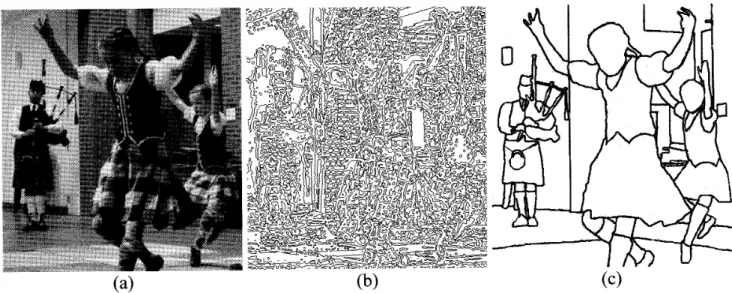
(Figure
1).
Our visual systems are adept at integrating subsets
of theseregions intomeaningful entities. How this
is
achieved
is
afundamental question,which has been researched extensivelyin
the domains ofexperimen-tal and computational neuroscience
(Wertheimer,
1938;
Marr,
1982; Hummel & Biederman,1992;
Ull-* Department of Brain and
Cognitive
Sciences,Massachusetts
Institute
of Technology,Cam-bridge,
MA
02139
Correspondence
to<psinha@mit,edu>
Copyright
2006.man, 1996; Hupe et al.
1998;
Needham,
2001; Tu eta].,20e3).
Much
oftheworkhas
focused
on the use ofheuristicssuch asalignment of contours, and
similar-ityof texturestatistics
(Grossberg
&
Mingolla.
1985;Mumford
& Shah, 1985;Field
et al. 1993;Kovacs&
Julesz,
1993;Leung
&
Malik, 1998; August et aL,1999).
In
circumscribed domains, these heuristicscan account rather well for
human
performance(Koffka,
1935;Kanizsa,
1979;
Elder
&
Zucker,1998L
but they tend to prove inadequate for analyzing
real-world
imagery
under lessconstrained settings(Shi
&
Malik,
1997; Borenstein&
Ullman,
2002).Furthermore, itisunclear whether theseheuristics
serve toorganize
inforrnation
duringthe
early stages of visual experience. Determining thenaturc of cues active at thistime isimportant for elucidatingthe
principles of visualIearning
and bootstrapping. With thismotivation, we undertook studies withSK,
an individualwho afforded us a rare opportunity to
examine visual skills intheirearly stages.
SK i$a 29 year old male,
born
in
Bihar,India. By
..-thetimc
SK
was4
months old, members ofhis
farnily
The
Japanese
PsychonomicSociety.
Allrights reserved,NII-Electronic Library Service
Y.OsTRovsKy,
E,
MEyERs,
and P.SINHAi Parsing visual scenesvia dynamic cues23
o
'
(a)
(b)
Figure 1. Natural
images,
such as the one shown in(a)
are collections of many regions oluminances,
asindicated
in
(b),
The human visual systern has to accomplish thesubsets of theseregions
into
coherent objects, asin
(c).
(c)f
different
hues andtask of
integrating
noticed that
he
had
an inabUity tofixate.
Due
tofinancial
and logisticalconstraints, medicalinterven-tionwas not sought until SK was an aclolescent. At theage of
12
years,SK
was examinedby
anophthal-mologist, who recornrnended surgery tocorrect
his
sight.
However,
the operation was cancelled due toSK's
father
becQrning
$ick, which completelyde-pletedhis
family's
finances.SK was admitted to theState
School for theBlind
in Darbangha,Bihar,
where he studied for 12yearsand
learned
Braille.In
2000,
he
moved toa hostelfortheblind
inNew Delhiand enrolled
in
a correspondence course, whichearned him a masters
degree
inpolitical science inAugust,
2005.
Itwasduring
a visit tothishostelthatthe authors met SK
in
January
2004.
Examinations
by
three independentophthalmolo-gistsinNew
Delhi
yieldedidentical
asses$ments. SKhas
secondary congenitalbilateral
aphakia(Pratt
&
Richards,
1968;
Johnson
&Cheng,
1997),
with thelensesalmost completely absorbed
in
the anteriorand posterior charnbers of the right and
left
eyerespectively, The optical pathways inthe eyes are clear.
SK's
acuity was assessed tobe
20/900.
SKhad
neverbeen
able to afford a pairof eye-glasses that could compensatefor
his
aphakia. During our next visit to India,inJuly,
2004, we had SK examined againby
optometrists and ophthalmologists inNewDelhi and purchased a pair of eyeglasses for him.
Post-correctionacuity was deterrninedte
be
20f120.
The residual acuity
impairrnent
islikelydue to neu-ralamblyopia(Kiorpes
&
McKee,
1999).
Beginning
two weeks after the refractivecorrec-tion,we performed a series of experiments to assess
SK's visual abilities.
Tests
of low-levelvisual func-tion revealed thatSK
had
normal color and motion'
perception,
We
then
proceeded toinvestigate
hisimage parsing and object recognition skills.
Our
visual parsing studies comprised seven expen-ments, which assessedSK's
responses with images of simple shapes. Histaskwas tosayhow
many objects there werein
each oftheimages,
point towhere they were, and whenever possible,name them,Figure
2(a)
showsthe
specific tasks and representative stimulicorresponding tothese experiments.
Further
cletailsare provided
in
the methods section, The graphin
Figure
2(b)showsSK's
perfor,mance on these tasksrelative to thatof four control subjects, matched on socio-economic and educational
background.
For the contrels, viewingdistance
was increased toincQrpo-rate theinformation lossresulting from SK'sreduced
acuity,
SK'sresponses on thisexperimental
battery
iteda consistent pattern, He had no
difliculty
inenumerating
individual
geometric shapes when pre-sented by themselves, or even in the presence of other shapes, so long as they were non-overlappingNII-Electronic Library Service
24
(a)
=
leoo2gs8 sofiEe8(b)
The
Japanese
Journal
of PsychonomicScience
Vol.
25,No, 1i
O
Hovvmany objects?Howmanv oblects? ,{IX'・Mlge.,ii.ili.i-,l"....IHowmany
objects?,,ll,.,1il・11i・1/・ll/I...tttt/ulllltt:-.ttt
Hcrwmany objects?,,lll/////i!'i'/'i'-g.・l,1/l,-'a'
Whichobject
isinfront? N/l":"..Nfn--N.Ik11krl.:f-l Tracethe longcurvett/ttttttt
Hewmanv
objeets?ewContro[s
SKdi-fu
m
(c)
'
Figure 2,
(a)
The
experimental battery we used to assessSK's
image
parsing skil]s.(b}
SK's performance,relative to control subjects' on simple
image
segrnentation and shape analysis tasks.(c)
SK's
tracing(in
red) of a pattern drawnby
one of the authors, indicatingafragmented
percept of the input.(experiment
`A').
However, with overlapped Figures,presented either as
line-drawings
or asfi11ed
trans-parent surfaces
(experiments
`B'and `C'),
SK's
re-sponses were very differentfrom controls'.
He
per-ceived all closed loops,and regions of uniform lumi-nance as distinctobjects.To
ensure thathe
under-stood the task,wehad
toldhim at the start of theexperiment that Figures may be overlapped
(a
no-tionhe was familiarwith
from
his
priorhaptic
ex-perience)and that
he
had to indicate the numberof "objects'
rather than `regionsl
Besides SK's reports with overlapped Figures,
therewere some other notable response patterns as
well.
With
opaque overlapping shapes(experiment
'D'},
SK
was able to correctly indicate the number,
but
was at chance atdetermining
theirdepth-ordering
(experiment
'E').
Extended contours made up of a series of separated linescgments, embeddedin
afield
of randomly oriented ones(experiment
LF')NII-Electronic Library Service
Y.
OsTRovsKy,
E.MEyERs, and P.'
SINHA: Parsmgvisual scenes via dynamic cues 25along the contour was minimal. Inimages of
three-dimensional shapes, such as cubes er pyramids
(cx-periment
LG'),
with surfaces of differentluminance,SK
reported perceiving rnultiple objects, one corre-sponding toeach facet.He was unable tointegratethe
facetsinto
thepercept of a single3-D
object.Insummary, SK's performance with thisstimulu$
set indicated a profound
inability
to use cues ofcontour continuation,
junction
structure andFigural
symmetry to analyze the images presented.
SK's
tendency topcrceive theaforementioned stimuli
in
afragmented
manneris
also refiectedin
his
tracingsofsimple
Figures.
Figure 2{c)shows histracings(in
red)over a Figure
drawn
by
one of theauthQrs.Next we investigatedthe
functional
significance ofSK]s
atypicalimage
parsing skills.Given
hispre-nounced tendency toover-fragment
images,
wehy-pothesized that
SK's
ability to veridically segrnentand recognize real-world
images
would be compro-mised,To
testthis hypothesis,we assessedhis
nam-ing performance on a set of 50 images of objects
common
in
theIndian
setting.SK
was able torecog-nize only 20% of all images shown tohim. We asked
SK
topoint toobjects inseveral of theseimages
andalso to indicate theirextent, even
if
he
could notrecognize the objects,
A
few
results are $hown inFigure
3{a),
It
isevident thatSK
is
greatlyover-segmenting thescenes and ispartitioningthem
into
meaningless regions, which are changeable andunin-formative
regarding object identity.A robust objectrepresentation isdifliculttoconstruct
based
on suchfragments.
SK's
parsing can belargelyaccountedfor
by a simple algorithm of
luminance
and hue-basedsegmentation, The results obtained using such an
algorithm on the same images that
SK
saw, arein-cluded in Figure
3(b).
Further detailsof the algo-rithm are providedin
theMethods
section,
So
far,
we have described SK's performanceexclu-sively with static
imagery.
In order tomake ourexperiments more representative of everyday visual experience, which typically
involves
dynamic
inputs, we created a new set of stimuli thatincorporated
motion cues(Figure
4(a)).SK's task here was thesame as before. to
indicate
the number of objectsshown The individualshapes underwent small
inde-pendent
translations, For overlappingfigures,
theextent of movement was such as to mamtam an
overlap at all times.
The inclusien
,of
motion brought about adramatic
change
in
SK's
responses, As datain
Figure
4(b)
indicate,SK was able toproduce correct responses
for
a majority of the dynamic stimulL Motion also allowedSK
toperceive shapes embeddedin
noise, atask that
he
was entirely unable todo inthe static condition,Motion
thus appears to be instrumentalforenabling SK tolinktogether partsof an object, and segregate them from thebackground,
Beyond
facilitating
intra-object
integration andobject-background segregation, our results suggest that motion plays another
important
rolein
SK's
objectperception
skills. Itappears tohelp construct representations thatcanbe
used to recognize objectsinstatic images,
We
had
mentioned abovethat
in
animage
set of 50 common objects,SK
was able torecognize only
20%
ofthe
images shown.It
is
inter-esting to consider whether there isan underlyingprinciplethat could explain the observed
partition-ing into`recognizable'
and `unrecognizable' sets,
In
examining
SK's
responses, an interestingpattern be-came evident.As
shownin
Figure
4(c),
thepartition-ing
corresponding to SK's responsesis
very similar tothe one obtained under the criterion of motility.objects that move versus those that do not.
The
congruence isstatistically significant
to<O.OO05;
x2test),
Before
considering theimplications
ofthis
re-sult, we need toaddress theconcern that
it
mightbe
driven
by somelow-level
image artifacts. Thiswould imply that the partitioning relates simply to
the
particular
choice of images rather than theeb-jects
shown therein.To
test
this
possibility,wecreated a separate set of
images,
which comprised a new exemplar foreach of the50
categories includedin
the original set, The photographs showed the objects against natural backgrounds and undernor-mal lighting.We assessed
SK's
object namingper-forrnance
on thisnew set.SK's
responses withthese
images
were consistent with those corresponding tothe original set
O<O.OO05;
x2test),
suggesting that thenaming performance islikelybeing
driven
by theim-NII-Electronic Library Service
26
TheJapanese
Journal
ofPsychonomic Science Vol.25,No,
1eeiwarv'i
'i,i/ilieewwlli/i・ll,/',,,,,2E,i-ll,ltt'k-ls:/;,#,?i・/ltmp.,,.,:i・:1/;/,
(a)
(b)
Figure 3,
(a)
SK's segmentation of real-world images. Outlinedin
green arethe
regionsthat
SK
saw asbeing distinctobjects. He was unablc torecognize any of these images.
{b)
Segmentation results from asimple algorithm
based
onhue
and luminance-based grouping(see
methods sectionfer
algorithm details), age artifacts.
A
plausible explanation of the congruencebe-tween the partitions derived
from
SK's
responses andthatbased on the criterion of motility, isthatmotion of objects heips
bind
theirconstituent regionsintQ
cohesivc representations, which can thenbe
used torecognize mstances m new mputs, that may wcll be statlc,
Taken together,theseresults point towards a
cru-cialrole of motion information
jn
the early stages ofobject
learning.
Motion appears to help both insegregating objects and also
in
binding their con-stituentsinto
representatiens forrecognition.Given
thisearly effectiveness of motion cues,it
seemsplau-sible that motion might bootstrap the
learning
ofFigural cues oi grouping
(such
as contourcontinua-tion and symmetry), which can then beused on their
own toperform grouping instatic
images
(Cavanagh,
1993),
Consistent
with thispossibility, thedevelop-mental progression of motion processing inthe
pri-mate
brain
begins
with a significantlevel
offunc-tionalityright at birth
(Kiorpes
&
Mevshon, 2003,2004), Behavioral studies with human infantshave
shown that sensitivity to motion based cucs
for
grouping and other visual analyses arises wetl
be-tore
sensitivity tostatic Figural cues{Arterberry
&
Yonas, 2000;
Johnson,
2003),
Even inadult'
ers, motion cues greatlyiacihtatenovel ebject
]earn-ing
(Brady
&
Kersten. 2003).Furthermore,
damage te putative motion sensitive areas in the humanvisual cortex has
been
observedto
lead
topro-found
impairments
in object integrationskills(Da-masio. 1985).
These results from
SK
are subject tothe cautionsNII-Electronic Library Service
Y.
OsTRovsKy,
E.MEyERs, andP.
SINHA:
Parsing
vi$ualscenes viadynamic
cues 27(a)
:"i?\
'
N.
-.-)}x
Namethe objects
I,j-lil
"flssis.
-
g.
Name the object fi5loo96oge-U2 soraE6tvtu(b)
e
ee
Controlsma
SK(c)Figure
4.
(a)
Stimulus sets for assessing roleSK's
performance relative tocontrols'.(c)
Lepanel:
SK's
recognit{on resuits.i"herent
ininterpreting
any case-study, Ouradop-tion of a case-study
format
is
necessitated by the rarity ofSK's
condition. We deriveconfidence inthegeneralityof theseresults based on theircongruence with results from previouslyreported case-studies of sight-recovery, and the infant
literature.
While theearlier papers on sight recovery
in
adulthood(Gre-gory
&
Wallace,
1963;
Fine et al. 2003>did
notspecifically
focus
on theindividuals'
region integra-tionskills, they reported difucultiesin
natural image recognition(`iWe
formed the impression thathe
saw[the
natural scenes as]little
more than patches of colour," Gregory&
Wallace,
1963, page 24)andin
simple image parsing("[MM]
described
twooverlap-ping transparent squares as three surfaces with the
central square
in
front."
Fine et al,,2003,page915).
Furthermore,
in
these past cases, as inthe presentone, motion sensitivity was evident soon after
treat-of dynamic
information
inftpanel:
Partition
obtainedSK's
object segregation skills,(b)
viathe
criterion of `motiljty. Rightment. Inthe infantliterature,
it
has
been
shown thatbabies'
perception of static visual scenesis
quitefragmented. unti] approximately six months of age.
During
・this
period,theirability tolinkspatially sepa-rated parts of a partiallyoccluded objectis
driven
strongly
by
common motion(Kellman
&
Spelke,
1983;
Johnson
et al. 2002),Our results cornplement these elegant studies
in
significant ways, First,they show that region inte-gration via
Figural
cues isnot merely a maturationalprocess,unfolding with age, but rather a visually
driven
developmental one, Second, they explicatethe nature of processing
in
the absence of occlusion,when purely
Figural
cues(such
asspatiallycontigu-ous collinear contours) can conceivably allow
for
grouping. And, third,they relate grouping to
real-world object recognition
by
showing that motionNII-Electronic Library Service
28
The
Japanese
Journal
ofPsychonomic
Science
Vol.25,No.1regions thatcan serve as representations
for
recogni-tion innew, possiblystatic,inputs, Taken together,
theseresults suggest thatdynamic
information
pro-vides a
key
organizing infiuenceon early visual proc-essmg.
Methods:
Image segmentation algorithm
The image segmentation algorithm used tocreate
the images
in
Figure
3b works as follows:
1)
The
image
istransformedin
toCIE
LAB
colorspace.
2) Each pixel
in
theimage
is
addedto
a `regiontable'thatspecifies theLAB color ofthe region
(which
isinitiallyjust
the pixel'scolor value),and
the
region size(which
is
initially
1).The
pixelsof an image are added to the table
in
randorn order.
3) A predefinedthreshold
T
is
set by theuser-thisistheone
free
parameter
of thealgorithm,For
the
images
shown inthispaper,T
was set tobe
10.
4) The algorithrn then
loops
through each entry
in
the region table,merging each regionR
with itsspatially adjacent regions
Ai
if
thedistancebetween
R
andAi
in
LAB space islessthan thethresholdT. The LAB color entry in
theregion tableisupdated toa weighted
age oi the merged regions
based
on theirtivesizes.
The
pixelcount entry isupdated toreflect the totalnumber of pixels
in
the newmerged region,
5) ThealgorithmstopswhenthedistanceinLAB
space
between
all adjacent regionsis
greaterthan the threshold T,
Experimental methods
All experimental stimu]i were presented on a 15"
CRT
monitor with a display resolution of1280
×1024
pixels and 85Hz refresh rate. Each of the conditions comprised 10distinct
trials,SK's viewingdistance
was not constrained during the testjng,but
averaged 40cms. The individualobjects spanned, on average, 8 degrees of visual angle.
In
dynamic
dis-plays, objects' speed averaged
6
degrees/second.
Allpresentationsstayed up until a response.
SK
volun-teeredhisparticipationand was not paid,other than
being
compensatedfor
transportationcosts. He wasfree
totake asmany rest breaks as hewishedduring
the course of thetesting,
Acknowledgments
The authors wish tothank SK, the
doctors
atNew
Delhi's
Shroff
Eye
Hospital andDrs.
Richard
Held,Scott
Johnson,
ElizabethSpelke
and MichaelOber-dorfer. This work was supported
by
the AlfredP,
Sloan Foundation, the
John
MerckScholars
Fund
and the National Eye Institute
(NIH).
This
study was conducted as part of Project Prakash-a recentlylaunched charitable and scientific endeavor whose
'
t
t
goal
is
tolocate
congenitallyblind
childrenin
India,
'
and treatthose whose blindness
is
curable,References
Arterberry, M.E.
&
Yonas
A. 2000. Perception ofthree-dimensional shape specified by optic
flow
by
8-week-old infants.Ptercoption
&
RsychQPh3,sics,
62
(3),
550-556,
August,
J.
Siddiqi,K,,& Zucker,S.
W. 1999.Contour
Fragment
Grouping andShared,
Simple Occluders,Computer
Vision
andimage
Uitderstanding,76{2):
146-162.
Borenstein,
E.
&
Ullman, S.2002,Class-specific,
down
segmentation. A. Heyden etaL(Eds.),
LNCS
2351,
Springer,
Verlag,
pp,109-122.
Brady,
M.J.
&
Kersten,
D, 2003. Bootstrappedlearning of novel objects.
Ibuvaal
of
Vision,
3(6),
413-422,
http:1/journalofvision.orgl316/2L doi:
10.1167/3.6.2.
Cavanagh,
P.1993.The
perception of form andtion,Current
QPinion
in
IVlaurobiolagy,
3,
177-182.
Damasio,
A.R.
1985, Disorders of complex visualprocessing: agnosia, achromatopsia, Balint's
drome.
and relateddifficulties
of orientation andconstruction. In:M,
M,
Mesulam
(Ed,),
PrinciPtesof
BehaviorutIVburotogy,Davis,Philadelphia,
Elder,
J.
and Zucker, S.W. 1998.Evidencefor
ary-specific grouping in
human
vision, VisionRe-search, 38(1},143-152.
Field,
D,,Hayes,A.&
Hess,
R.
1993.Contour
tionby the
human
visual system: evidencefor
alocal"Association
Field"
Vision
Res.
33(2),
193.Fine,
I.
Wade,
A.R,,Brewer,
A,
A.
May,
M,G.Good-man, D.F. Boynton,
G.
M.
WandelL
B.A. &Ma-cLeod, D.I. 2003. Long-term deprivation affects visua] perception and cortex. Ndture
IVeuroscience,
NII-Electronic Library Service
Y.
OSTROVSKy,
E,MEyERs, and P.SINHA: Parsing vi$ual scenesvia dynamic cues 296(9),
915-916,
Gregory,
R.
L.& Wallace,J.
G,
1963. Recovery fromear!y
blindness:
A case study.Quarterly
fournat
of
PsychoZczgy.
Monograph
no.2.
Grossberg,
S,
&
Mingolla,
E.1985.Neural Dynamicsof Perceptual
Grouping:
Textures, boundaries andemergent segmentations, Percoption and
Psycho-Physics,
38(2),141-171.HumrneL
J,
E,& Biederman,L
1992,
Dynamic binding
in
a neural network forshape recognition.Rsycho-togical
Review,
99,480-517.Hupe,
J.
M,,
James,
A.C,,Payne,B,
R.
Lomber,
S.G.,Girard, P.
&
Bullier,J,
1998. Corticalfeedback
improves discriminationbetween Figure and
ground by Vl,
V2
andV3
neurons. Ndture,394,
784-787,
Johnson,
B.L. & Cheng, K.P. 1997.Congenital
akia: a clinicopathologic report of threecases.nat
of
PediatricCiphthalmotagicalStrzibismus,
34(1), 35-39.Johnson,
S,
P,,
Bremner,
J,
G.,
SIater,A.,Mason,U.,
&
Foster,
K.2002.Young
infants'perceptionof unityand forrninocclusion
displays.
foumaal
of
EmpenLmental
Child
RsycholQgy,81,
358-374,
Johnson,
S.
P.
2003,
Development of fragmented vs.holisticobject perception.In
G.
Schwarzer
& H.Leder
{Ecls.),
The
devetoPment
of,lace
Processing
(pp.
3-17).
Cambridge,
MA:
Hogrefe&
Huber,
Kanizsa.
G, 1979.0rganization
in Vision:Essays on
Gestalt
Plarception,NewYork:
Praeger.Kellman,
P.
J.
&
Spelke,E.
S,
1983.
Perception
oftlyoccluded objects in infancy.
CQg?iitive
qgy,15,
483rc524.
Kiorpes,L,
&
McKee,
S,
P.1999.Neural
mechanismsunderlying amblyopia.
Current
Qpinion
in
ology 9,480-486,
Kiorpes,L.& Movshon,
J,
A.2003.
Neural limitationson visual development
in
primates.In
Chalupa,
L.
M.
&
Werner,
J.
S.{Eds,),
TheVisuae
Nigurosctences,(pp,
159-173}. Cambridge, Massachusetts: MITPress.
Kiorpes, L,
&
Movshon,
J,
A, 2004. Development ofsensitivity tovisual motion inmacaque monkeys,
VisualIVeuroscience,
21(6),
851-859.
Koffka,
K,(1935),
f'le'inciplesof
Gestalt IlsycholQgl,,New York: Harcourt, Brace and
World.
Kovacs,
I.
&
Julesz,
B,1993,A
CIosed
Curve
is
MuchMorc
than anIncomplete
One: EffectofClosure
inFigure-Ground
Segrnentation.
Proc.IVdt,Acad,Sci.
USA, 90,7495-7497.
Leung,
T.
&
Malik,
J,
1998.
Contour
continuityin
region based
image
segmentation. In FijthEuro.
Coof
Computer Vision,Freiburg,Germany.
Marr,
D.
1982,
Vision:
A
comPutationatinvestigation
into
thehuman
rePresentation andProcessing
of
vis-ual
injbrmation,
IVlew}'brk:W. H.Freeman
and
Company.
Mumford,
D.
&
Shah,
J,
1985.Boundary detectionby
minimizing functionals,
In
IEEE Conj1on ComPuter
Vision
and Patter?zRecognition,
San
Francisco,
Needham,
A
20el. Object recognition and objectsegregation in4.5-month-o]d
infants.
10urnal
of
perimental
Chitd
Rsychology,
78,3-24.
Pratt,
J.
C.
&
Richards,
R.
D.
1968,Bilateralsecondarycongenital aphakia,
Arch,
QPhthalmology,
80{4), 420-422.Shi,
J.
and Malik,J.
(1997),
Norrnalized
cuts andage segmentation, Conjlarence
in
ComPuter
Visionand
Ptittem
Recagnition(pp
731-737},San
Juan,
Tu, Z.Chen,
X,,
Yuille,A.L,,& Zhu,S.
C.
2003.
Image
Parsing:
Unifying
Segmentation,
Detection, andRecognition.
I}roceedings
of
the IE[IEintl.Coof onComputer Vision.
Ullman,
S.1996.High-level
visien,Cambridge,
MA:MIT Press.
Valvo,
A,
!971. Sight Restoration coflerLong-Term
Blindness:
The
lh,oblemsand BehaviorPatterns
of
Visual
Rehabilitation.
American Foundation fortheBlind,
Von Senden, M. 1932.
SPace
andSight:
The RircePtion
of
Space
andShmpe
in
theCongenitally
BtindBqforeand Afler
QPeratien.
Reprint,Glencoe,
IL: Free
Press,
196e,
Wertheimer,
M.
1938. Laws of organization inceptual