Recent Developments
of
the
mdLVs Algorithm
for
Singular Values
and the
I-SVD
Algorithm
for Singular
Value
Decomposition
特異値計算の
mdLVs
アルゴリズムと特異値分解の
I-SVD
アルゴリズムにおける最近の進展
京都大学情報学研究科 中村佳正1(Yoshimasa Nakamura)
Graduate SchoolofInformatics, Kyoto University
京都府立大学人間環境学部 岩崎雅史 (Masashi Iwasaki)
Faculty ofHuman Environment, KyotoPrefectural University
京都大学情報学研究科 木村欣司 (KinjiKimura)
Graduate School ofInformatics, Kyoto University
奈良女子大学人間文化研究科 高田雅美 (Masami Takata)
Graduate School of Humanitics
&
Sciences, NaraWomen’s UniversityAbstract Recently
a
new
algorithmforcomputing singular valuesnamedthemdLVs(modifieddiscrete Lotka-Volterra with shift) is designed. The firstpart of this reportis a brief
survey
ofthe recentdevelopments
on
the positivity and shifts ofthe mdLVs algorithm. The second partis
an
exposition ofthe I-SVD (Integrable SingularValue Decomposition) algorithm whichisa
combination of the mdLVs algorithm and thedLV-type transformation for computing singular
vectors ofbidiagonal matrices. Because of the separation of computation of singular values
fromthat of singularvectors theI-SVD algorithm
mns
in $O(m^{2})$ fiops andis rather fasterthanDBDSQR code ofLAPACK.
1.
Introduction
An algorithm named the $dLV$ (discreteLotka-Volterra) algorithm for computing bidiagonal
matrix singularvalues has been discussed
in
theseries
ofpapers [11, 12, 13, 14, 15], wheresuchbidiagonalmatrices
can
bederivedfromarbitrarynonsingularmatrices throughtheHouseholderpreconditioning
process
[91. A generalbackground is fumishedin
[21, 22]. See alsoa
recentreview
paper
[3]. Therecurrence
relation of$dLV$ itselfisa
discrete-timeintegrable dynamicalsystem. Convergence of the $dLV$ algorithm to singular values is shown in [11]. See
\S 4
ofthis report. The basic fact is that $dLV$ is
a
deformation equation of orthogonal polynomials(OPs). The parameter of$dLV$ should be positive. Therefore the
recurrence
relation of$dLV$ issubtraction free. A positivity ofHankel determinants is ensured whose elements
are
momentsassociated with OPs and then all the variables of$dLV$
are
also positive [14]. This fact will bereviewed in
\S 3.
In arecent work [151an
exponential stability of$dLV$ ina
localsense
is provedby
using
the existence ofa
center manifold around thefixed points.
This implies that $dLV$is
robust andhighly credible algorithm. The
convergence
rateof the$dLV$ algorithmis linear [11].Therefore
some
shifted versionsof$dLV$have been formulatedin [12, 13].The mdLVs (modified $dLV$ with shift) algorithm presented in [131 is shown to satisfy
the
same
positivity of variables and hasa
higher relativeaccuracy.
Speed ofthe mdLVs algorithmdepends onthe choice of shift oforigin. Thecostforcomputing shifts wastes
more
than30% oftotalexecution time of the mdLVs code [291, where the shiftis determined
as
a
lower bound ofthe ninimal singular value ofgiven
upper
bidiagonal matrices. Thereforea
lighter shift basedon
more
accurate bound mustbe important to accelerate the mdLVs algorithm. The Johnsonbound [17],
a
Gersgorin-type lower bound of symmetric tridiagonal, has been adopted in themdLVs code [29]. Recently
a
new
lower bound is found which is called the p-th generalizedNewton bound. In the first part ofthis report (\S 2$\sim$
\S 5) we
discuss the recent developmentson
thepositivity and shifts ofthe mdLVs algorithm.
The second part (\S 6$\sim$
\S 7)
isan
exposition ofthe I-SVD (Integrable Singular ValueDecom-position) algorithm[16] whichis
a
combination of the mdLVs algorithm for singular values andthedLV-type transformation for singularvectors of$m\cross m$ bidiagonal matrices. Namely,
com-putations of singular values and vectors
are
completely separatedinI-SVD.
Here the dLV-typetransformation performs
an
accurate double Cholesky decomposition ofa
shifted symmetrictridiagonal matrix which gives rise to
a
twisted factorization of thesame
matrix.
Eachsingu-lar vector is computed from the twisted
matrix
within $0(m)$ flops. Then the I-SVD algorithmsolves the bidiagonal
SVD
problemwithin
$0(m^{2})$ flops. It is shownin
[301 forsome
class oftest matrices thatthe
I-SVD
codeis ratherfaster than the standardSVD
code ofLAPACK.
2.
Orthogonal
Polynomials:
Preliminary
Let
us
begin with Favard’s theorem [21. Let $\{s_{k}\},$ $(k=1,2, \ldots)$ bea
sequences of realnumbers. When the bilinear form $\sum_{k=0}^{m}\sum_{\ell=0}^{m}s_{k+\ell}\alpha_{k}\alpha_{l}$ is positive for
any
$m$, then $\{s_{k}\}$ iscalledpositive. Itisknown that $\{s_{k}\}$ is positive if and onlyifthe Hankeldeterminants
$s_{0}$ $s_{1}$ . .
.
$s_{n}$$s_{1}$ $s_{2}$
. .
.
$S_{n+1}$$D_{n+1}:=$ , $(n=0,1,2, \ldots)$
:.
:
:.
$s_{n}$ $s_{n+1}$
. .
.
$s_{2n}$are
positiveforany
$n=0,1,$ $\ldots$.
be polynomials of$\lambda$ defined
by thethree terms recuirence relation
$Pk+1(\lambda)=(\lambda-b_{k}+i)_{Pk}(\lambda)-a_{k^{2}Pk-1}(\lambda)$
,
$p_{0}(\lambda)=1$, $p_{1}(\lambda)=\lambda-b_{1}$
.
Then there exists
a
unique linear functional $J$ such that $s_{0}=J[1],J\lceil flk(\lambda)p\ell(\lambda)]=0,(k\neq$$\ell,$ $k,$$l=0,1,$$\ldots)$ for
any
positive constant$s_{0}$
.
Moreover, $a_{k^{2}}>0$ ifand only ifthe moments $s_{k}$ $:=J[\lambda^{k}],(k=0,1, \ldots)$are
positive.The polynomial$pk(\lambda),$ $(k=1,2, \ldots)$ takes thedeterminant form [27]
$s_{0}$ $s_{1}$
.
.
.
$s_{k}$$s_{1}$ $s_{2}$
. . .
$s_{k+1}$ $Pk( \lambda)=\frac{1}{D_{k}}$:
::.
$s_{k-1}s_{k}$
. .
.
$s_{2k-1}$1 $\lambda$
. .
.
$\lambda^{k}$Then the coefficients $a_{k^{2}}$ of the
recurrence
relationare
$a_{k^{2}}= \frac{D_{k-1}D_{k+1}}{D_{k^{2}}}$.
Itis shown from$a_{1^{2}}\cdots a_{k^{2}}=D_{k+1}/D_{k}$ that $D_{k}>0$ for
any
$k$ andthe corresponding momentsare
positive.Favard’s theorem
says
that the polynomials $\{pk(\lambda)\}$ defined by the three termsrecurrence
relation with positive coefficients $a_{k^{2}}$
are
orthogonal with respect to the linear functional $J$.
Namely, $J[pk(\lambda)p\ell(\lambda)]=s_{0}a_{1^{2}}\cdots a_{k^{2}}\delta_{k,l}$
.
In thiscase
the corresponding set of moments $\{s_{k}\}$is positive and vice
verse.
OPshave
some
special features. Oneofthem is the position ofzeros.
Itis known thatzeros
of OPs
are
mutually distinct real numbers and hasan
interlacing property[l]. For example,let $\lambda_{j}^{(n-1)},(j=1,2, \ldots, n-1)$ and $\lambda_{j}^{(n)},(j=1,2, \ldots, n)$ be
zeros
of $p_{n-1}(\lambda)$ and $p_{n}(\lambda)$,respectively. Then
$\lambda_{1}^{(n)}<\lambda_{1}^{(n-1)}<\lambda_{2}^{(n)}<\lambda_{2}^{(n-1)}<\cdots<\lambda_{n-1}^{(n-1)}<\lambda_{n}^{(n)}$
.
This leads to the following statement. The rational function $p_{n-1}(\lambda)/p_{n}(\lambda)$ of degree $n$ admits
a
partial fractionexpansion$\frac{p_{n-1}(\lambda)}{p_{n}(\lambda)}=\sum_{j=1}^{n}\frac{\rho_{j}^{(n)}}{\lambda-\lambda_{j}^{(n)}}$, $\rho_{j}^{(n)}=\frac{p_{n-1}(\lambda_{j}^{(n)})}{p_{n}’(\lambda_{j}^{(n)})}$
.
Fromtheinterlacing property it follows that the residues$\rho_{j}^{(n)}$,theChristoffelcoefficients,satisfy
thepositivity condition$\rho_{j}^{(n)}>0$
.
For the Hermite, Legendre and Chebyshev polynomials
every
moments with odd orderare
contour $C_{\lambda}$
are
invariant under the exchange $\lambdaarrow-\lambda$. The linear functional $J$ satisfying $s_{2k-1}=J[\lambda^{2k-1}]=0$, $(k=1,2, \ldots)$ is called symmetric and the correspondingOP is
called symmetric. When $d\mu(\lambda)=w(\lambda)d\lambda$, the weight function $w(\lambda)$ is
an even
functionover
the interval $(-\xi, \xi)$
.
The coefficients $b_{k}$ of therecurrence
relationare zero
for symmetricOPs.Namely, $b_{k}=0,$ $(k=1,2, \ldots)$
.
In the followingdiscussionswe
restrictourselves to symmetricOPs.
Let
us
consider the three termsrecurrence
relation ofsymmetric OPs$pk+1(\lambda)=\lambda_{Pk}(\lambda)-a_{k^{2}}p_{k-1}(\lambda)$, $p_{0}(\lambda)=1$, $p_{1}(\lambda)=\lambda$.
In [14]
we
obtain theChristoffel-Darboux formulafor symmetric OPsas
follows.$\{\begin{array}{ll}a_{1^{2}}\cdots a_{2m-1^{2}}(\sum_{j=1}^{m}\frac{p_{2j-1}(.\lambda)p_{2j-1}(\kappa)}{a_{1^{2}}\cdot\cdot a_{2j-1^{2}}}) =\frac{p_{2m-1}(\lambda)p_{2m+1}(\kappa)-p_{2m+1}(\lambda)p_{2m-1}(\kappa)}{\kappa^{2}-\lambda^{2}} for k=2m-1a_{1^{2}}\cdots a_{2m}^{2}(\sum_{j=1}^{m}\frac{p_{2j}(\lambda)p_{2j}(\kappa)}{a_{1^{2}}\cdots a_{2j^{2}}}+p_{0}(\lambda)p_{0}(\kappa)) =\frac{p_{2m}(\lambda)p_{2m+2}(\kappa)-p_{2m+2}(\lambda)p_{2m}(\kappa)}{\kappa^{2}-\lambda^{2}} for k=2m\end{array}$
In contrast to the
case
of usual OPs [1, 2, 271,a parity emerges.
TheChristoffel-Darboux
formulais useful,for example, todiscuss the
convergence
ofOP series.
3
Discrete
Lotka-Volterra System
and
Its Positivity
In this section
we
fistdefinea
kemel polynomial$p_{k}^{*}(\lambda)$ of the original symmetric OP$p_{k}(\lambda)$.
To this end
we
assume
$pk(\kappa)\neq 0$.
$p_{k}^{*}(\lambda);=\{\begin{array}{ll}-\frac{a_{1^{2}}\cdots a_{2m-1^{2}}}{p_{2m-1}(\kappa)}\sum_{j=1}^{m}\frac{p_{2j-1}(.\lambda).p_{2j-1}(\kappa)}{a_{1^{2}}\cdot a_{2j-1^{2}}} for k=2m-1-\frac{a_{1^{2}}\cdots a_{2m}^{2}}{p_{2m}(\kappa)}(\sum_{j=1}^{m}\frac{p_{2j}(\lambda)p_{2j}(\kappa)}{a_{1^{2}}\cdots a_{2j^{2}}}+p_{0}(\lambda)p_{0}(\kappa)) for k=2m\end{array}$
Then theChristoffel-Darbouxformula leads to
$p_{k}^{*}( \lambda)=\frac{1}{\kappa^{2}-\lambda^{2}}(Pk+2(\lambda)+A_{kPk}(\lambda))$, $A_{k}$ $.=- \frac{p_{k+2}(\kappa)}{pk(\kappa)}$.
When
$k=2m-1,$
$p_{k}(\lambda)$ isan
odd function. When $k=2m,$$p_{k}(\lambda)$ iseven.
The poles $\lambda=\pm\kappa$are
apparent poles. Hence$p_{k}^{*}(\lambda)$ isa
polynomial of degree $k$.
The transformationis just the Christoffel transformation for the symmetric OP $\{p_{k}(\lambda)\}$. Letus introduce
a
new
linearfunctional $J^{*}$ by
$J^{*}[A(\lambda)]:=J[(\kappa^{2}-\lambda^{2})A(\lambda)]$,
for
any
polynomial $A(\lambda)$ anda
suitable constant $\kappa<0$. The corresponding weightfunction
is $w^{*}(\lambda)$ $:=(\kappa^{2}-\lambda^{2})w(\lambda)$
.
Wecan
generalize a theorem in $[2|$on
the positivity of linearfunctional.
Theorem [14] Let the linear functional $J$ be positive definite
over
the interval $[-\xi,$$\xi,$$|$ with
$\xi>0$
.
The $J^{*}$ ispositive, i.e.
$\{s_{k}^{*}:=J^{*}[\lambda^{k}]$ is positiveover
$[-\xi,\xi, ]$, ifand only if$\kappa\leq-\xi$.
We
now
considera
successiveuse
oftheChristoffel transformations$p_{k}^{(n+1)}= \frac{1}{(\kappa^{(n)})^{2}-\lambda^{2}}(p_{k+2}^{(n)}+A_{k}^{(n)}p_{k}^{(n)})$, $A_{k}^{(n)}:=- \frac{p_{k+2}^{(n)}(\kappa^{(n)})}{p_{k}^{(n)}(\kappa^{(n)})}$, $(n=0,1, \ldots)$
to generate
a
sequence
ofkemelpolynomials$\{p_{k}^{(0)}.=p_{k}(\lambda)\}arrow\{p_{k}^{(1)}.=p_{k}^{*}(\lambda)\}arrow\{p_{k}^{(2)}\}arrow\cdots$ ,
where$p_{k}^{(n)}(\kappa^{(n)})\neq 0$ followsfrom$\kappa^{(n)}>-\lambda_{1}^{(n)}$
.
As the compatibility conditions ofthe Christoffel transformation and the
recurrence
relation$p_{k+1}^{(n+1)}=\lambda p_{k}^{(n+1)}-(a_{k}^{(n+1)})^{2}p_{k-1}^{(n+1)}$
we
obtain$(a_{k}^{(n+1)})^{2}$ $=$ $(a_{k}^{(n)})^{2} \frac{A_{k}^{(n)}}{A_{k-1}^{(n)}}$
$=$ $(a_{k}^{(n)})^{2} \frac{p_{k+2}^{(n)}(\kappa^{(n)})p_{k-1}^{(n)}(\kappa^{(n)})}{p_{k}^{(n)}(\kappa^{(n)})p_{k+1}^{(n)}(\kappa^{(n)})}$
.
Let
us
set$\hat{u}_{k}^{(n)}:=(a_{k}^{(n)})^{2}\frac{p_{k-1}^{(n)}(\kappa^{(n)})}{p_{k}^{(n)}(\kappa^{(n)})}$.
Itfollows from$p_{-1}^{(n)}=0$ that$\hat{u}_{0}^{(n)}=0$
.
Let$\lambda_{j}^{(n)},$ $(j=1, \ldots, k)$ bezeros
ofthe OP$p_{k}^{(n)}(\lambda)$.
Notethatin thepartial fraction
expansion
$\frac{p_{k-1}^{(n)}(\kappa^{(n)})}{p_{k}^{(n)}(\kappa^{(n)})}=\sum_{j=1}^{k}\frac{\rho_{j}^{(n)}}{\kappa^{(n)}-\lambda_{j}^{(n)}}$
the residues $\rho_{j}^{(n)}$ of
are
positive. While it followsfrom the positivity ofthelinear functional $J^{*}$
that$\kappa^{(n)}-\lambda_{j}^{(n)}<0$
.
Thus$p_{k-1}^{(n)}(\kappa^{(n)})/p_{k}^{(n)}(\kappa^{(n)})<0$and then $\hat{u}_{k}^{(n)}<0$.
Inserting $\hat{u}_{k}^{(n)}$ into the three terms
recurrence
relationwe
derive
Similarly
we
have$(a_{k}^{(n+1)})^{2}=\hat{u}_{k}^{(n)}(\kappa^{(n)}+\hat{u}_{k+1}^{(n)})$
.
We elimuinate $(a_{k}^{(n+1)})^{2}$ tohave
$\hat{u}_{k}^{(n+1)}(\kappa^{(n+1)}+\hat{u}_{k-1}^{(n+1)})=\hat{u}_{k}^{(n)}(\kappa^{(n)}+\hat{u}_{k+1}^{(n)})$ .
This equation
was
first derived by Hirota (1997, [101) and $Sp\ddot{m}donov$-Zhedanov(1997, [26]),independently, where $\kappa^{(n)}$
are
arbitrary constant. In
our case
$\kappa^{(n)}$ shouldbe less than
or
equalto $-\xi$ to guarantee the positivity of the linear functional,
say
$J^{(n)}$ and then Hankeldetermi-nants $D_{k}^{(n)}$
.
Since $\hat{u}_{k}^{(n)}$ is expressedas a
ratio ofthe Hankel determinants,this
property is
very
importantto design stable numerical algorithm. Define
$\delta^{(n)}:=\frac{1}{(\kappa^{(n)})^{2}}>0$, $u_{k}^{(n)}=\kappa^{(n)}\hat{u}_{k}^{(n)}>0$
.
We
can
introducea
scale change $u_{k}^{(n)}arrow 1/(\xi^{2}M)u_{k}^{(n)}$ to relax the condition $0<\delta^{(n)}\leq 1/\xi^{2}$to $0<\delta^{(n)}\leq M$ for
some positive
constant $M$.
Thenwe
obtain $u_{k}^{(n+1)}(1+\delta^{(n+1)}u_{k-1}^{(n+1)})=u_{k}^{(n)}(1+\delta^{(n)}u_{k+1}^{(n)})$,$u_{k}^{(n)}>0$, $0<\delta^{(n)}\leq M$, $(n=0,1, \ldots, k=1,2, \ldots)$
.
Let
us
regard $u_{k}^{(n)}$as
the value of$u_{k}=u_{k}(t)$ at the time $t= \sum_{j=0}^{n-1}\delta^{(j)}$
.
Keeping $t$ toa
constant
we
take a limit $\delta^{(n)}arrow+0$ such that $\delta^{(n+1)}/\delta^{(n)}arrow 1$.
We then derive the system ofdifferential equations
$\frac{du_{k}}{dt}=u_{k}(u_{k+1}-u_{k-1})$, $u_{0}(t)=0$, $(k=1,2, \ldots)$
for the variable $u_{k}=u_{k}(t)$ fromthe
recurrence
relation. Thisprocess
corresponds to the limit$\kappa^{(n)}arrow-\infty$ and does notviolate the positivity of linear functionals. This systemis sometimes
called the Lotka-Volterra (LV) system in mathematical biology. In this section it is shown
that the successive Christoffel transformations of symmetric OPs induce a deformation of the
coefficients $\{a_{k}^{(n)}\}$ of the three terms
recurrence
relation. Theresulting deformation equation isthe$dLV$ systemhaving
a
positive explicit solution.4
Convergence
of
$dLV$Algorithm
In the series of
papers
[11, 12,151
it is showna
solution of$dLV$converges
tothesame
limitas
ofthe LV forany choice ofpositive $\delta^{(n)}$.
Namely,$\lim_{narrow\infty}u_{2k-1}^{(n)}=\sigma_{k^{2}}$, $\lim_{narrow\infty}u_{2k}^{(n)}=0$,
where $\sigma_{k}$
are
singular vales of$B$ suchthatIt is tobe remarked that the initial value setting is different from thatinthe LV
case.
We shouldchoose
$u_{2k-1}^{(0)}= \frac{b_{2k-1^{2}}}{1+\delta(0)_{u_{2k-2}^{(0)}}}$, $(k=1,2, \ldots, m)$,
$u_{2k}^{(0)}= \frac{b_{2k^{2}}}{1+\delta(0)u_{2k-1}^{(0)}}$, $(k=1,2, \ldots, m-1)$,
as
wellas
$u_{0}^{(0)}=0$ and $u_{2m}^{(0)}=0$.
We named this procedurethe $dLV$ algorithm forcomputingsingular valuesofbidiagonal
matrices.
More important notion is the numerical stability. It is known [25], for example, the qd
algorithm is numerically instable because ofdivision by
a
small amount. One the other handthe Demmel-Kahan QR has been standard algorithm for a long time
as
a
stable algorithm inspite of slow speed. The numerical stability of$dLV$ is proved in [12]. The starting point is
a
matrix representation of$dLV$
.
$L^{(n+1)}R^{(n+1)}=R^{(n)}L^{(n)}-( \frac{1}{\delta(n)}-\frac{1}{\delta(n+1)})I$,
$L^{(n)}:=(\begin{array}{llll}J_{1}^{(n)} O1 J_{2}^{(n)} \ddots .1 J_{m}^{(n)}\end{array})$ , $R^{(n)}:=(\begin{array}{llll}1 V_{1}^{(n)} 1 \ddots \ddots V_{m-1}^{(n)}O 1\end{array})$
,
$J_{k}^{(n)}:= \frac{1}{\delta(n)}(1+\delta^{(n)}u_{2k-2}^{(n)})(1+\delta^{(n)}u_{2k-1}^{(n)})$ , $V_{k}:=\delta^{(n)}u_{2k-1}^{(n)}u_{2k}^{(n)}$,
where $I$ is the $m\cross m$ unit matrix. Note that $1/\delta^{(n)}-1/\delta^{(n+1)}$ gives
a
shift oforigin for thematrix $R^{(n)}L^{(n)}$
.
Letus
introducenew
nonnegativevariables $w_{k}^{(n)}$ definedas
$w_{k}^{(n)}:=u_{k}^{(n)}(1+\delta^{(n)}u_{k-1}^{(n)})$
and
a
tridiagonalmatrix $Y^{(n)}$ suchthat$Y^{(n)}:=L^{(n)}R^{(n)}- \frac{1}{\delta(n)}I$
.
We derive from thematrix form of$dLV$
$Y^{(n+1)}=R^{(n)}Y^{(n)}(R^{(n)})^{-1}$.
Itis nothard to
see
$w_{k}^{(n)}>0$ providing $u_{k}^{(0)}>0$ and $\delta^{(n)}>0$ for $k=1,2,$ $\cdots,2m-1$.
Thus$R^{(n)}$ is nonsingular for
any
$n$. This similarity transfomation implies that the eigenvalues of
$Y^{(n)}$
are
invariantunder theevolution $n\Rightarrow n+1$ ofthe$dLV$system. A symmetrization of$Y^{(n)}$is introducedin [11] byusing
a
diagonal matrix $G^{(n)}$as
follows: $A^{(n)}$ $:=$ $(G^{(n)})^{-1}Y^{(n)}G^{(n)}$,
$G^{(n)}$$:=$ diag $( \prod_{j=1}^{m-1}\sqrt{w_{2j-1}^{(n)}w_{2j}^{(n)}},$
Notethat $G^{(n)}$ is nonsingular for
any
$n$ and $|A^{(n)}|= \prod_{j=1}^{m}w_{2j-1}^{(n)}$.
Wesee
that the$dLV$ systemtakes the form of similarity transformation
$A^{(n+1)}=P^{(n)}A^{(n)}(P^{(n)})^{-1}$, $P^{(n)}:=(G^{(n+1)})^{-1}R^{(n)}G^{(n)}$
of the positive definite matrix $A^{(n)}$, which implies that the eigenvalues of $A^{(n)}$
, for all $n$,
are
invariantunder the evolution $n\Rightarrow n+1$ of$dLV$
.
Sincethe eigenvalues of$A^{(n)}$
are
identically equal tothose of$Y^{(0)}$,these eigenvaluesare
in-dependent from the choice ofthe variable step size$\delta^{(n)}$
.
Note also that$A^{(n)}$can
be decomposedinto $A^{(n)}$ $=$ $(B^{(n)})^{T}B^{(n)}$, $B^{(n)}:=(\sqrt{w_{1}^{(n)}}O$ $\sqrt{w_{3}^{(n)}}\sqrt{w_{2}^{(n)}}..$
.
$\sqrt{w_{2m-2}^{(n)}}\sqrt{w_{2m-1}^{(n)}}$.
Therefore the singular values of$B^{(n)}$
are
equal tothepositivesquare
rootsof theeigenvaluesof$A^{(n)}$
.
Then the singular values of theupper
bidiagonal matrix $B^{(n)}$are invariant
underthetimeevolution $n\Rightarrow n+1$ ofthe $dLV$ system.
Numericalstabilityof the$dLV$algorithm isproved
as
follows. Thepositivity
oftheparameter$\delta^{(n)}$ and the variable $u_{k}^{(n)}$ play
a
key role. In Ref. [121 thecondition
$0<\delta^{(n)}\leq M$are
assumed. As is shown in
\S 3
ofthispaper
thecondition naturallyfollows from thepositivity ofthe
sequence
of$kemel0Ps$.
Bytakingtrace of the similaritytransformationwe
see
$\sum_{k=1}^{2m-1}w_{k}^{(n)}=\sum_{k=1}^{m}\sigma_{k^{2}}$.
Namely $w_{k}^{(n)}$
are
boundedas
well as positive. Consequently $u_{k}^{(n)}$are
alsopositive andbounded.
Let $k=1$ in the $dLV$ system, then
we
have $\lim_{narrow\infty}u_{1}^{(n+1)}=u_{1}^{(0)}\prod_{n=0}^{\infty}(1+\delta^{(n)}u_{2}^{(n)})$.
Thisimplies $u_{1}^{(0)}\leq u_{1}^{(1)}\leq\cdots u_{1}^{(n)}\leq\cdots$
.
Since $u_{1}^{(n)},$ $n=0,1,$ $\cdots$, is monotonicallyincreasing
and
bounded, $u_{1}^{(n)}$ converges to
some
positive constant$c_{1}$
as
$narrow\infty$.
Simultaneously, $\prod_{n=0}^{\infty}(1+$$\delta^{(n)}u_{2}^{(n)})$
converges
tosome
positiveconstant $p_{1}$.
Let
us assume
that$\prod_{n=1}^{\infty}(1+\delta^{(n)}u_{2k-2}^{(n)})$converges
tosome
positiveconstant$p_{k-1}$
.
Let$v_{k}^{(0)}=$$u_{k}^{(0)}(1+\delta^{(0)}u_{k+1}^{(0)})$ and$v_{k}^{(0)}>0$
.
Then,byusing
$0<\delta^{(n)}<M$,we
see
that$(v_{2k-1}^{(0)}/pk-1) \prod_{n=1}^{N}(1+$ $\delta^{(n)}u_{2k}^{(n)})$converges
to $u_{2k-1}^{(N+1)}$as
$Narrow\infty$.
Hence it follows that$0< \prod_{n=0}^{\infty}(1+\delta^{(n)}u_{2k}^{(n)})<M_{3}$for
some
constant $M_{3}$.
It is also obvious that $\prod_{n=1}^{N}(1+\delta^{(n)}u_{2k}^{(n)}),$ $N=1,2,$ $\cdots$ , ismonoton-ically increasing. Therefore it follows that $\prod_{n=1}^{\infty}(1+\delta^{(n)}u_{2k}^{(n)})=p_{k}$
.
Simultaneously,we see
that$\lim_{narrow\infty}u_{2k-1}^{(n)}=v_{2k-1}^{(0)}pk/pk-1>0$, namely,
$\lim_{narrow\infty}u_{2k-1}^{(n)}=c_{k}$
where$c_{k}$ is
some
positive constant.Note here that $\sum_{n=0}^{\infty}\delta^{(n)}u_{2k}^{(n)}$
converges
tosome
constant$\delta^{(n)}u_{2k}^{(n)})=p_{k}$ for$\delta^{(n)}u_{2k}^{(n)}>0,$ $n=0,1,$ $\cdots$
.
Moreover $\lim_{narrow\infty}\delta^{(n)}u_{2k}^{(n)}=0$ forany
positivebounded
sequence
$\delta^{(n)}$, if$\sum_{n=0}^{\infty}\delta^{(n)}u_{2k}^{(n)}=s_{k}$
.
Therefore it follows that $\lim_{narrow\infty}u_{2k}^{(n)}=0$.
Note here thatlim$narrow\infty^{A^{(n)}}=$ diag$(c_{1}, c_{2}, \cdots, c_{m})$
.
Thisimplies that$c_{k}$ is
one
of theeigenval-ues
of$A^{(n)}$, namely, thesquare
ofa
singularvalue of$B^{(n)}$.
Singular values of$B^{(n)}$are
equaltothose of $B=B^{(0)}$
.
It is concluded that the $dLV$ algorithmconverges
to singular values ofthebidiagonal matrix $B$ with
nonzero
diagonals and sub-diagonals in numerically stableway.
TheChristoffel transformation ofsymmetric OPs gives
rise
tothepositivity andboundedness
oftheparameter$\delta^{(n)}$ and the variable$u_{k}^{(n)}$ ofthe $dLV$ algorithm. No subtraction
appears
in $dLV$
.
Thenahigher
accuracy
follows.5
Recent
Developments
on
Shifts
of
mdLVs
Algorithm
On speedthe $dLV$ algorithm has
a
first orderconvergence
providing that$\delta^{(n)}>0$.
Itis slow.The shift $1/\delta^{(n)}-1/\delta^{(n+1)}$ for $R^{(n)}L^{(n)}$ brings
an
”internal shift” of the $dLV$ algorithm. Toaccelerate the
convergence
an”extemal” shift oforigin is introduced in [13] througha
mapping$(B^{(n)})^{T}B^{(n)}arrow(\overline{B}^{(n)})^{T}\overline{B}^{(n)}$ $:=(B^{(n)})^{T}B^{(n)}-(\theta^{(n)})^{2}I$
.
Ifasummationof shifts $(\theta^{(n)})^{2}$ is lessthan the square $\sigma_{m}^{2}$ oftheminimal singularvalue of$B$, then
$\lim_{narrow\infty}u_{2k-1}^{(n)}=\sigma_{k^{2}}-\sum_{n}(\theta^{(n)})^{2}$, $\lim_{narrow\infty}u_{2k}^{(n)}=0$
is shown. The positivity and boundedness of the vaniable $u_{k}^{(n)}$
are
not violated by the shift.Such
a
stable shift is given by using the Johnson bound [17], for example. Thena
new
stablealgorithm with shift for bidiagonal singular value problem results which is named the mdLVs
algorithm. The mdLVs has two types of parameters. One is the intemal parameter $\delta^{(n)}$
.
Theother is the extemal shift parameter $\theta^{(n)}$
.
ThemdLVs algorithm is
more
accurate than theDemmel-Kahan QRalgorithm, the Divide&Conquer algorithm and the dqds algorithm which
are
practically used bidiagonal singular value computing algorithms (cf. [4])throughthe presentLAPACK codes [20]. The mdLVs algorithm is faster than the Demmel-Kahan QR, Divide&
Conquer the
as
well as the bisection algorithm. On these established algorithmssee
the book[4] andreferences therein.
The Johnson bound has been adoptedin the original implementation [28, 29] of the mdLVs
algorithm [13]. The Johnson shift is
$\Theta^{(m)}$ $;=$ $\min_{k=1,\ldots m},(\sqrt{w_{2k-1}}-\frac{1}{2}(\sqrt{w_{2k-2}}+\sqrt{w_{2k}})\}$
$<$ $\sigma_{m}$
,
where $w_{0}=0,$ $w_{2k-1}+w_{2k-2}$
are
the $(k, k)$-elements and $\sqrt{w_{2k}w_{2k-1}}$are
the $(k, k+1)$ andRecently the following lower bound is found by K. Kimura
$\Theta_{p}^{(m)}$ $:=$ $($trace$(B^{T}B)^{-p})^{-\frac{1}{2p}}$
1
$( \frac{1}{\sigma_{1^{2p}}}+\cdots+\frac{1}{\sigma_{m^{2p}}})^{\iota/2p}$
$<$ $\sigma_{m}$, $(p=1,2, \ldots)$
which
is
called the p-th generalized Newtonbound.
The cost for the generalized Newton shiftis shown in [18] to be only $O(m)$
.
Y. Yamamoto [191proves
that the generalized Newton shiftperforms aweakly$(p+1)$-th order
convergence.
The mdLVs codewiththe generalized Newtonshift where$p=2,3,4$ is faster and
more
accurate than the mdLVs code with the Johnson shift.Here
$I_{p}$ $:=$ trace$(B^{T}B)^{-p}$
are
conserved quantities of the$dLV$ system. Thisstrongly suggests that$\Theta_{p}^{(m)}$are
also expressedonly by using positive variables. Recently this conjecture is proved affirmatively for by T.
Yamashita and
a
subtraction free $O(m)$ formula forcomputing $\Theta_{p}^{(m)}$ is presented in [32]. Thegeneralized Newton shift willbeuseful for the dqds algorithm [23,
241
for singular values.6
Double
Cholesky
Decomposition and
dLV-type
IPansrormation
Let
us
assume
that all of the singular values ofan
$m\cross m$upper
bidiagonalmatnix
$B$are
positive, simple and
are
already computed. Let $\hat{\sigma}_{j}$ be the computed singular value. In thissection
we
introduce the dLV-type transformation for computing the right singular vector $v_{j}$and the left singularvector$u_{j}$ corresponding to each $\hat{\sigma}_{j}[22|$
.
The right singularvector$v_{j}$ of$B$
is
a
solutionvector$v_{j}=$ $(v_{j}(1), v_{j}(2), \cdots , v_{j}(m))^{T}$ ofthe system oflinear equation$(B^{T}B-\hat{\sigma}_{i^{2}}I)v_{j}=0$
.
Computed singular value $\hat{\sigma}_{j}$ usually contains
some
errors
though the mdLVs algorithm hasa
higherrelativeaccuracy.
Conversely, if $v_{j}$ isa
correct singular vector corresponding to thecorrectsingular value $\sigma_{j}$, then $(B^{T}B-\hat{\sigma}_{j}^{2}I)v_{j}\neq 0$for
an
approximant$\hat{\sigma}_{j}$ of$\sigma_{j}$
.
Therefore letus
findmore
accurate singular vectorbysolving the linearequation$(B^{T}B-\hat{\sigma}_{j^{2}}I)v_{j}=c_{j}$
for
a
suitable constant vector $c_{j}\neq 0$.
A derivation of the residual vector $c_{j}$ will be describedlater. As $\hat{\sigma}_{j}$ is close to
$\sigma_{j}$, thecoefficientmatrix $B^{T}B-\hat{\sigma}_{j}^{2}I$ becomes singular. Thus
we
use
a
directmethodfor solvingtheill-conditioned linear equation $(B^{T}B-\hat{\sigma}_{j^{2}}I)v_{j}=c_{j}$
.
Any positive definite real
symmetric
matrixcan
be decomposed into the product ofa
lower(orupper)triangularmatrixand its transposed. This iscalledthe Cholesky decomposition. Once
inversion
of thetriangular factoratalowercomputationalcostthan the Gaussianelimination. Inthiscase we first considerthe so-called “double Cholesky decomposition” ofapositive definite
matrix $B^{T}B-\hat{\sigma}_{j^{2}}I$
as
$B^{T}B-\hat{\sigma}_{4^{2}}I=\{\begin{array}{l}(B^{+})^{T}B^{+},(B^{-})^{T}B^{-},\end{array}$ $B^{+}:=(b_{1}^{+}0$ $b_{3}^{+}b_{2}^{+}$...
$b_{Am-1}^{+}b_{2m-2}^{+}r$ , $B^{-}:=(b_{2}^{-}b_{1}^{-}$ $b_{3}^{-}b_{2m-2}^{-}b_{2m-1}^{-}0$ ,where $B^{+}$ and $B^{-}$
are
upper and lower bidiagonal matrices, respectively. If $B^{T}B-\hat{\sigma}_{j^{2}}I$ isnonsingular butindefinite, namely, if$\hat{\sigma}_{j}$ is greater than theminimal singular value
$\sigma_{m}$ of $B$, the
doubleCholeskydecomposition of complex type
can
beintroduced similarly.Aproblem
arises.
Cholesky decompositionof suchan
ill-conditionedmatnxas
$B^{T}B-\hat{\sigma}_{i^{2}}I$is liabletobe numerically unstable. Itis difficultto compute accuratetriangularfactors $B^{+}$ and
$B^{-}$
.
Note that the Cholesky decomposition takes the form of the shift mapping ofthe mdLVsalgorithm $B^{T}B-\hat{\sigma}_{j^{2}}I=:\overline{B}^{T}\overline{B}$
.
Whereasan
intemal shiftofthematrixrepresentation of$dLV$algorithmis causedbythe difference $1/\delta^{(0)}-1/\delta^{(1)}$, where $\delta^{(0)}$ and $\delta^{(1)}$
are
parameters of$dLV$
.
Therefore,
we
divide$\hat{\sigma}_{j^{2}}$ into two$\hat{\sigma}_{j^{2}}=\frac{1}{\delta_{+}^{(0)}}-\frac{1}{\delta_{+}^{(1)}}$
.
Consequently the targetCholesky decomposition
can
be dividedintothree$B^{T}B- \frac{1}{\delta_{+}^{(0)}}I=(\mathcal{W}^{(0)})^{T}\mathcal{W}^{(0)}$, $(\mathcal{W}^{(0)})^{T}\mathcal{W}^{(0)}=(\mathcal{W}^{(1)})^{T}\mathcal{W}^{(1)}$ , $( \mathcal{W}^{(1)})^{T}\mathcal{W}^{(1)}+\frac{1}{\delta_{+}^{(1)}}I=(B^{+})^{T}B^{+}$ , where $\mathcal{W}^{(p)}:=(\mathcal{W}_{1}^{(l)}0$ $\mathcal{W}_{3}^{(l)}\mathcal{W}_{2}^{(l)}$
...
$\mathcal{W}_{2m-1}^{(\ell)}\mathcal{W}_{2m-2}^{(l)}$ ,The firstequationreads
$\mathcal{W}_{k}^{(\ell)}:=\sqrt{u_{k}^{(p)}(1+\delta_{+}^{(\ell)}u_{k-1}^{(l)})}$,
$(l=0,1)$
.
$b_{2k-1^{2}}= \frac{1}{\delta_{+}^{(0)}}(1+\delta_{+}^{(0)}u_{2k-2}^{(0)})(1+\delta_{+}^{(0)}u_{2k-1}^{(0)})$, $b_{2k}^{2}=\delta_{+}^{(0)}u_{2k-1}^{(0)}u_{2k}^{(0)}$, $u_{0}^{(0)}\equiv 0$.
From the assumption
on
the given bidiagonal matrix $B$we
see
$b_{2k-1}\neq 0$ and $b_{2k}\neq 0$.
Thus$u_{2k-1}^{(0)}\neq 0$and $u_{2k}^{(0)}\neq 0$
.
Theparameter$\delta_{+}^{(0)}$ shouldnotbe equaltothe inverse ofany
eigenvalueof$B^{T}B$
.
Then, since eigenvalues of$B^{T}B-1/\delta_{+}^{(0)}I$are
simple andnonzero, $1+\delta_{+}^{(0)}u_{2k-2}^{(0)}\neq 0$and 1 $+\delta_{+}^{(0)}u_{2k-1}^{(0)}\neq 0$
.
Let $\overline{\sigma}_{m}$ bea
lower bound of the minimal singular value of $B$.
Wechoose
a
positive
number$\delta_{+}^{(0)}$so
that$\delta_{+}^{(0)}>1/\sigma_{m}^{2}$.
Then $u_{k}^{(0)}$are
computedsequentially.Since
$B^{T}B-1/\delta_{+}^{(0)}I$ is not ill-conditioned, in general, the Cholesky factor $\mathcal{W}^{(0)}$
can
becomputed
stably. It follows from $1/\delta_{+}^{(0)}<\overline{\sigma}_{m}^{2}$ that $B^{T}B-1/\delta_{+}^{(0)}I$ is positive definite.
When $B$ has
a
tiny singular values,
we can
choosea
positive number $\delta_{+}^{(0)}$so
that $\delta_{+}^{(0)}\neq 1/\hat{\sigma}_{k^{2}}$, where $\hat{\sigma}_{k}$
are
singular values of$B$computedby mdLVs. In this
case
the elements $\mathcal{W}_{k}^{(\ell)}$ of theCholesky factor$\mathcal{W}^{(0)}$ becomes
pure
imaginary. But there isno
additional difficulty.The second equation is written
as
$u_{k}^{(0)}(1+\delta_{+}^{(0)}u_{k-1}^{(0)})=u_{k}^{(1)}(1+\delta_{+}^{(1)}u_{k-1}^{(1)})$, $\delta_{+}^{(1)}:=\frac{\delta_{+}^{(0)}}{1-\delta_{+}^{(0)}\hat{\sigma}_{j^{2}}}$, $u_{0}^{(1)}\equiv 0$
.
This is
a
transformation from $u_{k}^{(0)}$ to $u_{k}^{(1)}$ with the parameter $\delta_{+}^{(0)}$.
Since
$u_{k}^{(0)}\neq 0$ and $(1+$$\delta_{+}^{(0)}u_{k-1}^{(0)})\neq 0,$$u_{k}^{(1)}$in thematrix $\mathcal{W}^{(1)}$
are
computedsequentially fromgiven $u_{k}^{(0)}$ and $\delta_{+}^{(0)}$
.
Ifwe
set$\delta_{+}^{(1)}=\delta_{+}^{(0)}$ temporarily, then$u_{k}^{(1)}=u_{k}^{(0)}$,
an
identity transformation. Sincethetransformation
is
very
similar to the $dLV$ system, the transformation is named thestationary
$dLV$ (stdLV) in[16].
The third equation describes
a
process
to generate bidiagonal matrix $B^{+}$ from the variables$u_{k}^{(1)}$ withparameter $\delta_{+}^{(1)}$ through
$\frac{1}{\delta(1)}(1+\delta_{+}^{(1)}u_{2k-2}^{(1)})(1+\delta_{+}^{(1)}u_{2k-1}^{(1)})=b_{2k-1}^{+2}$,
$\delta_{+}^{(1)}u_{2k-1}^{(1)}u_{2k}^{(1)}=b_{2k}^{+2}$
.
(1)The left hand side of the flrst equation
can
be regardedas a
shift oforigin of the ill-posedmatrix $B^{T}B-\hat{\sigma}_{j^{2}}I$
.
This isbecause $B^{T}B-1/\delta_{+}^{(0)}I=B^{T}B-\hat{\sigma}_{j^{2}}I-1/\delta_{+}^{(1)}I$. Bya
suitablechoice of$\delta_{+}^{(0)}$ a possible numerical instability in the Cholesky decomposition
$B^{T}B-\hat{\sigma}_{j^{2}}I=$
$(B^{+})^{T}B^{+}$ can be avoided. On the other hand the third equation
recovers
the factor $B^{+}$ ofthe Cholesky decomposition from the transform$u_{k}^{(1)}$ of$u_{k}^{(0)}$ by the stdLV transformation.
The
relationship is expressed in the following stdLV diagram.
Cholesky decomposition $\{b_{k}\}$
–
$\{b_{k}^{+}\}$ $\delta_{+}^{(0)}\downarrow$ $\uparrow\delta_{+}^{(1)}$ $\{u_{k}^{(0)}\}$$arrow$
$\{u_{k}^{(1)}\}$ stdLVtransformation Fig.1:
stdLV diagramThe otherCholesky decomposition $B^{T}B-\hat{\sigma}_{j^{2}}I=(B^{-})^{T}B^{-}$ is alsodivided into three $B^{T}B- \frac{1}{\delta_{-}^{(0)}}I=(\mathcal{W}^{(0)})^{T}\mathcal{W}^{(0)}$, $(\mathcal{W}^{(0)})^{T}\mathcal{W}^{(0)}=(\mathcal{V}^{(-1)})^{T}\mathcal{V}^{(-1)}$, $( \mathcal{V}^{(-1)})^{T}\mathcal{V}^{(-1)}+\frac{1}{\delta^{\underline{(}-1)}}I=(\mathcal{B}^{-})^{T}\mathcal{B}^{-}$, where バ $j^{2}= \frac{1}{\delta^{\underline{(}0)}}-\frac{1}{\delta^{\underline{(}-1)}}$, $\mathcal{V}^{(-1)}:=(\mathcal{V}_{1}^{(-1)}0\mathcal{V}_{3}^{(-1)}\mathcal{V}_{2}^{(-1)}$
...
$\mathcal{V}_{2m1}^{(-}\mathcal{V}_{2m\frac{1)}{1)-}2}^{(-}$ ,The second equation leadsto
$\mathcal{V}_{k}^{(-1)}=$ sgn$(\mathcal{W}_{k}^{(0)})\sqrt{u_{k}^{(-1)}(1+\delta^{\underline{(}-1)}u_{k+1}^{(-1)})}$
.
$u_{k}^{(0)}(1+\delta^{\underline{(0})}u_{k-1}^{(0)})=u_{k}^{(-1)}(1+\delta_{-u_{k+1}^{(-1)}}^{(-1)})$, $\delta_{-}^{t-1)}:=\frac{\delta^{\underline{(}0)}}{1-\delta_{-}^{(0)}\hat{\sigma}_{j^{2}}}$, $u_{2m}^{(-1)}\equiv 0$
.
The
mapping
from $u_{k}^{(0)}$ to $u_{k}^{(-1)}$ is called thereverse-time
$dLV$ (rtdLV) transformation,By
a
suitable choice of$\delta_{-}^{(0)}$
a
possible numerical instability in the Cholesky decomposition $B^{T}B-$
$\hat{\sigma}_{j^{2}}I=(B^{-})^{T}B^{-}$
can
be avoided. The relationship betweenvariables isexpressedin
the rtdLVdiagram. Choleskydecomposition $\{b_{k}\}$
–
$\{b_{k}^{-}\}$ $\delta_{-}^{(0)}\downarrow$ $\uparrow\delta^{\underline{(}-1)}$ $\{u_{k}^{(0)}\}$$arrow$
$\{u_{k}^{(-1)}\}$ $rtdI_{\lrcorner}V$ rransrormation Fig.2:
rtdLV diagramWe
name
the pair of stdLVandrtdLVas
thedLV-typetransformation.
Thisperformsthedou-bleCholesky decomposition ofawide class of positive definite symmetric tridiagonal matrices
$B^{T}B$ in
a
numerical stableway
[16] by choosing suitableparameters $\delta_{\pm}^{(0)}$.
Onthe otherhand,
the qd-typetransformation forcomputing eigenvectors ofsymmetrictridiagonals, proposed by
Parlett and Dhillon[5, 23] has
no
such parameter. Indeed there isa
$3\cross 3$ nonsingular testmatrixhaving
a
tiny eigenvalue. The qd-typetransformationmakea serious
error
though thedLV-typewith $\delta_{\pm}^{(0)}=1$ gives
an
accurateCholesky decomposition. Noted thatsymmetric positive definite tridiagonal matrix $B^{T}B$
.
Whena
relativegap ofeigenvalues isvery
small, both the qd-type and the dLV-typehave challenges
in
orthogonality ofresultingeigen-vectors and singular vectors. For example, the qd-type fails to compute accurate
eigenvectors
ofthe gluedWilkinson matrix [7].
7
Twisted
Factorization
and
Numerical Examples
In this section
we
explain a procedure for computing accurate right singular vectors $v_{j}$ of$B$ from the factors $B^{\pm}$ of double Cholesky decomposition. This part is essentially
same as
the twisted factorization method by [5, 6,
231.
The residual vector $c_{j}$ in the linear system$(B^{T}B-\hat{\sigma}_{j^{2}}I)v_{j}=c_{j}$ is set
as
$\gamma j,k^{;=b_{2k-1}^{+2}+b_{2k-1}^{-2}-(b_{2k-2^{2}}+b_{2k-1^{2}}-\hat{\sigma}_{j^{2}})\neq 0}$, $c_{j}=\gamma e$ ,
$e_{\rho}:=(0, \cdots, 0,1,0, \cdots, 0)^{T}$,
where $\gamma j,k$
are
theresidual parameters, the $\rho$-th element of $e_{\rho}$ is 1 and $\rho$ is anumber such that$|\gamma_{j,k}|$ takes the minimum for $k=\rho$, namely, $\rho$ indicates the “most accurate” point. Then the
so-called “twisted matrix” $N_{\rho}$ is introduced
as
follows. Set$N(k)=\{\begin{array}{l}\frac{b_{2k}^{+}}{b_{2k-1}^{+}}, (k=1,2, \ldots, \rho-1),\frac{b_{2k}^{-}}{b_{2k+1}^{-}}, (k=\rho, \rho+1, \ldots, m-1),\end{array}$
$D^{+}(k)=b_{2k-1}^{+2}$, $(k=1,2, \ldots, \rho-1)$, $D^{-}(k)=b_{2k-1}^{-2}$, $(k=\rho+1, \rho+2, \ldots, m)$
.
If$b_{2k}^{\pm}$ is real, then
so
is $b_{2k\mp 1}^{\pm}$.
If$b_{2k}^{\pm}$ ispure imaginary,
so
is $b_{2k\mp 1}^{\pm}$.
Therefore, $N(k)$are
alwaysreal. Define $N_{\rho}.=[N(1)1$ $1$
.
$N(\dot{\rho}.-1)$ 1 $N(\rho)1^{\cdot}.\cdot$ $N(m-1)1]$ ,$D_{\rho}:=$ diag$(D^{+}(1), \cdots, D^{+}(\rho-1), \gamma_{j_{2}\rho}, D^{-}(\rho+1), \cdots, D^{-}(m))$
.
The coefficientmatrix ofthe linear system $(B^{T}B-\hat{\sigma}_{j^{2}}I)v_{j}=\gamma_{j,\rho}e_{\rho}$ takes the form
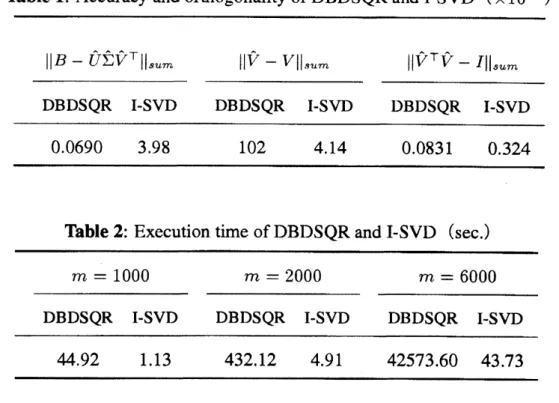
Table
1:
Accuracy and orthogonality of DBDSQRand I-SVD $(\cross 10^{-9})$$\Vert B-\hat{U}^{\underline{\hat{\nabla}}}\hat{V}^{T}||_{sum}$ $||\hat{V}-V\Vert_{sum}$ $\Vert\hat{V}^{T}\hat{V}-I||_{sum}$
DBDSQR I-SVD DBDSQR I-SVD DBDSQR I-SVD
0.0690
398
102
4.140.0831
0.324
Table
2:
Execution timeof DBDSQR andI-SVD
(sec.)$m=1000$ $m=2000$ $m=6000$
DBDSQR I-SVD DBDSQR I-SVD DBDSQR I-SVD
4492
1.13
432.12
491
4257360
4373
This is sometimes called thetwisted factorization. The substitution for determining $N(k)$ and
$D^{\pm}(k)$
can
be done from the twisted point $k=\rho$as
$k=\rho,$ $\rho\pm 1,$ $\rho\pm 2$,. . .
.
Whilevarious
errors
may
be accumulated ifwe
compute matrix factorizations by the usual one-sidesubstitution. The twistedfactorization foreach$\hat{\sigma}_{j}$
can
be computed by$O(m)$ times of divisions.Since $D_{\rho}e_{\rho}=\gamma e,$ $N_{\rho}e_{\rho}=e_{\rho},$ $D_{\rho}N_{\rho}e_{\rho}=N_{\rho}D_{\rho}e_{\rho},$ $v_{j}$ satisfies the linear system $(B^{T}B-$
$\hat{\sigma}_{j^{2}}I)v_{j}=\gamma j,\rho e_{\beta}$ and is
an
eigenvectorof$B^{T}B$ providing that$N_{\rho}^{T}v_{j}=e_{\rho}$
.
The solution vector$v_{j}=(v_{j}(k))$ of$N_{\rho}^{T}v_{j}=e_{\rho}$ is givenby
$v_{j}(k)=\{\begin{array}{ll}1, (k=\rho),-N(k)v_{j}(k+1), (k=\rho-1, \rho-2, \ldots, 1),-N(k-1)v_{j}(k-1), (k=\rho+1,\rho+2, \ldots, m),\end{array}$
which gives rise to the right singular vector $v_{j}$
.
Since each singular vectorcan
becom-puted within $O(m)$ flops, the computation of k-singular vectors costs $O(km)$ flops for $k=$
$1,2,$ $\ldots,$$m$
.
The left singular vectors $u_{j}$ of $B$are
given through $U=BV\Sigma^{-1}$, with $U=$ $(u_{1}, \ldots, u_{m}),$ $V=(v_{1}, \ldots, v_{m}),$ $\Sigma=$ diag$(\hat{\sigma}_{1}, \ldots,\hat{\sigma}_{m})$,or
by solving the system $(BB^{T}-$$\hat{\sigma}_{j^{2}}I)u_{j}=0$ directly.
Finally
we
quotesome
numerical examples from[301 onan
implementation of theI-SVDal-gorithm. InTable 1 the
accuracy
of singularvalue decomposition,theaccuracy
ofrightsingularvectors and their orthogonality
are
considered. Here $\Vert\hat{V}-V\Vert_{sum}$ indicatesthesum
ofabsoluteright singular vectors. The numerical numbers in Table 1
are averages
of1001000
$\cross 1000$bidiagonal testmatrices whose singular values
are
randomly distributed. Here DBDSQRis thestandard LAPACK code for bidiagonal SVD where the Demmel-Kahan QR algorithm is
im-plemented. In the I-SVD code the left singular vectors
are
computed by $\hat{U}=B\hat{V}\Sigma^{-1}^{\wedge}$and
a
re-onhogonalization of all ofthe singular vectors is performed by inverse
iterations
once.
Ittakes extra $O(m^{2})$ flops. The parameters $\delta_{\pm}^{(0)}$
are
fixed to 1. Table 1shows that DBDSQR is
better than the I-SVD code by $1\sim 2$ digits
on
theaccuracy
ofSVD and the orthogonality ofsingularvectors. However
on
theaccuracy
of singularvectors I-SVD is betterthan DBDSQR.Table 2 is a comparison of execution time between DBDSQR and the I-SVD code. It is
obvious that the
I-SVD
algorithm needs only $O(m^{2})$ flops and is rather faster than DBDSQRof $O(m^{3})$ flops. I-SVD also has
a
better scalability. The I-SVD code with theHouseholder
preconditioning to bidiagonal manices and
an
inverse transformation is still sufficiently fasterthan DBDSQR with Householder[30].
8.
Concluding
Remarks
This report surveysrecent developmentsofthe mdLVs algorithm for singular values and the
I-SVD algorithm for bidiagonal SVD. The mdLVs is
a
shifted version of the $dLV$ algorithm.We first show how the $dLV$ algorithm has
a
higheraccuracy.
The Christoffel transformationof
symmetric OPs
gives
rise to thepositivity
and boundedness of the parameter $\delta^{(n)}$and the
variable $u_{k}^{(n)}$ of the $dLV$ algorithm. No subtraction
appears
in $dLV$.
Positivity
is also essential
in the formulation of the mdLVs algorithm. Namely, if
a
shiftis less than theminimal singularvalue, then the positivity of mdLVs follows.
The Johnson bound [171 has been adopted in the mdLVs code [291. Recently
a
new
lowerbound is found which is called the p-th generalized Newton bound. The generalized Newton
shift costs only $O(m)$ flops where $m$ is the size ofgiven bidiagonal matrix [18]. Y. Yamamoto
[19]
proves
that the generalized Newton shiftperfoimsa
weakly $(p+1)$-th orderconvergence.
The mdLVs code with the generalized Newton shift where $p=2,3,4$ is faster and
more
accu-rate than the mdLVs code with the Johnson shift. Though lower and upper bounds of matrix
eigenvalues have been studied fully [311, exploring for
new
bound is stillan
important
problemin numerical linearalgebra.
The I-SVD algorithm is
a
combination ofthe mdLVs algorithm and the dLV-typetransfor-mation for singularvectors. Because ofthe separation ofcomputation of singular values from
that of singularvectors theI-SVD algorithm
runs
in $O(m^{2})$ flops. Whereas theDemmel-KahanQR algorithmrequires $O(m^{3})$ flops. Thus theI-SVD code is ratherfasterthan DBDSQR code
ofLAPACK. TheI-SVD code has a good orthogonalityofsingularvectors for the
case
ofran-dommatrices. Toimprove the orthogonality for clustered
matrices
theI-SVD algorithm should参考文献
[1] N. I. Akheiezer, The ClassicalMoment Problem andSome Related Questions inAnalysis,
Edin-burgh: Olver&Boyd, 1965.
[2] T. S. Chihara,AnIntroduction to Orthogonal Polynomials, New York: Gordon&Breach, 1978.
[3]
$pearMoody$ T. Chu, “Linearalgebra algorithms as dynamicalsystems,
‘’
Acta Numerica, 2008, to
ap-[4] J. Demmel,AppliedNumerical Linear Algebm, Philadelphia: SIAM, 1997.
[5] I. S. Dhillon and B. N. Parlett, Orthogonal eigenvectors and relativegaps, SIAM J. Matrix Anal. Appl.,25(2004), 858-899.
[6] I. S. Dhillon and B. N. Parlett, Multiple representations to compute orthogonal eigenvectors of
symmetrictridiagonalmatrices,Lin. Alg. Appl.,387(2004), 1-28.
[7] I. S. Dhillon, B. N. Parlett andC. Vomel, Gluedmatrices andtheMRRR algorithm, SIAM J. Sci.
Comput., 27(2005),496-510.
[8] K. V. Femando, B. N. Parlett, Accurate singular values and differential qd algorithms, Numer.
Math.,67(1994), 191-229.
[9] G. H. Golub and C. F. Van Loan, MatrixComputations 3rd$edn$, Baltimore: The Johns Hopkins
Univ. Press, 1996.
[10] R. Hirota, ”Conservedquantities of random-time Todaequation”, J. Phys. Soc.JapanVol. 66, pp.
283-284, 1997.
[11] M. Iwasaki and Y.Nakamura,“Onaconvergenceof solution of the discreteLotka-Volteirasystem;’
InverseProblems, vol. 18,pp. 1569-1578, 2002.
[12] M.Iwasaki and Y. Nakamura,“Anapplicationofthe discreteLotka-Volterrasystem withvariable
step-size to singular value computation,” InverseProblems, Vol. 20,pp. 553-563, 2004.
[131 M. Iwasaki and Y. Nakamura, “Accurate computation of singular values interms of shifted inte-grableschemes, ”
JapanJ. Indust.Appl. Math. Vol. 23,pp.239-259, 2006.
[14] M. Iwasaki and Y.Nakamura, ”Positivity and stability ofthe $dLV$algorithm forcomputing matrix
singularvalues,”in:Proceedings
of
the 2nd IntemationalConference
onInformatics
Researchfor
Developmentof
KnowledgeSocietyInfrastructure
ICKS2007, $Eds$. M. Fukushima, K. Tajima andK. Tanaka, IEEE Computer SocietyPress,pp. 103-110,2007.
[15] M. IwasakiandY. Nakamura, ”Center manifold approachtodiscrete integrable systemsrelatedto
eigenvalues and singularvalues,’‘Hokkaido Math. J., Vol. 36,pp. 759-775, 2007.
[16] M.Iwasaki,S. SakanoandY. Nakamura, ‘Accuratetwistedfactorizat\’ionof realsymmetric
tridiag-onalmatrices and its applicationtosingular valuedecomposition,” Trans. Japan SIAM, 15(2005),
461-481. (岩崎雅史. 阪野真也, 中村佳正, 実対称3重対角行列の高精度ツィスト分解とその
特異値分解への応用, 日本応用数理学会論文誌).
[17] C. R. Johnson, ‘A Gersgorin-type lowerbound for the smallest singular value;‘ $Lin$
.
Alg. Appl.,Vol. 112,pp. 1-7, 1989.
[18] K.Kimura, T.Yamashita and Y.Nakamura,“On$O(N)$formulaforthediagonalelementsofinverse
powersofsymmetric positivedefinitetridiagonalmatrices,’‘ inpreparation.
[19] K. Kimura,Y Yamamoto,M. TakataandY Nakamura,“Generalized Newton shifts: An arbitrarily
high ordershufting scheme for singular value computation,” inpreparation.
[21] Y. Nakamura, ‘A new approach to numerical algorithms in terms of integrable systems,”
in:Proceedings
of
IntemationalConference
onInformatics
Researchfor
Developmentof
Knowl-edge Society
Infrastructure
ICKS 2004, $Eds$.
$T$ Ibaraki, T Inui and K. Tanaka, IEEE ComputerSocietyPress,pp. 194-205,2004.
[221 Y. Nakamura, Functionality
of
Jntegrable Systems, Tokyo: Kyoritsu Shuppan, 2006, (中村佳正著「可積分系の機能数理」 共立出版).
[23] B. N. Parlett and I. S. Dhillon, Femando’s solution to Wilkinson’s problem: An application of doublefactorizatio$n$,Lin. Alg. Appl., 267(1997),247-279.
[24] B. N. Parlett and $0$
.
A. Marques, An implementation ofthe dqds algorithm (positive case), Lin.Alg. Appl.,309(2000),217-259.
[25] H. Rutishauser. “Ein Quotienten-Differenzen-Algorithmus,” $7_{\wedge}$ angew Math. Phys., vol.
5. pp.
233-251, 1954.
[26] V. $Sp\ddot{m}donov$ and A.Zhedanov, ”Discrete-time Volterra chaina$nd$classical orthogonal
polynomi-als,”J. Phys.$A$, vol. 30,pp. 8727-8737, 1997.
[27] G. Szeg\"o, OrthogonalPolynomials, Providence: Amer. Math. Soc., 1939.
[28] M. Takata, M. Iwasaki, K. Kimura and Y. Nakamura, “Implementation and its evaluation of
rou-tine for computing singularvalues with high accuracy,” IPSJ Trans. Adv. Comput. Systems, 46, No SIG12(2005),299-311,(高田雅美, 岩崎雅史, 木村欣司, 中村佳正, 高精度特異値計算ルー
チンの開発とその性能評価, 情報処理学会論文誌).
[29] M.Takata,M. Iwasaki, K.Kimura and Y.Nakamura. “Anevaluationofsingular value computation
by the discrete Lotka-Volterra system,” in:Proceedings
of
The 2005 IntemationalConference
onParalleland DistributedProcessing Techniques and Applications (PDPTA2005), Vol. II,pp.
410-416,2005.
[30] M. Takata. K. Kimura. M. IwasA and Y. Nakamura, “Implementation oflibrary for high speed
singular value decomposition2”IPSJTrans. Adv.Comput.Systems, 47, No.SlG7(ACS 14), (2006),
91-104,($\ovalbox{\tt\small REJECT}$ffl%$\not\equiv$, $*\}\backslash \dagger I\overline{\text{ロ}}\urcorner,$ $\epsilon ur\ovalbox{\tt\small REJECT}\Re R,$ $\mathfrak{c}P\}\backslash \dagger\dagger\not\leqq iE$,
-$\ovalbox{\tt\small REJECT}$I $\grave$
ま$*$g{F9$\beta\not\in$のためのライブラ $\dagger$
) $\ovalbox{\tt\small REJECT}$ $\mathfrak{X},$ $’\ovalbox{\tt\small REJECT}\Re\infty g_{\mp\hat{=}p|wX_{\overline{p}}^{-}T)}^{r^{\backslash }3a}$
.
[31] R. Varga,GerSigorinand HisCircles, Heidelberg: Springer-Verlag,2004.
[32] T.Yamashita, K.Kimuraand Y.Nakamura, “Onsubtraction free formulaforthe diagonalelements