微小振動子の入力場立相揺らぎに対するロバスト
フィルタリング及び
LQG
$\ovalbox{\tt\small REJECT}\iota$」
御
慶磨義塾大学大学院理工学研究科 $*$
飯田 早苗
Sanae Iida
Graduate School of
Science
and Technology
Keio University
The quantum Kalman filter and LQG controller provides enough specification for
accurate estimation and control in linear quantum system, though this holds only in the case when a trustful mathematical model of the system is available. In this
paper, we consider an optomechanical oscillator which is continuously monitored via
an
optical laser, although the laser phase is unknown. For this system,we
proposea
robust scheme ofboth filtering andcontrol against the phase uncertaintyoftheoptical laser. The filter estimates the uncertain parameter using
an
auxiliary estimator that adaptively changes the filtering and control algorithmso
that it aquires the betterestimation and control performance
near
to that of the optimalone.
The robustnessis demonstrated in
a
numerical simulation.1
Introduction
To realizevarious nano-architectures including quantum informationprocessors [9],
we
needaccurate measurement and control of thesystem under consideration. Quan-tum filtering theory [2, 3, 4] and its application to quantum feedback control [13, 14]serve
basic methodologies satisfying these requirements and have actually shown the potential usefulness [1, 6, 11]. For linear quantum systems, especially, the filter andthe controller have completely the
same
formas
the traditional Kalman filter andLQG controller, thus such a quantum Kalman
filter
anda
quantum $LQG$ controllerare
enough implementable in reality.However,
as
in the classicalcase
(we here call “classical only because they are notquantumsystems), the quantumKalman filter and the quantum LQG controller work well only when a trustful mathematical model of the system under consideration is
available. Fortunately, for this long-standing issue, the classical system theory has
provided
a
number ofsolutions; theyare
largely classified to two approaches.The first is based
on
the notion of “soft sensing that is, the estimation algorithmis modified, without adding a real sensor,
so
that the filter and the controller acquire robustness against the model uncertainty [8, 10].The second is the “hardwaresensing” method that simply introduces actual
sensors
so
as
to obtainmore
information utilizable forthe better estimation under uncertain-ties. This method is, classicallymore or
less,never
inferior to the above soft sensing technique, if one affords to buy an expensive high-quality sensor required. In thequantum case, however,
we
cannot always have sucha
hopefulstatement. This is due to the unavoidable quantum back-action property; that is, introducing a hardwaresensor
must bring additional noise to the system, thus it sometimes happens that the estimation performance getsworse. The hardware sensingmethod for robust quantumfiltering and control has, presumably because of this fact, not yet been examined.
In this paper, despite of the back-action issue mentioned above, we apply the idea of hardware sensing to the quantum
case
and propose a new configuration of thequantum Kalman filter and the quantum LQG controller that has robustness against
a certain practical uncertainty.
Let
us
first describe the uncertaintywe
treat in this paper. Fig.1 depictsa
gen-eral linear quantum system coupling with
an
optical laser field. The output light is measured using so-called balanced homodyne detector, and the signal generated is then processed in the filter to calculate the estimate of the system variable. Alsowe can control the system with the estimate
so
that the system has nice property.In reality,
an
uncertainty appears in this input laser field; that is, the phase of theinput laser cannot be determined in any real experiment. As shown later on, the
phase uncertainty is explicitly contained in all the system, the filter and the
図1 Schematic of the quantum Kalman filter. First, the system couples with a
input laser. Theoutput laser ismixed, byabeamsplitter(BS), withastrong
ref-erence lightcalled the local oscillator(LO), and twooutputs arethen respectively
detected via aphoton detector. This whole measurement configuration is called
the homodyne detection. Finally, the quantum Kalman filter uses the output to calculatethe best estimation $\pi(\hat{x}_{t})$.
control performance. It should be mentioned that this sort of indirect measurement
scheme through
a
laser is commonly used for various quantum systems, for instancean
atomic system in the cavity QED setup [5, 7] andan
opto-mechanical system inan optical interferometer [12]. In this sense, the robust Kalman filtering and LQG control technique under the phase uncertainty of the input laser should be widely
useful and significant.
We next mention briefly about the hardware sensing scheme for robust Kalman
filtering and LQG control. This is built up by first dividing the input laser before it
goes into the system and then putting another homodyne detector along the second
optical path to obtain further information;
see
Fig. 3 in Section 3. $A$ (probabilistic)back-action is brought when
one
does this additional measurement. Nonetheless,the hardware sensing scheme proposed allows us to estimate the unknown parameter itself; the result can then be fed back to adaptively change the filtering and control algorithm and, eventually, the filter and the controller acquire robustness property despite of the back-action mentioned above. We call this scheme the adaptive Kalman
filter
and the adaptive $LQG$ controller.This paper is organized
as follows.
In Section 2, the standard quantum Kalman filter and LQG controllerare
described by taking an opto-mechanical oscillatoras
a system, then the uncertainty issue is explained. Section 3 is devoted to show the
configurationand the algorithm ofthe adaptive Kalman filter andLQG controller. Its
robustness property is further given. Finally, inSection4, wenumericallydemonstrate
図2Schematic ofthe optomechanical oscillator. The right end mirror of the Fabry-Perot cavity serves asthe oscillator, where$\hat{x}_{t}$ is the system variable, $\^{a}_{t}$ is an annihilationoperator corresponding to the intra-cavity, and $\mathcal{A}_{in}$ is the mean
amplitude ofthe input laser.
2
The
quantum
Kalman
filter and
LQG
controller
The system
we
focuson
isan
optomechanical oscillator. Consider now a Fabry-Perot cavity composed of a moving mirror which interacts with an input field $A_{in_{t}}.$The mirror is modeled with position operator $\hat{q}_{t}$, momentum operator $\hat{p}_{t}$,
mass
$m,$
and resonant frequency $\omega_{m}$
.
The intra-cavity optical field \^a decays at rate $\gamma$ due tocoupling through the partially transmitting mirror to the output beam $A_{out_{t}}$
.
Theintra-cavity opticalfieldassumed to be resonant at theinput beam’s carrier frequency $\omega_{0}$, at which point the roundtrip length is $2L$
.
The mirror position$\hat{q}_{t}$ isdefinedrelativeto this equibirium position. The operators obey canonical commutation relations:
$[\hat{q}_{t},\hat{p}_{t}]=i\hslash,$ $[\^{a}_{t}, \^{a}_{t}^{\dagger}]=1.$
Removing
mean
fields and defining amplitude and phase quadrature operators for the fluctuations that remain, $A_{in_{t}}=\mathcal{A}_{in}+(\hat{\xi}_{1_{t}}+i\hat{\xi}_{2_{t}})$, $A_{out_{t}}=\mathcal{A}_{in}+(\hat{\eta}_{1_{t}}+i\hat{\eta}_{2_{t}})$,and $\hat{a}_{t}=\alpha+\^{a}_{1_{t}}+i\^{a}_{2_{t}}$ where $\alpha=\mathcal{A}_{in}\sqrt{2}/\gamma$, We
can
obtain the system dynamicswith the variable$\hat{x}_{t}=(\hat{q}_{t},\hat{p}_{t},\hat{a}_{1_{t}},\hat{a}_{2_{t}})^{T}$ which is found in a form of so-called quantum
stochastic differential equation:
$d\hat{x}_{t}=A\hat{x}_{t}dt+B(u_{t}dt+d\hat{\xi}_{t})$, (1)
where $u_{t}=(u_{1_{t}}, u_{2_{t}})^{T}$ is the control input, $\hat{\xi}_{t}=(\hat{\xi}_{1_{t}},\hat{\xi}_{2_{t}})^{T}$ is the input laser, $\kappa(\alpha)=\alpha\omega_{0}/L$ is
an
optomechanical coupling strength, and $\alpha=(\alpha_{1}, \alpha_{2})^{T}.$The output light ofthe system is subjected to the following equation:
$d\hat{Y}_{t}=C\hat{x}_{t}dt+D(u_{t}dt+d\hat{\xi}_{t})$, (3)
$C=HB^{T}, D=\{\begin{array}{ll}-1 00 -1\end{array}\}$ , (4)
where $\hat{Y}_{t}=(\hat{\eta}_{1_{l}},\hat{\eta}_{2_{t}})^{T}$, and $H$ is
a
2-dimentionalrow
vector satisfying $HH^{T}=4.$The outputs commute with each other, i.e., $[\hat{Y}_{t}, \hat{Y}_{s}]=0,$$\forall s,$$t$, thus the sequence of
scalars $y_{t}=\{y_{s} : 0\leq s\leq t\}$ is obtained. For the observer, the variables
can
beregarded
as
classical random variables, which implies the existence of classicalcondi-tional expectations $\pi(\hat{x}_{t})$ $:=\mathbb{E}(\hat{x}_{t}|\mathcal{Y}_{t})$
.
The quantum Kalman filter is the algorithmthat updates the estimates $\pi(\hat{x}_{t})$ depending
on
the measurement outcome $y_{t}$:$d\pi(\hat{x}_{t})=A\pi(\hat{x}_{t})dt+Bu_{t}dt+(V_{t}E^{T}+F)d\tilde{y}_{t}$, (5)
$\dot{V}_{t}=(A-FE)V_{t}+V_{t}(A-FE)^{T}$
$+2V_{t}E^{T}EV_{t}+BB^{T}-4FF^{T}$, (6)
$E=HC, F=- \frac{1}{4}BH^{T}$, (7)
where $d\tilde{y}_{t}=dy_{t}-\mathbb{E}(d\hat{Y}_{t}|\mathcal{Y}_{t})$ represents the innovationterm showing the difference
of $dy_{t}$ and the estimate of $d\hat{Y}_{t}.$ $V_{t}$ represents the (symmetrized)
error
covariancematrix.
To cool the oscillator, it is expected that a feedback controller minimizing the estimated value of the position operator $\hat{q}_{t}$ and momentum operator $\hat{p}_{t}$
.
Becauseof the linearity of both the dynamics and the output equation, this requirement is
satisfied with the LQG control. We can construct an optimal control law $u_{t}^{*}$ that minimizes the following quadratic-type cost function:
$J= \langle\frac{1}{2}\int_{0}^{T}(\hat{x}_{t}^{T}Q\hat{x}_{t}+u_{t}^{T}Ru_{t})dt\rangle$ (8)
where $Q\geq 0$and $R>0$represents the penalty for the variables and the controlinput,
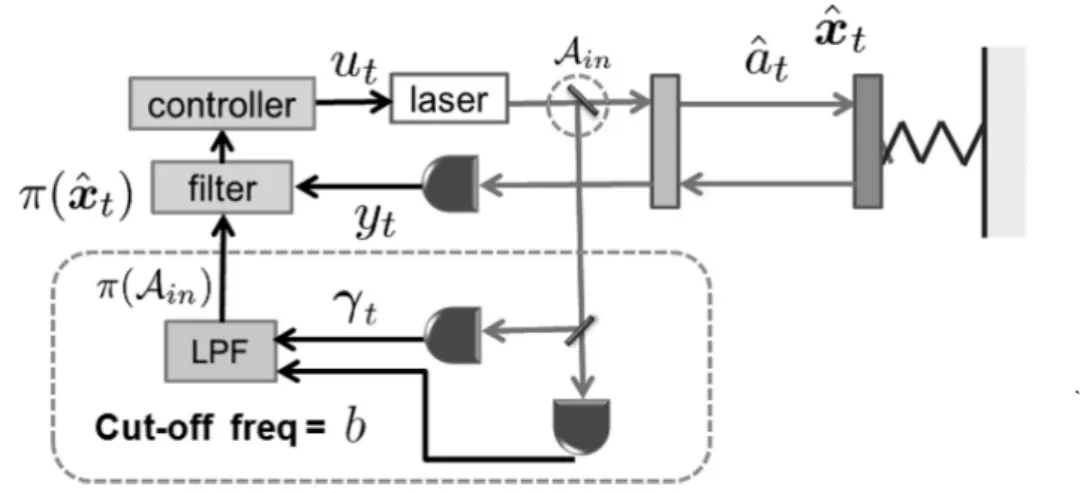
図3Schematic ofthe adaptive quantum Kalman filter and LQG controller.
The LQG control theory gives the explicit form of the optimal controller:
$u_{t}^{*}=-R^{-1}B^{T}P_{t}\pi(\hat{x}_{t})$ (9)
where $P$ is the solution to the following algebric Riccati equation:
彦 $+P_{t}A+A^{T}P_{t}-P_{t}BR^{-1}B^{T}P_{t}+Q=0$ (10)
We here explain the issue of uncertainty. In reality the input laser field amplitude
$\mathcal{A}_{in}=|\mathcal{A}_{in}|(\cos\theta+i\sin\theta)$ is not the value that
can
be determined beforehand. Thatis, the phase $\theta$ takes a different value in every experiment and thus should be treated
as an unknown parameter. As shoun in equation (2), $\mathcal{A}_{in}$ explicitly appears in the $A$
matrix (note that $\alpha=\mathcal{A}_{in}\sqrt{2}/\gamma$). Therefore,
we can
never
carry out precise updatesof the estimates, which eventually degrade the total performance ofthe filtering and
control.
3
The adaptive filtering
and
control
We heredescribe the hardware sensing scheme. The input laser is divided into two optical paths via a beam splitter, and the new second path is then measured by the dual homodyne detector. That is, we
measure
both the sine and cosine elements of this second laser field, generating the signal$d\gamma_{t}=\mathcal{A}_{in}dt+dv_{t}$, where$v_{t}$ isa
2-dimensionalto build the adaptive filter we must introduce vaccum
fluctuations
that subsequently produce the additional noise $v_{t}$; this is the unavoidable probabilistic back-actionbrought by the hardware sensing. The signal $\gamma_{t}$ is then processed through
a
low-pass filter (LPF) with the cut-off angular frequency $b>0$.
The LPF variable $\pi(\mathcal{A}_{in})$ obeys$\pi(\mathcal{A}_{in})=e^{-bt}\mathcal{A}_{in_{0}}+b\int_{0}^{t}e^{-b(t-s)}(\mathcal{A}_{in}ds+dv_{s})$
$= \mathcal{A}_{in}(1-e^{-bt})+b\int_{0}^{t}e^{-b(t-s)}dv_{s}$
.
(11)We find $\mathbb{E}(\pi(\mathcal{A}_{in}))arrow \mathcal{A}_{in}$
as
$tarrow\infty$, thus $\pi(\mathcal{A}_{in})$ asymptotically givesan
unbiasedestimate of$\mathcal{A}_{in}.$
The adaptive Kalman filter estimates $\hat{x}_{t}$, using the LPF variable $\pi(\mathcal{A}_{in})$ instead
of the unknown parameter $\mathcal{A}_{in}$
.
Writing suchan
estimateras
$\pi^{A}(\hat{x}_{t})$, the adaptiveKalman filter and LQG controller
are
givenas
follows:$d\pi^{A}(\hat{x}_{t})=A^{A}\pi^{A}(\hat{x}_{t})dt+Bu_{t}^{A}dt+(V_{t}E^{T}+F)d\tilde{y}_{t}^{A}$, (12) $u_{t}^{A}=-R^{-1}B^{T}P_{t}^{A}\pi^{A}(\hat{x}_{t})$, (13)
where $A^{A}$ is the $A$ matrix using the LPF variable $\pi(\mathcal{A}_{in})$ instead of the unknown
parameter$\mathcal{A}_{in}$, and $P^{A}$ is the matrix which follows equation (8) using $A^{A}$ instead
of
$A$, and$d\tilde{y}_{t}^{A}=d\tilde{y}_{t}+E(\pi(\hat{x}_{t})-\pi^{A}(\hat{x}_{t}))dt$
which indicates that the adaptive Kalman filter is driven with
a
difference ofthe truefilter
and the adaptive filter.$0$ 2 4 6
time 810
図4The difference between the adaptive (or nominal) and the true estimates for $\hat{q}_{t}$
Let
us
heresee
some
actual trajectories of the estimates ofthe adaptive filter and controller. We particularly focus on three types of the filter where the cut-offfre-quency is chosen as $b=0.5,$$b=0.1$, or $b=0.01$. The true laser amplitude is
$\mathcal{A}_{in}=(1,0)^{T}$, which
can
be used to run the true Kalman filter. For comparison,we
also examine
a
nominal filter that set $\mathcal{A}_{in}$ to be $(0,1)^{T}$ Fig.4 shows the difference between the adaptive (or the nominal) and the true estimates of $\hat{q}_{t}$.
Wesee
that thenominal filter fails in the estimation, while the adaptive Kalman filters well estimate, particularly when $b=0.1$
.
Wecannumericallyseethe optimalcut-off frequencywhichcut-offfrequency
図 5The cut-off frequency dependence of the cost function
minimizes the cost function $J$
.
Fig.5 shows the cut-off frequency dependence of thecost function. The final time $T$ in this simulation is 3. At lower cut-offfrequencies,
the cost function takes large value. The cost function takes the minimum value at
$b=0.03$, and gradually takes larger value as $b$ get larger. In general, with smaller
valueof$b$, we canobtain morepreciseestimation in the steady state case, but it shows
the more slowly
convergence
to the true filter. In other words, in the early stage of the estimation, the adaptive Kalman filter with small value of $b$ has almostno
infor-mation of$\mathcal{A}_{in}$, and thus has the
same
qualityas
that of the nominal filter.On
the other hand, with larger value of $b$, the adaptive Kalman filter has fast convergence,when
we
takea feedback
controlwhichrequires rapid convergence and accuracy, thereexists the optimal value ofthe cut-off frequency in terms of the trade-off between the
convergence and the accuracy.
5
Conclusion
In this paper, for an optomechanical oscillator coupling with a laser field, we have
proposed an adaptive filtering and control scheme that estimates both the system
variables and the unknown phase parameter of the input field. It was then shown that, by choosing the cut-offangular frequency in the LPF for the adaptive filtering,
we
can
obtain the robust filter and controller against the phase uncertainty.Though we have assumed that the uncertainty is constant and only appears in the
phase, inreality these assumptions maynot besatisfied. The robust filteringproblem
in the
more
general setting remains open.参考文献
[1] C. Ahn, A. C. Doherty, and A. J. Landahl, Continuous quantum
error
correction via quantum feedback control, Phys. Rev. $A$, vol. 65, p. 042301,2002.
[2] V. P. Belavkin, Quantum filtering ofMarkov signals with white quantum noise,
Radiotechnika $i$ Electronika, vol. 25, pp. 1445-1453, 1980.
[3] V. P. Belavkin, Quantum stochastic calculus and quantum nonlinear filtering, $J.$
Multivariate Anal., vol. 42, pp. 171-201, 1992.
[4] V. P. Belavkin, Nondemolition measurements, nonlinear filtering, and dynamic programming of quantum stochastic processes, in Proc. Bellman Continuum,
$Sophia-Antipoli\mathcal{S}$ 1988,
ser.
Lecture Notes in Control and Information Sciences121, Springer-Verlag, New York, pp. 245-265, 1988.
[5] H. J. Carmichael, An open systems approach to quantum optics, Springer-Verlag,
Berlin Heidelberg New-York, 1993.
[6] R. Van Handel, J. K. Stockton, and H. Mabuchi, Feedback control of quantum
state reduction, IEEE Trans. Automat. Contr., vol. 50, pp. 768-780, 2005.
[7] H. Mabuchi and A. C. Doherty, Cavity quantum electrodynamics: coherence in
[8] J. B. Moore,
R.
J. Elliott, andS.
Dey,Risk-sensitive
generalization ofminimumvariance estimation and control, J. Math. Syst., Estim., Control, vol. 7, pp. 1-15,
1997.
[9] M. A. Nielsen and I. L. Chuang, Quantum Computation and Quantum
Informa-tion, Cambridge University Press, Cambridge,
2000.
[10] I. R. Petersenand A. V. Savkin, Robust Kalmanfiltering
for
signals and systemswith large uncertainties, Birkhauser, Boston, 1999.
[11] L. Thomsen, S. Mancini, and H. M. Wiseman, Continuous quantum nondemo-lition feedback and unconditional atomic spin squeezing, J. Phys. $B$, vol. 35, $p.$
4937,
2002.
[12] P. Verlot, A. Tavernarakis, T. Briant, P. F. Cohadon, and A. Heidmann, Scheme
to probe optomechanical correlations between two optical beams down to the quantum level, Phys. Rev. Lett., vol. 102, p. 103601,
2009.
[13] H. M. Wiseman, Quantum theory of continuous feedback, Phys. Rev. $A$, vol. 49,
p. 2133,
1994.
[14] H. M. Wiseman and G. J. Milburn, Quantum Measurement and Control,