Importance of Decentralized Development
Planning and the Role of Government under
Market Oriented Economy : The Case of Myanmar
(マング・マング・ルウィン教授 退職記念号)
著者
Lwin Maung Maung
journal or
publication title
Journal of Economics, Kumamoto Gakuen
University
volume
25
number
1-4
page range
5-36
year
2019-03-31
URL
http://id.nii.ac.jp/1113/00003331/
1
Role of Government under Market Oriented Economy:
The Case of Myanmar
Maung Maung Lwin
Introduction
The broadly-based decentralized planning has been considered as most direct and effective way of overcoming the major obstacles to development and achieving sustainable progress of peoples’ social and economic wellbeing among the market-oriented economies of this century. If we trace back the history of economic planning, many developing countries of the world introduced economic plans, centralized and decentralized, especially during the period from 1950s to end of 1980s. Particularly the failures of centralized controlled plans which resulted unstable economic growth and chronic poor economic performances was followed by out broke of economic, political and social unrest in Myanmar (August 1988), China (Tiananmen Square protects, August 1989), the fall of Berlin Wall (November 1989), Czechoslovakia (December 1989) and Soviet Union (collapse, December 1991). The failures of centralized planning and collapse of socialist governments were the major causes of worldwide mystique of planning and less confidence in development plans. As a result, the former socialist planned economies of Soviet, China, Central and Eastern Europe, and the countries of Asia began to introduce the administrative and market-oriented reforms measures since early 1990s for achieving sustained economic growth through rapid inflow of official Development Assistance (ODA) and Foreign Direct Investment (FDI). These counties were generally known as transitional economies and comprising about one third of the total world population (Lwin 2000, World Development Report 1996, 1997). The countries of Cambodia, China, Laos, Myanmar and Vietnam during 1990s were recognized as transitional economies of Asia. All these transitional economies have been introducing the “hybrid style
of political and economic management” which is the unique blend of “broadly based decentralized development planning, the market mechanism and deliberate government initiative and guidance,”. As
a result of successful economic and administrative reforms, privatization, regular decentralization of
The author would like to express his thanks to Dr. Myint San, for his valuable comments at the 7th
AURCED-MARCED International Conference of 2017, and Dr. Kinoshita Toshikazu and Dr. Yamakawa Takahiro, for their critical comments and arranging excellent diagrams for this study.
2
central authorities, and eradication of public sector corruption aswell as efficient utilization of FDI and ODA, many of these countries have begun to achieve high and sustained economic growth since the later part of 1990s.
As in the other transitional economies of Asia, Myanmar’s centralized control planning system of socialist military government was also replaced by semi-decentralized planning together with introducing some market and private sector-oriented policy measures by military generals after 1988 (Lwin 2017). But, unfortunately, Myanmar could not achieve stable and high economic growth, and progress of peoples’ daily socioeconomic conditions as in other transitional economies of Asia and Indochina during 1990 and March 2016. The main causes of failure comprised (a) over centralization and control, (b) poor development management capability of government, (c) nationwide corruption, (d) taking monopoly power in doing business and industry for army and personal interest, and (e) abuse of political power for earning illegal huge profit. However, in April 2016, Myanmar has had the opportunities to govern and manage her country and economy in a democratic and more free and fair market-oriented way, even not fully. Currently, Myanmar is seriously trying to reform her style of political and economic management, and introduce long-term development plan in order to achieve peace, stability and economic growth. Myanmar already had the experiences of both planning under free market economy and socialist centralized command economy after her independence. The Two-year Plan and Eight-year Plan of parliamentary democracy government during the years between 1948 and 1962 was having strong socialistic and nationalistic characteristics. As a result, all the important industries and business activities were established, owned and operated by the public sector. The growth of private sector was also given less priority during this period. Then, Myanmar also had the long experiences of centralized controlled planning under socialist military government (1974-1988) and so-called decentralized plan and semi-open market economy experiences under military and military backed U Thein Sein government during the years from 1990 to March 2016. Therefore, it is better to judge that Myanmar is still lacking the real experiences of broadly-based decentralized planning under free and fair democratic market-oriented economic system simultaneously with an objective of transforming from a public sector dominated to private sector led economy.
Accordingly, this study attempts to examine the importance of “decentralized development plan, market and government” under democratic market-oriented economy as well as under globalization1
process. It has three main objectives, (1) highlighting the important role of decentralized plan, government, and market under the free and fair democratic market-oriented economy, (2) reexamining
3
the characteristics and main causes of failure in past Myanmar’s development plans and (3) providing some suggestions for present Myanmar Sustainable Development Plan (MSDP).
1. General Concepts and Legacy of Planning:
(a) Concept of Planning: According to Todaro (1992), “economic planning may be described as the
conscious governmental effort to influence direct and in some cases, even control changes in the principal economic variables of a country or region over the course of time in order to achieve a predetermined set of objectives”2. Waterson (1971) also attempted to explain such as, “planning is, in
essence, an organized, conscious and continual attempt to select the best available alternatives to achieve specific goals”. In other words, planned economy is an economic system in which the state or government manages the country’s economy in order to achieve desirable socioeconomic growth within given period of time through implementing the predetermine plan targets. Generally, development plans consist of long-term socioeconomic perspectives which describe desirable national socioeconomic objectives, goals and identified role of various economic sectors which have to play in achieving predetermined targets. Economic plans can be either comprehensive or partial as well as centralized or broadly-based decentralized or indicative.
Moreover, Todaro (1992) classifies economic planning according to economic system into three; viz. (1) planning in market economies, (2) planning in command economy and (3) planning in mixed developing economies3. This study will concern more with mixed developing economies which are also
recently known as market-oriented economies. Before 1990s, generally, development planning has two types based on degree of state control viz. centralized controlled planning and indicative planning. The former was practiced in socialist command economies in which the role of state and public sector is dominant in managing social and economic life of the people. Plan formulation, targeting, policy formulation and decision making, and implementation are under the strict control of central government. This type of plan was pursued in Soviet Union and the socialist countries of Eastern Europe and Asia before 1990s.
Indicative plans are chiefly used in developed free market economies in which private sector is dominant and social and economic lives of the people rely on this sector than public sector and the state. French is widely known for indicative planning. Implementation of indicative plan and decision making are partly guided by Adam Smith’s invisible hand or market forces that helps demand and supply of goods and services to approach equilibrium automatically. But, if the market situations become difficult
4
to approach equilibrium, the government intervention has to take into action. In these capitalist free market economies, public sector is taking role as an initiator, facilitator, supporter and monitor to accelerate the country’s process of development while the private sector is involving in producing goods and services need for the economy to move on the predetermined planned growth path. The length of plans generally covers annual plan, medium term plan and long-term plan. The components or hierarchy of development plans generally comprise national development plan, regional development plan, urban development plan, rural development plan, sectoral development plan and project development plan.
As mentioned above, the nature, characteristics, type and catch phrase of plan are depending on ever changing economic and political system and situation in a global scale. However, this study prefers to use the term “broadly based decentralized development plan” which would be appropriate for market-oriented economies in which “deliberate government intervention and market forces” play an important role. Before examining the main differences between centralized controlled and broadly-based decentralized development planning, it is worthy to explain the “nature of growth and
development”, “economic plan and development plan” and “legacy of development planning” briefly. (b) The nature of economic growth and development: Economic growth means the progress of peoples’
per capita income, Gross Domestic Product (GDP) and Gross National Product (GNP). Development means the growth of peoples’ per capita income, GDP and DNP together with the progress of peoples’ health, education, distribution of income, and quality of living environment. In a broader sense, achieving development also means changes in socioeconomic structure of the country. Therefore, development has wider and deeper meaning than economic growth. Moreover, it is important to keep in mind that (1) development cannot be achieved without economic growth and (2) high, stable, shared, and ample enough economic growth is required for achieving sustainable development in the long term.
(c) Economic Plan and Development plan: Economic plans generally follow the growth first strategy
which particularly focuses the growth of people’s income, GDP and GNP. This type of economic plan was applied during the period of immediate after the Second World War with an objective of rehabilitation of war damages. But, development plans which introduced in developing countries during early 1970s gave the priority on progress of peoples’ employment and income together with the improvement of distribution of income, poverty reduction, education, health and quality of living environment. Therefore, development planning means “managing the country’s economy to achieve the progress of socioeconomic wellbeing of the people” through implementing predetermined desirable long-term national socioeconomic objectives, goals and targets.
5 Diagram 1. Legacy of development planning
Source: Author’s image diagram based on his development economics lectures at the Graduate School of Economics, Kumamoto Gakuen University, Japan (1995-2018).
(d) Legacy of development planning: If we trace back the history of economic planning, the
comprehensive and centralized controlled development plans were formulated and implemented in former communist and socialist countries of Soviet Union, Eastern Europe and Asia after the Second World War. On the other hand, industrialized developed capitalist free market economies of Western Europe, America and Japan have been introducing the broadly based decentralized or indicative national, rural, urban, and industrial and business development plans through deliberate government intervention and market mechanism since the beginning of their history of economic development. The collapse of Soviet Union and emergence of transitional economies in Eastern Europe and Asia during early 1990s led to the abolition of centralized controlled planning system. As a result, former planned economies have been actively introducing market-oriented policies measures together with broadly based decentralized planning mechanism as in capitalist free market economies. Moreover, these countries have attempt to reform their economies and societies from a public sector dominated ones to private sector led ones.
6
2. The Nature of Centralized and Decentralized Planning
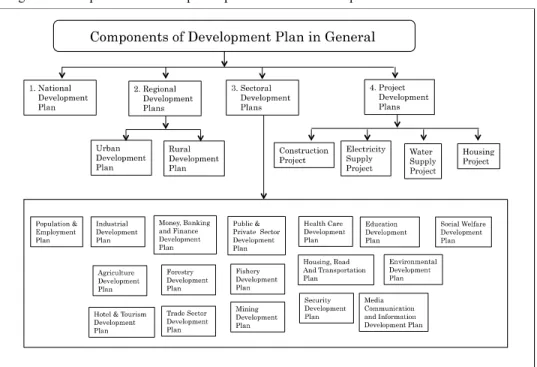
Controlling country’s economy by a central government to achieve predetermined targets is generally known as centralized planning. In the socialist centralized planned economies, major industry, business, trade, agriculture land, telecommunication, transportation, schools, universities, hospitals, electricity, and water supply are owned and operated by the state or public sector. Accordingly, plan formulation, target setting, coordination, management, decision and policy making, and implementation are done by central government through top down hierarchical administrative process. Moreover, central government also decides and controls the budget, finance, policy formulation, and enacting laws, rules and regulations for plan implementation. Market mechanism is replaced by decision of command authorities. The components of planning under centralized controlled economies are very comprehensive as depicted in diagram (2). There are also many historical evidences and finding that the government authorities of centralized controlled economies have overconfidence in implementation of development plans although they do not have appropriate data, information, budget and executing capacity.
In contrast, planning procedure and process are highly decentralized and manage and operate through bottom up approach in capitalist free market and mixed economies. Plans are not also comprehensive and almost all the production, consumption, saving, investment, trade and services activities are managed and operated by private sector through government’s broad guide lines and market mechanism. The deliberate governments’ initiative and guidance, support and the market play an important role in these economies. All levels of government authorities, investors, producers, and consumers are associated each other through government’s broad guide lines and market demand and supply forces. Establishing planning agency and its related departments and organization is very important in which all the office personals are participating under the flexible way of sharing power and responsibility for having clear and desirable plan objectives, targets and policy measures. In other words, decentralized planning is the process of careful investigating and organizing in policy formulation and decision making through flexible way of administration, management, cooperation, adjustment and monitoring in order to achieve predetermined objective, goal and target leading to the progress of socio-economic wellbeing of the people.
7
Diagram 2. Components of development plan under centralized planned economies
Source: Author’s image diagram based on his development economics lectures at the Graduate School of Economics, Kumamoto Gakuen University, Japan (1995-2018).
The main differences between centralized and decentralized planning are extent of plan’s comprehensiveness and degree of control and flexibility during the process of plan formulation, target setting, policy formulation, coordination, monitoring and implementation. Therefore, command
economies are centralized planned economies, but not all the planned economies are command or centralized planned economies.
The criticisms on centralized planning argue that planners usually do not aware enough the really situation of consumer preference, the nature of wages, price, money supply and inflation, shortage and surplus of good and services, and market signal. Inaccurate information and statistical data, and over centralization of socialist planned economies usually led to the miss economic management and decision and policy making, and then finally the failure of plans in practice. On the other hand, proponents of economic planning argue that uncontrolled market economies usually faced with the fluctuation of prices, inflation, high rate of unemployment, economic stagnation and social problems. Market signal alone cannot gear and operate the principle tasks for achieving national objectives and goals. But, it is important to notice that there is no country in which market forces alone operate. In
8
other word, there is no completely planned and completely unplanned economy in the real world. For example, in economically developed capitalist free market economies of United Kingdom, French, United States of America and Japan, the role of governments and broadly based highly decentralized plans (indicative plan) are playing important role to achieve stable prices, employment, income, inflation, deflation and sustained economic growth. Moreover, the timely formulation and operation of fiscal, monetary and budget policies by the government and central bank have been playing major role in economically developed free market economies.
3. Importance of Decentralized Plans and Deliberate Government’s Intervention
(a) Decentralization reforms in retrospect:
The concept of decentralization is mainly based on two schools of thought, “territorial decentralization” and “divisional decentralization”. The “territorial decentralization” generally involves the delegation of power to lower levels in a territorial hierarchy and “divisional decentralization” mainly concerns with the delegation of power from center to other lower levels within or outside of the organizational hierarchy. If the power decentralization in political, administration, and economic affairs still concentrated in the center with only very limited power delegated to the lower authorities, there will be no genuine decentralization. Therefore, only the existence of central authority and many types of lower level authorities such as, regions, states, townships, cities, village wards and village tracts in a ruling government does not mean real existence of decentralization. This means that the power of the government authorities is required to divide into various lower levels or units and each of it must possess certain degree of autonomy in decision making and administration which directly address the practicing of delegating of budgetary control, responsibility, and work sharing. Decentralization measures can be found as deregulation of public sector, contracting out, privatization, corporatizations within the framework of jurisdictions.
Decentralization of political and economic management especially in public sector administration has become worldwide phenomenon in both developed and developing countries especially after 1990. The United Kingdom, one of the developed capitalist free market economies, enhanced the continuous decentralization reforms in public sector administration since 1979 and then in 1988 and 1993. Similar style of decentralizations in public administration were also taken placed in United States in 1979 and New Zealand in 1988. These decentralization reforms in capitalist market economies were followed by economic and administrative reforms as well as plan to market reform of transitional economies of
9
Russia, newly independent states of former Soviet Union, Eastern Europe and Asia of early 1990s4. This
transition from centralized plan to market in these countries could lead to the fundamental political and economic change in the world economy as these transitional economies have occupied about one-third of world population. The USA centric and Euro focus world economy has gradually diverted to economies of Asia Pacific Region comprising Japan, Korea, Singapore, Taiwan, Hongkong, Thailand, Malaysia, China, Vietnam and recently Myanmar. The countries of China, Laos, Myanmar and Vietnam were known as Transitional Economies of Asia (TEAs) during 1990s. As in other TEAs Myanmar also began to introduce market-oriented policy measures and administrative reforms since early 1990s. The reform strategy applied in Myanmar during that period was piece-meal approach rather than the regular and all out approaches strategy5. However, political power as well as almost all the important industry,
business, banking, trade, telecommunication, transportation, construction and services economic activities etc. were under the control of military government. As a result, although the centralized control system was abolished, the strong centralized control behaviors and actions remained unchanged in Myanmar throughout the period from 1990 to March 2016.
(b) Why do we need an appropriate blend of plan, market and government?
If we could know first where we are, and whither we are tending, we could better judge what to do, and how to do it (Abraham Lincoln). Decentralized development plans can clearly provide the important information stated by Lincoln. First, development plans investigate the real socioeconomic situation of the country (where we are); second, sets the targets towards goal and objectives (whither we are tending); third, find the ways and means, and policy measures (better judge what to do and how to do it); finally, implement the plan to achieve macro targets, goals and objectives. But, only the decentralized development plans which formulate and implement under deliberate government initiative and guidance through market mechanism could lead to most direct and effective way of correcting market failures and overcoming major obstacles to development. Moreover, for achieving sustainable development under market-oriented economies through the application of decentralized plan, governments of these countries must equip the “appropriate development management capability”.
The people in many developing countries who have had severe bitter experiences from both of centralized controlled and decentralized plans, still do not believe much the importance of any type of development plan for applying as a mean of improving their daily socioeconomic lives. This leads to mystique of planning and less confidence of ordinary people in development planning. However, market situations in these countries are imperfect and sometimes distorted. Therefore, it is difficult to achieve
10
national objectives and goals through market forces alone or without plan and deliberate government’s intervention. Accordingly, an appropriate blend of “plan, market and government intervention” or formulation and implementation of hybrid type decentralized plans are required in market-oriented economies.
Regarding economy of Myanmar, as in other developing countries of Asia and Indochina, its private sector still does not have capacity to take the major role for achieving national objectives and welfare of the society. Myanmar’s private industries and business activities are also still lacking the “spirit of
social entrepreneur and social business” which contribute socioeconomic benefits to the country
simultaneously with profit earning. Therefore, democratic government of Myanmar is still responsible to provide broad guidelines and targets as well as initiative and support to both private and public sector enterprises. But, it is required to formulate and implement the development plans through broadly based decentralized guide lines, management, monitoring and coordination in order to enhance free and fair competition, transparency, accountability, responsibility taking and work sharing.
It is the real fact that there is no viable alternative to a market economy, a real place for the progress of industry, business, and trade, as well as peoples’ employment and income. For correcting short-term market failures, deliberate government intervention is appropriate enough. But, for achieving long term national socioeconomic objectives and goals as well as balanced regional, urban and rural development, the broadly-based decentralized long-term development plan is required. Economic plan lovers advocate that free market mechanism can lead to unstable saving, investment, production, consumption, distribution, price, employment, income as well as finally to unbalanced, unshared and fluctuated economic growth. Therefore, a hybrid (plan–market-government) style of national economic management and administration is required. It is needless to repeat again that plan alone or market mechanism alone cannot function effectively for the fruitful progress of peoples’ social and economic wellbeing. Accordingly, appropriate government intervention is also extremely required. But, the governments of developing market-oriented economies must have development management capability which enable to manage the current and expected forthcoming obstacles to development as well as maintain peace and stability and improve peoples’ employment and income.
3. The Importance of Governments’ Capability
As discussed above, plan and market alone cannot achieve predetermined expected results especially such as, (1) national vision, objective and goal (2) building democratic society (3) balancing peace and
11
sustained economic growth (4) transforming public sector dominated to private sector led economy (5) balanced and proportionate development among region and states, between urban and rural areas and between capital and local cities (6) reducing chronic income differential and poverty (7) improving daily socioeconomic life of people through generating employment and income opportunities, and (8) preserving natural environment, traditional life style, culture and values. Generally, the governments who have appropriate development management capability can govern and manage the country and economy to achieve all these above mentioned predetermined expected results with the help of decentralized development plan and market.
Development management capability of government6(DMCG) is the ability of government in
governing and maintaining political stability, peace and economic growth through accountable and transparent ways. Moreover, it also refers to the ability of government in managing improvement of socio-economic wellbeing of the people through the sustained growth of the employment and income opportunities. But, without the existence of democratic way of political and economic management7, it could not achieve the sustainable development
(Lwin 2007). Usually, capable governments have appropriate development management capability and can use its ability effectively. A government may be capable but not very effective, if its capability is not used in peoples’ or society’s interest. Effectiveness is a result of using that capability to meet peoples’ needs (World Bank 1997). The major government actions for society interest comprise restoration of peace, law and order as well as promoting public health, education, socioeconomic infrastructures and employment and income opportunities. The most remarkable and important characteristics of DMCG, generally found in many developing countries like Myanmar are depicted in diagram (3).
Capacity of national development refers to the ability of a nation to maintain the peace and improvement of socioeconomic wellbeing of the people. The both of government (ruling party and against parties) and the people are responsible for building nation peace and development. The growth of social entrepreneurs as well as healthy and educated middle class can be considered as engine of national economic growth. Because, educated, healthy and hard-working middle class have appropriate way of thinking and cultural values that usually go well with rapidly changing globalization and internationalization process. Moreover, the growth of middle class also makes possible for the country to take full advantage for nation building through the progress of industry, business, trade, science and technology.
12
Diagram 3, Development Management Capability of Government
Source: Author’s image diagram based on his development economics lectures at the Graduate School of Economics, Kumamoto Gakuen University, Japan (1995-2018).
4. Planning Practices in Some Selected Countries
United States of America: USA introduced economic planning since during the First World War to manage properly the food, fuel, railways and war industries. The similar system of planning was also used during the Second World War to handle the stagger economic growth. From the Cold War period to present, US Federal Government has directed a remarkable amount of investment and funding for research and development, and progress of technology which could lead to the development of laser technology, nanotechnology, telecommunications, internet, software and computers. The deliberate government action, support and guidance has been playing important role in process of USA history of economic development. Accordingly, US economy is also known as “state capitalism” or a capitalist
market economy led by the state or government.
Japan: Japan is known as one of the most industrialized and developed capitalist free market
economies of the world. Economic Planning Agency (EPA) of Japan is famous for conducting business and industrial survey and research, and providing economic planning policies to the government in
1. Keeping Peace and Tranquility in a Democratic Way 2. Building Democracy and Freedom in Political and Economic Management 4. Eradication of Public Sector Corruption 3. Having Accountability and Transparency in Political and Economic Management 5. Having Free and Fair Competition in Business, Industry and Trade, and
Macro-Economic Stability
Myanmar is trying to improve all these characteristics Characteristics of Appropriate Development Management
Capability of Government (ADMCG)
13
order to stabilize the economy and promote the daily lives of the people. The EPA is also drafting and promoting long-term economic policies, dictating and announcing annual policy, and investigating the domestic and foreign economic trends and the national income. Japan does not have propaganda type comprehensive national, regional, urban and rural development plans as in socialist economies of before 1990s. But, Japan has been producing inter-industry table every five year for monitoring national and regional development since 1955. In 1990s, almost all the prefectures of Japan prepared their own inter-industry tables for managing changes in socioeconomic structure, demand and supply, price structure, repercussion effect of economic activities, inter-regional linkages and employment generation effect.
Inter-industry tables are constructing not only by central and regional governments but also by private organizations, research centers and universities. Regarding regional and of development of Japan, the initiatives of United Nations Center for Regional Development (UNCRD) is remarkable. The main office of UNCRD was established in 1975 at Nagoya City and it has been playing important role in regional and urban development planning of Japan. UNCRD is also providing regional and urban development training and skill programs to the people from developing countries8.
Malaysia, Korea and Singapore: The successful semi-developed countries of Asia used various degrees of economic planning and state-directed investment. It was known as “state development capitalism” or “East Asian Model” since during 1980s. The mixed economies of Malaysia and South Korea introduced a series of macroeconomic plans for the rapid development of industrialization. A free market economy of Singapore was also partly used economic planning initiated by the government. Cambodia, China, Laos, and Vietnam: Most of the today’s developing countries belong to mixed economies which are also known as “transitional economies” and “market-oriented economies” especially after 1990. In these countries, education, healthcare, transportation, electricity and important industrial enterprises are still owned and operated by public sector although they are actively introducing various degrees of market, plan, privatization and decentralization measures. For example, former communist economies of Cambodia, China, Laos, and Vietnam and have been introducing market-oriented policy measures since early 1990s to present. Moreover, these countries allowed the private sector to established and operate even the universities, hospital and research center by passing laws and regulations since early 2000s9. Unfortunately, Myanmar is still far behind from these countries
especially in education and research, although it also introduced market-oriented policy measure at the
14
same time. Among them China, Vietnam and Laos are recognized as “socialist market economies of Asia” although they are still under the communist political regimes. Therefore, it is better judge that
“decentralized plan, market and the government” have been playing an increasing important role in
today’s developing economies of the world.
5. Myanmar’s Past Planning Experiences:
Myanmar, a country of Southeast Asia, has the different political and economic background and experiences from that of others10. For example, it has six different of political, economic, and
administrative experiencesviz. (i) free market economy under British rule (1885-1948), (ii) free market economy under democratic civilian government (1948-1962), (iii) centralized planned economy under socialist military government (1962-1988), (iv) semi-market economy under military government (1988-2010), (v) market economy (market-oriented) under military backed government (2010- March 2016), and finally (vi) market economy (market-oriented) under civilian democratic government (April 2016 to present). Because of the strong socialistic character of the civilian government after
Diagram 4, Type of economic systems and governments in Myanmar
Source: Author’s image diagram based on his development economics lectures at the Graduate School of Economics, Kumamoto Gakuen University, Japan (1995-2018).
15
independence (1948-1962), all the newly established important industries were public owned. Moreover, in 1962, immediate after took over power of socialist military government, all the private and foreign own industries and business activities were nationalized and put under centralized control of military generals and high-ranking officials. After the collapsed of this socialist military government in 1988, the new generation of military general who had more capitalistic market-oriented ideas introduced the piece meal approach reforms measures which mainly comprised privation of public industries and partly application of market signals11. But, the industries and businesses were owned and operated by army
and their relatives and cronies during the whole period from 1988 to March 2016. Therefore, there was no free and fair competition in doing business in Myanmar. In short, Myanmar has had the long experiences of economic planning under market economy and centralized controlled economy during the period between 1948 and 2016. Currently, the formulation of long-term Myanmar Sustainable Development Plan (MSDP) is in progress. The various type of economic systems and governments of Myanmar (1948-2017) is depicted in diagram (4).
5-1. The main features and causes of plan failure (1948-1962)
Myanmar had three major development plans during 1948 and 1988 viz. (1) Two-year Plan (1949/50-1950-51), (2) Eight-year Plan (1952-1959), and (3) Twenty-year Plan (1974/75-1993/94). The major development plans of Myanmar and its objectives are depicted in diagram (5). However, this section 5-1, will discuss only the Two-year and Eight-year Plan regarding their main features and the causes of plans failures.
(a) The Two-year Plan was announced in April 1948 as a first attempt of economic pinning in Myanmar.
This plan, not a full fledge one, was formulated by National Planning Board within two months period basing on the expectation of achieving plan targets within two years. The main objective of this plan was rehabilitation of country economy to prewar level by 1950/51. The plan was never implemented as schedule mainly due to the lack of budget and out broke of nationwide insurgency problems. We can summarize the main causes of plan failures as follows.
(1) Lack of accurate statistics and information for plan formulation,
(2) Poor knowledge and experience of economic planning and managing economy, (3) Shortage of budget for plan implementation,
(4) Over confidence in plan target setting and implementation, (5) Failure in maintaining peace and law and order restoration, and
16 (6) poor capability of balancing peace and economic growth.
(b) The Eight-year Plan was formulated by American engineers and economists from Knappen Tipped Abbett Engineering Co. and also known as KTA plan in Myanmar. The Eight-year plan had the objective of doubling the country’s real GDP by 1959/60. But, the plan was abandoned in 1955 and substituted by a Four-year plan (1956/57-1959/60).
This Four-year plan was not also implemented fully due to the lack of peace and tranquility during plan period. It is widely accepted that the failure of two development
plans of civilian government under free market economy was mainly because of civil war and social unrest throughout the period from 1948 to 1962. For example, the Care Taker Military Government staged a coup in 1958 and took the political power in 1962. It is also widely recognized that the lack of political consensus among political leaders was the major cause of transfer of political power to military generals who could have chance to governed Myanmar from 1962 to March 2016. We can summarize the causes of eight-year plan’s failure as follows:
Diagram 5, Myanmar’s major development plans and its objectives
Source: Author’s image diagram based on U Thet Tun (1959), Hal Hill and S. Jayasuriya (1986), Mya Than (1996) and Myat Thein (2006)
Eight Year Plan(Pyi Taw Thar Plan)1952
-59
17
Diagram 6. Main features of development plans under democratic civilian government
Source: Author’s image diagram based on U Thet Tun (1959) and Myat Thein (2006).
Diagram 7. Main causes of plan failure under democratic civilian government
Source: Author’s image diagram based on U Thet Tun (1959) and Myat Thein (2006).
Planning Board within two months period
taker government from 1958 to 1960.
18
(1) Shortage of foreign exchange due to decline in world rice price, (2) Poor experiences on world rice market,
(3) Poor plan organization, administration, and supervision, (4) Shortage of budget for plan implementation
(5) Relative neglect of agriculture sector and primary industries, (6) Failure in maintaining peace, and law and order restoration, (7) Lack of political consensus among political leaders
(8) Poor capability in balancing peace and economic growth
The main features and causes of failures of Two-year Plan and Eight-year Plan under the civilian democratic government (1948-1962) are depicted in diagram (6) and (7).
5-2. The main features and causes of plan failure (1962-1988)
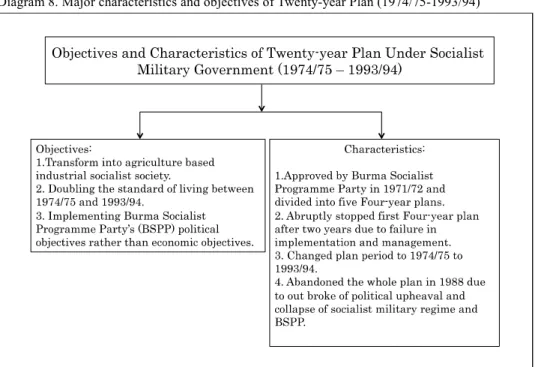
The Twenty-year Long-term plan (1974/75-1993/94) was approved by the Burma Socialist Programme Party (BSPP) in 1971/72 and divided into five Four-year plans. The first Four-year plan (1971/72-1975/76) was abruptly stopped after two year due to failure in plan implementation, management and administration. Then, changed the plan period to (1974/75 -1993-94). The Twenty-year plan had three main objectives, (1) Transform the country economy from agriculture to agriculture based industrial society,
(2) Doubling the peoples’ standard of living by 1993/94, and (3) Implementing the Burma Socialist Programme Party objectives. The main features and objectives of Twenty-ear plan are depicted in diagram (8).
19
Diagram 8. Major characteristics and objectives of Twenty-year Plan (1974/75-1993/94)
Source: Author’s image diagram based on Ministry of Planning and Finance (1991), Mya Than (1996) and Myat Thein (2006).
It would be appropriate to summarize and categorize the main causes of failure into political and economic factors as follows:
(a) Causes of plan failure related to political factors:
(1) Over confidence of BSPP political leaders
(2) Poor capability of government in policy formulation, plan coordination, monitoring and implementation,
(3) Over centralization, control and top-down process in policy and decision making, (4) Over emphasis on political objectives rather economic objectives,
(5) Lack of administrative reforms for correcting chronic abuse of political power and nationwide public sector corruption,
(6) Lack of ability in maintaining peace and restoration of law and order in a democratic way
(b) Causes of plan failure related to economic factors:
(1) Lack of appropriate knowledge on real socioeconomic condition of the country,
20 (2) Insufficient budget for plan implementation, (3) overvalued exchange rate system,
(4) Distorted price and wage structure, (5) Neglect of market forces and private sector
(6) Less priority given to agriculture sector and progress of rice production (7) Lack of transparency and accountability in economic management, (8) Mismanagement in state owned economic enterprises
(9) Lack of free and fair competition in industry, business and trade
(10) Lack of market friendly economic environment for domestic and foreign investors (11) Lack of economic reforms to correct distorted wage, price and over value exchange rate (12) Chronic commodity shortage, inflation and severe peoples’ daily lives
In short, the main cause of plan failure under socialist military government was the long lasted severe economic problems throughout the years from 1962 to 198811. The failure of achieving expected plan
targets led to the problems of unstable economic growth, increasing unemployment, high inflation rate, and severe shortage of daily use commodities supply. These unmanageable problems finally led to the collapse of socialist military government and abandon the centralized controlled twenty-year plan of Myanmar in 1988.
5-3. The main features and causes of plan failure (2010-2015)
The National Comprehensive Development Plan (NCDP), a twenty-year long-term plan (2010-2030), was formulated and implemented under military backed former general President U Thein Sein Government (TSG). This long-term development plan was divided into four medium-term five-year plans as follows:
(1) First five –year plan (2010-2015), (2) Second five –year plan (2015-2020), (3) Third five –year plan (2020-2025), and (4) Fourth five –year plan (2025-2030).
The main objective of the NCDP was provision of general and specific guidelines for (a) road map (b) planning framework (c) policy formulation, and (d) investment decisions by setting priority directions, long-term goals, and broad strategies. This objective intended to help diversity as well as deepen and
21
accelerate the sustainable development of Myanmar. The two long term goals of the plan were (1) to build a growing, diversified and sustainable economy and (2) to ensure the “inclusive growth and development” is people centered. Moreover, the seven strategies of the plan had strongly addressed the building and strengthening administrative system and government organization, strengthening economic environment and well footed business enterprises, expansion of domestic and foreign trade routes, encouraging economic sectors which have international competitive strength, developing domestic economic potential, promoting human resource development and reducing poverty, and preserving and protecting natural environment. The NCDP under TSG had also deliberately examined the stages of reforms, expected outcomes and scenario. These reforms, outcomes and scenarios can be summarized as follows:
Four stages of reforms:
(1) First stage reform focuses on political and governance change for achieving peace and national unity.
(2) Second stage reform focuses on economic and social development towards achieving Myanmar as a developed nation which integrated into the global economic community.
(3) Third stage reform focuses on transformation of public administration. (4) Fourth stage reform focuses on private sector development.
Four numerical expected outcomes:
The Twenty-year long-term development plan has four numerical expected outcomes viz. (1) Average GDP per capita growth of 7.2% during 2010 and 2030,
(2) FDI inflows of $ 8 billion per annum by 2021, (3) GDP potential of $ 180 billion by 2030, and
(4) middle income country status with a GDP per capita of $ 3,000 by 2030. Growth scenario (Per capita GDP, (US$ current) and growth rates)
(1) End of first five –year plan (2010-2015) High: $ 1,088, (9.1%)
Medium: $ 1,052, (7.2%) Low: $ 1,003, (4.7%)
(2) End of second five-year- plan (2015-2020) High: $ 1,679, (9.1%)
Medium: $ 1,491, (7.2%)
22 Low: $ 1,262, (4.7%)
(3) End of third five-year plan (2010-2025) High: $ 2,590, (9.1%)
Medium: $ 2114, (7.2%) Low: $ 1,588, (4.7%)
(4) End of fourth five –year plan (2025-2030) High: $ 3,997, (9.1%)
Medium: $ 2,998, (7.2%) Low: $ 1,998, (4.7%)
If we evaluate the NCDP under TSG compared to past development plans of Myanmar, (1) vision and strategy (2) theoretical contents (3) major policies and guide lines (4) formulation (5) target setting, (6) stages of reform, outcomes, scenario, and (7) consistency, and feasibility are quite impressive. Because, it has obvious democratic and people centered approach and characteristics compared to Twenty-year long-term plan of socialist military government under BSPP. The broadly-based visions and its followed-up policies and targeted expected growth rates were also seemed relevant. For example, country’s stages of economic growth and expected growth of peoples’ per capita income were basing on the well-known broad international guidelines or growth steps of LDC graduation through achieving MDGs and SDGs, after that catching up the level of ASEAN and then the world standard. The expected outcomes related to average GDP growth rate (2015 ~ 2021), GDP per capita (2010), size of potential total GDP (2030), FDI inflow (2021) as well as growth scenario related to GDP per capita and growth rate for first to fourth five-year plans were also at the acceptable level. For building successful export led growth economy, consideration of comparative advantage through domestic, regional and global network approaches, Yangon-Mandalay growth pole strategy, North-south economic corridor, East-west economic corridor, North-east economic corridor, and Yangon-Myawady economic corridor were also impressive.
However, unfortunately, it is needless to emphasize that NCDP under PTSG (2010~March 2016) was still strongly characterized by military (Tatmataw) style centralized control hierarchical way of plan management, operation, implementation, and corrupted actions12. Moreover, this third development plan
of Myanmar under PTSG was also abandon as past two development plans of Eight-year and Twenty-year plans, because of transfer of political power to civilian democratic government in April
23 2016, due to 2015 general election result.
6. Myanmar Sustainable Development Plan (MSDP)
The fourth long-term development plan of Myanmar has been the MSDP of present democratic
government. This plan has 3 pillors,5 goals, 28 strategies, 238 action plans.
But, the plan is still under the drafting stage and not widely known by domestic and foreign scholars regarding plan period, predetermined investment, saving, ICOR, FDI, GDP growth rates, as well as export, import, sectoral and regional targets. As discussed in previous sections, Myanmar’s first development was formulated and implemented by civilian democratic government after the independence known as Eight Year Plan or KTA Plan or Pyi Taw Thar Plan. The second development was under the socialist military government and the third, NCDP was under the military backed TSG. Unfortunately, all these past development plans were abandoned mainly due to uncontrollable political instability and severe peoples’ daily socioeconomic decline which led to collapse of ruling government and transfer of political power. Nobody will deny that present MSDP should carefully reexamine and learn valuable lessons from the past planning experiences, especially the main causes of plan failures in order not to repeat again the past mistakes. All the past development plans and present MSDPD have one common objective, that is building industrially developed peaceful high-income nation or building a sustainable peaceful, healthy, happy and wealthy nation although these plans have different catch phrases13. Due to author’s limited knowledge and difficulties of obtaining official information and
statistics on present MSDP, it is impossible to examine and made critical comments as well as suggestions. However, this paper attempts to provide some important suggestion based on the Myanmar’s past plan experiences and lessons from the broadly-based decentralized development plan of developed free market economies and high performing market-oriented economies of Asia.
6.1. Suggestions for Myanmar’s Sustainable Development Plan (MSDP)
As discussed above, one third of world population already have had the bitter experiences of centralized planning experiences for about six decades. Therefore, these countries are actively trying to introduce decentralization reform measure since early 1990s. This worldwide phenomenon has been known as transformation from “plan to market” and “centralized control plan to decentralized plan”. But, many of developing market-oriented economies still have strong centralized attitude, behaviors and actions, consciously or unconsciously, in administration and managing countries’ economy. Probably,
24
this is mainly due to legacy of paternalistic way of governance or legacy of centralized planning. Myanmar is no exception. Generally, most of the new governments of developing countries, democratic or nondemocratic, are usually abolish or neglect the former governments’ development plans, easily. Finding the possibility of making amendment, revision and modification of the governments’ previous plans, if possible, is much better than the easy abolishment. The abolishment and neglect of previous long-term development plans, which is still at the ongoing stage, is a kind of wasting countries’ scarce financial and manpower resources, and valuable time. Because, formulation of development plan usually takes time as well as needs huge budget and manpower. Therefore, the planning experts and responsible authorities should study to analyze and evaluate thoroughly the past development plans regarding vision, objective, organizational structure, planning technique and procedure, budget and finance, causes of failure and success, before the formulation of new development plans. This is the arts of development planning and all the planning experts follow this rule.
Importance of medium-term plan period: The plan period, long-term development plans, such as
twenty-year, are better to divide into five four-year plans. Suggesting a shorter plan period of four years rather than five years has two reasons (i) shorter medium plan period has flexibility to correct, adjust and revise and can have less impact on the whole long-term plan when plan faces with the problem of abolition and (ii) possible to avoid overlapping problem related to end years of the medium-term plans and election years. There are many evidences that the nationwide election campaigns and elections create unexpected negative impacts on plan operations and performances if the end years of plans and election years are overlapped. It is the real situation that many developing countries could not implement fully their long-term development plans and had to decide making critical amendments, changing medium plan period and plan abolition due to political instability and severe economic stagnation. Myanmar already have had these bitter plan experiences.
Importance of enhancing decentralized behavior and action: In order to implement successfully the
MSDP’s predetermined objective and targets Myanmar’s central planning authorities have to avoid and reduce the over centralized control actions towards lower level authorities for the process of policy formulation and decision making, and operation. And, the lower authorities are also needed to understand that decentralization of authorities under market-oriented economy means sharing power on the one hand and but also the sharing work and responsibility hierarchically on the other. The all level of authorities should always keep in mind that all the individuals are managing the country’s economy in a decentralized democratic way rather than centralized control and military style of managing
25
economy through market mechanism. If the economy does not perform as expected or if invisible hand does not work properly, government intervention which is deliberate guidance, initiative, monitoring and control should be taken place timely with the help of economic instruments and market signal. In order to avoid the bitter experiences of past centralized plans and to overcome the present and forthcoming obstacles to sustained economic growth, effective decentralized behaviors and actions of government authorities are extremely important. Today’s developing countries, including Myanmar, should have “Decentralization and Administrative Reform Committee” in all ministries in order to create speedy, smooth and effective administration and management environment.
MSDP should also be considered the following suggested points which is trying to base on the decentralized planning practices and ideas.
1. MSDP predetermined fundamental objectives, goals and targets must be in lined with the National long-term political and economic vision, objectives and goals,
2. As a step by step approach development strategy of MSDP, graduation from LDC by achieving UNDP graduation thresholds of per capita GNI, Human Asset Index (HAI) and Economic Vulnerability Index (EVI) should be given first priority then attempt to achieve basic international goals (UNDP Sustainable Development Goals, SDGs) and then again to catch up the socioeconomic level of Southeast Asia countries (CLMV and ASEAN average),
3. As long-term political and economic objective, MSDP should have road map and clear strategy for (1) Transforming from public sector dominated economy to private sector led economy, (2) Building market friendly political and economic environment through administrative and economic reform measures for achieving stable progress of employment and income opportunities, and (3) Maintaining balance between peace and economic growth in line with the building federal democratic country, 4. Specific policies of MSDP should be address the (1) Reducing country’s regional differences in
physical infrastructure and socioeconomic opportunities, (2) Provision of microcredit, training and supporting policy measures for graduation of huge informal sector economic activities (or) formalization of microenterprises14 (3) Provision of education, healthcare and social welfare facilities,
training and skill development program, employment and income opportunities, quality living environment and security for human resource development, building capacity of nation, and gradual reduction of chronic poverty towards sustainable development.
5. More specifically, (1) Provision of required budget, human resource and capacity building programs
26
for MSDP formulation and implementation, (2) Application of monetary, fiscal, budget, and exchange rate policy measures for maintaining stable investment, production, employment, wage and price, and (3) Formation of decentralization and administrative reform committee in order to have speedy and smooth and efficient running for routine works of ministries and departments should be considered seriously as important integral parts of MSDP.
It is likely remained centralized controlled attitudes and behaviors in managing national, regional and sectorial economic affairs of Myanmar. Generally, in many developing countries, policy formulation and decision making authorities are still practicing centralized controlled attitudes and behaviors on the one hand and the lower level authorities are also still waiting detail guidance from above on the other as in the past. Probably, centralized control and the paternalistic way of managing economy is still alive. Moreover, if central governments take care and take responsibility too much everything for the development of their regions and states, these regions and states cannot achieve self-sustained strength and sustainable development properly. Asa result, the central government can be also faced with the chronic problem of shortage and allocation of scarce national budget.
Concluding remarks:
Myanmar is known as the last economic frontier of Southeast Asia and it needs broadly based decentralized development plan rather than centralized controlled plan to step forward into the higher stages of economic growth with well-footed strength. In order to manage her present economic situations for further progress and then for achieving stable and high economic growth, deliberate government’s initiative and guidance are extremely important with the help of plan and market. Currently, the formulation of National Sustainable Development Plan (NSDP) of two and a half years old civilian democratic government is in progress. Therefore, it is impossible to investigate and evaluate the contents and features of NSDP as well as the extent of its decentralized attitude and actions. However, it is likely true that the present Myanmar’s style of administration and economic management still has attitudes and behavior of centralization and control, although it is not sure whether consciously or unconsciously.
Moreover, it has been a real fact that today’s developing countries’ governments still have the characteristics of paternalistic ways of governance. Probably, Myanmar also have quite similar situation and characteristics. Moreover, generally, most of the high-ranking authorities rarely notice their attitude,
27
behavior and action which are tending towards centralization and control although they are frequently using the word “decentralization”. As a result, all these governments of developing countries have been facing problems of daily administrative and management rigidities. Due to the lack of effective decentralization of budget, political power, doing business, taxation, education and health care, and economic freedom and rights in regions, states, local cities and villages, all the central governments are facing with the chronic problems of shortage and allocation national budget. In order to solve the chronic difficulties in administration and economic management, the author usually suggests as a joke that developing countries’ high-ranking government authorities should install the transparency, accountability, integrity, predictability, and decentralization software package into their brains, if possible.
In order to implement MSDP successfully (a) introducing decentralization measures in administration and management of public and private sectors without neglecting the political implications (b) establishing decentralization and public sector reform committee, and more importantly, (c) finding an appropriate way of enhancing reconciliation between Tatmataw (army) and the people as well as between strong opposition party and ruling party are required. Moreover, Myanmar should learn experiences of handling plan and market not only from the developed market economies and high performing market economies of Asia but also especially from her past bitter planning experiences. However, the most challenging task of Myanmar would be the maintaining peace and tranquility, balancing peace and progress of employment and income opportunities, and macroeconomic stability in a democratic way.
It is impossible to find a country without having any kind of economic plan or development plan in the world. As stated above, after suffering bitter experiences of chronic and severe poor daily life of the people under centralized control planning system, almost all the former socialist planned economies have been actively introducing the market, decentralized plan and deliberate government intervention since early 1990s. A development plan which bases on three pillars viz. “Government, Market and
Decentralization” should be labeled as “Hybrid Type Sustainable Decentralized Development Plan”.
This paper attempted to provide the nature and importance of decentralized development plan, Myanmar’s past planning experiences comprising characteristics of plans and causes of failure, and suggestions for the present MSDP. The author also strongly express that the success of development plans which is a unique blend of “deliberate government intervention, market signal and
decentralization measures” solely relies on “development management capability of governments”.
28
Accordingly, this study has given weight on the importance of strengthening capacity of government authorities and their staff. Therefore, the provisions of education, healthcare, social welfare and training opportunities as well as skilled development programs which enables to recruit high quality human resources should be considered as most fundamental and effective way of building government’s capacity. It is hope that this study would provide applicable some suggested hints and guidelines for the formulation and implementation of Myanmar Sustainable Development Plan which has an objectives of building Myanmar to become one of the wealthy and peaceful nations in the world.
Notes:
1. The concept of internationalization and globalization refers to Lwin’s development lecture outlines and syllabus on Global Human Resource Development 2017, Faculty of Economics, Kumamoto Gakuen University, Japan.
2. Regarding nature and type of development planning, please see in Todaro, M.P., (1992), pp. 415-434.
3. For three types of economic planning under different economic system, please also see in Todaro, M.P. (1992).
4. Regarding transition from plan to market economy in the countries of Eastern Europe, please see in Paul Marer and Salvatore Zecchini (1991), pp.57-100.
(http://wwww.preservedarticles.com/2012031427260/what-is-decentralized-planning.html
5. Regarding detail explanation of economic reform strategies namely, piece meal approach, all out approach and regular approach as well as failure of economic reform in Myanmar, please see in (Lwin 2000).
6. Regarding the nature, concept and importance of development management capability of government please see in The Role of Government and Its Development Management Capability: (A Master Key for Political Stability and Sustainable Development of Myanmar), Lwin 2016. 7. For quantitative approach, human rights approach, and development approach to democracy please
see (a) A simultaneous-equation approach to democracy, stability and growth can be seen in Feng Yi (2003), pp. 93-122. (b) Regarding human rights abuse and violations in Burma, please see in Sein Win (2001), pp 113-122. (c) Debates on democracy and development, and perspective, please see in Georg Sorensen (1993), pp 68-85.
29
8. UNCRD, which was established in 1971 based on an agreement between the Government of Japan and the United Nations, strive to promote sustainable regional development in with a focus on development planning and management in the context of globalization and decentralization trends, and the growing concern towards global environmental issues and their impacts. UNCRD is also organizing inter-institutional workshops, inter-municipal workshops, training program, endogenous regional development through community initiatives. (http://www.uncrd.or.jp/ February 17, 2017)
9. For example, even in the field of education, China, Vietnam and Cambodia have passed the laws and regulation for establishing private universities, research centers, training schools and language centers, since early 2000s. Japan has many old private universities in which some are more than 70 years old. According to 2016 data, Japan had 781 universities in which 603 (77.2%) was private owned as well as it had 2.9 million university students in which 2.1 million (73.4%) was private students. The provision of economic and political environments for free and fair competition between public and private educational institutions have successfully led not only to the progress of quality and competitive strength between private and public universities but also could reduce the government’s huge budget burden for education expenditure. Needless to point that the government’s deliberate initiative, guidance and support through passing appropriate laws, rules and regulations have been playing in major role in administration and promoting quality of universities. These laws and regulation are mainly concerned with university capacity and newly recruited number of students, entrance exam, curriculum, syllabus, school fees, active and experience learning programs, e-learning and digitalization, international exchange and internship program, job search, student service and campus life. In Japan, recently, all the private and public universities must announce their concrete admission policy, curriculum policy and diploma policy. But, unfortunately, Myanmar is still lacking effective reform measures, especially for the development of university education and research.
10. Development of political economy of Myanmar since after the independence may broadly be classified into three periods: the institutional period, 1948-62; the Revolutionary Government, 1962-73; and the subsequent period which might be termed as ”Pragmatic Authoritarian Socialism”, Hal Hill and Sisira Jayasuriya 1986. p.8.
11. Regarding more detail on “From Centrally Planned to Market Economy in Myanmar”, please see in
30 U Tun Wai (1996).
12. Regarding chronic poor economic performance, especially for detail sectoral study on vision, strategy and the role of government in Myanmar, please see in Khin Maung Kyi, Findlay, R, et al. (2000). Economic Development of Burma: A Vision and A Strategy.
13. The catch phrases of Myanmar’s development plans can be summarized as follow. (i) Two-year Plan of civilian democratic government: Rehabilitation and economic growth
(ii) Eight-year plan of parliamentary democratic government: Pyi Taw Thar Plan (Building affluent nation)
(iii) Twenty-year plan of socialist military government: Balanced and proportionate development (iv) Twenty-year plan of military backed government: Comprehensive development
(v) Long-term plan of civilian democratic government: Sustainable development
14. Regarding formalization of huge informal sector activities (microenterprises), please see in Lwin M.M. (1993), A Preliminary Study on Graduation of Informal Sector Activities.
References:
1. Feng, Yi. (2003). Democracy, Governance and Economic Performance, MIT Press.
2. Johannen, Uwe and James Gomez (Ed.), (2004). Democratic Transition in Asia. Select Publishing, Printed in Singapore.
3. Hal Hill and Sisira Jayasuriya. 1986. An Inward-Looking Economy in Transition: Economic Development in Burma since the 1960s, Institute of Southeast Asian Studies, Printed in Singapore. 4. Ingham, Barbara. (1995). Economics and Development, Mcgraw-Hill International (UK) Limited. 5. Khin Maung Kyi, Findlay, R. et al. (2000). Economic Development of Burma: A Vision and A
Strategy, Printed in Singapore.
6. Kraft, Michael E and Scoot R. Furlong. (2013). Public Policy: Politics, Analysis and Alternatives, Fourth Edition, SAGE publication, Inc.
7. Lam, Jermain. T. M. (1996). Decentralization in Public Administration: Hong Kong’s Experiences, in Public Policy and Administration, Volume 11, No. 1, Spring, published by Joint University Council, UK.
8. Lwin, Maung Maung. (2017). The Government and Development Planning under Market Oriented Economy, the paper presented at the 7th International Conference on Development Alternatives,
31
AURCED & MARCED, Angkor University, Siem Reap City, Cambodia.
9. Lwin Maung Maung. (2016). The Role of Government and Its Development Management Capability (A Master Key for Political Stability and Sustainable Development of Myanmar), Journal of Economics, Vol.22 (No.3-4), March, Institute of Economics, Kumamoto Gakuen University, Japan.
10. Lwin, M.M. (2000). “Working Poor and Economic Transition: An Asian Experience~ The Case of Myanmar”, No.3. March, Research Center for University Education, Kumamoto University, Japan. 11. Lwin, Maung Maung. (1996). “Industrialization of Myanmar and Economic Dynamism of Pacific Asia”. Vol.24, No.1, September, Research Center for Foreign Affairs, Kumamoto Gakuen University, Japan.
12. Lwin, Maung Maung. (1993). A Preliminary Study on Graduation of Informal Sector Activities: The Case of Bangkok Metropolitan Region, in Urban Informal Sector Employment: A Cross-National Comparative Study, Research Institute for Regional Planning and Development, The Sasakawa Peace Foundation 1991/92 Fiscal Year Study Project.
13. Maidment, Richard, Goldblatt and Mirtchell, Jeremy. (Ed.). (1998). Governance in the Asia-Pacific, Routledge.
14. Marer, Paul and Zecchini Salvatore (Ed.), (1991). The Transition to a Market Economy. OECD. 15. Meier, G.M. and Rauch, J.E. (2000). Leading Issues in Economic Development, Seventh Edition.
Oxford University Press.
16. Ministry of National Planning and Economic Development, (2014). National Comprehensive Development Plan, The Government of the Republic of the Union of Myanmar.
17. Mya Than & Joseph L.H. Tan (Ed.). 1990. Myanmar Dilemmas and Options: The Challenge of
Economic Transition in the 1990s, Institute of Southeast Asian Studies, Printed in Singapore.
18. Myat Thein. (2004), Economic Development of Myanmar. Institute of Southeast Asian Studies, Printed in Singapore.
19. Okita Saburo. (1980). The Developing Economies and Japan: Lessons in Growth, University of Tokyo Press, Japan.
20. Todaro, M.P. (1992), Third edition. Economics for a Developing World. An introduction to principles, problems and policies for development, Longman, Printed in Singapore.
21. The World Bank. 1997. World Development Report: The State in a Changing World
World Bank. (1997). World Development Report: from Plan to Market, Oxford University Press.
32
22. U Tun Wai (1996). Centrally Planned to Market Economy: Myanmar, in Pradumna B. Rana and Naved Hamid (Ed.). From Centrally Planned to Market Economies: The Asian Approach, Volume 3, Lao PDR, Myanmar and Viet Nam, Oxford University Press.
23. Woronoff, Jon. (1992). Japan: The (Coming) Economic Crisis. pp. 45-59. Yohan Publication, Inc. Tokyo, Japan.
24. 㛗㇂ᕝၨஅ㸹1995ࠊࠗࢪࡢ⤒῭Ⓨᒎᨻᗓࡢᙺ࠘ࠊᩥ┾ᇽࠋ(The Role of State in Economic Growth of Asia).