A Strategic Plan Proposed to S&P Syndicated Public Company Limited For its Entry into the Japanese Market as a “Global Thai Kitchen”
By
ACKARADEJRUANGSRI Pajaree 52109001
Submitted to the College of Asia Pacific Management in Partial Fulfillment of the Requirements for the Degree of Master of Business Administration in
International Business and Marketing
Ritsumeikan Asia Pacific University March 18th, 2011
© 2011 ACKARADEJRUANGSRI Pajaree All rights reserved
Signature of the Author:
ACKARADEJRUANGSRI Pajaree College of Asia Pacific Management March 2011
Certified by:
TAKAMOTO Akihiro Professor March 2011
II
Acknowledgement
In doing this paper, I received a lot of support and suggestions from my supervisor, Professor TAKAMOTO Akihiro. Without his close mentoring, this paper would never have been completed. I am thankful for his endless effort in suggesting ideas and useful concepts, and his willingness to guide me all the way through. Moreover, a special thanks to my seminar classmates for their continuous support, helpful comments and tremendous encouragement. What is more, a thank you to my friend, Benja Sem who helped correcting my grammar and proofreading my very first draft. Finally, I would like to express my deepest appreciation toward my family and all my friends. I would like to thank them for their immense love which has influenced me to be who I am today.
III
Table of Contents Acknowledgement
Table of Contents
List of Tables, Graphs, and Figures Executive Summary
Chapter I: Introduction
1.1 Background of the Study………. 1
1.2 Objective of the Study………... 2
1.3 Questions………... 2
1.4 Methodology……….. 3
1.5 Significance of the Study………... 4
1.6 Structure of the Paper……… 5
Chapter II: Corporate Information and Corporate Analysis 2.1 Corporate Background……….. 6
2.2 Corporate Information………. 8
a. Missions………. 8
b. Visions………. 9
c. S&P and Its Products and Services………. 9
d. S&P and Its Subsidiaries………... 13
e. S&P and Its Productions and Manufacturing………... 18
f. Slogans………. 20
g. Corporate Culture………. 21
IV
2.4 Future Business Movements……….. 26
a. Future Plan………... 27
b. Outlet Expansion……….. 28
c. Manufacturing Quality Development………... 29
2.5 The Secrets of S&P’s Success………... 30
a. The Secrets of S&P’s Success in the Domestic Market…………... 30
b. The Secrets of S&P’s Success in Overseas Markets……… 37
Chapter III: A Strategic Plan for S&P to Enter the Japanese Market 3.1 Country Analysis………. 41
3.2 Market Analysis………. 44
3.3 Consumer Behavior Analysis...………. 47
3.4 Competitor Analysis……….. 49
3.5 Key Success Factors……….. 51
3.6 Strategic Plan………. 52
a. Little Bangkok’s General Business Information………. 52
b. Marketing Strategies……… 54
c. Financial and Budget Forecasts………... 65
d. Action Plan………... 72
e. Contingency Plan………. 75
Chapter IV: Recommendations……….. 79
Bibliography……… 82
V
List of Tables, Graphs, and Figures
Tables
Table I: S&P and Its Domestic Restaurants and Bakeries Business………… 14
Table II: S&P and Its Overseas Restaurants Business………... 18
Table III: S&P and Its Five Years Financial Highlights………. 23
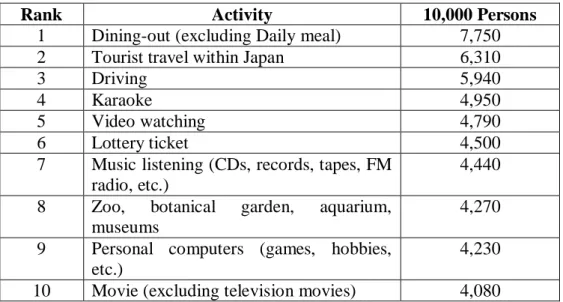
Table IV: Leisure Activity……….. 45
Table V: Japanese Consumption Expenditure by Product Category as % of Total Expenditure in 2007 ……… 46
Table VI: Little Bangkok’s Monthly Total Sales Forecast for Year 2012……. 67
Table VII: Little Bangkok’s Three Year Sales and Direct Cost of Sales Forecast………. 68
Table VIII: Little Bangkok’s Marketing Expense Budget for Three Year Plan……… 69
Table IX: Little Bangkok’s Prospect Income Statement……… 70
Graphs Graph I: Revenue Breakdown by Distribution Channel 2009……….. 25
Graph II: Revenue Breakdown by Product 2009………... 25
Graph III: Total Income………... 25
Graph IV: Net Profit……… 25
Graph V: Operating Cash Flow………. 26
Graph VI: Dividend per Share………. 26
VI
Graph VIII: Little Bangkok’s Break-even Point for Year 2012, Monthly……... 65 Graph IX: Little Bangkok’s Expense Forecast for Year 2012……….. 69
Diagrams
Diagram I: The Secrets of S&P’s Success………. 40 Diagram II: Little Bangkok and Its SWOT Analysis in the Japanese Market…. 55 Diagram III: Little Bangkok and Its STP in the Japanese Market……… 57 Diagram IV: Little Bangkok’s Position in Food and Restaurant Market, Japan... 59 Diagram V: Little Bangkok’s Position among Competitors in Ginza…………. 60 Diagram VI: Little Bangkok and Its Marketing Mix....……….…... 62
VII
Executive Summary
This Little Bangkok Thai Restaurant strategic plan is proposed to S&P or S&P Syndicated Public Company Limited, to enter into the Japanese market. By implementing this plan and strategic analysis, Little Bangkok is expected to be the first successful casual and contemporary Thai style restaurant in Ginza Street. This is due to the advantages of S&P’s over 30 years of experience in Thai food and restaurant business, well-prepared strategic plan, and a recent boom of ethnic food.
At Little Bangkok, the full-flavor of deliciousness, freshness, high standards, premium quality, impeccable service, relaxing atmosphere, as well as reasonable prices are the restaurant’s main selling points and unique competitive advantages.
Furthermore, by differentiating itself as a price leader and the first casual and contemporary Thai style restaurant in Ginza Street, Little Bangkok will generate a net income more than 70 million yen over the next three years. In addition, to follow the values and interests of its mother company and have maximum control over the management as well as earn above average return, Little Bangkok will apply a new wholly-owned subsidiary strategy to effectively establish its first restaurant.
This paper includes an executive analysis of the successful path S&P has taken until now, a proposed strategic plan and business strategies of Little Bangkok to penetrate into the Japanese market, and recommendations for its operating betterment in this new market, Japan.
1
Chapter I: Introduction
1.1 Background of the Study
For more than three decades, Thai food has gained renown as being very healthy for its use of many fresh vegetables, spices and herbs. This popularity of Thai food is due to its unique balance of the five fundamental taste senses: sweet, sour, salty, hot (spicy), and bitter. Besides the variety of these delicious flavors, the textures, colors and way that Thai food is presented make it becomes very exciting and extremely appealing on international tables.
Recently, with the boom in Asian food and health consciousness has boosted up the demand for Thai food in overseas markets. In 2009, refer to the survey by the Kellogg ( K - news – people )1 School of Management at Northwestern University in the United States, Thai food was ranked in fourth place among the world’s most popular cuisines. Moreover, in 2010, according to Simply-Thai, there were approximately 14,500 Thai restaurants operating in 30 countries around the world. Among those gigantic numbers, less than half of them were being run by Thais. As the market of Thai food and restaurant business becomes very competitive and challenging, to survive and succeed by only serving the authentic Thai taste is not enough. Understanding Thai cuisine, adding up values and delivering beyond expectations are a must for today’s Thai restaurants. S&P
1
See http://www.forbes.com/global/2009/0713/restaurants-thailand-entrepreneurs-let-them-eat-thai.html
2
Syndicated Public Company Limited, or “S&P”, is one of the only top three Thai food and restaurant businesses (James, 2010)2, who truly understands those essences and fits with Thai food lovers needs. At present, S&P is successfully operating restaurants and bakery shops nation-wide and 20 Thai restaurants in Singapore, Taiwan, United Kingdom, Switzerland, China and the Philippines. It is fairly surprising that Japan, the most prosperous neighboring country in terms of economics, population and culture, is currently not on the company’s list.
1.2 Objective of the Study
The primary objective of this study is to create a strategic plan in order to find out the most effective strategies for S&P-Little Bangkok to penetrate and establish its first restaurant in the Japanese market. Furthermore, in consequence of this strategic plan, it will indicate the possibility of whether or not Japan could fruitfully be the next potential market for S&P in the near future.
1.3 Questions
Based on the above mentioned background and the paper’s interest, the following questions have been posed:
What are the secrets of success of S&P’s businesses in both Thai and
international markets?
Is it feasible for S&P-Little Bangkok to enter the Japanese market?
2
See James, C. (2010,03 27). Top Three Thai Restaurant Chains in Bangkok. The Insider for
3
What are the most effective entry strategies for entering the Japanese
market?
1.4 Methodology
This strategic plan will apply a hybrid between primary and secondary data research methods.
Theoretical frameworks and literature reviews will be used as secondary
sources of data;
- A large amount of time will be spent studying literature regarding company background and corporate information, to strengthen my understanding on S&P company’s roots and its secret to success. - Furthermore, by reviewing the analysis of the food and restaurant
industry, particularly in the Japanese market, it will help to gain some insight factors that determine the restaurant trend as well as major competitors in this new market.
Questionnaires, observation at sites and interviews with S&P staff will be
used as primary sources of data;
- First, the questionnaire will be done in Thailand with S&P’s customers to find out the real feedback and customer satisfaction at the restaurant site. In Japan there will be an observation of several Thai restaurants in major shopping arcades in Tokyo, which are Shinjuku, Shibuya and Ginza, to detect the real consumer behavior,
4
their expectations and to understand more about the market characteristics of their dining. By collecting and analyzing the results of these questionnaire and observation, later on it will help in plotting a strategic plan and action plan at a final stage.
- What is more, there will be an interview with S&P staff, a restaurant manager and his subordinates, to capture the real employee’s opinions and their attitudes toward the company. By doing so, this will lead to the completion of two sides of perspectives, from customers and employees, which will help in diminishing this study’s bias.
1.5 Significance of the Study
The result of this study will indicate the feasibility of expanding S&P’s restaurant, Little Bangkok, into Japan for the first time. Moreover, since this study presents all necessary matters in opening a new restaurant in new market, thus, it will be a significant endeavor in encouraging other Thai food and restaurant businesses to spread their wings into the challenging international market. Furthermore, this study will also inspire those people who are interested in starting their own food and restaurant business. They will benefit from the past and present successful experiences of S&P as well as from the exclusive analysis and prospective strategic plan.
5 1.6 Structure of the Paper
This paper focuses on a strategic plan of S&P-Little Bangkok for penetrating into the Japanese market. The paper first presents the corporate background and corporate information: the missions, visions, corporate culture, business movements and achievements of S&P. This is followed by the analysis of its successful path in the food and restaurant industry, both in the domestic market and overseas branches. Then the strategic plan of Little Bangkok will be created and analyzed from the international management perspective, in order to see the feasibility of opening its first restaurant in Japan. Finally, a three year financial forecast and action plan, Little Bangkok’s business advantages in the Japanese market and recommendations will be proposed for its future entrance.
6
Chapter II: Corporate Information and Corporate Analysis
Company Name S&P Syndicate Public Company Limited
Industry Food and Restaurant Business
Founded 1973
Headquarters Bangkok, Thailand
Registered Capital 525,000,000 Baht, comprising 105 million
ordinary shares with a par value of 5 Baht per share.
Number of stores 362 bakery shops and restaurants in Thailand
and 20 restaurants in overseas (Dec 31st, 2009)
Homepage www.snpfood.com
2.1 Corporate Background
The legend of today’s most successful and leading Thai restaurant, bakery shop and manufacturer of quality food products, “S&P Syndicate Public Company Limited” or “S&P”, started back in 1973. The story began when the youngest sister of the Raiva family, Khun Pantipa Raiva, persuaded her eldest sister, Khun Patara Sila-On, to open a small ice-cream parlour together. Initially, the two sisters were ordinary housewives who wanted to open an ice-cream store just for a hobby. At the beginning, their store was serving only ice-cream, but after only one month of operation, there were many customers who requested for an easy meal. Since then, the store started to bake homemade bakery and served easy daily dishes that Thai people usually have at home. Within one year, S&P became very
7
popular among students, parents and career workers who lived nearby Soi Prasanmitr Sukhumvit 23, where the first S&P store was located.
Originally, the name of the store was “The P&S”. “P” stands for “Prasanmitr” and “S” stands for “Sila-On”, giving an honor to their first successful store and to the eldest sister. However, The P&S was difficult for Thai people to pronounce, thus, the name of the store was changed to “S&P”.
By chance in 1981, the full steam of S&P’s bakery and restaurant was started when the younger brother, Khun Pravesvudhi Raiva, suggested his sisters to open the second S&P branch at Siam Square, the most chic and popular shopping center in Bangkok during the eighties period. From that time, the two founder sisters, along with help from their brothers and sisters (in total of bonding five) 3, began to seriously operate their million dollars business.
Throughout several years of improvement, development and always support from S&P’s loyal customers, presently S&P is operating over three hundred and sixty restaurants and bakery shops, plus four manufacturers located around the country. Moreover, the company has been very successful in introducing new brands such as Patara, Patio, Blue Cup, and Vanilla. In addition, S&P has also entered into overseas markets including Singapore, Taiwan, United Kingdom, Switzerland, China and recently the Philippines (see Appendix I for S&P and Its Milestone).
3
Khun Patara Sila-On, Khun Pantipa Raiva, Khun Varakorn Raiva, Khun Pravesvdhi raiva and Khun Kachorndej raiva
8
At the present, S&P offers full table service, ranging from Thai, Chinese to Japanese dishes, as well as delicious cakes, desserts, ice-creams and beverages.
In terms of its performance, for the second quarter of 2010 (PCL, 2010) 4, S&P has registered capital of 523.4 million Baht (US$ 14.9 million) and records half year revenues of 2,353.8 million Baht (US$ 67.2 million). The company also currently employs a total of 4,400 employees.
2.2 Corporate Information
Over the last 30 years, the policies that the Company have always maintained are to offer good service and quality products as well as continuously develop and innovate new products to best respond to the customer’s needs. Here are S&P’s missions, visions, products and services, subsidiaries, productions and manufacturing, slogans and corporate culture, which at all times lead them to accomplish their goals;
a. Missions
To define its missions, S&P addresses these five classic questions to create a clear sense of purpose, direction and opportunity among its employees. These five simple but sounding questions are “What is our business? Who are the customers? What is of value to the customers? What will our business be? and What should our business be?” , below are the mission statements of S&P;
4
9
Extensive network of Thai restaurants worldwide/restaurant &
bakery shops in Thailand
Successful & high impact concept, process and product innovation
High quality and cost competitive bakery and packaged food
products
Rapid growth and strong market position in retail business
domestically and internationally
Strong and sustainable financial returns
Create a happy workplace where people work with passion and
develop their full potential
Do good for our community and our world
Moreover, S&P’s mission statements will be at their best when they are guided and accompanied by its corporate visions.
b. Visions
World leader in the Thai restaurant business
Thai leader in the bakery business
Thailand’s most innovative food business & product creation
c. S&P and Its Products and Services
According to the Company 2009 annual report, S&P’s products and services can be categorized into 7 major categories, which are restaurants and bakery shops chain, bakery products, frozen products, S&P branded snack products, catering
10
and home delivery services, Haagen Dazs ice-cream, and sausages, pasta and food coloring. Below are some explanations for each category.
Restaurants and Bakery Shops Chain
Recently, there are about 362 branches of S&P Restaurants and Bakery Shops placed in Bangkok and major provinces. S&P Restaurants serve a diverse group of target customers, from families to career workers and students, depending on each branch’s location. While, S&P Bakery Shops provide customers with the convenience of small outlets and counters for take-home purchases of S&P’s fresh cakes, pastries, cookies, frozen meals and snacks. They are sited in locations such as supermarkets, office complexes and JET petrol stations.
Bakery Products
For more than thirty years, S&P has been renowned for its fresh cakes and homemade bakery. Nowadays, S&P provides custom decorated cakes to suit every occasion, from birthdays to weddings, in a fancy variety of designs. S&P’s bakery product line also includes pastries, breads and cookies. All of these delicious products are prepared with quality ingredients and guarantee the taste by their signature recipe. Besides that, the products are presented in an eye-catching package which has been recognized with several design awards for its creativity.
11
Frozen Products
The “Quick Meal” brand of frozen prepared food is manufactured by S&P. The concept of this “Quick Meal” is “like having a chef at home”. Within five minutes, the customers can enjoy a tasty meal by simply warming the “Quick Meal” in a microwave. At the moment, these frozen food products are featuring one-dish menus, entrees, desserts, and vegetarian selections. Moreover, the products are very popular and well suited with modern customers who are not good at cooking or have no time to cook.
The Company also manufactures frozen foods as ingredients for use in its own restaurant branches. These include sauces, dipping sauces and curry pastes. Thereby, this helps to reduce final preparation times for its diners and adds the benefits to the maintenance of consistent recipes, quality and cost control.
The “S&P” Branded Products
Products under S&P’s in-house brand comprise of prawn and fish crackers, roasted nuts, snacks, various Thai sweets and S&P drinking water. These product lines are available through S&P outlets, supermarkets and are exported to some overseas markets as well. Currently, a new series of canned Thai curry and soup broths have been developed to respond to the expansion of overseas markets’ demand.
12
Catering and Home Delivery Services
The Company’s outside catering service is ideal for many functions, from weddings to birthdays and seminars. The service is totally comprehensive and overseen by a team of specialists who are experts in arranging table settings, floral decorations and all kind of party arrangements. For catering, the catering menus are constantly being updated with new selections to offer clients with more choices. The catering’s customers range from public sector agencies and state enterprises to private sector corporations and Embassies, who all trust S&P’s high quality and professionalism.
In addition, the Company also offers customers the convenience of home delivery services by dialing through a hotline or by ordering via S&P’s website at snpfood.com. Besides that, there is a Tiffin meals service, called “Pinto”, with a wide rotating choice of menus. At present, there are 1,800 households in Bangkok who have become the regular customers.
“Haagen-Dazs” ice-cream
The internationally well-known “Haagen-Dazs” super-premium ice-cream5 is 100% imported by HD Distributors (Thailand) Co., Ltd., a joint venture, 47% of the shares owned by S&P. Customers can enjoy Haagen-Dazs at 14 flagships and dipping stores in Bangkok and high-traffic tourist locations, such as Pattaya, Phuket and Chiangmai.
5
Häagen-Dazs (pronounced /ˈhɑːɡəndɑːs/) is a brand of ice cream, established by Polish immigrants Reuben and Rose Mattus in the Bronx, New York, in 1961. Nowadays, Häagen-Dazs is selling in the United States and 54 other countries around the world, become the no. 1 in ice cream producer (Haagendazz, 2010)
13
Sausages, pasta and food coloring
For many years, Seriwat Foods Co., Ltd., has provided sausage and ham deli items; frozen food; pasta; coloring and essences used in the food industry; including flavorings and ready to eat jellies, named “Jelio”, to S&P’s subsidiaries and outside trading partners. However, since October 2004, Seriwat Foods Co., Ltd. has transferred all of its production activities to S&P Syndicate Public Co., Ltd. Since then, the finest and delicate quality of sausages, pasta and food coloring are fully run and controlled by S&P.
d. S&P and Its Subsidiaries
Since the world consumption and demand for Thai food is growing, S&P and its subsidiaries have diversified its food and restaurant business into the following categories:
Domestic Restaurants and Bakeries
Under S&P’s operations of domestic restaurants and bakeries, there are mainly 7 brands, which are the “S&P”, “Patio”, “Patara”, “Vanilla”, “Golden Dragon”, “Bluecup” coffee, and recently the “Grand Seaside”. For each individual brand, the target market and the way the Company positions itself are unique and different from one to another to better serve different groups of customers.
14
Table I: S&P and Its Domestic Restaurants and Bakeries Business
Operated by % holding by Branches
S&P Bakery S&P Restaurant Vanilla Restaurant Patio Restaurant Patara Restaurant
Grand Seaside Restaurant Total stores operated by S&P 100%
Pizza Patio Restaurant Haagen Dazs Cafe
S&P S&P S&P S&P S&P S&P S&P S&Pizzanotti HD Distributors 100% 47% 229 91 5 3 1 1 330 6 26 Total 362
Source: S&P’s 2009 Annual Report
S&P Restaurants – the origin of all S&P’s subsidiaries offer full service with an extensive menu, as well as cakes, desserts, ice-creams and beverages. The restaurants’ customer profiles are diverse and range from families, to students, career workers as well as other client groups.
www.snpfood.com
Patara – These restaurants are catering to an up-scale target customer group and foreign diners, with Thai cuisine and a contemporary presentation. The menu offers creative recipes amidst an ambience of quiet sophistication.
15
Patio – serves international dishes in a casually trendy setting. The menu reflects an individual touch and is presented with flair. Patio also offers home-made products such as salad dressings, soups, pasta and ready-made sauces. Moreover, the Patio brand includes PizzaPatio.
www.patiofood.com .
Vanilla – a new breed of restaurant and bakery, selling Western dishes and desserts. The restaurant interiors are a fresh interpretation of European sensibilities, striking a chord with a fashionable, young crowd. Vanilla also offers cooking classes for budding chefs. This Vanilla brand is also represented by the Vanilla Industry, Vanilla Restaurant and Vanilla Brasserie names.
Grand Seaside – is a seafood restaurant located in Laem Farn, Sri Racha District. The menu features the freshest seafood in a relaxed beachside view. The restaurant often caters for large parties
Golden Dragon – is a contemporary Chinese restaurant with authentic taste. The restaurant is famous for its dim-sum delicacies and its traditional moon cake.
Blue Cup – the coffee counters offering premium quality coffee beverages. There are currently Blue Cup services available in 129 of S&P Restaurants, as well as the first flagship of “Blue Cup ebb and flo” outlet in Siam Centre. This café is appealing to customers who appreciate the premium quality taste of tea and coffee.
16
Besides the above 7 brands under S&P mother company, the “Delio”, “Royallee”, “SimplyThai” and “Jelio” are also new brands under the Company’s trademark. These four brands’ products are available at S&P Restaurants and Bakery Shops as well.
Overseas Restaurants
For the international market, the Company proudly represents the cuisine aspect of Thai culture in foreign countries. As of December 31st, 2009, there are currently a total of 20 restaurants in six countries under the following brand names of “Patara”, “Siam Kitchen”, “Thai”, “Patio”, “Bangkok Jam” and the first licensed brand of “Thai-Patio”.
Patara Fine Thai Cuisine – is a Thai restaurant that focuses on the upper-end of
the market with an emphasis on exquisite presentation, authentic tastes, refined service and a sleek ambiance. Patara maintains the diversity of genuine Thai recipes, even though the majority of its clients are foreign diners. In 2005, the London branches of Patara were honored with the proud distinction of the PM Award 2005 (The Prime Minister’s Export Award 2005) for Best Service Provider. The restaurants have also been voted by leading magazines as the best Thai restaurants in London. Presently, there are 7 Patara Fine Thai Cuisines: 1 branch is in Singapore; at Raffles City Plaza, 4 branches are in the United Kingdom; at Fulham, Beauchamp PL., Maddox St., and Soho-Greek St.; another branch is in
17
Geneva No.13, Switzerland; and the most recent Patara Fine Thai Cuisine is operating in Beijing, China.
Siam Kitchen – a casual Thai restaurant concept was created for the Singapore
market. The menu concentrates on single-dish items for quick and convenient dining. The outlets are usually located in suburban shopping malls such as at Causeway Point, Lot 1 Shoppers’ Mall, City Square Mall, and Parco Bugis Junction, for a better way to reach target customers. The Siam Kitchen formula has expanded rapidly and gained strong acceptance among the Singaporean market. The restaurants have also received Halal certification, which has earned the trust of the large Muslim population in Singapore.
THAI – a contemporary Thai restaurant in Geneva, Switzerland. The menu
reflects a harmonious blend of Thai and Western influences. The interior design speaks of a modern design with a distinctive Thai motif through a careful selection of materials.
Patio – Patio-Taipei is the first branch of Patio in the Taiwanese market. The
restaurant is set in a stylishly relaxing atmosphere. The menu deftly mixes contemporary culinary trends with updated, well-loved Thai favorites. The restaurant interiors are contemporary with Thai design references to impart an oriental warmth.
Bangkok Jam – represents a Thai and Pan Asian cuisine bistro which is targeting
18
Thai-Patio - is the first S&P franchise restaurant in an overseas market. It fairly
recently opened in Greenbelt 5 in Manila, Philippines. The restaurant serves genuine home-cooked Thai dishes in a contemporary Thai modern style atmosphere.
The following table II illustrates all of the 19 overseas restaurants and 1 franchise restaurant brand in 6 countries.
Table II: S&P and Its Overseas Restaurants Business
England
Switzer-land Singapore Taiwan China
The Philippines Total Patara Thai Patio Siam Kitchen Little Bangkok Thai Restaurant Thai-Patio* 4 1 1 1 6 1 4 1 1 7 1 4 6 1 1 Total 4 2 8 4 1 1 20
*Licensed brand/Source: S&P’s 2009 Annual Report
e. S&P and Its Productions and Manufacturing
Presently, S&P has 4 manufacturers. Among these four, three of them are manufacturing bakery products, and another manufacture is producing frozen food. Sukhumvit 62, Bangna, Chiangmai and Lad Krabang are the citadel factory points for the Company.
19 Sukhumvit 62
This manufacturer is producing fresh cakes, frozen cake, breads, pastries, cookies, Thai sweets, moon cakes and drinking water 365 days a year. The products are distributed through the Company’s own restaurant and bakery outlets, outside supermarkets and via export channels to overseas markets as well.
Bangna
The main production of Bangna’s manufacturing is frozen dough and cookies, all under the “S&P” and “Delio” trademark. Similar to the chief manufacturer, Sukhumvit 62, the products are distributed through the Company’s own restaurant and bakery outlets, outside supermarkets and via export channels.
Chiangmai
The only manufacturer of S&P in the northern part of Thailand, Chiangmai produces fresh cakes, breads & pastries. The products are distributed through the Company’s own restaurant and bakery outlets in the Chiangmai area.
Lad Krabang
Lad Krabang manufacturer mainly produces all formulas of sausages and frozen food for the Quick Meal brand and frozen sauces for in-house restaurant usage. The products from this manufacturer are also distributed through the Company’s own restaurant and bakery outlets, outside supermarkets and via export channels.
As a whole, all of S&P products and its brands have been well-recognized both nationwide and worldwide as being premium-quality food. S&P’s Bakery
20
Factory/Manufacture has received Hazard Analysis Critical Control Point (HACCP) Certification by the Ministry of Industry, Thailand. This HACCP recognition is a globally accepted production standard for the food industry and it is an essential tool for securing credibility in foreign export markets. Additionally, S&P’s export products also have been awarded the prestigious “Thailand’s Brand Mark” from the Department of Export Promotion in 2005.
f. Slogans
To capture every need, preference and lifestyle of customers, S&P has diversified its business into various areas. For each business area, the Company has created a simple but impressive slogan that best signifies each store’s character. These are;
S&P Restaurant and Bakery – Simply Delicious
S&P Bakery Shop – Fresh Baked Everyday
Patio – Joy of Eating
Grand Seaside – Great Seafood…Good View
PizzaPatio – The Unique Italian Taste
Bluecup Coffee and Tea – Brewing New Ideas
Caterman – Leave the Details to Us
Just like the slogan “Simply Delicious”, every dish on S&P Restaurant and Bakery’s menu is so simple that Thai people can find them everywhere. But the major difference is the authentic delicious taste that S&P offers, the genuine taste that can only be found at S&P Restaurant and Bakery.
21 g. Corporate Culture
The word “Family” is the key that has been well shared and guided among S&P’s employees. From the Board of Directors (see Appendix II for Board of Directors and Appendix III for Organization Chart) to the temporary employees, everyone work together as one big family.
“Without good support from co-workers, great effort from subordinates and marvelous trust from our shareholders, our Company could not come this far. Together we will move forward to prosperity and maintain our established reputation for many years to come”
Khun Patara Sila-On S&P’s Chairman of the Board of Directors
These are the valuable words that the Chairman of the Board of Directors gave at the 2009 S&P annual meeting. Moreover, these two simple phases of “Just do what we think are the best for our loves and always give them a smile” are the two familiar phrases that every S&P staff member takes as a norm.
Generally, a degree from a cooking and culinary school or majoring in hospitality could positively be a good passport to work in the food and restaurant industry. However, for S&P, degrees and experiences are not the most important factors. To become one of S&P’s employees, passion and eagerness to learn and a mind for service are raw natural characteristics that S&P is looking for in employees. After new employees have been hired, there will be a training session. For
22
example, to become S&P’s chef, the trainee has to spend two to three months in the kitchen, learning from a real chef how to select premium quality meat, vegetables, fruits and all kinds of ingredients and nutrition. Next they learn how to prepare, cut, clean and keep them in good temperature, after which they then start tasting the food and learn how to cook each dish. Finally, they master the art of plate decoration. In every single step, the trainee puts his or her mind, thoughts and heart in with a high expectation to receive a smile back from the customers.
In addition, S&P is not 100% profit oriented. For many years, the Company has been continually supporting charitable foundations and providing funding for underprivileged children’s organizations. S&P tries its best for the betterment of Thai society. What is more, S&P also provides Learning Centre grants scholarships and free regular vocational classes in retailing business and home economics for its staff and outside students. These opportunities are for those who lack the means to further their education and career.
Therefore, community unity, full of effort and hard working staff, and a social oriented mind are at the hub of S&P’s corporate culture.
2.3 Business Achievements and Financial Highlights
Conducting business in Thailand during the year 2009 was in the midst of difficulties and challenging because of the impact of low domestic spending, a sluggish economy, political uncertainty, rising costs brought by soaring oil prices, and foreign exchange rate volatility. Therefore, S&P reviewed their strategies and
23
worked extremely hard and planed throughout the year to cope with this changing environment and kept a close watch on it.
Consequently in 2009, total revenue increased by 7.37% to 4,763 million Baht, which consisted of sales and services revenue amounting to 4,700 million Baht and other revenue of 63 million Baht. While sales and services revenue increased by 7.35%, the Company achieved 293 million Baht in net profits, which increased by 67 million Baht or about 30.15% compared to the previous year. The following table demonstrates the highlight for S&P’s past five years financial performance.
Table III: S&P and Its Five Years Financial Highlights
Operating Performance (Units: Thousand Baht) 2009 2008 2007 2006 2005 Revenue from
sales and services
4,700,144 4,378,167 4,013,841 3,727,256 3,361,307
Other income 63,557 58,450 61,934 72,739 53,805
Total revenue 4,763,701 4,436,617 4,076,775 3,799,995 3,415,112
Gross profit 2,058,781 1,860,714 1,696,261 1,606,538 1,428,276
Net profit (loss) 293,040 225,149 181,774 226,793 203,601
Financial Status (Units: Thousand Baht) 2009 2008 2007 2006 2005 Current assets 1,461,843 1,212,737 1,100,004 1,001,717 777,585 Total assets 2,754,049 2,521,823 2,517,514 2,398,461 2,084,535 Total liabilities 710,032 555,931 556,829 507,309 511,853 Shareholder’s equity 2,044,017 1,965,892 1,960,685 1,891,153 1,572,682 Paid up capital 523,431 523,431 523,431 502,303 434,769
Net cash provided
by operating
activities
24 Financial Ratios
(Units: Percent) 2009 2008 2007 2006 2005
Return on investment 11.1% 8.9% 7.40 10.10 10.6
Return on equity 14.6% 11.5% 9.4 13.1 14.2
Net profit margin 6.2 5.1 4.5 6 6
Debt to equity 0.3:1 0.3:1 0.3:1 0.3:1 0.3:1
Growth Rate
(Units: Percent) 2009 2008 2007 2006 2005
Total revenue growth 7.4 9.1 7.7 10.9 12.2
Net profit growth 30.2 23.9 -19.9 11.4 11.1
Total assets growth 9.2 0.2 5.0 15.1 19.2
Source: The Company Annual Report 2009
To breakdown these revenues, the domestic restaurant and bakery shop contributed 75% of total revenue to S&P Syndicated Public Company Limited. Other 15.2% was from packaged food and bakery trading. These include ready to eat meal, frozen food and bakery products. The remaining 0.9% was from overseas restaurant and 0.1% was from other business activities, such as catering service, home delivery and pinto service.
For domestic restaurants and bakery shops, in the year 2009, revenue accounted for three fourths of total sales and services revenue. This resulted from sales growth of existing outlets and new outlets that opened. This year, the Company opened 42 new outlets, 8 of which are restaurants and 34 are bakery shops.
For packaged food and S&P’s bakery trading business, this year, the “S&P Brand” and “Quick Meal Brand” has been distributed through all Lotus Express convenient stores. Due to continuous expansion of all modern trade branches, the
25
products are now placed throughout the country. Furthermore, advertising and promotion also boosted up the sales for these products categories.
Last but not least, for overseas restaurants, the global economic recession and slow down in consumer spending caused a decrease in sales revenue. In addition, the appreciation of the Thai Baht against some foreign currencies also had an impact on transactions of sales revenue. The graphs below illustrate S&P’s major business achievements in 2009.
26 Source: The Company 2009 Annual Report
2.4 Future Business Movements
In October 2009, the Company celebrated its 36th Anniversary in the food and restaurant business. The Company’s success is clearly illustrated in its ability to maintain an annual revenue growth of 7.4% or 4,700 million Baht in total sales during the mid global recession and local political uncertainty (The Company 2009 Annual Report). Globally, S&P opened another Siam Kitchen store in Singapore and a flagship Patara Fine Thai Cuisine in Beijing, China.
Locally, the Company opened 42 S&P Restaurants and Bakeries, focusing on major provinces in Thailand, in order to reach out to all potential customers.
On product development, S&P worked harder to bring more varieties to existing lines of frozen meals, bakery, and meat products. Organic, natural and locally available ingredients are introduced to create a wider range of menu offerings. Therefore, the Company’s current goal is to provide a modern lifestyle that is more conscious to health and environmentally friendly products.
27
Below is a summary of S&P’s future plan, outlets expansion and manufacturing quality development to congregate with the goals.
a. Future Plan
First, innovation and creativity has always been a key vision of S&P. During 2010, the Company will emphasize the need for its management and staff to be more innovative and creative in the way they think, work and do things in order to raise performances in all areas of operation.
Second, to maintain growth domestically, the Company intends to open new restaurant, bakery and coffee corner branches, concentrating on major provinces and high potential towns outside Bangkok. This is in line with the Company’s aim to strengthen its presence throughout Thailand.
Third, the Company’s mission is to be the number one restaurant and bakery brand within each community where they operate. This can be achieved by providing high quality products, meals and services, making S&P synonymous with “Quality and Tasty”. The Company will continue to improve the performance of all outlets, ensuring efficient operations, high standards of friendly service and the very best food products and meals.
Fourth, to raise outlet performance, the Company will continue to emphasize its training schemes during the year and add in special courses to improve management skills at all levels.
Fifth, over the next three years, the Company will make overseas expansion one of its main priorities. Its aim is to open more restaurants in Europe
28
and explore new markets in Asia and Australia with a view to establishing new restaurants through new joint venture partnerships.
Finally sixth, to take advantage of the popularity of ready-made Thai food in overseas markets, the Company will look into the possibility of establishing food manufacturing facilities in other countries, particularly within Europe. In addition, the Company will explore new markets for the export of Thai food made in Thailand.
b. Outlet expansion
In 2010, the Company plans the expansion of new branches to approximately 50 outlets in Bangkok and its outlying areas including important provinces. These outlets include restaurants and bakery shops which may be located in leading department stores, supermarkets, discount stores, hospitals, office buildings, as well as petrol stations, or stand alone outlets in populated areas. Consideration in choosing the outlet’s category at the point of sales, as well as the suitability of locations, depend mainly on easy access and population of the community as deciding factors. Moreover, the Company plans to consistently improve management operations in all outlets with standard quality GMP6, and with contemporary designs in accordance with target group in each location.
6
GMP refers to the Good Manufacturing Practice Regulations promulgated by the US Food and Drug Administration under the authority of the Federal Food, Drug, and Cosmetic Act. These regulations, which have the force of law, require that manufacturers, processors, and packagers of drugs, medical devices and some food take proactive steps to ensure that their products are safe, pure, and effective. GMP regulations require a quality approach to manufacturing, enabling companies to minimize or eliminate instances of contamination, mix ups, and errors. This in turn, protects the consumer from purchasing a product which is not effective or even dangerous (ISPE, 2010).
29
On the international restaurant business, apart from the plan to expand the Thai restaurants in existing oversea countries, new markets in which the Company has no presence such as Asian countries, Australia and the countries in the Middle East are also registered in the new plan. The Company has projected plan to open not less than 2 international restaurants in 2011.
c. Manufacturing Quality Development
During the past year (2008), the Company has put a lot of investment to increase production capacities at the 2 manufacturing sites, Bangna and Lad Krabang, which consist of:
The construction of a new building for the production of salted and sweet bakery fillings in the bakery factory at Bangna site, with a usable area of 1,300 square meters.
The construction of a new building for frozen prepared meals for export in the food factory at Lad Krabang Industrial Estate, with a usable area of 6,000 square meters.
When these two constructions are completed, the production capacities will match and be able to serve varieties of demands from the outlets expansion for the next 5 years.
From then on, the Company plans to concentrate on developments and improvements on production processes, and quality control systems in each
30
production line. Hence, this will generate maximum efficiency and operational results for the above investments.
2.5 The Secrets of S&P‟s Success
With fully-integrated operations ranging from production, packaging, retailing, to delivery, S&P stands out as one of the country’s flagship leaders in restaurant and bakery businesses7. Moreover on international shore, according to Martens 20098, S&P has also become the world’s biggest group of full-service Thai restaurants, with over 350 company-owned domestic outlets as well as a growing collection of 20 famous splendid Thai restaurants abroad.
Behind these remarkable achievements, based on my analysis, what are the strengths and major determinants for S&P’s success in both domestic and overseas market will be exemplified and analyzed in the following paragraphs.
a. The Secrets of S&P‟s Success in the Domestic Market
Long history with well establishment
The long history with well establishment of the Company is the first secret of S&P’s success. Throughout 36 years of its operation, from a small ice cream parlour to business worth millions of dollars, S&P has long been committed to
7
Domestically in 2009, S&P had only a 1.5% share of Thailand's $3.5 billion market for full-service Asian restaurants, but that gave the Company becomes the biggest group in Thai cuisine, according to Euromonitor research. Those bigger four players are the MK, led by the 285 branches of MK Restaurants, with a 9.8% share. However, MK serves a Chinese-influenced hot pot, not Thai food, while the other three are specialize in Japanese dishes.
8
31
well-selected ingredients brought into the best production to create high quality products and services, and to serve the best to its customers. Today, the Company is renowned and well-respected for its culinary history, delicious recipes and has become the most distinguished outdoor kitchen for both Thais and foreign diners.
Good food, great taste with high quality standards
As one of S&P’s goals is to be recognized as the best restaurant and bakery shop for good food, great taste with premium quality, for many years of efforts, the Company has accomplished this goal and it becomes the second strength for S&P’s success.
Said by Cassandra James, a famous food journalist in Asia Travel Examiner; “I like S&P because it serves top quality and delicious Thai food at a reasonable price.”, this statement is a good confirmation for the outstanding taste with premium quality food offered by the restaurant. Furthermore, in her article, she also mentioned S&P as one of the finest Thai restaurant which everyone must try while visiting Thailand.
Moreover, in proportion to the result of the questionnaire (see Appendix VI and VII for S&P Customer Satisfaction Questionnaire and Its Result) from 50 respondents, the “good food, great taste with high quality standard” proved to be an important factor for its business’s success. Since the cleanness, delicious taste and the quality of food/freshness are ranked as the top 3 reasons for dining grounds at S&P Restaurants.
32
Numerous awards guarantee
The success over the past 36 years, including various awards that the Company has won, serves as a sign of affirmation of customers’ confidence and recognition towards S&P.
To mention some, in 2008, the Company obtained quality certification under the Codex Good Manufacturing Practice (GMP) standard for 5 points of sale from the Thai Industrial Standards Institute, the Ministry of Industry. In addition, the Company’s factories have maintained and developed the scope of quality standard certification to an international level, that is food safety (Codex Food Hygiene), including Good Manufacturing Practice and many high qualifying standards under the ISO/IEC 17025 : 2005, ISO 9001 : 2000 and ISO 22000 : 2005.
Likewise, for the bakery production and the food manufacturing lines, they were also awarded certification by both the Ministry of Agriculture and Cooperatives and the Ministry of Public Health for “Food Safety Mark”. Meanwhile, the branch operations line earned the coveted “Clean Food, Good Taste” plaques and the “Healthy Menu” signs from the Department of Medical Science, the Ministry of Public Health. Last but not least, S&P’s production processes were recognized with the GMP and Hazard Analysis and Critical Control Point (HACCP) certification from the Thai Industrial Standards Office.
These achievements of official certifications and awards are not only the Company’s strength and source of competitive advantage, but they are also a
33
pride for the Company that reflect the efficiency of its operations, while serving as inspiration for a further development to the next upper levels.
Diversification of product and service lines and multi-brand
extensions
Presently, the Company underpins its strengths in a variety of products, services and meal choices under various brands, for a better reach to different groups of customers. For example, the main S&P Restaurant offers full extensive services, ranging from food, desserts, bakery and beverages. Its target customers are diverse and vary from families, to students, career workers as well as other client groups. On the other hand, the Vanilla, a new breed of S&P’s restaurant and bakery, serves mostly western dishes and desserts, which the restaurant chiefly focuses on a fashionable, young crowd of customers.
By offering various products and services in many different brands, this fruitfully helps the Company to diversify its business risks, contributes to a healthier financial performance through greater sales volume and at the end it hits a bigger success as the Company becomes the leader in food and restaurant business in the Thai market.
Continuous in research, development and innovation
Currently, the Company has consistently pursued a policy of active product development. For instance, the Company creates an outstanding packaging particularly for special seasons and launches new healthy menus especially for
34
dietary customers. What is more, S&P’s R&D team has put a lot of efforts in eliminating unnecessary wastes for building a competence in efficiency issue and adapting “Going Green” concept throughout its production processes. In correlation to this, the Company presently employs 18 technicians who specialize in food science, food engineering, product development and packaging field, to facilitate the process and make sure that every step is under control, safe, and that the final product also satisfies and suits well with customer needs and wants.
Altogether, with nonstop creativity and innovation, the Company has proved itself to be strong and the leader in this business area.
Good leaders with global vision
The success and failure of any business depends very much on the efficacy and the ability of the leader. By having a good leader, it always means a goal is half way reached and clearly sees a victory. In case of S&P, it is undeniable that part of its tremendous success comes from having good bosses.
Much credit for many advances and the Company’s successes are given to the five founders and members of Sila-On’s and Raiva’s families. These days, at least 14 of their siblings; children, in-laws, nieces and nephews, have joined the Company. “When relatives graduated from abroad, they each have fresh ideas, so the Company gets new brands and introduces new products, which the results are beyond our expectations”, said Khun Phailin Nimityongsakul, the Vice President for Research and Development.
35
Moreover, all of S&P’s Board of Directors and the management team have unique characteristics of good leaders. These are self-knowledge, high commitment, very supportive, dynamic to any changes, and open minded. Furthermore, they also have a global vision to step into new markets, be able to take risks, as well as yearning for the betterment of the society. Lastly, the award of “Top 15 Female Entrepreneurs in 2006” given by “Leading Women Entrepreneur of the World” or “LWEW” to Khun Patara Sila-On, the Chairman of the Board of Directors, is another guarantee for her great leadership and that is certainly another secret of S&P’s success.
Good corporate governance and unity of corporate culture The positive effect of good corporate governance on different stakeholders is ultimately a strength toward the company prosperity. For S&P, the Company works extremely hard and tries its best to ensure that all of its stakeholders, including shareholders, customers, suppliers, creditors, employees, society, and even competitors, are contented to do the business together (see Appendix VIII for S&P and Its Corporate Governance). In addition, with a strong in unity of corporate culture, it builds up a closer bond among the Company’s members. This statement is very true, according to an interview with Khun Kovit Muangnakum, the manager of S&P Restaurant and Bakery shop at Chonburi Branch. Khun Kovit confirmed that in all 8 years of his experiences working at S&P, the good corporate governance and unique corporate culture have contributed countless values to their achievements and enriches the Company’s future (see Appendix IX for S&P and Its Employee Interview).
36
Right business strategies
In the beginning of its operation, the Company had long been applying the “Conservative Strategy” for its food and restaurant business. During that time, the Company followed one famous idiom of “Slow but Sure”, to gradually grow in sustainable way. However, when time passed, the marketplace became aggressively competitive and customer preferences also rapidly changed. It was time for S&P to make a shift. With careful consideration, the Company determined to go for the best combination of old meets new, by applying a conservative strategy with a progressive strategy. Unlike before, in 2006, S&P opened a new business chapter by inviting the Minor International PCL Thailand9 to become its new business partner (Investments, 2010)10. Through their merger, both companies are enjoying win-win benefits with a huge access to new business channels.
Overall, S&P has an excellent business instinct and truly understands its competencies. The Company knows exactly when to invest or to divest, what the right game is for them to play, where the potential markets are and how to segment, target and position its products and services in those markets. Without utilizing the right business strategies, S&P could not come this far.
9
Minor International PCL, Thailand is one of the largest hospitality and leisure companies in the Asia Pacific region with over 1,000 restaurants and 27 hotels and resorts. Complementing to its resort and hotel operations, the Pizza Company, Swensen’s, Sizzler, Dairy Queen, Burger King, the Coffee Club and Thai Express, are the food and restaurant brands under the Group’s operation (PCL M. I., 2006).
10
See Investment, L. (2010). S&P Syndicated PCL. Retrieved 11 27, 2010, from Lombard Investment: htpp://www.lombardinvestments.com/portfolio_comp.shtml#S&P
37
b. The Secrets of S&P‟s Success in Overseas Markets
Good reference from domestic success
Besides many years of experiences in the food and restaurant business, lots of awards, good leaders, and great teamwork, the success of S&P in the domestic market is another important strength that leads to the boom of its overseas branches.
Back in 1990 at Fulham Road, London, the first S&P’s international branch was established11. In those days, the restaurant was hardly recognized by the local people. The business was profitable but slowly growing. However there was a turning point, when the local newspaper wrote an article about the origin of this restaurant and credited its authentic Thai taste with superb services to the big success of its mother company S&P in Thailand. Since then, many local customers as well as travelers come to dine at the restaurant more and more. Therefore, great backup and good references from domestic success are certainly one crucial part for S&P’s affluence in overseas markets.
Truly understand the markets
“Know yourself, know the market, know the customers and know the competitors”, these are a marketing recipe that the Company masters in understanding the market. In fact, the Company truly understands each market characteristic with each customer’s nature, such as to be successful in Singapore market, the Company has to create an image of casual and contemporary Thai
11
38
style restaurant for quick and convenient dining. This is mainly due to the unique character of Singaporean customers of active lifestyle, while the time is money for them. In contrast, for a different market like the United Kingdom, the Company has to define itself as a high-end Thai restaurant with exquisite presentation, since its target customers have a distinctive dining culture of good-manner, very traditional, peaceful and calm. Hence, penetrating into new marketplace is definitely not a difficult issue or big obstacle for S&P’s success.
Good relationship with local community
S&P Global Co., Ltd., the operator of S&P’s restaurant businesses abroad, is an active and good contributing member of the local community. Since 2000, the Company has been participating in as many as 50 local projects, including many local charity activities and open booths to promoting Thai food and Thai culture at Thai Embassy and several at local events. By doing so, each S&P’s international branch becomes an integrated part of the local community. What is more, the local people, also feel that those S&P’s restaurants are their restaurants, and there is no room for an outsider anymore.
Thai Government support
Thanks to the Thai government’s attempt in promoting Thailand as the “Kitchen of the World”, the Company is now enjoying generous governmental support in facilitating its overseas expansion and many food trade incentives. The goal of this project is to increase the number of Thai restaurants in overseas markets to 20,000 restaurants by 2014. In order to reach this goal, the government
39
encourages Thai investors to invest more in Thai restaurants overseas and provides support in the forms of training, information, finance, and some raw material trade incentives. In 2003, there were approximately 6,000 Thai restaurants in overseas market. However, after this project was activated in April 2004, the numbers of Thai restaurant abroad were increased dramatically and reached 10,000 restaurants in 2007 (Bank of Ayudhya Monthly Magazine, August 2008). S&P is also one of those restaurants that benefits from the government support and the growth opportunities in overseas markets. Since 2004, the Company has been adding 4 more restaurants in 4 countries: Singapore, Taiwan, the Philippines and China.
As a whole, there are many factors that contribute to the Company’s success. However, without continuous support and a good response from the customers, both domestically and internationally, S&P could not come this far.
The following diagram shows the summary of the strengths and major determinants for S&P’s success in both domestic and overseas markets.
40
41
Chapter III: A Strategic Plan for S&P to Enter the Japanese Market
3.1 Country Analysis
Source: National Encyclopedia Japan, an island nation in East Asia, is an archipelago located east of the Korean peninsula. Its name “Japan” or “Nippon” or “Nihon” means “Sun-Origin”, which is sometimes the country is referred to the “Land of the Rising Sun”. It has an area of 377,944 square kilometers which makes the country slightly smaller than the state of California. Historically, right after WWII had ended, Japan was devastated. All the large and important cities, industries, infrastructures and transportation networks were severely damaged. However, only within a few decades, Japan could develop and transform itself from an isolated to civilized country. This was mainly owing to the government-industry cooperation, a strong work ethic, mastery of high technology, and a comparatively small defense allocation. Today, Japan has the world’s tenth-largest population, with over
42
127 million people. Tokyo, the capital city, is also the largest metropolitan area in the world.
Economically, as of 2009, Japan is the second largest economy in the world, after the United States, at around US$5 trillion in terms of nominal GDP and third after the United States and China in terms of purchasing power parity. Moreover, Japan has a large industrial capacity and is home to some of the largest, leading and most technologically advanced producers of motor vehicles, electronic equipment, machine tools, steel and nonferrous metals, ships, chemicals, textiles and processed foods. The service sector also accounts for three quarters of the gross domestic product (CIA, 2010)12. Even though in 2009 and 2010, the real growth rate of gross domestic product of Japan experienced negative growth for the first time after the five years economic upbeat, but in 2011, the real growth rate is projected to reach 1.75%. This is a good sign for economic recovery and new investment. However, in the long-run, aging and a shrinking population are the two major problems for advancing its economy.
For societal and cultural background, Japanese society is linguistically and
culturally homogeneous with small populations of foreigners. Zainichi
Koreans, Zainichi Chinese, Filipinos, Japanese Brazilians, and Japanese
Peruvians are amongst small minorities resident in Japan. Furthermore, as the influence from Shinto and Buddhist religion, the country is truly the land of peace and harmony that continues to evolve in a positive unification of tradition and
12