
A Study on Subjective Well-Being between Chinese and Japanese Adolescents
51
0
0
全文
(2) Contents Abstract •••••••••••••••••••••••••••••••••••••••••••••••• 1 Introduction. ·············································2. Study 1 •••••••••••••••••••••••••••••••••••••••••••••••••• 7 Method. ··············································7. Results ••••••• • • • • • •••.•• • • • • • • • • • •• • • • • • • • • • • • • • • • • • •• 8. Discussion ••••••••••••••••••••••••••••••••••••••••••• 14 Study 2 • • • • • • • • •• • • • • •••• • • • • •• • • • • • • • • • • • • • • • • • • • • • •••• 17 Method •••••••••••••••••••••••••••••••••••••••••••••• 17 Results •••••••••••••••••• • •• • • • • • • • • • • • • • • • • • • • • • • •••• 18. ···········································27 General Discussion ·······································29 References ··············································31 Acknowledgements ·······································35 Appendix ···············································37 Discussion.
(3) Abstract The purpose of this study is to investigate the subjective well-being (SWB) in Chinese. and Japanese adolescences, and to clarify the relationship between their feeling of school adjustment and SWB. 47 Chinese and 66 Japanese college students took part in. Study 1; and 569 Chinese and 563 Japanese students including Jr. high school, high school and college students took part in Study 2. For the measurement ofthe subjective. well-being, Oxford Happiness Questionnaire (OHQ; Hills & Argyle, 2002) was used.. Moreover, the students' feeling of school adjustment was measured by Students Adjustment Scale for Jr. high school and high school students (SAS; Asakawa, Ozaki &. Kogawa, 2003) and the one for college students (Yoshida, Suzuki, Kogawa, Asakawa & Azuma, 2002). Main findings were as obtained: In Study 1, there was no significant difference between the Chinese and Japanese college students on general scores of SWB,. however, Chinese students showed more self-efficacy than Japanese students; Japanese students showed more positive affect and life satisfaction than Chinese students; in. Study 2 significant difference was indicated in SWB between China and Japan. The relation to friends aspect showed universality across the two countries, while the relation to family aspect and academic activity showed some cultural variation. Those findings were discussed from cross-national psychological viewpoints.. Key words: subjective well-being, school adjustment, adolescence. 1.
(4) Introduction Starting at least from the Ancient Greeks, the concept of "Happiness" is one of the most important topics required debate and discussion. Aristotle (350 B.C.E.) said "What is the highest of all goods achievable by. action? ...both the general run ofman and people of superior refinement say that it is happiness (Nicomachean Ethics, Book 1, Chapter 4)". There are also. some psychological data prove that happiness were rated as much important. in producing the good life (King & Napa, 1998; Skevington, MacArthur & Somerset, 1997). But for a long time, psychologists have made huge strides in the study on personal weakness and therapy for mental illness. Seligman (1998) argued that psychology is notjust the study of mental illness and impairment; it is also the study of strength and virtue. Moreover, treatment is notjust fixing what is broken; it is also nurturing what is best within us. It. could be considered that psychologists did such goodjob on relieving. depression of human and aim is to make them happier. Ueda, Yoshimori & Yukura (1992) suggested that "what is the good life" is one of the most. important topics needed to be debated and discussed, since psychology is the scientific study of humanity, One approach to defining the good life is. happiness. Recently, major progress has been made in conceptualization of. "Subjective Well-Being" (commonly abbreviated as SWB), which means exactly the same thing to happiness.. As Argyle (1987) said that "happiness, along with health and mental health, is increased by the presence of certain social relationships and. depressed by losing these and by other stressfu1 life events. These findings are remarkably consistent and they make a lot of sense. So I shall rely to a. large extent on subjective reports ofhow people feel: ifpeople say they are. happy then they are happy. Ifpeople say they are depressed then they are. depressed", the concept of SWB focuses on people's feeling of whether they are living on good lives,. 2.
(5) The study of SWB has evolved since Wilson (1967) presented a broad. review of SWB research which the author concluded that those with the most advantages were happiest. He wrote that "the happy person emerges as. a young, healthy, well-educated, well-paid, extroverted, optimistic, worry-free, religious, married person with high self-efficacy, high job. morale, modest aspirations, of either sex and of a wide range of intelligence". Researchers have found that the literature on SWB including both cognitive judgments and affective reactions (Diener, 1984; Diener, Suh,. Lucas & Smith, 1999; Diener, 2000). Especially, Andrews & Withey (1976). suggested that, three general components have been identified: life satisfaction (global judgments ofone's life), the presence ofpositive affect. (experiencing many pleasant emotions and moods), and the absence of negative affect (experiencing few unpleasant emotions and moods).. Comparisons with emotional intensity forms a factor which is independent of SWB, Ruff (1989) took a different approach and developed a. measure of psychological well-being (PWB) with six factors: autonomy, environmental mastery, personal growth, positive relations with others, purpose in life, and self-acceptance. As mentioned above, there are many methods to define and measure SWB. In the present study, descriptions of SWB in past studies were involved, resulting in the following definition: "a. global assessment ef all aspects of a person's life including positive perception and attitude that accord to one's own criteria.". Clearly, there are substantial differences in the mean levels of SWB reported by different national and cultural members. Most studies reported. that wealthier nations have higher levels of SWB. According to Diener & Diener (1995), one reason that wealthy nations may be happier is that they are more likely to fulfill basic human needs for food and health, as well as. to have better human-rights records. Moreover, Furnham & Cheng (1999) examined personality as predictor of happiness in Britain, China and Japan. 3.
(6) among comparable groups. It indicated that compared to similar groups in China and Japan, British participants reported higher levels of happiness. Though personality predispositions appear to be one of the strongest factors. influencing SWB (e.g., DeNeve & Cooper, 1998; Diener, Oishi & Lucas,. 2003), there are also some researches argued that happiness is not completely based on inborn temperament, typically accounts for no more than 300/o of the variance on SWB measures. (e.g., Diener, 2000; Zheng,. Sang & Lin, 2004). Moreover, the investigations reported so far mainly conducted in western countries, little is known about the differences in SWB of adolescents living in Asian. In response to this situation, it is. necessary to inspect whether Furnham & Cheng (1999) conclusions still valid.. China is a developing country which is undergoing industrial, economical, political, and social reforms, In the midst of the development,. people's value composition and consciousness system have also drastically. changed. In the mean time, Japan is geographically close to China and greatly affected by Chinese culture. Japan underwent rapid changes and. reached the top level of economic development in the world, and was incorporated in modern western culture. Though China and Japan have common oriental roots of eastern culture, individual in each country might show different SWB levels. Therefore, the first purpose of the study is to. investigate the similarities and differences in SWB between China and Japan. It is expected to get valuable suggestions in order to elucidate the. SWB of two countries, and contribute to meaningful education which lead them to an ideal life.. In the study, adolescence in the life cycle was focused on. Adolescence. is described as an uncomfortable intermediate state between being a child and being an adult. Sawada (1991) proposed that adolescen'ce is one of the. important periods of life, which not only characterized by rapid growth of. 4.
(7) intelligent and self-expression, but also development of social skills. Since adolescence is a time to reach the highest level of a variety of capabilities,. feeling SWB in this time is expected to be effective in maintaining mental health.. School as a major domain of adolescence life has been widely known.. According to Huebner, Suldo, Smith & McKnight (2004), bettering students' lives is frequently the underlying mission of school education.. They argued that past approaches to achieving this goal have focused. primarily on remediation of problems, or reducing the potential for pathology to develop which have been limited, Efforts to improve students'. lives must also focus on developing strengths, facilitating positive responses to adversity, and strengthening the important institutions in students' lives. School should support all students to realize their individual. potentials, to develop both themselves and society and to have satisfying lives. Thuneberg (2007) proposed that schools exist because society needs an effective organized way to teach the principles and essential skills to youngsters. It is suggest that feeling adjustment in school (e.g., feeling. muchjoy, enthusiasm, effort and engagement in school) cannot be ignore in evaluating students' life.. The second purpose of the study investigate the relationship between. SWB and feeling of school adjustment, with the assumption showing that high level of feeling of school adjustment has positive effects on students'. SWB. Though this relationship has not been previously addressed thoroughly, it could be supported by persons-in-environments transition. (Yamamoto & Wapner, 1992) which found that the balance in the transaction process which people affected by environmental aspects (physical, interpersonal, social and cultural aspects) and people make themselves actively capable to cope with an environment called "adjustment state". Therefore, there is a literature on the feeling of school adjustment. s.
(8) trait correlations of SWB which need to be investigated.. For the purpose of the study, SWB was assessed by Oxford Happiness. Questionnaire (OHQ) devised by Hills & Argyle (2002). The OHQ was derived as an improved version of its predecessor, the Oxford Happiness Inventory (OHI; Argyle, Martin, & Crossland, 1999) to measure happiness as a whole. It included self-efficacy, sense of humor, efficacy, mental alertness, and so-on. Furthermore, previous studies on the feeling of school. adjustment (Naito, Asakawa, Takase, Kogawa & Koyizumi, 1986; Asakawa, Morii, Kogawa & Uechi, 2002; Asakawa, Ozaki & Kogawa, 2003; Yoshida,. Suzuki, Kogawa, Asakawa & Azuma, 2002) have developed the school adjustment scale for Jr. high school, high school and college students. These. studies investigated how students develop their feelings of school adjustment to their school. They showed that feeling of school adjustment consisted of such subscales, for example, academic activity, interpersonal relations with friends and family members, attitudes toward extracurricular school activities, self-affirmation. In other words, students evaluate their. school life according to how they feel adjustments in school (e.g. feeling about academic activity, keep the positive relationships with friends).. To summarize, the purpose of the study has twofold: first, the similarities and differences in SWB of students in China and Japan is examined; second, the relationship between SWB and feeling of school adjustment is investigated.. 6.
(9) STUDY1 The present study is planned to investigate the difference of SWB. between Chinese and Japanese college students, and to confirm how students' feeling of school adjustment relates with hislher SWB.. Method Participants. In total, 113 students participated in the study (24 males and 89 females), of which 47 Chinese college students studying abroad at Japan (mean age =24.1, SD :2.57), and 66 Japanese college students (mean age= 20.2, SD - 1.40).. Measures The first questionnaire asked for background information including. gender, age, and grade. The other two questionnaires contained scales discussed below. Subjective well-being The Oxford Happiness euestionnaire (OHQ; Hills &. Argyle, 2002) was used for measurement of SWB. The OHQ contained 29 items roughly equal numbers of positive and negative item, including self-efficacy, sense of purpose, sense of humor efficacy and so-on. Each participant was asked to judge the extent to which eaeh item described him / herself on 4-point scales.. After conversion of the scores of the reverse items, OHQ was scored in such a way that the higher the score, the higher level ofSWB.. Feeling of school adjustment Students Adijustment Scale for College Students (SAS; Yoshida, Suzuki, Kogawa, Asakawa & Azuma, 2002) was used, This scale contained 28 items that was used to measurement of college students'. adjustment to their school, including mental health, academic satisfaction, interpersonal relation to friends, evaluation from others, and interpersonal relation to teachers. Each participant was asked respond on 4-point scales the same as OHQ (1== disagree, 2= slightly disagree, 3= slightly agree, 4 = agree). The. 7.
(10) higher the score indicated the positive feeling of his / her school adjustment.. Translations of the questionnaires were done by bilingual persons, sensitive to the nuances and subtleties of Chinese and English, Chinese and. Japanese. To ensure the conceptual accuracy of the translation, questionnaires were independently back translated into English and Japanese.. Procedures The survey was conducted in July, 2010. Japanese participants were. administered the questionnaire during a lecture in groups, under the. supervision of the professor, while Chinese participants responded individually with the author.. Before completing questionnaires, the participants were asked to read a written introduction and instruction about the research from the first page of. the questionnaire booklet, Questionnaire named as "school life questionnaire". Each scale was presented after the question, "how much you. agree or disagree with each statement?" It took approximately 15 min to complete the questionnaires.. Results Factor structure of SWB AIthough Hill & Argyle (2002) suggested that the construct of SWB measured by the OHQ can be better considered as one-dimensional, the present study investigated to determine underlying dimensions of SWB. Factor analysis based on a principal factor solution was conducted on OHQ, and an attenuation condition of the eigenvalue was taken into consideration.. As the same as Hill & Argyle (2002), factor analysis with varimax rotations and the request command of extracting three factors was performed. Item 2, 3, 6, 21 were deleted because their factor loadings were < .40 (.31, .30, .35. and .31, respectively). Likewise, while item 9, 17, 4, 22, 15, 28, 10,.16, 1. 8.
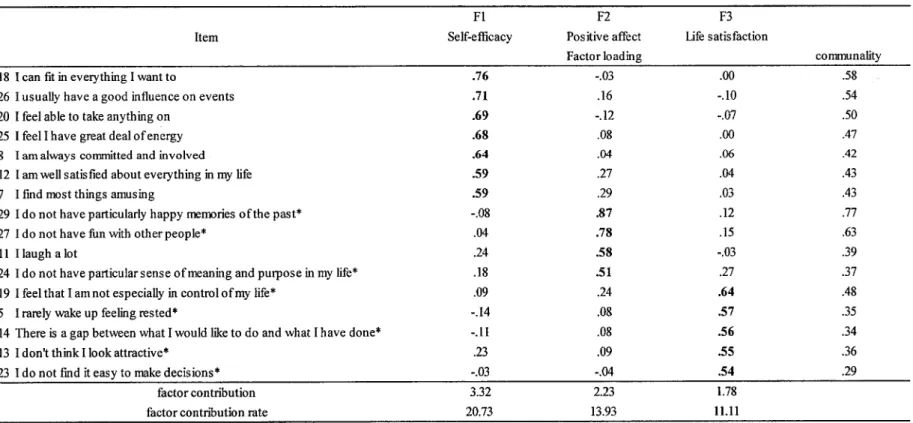
(11) loaded > .40, they too were deleted because they also loaded highly on another factor. Additional factor analysis of the same sort was performed on. the remaining items. As a result, three factors for SWB were adopted based on interpretability.. The items in factor 1 were related to the respondents' confidence in their life (e.g. "I can fit in everything I want to" and "I feel able to take. anything on"). Therefore, this factor was labeled "Self-efficacy". Factor 2 involved items related to respondents' pleasant sensation in their life, for example, "I have fun with other people" and "I laugh a lot". Therefore, this. factor was labeled "Positive affect". The last factor was related to respondents' evaluation on their life, for example, "I feel I am especially in. control of my life" and "There is not a gap between what I would like to do and what I have done". Therefore, this factor was labeled "Life satisfaction".. The results are shown in Table 1.. 9.
(12) Table 1 Rotated factor analysis ofOxford Happiness Questionnaire. Fl Item. F2. Selfethcacy. Pos itive affect. F3 life satis faction. communality. Factorloading. 8. 18 Ican fit in everythingIwant to. .76. -.03. .oo. .58. 26 I usually have a good influence on events. .71. .16. t.10. .54. 20 I feel able to take anything on. .69. .12. -.07. .50. 25 I feelIhave great deal ofenergy. .68. .08. .oo. .47. 8 Iamalwayscorrmiittedandinvolved. .64. .04. .06. .42. 12 I am well satis fied about everything in my life. .59. .27. .04. .43. 7 I fmd mo' st things amusing. .59. .29. .03. .43. 29 I do not have panicularly happy mernories ofthe past". t.08. .87. .12. .77. 27 I do not have fun with other people". .04. .78. .15. .63. 11 I laugh a lot. .24. .58. -.03. .39. 24 I do not have particular sense ofmeaning and purpose in my ure*. .18. .51. .27. .37. 19 I feel that I amnot especially in contro1ofmy life*. .09. .24. .64. .48. 5 I rarely wake up feeling rested'. -.14. .08. .S7. .35. 14 There is agap between what I would like to do and what Ihave done'. -.1I. .08. .56. .34. 13 I don't thinkI look attractive". .as. .09. .55. .36. 23 I do not fmd it easy to make decis ions". -.03. -.04. .54. .29. factor contribution factor contnbution rate * is reverse coded. 3.32. 2.23. 1.78. 20.73. 13.93. 11.11.
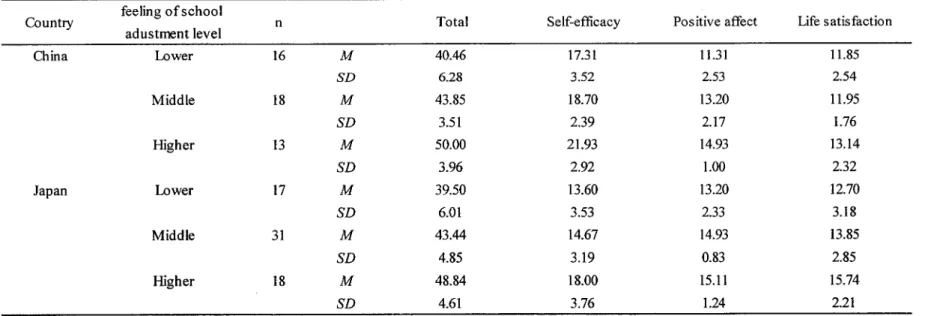
(13) Internal consistency Cronbach's alphas were computed to examine the internal consistency. and reliability of the total and subscale scores of OHQ. As a result, Cronbach's alpha for the total scores of OHQ was .78; for the Self-efficacy was .85, the Positive Affect was .77, and the Life Satisfaction was .71. All achieved sufficient reliability.. Country and levels of feeling of sehool adjustment related change in. SWB In order to determine feeling of school adjustment-related effects, feeling of school adjustment was divided in three levels: greater than mean. + 112SD, between mean + 112SD and mean - 112SD, and smaller than mean 112SD. These well be referred to as "higher", "middle" and "lower" levels. The characteristics ofparticipants are summarized in Table 2.. The total and subscale scores of OHQ were further analyzed with analyses of variance (ANOVA) 'aimed at detecting the differences in country and feeling of school adjustment level. All scales were analyzed. using between group analysis of ANOVA, in which the independent variables were country (China and Japan) and feeling of school adjustment. ievel (lower, middle and higher). ' The analyses revealed no significant effects of country in total scores. of OHQ, but in subscales (Self-efficacy: F(1, 107) = 38.40, p <.OOI; Positive affect: F(1, 107) = 13.91, p <.OO1; Life satisfaction: F(1, 107) =. 12.99, p <.OOI). The Bonferroni multiple comparison procedure was performed, yielding a difference between the two countries at the significance level of 50/o. Chinese students (M = 19.28, SD = 3.37) showed. more self-efficacy than Japanese students (M=15.30, SD=3.85). Japanese students (M = 14.45, 14.05; SD = 1.73, 3.00) showed more positive affect and life satisfaction than Chinese students (M = 13.19, 12.28; SD = 2.41, 2.19).. 11.
(14) There was also a significanteffect of feeling ofschool adjustment level. (Total scores: F(2, 107) = 29.97,p<.OOI; Self-efficacy: F(2, 107)= 16.86, p<.OOI; Positive affect: F(2, 107) = 20.60,p <.OOI; Life satisfaction: F(2,. 107) = 6.19, p <.Ol), The Bonferroni multiple comparison procedure was performed, yielding a difference among the three levels at the significance level of 50/o in the total scores (M = 39.88, 43.62, and 49.33), self-efficacy. (M = 15.06, 16.38, and 19.67), positive affect (M = 12.45, 14.19, and 15.03). and life satisfaction (M = 12.36, 13.04 and 14.64). The students in higher level showed happier than those in the middle and lower level.. However, the interaction between country and feeling of school adjustment level was not significant neither in total scores nor subscales,. 12.
(15) Table 2 Means and standard deviations on total and subscales ofOxirord Happiness Questionnaire. among three feeling ofschool adjustment levels in China and Japan. feeling ofschool. Country China. adustment level. Lower. l6. Middle. 18. tB. Mgher Japan. Lower Middle. Mgher. 13. 17. 31. 18. Life satisfaction. Total. Self-eMcacy. M. 40.46. 17.31. SD. 6.28. 3.52. 2.53. 2.54. M. 43.85. 18.70. 1320. 11.95. SD. 3.51. 2.39. 2.17. 1.76. M. 50.00. 21.93. 14.93. 13.14. SD. 3.96. 2.92. 1.00. 2.32. M. 39.50. 13.60. 13.20. 12.70. SD. 6.01. 353. 2.33. 3.l8. M. 43.44. 14.67. 14.93. 13.85. SD. 4.85. 3.19. O.83. 2.85. M. 48.84. 18DO. 15.11. 15.74. 4.61. 3.76. 1.24. 2.21. n. SD. Positive affect 11.31. 11.85.
(16) Discussion The purpose of the study was to investigate the difference of SWB between Chinese and Japanese college students. First, a factor analysis conducted on OHQ yielded three common factors in two counties. The items that loaded highly on each factor were identical. In addition, three factors. correspond to hallmarks (subjective, positive measures and global assessment) of SWB indicated by Diener (1984). The first factor, labeled Self-efficacy supported by "Subjective" which resides within the experience of the individual. The second factor labeled positive affect was supported. by "Positive measures" which indicated that the literature on SWB is concerned with how people experience their lives in positive ways. And the third factor labeled life satisfaction was supported by "Global assessment",. since many previous researches have defined SWB as a global assessment of a person's life. This result indicates that OHQ has a stable factor structure. across cultures as a valid measurement of SWB.. Moreover, the present study found that there was no significant difference between the Japanese and Chinese college students on general scores of subjective well-being. This result supported by Furnham & Cheng. (1999), however, significant differences between Japanese and Chinese college students were found in the mean scores of subscales. The factor "self-efficacy" including confidence, sense of responsibility. such items, Chinese students showed significantly higher scores than those. in Japanese students. One explanation for this would be that the students who can study abroad at Japanese colleges are the elite. Only the one get higher grade compared to peers would have this opportunity. Because of this,. the students studying abroad accounted for all Chinese students were expressed more self-efficacy than regular Japanese college students.. In contract, compared to Chinese college students, Japanese reported higher scores in positive affect and life satisfaction. Suh, Diener, Oishi, &. 14.
(17) Triandis (1998) did the cross-national research on SWB. Participants were. required to rate their satisfaction with life on a scale ranging from 1 (extremely dissatisfied) to 7 (extremely satisfied). They reported that the average score of Japanese was 4,O, higher than Chinese which was 3.3. It is. indicated that compared to Chinese, Japanese feel more satisfaction with life and happier. Moreover, as well as cross-cultural aspects of living and studying environment, Chinese students studying abroad face more difficult situation of life which may influence their life satisfaction and positive affect.. The present study was also designed to assess the relationship between. SWB and feeling of school adjustment. One ofthe main finding ofthe study. was that the students' SWB was associated with feeling of school adjustment, which could be said that there is a positive correlation between them. That is, if feeling of school adjustment level is higher, the SWB level. is also higher. Previous researches suggested that satisfaction with important domain is one of components of SWB (e.g., Diener, Suh, Lucas & Smith 1999; Diener, 2000). Doubtless, students spend a lot of their time at school, and school is one of the important domains in students' life. In other. words, positive reactions to school facets could show positive responses to other facets. Makino & Tagami (1998) reported that the ability to realize the. quality of intimate social interaction has become an important factor for increasing SWB. It is considered that the high feeling of school adjustment. could become the basis for a positive attitude towards school as well as enhance the•evaluation of living environment; the high level judgment of. school life would increase SWB. Moreover, according to the study of persons-in-environments transition theory (Yamamoto & Wapner, 1992), people affected by environmental aspects while making them actively capable to cope with an environment which called adjustment state. It is suggested that students get the balance between themselves and the school. 15.
(18) brought about as a result of increasing SWB.. Finally, the study contributes an important perspective on SWB in. Asian. However, since the surveyed Chinese college students were the students studying abroad at Japanese colleges, such results of cross-culture study was not seen to be rigorous. It is suggested the further investigation. on SWB in China and Japan should be required.. 16.
(19) STUDY2 The purpose of the present study is to investigate the difference of SWB between China and Japan from Jr. high school to college students, and it is examined how the feeling of school adjustment contributes to students' subjective well-being in a cross-sectional study.. Methed Participants In total, 1132 students participated in the study (496 males and 636. females), of which 183 Jr. high school students (mean age : 13.3, SD =. O.70), 184 high school students (mean age = 16,5, SD = O.75), and 202 college students (mean age = 20.6, SD = 1.03) from China; 212 Jr. high sohool students (mean age = 13.9, SD = O.31), 160 high school students (mean age = 16.8, SD = O.38) and 191 college students (mean age = 19,5, SD = 1.39) from Japan.. Measures The first questionnaire asked for background information including gender, age, grade and only child or not. The other two questionnaires contained scales discussed below. Subjective well-being The Oxford Happiness euestionnaire (OHQ; Hills &. Argyle, 2002) was the same as STUDY 1, The OHQ contained 29 items roughly equal numbers of positive and negative item, including self-efficacy, sense of purpose, sense of humor efficacy and so-on. Each participant was asked to judge. the extent to which each item described him / herself on 4-point scales After conversion of the scores of the reverse items, OHQ was scored in such a way that the higher the score, the higher level of SWB.. The feeling of schoel adjustment Students Adiustment Scale for lr. high. school and high school students (SAS; Asakawa, Ozaki & Kogavva, 2003). This scale was a 36-items questionnaire designed assesses Jr. high and high school. 17.
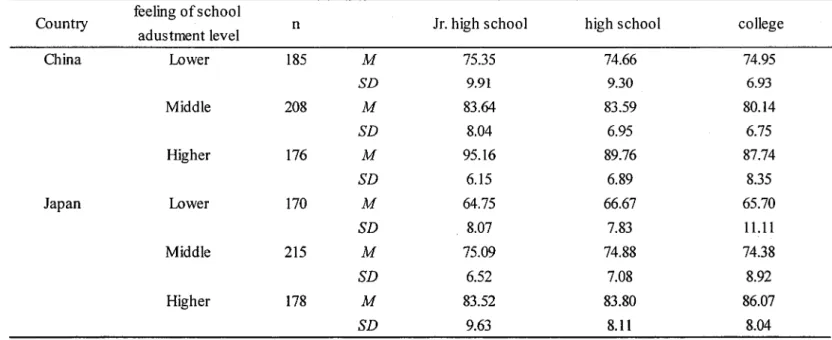
(20) students' adjustment to their school, including attitude toward extra school activity, relation to family members, interpersonal relation to teachers, academic activity, self--affirmation, interpersonal relation to friends. Students Adijustment. Scale for College Students (SAS; Yoshida, Suzuki, Kogawa, Asakawa & Azuma, 2002) was the same as STUDY 1. This scale contained 28 items that was used to measurement of college students' adjustment to their school, including mental health, academic satisfaction, interpersonal relation to friends, evaluation from others, and interpersonal relation to teachers. Each participant was asked respond on 4-point scales the same as OHQ (1= disagree, 2== slightly disagree, 3 : slightly agree, 4== agree). The higher the score indicated the positive feeling of his / her. school adjustment.. Translations of the questionnaires were done by bilingual persons, sensitive to the nuances and subtleties of Chinese and English, Chinese and. Japanese. To ensure the conceptual accuracy of the translation, questionnaires were independently back translated into English and Japanese.. Procedures The survey was conducted in September, 2010 and January, 2011. All participants were administered the questionnaire during a lecture in groups, under the supervision of the professor.. Participation as voluntary and participants were instructed to start responding after reading the instructions, assuring them of their privacy.. Questionnaire named as "school life questionnaire". Each scale was presented afier the question, "how much you agree or disagree with each statement?" It took approximately 15 min to complete the questionnaire.. Results. First, Cronbach's alphas were computed to examine the internal consistency and reliability of OHQ in both China and Japan. As a result,. 18.
(21) Cronbach's alpha for Chinese students was .86, and for Japanese students was .85. All achieved sufficient reliability.. Though I tried to do factor analysis on OHQ in SUTDY 1, Hill & Argyle (2002) indicated that the construct of SWB measured by the OHQ should be better considered as one-dimensional. Therefore, in present study,. SWB is considered to be one factor. Participants' characteristics are summarized in Table 3. As the same as STUDY 1, feeling of school adjustment was divided in three levels: greater. than mean + 1!2SD referred to higher level, between mean + 112SD and mean - 112SD referred to middle level, and smaller than mean - 112SD referred to lower level.. 19.
(22) Table 3 Means and standard deviations on Oxford EEappiness Questionnaire among the three grads in the combination ofthe three feelmg ofschool adjustment levels in China and Japan. Country China. feeling ofschool adustment level. Lower Middle. 185. 208. B Higher Japan. Lower Middle Higher. high school. college. 75.35. 74.66. 74.95. SD. 9.91. 9.30. 6.93. M. 83.64. 83.59. 80.14. SD. 8.04. 6.95. 6.75. M. 95.16. 89.76. 87.74. SD. 6.15. 6.89. 8.35. M. 64.75. 66.67. 65.70. SD. 8.07. 7.83. 11.11. M. 75.09. 74.88. 74.38. SD. 6.52. 7.08. 8.92. M. 83.52. 83.80. 86.07. 9.63. 8.11. 8.04. Jr. high school. n. 176. 170. 215. 178. M. SD.
(23) Country, grade and levels of feeling of school adjustment related change. in SWB The SWB scores were further analyzed with analyses of variance (ANOVA), in which the independent variables were country (China and Japan), grade (Jr. high school, high school and college) and feeling of school adjustment level (lower, middle and higher) for the between groups. measure. A three-way interaction F(4, 1114) = 2.89,p < .05, was significant. In. order to conduct the tests of simple main-effects, the ANOVA was computed for both countries. There was a significant interaction between grade and feeling of school adjustment level in Chinese students (F(4, 560). = 4.12, p < .Ol) while the one in Japanese students was not significant. Further analyses indicated the simple main-effect for grade was significant (middle level: F(2, 560) = 5.02, p < .Ol; higher level: F(2, 560) = 13.65, p. < .OOI). Jr. high school (M = 83.64, SD = 8.04) and high school students (M = 83.59, SD = 6.95) showed happier than college students (M == 80.14, SD = 6.75) in middle level. And Jr. high school students (M = 95.16, SD = 6.15). showed happier than high school (M == 89.76, SD = 6.89) and college students (M = 87.74, SD = 8.35) in higher level. The simple main-effect for feeling of school adjustment level was also significant in all grade, F(2,. 560) = 97.61, 58.29 and 40.23, allp <.OOI, respectively. The mean scores were 95.16, 89.76 and 87.74 for Jr. high school, high school and college students, respectively, in high level in comparison with 83.64, 83.59, 80.14. for those in middle level and 75,35 74.66 and 74.95 in Iower level. The. '. results are summarized in Figure 1 and 2.. 21.
(24) 100.00. 100.00. 95.00. 95.00. 90.00. 90.00. 85.00 se.oo. B. -d---eee".b.-N x "e-e-eee--e-"et--e--e-ee". 75 .00. 85.00. ".. Iower. 80.00. e"e middle. 75.00. e.. -higher 70.00. 70.00. 65.00. 65.00. 60.00. 60.00. A-•-----tZ" ... -ee--e-e-e-eg. ".. Iower. e-e middle. -higher. e•••••e•••••"•..........t. Jr.high school High school College. Jr.high school High school College. Figure 1 SWB mean scores in Chnese students.. Figure2 SWB mean scores in Japanese students..
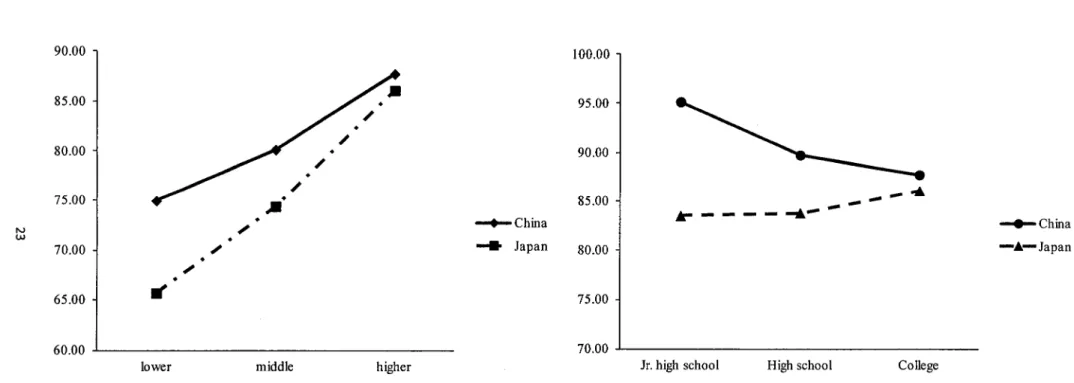
(25) 90.00. 100.00. 85.00. 80.00. 75.00. 8 70.00. 65.00. t. .. '. .. -. .. -. .. J. •. -. .. -. .. 1. .. -. 95.00. .. 90.00. 85.00. --". China. --- Japan. t "' ---. ----. .4. -China --A- Japan. 80.00. 75.00. 70.00. 60.00 lower. middle. higher. Figure 3 Comparison of SWB on all feeling ofschool adjustment levels in Chinese and Japanese college students.. Jr. higli school High school College Figure 4 Comparison of Chinese and Japanese students' SWB in all grades on higher feeling of school adjustment level..
(26) The ANOVA was also computed for each grade. Further analyses indicated a significant interaction between country and feeling of school adjustment levels only in college students (F(2, 387) = 5.81, p < .Ol) as. illustrated in Figure 3. The difference between Chinese and Japanese students was significant in middle and lower Ievel (lower level: F(1, 387) =. 35.14, p <.OOI; middle level: F(1, 387) = 20.00, p <.OOI ). Chinese students (M == 74.95, 80.14; SD = 6.93, 6.75) showed happier than Japanese. students (M = 65.70, 74.38; SD = 11.11, 8.97). The simple main-effect for feeling of school adjustment level was also significant in both China and. Japan, F(2, 387) = 34.72 and 81.30, bothp <.OOI, respectively. The mean score were 87.74 and 86.07 for Chinese and Japanese students, respectively, in high level in comparison with 80.14 and 74.38 for those in middle level and 74.95 and 65.70 in lower level.. In addition, Figure 4 showed the interaction between country and grade was also significant in higher feeling of school adjustment level (F(2, 348). = 11.47, p <.OOI). Further analyses indicated that the simple main-effect for country was significant in Jr. high school (F(1, 348) == 64.89, p < .OOI). and high school (F(1, 348) = 16.95,p <,OOI). The mean scores were 95.16. and 83.52 for Chinese and Japanese students, respectively, in Jr. high school in comparison with 89.76 and 83.80 for those in high school. Besides,. there was also significant difference in grades on Chinese students (F(2,. 348) = 12.90, p < .OOI), Jr. high school students (M = 95.16, SD = 6.15). showed happier than high school (M = 89.76, SD = 6.89) and college students (M = 87.74, SD == 8.35), but not for Japanese students.. Relationship between SWB and feeling of school adjustment. Multiple regression analyses using the stepwise method were conducted to examine which subscales of feeling of school adjustment affected each grade of SWB. Table 4 presented the multiple regression output while SWB as the Dependent Variable and subscales of SAS as the. 24.
(27) Predictor Variable. Data of school adjustment in college students was not count in this analyses due to the fact that the subscale Cronbach's alpha. were low (academic activity was .57; interpersonal relation to friends was .56) but the total scores were high.. Significant standardized partial regression coefficients were seen for. frequency of contact on each grade, suggested that SWB in any grade is contingent upon feeling of school adjustment. For Chinese Jr. high school' students, relation to family members had a strong effect. For Chinese high. school students, interpersonal relation to friends was significant explanatory variables. For Japanese Jr. high school students, academic activity and SWB were related, while interpersonal relation to friends had a strong effect in high school students.. 25.
(28) Table 4 Multiple regressions ofSWB variables on feelmg ofschool adjustment Predictor Variable. feeling ofschool adjustment. Dependent Variab le. SWB. 8. Chinese Jr. high school. self-affirmation. relation to family. .594. academicactivity extraschoolactivity. Japanese high school *** p<.OOI.. relation to fiiends. *** .586. Ch inese high school. Japanese Jr. high school. R2 relation to teachers. .606. ***. *** .748. ***. .353. ***. .344. ***. .367. ***. .560. ***.
(29) Discussion The purpose of the study was to clarify SWB in Chinese and Japanese. students. As Furnham & Cheng (1999) pointed out that, the relationship between personality and happiness was relatively consistent across cultures.. Although the major difference between the three cultures (Britain, China. and Japan) was that neuroticism was not a negative predictor among the Japanese, Chinese and Japanese showed similar in overall level of SWB.. Comparing to their conclusion, the results of the study apply another viewpoint of SWB. It indicated that there is difference in perception of. SWB in Chinese and Japanese adolescents as the feeling of school adjustment invested to be the influence factor of SWB in the study. This. result complements the one from Study 1, and make clearer of the difference.. The results from two countries indicated differences in multiple regressions. In Jr. high school, relation to family members is more important. to Chinese students' SWB, while academic activity had a strong effect for. Japanese students. Zhu & Nishikawa (1999) examined parent-child affiliation compared between Chinese and Japanese families. They reported that the difference in parent-child relationship between two countries was partly attributed to Chinese one-child policy, In present study, 32.690/o of Chinese participants are the only child, and the rate in Japanese participants was 7.460/o which is almost one-fifth of China. In only-child families, parents. naturally have one focal point, and they may tend to be more concerned about welfare of their child. On the other hand, since there are more than one child. in general Japanese families, Zhu & Nishikawa (1999) pointed out one of the features to characterize child-rearing that parents tend to be highly interfering. in the domain of education (e.g., academic success would be the prime concern), yet relatively unrestrictive in other domain. It is suggested that. intimate parent-child relationship contribute to Chinese students' SWB. Thus,. 27.
(30) it might be one explanation for the difference of SWB between Chinese and Japanese students. However, in high school, interpersonal relation to friends seems to be most important in both Chinese and Japanese students. Previous studies indicated that different from people in western culture who find it natural to consult their affect, and feeling pleasant emotions frequently is a reasonable. predictor of evaluating the good life, people in Asian cultures tend to more often consult norms for whether they should be satisfied and to consider the social appraisals of family and friend in evaluating their lives. In Asian. cultural contexts, happiness tends to be defined in terms ofinterpersonal. connectedness (e.g., Uchida, Norasakkunkit & Kitayama, 2004; Diener, 2000). In western culture, there is a strong belief in the independence and autonomy ofthe self. Happiness for them is likely to be constructed as personal achievement. In contrast, in eastern cultures, individuals' contexts are highly motivated to adjust and fit themselves to the pertinent social relations. Happiness in this culture is likely to depend crucially on the realization of. positive social relationship. Kitayama & Markus (2000) indicated that happiness is constructed as realization of social harmony in Asian culture.. Therefore, the results of the study improved that SWB in China and Japan which both belonged to eastern cultural was found to be highly effective relationship with the surroundings.. Adolescence is a period oftransition oflife span as previously suggested.. As they grow up, they demonstrate growing autonomy and their decisions and relationships increasingly determine their development. While their self-reliance increases with age, adolescents lack the status and resources of. adults. They possibly experience more confiicts of multiple origins. This. might explain the continuing decrease of SWB scores with age in Chinese adolescents. The factors contributing to the difference between Chinese and Japanese adolescents remain a subject of further investigation.. 28.
(31) Since school adjustment invested to be one of the influence factors of SWB in the study, the hypothesis that higher level of school adjustment would relate positively to SWB was upheld. Unfortunately, significant interaction between grade and feeling of school adjustment level only reported in Chinese students. It indicated that compare to Japanese students,. Chinese students showed stronger dependence on school. Huebner, Suldo, Smith & McKnight (2004) suggested that school support all students to realize their individual potentials, to develop both themselves and society and. to have satisfying lives. That may be another explanation for the difference of. SWB between Chinese and Japanese students.. General Diseussion Four primary conclusions emerge from the study. Compared to the results of Furnham & Cheng (1999), the study indicated another point of sight in SWB research, It is clear that there is a significant difference of. SWB in Chinese and Japanese adolescents, while the relation with friends aspeet showed universality across China and Japan, the relation with family. aspect showed some cultural variation. In order to complements previous. researches on SWB based on western tradition more researches on SWB ' should be specifically concerned with eastern culture. Secondly, there is a coherent pattern of relationships between scores on. the Oxford Happiness Questionnaire and the Students Adjustment Scale in. each sample. These results provide evidence that feeling of school adjustment did contribute to students' SWB, therefore, fostering a sense of. school adjustment would lead to increasing students' SWB, and high Ievel ofSWB might be beneficial for the school life, Although school occupies an. important place in adolescent's life, in the study of SWB, except school adjustment, more elements should be considered in the future research.. Thirdly, the findings in the present study should be interpreted. 29.
(32) cautiously for at least one reason. The definition reflects the view that SWB. refers to a subjective evaluation which is embedded in a cultural, social. context. As Sakurai (2009) suggested, it seemed that reflect a cultural. aspect, Japanese tend to answer more positively to negatively-keyed question (e.g., "are you unhappy?") rather than to positively-keyed questions (e.g., "are you happy?"). There are much less negative items than positive ones in present study. Negatively-keyed questions should be added. to the OHQ and SAS in order to evaluate more appropriately. Last but not least, the study of Markus & Kitayama (1991) based on the. conceptualization of cultural psychology, suggested that SWB differs from culture to culture. Kitayama & Markus (2000) also pointed out that the main. determinant of happiness is due to cultural factors and culture-defining itself predict happiness. The fixed items in questionnaire could not reflect. cultural diversity in SWB. Despite the encouraging findings, questionnaire. is not the only way to assess SWB. Moreover, the data ofSWB in China and. Japan was only put up from Hainan and Okinawa in the study. These two places might not represent the whole characteristic of Chinese and Japanese.. Because fieldwork will produce more informative composite, the strengths of the different types of research methods are often complementary to each. other. For this reason, fieldwork should combine with one-time questionnaire in the future research.. 30.
(33) References Andrew, F. M., & Withey, S. B. (1976). Social indicators of well-being: America 's perception oflife quality. New York: Plenum Press.. Argyle, M. (1987) The Psychology of Happiness. London: Methuen & Co. Argyle, M., Martin, M., & Crossland, J. (1989). Happiness as a function of personality and social encounters. In J, P. Forgas & J. M. Innes (Eds.),. Recent advances in social psychology.' An international perslpective (pp. 189-203). Amsterdam: North-Holland, Elsevier Science. Aristotle. (350 B.C.E.) Nicomachean Ethics, Book 1, Chapter 4. Retrieved from http:11classics.mit.edulAristotle/nicomachaen.1.i.html. Asakawa, K., Ozaki, T. & Kogawa, M. (2003). A school psychological study of fresh students' adjustment to their junior high school. Hyogo. University of Teacher Educationjournal, 23, 81-88.. Asakawa, K., Morii, Y., Kogawa, M., & Uechi, Y. (2002). A study of students' adjustment to their high school: Development of the index of. students adjustment to high school life. Hyogo University of Teacher Education journal, 22, 37-40. DeNeve, K. M. & Cooper, H. (1998). The happy personality: A meta-analysis. of 137 personality traits and subjective well-being. Psychological Bulletin, 124 (2), 197-229.. Diener, E. (1984). Subjective well-being. Psychological Bulletin, 95 (3),. 542-575. Diener, E. (2000). Subjective well-being: The science of happiness and a proposal for a national index, American Psychologist, 55 (1), 34-43. Diener, E., & Diener, M. (1995). Cross cultural correlates of life satisfaction. and self-efficacy. Journal of Personality and Social Psychology, 69,. 851-864. Diener, E., Suh, E. M., Lucas, R. E., & Smith, H. L. (1999). Subjective. Well-Being: Three decades of progress. Psychological Bulletin, 125. 31.
(34) (2), 276-302.. Diener, E., Oishi, S., & Lucas, R. E. (2003). Personality, culture and subjective well-being: Emotional and cognitive evaluations of life.. Annual Review ofPsychology, 54, 403-425. Furnham, A., & Cheng, H. (1999). Personality as predictor ofmental health. and happiness in the East and West. Personality and Individual Dbjferences, 27, 395-403.. Hills, P., & Argyle, M. (2002). The Oxford Happiness Questionnaire: A. compact scale for the measurement of psychological well-being. Personality and Individual Differences, 33, 1073-1082. Huebner, E. S., Suldo, S. M., Smith, L.C., & McKnight, C. G. (2004). Life. satisfaction in children and youth empirical foundations and implications for school psychologists. Psychology in the Schools, 41(1). 81-93.. King, L. A., & Napa, C. K. (1998). What makes a life good? Journal of Personality and Social Psychology, 75, 156-165.. Kitayama, S., & Markus, H. R. (2000). The pursuit of happiness and the realization of sympathy: Cultural patterns of self, social relations,. and well-being. In E. Diener, & E. M. Suh (Eds.), Subjective well-being across cultures (pp. 113-161). Cambridge: MIT Press.. Makino, Y. & Tagami, F. (1998). Relations of social interactions to subjective well-being. Japanese Journal of Educational Psychology,. 46, 52-57. Markus, H. R., & Kitayama, S. (1991). Culture and the self: Implications for. cognition, emotion, and motivation. Psychological Review, 98, 224-253. Naito, Y., Asakawa, K., Takase, K., Kogawa, M., & Koyizumi, R, (1986). An school adaptation scale for high school students. Hyogo University. of Teacher Educationjournal, 7, 135-146.. 32.
(35) Ruff, C. D. (1989). Happiness is everything, or is it? : Explorations on the. meaning of psychological well-being. Journal of Personality and Social Psychology, 57(6), 1069-1081. Sakurai, R. (2009). Cross-cultural study on students' life satisfaction: a pilot. study on the sense of "happiness" in Finland, Bhutan, and Japan. The. Sellrf the Other and Language (ID: Dialogue between Philosophy and. Psychology (Graduate School ofEducation, Kyoto University?, 111-118. Sawada, H. (1991). The way to understand adolescence. In N. Imaizumi & H. Minami (Eds.), Psychology ofadolescence in life cycle (pp. 228).. Kitaooji Shobo Pubilishing. Schimmack, U., Oishi, S., & Diener, E. (2002). Cultural influences on the. relation between pleasant emotions and unpleasant emotions: Asian dialectic philosophies or individualism-collectivism? Cognition & Emotion, 16(6), 705-719. Seligman, M. E. P. (1998, January), Building human strength: Psychology's. forgotten mission. APA Monitor, 29 (1). Retrieved from http:11www.apa.orglmonitorl Skevington, S. M., MacArthur, P., & Somerset, M. (1997). Developing items. for the WHOQOL: An investigation of contemporary beliefs about quality of life related to health in Britain. British Journal of Health. Psychology, 2 (1), 55-72, Suh, E,, Diener, E,, Oishi, S., & Triandis, H. C. (1998). The shifting basis of. life satisfaction judgments across cultures: Emotions versus norms. Journal ofPersonality and Social Psychology, 74 (2), 482-493. Thuneberg, H. (2007). Is a maJ'ority enough2 Psychological well-being and its relation to academic andprosocial motivation, self-regulation and. achievement at school. Research Report 281, dissertation research, University of Helsinki, Yliopistopaino.. 33.
(36) Uchida, Y., Norasakkunkit, V., & Kitayama, S. (2004). Cultural constructions of happiness: theory and empirical evidence. Journal of. Happiness Studies, 5, 223-239.. Ueda, S., Yoshimori, M., & Yukura, M. (1992) The psychological study of happiness (2): An attempt to make the happiness scale. Bulletin ofthe. Faculty of Education, Hiroshima University, Part 1 (Pedagogy & psychology? 41 (1), 35-40. Wilson, W. (1967). Correlates of avowed happiness. Psychological Bulletin,. 67 (4), 294-306.. Yamamoto, T., & Wapner, S. (Eds.) (1992). A developmental psychology study oflife transition. 2"d ed. Japan: Kitaooji Shobo Publishing.. Yoshida, S., Suzuki, K., Kogawa, M., Asakawa, K., & Azuma, K. (2002). A study of adjustment to college and future prospects in female students.. The Japanese Society for Study of Career Guidance. 1 1, 22-23.. Zheng, X., Sang, D., & Lin, Q. (2004). Personality, cognitive and social. orientations and subjective well-being among Chinese students. Australian Psychologist, 39(2), 166-171.. Zhu, W., & Nishikawa, K. (1999). Parenting style and parent-child affiliation: a comparison between urban Japanese and Chinese. Bulletin of the Faculty of Education, Mie University Educational Science, 50, 149-159.. 34.
(37) Acknowledgements This dissertation would have been impossible without the ongoing assistance and support ofmany people in many ways. First and foremost, I would like to express my sincerest gratitude to my. supervisor, Professor Kiyoshi Asakawa, for taking me under his wings and. providing me with this research opportunity. I really appreciate his guidance, support, understanding, patience and encouragement all through my master program and my dissertation work, I am also deeply indebted to. Professor Sayoko Kobayashi, Associate Professor Tadao Fujiwara and Associate Professor Keiko Akimitsu for their continued support and helpful. and insightfu1 comments.. My deep gratitude also goes to Professor Masafumi Kogawa, Professor. Daisuke Tominaga, Professor Tuyoshi Matsumoto, Associate Professor. Reiko Nakama and Mr. Masanori Minami, who has encouraged me and provided invaluable suggestions.. I would like to thank Mr. Haiwen Li, Mrs. Huijun Li, Mrs. Dongxia Xie. and the students from Affiliated Middle School and High School of Hainan Normal University and Hainan Normal University, who participated in the study for supporting me in this effort. I also express my hearty thanks to Mr.. Ohama Hiroshi and the students from Shuri Middle School, Naha High School and University of the Ryukyus, who participated in the study with great cooperation. Without their impressive kindness and patience, I could not have completed the study.. I am really thankful to Rotary Yoneyama Memorial Foundation for the. 35.
(38) financial support of my life. I am also gratefu1 to my consular Mr. Konishi,. who has been so kind to me during my stay in Japan. I also owe much to the. kind people in Ono-Kato RC for their encouragement all through my study here in Japan.. I also wish to express my sincere gratitude to the following people who. studied with me for their valuable ideas, kind support and warm encouragement: Ms. Mami Imai, Ms. Mari Ishii, Mrs. Kazumi Adachi, Mrs.. Kimiko Kaneshige, Mr. Hanshu Sakai, Mr. Kouhe Wakuda, Miss. Shiho Fukuyi, Miss. Yuki Kajiwara, Miss. Manami Suzuki, Miss. Aoi Kishino,. Miss. Huizi You, Miss. Jie Hua and Miss. Manami Imaishi. I enjoyed discussing with them and will remember the wonderful times.. Last but not least, I wish to thank my parents for their enthusiasm, understanding and support all the time.. 36.
(39) Appendix 大学の生活についての調査 ( S 制御 1. &Study2 ). ••••••••••••••••••••••••••••••••••••••••••••••••••••••• 3 8 中学(高校)の生活についての調査 ( S t u d y2 ) ••••••••••••••••••••••••••••••••••••••••••••••••••••••• 44. 37.
(40) 大学の生活についての調査. 兵庫教育大学大学院 学校教育学専攻. 学校教育研究科. 学校心理学コース. 浅川潔司研究室祁秋夢. 女この調査は、いくつかの質問紙から構成されています。 ;t-Cl,¥金企について答えて みなさんが、現在、大学生還まとC皇室巨感じたり、考t 下さい。. 女この調査は、警弦企成績とは何の関係もあ旦主主企怠また、それぞれの質問には 正しい答えやまちがった答えといえるものはありません。ですから、現在、感じてい ることや考えていることを、そのまま答えて下さい。. 女答えている聞は、昆虫食込金査星主旦J駐英しないでくだ宣ピ旦. 女あなたの答えを、銀(J)A.(こ見せることはありませんので、安心して答えて下さい。. 女最初から順番に落ち着いて答えて下さい。士会主企質問に必ず答えて下さい。. 女最後に、もう一度記入もれがないか確かめてください。. 38.
(41) A . あなた自身に関わることを答えて下さい。 1)あなたの性別を教えてください。. 〈男・女〉. 2) あなたの学年を教えてください。. 学部( 1. ・ 2. ・ 3. 大学院( 1. ・ 2. ・ 3 )年生. 3) あなたの年齢を教えてください。. (. 4) あなたは一人っ子ですか。. くはい. 39. ・ 4 )年生. )歳. ・ いいえ〉.
(42) 全 く. B .. 下記の文章を読み、あなたの思うものに最も近い項│き 目を 1つだけ選び、その数字(1"-'4)ω をつけ│男. Iな. てください。. い. 私はほとんどの人に対レて温かい気持ちに. 4). なる '-='.~--=-_. _ ---.-,..,~. -~~~-----'----I. 1. まりない. め…|私ほ由来i示ITu~あまb町会合自治まが 1. …. 田 ス ー. 3三. 宮;思 長 ;ぅ;ぅ i. I1 2. 私はすっきりした気分で目覚めることはあ. 5). 少 ; か j非 レ jな ; 常 そ!り;に う;そ:そ. 2. 314 314. I1 2 3 4. 7) I 私はどのようなことにでも、楽しさを感じる. 4. I 私はいつも伺かに専怠レ、夢中になっている 9) I 人生はいいものだ 10) I 私はこの世界がよいところだとは思わない 1 . . 1 . . . . . . ) . . . . . " " [ . . . . i ムl おく実る…山 . . _ _ . . . . . . . . . . . . . . 1 " . . . . . 1 8). …. m. ω. 12) 私は自分の人生のあらゆるものにとても満 1 '-'---'~--'. .~------~. -. ---.-- -. -..-~. 1. 1. 足している. 13) 私は自分が魅力的に見えるとは思わない 1. │. ととの聞にはギャップがある. 1 . 5 . ) . . . . . . 1 元日己でも幸四台長…………. … … 一 一. 3. 4. 112 3 4. 私がやりたいこととこれまでやってきたこ. 1 4〉│. 2. 1 2 3. 4. " 1 . . . 1. 16) I 私はなにかを見て美レいと思うことがある I1. 17) I 私はいっち人に元気を与える. I1 18) I 私は自分の望む通りどんなことでもできる I1 I2 I3 !4 19) 1私は自分の人生を特には思い通りにしてい -=:~-~= ~,.~ -.~ .-._-.~.- -~ _ . - - - " 11 ないと思う. 20) I 私は何でも手に入れることができると思う I1. 21)I 私はとても注意深し 1 と思う. I1 40. 2 !3 !4.
(43) 力 、. 全少. B .. くし. 下記の文章を読み、あなたの思うちのに最ち近い項. な り そ. 33. 非 常. そ. つ つ. てください。. な わ い. 私はよく喜びを感じ、とても得意な気持ちに 22) 1 =.-=-~~_:~~ ~.~._, - - ~,-~,~, ~__v.~ ' 11 なる経験をする. 、 宮. う. 思. つ つ. 2 13 I4. : : : . = . _ . -. 私は伺かを決断することが簡単ではないと 23) I ~.,.-. --_.-.-~. ' 1 1 I2. I3 I4. 思つ. 4. 24) 私は人生に特別な意義や目的を感じない 1. 25) I 私は活力に満ちあふれている 26) I 私はだいてい物事を畏い方向へもっていく. I1 27) I 私は人と一緒にいても楽レくない I1 28) I 私は特に自分が健康だとは感じない I1 I. 29) 私は過去にとりたてて幸せだと感じた思い _ . ---. . I 1 I2 I'~:~-~~'--. _.__.~.. 出はない. ._.~.-. 一. 。回答がおわりましたら、次のページの質問に回答してください。. 41.
(44) 云 d《 丘、. く. c .. 当. て l ま. 下記の文章を読み、あなたの思うものに最も近い項. ま. " ' 4 )I こOをつけ 目を 1つだけ選び、その数字(1". 最近私は,この大学に入学してよかったと. 思っている ・ ・・“咽判叫・"句"“"・"“““・......・ ・ ' “ ・ “ . . . . . . . . “ " “ . . . . . . . . . 2) . 私は,多くの人とつきあおうと思う . . . J… . . “ . . . . . . . . . . . ・ . . . ・ ・ . . . ・ ・ " “ . . . . . . . “ “ " . . . . “・ ・ “ " ・ ・ ・1 ……… . 私の大学の先生たちは,私の勉強を評価し H. ま. り. 当. て l ま. ら ま な ら し1 な い. てください。. 1). あ. 2. 、 力 な り 当 て. と て ち よ く. ま. て l ま. i ま る. 当. ま る. 3. 4. 3. 4. 3. 4. 2 !3. 4. H. ・a・“"咽冒咽同....,.~..・e ・. H M. M. 3). 2. てくれる ・吋““・・ ・ 仲 ・ . . . . . . . . ・ 句 ・ ・ ・ . . . . . . . ・ 咽 官 ・ ・ 咽 " ・ . . . . . ・ ・ … … … ・ ・ ・ー ・ 私は,自分の勉強が思うように進むと感じて. m o. 4). いる . . . . . , . “ ・ . . ・・ ・ . . . . . . . . ・ ・ ・ ・ ・・ . . . . . . . . . . . . . . ・ ・ . . . . . ・ 仲 ・ ・ ・ ・ ・ ・・ 咽 . . . . “ . . . . . . . 、 . . . . . . . . . ー ' “ , . . . . " . . . . . . . “ " “ . . .町 5 ) 私は最近,ゅううつになりがちだ . . . . . . . . . . . . . " . . . “ . . . . . . . . . 町 ・ ・ 咽・ ー ・ ・ ・ ・ 曹 司 . . . . ・ . 且. H. a. H. 2 13 4. h. 6). 私のコースの担任は,私のことをよく思つ ている 刊 . . . . . . . ・ . . . . . . . . . ・ . . . . . . . . . . . . ・ _ . . ・・ 叫 “ . . . . . ・ 、 . . . . . . . . . . . . . . . . . . . . . . , 叫 町 ・ . . . . . " ・. . 町 " . . ・ . . , . ・ 私は,この大学での勉強が楽レい 山 白 . ・ ・ 自 由 . . . , ・・ ・ . . ・ , . ・・ 刊 山 町 田 ・・ ・ . . . . . . ・ ・ ・ ・・ ・ ・・・・ ー . . . ・・ . , . . . . . . . . ・山 市 山 川 町 山. 2. 3. 2. 3 14. 2. 3. 4. H. ア 〉. H H. 8). H H. M. H. H H. H. H. H. h. 私は,自分の大学内に何でも話せる友だち がいる . . . . . . “ " “ . . . . . . " . . . . . . . . . . . . . . . 伺 . . . . . . . . . . . , . . . . ・ ・ " ・ ・ 咽・ ・ ・ 句 . . . . . . . . . . . . . . . . . . . . . . . . ・ 咽 帥 帆 叫 ・ . . . . . . . . . . . . . " . . " . . . , . . . . . . . . . . " " . “ . . " “ ・ 私の授業での発表は, t 受業の中で評価され. 1. 4. e. 9). 1. ている . . . . . . . 山 ・内 町 ・ ・・ 村 山 町 村 山 阿 仲 叫 山 間 咽 山 山 町 " , , , . 川 山 . . . . ・ _ . . . ・・ ・ , 10) 私は最近,一生懸命自分の勉強をしている “ “ . . . . . . . . . . . . . . . . . . . . . . . . 同 叶 . . . . . . . . . . , . . . . . . . “ " “ " “ 句 , . " . . . . ・ ・ ・ “ . . . , , , . . . . , , . , , . 例. . . . . . . . ・ “ " “ “ “ 制 ・・ “ . . . ・ . . . ー . . . . . . ・ . . . . . . “ . . . . . _ . . ・ ・ ・ ・ ー ・ . . . . . . . . . 11) . 私は最近,神経質になってきた 1 2 . . . ・ ・ ・ “ “ ・ H. H. M. M. 4. M. H. 3. 4. 3. 4. 3. 4. a. ............................................................................................."........................“・・............~........“". 12). 私の大学の先生たちは,私のことをよく思 っている _ . . . . . _ . . ・ ・ ・ . . . . . . ・ " . _ . ・・ . . . . . . . . . . . . . . . . . _ . . . . 咽 ・ 判 官 阿 ・ 叫 . . _ . . . . . . .. 句 叫 句 . . “ . . . . . . . . . . ‘ . . . . ・ . . . . ‘ ・ . . . . . . . “ . . . . . 柏 . . この大学で私が受ける授業は,私の勉強に H H. 13) ・. p m. …"…。. 14). 4. 役立つ 山 山 山 " 問 問 問 山 間 同 』 恒 閉 山 間 . . . _ . _ . . . . “ 出 山 川 村 山 戸 判 “ ・ 田 町 山 . . . . _ . . . . _ . . ・ ・ 四 . . . . ・ ・ 川 崎 山 村 H. 私が話すとき,人は私に J~\ を開いてくれる. 町一…ー 一 一 一 岡 山 一 一 … … . . . . . . . . . . . ・ … ー … … … … … … … … 山 山 … … … … " 日 目 山 … … … … … 一 一 … … … 一 山 私の大学の友だちは,私の勉強を評価して. 15). くれる _ . _ _ . . _ . _ . . . ・・ 町 一 … … … _ . . . . _ _ . " .ー 一 一 … 一 一 … 一 一 … . … … 一 一 … … 四 一 … 一 一 . _ . . . . . . ・・ 一一一…… 一 私はこの大学で勉強を続けていく私の能力 M. 16). 2. H. M. に自信がある 4 2. 2. 3. 4. 3. 4. l.
(45) あ ま り. か な り. b. てください。. な い. て l ま ま ら な い. て l ま ま る. 17) 1私は最近,なんとなく不安になる. 1. 2 i3. 全. く. c .. 当. て l ま ま. 下記の文章を読み、あなたの思うものに最も近い項 目を 1つだけ選び、その数字 ( 1,-....,4) I こOをつけ. 私は,自分のコースの担任と,勉強以外の面 18) 1 ='::-=-~-.:-.~ ~ :~~:~'.~~ , . , .---1 1 でも個人的なつきあいがある. 19). 私は最近,この大学での自分の学習に価値 ---,,~. 1. ---~,---~ ~.-.~.=. 1. 1. があるかどうか疑問に思う. 当. 2. と て ち よ く. 当. 当. て l ま ま る !. 4. I3 i4. 213 4. . , , _ . --, " . , .--1 1. 私は,自分の大学の友だちと勉強以外の面. 20) 1. --. でち個人的なつきあいがある 私のコースの担任は,私の勉強を評価レて 21)1 -. , . . _ . , , , -_ u . -11 i2 i3 i4 .~~- ~. ,~--. くれる. 22)I 私は最近,勉強する気があまりレない … …… … … ……・-…… … … . . . . ・ ・・ … 23)I 私は最近,感情の変化が激レい f . . . . . . . . . . . .. om. 11 213 4 …仰い………ト 1112 3 4. … … … ト . . " . . . ・ - … γ. 私は,圏内の他の大学に入学すればよかっ 24)I-=.:.:....~'-=-~~:--"~ ,-,,~ - , -11 2 I3 14 たと思っている I.i- I 25)I 私は,集団に参加することができる 11 2 314 y._'-"". .?~2........I相手1 烹奏での秀奈川は?烹<-之さる. …. ω . . . . . L . . . . : !よ “ 2 3… L竺. 私は卒業するまでに,価値のある学習成績. 27)I~.....'-~:-~ ,:::.,~-~-' をあげる自信がある. '~'=--~--~~."..'."11. 長 ..)......[弘1d:~~I,こ色分力慌た七 lま~玩I 玩耐震えィ長引ちだ:…一一…. 2¥3 4. l ii z i 3 H │ 子. 3. 弓. 以上で、全ての質問は終わりです。 ちう一度、回答が抜けていないかの確認をお願いします。 記入が終わりましだら、配布者に提出してください。. ご協力ありがとうございました。 43.
(46) 中学(高校〉の生活についての調査 兵庫教育大学大学院 学校教育学専攻. 学校教育研究科. 学校心理学コース. 浅川潔司研究室祁秋夢. 女この調査は、いくつかの質問紙から構成されています。 みなさんが、現在、中学(高校)生活支互金主うに感じたり、毛主玄{, ¥ . @ 企広三位玄答えて下さい。. 女この調査は、学校の成績釘封耳金関係もありません。また、それぞれの 質問には正しい答えやまちがった答えといえるものはありません。です から、現在、感じていることや考えていることを、そのまま答えて下さい。. 女答えている聞は、周りの人のを見たり、相談しないでください。 女あなたの答えを、飽(J)A.巴里: t t . @ことはありませんので、安心して答え て下さい。. 女最初から順番に落ち着いて答えて下さい。すべての質問に必ヨ資;;t玄 下さい。. 女回答したくない方は、記入せずにこの冊子をそのまま返却してください。. 女最後に、もう一度記入もれがないか確かめてください。. 4 4.
(47) A . あなた自身に関わることを答えて下さい。 1)あなだの性別を教えてください。. 〈男・女〉. 2) あなたの学年を教えてください。. 中学( 1. ・ 2. ・ 3 )年生. 3) あ な だ の 年 齢 を 教 え て く だ さ い 。 (. くはい. 4) あなたは一人っ子ですか。. 45. )歳. ・ いいえ〉.
(48) く そ. 少 レ そ. ' E U A B. 官 、. /丘 三 ¥. B . 下記の文を読み、あなたの思うものに最も近い項目. " ' ' 4 )I こOをつけて を 1つだけ選び、その数字(1' ください。. 1). I 私は自分の生き方にあまり満足していなし 1. 2) I 私は他の人々にとても関山がある 3) I 人生は価値があると思う. 4). 私はほとんどの人に苅レて温かい気持ちを ちてる. つ. わ つ な し1. まりない. …6 )…. 1. つ. 常 非. そ. つ. 宮 、. 、 忠. つ. つ. ; 三 : お I1 2 i3 i4. 私はすっきりレ疋気分で目覚めることはあ. 5〉 1. つ. と て も そ. 1 21. 4. f f b " i 三 由 来 止 対 G-Cあまり会旬的ではない. 7). I 私はどのようなことにでち、楽レさを感じる. 8). I 私はいつも何かに専怠レ、夢中になっている I1. 9) し人生はいいちのだ. │. 10) I 私はこの世界がよいところだとは思わない I1. 11) I 私はよく笑う 私は自分の人生のあらゆるものにとても満 12) I 足している. 13) I 私は自分が魅力的に見えるとは思わない 私がやりだいこととこれまでやってきたこ 14) I ととの聞にはギャップがある 1 . . . . . . . . 5 . . ) . . . 1志 は " と て も 手 伝 た ご. 16) I 私はなにかを見て美しいと思うことがある 17) I 私はいつも人に元気を与える 18) I 私は自分の望む通りどんなことでちできる I1 私はあえて自分の人生を思い通りにしてい 19) I ~~~, -::_-~--"~-'~.y~_._- _ YI 1 るとは思わない. 2 3 4. 20) I 私は何でも手に入れることができると思う. I1. 21) I 私はとても注意深いと思う. I1 2 3 4 46. 2 3 4. …一十一…ー…十一一一.
(49) 全. 少. く そ. レ そ. 思 わ な い. 思. 22) 私はよく喜びを感じ、とても得意な気持ちに 'I.:"~~~_~:'-' ~/L!J''-'' ' - '- '-'I'~/UJ\'~~~~ !J " ' 11 なる経験をする l. 2. 私は伺かを決断することが簡単ではないと 23) I 一-•-. .----•_ .----I1. 2. 8 . 下記の文を読み、あなたの思うものに最も近い項目. つ つ. を 1つだけ選び、その数字(1" ' 4 )I こOをつけて ください。. l. と て ち そ. 非 常. そ. つ つ 居 思 つ 、 つ つ. 4 3. 4. 思つ. 24) I 私は人生に特別な意義や目的を感じない. I1 私は活力に満ちあふれている I1 25) I 私はだいてい物事を良い方向へもっていく I1 12 I3 14 26) I 27) I 私は人と一緒にいてち楽レくない I1 !2 I3 28) I 私は特に自分が健康だとは感じない I1 I2 i3 i4 私は過去にとりたてて幸せだと感じた思い│ i i j 29) I'~:~-'._-~'---'-- -, -'--'~'-'-'~"-I 1 2 I3 i4 出はない. 。回答がおわりましたら、次のページの質問に答えてください。. 4 7.
(50) 下記の文を読み、あなたの思うものに最も近い項目 を 1つだけ選ぴ、その数字 ( 1,-....,4)I こOをつけて ください。 1). I 私は学校ヘ行くのが楽レい 1. 親は良き理解者だ. I. 4. 1 1. I 自分がなさけなくてイヤになる 7) I 私には悩みを間いてくれる友人がいる 8) I 今の自分に自信がもてない 9) I 私は部活動に自主的に参加している 10) I 私は親から信用されていると思う 11) I 先生は私によく声をかけてくれる 12) I 私は自分にあった進路を考えている 6). 314. 2. 314. I1 I1. 4 4. 314. 121611. 13) I 私はちょっとしたことでくよくょする 私は部活動を通じて成長できると思ってい. る 私は自分の思っていることを家族にきちん と伝える. 2. 3. 4. 2. 3. 4. i2 3. 4. 16) I 私はこの学校で相談できる先生がいる. 2. 17)…l 相手自 J 5 ( ] )進E 号 ( ] ) C ζ 努事割r;:考え玄い秀 I . . J .. 2. 18). 4. I1. 5) I 私は勉強に積極的である. 15). 2. 3 3. 1. 4) I 私は先生に親しみや温かさを感じる. 14). iつ. 2. 2) I 私は部活動に意欲的に取り組んでみたい 3). レ iて. そ Iち : う!そ 思!う う;思. 非常にそう思う. 全くそう思わない. c .. 少 iと. 部活動をやることで伺かをやりとげている. と わ : : : : : : : : 一 … 一 │. という実感が得られると思ぅ. 長 . . ) _ . . . ' [ お 長 時 計 手v v ¥. 1. 20). 部活動に参加することは楽しいことだと思. つ. わ~?.J亙!己一一言語匙v)記長だし"瓦二|. 4 4. I. !_ 2 2 ) 私は友だちからいろいろと打ち明けられて I 相談される I1 .!2 !3 4 ふ子│初期を尊台己記し ¥D … I Li 2 1玄 14 ー. 48. ….
図

+2
関連したドキュメント
This paper aims to study the history of Chinese educational migration and state policies which influence overseas Chinese students, to explore the mobility tendency of
The aim of this pilot study was to measure PBDEs in serum samples from young Japanese males and to examine the relationship between serum PBDE levels and sperm quality.. MATERIALS
Related to this, we examine the modular theory for positive projections from a von Neumann algebra onto a Jordan image of another von Neumann alge- bra, and use such projections
knowledge and production of two types of Japanese VVCs, this paper examines the use of syntactic VVCs and lexical VVCs by English, Chinese, and Korean native speakers with
This study investigates when and how the readers make a decision on such dependency during on-line sentence processing, especially when they read sentences
There was no significant statistical difference observed between Swimsuit X and Swimsuit C in terms of walking speed in the water, step/pace, or heart rate immediately after the
This study examined the relationship between the swimming velocity Japanese top junior competitive swimmers and their muscle mass according to growth
Introduction to Japanese Literature ② Introduction to Japanese Culture ② Changing Images of Women② Contemporary Korean Studies B ② The Chinese in Modern Japan ②
