
キイロタマホコリカビのヘテロジニアス核RNAを含むリボ核タンパク粒子
7
0
0
全文
(2) Journal of Hokkaido University of Education (Section II B) Vol. 28, No. 1 September 1977. •\mW^±W^ (HS2^B) ^28^ ^1-^- Bg^ 52 ^ 9 ^. Ribonucleoprotein Particles Containing Heterogeneous Nuclear RNA in D. discoideum1. Fusayuki KANDA Biological Laboratory, Kushiro College, Hokkaido University of Education Kushiro 085. ^ n^^r; ij ^li'^^Tu^'^r^^RNA. ^^])^^>^^'^ tt ffl ^ ^?T. WWKWMW^W^ SUMMARY The nuclear pulse-labeled RNA in the cellular slime mold Dictyostelium discoideum exists as small-sized (10 to 50 S) ribonucleoprotein (RNP) particles in contrast to large-sized nuclear RNP particles in higher eukaryotes. These small-sized RNP particles are not artificial products due to a ribonuclease digestion of large particles, nor ribosomal and its precursor particles. It seems. certain that the pulse-labeled RNA contained in the nuclear RNP is heterogeneous nuclear RNA, because it was heterogeneous in size and resistant to actinomycin D and because it exhibited the same sedimentation pattern as that of poly(A)-containing nuclear RNA. The proteins included in the RNP particles are composed of several major proteins and heterogeneous minor ones.. In mammalian nuclei there exist ribonucleoprotein (RNP) particles with sedimentation coefficients of 40 S to 250 S (1). The RNP particles contain the so-called heterogeneous nuclear RNA (HnRNA) which is supposed to be the precursor to cytoplasmic mRNA, although almost all of HnRNA degrades within the nuclei. It has been also demonstrated that HnRNA in mammalian cells is fairly large in size, as compared with cytoplasmic mRNA. In contrast, some of lower eukaryotes do not have such large-sized HnRNA as found in mammalian cells (2-4). In fact,. HnRNA in the cellular slime mold Dictyostelium discoideum has been reported to be only 20 % larger on the average than cytoplasmic mRNA (2).. lThis work was carried out while the author was at the Department of Botany, Faculty of Science, Hokkaido University.. Abbreviations: RNP, ribonucleoprotein; HnRNA, heterogeneous nuclear RNA; poly(A), polyadenylic acid; poly(U), polyuridylic acid.. (23).
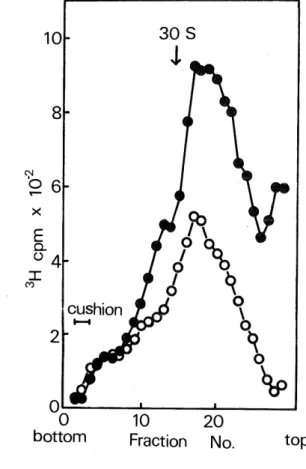
(3) F.KANDA. Then, a question arose as to whether or not such small HnRNA in this organism exists as. RNP particles. In this paper, it will be reported that D. discoideum possesses nuclear RNP particles containing HnRNA, although they are small in size (10 S to 50 S) relative to those in higher eukaryotes.. The amoeba cells of D. discoidenm NC-4 which were grown as reported previously (5) were Fig. 1. Sedimentation analysis of the nuclear extracts. prepared at pH 7.0 (a) and pH 8.0 (b) after labeling of cells with[3H)uracil for 30 min at the early aggregation stage during morphogenesis. Amoeba cells grown by using. dead Escherichia coli cells as nutrients (5) were harvested in a late log-phase of growth, washed several times by. centrifugation with TKM buffer (15 mM Tris-HCl (pH 7.6), 20 mM KC1 and 5 mM MgCla) and suspended in the same buffer containing streptomycin sulfate (150 /ug/ml) at a cell density of 3 x 10⁸/ml. In order to obtain a high degree of synchrony of morphogenesis, definite volumes of the cell suspension were dispensed on non-nutrient. agar plates containing streptomycin (150 ^/g/ml), followed by incubation at 23°C. The cells in the early aggregation stage of morphogenesis (5 to 6 h after the onset of incubation) were treated with 120 //g/ml of actinomycin D for 1 h and then labeled with 500 ^Ci/ml of C3H]uracil for 30 min in the presence of the drug. After labeling, cells were rapidly chilled and washed with ice-cold TKM buffer by centrifugation. The preparation of the nuclei, as described below, was carried out at 0° 4°C. The labeled cells were disrupted in a Potter-type homogenizer at a concentration of 2 x 10" cells/ml in 5 % sucrose containing 0.2 % Triton X-100, 3 mM magnesium. acetate and 10 //g/ml polyvinylsulfate. After 10 min incubation, an equal volume of 22 % sucrose containing 3. mM magnesium acetate and 10 ^g/ml polyvinylsulfate was added to the cell homogenate. The nuclei were. pelleted by centrifugation at 1,000 x g for 10 min and washed twice with 13.5% sucrose containing 0.1% Triton X-100, 3 mM magnesium acetate and 10 /uH/m\ polyvinylsulfate. The crude nuclei were further purified through a solution of 1.95 M sucrose, 3mM magnesium acetate. and 10 ,ug/ml polyvinylsulfate by centrifugation at 17,000 rpm for 45 min at 4°C in an SW 25.1 rotor of a Spinco L ultracentrifuge. The purified nuclei were suspended in TNM buffer (pH 7.0) containing 10 //g/ml polyvinylsulfate, stirred for 10 min at 4°C and centrifuged at 7,000 x g for 10 min. The resultant supernatant fluid was termed pH 7.0 nuclear extract, and the residual pellet was resuspended in TNM buffer (pH 8.0), stirred for 30 min at 4°C and centrifuged at 10,000 x g for 10 min to remove nucleoli and nuclear debris. The supernatant fluid so obtained was named pH 8.0 nuclear extract. The pH 7.0 or 8.0 nuclear extract was mixed with a trace amount of 14C-labeled 30 S ribosomal subunits of E. coli Q13 as a reference to determine the sedimentation coefficient and then centrifuged. using a Hitachi RPS 27 rotor at 26,000 rev./min for 14 h at 4°C in a 10—25% (w/v) linear sucrose gradient containing 2 M sucrose cushion in the bottom which was made with TNM (pH 8.0) containing 10 {j.g/m\ polyvinylsulfate. After centrifugation, an appropriate number of fractions of the gradient were taken, an aliquot (0.05. ml) of each fraction was placed on glass-fiber filters (Whatman GF/C) and the radioactivity was measured in a Beckman liquid scintillation spectrometer as described previously (7). 0——0, pH 7.0 nuclear extract; ®—•, pH 8.0 nuclear extract.. (24).
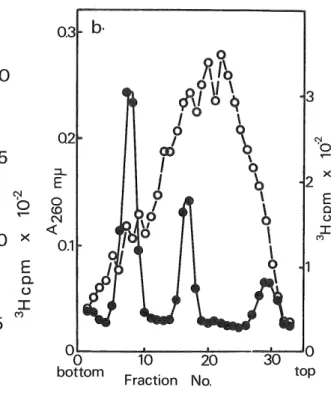
(4) Nuclear RNP in D. discoidenm. 0.15. h. » a. f !? A. ^I. 0.1 h 3_ E~. 0 $ cQ <. ^. ^./. ^v. f. 0.05h. H AV •'1 ^. ''\ \. bottom. 15. 3CM. b. 4-. E. Fraction No.. 5. <( I. ^. '0. \. ?. \ •-12. \. E. a u. 3:. I. 0.1 E-. 0 .•11. m\. a. 3:. 2-. .°^. *.< H<xx. 10 20. r^J. 0. \\<. JL. / r. 0. Q (0. <. -10. *. [I,p. Q2|. _/. ^. ^. (f. 6-. ». x. °OL-. 20. t. i. 0.3 . b.. bottom. 10 20 Fraction No.. 30. JQ top. jo top. Fig. 2. Sedimentation analysis of RNA obtained from crude nuclei, the pH 7.0 and 8.0 nuclear extracts. The. cells were labeled with [3H)uracil for 30 min in the presence of 120 p.g/m\ actinomycin D as described in the legend of Fig. 1. a; RNA from crude nuclei. The crude nuclei were prepared from cell homogenate by centrifugation at 1,000 x g for 10 min for several times. They were suspended in. 25 mM Tris-HCl (pH 7.6) containing 5 mM sodium EDTA and 2.6% sodium dodecylsulfate, followed by a treatment with 1% diethylpyrocarbonate and RNA was then extracted with a solution of phenol-chloroform-isoamylal-. cohol (49:49:2) (2) and precipitated in 95% cold ethanol. The RNA sample was dissolved in a solution consisting of 10 mM Tris-HCl (pH 7.6), 0.1 M NaCl and 0.05% sodium dodecylsulfate, mixed with unlabeled 26 S and 17 S rRNA's of D. discoideum as markers and analysed on 4,8. ml of a 15—30% (w/v) linear sucrose gradient in the above solution by centrifugation for 2 h at 48,000 rev./ min and 22°C in a Spinco SW 50 rotor. After centrifugation, an appropriate number of fractions of the gradient were taken and one-half portion of each fraction was measured for absorbance at 260 mp. and radioactivity.. For the assay of poly(A)-containing RNA, the remaining. ~0. bottom. half portion was adjusted at the final concentration to 10. Fraction No.. mM Tris-HCl (pH 7.6), 0.12 M NaCl, 0.1 mM sodium. (25).
(5) F.KANDA. EDTA and 0.5% sodium dodecylsulfate and passed through poly(U)-filters prepared according to the procedure described by Sheldon et al. (8). The filters were then washed with the same buffer followed by washing with 0.3 M ammonium acetate in 50% ethanol, dried and counted as described by Firtel et al.(9). b and c; RNA from the pH 7.0 (b) and 8.0 (c) nuclear extract. The extraction of RNA of the pH 7.0 and 8.0 nuclear extract was performed by the sodium dodecylsulfate-phenol procedure as described previously (7). The. RNA prepared from pH 7.0 and 8.0 nuclear extract was mixed with unlabeled 26 S and 17 S rRNA's of D. discoidenm and centrifuged in 10—25% (w/v) linear sucrose gradients in 20 mM Tris-HCl (pH 7.6) containing 0.1 M NaCl, 2 mM sodium EDTA and 20 /ng/m\ polyvinylsulfate at 26,000 rev./min and 4°C for 15 h using a Hitachi RPS 27 rotor- After centrifugation, the gradient was fractionated, water was added to each fraction, and ab-. sorbance was measured at 260 m/u. The RNA was precipitated in 10% cold trichloroacetic acid containing 5% acetone. The precipitated material was collected on a glass-fiber filter (Whatman GF/C) and the radioactivity was measured as described previously (7). •—•, absorbance at 260 m^i ; 0——0,3H-radioactivity ofRNA precipitated with trichloroacetic acid; X •••••• X, 3H-radioactivity of RNA bound to poly(U)-filters.. labeled pulsely with C3H)uracil at an early aggregation stage during morphogenesis, following a pretreatment with actinomycin D (120 /^g/ml) for 1 h. Since it is known that in this organism the rate of synthesis of rRNA decreased remarkably in the early stage of morphogenesis and the actinomycin D concentration used here selectively inhibits rRNA synthesis, it should be noticed that no precursor molecules of rRNA were synthesized under the above conditions for labeling.. After the labeling of cells, the nuclei were isolated as described in the legend of Fig. 1 and nuclear extracts were then prepared from intact nuclei with TNM buffer (10 mM Tris-HCl, 0.1 M NaCl and 1 mM magnesium acetate) under two different pH conditions (pH 7.0 and 8.0) according to the procedure of Georgiev and Samarina (6). Preliminary experiments indicated that when the nuclear extract was prepared at pH 8.0, approximately 34 % of 3H-labeled materials in nuclei were. extracted, while the extraction efficiency at pH 7.0 was very low (about 5 %). Figure 1 shows the radioactivity profiles after a sucrose gradient centrifugation of nuclear extracts prepared at pH 7.0 and 8.0 from labeled cells. It can be seen that labeled materials. sedimented heterodispersedly with a broad peak in the 20 S region. The sum of the radioactivity of the labeled material sedimenting in the region from 10 S to 50 S comprises approximately 88 % and 80 % of the total radioactivity in the pH 7.0 and 8.0 nuclear extracts, respectively. There were few labeled materials sedimenting faster than 50 S in both nuclear extracts. To know if small particles containing pulse-labeled RNA found in this experiment result from the partial degradation of large particles by ribonuclease digestion during the process of isolation of nuclei or if they are intrinsical entities in this organism, RNA prepared from crude nuclei, the pH 7.0 and pH 8.0 nuclear extracts of labeled cells were examined by sucrose gradient centrifu-. gation. In this experiment, RNA obtained directly from the crude nuclei is expected to be larger in size than that from the pH 7.0 or pH 8.0 nuclear extract, if large particles containing labeled RNA really exist in the nuclei of this organism but are degraded during the course of the purification of nuclei or the extraction of labeled materials from nuclei. Figure 2 shows that no. significant difference with the sedimentation profile of labeled RNA was observed between the RNA's of three different sources; almost all of the labeled RNA was heterodispersedly distributed from about 5 S to SOS with a broad peak in the 15 S region, although the amount of labeled RNA sedimenting in the region heavier than 15 S was not so much in the RNA sample from the crude. (26).
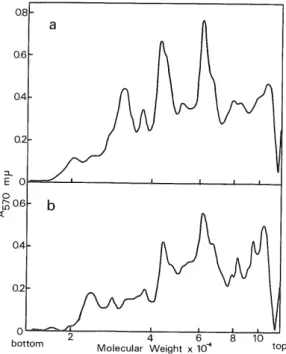
(6) Nuclear RNP in D. discoideum nuclei relative to that from either pH 7.0 or pH 8.0 nuclear extract. This result suggests that the. small nuclear particles containing pulse-labeled RNA inherently exist in this organism, but are not artificial particles due to the ribonuclease digestion. It is also clear in Figs. 2b and 2c that the pH 7.0 or pH 8.0 nuclear extract does not contain C H) labeled ribosomal precursor particles, because the actinomycin-resistant RNA prepared from both nuclear extracts is small and considerably heterogeneous in size in contrast to rRNA or its precursors. Then, are the small nuclear particles obtained here HnRNA? To elucidate. this point, the sedimentation pattern of polyadenylic acid (poly(A))-containing RNA in the RNA sample prepared from crude nuclei was examined by the binding assay of poly(A)-containing RNA to polyuridylic acid (poly(U))-filters (poly(U) attached to glass-fiber filters), since in D. discoideum as well as in other eukaryotes HnRNA has at least one sequence of poly(A) at the 3'-end (2). As shown in Fig. 2a, the sedimentation pattern of poly(U)-bindmg RNA closely resembles that of actinomycin D-resistant RNA from the nuclei. Similar results were obtained also with the pulsely labeled RNA contained in nuclear particles prepared at pH 7.0 or pH 8.0 (data not shown). Thus, the above data clearly indicate that the pulsely labeled RNA in nuclear particles contains HnRNA. Figure 3 shows the electrophoretic patterns of proteins extracted from the nuclear particles. containing HnRNA in sodium dodecylsulfate polyacrylamide gels. When proteins were prepared from the pooled fractions containing 15 S to 20 S nuclear particles, they were separated into several major bands in addition to heterogeneous minor ones. The molecular weights of repro-. ducible major protein bands were estimated to be about 42,000 and 60,000 daltons. These proteins are surely different from ribosomal (10) and chromatin (11) proteins of D. discoidenm, and also. Fig. 3. Densitometric tracings of stained gels after electrophoresis of proteins from the nuclear RNP particles of D. discoidenm on sodium dodecylsulfate-polyacrylamide gels. The pH 7.0 and 8.0 nuclear extracts were centrifuged in a sucrose gradient as described in Fig. 1. After centrifugation, the fractions corresponding. to 15-20 S were pooled and 0.1 volume of 100% (w/v) cold trichloroacetic acid was added. The precipitated RNP particles were collected by centrifugation at 12,000 x g for 20 min at 0°C. The pellet was dried and then dissolved in O.lml of 0.1 M sodium phosphate (pH 7.0) containing 1% sodium dodecylsulfate, 1% 2-mercaptoethanol and 4 M urea. It was incubated for 3 h at 37°C. and then electrophoresed on 10% polyacrylamide gels containing 1% sodium dodecylsulfate for 12 h at a constant current of 5 mA/gel. For the determination of the molecular weights of proteins, several marker proteins were parallely run in separate gels. After electrophoresis, the gels were stained with coomassie blue,. destained with 7% acetic acid and densitometrically. 0' bottom. Molecular Weight x 1CT. scanned at 570 m/u as described previously (10). a, proteins of RNP extracted at pH 7.0 ; b, proteins of RNP extracted at pH 8.0.. (27).
(7) F.KANDA. different from cytoplasmic total and nuclear soluble proteins with respect to their molecular weights (unpublished data). The results obtained in this study suggest that in D. discoideum HnRNA exists as comparatively small-sized (10 S to 50 S) RNP particles. Very recently, however, Firtel and Pederson (11) have reported 55 S nuclear RNP particle containing mRNA precursor in the same organism. They have obtained the RNP particles from cells in the log-phase of growth in which rRNA synthesis is much more active than in the morphogenetic phase. It is not clear that the difference between their data and the data in this paper is due to the difference of the method used for the preparation of RNP particles or to the difference of the developmental stage during the life cycle of this organism. Further experiments are now in progress to clarify the cause for the difference.. The author thanks Dr. M. Iwabuchi of Hokkaido University for his helpful advice during the course of this study and critical reading of this manuscript. Thanks are also due to Professor I.. Harada and Dr. S. Tanifuji of Hokkaido University for their encouragement. REFERENCES 1. Pederson, T. (1974) / Mol. Biol. 83, 163-183 2 . Firtel, R. A. & Lodish, H. F. (1973) / Mol. Biol. 79, 295-314 3 . Gamow, E. & Prescott, D. M. (1972) Biochim. Biophys. Acta 259, 223-227 4 . Prescott, D. M., Bostock, C., Gamow, E. & Lauth, M. R. (1971) Exptl. Cell Res. 67, 124-128. 5 . Mizukami, Y. & Iwabuchi, M. (1970) Exptl. Cell Res. 63, 317-324 6. Georgiev, G. P. & Samarina, 0. P. (1971) in Advances in Cell Biology (Prescott, D. M., Goldstein, L. & McConkey, E., eds) vol. 2, pp. 47—110, Appleton-Century-Crofts, New York 7 . Iwabuchi, M., Mizukami, Y. & Sameshima, M. (1971) Biochim. Biophys. Acta 28, 693-700 8 . Sheldon, R., Jurale, C. & Kates, J. (1972) Proc. Natl. Acad. Sci. U.S. 68, 417-421 9 . Firtel. R. A., Jacobson, A. & Lodish, H. F. (1972) Nat. New Biol. 239, 225-228 10. Kanda, P., Ochiai, H. & Iwabuchi, M. (1974) Eur. J. Biochem. 44, 469-479 11. Firtel, R. A. & Pederson, T. (1975) Proc. Natl. Acad. Sci. U.S. 72. 301-305. (28).
(8)
図
関連したドキュメント
Furuta, Log majorization via an order preserving operator inequality, Linear Algebra Appl.. Furuta, Operator functions on chaotic order involving order preserving operator
(In a very recent preprint, Niethammer and Vel´azquez [9] have obtained a remarkable estimate for the effective potential of a single particle in the supercritical case by taking
[3] Chen Guowang and L¨ u Shengguan, Initial boundary value problem for three dimensional Ginzburg-Landau model equation in population problems, (Chi- nese) Acta Mathematicae
Keywords: continuous time random walk, Brownian motion, collision time, skew Young tableaux, tandem queue.. AMS 2000 Subject Classification: Primary:
The main problem upon which most of the geometric topology is based is that of classifying and comparing the various supplementary structures that can be imposed on a
It turns out that the symbol which is defined in a probabilistic way coincides with the analytic (in the sense of pseudo-differential operators) symbol for the class of Feller
Then it follows immediately from a suitable version of “Hensel’s Lemma” [cf., e.g., the argument of [4], Lemma 2.1] that S may be obtained, as the notation suggests, as the m A
His idea was to use the existence results for differential inclusions with compact convex values which is the case of the problem (P 2 ) to prove an existence result of the
