
駿河湾産カイミジンコLeuroleberis属の1新種
9
0
0
全文
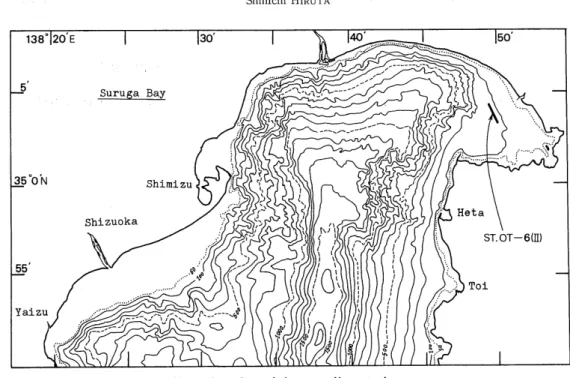
(2) Journal of Hokkaido University of Education (Section II B) Vol. 33, No. 1 September, 1982. ^^jga^^^SS (^2SPB) ^33^ m-?- Bgffi57^9^. A New Species of the Genus Leuroleberis Kornicker from Suruga Bay, Central Japan (Ostracoda : Myodocopina). Shinlchi HIRUTA Biological Laboratory, Kushiro College, Hokkaido University of Education, Kushiro 085. ^EB K— : ^^nTN^^7 ^ $ ^~ > =? Leuroleberis |§0 1 |:JTJ. WW^±W gfr^Af^l^. Abstract A new spcies of the genus Leuroleberis is reported from Suruga Bay. The species is easily distinguishable from the other congeneric species so far known in the morphology of the endopodite of the second antenna.. Introduction In previous reports (Hiruta, 1981a,b), I described two myodocopid ostracods from Suruga Bay, Central Japan, based upon specimens collected by the surveys for benthos around Suruga Bay, which were carried out by the staff of the Marine Ecology Division of the Ocean Research Institute, University of Tokyo, on boad the R/ V Tansei-Maru. The present paper deals with a new species of the genus Leuroleberis Kornicker, 1981, based upon two female specimens. from the surveys above mentioned, as the third report of the taxonomic study of myodocopid Ostracoda from Suruga Bay. The specimens were collected by the beam trawl of a 2m span. at St. OT-6(II) (Fig. 1) on July 14, 1978, during the cruise KT-78-11. The type specimens are deposited in the Zoological Institute, Faculty of Science, Hokkaido University.. Leuroleberis surugaensis n. sp.. (Figs. 2-5) Male unknown. Female. Carapace(Fig. 2-1—3) ovel in lateral view, with a deep incisur;surface covered. (11).
(3) 12. Shinlchi HIRUTA. |30'. 1380|20'E |. |50'. Suruga Bay. 35°0'N. 55'. Yaizu. Fig. 1. location of the sampling station.. with a number of small fassae; anterior surface without short ridges; anterior margin of rostrum and anteroventral margin of valve without scallops. Anterior infold with many. bristles; a row of bristles present on list below incisur; posterior infold with two rows of bristles. M.edial surface near anterodorsal infold with bristles. Lamellar prolongation was detected along anterior margin, but in other parts of the margin it was not clearly observed. Central adductor muscle scar consisting of about 43 oval and elongate individual muscle scars.. Size (mm) length height Holotype 5.23 4.25 Paratype 5.40 4.45 Upper lip (Fig. 2-4,5) consisting of a pair of hirsute lobes. Rod-shaped organ and median eye (Fig. 2-6). Rod-shaped organ elongate, constricted near the middle and tapered distally.. Lateral eyes (Fig. 2-7) well-developed, with more than 60 ommatidia. First antenna (Fig. 3-1). First segment longer than second, with long hairs on ventral and. medial surfaces; second segment about twice as long as anterior margin of third, with six bristles on anterior margin, four to eight lateral bristles, and long hairs on posterior and medial surfaces ; third segment with eleven to thirteen bristles on anterior margin and one short bristle on posterior margin ; posterior margin of the segment half length of anterior margin ; fourth segment somewhat shorter than third, with one anterodistal and five posterodistal bristles of which one is much longer than others; fifth segment as long as anterior margin of third, with a sensory bristle which is furnished with nine long distal filaments and six short proximal filaments; sixth segment short, with one distal bristle; seventh and eighth segments not clearly detected : a-bristle stout and claw-like ; b-bristle slightly shorter than c-bristle, both with filaments ; d- and e-bristles as long as b-bristle, without filaments ; f-bristle slightly shorter. (12).
(4) A New Species of Leuroleberis from Suruga Bay. Fig. 2. Leuroleberis surugaensis n. sp. Female (Holotype). 1. lateral view ; 2. medial view of anterior part ; 3. medial view of posterior part ; 4. upper lip, anterior view ; 5. ditto, lateral view ; 6. rod-shaped organ eye ; 7. lateral eyes.. (13). 13.
(5) 14. Shinlchi HIRUTA. than b-bristle, with filaments ; g-bristle somewhat longer than c-bristle, with filaments.. Second antenna (Fig. 3-2—4). Protopodite with one medial bristle and long hairs along anterior surface. Endopodite three-segmented; first segment somewhat longer than second,. with several proximal bristles and six distal bristles on dorsal surface; second segment without bristle; third segment short, with long terminal bristle. Exopodite : first segment longer than the following segments combined; second to eighth segments with basal spines; ninth segment with one short and four long bristles ; bristles except short one on ninth segment with teeth along. Fig. 3. Leuroleberis surugaensis n. sp. Female (Holotype). 1. first antenna ; 2. second antenna, protopodite and endopodite ; 3. ditto, exopodite ; 4. ditto, endopodite.. (14).
(6) A New Species of Lenr^berk " from Suruga Bay. 15. ^=^F=-^s.^ (15).
(7) Shinlcbi ?^ 16. 1-3. Famale (Holotype). rugaensis n- SP-. "•••s"^"-1"'1. (16). fvenfh 1. sixth limb, 2. se-.
(8) A New Species of Leuroleberis from Suruga Bay 17 antenor margin.. Mandible (Fig. 4-1—3). Ventral branch of coxale endite with spines along whole length and three or four teeth on its tig ; one short bristle present near base of ventral branch ; dorsal branch as shown in figure. Basale : ventral surface to endite with about 44 long bristles and about 20 minute bristles; dorsal surface with about 15 bristles of which distal two are long. Exopodite as long as dorsal margin of first endopodite segment, with two ventral bristles, proximal one twice as long as distal one. Endopodite : ventral margin of first segment with nine bristles of different lengths ; dorsal surface of second segment with a number of bristles ; ventral surface of second segment with three or four subterminal bristles and two terminal. bristles; end segment small, with three long, stout bristles and three bristles of different lengths. Maxilla (Fig. 4-4). Epipodite elongate, tapering distally; proximal part of maxilla with thirteen long endite bristles, about eleven short bristles, and one short lateral bristle. Basale : dorsal margin hirsute, with about ten proximal bristles and about nine distal bristles of which two are long ; medial surface with bristles forming a row near ventral margin, about eleven. bristles near distal edge, and four long bristles near ventrodistal edge. Endopodite : first segment with one short dorsal bristle and one long ventrodistal bristle; end segment with six bristles of different lengths. Fifth limb (Fig. 4-5). Dorsal margin with hairs and nine to twelve bristles; bristles of anterior margin form a single row; ventral margin with comb of slender bristles which form two rows; exopodial bristles consisting of two long and three minute bristles; three short bristles present below exopodial bristles. Sixth limb (Fig. 5-1). Anterior margin with two sutures; proximal half of anterior surface with three rows of bristles and distal half with a row of bristles; ventral margin with more than a hundred bristles of different lengths; posterior part of limb hirsute, with six to nine bristles on distal margin; four to five bristles in place of epipodial appendage. Seventh limb (Fig. 5-2). Each limb with about 140 cleaning bristles ; terminus consisting of opposing combs, each with about 30 teeth of different sizes. Fnrca (Fig. 5-3). Each lamella with three primary claws followed by eight or nine short bristles; primary claws with two rows of secondary teeth along posterior margin; proximal three bristles with strong teeth on distal part ; lamellae near base of primary claws with hairs. Posterior of Body hirsute. Genital organ (Fig. 5-3). A pair of lobes with several bristles present in front of furca as shown in figure.. Remarks. Although the two specimens examined were non-ovigerous, without eggs in the. brood pouch, they seem to be adults judging from the following reasons. The cleaning bristles of the seventh limb show adult-like form; that is, none of the bristles tapers. The genital lobes are well-developed, having several short bristles.. The genus Leuroleberis contains the following species (with regard to their localities and records, see Kornioker, 1981) : L. orbicularis (Brady, 1897), L. zealandica (Baird, 1850), L. poulseni (Moguilevsky and Ramirez, 1970), L. sharpei Kornicker, 1981, and L. mackenziei Kornicker, 1981. The present new species is easily discernible from these congeneric species. (17).
(9) 18 Shinlchi HIRUTA in the morphology of the second endopodite segment of the second antenna. In L. surugaensis n. sp. the segment has no bristle, while other species have one or more bristles on the corresponding segment. Specimens examined. Holotype: non-ovigerous female; paratype: non-ovigerous famale. (14-VII-78; KT-78-11). Locality. Suruga Bay : Uchiura-Wan, St. OT-6 (11) (35°03.3/ N 138°50.0/ E — 35°04.3/ N138° 49.4/ E); depth 108-115 m; mud.. Acknowledgements I would like to express my sincere gratitude to Professor Masuoki Horikoshi and Mr. Suguru Ohta of the Ocean Research Institute, University of Tokyo, who gave me the opportunity to examine the specimens reported in this paper. This study was supported in part by the Grant-in-Aid for Co-operative Research of the Ministry of Education, Science and Culture,. Project No. 534033.. References. Hiruta, Sh. 1981a. A new species of the genus Azygocypridina Sylvester-Bradley from Suruga Bay, Central Japan (Ostracoda ;Myodocopina). J. Hokkaido Univ. Educ. Section II B, 32:49-56. 1981b. A new cypridinid ostracod (Myodocopina) from Suruga Bay, Central Japan. Proc. Japan Soc. System. Zool. 21:27-34. Kornicker, L. S. 1981. Revision, distribution, ecology, and ontogeny of the ostracode subfamily Cyclasteropinae (Myodocopina: Cylindroleberididae). Smiths. Contr. Zool. 319, 548 pages.. (18).
(10)
図


関連したドキュメント
First, the theory characterizes the category of sets and mappings as an abstract category in the sense that any model for the axioms which satisfies the additional (non-elementary)
As for the long time behavior of solutions for the micropolar fluid flows on unbounded domain, Dong and Chen [7] investigated the existence and regularity of the global attractors in
In addition, under the above assumptions, we show, as in the uniform norm, that a function in L 1 (K, ν) has a strongly unique best approximant if and only if the best
L. It is shown that the right-sided, left-sided, and symmetric maximal functions of any measurable function can be integrable only simultaneously. The analogous statement is proved
Wro ´nski’s construction replaced by phase semantic completion. ASubL3, Crakow 06/11/06
Double rotational surfaces are on the one hand studied as a continuation of the research on twisted surfaces in 3-space, see [4] and the references therein, and on the other hand
[r]
The aim of this article is to study, in the context of finitely generated groups of polynomial volume growth, a natural class of random walks that allow for long range jumps..
