Molecular mapping of a male fertility restorer
locus of Brassica oleracea using EST-based SNP
markers and analysis of a syntenic region in
Arabidopsis thaliana for identification of
genes encoding pentatricopeptide repeat
proteins
著者
Ashutosh, Sharma Bhavana, Shinada Tomotaka,
Kifuji Yasuko, Kitashiba Hiroyasu, Nishio
Takeshi
journal or
publication title
Molecular Breeding
volume
30
number
4
page range
1781-1792
year
2012-12-01
URL
http://hdl.handle.net/10097/60985
doi: 10.1007/s11032-012-9761-4
Published in Mol Breeding (2012) 30: 1781-1792 Postprint; The final publication is available at Springer via
http://dx.doi.org/10.1007/s11032-012-9761-4
Molecular mapping of a male fertility restorer locus of Brassica
oleracea using EST-based SNP markers and analysis of a syntenic
region in Arabidopsis thaliana for identification of genes encoding
pentatricopeptide repeat proteins
Ashutosh, Bhavana Sharma, Tomotaka Shinada
a), Yasuko Kifuji
a), Hiroyasu Kitashiba,
Takeshi Nishio
*Graduate School of Agricultural Science, Tohoku University, Sendai, Miyagi 981-8555, Japan * Corresponding author
a) Present address: Kaneko Seeds Company Ltd., Isesaki, Gunma, Japan Abstract
An F2 population was developed from a cross between a mur-cytoplasmic male sterile broccoli line and a restorer Chinese kale
line. Phenotypic analysis of F2 plants indicated that the pollen fertility is controlled by two genes and segregated in a duplicate
gene interaction mode with a ratio of 15:1. A total of 236 SNP markers were developed utilizing 1448 primers designed for production of EST-SNP markers of Raphanus sativus and analyzed by the dot-blot technique in 205 F2 individuals. A linkage
map was constructed with a total of 142 markers and these markers were assigned to nine linkage groups together with SSR markers mapped previously on the published linkage maps of B. oleracea. The linkage map spanned 909 cM with an average marker distance of 6.4 cM. A fertility restorer locus (Rfm1) was mapped on LG1, corresponding to chromosome 3, along with a flower color locus at a distance of 25 cM. SNP markers flanking the Rfm1 locus were BoCL2642s at a distance of 2.5 cM on one side and BoCL2901s at a distance of 7.5 cM on the other side. All the SNP markers showed homology with Arabidopsis
thaliana and Brassica rapa genome sequences. Three PPR genes of the P-subfamily, particularly expressed in buds of the
restorer line, were identified and these genes could be potential candidate fertility restorer genes.
Keywords: Cytoplasmic male sterility, Fertility restorer locus, Diplotaxis muralis, Linkage map, Synteny, PPR genes
Introduction
The family Brassicaceae is an economically important source of vegetables, oilseeds and forages. Brassica oleracea is one of the major species in this family, which includes broccoli, cauliflower, cabbage and kale. Commercial hybrid seed production of B.
oleracea vegetables is performed using self-incompatibility, but
sometimes its instability results in contamination of selfed seeds in hybrid seeds. Cytoplasmic male sterility (CMS) together with fertility restoration is a reliable hybrid seed production tool in crop species and also an excellent model to study nuclear-cytoplasmic gene interaction. CMS is the maternally inherited inability of plants to produce functional pollen and is associated with the expression of novel chimeric open reading frames (ORFs) encoded by mitochondrial genome. The chimeric ORFs differ among the CMS systems, but often carry a recognizable segment of coding or flanking sequences of essential mitochondrial genes. The nuclear genes that suppress or compensate for mitochondrial dysfunction and restore fertility to CMS plants are designated fertility restorer (Rf) genes. The CMS-Rf system is commercially used for hybrid seed production of Brassica napus, Brassica juncea, onion, etc. In Brassicaceae, several different cytoplasmic male sterile lines have been identified and these can be grouped under two categories, alloplasmic and autoplasmic. CMS lines have been developed in B. napus, B. rapa and B. juncea, and four sources of
Brassica CMS, i.e., ogu/kosena, pol, nap and tour, have been well
characterized at molecular level (Schnable and Wise, 1998). In each case, a novel open reading frame has been identified in transcripts of normal mitochondrial genes. Identification of a new CMS line and a restorer gene is always beneficial as a new source
material for hybrid breeding. Each restorer gene is unique in nature and molecular study helps to elucidate the mechanism of gene action. A Diplotaxis muralis-based CMS line of B. oleracea (termed here mur CMS B. oleracea) has been developed previously and a novel open reading frame, orf72, associated with male sterility has been identified (Shinada et al. 2006).
For most alloplasmic CMS systems, fertility restorer genes are required to be introduced from cytoplasm donor species. Restoration is mostly governed by a single restorer gene in all the known Brassica CMS-Rf systems except tour CMS B. napus, in which two dominant genes, Rft1 and Rft2, have been reported for fertility restoration (Janeja et al. 2003). Even a single restorer gene has been found to restore pollen fertility in two different CMS Brassica lines developed from different cytoplasms (Bhat et al. 2005). A number of restorer genes have been cloned in maize, petunia, radish, rice and sorghum, and all except rf2 in maize (Cui et al. 1996), Rf17 of CW-CMS rice (Fujii and Toriyama 2005) and Rf2 in Lead rice CMS (Itabashi et al. 2011) encode pentatricopeptide repeat (PPR) proteins targeted at mitochondria (Bentolila et al. 2002; Brown et al. 2003; Desloire et al. 2003; Koizuka et al. 2003; Kazama and Toriyama 2003; Klein et al. 2005). CMS restorer genes belong to P-subfamily of PPR genes, which are categorized based on their C-terminal domain structure (Small and Peeters 2000; Lurin et al. 2004). All restorer genes cloned to date have been identified by a map-based cloning approach, in which the first step is to find DNA markers linked with a fertility restorer locus followed by fine mapping for positional cloning of the gene.
The objective of the present study was molecular mapping of
TOUR: Tohoku University Repository
- 2 -
a male fertility restorer locus of mur CMS B. oleracea and analysis of an Arabidopsis thaliana homologous region for identification of genes encoding PPR proteins. A linkage map was constructed using EST-based SNP markers based on an F2 population derived from a CMS line and a restorer line of B. oleracea. A total of 142 loci were assigned to nine linkage groups with a total coverage of 909 cM. A fertility restorer locus (Rfm1) was mapped on LG1, corresponding to chromosome 3 of B. oleracea, along with a flower color gene. Flanking EST-SNP markers for Rfm1 were identified covering a region of 10 cM. Based on sequence homology of a region between the markers flanking the Rfm1 locus with the genome sequences of Arabidopsis thaliana and Brassicarapa, three genes encoding PPR proteins could be identified. These
genes are expressed only in buds of the fertility restorer line and are potential candidate genes for male fertility restoration.
Materials and methods Plant materials
A CMS line of alloplasmic origin in Brassica rapa has been developed by substituting the nucleus of wild species Diplotaxis
muralis with the nucleus of B. rapa var. chinensis through repeated
backcrossings of an intergeneric hybrid of D. muralis x B. rapa with B. rapa as a pollinator for eight generations (Hinata and Konno 1979). Similarly a CMS line in broccoli (B. oleracea var.
italica) harboring D. muralis cytoplasm has also been developed by
N. Konno and K. Hinata (unpublished), named mur CMS B.
oleracea. A male fertility restorer line has been developed in
Chinese kale (B. olearcea var. alboglabra) by backcrossing with another male semi-sterile alloplasmic line of B. oleracea having D.
muralis cytoplasm (Shinada et al. 2006). A segregating F2 population generated from a cross between CMS broccoli and restorer Chinese kale was used for genotyping.
Phenotyping and genomic DNA extraction
A segregating F2 population was grown in a greenhouse from July 2009 to March 2010 in Sendai, Japan. Pollen fertility and sterility of 205 plants were investigated at the flowering stage through visual examination of pollen grain dust and stainability with 2% acetocarmine. Seed setting ability was also examined after self-pollination in some plants. Based on pollen grain fertility, plants were categorized as male fertile (male fully fertile and male semi-fertile) or male sterile and analyzed to decipher the genetics of fertility restoration. The F2 population also showed segregation for white and yellow flower color, and phenotypic data were obtained for molecular mapping of a flower color gene. Genomic DNA was extracted from young leaves of all the individuals using the modified CTAB protocol (Doyle and Doyle 1990). The DNA was quantified by ethidium bromide staining after electrophoresis on agarose gel and used as a PCR template in genotyping of the F2 population with EST-SNP and SSR markers.
Development of EST-based SNP markers and detection of polymorphism
The expressed sequence tag (EST) sequences of radish published
on the radish sequence database
(http://radish.plantbiology.msu.edu) have been explored to design primer pairs for specific amplification of genes and to identify
single nucleotide polymorphisms (SNPs) for production of EST-based SNP markers in Raphanus sativus (Li et al. 2011). Since R. sativus and B. oleracea belong to the same tribe Brassiceae, these radish primer sequences were utilized for production of EST-based SNP markers in B. oleracea. These primers were used in PCR amplification from genomic DNA of the parental lines, i.e., CMS broccoli and restorer Chinese kale. A 20 µl reaction mixture contained 10 ng of plant genomic DNA, 10 pmol of each primer, 1x ExTaq buffer, 2 nmol of each dNTP, and 0.5 U of Taq DNA polymerase (ExTaq, Takara Biomedicals, Japan). PCR was performed in a thermal cycler (Eppendorf) with the following cycling conditions: initial denaturation at 94°C for 5 min, 40 cycles of 94°C for 30 sec, 56°C for 30 sec and 72°C for 1 min. Five microliters of the PCR product were electrophoresed on 1.2% agarose gel, and amplified fragment sizes ranged from 300 bp to 600 bp. Single fragment PCR products were selected and sequenced by the Sanger method. High quality sequences were aligned and analyzed to identify SNPs using software SEQUENCHER version 4.7 (Gene Codes Corporation, MI, USA). Sequences having SNPs between CMS broccoli and restorer Chinese kale were used for designing probes for dot-blot-SNP analysis, which is a cost effective and highly efficient SNP analysis method (Shiokai et al. 2010a). For each marker, a set of two oligonucleotide probes of 48 nucleotides, comprising a sequence of 17 nucleotides with an SNP in the middle, a 6-nucleotide spacer and a bridge sequence of 25 nucleotides, were designed. The hybridization conditions for the probes were predicted using
DINAMelt web server
(http://www.bioinfo.rpi.edu/applications/hybrid/) and slight modifications were made in hybridization temperature or salt concentration to achieve optimum dot-blot results as described by Shiokai et al. (2010b). Genomic regions having SNPs were amplified by multiplex PCR using 5 or 6 primer pairs mixed together based on annealing temperature and other parameters (Kaplinki et al. 2005). The PCR reaction was set up in a 10 µl volume consisting of 10 ng template DNA, 10 pM of each primer, 1x KAPATaq buffer (without MgCl2), 1.75 mM MgCl2, 0.25 mM of each dNTP and 0.25 U of KAPATaq DNA polymerase (KAPABIOSYSTEMS, Boston, MA, USA). The PCR conditions were initial denaturation at 94°C for 4 min, 35 cycles of 94°C for 30 sec, 56°C for 30 sec and 72°C for 1 min and final extension at 72°C for 5 min. PCR-amplified products were denatured by mixing an equal volume of denaturation solution containing 0.4N NaOH and 10mM EDTA before blotting onto nylon membrane by Multi-pin Blotter (ATTO, Japan). SNP detection was performed using the dot-blot-SNP analysis procedure (Shiokai et al. 2010a), except that the washing and hybridization temperature were changed as per the probe.
SSR marker analysis
SSR markers from published literature (Supplementary Table 1) were screened for polymorphism between parental genotypes to select potential anchor markers for the B. oleracea genetic map. PCR amplification of SSR markers was performed as per the reaction conditions given in the reference data of markers. The amplified products were resolved on 8% polyacrylamide gel in 1xTBE buffer and visualized under UV after staining with ethidium bromide. Markers polymorphic between the parents were used for genotyping of F2 plants to assign linkage groups to those of the reference linkage map (Lowe et al. 2004; Piquemal et al. 2005;
Iniguez-Luy et al. 2008). Two SCAR markers, M3.4 and Nit-2, were also analyzed on 3% agarose gel (Supplementary Table 1). Linkage analysis and map construction
Linkage analysis and map construction were performed using JoinMap 4.0 software (Van Ooijen, 2006) and linked loci were grouped with independent LOD parameter into nine linkage groups. The marker order was confirmed by a regression mapping algorithm on the basis of a minimum LOD score of 1.0 and a maximum recombination fraction of 0.4. The Kosambi map function was used to estimate genetic distances in cM (Kosambi 1944). The EST-based SNP markers were named <Bo> <EST name> <s> and SCAR markers were designated with <c> at the end, with names following the international nomenclature (De Vincente et al. 2004).
Sequence comparison with Arabidopsis thaliana and Brassica rapa genomes
The sequences of EST-based SNP loci on a linkage map were aligned with the genome sequences of A. thaliana (TAIR; http://www.arabidopsis.org) and B. rapa (Brassica rapa Genome Sequencing Project Consortium) using the BLAST tool of the Brassica database BRAD (http://brassicadb.org/brad) (Feng et al. 2011) and homologous regions were searched. The E-value, a statistical significance threshold for reporting matches against database sequences, was set at 0.01 for sequence alignment. The sequences of marker loci were regarded as homologous to the genomes with a threshold value of E<10-10. The regions having at least three loci with conserved collinearity with A. thaliana and B.
rapa were considered to be homologous syntenic regions. A single
non-collinear homologue in the syntenic region was ignored. Identification of PPR genes and expression analysis
EST-SNP markers flanking Rfm1 showed sequence collinearity with the B. rapa and A. thaliana genome sequences. A selected syntenic region of the A. thaliana sequence was searched for PPR
genes in the browser
(http://www.plantenergy.uwa.edu.au/gb2/gbrowse/atbrowser/) and primers were designed based on PPR-encoding genes of A.
thaliana (O’Toole et al. 2008). A homologous B. rapa sequence
region was also analyzed by GENSCAN
(http://genes.mit.edu/GENSCAN.html/) to predict genes, and deduced amino acid sequences were aligned with known sequences of A. thaliana proteins using the BLASTP program of NCBI. Predicted peptides having high similarity to A. thaliana PPR proteins were identified. Genes encoding PPR proteins were selected to design specific primers for PCR (Supplementary Table 5). Genomic DNAs of CMS broccoli and restorer Chinese kale were used as templates in PCR amplification. The 20 µl reaction mixture contained 10 ng of plant genomic DNA, 10 pmol of each primer, 1x ExTaq buffer, 2.5 nmol of each dNTP and 0.5 U of Taq DNA polymerase (ExTaq, Takara Biomedicals, Japan). PCR was performed in a thermal cycler with the following cycling conditions: initial denaturation at 94°C for 4 min, 40 cycles of 94°C for 30 sec, annealing temperature (as given in Supplementary Table 5) for 30 sec and 72°C for 45 sec. PCR products were resolved on 1.5% agarose gel and visualized under UV after staining with ethidium bromide.
RNA was extracted from young leaves and buds of CMS broccoli and restorer Chinese kale using SV Total RNA Isolation System (Promega Corp.) as per the manufacture’s instructions. First strand cDNA was synthesized from 1 µg total RNA using Pd(N)6 primer and reverse transcriptase of the first strand cDNA synthesis kit (GE Healthcare, UK). RT-PCR was performed using PPR gene-specific primers with the same PCR conditions as used in amplification of genomic DNA. The actin gene primer set was used as a positive control of RT-PCR. The amplified products were separated on 1.5% agarose gel and visualized under UV after staining with ethidium bromide.
Results
Phenotypic analysis of pollen fertility
An F2 population segregating for pollen fertility was used for linkage map construction and gene mapping. Phenotypic differences were clearly distinguishable between fully fertile and sterile flowers, as the sterile flowers had comparatively short filaments with stunted anthers having a small quantity of pollen, whereas fully fertile flowers had long filaments positioned above a stigma and a high quantity of pollen (Fig. 1). The semi-fertile flowers had medium size filaments and a comparatively less quantity of pollen than fertile ones. Pollen grain stainability showed a clear difference between semi-fertile and fertile, which was reconfirmed by visual examination. The pollen grain fertility
- 4 -
was analyzed in 205 individuals, and 191 plants were classified as fertile (170 full fertile and 21 semi-fertile) and 14 as sterile. The phenotypic segregation fitted well with the 15:1 ratio (χ2 value 0.117), revealing that fertility restoration was controlled by two genes under the duplicate gene interaction mode (Table 1). The genetic mode of fertility restoration was sporophytic and all the plants in F1 progeny were fully fertile. In the F2 population, there were 153 white flower plants and 52 yellow flower plants, suggesting that white petal color (from Chinese kale) was dominant over yellow petal color (broccoli) and is under monogenic control (segregation ratio 3:1). In this segregation analysis, we were unable to detect linkage between the genes for fertility restoration and a flower color gene. Reciprocal crosses made between B. oleracea cultivars of yellow petal color and B. oleracea var alboglabra of white petal color yielded the identical results, hence confirming that the inheritance of flower color is not influenced by the cytoplasm.SNP analysis and molecular mapping of a restorer gene
A total of 1,448 primer pairs derived from radish EST-sequences were used in PCR amplification of DNAs from parental lines and 729 (~50%) of these primer pairs yielded single band amplification. Out of these, 720 amplified products were sequenced and data showing a sequence quality score >90% were analyzed for SNP identification. In 633 DNA fragments, sequence data were obtained from both CMS broccoli and restorer Chinese kale and aligned properly, while 87 sequences were obtained either from one of the parental lines or were poorly aligned. The aligned sequence data of 633 fragments covering ~300 kb showed 1,113 nucleotide variations between the parental lines. A total of 236 fragments having SNPs were identified by comparing parental sequences. The frequency of variable bases, i.e., SNPs and indels, was 1/268 bp and the frequency of SNP was 1/325 bp (Table 2). Sequences
having SNPs between the parental lines were used for designing probes of SNP markers. SNPs of 204 markers, which have been developed for QTL analysis using an F2 population obtained from a cross between cabbage and broccoli (Kifuji et al. unpublished), were also screened and 48 SNP markers were found to be polymorphic between CMS broccoli and restorer Chinese kale. Among 122 SSR markers surveyed for polymorphism, 15 single-locus SSR markers covering all the linkage groups showed segregation in the F2 population.
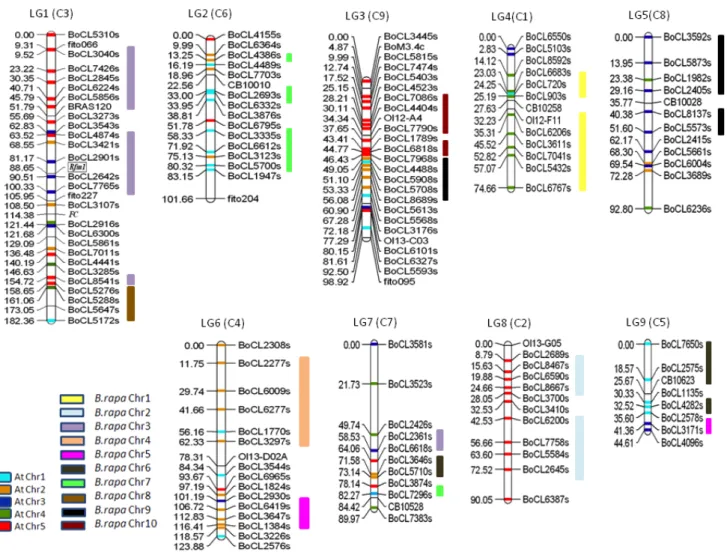
In total, 163 markers segregated in the 205 F2 plants genotyped. By linkage analysis with JoinMap 4.0 software, 142 markers (125 EST-SNPs, 15 SSR, 1 SCAR and one flower color) could be assigned to nine linkage groups, designated LG1-LG9, and the others remained ungrouped. Primer sequences, probe sequences and hybridization conditions of the mapped SNP markers are given in Supplementary Table 2. One to three SSR markers were assigned to each linkage group and on this basis the linkage groups were designated C1-C9 as per the reference linkage map of B.
oleracea (Fig. 2). The linkage map spanned 909 cM with an
average distance between markers of 6.4 cM, a minimum distance of 0.2 cM and a maximum distance of 23 cM. The largest linkage group (LG1) comprised 30 markers and had length of 182.4 cM and the smallest group (LG9) had 8 loci with 44.6 cM. Based on the estimated physical length of 596 Mb in B. olercaea (Johnston et al. 2005), the average physical distance between markers for this map is estimated to be 4.9 Mb (estimated 1 cM=766 kb).
Linkage analysis of phenotypic data by JoinMap 4.0 assigned the Rfm1 locus to LG1 (chromosome 3) of B. oleracea. We were unable to locate the exact position of another restorer locus (Rfm2) on the linkage map, but comparing segregation distortion for markers in sterile and semi-fertile plants, it seemed to be positioned on LG3 between markers BoCL6818s and BoCL7968s. SNPs flanking the Rfm1 locus were BoCL2642s on one side and BoCL2901s on other side at a distance of 2.54 cM and 7.48 cM, respectively. The flower color locus was also assigned to LG1 with a distance of 25 cM from Rfm1 locus. The closest marker to the flower color locus was BoCL3107s, which was identified at a distance of 5.88 cM.
Syntenic relation with A. thaliana and B. rapa
All the EST-SNP markers used in the present study showed homology with A. thaliana and B. rapa genome sequences in BLAST analysis with the BRAD software. Loci homologous to A.
thaliana at a significance threshold E < 10-10 were 115 and were distributed over all the nine linkage groups. Collinearity was interrupted by the presence of markers showing homology to other regions of the B. oleracea map at a significant E value. Matching nucleotide lengths, E values and chromosome names are given in Supplementary Table 3. Based on criteria of three or more (continuous) collinear markers, we identified 11 regions syntenic
with the genome of A. thaliana. LG8 was completely collinear with chromosome 5 of A. thaliana, whereas LG1 and LG3 were homologous to a 55 cM region and a 40 cM region of A. thaliana chromosome 5, respectively. LG7 had segmental homology to all five chromosomes of A. thaliana. LG9 was homologous to chromosome 1 of A. thaliana. Homology of each locus to the B.
rapa genome sequence was searched for by the BLAST tool of
BRAD (Brassica database) for the recently published B. rapa genome sequence (Brassica rapa Genome Sequencing Project Consortium) and a total of 24 syntenic segments were identified by comparison with our linkage map of B. oleracea based on criteria of three or more (continuous) collinear markers. LG1 had four collinear regions, three of which were collinear with chromosome 3 of B. rapa. LG2 (C6), LG4 (C1), LG5 (C8) and LG8 (C2) showed synteny with B. rapa chromosome 7, 1, 9 and 2, respectively (Fig. 2).
Identification of PPR genes in the syntenic region and expression analysis
The EST-SNP markers BoCL2901s and BoCL2642s flanking Rfm1 showed sequence homology with regions of 608,752 - 609,089 bp
and 2,439,089 - 2,439,370 bp, respectively, on chromosome 3 of A.
thaliana and homology with regions of 14,577,244 - 14,577,510 bp
and 15,565,034 - 15,565,334 bp, respectively, on chromosome 3 of
B. rapa. The homologous segment of A. thaliana (~3 Mb of
chromosome 3) contained 18 genes encoding pentatricopeptide repeat (PPR) proteins. Nine of them were P-subfamily PPR genes, which encode PPR proteins targeted to mitochondria or plastid (Supplementary Table 4). The region of B. rapa ca. 1 Mb in size was analyzed by GENSCAN and a total of 216 genes were predicted. These were searched to detect identity with A. thaliana PPR proteins by the BLASTP program and deduced amino acid sequences showed identities with 16 PPR proteins. The highest identity (87%, e value 0) was between the B. rapa predicted peptide and AtPPR_3g06920. Interestingly, AtPPR_3g06920 was one of the 18 identified PPR genes in the region of ~3 Mb on A.
thaliana chromosome 3. In most cases, the CMS restorer genes
encode PPR proteins of the P-subfamily targeted to mitochondria and these Rf PPR genes are present in clusters together with other non-restorer PPR genes (Brown et al. 2003; Koizuka et al. 2003; Barr and Fishman 2010). We utilized the A. thaliana sequence information for designing eight specific primer pairs for
Fig. 2. Genetic linkage map of B. oleracea based on EST-SNP markers with comparative maps of A. thaliana and B. rapa. The
linkage groups are labeled as LG1–LG9 in the order of length and their correspondence to the C genome chromosome (C1-C9). Marker positions (in cM) are shown on the left side with the corresponding marker names on the right side of each LG. Each locus was tested for homology with A. thaliana and B. rapa and is represented in the horizontal bar within LGs (colored according to Parkin et al. 2005) and verticals bars shown to the right of LGs (colored as per given at the bottom of the figure) for A. thaliana and
- 6 -
P-subfamily PPR genes. In PCR using a primer pair designed from the sequence of AtPPR_3g02490, two faint bands were amplified in parental genomes with slight variation in size. Amplified products having expected sizes were obtained from genomic DNAs of both CMS broccoli and restorer Chinese kale by the primer pairs of AtPPR_3g07290, AtPPR_3g06430, AtPPR_3g049650 and AtPPR_3g06920, whereas there was no amplification by the primer pairs of AtPPR_3g02650, AtPPR_3g04130 and AtPPR_3g09060 (Supplementary Table 5). PCR products of parental genotypes had no size polymorphism and showed monomorphic bands (Fig. 3). RT-PCR was performed using total RNA from leaves and buds of CMS broccoli and restorer Chinese kale. By the primer pair of AtPPR_3g02490, two bands (approximately 500 bp and 700 bp) were obtained in the buds and leaves of the restorer line by RT-PCR and a single band was detected in the leaves of CMS lines, whereas there was no amplification in the CMS buds. The primerpair of AtPPR_3g07290 generated faint amplification of 500 bp in the buds of both the CMS and restorer lines. By the primer pair of AtPPR_3g06430 and AtPPR_3g06920, products having sizes of 700 bp and 350 bp, respectively, were amplified exclusively in the restorer buds with no amplification in the CMS buds nor in the leaves of the CMS and restorer lines. The primer pair of AtPPR_3g09650 generated a product of 350 bp in the restorer buds and faint amplification in the leaves of the CMS and restorer lines. RT-PCR was replicated and consistency of results was confirmed (Fig. 3).
Discussion
In most Brassica CMS systems, a single gene restores pollen fertility, e.g., pol CMS of B. napus (Feng and McVetty, 1989) and
mori CMS of B. juncea (Prakash et al. 1998), whereas fertility
Fig. 3. Analysis of PPR genes. (a) PCR
amplification of PPR genes in genomic DNA of CMS broccoli (St) and restorer Chinese kale (Fr). (b and c) Expression analysis of PPR genes using RT-PCR in buds and leaves of CMS and restorer plants. SB, CMS bud; FB, restorer bud; SL, CMS leaf; FL, restorer leaf; M, 100 DNA ladder. The actin gene was used as a control.
restoration in mur CMS B. oleracea was found to be under the control of two loci functioning in a duplicated mode of gene interaction. Janeja et al. (2003) have also reported two dominant genes, i.e., Rft1 and Rft2, required for fertility restoration in tour CMS B. napus, in which Rft1 alone can restore pollen fertility completely.
Developing a linkage map of DNA markers is a prerequisite for molecular mapping of important agronomic traits and facilitating marker assisted breeding. Most of the restorer genes cloned so far have been identified by a map-based cloning approach, in which the first step is to find DNA markers linked with an Rf locus followed by fine mapping and synteny analysis with known genomes. Although the Rf2 gene of CMS T-maize encoding a mitochondrial aldehyde dehydogenase has been identified by a transposon tagging strategy (Cui et al. 1996), molecular tagging and fine mapping of restorer loci in other species, e.g., petunia, radish and rice, have been performed for the cloning of genes. We constructed a linkage map of B. oleracea using EST-based SNP markers with a segregating F2 population of CMS and restorer parents. In the primers designed from R. staivus EST sequences, 50% primers yielded single band amplification in the parental lines, and 236 ESTs having SNPs (37%) were identified. This result proved the transferability of EST information to other Brassicaceae species and the utility of resources in marker development. Rfm1 of
mur CMS B. oleracea was mapped on LG1 (B. oleracea
chromosome 3) with flanking markers at a distance 2.54 cM on one side and 7.48 cM on the other side. For the tour Brassica restorer gene, Trendelkamp et al. (1999) have identified 11 AFLP markers linked with the restorer gene, whereas Janeja et al. (2003) have found two AFLP markers by using NILs. Two AFLP markers and one close (0.6 cM) SCAR marker linked to the fertility restorer gene have been developed in mori CMS B. juncea (Ashutosh et al. 2007). Since AFLP markers could not be used directly for map-based cloning of genes, they must be converted to sequence-tagged markers, such as SCAR, CAPS or SNP markers. Furthermore, AFLP markers frequently reside in intergenic regions, which is not suitable for synteny analysis. The present EST-SNP linkage map would be informative for identification and positional cloning of agronomically important genes in B. olercaea.
Chromosome 5 of A. thaliana showed synteny to the complete LG8 (B. oleracea chromosome 2), a 55 cM LG1 segment (B.
oleracea chromosome 3) and a 40 cM LG3 segment (B. oleracea
chromosome 9). Repeated long syntenic regions have been reported for B. oleracea corresponding to chromosome 2, 3 and 5 of A.
thaliana genome by comparing RFLP and EST sequences (Lan et
al. 2000; Babula et al. 2003; Parkin et al. 2005) but not for whole linkage group. We also found repeated long regions in B. oleracea chromosomes syntenic to A. thaliana chromosome 2, 3 and 5, whereas a single syntenic region for chromosome 1 and 4 of A.
thaliana. Brassica species has 87% sequence identity in coding
regions with A. thaliana (Cavell et al. 1998) and some genes have counterparts. Other genes have no apparent counterparts, but synteny is preserved between Brassica and A. thaliana. Transcriptome mapping followed by homology analysis between B.
oleracea and A. thaliana have revealed extensive collinearity of the
genomes and duplication mostly of chromosome 1 and 5 of A.
thaliana (Li et al. 2003). Furthermore, in the present study,
sequence homology analysis identified 24 syntenic segments in the recently published B. rapa genome. LG1 had four collinear regions, three of which showed synteny with chromosome 3 of B. rapa. These results indicate the suitability of sequence-based markers for
comparative genomic studies. Radish EST sequences have been utilized extensively to generate an SNP linkage map of R. sativus and comparative studies have revealed high homeology among
Brassica species (Li et al. 2011).
A. thaliana-derived markers have been utilized in high density
mapping of the Rfp restorer locus of B. napus and have supported the extended collinearity between the B. napus Rfp region and an orthologous segment of A. thaliana genome with a single exception (Formanova et al. 2010). Cloning of the restorer genes of the radish CMS systems ‘Ogura’ and ‘Kosena’ has been performed utilizing the close synteny between radish and A. thaliana genomes following a map-based approach, and Rf-encoded PPR genes have been revealed to be present in clusters together with other non-restorer PPR genes (Brown et al. 2003; Desloire et al. 2003; Koizuka et al. 2003). The flanked markers of the Rfm1 gene showed homology with the A. thaliana region containing 18 genes encoding PPR proteins and nine of these belong to the P-subfamily of the PPR genes. One of the PPR genes, AtPPR3g06920, was also found in a syntenic B. rapa region around the Rfm1 locus. Analyzing syntenic genomic regions from A. thaliana and B. rapa, Geddy and Brown (2007) have shown that the location and direction of PPR genes are less conserved in collinear regions and often appear in different chromosomal contexts. PPR regions were aligned for a small region, but in the present studies we considered a large region of ca. 3 Mb for analysis and found conserved PPR genes. Kato et al. (2007) have reported that the Rf-1 locus of rice contains several duplicated copies of the restorer gene. Furthermore, the gene order between clusters from different species is conserved, suggesting that the Rf1 locus may have been generated by homologous recombination. The PPR protein-encoding genes in B.
oleracea, similar to AtPPR_3g06430, AtPPR_3g09650 and
AtPPR3g06920, which were deduced from the syntenic region of A.
thaliana, showed gene expression exclusively in fertile buds. All
three PPR genes belong to the P-subfamily category in A. thaliana. A target organelle of protein encoded by AtPPR_3g06920 is unknown, whereas AtPPR_3g06430 and AtPPR_3g09650 encode proteins targeted to plastids as per Predotar prediction (Lurin et al. 2004). Based on findings of the present study, we consider these genes to be potential candidate restorer genes, but additional molecular analysis is required to confirm their relevance and functional role in fertility restoration.
Acknowledgements
This work was supported in part by the Program for Promotion of Basic and Applied Research for Innovations in Bio-oriented Industry (BRAIN), Japan. Ashutosh is a recipient of a research fellowship from the Japan Society for the Promotion of Science for Foreign Scientists.
Supplementary Data
Supplementary Table 1. Primer pair sequences of polymorphic
SSR and SCAR markers and their mapped reference chromosomes of B. oleracea
Supplementary Table 2. Sequences of primer pairs and probes of
SNP markers and hybridization and washing conditions
Supplementary Table 3. Analysis of homology with Arabidopsis
thalaina and Brassica rapa genome using blast tool of BRAD
Supplementary Table 4. List of PPR genes in the homologous
region of Arabidopsis and subcellular localization of PPR proteins
Supplementary Table 5. Primer sequences of PPR genes derived
- 8 -
DNA in B. oleraceaReferences
Ashutosh, Sharma PC, Prakash S, Bhat SR (2007) Identification of AFLP markers linked to the male fertility restorer gene of CMS (Moricandia-arvensis) Brassica juncea and conversion to SCAR marker. Theor Appl Genet 114:385-392
Babula D, Kaczmarek M, Barakat A, Delseny M, Quiros CF, Sadowski J (2003) Chromosomal mapping of Brassica oleracea based on ESTs from Arabidopsis thaliana: complexity of the comparative map. Mol Genet Genomics 268:656-665
Barr CM, Fishman L (2010) The nuclear component of a cytonuclear hybrid incompatibility in Mimulus maps to a cluster of pentatricopeptide repeat genes. Genetics 184:455-465 Bentolila S, Alfonso AA, Hanson MR (2002) A pentatricopeptide
repeat-containing gene restores fertility to cytoplasmic male-sterile plants. Proc Natl Acad Sci USA 99:10887-10892 Bhat SR, Prakash S, Kirti PB, Dinesh Kumar V, Chopra VL (2005)
A unique introgression from Moricandia arvensis confers male fertility upon two different cytoplasmic male-sterile lines of
Brassica juncea. Plant Breeding 124:117-120
Brown GG, Formanova N, Jin H, Wargachuk R, Dendy C, Patil P, Laforest M, Zhang J, Cheung WY, Landry BS (2003) The radish
Rfo restorer gene of Ogura cytoplasmic male sterility encodes a
protein with multiple pentatricopeptide repeats. Plant J 35:262-272
Cavell AC, Lydiate DJ, Parkin IA, Dean C, Trick M (1998) Collinearity between a 30-centimorgan segment of Arabidopsis
thaliana chromosome 4 and duplicated regions within the Brassica napus genome. Genome 41:62-69
Cui X, Wise RP, Schnable PS (1996) The rf2 nuclear restorer gene of male-sterile T-cytoplasm maize. Science 272:1334-1336 De Vincente C, Thomas M, Adriana A (2004) Descriptors for
genetic markers technologies. IPGRI report, Rome, Italy Desloire S, Gherbil W, Laloui S, Marhadour V, Clouet V, Cattolico
L, Falentin C, Giancola S, Renard M, Budar F, Small I, Caboche M, Delourme R, Bendahmane A (2003) Identification of the fertility restoration locus Rfo in radish as a member of the pentatricopeptide-repeat protein family. EMBO Rep 4:588-594 Doyle JJ, Doyle JL (1990) Isolation of plant DNA from fresh tissue.
Focus 12:13-15
Fang GH, McVetty PBE (1989) Inheritance of male-fertility restoration and allelism of the restorer gene for the polima CMS system in oilseed rape. Genome 32:1044-1047
Feng C, Shengyi L, Jian W, Lu F, Silong S, Bo L, Pingxia L, Wei H, Xiaowu Wa (2011) BRAD, the genetics and genomics database for Brassica plants. BMC Plant Biology 11:136 Formanova N, Stollar R, Geddy R, Mahe L, Laforest M, Landry
BS, Brown GG (2010) High resolution mapping of the Brassica
napus Rfp restorer locus using Arabidopsis-derived molecular
markers. Theor Appl Genet 120:843-851
Fujii S, Toriyama K (2005) Molecular mapping of the fertility restorer gene for ms-CW-type cytoplasmic male sterility of rice. Theor Appl Genet 111:696-701
Geddy R, Brown GG (2007) Genes encoding pentatricopeptide repeat (PPR) proteins are not conserved in location in plant genomes and may be subject to diversifying selection. BMC Genomics 8:130
Hinata K, Konno N (1979) Studies on a male sterile strain having the Brassica campestris nucleus and the Diplotaxis muralis
cytoplasm. I. On the breeding procedure and some characteristics of the male sterile strain. Japan J Breed 29: 305-311
Iniguez-Luy FL, Voort AV, Osborn TC (2008) Development of a set of public SSR markers derived from genomic sequence of a rapid cycling Brassica oleracea L. genotype. Theor Appl Genet 117:977-985
Itabashi E, Iwata N, Fujii S, Kazama T, Toriyama K (2011) The fertility restorer gene, Rf2, for Lead Rice-type cytoplasmic male sterility of rice encodes a mitochondrial glycine-rich protein. Plant J 65:359-367
Janeja HS, Banga SS, Lakshmikumaran M (2003) Identification of AFLP markers linked to fertility restorer genes for tournefortii cytoplasmic male-sterility system in Brassica napus. Theor Appl Genet 107:148-154
Johnston JS, Pepper AE, Hall AE, Chen ZJ, Hodnett G, Drabek J, Lopez R, Price HJ ( 2005) Evolution of genome size in Brassicaceae. Ann Bot 95:229-235
Kaplinski L, Andreson R, Puurand T, Remm M (2005) MultiPLX: automatic grouping and evaluation of PCR primers. Bioinformatics 21:1701-2
Kato H, Tezuka K, Feng YY, Kawamoto T, Takahashi H, Mori K, Akagi H (2007) Structural diversity and evolution of the Rf-1 locus in the genus Oryza. Heredity 99:516-524
Kazama T, Toriyama K (2003) A pentatricopeptide repeat-containing gene that promotes the processing of aberrant
atp6 RNA of cytoplasmic male-sterile rice. FEBS Lett
544:99-102
Klein RR, Klein PE, Mullet JE, Minx P, Rooney WL, Schertz KF (2005) Fertility restorer locus Rf1 of sorghum (Sorghum bicolor L.) encodes a pentatricopeptide repeat protein not present in the collinear region of rice chromosome 12. Theor Appl Genet 111:994-1012
Koizuka N, Imai R, Fujimoto H, Hayakawa T, Kimura Y, Kohno-Murase J, Sakai T, Kawasaki S, Imamura J (2003) Genetic characterization of a pentatricopeptide repeat protein gene, orf687 that restores fertility in the cytoplasmic male sterile Kosena radish. Plant J 34:407-415
Kosambi DD (1944) The estimation of map distance from recombination value. Ann Eugen 12:172-175
Lan TH, DelMonte TA, Reischmann KP, Hyman J, Kowalski SP, McFerson J, Kresovich S, Paterson AH (2000) An EST-enriched comparative map of Brassica oleracea and Arabidopsis thaliana. Genome Res 10(6):776-788.
Li F, Hasegawa Y, Saito M, Shirasawa S, Fukushima A, Ito T, Fujii H, Kishitani S, Kitashiba H, Nishio T (2011) Extensive Chromosome homoeology among Brassiceae species were revealed by comparative genetic mapping with high-density EST-based SNP markers in radish (Raphanus sativus L.) DNA Research18:401-411
Li G, Gao M, Yang B, Quiros CF (2003) Gene for gene alignment between the Brassica and Arabidopsis genomes by direct transcriptome mapping. Theor Appl Genet 107:168-180
Lowe AJ, Moule C, Trick M, Edwards KJ (2004) Efficient large scale development of microsatellites for marker and mapping applications in Brassica crop species. Theor Appl Genet 108:1103-1112
Lurin C, Andres C, Aubourg S, Bellaoui M, Bitton F, Bruyere C, Caboche M, Debast C, Gualberto J, Hoffmann B, Lecharny A, Le Ret M, Matrin-Magnietee M-L, Mireau H, Peeters N, Renou J-P, Szurek B, Taconnat L, Small I (2004) Genome-wide
analysis of Arabidopsis pentatricopeptide repeat proteins reveals their essential role in organelle biogenesis. Plant Cell 16:2089-2103
O’Toole N, Hattori M, Andres C, Iida K, Lurin C et al (2008) On the expansion of the pentatricopeptide repeat gene family in plants. Mol Biol Evol 25:1120-1128
Parkin IA, Gulden SM, Sharpe AG, Lukens L, Trick M et al (2005) Segmental structure of the Brassica napus genome based on comparative analysis with Arabidopsis thaliana.
Genetics171:765-781
Piquemal J, Cinquin E, Couton F, Rondeau C, Seignoret E et al (2005) Construction of an oilseed rape (Brassica napus L.) genetic map with SSR markers. Theor Appl Genet 111:1514-1523
Prakash S, Kirti PB, Bhat SR, Gaikwad K, Kumar VD, Chopra VL (1998) A Moricandia arvensis based cytoplasmic male sterility and fertility restoration systems in Brassica juncea. Theor Appl Genet 97:488-492
Schnable PS, Wise RP (1998) The molecular basis of cytoplasmic male sterility and fertility restoration. Trends Plant Sci 3:175-180
Shinada T, Kikuchi Y, Fujimoto R, Kishitani S (2006) An alloplasmic male-sterile line of Brassica oleracea harboring the mitochondria from Diplotaxis muralis expresses a novel chimeric open reading frame, orf72. Plant Cell Physiol 47 (4):549-553
Shiokai S, Shirasawa K, Sato Y, Nishio T( 2010a) Improvement of the dot-blot-SNP technique for efficient and cost-effective genotyping. Mol Breed 25:179-85
Shiokai S, Kitashiba H, Nishio T (2010b) Prediction of the optimum hybridization conditions of dot-blot-SNP analysis using estimated melting temperature of oligonucleotide probes. Plant Cell Rep 29: 829-34
Small ID, Peeters N (2000) The PPR motif: a TPR-related motif prevalent in plant organellar proteins. Trends Biochem Sci 25:46-47
Trendelkamp H, Uzunova MI, Ecke W (1999) Mapping a restorer gene for CMS tour 25-143 cytoplasm in rapeseed (Brassica
napus L.). Proceedings of the 10th international rapeseed
congress, Canberra, Australia
Van Ooijen JW (2006) JoinMap4.0 Software for the Calculation of Genetic Linkage Maps in Experimental Populations. Kyazma BV: Wageningen The Netherlands
Wang X, Wang H, Wang J et al (2011) The genome of the mesopolyploid crop species Brassica rapa. Nature Genetics 1035-1039. doi:10.1038/ng.919
Supplementary Table 1. Primer pair sequences of polymorphic SSR and SCAR markers and their mapped reference chromosomes of B. oleracea
Name of markers
Reference chromosomes
of B. olercaea
References
SSR markers
FITO66
AGCCCATTTACCTGCTGA
GAAAGACGATGCTTAGGGT
C3
Iniguez-Luy et al. (2008)
BRAS120
AAAAATAAATACAGCGAACC ACCTTTAGCAGCTAATCATC
C3
Piquemal et al. (2005)
FITO227
GTAACAGCAGAAGCAGAAGCA
CAGGTTCACGATACACAAGA
C3
Iniguez-Luy et al. (2008)
CB10010
TTATCTTTGAATGAGCATCT
ACCCTGTTCCTTCTACTAT
C6
Piquemal et al. (2005)
FITO204
TCTGATGGAGAAGAAGAAGAC
ATTGAAGAGGAAGAAGGAGAA
C6
Iniguez-Luy et al. (2008)
Ol12-A04
TGGGTAAGTAACTGTGGTGGC
AGAGTTCGCATACTCTGGAGC
C9
Lowe et al. (2004)
Ol13-C03
GATCGGAGATGCGATGAGAG
GCATGCACCAGTGAAAAACTC
C9
Lowe et al. (2004)
FITO95
AGATTTCATCCACAGCCTC
TTTGATTCTTGCGTTCTCTC
C9
Iniguez-Luy et al. (2008)
CB10258 ATGATGCCTAGCATGTCC
AAGCTAAAGCGAAAGAAGC
C1
Piquemal et al. (2005)
Ol12-F11
AAGGACTCATCGTGCAATCC
GTGTCAGTGGCTACAGAGAC
C1
Lowe et al. (2004)
CB10208
ACTACTGTTGCGGTTGGA
GGCATTCATTACGTCTGC
C8
Piquemal et al. (2005)
Ol13-D02A
TTCTCCACACCAAGCAACAC
TACAGGCTTGGTCGTTTTCC
C4
Lowe et al. (2004)
CB10528
ATGCTTTCTTTGCACGAG
ACCAGACTGATGGTGTGC
C7
Piquemal et al. (2005)
Ol13-G05
GTGTGCAGGAAACGATGTTC
GGGAGTTTGAAGAGAAAGCG
C2
Lowe et al. (2004)
CB10623
GAGATCGAAGGTCTCGGT
GAGTCGAAACAGTGGTGG
C5
Piquemal et al. (2005)
SCAR markers
Assession No.
M3.4
CGCTAACTCAAGGCTTCGAA
CTAAATCACTGAGCCGGTGA
AF136223
Nit2
TCAAAGCCAGTACTCCTGGT
TGTCCAGCCGGGTCTTTTAA
AF1380304
Primer sequences Forward
Reverse
Supplementary Table 2. Sequences of primer pairs and probes of SNP markers and hybridization and washing conditions
Linkage group
Position
(cM) Temperature SSC
BoCL5310s 1 0 Forward primer CAACGAGAATCCAGATGCTGAG Chinese kale GTCGCTGACGCTCTCTT 55 0.5 Reverse primer TTCAAGACCAGTCCCATAAGCA Broccoli GTCGCTGATGCTCTCTT 50 0.5
fito066 1 9.309
BoCL3040s 1 9.523 Forward primer AGCGTTTGCAGGAATCATAGGT Chinese kale GTTCAGATACCAACAGA 45 0.5 Reverse primer AGCTCGGTCAAGAAACTCTGCT Broccoli GTTCAGATTCCAACAGA 45 0.5 BoCL7426s 1 23.222 Forward primer TAGTCCCTTCTCCGATAGCACA Chinese kale CTCATGGGGTCTCTCAC 45 0.1 Reverse primer GATTCAAGGAGGTGGGATCAT Broccoli CTCATGGGATCTCTCAC 45 0.5 BoCL2845s 1 30.346 Forward primer AACCAAGCAGCTTAATCGGTTC Chinese kale CTTGATGCTGAAGAAGA 45 0.5 Reverse primer TTGCCTGAAACAGTTCTCCAAG Broccoli CTTGATGCGGAAGAAGA 45 0.5 BoCL6224s 1 40.713 Forward primer ACGACAGAGCTCGTTTAACCAC Chinese kale TCAACCAAAAACTATAG 40 0.5 Reverse primer TTGACCAAGAACGAAGATGGTG Broccoli TCAACCAAGAACTATAG 40 0.5 BoCL5856s 1 45.788 Forward primer GAAAGGAGCATTGGAAGGACAC Chinese kale AAAGTTCCAACTGCGAA 50 0.5 Reverse primer GTAATGGTGTGGCGGCATATAA Broccoli AAAGTTCCGACTGCGAA 50 0.2
BRAS120 1 51.787
BoCL3273s 1 55.691 Forward primer CAAGCGAGATTGTCGTGAAAGA Chinese kale AAGTACTTAAGGTGTCT 40 0.5 Reverse primer CCAAAGATTTTGCACTGTCAGC Broccoli AAGTACTTTAGGTGTCT 40 0.5 BoCL3543s 1 62.828 Forward primer TTAAGGGTCTTCCTTCCATGCT Chinese kale CAGCCTTGACATCACTG 55 0.5 Reverse primer GAGGTCAAGATGGAGCAAGGTT Broccoli CAGCCTTGGCATCACTG 50 0.5 BoCL4874s 1 63.523 Forward primer ACTGAAGAGGAGCACGCTTTTT Chinese kale GGTAAAAACGGATGGAA 45 0.5 Reverse primer AAGCAAAACCGAACCTCTCAAG Broccoli GGTAAAAATGGATGGAA 40 0.5 BoCL3421s 1 68.55 Forward primer ATTTGCAGCGCCTGTTGTAG Chinese kale AAGTTGCTAGGTTGGCC 50 0.5 Reverse primer AGTGTGCAAACAGCAAGCAG Broccoli AAGTTGCTCGGTTGGCC 50 0.2 BoCL2901s 1 81.172 Forward primer AGTATGGTGCAAAGAAGCTCCA Chinese kale TCCTTAGGAAAATCATC 40 0.5 Reverse primer GACCAAGAATGTCAACCACCAA Broccoli TCCTTAGGCAAATCATC 40 0.2
Rfm1 1 88.645
Marker name * B. oleracea Probe sequence**
Hybridization and washing conditions Primer sequence (5'-3')
BoCL2642s 1 90.513 Forward primer CCAGGTCTCTGTTTTTCTGCTG Chinese kale CAAGGGAATCATCGGCT 50 0.5 Reverse primer AGACGTAGGCAAGCATTTGACA Broccoli CAAGGGAAGCTTCGACT 50 0.5 BoCL7765s 1 100.328 Forward primer ACAAGGATGAAAGTTGCAGCAG Chinese kale GCTCTCACAGGACAGCT 50 0.5 Reverse primer TTCTGTTCTCGAGTTGGTTTCG Broccoli GCTCTCACGGGACAGCT 50 0.2 fito227 1 105.951
BoCL3107s 1 108.496 Forward primer TGGACGGATTGACTATGGAGAA Cabbage TACATATCAGTCTTTGG 45 0.2 Reverse primer AAACCCAAAAGAGGGTCAAAGC Broccoli TACATATCTGTCTTTGG 45 0.5
FC 1 114.382
BoCL2916s 1 121.435 Forward primer ACGAGTTTCAAAAAGGGAGCAG Chinese kale ACTGTAGCGGCAGTGGC 50 0.5 Reverse primer GTAGAAGATGCCTTTGGCGTTT Broccoli ACTGTAGCTGCAGTGGC 50 0.5 BoCL6300s 1 121.68 Forward primer CATGCAAAGACCCATCACAAGT Chinese kale GGACTCAATCCGCCGCA 55 0.5 Reverse primer AAGCAAGTCATCGGGAATAGGA Broccoli GGACTCAACCCGCCACA 55 0.5 BoCL5861s 1 129.091 Forward primer ACGCTCCGACTCAATAGCATCT Chinese kale ATCGTCCCGAGGTTCAA 50 0.2 Reverse primer TTCGGACAACAAGATGAGGAGA Broccoli ATCGTCCCTAGGTTCAA 50 0.5 BoCL7011s 1 136.484 Forward primer AAGCGTAAAGATGCGGTCACTA Chinese kale TCACACCATACACGGTG 50 0.5 Reverse primer GTTTCGCCTTGTCGACTTCATT Broccoli TCACACCAAACACGGTG 50 0.5 BoCL4441s 1 140.187 Forward primer GGAAAGGACACGACTTTGAGGT Chinese kale AGGTGAAGTAATGGAGA 45 0.5 Reverse primer AGACTCCGCTTCTCATCTTTCC Broccoli AGGTGAAGCGATGGAGA 50 0.5 BoCL3285s 1 146.629 Forward primer ATCTGAAGGTTGGTCACTGCAA Chinese kale GCATGTCTATCATGGTG 45 0.5 Reverse primer CAAAACCACTGTCCAAAACTCG Broccoli GCATGTCTTTCATGGTG 45 0.5 BoCL8541s 1 154.717 Forward primer GAGAAGAGCTTCCAAAGGCAAC Chinese kale GTCCGTTGATTCCTGCG 50 0.5 Reverse primer TCCTTGGTTTCACCCATCTCTT Broccoli GTCCGTTGGTTCCTGCG 50 0.5 BoCL5276s 1 158.646 Forward primer TGAGAACGTAGGAGGCAAAATG Chinese kale GTGATTCCTTGCATCAA 45 0.5 Reverse primer ACTCGTGAGCAACCACAACAAC Broccoli GTGATTCCGTGCACCAA 50 0.1 BoCL5288s 1 161.063 Forward primer GTTCAACTCCAGGGGAGATGTT Chinese kale CTTGACTTTGCTACAGA 45 0.5 Reverse primer CTCCATAATCCCACCATCAAAG Broccoli CTTGACTTCGCTACAGA 45 0.5 BoCL5647s 1 173.046 Forward primer GCAAGCATGGATGATGATGAAC Chinese kale TCGACCGTAGTAGTGAA 50 0.5 Reverse primer AAGACGCTGTCGAAAACGTAGA Broccoli TCGACCGTGGTAGTGAA 50 0.5
BoCL5172s 1 182.362 Forward primer TCCCATATCGAAGGCAAGCTAT Chinese kale CGAAATGTCATTTACAT 45 0.5 Reverse primer AACGCATACACTTGTCCCCAGT Broccoli CAAAATGTAATTTACAT 45 0.5 BoCL4155s 2 0 Forward primer GCTAAATCGAGCAAAGCTGGTT Cabbage AGGAAGACATAAAGGAC 50 0.5 Reverse primer GCATTTCTTCCCAGTTTCTTGG Broccoli AGGAAGACGTAAAGGAC 50 0.5 BoCL6364s 2 9.987 Forward primer AAATACACTCAAGGGTGCAAGG Chinese kale TTTGATGACCTCGATGA 45 0.5 Reverse primer AGAGCTGCTCACTGTGGCTAAA Broccoli TTTGATGATCTCGATGA 45 0.5 BoCL4386s 2 13.246 Forward primer ACAACTTGTGTGATTGGGAACG Chinese kale CAAGAAGTCGATGGGCT 50 0.5 Reverse primer TCCAACATTGTAGCCTGACCAC Broccoli CAAGAAGTTGACGGGCT 50 0.5 BoCL4489s 2 16.194 Forward primer GCTATGCCCTTCCTCATGCTAT Chinese kale CGGTGCCCGGAAGTCCT 55 0.5 Reverse primer CGGTGATCTCTTTGCTCATACG Broccoli CGGTGTCCAGAAGTCCT 50 0.5 BoCL7703s 2 18.96 Forward primer GGGAAGTGAGAGGAAAGCAATC Chinese kale AACAGAAATTCGTGAGT 45 0.5 Reverse primer TAGCATTCTGCCTCTTGCCTTT Broccoli AACAGAAACTCGTGAGT 45 0.5
CB10010 2 22.555
BoCL2693s 2 32.996 Forward primer CCAAGCTAGGTAAAAGCGAGGA Chinese kale ACGCTGGCCAGGGTTTC 55 0.5 Reverse primer AATACGCAGTTACGGGTCGAGT Broccoli ACGCTGGCTAGGGTTTC 55 0.5 BoCL6332s 2 33.949 Forward primer TCATCTCTCCTTGCGTCTTCTG Chinese kale GCAGCGGCGGTGTTTGT 60 0.5 Reverse primer GTAGCGGCAGACAAGAACTTCA Broccoli GCAGCGGCCGTGTTTGT 60 0.5 BoCL3876s 2 38.81 Forward primer CGCACAAGGAGGGAGATACTTT Chinese kale TGAAGCCGGCATCACTT 55 0.5 Reverse primer CGGCTTTCCAATGTAACCTCTT Broccoli TGAAGCCGCCATCACTT 55 0.5 BoCL6795s 2 51.779 Forward primer GCAAATGCAAGATCTGAACAGG Chinese kale TTCTTTTGCCTGTTGTA 45 0.5 Reverse primer CATCCAACCATCAAGGACCAA Broccoli TTCTTTTGGCTGTTGTA 45 0.5 BoCL3335s 2 58.327 Forward primer ACACAGACAAAGCAAAGGCAAG Cabbage ACCAGACCAAAGAGATA 45 0.5 Reverse primer CATTAGAGGCAACGGGAAGAAC Broccoli ACCAGACCGAAGAGATA 45 0.5 BoCL6612s 2 71.916 Forward primer GATTAGCAGCGCAGTTTCACAG Chinese kale ATCTCCTAGTCTCCTTG 45 0.5 Reverse primer TGAGCTTTCTCCAACTCTGCTT Broccoli ATCTCCTACTCTCCTTG 45 0.5 BoCL3123s 2 75.13 Forward primer TCGCTCCTACAAACCTAAACGA Chinese kale TGATGGAAACCGTAAGA 45 0.5 Reverse primer TTCATCCGACCTCTCCTTTTTC Broccoli TGATGGAAGCCGTAAGA 45 0.2 BoCL5700s 2 80.321 Forward primer TGCGCATTAGCCGTATTCTGTA Chinese kale AGTCGACTACTCAGGGG 50 0.5 Reverse primer AGTCTCACCGAGCTCAACATCT Broccoli AGTCGACTCCTCAGGGG 50 0.5 BoCL1947s 2 83.148 Forward primer GATTGACGAGAACCGTACTGGA Cabbage AGATTCTCCGGTACTCA 45 0.5
Reverse primer CTCGATCGGATGGTACAAACAA Broccoli AGATTCTCAGGTACTCA 40 0.2 fito204 2 101.657
BoCL3445s 3 0 Forward primer GCATGCAACTGCTAGTCTCGTT Chinese kale AAAGGTCACATGAAAAG 40 0.2 Reverse primer TTGTGGGAACAGCTTCCCTTAG Broccoli AAAGGTCAAATGAAAAG 40 0.2
BoM3.4c 3 4.869
BoCL5815s 3 9.988 Forward primer AGCGACGCTAATGGCTACAACT Chinese kale ATGGTTCCCGTTCTTTA 50 0.5 Reverse primer TGGCAATCCACTTTACCCTTCT Broccoli ATGGTCCCGGTTCTTTA 50 0.5 BoCL7474s 3 12.742 Forward primer GGGGATCTCTCGATAGCTGAAT Chinese kale CTAAGCTACACGATAAT 40 0.2 Reverse primer CAGAGCGTGTTCAACCGTACTT Broccoli CTAAGCTAGACGATAAT 40 0.5 BoCL5403s 3 17.523 Forward primer ATTGGAGCATTTCAAGCTACCG Chinese kale TTCGGAGACAAAAGCTC 50 0.5 Reverse primer TCCAGCTACGTCTCTGCAAGTA Broccoli TTCGGAGAAAAAGGCTC 50 0.5 BoCL4523s 3 25.145 Forward primer AATGAATTCTTCTGGGGTGCTC Chinese kale AGGTTCATGTAAAGTCA 40 0.5 Reverse primer CTTGCTCTTGTCACCAAGCTCT Broccoli AGGTTCATCTGAAGTCA 40 0.1 BoCL7086s 3 28.207 Forward primer AGTGTTTGGGGAAGAGAAGGTG Chinese kale GTGGATGTACCGTTTCC 50 0.1 Reverse primer TCTGCTCGACGTTCTTTCTCAG Broccoli GTGGATGTGCCGTTTCC 50 0.5 BoCL4404s 3 30.106 Forward primer AGAGAAGACCAACTGGGCAAAG Cabbage GCTAAGTTCTGCGAGAC 45 0.2 Reverse primer CATCACATGCACGGTTCTAACA Broccoli GCTAAGTTTTGCGAGAC 45 0.2
Ol12-A4 3 34.336
BoCL7790s 3 37.646 Forward primer GTGTGGATCGATTCCATAACCA Cabbage AAGTTTTTGTATTCATG 35 0.5 Reverse primer GGAGCTGTGCTTGGATCTTCTT Broccoli AAGTTTTTTGTATTCAT 35 0.5 BoCL1789s 3 43.407 Forward primer GTTTCCGAGACCTTCCGGTTAT Chinese kale AAAGTCAAGGGTGAGGA 45 0.5 Reverse primer ATCATCAAAGGGTGAACGGAGT Broccoli AAAGTCAACGGTGAGGA 45 0.5 BoCL6818s 3 44.767 Forward primer GAGGTTGCGGTACTCTGCATAA Cabbage TTTGGATATTTTTGTTT 35 0.5 Reverse primer GGCCAACCCTTGTGTAATCATA Broccoli TTTGGATTTGTTTGTTT 35 0.5 BoCL7968s 3 46.425 Forward primer ACAAGACGCATCAATGTCACCT Cabbage GAGCTATCATGGAGGTG 45 0.2 Reverse primer GAAACCCCCTTAGCCTCTTTTG Broccoli GAGCTATCGTGGAGGTG 45 0.2 BoCL4488s 3 49.046 Forward primer CGGTCATGTCTCCCTCTTTTTC Chinese kale ACTTATCCACAACAAGT 45 0.5 Reverse primer TAAGGTGTACGGCGAGTTCGTA Broccoli ACTTATCCGCAACAAGT 45 0.5
BoCL5908s 3 51.104 Forward primer TCTACGATCAACCAACCCTCCT Chinese kale CTCCTGCGCCCATCAAC 50 0.1 Reverse primer GAGGTTCTCGATGATGACGTTG Broccoli CTCCTGCGACCATCAAC 50 0.2 BoCL5708s 3 53.325 Forward primer GCGCTTCGAATGAATCTCTCTT Chinese kale GCTGTTTCTTGGAAAAC 45 0.5 Reverse primer AGCTGAATCACTTGCAGCTCCT Broccoli GCTGTTTCGTGGAAAAC 45 0.2 BoCL8689s 3 56.08 Forward primer CCTTCCTTCATTTGACGCTTG Chinese kale GGTTGAAATGGATGTTC 45 0.5 Reverse primer GGAGTTTTCTTCTCTGCCTCCA Broccoli GGTTGAAAAGGATGTTC 45 0.5 BoCL5613s 3 60.896 Forward primer GAAGGGTGGAAAACACTCCACT Chinese kale GCTTCCAGTTCCTCCGG 50 0.5 Reverse primer CATTTGTTAACGGCTGGGTCTC Broccoli GCTTCCAGGTCCTCCGG 50 0.5 BoCL5568s 3 67.283 Forward primer AATAAACCTCTGGCGGTTATCG Chinese kale GATGAGAACGGGAAAGG 45 0.5 Reverse primer AGCGAACACACCAACAACACTC Broccoli GATGAGAATGGGAAAGG 45 0.5 BoCL3176s 3 72.184 Forward primer TCAGATCTCCTGAGGTTGTTCG Chinese kale GAGTGTGCTTCTATAAA 45 0.5 Reverse primer GTCATTCTCTCCCCACCCTTTA Broccoli GAGTGTGCCTCTATAAA 45 0.5 Ol13-C03 3 77.286
BoCL6101s 3 80.149 Forward primer CACTTCAAGAATCCAGCCAAGA Cabbage TTTAATTAGTCGTTCTA 35 0.1 Reverse primer GAGCAACGCAAAAGTCAATCAC Broccoli TTTAATTATTCGTTCTA 35 0.1 BoCL6327s 3 81.615 Forward primer AACAGCCAACTTCATCTTCGTG Chinese kale CAGCTTATGCGTTTGCT 45 0.2 Reverse primer TCGAGCATATGACGAGCTTCTT Broccoli CAGCTTATACGTTTGCT 45 0.5 BoCL5593s 3 92.504 Forward primer TCCATCTCTTCACCCACTTCTG Chinese kale TTCCTCGTCGTCCCACG 50 0.2 Reverse primer TGTCGATTCCGACATGGTTATC Broccoli TTCCTCGTTGTCCCACG 50 0.5
fito095 3 98.919
BoCL6550s 4 0 Forward primer GTCTTCTCCGATCCGATTCTTC Chinese kale GGAGACGGCGGCGCGAG 60 0.5 Reverse primer GAGTAAGAGCCAACGCCATAGA Broccoli GGAGACGGTGGCGCGAG 60 0.5 BoCL5103s 4 2.825 Forward primer AAAGCATTCAAGGGCTACATCG Chinese kale CAGATTTGCTCCCTTTA 45 0.5 Reverse primer GATGCCATCCCATGATGAAAC Broccoli CAGATTTGTTCCCTTTA 45 0.5 BoCL8592s 4 14.122 Forward primer CTGCAAACATATCCTCGGTTTC Chinese kale TTAATTACAATATTTAA 30 0.5 Reverse primer ATGGATTGGTGTGGATAAGAGG Broccoli TTAATTACTTTATTTAA 30 0.5 BoCL6683s 4 23.025 Forward primer GAAGAAAGTCGAAATGCGTGTG Cabbage TTGCCAAAGCTAAACAG 40 0.5 Reverse primer GATTCCACGCAAACTCTCAATG Broccoli TTGCCAAACCTAAACAG 40 0.5 BoCL720s 4 24.253 Forward primer CAAAAAGGAAGATCTGGTGCAG Cabbage CTGAAGCACTTTTGTTA 40 0.5
Reverse primer GGAACATGCCCATTATCAGACA Broccoli CTGAAGCATTTTTGTTA 40 0.5 BoCL903s 4 25.192 Forward primer ACGGCTCTTCGGGAACATATAC Cabbage CTCGCATGTAACGGTTT 45 0.5 Reverse primer CTCTCTCTCACTGTCGGCAAAA Broccoli CTCGCATGCAACGGTTT 50 0.5
CB10258 4 27.625
Ol12-F11 4 32.229
BoCL6206s 4 35.309 Forward primer TGCCACTCGTAAAGGTATGTGG Chinese kale AGACGACATGGCATCGG 50 0.5 Reverse primer AGTCAACCACCTTTGCACATGA Broccoli AGACGACACGGCATCGG 50 0.2 BoCL3611s 4 45.517 Forward primer AATATCGAAAGCACCAGGCTTC Chinese kale AGGGAGATTCCTGCGTA 50 0.5 Reverse primer CTTCTTAACCGGAGCAATGACC Broccoli AGGGAGATCCCTGCGTA 50 0.2 BoCL7041s 4 52.822 Forward primer AAGCAGGTAAAGACTCCGTGCT Chinese kale GGCGCTGCAAAGCTCAC 55 0.5 Reverse primer CAAGAACAAGGCCCAGAACACT Broccoli GGCGCTGCTAAGCTCAC 55 0.5 BoCL5432s 4 57.068 Forward primer TCAGGCTTCGTCGAGTACATTC Chinese kale ATGCAGAGATTGTGATA 45 0.5 Reverse primer AGCTCTCATAGCAACACCATCG Broccoli ATGCAGAGGTTGTGATA 45 0.2 BoCL6767s 4 74.664 Forward primer CATCCAAGAAGCATGCAACACT Chinese kale ATCTCAGGGGAAGACTT 45 0.2 Reverse primer GGAGGCATTAAGCATCTCTTCC Broccoli ATCTCAGGAGAAGACTT 45 0.2 BoCL3592s 5 0 Forward primer GCTGATCAACTTCCATCTCCAA Chinese kale AACAAGATTGTCCTATT 45 0.5 Reverse primer GATATGGGTGATGGTTGGGTTT Broccoli AACAAGATGGTCCTATT 45 0.5 BoCL5873s 5 13.946 Forward primer GCTTCCCTTTCTCGTTTTCTCA Chinese kale CTCCGTTAACGTGGGGA 55 1
Reverse primer CAATGTTCTTCAATCCCAGCAC Broccoli CTCCGTTACCGTGGGGA 55 0.5 BoCL1982s 5 23.375 Forward primer CTTTTTCCCAGTGAAAGCTTGG Cabbage AGAGCTACTACTTGCTA 40 0.5 Reverse primer AAGTTGTGCCTGAACCTGAACC Broccoli AGAGCTACCACTTGCTA 45 0.5 BoCL2405s 5 29.158 Forward primer TCACTGCCACTACTTGCAAAGC Chinese kale TTATGCTCAGCTACGCT 50 0.5 Reverse primer AGCGAGTGCATCAGAACGTTTA Broccoli TTATGCTCGGCTACGCT 50 0.2
CB10028 5 35.769
BoCL8137s 5 40.383 Forward primer AACCTCCCTGTGACTTCCTTCA Chinese kale ATGTGCGTGTCTATGAG 45 0.2 Reverse primer ATATTGCCTTGACCACATGCAC Broccoli ATGTGCGTATCTATGAG 45 0.5 BoCL5573s 5 51.595 Forward primer ATGTGCATGGACAATCGCTTAG Chinese kale CTGGATGGGTTGTGTGA 45 0.2 Reverse primer CATTCCTTTGAGAGGGAGGCTA Broccoli CTGGATGGATTGTGTGA 45 0.5
BoCL2415s 5 62.172 Forward primer CTGCATTACCTTCACGTCTTCC Chinese kale AAGAGTTCGCTGCTTGC 50 0.5 Reverse primer CGCTCTCATGAACCGATAATCT Broccoli AAGAGTTCACTGCTTGC 50 1 BoCL5661s 5 68.303 Forward primer ACGAACGTTGTACCCAATGTGA Chinese kale CATTACGCGTGTCTGAT 45 0.2
Reverse primer CTGCTTTCTTTCCCAATTCCAC Broccoli CATTACGCTTGTCTGAT 45 0.5 BoCL6004s 5 69.542 Forward primer AAGAGACAAGCCCACGAATCAT Chinese kale AAGTAAGGGAAGAGGAG 40 0.5 Reverse primer GTCCTAAAGACCCATCGCAATC Broccoli AAGTAAGGAAAGAGGAG 40 0.5 BoCL3689s 5 72.275 Forward primer AACCTCCACAAAAACCTCATCC Chinese kale TGGAACAGGGACTTCAT 45 0.2 Reverse primer AGGAGCATCATCAGGGGAAT Broccoli TGGAACAGAGACTTCAT 45 0.5 BoCL6236s 5 92.8 Forward primer CAAATGCTCCAAGAACTGAACC Chinese kale GACAACGGGGTAGCTCT 55 0.5 Reverse primer ATCTTCAATCCTGGGCAAACTC Broccoli GACAACGGCGTAGCTCT 55 0.5 BoCL2308s 6 0 Forward primer GAGACTGCATCTGGATTTGGTG Chinese kale TGTAAACAGAGTGCAAC 45 0.5 Reverse primer TTCACAGGAAGAAACCATGACC Broccoli TGTAAACAAAGTGCAAC 45 0.5 BoCL2277s 6 11.754 Forward primer AGAAGCCGAGCATTGTGTTG Chinese kale CCTGGAGGTCTCTTGGG 50 0.5 Reverse primer AGTCCCCTGGATTCCTTGAA Broccoli CCTGGAGGACTCTTGGG 50 0.5 BoCL6009s 6 29.743 Forward primer TGTGAGCAAGGTTACCGTCTTG Chinese kale ACCTGGTTGCTAGATAA 40 0.1 Reverse primer TTACCATGGCTTCCTCATCTTG Broccoli AACTGGTTACTAGATAA 40 0.5 BoCL6277s 6 41.657 Forward primer CCGATATGGTGGAGATGGTACT Chinese kale ATACTGCTCTTTGTCTT 45 0.5 Reverse primer CAACGTCCAAAACACACTATGC Broccoli ATACTGCTGTTTGTCTT 45 0.5 BoCL1770s 6 56.159 Forward primer GCTTCCTTTCACATGCTCCTCT Cabbage ATGACGATATGCATGAT 40 0.1 Reverse primer CCTGGAATCGTGCTTGATGTT Broccoli ATGACGATCTGCATGAT 40 0.1 BoCL3297s 6 62.334 Forward primer ATAGCGAGAGCGCAAGAGAGAT Chinese kale GTTCCTGTCTCTCTGTT 45 0.5 Reverse primer ATCAGCTGCATTTCTGCAAGAC Broccoli GTTCCTGTATCTCTGTT 45 1 Ol13-D02A 6 78.313
BoCL3544s 6 84.338 Forward primer GGATCCACGAAAACCCACTAAA Chinese kale CTCGTTCTTGTTTCGGC 45 0.5 Reverse primer TAACTCCGGGGACAACGTTAAT Broccoli CTCGTTCTAGTTTCGGC 45 0.5 BoCL6965s 6 93.674 Forward primer CCGCTTCTAAAATTCCTCTCCA Chinese kale CATCGAGGTCATCTCTC 50 0.5 Reverse primer CGGAATCAATCTTGTTGCTACG Broccoli CATCGAGGCCATCTCTC 50 0.5 BoCL1824s 6 97.187 Forward primer GGAACTTCCCTCGAGAGTCAAA Cabbage AAGATTGTTAAGCTCGA 40 0.5 Reverse primer AAACTTCAGTTCAGGGCATGG Broccoli AAGATTGTGAAGCTCGA 45 0.5 BoCL2930s 6 101.19 Forward primer TTCGGTTTCGATTCTCCTCTTC Chinese kale TCTCTGATCCATCTCAC 40 0.2
Reverse primer TGATTAACCGGAAGGCTCCTAA Broccoli TCTCTGATTCATCTCAC 40 0.2 BoCL6419s 6 106.718 Forward primer CGCAAATCCTACCAAGACCTTC Chinese kale GCTGCGTCCGCTGTTTC 55 0.5 Reverse primer ATCGAGGAGGTCTGGATTCTCA Broccoli GCTGCGTCTGCTGTTTC 55 0.5 BoCL3647s 6 112.827 Forward primer TGTCACTTGGAGGTACACACGA Chinese kale GACCAGCGGGTGGTGAA 55 0.2 Reverse primer TGCATCGGCCATATAAGAGTTG Broccoli GACCAGCGAGTGGTGAA 55 0.2 BoCL1384s 6 116.413 Forward primer GAAGAACAAAGTGGCGGCTATT Cabbage CAGCGTCGTATTGTTAG 40 0.5 Reverse primer CATGGTTGATGGCTTCATACG Broccoli CAGCGTCGGATTGTTAG 45 0.2 BoCL3226s 6 118.569 Forward primer CATCCGACGATAGAATGGTGAG Chinese kale TGGGATCTTGGAGATGG 50 0.5 Reverse primer CTACATCCCATGCCGGTTAAGT Broccoli TGGGATCTCGGAGATGG 50 0.5 BoCL2576s 6 123.876 Forward primer AGATTGCGTTGAAGTGTTAGGC Chinese kale GCTCTTGCTTTGGTTAA 45 0.5 Reverse primer GGGAAACTTCACACTTCGTTTC Broccoli GCTCTTGCGTTGGTTAA 45 0.2 BoCL3581s 7 0 Forward primer TCCTCTGATGTTGTTCCTGTGC Chinese kale ACTTTTGTATCATTAAT 35 0.5 Reverse primer TTACACATTTCCCCACCTTGTG Broccoli ACTTTTGTCTCATTAAT 35 0.2 BoCL3523s 7 21.726 Forward primer GAAGTCATGACCAGATCGATGG Chinese kale AGACGGGAGGGGCGAAC 55 0.2 Reverse primer GACCTTGACAAAAACGCTACCA Broccoli AGACGGGACAGGCGAAC 55 0.2 BoCL2426s 7 49.737 Forward primer TTGTCCAGAGCATCTTTTGCAG Cabbage ACTATGTCAGCTAGAGA 40 0.5 Reverse primer TATCCATTACATTCGCGTGGTC Broccoli ACTATGTCTGCTAGAGA 40 0.5 BoCL2361s 7 58.532 Forward primer TCTAGATAACCACGTGGCGTTG Chinese kale CGGTACATAGCTGGGCT 50 0.5 Reverse primer CACGGATAGCAAGCTTCACAGT Broccoli CGGTACATTGCTGGGCT 50 0.5 BoCL6618s 7 64.064 Forward primer GTCGATGCCTAGCGTTGTGATA Chinese kale ACGTGGGTCGGGACTAG 55 0.5 Reverse primer CCGGTTCACAAACTCCAAAATC Broccoli ACGTGGGTGGGGACTAG 55 0.5 BoCL3646s 7 71.583 Forward primer TATGCTCAAGATGGTTCAGTGG Chinese kale CTCATTGGTGCTGTCTT 50 0.5 Reverse primer AGTAAATGCCGGAGAAACAAGC Broccoli CTCATTGGAGCTGTCTT 50 0.5 BoCL5710s 7 73.135 Forward primer CAAGGCATGTCCGTAACGTAAG Cabbage TTAGTTGAATTTAACGT 35 0.2 Reverse primer GGGTCTCGCATTTACATACACG Broccoli TTAGTTGAGTTTAACGT 35 0.2 BoCL3874s 7 78.137 Forward primer ACGGGAAGCCAGTTTCAAGA Cabbage AGAAAAAAGATTGTTCT 35 0.5 Reverse primer TAACGAAAACCAGAGGATCAGC Broccoli AGAAAAAAAATTGTTCT 35 0.5 BoCL7296s 7 82.274 Forward primer TCCGGCAAGAAGTGTCTGTT Chinese kale AGTGCATGCCCGAAACT 50 0.5 Reverse primer TGGTCATGTTCATGCCTACGA Broccoli AGTGCATGTCCGAAACT 50 0.5
BoCL7383s 7 89.971 Forward primer AGTTCTTGACGAATTGCCTTCC Chinese kale TGACAAGTAGGAGGCGA 50 0.5 Reverse primer ACTCAAGCCCATCGACTACGTT Broccoli TGATAATTGGAAGGCGA 45 0.5
Ol13-G05 8 0
BoCL2689s 8 8.792 Forward primer TCGCAGGCATCTTAGAATACGA Chinese kale TGCCTCAGAAGGTTGAT 50 0.5 Reverse primer GTAACGCAGCACCATCAAGTTC Broccoli TGCCTCAGGAGGTTGAT 50 0.5 BoCL8467s 8 15.628 Forward primer CAAACCGGTTCTGTGAAATCTG Chinese kale GCAGAGACCGTCTTCCA 50 0.5 Reverse primer CACGCCTCAGAATAGCAATCAA Broccoli GCAGAGACTGTCTTCCA 50 0.5 BoCL6590s 8 19.88 Forward primer GTCTTCATTGGAGCCTCTGGAT Chinese kale AGTAAAGCCTACATTTT 40 0.5 Reverse primer ACCGAGGCTCTTTCTTCTATCG Broccoli AGTAAAGCATACATTTT 40 0.5 BoCL8667s 8 24.663 Forward primer CCCGGAAAATTCTCAGCTTCTA Chinese kale TGTTTCTTTCTGACACC 45 1
Reverse primer CATAACGTTGACGGTCTCTTCC Broccoli TGTTTCTTGCTGACACC 45 0.5 BoCL3700s 8 28.05 Forward primer AGTGAGGATGACCACAATCCAA Chinese kale AGGCTCGCCTCAAGGTT 50 0.2 Reverse primer TTGTCTGTCTCTCCCTTCATCG Broccoli AGGCTCGCATCAAGGTT 50 0.5 BoCL3410s 8 32.529 Forward primer CGATCAACAACGTCTCCTTGTC Chinese kale GGGATCGTGGTGGACGT 50 0.5 Reverse primer CATATCTTAACGCCGTCCATCC Broccoli GGGATCGTTGTGGACGT 50 0.5 BoCL6200s 8 42.533 Forward primer GGTTGGAAAGCAATTGGTGAAC Chinese kale AGAAGGAATGAGAAGTC 45 0.5 Reverse primer GGTTCGACACACAAAGAAACCA Broccoli AGAAGGAACGAGAAGTC 45 0.5 BoCL7758s 8 56.663 Forward primer TTCCTAAGACGGTGTCTCAAGC Chinese kale AACCGTGCTTACTTGCG 50 0.5 Reverse primer CTTCTTGATTCAGCTGCGTTTG Broccoli AACCGTGCCTACTTGCG 50 0.2 BoCL5584s 8 63.599 Forward primer CAAGAGCACAATCTCGGTCCTA Cabbage GGTACCACTCAGGAGAA 45 0.5 Reverse primer ATGACACGCGTTTACACTCTGC Broccoli GGTACCACACAGGAGAA 45 0.5 BoCL2645s 8 72.522 Forward primer TACGGATCGGGTCAAATAAACC Chinese kale TACGGACCGTCGACCTA 55 0.5 Reverse primer CAAGATGGGACTCCTCACAAGA Broccoli TACGGACCTTCGACCTA 55 1 BoCL6387s 8 90.05 Forward primer TTGATGCGCTTAAAGGTGGTC Chinese kale TGGCAGGCAGCTACAAG 55 0.5
Reverse primer CCCTGATCTCTTCTGTTGCTTC Broccoli TGGCAGGCGGCTACAAG 55 0.5 BoCL7650s 9 0 Forward primer AAGTTCCTGGCTGCAGCTCTAT Cabbage AAGAAGAACGGAAAGAA 40 0.5 Reverse primer AATGGTGGAACCGAGTTCTGTC Broccoli AAGAAGAATGGAAAGAA 40 0.5 BoCL2575s 9 18.574 Forward primer TCGTTCAACATGGTTCATAGCC Chinese kale AGATAGATGTCATTCAA 40 0.5 Reverse primer CCCCTGTCTCCAAATGCAATA Broccoli AGATAGATCTCATTCAA 40 0.5
BoCL1135s 9 30.335 Forward primer TACAAGTACCGGCCATAGGTGA Cabbage TTCATATTGGAACGGCT 40 0.5 Reverse primer GCATGCTGAAAGATTCTCTGTG Broccoli TTCATATTTGAACGGCT 40 0.5 BoCL4282s 9 32.523 Forward primer ACTAAACCCTGGTGGTGTTTCC Chinese kale GTTGCACCAGTTTCTGT 50 0.5 Reverse primer CATCAGATCAGCCATCATGACA Broccoli GTTGCACCTGTTTCTGT 50 0.5 BoCL2578s 9 35.597 Forward primer CAACACATCTCTTCCCAAAACC Chinese kale CCAACACCTGCCATAGC 50 0.5 Reverse primer TGTGGAAGTGGGTAAAGGGTTA Broccoli CCAACACCGGCCATAGC 50 0.2 BoCL3171s 9 41.361 Forward primer TAGCCCTAATCTCATGGGTGGT Chinese kale AGAACCGCGATAAGCCA 50 0.5 Reverse primer GATCGCCGAAACCCAATAGTAA Broccoli AGAACCGCAATAAGCCA 50 0.5 BoCL4096s 9 44.609 Forward primer CAGATGACCTCTTCTCCGGAAT Chinese kale AAAATCCTCTTGGAGGC 50 0.5 Reverse primer CATCATCCCAGGAGGGAAATTA Broccoli AAAATCCTGTTGGAGGC 50 0.5