Wavelike-Particle
Structures in Boltzmann
Equation and
its
Applications
Shih-Hsien Yu
Department of Mathematics, National University of Singapore
Abstract
A wavelike-particlelike structure in the Boltzmann equationwasdeveloped since 2002. This developmenthadled tosomequantitative and qualitative analysis inthe nonlinearproblems forthe Boltzmannequation. We willgive abrieflysurveyofthis development. The dual natureproperty givesriseto the precise construction of the Green’sfunction for Boltzmann equation around aglobal Maxwellianstate. By the
precise structure in Green’s function, various problemssuch as invariant manifolds
for the steady Boltzmann flows, time asymptotic nonlinear stability ofBoltzmann shock layers and Boltzmann boundary layers, Riemann Problem, and bifurcation
problem of boundary layer problem, etc. can be analyzed.
1
Introduction
The hard sphere collision model for the Boltzmann equation is:
$\partial_{t}f+\xi\cdot\nabla_{\vec{x}}\mathfrak{f}=Q(f)/\kappa, \mathfrak{f}(\vec{x}, t,\xi)\in \mathbb{R}, \vec{x}, \xi\in \mathbb{R}^{3}, \kappa>0$. (1)
Here, $f(\vec{x}, \xi, t)$ stands for the gas particle velocity density function with velocity $\xi\in$
$\mathbb{R}^{3}$
at $(\vec{x}, t)\in \mathbb{R}^{3}\cross \mathbb{R}$; and $Q$ is a bilinear integral operator on the velocity density
function $f(x, t, \xi)$, which represents the mechanism for particle collision. One can regard
the collisionoperatoras anequilibrating mechanism. The constant $\kappa>0$isthe Knudsen’s
number, which represents the meanfree path of the gas flow.
This equation is a particularly interesting equation in terms of its physics nature by
varying the size of $\kappa$ and the sizes ofthe space-time scales. When $\kappa\gg 1$ and in
a
smallspace-time scales, the solution behavior resembles to free particle motions. When $\kappa\ll 1$
and space-time scales
are
large, the balance of the transport nature $\partial_{t}+\xi\cdot\nabla_{x}$ and theequilibratingmechanics by$Q$ results in aconventional compressible fluid structure, which
is close to the compressible Euler equation for ideal gases by the Hilbert expansion.
With the presence ofaphysical boundary, the gas flows behave very differently from
the conventional fluid mechanics such as the thermal transpiration flows, edge flows,
condensation-evaporation problems, etc. mentioned in the monograph by Sone, [35].
Grad, [9, 8, 10], also recognised an atypical nature when the presence of boundary. He
boundary, initialdata, and shock
wave
whichare
the key elements for adeepunderstand-ing ofthe Boltzmannequation.
Since the collision operator $Q$ is
a
nonlinear integral operator, it attracts attentionsof researchers to develop theories
on
$Q$ suchas
the exponentially fast convergence toan equilibrium state for a space homogeneous problem, [2, 3]. However, those beautiful
results on space homogeneous problems did not provide so much informations to study
the space inhomogenous problems. The first global result
on
nonlinear theorem with thepresence of $\xi\cdot\nabla_{\vec{x}}$ by [36]
was
due toa
better understanding of the spectral property ofthelinearized Boltzmannequation $(\partial_{t}+\xi\cdot\nabla_{x}-L)g=0$ in [6], where$L$ is alinear collision
operator around a global Maxwellian state. The analysis
on
the spectrum of$-\xi\cdot\nabla_{\vec{x}}+L$is the first analytic establishment on the balance of$\xi\cdot\nabla_{\vec{x}}$ and L.
The mathematical developments onthe Boltzmann equation thrilled since late 70 by
various groups by different approaches and interests. Mathematically and physically, the
collective behavior among $\xi\cdot\nabla_{\vec{x}},$ $Q$, and a physical boundary is
even
more interestingand complex. However, one still expects further substantial progress in this regard to
achieve the understanding so that this subject is possible. On the other hand from 60
Sone [22, 23, 24, 24, 26, 27, 28, 29, 30, 31] has obtainedveryinteresting theories regarding
to boundary phenomena related to the Boltzmannequation and kinetic equations.
In year
2002
a completely different approach in the mathematical analysis for theBoltzmannequation
was
introduced byLiu
and Yu toserve
as
aprimarytool to undertakethe analysis for the singular layers
arouse
from the shock layer, boundary layer, and initiallayer as well
as
to give some partial results on Sone’s discoveries. This is an approachbased on the dual physical natures “wavelike-particlelike” of the Boltzmann equation.
This article isaimedtoreviewthis development and its applicationstowardsthe problems
by Sone and Grad.
2
Some
background
and
motivation
for
Boltzmann
equation and
conservation
laws
In [6],
one
considers the spectrum problem$(-i\xi\cdot\eta+L)\psi(\eta)=\sigma(\eta)\psi(\eta)$ (2)
for the linear Boltzmannequation
$f_{t}+\xi\cdot\nabla_{\vec{x}}f-Lf=0$ (3)
around a global Maxwellian state $M=M_{[1,0,\theta]}$ in the Fourier variable $\eta\in \mathbb{R}^{3}$, where
$M_{[\rho,u,\theta]}(\xi)=\rho\frac{e^{-1*^{-u}L^{2}}}{(4\pi\theta)^{3/2}}$
$|\eta|<\kappa_{0}$ there
are
five branches $\sigma_{j}(|\eta|)\subset\{z\in \mathbb{C}|Re(z)<0\}$ tangential to the imaginaryaxis with the asymptotic for $|\eta|\ll 1$
$\{\begin{array}{l}\sigma_{1}(\eta) , \sigma_{2}(\eta)=\pm ic|\eta|-A_{1}|\eta|^{2}+O(|\eta|^{3}) ,\sigma_{j}(\eta)=-A_{j}|\eta|^{2}+O(1)|\eta|^{3} for j=3, 4, 5,\end{array}$ (4)
with $A_{j}>0$, where$c=\sqrt{5\theta}/3$ is the speed of sound
wave
at rest; and there is aspectralgap:
$\sigma(\eta)\not\in\{Re(z)>-\kappa_{1}\}$ for $|\eta|>\kappa_{0}$. (5)
One can view the spectrum $\sigma(\eta)$
as
a balance of the space transport mechanism $\xi\cdot\nabla_{\vec{x}}$in the Fourier variable $\eta$ and the linear collision operator L. By this spectrum property
in [36],
one
applied a resolvent approach and a bootstrap approach to yield nonlinearstability ofa global Maxwellian state M.
In [11, 21], one expanded the eigenfunction $\psi(\eta)$ in terms of the collision invariants
of $L$ so that the relationship between the Boltzmann equation and the hydrodynamic
equations is clearer. The expansion of the eigenfunctions gave hints to the introduction
of macro-micro decomposition in [14]:
$f=P_{0}\mathfrak{f}+P_{1}\mathfrak{f}\equiv \mathfrak{f}_{0}+f_{1}$, (6)
where $P_{0}$ is a linear combination of finite number of collision invariants related to a
local Maxwellian; and one can identify $f_{0}$
as
a vector in $\mathbb{R}^{3}$for a planar wave problem.
With this decomposition, one can rewrite the time asymptotic stability for aplanar
wave
perturbation $j,$ $\partial_{t}j+\xi^{1}\partial_{x}j=\frac{\delta Q}{\delta\varphi}j+Q(j)$, of a Boltzmann shock profile $\varphi$ coupled with a
$3\cross 3$ viscous systemthrough the microscopic component$j_{1}$ of$j$:
$\partial_{t}F+A(x)F_{x}=B(x)F_{xx}+O(1)J(\partial_{t}j_{1}) , F\in \mathbb{R}^{3}$. (7)
Here, the Boltzmann shock profile $\varphi$ of(1) is atravellingwavesolution $f(x_{\}}t)=\varphi(x-st)$
connecting two Maxwellians $M_{[\rho\pm,u\pm,\theta\pm]}$ given by a hyperbolic shock wave $((\rho-,$$u_{-},$$\theta$
$(\rho+, u_{+}, \theta_{+}))$ together with the speed $s$ given the Rankine-Hugoniot condition.
Then, by assuming that the difference of the end states of the shockwave is sufficient
small and the total macroscopic component of perturbation is zero, one shows that the
Boltzmann shock profile is stable by implementing the energy method for conservation
laws by [7]. The consequence of the stability is that the Boltzmann shock profile $\varphi(x, \xi)$,
obtained by [1], is a positive-valued function in $(x, \xi)$.
With the micro-macro decomposition, one can implement this energy method to work
out the problemabout the existence of Knudsen layers (boundary layers) with condition,
$|MachNumber|\neq 0$,1, [37]. Theenergymethod
was
also applied to derivea
macroscopic[18], and to show nonlinear stability of the boundary layer with Mach number less $-1,$
[38]. When Mach Number $>-1$, the energy method
can
not be applied due to the factthat the solution of initial boundary value problem contains singularity at boundary
so
that the energy method could not be applied. It led to search for a new approach which
does not require regularity property of the solution. The right candidate for such a tool
is the Green’s function since the Boltzmann equation is
a
semilinear equation.3
Particlelike-Wavelike
Duality
One starts to consider problems in planar wave solutions to establish the understanding
on the natures ofthe Boltzmann equation, i.e. $x,$$\eta\in \mathbb{R}$, and $\xi\in \mathbb{R}^{3}.$
We start to review the work given in [15]. It begins from the consideration of the
Green’s functionfor (3). The Green’s functioncanbe representedasthe inversetransform
of the semigroup:
$\mathbb{G}(x, t)=\frac{1}{2\pi}\int_{\mathbb{R}}e^{i\eta x+(-\xi^{1}\eta+L)t}d\eta$. (8)
This is
an
$L$ operator-valued function in $(x, t)$, where $L_{\xi}^{2}$ is the standard Hilbert space,$L^{2}(\mathbb{R}^{3})$. The spectral information $\sigma(\eta)$ of (2) given in (4) poses adifficultyto obtain the
Green’s function for any $(x, t)$ since there is no spectralinformation $\sigma(\eta)$ for all $|\eta|\geq\kappa_{0}.$
In order to cope with the insufficient spectral information due to (5), one introduces a
long wave-short
wave
decomposition ofthe Green’s function$\mathbb{G}(x, t)=\mathbb{G}_{L}(x, t)+\mathbb{G}_{S}(x, t)$,
$\{\begin{array}{ll}\mathbb{G}_{L}(x, t)\equiv\frac{1}{2\pi}\int_{|\eta|<\epsilon_{0}}e^{i\eta x+(-i\eta x+L)t}d\eta, for a fixed \epsilon_{0}\in(0, \kappa_{0}) , (9)\mathbb{G}_{S}(x, t)=1-\mathbb{G}_{L}(x, t) .\end{array}$
Here, $\mathbb{G}_{L}(x, t)$ is
a
longwave
component of the Green’s function. The spectruminforma-tion (4) is the
core
tobuild the longwave
componentfor both the Boltzmannequationandlinearized compressible Navier-Stokes equations. By complex analysis one can conclude
the long wave component $\mathbb{G}_{L}(x, t)$ satisfies for $t\geq 1$ and $|x|<2ct$ there exists $C_{0}>0$
such that
$\Vert \mathbb{G}_{L}(x, t)\Vert_{L_{\xi}^{2}}\leq O(1)(\frac{e^{-\frac{(x+ct)^{2}}{C_{0}t}}+e^{-}\sigma^{x}\frac{2}{0^{t}}+e^{-\frac{(x-ct)^{2}}{C_{0}t}}}{\sqrt{t+1}})$ ; (10)
$\Vert\partial_{x}^{k}\mathbb{G}_{L}\Vert_{L_{x}^{2}(L_{\xi}^{2})}\leq O(1)$ for $k=0$,1, 2,$\cdots$ (11)
and one also has that
$\Vert \mathbb{G}_{S}(x, t)\Vert_{L_{x}^{2}(L_{\xi}^{2})}\leq O(1)e^{-t/C_{0}}$, (12)
Though $\Vert \mathbb{G}_{S}\Vert_{L_{x}^{2}(L_{\xi}^{2})}$decays exponentially fast, it still does notassertthat the
$\Vert \mathbb{G}_{S}\Vert_{L_{x}^{\infty}(L_{\xi}^{2})}$
decays sufficient fast for the purpose to study the full nonlinear problem with presence
of boundaries or shock layers. To resolve the problem for obtaining the estimate for
$\Vert \mathbb{G}_{S}\Vert_{L_{x}^{\infty}(L_{\xi}^{2})}$,
one
needs to reconsider the problem (3) in the space-timedomain instead ofthetransform domain, andone needs to spell out the linear collision operator $L$in details
in order to catch the physics nature of the Boltzmann equation:
$Lg(\xi)=-\nu(\xi)g(\xi)+Kg(\xi)$,
$\{\begin{array}{ll}\nu(\xi)\geq\nu_{0}(1+|\xi|) , Kg(\xi)\equiv\int_{\pi}K(\xi, \xi_{*})g(\xi_{*})d\xi_{*}, (13)K(\xi, \xi_{*})\in C^{\infty} for |\xi-\xi_{*}|>0. \end{array}$
Afterspelling $L$onerearranges (3) in the form of particle propagation (ODE along particle
path):
$\{\begin{array}{l}(\partial_{t}+\xi^{1}\partial_{x}+\nu)f=Kf,f(x, t, \xi)=\delta(x)\delta^{3}(\xi-\xi_{*}) .\end{array}$ (14)
Then,
one
can perform the standard Picard’s iteration in ODE forfinite number ofitera-tions with some cut-off in $K(\xi, \xi_{*})$ in the first iteration to yield the following particlelike
decomposition:
$\{\begin{array}{l}f=\mathbb{P}+R,\mathbb{P}\equiv\sum_{k=0}^{2l}f_{k}.\end{array}$ (15)
Here, $R(x, t)$ is the remainder term ofthe Picard iteration. The functions $f_{k}$ and $R(x, t)$
satisfy the property:
$\mathfrak{f}_{0}(x, t)=e^{-\nu(\xi)t}\delta(x-\xi^{1}t)\delta^{3}(\xi-\xi_{*})$,
$\Vert f_{k}(x, t)\Vert_{L_{\xi}^{2}}\leq O(1)e^{-(|x|+t)/C_{0}}$ for $k=3,$ $\cdots,$$2l+1,$
$\partial_{\xi}^{k}f_{2}(x, t, \xi)<\infty$ for $k=0,$$\cdots,$$2l$, (16)
$\{\begin{array}{l}(\partial_{t}+\xi^{1}\partial_{x}-L)R=Kf_{2l+1},R|_{t=0}\equiv 0.\end{array}$
From the properties (16) and (4),
one
can only have property about the remainder$R(x, t)$ there exists $C_{0}>0$
$\Vert R(\cdot, t)\Vert_{L_{x}^{2}(L^{2})}\epsilon\leq C_{0}$ for $t>0$. (17)
Here, neither the two decompositions (9) nor (15) give the global structure of $\Vert \mathbb{G}(x, t)\Vert_{L_{\xi}^{2}}$
for all $(x, t)$.
Denote
$M_{l}\equiv e^{(-\xi^{1}\partial_{x}-\nu(\xi))t}K*e^{(-\xi^{1}\partial_{x}-\nu(\xi))t}K*$ $\cdots$
$*e^{(-\xi^{1}\partial_{x}-\nu(\xi))t}K*e^{(-\xi^{1}\partial_{x}-\nu(\xi))t}$. (18)
Lemma
3.1
(Mixture Lemma [15]). For each given $l\geq 0$ there exists $O_{l}>0$ such that$\Vert\partial_{x}^{l}M_{l}g\Vert_{L_{x}^{2}(L_{\xi}^{2})}\leq O_{l}(\Vert g\Vert_{L_{x}^{2}(L_{\xi}^{2})}+\Vert\partial_{\xi}^{l}g\Vert_{L_{x}^{2}(L_{\xi}^{2})})$
for
$t\geq 0$. (19)Here, $e^{(-\xi^{1}\partial_{x}-\nu(\epsilon))t}$
is
a
transport mechanism in the space-time domain and $K$ isa
mechanism to mix the velocity density distribution $\xi$ at $(x, t)$. This lemma asserts the
conversionfrom the microscopic regularity $\partial_{\xi}$ to the macroscopic regularity$\partial_{x}$ withevery
two mixture of $e^{(-\xi^{1}\partial_{x}-\nu(\zeta))t}K_{(x_{)}t)}*e^{(-\xi^{1}\partial_{x}-\nu(\xi))t}$K. This lemma is about the conversion on
the regularity through space convection and microscopic velocity.
3.1
Dual
structures
Here, (10), (11), (12), (16), (17), and (19)
are
factsof simple mathematical analysisexcept (10) requiredsome
detailedcomplex analysis. Byeachown
mathematical approach along,thereis nomuchroomto obtain the structure $\Vert \mathbb{G}(x, t)\Vert_{L_{\xi}^{2}}$. It is strikingly interesting that
all those simpleestimates binding togetherwillgeneratethedualnaturesof theBoltzmann
equation. By equating the two decompositions (9) and (15) together,
$\{\begin{array}{l}\mathbb{P}-\mathbb{G}_{S}=\mathbb{G}_{L}-R,\Vert\partial_{x}^{l}(\mathbb{G}_{L}-R)\Vert_{L_{x}^{2}(L_{\xi}^{2})}=O_{l} for l\geq 2,\Vert \mathbb{P}-\mathbb{G}_{S}\Vert_{L_{x}^{2}(L_{\xi}^{2})}\leq O(1)e^{-t/C_{0}}.\end{array}$ (20)
The above and Poincare’s inequality yieldthat
$\Vert R-\mathbb{G}_{L}\Vert_{L_{x}^{\infty}(L_{\xi}^{2})}=\Vert \mathbb{P}-\mathbb{G}_{S}\Vert_{L_{x}^{\infty}(L_{\xi}^{2})}\leq O(1)e^{-t/C_{1}}$ for
some
$C_{1}>0$. (21)Itconcludes that the remainder term$R$and thelong
wave
component$\mathbb{G}_{L}$are
exponentiallyclose; and the compressible viscous fluid
wave
structure presented in $R$ and the shortwavecomponent $\mathbb{G}_{S}(x, t)$
are
as
follows.$\Vert R(x, t)\Vert_{L_{\xi}^{2}}\leq O(1)(\frac{e^{-\frac{(x+ct)^{2}}{C_{0}(t+1)}}+e^{-\frac{x^{2}}{C_{0}(t+1)}}+e^{-\frac{(x-ct)^{2}}{C_{0}(t+1)}}}{\sqrt{t+1}})$ ;
(22)
$\Vert \mathbb{P}-\mathbb{G}_{S}(x, t)\Vert_{L_{\xi}^{2}}\leq O(1)e^{-t/C_{1}}.$
In particular, one can have atime lapse property for the remainder term $R$:
$\Vert R(x, t)\Vert_{L_{\xi}^{2}}\leq O(1)\int_{0}^{t}e^{-\tau/C_{1}}d\tau(\frac{e^{-\frac{(x+ct)^{2}}{C_{0}(t+1)}}+e^{-\frac{x^{2}}{C_{0}(t+1)}}+e^{-\frac{(x-ct)^{2}}{C_{0}(t+1)}}}{\sqrt{t+1}})$ (23)
This, (15), and (16) together conclude the particlelike-wavelike structure, $\mathbb{P}(x, t)-$
3.2
Diagonal and off-diagonal hydrodynamic
structure
With respect to the macro-micro decomposition $(P_{0}, P_{1})$, the representation $P_{0}\xi^{1}P_{0}$ of
the macroscopic transport $\xi^{1}$ is identical to the convection matrix of a linearized Euler
equation. The convection matrix can be diagonalised in terms of the Riemann invariants
$E_{j},$ $j=1$,2,3,
$P_{0}\xi^{1}P_{0}E_{j}=\lambda_{j}E_{j},$
$(E_{j}, E_{k})=\delta_{k}^{j},$
$\{\lambda_{1}, \lambda_{2}, \lambda_{3}\}=\{-c, 0, c\},$
so that each Riemann invariant $E_{j}$ propagates along a particular direction $dx/dt=\lambda_{j},$
where$c$isthe speed of soundwave. ThoseRiemann invariants $E_{j}$ and the Green’s function
$\mathbb{G}(x, t)$ satisfy for $t\geq 1$
$( E_{l}, \mathbb{G}_{L}(x, t)E_{k})\leq O(1)\frac{e^{-\frac{(x-\lambda_{j}t)^{2}}{C_{1}t}}}{t^{(3-\delta_{j}^{k}-\delta_{j}^{l})/2}}$
for $|x- \lambda_{j}t|<\frac{c}{2}t$. (24)
4
Application
of
the
Green’s function
After establishing the structure of theGreen’s functions for planarwavesolutions,
one
hadapplied those structures to various nonlinear problems. We will outline the applications of the Green’s function in this section.
4.1
Pointwise
convergence
to global Maxwellian
state
In [15], one considers a small perturbation of the Boltzmann equation around
a
globalMaxwellian in a 1-D space domain
$\{\begin{array}{l}f_{t}+\xi^{1}\partial_{x}f=Lf+M^{-1/2}Q(M^{1/2}f) ,\Vert f(x, 0)\Vert_{L^{\infty}}\epsilon_{)}\beta\leq O(1)\epsilon e^{-|x|}, \beta\geq 5/2\end{array}$ (25)
where $\Vert g\Vert_{L_{\xi,\beta}^{\infty}}$ is defined by $\Vert(1+|\xi|)^{\beta}g\Vert_{L_{\xi}}\infty$. The Green’s function and the lemmas in [13]
for nonlinear waves coupling give the structures of the perturbations as follows.
$\Vert f(x, t)\Vert_{L_{\beta}^{\infty}}\leq O(1)\epsilon(\sum_{j=1}^{3}\frac{e^{-\frac{(x-\lambda_{j}t)^{2}}{C_{0}(1+t)}}}{\sqrt{1+t}}+\psi_{j}(x, t)+e^{-(|x|+t)/C_{0}})$ , (26)
where $\psi_{j}(x, t)=1/\sqrt{(x-\lambda_{j}t)^{2}+t}$, which is the dissipation
wave
given in [13].4.2
Time
asymptotic
stability of
an
initial
boundary
value
prob-lem
In [19], one considers a global Maxwellian $M_{[1,u,\theta]}$ with Mach number $\equiv$ $u/\sqrt{5\theta/3}\not\in$
One begins with the linear Milne’s problem:
$\{\begin{array}{l}g_{t}+\xi^{1}\partial_{x}g=Lg,g(0, t)|_{\xi^{1}>0}=0,\Vert g(x, 0)\Vert_{L^{\infty}}\epsilon,3\leq e^{-|x|}.\end{array}$ (27)
TheGreen’s function$\mathbb{G}(x, t)$ for (3) playsarole to reduce the linear initial boundary
prob-lem into apure boundary value problem by subtracting $h(x, t)\equiv\int_{0}^{\infty}\mathbb{G}(x-y, t)g(y, 0)dy$
from $g(x, t)$ to result in the boundary value problem:
$\{\begin{array}{l}\partial_{t}j+\xi^{1}\partial_{x}j-Lj=0,j(0, t)|_{\xi^{1}>0}=-h(0, t)|\epsilon^{1}>0,j(x, 0)\equiv 0,\end{array}$ (28)
wherethefunction$h$satisfies $\Vert h(O, t)\Vert_{L_{\xi,3}^{\infty}}\leq O(1)\sum_{j=1}^{3}\frac{e^{-\lambda_{j}^{2}t}}{\sqrt{t+1}}$
due tothe pointwise structure
of$\mathbb{G}(x, t)$ and where $\{\lambda_{1}, \lambda_{2}, \lambda_{3}\}\equiv\{u-\sqrt{5\theta}/3, u, u+\sqrt{5\theta}/3\}$. For the problem (28)
together with a boundary condition $h(O, t)|_{\xi^{1}>0}$ with
a
pointwise structure, a upwinddamping mechanism$\gamma B_{+}$ was applied to introduce an auxiliary problem
$\{\begin{array}{l}\partial_{t}j_{a}+\xi^{1}\partial_{x}j_{a}-Lj_{a}=-\gamma B_{+}j_{a},j_{a}(0, t)|_{\xi^{1}>0}=-h(0, t)|_{\xi^{1}>0},j_{a}(x, 0)\equiv 0.\end{array}$ (29)
This problem can be solvedglobally by the energymethod with anexponentially growing
weighted function in $x$ and $t$, where $0<\gamma\ll 1$ and the damping mechanism $B_{+}$
was
introduced in [37] for the construction of
a
boundary layer. Then,one uses
$j_{a}(0, t)$as
an
approximation to the full boundary dataj$(O, t)$.
The diagonal-off diagonal structure (24) and Duhamel’s principle
are
used to justifythat the approximated full boundary function j $(0, t)$ is
a
good approximation$toj(O, t)$so
that one can form a geometric series $\sum_{k=1}^{\infty}j_{a,k}(0, t)$ to represent the full boundary data
$j(O, t)$ and each term satisfies
$\Vert j_{a,k}(0, t)\Vert_{L_{\xi,3}^{\infty}}\leq O(1)\gamma^{-1/4+k}\sum_{k=0}^{\infty}\sum_{j=1}^{3}\frac{e^{-\lambda_{j}^{2}t/C_{0}}}{\sqrt{t+1}}$. (30)
This yields the full boundary data j$(O, t)$. With this data, $\mathbb{G}(x, t)$, and the first Green’s
identitytogether,
one
obtainedthe pointwise structure of the solutionj(x, t) for all $(x, t)\in$$\mathbb{R}_{+}\cross \mathbb{R}_{+}$. With the precise structure of the linear problem (28), the nonlinear
time-asymptotic stability follows.
Followingthe analysis for the nonlinear time asymptotic stability problem foraMaxwellian
in half space domain, in [4] one continued to study the time asymptotic pointwise
stability problem for
a
Knudsenlayer for thecases
Mach number $\not\in\{-1, 0, 1\}$were
con-cluded, and the motivation to introduce the Green’s function to study the Knudsen layer
wasjustified in this work.
4.3
Bifurcation of boundary
layers
In [20], one started to analyse the Knudsen layer when the Mach number close to $0$ and
$\pm 1$. The Knudsen layers constructed in [37] areunder acondition that the Mach number
at the far field does include $\pm 1$ and O. Indeed, when the Mach numbers are around $0$ or
$\pm 1$, the physical behaviours of the solutions are rather singular as pointed out
by Sone’s
works listed the reference. The Knudsen layer problem with Mach number near $\{\pm 1, 0\}$
is
a
bifurcation problem,$\{\begin{array}{l}-\xi^{1}\partial_{x}F-Q(F)=0 for x\in \mathbb{R}_{+},\lim_{xarrow\infty}F(x)=M_{[\rho,u,\theta]},F(0, t)|_{\xi^{1}>0}:posed,\end{array}$ (31)
with respect toparameters given by the macroscopic variables of the Maxwellian $M_{[\rho,u,\theta]}$
at the far field. This is a singular problem due to two facts that the system (31) is an
infinite dimensional dynamical system and it also possesses a transonic behavior with
Mach number close to $\pm 1$ and a condensation-evaporation nature with Mach number is
close toO. Thisproblemwasnotreadyduring the workin [37]. At thattimetheanalytical
tools (energy estimates) available
were
too primitive and too rough to realize the richnatures ofthe problem. The pointwise structure of the Green’s function in (24) and the
particlelikestructure $\mathbb{P}$
given in (15) play an essential role to performa finite dimensional
reduction for the dynamical system (31). To devise a finite dimensional reduction,onewill
need to construct invariant manifolds for the system (31). One establishes the invariant
manifolds from building concrete projection operators $\mathbb{S}_{x},$ $\mathbb{U}_{x}$, and $\mathbb{C}_{0}$ on
$L_{\xi,3}^{\infty}$ for a linear
system,
$\xi^{1}\partial_{x}f-Lf=0$, (32)
i.e. for any $b\in L_{\xi,3}^{\infty}$ thefunctions $\mathbb{S}_{x}b$ and $\mathbb{U}_{x}b$ give the solutions of (32) so that
$\lim_{xarrow\infty}\mathbb{S}_{x}b=0$, (33)
$xarrow-\infty hm\mathbb{U}_{x}b=0$, (34)
$\mathbb{C}_{0}b\in Range(P_{0})$, (35)
With the pointwise structure (24),
one
can
show that the functions $\mathbb{S}_{x}b$ and $\mathbb{U}_{x}$are
$\{\begin{array}{l}\mathbb{S}_{x}b\equiv\int_{0}^{\infty}\mathbb{G}(x, s)\xi^{1}(1-\tilde{B}_{+})bds for x>0,\mathbb{S}_{0+}b\equiv\lim_{xarrow 0+}\mathbb{S}_{x}b,\mathbb{U}_{x}b\equiv-\int_{0}^{\infty}\mathbb{G}(x, s)\xi^{1}(1-\tilde{B}_{-})bds for x<0,\mathbb{U}_{0-}b\equiv\lim_{xarrow 0-}\mathbb{U}_{x}b,\mathbb{C}_{0}b=\tilde{P}_{0}b,\end{array}$ (37)
$\{\begin{array}{l}\tilde{P}_{0}\equiv\sum_{k=1}^{3}\tilde{B}_{k},\tilde{B}_{k}g\equiv\frac{(E_{k},\xi^{1}g)E_{k}}{\lambda_{k}},\tilde{B}_{\pm}\equiv\sum_{\pm\lambda_{k}>0}\tilde{B}_{k)}\end{array}$
where $\tilde{P}_{0},$ $\tilde{B}_{+}$
, and $\tilde{B}_{-}$
are
the Euler flux projection, the upwind Euler flux projection,and downwind Euler fluxprojection.
The properties (33) and (34)
are
due to (24). The identity (36) is due to the $\delta-$functions in $\mathbb{P}$
(the particlelike wave) to yield a version of Gauss lemma given in Lemma
3 in [20]. Then, one has obtained the projection operators $\mathbb{S}_{0+},$ $\mathbb{U}_{0-}$, and $\mathbb{C}_{0}$ to the
linear stable manifold, linear unstable manifold, and the linear center manifold; andone
alsohas an exponentially decaying structures in $\mathbb{S}_{x}$ and $\mathbb{U}_{x}$ of the linear stable flows and
linearunstable flows. Thus, with the exponentially decaying structures
one can
apply thestandard construction to obtain the local stable, local center-stable manifold for (31).
When the Mach number is close to $0$, and $\pm 1$,
one
needs to compare the structures ofthe linear stable and linear unstable manifold. When the Mach number is $-1$, there is
a
1-dimensional degeneracy to the center manifold either from the linear stable manifold or
linear unstablemanifold. One can calculate this degenerated vector and
use
it to modifythe upwind damping $\tilde{B}_{+}$
andthe projection operator $\mathbb{S}_{x}$ into
$\{\begin{array}{l}B_{3}^{\#,\epsilon}g \equiv\frac{(\xi^{1}E_{3}^{\epsilon},g)}{(\xi^{1}E_{3}^{\epsilon},\ell_{3}^{\epsilon})}\ell_{3}^{\epsilon},\mathbb{S}_{x}\#,\epsilon g \equiv\int_{0}^{\infty}\mathbb{G}^{\epsilon}(x, \tau)[\xi^{1}(1-B_{3}^{\#,\epsilon})g]d\tau\end{array}$ (38)
so that one can verify the continuity of the microscopic component,
$P_{1}\int_{0}^{\infty}\mathbb{G}^{\epsilon}(x, \tau)[\xi^{1}(1-B_{3}^{\#,\epsilon})g]d\tau$, (39)
where $\epsilon$ is the difference of the Mach number and $-1$. Then, by energy estimates one
with an algebraic condition (148) in [20] onthe macroscopic and microscopic component
toyield the uniformly exponentially decaying upper bound $e^{-\alpha x}$ for $x>0$ of
$\Vert \mathbb{S}_{x}\#,\epsilon\Vert_{L_{\xi}^{2}}$ and
with the uniform structure in $\epsilon>0$. By taking the limits $\epsilonarrow 0+$, it follows
$\{\begin{array}{l}b=\mathring{\mathbb{S}}_{0+}b\oplus\mathring{\mathbb{C}}_{0}b\oplus\mathring{\mathbb{U}}_{0-}b,dim(Range(\mathring{\mathbb{C}}_{0}))=4,\end{array}$ (40)
where $\mathbb{S}_{0+}\circ,$ $\mathbb{U}_{0-}^{o}$
, and $\mathring{\mathbb{C}}_{0}$
are
linear stable manifold and linear unstable manifold, and thelinear center manifold. With the uniformly exponential decaying upper bound of $\Vert\mathring{\mathbb{S}}_{x}\Vert_{L_{\xi}^{2}}$
for $x>0$,
one can
construct the local centre-unstable manifold. By taking the limitof $\epsilonarrow 0-$, then
one
can
construct the local unstable and center-stable manifolds; andthe dimension of the nonlinear center manifold is 4. Since all Maxwellian states $M$ are
equilibriumstates of the dynamicalsystem, theyareall in the center manifold. Due to the
fact that the collision operator is orthogonal to the collisioninvariant, themacroscopicflux
$\vec{q}=P_{0}\xi^{1}M$ is an invariant 3-vectorofthe dynamical system. This givesathree constraints
to the 4-dimensional center manifold and yields a 1-dimensional invariant manifold in the
center manifoldwithtwo fixed points correspondingto the Maxwellians $(M_{-}^{\vec{q}}, M_{+}^{\vec{q}})$, which
are related to the end states of a shock wave. Then, by using the coordinate of the
linear center manifold and linear stable manifold one can obtain a two scale dynamical
system in the center-stable manifold with two co-dimension 2 invariant manifolds at the
equilibrium states $M_{-}^{\vec{q}}$
and $M_{+}^{\vec{q}}$.
The flows
on
the two co-dimension 2 will converge tothe equilibrium state with an uniform exponential rate. Otherwise, it behaviours like a
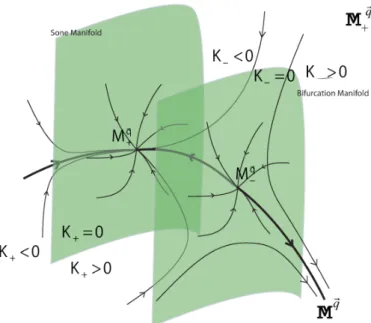
Burgers’ equation (compressiblefluidlike). We illustrate the phase diagram of the
center-stablemanifold of the dynamical system given by (31) around aMaxwellian $M_{0}$ state with
Mach number$=-1.$
The dynamical system on the 1-D invariant
curve
(center manifold) is a Burgerstype ODE (First order ODE). This flow concludes a connecting orbit for the two states
$(M_{-}^{\tilde{q}}, M_{+}^{\vec{q}})$.
This proves the existence of Boltzmann profile as well as the monotone
prop-erty of the profile. This monotone property is a problem raised in [14]. Here, the two
co-dimension 2 invariant submanifolds of the center-stable manifold define two scalar
functions $K$-and $K_{+}$ on the center-stable manifold so that the function $K_{-}$ gives the
bifurcation of the dynamical system; and the function $K_{+}$ defines the hydrodynamics
flows patterns, either a slowly expanded pattern for flows in the region $K_{+}<0$ or an
exponentially fast compressive wave pattern in the region $\{K_{+}>0\}\cup\{K_{-}<0\}$. With
these two functions, one can return to the bifurcation of the Milne’s problem (31). By
Lemma 20 in [20], there is a local 1-1 continuous map $\iota_{\vec{q}}$ from the center-stable manifold
with given macroscopic flux $\vec{q}$ to the space
$L_{\xi,3,+}^{\infty}$, which is the space for the imposed
boundary data. Thus, the sign of the function $K_{-}(\iota_{\vec{q}}(b))$ gives the bifurcation of the
Milne’s problem around the Mach number $=-1$. When Mach number is around $0$, the
$K_{+}$
Figure 1: Two-scale dynamics
on
thecenter-stablemanifold$\mathbb{M}_{+}^{\vec{q}}$ which is the center-stablemanifold with macroscopic flux $\vec{q}\equiv P_{0}\xi^{1}M_{-}.$
4.4
Linear
and nonlinear
wave
scattering around
a
Boltzmann
shock
layer
In[39],
one
considers the Boltzmannequationarounda
Boltzmannshock profile, $\varphi(x-st)$:$\{\begin{array}{l}(\partial_{t}-s\partial_{x}F)+\xi^{1}\partial_{x}F-L_{\varphi}F=Q(F) ,F(x, 0)=F_{0}(x) , (posed initial data,)\end{array}$ (41)
where $L_{\varphi}$ is
a
linear collision operator around the shock profile $\varphi$. Suppose that theBoltzmann shockprofile $\varphi$ is for
a
weak 3-shockwave
$(\vec{u}_{-},\vec{u}_{+})$ fora
compressible Eulerequation
as a
system of hyperbolic conservation laws:$\vec{u}_{t}+\vec{F}(\vec{u})_{x}=0, \vec{u}\in \mathbb{R}^{3}.$
One wants to
remove
thezero
total macroscopicmass
condition in [14],$\int_{R}P_{0}F_{0}(x, 0)dx=0$ (42)
for the purpose to investigate the hydrodynamic limits problem for the Boltzmann
equa-tion, [9, 10].
The main point ison obtaining the optimal linearwave propagationaroundthe
Boltz-mann shock layer and to
use
it to establish the nonlinearwave
coupling. The central ideaaround a shock profile is called the T-C scheme (transverse-compressible scheme). This
scheme is closely related to the Lax’s entropy condition for a p-th shock wave and the
diffusewavesintroduced in [12] to determine the viscous shock profile phase shift. In [39]
one uses the Green’s functions at two far fields to construct
an
approximated solution$A_{0}(x, t)$ and a local wave front $l_{0}(t)\varphi’(x)$ to approximate the solution of the linearized problem
$(\partial_{t}+(\xi^{1}-s)\partial_{x}-L_{\varphi})f=0$ (43)
to yield that $\mathscr{E}_{0}$, the truncation
error
for (43),$\mathscr{E}_{0}\equiv(\partial_{t}+(\xi^{1}-s)\partial_{x}-L_{\varphi})(A_{0}(x, t)+l_{0}(t)\varphi’(x))$ (44)
satisfies that following property:
$\{\begin{array}{l}\int_{\pi}(D_{i}, \mathscr{E}_{0}(x, t))dx=0, i=1, 2,\Vert P_{0}\mathscr{E}_{0}(x, t)\Vert_{L_{\xi,3}^{\infty}}\leq O(1)\frac{\epsilon^{2}}{t}e^{-(\epsilon|x|+\epsilon^{2}t)/C_{0}} for t\geq\epsilon^{-2},\Vert P_{1}\mathscr{E}_{0}(x, t)\Vert_{L_{\xi_{1}3}^{\infty}}\leq O(1)\frac{\epsilon}{\sqrt{t}}e^{-(\epsilon|x|+\epsilon^{2}t)/C_{0}} for t\geq\epsilon^{-2},\end{array}$ (45)
where $\epsilon\equiv\Vert\vec{u}_{-}-\vec{u}_{+}\Vert$ and $\{D_{1}, D_{2}, M_{-}-M_{+}\}$
are
the macroscopic dual vectors of$\{r_{1}(\vec{u}_{-}), r_{2}(\vec{u}_{-}), \vec{u}_{-}-\vec{u}_{+}\}$, and $r_{j}(\vec{u}_{-})$ are the j-th left eigenvectors of $\vec{F}’(\vec{u}_{-})$. The
approximated solution $A_{0}+l_{0}\varphi’$ for (43) with the property (45) is the $T$ part of the T-C
scheme.
Next, one needs to have an exponentially sharpestimate of the output $w(x, t)$ due to
the truncation error $\mathscr{E}(x, t)$:
$\{\begin{array}{l}(\partial_{t}+(\xi^{1}-s)\partial_{x}-L_{\varphi})w=-\mathscr{E}_{0},\int_{\mathbb{R}}P_{0}w(x, 0)dx=0.\end{array}$ (46)
This is a system of equations and there is no spectrum gap property to
assure
anex-ponential decayingstructure though $w(O, t)$ will exponentiallyconverge in time. For the
purpose to assert an exponential estimate, oneintroduced adamping to the system (46):
$\{\begin{array}{l}(\partial_{t}+(\xi^{1}-s)\partial_{x}-L_{\varphi})W_{0}=-\mathscr{E}_{0}-\gamma\sum_{j=1}(D_{j}, W_{0})D_{j},\int_{\pi}P_{0}W_{0}(x, 0)dx=0,\end{array}$ (47)
with a small$\gamma>0$. This system possesses conservation laws:
so
that with $\gamma>0$, (48), andenergy
estimatesone
shows that this system will decay intime exponentially.
Since the truncation
error
$P_{0}\mathscr{E}_{0}$ doesnotpossess
anytransient components, thedamp-ing $- \gamma\sum_{j=1}(D_{j}, W_{0})D_{j}$ is essentiallyvirtual. Hence, the solution $W_{0}(x, t)$ gives
an
expo-nentially sharp approximation to the solution $w_{0}(x, t)$ around $x=$ O. The construction
of the approximated solution $W_{0}(x, t)$ is called the $C$-part of the T-C scheme. This part
creates another truncation
error
$- \gamma\sum_{l=1}^{2}(D_{l}, W_{0})D_{l}$. Then, this leads to consider theproblem
$\{\begin{array}{l}(\partial_{t}+(\xi^{1}-s)\partial_{x}-L_{\varphi})f_{1}=\gamma\sum_{l=1}^{2}(D_{l}, W_{0})D_{l)}f_{1}(x, 0)=0.\end{array}$ (49)
One repeats the same procedure to give the T-C iteration:
To find $A_{i}$ and $l_{i}(t)$ satisfying
$\{\begin{array}{l}\mathscr{E}_{i}(x, t)\equiv(\partial_{t}+(\xi^{1}-s)\partial_{x}-L_{\varphi})(A_{i}+l_{i}(t)\varphi’)-\gamma\sum_{l=1}^{2}(D_{l}, W_{i-1})D_{l},(\partial_{t}+(\xi^{1}-s)\partial_{x}-L_{\varphi})W_{i}=-\mathscr{E}_{i}-\gamma\sum_{j=1}(D_{j}, W_{i})D_{j},W_{i}(x, 0)=0,\end{array}$ (50)
and the property (45) for $\mathscr{E}_{0}$ still holds for $\mathscr{E}_{i}$. Finally,
one
obtained sharp linearwave
scattering structure around theshock profile. The linearwave scattering structureis used
to show the pointwise structure of solution of (41)
as
illustrated:This T-C scheme also works for viscousconservation law. Especially, the sharp
point-wise structure gives advantages in the study of the
case
with presence of boundary in4.5
Riemann
problem
for shock
wave
data
In [40], one considers the initial value problem (41) with a shock wave initial data $F_{0}(x)$:
$F_{0}(x)=\{\begin{array}{l}M_{\vec{u}-} for x<0,M_{\vec{u}_{+}} for x>0.\end{array}$ (51)
Here, $(\vec{u}_{-},\vec{u}_{+})$ is
a
shockwave
and $M_{\vec{u}\pm}$are
Maxwellians related to the states $\vec{u}\pm$; and$\Vert\vec{u}_{-}-\vec{u}_{+}\Vert=\epsilon\ll 1.$
This problem is a multi-time scale problem. There are five time scales illustrated by the table:
In the time scale
$0<t<1$
, the particlelike structure $\mathbb{P}$of the Green’s function and
the shock wave initial data force the solution $F(x, t)$ to behave close to the hyperbolic
scale function $f(x/t)$. In the time scale $t\sim 1$, one breaks the collisionoperator into gain
and loss to yield the $O(1)$ structure. When $t\in(1, \epsilon^{-2})$, one
can
linearize the problem atthe Maxwellian $M_{\vec{u}-}$ or$M_{\vec{u}+}$, then by the structure (24)
one
concludes that the structuresresemble to the convected heat equation with speeds $\lambda_{j}$. When $t\in(\epsilon^{-2}, \epsilon^{-2}\log\epsilon)$, one
restricts the macroscopic state on the line segment connecting $M_{\vec{u}-}$ and $M_{\vec{u}+}$ to form an
approximated solution. This restriction carries the spirit of the Chapman-Enskog
expan-sion. One can derive a nonlinear scalar equation close to the viscous Burgers equation.
One can use the Hopf-Cole transform effectivelyto realize the formation of the nonlinear
layer. When $t\sim\epsilon^{-2}\log\epsilon$, one can
use
the formed profile by the Burgers-like equationand compare it with the Boltzmann shock profile so that one applies the stability of a
shock profile in [40] to yield the global structure of the Riemann problem with a shock
4.6
Future developments
The works done in [4, 15, 19, 20, 39, 40]
are
for planarwave
motions ofthe Boltzmannequation. When the perturbations are multi-D, the mathematical analysis of the related
problems are completely open. Indeed, there are many open problems in physics
men-tionedin the classicalbook [35].
About the Boltzmann equation in multi-D, the work in [17] gavethe Green’s function
in
3-D
spacedomain; andgave a
wave
structure related to Huygen’s principle for the 3-Dd’Alembert
wave
equation. In this aspect, it is interesting to consider the shock profilestability under a 3-D perturbations and in particular the multi-D hyperbolic scale waves
interact with the viscous shock front. It is also interesting to consider the Riemann
prob-lem without assuming the shock
wave
data. The thermal transpiration flow derivedin[35]is an interesting physical phenomenon to distinguish the difference between Boltzmann
equation and conventional fluid mechanics. To investigate the geometric effects due to a
physical boundary andto relate it with the geometric theory of diffractions would be very
interesting
as
well.It is also very interesting to complete the $Grad$’s and Sone’s program to study the
interactions ofthe singular layers (shock layer, initial layer, and boundary layer) for 1-D
problem.
References
[1] Caflisch, R. E.; Nicolaenko, B., Shock profile solutions
of
the Boltzmann equation,Comm. Math. Phys., 89 (1982),
161-194.
[2] Carleman, T. Sur LaTh\’eoriede
l’\’Equation
Int\’egrodiff\’erentiellede Boltzmann. ActaMathematica 60 (1933), 91-142.
[3] Carleman, T. Probl\’emes math\’ematiques dans la th\’eorie cin\’etique des gaz. (French)
Publ. Sci. Inst. Mittag-Leffler. 2 Almqvist
&
Wiksells Boktryckeri Ab, Uppsala1957
[4] Deng, Shijin; Wang, Weike; Yu,Shih-Hsien Pointwise convergence toKnudsen layers
of
the Boltzmann equation. Comm. Math. Phys. 281 (2008), no. 2, 287-347[5] Deng, Shijin; Wang, Weike; Yu, Shih-Hsien, Viscous conservation laws with boundary.
SIAM J. Math. Anal. 44 (2012),
no.
4, 2695-2755[6] Ellis, R.; Pinsky, M. The first and second fluid approximations to the linearized
Boltzmann equation. J. Math. Pures Appl. 54 (1975), no. 9, 125-156.
[7] Goodman, J. Nonlinear asymptotic stability
of
viscous shock profilesfor
conservation[8] Grad, H. Asymptotic theory
of
the Boltzmann equation, Physics of Fluids, No. 2 Vol. 6, (1963), 147-181.[9] Grad, H. $A\mathcal{S}$
ymptotic equivalence
of
theNavier-Stokes andnonlinear Boltzmannequa-tions, Proc. Symp. Appl. Math. 17(ed. R.Finn), 154-183, AMS, Providence,
1965.
[10] Grad, H. Proc. Symp. in Appl. Math. 17,
154-183
(1965), Rarified Gas Dynamics, I,26-59 (1963).
[11] S. Kawashima, A. Matsumura,
&
T. Nishida, On the fluid-dynamicalapproximationto the Boltzmann equation at the level
of
the Navier-Stokes equation. Comm. Math.Phys.
70
(1979),no.
2,97-124.
[12] Liu, Tai-Ping, Shock waves and
diffusion
waves. Nonlinear systems of partialdiffer-ential equations in applied mathematics, Part 1 (Santa Fe, N.M., 1984), 283–291,
Lectures in Appl. Math., 23, Amer. Math. Soc., Providence, RI,
1986
[13] Liu, T.-P. Pointwise convergence to shock
waves
for
viscous conservation laws.Comm. Pure Appl. Math. 50 (1997), no. 11,
1113–1182.
[14] Liu, T.-P.; Yu, S.-H. Boltzmann Equation: Micro-Macro Decompositions and
Posi-tivity
of
Shock Profiles, Comm. Math. Phys. 246 (2004), 133-179.[15] Liu, T.-P.; Yu, S.-H. The Green’s
function
and large-time behaviorof
solutionsfor
one-dimensional Boltzmann equation, Comm. Pure. Appl. Math., 57 (2004), no.12,
1543-1608.
[16] Liu, Tai-Ping; Yang, Tong; Yu, Shih-Hsien Energy method
for
Boltzmann equation.Phys. D188 (2004),
no.
3-4,178–192.
[17] Liu, T.-P.; Yu, S.-H. Green’s
function of
Boltzmann equation, 3-D waves, Bull. Inst.Math. Acad. Sin. (N.S.) 1 (2006), no. 1, 1-78.
[18] Liu, Tai-Ping; Yang, Tong; Yu, Shih-Hsien; Zhao, Hui-Jiang Nonlinear stability
of
rarefaction
wavesfor
the Boltzmann equation. Arch. Ration. Mech. Anal. 181 (2006),no. 2, 333–371.
[19] Liu, T.-P.; Yu, S.-H., Initial-bouniary value problem
for
one-iimensional wavesolu-tions
of
the Boltzmann equation, Comm. Pure Appl. Math., 60 (2007), no. 3, 295-356.[20] Liu, T.-P.; Yu, S.-H. Invariant
Manifolds for
steady Boltzmannflows
and its[21] T. Nishida, Takaaki Fluid Fluid dynamical limit
of
the nonlinear Boltzmann equationto the level
of
the compressible Euler equation. Comm. Math. Phys. 61 (1978), no.2, 119-148
[22] Sone, Y., Kinetic theory analysis of linearized Rayleigh problem, J. Phys. Soc. Jpn
19
(1964),1463-1473.
[23] Sone, Y., Effect of sudden change of wall temperature in ararefied gas, J. Phys. Soc.
Jpn20 (1965),
222-229.
[24] Sone, Y., Thermalcreep in rarefied gas, J. Phys. Soc. Jpn21 (1966),
1836-1837.
[25] Sone, Y.,Asymptotic theory of flow ofrarefied gas
over
asmooth boundary I, in: L.Trilling and H. Y. Wachman, eds.,
Rarefied
Gas Dynamics (Academic Press, NewYork), Vol. I, (1969), 243-253.
[26] Sone, Y., Asymptotic theoryofflow ofrarefied gas
over
asmooth boundary II, in: D.Dini, ed.,
Rarefied
Gas Dynamics (EditriceTecnico Scientifica, Pisa), Vol. II, (1971),737-749.
[27] Sone, Y., Kinetic theory of evaporation and condensation Linear and nonlinear
prob-lems, J. Phys. Soc. Jpn45 (1978),
315-320.
[28] Sone, Y., Kinetic theoretical studies of the half-space problem of evaporation and
condensation, Transp. Theory Stat. Phys. 29 (2000),
227-260.
$[29_{\backslash }]$ Sone,Y.; Onishi, Y., Kinetictheory ofevaporation and condensation: Hydrodynamic
equation and slip boundarycondition, J. Phys. Soc. $Jpn44$ (1978), 1981-1994
[30] Sone, Y.; Aoki, $K$; Yamashita, K., A study of unsteady strong condensation
on a
plane condensed phase with special interest in formation of steady profile, in: V.
Boffi and C. Cercignani, eds.,
Rarefied
Gas Dynamics (Teubner, Stuttgart), Vol. II,(1986),
323-333.
[31] Sone, Y.; Golse, F.; Ohwada, T.; Doi, T., Analytical study of transonic flows of a
gascondensing onto itsplane condensed phaseonthe basis of kinetic theory, $Eur.$ $J.$
Mech. B/Fluids 17 (1998), 277-306.
[32] Sone, Y., Kinetic theory
of
evaporation and condensation Linear and nonlinearprob-lems, J. Phys. Soc. Jpn, 45 (1978), 315-320.
[33] Sone, Y.; Aoki, $K$; Yamashita, K. $\mathcal{A}$
study
of
unsteady strong condensationon a
and C. Cercignani,eds., RarefiedGasDynamics(Teubner, Stuttgart),Vol. II, (1986),
323-333.
[34] Sone, Y.; Golse, F.; Ohwada, T.; Doi, T. Analytical study
of
transonicflows of
a
gas condensing onto its plane condensedphase on the basis
of
kinetic theory, Eur. J.Mech. B/Fluids, 17 (1998), 277-306.
[35] Sone, Y. Molecular Gas Dynamics: Theory, Techniques, and Applications,
Birkhauser, 2007.
[36] Ukai, S. On the existence of global solutions of mixed problem for non-linear
Boltz-mann equation. Proc. Japan Acad. 50 (1974),
179-184.
[37] Ukai, S.; Yang, T.;Yu, S.-H. Nonlinear Boundary Layers of the Boltzmann Equation:
I. Existence. Commun. Math. Phys. 236 (2003),
373-393.
[38] Ukai, S.; Yang, T.; Yu, S.-H. Nonlinear stability
of
boundary layersof
the Boltzmannequation. I. The case $M \infty\int-1$. Comm. Math. Phys. 244 (2004), no. 1, 99–109.
[39] Yu, Shih-Hsien, Nonlinear wave propagations over a Boltzmann shock profile. J.
Amer. Math. Soc. 23 (2010), no. 4,
1041–1118.
[40] Yu, Shih-Hsien, Initial and Shock Layers