Rapid synthesis of poly(methyl methacrylate) particles with high molecular weight by
soap-free emulsion polymerization using water-in-oil slug flow
Takaichi Watanabe1, Kengo Karita1, Koki Tawara1, Takuya Soga2, and Tsutomu Ono1*
(1) Department of Applied Chemistry, Graduate School of Natural Science and Technology, Okayama University, 3-1-1 Tsushima-naka, Kita-ku, Okayama, 700-8530, Japan
(2) Department of Material and Energy Science, Graduate School of Environmental and Life Science, Okayama University, 3-1-1 Tsushima-naka, Kita-ku, Okayama, 700-8530, Japan
* Tsutomu Ono
Email: [email protected]
Keywords: Microreactor, Internal circulation, Heterogeneous polymerization,
Abstract
We propose a flow process for the production of poly(methyl methacrylate) (PMMA)
particles by soap-free emulsion polymerization using a water-in-oil (W/O) slug flow in a
microreactor. Thin oil films generated around the dispersed aqueous phase of the W/O
slug prevented the prepared particles from adhesion to the microchannel wall, enabling
the continuous production of PMMA particles without clogging. The effects of the linear
flow rate of the slug flow and the addition of ethanol in the dispersed aqueous phase on
the polymerization were evaluated. We found that increasing the linear flow rate of the
slug flow or the addition of ethanol in the dispersed aqueous phase resulted in PMMA
particles with high molecular weight (~ 1,500 kg mol-1) in 20 min reaction time. We
believe that this process would be a promising way to prepare polymer particles with high
Introduction
Soap-free emulsion polymerization is an environmentally-friendly process that does not
use hazardous solvent or surfactants for the production of submicron-sized polymer
particles with a narrow size distribution [1,2]. In general, soap-free emulsion
polymerization takes place in the system consisting of a sparingly water-soluble monomer,
an ionic water-soluble initiator, and water. In the polymerization, the ionic water-soluble
initiator molecules first decompose and react with sparingly water-soluble monomers
dissolved in water. The resulting oligomer containing an ionic end group becomes
immiscible in water as growing their lengths, which serves as a surfactant and aggregates
into micelles (nucleation). The polymerization takes place mostly in the micelles and
monomer is supplied from large monomer droplets by diffusion through the water phase,
resulting in polymer particles dispersed in water [3]. Although soap-free emulsion
polymerization has been generally conducted in batch reactors (batch process), there is
still room for improvement in the reactor from the viewpoint of process intensification
In the last two decades, microreactors have attracted considerable attentions in
the field of chemistry and chemical engineering as interesting reaction fields, since they
have advantages in facilitating heat and mass transfer [4-6] and providing precise
temperature and reaction time [7-10]. These characteristics of microreactors are derived
from their large surface to volume ratio and short diffusion path. In recent years,
microreactors have been also applied to both homogeneous and heterogeneous
polymerization processes. Homogeneous polymerization including radical
polymerization [11] and controlled/living polymerization [12,13] with the use of
microreactors provides polymers with controlled molecular weight and narrow molecular
weight distribution. Heterogeneous polymerization using liquid-liquid multiphase
systems such as emulsion polymerization [14], miniemulsion photopolymerization [15]
and suspension polymerization [16] has been shown to be a robust way to prepare
polymer particles with various sizes and structures. However, these polymerization
processes have a potential risk of clogging due to uncontrollable adhering of polymer
To overcome the clogging issue, liquid-liquid slug flow has recently attracted
a great deal of attention as a new type of polymerization field. Different from
aforementioned emulsion droplets, the segmented liquid-liquid slug flow is formed
without surfactant and thus collection of products after polymerization can be achieved
easily by spontaneous phase separation at the exit of microreactors. Moreover, because
of different wettability of the channel wall for two immiscible liquid phases (i.e. organic
phase and aqueous phase), adhesion of polymerization phase to the channel wall can be
mitigated by selecting the material compositions of tubing and thin liquid films are
formed between the dispersed phase slugs and the inner wall of microreactor [19]. The
thin liquid films prevent the viscous polymer solution from adhering to the channel wall
and clogging of the channel [20, 21]. Furthermore, it is well-known that internal
circulation flow generated in a slug flow enhances the mixing of reactants in each slug
and facilitates mass transfer between the liquid-liquid interfaces [19, 22-24]. Although a
few studies using a slug flow for polymerization have been reported, to the best of our
knowledge, there are no studies showing the production of polymer particles using a slug
In this study, we propose a soap-free emulsion polymerization using a
water-in-oil (W/O) slug flow (slug flow process). Different from aforementioned typical
soap-free emulsion polymerization using an oil-in-water (O/W) system in a batch process, we
use a W/O system in the slug flow process to limit the polymerization field in the
dispersed aqueous phase and prevent the produced polymer particles from adhering to the
microchannel wall. Moreover, internal circulation in the slug flow contributes to efficient
mixing in each segment as well as promotion of monomer diffusion from oil to aqueous
phase. We expect that the internal circulation in the slug flow would increase the rate of
polymerization. For a model monomer in this study, we chose methylmethacryate
(MMA) because of its high solubility in water (~15.9 g/L at 20 °C) [25] and relatively
high polymerization rate, which should be suitable for flow process with limited lengths
of reaction tubing (residence time ~ 30 min). We first compare the reaction performance
of soap-free emulsion polymerization of MMA in the slug process with that in the batch
process. Then, we evaluate the effects of the linear flow rate of the slug flow and the
addition of ethanol in the dispersed aqueous phase on the characteristics of the
Experimental Section
Materials
Methyl methacrylate (MMA, FUJIFILM Wako) was used after purification by distillation
under a reduced pressure to remove polymerization inhibitors. Deionized water used in
all experiments was obtained from an Elix UV (Millipore, Japan) purification system.
Sodium persulfate (NaPS), dodecane, N,N-dimethylformamide (DMF), and ethanol were
purchased from FUJIFILM Wako and used without further purification.
Fabrication of a microreactor system
The microfluidic device was fabricated by assembling a T-shaped
poly(1,1,2,2-tetrafluoroethylene) (PTFE) union (o.d. 1/16”,GL science) and PTFE tubing (i.d. 1 mm
and o.d. 1/16”, GL science). The inlet PTFE tubing was connected to syringes (HSW
Dual Syringe Pump, Harvard Apparatus). The outlet PTFE tubing was coiled helically
and dipped in an oil bath (PAIRSTIRRER PS-1000, EYELA) at 70 °C.
Soap-free emulsion polymerization of MMA in a microreactor (Slug flow process)
Soap-free emulsion polymerization was carried out using a W/O slug flow in the
microreactor. For the initiator solution (W), an aqueous solution dissolving 5.0 mmol L
-1 of sodium persulfate (NaPS) was used. For the organic solution (O), a mixture of MMA
and dodecane (MMA/dodecane = 1/4 (v/v)) was used. Both solutions were pumped into
the microreactor using syringe pumps (Harvard Pump 33 Dual Syringe Pump, Harvard
Apparatus) with a total flow rate in the range of 92.3 to 274.8 μL min-1, while keeping
the volume ratio of organic to aqueous phase constant at 1.0. W/O type slug flow was
formed at the T-shaped union and it passed through the reaction tubing placed in an oil
bath (PAIRSTIRRER PS-1000, EYELA) at 70 °C. The residence time of heating zone
was controlled from 5 to 20 min by changing the length of the tubing. After the
polymerization, the sample solution was collected in a sample bottle (10 mL,
resulting polymer particles were washed with pure water 3 times and collected by
centrifugation (himac CF 15R, HITACHI, 15,000 rpm for 10 min).
Soap-free emulsion polymerization of MMA in a batch reactor (Batch process)
Soap-free emulsion polymerization of MMA using a batch reactor was conducted in a
glass two-neck flask at 70 °C for 5 to 20 min under a nitrogen atmosphere. A mixture of
MMA and dodecane (MMA/dodecane = 1/4 (v/v), total: 10 mL) and NaPS (5.0 mmol L
-1) aqueous solution (10 mL) were first added to a glass three-neck flask, and the mixture
(organic phase : aqueous phase = 10 mL : 10 mL) was stirred with a magnetic stirrer at
800 rpm under a nitrogen atmosphere to prepare O/W emulsion. The O/W emulsion was
then poured into the glass two-neck flask preheated at 70 °C under a nitrogen atmosphere
to initiate the polymerization. After the predetermined reaction time was reached, the
polymerization was quenched by cooling the reactor in an ice bath. The resulting polymer
particles were washed with pure water 3 times and collected by centrifugation (himac CF
15R, HITACHI , 15,000 rpm for 10 min). The collected sample was freeze-dried
Characterization
The morphology of the prepared particles after drying was observed by means of a
scanning electron microscope (SEM, S-4700, Hitachi Ltd., Japan) at a voltage intensity
of 2 kV. Before SEM observation, the prepared particle samples were sputter-coated
(E-1030 Ion-Sputter, Hitachi Ltd., Japan) with Pd/Pt in order to reduce the sample charging.
Average particle diameter and the size distribution were determined from SEM images
by using an image analysis software (WinROOF, Mitani Co., Ltd., Japan). In the analysis,
the size distribution was evaluated as the coefficient of variation (CV) that is defined as
the ratio of the standard deviation to the average diameter. The CV values were calculated
from the average diameter of 200 particles. The conversion of monomer was determined
by means of a gas chromatography (GC-14A, Shimadzu Ltd., Japan). The weight-average
molecular weight (Mw), number-average molecular weight (Mn), and molecular weight
distribution (Mw/Mn) were characterized by using a gel permeation chromatography
(HLC-8120 GPC, Tosoh Ltd., Japan), equipped with a refractive index detector and
(Figure 1)
Results and Discussion
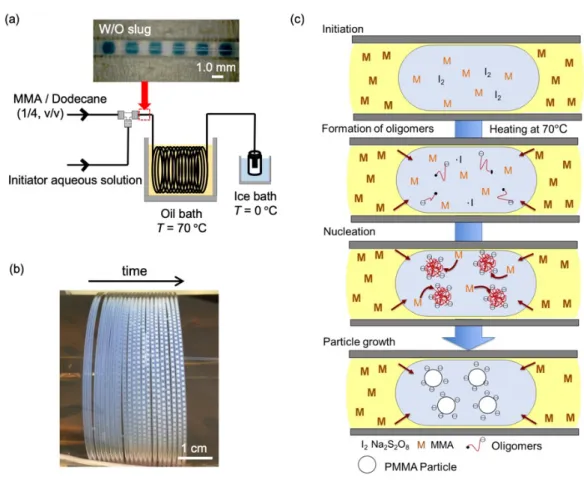
Figure 1a shows a schematic image of the microfluidic system for the soap-free emulsion
polymerization of MMA using a W/O slug flow. In this system, we used a mixture of 20
vol% MMA and 80 vol% dodecane as the organic phase and an initiator aqueous solution
as the aqueous phase. The dodecane in the organic phase was served as an inert oil to
keep the slug flow stable during polymerization. When feeding the organic and aqueous
phases at the volume ratio of 1.0 into the microfluidic device, W/O type slug flow was
spontaneously formed at the T-junction because the wall of the microchannel is made of
PTFE and intrinsic hydrophobic. The slug flow then entered the reaction zone, where the
temperature was fixed at 70 °C. Because of the narrow channel width, the temperature of
each slug reached to 70 °C soon after entering the heating zone and then polymerization
took place in the dispersed aqueous phase. We macroscopically confirmed that the color
polymerization, indicating that polymer particles formed only in the dispersed aqueous
phase (Figure 1b). We also found that the microreactor can be operated without clogging
at least for 30 min. Based upon these results, we consider that the dispersed aqueous phase
of the W/O slug flow can be served as micron-sized reaction field for the soap-free
emulsion polymerization of MMA and that the mechanism of nucleation and growth in
the slug flow process is analogue to that in the batch process, as shown in Figure. 1c. In
the slug flow process, initiation reaction first occurs by the decomposition of the ionic
water-soluble initiators in the dispersed aqueous phase. Then, the ionic radicals react with
dissolved MMA molecules in the aqueous phase to form surface-active oligomeric
radicals which generate micelles. After the formation of the micelles, particle growth is
achieved by monomer supply from the continuous organic phase to the micelles in the
dispersed aqueous phase via internal circulation flow, which finally leads to the formation
of PMMA particles in the dispersed aqueous phase.
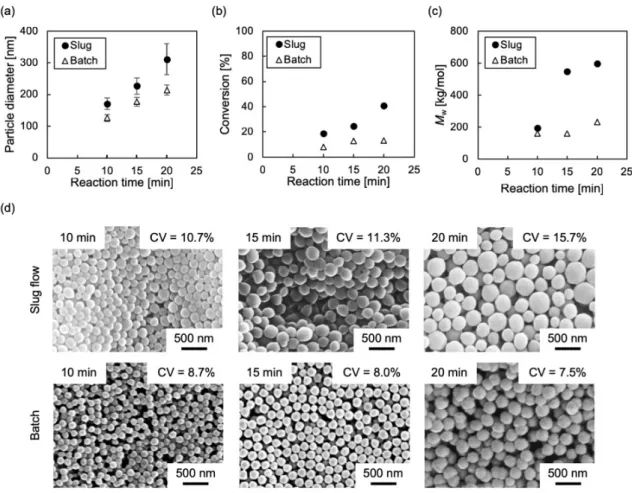
To compare the reaction performance between slug flow and batch processes,
we conducted the soap-free emulsion polymerization of MMA using W/O slug flow and
particle diameter, monomer conversion, weight-averaged molecular weight (Mw), and
molecular weight distribution (Mw/Mn). It is noted here that in the batch process, we used
the organic phase consisting of MMA and inert oil (dodecane) (1/4, v/v) and fixed the
volume ratio of organic to aqueous phase at 1.0 to ensure a rationale comparison between
slug flow and batch processes, although soap-free emulsion polymerization of MMA
using a batch process is generally performed in the conditions where inert oil does not
exist and the volume ratio of organic to aqueous phase is less than 1.0. In both the systems,
the particle diameter became bigger as increasing the reaction time and the particle
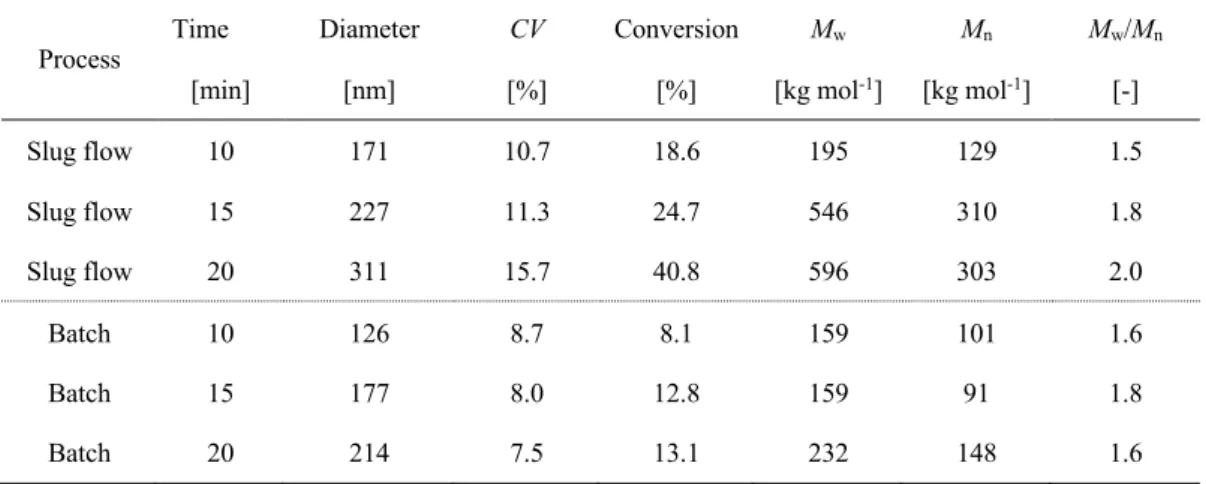
growth in the slug flow was faster than that in the batch process (Figure 2a). The
monomer conversion in the slug flow was higher than that in the batch process at each
reaction time, suggesting that the rate of polymerization in the slug flow is higher than
that in the batch process (Figure 2b). Moreover, the Mw of PMMA particles prepared
using the slug flow showed a marked increase as increasing the reaction time and reached
about 600 kg mol-1 in 20 min, which was approximately three times larger value than that
using the batch reactor in 20 min (Figure 2c). On the other hand, the Mw/Mn values
(Table 1). We consider that the high polymerization rate and high molecular weight in
the slug flow would attribute to two effects: high heat transfer efficiency in the
microreactor [26] and high mass transfer efficiency induced by the internal circulation
flow in the slug flow [19]. Because of high heat transfer efficiency in the microreactor,
the reaction temperature in slugs reaches to a fixed temperature soon after they entered
the reaction zone and thus the decomposition of initiator molecules occurs in a more
uniform manner. This increases the numbers of ionic radicals and growing chains in the
dispersed phase, leading to high rate of polymerization. Another factor is the internal
circulation flow in slug flow, providing high mass transfer efficiency through
liquid-liquid interfaces. The internal circulation flow continuously provides the dispersed
aqueous phase with monomer from the continuous phase and maintains the concentration
of the dissolved monomer in the dispersed aqueous phase high, which facilitates the
propagation of polymer.
However, in the case of the slug flow, unexpectedly, the CV value of the
resulting PMMA particles gradually increased from 10.7 to 15.7% with increasing the
detailed mechanism yet, the broader particle size distribution in the slug flow process
compared to that in the batch process would be due to non-uniform mixing by internal
circulation flow in each slug [27]. We consider that the non-uniform mixing in each slug
at the particle growth stage may broaden the particle size distribution. These findings
suggest that soap-free emulsion polymerization using a W/O slug flow can be effective
to rapidly synthesize polymer particles with higher molecular weight, although the
particle size distribution increases as a function of reaction time.
(Figure 2)
(Table 1)
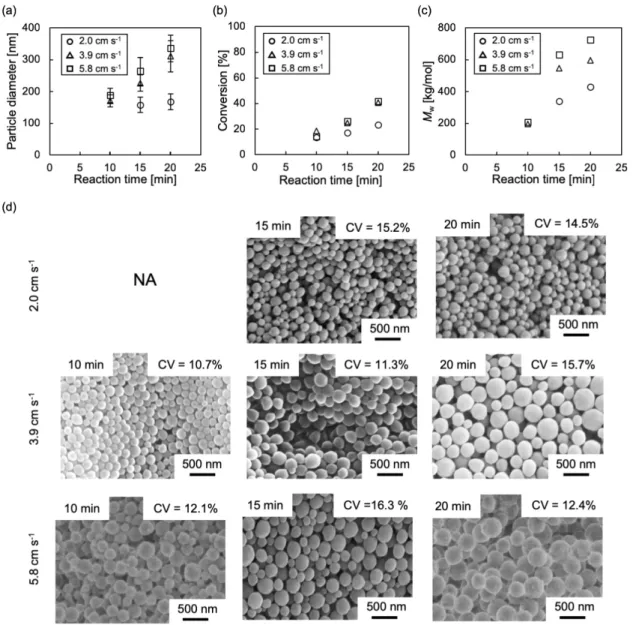
We next evaluated the effect of internal circulation in the slug flow on the
soap-free polymerization of MMA by using a W/O slug flow with three different linear flow
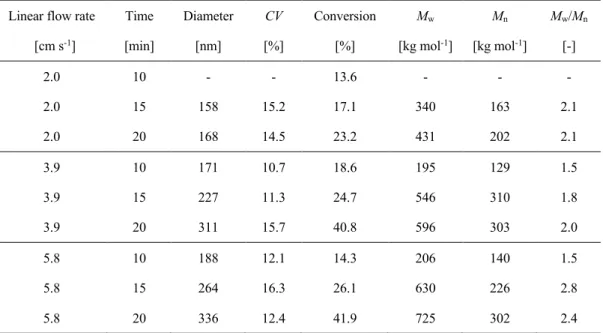
rates (2.0, 3.9, and 5.8 cm s-1). Figure 3a shows the effect of the linear flow rate on the
particle diameter as a function of time. It is noted that we could not obtain enough amount
of polymer particles to observe at 10 min in the case of linear flow rate at 2.0 cm s-1.
When compared at each reaction time, the particle diameter increased with increasing the
between 3.9 and 5.8 cm s-1 conditions (Table 2). Similar trend was confirmed from the
monomer conversion plots as depicted in Figure 3b. Moreover, we found that when
increasing the linear flow rate, the Mw of the PMMA particles significantly increased as
increasing the reaction time (Figure 3c). We consider that when the linear flow rate is at
2.0 cm s-1, the internal circulation flow is too weak to promote MMA diffusion to the
dispersed aqueous phase, which gives “diffusion-limited” condition and results in a
relatively slow rate of polymerization. When the linear flow rate is increased from 2.0 to
3.9 cm s-1, the reaction regime changes from “diffusion-limited” to “reaction-limited”
condition and the enhanced internal circulation flow continuously provides sufficient
amount of MMA to the dispersed aqueous phase, which saturates the aqueous phase with
MMA. Hence, the rate of polymerization increased with increasing the linear flow rate
from 2.0 to 3.9 cm s-1 and then became almost constant over 3.9 cm s-1. These results
suggest that the internal circulation flow generated in a W/O slug flow intensify the rate
of polymerization.
(Figure 3)
It is well known that particle nucleation in soap-free emulsion polymerization
takes place in the aqueous phase and the solvent quality of the aqueous phase can affect
the characteristics of the polymerization as well as the resultant polymer particles [28].
To investigate whether increasing MMA solubility in the dispersed aqueous phase of the
W/O slug affects the rate of polymerization, we performed the soap-free emulsion
polymerization of MMA using a W/O slug flow in the presence of 20 vol% ethanol as a
cosolvent in the dispersed aqueous phase. Before the experiment, we confirmed that the
presence of ethanol in the dispersed aqueous phase up to 20 vol% did not affect the flow
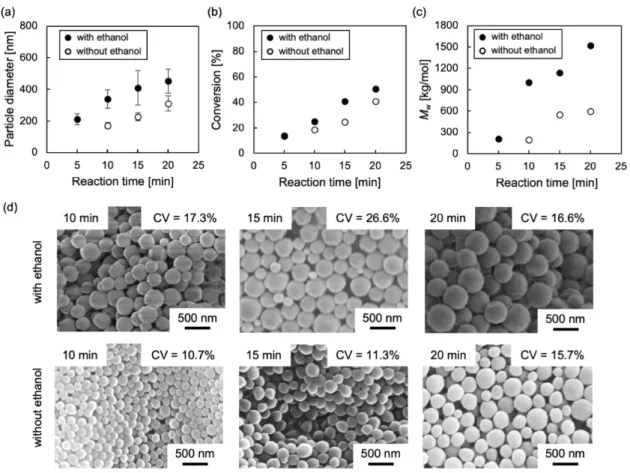
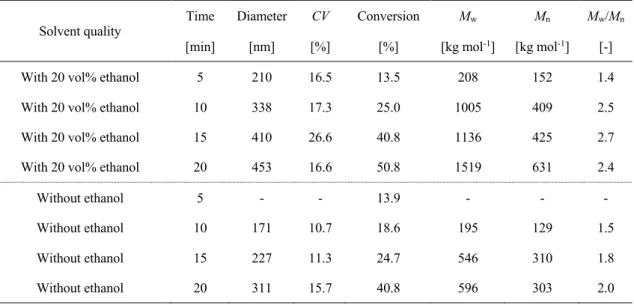
pattern in the microreactor. Figure 4 shows the comparison of the soap-free emulsion
polymerization of MMA using the W/O slug flow with and without 20 vol% ethanol. We
found that the particle diameter in the presence of ethanol became larger than that in the
absence of ethanol (Figure 4a). This is because ethanol in the aqueous phase decreases
electrostatic repulsive forces between the prepared particles and causes the promotion of
their coagulation [29]. Regarding monomer conversion, there was no significant
difference in monomer conversion between the systems with and without ethanol,
(Figure 4b). On the other hand, we found that the Mw of PMMA particles in the presence
of ethanol was considerably higher than that in the absence of ethanol when compared at
each reaction time. Specifically, the Mw of PMMA particles in the presence of ethanol at
20 min was about 1,500 kg mol-1, while that in the absence of ethanol was about 600 kg
mol-1 (Figure 4c). We speculate that these results would be due to the effect of ethanol
on the critical chain length of PMMA oligomers. Because ethanol is a good solvent for
MMA, the addition of ethanol into the reaction medium increases the solubility of MMA
in the dispersed aqueous phase, which makes the critical chain length of PMMA
oligomers longer. The longer critical chain length of the PMMA oligomers reduce the
required number of polymer molecules to form a single particle nucleus, which increases
the amount of monomer to be incorporated in a single particle, thus resulting in PMMA
with high molecular weight in a short reaction time, when compared with the case without
ethanol. Based upon these results, we concluded that the addition of ethanol in the
dispersed aqueous phase of W/O slug flow for the soap-free emulsion polymerization of
MMA significantly increases the molecular weight of PMMA particles and that PMMA
(Figure 4)
(Table 3)
Conclusion
We developed a continuous flow process for the production of PMMA particles by
soap-free emulsion polymerization using a W/O slug flow in a microreactor. Because of high
heat/mass transfer efficiency in the W/O slug flow, the soap-free emulsion
polymerization using the W/O slug flow showed higher polymerization rate than that
using the conventional batch process. We also found that the increase of the linear flow
rate of the slug flow or the addition of ethanol in the dispersed aqueous phase increased
the particle diameter and the molecular weight of PMMA particles. Using the slug flow
process, we succeeded in the continuous production of PMMA particles with high
References
[1] J. W. Goodwin, J. Hearn, C. C. Ho, R. H. Ottewill, Colloid. Polym. Sci., 1974, 6, 464.
[2] D. Nagao, T. Sakamoto, H. Konno, S. Gu, M. Konno, Langmuir, 2006, 22, 10958. [3] Z. Song, G.W. Poehlein, J Colloid Interface Sci., 1989, 128, 486.
[4] T. Schwalbe, V. Autze, G. Wille, Chimia, 2002, 56, 636.
[5] K. Wang, Y. C. Lu, Y. Xia, H. W. Shao, G.S. Luo, Chem. Eng. J., 2011, 169, 290.
[6] M. N. Kashid, A. Renken, L. Kiwi-Minsker, Ind. Eng. Chem. Res., 2011, 50, 6906.
[7] J. Yoshida, The Chemical Record, 2010, 10, 332.
[8] V. Hessel, H. Lowe, Chem. Eng. Technol., 2005, 28, 267. [9] M. Belimov, D. Metzger, P. Pfeifer, AlChE J., 2017, 63, 120.
[10] G. V. Casquillas, C. Fu, M. Le Berre, J. Cramer, S. Meance, A. Plecis, D. Baigl, J-. J. Greffet, Y. Chen, M. Piel, P. T. Tran, Lab Chip, 2011, 11, 484.
[11] L. Brocken, P. D. Price, J. Whittaker, I. R. Baxendale, React. Chem. Eng., 2017, 2, 662.
32, 604.
[13] P. Derboven, P. H. Van Steenberge, J. Vandenbergh, M-. F. Reyniers, T. Junkers, D. R. D'hooge, G. B. Marin, Macromol. Rapid Commun., 2015, 36, 2149.
[14] X. Liu, Y. Lu, and G. Luo, Ind. Eng. Chem. Res. 2017, 56, 9489.
[15] A. Chemtob, E. Lobry, A. Rannée, F. Jasinski, M. Penconi, E. Oliveros, A. M. Braun, A. Criqui, Macromol. React. Eng. 2016, 10, 261.
[16] Z. Liu, Y. Lu, B. Yang, G. Luo, Ind. Eng. Chem. Res., 2011, 50, 11853. [17] V. Daniloska, R. Tomovska, J. M. Asua, Chem. Eng. J., 2013, 222. 136.
[18] A.K. Yadav, J.C. de la Cal, M.J. Barandiaran, Macromol. React. Eng., 2011, 5, 69. [19] Y. Seike, E. Kamio, T. Ono, H. Yoshizawa, J. Chem. Eng. Japan., 2007, 40, 1076.
[20] Y. Song, J. Song, M. Shang, W. Xu, S. Liu, B. Wang, Q. Lu, Y. Su, Chem. Eng. J.,
2018, 353, 769.
[21] J. Song, S. Zhang, K. Wang, Y. Wang, J. Taiwan Inst. Chem. Eng., 2018, 0, 1.
[22] M. N. Kashid, I. Gerlach, S. Goetz, J. Franzke, J. F. Acker, F. Platte, D. W. Agar, S. Turek, Ind. Eng. Chem. Res., 2005, 44, 5003.
[24] T. Yasukawa, W. Ninomiya, K. Ooyachi, N. Aoki, K. Mae, Chem. Eng. J., 2011,
167, 527-530.
[25] K. W. Min, W. H. Ray, J. Macromol. Sci. C., 1974, 11, 177.
[26] A. K. Yadav, M. J. Barandiaran, J. C. de la Cal, Macromol. React. Eng., 2014, 8,
467.
[27] A. Ghaini, A. Mescher, D. W. Agar, Chem. Eng. J., 2011, 66, 1168.
[28] A. M. Homola, M. Inoue, A. Robertson, J. Appl. Polym. Sci., 1975, 19, 3077. [29] Z. Liu, H. Xiao, Polymer, 2000, 41, 7023.
Figure Captions
Figure 1 (a) Schematic image of the experimental setup for soap-free emulsion
polymerization using a water-in-oil (W/O) slug flow. (b) A photograph of the W/O slug
flow during polymerization at 70 °C. (c) Schematic image of particle formation in W/O
slug.
Figure 2 Comparison of the characteristics of the soap-free emulsion polymerization of
MMA using W/O slug flow and batch reactor regarding (a) particle diameter, (b)
conversion of MMA and (c) weight-averaged molecular weight of PMMA. (d) SEM
images of PMMA particles at different reaction times. The CV was defined as the ratio of
the standard deviation to the average diameter. NA means not available.
Figure 3 Effect of the linear flow rate of a W/O slug flow on the soap-free emulsion
polymerization of MMA (a) particle diameter, (b) conversion of MMA and (c) weight-averaged molecular weight of PMMA. (d) SEM images of PMMA particles prepared at different linear flow rates. The CV was defined as the ratio of the standard deviation to the average diameter.
Figure 4 Effect of the addition of ethanol to the aqueous phase on soap-free emulsion
SEM images of PMMA particles prepared with or without ethanol in the aqueous phase.
Table captions
Table 1 Characteristics of PMMA particles prepared using W/O slug flow and batch processes.
Table 2 Effect of the linear flow rate of a slug flow on the characteristics of PMMA particles prepared using a W/O slug flow.
Table 3 Effect of the addition of ethanol in the dispersed aqueous phase on the characteristics of PMMA particles prepared using a W/O slug flow.
Figure 1 (a) Schematic image of the experimental setup for soap-free emulsion
polymerization using a water-in-oil (W/O) slug flow. (b) A photograph of the W/O slug
flow during polymerization at 70 °C. (c) Schematic image of particle formation in W/O
Figure 2 Comparison of the characteristics of the soap-free emulsion polymerization of
MMA using W/O slug flow and batch reactor regarding (a) particle diameter, (b)
conversion of MMA and (c) weight-averaged molecular weight of PMMA. (d) SEM
images of PMMA particles at different reaction times. The CV was defined as the ratio of
Figure 3 Effect of the linear flow rate of W/O slug flow on the soap-free emulsion
polymerization of MMA (a) particle diameter, (b) conversion of MMA and (c) weight-averaged molecular weight of PMMA. (d) SEM images of PMMA particles prepared at different linear flow rates. The CV was defined as the ratio of the standard deviation to the average diameter. NA means not available.
Figure 4 Effect of the addition of ethanol to the aqueous phase on the soap-free emulsion
polymerization (a) particle diameter, (b) conversion of MMA and (c) weight-averaged
molecular weight of PMMA. The linear flow rate was kept constant at 3.9 cm s-1. (d)
SEM images of PMMA particles prepared with or without ethanol in the aqueous phase.
Table 1 Characteristics of PMMA particles prepared using W/O slug flow and batch processes.
Process Time Diameter CV Conversion Mw Mn Mw/Mn [min] [nm] [%] [%] [kg mol-1] [kg mol-1] [-]
Slug flow 10 171 10.7 18.6 195 129 1.5 Slug flow 15 227 11.3 24.7 546 310 1.8 Slug flow 20 311 15.7 40.8 596 303 2.0 Batch 10 126 8.7 8.1 159 101 1.6 Batch 15 177 8.0 12.8 159 91 1.8 Batch 20 214 7.5 13.1 232 148 1.6
Table 2 Effect of the linear flow rate of a slug flow on the characteristics of PMMA particles prepared using a W/O slug flow.
Linear flow rate Time Diameter CV Conversion Mw Mn Mw/Mn
[cm s-1] [min] [nm] [%] [%] [kg mol-1] [kg mol-1] [-]
2.0 10 - - 13.6 - - - 2.0 15 158 15.2 17.1 340 163 2.1 2.0 20 168 14.5 23.2 431 202 2.1 3.9 10 171 10.7 18.6 195 129 1.5 3.9 15 227 11.3 24.7 546 310 1.8 3.9 20 311 15.7 40.8 596 303 2.0 5.8 10 188 12.1 14.3 206 140 1.5 5.8 15 264 16.3 26.1 630 226 2.8 5.8 20 336 12.4 41.9 725 302 2.4
Table 3 Effect of the addition of ethanol in the dispersed aqueous phase on the characteristics of PMMA particles prepared using a W/O slug flow.
Solvent quality Time Diameter CV Conversion Mw Mn Mw/Mn [min] [nm] [%] [%] [kg mol-1] [kg mol-1] [-]
With 20 vol% ethanol 5 210 16.5 13.5 208 152 1.4 With 20 vol% ethanol 10 338 17.3 25.0 1005 409 2.5 With 20 vol% ethanol 15 410 26.6 40.8 1136 425 2.7 With 20 vol% ethanol 20 453 16.6 50.8 1519 631 2.4
Without ethanol 5 - - 13.9 - - -
Without ethanol 10 171 10.7 18.6 195 129 1.5 Without ethanol 15 227 11.3 24.7 546 310 1.8 Without ethanol 20 311 15.7 40.8 596 303 2.0
Table of Contents
Soap-free emulsion polymerization of methyl methacrylate (MMA) in a microreactor
was demonstrated using a water-in-oil slug flow. It was found that the rate of
polymerization in the slug flow was higher than that in the conventional batch process,
which consequently resulted in polymer particles with million molecular weight in 20
min reaction time.
Polymerization 0 400 800 5 10 15 20 25 Mw [kg /mo l]
Reaction time [min]
W/O slug flow PMMA particles
Slug Batch