Geographical Analysis of Broiler Distribution in India:
Focusing on Regional Differences between North and South India
GOTO, Takuya
I. Introduction1. Research trends of the Indian broiler industry
Since the 1990s, meat consumption in India has increased substantially with the rapid economic development of the country. In particular, large proportions of Indian population are Hindu or Muslim and eating chicken is more acceptable from a religious viewpoint. Hence, the production of broilers (meat-type chicken) as well as the consumption of chicken has grown rapidly. The social and economic impact of this “ Pink Revolution ” (Ranjhan 2004), coming after the “ Green Revolution ” (wheat cultivation) and“White Revolution”(dairy farming), is attracting much attention. In fact, new areas of broiler production have emerged in different locations since the 1990s and the growth of poultry companies and wholesalers which control domestic chicken distribution has been impressive. The growth of the Indian broiler industry has been noticed by researchers and a number of studies have been conducted on the subject.
Research focused on South India, where the poultry industry has been active traditionally, has been particularly significant. For instance, Murthy and Madhuri (2013) and Sridharan and Saravanan (2013) pointed out how poultry companies have played an important role in the development of production areas, by taking the states of Andhra Pradesh and Tamil Nadu as examples, respectively. However, India is a vast country and it is important to take note of regional differences in broiler production and distribution structures. Singh (2006: 3) showed that broiler produc-tion and distribuproduc-tion in South India are under the control of poultry companies, whereas their influence is weak in North India, where wholesale markets play a central role in broiler distribution.1
In fact, Gangwar et al. (2010) found that the Ghazipur Market, which is India's largest chicken wholesale market in Delhi, serves as a major base of broiler distribution in North India.
2. Purposes of this study
chicken distribution in different parts of India. However, we must focus on two aspects of the industry to grasp the full picture of growing broiler distribution in India.
First, we need to discuss more exhaustively what actors control chicken distribution in India. The previously mentioned studies mostly depict the reality of chicken distribution in limited geographical areas and do not necessarily provide spatial and geographical analyses. Thus, even basic statistics such as the number of domestic poultry companies in India and the manner in which they are involved in chicken distribution have not been identified. With regard to chicken wholesale markets, there is no information on the geographical aspects of regions from which wholesalers purchase broilers.
Second, regional differences in broiler distribution should be re-examined based on results of such geographical analyses. What has been revealed in previous studies is only the simple structure of the industry, described as “ South India = broiler distribution under the control of poultry companies ” and “ North India = broiler distribution under the control of wholesalers.”This structure may have changed since the 2000s. Changes in regional differences in broiler distribution, as well as their problems to the future of the Indian broiler industry, must be examined based on the latest data.
Thus, this study attempts to examine the growing broiler distribution in India with regard to (1) actors involved in broiler distribution in North and South India, and (2) changing regional differences between North and South India. In this study, the data from the author's field surveys2
on poultry companies and chicken wholesalers are used.
II. Regional Characteristics of Broiler Production and Distribution in India 1. Expansion of broiler production and its regional characteristics
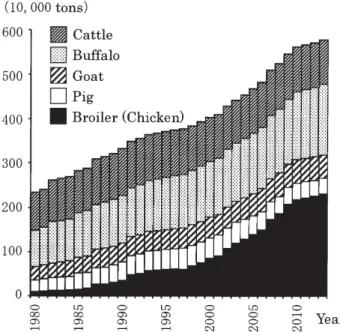
The author now details the characteristics of broiler production and distribution in India from a geographical perspective. Figure 1 shows changes in meat production volume in India. While domestic meat production volume has steadily increased with the growth of the Indian economy, the growth rate has been especially remarkable after 2000. The increase in the volume of chicken production has been particularly significant and chicken has become the largest meat sector, surpassing buffalo meat in 2005.
However, production areas of broilers are not evenly formed across India. As indicated in Figure 2, which shows broiler population by state, the major production
Figure 1. Changes in meat production by type in India (1980-2013)
Source:“FAOSTAT ”issued by the Food and Agriculture Organization of the United Nations (FAO).
Figure 2. Number of broilers by state in India (2012)
Note: Six states, whose names are indicated above, have more than 20 million broilers.
areas are located in South India, particularly the states of Andhra Pradesh and Tamil Nadu, which have had a strong poultry industry traditionally. Besides these, emerging production areas such as Maharashtra State in West India and Haryana State in North India are fast growing. The reasons for a strong poultry industry in South India are climate conditions suitable for poultry farming3
and significantly higher chicken consumption per capita in South than in North India.4
2. Growth of broiler distribution and its regional characteristics
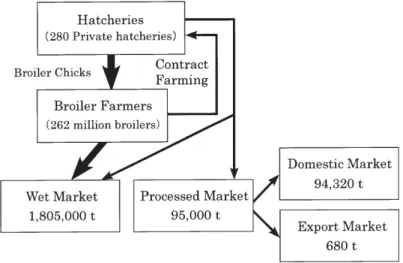
Through what processes are broilers that are produced in the production areas distributed to consumers? Figure 3 shows the broiler distribution flow in India as of 2005, based on the findings of Mehta and Nambiar (2008: 16). In India, poultry companies called“hatcheries,”spread across the country, have had a strong influence over the broiler industry (Goto 2006). Generally, hatcheries refer to poultry companies that produce and supply broiler chicks to farmers. Farmers receiving chicks from hatcheries raise them to maturity and also ship the broilers to affiliate poultry companies and local wholesale markets. An important point to note is that about 95% of broilers are shipped alive from farmers to wholesale markets and retail shops, where they are slaughtered and sold to consumers (Figure 3). Live bird distribution channels called“wet markets”are prevalent in India because of specific factors such as an under-developed infrastructure for refrigerated broiler transportation and a
Figure 3. Overview of broiler distribution in India (2005)
Note 1. Dominant distribution routes are indicated in bold. Note 2. Number of hatcheries is based on the data in 2003. Note 3. Number of broilers is based on the data in 2007.
Sources:“Indian Livestock Census”(2007) issued by the Government of India, Mehta and Nambiar (2008: 16)
consumer preference for fresh chicken (Landes et al. 2004: 18).
Thus, at least two characteristics of broiler distribution in India can be confirmed. (1) poultry companies supplying chicks have a strong influence; and (2) wholesale markets play an important role as distribution bases because most broilers are traded live. As mentioned earlier, broiler distribution is strong influenced by poultry companies in South India and by wholesale markets in North India. Are these regional differences still prevalent? In later sections, we will look closely at the actu-al situation of broiler distribution in North and South India.
III. Growth of Major Poultry Companies and the Regional Structure of Broiler Distribution: Cases in South India
1. Location of the Indian poultry companies
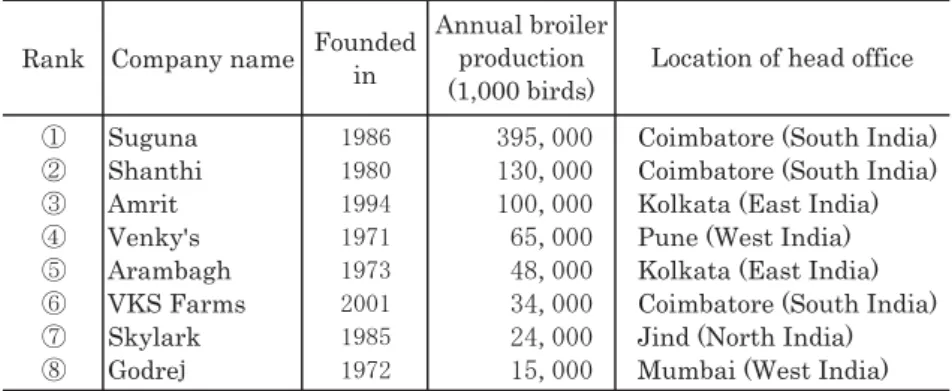
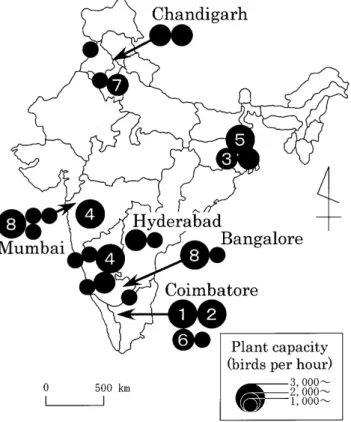
This section looks at what actors are involved in broiler distribution in South India. Eight major poultry companies with a strong influence over today's broiler distribution in India are listed in Table 1. Among the eight companies, Suguna, Shanthi, Amrit, and Venky's comprise the“Big 4,”having especially large market shares. As for head offices of the eight major companies (see Table 1), three of them are based in Coimbatore, South India, and two are in Kolkata, East India; the majority of the major companies originate in the southern and eastern parts of India, where the poultry industry has been traditionally active. Only one of the companies, Skylark, is based in North India (Jind, Haryana). Recently, the demand of processed chicken products has increased gradually in India, so most of these companies are constructing their broiler processing plants. Figure 4 shows the location of the broiler processing plants in India as of 2014. In this figure, it is clear that many broiler
processing plants are located in South India (especially 4 states). Such a location of the major poultry companies almost coincides with the location of production areas shown in Figure 2, suggesting that the activities of these companies are central to broiler production and distribution in the nation. Yet, some of these companies, including Suguna and Venky's, have expanded their businesses to North India and co-opted farmers, which hints at an association with the growth of production areas in North India as indicated in Figure 2.
2. Regional development of broiler contract farming
How are these poultry companies involved in broiler distribution? According to the author's field surveys, all the poultry companies listed in Table 1 executed“contract farming”agreements with their farmers for broiler purchase. Contract farming refers to a system in which poultry companies supply chicks, feed, vaccines to affiliated
Figure 4. Location of broiler processing plants in India (2014)
Note 1: Numbers 1 through 8 in the figure correspond with the company ranking in Table 1.
Note 2: Names of districts with at least two processing plants are indicated above. Source:“Report on size & structure of the poultry processing industry in India (end of
farmers and these farmers raise and sell broilers to the companies at a contract price. For example, the biggest poultry company Suguna has contracted with approximately 15,000 broiler farmers across 11 states in India for broiler purchase (Ramesh 2010: 37). The second-largest company, Shanthi, also has approximately 1,800 contract broiler farmers located in five states. Below, we review the details of broiler purchases by Shanthi, whose contract farmer data were available.
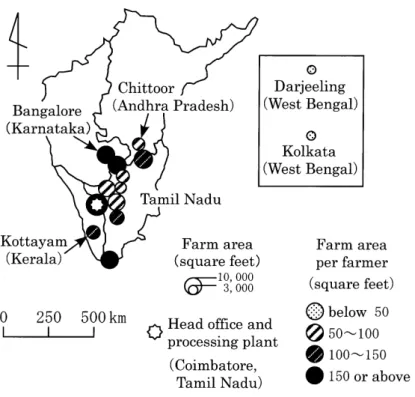
Figure 5 shows the distribution of Shanthi's contract broiler farmers. As mentioned earlier, Shanthi is a poultry company based in Coimbatore, Tamil Nadu, and has contracted with 1,781 farmers located in five states of India. According to the distribution map, a considerable proportion of the contract farmers are concentrated in the northwest part of Tamil Nadu State, especially in Coimbatore, where Shanthi's head office and broiler processing plant are located. Specifically, 23.8% of all contract farmers (423 farmers) are located in Coimbatore and three neighboring districts. Although Shanthi's contract farmers are also located in four states in South India, most of them are located in regions near state borders, such as Kottayam, Kerala;
Figure 5. Distribution of Shanthi's contract broiler farmers (2015)
Note 1: Distribution of contract broiler farmers is based on farm area by district. Note 2: District's name (State's name) means the farm location outside of Tamil
Nadu State.
Bangalore, Karnataka; and Chittoor, Andhra Pradesh (Figure 5). Broilers of these farmers are loaded on trucks and transported to the processing plant in Coimbatore and local markets in Tamil Nadu State. The distance between Shanthi's processing plant in Coimbatore and the farthest farmer in Chittoor is about 400km and it takes about 14 hours to transport broilers between the two locations.5
Shanthi also purchases broilers from a number of farmers in West Bengal State in East India (see Figure 5), but broilers from those farmers are not transported to South India but directly distributed to local markets in West Bengal State.
Thus, Shanthi produces broilers by contract with farmers but not all the broilers produced will be shipped to their processing plant and become processed chicken. Most of purchased broilers are transported live to local markets and distributed by wholesalers. The current status of the Indian broiler industry, i.e., an under-developed processed chicken market and prevalence of live bird distribution is reflected in the situation described above.
3. Recent changes in broiler distribution strategies of the Indian poultry companies In recent years, however, there have been changes to this scenario. The biggest change is the emergence of private chain stores for chicken retailing run by poultry companies alongside an increase in chicken consumption in India (Karthikeyan and Nedunchezhian 2013). Table 2 shows the eight major companies' chain stores for chicken retailing and their chicken brands. All the eight companies have their private chicken brand and most have created retail chain stores after the 2000s. Currently, Suguna has the largest number of stores in India. They started private chain stores for chicken retailing under the name“Suguna Daily Fressh”in 2007 and rolled out a Table 2. Broiler distribution strategies of the eight major poultry companies in India (2013)
private processed chicken brand called“Home Bites”through 201 stores across the nation. Further, many poultry companies export chicken to countries primarily in the Middle East region today (see Table 2).
The author examined the locations of private chain retail stores with a focus on three of the eight major companies (Suguna, Venky's, and Godrej), whose private retail store data were available. According to Figure 6, Suguna has the largest number of stores, with 145 of their 201 stores (72.1%) in 12 districts of Kerala State and 22 (10.9%) in Bangalore, Karnataka; most of the company's stores are located in South India. Most of Venky's stores (25 across the nation) and Godrej's stores (35 across the nation) are also located in South India (such as Bangalore) and West India (such as Pune and Mumbai). Although there are a few stores of the three companies in North India (Figure 6), including the National Capital Region of Delhi (the Delhi NCR), it nevertheless shows that they have avoided opening stores in North India. For instance, Venky's opened two stores in the Delhi NCR in 2010, but one of them closed in less than five years.6
Godrej opened eight stores in the Delhi NCR in and after 2005, but they had to close all of them in five to six years.7
This suggests that retail stores for processed chicken are accepted in South but not in North India, where the consumption of processed chicken is low.
Figure 6. Locations of three major poultry companies' chain stores for chicken retailing (2016)
Note 1: Distribution of each company's stores is shown by district (except Kerala State where there are a large number of stores).
Note 2: Names of districts with at least 10 stores of each company are indicated above. Sources: The companies' websites and interviews with the company officials.
IV. Growth of the Chicken Wholesale Market and the Regional Structure of Broiler Distribution: Cases in North India
1. Overview of the Ghazipur Market and its chicken wholesalers
As discussed in Section III, many poultry companies have promoted contract farming and are operating private retail stores in South India as a new channel of broiler distribution. Meanwhile, what changes have occurred in North India in relation to broiler distribution? As pointed out by Landes et al. (2004) and Surana (2010), the Ghazipur Market that opened in Delhi in 1992 serves as a central hub of broiler distribution in North India. It was opened by the Government of India to streamline domestic chicken distribution by bringing the dispersed chicken wholesalers in Delhi into one market. Today, it is India's largest chicken wholesale market. According to Gangwar et al. (2010), the number of broilers consumed in the Delhi NCR per day is approximately 200,000 and about 50% is supplied by the Ghazipur Market. In the wholesale market, chicken wholesalers called“commission agents”purchase broilers from farmers in different parts of India.
Figure 7 shows changes in broiler trading volume in the Ghazipur Market between 2004 and 2013. From 2004 to 2013, the broiler trading volume increased 45.3%. However, as described later, the trading volume in the past five years have stagnated above 50,000 tons. Thus, chicken wholesalers of the Ghazipur Market purchase as much as
Figure 7. Changes in the broiler trading volume in the Ghazipur Market (2004-2013)
50,000 tons of broilers. As of 2015, 87 wholesalers conducted purchasing activities in the Ghazipur Market and the author had opportunities to interview with 15 of them, whose overviews are provided in Table 3.8
First, most of the 15 wholesalers in Table 3 began their chicken wholesaling business as a family business before the opening of the market.9
All 15 wholesalers were Muslim and 13 of them belonged to the same professional community (jati) called “Qureshi.”Qureshi is a jati of Muslims traditionally engaged in livestock slaughtering,
and some members of the 13 wholesalers are related by blood. Similarly, about 70 of the 87 chicken wholesalers in the Ghazipur Market are Muslim and most of them belong to the Qureshi community.10
Thus, the survey results shown in Table 3 can be assumed to generally represent the attributes of all chicken wholesalers of the Ghazipur Market.
2. Broiler distribution system in the Ghazipur Market The chicken wholesalers purchase
broilers from farmers and sell them to consumers. Farmers borrow trucks to carry the broilers to the market and sell the broilers based on daily auction (see Figure 8). Most of the sold broilers will be instantly slaughtered in the market and distributed to retail stores, fast-food chains, and hotels in the Delhi NCR for consumption. Farmers are bound to pay for borrowed trucks for broiler trans-portation as well as various fees to
market stakeholders.11 Moreover, the auction process lacks transparency (Singh 2006:
24) and chicken wholesale prices are lower in comparison with those in South India. Figure 8. Broilers waiting for daily auction in
the Ghazipur Market
Photo: The author (22 February 2015).
Figure 9. Regional differences in wholesale and retail prices of broiler in India (2015)
This makes quite a few farmers hesitant to ship to the Ghazipur Market. In fact, chicken wholesale prices in Delhi are as low as 60% of those in South India (Tamil Nadu State), according to the Government of India (Figure 9). Moreover, the gap between wholesale and retail prices in Delhi is greater than in South India, which may suggest that farmers are forced to trade broilers at unfair prices (see Figure 9). Yet, unlike in South India, distribution channels of broilers are limited in North India and farmers rarely have options other than to ship to the Ghazipur Market.
In recent years, however, a number of poultry companies have started to expand their business to North India, e.g., Harayana State. These companies actively acquire farmers in production areas in North India and this has caused broiler trading volume in the Ghazipur Market to stagnate (Figure 7). While about 90% of broilers currently traded in the Ghazipur Market are from Haryana State, the ratio has been decreasing year after year and the geographical areas from which broilers are purchased has been expanding.
3. Geographical range of broiler purchasing areas by the Ghazipur wholesalers
Such changes are also implied by data on regions from which wholesalers purchase broilers. As indicated in Table 3, many wholesalers still depend on broilers from Haryana State in their purchasing. On the other hand, however, geographical areas from which wholesalers purchase broilers have been expanding. Most of the 15 wholesalers purchase broilers from farmers in remote locations such as Nashik (eight) and Mumbai (one) in Maharashtra State, and Rajnandgaon (one) in Chhattisgarh State. Surana (2010: 14) pointed out that the broiler purchasing areas of the Ghazipur wholesalers were limited to the five neighboring states of Delhi, but the situation has changed substantially. As indicated in Figure 10, the farthest areas from which the 15 wholesalers purchase broilers go far beyond the five states. Surprisingly, the road distance between Delhi and Mumbai is about 1,200km, and it takes about 36 hours by road.
Thus, facing stagnation of the broiler trading volume, wholesalers of the Ghazipur Market, who have played important roles in broiler distribution in North India, have now changed their purchase strategies. Interestingly, nearly half (seven) of the 15 wholesalers plan to own in-house broiler farms to avoid a chicken inventory shortage (see Table 3). Two of the wholesalers (No.5 and No.6) already own in-house farms in Haryana State and receive broilers from such farms as necessary.12
V. Conclusion
This study focuses on the growing broiler distribution in India by examining chan-ges in regional differences between North and South India from a geographical perspective. Table 4 summarizes the regional structure of broiler distribution in North and South India, based on the analyses of this study.
In South India, the major poultry companies, including Suguna and Shanthi, have committed to contract farming, i.e., suppling chicks to and purchasing broilers from contract farms. Contract farming offers significant benefits to contract farmers by facilitating stable management of their farming business with guaranteed sales of broilers at prescribed contract prices. With contract farming gaining popularity, many poultry companies have begun to purchase broilers from farms located beyond state borders and some have even entered the North Indian market in recent years. In the 2000s, the major poultry companies started to establish broiler processing plants and private chain stores for chicken retailing in South India, to sell broilers under their own brand.
Figure 10. Geographical range of broiler purchase by chicken wholesalers of the Ghazipur Market (2015)
Source: The author's interviews with the Ghazipur Market wholesalers in December 2015 and February 2016.
On the other hand, the Ghazipur Market located in Delhi has had a strong impact on broiler distribution in North India. As some poultry companies promoted contract farming in North India, the broiler trading volume in the Ghazipur Market became stagnant. As a result, the geographical area from which the Ghazipur wholesalers purchase broilers now extends to the states of Maharashtra and Chhattisgarh. Landes et al. (2004: 18) pointed out that interregional movements of broilers were not common in India because there were much difficulties in live bird transportation by trucks. However, broiler purchase areas by poultry companies and wholesalers have expanded drastically in the last decade. The expansion of purchase areas requires long-distance transportation and this has created a new issue of lowering farmers' incomes owing to frequent occurrences of broilers' death and weight loss during transportation (APTEC Technology Consulting 2011: 7).
This study is of great significance in that it examines broiler purchase activities by poultry companies and wholesalers from a geographical perspective for the first time. For the future, a detailed field survey should be conducted to show how activities of poultry companies and wholesalers identified by this study affect broiler farmers in different production areas.
Acknowledgements
I would like to express my sincere thanks to Prof. Singh, R.B., Prof. Sharma, V.R., their graduate students in Delhi University, and especially my translator Verma, D.K. who kindly assisted my interviews with poultry companies and wholesalers. This study was supported by JSPS KAKENHI Grant-in-Aid for Scientific Research (A) Grant Number 26257012 (Representative: Kazuo Tomozawa).
Notes
1. According to Singh (2006: 3), the ratio of chicken distribution under the control of poultry companies is 85% in South India, 75% in West India, 50% in East India, and 30% in North India (The figures are estimates as of 2006).
2. Five field surveys were conducted in India between 2015 and 2017; interviews were conducted with major poultry companies' officials, the Ghazipur Market's officers and wholesalers.
3. The narrow annual range of temperatures in South India is considered suitable for raising broilers. The much broader annual range of temperature in North India is believed to be inappropriate for poultry farming as it increases broilers' mortality rates.
4. Andhra Pradesh State has the highest chicken consumption per capita in India as of 2011, the state consumed about 15 times more chicken than the state of Rajasthan, North India, where chicken consumption per capita was the lowest (Government of India 2014).
5. The author's interview with Shanthi in February 2017. 6. The author's interview with Venky's in February 2017. 7. The author's interview with Godrej in February 2017.
8. Interviews with chicken wholesalers of the Ghazipur Market were conducted twice in December 2015 and February 2016.
9. Before 1992, the large majority of chicken wholesalers currently operating in the Ghazipur Market were engaged in the chicken distribution business in the Old Delhi, where the ratio of Muslim population is high.
10. The author's interview with the Ghazipur Market officers in December 2015. 11. According to the Ghazipur Market, farmers must pay a fee, including an
“unloading fee”of 1.5 INR per cage for unloading broiler cages from trucks arriving at the market; a“land fee”of 2.5 INR per cage for placing broiler cages in a standby space within the market until auction (about 10 broilers in a cage); and a“wholesales commission fee”of 3.12% of the total transaction amount for consigning sales to wholesalers (Surana 2010: 14).
12. For example, wholesaler No. 5 on Table 3 has farms in Gurgaon, Haryana State, which is about 60km from Delhi. They employ workers from outside the State for raising broilers.
References
APTEC Technology Consulting. 2011. Structure, size, pitfalls & prospects: the Indian broiler processing sector. APTEC White Paper, Greater Noida, India.
Gangwar, L.S., Saran, S. and Kumar, S. 2010. Broilers' supply value chain in the national capital region Delhi: a case study of the Ghazipur poultry market. Agricultural Economic Research Review 23, 461-468.
Goto, T. 2006. Development mechanisms of the broiler meat production areas in India: analysis based on the agribusiness behaviors. Annual Report of Research Center for Regional Geography 15, 171-187. (JE)
Government of India. 2014. Household consumption of various goods and services in India 2011-2012. National Sample Survey Office, Ministry of Statistics and Programme Implementation, New Delhi, India.
Karthikeyan, R. and Nedunchezhian, V.R. 2013. Vertical integration paving way to organized retailing in Indian poultry industry. International Journal of Business and Management Invention 2(1), 39-46.
Landes, M., Persaud, S. and Dyck, J. 2004. India's poultry sector: development and prospects. Market and Trade Economics Division, Economic Research Service, United States Department of Agriculture (USDA), Washington DC, USA.
Mehta, R. and Nambiar, R.G. 2008. The poultry industry in India. In Poultry in the 21st
century: avian influenza and beyond (proceedings of international poultry conference), ed. Food and Agriculture Organization of the United Nations (FAO), 149-210. Rome, Italy.
Murthy, M. and Madhuri, S.B. 2013. A case study on Suguna poultry production through contract farming in Andhra Pradesh. Asia Pacific Journal of Marketing & Management Review 2(5), 58-68.
Ramesh, G. 2010. Mainstreaming an unorganized industry: the case of Suguna poultry. VIKALPA 35(2), 35-47.
Ranjhan, S.K. 2004. Indian meat industry perspective. Food and Agriculture Organization of the United Nations (FAO), Rome, Italy.
Singh, S.K. 2006. GAIN report: India poultry and products annual 2006. Foreign Agricultural Service, United States Department of Agriculture (USDA), New Delhi, India.
Sridharan, A. and Saravanan, R. 2013. A study on motivating factors to enter into poultry farming with special reference to Suguna broiler contract farms in Coimbatore district. International Journal of Marketing, Financial Services &
Management Research 2(4), 109-117.
Surana, N.K. 2010. A project report on poultry trade at New Delhi. AMCAP School of Management, Bikaner, India.