COMMUNITY CAPACITY BUILDING
AND COLLECTIVE ACTIVITIES:
A CASE STUDY OF
THE TEENEK INDIGENOUS COMMUNITY
OF TAMALETOM
by
Olga Patricia Barreda Moreno March 2011
Thesis Presented to the Highter Degree Committe of Ritsumeikan Asia Pacific University
in Partial Fulfillment of the Requirements for the Degree of Master‟s of Science in International Cooperation Policy
REVISIONS
1. Clarify if snowball sampling method was used to find the research site.
Response: The method used to find the research site was labeled as snowball sampling and has been clarified in the methodology section.
2. Explain how did your strategy to accompany Benigno for fieldwork or his presence in the field research affect data
Response: This has been addressed in the methodology section under instrumentation.
3. Describe the importance of informal interviews conducted spontaneously.
Response: This has been addressed in the methodology section under instrumentation.
4. Mention the negative aspects of TCA or the pre-existing social capital.
Response: A discussion of the negative aspects of the pre-existing social capital was included in chapter 5 and the conclusion.
5. Describe appreciative inquiry as it related to the recommendations and main points of this thesis.
Response: A discussion about Appreciative Inquiry is now included in the methodology section under strategic enquiry and considered in the policy implications section.
Response: More discussion and explanations were added in the conclusion to clarify this question.
7. Discuss the rationale for why Benigno and the Ceremonial Center committee can be the representative of Tamaletom’s community activities.
Response: This has been addressed under the explanation of case selection under the methodology section under study site as well as in chapter 7.
8. Check grammar and typos.
Response: I conducted an automatic spell and grammar check and additionally had it revised again by a native speaker.
i
ACKNOWLEDGEMENTS
The challenges I encountered while producing this thesis had been overcome thanks to many individuals who selflessly helped me and supported me in all stages of its production. This is why I would like to start this work by thanking them for their support.
I would like to thank my supervisor, Professor Koichi Miyoshi, for supporting me academically and financially. He has given me countless opportunities to learn from his experiences, has patiently guided my research and encouraged me many times to not give up and make the biggest effort possible. I would like to express my deepest gratitude for his kindness.
I am very thankful for all the people who supported my research in the field. I would like to thank Benigno Robles Reyes and his family, who kindly opened the doors of their house and their community for me. They took care of me and treated me like family. Without Benigno, I could not have gathered all the data presented here. I would also like to thank all the people inside the community who accepted me and welcomed me in their home to chat, and the people I interviewed who spent some minutes of their busy schedule to answer my questions. Last but not least, I would like to thank the Archeologist Guillermo Ahuja who patiently taught me about the local communities and contacted me with Benigno among other people who helped me and even took me to meet them. He was the person who opened all doors for me.
I also want to show my appreciation to the Ritsumeikan Center for Asia Pacific Studies, Asia Pacific University for granting me the Graduate Student Research Support Program. I would like to thank my family who has given me all their love and support, if it weren‟t for them I wouldn‟t have the courage to come to study in Japan. Even if they are far away I can feel their warm support every time we talk. I would like to thank Rodrigo Velazquez for all his help and support even in the most discouraging situations. Thank you for coming all the way here and making sure I could go through with this last stage and also for doing all you could to keep my hands free for writing.
Furthermore thanks to all my friends who put up with me during these two years. Especially my seminar friends: Yumiko Okabe, my senpai, advisor, sister and best friend; Raphael Baptist, my friend, mentor and sometimes even dad; Nirmisha Shrestha, my sweetest and most patient friend; Michel Sebera, Fellizardo Chacuamba, and Valeria Escliar who encouraged me and supported me during seminar classes.
ii
I, Olga Patricia Barreda Moreno hereby declare the contents of this thesis contain only my original work.
Any contributions by others have been cited or acknowledged appropriately.
iii
TABLE OF CONTENTS
LIST OF TABLES AND FIGURES ... VI LIST OF ACRONYMS AND TERMS ... VIII ABSTRACT ... X
CHAPTER 1 INTRODUCTION ... 1
1.1 RESEARCH PROBLEM ... 1
1.2 RESEARCH QUESTIONS ... 3
1.3 RESEARCH OBJECTIVES ... 3
1.4 SIGNIFICANCE OF THE RESEARCH ... 4
1.5 SCOPE AND LIMITATIONS OF THE RESEARCH ... 4
1.6 STRUCTURE OF THE THESIS ... 5
CHAPTER 2 LITERATURE REVIEW ... 7
2.1 PUBLIC ADMINISTRATION AND GOVERNANCE ... 7
2.1.1 Decentralization ... 8
2.1.2 Localization ... 10
2.2 COMMUNITY AND DEVELOPMENT ... 12
2.2.1 Community ... 12 2.2.2 Community Development ... 14 2.3 COMMUNITY CAPACITY ... 15 2.3.1 Characteristics ... 16 2.3.2 Strategic component ... 17 2.4 COLLECTIVE ACTIVITIES ... 22 2.5 COMMUNITY CHANGE ... 24 2.6 ANALYTICAL FRAMEWORK ... 26 CHAPTER 3 METHODOLOGY ... 29 3.1 PHILOSOPHICAL WORLDVIEW ... 29 3.2 STRATEGY OF ENQUIRY ... 31 3.3 DATA COLLECTION ... 33 3.3.1 Study site ... 34 3.3.2 Participants ... 37 3.3.3 Instrumentation ... 38
3.4 DATA VALIDATION AND ANALYSIS ... 41
3.5 METHODOLOGICAL LIMITATIONS... 42
CHAPTER 4 MEXICAN INDIGNEOUS RURAL COMMUNITY DEVELOPMENT ... 43
4.1 THE UNITED MEXICAN STATES ... 43
4.1.1 Historical Background ... 43
4.1.2 General country profile ... 44
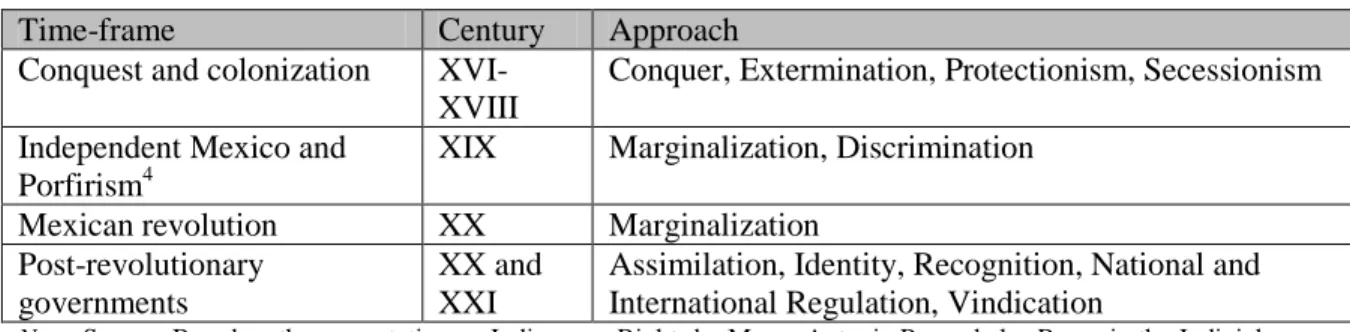
4.1.3 Mexican Indigenous community background ... 47
iv
4.2.1 Vision 2030 and The Plan Nacional de Desarrollo (PND) 2007-2012 ... 48
4.2.2 Rural Sector ... 50
4.2.3 Indigenous Communities ... 51
4.3 PUBLIC ADMINISTRATION ... 52
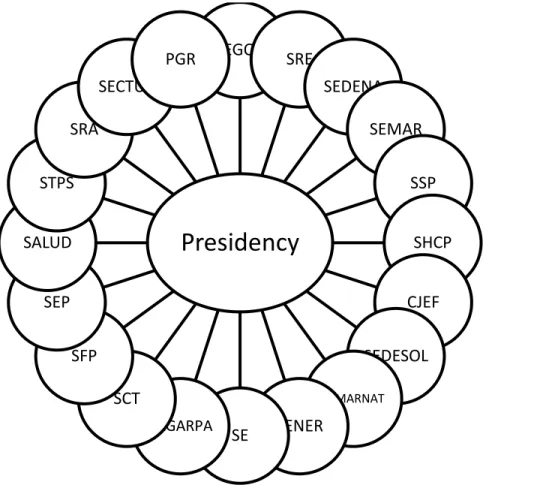
4.3.1 Public administration structure ... 52
4.3.2 Public administration system ... 54
4.3.3 Public administrative units ... 54
4.4 DECENTRALIZATION ... 56 4.5 LOCALIZATION ... 59 4.5.1 State Level ... 59 4.5.2 Municipal Level ... 60 4.5.3 Community Level ... 60 4.6 SUMMARY ... 61
CHAPTER 5 TYPES OF COLLECTIVE ACTIVITIES AND COMMUNITY CAPACITY ... 63
5.1 LOCAL CONTEXT OF TAMALETÓM ... 64
5.1.1 General Background ... 64
5.1.2 History of Tamaletom ... 65
5.2 ANALYSIS OF TAMALETOM‟S COLLECTIVE ACTIVITIES ... 66
5.2.1 Traditional Collective Activities ... 67
5.2.2 Community oriented Collective Activities ... 70
5.3 ANALYSIS OF CHARACTERISTICS OF COMMUNITY CAPACITY ... 72
5.3.1 Sense of community ... 72
5.3.2 Commitment ... 73
5.3.3 Ability to set and achieve objectives ... 73
5.3.4 Ability to recognize and access resources ... 74
5.4 SUMMARY ... 76
CHAPTER 6 EXTERNAL INFLUENCE AND INTRODUCTION CCA ... 79
6.1 NETWORK:EXTERNAL ACTORS OF TAMALETOM ... 79
6.1.1 CDI, INAH ... 80
6.1.2 Radio Station XEANT ... 84
6.1.3 MAIZ, COMCAUSA, CEMIAC ... 87
6.1.4 World Vision. ... 89
6.1.5 Community University and other institutions ... 89
6.2 SUMMARY OF NETWORK IN TAMALETOM ... 93
6.3 COMMUNITY CHANGE ... 95
6.4 SUMMARY ... 97
CHAPTER 7 COMMUNITY MEMBERS AND MORE COMPLEX CCA ... 99
7.1 LEADERS... 99
7.2 HUMAN RESOURCES ... 104
7.3 COMMUNITY ORGANIZATIONS... 107
v 7.3.2 Dancers groups ... 111 7.3.3 Embroiderers groups ... 112 7.3.4 Traditional Kitchen... 115 7.4 COMMUNITY CHANGE ... 116 7.4.1 Impact of leadership ... 116
7.4.2 Impact of community groups ... 117
7.5 SUMMARY ... 118
CHAPTER 8 CONCLUSION ... 120
8.1. SUMMARY OF ANALYSIS... 121
8.2. CONTRIBUTION TO COMMUNITY CAPACITY THEORY ... 124
8.3. POLICY IMPLICATIONS ... 126
8.4. AREAS FOR FURTHER STUDIES ... 127
REFERENCES ... 129
APPENDICES ... 133
APPENDIX 1:MAP OF MEXICO AND LOCATION OF COMMUNITY ... 133
APPENDIX 2:ROAD TO TAMALETOM FROM TOURISM MAGAZINE ... 134
APPENDIX 3:NEWSPAPER ARTICLE OF THE START OF THE CEREMONIAL CENTER PROJECT ... 134
APPENDIX 4:NEWSPAPER ARTICLE ABOUT THE SPRING EQUINOX CELEBRATION ... 135
vi
LIST OF TABLES AND FIGURES Tables
TABLE 2.1KEY ELEMENTS OF SOCIAL CAPITAL ... 21
TABLE 3.1CASE SELECTION SCHEDULE ... 36
TABLE 3.2FIELDWORK DETAILS ... 37
TABLE 3.3INTERVIEW SCHEDULE ... 39
TABLE 4.1RESEARCH LOCALIZATION ... 45
TABLE 4.2COMPOSITION OF THE HUASTECA REGION ... 46
TABLE 4.3EVOLUTION OF THE APPROACH TOWARDS INDIGENOUS COMMUNITIES IN MEXICO ... 47
TABLE 4.4COUNTRY DEVELOPMENT STRATEGY PROGRAM THEORY MATRIX ... 50
TABLE 4.5PRESENT MEXICAN PUBLIC ADMINISTRATIVE UNITS ... 55
TABLE 4.6CATEGORIES OF LOCALITIES WITHIN THE MUNICIPALITY ... 56
TABLE 5.1 HISTORY OF PROJECTS IN TAMALETOM ... 66
TABLE 5.2COLLECTIVE ACTIVITIES BEFORE EXTERNAL INFLUENCE (TCA) ... 69
TABLE 5.3COLLECTIVE ACTIVITIES AFTER EXTERNAL INFLUENCE (CCA) ... 71
TABLE 5.4TAMALETOM'S CHARACTERISTICS OF COMMUNITY CAPACITY ... 72
TABLE 5.5LOGICAL FRAMEWORK OF COLLECTIVE ACTIVITIES ... 78
TABLE 6.1SUMMARY OF PROGRAMS OFFERED BY CDI ... 83
TABLE 6.2RELATION OF EXTERNAL IMPACTS AND COMMUNITY CAPACITY ... 96
TABLE 7.1LEADERS IN TAMALETOM ... 102
TABLE 7.2CEREMONIAL CENTER PROJECT BACKGROUND IN CHRONOLOGICAL ORDER ... 108
TABLE 7.3RELATION OF LEADERS AND COMMUNITY GROUPS WITH COMMUNITY CHANGE ... 118
Figures FIGURE 2.1LOCALIZATION OF POLICY STRUCTURE ... 12
FIGURE 2.2LEVEL OF COMMUNITY ... 14
FIGURE 2.3ROLE OF LEADER IN COMMUNITY CHANGE ... 19
FIGURE 2.4COMMUNITY CAPACITY DEVELOPMENT AND POLICY STRUCTURE MODEL ... 26
FIGURE 2.5TAMALETOM COMMUNITY CAPACITY BUILDING AND POLICY STRUCTURE MODEL HIGHLIGHTING EXTERNAL INFLUENCE AND COLLECTIVE ACTIVITIES ... 28
FIGURE 4.1FEDERAL GOVERNMENT STRUCTURE ... 53
FIGURE 5.1HAND DRAWN MAP OF TAMALETOM ... 65
FIGURE 5.2COMMUNITY MEMBERS IN FAENA... 68
FIGURE 5.3CHURCH OF TAMALETOM 3RD SECTION ... 76
FIGURE 6.1ELECTION OF THE INDIGENOUS ADVISOR OF THE CENTRAL HUASTECA REGION 2011 ... 81
FIGURE 6.2VOLADORES OF TAMALETOM PERFORMING IN WASHINGTON DC ... 84
FIGURE 6.3XEANTRADIO STATION ... 86
FIGURE 6.4COMMUNITY UNIVERSITY OF TANCANHUITZ... 91
vii
FIGURE 7.1AUTHORITIES THAT GATHER IN THE GENERAL ASSEMBLY ... 100
FIGURE 7.2WORK OF BENIGNO'S SON ... 106
FIGURE 7.3CEREMONIAL CENTER OF TAMALETOM ... 109
FIGURE 7.4MUSEUM AND KITCHEN OF THE CEREMONIAL CENTER ... 110
FIGURE 7.5CULTURAL WORKSHOP AT THE CEREMONIAL CENTER ... 111
FIGURE 7.6DIRECT SALES POINT FOR EMBROIDERERS IN CEREMONIAL CENTER ... 115
FIGURE 8.1COMMUNITY CAPACITY DEVELOPMENT THROUGH TRADITIONAL AND COMMUNITY ORIENTED COLLECTIVE ACTION IN TAMALETOM ... 123
viii
LIST OF ACRONYMS AND TERMS
AI Appreciative Inquiry
CCA Community Oriented Activities CEMIAC Mexican Center of Exchange
CDI National Commission for the Development of Indigenous Peoples COMCAUSA Supportive Urban and Peasant Communities with Alternatives CONAMI National Council of Indigenous Women
CONOC National Council of Peasant Organizations
COPLADEM Committees for Municipal Development Planning INAH National Institute of Anthropology and History INEGI National Institute of Statistics and Geography INI National Indigenous Institute
MAIZ Zapatista Indigenous Agrarian Movement NAFTA North America Free Trade Agreement NGO Non-Governmental Organization
PACMYC Community and Municipal Culture Support Program PAEI Program of Indigenous School Dormitories
PAN National Action Party
PFRI Program of Regional Indigenous Funds
PND National Development Plan
PDPI Program for the Development of Indigenous Peoples
POPMI Program of Productive Organization for Indigenous Women PPCMJ Program of Promotion of Agreements in Justice Matters PRI Institutional Revolutionary Party
ix
PROCAMPO Program of Direct Subsidies for Agriculture PRODICI State‟s Indigenous Community Development Program
PROFODECI Program for Fostering and Promoting Indigenous Culture PTAZI Alternative Tourism Program in Indigenous Zones RMALC Mexican Network of Action against Free Trade
SAGARPA Ministry of Agriculture, Stockbreeding, Rural Development, Fishing and Food Supply
SECTUR Ministry of Tourism
SEDESOL Ministry of Social Development
SEP Ministry of Public Education
SFP Ministry of Public Function
SLP San Luis Potosí
TCA Traditional Collective Activities
UN United Nations
UNICOM Community University of Tancanhuitz XEANT Radio station “la voz de las Huastecas”
x ABSTRACT
This thesis explains the case study of community capacity development in Tamaletom community, Mexico, through the analysis of collective activities and their evolution. The objective is to analyze and interpret the impact of collective activities in community capacity of Tamaletom by conceptualizing it to contribute to community capacity development theory.
I used a post-modern paradigm and qualitative research approach. For this research, I stayed in the community with the community leader and used observation and interviews as tools to gather data.
This thesis approached the problem of the paradigm of development has historically been seen from a top-down perspective. Changes in this paradigm have been noticeable since recent years, and new strategies of participatory development are being implemented. Capacity development is essential for effective and sustainable participatory development but strategies for community capacity are not fully studied and tried.
In this paper I identified two types of collective activities: Traditional Collective Activities (TCA) and Community oriented Collective Activities (CCA). They both impact Community Capacity in different ways and levels, and at the same time, higher levels of Community Capacity make more complex Collective Activities possible, creating a cyclic relation.
The members of community of Tamaletom engaged in TCA which developed a high sense of community. Later, government and other external intervention, in an effort to reach local communities and engage in participatory development, created CCA in Tamaletom. This indirectly built commitment, increased access to resources and ability to set and achieve objectives by creating a common goal which coincidentally was the same as the community leaders. Soon, engaging in a combination of both allowed the development of more complex and sophisticated activities for future community change, continuously and gradually building Community Capacity.
1 CHAPTER 1 INTRODUCTION
This chapter introduces the research problem by explaining the issues of holistic development, development strategies involving community participation, and discussions on community capacity for effective localization and decentralization. Then the questions and objectives of this thesis are presented. The significance of this research along with the scope and limitations are described and in the end, an outline of the thesis will be given to facilitate its reading.
1.1 Research Problem
This study focuses on the issues of holistic development, development strategies involving community participation, and discussions on community capacity for effective localization and decentralization. These problems are explained in the following paragraphs.
The paradigm of development has historically been seen from a top-down perspective. Development policies or any other type of strategy are often designed and applied using commercial or political criteria, through colonizer or paternal perspective, aimed at the benefit of the “users”, “public”, “client”, “beneficiary”, etc. (Mora M & Mora C., 2010, p. 36). Development has been in the hands of government bureaucrats that believe they are righteous representatives of a nation because they were former combatants, social or social leaders, or intellectuals. Jackson and Kassam (1998, p. 11) state that “donor-driven and control-oriented approaches … predominate the field of development cooperation.”
2
Changes in this paradigm have been noticeable since recent years, taking the Paris Declaration on Aid Effectiveness in 2005 as a milestone. This declaration takes the lessons learned of decades of experience in the field of development and emphasizes the need of more community participation, ownership of development strategies and inclusive partnership. This new paradigm is born along new strategies of participatory development such as participatory evaluation, in which stakeholders in a development intervention participate in the all stages of evaluation and in the action taken as a result in where by participating in this process they build their own capacity to promote other forms of participatory development (Jackson & Kassam, 1998). Another such as the Sustainable Livelihoods Approach which “places great emphasis on involving people in both the identification and the implementation of activities where appropriate” (Krantz, 2001, p. 2). Mexico has had important initiatives with significant impacts such as PACMYC and the regional funds of CDI formerly known as INI which supported self-management of the indigenous development projects.
“Capacity-building, along with „empowerment‟, „participation‟, and „gender-equity‟ is seen as an essential element of effective and sustainable participatory development (Eade, 1997, p. 1)”. Miyoshi and Stenning (2008a, p. 49) argue that it is “vital to enhance the comprehensive capacity of community members to cope with problems on their own initiative and with their own efforts by utilizing … resources within the community” for local municipality development. The importance of building community capacity and social capital in community development became evident and theories on how to identify, build and sustain it became hot topics of discussion.
3
The theory of community capacity building (Chaskin, Brown, Venkatesh, & Vidal, 2001) advanced on this topic. The community capacity development and policy structure model conceptualizes “the capacity of rural communities as well as social and economic activities implemented by them” (Miyoshi & Stenning, 2008a, p. 53) but these theories and models have not been explored in the context of rural indigenous community development. The issue of the role of collective action and its impact on community capacity has not been sufficiently explored either and it is in itself a very vague concept that needs further clarification and analysis.
1.2 Research Questions
In order to address the problems above, the main question of this thesis was formulated in the following way:
How is community capacity developed in the indigenous community of Tamaletom?
Sub-questions were also formulated:
What kind of policy exists in Mexico for rural community development?
How did the community policy structure and community capacity evolve?
How did external influence introduce new goals and activities to the community?
How do the groups and leaders engage in the new types of collective activities?
4
The main objective of this research is to contribute to community capacity development theory by theorizing the impact of collective activities found in the indigenous community of Tamaletom in developing community capacity. Second is to describe how the context of Mexico‟s development policy is adopted at local levels. Third is to explore the existing collective activities, the introduction of new ones and their impact on community capacity. Fourth is to clarify the process of creation of new community oriented collective activities through external influence and its impact on new goals and capacity of people of the community. Last is to analyze how these new goals are adopted by the community developed into more complex collective activities and create change in community.
1.4 Significance of the Research
This research aims to contribute to further development of development theory and rural and participatory development studies; contribute to the literature on community capacity and policy structure; and lastly, to contribute to the very few literature and shed some light on community capacity building in indigenous communities.
The research also aims to create a clearer concept of what is the role of collective activities in the process of community capacity building. By doing so, the assessment of community capacity and strategies to build it will become more clear and effective.
5
This research focus is to clarify and build on community capacity development theory by analyzing a case study in the indigenous community of Tamaletom in rural Mexico. This study does not go without limitations.
The first limitation was time. Since I am studying in Japan, I had only a few months available to go back and conduct research. On top of that, the current situation of lack of safety and violence in Mexico limited my options of cases to communities where I could have a key informant.
The use of qualitative approach, case study and key informants to gather data limits the findings of this thesis. I attempted to mitigate this by expanding the informant‟s selection by talking on my own to people outside my informant‟s circle. To a lesser level, language posed some limitation since some people in the community were not fluent Spanish speakers and on the other hand, I am not a native English speaker which limits my writing abilities. To mitigate this limitation, I have checked grammar and spelling with a native speaker.
1.6 Structure of the Thesis
This thesis consists of 8 chapters. Chapter 2 is the review or literature related to the study, with the purpose of clarifying the main concepts and theories that guide this thesis. This chapter explains governance and its trends towards decentralization and localization, the growing emphasis on community and community development, community capacity and collective activities though which community change is achieved. The analytical framework guiding this study is presented at the end of chapter 2.
6
Chapter 3 presents the methodology used in this study, clarifying my personal worldview and the strategy of inquiry I used. This chapter also describes the fieldwork conducted for this study and clarifies the methods utilized. Finally some limitations are described.
The following 4 chapters are the data chapters. They are divided this way to relate clearly to the literature in chapter 2.
Chapter 4 presents the context of Mexico‟s public administration and how policy for development is actually planned and implemented.
Chapter 5 presents the community of Tamaletom, their two types of collective activities: TCA found naturally in the community, and CCA created after external influence; as well as the change in their community policy structure and development of community capacity.
Chapter 6 describes specifically how external influence created new types of collective activities, CCA, and the impact in community and community capacity.
Chapter 7 describes how the leaders and individuals promoted and advocated the traditions of the community, and how the community groups adopted these new goals and engaged in new collective activities based on their existing collective activities and achieve a more complex policy structure.
Chapter 8 summarizes the whole thesis, offers a contribution to community capacity theory and gives recommendations for further study.
7 CHAPTER 2 LITERATURE REVIEW
The purpose of this chapter is to clarify and describe all the key concepts utilized in the case analysis and discussion. I will start explaining the continuously changing theories of public administration and governance along with their real life context which commonly draws on decentralization, localization, capacity development. However, for such approaches to be successful and achieve good governance, one requirement is enough citizen participation and organization, in other words, community capacity development.at a local level.
2.1 Public Administration and Governance
The theory of public administration has been changing. Firstly the society the governments are meant to regulate have changed and become less governable making it difficult for the government alone to implement policy (Peters, 2001, p. 15; Pierre & Peters, 2000, p. 5). Secondly, the state has become what is called a “hollow” state, where it loses importance an autonomous actor and depends on third parties such as the private sector and nonprofit organizations to distribute its services (Frederickson & Smith, 2003, p. 208; Peters & Pierre, 2007, p. 4; Rhodes, 1997, p. 53). This means that public administration now includes a variety of institutions and organizations traditionally considered outside the realm of the government. Thirdly, there is a global tendency towards decentralization is expanding, where the central government has to work more closely with subnational governments or decentralized organisms (Peters & Pierre, 2007).
8
Frederickson and Smith (2003) identified some core ideas of postmodern public administration. Among them are that bureaucracies are ineffective, cooperation, consensus and democracy is more likely to result in effectiveness than administrative authority, and that modern concepts of public administration must be more democratic, adaptable and responsive to social, economic and political change (p. 128).
As a consequence of these changes and constraints in the process of governing and the role of state, the concept of governance emerged as an alternative (Pierre & Peters, 2000, p. 7; Rhodes, 1997, p. 46). There is no cut clear meaning of governance. Rhodes (1997, p. 57) defines it as “self-organizing interorganizational networks” blurring “the distinction between state and civil society”; Pierre and Peters as the method to steer the economy and society and reach collective goals linking the political system with its environment (2000, p. 1), the UN (cited in (Cheema & Rondinelli, 2007) as “the exercise of political, economic and administrative authority in the management of a country‟s affairs” (p. 6).
For the purpose of this research, the description by Pierre and Peters (2000, pp. 21–22) of governance as communities is of relevance since it is a political theory which purportedly has found the middle standpoint between a state oriented and market oriented governance, as it minimizes state involvement and foster civic spirit in the community. The issue of this theory is that it is too idyllic, since people tend to be less inclined to make personal sacrifices to the common good.
9
Decentralization began after the Second World War as an effort to make public service more efficient and promoting democratic governance by empowering the local administrative units, which up until then they had been following the policy of an increasingly centralized government. Cheema and Rondinelli (2007) define decentralization as “the transfer of authority, responsibility, and resources – through deconcentration, delegation, or devolution – from the center to lower levels of administration” (p. 1). Decentralization became a popular strategy, even so that the IMF, the World Bank, and other international development agencies prescribed it as part of the structural adjustments.
Decentralization was later defined more broadly as not only transferring “power, authority, and responsibility within government but also sharing authority and resources for shaping public policy within society.” (Cheema & Rondinelli, 2007, p. 6) This concept included not only government but the private sector and civil associations. Since the broader concept of decentralization includes these societal institutions, a successful participation of these actors cannot be achieved without enough administrative and organizational capacity.
The concept of decentralization is inevitably linked to building capacity at the smallest levels of community. The logic here is that if the capacity of the community organizations or local government is now high enough, allocating power and resources to the lower levels of community often results in the creation of widening disparities and increasing corruption (Cheema & Rondinelli, 2007, pp. 8–10).
10
Decentralization in Latin America ironically progresses through top-down policies, as the central government sees local governments as not having enough capacity to control, direct and elaborate its own policies. In the case of decentralization of poverty reduction policies, Mexico‟s subnational governments‟ role consists on adapting the national guidelines to the particular needs of their jurisdictions, however some national programs such as Oportunidades, where a financial subsidy is transferred to poor families, is fully managed by the central government, leaving subnational governments with the role of implementer with no influence on the policy (Cabrero, 2007).
This role of implementer was already discussed by Grindle (1980) taking the case of Mexico. She argued that they end up being more responsive to groups considered essential to the regime in power, rather than the intended beneficiaries of the program for which he is responsible (p. 200) and that one way of tackling this is to improve the capacity of the intended recipients for effective demand making (p. 222). She concluded given this issue, the intended beneficiaries have to rely on the congruence of their needs with the goals of the implementers to benefit from the policies.
Cabrero (2007) argues that this type of decentralization on the other hand can create frustration among local levels of government which leads to a bottom-up approach – still rare but existent – claiming they have more proximity with the citizens and more capacity to address their needs.
11
Localization is not widely argued by researchers in spite of being an important issue in governance. Miyoshi and Banyai (2010) talk about the importance of localization in the context of policy evaluation as it promotes participatory practices and facilitates decentralization. They argue that localization of policy can make planning and evaluation at the local level clearer and empower the community.
Localization means to take the policy structure down to the smallest level of community while maintaining the relationships and connection between levels (Miyoshi and Banyai, 2010). Figure 2.1 is an example of localization of a national policy into two different regions, localizing the end outcome of the policy to a smaller level of community maintaining the national policy structure.
12
Figure 2.1 Localization of Policy Structure
Note. Source: Miyoshi 2011
Localization, as well as the previously discussed concepts of democratic governance, and the broader concept of decentralization require community organizing and participation, which can‟t be achieved without a sufficient level of community capacity.
2.2 Community and Development 2.2.1 Community
The word community has been appearing frequently in this chapter as an integral part of the governance, decentralization and localization processes. For the purpose of this study, a community is taken as the unit of analysis so it is imperative to define what a community is and which definition is important for this work.
13
Community has been defined as
any area of common life, village, or town, or district,, or country, or even wider area. To deserve the name community the area must be somehow distinguished from further areas, the common life may have some characteristics of its own such that the frontiers of the area have some meaning. (MacIver, 1970, pp. 29–30)
often used interchangeably with neighborhood to refer to a geographic area within which there is a set of shared interests or symbolic attributes. (Chaskin et al., 2001, p. 8)
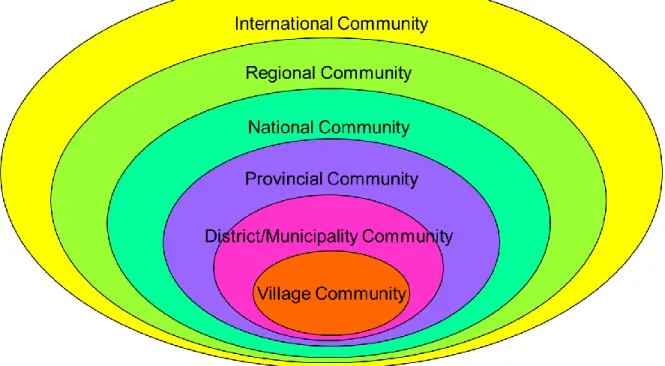
a relative aggregation where a social system is constructed by individuals and organizations acknowledged by a specific area, generally defined by administrative boundaries, and within this system, such organization, groups and individuals recognize themselves as being a member of the community. (Miyoshi, 2010, p. 7)
All these definitions imply there could be different levels of community. These are shown in figure 2.2 below. For the purpose of this research, the latter definition of community is adopted.
14
Figure 2.2 Level of Community
Note. Source: Miyoshi, 2011
2.2.2 Community Development
Development has turned its emphasis to involve participation of people at a local level. Community development has become an alternative development approach, and like the concept of decentralization, which poses emphasis on people‟s participation and development of their capacity. Community based strategies can be seen in Community-Based Forest Management approach where the management of forest resources and land is done by the local communities which offers them tangible benefits (Klooster & Masera, 2000).
15
The latest approach involving community‟s participation is the Sustainable Livelihoods Approach. The SL approach “places great emphasis on involving people in both the identification and the implementation of activities where appropriate” (Krantz, 2001, p. 2) and “brings attention to bear on the inherent potential of people in terms of their skills, social networks, access to physical and financial resources, and ability to influence core institutions” (Serrat, 2008, p. 1).
2.3 Community Capacity
Eade and Williams (1995, p. 9) state that “strengthening people‟s capacity to determine their own values and priorities, and to organize themselves to act on these, is the basis of development”. This statement shows the important of such capacity for the welfare of the society.
The concept of community capacity is defined as
the combined influence of a community‟s commitment, resources and skills that can be deployed to build on community strengths and address community problems and opportunities. (Aspen Institute, 1994)
the interaction of human capital, organizational resources and social capital existing within a given community that can be leveraged to solve collective problems and improve or maintain the well-being of that community. It may operate through informal social processes and/or organized efforts by individuals, organizations, and social networks that exist among them and between them and the larger systems of which the community is a part (Chaskin et al., 2001, p. 7)
16
a basic element that enables a community to function, and refers to the ability to achieve the community‟s shared goals through collective efforts of individuals and organizations, who are the community members, utilizing human organizational and social resources available within the community, as well as to promote and maintain the richness of the community. (Miyoshi, 2010, p. 7)
These definitions are extensive and focus on collective goals or problems by managing resources in and by the community. They identify community components or actors, characteristics and functions.
2.3.1 Characteristics
The four characteristics of community capacity are: sense of community, commitment, ability to set and achieve objectives, and ability to recognize and access resources which may exist to a differing degree in any community and may not possess every characteristic but still have capacity (Chaskin et al., 2001; Miyoshi & Stenning, 2008b).
Sense of community. This characteristic reflects the common shared values, norms and
visions, and sense of belonging of the community members. This can be described either in affective or instrumental terms, i.e. working together to solve a problem or support a common good (Chaskin et al., 2001). It has been displayed through shared myths, symbols, rituals, ceremonies, language, dress and customs (McMillan & George, 1986, pp. 10–11). Sense of community is not sufficient on its own to create community capacity; it must be joined by other characteristics such as commitment or access to resources.
17
Commitment. It means taking responsibility of what happens in the community.
Community members must see themselves as stakeholders in the collective well-being of the community and they should be willing to act as such (Chaskin et al., 2001). This definition sees two aspects of commitment, awareness of each person as an indirect or direct stakeholders and their actual participation in collective activities.
Ability to set and achieve objectives. This characteristic was changed from “ability to
solve problems” identified by Chaskin et al (2001) by Miyoshi and Stenning (2008b) to avoid a negative denotation. This characteristic allows flexibility to continuous change, such as new challenges, and also involves more collective decision making in the absence of influential individuals (Chaskin et al., 2001).
Ability to recognize and access to resources. This characteristic is modified by adding the
word “recognize” by Miyoshi and Stenning (2008b). By resources, it means resources within and beyond the community so it means creating links with larger social and political systems. Small communities exist within the larger socioeconomic systems and their well-being depends largely on their access to the policy made and implemented outside their border. The resources within communities consist of knowledge and skills of individual residents, commitment and skills of community groups, facilities, and services of local institutions. Resources can be any kind: economic, human, physical, and political (Chaskin et al., 2001).
18
The components of the community refer to the stakeholders or agents in and outside the community which hold a link with it and through which capacity can be engaged or enhanced (Chaskin et al., 2001). “The community components, their characteristics and functions should not be simplified into … linear, one-way or easily categorized inter-relationships, as reality is not that straightforward” (Miyoshi & Stenning, 2008b, p. 22).
Human resources. Chaskin (2001) identifies human resources as individual community
members with human capital – the skills, resources, and knowledge of individual residents and their participation in community-improving activities. In other words, individuals who are the best at what they do and use their skills in favor of the community. When these individual members become agents of change or mobilize others and catalyze action using their human capital they become leaders (Chaskin et al., 2001).
Leadership. Leaders are agents of change (Chaskin et al., 2001). “Leadership is a kind of
work done to meet the needs of a social situation”, “leadership is not equivalent to office-holding or high prestige or authority or decision-making” and thirdly “leadership is dispensable” (Selznick, 1984, pp. 23–24). Chaskin et al. (2001) believe a leader can emerge from any of a number of places in a community and calls him the charismatic “informal” leader. This study covers both types of leadership: formal and informal.
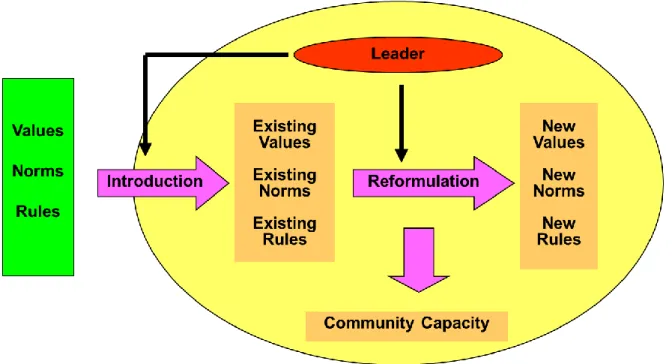
Figure 2.3 shows how leader changes the community‟s existing values, norms and rules, to create new ones by reformulating depending them and introducing new ones from outside. This process creates new goals and therefore community change, increasing community capacity.
19
Figure 2.3 Role of Leader in Community Change
Note. Source. Miyoshi, 2011
Organization. Organizations are collective bodies of a community (Chaskin et al., 2001).
As leadership, these can be formal (governmental, non-governmental, private, social organizations) or informal (church groups, dancing groups) and connect to larger systems, within and beyond the community as appropriate (Chaskin et al., 2001). Their capacity is measured beyond simple accounting services or goods provided, but also incorporate constituent representation, political influence and ability to collaborate with one another (Glickman and Servon, 1998 as mentioned in Chaskin et al, 2001).
For the purpose of this study, only organizations created within the limits of the community are considered in this type of component.
20
Social Capital and Networks. This component includes all networks among community
members and between them, and entities beyond the community boundaries, among individuals, informal groups, and formal organizations (Chaskin et al., 2001; Miyoshi & Stenning, 2008b).
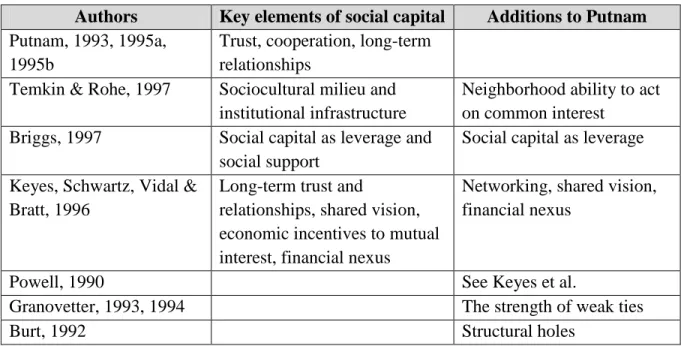
Social capital has been largely discussed in the context of community development (Chaskin et al., 2001; Gittell & Vidal, 1998). It is defined as “the features of social organization, such as trust, norms and networks, that can improve efficiency of society by facilitating coordinated action” (Putnam, 1993, p. 167), as “resources embedded in a social structure which are accessed and/or mobilized in purposive actions” (Lin, Cook, & Burt, 2001, p. 12), and as “networks and norms that enable participants to act together effectively to pursue shared objectives” (Gittell & Vidal, 1998, p. 15). The basic elements seen in these definitions are the existence of elements (networks) that can be used to produce action.
Gittel and Vidal (1998) describe the evolution of the key elements of social capital according to different actors taking the work of Putnam (1993) as a departure point as shown in Table 2.1.
21
Table 2.1 Key Elements of Social Capital
Authors Key elements of social capital Additions to Putnam
Putnam, 1993, 1995a, 1995b
Trust, cooperation, long-term relationships
Temkin & Rohe, 1997 Sociocultural milieu and institutional infrastructure
Neighborhood ability to act on common interest
Briggs, 1997 Social capital as leverage and social support
Social capital as leverage Keyes, Schwartz, Vidal &
Bratt, 1996
Long-term trust and
relationships, shared vision, economic incentives to mutual interest, financial nexus
Networking, shared vision, financial nexus
Powell, 1990 See Keyes et al.
Granovetter, 1993, 1994 The strength of weak ties
Burt, 1992 Structural holes
Note. Source: Gittel & Vidal, 1998, p. 16
Putnam (2000) later identified two types of social capital: bonding, closed networks within the community, who already know each other; and bridging, network to access external resources, among people who previously did not know each other. These two types of collective activities have been discussed and refined by other authors.
Temkin and Rohe (1998) introduce sociocultural milieu as the sense of attachment to their community among residents (bonding), and institutional infrastructure is the level and quality of the community to act on their common interest making external connections (bridging). Granovetter (1973) discussed “weak ties” as a more effective method to reach a larger number of people than strong ties, indispensable to individuals‟ opportunities and to their integration into communities, and an important resource in making possible mobility opportunity (bridging). Burt (1995) called the gaps between non-redundant contacts
22
“structural holes” and suggested that these should be filled by the community people to their own benefit to serve a collective good (bridging).
These two types of social capital are crucial for this study as I make a strong inference that the both separately are embedded within different types of collective activities with different types of collective goals which influence community capacity differently.
The focus of this study shall not confused with discussed the network and types of social capital of the community. It is rather to discuss the new type of collective activities that were created as a result of the process of networking stated above.
2.4 Collective activities
Collective activities have been discussed as part of different community development strategies: Onpaku approach, where new community based business activities are promoted in the community by the implementing organization through providing incentives for activities and presenting venues and opportunities to realize collective activities and such program plans and development are based on the activities of pre-existing activities in the community (Miyoshi, 2010, p. 35; Miyoshi & Ishimaru, 2010); and Centipede Agriculture of the city of Oyama, where in case some farmer was falling out, adjustments were made so that the leader and followers could coexist (Miyoshi, 2010, p. 33).
They have been discussed as an essential feature for community organizing strategy for community capacity building, which brings people together and seeks sustained
23
engagement of community members in collective action around issues important to them (Chaskin et al., 2001, pp. 93–122).
Chaskin (2001, p11) identified collective activities as one of the common factors of the definitions of many authors on community capacity, as well as a need of a platform to engage in them. But what are these activities and how do people engage in such have barely been discussed. It is to note that many communities do not have large segments of residents working for a collective good, sometimes they have a small group of residents which is consistent and active (Chaskin et al., 2001, p. 121).
The platforms to engage in collective activities are essential and usually provided by the implementing organization. It serves as a space where even individuals that are motivated by their own benefit, work with other similar individuals that otherwise would not collaborate with, i.e. a marketplace, a festival venue or taking the Onpaku example, a venue for programs. This system of platforms makes collaboration and collective activities easier since the individual or groups can simply contact the implementing organization or go directly to the place to do their activities.
I will attempt to interpret such discussions and theorize on what are collective activities and how do they manifest in the community through the findings of this thesis. Since collective action is born as people come together and work towards a collective goal, the understanding of such goal is important to understanding the types of collective activities. Analyzing the discussions mentioned at the beginning of this section I have come up with a vague classification of them.
24
People gather and work together because it is important to them, it is a custom, a habit, or tradition, part of their culture, of themselves or to preserve their lifestyle: such actions can include going to church, school, planning festivals every year, doing religious processions, harvesting, etc. These collective actions are done among the members of within the community and usually rely on strong bonds of the community members. A strong sense of community is potentially built through this since through engaging in them they share common values and strengthen their identity.
The second goal is to promote a better livelihood in the community, to promote development, knowledge, skills, new techniques, and new values. These activities have been broadly discussed and analyzed by many researchers such as the studies mentioned in the first part of this section. These activities are characterized by the influence of a third party from beyond or within the community, who organize groups of members of the community and engage on new collective enterprises for the collective good of the community. These activities rely on building new bridges among members within and beyond the community.
This thesis will attempt to exemplify and support these arguments by discussing the findings of how both are needed to increase community capacity and develop more sophisticated community policy structure.
2.5 Community Change
Community change refers to the end outcome of the community policy, localized from the explanation that “end outcomes signify the eventual change in society due to a certain
25
activity or process” (Miyoshi, 2010; Miyoshi & Stenning, 2008b). For the purpose of this study, such change is relevant only if it concerns community capacity development. For such purpose, the Community Capacity Development and Policy Structure Model is used as a theoretical framework, as shown in figure 2.4.
The model shows that “as the community develops or upgrades its capacity, the community will naturally transfer to or select a new and more sophisticated or value-added policy structure” (Miyoshi & Stenning, 2008b, p. 42). This study will emphasize this more value added policy structure as a result of community capacity building through collective activities.
26
Figure 2.4 Community Capacity Development and Policy Structure Model
Note. Source: Miyoshi, 2011
2.6 Analytical Framework
Analytic frames constitute ways of seeing an idea (Ragin, 1994, p. 61); it guides the researcher on how to answer the research question usually based on a theory or pool of ideas. Figure 2.5 introduces the theoretical framework developed in accordance to this thesis main question: “how the community capacity of the indigenous community of Tamaletom built?” It was formulated in the course of the research mainly based on the theoretical framework of Community Capacity Building and Policy Structure Model and other concepts introduced in this chapter.
27
This framework highlights the importance of historical context and decentralization policies which will be discussed and clarified in chapter 4 of this thesis. The activities which are part of the community policy structure are divided into Traditional Collective Activities (TCA) and Community oriented Collective Activities (CCA) based on the findings of this thesis and will be discussed in chapter 5. I will also argue how these activities build specific characteristics of community capacity. The framework also suggests that interaction of the community‟s external network or external parties, with the internal social agents, mainly leaders and community groups, has an impact on the community policy structure and capacity. The impact of the external network and development policies will be discussed in chapter 6 arguing that such impact created CCA and built community capacity indirectly; and the role of internal social agents of creating and engaging in more CCA using TCA through leadership and community groups will be discussed in chapter 7.
28
Figure 2.5 Tamaletom Community Capacity Building and Policy Structure Model Highlighting External Influence and
Collective Activities
External Parties
National and International agencies Localization Local initiatives National GovernmentState and Municipal Government Localization of policy Decentralized organisms
Tamaletom Community
Community Policy Structure Community Capacity
Outcomes (Community Change) Inputs Activities Outputs TCA CCA Intermediate End outcome Characteristics of community capacity Sense of community Commitment Ability to set objectives Ability to access resources Functions Planning Implementation Evaluation
Note. Source: Created by author based on Chaskin et. al. 2001, Miyoshi & Stenning, 2008a and interviews and observations
L eader sh ip Com m un it y gr oup s
29 CHAPTER 3 METHODOLOGY
This chapter will explain the methodology employed in the research of this work. It will start explaining the design of the research which is the plan followed to answer the research questions (Tripodi, 1981; Cooper & Schindler, 1998). The design reflects the philosophical worldview assumptions of the researcher, the strategy of inquiry, and the specific methods utilized for data collection (Creswell, 2009, p. 5).
The research methodology or paradigms that guided this research based on well-known traditional and modern schools of thought will be identified first. Based on the identified philosophical worldview assumptions of the researcher, the strategy of inquiry and analytical framework for this research are defined. After defining the research paradigm the chapters takes on a more practical sense explaining the method of selection of the research site, and the methods for data collection along with the details of how and when they were actually employed in the field. Finally some research limitations will be pointed out.
3.1 Philosophical worldview
This study is approached form a post-modernist paradigm. The worldview or paradigm is defined as a “basic set of beliefs that guide an action” (Guba, 1990, p. 17) as cited in (Butler-Kisber, 2010; Creswell, 2007).
The history of mankind has been divided in three eras which are characterized by three different ways of seeing reality or paradigms: the premodern (theological beliefs), modern
30
(scientific and objective), and postmodern (relative and constructed on personal realities) (Butler-Kisber, 2010; Raskin, 2002; Sexton, 1997). “Postmodernism rejects all truth claims, accepting there are multiple realities and no foundations for asserting the superiority of one interpretation over another.” (Rhodes, 1997, p. 184).
Creswell (2009) identifies four worldviews: postpositivism, constructivism, advocacy/participatory and pragmatism. Postpositivists seek to identify and assess causes that influence outcomes; constructivists seek to understand the contexts of worlds where individuals live and work in order to understand the historical and cultural settings; a researcher with advocacy/participatory worldview is concerned with providing voice to participants and raising their consciousness of the need to improve their lives; and pragmatists focus on the research problem and how to understand and solve it.
As a truly beginner researcher with no prior experience doing research, identifying the philosophical worldview I bring to the study was not an easy task but given this explanation, my worldview is mainly a mix of constructivism, as I developed close relationships with the participants and tried to get a detailed picture of the case; and advocacy/participatory since I explicitly advocated for the community and they somehow helped me shape and focus my research. This worldview is typically seen with a qualitative strategy of inquiry as explained in the next section of the chapter.
In addition to the paradigms adopted in this research, I used an adaptive approach. Mendis-Millard and Reed (2007, p. 547) explain that this approach allows the researcher to have a loose research design and be more flexible with the participant‟s needs and desires. It was
31
essential to take this approach since I was aiming at having a deep connection of trust with the participants.
3.2 Strategy of Enquiry
The individual researcher‟s worldviews shape the design of the research. In addition, Creswell (2009) suggests that the discipline area of the student and supervisor‟s worldview often shape the researcher‟s own “set of beliefs” (p. 6). As I stated before, I approach this research through a post-modernist, constructivist and participatory paradigm which points out to using qualitative inquiry. Figure 3.1 shows the relation of the evolution of eras of mankind and research approaches.
In addition, the people who engage in qualitative inquiry “support a way of looking at research that honors and inductive style, a focus on individual meaning and the importance of rendering a complexity of a situation” (Creswell, 2009, p. 4). Postmodern era is
Modern era Positivistic research
Postmodern era Qualitative research
Objective, external reality Constructed reality
Realist Critical Pragmatist Constructivist Relativist
realist
Figure 3.1 Qualitative Inquiry Continuum
32
somehow characterized by the emergence of qualitative research. Denzin and Lincoln (2005, as outlined in Butler-Kisber, 2010, p. 3) mapped out eight moments in qualitative research corresponding to the last two eras of mankind where qualitative research struggled to be accepted a legitimate for of study.
Below is Creswell definition of qualitative research:
Qualitative research is an inquiry process of understanding based on distinct methodological traditions of inquiry that explore a social or human problem. The researcher builds a complex, holistic picture, analyzes words, reports detailed views of informants, and conducts the study in a natural setting. (2007, p. 15)
Because of the natural setting and detailed explanations needed for conducting qualitative research it has also been called descriptive or naturalistic research among various other labels (Wolcott, 2009, p. 2).
A qualitative type of research suggests 5 different approaches to inquiry (Creswell, 2009). These are the narrative research, phenomenology, ethnographies, grounded theory studies and case study. Butler-Kisber (2010) classifies different inquiry approaches by form of typology: thematic, narrative and arts-formed inquiries. Depending on the author the names and classifications for qualitative inquiry varies. For the purpose of this research, the case study inquiry approach was selected and will be discussed below.
A case study is used when “how” or “why” question is being asked about a contemporary phenomenon in its real-life context, which the researcher has little or no control over (Yin, 1994, p. 9). It is not only a data collection method or a design feature alone but a holistic
33
research strategy that allows the researcher to make a deep investigation of a particular case, (Yin, 1994, p. 14) supporting existing theories and models and incorporating elements of grouded theory. A case study research can include single and multiple case studies and it is mainly used to explain, describe, illustrate, and evaluate cases which other strategies would leave unclear (Yin, 1994). This study adopts a descriptive case study approach focusing on a single case.
To select this case, I looked for a model case or the best example of collective action and endogenous development. I gave high importance to potential projects and usage of existing resources.
This case features an example of the appreciative inquiry apporach (AI) which hightens positive potential of a situation. The capacity of the leader to identify the strenghts and advanages of the community and the collective action of the members of the community groups towards a common vision that characterizes this case is similar to the principles of AI. This approach is different from the common problem-solving methodologies as it is based on the assumption that “every organization has something that works well and these strenghts can be the starting point for creating positive change” (Cooperrider, Whitney, Stavros & Fry, 2008, p.3). AI is a strength-based approach (Kimura & Kodama, 2008) and as such, it reflects the capacity of the leaders and community members to identify their potential resources and coordinate efforts towards change.
34
The first section of this chapter clarifies the postmodernist approach I take for conducting this research and the strategy of inquiry it entails. This section now goes into explaining the specific methods and instruments I used to collect primary data in the field or study site. It also clarifies how and when these methods were used and the participants in the research. Secondary data was gathered through books, journals, magazines, newspapers, videos, lecture notes, and training presentations, and referenced throughout this document.
3.3.1 Study site
The study site was defined very broadly based on my own interests on studying an indigenous community in Mexico as I had been advocating their rights and studied their issues as a graduate student. I also believed it could contribute to the theory as these types of communities had been barely studied. In August 2010, I went back to my hometown Tampico to refine the case for study and create contacts with academics and government officials knowledgeable on the topic.
I attended the annual XV Festival de la Huasteca1 held in my hometown. For 3 days, lecturers from 5 different states talked about tourism development cases in indigenous communities of the region and I took the chance formally introduced myself as a researcher from Ritsumeikan Asia Pacific University looking for a case I could use for my study. I decided to concentrate on the State of San Luis Potosi because of the high number of indigenous cases and closeness to my hometown but due to the lack of time and resources to visit the communities that time, I had to go back to Japan and look for a promising case
35
through information shared by the professor Mauricio Guzman of the Colegio de San Luis Potosí via e-mail.
In February 2011, I went back to Mexico to narrow the case down and conduct the fieldwork but unfortunately Professor Guzman was not available to help me. I struggled calling other people and meeting researchers from the Tecnologico de Monterrey who could help me and I finally received a positive answer from the Archeologist Guillermo Ahuja from the Cultural Center of the Huasteca Region of SLP in Ciudad Valles.
To select the case, I stayed in Ciudad Valles for 3 days. During that time I interviewed the archeologist and asked him which would be a good case from his point of view. He pointed me out to two communities: Huehuetlán and Tamaletom in Tancanhuitz; and suggested me to talk to historians and government officials from various municipalities and asked their opinion too. He took me to a meeting with them where I was again formally introduced and I could get some information. Then he took me to Huehuetlán and Tamaletom to meet the community leaders and hold interviews with them.
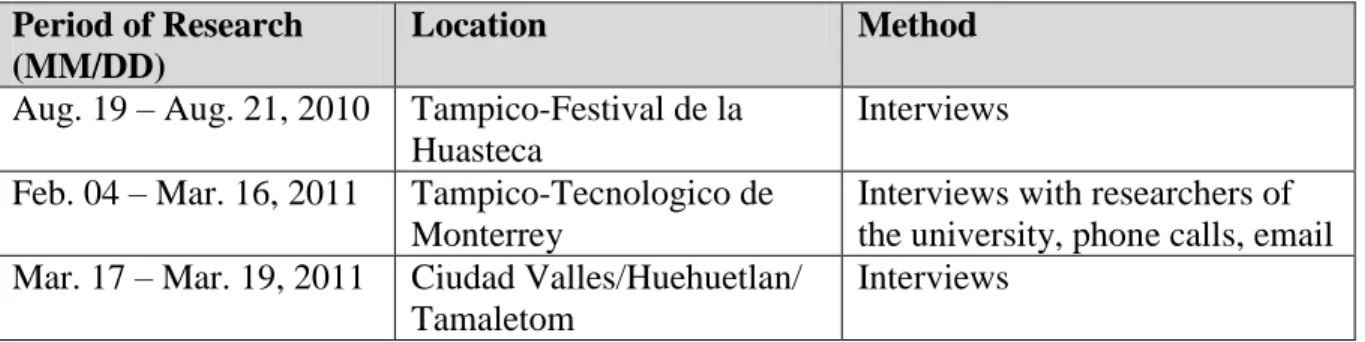
As a result of the interviews and observations of the communities, the Tamaletom case was selected and I asked the leader, Benigno Robles to support me receiving a positive answer. The first round of fieldwork for narrowing down the case is shown in table 3.1 below.
36
Table 3.1 Case Selection Schedule
Period of Research (MM/DD)
Location Method
Aug. 19 – Aug. 21, 2010 Tampico-Festival de la Huasteca
Interviews Feb. 04 – Mar. 16, 2011 Tampico-Tecnologico de
Monterrey
Interviews with researchers of the university, phone calls, email Mar. 17 – Mar. 19, 2011 Ciudad Valles/Huehuetlan/
Tamaletom
Interviews
The method for finding the research site was mainly based on the advice of my key informants who pointed me to other key informants. This is similar to the snowball sampling method used to recruit more research participants through the participant‟s network of acquaintances (Penrod, Preston, Cain, & Starks, 2003) and could be therefore labeled as such.
During the second round of fieldwork, I was allowed to reside in the house of Benigno, and he supported me and coordinated my interviews and visits to the community groups, government officials, and external organization representatives. He is the leader of the project of the Ceremonial Center of Tamaletom. In this case, Benigno, as well as the Ceremonial Center committee, became the main research focus and are placed as the center of community activities for their high community capacity and complex Collective Activities and therefore are the main focus in order to explain the development of community capacity. Other community activities and groups were also interviewed and discussed in this research in order to clarify and give a more detailed context of the whole range of Tamaletom‟s community activities and analyze their impact on community capacity.
37
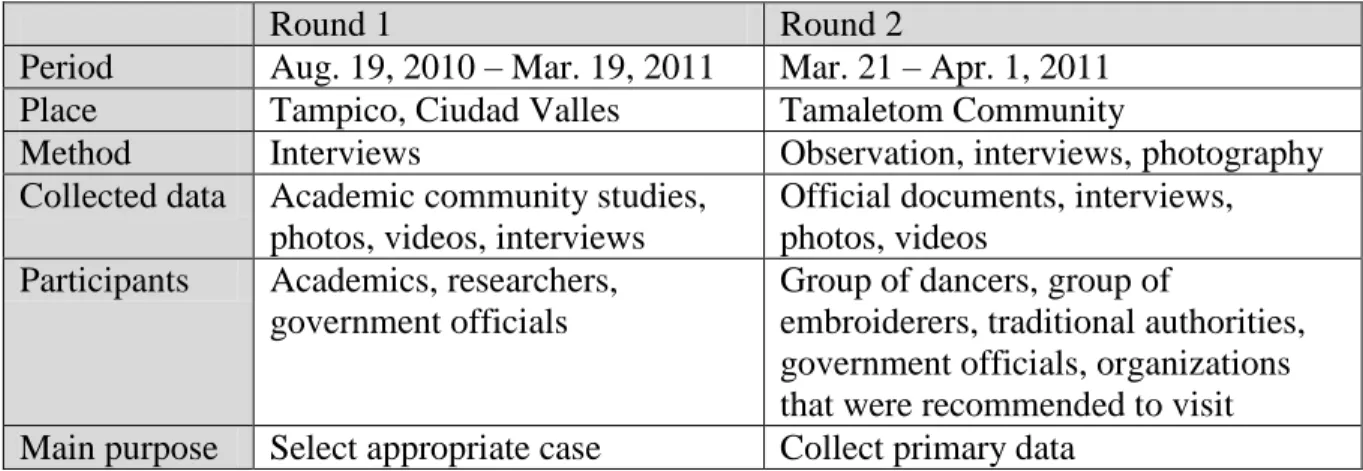
Table 3.2 shows the details of this second round of fieldwork.
Table 3.2 Fieldwork Details
Round 1 Round 2
Period Aug. 19, 2010 – Mar. 19, 2011 Mar. 21 – Apr. 1, 2011 Place Tampico, Ciudad Valles Tamaletom Community
Method Interviews Observation, interviews, photography
Collected data Academic community studies, photos, videos, interviews
Official documents, interviews, photos, videos
Participants Academics, researchers, government officials
Group of dancers, group of
embroiderers, traditional authorities, government officials, organizations that were recommended to visit Main purpose Select appropriate case Collect primary data
3.3.2 Participants
Snowball sampling was used utilizing Benigno‟s network to access the key informants in the community due to the difficulty to access the population due to its physical dispersion and lack of time for the community to grow used to my presence. It usually used in cases where the population is sensitive to the topic of research or where it is hidden (Penrod et al., 2003).
I was again referred to other key informant by the people I interviewed and I spent most of the time in the fieldwork walking in and around the community guided all the time by Benigno. I also interacted and discussed casually with members of the community and through this I learned about their opinions and points of views of their environment and everyday life.