年を重ねる毎にマイナス要因が増え、そうした障壁が高齢英語学習者の英語修得に大きな支障 をもたらしている。一方で、英語学習に興味を持つ高齢者数は年々増えている。そのような現状 を踏まえ、今後、高年齢者向け英語教育の研究は、必要不可欠になってくるであろう。本論文で は、こうした高年齢者に関して、なぜ英語教育が必要なのか、高年齢学習者特有の傾向と共通点 は何か、加齢による英語学習上のマイナス要因は何か、どのようにしてそれらを克服していった ら良いのかを考察しながら、高年齢者とって最も効果的な英語教育を見つけ出していく。考察に あたっては、E 英会話学校から得られたデータで現況を把握し、言語学者、老年学者の意見や学 習者本人及び現場の英語教師たちの経験談を参照しながら進めていった。結果、高年齢者の言語 教育においては、幼児や若者たちとは異なる教育方法や工夫が必要であることを発見した。しか し同年齢間でも個人差があることから、結論として、成功に導く英語修得には、年齢以外の要因 も大きく関わっていることが裏付けられた。
1. Introduction
Younger learners usually learn English much quicker than older ones. Infants especially show a great improvement in their English in a short period of time. It is astonishing to know that four year old children, who have been studying English for only eight months, can sing ‘Silent Night’ in English after a three-day-practice. It has already been proved by many people that children have endless potential abilities in learning language.
English Education for Older Learners
高年齢者の英語教育
MORI Yoko
森 容子
Data from http://memorva.jp/ranking/japan/soumu_population_2010.php On the other hand, older learners find it difficult to master English. It is clear that teaching those older learners is more difficult than teaching infants. Despite this fact, few books are seriously concerned with language education for older learners and if anything most books have not supported the older learners.
The word ‘older’ here is used in comparison with younger people. To be more precise, I mainly focus on people who are over forty, but also include late thirties in a broad sense.
This paper examines why English is needed by older people, what are the main difficulties for them to learn English, and how they can conquer those difficulties. Its final aim is to find out the most effective way of teaching the older learners.
There are three reasons why Studies of English teaching for older people is required more nowadays. The first reason is that the majority of the Japanese population at present is aged between thirty and seventy as shown in Graph 1 below. We, therefore, focus on these middle aged and older people.
[Graph 1]
Rationalization of housework, a decrease in the birthrate and the growth of their children, have given women over thirty more free time, which leads them to study something in order to carry out their future plan more effectively. They may try to get a
Data given by the public relations department of JATA
better job or they may plan to travel abroad. Graph 2 shows the composition ratio of overseas tourists in 2006 and 2011 by age group. Looking at the number of tourists by age group, the majority of tourists are the over thirties and forties. Comparing 2006 and 2011 the number of tourists in their forties and over sixties increased. Whatever their future plans are, English knowledge is more likely required due to the necessity of international communication.
[Graph 2]
Concerning men of over forty, they are supposed to take up a position of more responsibility in their company. Internationalization nowadays has increased the number of companies that deal with foreign companies, so they are more likely to have an opportunity to go abroad or to talk with foreigners as a representative. Consequently they are also required to master English.
The second reason lies in the necessity of mothers’ studies in order to bring up their children. Most mothers force their children to study very hard so as to win an examination battle or to cope with the excessive competition their children are faced with. As a result they put too much burden on their children’s shoulders. Under those circumstances mothers’ nags only encourage their children to feel unfairly treated and unhappy. What is
worse, it usually leads to a breakdown between parents and child. To avoid this problem, mothers themselves should set their sons and daughters good examples if they want their children to study. The remarks from a forty year old mother illustrate the suggestion mentioned above: “I try to find a time to study English, for at least two hours a day, however busy I am. My daughters have seen me studying like that ever since they can remember, so they themselves always study spontaneously. I’ve never asked my daughters to study.” That’s the reason why it is necessary for mothers to study. So which subject should they study? With the increase of infants learning English, the number of mothers who start to learn English is also increasing. They have started it in order to help their children with their English study outside the school. Studying together with their children brings them two benefits: One is to make a good and warm relationship between mother and child by studying the same subject. The other is to learn their own English more effectively and actively through teaching it to their own children.
The third reason is related to people over sixty. The success of universities for older generations confirms to us the importance of their study. Let us take an example from ‘Inamino Gakuen’ in Hyogo Prefecture which only accepts students of over sixty. When it first started, the number of candidates was so many that students had to be selected by lots and the school enrollment in 2010 is still one-thousand six hundred seventeen students, including fifty-one graduate students. This fact tells us that many old people have a strong desire to study. As a result of their study the following gains are reported:
(1) Gain of power and strength. The longer they study the younger they look and feel (2) Establishment of better relationships with family
(3) Reduction of complaints and no backbiting (4) Becoming more lively.
(5) Disappearance of emptiness and loneliness (6) Increase in their desire to study
Thus study plays a very important role for old people. Most of those old people are eager to learn new information and they show a great interest in world affairs and international communication. Considering that English words are adopted into our daily conversation nowadays, it is sensible for even the aged to study English in order to catch
up with others and enjoy their lives.
2. Older English Learners
2.1 Research on the Actual Situation
Judging from the information provided by English teachers and stuff at a certain English conversation school in Tokyo, we can conclude the following:
(1) The number of older students is more than what we would have expected. English learning is especially popular among the people in thirties. According to the staff of the school, the number of older students is increasing every year. An increasing number of English courses at many culture centers is further evidence for this point.
(2) The main motivation of male students lies in the need of English for their work.
(3) English is popular among wives. The majority of female students are housewives. Their main motivations are: 1) interest and a deep liking for English 2) overseas tours 3) gaining a job 4) necessity
(4) The reason why there are more female students than male ones in fifties is assumed to be that they have more free time due to their children’s marriage. Sixties is also the retiring age, which might send them to an English school. In other words, older people tend to start studying English when they are released from other duties in their lives. (5) The older people lose more easily their confidence to take up the challenge of new things.
In women this tendency is more pronounced.
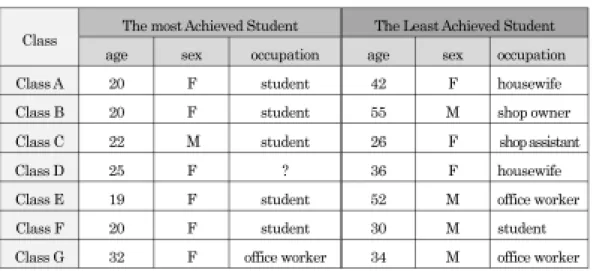
Next I would like to look at the individual students in the English conversation school. We can always find achieved students and less achieved students in every class.
Table 1 is the data on the age, sex, and occupation of the most achieved student and the least achieved student in seven mixed aged classes. Each class consists of approximately twelve students aged between eighteen and fifty. All of them are one year conversation courses for beginners. An oral approach is mainly used as a teaching method. This table shows that six out of seven of ‘the least achieved students’ are over thirty years old while six out of seven of ‘the most achieved students’ are under thirty years old. This
[Table 1]
discovery matches the English teachers observation in their classes: Young students are more likely to improve their English by the end of term, whereas the older ones are usually struggling in their English study to the end.
Table 2 shows the data of the actual conditions of twenty older students obtained by ten experienced English teachers who have taught beginners. The question items from 1) to 11) on the horizontal line are 1) age 2) sex 3) occupation 4) English level 5) quickness of response 6) knowledge of grammar 7) pronunciation 8) best order of four skills (R-Reading, W-Writing, S-Speaking, L-Listening) 9) improvement for one year 10) verbal memory 11) diligence. Each item except 8) is labeled A, B, C in descending order of excellence.
We can find the following tendencies about older students with the help of this table: (1) They cannot respond immediately, namely it takes time for them to answer the
questions in English.
(2) They have problems with pronunciation.
(3) It is difficult to memorize phrases and vocabulary. They need more time to memorize or recite English.
(4) Although they are very diligent their improvement is slow. (5) Their speaking ability is as weak as their listening ability.
[Table 2]
(6) They have fewer problems with reading. (7) Most of them know grammar quite well.
Except for (6) and (7), those tendencies mentioned above are disadvantages for language learners. Although (6) and (7) apparently seem to be favorable tendencies, they cannot always be regarded as strong points, for even if they can read English smoothly, we cannot consider them as excellent readers without correct pronunciation. Also, even if we know grammar well, it is useless unless we can use it freely in our communication. Consequently Table 2 proves to us that it is difficult for older learners to learn English.
However, those tendencies are also common to most of the Japanese learners who are
learning English. To make the age-related difference among Japanese English learners clearer, the study of gerontology and linguistics may be helpful.
2.2 Difficulties in Teaching Older Learners
In the study of gerontology, the following characteristics about the old have been reported: Firstly, there is a marked declined in intelligence. It is said that intellectual capacity grows until twelve years old and thereafter it decreases or stops. This fact has been already proved by many scholars such as Foster J.C., Taylor R.W., Beeson M.F., Yerkes R.M., Willoughby R.R., Jones H.E., Conrad H.S., Miles C.C. etc. Secondly, they become slow in their movement. Thirdly, there is a marked decline in memory. Compared with the achievement of elementary school students, it would take five years for old people to catch up with the children who study the same subject for one year. It is reported that memory generally improves remarkably up to fourteen years old and at about nineteen years old it begins to decline. Older people have great difficulties in memorizing new techniques and vocabulary. Concerning knowledge accumulated from their childhood, they can remember this quite easily. Thus findings in gerontology agree with the result of the data in Table 2. In addition to the above mentioned factors, timidity is also raised as a universal characteristic of the old.
Next come the views of linguists and experienced language teachers. They especially emphasize the difficulty of learning pronunciation in growing older. Recently many scholars support the assumption that unless we learn it up to fourteen years old, it is impossible to master pronunciation completely. On the other hand, Nakatsu R. presents a different view on this matter. Her opinion is as follows: People master pronunciation easily before puberty. The age between thirteen and eighteen is considered as its golden age. Regarding adults, it takes much more time to master pronunciation, but it might be possible to correct their pronunciation up to the age range of thirty-forty years old. Although the possibility of mastering pronunciation is extended up to forty years old, she also has a negative view on learners of over forty.
Then let us work out why it is difficult for older learners to master pronunciation. That is connected with the following tendencies seen in growing older:
(1) With the acquisition of the sound pattern of our mother tongue, the need for close auditory discrimination ability is reduced and the ability itself declines.
(2) As we grow older we pay more attention to what we say, and less to the phonetic detail of how we actually say it, which we increasingly take for granted.
(3) The majority of older learners lose the power of mimicry.
(4) They become unwilling to make unfamiliar sounds, or to run the risk of committing errors of performance, in front of other people.
(5) They are likely to become increasingly dominated by the written form of language, rather than by speech.
These arguments from the linguistic point of view are consistent with (2), (3), (5), and (6) of the older learners tendencies found in Table 2.
Adding to difficulties in pronunciation, it is also pointed out by Sato M. who is one of the language teachers, that it is very inefficient to give older learners remedial training on pronunciation because of too much interference. (The English Journal of English Teaching, December 1981, p.11)
Unifying the findings gained by referring to the three sources of information from English teachers, gerontology and linguistics, we can pick out five principal characteristics of older learners, which lead to the difficulties in learning English:
(1) Reduced power of memory (2) Slowdown of movement (reaction) (3) Difficulties in pronunciation
(4) Greater reliance on writing (i.e. Weakness in English as an active language) (5) Increased shyness (Timidity)
Thus it has been proved that older learners have great difficulty in learning English. As a natural result, most teachers find it difficult to teach older learners.
2.3 Common Elements of Successful Older Learners
As we have seen so far, older learners have many disadvantages in learning English. So is it impossible for them to master English? No, there are some people who have succeeded in mastering English despite their age barriers. The most interesting example
here is drawn from Mr. K. He is a doctor of ninety two years old. He has been studying English at a language school for three years. He started from an Introductory level at the age of eighty nine and he is in the Intermediate class now. In fact his improvement is going down in proportion as he reaches a higher level, but his speaking skill has been progressing since he became an Intermediate student. It would be helpful to introduce his personal history in order to find out the key to his success in English: It was about eighty years ago that he started learning English. He had studied English for three years at school under a grammar translation method. The lesson was held for one hour a week and mainly reading and writing were taught. They had a native English teacher at the school for one year. After graduation he stopped studying English. When he became a university student he studied how to read and write German. Then he practiced medicine till seventy years old when he suddenly decided to be a ship’s doctor. He needed English to communicate with foreigners on the ship, so he studied English again with books by himself. He read English books every day. At first he had to look up at least twenty words in the dictionary in order to read one page, but four years later the number of words he looked up in the dictionary had become about ten. He had worked on the ship for ten years. Considering his age he looks very young once he starts talking: He speaks very clearly. He remembers very clearly details of his experiences. He has a good memory. He has a good knowledge of English. He is talkative, active, and diligent. When the interview was given to him in English, he could carry on his English conversation without any difficulties although he was sometimes stuck for a word. Concerning Mr. K, his reading ability is the best of all, next comes writing ability, followed by speaking and listening ability comes last. In fact, during the interview he sometimes asked the interviewer to repeat the question or he sometimes gave inconsistent answers. Regarding pronunciation, the ‘th’ sound tends to change into ‘s’ in conversation, but in a reading passage it is pronounced properly. In the judgment of a native speaker of English, his pronunciation in reading English passages has no problems and it has a European accent rather than a Japanese one. In remembering the old learners’ main difficulties which we have found so far, the principal characteristics of older learners of (1), (2), and (5) mentioned in section 2.2 do not apply in his case. This is presumed to be one of the reasons why he could make progress in English in spite of old
age. It is quite unusual case for a man of ninety two years old to keep a good memory, but this can also be explained by two findings of gerontology, that age does not dim one’s accumulated memory and constant study and work prevents the old from developing the symptoms of senility. In other words, his past experience of learning a foreign language and his industrious attitude toward study, continued from his childhood, came in handy when he started to learn English again at the age of eighty nine.
Common factors in their characters and attitudes can also be extracted from twenty other successful older students in Table 2. The following are the essential elements for older learners to succeed in their English study:
(1) Enthusiasm: With this they can carry on their studies despite many difficulties.
(2) Diligence: As age increases one needs more time to memorize, so the success of learning lies in how much time they spend on it.
(3) Degree of English Need: Among those students seven students need English for their work. English needed for enjoyment is also a strong element. Miss W studied English at the age of fifty five to stay in America and in the case of Mr. I (45 years old), he wants to visit his daughter who is staying in America. The reason why more talkative and sociable learners can improve their English also fits into this case, that is, they like to use English as a tool for communication in order to enjoy their life with large numbers of acquaintances. Those people often study or know other foreign languages too. ‘Necessity is the Key to Improvement’ is also proved in history. People whose countries used to be English colonies can speak English fluently. This is because they once needed English in order to live. Around tourist spots in some countries foreign tourists often see local children selling souvenirs on the street and surprisingly those children can speak English very fluently even though they do not get enough education. On the whole, the stronger the need for English is, the more possibility people have of improving their English. Also the sooner mastery of English is required, the quicker they learn it. We can see this example in the case of Mr. S (age 42) who has to go to America on official business within four months.
(4) Past Language Experience: There are some similar rules in learning foreign languages. To master one foreign language, therefore, is a great help to our confidence when we
learn another language. This applies in the case of Mrs. Lomb K., who is the author of
Igy Tanulok Nyelveket (How Did I Master Foreign Languages) and made it possible to
master sixteen foreign languages. It is also said by Thorndike that “if the new stimulus is similar to the stimulus which has been experienced before, we can easily react to this new stimulus.”
(5) The Length of Brain Work Involved: According to the study of gerontology, it has been proved that people who had more opportunities to use their brains in their work had less phenomena of aging. Also it has come out that women show this phenomenon of aging more distinctively than men with the increase of age. The reason lies in the fact that women have less opportunity to receive vocational training and education.
Thus it is evidenced that the difficulties in learning English are not always caused by chronological age. The phenomena of aging depend on the individual. Therefore it is possible for older learners to master English by the development of the brain, constant effort and strong motivation.
3. Teaching Method for Older learners
3.1 Before Teaching Older Learners
Although we have discovered the fact that development of the brain, constant effort, and strong motivation are the elements for successful older learners, most of older learners are unlikely to have those elements. Moreover, they have a common national character as Japanese which often becomes a serious obstacle to progress in learning English: They are passive in every aspect. The traditional Japanese educational system has created many people who do not know how to express themselves under the belief that ‘silence is a virtue’. Mr. Reischauer, who was former ambassador in Japan, also pointed out that the Japanese tend to have poor self-expression. However, the culture and the habit of English speaking countries is the opposite. Different from Japan, words as a communication tool are more important in an English speaking country in which many different races live together. They cannot survive unless they have eloquence. To master English, we cannot neglect this
cultural difference between Japan and English speaking countries. Japanese students are most likely to answer with only the simple word ‘Yes’ or ‘No’ and no more when they are asked questions in English. There is no way of improving English without practice, that is, speaking as much as possible. Thus Japanese learners should know that ‘silence is NOT a virtue’.
In England we can meet many Japanese who have been there for a few years, but still cannot speak English well. The length of time in a foreign country is not the point. The important point is how much time they use their spare time to practice the language. There is the very instructive narrative of Edith Hanson’s personal experience of learning Japanese: Whenever English words came into her head, she replaced them with Japanese. She kept a cat at home and always spoke to her in Japanese. She always carried a dictionary with her. This is just one example. All the successful learners made a great effort with an ‘active attitude’ like this.
However, older learners usually have a tendency to depend on teachers so much that they neglect those discretionary efforts. As it is impossible for older learners to master English without those active attitudes, language teachers should firmly convince their older students of its importance before they start teaching.
3.2 Solution for Memory Decline
Now let us solve their problems one by one and find an effective teaching method for older learners. To make up for the barrier of memory decline, it is important to relieve their memory load, so it is better not to teach too much English at a time. There are endless English words and phrases to learn. There are also many exceptions in English. It seems almost impossible for older learners to memorize all of them. It is not a good idea to teach English sentences or phrases from the very beginning because they have to learn pronunciation, vocabulary, and grammar all at once, which is too much for them to memorize. It is, therefore, suggested that teachers should start with phonemes first, then vocabularies and to teach sentences last after students get used to the sounds of those unfamiliar languages. In this case it is also important to make sure that students understand the previous lessons completely before moving on to the next step. The finding
that ‘the most advantageous learning condition for the older learner is to make use of their accumulated language habit’ gives us the idea that it is more effective to use Japanese language to deepen their understanding. This is proved by many English teachers.
Let us take an example of Mr. Y. He is a coffee shop owner of fifty six years old. Four years ago, he started to learn English at an English school as a complete beginner. It was a two-hour-lesson held twice a week. For the first three years English had been taught to him by an Oral Approach and the S-R (Stimulus-Response) Theory of B. F. Skinner’s Behaviorist Psychology as a teaching method. Based on this theory, English was used in the classroom for every aspect of the work and grammar was taught by pattern practice. Four textbooks used at the school were carefully chosen with the following aims.
(1) To develop listening comprehension and reading ability on a short passage (2) To make a picture composition
(3) To manage a controlled conversation
(4) To understand grammar in the following order: i) presentation ii) substitution drill iii) conversion drill iv) guided response v) free response drill
He is a diligent student and his attendance for three years was very good. Nevertheless this teaching method did not seem to be effective for him. Although he seemed to be very familiar with English, his English was still poor and he made numerous grammatical mistakes. For example, “What is this a your camera?”, “That’s are door.” (It is assumed that he took ‘are’ for ‘a’ since he learned it by ear.) and “Yes, I do.” in answer to the question “Is your hobby collecting stamps?” Then one year ago he decided to have a private English lesson for two hours a week. In his private lesson, a Grammar Translation Method was adopted and he also had exercises for English composition by permutating Japanese sentences with English sentence patterns. The main aim for teaching him this time was to master the complete rules of English. In his case, Japanese had infiltrated into his mind too deeply to remove. Moreover, he had a very poor memory. In order to conquer these disadvantages a Spiral Technique (repeating the same items at several calculated intervals) was used and all the explanation were done using Japanese language. Also, to make the memory of new words clear, dictation was added. The following is the test score before and after having one-year private English lessons.
[Table 3]
★ figure in parentheses is full marks
The above result shows that his listening ability was not improved at all, but the other abilities were significantly improved. In fact he could make a better English conversation than before. Thus, in the case of Mr. Y, it has been shown that the use of the Grammar Translation Method and Japanese language in teaching was very helpful for him in understanding English.
Another interesting experiment was made upon Mrs. S. She is a housewife of forty one years. She had been studying English for one week when the experiment was given. She was given seventy basic English words to memorize. Firstly, these words were given without any hints and secondly with some hints to help her memorize. As a result, she could recall words with hints much quicker than without them. According to the findings of gerontologists, older people are unlikely to find a clue by themselves to help recall, so they need the teachers’ help to reproduce the words. Four kinds of clue were given to her: a) Japanese words related to the English sound and the Japanese meaning, i.e. ‘ji(words) wo hiku(check) sho(book) nari’ (the book to check the words) for ‘dictionary’ b) spelling: It is said that we can retain our memory longer when we make good use of our five senses, so writing and pronouncing the words are useful in helping us memorize well. c) picture: G.D. M. (Graded Direct Method) is based on the visualization of English words. d) a sentence including the word. Among these four kinds of clue their efficiency was found to be in the following order: a)→ d) → c) → b) In her case, again, using Japanese as her mother tongue was proved to be very useful. Thus use of the Japanese language seems to have the greatest influence on older learners.
Tanabe T. mentions in his book Nande Eigo Yaruno? (Why do we learn foreign languages?), that “since our mother tongue has been acquired in connection with our experience and a long term accumulation of the words, it is closely tied in with people’s
thinking and feeling.” This is the reason why it has not been successful to teach older learners English using the Direct Method or Oral Method, whereas children learn their mother tongue naturally by this method. He continues his argument with the terms of ‘parole’ and ‘langue’ used by Saussure: “In studying a foreign language, it is natural to start with ‘langue’ while acquisition of mother tongue was started with ‘parole’. Thus, to study foreign languages is to build up another language system on the mother language and the new language system is named ‘meta-langue’.” In his opinion, people cannot escape from the habit of their mother tongue until they learn the secondary language habit through constant effort. If it is true, it is presumed to be impossible for adult learners to think in English from the beginning. Many scholars have supported the argument that students should think in the target language. This argument might apply to Europeans who study English or to children who haven’t yet formed their primary thinking in their mother tongue, but with regard to older learners, it is assumed to be too great a burden to control many articles (i.e. grammar, new words, thinking way) all at once. Moreover, we have to bear in mind that older learners have a poorer memory.
There are some other ways to make up for poor memory: (1) Frequent repetition (2) An active attitude: Active use of the dictionary, active use of the new words in actual situations, etc. (3) Selection of the materials to memorize: It is more effective to choose materials which a learner is interested in. (4) Good use of a learn-while-sleeping method: The idea comes from the theory that memory is entrenched during our sleep. This method has been proved to work in many successful cases, but on the other hands there are quite a few objections to it as well.
3.3 Solution for Slow Reaction Velocity
This disadvantage becomes a serious problem when older learners study together with younger learners. Thinking back to Mr. Y., it is considered to be one of the reasons why he could not improve his English even though he had attended the English class for three years. In the class teachers are likely to keep pace with the level of the majority of the class. As a consequence, slow learners are often ignored. The same was true in Mr. Y’s case. Lessons were carried on from one step to another without waiting for his full
understanding. Therefore, it is sensible for older learners to learn English with the same age group or alone.
Older learners cannot make a quick response, either. As long as their answer is right, this is not as big a problem as in the case of slow learners and all they should do to solve this problem is to do their best to reach the domain of ‘meta-langue’ by frequent practice.
3.4 In order to conquer a pronunciation problem
Good pronunciation is far more important than what we have considered so far and difficulty in pronunciation seems to be a big disadvantage. As mentioned before, since older learners tend to pay less attention to the phonetic details, a teacher should make the older learners realize how important phonetic details are.
The sounds of the Japanese language are made by chest breathing while English sounds are produced by abdominal breathing. That difference mainly causes the difficulties when Japanese people pronounce English. If we want to pronounce English words properly, we must, therefore, learn a new breathing system first of all, but it has been said to be impossible for the old to master this breathing system.
Yet there is a little compromise that can be made here to conquer their pronunciation problem. As for pronunciation, the following are the minimum they should learn to make a success of communication in English:
(1) Unfamiliar English sounds for Japanese
The sounds such as /v/, /f/, /r/, /æ/, /!:/ and the voiced or unvoiced sound of [th] are unfamiliar for Japanese. We often pronounce /b/ for /v/, /h/ for /f/, /l/ for /r/, and /"/and/#/ for [th] sounds of “Think about this”. The wrong use of those phonemes often changes the meaning of the words, hence much practice is needed concerning these phonemes. (2) Sounds distorted in certain environments in Japan
As a letter notation for worldwide understanding, we have transliterated Japanese into Latin character, ‘Romaji’. ‘Romaji’ is spelled out in accord with Japanese pronunciation which is quite different from some English ones. The Japanese sound of [si], [ti], [tu], [hu], [zi], [di], [du] are not found in English. When we pronounce English we are greatly influenced by these Romanized Japanese. For instance, short and long /i/ is
confused, /i/ is palatalized, aspirate approximates to sibilant and “he” and “she” become indistinguishable. /u/ has no lip-rounding. For Japanese there is no difference between /i!/ for “east” and /ji!/ for “yeast”. Initial “w” omitted, or rendered as glottal stop.
(3) Intonation and stress
English is a stress-timed language while Japanese is a syllable-timed one. There are no such things as pitch or stress in Japanese. Intensification is used for emphasis. Therefore all intonation patterns will be a big difficulty for Japanese, and should be practiced extensively by many different methods.
3.5 Concerning a problem of their greater reliance on writing
Instead of considering this tendency as a disadvantage, it is useful for teachers to make the most of this tendency in teaching. In other words, when teachers introduce new English words or sentences to those older learners, dictation of what they are listening to is often a powerful strategy to get them to inscribe the words in their memory.
3.6 In order to cope with increased shyness of older learners Lomb K. introduces the following equation in her book.
Time consumed + Motivation
= Result Shyness
The above equation tells us ‘the factors to master foreign language most effectively’ and in this formula shyness is also considered as a barrier to learning a foreign language. In general, it has been well-known that women can improve their English more quickly than men. That is because women have less shyness and more desire to communicate with people. According to a certain linguist, adults tend to writhe with shame when they cannot express the content at a level equivalent to their mental maturity.
Shyness is a psychological phenomenon, so we might not be able to get rid of it. However a teacher can at least provide a friendly atmosphere in his/her classroom lest older learners should feel too much tension during a lesson. A teacher is, therefore, required to devise more enjoyable presentations in the classroom like an entertainer. To do
so, it might be effective to use visual aids, pantomime, actual objects and so on. It is also important to select material suitable to the students’ needs and interests. Additionally, a teacher should remind older learners how important an active attitude and much verbal expression are for their English study. It is also important for teachers to give them confidence. According to findings in gerontology, praise encourages older people more than blame. Therefore teachers should try to encourage students with praise.
Like Edith Hanson, as mentioned before, it might also be a good idea to practice English with pets so that learners will not feel ashamed even if they make mistakes.
4. Difference Way of Thinking
We have come to the conclusion that the influence of the mother tongue, Japanese, is inevitable for older learners to learn English. It means the Japanese language is necessary to help older learners clarify what they are learning. However it is the Japanese language that we need, but not the Japanese way of thinking. Learners must bear in mind that all languages are closely tied in with people’s thinking and feeling as Tanabe T. mentioned and the way of expression is based on the culture, which differs from country to country. Therefore, if we want to have a conversation with foreign words, we cannot neglect this matter. That is, we cannot have smooth communication unless we change into the way of thinking of native speakers of English. The other reason why learning English is so difficult for older learners lies in their mind which is not flexible enough to switch over their channel of ‘thinking’. Here is an example: Japanese are most likely to translate their Japanese into the sentence like “There is nothing to eat, but please eat.” when they invite their friends in their house, but it is a completely contradictory concept for native speakers of English. Matsumoto M. also claims that Japanese should learn the logic threaded through English, in his book Kangaeru Eigo (English through Thinking). He also suggests that Japanese should try to approach the English way of thinking by comparing it with the Japanese way of thinking. However, since the buildup of mindset of older learners filters so deeply into their mind, the only the way for them to master a new way of conceiving is to
be aware of the differences of culture which relate most significantly to smooth English communication and to get accustomed to English through much practice. And it is a teacher who shows them the importance of switching over their way of thinking.
5. Conclusion
One of the interesting discoveries through writing this paper is that the starting age of our diminishing memory, reported by gerontologists, is in accord with the age, assumed by linguists, at which our ability to master foreign pronunciation becomes limited. This shows that memory is closely bound up with language learning, which supports the main reason why older learners find it so difficult to learn English. To relieve their memory load, therefore, would be the most effective way of teaching older learners. The use of Japanese language in introducing new items of English knowledge is one of the devices for this. They need the help of Japanese language, but the Japanese way of thinking should be avoided. It impedes smooth communication. Instead they have to master the English way of thinking as well as English knowledge if they want to be a fluent English speaker.
As we have seen so far, all successful older learners are very diligent, that is, they do not depend only on schools, but also study at home. In considering the 1st language acquisition of children, they have been given many free private lessons from their mothers all day long throughout their everyday life. Whereas adult learners learn English at English schools for only a few hours a week. It has already been asserted by many scholars that some work every day is more effective than interval learning even if the amount of time spent is very small. According to the research of a certain English school, TOEIC Test results went thirty percent up in ten days intensive study. In order to make up for the shortage of lessons at schools, it is indispensable for the learners to study at home for themselves. The more time learners spend on English study spontaneously, the quicker their mastery of English is and older learners require much more time to review newly learned items than younger learners. It is students themselves who can improve their English and the teachers’ task is only: (1) to teach students new English knowledge (2) to
correct students’ mistakes (3) to encourage and push students to study (4) to teach students how to study on their own (5) to solve students’ problems
To summarize, there are three significant points in teaching older learners on the assumption that the teaching method for older learners is different from that of other students.
(1) First of all, make students aware of how to solve their disadvantages as well as the importance of cultural differences.
(2) Do not teach English knowledge and practice at the same time. English knowledge such as phonemes, vocabulary, sentences, grammar comes first before teaching conversation, so that the students can avoid their confusion in memorizing. In this way they can also cultivate enough knowledge for them to study outside school without teachers.
(3) Lead the students to ‘learn the ropes’ for manipulating English in their own situation by themselves, but not by the complete mimicry of their teachers.
Above all, what is most important, is the ‘time consumed’ for repetition and practice. Because it is only the learners who can decide how to use their ‘time’, their diligence and active attitude for study is also strongly required. What the teacher can do for them at his/ her best is to show the learners the most effective way to spend their time on their English study. Learning foreign languages is something like training for sports. Whatever technique our coach teaches us, our body cannot follow the instruction at an early stage. Many instructions to remember only confuse us. It is not until we get the knack of the sports through our constant practice that all of a sudden instructions come into force at last. Given instructions stay somewhere in ourselves for a while and suddenly lead our body to the right action. Much the same is true of English lessons. Although students might not able to deal with English at first, they get familiar with it through many practices and then one day, all of a sudden, they can master it. Learning English needs patience and sustainment as well as effort. And the older learners need it more than younger learners to make up for their disadvantage.
Reference:
Curtis, D. (1965), Learn While You Sleep. Libra Publishers.
Bvrne, D. (1969), English Teaching Extract. Longmans.
Smith, N & Wilson, D. (1979), Modern Linguistics - Results of Chomsky’s Revolution. The Chaucer Press Ltd.
Meredith, P. (1961). Learning, Remembering & Knowing. Hodder and Stoughton Ltd. Strevens, P. (1978). New Orientations in the Teaching of English. Oxford University Press. 戸川行男、保崎秀夫、守屋国光編(1979)『老化のプロセスと精神障害』垣内出版(株) D.B.ブロムレー. 勝沼晴雄訳(1976)『高齢化の科学』産業能率短期大学 日高幸男、岡本包治、松本伸夫(1975)『老人と学習』日常出版 福智盛(1975)『たのしい老人大学―生きがいの創造』創元社 南博(1972)『記憶術』光文社 イイデス・ハンソン(1969)『カタコト英語で十分です』実業之日本社 国際交流基金編(1975)『日本人の発想から英語の表現へ』研究社 伊村元道、若林俊輔(1980)『英語教育の歩み―変遷と明日への提言』中教出版 貝瀬千章(1980)『生きた英語が話せる本』K.K.ロングセラーズ カトー・ロング. 米原万里訳(1981)『わたしの外国語学習法』創樹社 倉谷直臣(1977)『英会話上達法』講談社現代新書 最所フミ(1977)『英語の習得法』研究社 岩田一男、シャフスマ, H.(1981)『もうチョットで英語は話せる』光文社 田辺保(1979)『なぜ外国語を学ぶか』講談社 中津燎子(1978)『なんで英語やるの?』文春文庫 長谷川潔(1976)『日本語から見た英語―その類似と異質』サイマル出版 ショシャール, P. 吉倉範光訳(1951)『言語と思考』白水社 松本道弘(1974)『考える英語』朝日出版社 松本亨(1965)『英語の新しい学び方』講談社現代新書 村上健、宇都宮垂穂(1981)『成人のための英会話訓練 基礎編』日本 YMCA 同盟 リヴァース, W.M. 天満美智子訳(1972)『外国語習得のスキルその教え方』研究社 渡辺照宏(1962)『外国語の学び方』岩波新書 長谷川潔(1974)『日本語と英語』サイマル出版 「公益財団法人兵庫生きがい創造協会 平成22年度事業報告書」(2011) retrieved May 25, 2012 from http://www.h-ikigai.com/ikigai/jigyo/html/documents/H22houkoku.pdf ―216―